But when I have to go to my final judgement. This is one way that I would like to go out. In real style!
Category: Uncategorized


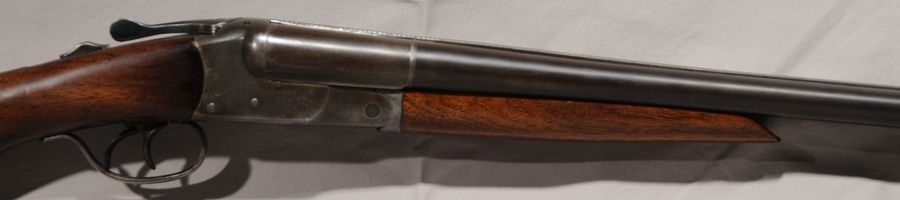
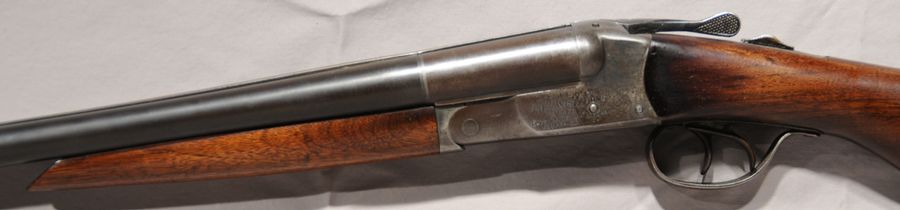
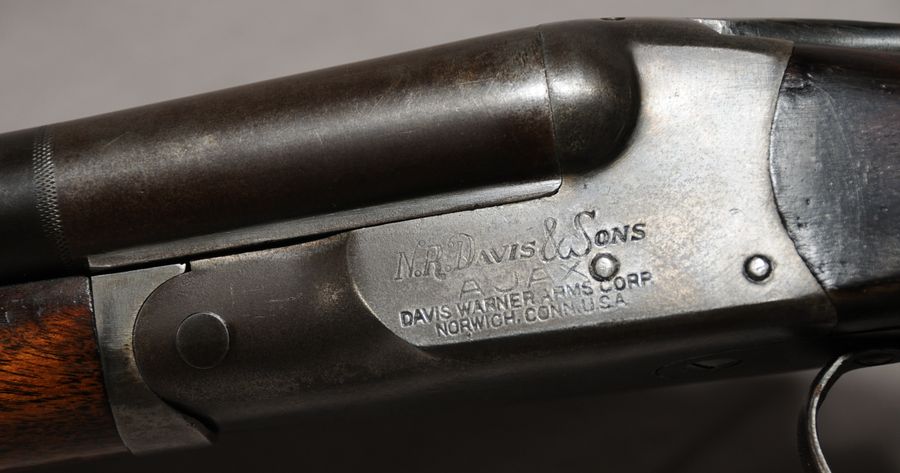
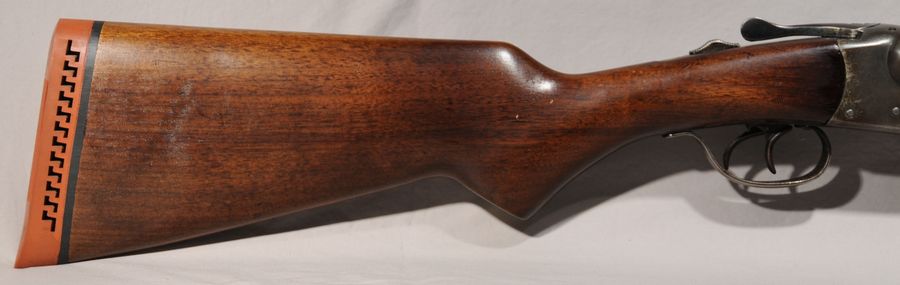
These were made in the 1920’s


Categories
Spencer repeating rifle
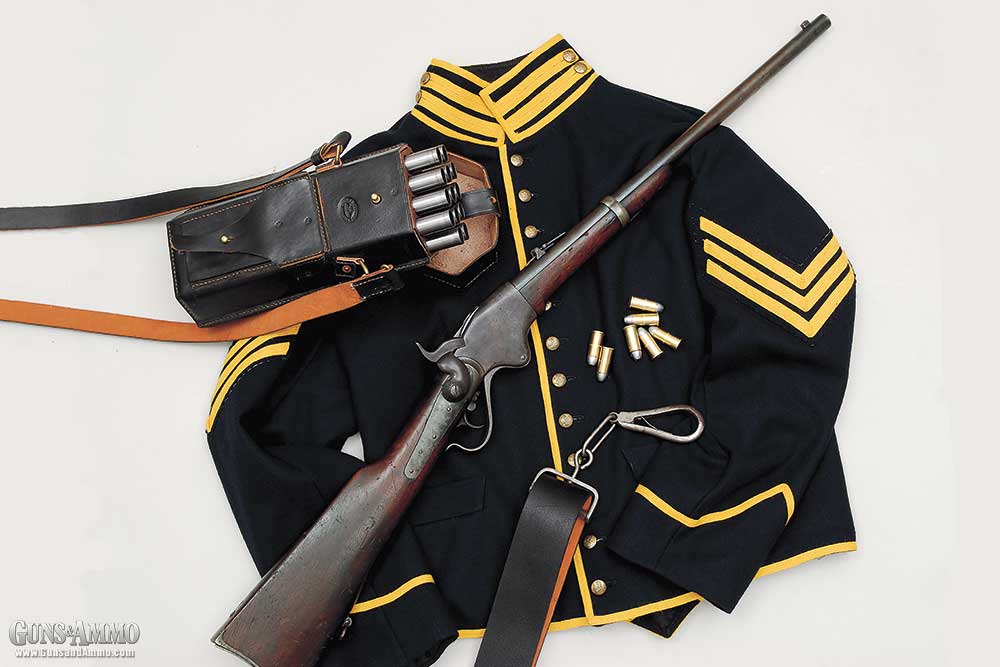


Spencer repeating rifle
| Spencer 1860 | |
|---|---|

Spencer Repeating Rifle
|
|
| Type | Lever Action Rifle |
| Place of origin |  United States United States |
| Service history | |
| Used by | United States Army United States Navy Confederate States of America Siam Japan Empire of Brazil |
| Wars | American Civil War Indian Wars Boshin War Paraguayan War Franco-Prussian War |
| Production history | |
| Designer | Christopher Spencer |
| Designed | 1860 |
| Manufacturer | Spencer Company Burnside Rifle Co [1] Winchester |
| Produced | 1860–1869 |
| No. built | 200,000 approx. |
| Specifications | |
| Length | 47 in (1,200 mm) rifle with 30 inch barrel 39.25 in (997 mm) carbine with 22 inch barrel[2] |
| Barrel length | 30 in (760 mm) 22 in (560 mm)[3] 20 in (510 mm)[4] |
|
|
|
| Cartridge | .56-56 Spencer rimfire |
| Caliber | .52 in (13 mm) |
| Action | Manually cocked hammer, lever action |
| Rate of fire | 14-20 rounds per minute[5] |
| Muzzle velocity | 931 to 1,033 ft/s (284 to 315 m/s) |
| Effective firing range | 500 yards[6] |
| Feed system | 7 round tube magazine |
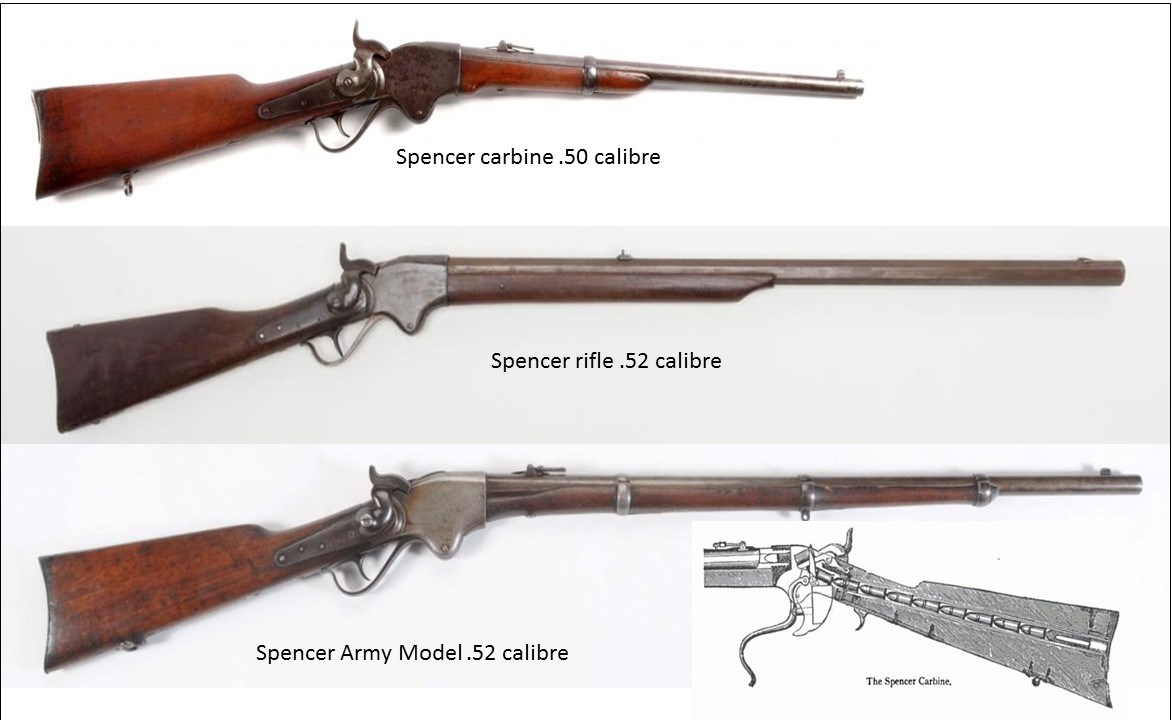
The Spencer 1860 was an American lever action rifle. Designed by Christopher Spencer, the Spencer was the world’s first military repeating rifle, with over 200,000 examples of the Spencer produced in the United States by three manufacturers between 1860 and 1869. The Spencer repeating rifle was adopted by the Union Army, especially by the cavalry, during the American Civil War, but did not replace the standard issue muzzle-loading rifled muskets in use at the time. The Spencer carbine was a shorter and lighter version.
Contents
[hide]
Overview[edit]

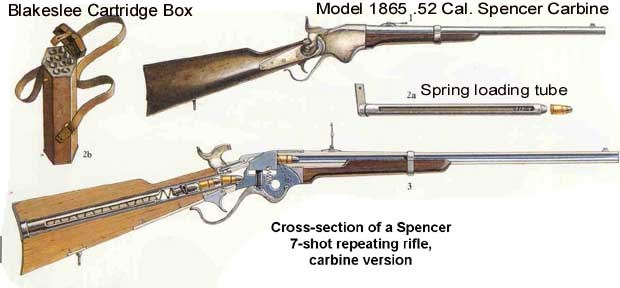
Diagram of the Spencer rifle showing the magazine in the butt
The design for a magazine-fed, lever-operated rifle chambered for the .56-56 Spencer rimfire cartridge was completed by Christopher Spencer in 1860. Called the Spencer Repeating Rifle, it was fired by cocking a lever to extract a used case and feed a new cartridge from a tube in the buttstock. Like most firearms of the time, the hammer had to be manually cocked in a separate action before the weapon could be fired. The weapon used copper rimfire cartridges based on the 1854 Smith & Wesson patent stored in a seven-round tube magazine. A spring in the tube enabled the rounds to be fired one after another. When empty, the spring had to be released and removed before dropping in fresh cartridges, then replaced before resuming firing. Rounds could be loaded individually or from a device called the Blakeslee Cartridge Box, which contained up to thirteen (also six and ten) tubes with seven cartridges each, which could be emptied into the magazine tube in the buttstock.[7]
Unlike later cartridge designations, the .56-56 Spencer’s first number referred to the diameter of the case just ahead of the rim, the second number the case diameter at the mouth; the actual bullet diameter was .52 inches. Cartridges were loaded with 45 grains (2.9 g) of black powder, and were also available as .56-52, .56-50, and a wildcat .56-46, a necked down version of the original .56-56. Cartridge length was limited by the action size to about 1.75 inches; later calibers used a smaller diameter, lighter bullet and larger powder charge to increase power and range over the original .56-56 cartridge, which was almost as powerful as the .58 caliber rifled musket of the time but underpowered by the standards of other early cartridges such as the .50–70 and .45-70.
History[edit]
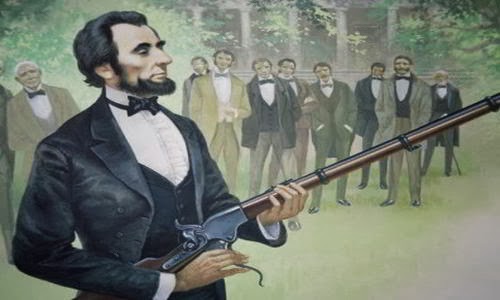
At first, the view by the Department of War Ordnance Department was that soldiers would waste ammunition by firing too rapidly with repeating rifles, and thus denied a government contract for all such weapons. (They did, however, encourage the use of carbine breechloaders that loaded one shot at a time. Such carbines were shorter than a rifle and well suited for cavalry.)[8] More accurately, they feared that the Army’s logistics train would be unable to provide enough ammunition for the soldiers in the field, as they already had grave difficulty bringing up enough ammunition to sustain armies of tens of thousands of men over distances of hundreds of miles. A weapon able to fire several times as fast would require a vastly expanded logistics train and place great strain on the already overburdened railroads and tens of thousands of more mules, wagons, and wagon train guard detachments. The fact that several Springfield rifle-muskets could be purchased for the cost of a single Spencer carbine also influenced thinking.[9] However, just after the Battle of Gettysburg, Spencer was able to gain an audience with President Abraham Lincoln, who invited him to a shooting match and demonstration of the weapon on the lawn of the White House. Lincoln was impressed with the weapon, and ordered Gen. James Wolfe Ripley to adopt it for production, after which Ripley disobeyed him and stuck with the single-shot rifles.[1][10]
The Spencer repeating rifle was first adopted by the United States Navy, and later by the United States Army, and it was used during the American Civil War, where it was a popular weapon.[11] The Confederates
Notable early instances of use included the Battle of Hoover’s Gap (where Col. John T. Wilder‘s “Lightning Brigade” of mounted infantry effectively demonstrated the firepower of repeaters), and the Gettysburg Campaign, where two regiments of the Michigan Brigade (under Brig. Gen. George Armstrong Custer) carried them at the Battle of Hanover and at East Cavalry Field.[12] As the war progressed, Spencers were carried by a number of Union cavalry and mounted infantry regiments and provided the Union army with a firepower advantage over their Confederate adversaries. At the Battle of Nashville, 9,000 mounted infantrymen armed with the Spencer, under the command of Maj. Gen. James H. Wilson, chief of cavalry for the Military Division of the Mississippi, rode around Gen. Hood’s left flank and attacked from the rear. President Lincoln’s assassin John Wilkes Booth was armed with a Spencer carbine at the time he was captured and killed.[13]

Spencer 1865 Carbine .50 caliber
The Spencer showed itself to be very reliable under combat conditions, with a sustainable rate-of-fire in excess of 20 rounds per minute. Compared to standard muzzle-loaders, with a rate of fire of 2–3 rounds per minute, this represented a significant tactical advantage.[14] However, effective tactics had yet to be developed to take advantage of the higher rate of fire. Similarly, the supply chain was not equipped to carry the extra ammunition. Detractors would also complain that the amount of smoke produced was such that it was hard to see the enemy, which was not surprising since even the smoke produced by muzzleloaders would quickly blind whole regiments, and even divisions as if they were standing in thick fog, especially on still days.[15]
One of the advantages of the Spencer was that its ammunition was waterproof and hardy, and could stand the constant jostling of long storage on the march, such as Wilson’s Raid. The story goes that every round of paper and linen Sharps ammunition carried in the supply wagons was found useless after long storage in supply wagons. Spencer ammunition had no such problem.[16]
In the late 1860s, the Spencer company was sold to the Fogerty Rifle Company and ultimately to Winchester.[17] Many Spencer carbines were later sold as surplus to France where they were used during the Franco-Prussian War in 1870.[18]
Even though the Spencer company went out of business in 1869, ammunition was manufactured in the United States into the 1920s. Later, many rifles and carbines were converted to centerfire, which could fire cartridges made from the centerfire .50-70 brass. Production ammunition can still be obtained on the specialty market.[19]










.jpg)


Categories
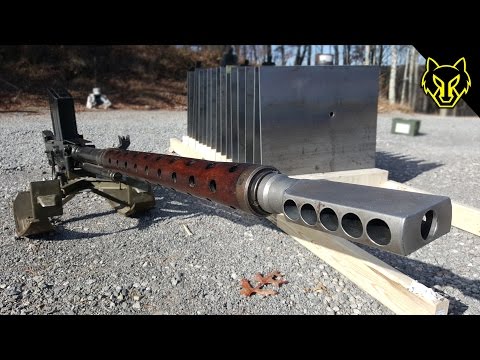
Some real insanity on You tube
Even when I was a lot younger & dumber than today. My wife is laughing out loud right now. There was no way I would of shot any of those monsters sober that is.
By the way I have personally seen the 50 caliber fail while in the Army.



Categories
Top 5 States to Avoid with Firearms
Just because it is the holidays, does not mean we can let our guard down. In fact, traveling to areas you are not as familiar with, crowded shopping malls, or on significant holidays all raise the threat from the everyday criminal as well as the lone wolf attacker. As a result, sadly, we need to be more vigilant and ready to take responsibility for our own safety. However, crossing state lines could land you an invite for Christmas dinner in the pokey. Here’s a list of the top five states to avoid while carrying with firearms, along with a handful of (dis)honorable mentions.

If you plan to be driving through many different states, know each state’s laws and regulations on traveling with a firearm.
The passage of the Concealed Carry Reciprocity Act through the U.S. House of Representatives is a step in the right direction, but not a law yet. The U.S. is a patchwork of confusing and cumbersome laws that change the rules of what you can carry, where you can carry, and whether you can possess the firearm, ammunition of magazine at without running afoul of the local laws. Now, if every state was like Vermont, law abiding gun owners could freely travel with their firearms with no worries. Unfortunately, many states have a history of being hostile to traveling gun owners. The federal “Firearms Owner Protection Act” allows travel through any state as long as the firearm is unloaded, in a locked case, and not easily accessible to the passengers. However, that is not to say that certain states that are less friendly to firearms have not created their own loopholes that would snare unsuspecting otherwise law abiding firearm owners. This led us to the top 5 states to avoid while traveling with a firearm this holiday season.
Top 5 States to Avoid With Firearms
- CONNECTICUT — Connecticut does not have any gun reciprocity agreements with other states. This means nonresidents are not allowed to carry handguns in Connecticut under a permit issued by another state.
- HAWAII — Every person arriving into the state who brings a firearm of any description, usable or not, shall register the firearm within three days of the arrival of the person or the firearm, whichever arrives later, with the chief of police of the county where the person will reside, where their business is, or the person’s place of sojourn. For more information, visit http://www.hawaiipolice.com/services/firearm-registration
- MASSACHUSETTS — Massachusetts imposes harsh penalties on the mere possession and transport of firearms without a license to carry. Prospective travelers are urged to contact the Massachusetts Firearms Records Bureau at (617)660-4780 or the State Police at https://www.mass.gov/service-details/massachusetts-firearms-laws for further information.
- NEW JERSEY — New Jersey some of the most restrictive firearms laws in the country. Your firearm must be unloaded, in a locked container and not accessible in the passenger compartment of the vehicle. The New Jersey Supreme Court ruled that anyone traveling within the state is deemed to be aware of these regulations and will be held strictly accountable for violations. Revell v. Port Authority of New York & New Jersey, 10-236
If you’re traveling through New Jersey here is information from the New Jersey State Police regarding transporting firearms through the state: http://www.state.nj.us/njsp/about/fire_trans.html - NEW YORK — Use extreme caution when traveling through New York with firearms. New York state’s general approach is to make the possession of handguns and so-called “assault weapons” illegal. But the state provides exceptions that the accused may raise as “affirmative defenses” to prosecution in some cases. NY Penal Code s. 265.20(12), (13) & (16).
A number of localities, including Albany, Buffalo, New York City, Rochester, Suffolk County, and Yonkers, impose their own requirements on the possession, registration, and transport of firearms. Possession of a handgun within New York City requires a New York City handgun license or a special permit from the city police commissioner. This license validates a state license within the city. Even New York state licenses are generally not valid within New York City unless a specific exemption applies. Such as when the New York City police commissioner has issued a special permit to the licensee. Or “the firearms covered by such license is being transported by the licensee in a locked container and the trip through the city of New York is continuous and uninterrupted.” Possession of a shotgun or rifle within New York City requires a permit, which is available to non-residents, and a certificate of registration.
States to Be Cautious traveling Through or To
- California
- Delaware
- District of Columbia
- Illinois
- Maryland
- Rhode Island