Categories
Uncategorized

I wish that my Shooting Range had this!

The Ultimate Training System: Swinging Into Action with Action Targets

As we age in the firearms world, it is often easy to forget the challenges presented to someone new to shooting. I live in the West with miles of public land. I have my own pile of steel and targets from when I ran a training company. When I learned to shoot a pistol, it was from professionals in the military. This was all part of the benefits package from giving up your youth to play hardball in all away games. It is very easy to overlook the cost and time barrier for someone just starting, not to mention the lack of access to shooting areas for most people. So while I am normally not a user of indoor ranges, I was excited to see the new system Action Targets is installing across the country.
Though I initially saw the system at Action’s Headquarters in Provo, Utah, I got a chance to play with it in depth closer to home. Independence Indoor Shooting opened not long ago in Meridian, Idaho, and they let me come in after hours to film a segment on the new range. Action Targets has always been an industry leader in indoor ranges, it is their core business. But this year is something special. Gone are the dim lights and clothesline target hangers. This isn’t your grandfather’s indoor range, hang onto your hats.
Article Continues Below

The first difference you notice with the new system is the robust I beams in the target carriages. Not only does this make for smooth target movement, it ensures the range isn’t going to shut down every five minutes for line repairs. It also makes target movements that otherwise wouldn’t be possible a reality. The lighting is well engineered, with enough LED lumen power to perform surgery if needed. I took a SIG Sauer P320 X-Five with fiber optic sights as my test gun specifically to test this. Not once was the lighting a problem. Just as important, the lighting can be controlled to simulate any environment you like. I could run the pistol through its paces in all conditions. Low light, no light, even sirens, and strobes.
The best part, by far, is the new computer control system. The problem with indoor ranges has always been, what if you don’t know how to train? You’re stepping up to a range for the first time and aren’t sure what types of drills to run. Maybe you’re a seasoned shooter, but remember when you were a new shooter. How did you know what to do? You buy a gun and some bullets, learn to put those bullets through cardboard, with no idea if you are improving on speed or skill.
Enter the Action Targets system. It has onboard training drills that range from beginner to advanced. It is a system that grows with you, steady progression from Barney Fife to John Wick. The beginner modules are simple, but they do build on fundamentals with both speed and accuracy. The advanced models are challenging, even if you have been at this for a while. And if you do get past the advanced models, you can always program your own. The training includes both rifle and pistol drills, and the range reaches all the way to 100 yards. Also included are several Federal Agency qualification sequences, a good check on progression. A very far cry from the indoor ranges I have seen in the past.
In the very near future, Action Targets will have a link on their website showing you the indoor ranges with the upgrades in your area. If you train by yourself, this is an awesome resource to use.
For more information about Action targets, click here.
For more information about Independent Indoor Shooting Range, click here.

Categories
Uncategorized

Gun parts

Running Spares- Keeping Your Weapon Going

Posted on 10/24/2017 by Wirecutter
AR-15 vs. AK-47. 7.62 vs 5.56. 308!! Mil-spec, mil-surp, match grade, green tip, etc, etc, etc. If you’ve been a shooter any amount of time, you’re familiar with these terms. In the internet-land these are hotly debated for some reason, each time by people who’ll no doubt prove this time around that their choice is the right choice, yours is not if you disagree, and whatever they’ve bought is by default the best (because they say so of course, along with it’s high price if talking among champagne elitists or it’s budget price if talking with the buildabag crowd) and every so often it’ll get backed up by unverifiable claims of “someone they know/trained with/watched a DVD of/thought lovingly about once who’s a no-crap SHTF ninja–type baddie” told them it’s what they run…
Yeah, Right. The overwhelming bulk of these people have never fired a shot in anger. Being a gun enthusiast doesn’t make one combat proficient. Pardon me for my genuine disinterest in their ‘opinions’.
What you very rarely hear is discussions about keeping your weapon running, long term. I guess that’s not ninja-enough. Believe it or not, it has little to do with weapon selection itself- it’s a question of logistics. Each of the common platforms have nuances, big and small, that need attention to keep your weapon from being deadlined. Nothing is worse that spending a month or more’s wage on a defensive rifle, an optic, mags and ammo, to have the weapon fail due to a dead trigger spring. It happens. It happened to an SR-25 I was running on a Known Distance (KD) range. Great rifle, but not widely known for its reliability. Even the Kalashnikov, the alleged marquee of reliability, has needs and can fail fairly easily and unexpectedly, especially with some of the lesser-quality brands out there. So all this being said, here’s a few guidelines to follow in order to keep your weapon running, post unpleasant-ness:

  1. Spare Bolts: Far and away, the only part I’ve actually seen break on the AR-15 platform (aside from the dead trigger spring on the SR-25…but that was different…) is the bolt. Just buy a spare, right? Well, yeah. BUT- Did you check the headspace with a go/no-go gauge? Do you own a go/no-go gauge for your weapon? Did you re-check it after so many rounds out of the weapon (the wear changes the spacing)? Did you test it for function? Is there any binding or unusual wear on the lugs? It goes without saying that the bolt must be quality- proper gas key staking, proper steel and heat treat, and no gimmicks (like the ‘lube-free’ AR-15 bolt…wtf, over?). The Kalashnikov also can have issues with the bolt. Some of the Yugo models have had mushrooming of the rear of the bolt where the hammer strikes- which could cause premature failure. You need to keep an eye on potential stress fractures as well, as some production runs from differing countries/companies have different heat treatments. You also need to understand not all AKs are the same; different countries have variations on their design. So know what you have, and pick up a spare parts kit for yours.
  2. Use Standardized Parts: Cornerstone to the homebuilt/bubba gun issues is the use of bargain-bin non-spec/non-standard parts. This is endemic to the AR, with all the snake oil being sold, so the watchword for keeping a rifle serviceable is using standardized simple spare parts. Believe it or not, for the money, DPMS makes a good lower parts kit.  On the AK, it’s a good idea to pick up a trigger pin retainer plate to replace the shepherd’s hook (you know, that paperclip that keeps the trigger in place and fails far more often than thought). They’re cheap, take all of 10 seconds to swap, and usually will never need replacing.
  3. Spare Trigger Packs: On the note of spare parts kits, the bulk of those parts are the trigger components. Now if you’re into custom triggers (and there’s some nice ones out there) that’s fine, but understand how it works. I strongly encourage new or inexperienced AR shooters to leave the internals alone- you need to get a feel for a bone stock weapon, and the trigger itself usually breaks in nicely with the weapon over time. In addition, if it’s a standardized trigger, with standard components, one can stock several running spares for all the rifles in the battery relatively cheap. The AK comparatively speaking has a very simple trigger, but believe it or not, can be the largest point of failure on the weapon. As cheap as the Tapco G2 is, if you’re a Kalashnikov kid it’s a great idea to have a spare on hand. Assemble it. The AK trigger is a drop-in component once assembled, but requires a tiny spring that loves to fly away if you have fumble fingers (ask me how I know). Have one pre-assembled so that it becomes simple under duress or less-than-ideal circumstances.
  4. Know the Points of Failure on Your Weapon: Every design out there, even the mythical Kalashnikov, has failure points in the design. It’s common knowledge that cleanliness is important to keep an AR bolt running (although it’s far more resistant to fouling than commonly thought). But other issues can arise, from the potential problems we’ve already identified to things unforeseen (like gas block issues or bolt hold-open failures) so it’s worth your training time not to just get mechanically better with the manual of arms but also to identify potential issues you may run into. The AKM for example, using a stamped-steel receiver, can suffer from broken rivets if improperly done. A broken trunnion rivet kills that rifle, then and there. Improper heat treatment or excessive wear of the bolt guide rails can cause failure to cycle. It happens. Having a working knowledge of the mechanics of your weapon is critical to being combat proficient- it’s a lot easier for a supporting apparatus to get a weapon running if the operator can diagnose the issue (more on that in a second).
  5. Use Common, De-Facto Standard Rifles: I really like the Sig MCX. That’s a cool little carbine, and although I haven’t run it with a can, I would be willing to bet it’s a dream to shoot suppressed. But aside from aesthetics, it doesn’t have a lot in common with the standard direct impingement AR. In fact, there’s a lot of proprietary components, such as the bolt carrier and dual recoil springs, which just might fail (and have, which is why it’s been recalled). If no one else in my Patrol is carrying that weapon (or can afford it), and we don’t have running spare components, then in the event my very expensive toy is deadlined, maybe it might be for good. Now I’m ineffective, all because I wanted to be the cool guy. The same for the PTR-91/G3/CETME weapons. Good rifles, sure. Popular in Iran, not so much with Rhodesians (according to Dennis Croukamp). But the HK roller-locked system is unlike anything else found in the wild here in the US, and although no doubt someone will comment to attest to it’s reliability, et. al., once those rollers go belly-up, that gun’s done. Get your spares now. So unless you’re a collector or enjoy cheap magazines for rifles that destroy brass, AND YES, THEY DESTROY BRASS, I wouldn’t bother but then there’s that rule that two is one and one is none if you happen to disagree. Be ready to supply spare parts or have the means to fabricate them. The AR on the other hand, far and away, along with the Garand action (both M1A and Mini varieties) and the AK to lesser degrees, are quite common and therefore are known quantities, so resolving group standards or potential logistical issues will much simpler. Any gunsmith in the world can usually keep them running…a CETME, maybe not. More on this in a second.
  6. Start Right, End Right. Buy Quality Parts: One of the biggest myths of the current gun culture is that quality must be equated with cost. While you do get what you pay for in most contexts, there’s also a definite law of diminishing returns. Quality, standard parts kits for the AR don’t usually cost a lot. $40-$50, maybe a little more, is about the norm. Spare quality bolts are a little more. The Tapco G2 AK trigger is ~$30. Spare milsurp AK parts, consisting of a spare bolt, bolt carrier and piston with recoil spring is around $100. Not a lot of money if you’re counting on that rifle working for the long haul. But in all cases, buy from a reputable manufacturer. On the other hand, you will reap Murphy’s rewards for being a cheap skate if you skimp on your resupply. Buy from reputable sources, buy from makers who stand behind their product, and buy from those who can tell you where and of what their stuff is made.
  7. Make Friends with a Gunsmith: There’s gonna be problems that come up that you can’t fix. Billy dropped his weapon during an IMT (individual movement techniques) and bent the barrel at the receiver. Johnny’s gas block just failed. Jeff showed up with a non-standard kludge stick and won’t fire six rounds without binding up. Mike’s well-worn AK just became a runaway gun or even better, broke two rivets on the front trunnion. If you’re training the untrained to become Light Infantry, which is what a lot of this ‘SHTF’ talk boils down to, these things are going to occur. I’ve observed each of these things happen with well trained guys by the way, and while that might be great for a chuckle, it happens more often than you think. It’s also very easy to laugh and say that ain’t us while sitting comfortably in your chair reading this…people do clumsy stuff under duress. A person cannot fix everything themselves, but a good Gunsmith is a great person to know and crucial to an Underground support. In addition to being a de-facto gun guy, he’s going to have a base of knowledge that you don’t, and chances are high he’s also gonna have the means to fabricate the parts that you otherwise cannot. (As an aside, I’ve never met a Gunsmith who wasn’t a pretty serious Survivalist) But along with that, just like a Doctor can’t look at you and just know you have the flu vs. an appendicitis, he needs an accurate description of symptoms, and a Gunsmith’s job gets a lot easier if the shooter can accurately describe what’s going on vs. mah gun just don’t work! -that takes experience and knowledge of the weapon, only gained through trigger time.

Standards matter. It’s not really about whatever your particular preference may be, or even what weapon is better for this or that, it’s about what the group can acquire, standardize upon, proficiently employ, and keep running long-term. In the US that favors the AR-15 the strongest. There are no guerrilla forces I can think of off-hand that simply picked what they wanted, either- it boils down to what the external support supplies them with or is expropriated (but this, of course, is another discussion for another day). So while that may or may not be your concern, creating a standard for your group, adhering to it, training around it’s strengths and limitations, and having a plan to keep those weapons running is critical to your success.

Categories
Uncategorized

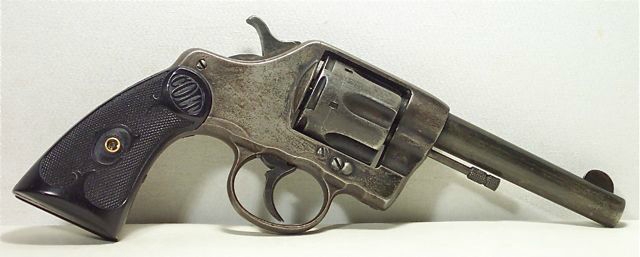
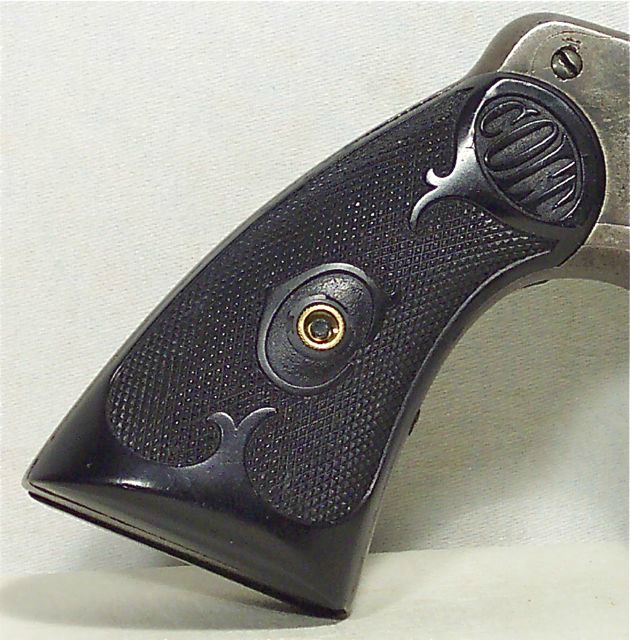
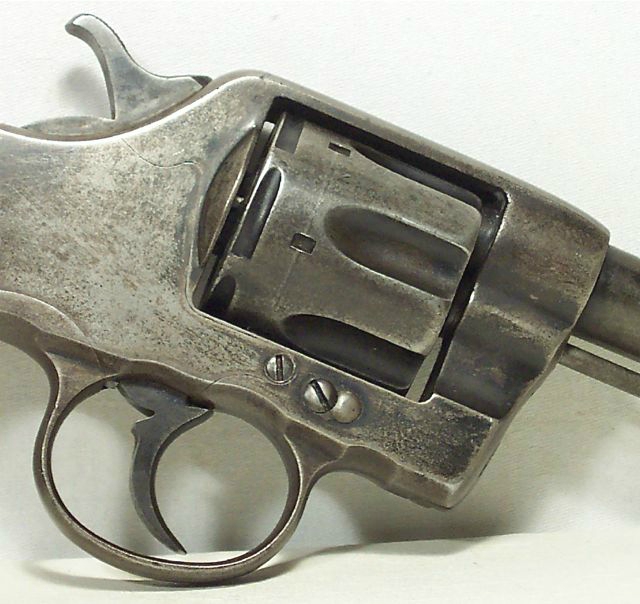
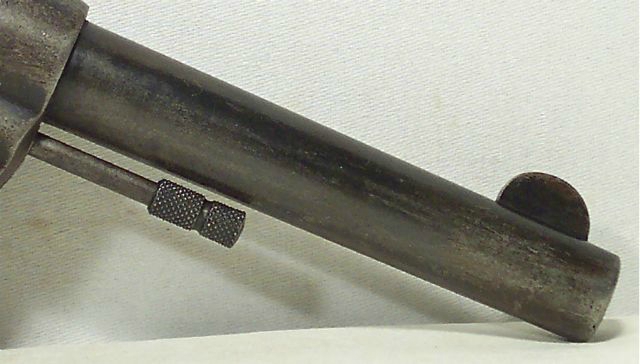
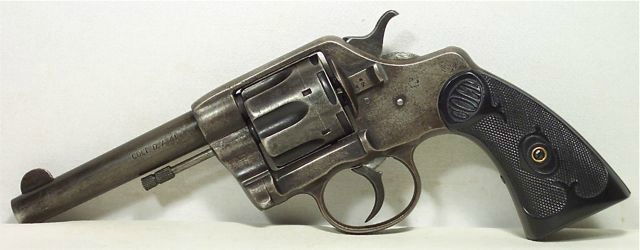
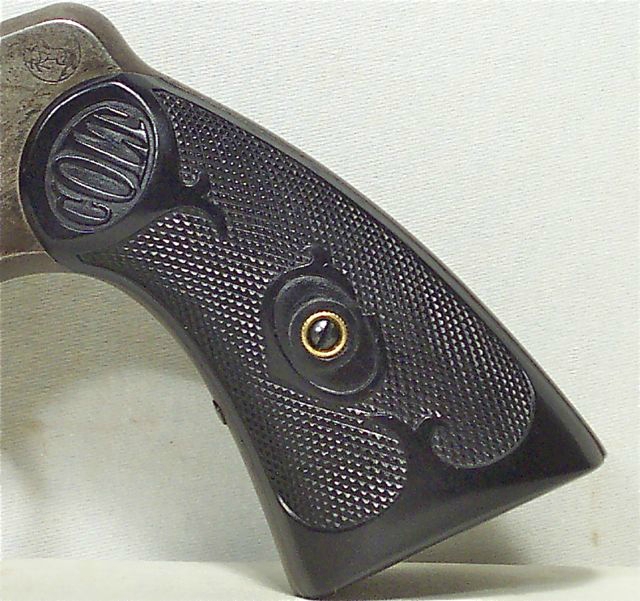
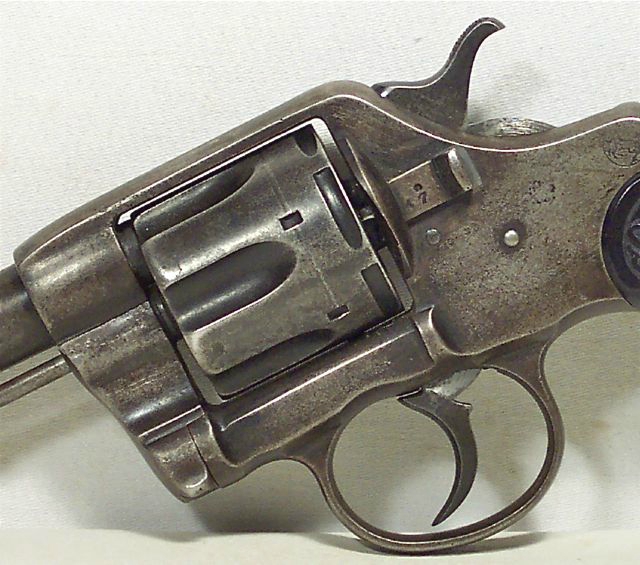
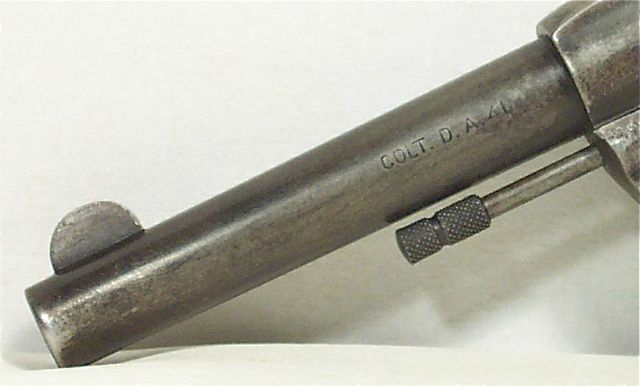
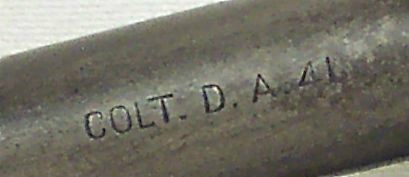
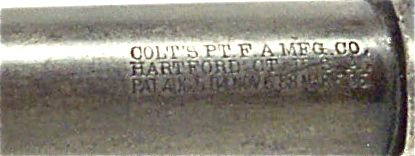
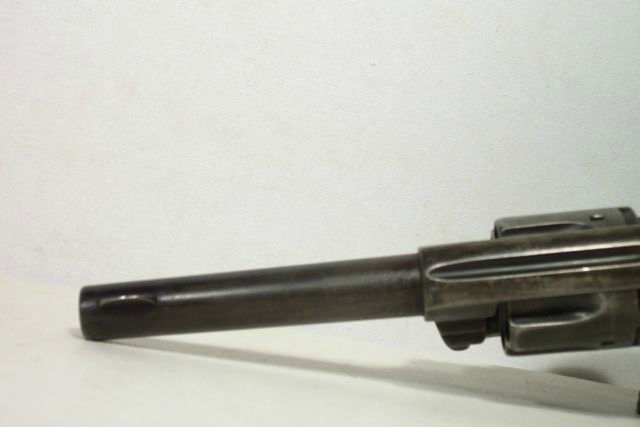
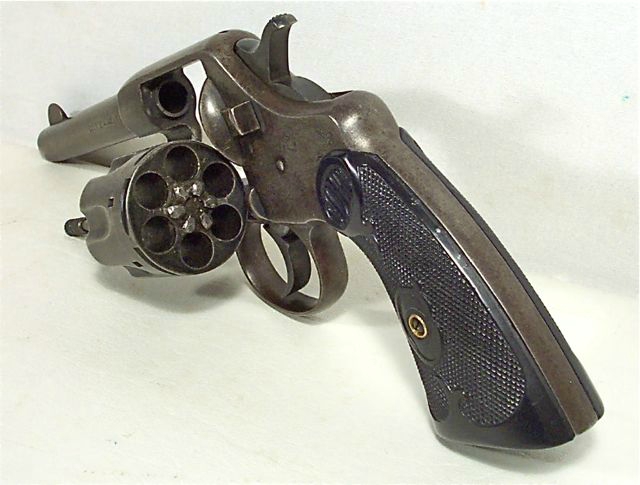
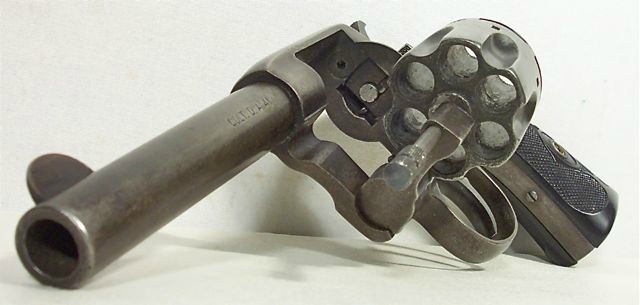
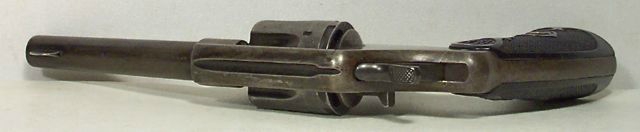
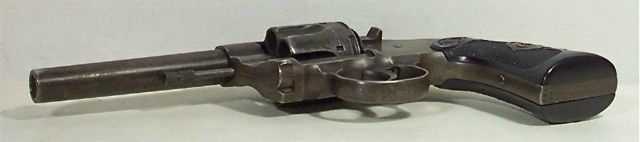
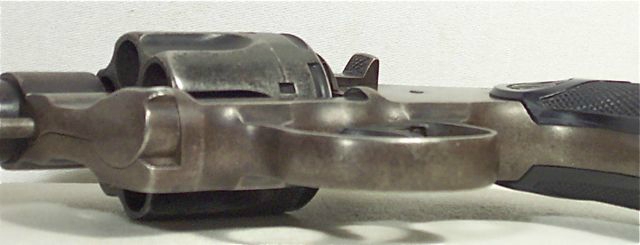
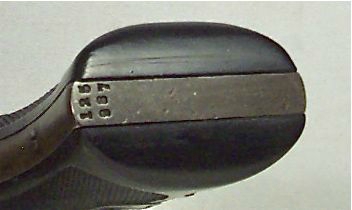
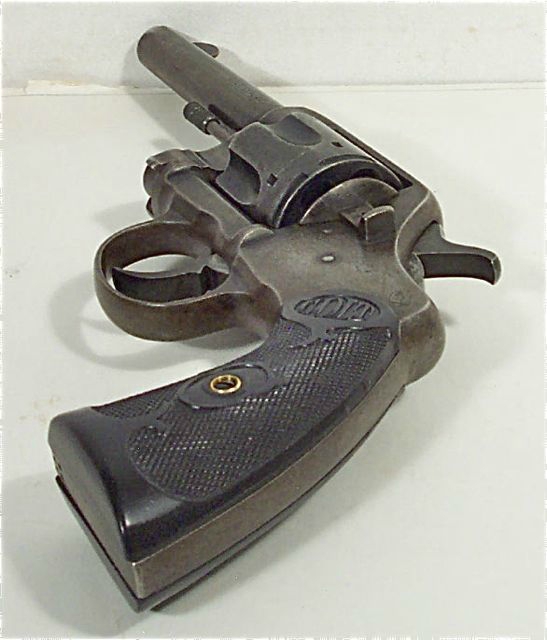
Colt New Army Navy 41

Colt - Colt New Army – Navy 41 – Antique
Colt - Colt New Army – Navy 41 – Antique - Picture 2
Colt - Colt New Army – Navy 41 – Antique - Picture 3
Colt - Colt New Army – Navy 41 – Antique - Picture 4
Colt - Colt New Army – Navy 41 – Antique - Picture 5
Colt - Colt New Army – Navy 41 – Antique - Picture 6
Colt - Colt New Army – Navy 41 – Antique - Picture 7
Colt - Colt New Army – Navy 41 – Antique - Picture 8
Colt - Colt New Army – Navy 41 – Antique - Picture 9
Colt - Colt New Army – Navy 41 – Antique - Picture 10


Categories
Uncategorized

Just one more Honest Honey!

Just need a few more what do you think.

Categories
Uncategorized

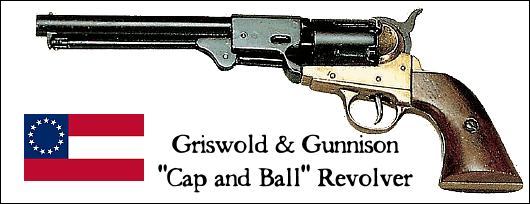
YouTube video Griswold & Gunnison: The Best Confederate Revolver Makers: Griswold & Gunnison

Image result for Griswold & Gunnison
The Holy Grail of ACW Pistols!
Image result for Griswold & Gunnison
Related image
Image result for Griswold & Gunnison

Attachments area
Preview YouTube video Griswold & Gunnison: The Best Confederate Revolver Makers

Categories
Uncategorized

Gun Porn

weaponslover:  SVD Dragunov
The best kind... Speed up and simplify the pistol loading process  with the RAE Industries Magazine Loader. http://www.amazon.com/shops/raeind
Image result for miss me yet Theodore R
American Black Walnut Gun Room, Beautiful display for your gun library. Custom built to fit the space and collection of guns.
How To Make Gun Powder The Old Fashioned Way in Less Than 30 Minutes

Categories
Uncategorized

How to Track a Human

Brett and Kate McKay | October 13, 2016

Manly SkillsSurvivalTactical Skills

How to Track a Human

man tracking human footprints on river bed illustration

It’s a common trope in classic Westerns. A posse is rounded up to find some bad guys who’ve headed out into the desert to hide. To help track them down, they bring on an Indian scout. To the astonishment of the cowboys, the native guide can determine how many people are in the bad guy’s gang, how long ago they camped at a particular spot, and that one of the ruffians is injured. It almost seems like magic.
But it’s not.
The scout was simply using a set of keen, field-developed senses, and practicing good forensics.
A few years ago when I did the ITS Tactical Muster, one of my favorite classes at the event was on human tracking, taught by professional combat tracker John Hurth. In just a few short hours, John was able to show us how to know what’s going on with someone on the lam and where he or she is headed simply by looking at their footsteps or noticing a broken branch.
Why would you need to know how to track a human? You’ll probably never have to go on a manhunt for a fugitive, but it’s a handy skill to have nonetheless. Maybe your kid wanders away from your house, or you lose a buddy in a remote wilderness area. Instead of wandering frantically and aimlessly, calling their name, you can know how to search for them effectively and efficiently.
Plus, once you know how to track a human, you can reverse engineer the process as well; that is, you’ll better be able to make your own escape without leaving a trail. You know, just in case you find yourself on an island, being chased by a stalker playing “the most dangerous game.”
Below, we provide a primer on tracking humans. Keep in mind, to really learn how to do this stuff, you need to practice it and practice it for years. But with some dedication, you may eventually reach the level of tracking evinced by the crack trackers in Butch Cassidy and the Sundance Kid, of whom the protagonists repeatedly said with exasperation, “Who are those guys?”

Develop Your Situational Awareness

The most important attribute a tracker must develop is his situational awareness. Without it, clues and signs that would lead him to his target go unnoticed.
Situational awareness comes down to two things: 1) observing, and 2) correctly interpreting your observations.
Learning how to become more observant takes time and dedication. It requires changing your mindset, training your memory and senses, and daily practice in truly noticing what you see. Fortunately, we have some fantastic guides on how to do all of those things:

Once you sharpen your powers of observation, you next need to know how to correctly interpret what you see, in order to reach correct conclusions about what’s going on. To do that, you must broaden and deepen your mental models.

Broaden and Deepen Your Mental Models

Mental models are simply ways of looking at and understanding the world. These paradigms create our expectations for how the world works — helping us grasp what’s happened before, what’s happening now, and what’s likely to happen next.
For a tracker, the mental models he needs to broaden and deepen the most are the ones that will better help him find his target. These fall into two main categories: environment and psychology/habits.

Environment

The most obvious subject a tracker needs to know inside and out is the environment in which he is tracking. He needs to understand things like how snow keeps a track changes depending on whether it’s more wet or dry. He needs to know that spiders usually spin their webs late in the evening (if footprints are beneath an unbroken spider web, the tracker can assume that the target passed the point earlier in the day). He needs to know about the fauna and rocks in the area. He needs to know how the wind blows. He needs to know the usual temperature of embers a certain number of hours after a campfire has burned out.
He also needs to know how stuff ages in an environment. A skilled tracker can look at objects or signs in his surroundings and roughly gauge how long ago they were left there by his target. He knows how long it takes for paper to start to brown or a plastic bottle to become discolored after being discarded in a desert or forest. He should be able to look at a broken branch and, based on the color of the exposed wood, roughly guess when it was broken. He even knows what human feces look like 1, 2, 3 days after it was excreted by his target. Developing these mental models will come with practice and time, but one way to build them up before you need them is to make “aging stands.”
Aging Stands: The Tracker’s Experiment

aging stand for learning human tracking techniques illustration
Aging stands are described by expert combat tracker John Hurth as “science experiments” for trackers. You make a one-row grid on the ground out of branches and place different objects into its squares. Ideally, each square will be exposed partly to direct sunlight and partly to areas shaded and protected by trees. In week one, you put items that you want to test in the first square: footprints, paper, broken twigs, water bottles, and yes, even poop. You want to make sure you have duplicate samples in the shaded and unshaded part of the square.
Each day, visit your aging stand and take notes on how things have changed. How have the exposed branches changed color? Has the paper started fading? What’s happened to the poop? Have the impressions of the footprints changed over time?
The next week, move to the next square in the grid and put fresh samples of the same items in it. Compare them to the samples in the first week’s square. Take notes on differences. The next week put new samples in the third square. Compare them to the first and second week’s squares. Over time, you’ll get a rough idea of the aging progression undergone by both natural and manufactured items.
You’ll want to conduct aging stand experiments at different times of the year — spring, summer, fall, and winter — to learn how seasonal variations in humidity, temperature, and precipitation affect the aging process. It’s a laborious exercise, but it’s essential for creating the mental models you need to successfully track someone.

Human Psychology & Behavior

A tracker needs to not only know what’s going on in the environment in which he’s following a target, but what’s going on in the target’s head as well. He needs to develop mental models that deal with human behavior, and this means having a robust knowledge of human psychology and sociology. Knowing the mindset and cultural background of your target can help you know how he’ll act and lead you to where he is. The famous scout Frederick Russell Burnham had this to say about developing these kinds of mental models:

“It is imperative that a scout should know the history, tradition, religion, social customs, and superstitions of whatever country or people he is called on to work in or among. This is almost as necessary as to know the physical character of the country, its climate and products. Certain people will do certain things almost without fail. Certain other things, perfectly feasible, they will not do. There is no danger of knowing too much of the mental habits of an enemy. One should neither underestimate the enemy nor credit him with superhuman powers. Fear and courage are latent in every human being, though roused into activity by very diverse means.”

Besides general cultural and psychological mental models, you need to develop mental models for your particular target. Does he like to eat certain foods? Does he have any medical conditions? Does he smoke or bite his nails? Is he familiar with the outdoors or is he a city dweller? Does he have any particular fears or insecurities? Does he know anyone in the area?
Knowing this sort of information about your target will inform the way you conduct your search and interpret the evidence you find in the field. For example, if you know your target smokes, you’ll be on the lookout for cigarette butts. If he has diabetes, and you come across a puddle of urine that smells fruity, you’ll know you’re on the right track.

Scan and Search: Taking in Your Environment

Now that you’re working on increasing your situational awareness by becoming more observant and developing appropriate mental models (this is in fact an exercise that should never end), it’s time to start actually tracking.
When you’re out tracking, you’ll be engaging in two visual modes: scan and search.

Scan

When you scan the landscape, the goal is to get a general, big-picture overview of your surroundings. Keep an open focus. Don’t have any particular thing you’re looking for, as that will cause “target blindness” and result in your missing other pieces of evidence. Visually sweep the area for possible anomalies in your environment like tracks, litter, blood stains, etc.
Rather than scanning an area haphazardly, tracking experts David Diaz and V. L. McCann recommend dividing it horizontally into thirds:

“Imagine the territory in front of you is a two-dimensional canvas of a painted nature scene. The top boundary is the horizon; the bottom boundary is the ground in front of you. Now divide that canvas into three equal parts: the foreground, the mid-distance, and the far ground…
In order to ‘see’ everything in such a vast area, it must be scanned systematically. With a horizontal movement of your eyes, sweep the foreground from left to right, right to left, and left to right, moving your line of vision up just enough to slightly overlap the area above the last sweep.”

In this way, you methodically work your way up to the far ground and ensure that you don’t miss anything — distant or near — lying before you.

Search

Diaz and McCann describe searching as “in-depth analysis of an area or object.” You can begin searching at any point in the scanning process once you’ve noticed an anomaly. Searching involves looking at the anomaly more closely and recording it in your mind or notebook for later analysis.
Just because you’ve searched one anomaly, doesn’t mean you should stop your scan of the area. Keep scanning and looking for more anomalies that you can more closely examine. As you continue your scan and search, take extra caution to avoid contaminating signs that you’ve uncovered. Leave litter where you found it, and don’t walk on footprints. You want to leave things in their original locations so you can put the pieces together and construct a story based on the evidence found.

Using Light for Scanning and Searching
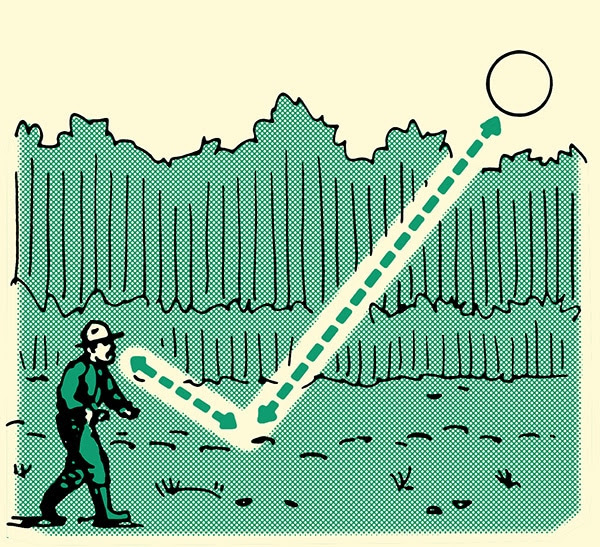
man tracking humans using angle of sunlight to help illustration
As you scan and search, use the light available to you to better locate possible anomalies. For example, in the morning and evening, the sun casts long shadows over impressions in the ground, bringing them into sharper relief. To better see these shadows, position yourself so that the tracks you’re following are between you and the light source. This will require you to change your position in relation to the tracks. Be mindful of not contaminating them with your own prints as you do so.
Tracking at night is possible with the assistance of a light source like a flashlight. You’ll want to use a colored light like green or red to avoid disrupting your night vision. (Side note: red used to be the preferred nighttime light color, but many operators are switching to green because it allows them to see objects more clearly without reducing night vision that much.)

using night vision to track someone in the dark
When you’re searching at night, if you look directly at the object you’ve identified, you’ll likely stop seeing it. Looking directly at objects requires you to use the cone area of the retina, and that’s not very active during low-light settings. To make up for this deficiency, you’ll want to use what Diaz and McCann call “off-center vision.” Instead of looking directly at the object you’ve identified, you’ll want to look left, right, above, and below it, pausing at times to verify the properties of the object.

Know What To Look For

As you scan and search your environment, you want to be on the lookout for a few indicators that will help you track your target. Hurth suggests being on the lookout for the following visual indicators (I haven’t included all of them — check out John’s book for the complete, exhaustive list):
Ground Indicators (on the ground)

how to track a person grass disturbed in straight line illustration

  • Footprints
  • Vehicle tracks
  • Trampled grass
  • Boot and shoe scuffs
  • Turned over dead leaves
  • Disturbed grass or soil
  • Mud, soil, sand, and water transferred from footwear onto another medium

Track Traps: The Honey Pot of Ground Indicators
Hurth suggests being on the lookout for “track traps.” These are areas on the ground that do an excellent job of capturing your target’s tracks. He calls them “honey pots” because they leave so much information behind. Mud, sand, soft dirt, and snow are great examples of track traps. Bodies of water or oil spills can be track traps too. A target who steps in water or oil will likely leave footprints on the ground after stepping in the fluid.

Aerial Indicators (above your ankle)

broken spider web between two trees how to track a person illustration

  • Broken cobwebs
  • Detached or missing leaves
  • Broken branches that point in the direction of the target
  • Scratches or scuffs on trees
  • Cut or broken vegetation
  • Tall grass or vegetation pushed down into an unnatural position
  • Clothing fabric in branches
  • Hair in branches

Litter Indicators (objects discarded intentionally or unintentionally)

  • Cigarette butts
  • Candy and food wrappers
  • Spent ammo casings
  • Used medical supplies
  • Gum/tobacco
  • Clothing

Blood Indicators
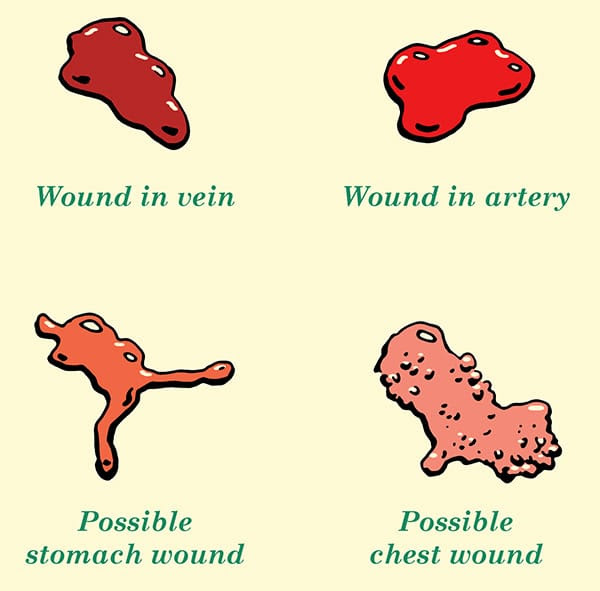
blood indicators what type of wound identification illustration
Your target might be injured and consequently leaving blood stains. The color of the blood stain can tell you a lot about the injury he or she has and how long it’s been since they left the blood stain there.

  • Dark red drops of blood. Indicates a venous wound. Non-life-threatening.
  • Bright red streaks of blood. Indicates a possible arterial wound. Life-threatening.
  • Pink, frothy blood. Indicates a possible wound to the lungs.
  • Light red, foul-smelling blood. Indicates a possible wound to the stomach.

Blood changes color over time as it’s exposed to the elements. Initially, blood spots will be brighter but will eventually fade to a brown or rust color.
Bodily Discharge Indicators
Vomit, poop, pee, snot — these bodily discharges may not be pleasant to contemplate, but they can not only help lead you in the direction of your target, but also paint a picture of his current condition.
Vomit and poop can tell you what sort of food your target’s been eating. If there’s a lot of liquid, clear vomit or you see diarrhea, there’s a chance he could be dehydrated.
If you find a urine spot that has a very fragrant ammonia smell, the target is likely dehydrated. If it has a fruity smell, there’s a chance he’s diabetic.
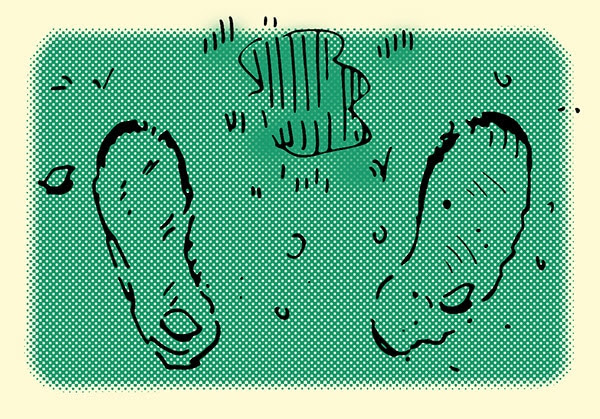
how to track a person man's urine on the ground illustration

Man peeing

how to track a person woman's urine on the ground illustration

Woman peeing

The relation of a urine stain’s position to a set of footprints can tell you if it came from a man or a woman. If the urine stain is in front of the footprints, probably a dude. If the stain is in the middle of the footprints or near the heels, likely a lady who popped a squat to do her business.
Audio and Olfactory Indicators
As a tracker, you can’t just rely on your sight to track down your target. Sounds — heavy breathing, talking, crying, movement in brush, coughing, etc. — can provide insights as to where your target is.
Smells can also provide useful clues. The smell of smoke can lead you to a campfire where the target is currently or has been recently. If the target’s been without a shower for a couple of days, he might also be giving off some pungent body odor.
Bottom line: as you scan and search with your eyes, don’t take your nose and ears offline. They can provide useful information you’d be missing using sight alone.

Identifying and Interpreting Footprints

While you should be scanning and searching for signs and indicators like blood, trampled grass, and broken cobwebs, footprints will be one of your primary ways of following and tracking your target.
A professional tracker is so adept at tracking footprints that he can identify individuals simply with a glance at the impressions in the ground. They can also immediately tell if the person is running, carrying a load, carrying another person, or even walking backwards.
The ability to create this dossier on a target simply by looking at their footprints requires some careful observation. Here’s what to look for when identifying and interpreting footprints.

Collect Information on a Footprint Data Card

A footprint data card is your police sketch of your target’s footprint. (John has a template in his book.) You’ll draw the pattern of the sole of his footwear on the card, determine if it’s a boot, shoe, or sandal, and make measurements that include the length of the print overall, the width of its heel (and its length if it’s a boot), and the width of the ball of the foot. You’ll also note if the impression reveals any manufacturer or sizing labels and if the toe is rounded, square, or pointed. You’ll want to record the time and location you located the print and the direction of travel as well.
Hurth recommends putting a nickname on top of the footprint data card based on its salient characteristics. So if you see a “Vibram” logo in a print, you can call that print “Vibram.”
If the target is barefoot, you’ll want to note whether he has a high arch, regular arch, or is flat-footed. You’ll want to measure the width of the ball of the foot and the heel. Make notes about their toes too — missing digits? Hammer toe?

Interpreting Footprints
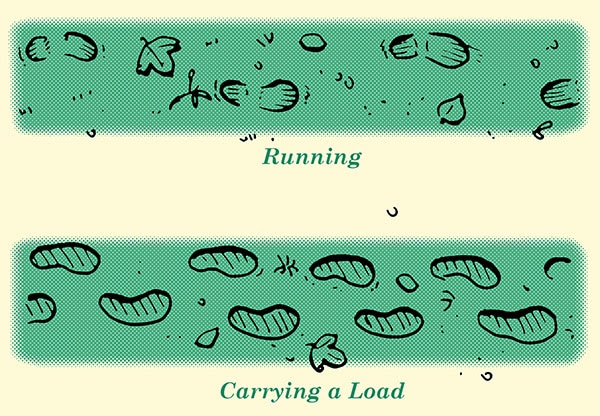
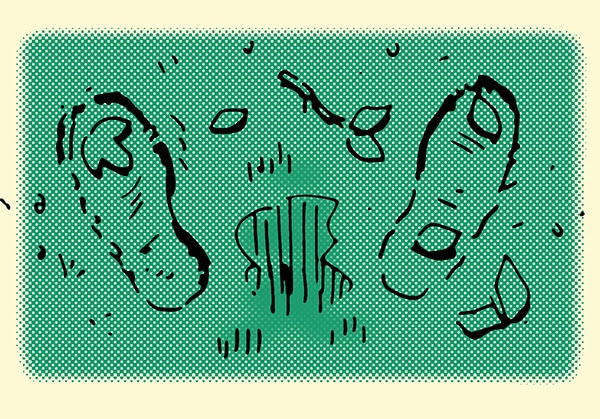
determining meaning in footprints when tracking humans illustration
If you look closely enough at footprints, they can tell you a lot about what your target was doing when he left them.
For example, the spacing and depth of the impressions can tell you about the target’s gait — whether he was running or walking. Impressions that are far apart from each other and deeper in the toe or the heel indicate that the target was running; impressions that are shallower and closer together indicate walking.
If the gait is shorter and the impressions are deeper, the target was likely carrying a load like a backpack. If you see a short gait and deep impressions, along with intermittent additions of another set of prints next to the target’s, you can deduce that he was carrying a person (and occasionally putting them down for breaks).
A set of impressions that have a circular indention to the side indicates that the target is using a walking cane or stick.
If one foot leaves a deeper impression than the other, it likely means the target is favoring that leg and that the other leg is injured.
So as you look at footprints, don’t just stop with the observation phase. Try to put together a story of what your target was doing, as this can help you develop a theory as to what he’s likely to do next.

Determining the Number of People in a Group by Footprints
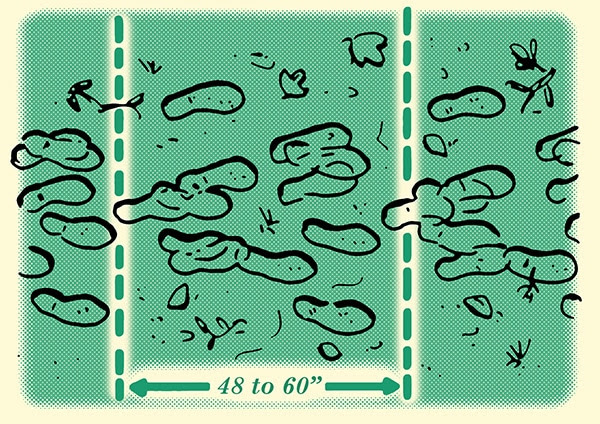
determining number of people in a group with footprints illustration
Sometimes counting the number of people in a target group is easy because there are distinct sets of footprints that you can count. But often the footprints overlap and mix together. How do you get a count then?
One way is to use the Box Method to get an estimate. Draw a line behind one print and then measure 48-60 inches forward and draw another line. Count all full and partial prints between those two lines (round up if you end on an odd number). Divide the total print count by two, and you’ll have a rough estimate of the number of people in your target group.

Practice Reading Footprints

Reading and interpreting footprints is a skill that can be acquired through practice. A great way to do that is to create an artificial track trap out of sand and then have your friends walk through it in different ways while you’re not looking. They can run, limp on one leg, carry each other, walk and then kneel, drag a body, pretend to fight each other, etc.
After they’ve left their tracks, go to the track trap and interpret what they did by looking at the tracks. After you’ve recreated the scenario your friends acted out, use a rake to clear the track trap’s slate and have your buds walk through it again.
I did this exercise with Hurth at the ITS Tactical Muster and had a blast. It’s pretty cool to be able to determine whether a fight went on or if someone was carrying a rifle simply by looking at footprints.

Putting It All Together: Creating a Story of Your Target

Tracking requires you to be hyper observant of your environment while simultaneously orienting your observations to the mental models in your head. This back and forth observing and orienting allows you to create a story of what’s going on with your target even though you weren’t there to observe them firsthand. By creating this story about your target as you collect evidence, you’ll be in a better position to figure out where they’re headed so you can find them.

Categories
Uncategorized

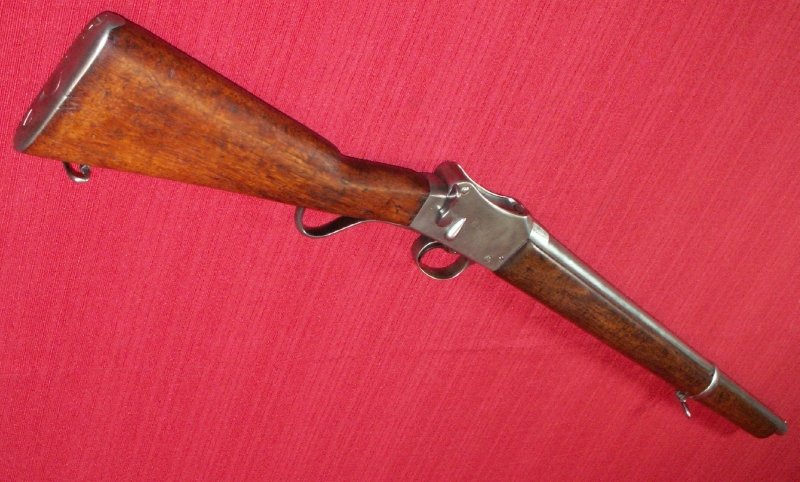
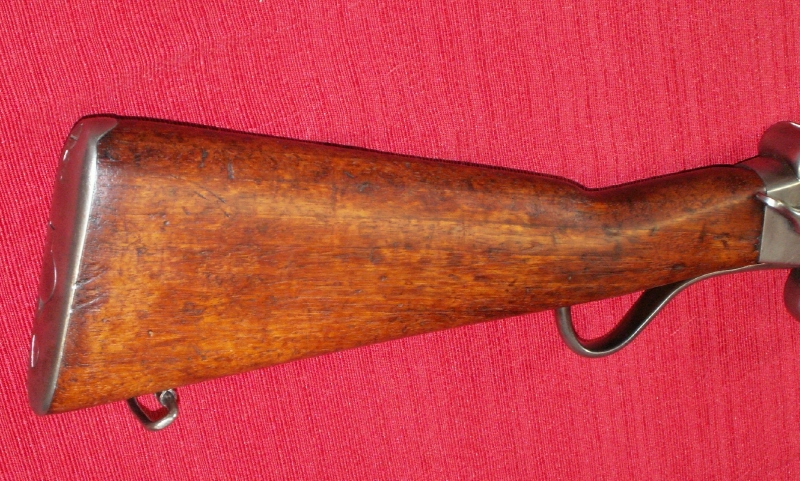
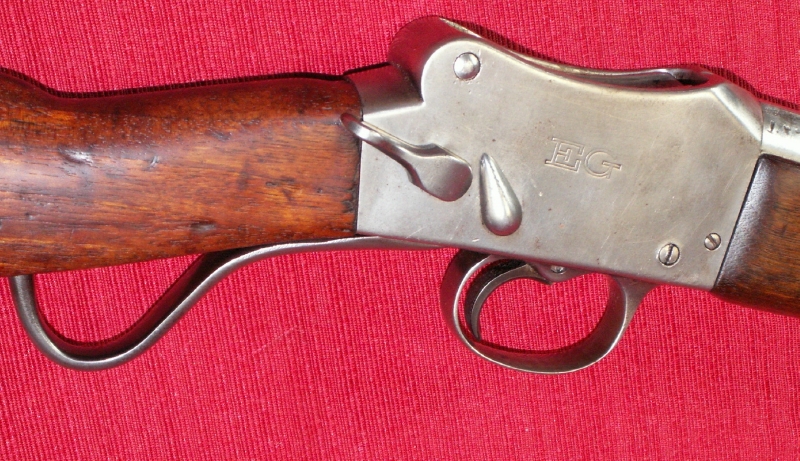
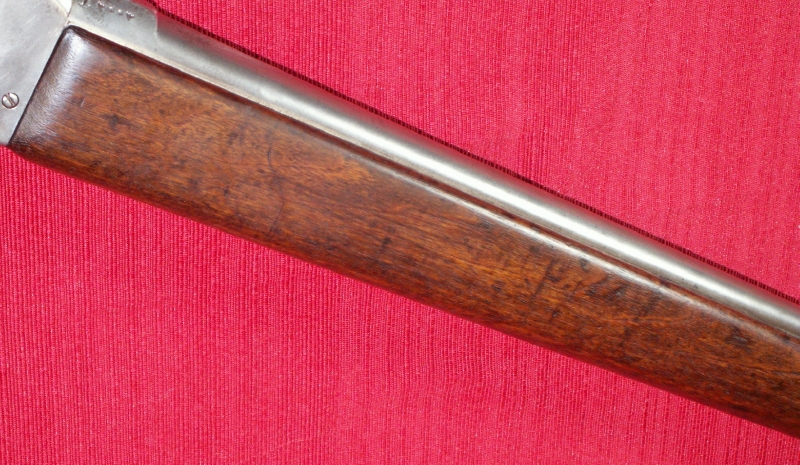
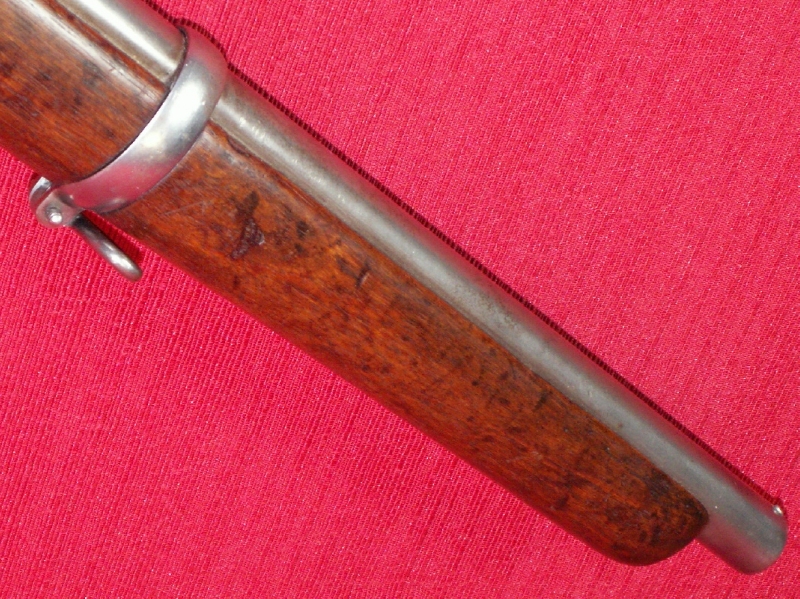
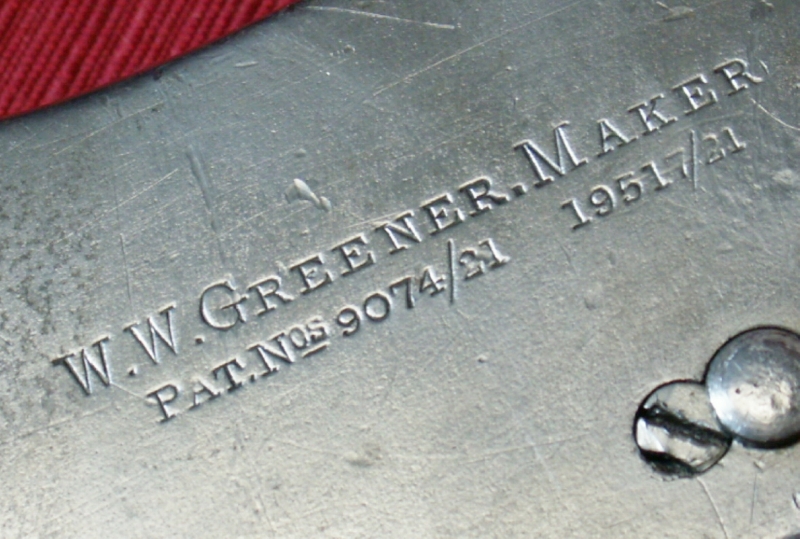
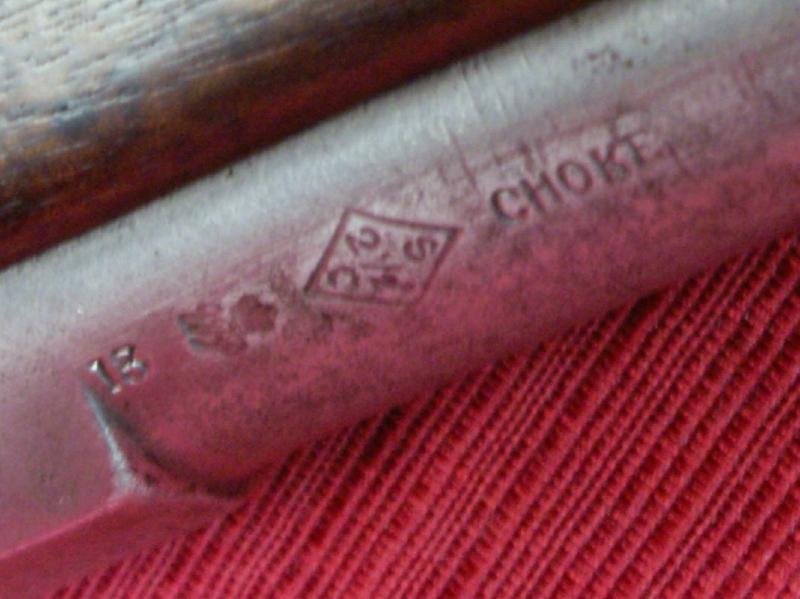
W. W. Greener, Ltd. — EG Special Bore Police Shotgun

W. W. Greener, Ltd. - EG Special Bore Police Shotgun - Picture 1

W. W. Greener, Ltd. - EG Special Bore Police Shotgun - Picture 2
W. W. Greener, Ltd. - EG Special Bore Police Shotgun - Picture 3
W. W. Greener, Ltd. - EG Special Bore Police Shotgun - Picture 4
W. W. Greener, Ltd. - EG Special Bore Police Shotgun - Picture 5
W. W. Greener, Ltd. - EG Special Bore Police Shotgun - Picture 6
W. W. Greener, Ltd. - EG Special Bore Police Shotgun - Picture 7
W. W. Greener, Ltd. - EG Special Bore Police Shotgun - Picture 8
W. W. Greener, Ltd. - EG Special Bore Police Shotgun - Picture 9
W. W. Greener, Ltd. - EG Special Bore Police Shotgun - Picture 10
I would hate to be on the wrong side of this puppy!
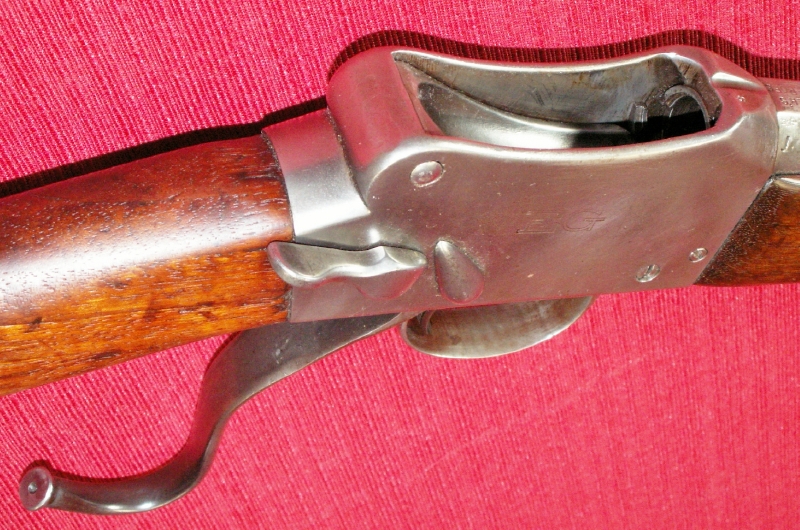
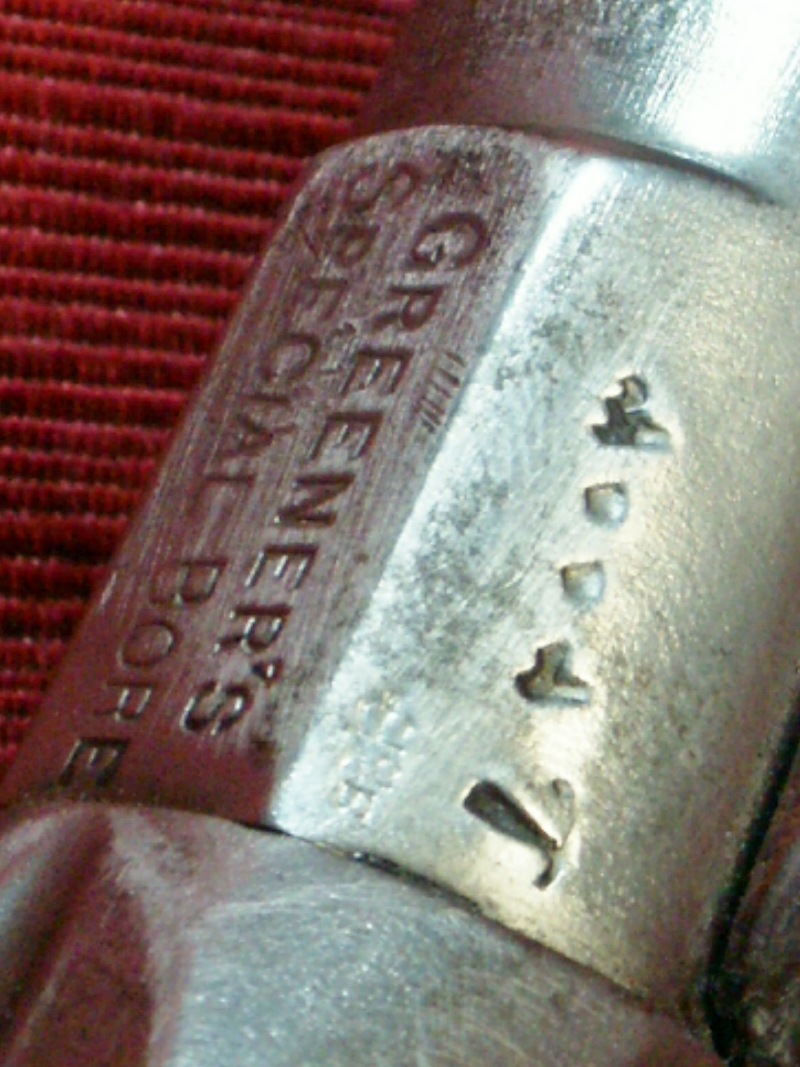
 W. W. Greener EG Special Bore Police Shotgun. These EG models were uses in the Egyptian Military and police Departments. These single shot Martini style shotguns were chambered for a unique shotshell.
It shouldn’t be used with a standard 12 gauge shell. I have read that a cut down (2” or 2-1/2) low brass 12 gauge shell can be made to work but you will need to have a conversion performed or you damage the split tip firing pin if not converted to a standard Martini rifle firing pin. The barrel length is 26 inches and overall length of firearm is 42 inches.
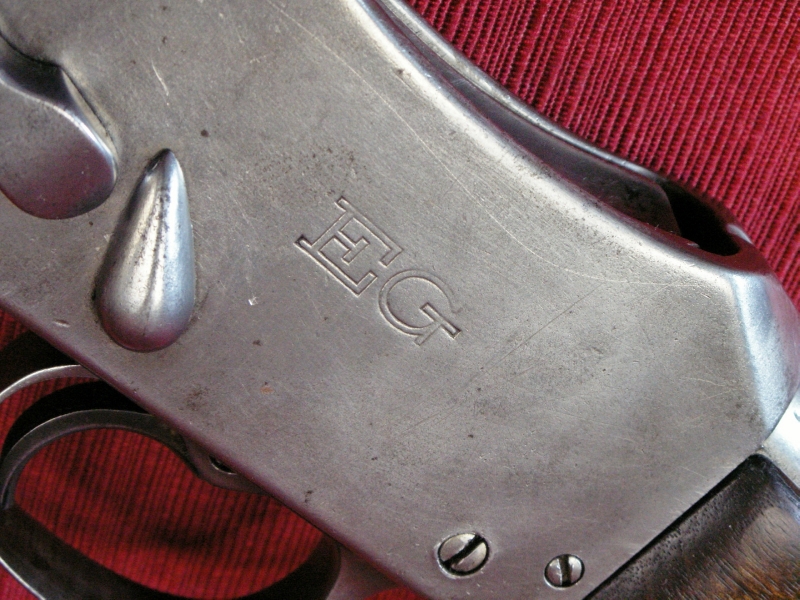
W.W. Greener is a sporting shotgun and rifle manufacturer from England. The company produced its first firearm in 1829 and is still in business, with a fifth generation Greener serving on its board of directors.
W. W. Greener Ltd
Private
Industry Firearms
Founded 1829
Founder William Greener
Headquarters ChippenhamUnited Kingdom
Area served
Local
Products Rifles
Website http://www.wwgreener.com/

History[edit]

The history of W.W. Greener begins in 1829, when William Greener, who had been working in London for Manton, a prominent gun maker, returned to his hometown of Newcastle and founded the W. Greener company. In November 1844, he determined that most of the materials and components he used for gun making came from Birmingham, and his business was being hampered by the distance between the two towns. Hence, he moved his business from Newcastle to Birmingham.
During the period of 1845-58, W. Greener was appointed to make guns for Prince Albert. Money obtained from supplying South Africa with two-groove rifles enabled the company to erect a factory on “Rifle Hill”, Aston, in 1859. It was around this time that the company began to really prosper.
Greener was a firm believer in the concept of muzzleloaders and refused to make any breechloaders. Hence, his son, William Wellington Greener, struck out a line of his own (the W.W. Greener company) and produced his first breechloader in 1864. When William Greener died in 1869, the two companies were amalgamated together as the W.W. Greener Company, and carried on by William Wellington Greener. William Wellington Greener was responsible for several innovations, as described in the sections below, and it was on the strength of his inventions that the company became famous. Under W.W. Greener, the company established offices in Birmingham, London, HullMontreal and New York City.
William Wellington Greener was succeeded by two of his sons, Harry Greener and Charles Greener. Leyton Greener, Harry’s son and fourth generation took over as Chairman in 1951 and today the company has a fifth generation, Graham Greener, as one of its directors.

Production[edit]

Production of Greener weapons started in 1829, when W. Greener began manufacturing his muzzleloaders. W. Greener was the first to discard vent holes in breeches. He was also instrumental in improving the hardness and quality of barrels, by using more steel in their manufacture. He also improved the Harpoon Gun and his model was the one adopted by the Scottish Fisheries, and is still in use today. His greatest innovation was the invention of the expanding rifle bullet.
In 1845-59, W. Greener was appointed to make sporting guns for the Prince Consort. In the 1851 London Exhibition, the company received the highest award “for guns and barrels perfectly forged and finished”. In 1853 and 1855, the company received Silver medals at the New York City and Paris Exhibitions. The company’s products were also sold for as much as 75 pounds, in the Southern states of America, before the Civil War.
Since W. Greener did not believe in breechloaders, his son, W.W. Greener started his own factory. In 1864, he produced his first patent, an under-lever pin-fire half-cocking breechloader with a top bolt entering the barrel underneath the top rib.
When W. Greener died in 1869, his son W.W. Greener merged the two companies into one. His next patent was the self-acting striker, followed by a famous cross-bolt mechanism produced as a single top bolt, in 1865. In 1873, this cross-bolt mechanism was combined with the bottom holding down bolts to produce the “Treble Wedge-Fast” breech action. The treble wedge-fast was one of the strongest breech actions ever invented and was widely copied by other manufacturers, after the patent rights expired.
The introduction of choke boring in 1874 is regarded as W.W. Greener’s greatest achievement. It was this invention that made the firm’s name famous. A discussion about this is in the section below.
In 1876, the firm introduced the Treble Wedge-Fast Hammerless Gun, otherwise known as the “Facile Princeps”. This gun was cocked by the dropping of the barrels. This action was one of the strongest ever produced. The W.W. Greener company restarted production of Facile Princeps guns in 1998.
In 1880, the firm produced a self-acting ejector for its guns, followed by the “Unique” ejector gun. These guns were designed to eject the spent cartridges when the gun was opened. Manufacture of the “Unique” ejectors stopped during the Second World War, and the company has recently begun to manufacture them again.
In 1895, W.W. Greener invented the world’s first Humane Killer, a gun designed to kill cattle, sheep, pigs and horses, quickly and easily. This instrument was adopted by the War Office, for use in the Veterinary, Remount and Butchering Departments, and by the Admiralty for its Victualling yards. The instrument was also modified to use .310 caliber cartridges. After several years, the models became obsolete in the 1960s and ammunition for the older models was impossible to obtain. Recently though, the company was asked to manufacture another model and hence, the Humane Killer Mk II was introduced. This new gun fires a .32 ACP round.

Choke bores[edit]

The introduction of choke bores was largely responsible for the fame of the W.W. Greener name. The invention of choke boring is usually attributed to American gunsmiths. The first known patents for choke boring were granted to a Mr. Sylvester H. Roper, an American inventor and gunsmith, (U.S. Patent 53,881, Improvement In Revolving Fire-Arms, April 10, 1866; and U.S. Patent 79,861, Improvements In Detachable Muzzle For Shot-Guns, dated July 14, 1868.) This was followed by a patent claim in London by Mr. Pape, an English Gun maker, whose patent application was six weeks too late to the 1866 Roper patent. Mr. J.W. Long, in his book “American Wildfowling”, credits a Mr. Jeremiah Smith of Southfield, Rhode Island, as the gunsmith who first discovered the concept, as far back as 1827.[1]
While American gunsmiths were the pioneers of the choke boring system, they had not really progressed beyond the elementary stage and their guns would lead, throw irregular patterns and not shoot straight.
W.W. Greener’s first intimation of the choke formation was derived from instructions given in a customer’s letter, in early 1874. The customer’s instructions described a choke, but did not give any details on the size or shape, or how it was to be obtained. Hence, W.W. Greener had to conduct many experiments to determine the perfect shape and size of a choke for a given bore. After that, he developed tools to produce the choke bore profile correctly and smoothly. The system of choke boring that he pioneered was so successful that it was later adopted by other manufacturers and hence, some authorities give him the credit for inventing the concept.
In December 1874, the first mention of Greener’s choke bore appeared in an article by J.H. Walsh, the Editor of Field magazine. The article mentioned the extraordinary shot pattern that the Greener shotgun could produce. The next issue came with an advertisement from W.W. Greener, stating that the firm would guarantee that their new guns would shoot a closer pattern than any other manufacturer. The advertisement claimed that Greener 12 bores were warranted to shoot an average pattern of 210, when the best 12 bore gun in the London Gun Trial of 1866 could only average 127. Naturally, the advertisement generated considerable controversy, especially from rival manufacturers of cylinder guns, who refused to believe the numbers quoted in the advertisement.
In order to resolve the controversy, the Editors of Field magazine decided to conduct a public trial in 1875. The London Trial of 1875 pitted choke bores and cylinder guns of various manufacturers in four categories—Class 1 (large bores, any boring), Class 2 (Choke bores, 12 gauge), Class 3 (Guns of English boring or Cylinders) and Class 4 (Small gauges, any boring). The choke bored guns performed better than the cylinder guns in all these tests, and W.W. Greener choke bore guns won the class 1, class 2 and class 4 categories. Greener Choke bores also won at the London Gun Trials of 1877 and 1879, and the Chicago Field Gun Trial of 1879. The results of these trials were responsible for making the W.W. Greener name famous.

Fake Greener guns[edit]

During the 1880s, as the company became well known, several small manufacturers in Belgium and Australia attempted to manufacture copies of Greener weapons. In several cases, the name was misleadingly similar: Greenen, Horace Greener, Albert Greener, A. Greener, W.H. Greener, A.H. Greener etc. are several examples of names of spurious weapons. Note that J.H. Greener and Albert Greener were two brothers of W W Greener and both brothers also made guns. Most J H Greener and a few Albert Greener guns are genuine.
In other cases, the maker would print “Greener” in bold gilt letters on the top rib and their own name in small characters, elsewhere on the gun. When one of these makers was challenged in Belgian courts, the defence advanced the theory that the weapons were using the Greener cross-bolt system and hence, the larger letters were intended to refer to the system, and not the maker of the weapon.
Due to the large number of forgeries, the W.W. Greener company offers to authenticate genuine Greener weapons for a small fee.

In popular culture[edit]

Wilbur Jonas, the general store owner, offers to sell Matt Dillon four Greener shotguns at an attractive price, in “Renegade White”, episode 4.30 of Gunsmoke.
Episode S5E1 of The Life and Legend of Wyatt Earp (1959), Earp is confront by “Shotgun Gibbs” who is armed with a Greener loaded with a rifled slug.[citation needed]
In the film Big Jake, John Wayne’s character asks his ex-wife, Martha (played by Maureen O’Hara), if she brought his “Greeners, the double-barrels”. Wayne then proceeds to open a gun case revealing matching shotguns and his favorite derringer, “Betsy”. There is also a reference in the 1973 film Cahill U.S. Marshal where Wayne is in a box car with several prisoners and one says, “You’re not going to leave that old Greener on cock are you?”.
In the Blood Bond book series by William W. Johnstone, most shotguns and sporting guns are referred to as greeners.
In the 1975 classic Jaws, Robert Shaw’s Quint character uses a modified Greener harpoon gun.

Bibliography[edit]

Teasdale-Buckle, G.T., Experts on Guns and Shooting, Sampson Low, Marston & Co. Greener, William Wellington, The Gun and Its Development, Ninth Edition, Bonanza Books NY, 1910 Greener, Graham N., The Greener Story, Quiller Press, 2000

See also[edit]

Categories
Uncategorized

This Song Almost became a National Anthem!

We will Rise again!
Enjoy!
Grumpy

Categories
Uncategorized

Free Printable Targets if you have access to a Printer that is!

Free Targets Printable Shooting Rifle Pistol Shotgun Archery Range Bull's Eye
 
 
Rifle sight adjustment in target practice