Oops!
Pak-40 German 75mm AT Gun Firing
This is the sad fate of a continent that has bet on its own demise. It wanted to be the great regulator and beacon of the world but is instead committing suicide homeopathically.

Family photo of European authorities during an event for Ukraine.
In recent years (and more recently in the Trump era), strategic and international affairs experts have spent tons of ink and paper trying to predict what the world would be like without America. Diplomatic gurus, prestigious essayists, former political leaders, and reputable publishers have dedicated blood, sweat and money to warn of all the bad things that lay ahead for Europeans when Washington looked the other way, over their heads, or retreated into itself.
Titles like “The Return of the Jungle” or “The End of the West” or “A World Without America” illustrate this trend.
But we have to admit that these attempts at warning and, at the same time, expressions of fear, have turned out to be all wrong. What we are experiencing in Donald Trump’s second term is not America’s retreat into strategic introspection.
Let them tell that to Khamenei or Maduro without going any further. Nor is it strategically a languishing of the West towards irrelevance. Today, America is stronger, richer and better prepared for today’s technological revolution than it was four years ago.
No. What the pundits have been unable or unwilling to see, possibly motivated by their excess of mental Eurocentrism, is the reality of the situation:
It is not America that is leaving the world, it is Europe, in fact, that is leaving it.
Instead of writing about a world without America, it would have been better if they had thought about a world without Europe. They would have better prepared us for the challenges that all Europeans have to face.
First of all, Europe has a serious military problem for which it has no solution: Ukraine. Eager to satisfy Joe Biden, they launched into a rhetorical escalation of support for Zelensky to the end and, logically, of confrontation with the Kremlin, without having the will or ability to deliver on their promises.
Without the United States—and Zelensky knows this well—Ukraine is lost. But E.U. leaders keep talking as if they are ready to launch us into World War III, except that they have neither the weapons nor the soldiers to wage it.
But instead of seeking a de-escalation in rhetoric and accepting the inevitable, that only Donald Trump could force a peace agreement, however painful it might be for Ukraine, Europe continues to jump on the bandwagon of bellicosity, putting fear into its population and painting apocalyptic scenarios but little else.
Secondly, Europe has a very serious social problem that dates back decades but has been especially aggravated by the nefarious decisions of the person who was considered to be the beacon of Europe, Chancellor Angela Merkel.
And that problem has a name and last name: uncontrolled immigration and Islamism.
There is no country or city that does not suffer an increase of an Islamist religious minority and that does not try to impose its rules on traditional European traditions and beliefs.
We see it every day in the crime figures and, very particularly, in the attacks against the integrity and safety of women. But we have also just suffered it this past Christmas with the multiple attacks on Christian symbols and in the places where families usually spend these days, Christmas markets and public squares.
It is not surprising that the new U.S. security strategy warns that if Europe does not change course by 2040, it will no longer be Europe.
Third, Europe suffers from a serious problem of economic and technological backwardness. Instead of being a paradise of development, it has only known how to regulate and regulate until it completely suffocates any hint of innovation.
It is neither in the A.I. race, nor in space, nor in energy. The fight against the big American tech companies and the E.U.’s eagerness to tax them, more a product of its own impotence than of a desire for retributive justice, drives the Old Continent further and further away from the future.
Worse still, the fear of American abandonment, if not disgust at the figure of President Trump, leads to a suicidal embrace of China, as if electric cars from Xi Jinping did not come burdened with totalitarianism and desires for global domination. As long as the E.U. bureaucracy remains the dominant source of industrial legislation, European nations are doomed to fail.
Fourth, Europe is a prisoner of its bad energy decisions and its commitment to the so-called “energy transition,” which was supposed to put Europe at the forefront of decarbonization.
What was never said is that in addition to the trillion-dollar bill for that step, the whole scheme rested on guaranteed access to Russian gas and liquefied natural gas from the Gulf. The confrontation with Russia and the sanctions closed that access and the taxes on hydrocarbons of all kinds threaten the main supplier, Qatar, to stop selling to Europe.
Either the E.U. gives up its ambitious energy agenda or it runs out of energy. There are no other options.
For the moment, it has already backtracked on the ban on combustion cars set for 2030, just around the corner. The allergy to nuclear power fueled by Merkel and the entire European left doesn’t help either.
Finally, Europe has a serious political problem. Having been created as the paradise on earth of freedom and welfare, its continuous problems in making its promises a reality have led to growing authoritarianism, an institutional system that tends to fortify the establishment and to condemn any other option that does not agree with what has been called the “social democratic consensus,” namely less nation, more State, more taxes, more regulation and more social control.
But if all that seemed to be accepted by citizens, it was in exchange for two vital things: security and prosperity. None of that is offered today.
On the contrary, Europeans are becoming less rich and more poor and feel assaulted on their soil and threatened by another foreseeable great war. Without a change in the continent’s political elites, it is very difficult for Europe to emerge from the current impasse.
Unfortunately, E.U. leaders are hellbent on preventing such a change. Hence their growing authoritarianism and their disdain for the deep values of democracy. Spain is a particularly acute case in this area, as its current prime minister has transformed Spanish democracy into a completely hollow shell of values and respect for democratic procedures.
But the United Kingdom is going in the same direction, not to mention France and Germany. People are being arrested for praying in the street, but only if they are Christians; people are being fined and imprisoned for giving opinions contrary to government policies because any criticism is judged a hate crime, especially if it deals with immigration.
It aspires to judicially eliminate opposition leaders outside the establishment and promotes the illegalization of parties that are not part of the grand consensus born after World War II.
But while this incipient “cold civil war” is taking place, Europe has become invisible as an actor in the rest of the world. It is not a player in the Middle East (for the better); it aligns itself against dictatorial change (see statements on the capture of Maduro or on the Iranian regime); and it believes that by getting cocky in front of its main ally, the United States, it becomes stronger. In Moscow and Beijing, there must be many people laughing loudly.
And worst of all, a world without America would be uninhabitable, but a world without Europe would hardly suffer.
This is the sad fate of a continent that has bet on its own demise. It wanted to be the great regulator and beacon of the world but is instead committing suicide homeopathically, all while the rest of the world yawns indifferently.

Most normal guys are fascinated by submarines. Had my life been just a little bit different, I might have aspired to service on a nuclear sub. I wanted to be a pilot, so I went into Army aviation.
However, had I just wanted to taste life in uniform, an enlistment as a submariner would have been an exceptionally cool way to do it. The very idea of a nuclear-powered machine that can cruise underwater indefinitely is mesmerizing. However, that’s really only if everything is going well.
Slowly dying of suffocation or hypothermia while trapped in a giant steel tube on the floor of the ocean is the stuff of nightmares. The Confederate CSS Hunley, the first military submarine to destroy a ship in combat, sank three times in its short period of service. Twenty-one men perished in those sinkings. Those practicalities are horrifying.
USS Squalus
On May 23, 1939, the new submarine USS Squalus undertook her 19th test dive. The first 18 had been unremarkable. However, 60 feet below the surface at a point 12 miles off the coast of New Hampshire, an air induction valve failed to close completely during a high-speed dive. Water flowed into the 310-foot vessel with terrifying rapidity.
Lt. Oliver Naquin, the skipper of the boat, directed that the watertight doors be dogged and sealed, but it was too late. The engine room and rear portions of the sub had already flooded, killing 26 of the 59-man crew almost instantly. The remaining 33 were saved because of the quick action of L. Naquin. Now dead in the water, the Squalus descended to the seabed at a depth of 240 feet.
Submarining was still in its relative infancy, and rescue equipment was rudimentary at best. There had never been a successful crew transfer below 60 feet prior to this time. The survivors of the Squalus knew this. However, Lt. Naquin remained upbeat and hopeful. His encouragement was later credited as being key to the men’s ultimate survival.
Hope
Submarines of the day had deployable buoys that could be released to produce a cloud of smoke and fire signal rockets. Naquin ordered these measures to be deployed emergently. The very last rocket was miraculously spotted by a sister sub, the USS Sculpin. The U.S. Navy then came alive.
These guys were figuring this out as they went along. The USS Falcon was one of the first ships on the scene. The Falcon carried an experimental rescue chamber designed by Lt. Cmdr. Charles Momsen. Momsen was a legendary submariner who also developed the Momsen Lung, an emergency breathing device used to help sailors escape a stricken boat. However, at 240 feet, this was far too deep for an unassisted ascent.
This steel chamber was 10 feet tall and 8 feet wide. It was designed to descend as deep as 300 feet on a cable and then seal on the deck of a stricken submarine by means of a rubber gasket. This exercise was dependent upon the sunken boat remaining upright. Fortunately, Lt. Naquin had landed his dead sub conning tower up.
Hard hat divers descended to the inert boat and affixed a cable to the railing alongside the sub’s forward hatch. As they walked across the submerged decking, they could hear the trapped crewmen banging with tools on the hull.
Two sailors named John Milakowski and Walter Harman crewed the experimental chamber down to the sunken submarine and effected a seal. The chamber could carry nine sailors in addition to the two operators.
The Rescue
This was the Atlantic, and the water was cold. With the sub’s systems disabled, there was no heat. By the time they got to the sunken vessel, the surviving crewmembers were suffering mightily from hypothermia. Harman and Milakowski distributed hot coffee and pea soup before loading up the first nine survivors for the long trek to the surface.
Each trip took at least two hours. Rescuing all 33 survivors required four cycles. The entire operation spanned two days, but Momsen and Company successfully rescued all the sub’s survivors.
A Grateful Nation
In recognition of their heroic, revolutionary accomplishment, four Navy divers were awarded the Medal of Honor. Forty-six other sailors earned the Navy Cross. Lt. Naquin eventually retired as a rear admiral. Of his crew, he said, “My officers and men acted instinctively and calmly. There were no expressions of fear and no complaints of the bitter cold. Never in my remaining life do I expect to witness so true an exemplification of comradeship and brotherly love. No fuller meaning could possibly be given the word ‘shipmate’ than was reflected by their acts.”
The Rest of the Story
The Squalus represented a $100 million investment in today’s money, and the Navy was slow to write her off. Miraculously, they raised the vessel over the course of four months. It took 628 deep dives to pull that off.
After a complete refit, the Squalus was recommissioned as the USS Sailfish. The Sailfish served throughout World War II, earned nine battle stars, sank 12 Japanese ships, and received a Presidential Unit Citation. Some of the original Squalus sailors remained on the boat during the war.
One of those 12 Japanese ships was the escort carrier Chūyō. At the time of its sinking, this carrier had 21 American sailors onboard who had been recovered from the sinking in combat of the USS Sculpin, the sub that had originally been so instrumental in the Squalus’ recovery.
Tragically, only one of these American submariners survived. The Sailfish was decommissioned after the war, the only American submarine to have been sunk, raised, recommissioned, and fought in combat during WWII.
Why 90% of MG42 Gunners Died
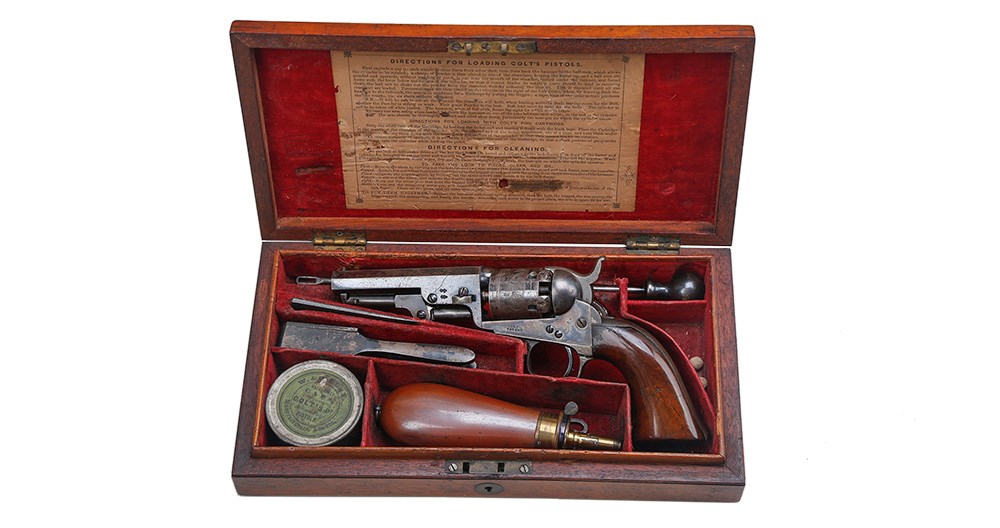
This is a past auction, but I thought the guns shown were just too nice ti ignore them. Grumpy