Categories
A Victory! Our Great Kids War

6th Marine Division Battle of Okinawa WW2

Categories
Our Great Kids Soldiering The Green Machine This great Nation & Its People War

Going For Broke: The 442nd Regimental Combat Team by Connie Gentry

The 442nd Regimental Combat Team, a segregated Japanese American unit, is remembered today for its brave actions in World War II. Despite the odds, the 442nd’s actions distinguished them as the most decorated unit for its size and length of service in the history of the US military.
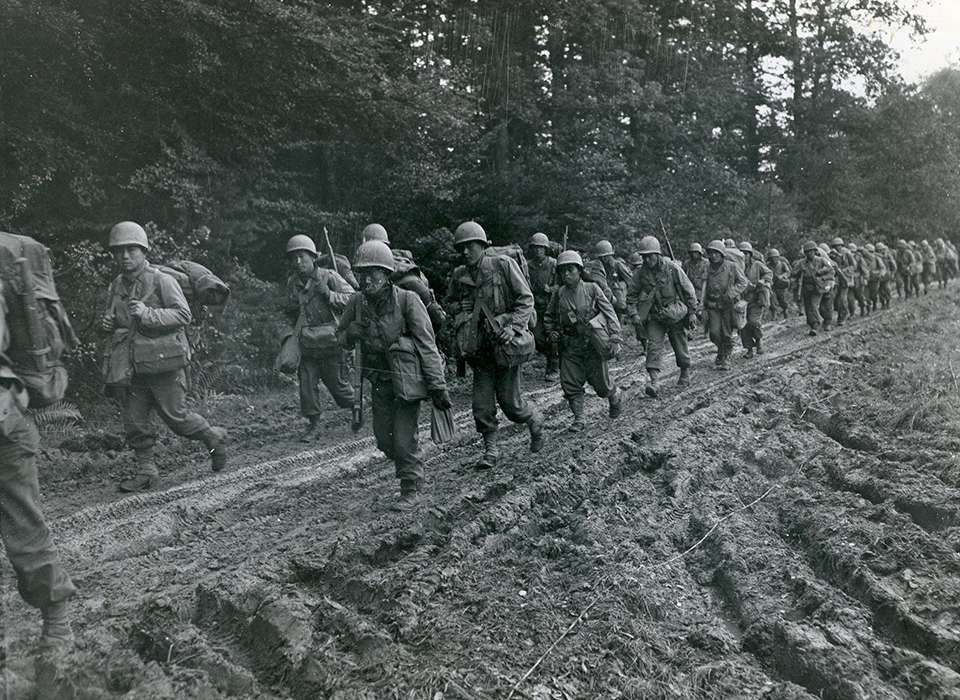
Soon after the December 7, 1941 attack on Pearl Harbor, President Franklin Roosevelt signed Executive Order 9066, effectively placing over 100,000 West Coast residents of Japanese descent, the majority of them American citizens, into incarceration camps. Racism against Japanese Americans was rampant as much of the country grew more fearful and suspicious of collaboration with the Japanese government. But Japanese Americans were equally outraged at the attack on their country. Despite the growing racism against them, many Japanese Americans answered the call to war.

President Roosevelt activated the 442nd Regimental Combat Team on February 1, 1943, nearly one year after the signing of EO9066. Hawaiian-born Nisei (second-generation Japanese Americans) made up roughly two-thirds of the regiment, with the remaining third composed of Nisei from the mainland United States. The motto of the unit was “Go For Broke,” a phrase that meant putting everything on the line in an effort to win big. Just as other minority groups, Japanese Americans faced two wars during World War II—war against the Axis powers and war against racism back home—making “Go For Broke” an appropriate motto.
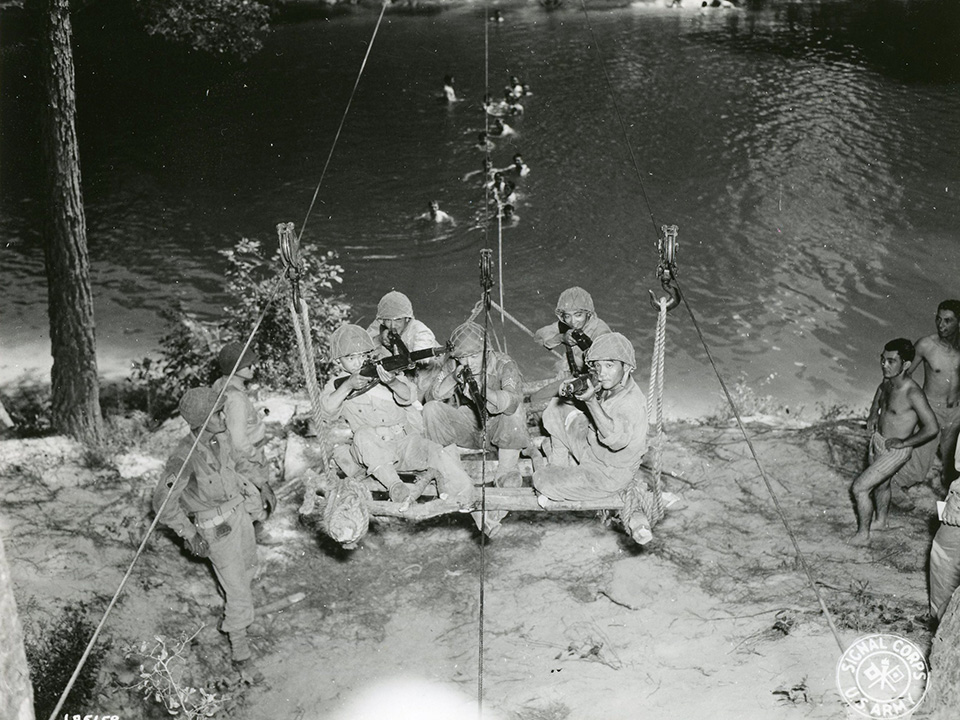
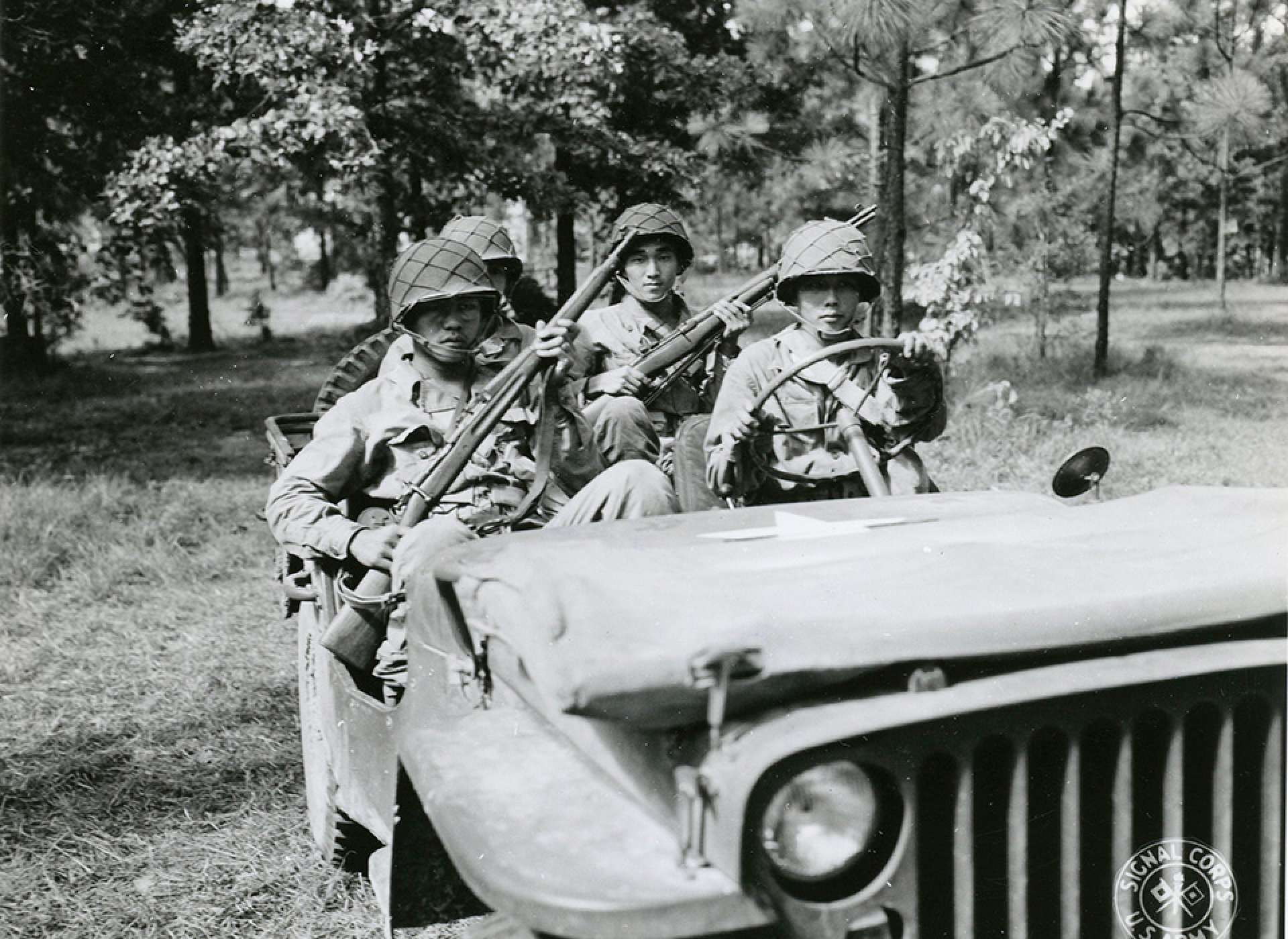
Men from the 442nd practicing training maneuvers in Camp Shelby, Mississippi. Courtesy of the US National Archives.

The 442nd RCT consisted of multiple units, including the 522nd Field Artillery Battalion, 232nd Combat Engineer Company, 206th Army Ground Forces Band, an Antitank Company, Cannon Company, Service Company, a medical detachment, and three infantry battalions. From May 1943 to April 1944, the men of the 442nd trained for combat, where they learned to fight as a team and excelled in practice maneuvers. Over the course of training, many men would be sent to Europe as replacements for the 100th Infantry Battalion, another Japanese American unit already fighting overseas and creating its own impressive track record.
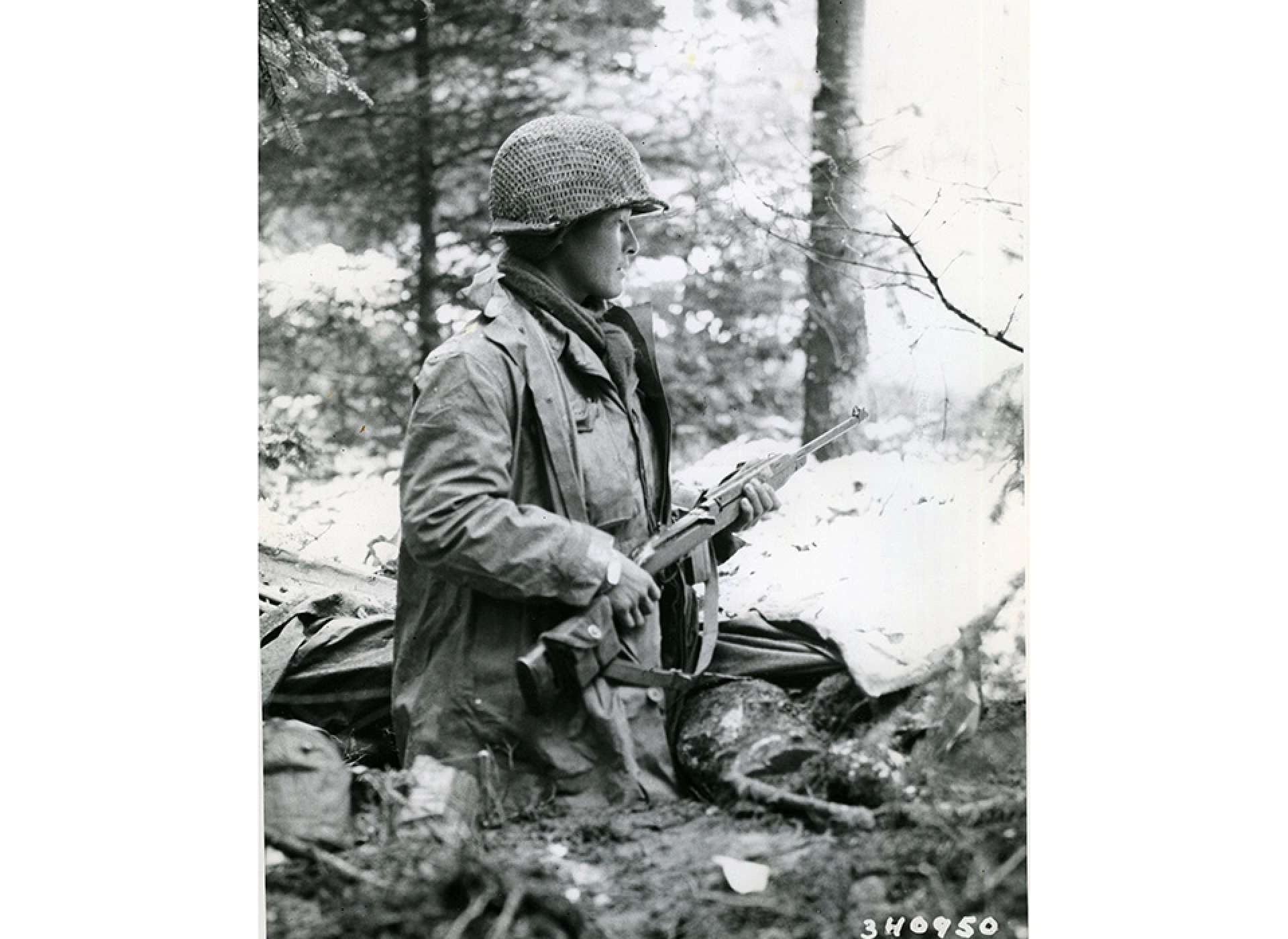
Training for the 442nd was completed in April, and on April 22, 1944, the unit left Camp Shelby in Mississippi on their journey to Europe for their first overseas assignment. They arrived in Italy in June 1944, where they began to fight alongside the 100th against Germans encamped across the country.

By August, the 100th was absorbed into the 442nd, with all units serving under the motto “Go For Broke.” In September 1944, the 442nd participated in the invasion of Southern France, successfully liberating French cities from Nazi occupation. The unit went on to fight with the 92nd Infantry Division, a segregated African American unit, in driving German forces out of northern Italy.
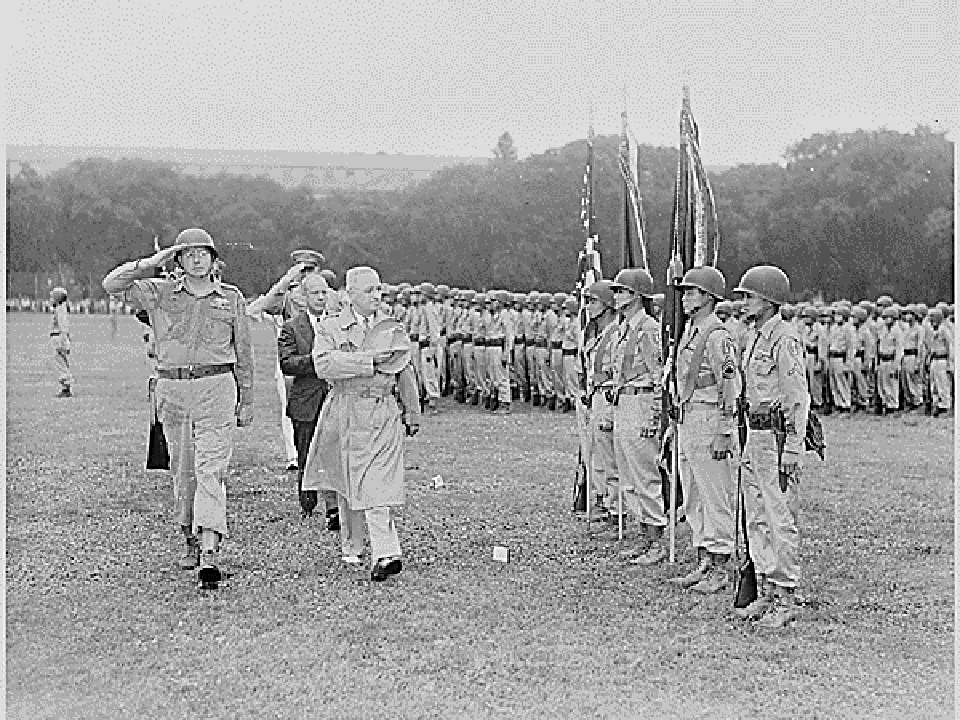
President Harry S. Truman removes his hat in front of the color guard of the 442nd.Courtesy Harry S. Truman Presidential Library


Today, the 442nd is remembered as the most decorated unit for its size and length of service in the history of the US military. The unit, totaling about 18,000 men, over 4,000 Purple Hearts, 4,000 Bronze Stars, 560 Silver Star Medals, 21 Medals of Honor, and seven Presidential Unit Citations. Additionally, the 100th garnished their own impressive record prior to their absorption into the 442nd. In 2010, various groups and advocates, including the National Veterans Network, were successful in obtaining congressional passage of the bill S. 1055, awarding all members of the 100th and 442nd, along with the Military Intelligence Service, the Congressional Gold Medal for their heroic service in World War II.

Against the odds, the men of the 100th Infantry Battalion and the 442nd Regimental Combat Team did “go for broke.” Despite the years of suspicion and racism that prevailed at home, these Nisei men fought for their country and their ideals of freedom and democracy. They fought heroically, leaving behind a record that is still untouched today.
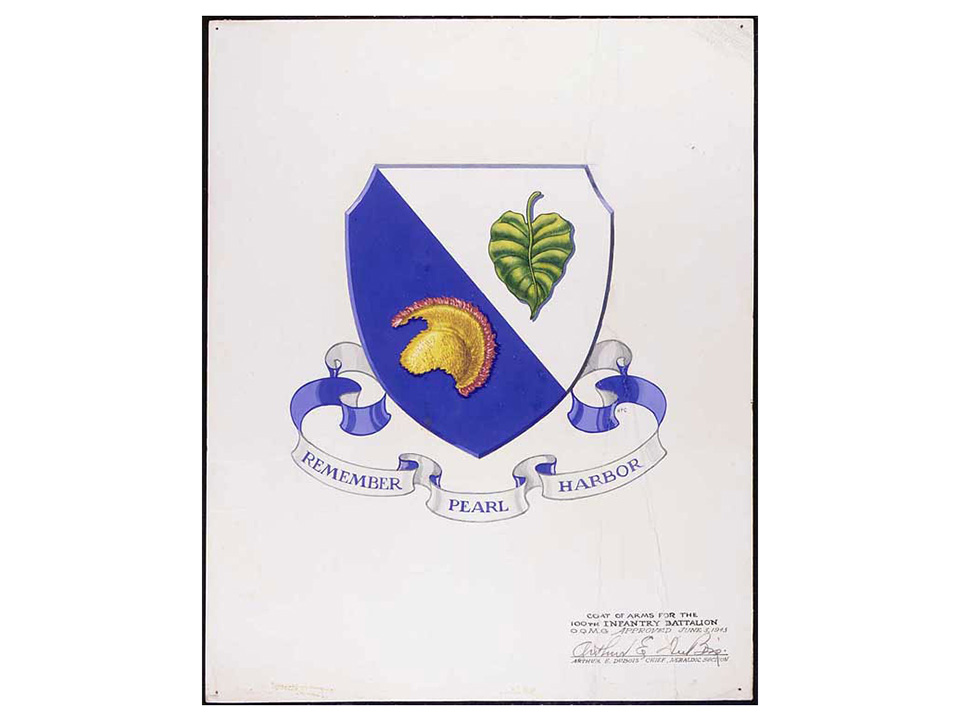
The logo and motto “Remember Pearl Harbor” of the 100th Infantry Battalion. Courtesy of the US National Archives.

Categories
Dear Grumpy Advice on Teaching in Today's Classroom Our Great Kids Soldiering This great Nation & Its People War

“The Last Combat Death of the Cold War” from that Fine Blog My Daily Kona

I posted this back in 2020, I am presently out of town, my employer sent me on a roadtrip. so I preloaded my scheduler thingie.

I ran across this on Farcebook and I remembered the incident and it infuriated me.  I was at North Georgia College and I heard about the Soviets shooting an American Officer then Soviets being Soviets, trying to blame the Americans.

I still remember the KAL 007 where the Soviets shot down the Korean jetliner then said that it was an “CIA plane” and we had proof that from intercepts that the Soviets knew that the plane was a civilian plane and the Soviets were being Soviets and duplicitous.   I knew about the “SMLM” missions because I lived in Germany in the 1970’s and the Soviets had their “SMLM” counterpart delegation in “Bunde” in the British sector and the American Sector they had their Main office in Karlsruhe and a satellite location in Frankfurt.

I know because I saw a guy in a Soviet Officer uniform in the Stars and Stripes in Frankfurt ( Soviets delegations had full access to the PX system, this is part of the reason that getting assigned to the Delegation was a prime assignment so they could send western goods back to the motherland for barter for other things) and he said “hi” to me and my being polite responded in kind as I was buying another book.

I asked my dad who was “El-Cid” in Frankfurt at that time about that and he explained what  that guy was and his purpose was and that he was a legal “spy” for the Soviet Military.

That Card on the lower right of the Pic, we all got them when we got “in Country” we were supposed to call a number if we saw this vehicle traveling around in Germany.  Especially near any maneuver or Training areas.

When I returned to Germany in 1986 as a GI and joined my unit at the Big Red One at Cooke Barracks, we immediately started border missions inside the (1K Zone) under the auspices of 2ACR who had the authority to run the area immediately behind the border between East Germany/West Germany and Czechoslovakia.

It was good duty, It was sobering to see the little M151 jeep loaded with a footlocker with claymore mines, LAAW rockets, extra ammo, grenades and so forth.  2ACR were Speedbumps for GSFG if they crossed the Fulda Gap and they knew it and we were to buy time for the other troops to get out of garrison to stop the Soviets before they got to the Rhine.  During this tour I spent 90 days in Wobeck by Helmstedt.  Then I spend the rest of my time at Stuttgart until 1991 with a detour in the Gulf.

14 years ago I bought a copy of a book and talked to the author, his name is James Holbrooke and Here is the Potsdam Missionslink on Amazon
It was interesting reading about the adventures on “that side of the fence and the “souped up Bronco’s they used”

I clipped this story off Farcebook and it is a worthy story of remembrance.

Fort Huachuca, AZ. – When Major “Nick” Nicholson and his driver, Staff Sergeant Jessie Schatz headed out to patrol an area in Ludwigslust, East Germany on the morning of March 24, 1985, there was nothing unusual about their mission. They were in uniform, driving a vehicle marked with the distinctive plates of the U.S. Military Liaison Mission (USMLM) and they were unarmed. As members of this unique organization, the two men were basically licensed spies, authorized by a 1947 treaty with the Soviet Union which allowed all parties of the occupation to maintain communications and exchange intelligence in the occupied zones of East and West Germany.

Originally, the agreement was designed to coordinate efforts and keep tabs on German disarmament and demilitarization. As the Cold War progressed, however, the liaison teams remained in place, keeping tabs on each other rather than the Germans. The Soviets had their own liaison mission which operated on the same principles inside the American, British, and French zones of occupation.

On this particular day, however, something went very wrong. The 2-man team was following a convoy of Soviet tanks returning from target practice — a very typical activity for a USMLM team. At some point, the two Americans left the convoy and headed for a tank shed off the main road.
Seeing no guards, they drove to within 200 yards of the shed. Major Nicholson left the vehicle to take some photos, leaving SSG Schatz with the vehicle to provide security. After a few minutes, Nicholson got back in and they drove closer, this time to within 10 yards. With the driver watching, he got back out and approached the shed to look in a window.
That was when Schatz noticed a young Soviet sentry emerging from the woods. Nicholson was turning to get back in his vehicle when the first shot rang out, narrowly missing his driver’s head. The Soviet sentry, a young sergeant named Aleksandr Ryabtsev, aimed again and fired two more shots.
One of them hit the major, and dropped him. Rising to an elbow, he shouted: “Jessie, I’ve been shot!” Then he collapsed. Schatz reached for his first aid kit, showing the Red Cross emblem to the sentry, and attempted to assist his teammate.
The sentry kept the AK-47 trained on Schatz, however, trapping him in the vehicle for over an hour. By the time anyone bothered to check for a pulse, Major Nicholson didn’t have one.
The Soviets refused to accept any blame, changing their story regularly and contradicting themselves repeatedly. In the final analysis by the U.S. Army investigators, Nick’s death was “officially condoned, if not directly ordered” by the Soviet leadership.
This incident caused immediate political furor, with both sides blaming the other. Major Nicholson’s body was eventually released, and he was buried with full military honors in Arlington National Cemetery. All 13 of his USMLM team members were present at his funeral. He was posthumously awarded the Legion of Merit and the Purple Heart, and in an unprecedented move, promoted to Lieutenant Colonel upon approval of the President.
Three years later, the Soviet Union expressed “regret” over Nicholson’s death. Ironically, by the time LTC Nicholson was inducted into the MI Hall of Fame in June 1991, the two divided sides of Germany had been reunited (Oct 3, 1990), and six months after his induction, the Soviet Union would officially be dissolved (Dec 26, 1991). The veterans of the Cold War, America’s longest war, deserve to be recognized, honored, and remembered. LTC Arthur D. “Nick” Nicholson, Jr: we thank you for your service.

Categories
Our Great Kids The Green Machine This great Nation & Its People

Why US Troops Are Training in Panama

The jungle SUCKS, I don’t envy these guys !! Grumpy

Categories
A Victory! All About Guns Our Great Kids Paint me surprised by this

Forging the Future Aluminum’s Journey from Rarity to Ubiquity By Will Dabbs, MD

The AR-15 rifle is the most popular long gun in America. It is built around upper and lower receivers cut from aircraft-grade aluminum.

Aluminum is a ubiquitous material in modern society. Back in 1956 when Gene Stoner and a few others designed that first AR-15 rifle around aluminum receivers, they literally changed the landscape. In the 1980s, everybody in the combat handgun world was churning out high-capacity, aluminum-framed pistols. Nowadays, we discard or recycle aluminum beverage cans by the zillions.

One of the neat things about aluminum is the way it sort of heals itself. Pure aluminum is highly reactive when exposed to air. However, the resulting aluminum oxide is exceptionally stable. This results in a natural microscopic protective coating on exposed surfaces. In applications like window frames, mechanical trauma from repetitive use results in tiny scratches that instantly oxidize, ensuring a robust material that resists environmental degradation.

Aluminum is relatively soft and easy to both extrude and machine. There are dozens of recognized aluminum alloys. Most AR parts are formed from 6061, which includes trace amounts of silicon, magnesium, copper and chromium. The 7075 alloy includes zinc in place of the silicon.

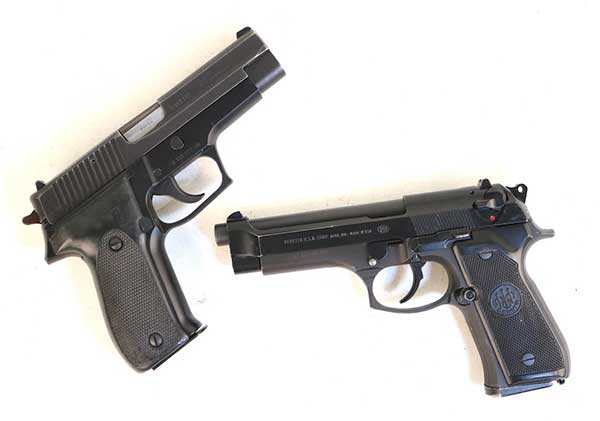
The 1980s was the decade of the “Wonder Nines.” These high-capacity 9mm pistols were built around aluminum frames.

Digging Deeper


Aluminum is indeed fascinating stuff. It has an atomic number of 13 and is roughly one-third of the density of steel. Aluminum is the 12th most common element in the universe and the third-most common element in the Earth’s crust right behind silicon and oxygen. It accounts for 1.59% of the Earth’s mass. The stuff is everywhere.

Despite the fact that aluminum was so common in nature, back in the late 1800s it was actually considered a precious metal. Gram for gram, aluminum once cost more than both gold and silver. Napoleon III reserved his aluminum flatware to impress visiting dignitaries. Lesser visitors got the silver.

In 1884, the Washington Monument was capped with a six-pound piece of aluminum. The total national output of aluminum that same year in the United States was only 112 pounds. Aluminum was revered similarly to platinum. How was it that such an abundant material might have been considered so rare and valuable a short century or so ago? That all depends on how you refine it.

While there are scads of elemental aluminum in the earth’s crust, prior to the late 1800s, it was terribly difficult to access. Most elemental aluminum is found in the form of a natural ore called bauxite. By 19th-century standards, extracting usable aluminum from this ore was nigh impossible.

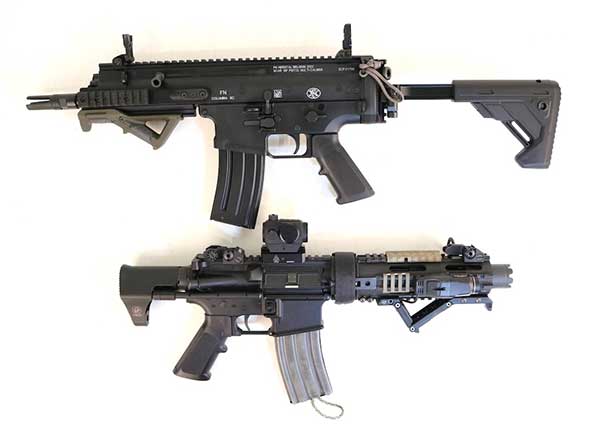
Nowadays, lots of guns are built out of aluminum. This custom
takedown AR short-barreled rifle and this FN SCAR-15P carbine
are counted among them.

Find a Need and Fill It

In 1886, a 17-year-old college student named Charles Hall was sitting in a chemistry class when his professor told him about the aluminum quandary. Hall’s professor actually said that if someone could devise a cost-effective method for extracting aluminum from bauxite, he would become the richest man in the world. Intrigued, the teenager went home determined to find a better way.

For the next five years, Charles Hall toiled in a workshop he had erected inside his family’s woodshed. Eventually, his perseverance paid off and he discovered a unique process that would produce aluminum from bauxite using electricity. At age 22, Charles Hall was indeed about to change the world.

Bizarrely, at exactly the same time in France, another 22-year-old, this one named Paul Heroult, discovered the identical technique. The resulting electrolytic extraction of aluminum from bauxite has become known as the Hall-Heroult Process.

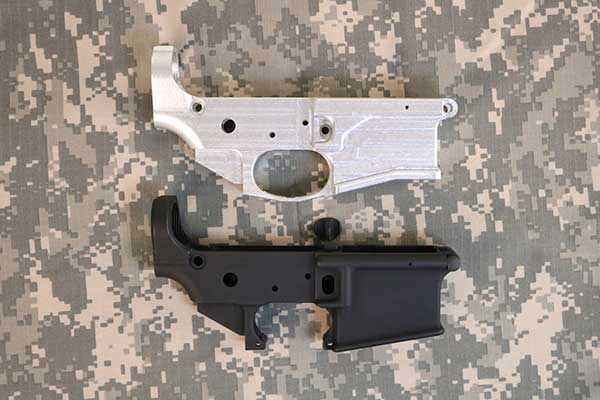
AR-15 receivers are lightweight, ubiquitous and strong.

Changing the World

Because both men discovered the process at the same time, neither established a monopoly. However, there was more than enough sweetness to go around. The young Charles Hall founded Alcoa, short for Aluminum Company of America. In 2023, Alcoa’s total revenue was $10.55 billion.

Extracting usable aluminum is still a terribly energy-dependent undertaking. As a result, most aluminum smelters are located in places where electric power is cheap. Production of one kilo of aluminum requires the equivalent of seven kilos of oil energy. That compares to 1.5 kilos for steel and 2 kilos for plastic. Today, 5% of the electric power produced in the United States goes toward smelting aluminum.

Ruminations

I am pretty quick to denigrate young people. With the exception of my own kids, I just don’t find the youth of today terribly impressive. In fact, I’m not sure I’d trust your typical Information Age 17-year-old unsupervised with electrical tape, much less a homebuilt metal smelting workshop. However, when Charles Hall was seventeen, he took up the challenge to find a better way to extract aluminum from rocks. In so doing, he did become lyrically wealthy.

Had Charles Hall been born a century later, he would not have been able to buy a beer or own a gun when he first embarked upon his holy quest to conjure aluminum from the ground. However, through hard work, perseverance and no small amount of talent, this driven young man did, indeed, change the world. So, the next time you drag your favorite AR-15 out to the range, just appreciate that some teenager figured out how to extract the stuff they used to make it.


Categories
Manly Stuff One Hell of a Good Fight Our Great Kids Real men This great Nation & Its People War

Stories You’ve Never Heard From WW1 & WW2

Categories
Our Great Kids This great Nation & Its People War

The Ship That Wouldn’t Die, USS Laffey (DD-724)

Categories
Our Great Kids Paint me surprised by this Soldiering The Green Machine This great Nation & Its People War

Your Life as Every Rank of Delta Force

Categories
Hard Nosed Folks Both Good & Bad Our Great Kids Real men Some Red Hot Gospel there! This great Nation & Its People

America’s Most Realistic Submarine Documentary: The People’s Choice Winner!

I AM SO GLAD THAT I JOINED THE US ARMY INSTEAD!!!! 

Grumpy

Categories
Fieldcraft Manly Stuff Our Great Kids Real men This great Nation & Its People War

William Fairbairn, Rex Applegate, the OSS and the ‘House of Horrors’