The amount of irony of this gun must be of huge. As I am sure that Jewish Slave labor must of been used in the making of these rifles during WWII in Europe. For the Nazi War machine, Whose assigned job was to take over the world. Then to kill EVERYONE who basically wasn’t German.
Then just to show you that you can never predict the future with any certainty. The Jewish Survivors wind up in the The Holy Land.
(Despite the best efforts of the British Empire. Who was running the place and kissing the Arabs behind. So that they could continue to make fantastic profits from the oil industry. Which they completely controlled in Iran & Saudi Arabia.)
Where their Zionist Leadership has just bought a whole mess of these rifles that had just made from the Czechs.
Which were to be used to protect their land from invading Arab Armies. Whose sole mission in life at the time. Was to finish Hitlers job of wiping the Jews from the face of the earth.
Anyways, Thanks to some brilliant leadership & some really hard fighting by the Jewish Grunts. They stopped the Arabs cold. Then they were able to push them back & beyond a bit. from their start up point before the UN stopped them
Bottom line – This to me at least proves that the Days of Miracles still exists. That and some Mausers in the right hands, Can still make some serious history. Grumpy
Category: Hard Nosed Folks Both Good & Bad

Special operators inserting via HALO (High Altitude Low Opening) parachute jump to launch a pitiless fight to the death with a fanatical enemy bent on global destruction is actually just the stuff of spy movies. That kind of thing almost never happens in the Real World. However, in November of 2001, the British Special Air Service launched Operation Trent. Trent was the stuff about which fiction writers scrawl.

In the modern era, most warriors see combat only sporadically. The Global War on Terror has been an anomaly, but most professional soldiers in the West only go to war for real about once or twice in a career. In the case of Special Operations Forces, their commanders are always on the prowl for proper missions. Early into the coalition invasion of Afghanistan SAS commanders got the tasking to take out an al-Qaeda opium plant near Koh-I-Malik Mountain in the Registan Desert, Helmand Province, Afghanistan.

Al-Qaeda was and is a truly world-class mob of villains. When they’re not actively bombing civilians they support themselves by refining and trafficking illicit narcotics. Though they drape themselves in the mantle of religion, the reality is that they are just fanatic thugs who want to watch the world burn.

The opium factory in this case was a fortified military facility of caves, bunkers, buildings, trenches, and hardened compounds. Intelligence estimates put the number of defenders at between 80 and 100 hard-core foreign fighters. These maniacal lunatics were well-armed, well-trained, and highly motivated.

Based upon the availability of close air support assets the assault would have to take place in daylight. Though the SAS is justifiably sketchy on operational details it is estimated that between 100 and 140 operators took part. Given the remote nature of the objective and the large numbers of troops required it was determined that insertion would be via C130 transport aircraft.
Show Time

The first order of business was to establish a makeshift airstrip to allow air landing of troops and vehicles via C130. As a result, G Squadron’s Air Troop inserted an eight-man reconnaissance patrol via HALO parachute jump. Jumping from a coalition C130 at more than 20,000 feet, this combat element dropped through subzero temperatures using supplemental oxygen and parachutes that opened automatically at 4,000 feet. They secured the air landing site, marked out a 900×40-foot runway, and established lay-up positions.

Seventeen hours later a flight of half a dozen USAF C130 aircraft touched down just long enough to disgorge a contingent of Land Rover DPV 110 “Pink Panther” vehicles, a pair of logistics trucks, and eight Kawasaki dirt bikes. The DPV 110’s were originally painted in a pink desert camouflage. Hence the name. During the 120-mile drive to the target one vehicle was lost due to mechanical failure. Its three-man crew remained behind to guard it. I suspect they were livid.

A Squadron drew the duty of assaulting the al-Qaeda facility, while G Squadron provided a base of supporting fire. Once in position under cover of darkness, these two elements awaited first light and a preparatory airstrike to launch their attack. Just after 0700, a combined strike package of US Navy F-14 Tomcats and F/A-18 Hornets kicked off the party.

The Navy strike aircraft pummeled the al-Qaeda facility until they ran out of ordnance, taking out a bunker with a GPS-guided JDAM bomb and strafing another position dangerously close to friendly operators. Under cover of the chaos, A Squadron elements approached the defensive works in their Pinkies, while the G Squadron blokes opened up with vehicle-mounted M2 .50-caliber machineguns, 7.62mm L7A2 GPMGs, L16 81mm mortars, MILAN antitank missiles, and Barrett M82A1 .50-caliber sniper rifles. What followed was a truly epic fight.
The Guns

The .50-caliber M2 or “Ma Deuce” as it is known by anyone who has ever donned a uniform, is the longest-serving weapon still in general issue by the US military. The M2 was contrived by the firearms luminary John Moses Browning in response to a request from General John “Blackjack” Pershing, the commander of the American Expeditionary Force in WW1.

The recoil-operated M2 weighs 84 pounds and cycles at around 500 rounds per minute. The Army has tried and failed to replace this apparently perfect weapon several times in the past century. However, today’s M2 that sits atop the M1 Abrams and modern MRAP vehicles is really minimally changed from the WW1-era original. The max effective range for the Ma Deuce is 1,800 meters.

The L7A2 is the British version of the Belgian MAG (Mitrailleuse d’Appui General) Gun. This 7.62x51mm air-cooled, belt-fed, General Purpose Machinegun was designed in the 1950s by Ernest Vervier. The MAG combined the best features from the American Browning Automatic Rifle and the German MG42. This same basic weapon serves in the American military as the M240.

The L7A2 weighs 26 pounds and cycles at around 650 rounds per minute. This same chassis has been used in fixed aircraft mounts, pintle mounts on vehicles, and as a man-portable support weapon in Infantry and Special Ops formations. The L7A2 fires from the open bolt and has been adopted by the militaries of some 89 nations.

The L16 81 mm mortar is a beast of a thing. It began as a joint venture between the UK and Canada. The L16 weighs 78 pounds and is typically serviced by a crew of three. This mortar offers a sustained rate of fire of a dozen rounds per minute and will throw an HE bomb up to 5,675 meters.

The MILAN antitank missile system is a joint French/German contrivance that first entered service in 1972. MILAN stands for Missile d’infanterie Leger Antichar. MILAN is also French for “kite.” MILAN is a wire-guided SACLOS (semi-automatic command to line-of-sight) missile. It weighs 36 pounds and has a maximum effective range of 2,000 meters.

Western nations supplied the Afghan Mujahideen with MILAN missiles during their war with the Soviets in the 1980s. These weapons took a devastating toll on Soviet armor. The newest versions of the MILAN use a 115mm HEAT warhead and advanced jam-resistant electronics.

The Barrett M82A1 is a semiautomatic recoil-operated anti-materiel weapon used throughout the free world. First launched in 1989, the M82A1 weighs 30 pounds and has a max effective range of 1,800 meters. The gun feeds from a 10-round detachable box magazine and is used by 55 different nations.

I first met the Barrett M82A1 while it was being used to detonate unexploded ordnance by a military EOD unit. The unique Barrett rifle has been used as a long-range sniper platform in a variety of operational conflicts. With match ammo, the Barrett is indeed a deadly and powerful long-range platform.
The Rest of the Story

A Squadron assaulters covered the last stretch of extremely difficult terrain on foot, engaging in a furious firefight with defenders in the process. One SAS operator was wounded during the approach, but another dozen gained access to an al-Qaeda cave complex. Here they killed six al-Qaeda fighters with no loss to their own. One SAS officer caught two rounds to his ceramic body armor and third through his canteen.

The al-Qaeda fighters were maniacal in their fervor, frequently running out from behind cover while firing only to be cut down by the attacking SAS men. The SAS Regimental Sergeant Major was shot through the leg while organizing the G Squadron supporting fires. Over the course of the next two hours, SAS troopers cleared buildings and caves of fanatical terrorist fighters, all at such close range as to make close air support ineffective.

Four hours after the initial airstrikes the compound was secure and the foreign fighters neutralized. A total of four SAS men were wounded. The attackers killed as many as 73 enemy soldiers and destroyed $50 million worth of opium. They also came home with several laptops and written records that were invaluable in unraveling the terrorist network.

A US CH47D extracted the wounded operators, while the rest of the force exfilled via C130. Three weeks later the shooters were back in the UK. Several of the SAS operators were decorated for their performance during the operation, and the al-Qaeda facility was thoroughly disrupted.
Ruminations


The Real World is never as clean or as tidy as the movies make it out to be. Combat is a terrifying, chaotic thing that strains even the most elite soldiers. However, the British SAS literally set the bar for special operations forces around the globe. In the case of Operation Trent, the largest SAS undertaking since WW2, the rarefied tactics and heroic exploits were everything you might find in a big budget action movie.

From G Squadron’s initial HALO assault to the unit’s mass exfil via C130 aircraft on an improvised runway, everything went down as it should have. The drug-making facility was destroyed and its operators killed. The SAS guys also retrieved a trove of invaluable intelligence materials. Operation Trent was the real deal, a special operator’s dream.


Editor’s Note: For today’s #ThrowbackThursday, we’re examining the lessons the Allied powers learned in World War II from one of America’s most formidable enemies at the time.
Arguably the greatest general that Germany produced during WWII was Field Marshal Erwin Rommel (1891-1944), The Desert Fox. A career soldier, he fought during both World Wars, and became so revered for his tactical leadership skills and aggressive battlefield style that some Allied forces began to believe he was superhuman. To that point, the British Army Commander-in-Chief C.J. Auchinleck, issued the following order to his officers:
There exists a real danger that our friend Rommel is becoming a kind of magician or bogey-man to our troops, who are talking far too much about him. He is by no means a superman, although he is undoubtedly very energetic and able. Even if he were a superman, it would still be highly undesirable that our men should credit him with supernatural powers. I wish you to dispel by all possible means the idea that Rommel represents something more than an ordinary German general. The important thing now is to see that we do not always talk of Rommel when we mean the enemy in Libya. We must refer to “the Germans” or “the Axis powers” or “the enemy” and not always keep harping on Rommel. Please ensure that this order is put into immediate effect, and impress up all commanders that, from a psychological point of view, it is a matter of highest importance.
No, Rommel was not superhuman, but he did have what the Germans called (big-word warning) Fingerspitzengefuhl, an innate sixth sense of what the enemy was about to do. For instance, a German general, Fritz Bayerlein, Rommel’s Chief-of-Staff at the time, relates the following two anecdotes.
“We were at the headquarters of the Afrika Korps…when suddenly Rommel turned to me and said, ‘Bayerlein, I would advise you to get out of this [location]: I don’t like it.’ An hour later the headquarters were unexpectedly attacked and overrun.”
Bayerlein continues, “That same afternoon, we were standing together when he [Rommel] said, ‘Let’s move a couple of hundred yards to a flank, I think we are going to get shelled here.’ One bit of desert was just the same as another, but five minutes after we had moved, the shells were falling exactly where we had been standing. Everyone…who fought with Rommel in either war will tell you similar stories.”
Rommel also had the ability to quickly size up a battle in progress, and the decision-making skills to then seize the opportunity to attack when one presented itself. Consequently, he earned a reputation for, at times, making rash decisions, but those decisions seemed to pay off for him and his armies more times than not.
A trait that endeared Rommel to his vanguard troops was that he “led from the front,” spending nearly as much time with the frontline, everyday soldier as he did with his officers back at headquarters. As a result, his soldiers were willing to follow him anywhere.
Another characteristic that helped make Rommel the military legend he became was that he was constantly learning, not only from his victories, but also his defeats—especially his defeats, which seemed to haunt him. And he was open to new ideas, new equipment, new weapons, anything that would make his armies more efficient and in turn, more successful.
For example, Rommel did not invent blitzkrieg—a highly mobile style of warfare employing armored, motorized forces—but he and his 7th Panzer Division of tanks certainly perfected it in France during 1940. Later in the war, his Afrika Korps then continued using the technique in the deserts of North Africa to win battle after battle.
Rommel had always been a prolific writer, and following his time in Africa he authored a paper titled The Rules of Desert Warfare, the small portions below being just a few of the more interesting excerpts from the six-page document.
- The tank force is the backbone of the motorized army. Everything turns on the tanks, the other formations are mere ancillaries. War of attrition against the enemy tank units must, therefore, be carried on as far as possible by one’s own tank destruction units…[they] must deal the last blow.
- Results of reconnaissance must reach the commander in the shortest possible time, and he must then make immediate decisions and put them into effect as quickly as possible. Speed of reaction in Command decisions decides the battle. It is, therefore, essential that commanders of motorized forces should be as near as possible to their troops and in the closest signal communication with them.
- It is my experience that bold decisions give the best promise of success. One must differentiate between operational and tactical boldness and a military gamble. A bold operation is one which has no more than a chance of success but which, in case of failure, leaves one with sufficient forces in hand to be able to cope with any situation. A gamble, on the other hand, is an operation which can lead either to victory or to the destruction of one’s own forces. Any compromise is bad.
- One of the first lessons which I drew from my experiences of motorized warfare was that speed of operation and quick reaction of the Command were the decisive factors. The troops must be able to operate at the highest speed and in complete coordination. One must not be satisfied here with any normal average but must always endeavor to obtain the maximum performance, for the side which makes the greater effort is the faster, and the faster wins the battle. Officers and NCOs must, therefore, constantly train their troops with this in view.
- In my opinion, the duties of the Commander-in-Chief are not limited to his staff work. He must also take an interest in the details of Command and frequently busy himself in the front line.
- The Commander-in-Chief must have contact with his troops. He must be able to feel and think with them. The soldier must have confidence in him. In this connection there is one cardinal principle to remember: one must never simulate a feeling for the troops which in fact one does not have. The ordinary soldier has a surprisingly good nose for what is genuine and what is fake.
In the WWII movie Patton, released in 1970, actor George C. Scott portrays the brash and flamboyant American General George S. Patton. Near the end of the movie, after Patton and his army have defeated Rommel and his troops, Patton shouts loudly across the battlefield in victory, “Rommel, you magnificent b______, I read your book!”
The book he was referring to was Rommel’s Infanterie Greift An (Infantry Attacks). Published in 1937, it chronicles his experiences during World War I. If you’d care to read it, the treatise will give you a look into the mind of one of the greatest tactical military geniuses of the 20th Century. The Rommel Papers, edited by B. H. Liddell Hart and published in 1953, is also highly recommended, relating Rommel’s WWII experiences in his own words.
Editor’s Note: For today’s #ThrowbackThursday, we’re examining the lessons the Allied powers learned in World War II from one of America’s most formidable enemies at the time.
Arguably the greatest general that Germany produced during WWII was Field Marshal Erwin Rommel (1891-1944), The Desert Fox. A career soldier, he fought during both World Wars, and became so revered for his tactical leadership skills and aggressive battlefield style that some Allied forces began to believe he was superhuman. To that point, the British Army Commander-in-Chief C.J. Auchinleck, issued the following order to his officers:
There exists a real danger that our friend Rommel is becoming a kind of magician or bogey-man to our troops, who are talking far too much about him. He is by no means a superman, although he is undoubtedly very energetic and able. Even if he were a superman, it would still be highly undesirable that our men should credit him with supernatural powers. I wish you to dispel by all possible means the idea that Rommel represents something more than an ordinary German general. The important thing now is to see that we do not always talk of Rommel when we mean the enemy in Libya. We must refer to “the Germans” or “the Axis powers” or “the enemy” and not always keep harping on Rommel. Please ensure that this order is put into immediate effect, and impress up all commanders that, from a psychological point of view, it is a matter of highest importance.
No, Rommel was not superhuman, but he did have what the Germans called (big-word warning) Fingerspitzengefuhl, an innate sixth sense of what the enemy was about to do. For instance, a German general, Fritz Bayerlein, Rommel’s Chief-of-Staff at the time, relates the following two anecdotes.
“We were at the headquarters of the Afrika Korps…when suddenly Rommel turned to me and said, ‘Bayerlein, I would advise you to get out of this [location]: I don’t like it.’ An hour later the headquarters were unexpectedly attacked and overrun.”
Bayerlein continues, “That same afternoon, we were standing together when he [Rommel] said, ‘Let’s move a couple of hundred yards to a flank, I think we are going to get shelled here.’ One bit of desert was just the same as another, but five minutes after we had moved, the shells were falling exactly where we had been standing. Everyone…who fought with Rommel in either war will tell you similar stories.”
Rommel also had the ability to quickly size up a battle in progress, and the decision-making skills to then seize the opportunity to attack when one presented itself. Consequently, he earned a reputation for, at times, making rash decisions, but those decisions seemed to pay off for him and his armies more times than not.
A trait that endeared Rommel to his vanguard troops was that he “led from the front,” spending nearly as much time with the frontline, everyday soldier as he did with his officers back at headquarters. As a result, his soldiers were willing to follow him anywhere.
Another characteristic that helped make Rommel the military legend he became was that he was constantly learning, not only from his victories, but also his defeats—especially his defeats, which seemed to haunt him. And he was open to new ideas, new equipment, new weapons, anything that would make his armies more efficient and in turn, more successful.
For example, Rommel did not invent blitzkrieg—a highly mobile style of warfare employing armored, motorized forces—but he and his 7th Panzer Division of tanks certainly perfected it in France during 1940. Later in the war, his Afrika Korps then continued using the technique in the deserts of North Africa to win battle after battle.
Rommel had always been a prolific writer, and following his time in Africa he authored a paper titled The Rules of Desert Warfare, the small portions below being just a few of the more interesting excerpts from the six-page document.
- The tank force is the backbone of the motorized army. Everything turns on the tanks, the other formations are mere ancillaries. War of attrition against the enemy tank units must, therefore, be carried on as far as possible by one’s own tank destruction units…[they] must deal the last blow.
- Results of reconnaissance must reach the commander in the shortest possible time, and he must then make immediate decisions and put them into effect as quickly as possible. Speed of reaction in Command decisions decides the battle. It is, therefore, essential that commanders of motorized forces should be as near as possible to their troops and in the closest signal communication with them.
- It is my experience that bold decisions give the best promise of success. One must differentiate between operational and tactical boldness and a military gamble. A bold operation is one which has no more than a chance of success but which, in case of failure, leaves one with sufficient forces in hand to be able to cope with any situation. A gamble, on the other hand, is an operation which can lead either to victory or to the destruction of one’s own forces. Any compromise is bad.
- One of the first lessons which I drew from my experiences of motorized warfare was that speed of operation and quick reaction of the Command were the decisive factors. The troops must be able to operate at the highest speed and in complete coordination. One must not be satisfied here with any normal average but must always endeavor to obtain the maximum performance, for the side which makes the greater effort is the faster, and the faster wins the battle. Officers and NCOs must, therefore, constantly train their troops with this in view.
- In my opinion, the duties of the Commander-in-Chief are not limited to his staff work. He must also take an interest in the details of Command and frequently busy himself in the front line.
- The Commander-in-Chief must have contact with his troops. He must be able to feel and think with them. The soldier must have confidence in him. In this connection there is one cardinal principle to remember: one must never simulate a feeling for the troops which in fact one does not have. The ordinary soldier has a surprisingly good nose for what is genuine and what is fake.
In the WWII movie Patton, released in 1970, actor George C. Scott portrays the brash and flamboyant American General George S. Patton. Near the end of the movie, after Patton and his army have defeated Rommel and his troops, Patton shouts loudly across the battlefield in victory, “Rommel, you magnificent b______, I read your book!”
The book he was referring to was Rommel’s Infanterie Greift An (Infantry Attacks). Published in 1937, it chronicles his experiences during World War I. If you’d care to read it, the treatise will give you a look into the mind of one of the greatest tactical military geniuses of the 20th Century. The Rommel Papers, edited by B. H. Liddell Hart and published in 1953, is also highly recommended, relating Rommel’s WWII experiences in his own words.
:max_bytes(150000):strip_icc():format(webp)/Theodore-Roosevelt-NYPD-3032-3x2gty-56a48a223df78cf77282df37.jpg)
Future president Theodore Roosevelt returned to the city of his birth in 1895 to take on a task that might have intimidated other people, the reform of the notoriously corrupt police department.
His appointment was front-page news and he obviously saw the job as chance to clean up New York City while reviving his own political career, which had stalled.
His appointment was front-page news and he obviously saw the job as chance to clean up New York City while reviving his own political career, which had stalled.
As the president of the police commission, Roosevelt, true to form, vigorously threw himself into the task. His trademark zeal, when applied to the complexities of urban politics, tended to generate a cascade of problems.
Roosevelt’s time at the top of the New York Police Department brought him into conflict with powerful factions, and he did not always emerge triumphant. In one notable example, his widely publicized crusade to close saloons on Sunday, the only day when many workingmen could socialize in them, provoked a lively public backlash.
When he left the police job, after only two years, the department had been changed for the better. But Roosevelt’s time as New York City’s top cop had been raucous, and the clashes he found himself in had nearly brought his political career to an end.
Roosevelt’s Patrician Background
Theodore Roosevelt was born into a wealthy New York City family on October 27, 1858. A sickly child who overcame illness through physical exertion, he went on to Harvard and entered New York politics by winning a seat in the state assembly at the age of 23.
In 1886 he lost an election for mayor of New York City. He then stayed out of government for three years until he was appointed by President Benjamin Harrison to the United States Civil Service Commission. For six years Roosevelt served in Washington, D.C., overseeing the reform of the nation’s civil service, which had been tainted by decades of adherence to the spoils system.
Roosevelt was respected for his work reforming the federal civil service, but he wished to return to New York City and something more challenging. A new reform mayor of the city, William L. Strong, offered him the job of sanitation commissioner in early 1895. Roosevelt turned it down, thinking the job of literally cleaning up the city was beneath his dignity.
A few months later, after a series of public hearings exposed widespread graft in the New York Police Department, the mayor came to Roosevelt with a far more attractive offer: a post on the board of police commissioners. Enthused by the chance to bring much-needed reforms to his hometown, and in a very public post, Roosevelt took the job.
The Corruption of the New York Police
A crusade to clean up New York City, led by a reform-minded minister, Rev. Charles Parkhurst, had prompted the state legislature to create a commission to investigate corruption. Chaired by state senator Clarence Lexow, what became known as the Lexow Commission held public hearings which exposed the startling depth of police corruption.
In weeks of testimony, saloon owners and prostitutes detailed a system of payoffs to police officials. And it became apparent that the thousands of saloons in the city functioned as political clubs which perpetuated the corruption.
Mayor Strong’s solution was to replace the four-member board that oversaw the police. And by putting an energetic reformer like Roosevelt on the board as its president, there was cause for optimism.
Roosevelt took the oath of office on the morning of May 6,1895, at City Hall. The New York Times lauded Roosevelt the next morning, but expressed skepticism about the other three men named to the police board. They must have been named for “political considerations,” said an editorial. Problems were obvious at the outset of Roosevelt’s term at the top of the police department.
Roosevelt Made His Presence Known
In early June 1895 Roosevelt and a friend, the crusading newspaper reporter Jacob Riis, ventured out into the streets of New York late one night, just after midnight. For hours they wandered through the darkened Manhattan streets, observing the police, at least when and where they could actually find them.
The New York Times carried a story on June 8, 1895 with the headline, “Police Caught Napping.” The report referred to “President Roosevelt,” as he was president of the police board, and detailed how he had found policemen asleep on their posts or socializing in public when they should have been patrolling alone.
Several officers were ordered to report to police headquarters the day after Roosevelt’s late night tour. They received a strong personal reprimand from Roosevelt himself. The newspaper account noted: “The action of Mr. Roosevelt, when it became known, made a sensation throughout the department and as a consequence, more faithful patrol duty may be performed by the force for some time to come.”
Roosevelt also came into conflict with Thomas Byrnes, a legendary detective who had come to epitomize the New York Police Department. Byrnes had amassed a suspiciously large fortune, with the apparent help of Wall Street characters such as Jay Gould, but had managed to keep his job. Roosevelt forced Byrnes to resign, though no public reason for the ouster of Byrnes was ever disclosed.
Political Problems
Though Roosevelt was at heart a politician, he soon found himself in a political bind of his own making. He was determined to shut down saloons, which generally operated on Sundays in defiance of a local law.
The problem was that many New Yorkers worked a six-day week, and Sunday was the only day when they could gather in saloons and socialize. To the community of German immigrants, in particular, the Sunday saloon gatherings were considered an important facet of life. The saloons were not merely social, but often served as political clubs, frequented by an actively engaged citizenry.
Roosevelt’s crusade to shutter saloons on Sundays brought him into heated conflict with large segments of the population. He was denounced and viewed as being out of touch with the common people. The Germans in particular rallied against him, and Roosevelt’s campaign against saloons cost his Republican Party in the city-wide elections held in the fall of 1895.
The next summer, New York City was hit by a heat wave, and Roosevelt gained back some public support by his smart action in dealing with the crisis. He had made an effort to familiarize himself with slum neighborhoods, and he saw that the police distributed ice to people who desperately needed it.
By the end of 1896 Roosevelt was thoroughly tired of his police job. Republican William McKinley had won the election that fall, and Roosevelt began concentrating on finding a post within the new Republican administration. He was eventually appointed assistant secretary of the Navy, and left New York to return to Washington.
Impact of Roosevelt on New York’s Police
Theodore Roosevelt spent less than two years with the New York Police Department, and his tenure was marked with nearly constant controversy. While the job burnished his credentials as a reformer, most of what he tried to accomplish ended in frustration. The campaign against corruption proved essentially hopeless. New York City remained much the same after he left.
However, in later years Roosevelt’s time at police headquarters on Mulberry Street in lower Manhattan took on a legendary status. He would be remembered as a police commissioner who cleaned up New York, even though his accomplishments on the job didn’t live up to the legend.
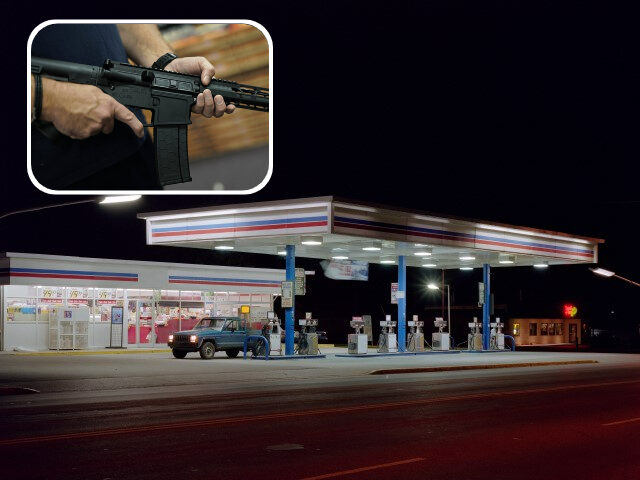
Philadelphia gas station owner Neil Patel hired security guards with AR-15s to deal with all the “nonsense, drug trafficking, hanging around, [and] gangs” endangering his employees.
Patel, who has a Karco gas station, hired “Pennsylvania S.I.T.E Agents clad with Kevlar vest and AR-15s or shotguns” to keep his employees safe, FOX 29 reports.
“They are forcing us to hire the security, high-level security, state level. We are tired of this nonsense: robbery, drug trafficking, hanging around, gangs,” Patel said.
The guards he hired wear Kevlar vests and train regularly, maintaining firearm proficiency.
Prior to hiring the guards, Patel’s car was vandalized and an ATM was stolen from his gas station. But FOX News notes Patel’s observation that crimes–including loitering–ended once he hired security.
AWR Hawkins is an award-winning Second Amendment columnist for Breitbart News and the writer/curator of Down Range with AWR Hawkins, a weekly newsletter focused on all things Second Amendment, also for Breitbart News. He is the political analyst for Armed American Radio and a Turning Point USA Ambassador. AWR Hawkins holds a PhD in Military History with a focus on the Vietnam War (brown water navy), U.S. Navy since Inception, the Civil War, and Early Modern Europe. Follow him on Instagram: @awr_hawkins. You can sign up to get Down Range at breitbart.com/downrange. Reach him directly at awrhawkins@breitbart.com.
————————————————————————————– If the state won’t do its job than somebody is going to have to pick up the slack. I really think that we are going see a LOT more of this coming down the pike! Grumpy

Doris “Dorie” Miller was supposed to have been a girl. Born October 12, 1919, to sharecroppers Connery and Henrietta Miller, he got the name Doris when the midwife assisting with his delivery became somehow convinced he would be female. Doris was the third of four sons accustomed to hard work on the family farm. Miller’s grandparents had been slaves.

Doris dropped out of school in the eighth grade and completed a correspondence course in taxidermy. Few ridiculed him over the effeminate nature of his name, however. By his 17th birthday, Doris was 6 foot 3 inches tall and weighed more than 200 pounds.

Miller enlisted in the US Navy in 1939. At this point in history, there were few billets open to African-American sailors. As a result, Doris trained as a mess attendant and was assigned to the USS Pyro, an aptly named ammunition ship.

In January of 1940, Miller transferred to the battlewagon USS West Virginia. There he found that he had a gift for boxing, a wildly popular sport among Navy personnel at the time. In short order, Miller had earned the coveted position of heavyweight champion of the ship, a vessel whose complement typically ran some 1,300 men.

Nobody is really sure where the name Dorie originated. Some claimed it was a typographical error made by some nameless clerk who simply could not believe that a 200-pound musclebound black man might actually be called Doris. Others asserted it was a nickname bequeathed by loyal shipmates following his boxing exploits.
One Fateful Sunday…

On Sunday morning, December 7th, 1941, Dorie Miller arose at 0600 to serve breakfast mess and begin collecting laundry. Two hours later his day was interrupted when Lieutenant Commander Shigeharu Murata, a Kate torpedo bomber pilot launched from the Japanese aircraft carrier Akagi, released the first of seven torpedoes to eventually strike the West Virginia.

West Virginia’s steel hull armor varied between 8 and 13.5 inches. One torpedo failed to explode. However, six is still a whole lot of torpedoes.

Miller’s battle station was an antiaircraft magazine amidships. He reported there only to find that it had been destroyed in a torpedo strike. Now looking for trouble, Dorie subsequently headed to “Times Square,” the confluence between fore-and-aft and starboard-to-port passageways. Lieutenant Commander Doir Johnson snatched up Miller and took him to the bridge to help move the injured Captain.

Captain Mervyn Bennion had been essentially eviscerated by shrapnel while running the fight from the bridge. Captain Bennion was a Mormon from Salt Lake City who had graduated third in his 1910 class at Annapolis. Bennion used one arm to hold his entrails in place while he directed the fight against the attacking Japanese.

Dorie Miller and others attempted to evacuate Captain Bennion to a position of safety amidst the attack. Despite the pleading of his men, Bennion remained at his post and ultimately bled out. Captain Bennion was posthumously awarded the Medal of Honor for his actions.

Under constant attack by Japanese dive bombers, torpedo planes, and fighters, the situation on the West Virginia’s bridge was dire. There were two unmanned Browning M2 .50-caliber machineguns mounted on the aft aspect of the bridge structure. Lieutenant Frederic White grabbed Miller along with Ensign Victor Delano and moved to these two guns amidst sleeting fire from the attacking Japanese planes.

Miller had never before seen a .50-caliber machinegun up close, so the two young Navy officers gave him a quick block of instruction under fire. They had expected Miller to feed ammunition, but he was manning the starboard gun and firing at the Japanese before they could intervene. Dorie Miller ran his gun until they had expended all available ammo.

By now the West Virginia had been struck by seven torpedoes and two armor-piercing bombs. Fast action on the part of damage control parties counter-flooded the ship such that she sank to the harbor bottom on an even keel. This maneuver saved countless lives.

His gun rendered useless by a lack of ammo, Dorie Miller then turned his attention to rescuing injured sailors. He helped move the wounded through the oily water to the quarterdeck and safety. Eventually, the crew abandoned the ship. Miller was among the last three to leave.
Dorie Miller’s Gun

The M2 .50-caliber machinegun was born on the blood-soaked battlefields of WW1. General John “Blackjack” Pershing commanded the American Expeditionary Forces in Europe and was alarmed over the introduction of armored aircraft like the German Junkers J.1 to the modern battlespace. Airplanes of this sort combined with observation balloons operating beyond conventional rifle range necessitated a new Infantry weapon. Pershing compiled the criteria for the new gun himself.

The weapon needed to be of at least .50-caliber and fire a 670-grain bullet at a minimum of 2,700 feet per second. The French 11mm was used as inspiration but was found to be too slow. Winchester designed the new cartridge, while the legendary John Moses Browning crafted the gun to fire it.

The end result was the .50BMG 12.7x99mm, itself essentially a scaled-up version of the standard .30-06 service round. After a bit of tweaking, this cartridge offered about the same performance as that fired by the German T Gewehr 1918 antitank rifle but in a rimless configuration. The rimless design made it much easier to cycle in an autoloading mechanism compared to previous rimmed designs.

Browning’s M1921 heavy machinegun was a water-cooled beast of a thing that weighed 121 pounds and fed solely from the left. However, the recoil-operated action was a legitimate stroke of genius. Browning died in 1926 but purportedly delivered the prototype on November 11, 1918, the day of the armistice.

After the great man’s death, other engineers tweaked his design into the world’s seminal heavy machinegun. Using a single common receiver the gun could be configured into seven disparate weapons, each of which could feed from either the left or the right by reversing a few parts. Series production began in 1933.

The air-cooled version was titled the M2 HB (Heavy Barrel) and tipped the scales at a more manageable 84 pounds. The M2HB sported a cyclic rate of around 500 rounds per minute. This gun sat atop most everything that rolled or crawled during WW2 and unleashed holy hades against the German and Japanese forces who faced it.


The AN/M2 was a “Light Barrel” aircraft version that weighed 60 pounds and cycled at a blistering 1,250 rpm. “AN” stands for “Army/Navy.” This gun armed just about every American combat aircraft of the war. Updated versions soldier on in aircraft mounts today.

There have been several concerted efforts to improve upon the design. However, the M2 sits minimally unchanged atop JTLV and MRAP vehicles currently serving downrange today. Trust me, running one of these puppies off of a military vehicle is the textbook definition of tactical overmatch.

I had always assumed that Dorie Miller’s gun was the water-cooled variant. However, a narrative I found concerning the Pearl Harbor defense of the USS Nevada, a sister ship to the West Virginia, described the bridge guns as air-cooled M2 HB’s. The Nevada burned through some 65,000 rounds of .50-caliber ammunition during the attack. One first-hand anecdote described changing out barrels when tracers began to veer off precipitously after protracted firing.
The Rest of the Story

Two weeks after the attack Miller was transferred to the USS Indianapolis. The recommendation that made it to President Roosevelt’s desk was that the Distinguished Service Cross be awarded to an “Unnamed Black Sailor.” Miller was eventually positively identified and there resulted Congressional efforts to have Miller awarded the Medal of Honor. In 1942 America, this would have been an earth-shaking event.

Secretary of the Navy Frank Knox ultimately recommended against the award and instead suggested the Navy Cross, then the third-highest commendation for valor in Naval service. Admiral Chester Nimitz decorated Doris Miller aboard the aircraft carrier USS Enterprise in May of 1942. Three months later Congress revised the ranking of medals for valor, placing the Navy Cross just below the Medal of Honor.

While white sailors were awarded officer’s commissions for similar valorous actions, Dorie Miller was promoted to Mess Attendant First Class in June of 1942. He continued his service aboard the Indianapolis before eventually being recalled to the states to help sell war bonds. His stocky visage ultimately graced a recruiting poster.

In 1943 Cook First Class Dorie Miller was assigned to the escort carrier USS Liscome Bay. During the Battle of Makin in June of that year the Liscome Bay caught a torpedo to the stern fired by the Japanese submarine I-175. The bomb magazine subsequently detonated, sinking the ship in 23 minutes. All but 272 of the 900-man ship’s complement were lost. Dorie Miller was among the dead.


In 1973 the US Navy launched the Destroyer Escort, USS Miller. The Gerald Ford-class supercarrier CVN-81 to be commissioned in 2030 will be named the USS Doris Miller. This will be the first aircraft carrier in American history named for an enlisted sailor.

