Category: Ammo

Here is a pair of classic African cartridges, both fully capable of taking any and all game on earth, one having been the workhorse of the African game departments and the other has attained unparalleled glory through the writings of an American on his first safari.
Both are designed to function in a bolt-action rifle, both are (relatively) easy on the shoulder, and can be built in a rifle that’s easy to carry. Both came on to the scene before the World War I, when the smokeless powder revolution had changed the course of cartridge development.
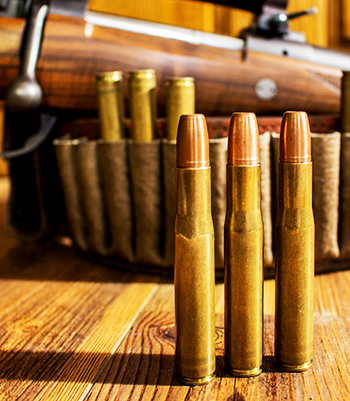
Starting with the elder of the two, the .404 Jeffery came onto the scene in either 1906 or 1907 (this date has been the topic of debate, but my friend Phil Shoemaker has a certified 1907 .404 Jeffery rifle), and was designed to be a rimless variant of the .450/400 Nitro Express, also known as the .400 Jeffery.
Instead of simply maintaining the .410-inch diameter bullet of the .450/400, the .404 Jeffery utilized a .423-inch diameter bullet of 400 grains, at the same muzzle velocity of 2150 fps, generating 4,100 ft.-lbs. of energy. A 300-grain load at 2600 fps was also offered, but was not very effective against dangerous game.
With a slight shoulder of 8˚-30′, the Jeffery case feeds like it was greased, and was an undeniable blend of striking power and low recoil. It was chambered in Vickers rifles, and was issued to the game scouts of Rhodesia, Tanganyika and Uganda for dangerous game control work.
Some feel that the initial loadings of the .404 Jeffery—the 400-grain/2150 fps combo—are a bit anemic, but for over a century it has worked and worked well. Though it isn’t among the most popular cartridges in the safari world—yet it has earned a place of reverence among professional hunters and those in the know—it has received a facelift as of late, with modern loads sending those 400-grain slugs at 2325 fps, for 4,800 ft.-lbs. of muzzle energy.
My own favorite handloads drive the 400-grain bullets at 2280 fps, mainly because that’s where I found the best accuracy; my Heym Express .404 Jeffery will put three shots into 0.75-inch at 100 yards. That load has taken elephant, buffalo and a good number of species of plains game.
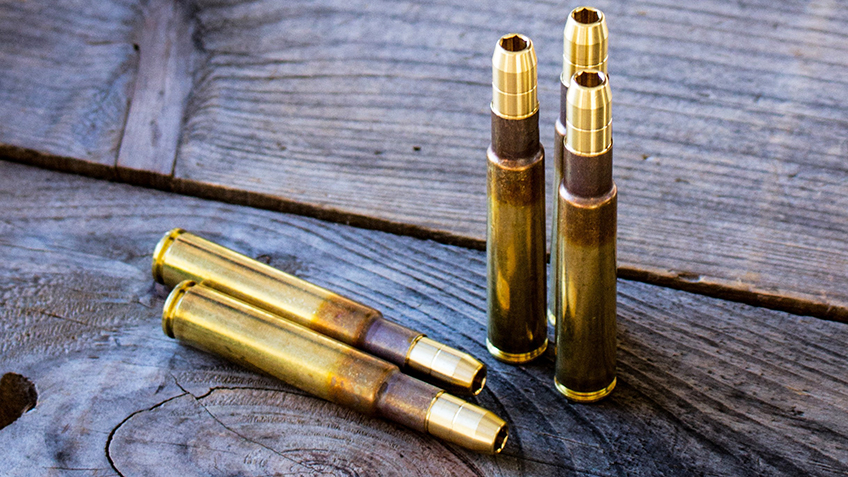
In 1911, London’s John Rigby & Co. released what would become one of their most famous proprietary cartridges: the .416 Rigby. Bearing marked similarities to the earlier .350 Rigby Magnum—they share the same 45-degree shoulder—the .416 Rigby used a unique bore diameter and a case large enough to prevent extraction problems in the heat of Africa and India.
The .416 Rigby was advertized as driving a 410-grain bullet at 2370 fps, for just over 5,100 ft.-lbs. of energy. This formula—well, actually a 400-grain 416” bullet at 2400 fps—would go on to become an undeniable classic, with the .416 Hoffman and .416 Remington Magnum replicating the recipe, albeit at a higher pressure.
Though the number of rifles produced prior to World War II was actually quite low—a whopping total of 169 rifles—it was the writing of experienced African hunters like John ‘Pondoro’ Taylor who sang its praises; but the 1953 release of Robert Ruark’s Horn of the Hunter, in which he idolized his PH Harry Selby and his .416 Rigby, that sealed the cartridge’s fate.
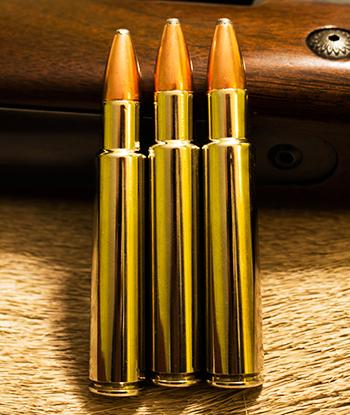
Selby’s .470 double rifle had been accidently run over and damaged, and the only suitable rifle he could find in Nairobi was a “dirty, rusty-looking .416 Rigby.” Though there were so few produced, the reputation of the .416 Rigby inspired writers like Jack O’Connor, who also sang its praises.
The 400-grain .416-inch bullet has a sectional density of 0.330, and that plays a big part in the penetration for which it is so famous. Federal and Ruger helped make the cartridge and rifle available, when both announced that ammunition from Federal would feed the new Ruger Safari Magnum, chambered in .416 Rigby in 1989. There are plenty of factory loads, as well as component bullets available for the .416.
So, while both of these cartridges have a rather impeccable reputation, which one makes a better choice for the dangerous game hunter? This is a tough one for me personally, as logic would dictate that the wider availability of the .416 Rigby—including the resurgence of the Rigby Big Game rifle—coupled with the slight velocity advantage would give it the edge.
However, having spent a considerable amount of time with both cartridges—in a few different rifles—I will admit that the Rigby recoils harder than does the Jeffery. It’s also easier to get an extra cartridge in the magazine with the narrower Jeffery case than with the big Rigby case.
I don’t think the modern Jeffery load—the 400-grain bullet at 2350 fps—gives up much to the Rigby, though the higher sectional density of the Rigby bullet might influence a choice, but the greater frontal diameter—.423-inch v. .416-inch—might offset that concept. In the Norma PH line of ammunition, which uses heavier-than-normal bullet weights, both the Rigby and the Jeffery drive a 450-grain Woodleigh softpoint or FMJ to the same muzzle velocity of 2150 fps.
Both kill very well, both have proven to be very accurate (I have sub-MOA loads for both) and both are wonderfully nostalgic.
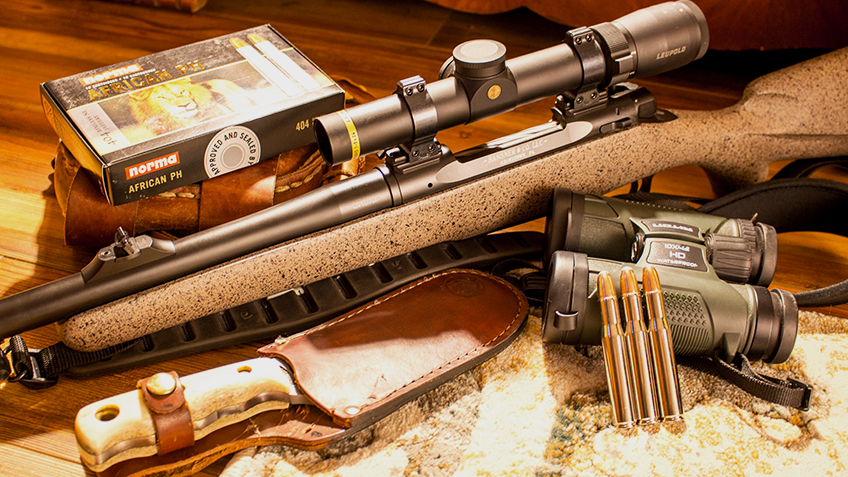
I wouldn’t find fault with a hunter for choosing one way or the other, so I’ll settle the argument with my own personal decision: I own two .404 Jeffery rifles—a Heym Express and a Bansner Custom—and I don’t own a .416 Rigby.
That said, you can’t go wrong with either. Though the Rigby is capable of higher velocities via handloading, I don’t really feel it’s necessary in a dangerous game situation. Dead heat here.
Categories
Some red hot Gospel about Ammo

Speer’s 220-grain jacketed soft-point was a classic, and while it is no longer produced,
it was a favorite among sixgunners with its half-jacket and semi-wadcutter front end.
It works well in Dave’s Smith & Wesson and Ruger revolvers.
As revolver bullets go, the old half-jacket Speer 200-grain hollowpoints and 220-grain softpoints may have looked like lead semi-wadcutters with really long gas checks, but out of my .41 Magnum revolvers, they worked like champs.
Indeed, back when I started handloading, these were among the most highly-recommended bullets I could use, according to older guys from whom I sought advice.
Alas, they went out of production some years ago, and I was lucky enough to have stocked up. But time passed, I went through a lot of bullets, discovering along the way how my sixguns also performed very well with the 210-grain JHPs from Nosler and Sierra, and the 210-grain XTP from Hornady, all loaded over stout charges of either H110 or then-Hercules (now Alliant) 2400.

Propelled by propellants such as H110, the 220-grain bullet was, as described
in a Speer reloading manual, a very effective deer bullet.
As my supply of the classic Speers dwindled, I had sort of resigned myself to living without what I considered one of the best bullet designs for magnum revolvers to ever come along.
Sure, the bullet design didn’t have the best ballistic coefficient, either for the .410-caliber pills for my .41 Magnums or the .429-caliber projectiles for the .44 Magnum, but they worked for me. The .44s were offered in two weights and styles, a 225-grain hollowpoint and a 240-grain softpoint.
Checking back in time via an old Speer reloading manual, I found the company also made a half-jacket 146-grain hollowpoint and 160-grain soft point in .357-caliber, though I never used them, since in those days, I pretty much stuck with 125-grainers. My bad.

Fired from Dave’s Ruger Blackhawk, the half-jacket Speer is capable of decent accuracy, even though he had one flyer.
Anyway, a couple of months ago, the gods smiled on me because a fellow reloader on Facebook, whom I’ve never met but he says he’s been a longtime reader of my stories relating to the .41 Magnum, reported that he had acquired a box each of the 200- and 220-grainers.
This got my immediate attention because my stores of the 220-grain bullets had dwindled to less than 40. Charles Hill, who shares my affinity for the .41 Magnum, shipped the soft points to me and I was all-too-happy to reimburse him for the shipping cost. He said he’d probably never use them, and they were part of a shipment he’d gotten from another guy, and so …

During a recent range session, the 220-grainer delivered the goods in terms of muzzle velocity. This load on the receiving end packs a punch.
Don’t Download!
A couple of things apparently lead to the demise of this bullet design. One was the downloading of the half-jacket projectiles, despite advice in the Speer loading manuals to not use them in “light, low velocity loads.” Indeed, Speer Reloading Manual #11 specifically cautions readers, “Bullets of this jacketed semi-wadcutter style should not be used in light, low velocity loads.”
Jacket separation apparently was a problem at low velocity; something I’ve never done with my magnum handloads. After all, what’s the point of having a magnum-caliber handgun if all you do is shoot light loads? That has never made sense to me.
But Allan Jones, who worked for Speer until his retirement, offered more detail about why this bullet design took a bow. While he did say jacket separation was a problem with “overly light loads,” he also recalled that Speer’s expansion of its plated bullets, which, in his words, “were far better bullets.”
I’ve shot a lot of plated Speer bullets, especially in my .45 ACP pistols, and they did perform remarkably well. Still, that half-jacket softpoint remains a favorite, maybe just because it was different.
When it was more readily available, I ran this pill over 15.5 grains of 2400 over a CCI 300 large pistol primer. This load would clock right around 1,200 fps out of my Blackhawk. Now, here’s an interesting historical tidbit: In the Speer Reloading Manual #11, the data listed for the 220-grain soft point called for a beginning load of 16.0 grains of 2400 with the maximum set at 17.5 grains, with a magnum primer.
But jump ahead to Speer Reloading Manual #14 and the starting charge recommendation is 14.2 grains of 2400 with the max being 15.8 grains, and a standard primer. All bullets were firmly roll crimped.

When Dave took delivery of a full box from a fellow .41 Magnum afficionado, he immediately loaded up a bunch of empty brass. The Speer soft point has a distinctive profile.

Every now and then, a little treasure surfaces. Dave’s Facebook friend Charles Hill send these along. Bullets such as these sometimes show up at garage or estate sales, or even gun shows.Keep your eyes peeled!
Despite the fact they’ve been discontinued, published data on these bullets—and especially the 220-grain version—for H110, 2400 and other popular propellants, still shows up.
Evidently there are still supplies of these Speer bullets still out there, and people keep using them, or find them at garage sales after some handloader has either passed—and the family is selling off his/her supplies—or just grown too old to continue.
Several years ago, I shot a mule deer buck with my Blackhawk, using a 200-grain Speer hollowpoint, along with a 210-grain JHP, and the buck didn’t get up to complain.
And, out of my Blackhawk many years ago, I managed hit a distant rock at about 150 yards with a couple of the 220-grain specimens at the bottom of a coulee in eastern Washington, shooting off a backpack for a rest.
Recently, I’ve also been shooting 220-grain Rainier Ballistics plated bullets over Accurate #9 with very good results out of both my Ruger and a Model 57 Smith & Wesson with a 6-inch barrel, but to suddenly come into possession of 102 (total) of the discontinued Speer bullets was like stumbling onto a small treasure.
I’ll credit fellow writer Brian Pearce for turning me onto Accurate #9 as a substitute for 2400, and so far this propellant has not let me down. I also use it to launch 215-grain cast lead semi-wadcutters with a beveled base from Rim Rock Bullets over in Polson, Montana, and that powder-bullet combination rocks, when launched by Winchester large pistol primers. I have used them to hit game-sized steel targets at better than a hundred yards.

Naturally, Workman weighed each bullet. Speer’s jacketed soft point was, in Dave’s recollection, remarkable for hitting the scale as advertised.
My Current Recipe
As for the 220-grain Speers, over 19.5 grains of H110, ignited by a CCI 350 large pistol magnum primer, I get decent accuracy with both my 6-inch Model 57 S&W and my 6 ½-inch Ruger Blackhawk, which turned in the slightly better muzzle velocity of 1,330 fps.
A 220-grain .41-caliber bullet traveling at that velocity is going to hit like a hammer and penetrate well into the vitals. I’ll acknowledge right up front that this load in either handgun delivers a snappy recoil, but it is nicely manageable for those used to shooting magnum sixguns.
So, what’s all of this about? In addition to gleefully enjoying this bullet bonanza, my motives also lean heavily toward self-preservation in the wilds.
I happen to live in the Pacific Northwest, and in just my immediate vicinity since May 2018, there have been two unprovoked mountain lion attacks—one was fatal—and more recently, a black bear sow attacked a teenage hiker when he apparently came between her and a cub, on one of the state’s most popular (translation: busy) hiking trails.

In the Pacific Northwest during hunting season, author keeps a .41 Magnum sixgun close at hand. He’s missed opportunities when legal bucks just wandered into range.
Normally, bears tend to stay away from such high traffic areas, and since the game cops couldn’t find this critter, she’s still out there, and she obviously has no reluctance to tangle with a human.
It’s not that I’m eager or even slightly interested in having to shoot a bear in self-defense, but I’m also not keen on the idea of being mauled in the unlikely chance a bear and I cross paths. I’ve come very (make that
uncomfortably) close to black bears before, and I figure if I can’t break that habit, the odds may be piling up against me.
During the fall deer season, I invariably carry a .41 Magnum even in camp. Should a buck wander past (which has happened to me a couple of times over the years) while my rifle is in its case, I might still manage to notch my tag with a carefully administered handgun shot.

Dave lives in bear and cougar country, where a wheelgun stoked with handloads
topped by a 220-grain Speer just might come in handy!
Henceforth, I plan to keep an eye peeled for garage sales where it just might be possible to come across another little jackpot of the 220-grainers.
Meanwhile, I’ll be using the ones I now have sparingly, hoping beyond hope that I score again. The fact that loading data is still showing up in the Hodgdon Annual Manual is a pretty good hint that somewhere, someone must have a supply that maybe, just maybe, they’ll be willing to share.
Categories