Category: All About Guns
The FN SCAR has grown from the 5.56 rifle reviewed here into a full family spanning fast-handling carbines and 20-inch precision rifles. For 2026, the question is no longer whether the SCAR is interesting. It is whether the 16S, 17S, or 20S makes enough sense to justify one very serious swipe of the credit card.
Editor’s Note: We updated the original FN SCAR 16S review for 2026 to include the SCAR 17S and 20S, 6.5 Creedmoor options, current MSRP information, the latest generation of SCAR changes, a model comparison, and buying guidance. The original author’s test data and comments remain intact so readers can see both where the commercial SCAR started and where FN has taken it.
Table of contents
- FN SCAR 16S vs. 17S vs. 20S: The 2026 Lineup
- FN SCAR 16S: The 5.56 Carbine for SCAR Purists
- FN SCAR 17S: The Battle Rifle Sweet Spot
- FN SCAR 20S: The Long-Range Member of the Family
- FN SCAR in 6.5 Creedmoor: What Changed?
- The Original FN SCAR Review: Where the Story Started
- SCAR 16S Trigger Time: Why the Original Rifle Won Us Over
- Which FN SCAR Should You Buy in 2026?
- Original FN SCAR 16S Technical Specifications
- Related Reads from GunsAmerica Digest
FN announced its next generation of commercial SCAR rifles in January 2026. The 16S, 17S, and 20S retain the unmistakable SCAR silhouette but receive more than two dozen updates, including a lighter, hydraulically buffered two-piece bolt carrier, revised triggers, extended receivers with M-LOK, fully ambidextrous controls, AR-pattern pistol-grip compatibility, and an updated gas system. FN also designed the new rifles around improved compatibility with forward-venting suppressors.

FN SCAR 16S vs. 17S vs. 20S: The 2026 Lineup
Back when this review was written, the commercial SCAR conversation centered heavily on the 16S and 17S. That is no longer enough. The SCAR 20S joined the commercial family in 2018, 6.5 Creedmoor reached the 20S in 2020, and the caliber later migrated into the 17S side of the family as well. For 2026, FN lists the 16S as its 5.56x45mm carbine, while the 17S and 20S are available in 7.62x51mm and 6.5 Creedmoor.
| 2026 Model | Primary Role | Current Caliber Options | Barrel | 2026 MSRP |
|---|---|---|---|---|
| FN SCAR 16S | General-purpose carbine | 5.56x45mm | 16.25 inches | $3,799 |
| FN SCAR 17S | Battle rifle / versatile heavy carbine | 7.62x51mm, 6.5 Creedmoor | 16.25 inches | $3,999 |
| FN SCAR 20S | Precision / DMR-style rifle | 7.62x51mm, 6.5 Creedmoor | 20 inches | $4,499 |
The current MSRP spread is surprisingly narrow considering how different these rifles are in purpose. Published 2026 pricing lists the SCAR 16S at $3,799, the 17S at $3,999, and the 20S at $4,499. Actual dealer and GunsAmerica pricing can move around, so MSRP should be treated as the comparison baseline rather than a guaranteed checkout number.
FN SCAR 16S: The 5.56 Carbine for SCAR Purists
If what you want is the basic SCAR experience without feeding a larger cartridge, the 16S remains the logical doorway. It is the 5.56x45mm member of the rifle family and the closest civilian relative to the SCAR-L that started this whole story. The new generation keeps the 16.25-inch barrel but moves to FN’s redesigned hydraulic-buffer system, updated controls, extended M-LOK receiver, revised trigger, and more conventional accessory compatibility.
The buyer case for the 16S is straightforward. You want SCAR engineering, SCAR ergonomics, and SCAR cachet, but you prefer the lower recoil and ammunition economics of 5.56. It remains the easy answer for high-volume range use and anyone who wants the lighter-caliber end of the family. The awkward part is that $3,799 is still a heroic amount of money for a 5.56 semiautomatic rifle. Nobody ever accused the SCAR of competing in the bargain aisle.
FN SCAR 17S: The Battle Rifle Sweet Spot
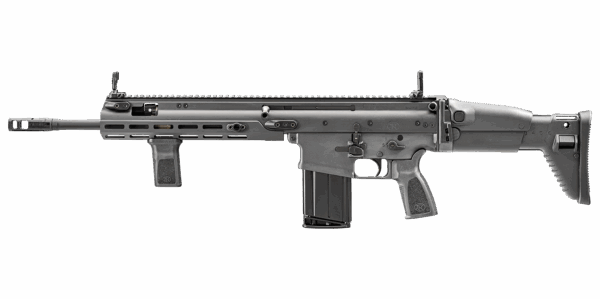
The 17S is the rifle for the shooter who looks at the 16S and thinks the same basic idea would be more entertaining with a larger hole in the barrel. For 2026, the 17S is offered in 7.62x51mm and 6.5 Creedmoor, retains a 16.25-inch barrel, and carries a published MSRP of $3,999. The new generation also gets the same hydraulic-buffer concept and modernization found across the refreshed SCAR family.
For a lot of buyers, this is the most broadly useful SCAR. The 7.62 version carries considerably more cartridges than the 16S without turning the rifle into the long, heavy precision package that is the 20S. If your mental image of a SCAR involves a hard-hitting folding-stock battle rifle rather than a 5.56 carbine or a prone precision gun, the 17S is likely the one haunting your credit card.
FN SCAR 20S: The Long-Range Member of the Family
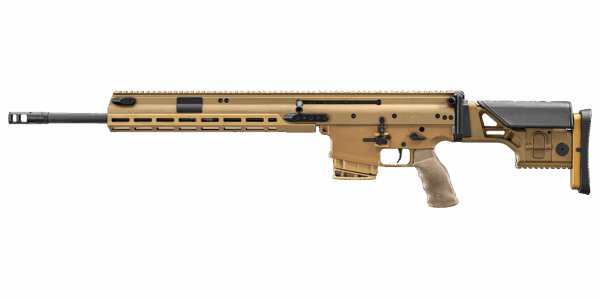
The SCAR 20S changes the mission. FN released the commercial precision rifle in 2018 with a 20-inch barrel, an extended receiver, an adjustable precision stock, and a two-stage trigger. It was closely inspired by the MK 20 SSR configuration and built to stretch the SCAR platform into precision-rifle territory.
The 2026 20S remains a 20-inch heavy-profile precision rifle and is offered in either 7.62x51mm or 6.5 Creedmoor. Current published specifications list a 10.7-pound weight and $4,499 MSRP, along with the precision-oriented stock and updated two-stage trigger.
This is not the SCAR I would choose if most of my shooting involved standing drills at conversational distance. It is the one I would choose if the point of buying a SCAR were magnified glass, a supported position, and making steel ring a very long way from the firing line. GunsAmerica has already taken the SCAR 20S into that world, and the platform has demonstrated exactly why FN stretched the receiver and barrel in the first place.
FN SCAR in 6.5 Creedmoor: What Changed?
FN announced the SCAR 20S in 6.5 Creedmoor in January 2020. That rifle used a 20-inch barrel with a 1:8” right-hand twist, the same precision stock concept, and the two-stage Geissele Super SCAR trigger used in the 7.62 precision rifle of the period. FN listed its MSRP at $4,499.
The caliber did not stop there. FN released a limited-production SCAR 17S DMR in 6.5 Creedmoor in 2023, then announced 6.5 Creedmoor barrel assemblies for the 17S in 2024. With the 2026 redesign, 6.5 Creedmoor is part of the current 17S and 20S lineup rather than an interesting footnote tacked onto one precision model.
That gives buyers a clean philosophical split. The 7.62x51mm models preserve the classic heavy-SCAR identity and broad ammunition familiarity. The 6.5 Creedmoor versions make the most sense when efficient long-range performance is the priority. Put another way, if most of your targets are close enough to read the writing on them, the Creedmoor advantage is largely academic. If you routinely run out of magnification before you run out of range, it becomes much more interesting.
The Original FN SCAR Review: Where the Story Started
The HK416 that DevGru used to introduce Osama bin Laden to his seventy dark-eyed virgins was itself an evolutionary offshoot of the space-age weapon that Gene Stoner and a few others conjured up way back in 1958. While its ergonomics are unparalleled and its design undeniably inspired, the basic chassis is more than half a century old. Back in 1958, a telephone was tethered to the wall, weighed as much as a frying pan, and was nearly as large. Surely this deep into the Information Age we could do better.
About every twenty minutes, somebody in the US Army posts a list of specifications that drives the flower of modern engineering prowess into an apoplectic furor of frenetic gun design. The carrot that drives all this capitalistic chaos is the prestige and subsequent vast market share that opens up to the weapons company that supplies the guns that American grunts pack downrange. In addition to the obvious monetary benefits of a fat government production contract, everybody knows that the coolest kids on the block serve with the US Special Operations Command. If Uncle Sam’s Bad Boys are humping a particular smoke pole, then everybody else on the planet will want one just like it.
Most of these fishing expeditions don’t amount to much. Everybody gets tooled up for a while, but budget priorities change, somebody new moves into the White House, or we go to war someplace else, and the process starts anew. Such boondoggles brought us the XM8 assault rifle as well as the XM25 Counter Defilade Target Engagement System. These weapons were both undeniably awesome, but you can’t find one outside a museum nowadays. However, now and then something truly magical happens.
Sig’s new M17 Modular Handgun System made such a splash. Uncle Sam now wants more than 400,000 copies. Additionally, everybody’s aunt out here in the civilian world is waiting in line for one as well. A proper government arms contract can put a company firmly on the map. With this as an impetus in 2004, Fabrique Nationale rejoiced when their newest rifle system was selected as the new Special Operations Forces Combat Assault Rifle.
SCAR: The World’s Coolest Acronym
SCAR stands for Special Operations Forces Combat Assault Rifle.
It was decided soon after the turn of the century that our boys and girls in SOCOM needed something spiffier than a fifty-year-old M16 variant. They go places and do things that others don’t, so their requirements might be a bit more stringent than is the case for the rest of us mere mortals. After a competitive comparison wherein the baddest operators in the business did their dead level best to tear up everybody’s newest toys, the FN offering reigned supreme. The end result was indeed a spanking piece of iron.

Modularity is the new gospel in modern firepower, and the FN SCAR just drips with it. The upper receiver starts out as an extruded bit of aluminum, while the polymer lower contains the fire control system and secures the magazine. There are two major military subtypes. The SCAR-Light (SCAR-L) runs 5.56x45mm. The SCAR-Heavy (SCAR-H) chambers 7.62x51mm. There were rumors of conversions allowing these guns to fire 7.62x39mm and 6.8x43mm Remington, but these variants never really made it to prime time. The SCAR-H can also be fitted with a conversion kit allowing it to run smaller 5.56x45mm rounds. The SCAR-L cannot be scaled up, however.
Both versions run off of a gas tappet design similar to that of the M1 Carbine. This particular method of operation keeps all the crud up front in the weapon so the operating parts stay clean and cool. The bolt carrier is a fairly massive piece of kit, so the rifle has plenty of spare energy to keep the action running when it gets dirty. The barrels are chrome-lined, free-floated, and easily exchanged. This allows a single chassis to be used for long-range engagements, mid-range assault rifle chores, and close-range CQB missions. There’s that modularity again.
Starting at the nose, the original SCAR uses a proprietary muzzle brake/flash suppressor that looks like a Jackson Pollock painting but remains undeniably effective. The gas system of the SCAR is easily adjustable without tools. Top-quality backup iron sights fold when not needed yet deploy quickly for use when life goes truly sideways. The front sight is adjustable for zero, while the rear sight readily compensates for bullet drop. The gun sprouts enough Picatinny rail space to mount a tactical crockpot along with a modest pinball machine.

On the rifle tested for this original review, the charging handle is rigid and reciprocates with the action so it can be used as a forward assist device if needed. This appendage is easily reversible at the user level, but one needs to mind one’s fingers lest they get pinched when rushed. The magazine release is in the expected place on both sides of the rifle, while the bolt release runs exactly like that of an M4. You can drop the bolt just as easily by giving the charging handle a quick snatch to the rear.

Current FN commercial SCAR rifles use the newer generation of controls and operating components rather than the exact reciprocating arrangement reviewed here. The 2026 redesign also adds a hydraulically buffered two-piece bolt carrier and fully ambidextrous controls.
The safety/selector is bilateral and in the same spot as that of the M4. However, on the original rifle it only rotates through maybe 80 degrees. In this regard, it more closely resembles that of an HK G36. The SCAR-L is designed to feed from NATO-standard 5.56mm magazines. The SCAR-H uses proprietary FN magazines.
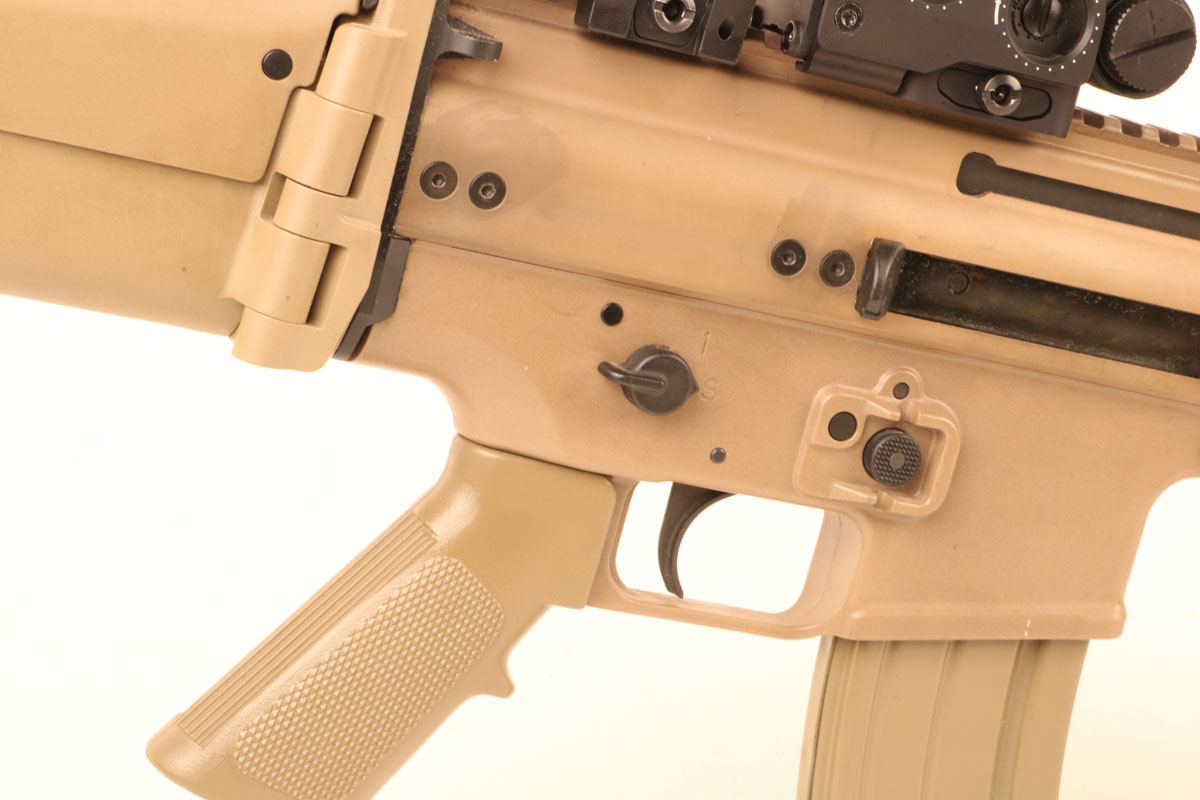
The real magic happens with the rear end of the rifle. The stock on the SCAR is as adjustable as your favorite recliner. Once you get it tweaked, the gun fits you like your most beloved pair of broken-in boxer shorts. In addition to a readily adjustable length of pull and comb height, the whole shebang pivots to the right for storage if need be. The rifle will still shoot fine with the stock folded, but nobody in his right mind would run it that way for real. By my count, there are six different sling attachment points. If you can’t find a handy place to hook a sling you are being too picky.
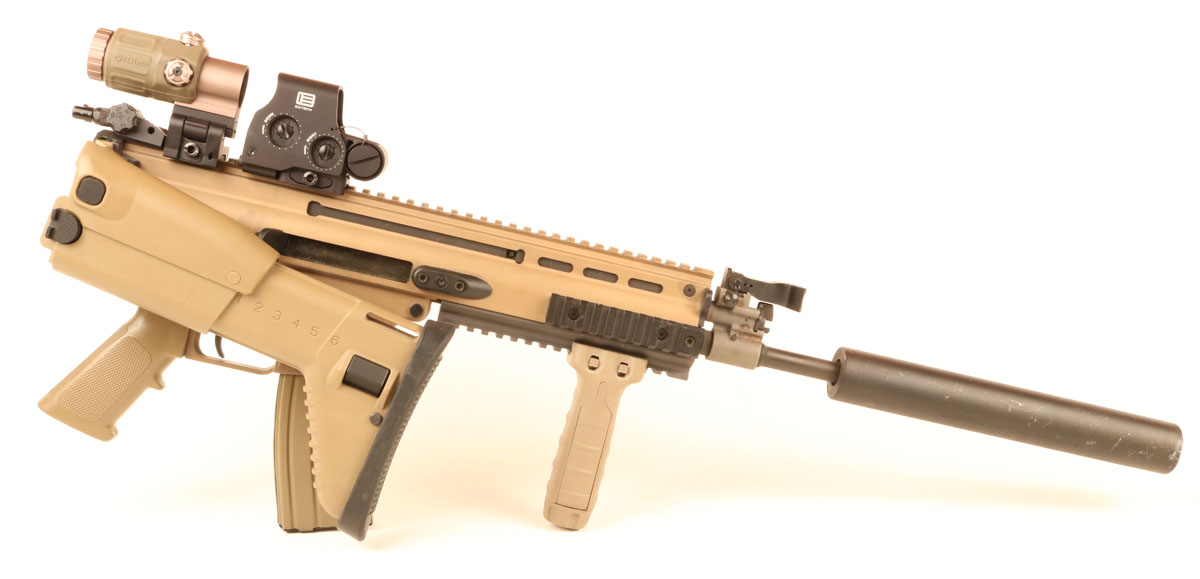

EOTech on the SCAR 16S: Tactical Glass That Still Works
I topped my SCAR with a new EOTech EXPS2 Holosight sporting a green reticle in concert with a flip-up magnifier. These two items are hardly cheap, but the last thing Osama bin Laden saw as he embarked for his well-earned eternal reward was the angry end of a Holosight. I can think of no higher accolade.

The perception of color is a billion-dollar industry. The good ladies in my medical clinic will order blue t-shirts calling them periwinkle and pink ones titled mauve. Out here in guy-world where I live such things are much simpler. Blue is just blue, while pink is simply pink. However, our eyes do typically get a lot more mileage out of green than red.
Take laser sights as an example. Both green and red laser sights may put out the same 500mw of power, yet the green sort is perceived as being much brighter. Green dots seem to throw much farther than red. In the case of the newest Holosight, the same cool laser-born holographic reticle seems to magically hover out over your target, but the green reticle is six times easier to see in daylight than is the red sort.
I have more than half a century on my eyes so I suffer from the inevitable age-related Presbyopia. This means I can see fine at a distance but need reading glasses up close. However, that weird Holosight reticle projected onto a little pane of indestructible glass two inches from my eyeball remains crystal clear just like my distant target. I have no idea how it works. Fairy dust maybe.
SCAR 16S Trigger Time: Why the Original Rifle Won Us Over
A tricked-out SCAR is an absolute dream on the range. The controls are all easily accessible, and once properly adjusted the buttstock fits me like a second skin. Recoil is a joke, and the gun stays flat and true at reasonable assault rifle ranges. The reciprocating charging handle on this original rifle takes a little getting used to, but it’s not a chore. Care must be exercised, however, not to pinch your fingers between the charging handle and the Holosight.

The gun is bulkier than your M4, though no heavier. The safety doesn’t seem quite so easy to re-engage, but I’ve been running an M16 since I was seventeen. Some things are tough to unlearn.
They say a direct gas impingement AR is more accurate, but that’s nuance at best. The SCAR shoots great as far as my eyes will allow. Anybody who splits those hairs is just a snob.
Particularly with a can in place, the gun is pleasantly front-heavy. This means doubles are fast and easy. Muzzle rise on semi-auto with the SCAR is not a real thing. After a proper afternoon turning ammo into noise, I find I must agree with SOCOM. The SCAR is the ultimate shooting machine.
From SOCOM to the Civilian SCAR Family
After a great deal of fanfare, USSOCOM bought enough SCAR-L rifles to outfit a Ranger Battalion and then sent them downrange with their best wishes. By all accounts, the weapons performed admirably, but, like a dog chasing a squirrel, Uncle Sam got distracted, ran out of money, and called the whole thing off. By 2013, all those lovely SCAR-L rifles had been pulled out of inventory and likely, knowing the government, ended up chopped up into beer cans or something comparably ignoble.

The SCAR-H still soldiers on with alacrity, albeit in markedly smaller numbers. A conversion kit indeed allows this rifle to run 5.56 ammo if desired, and the SCAR-H occupies the Designated Marksman Rifle role that had been filled by antiquated though updated M14 variants previously. Internet chatter claims that the Navy SEALs are still particularly fond of the gun. That is likely true. However, the Internet also tells me that Caitlyn Jenner is carrying the Loch Ness Monster’s baby and that the moon landings were faked on a soundstage in New Mexico. One mustn’t believe everything one reads.

FN is quick to point out that the SCAR got binned for budgetary reasons and not something more sinister. Nobody disputes that the SCAR is a better rifle than the M4. It is simply that Uncle Sam discovered more pressing places to spend our hard-earned cash. After a little trigger time on mine, I find myself quite taken with the gun as well.
The Original SCAR 16S Verdict, and What Changed Since
The FN SCAR 16S is the semi-auto civilian version of the SCAR-L. It’s an undeniably great rifle that is pretty crazy expensive. If you are in possession of a robust credit card, you can usually find a couple right here at GunsAmerica. I bought mine at a good price at a Sheriff’s auction of seized guns, of all places. The rifle is in fine condition, but I am intrigued by the story. How someone on the wrong side of the law ended up with such a rarefied combat rifle is thought-provoking, to say the least.
The SCAR rode its SOCOM cred to be adopted by twenty-seven different countries as well as LAPD SWAT. Belgium adopted the SCAR as their standard Infantry arm. Though our snake-eaters took a step back to their old M4 carbines, I suspect we will still see more of the SCAR in the future. The FN SCAR really is tomorrow’s high-end combat rifle.
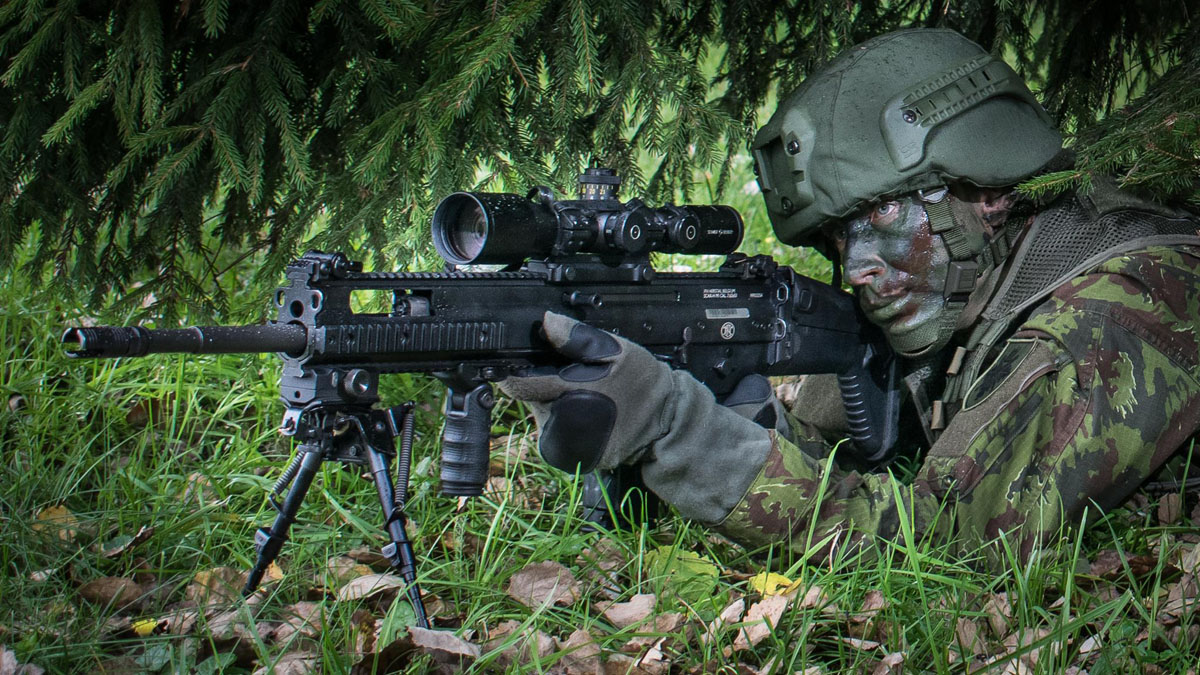
2026 update: That final prediction aged pretty well. The American commercial family now includes the SCAR 16S, 17S, 20S, and 15P, while the 2026 rifle redesign represents the largest consumer-facing mechanical refresh of the platform in years. FN says the new 16S, 17S, and 20S incorporate more than two dozen changes while preserving the basic SCAR identity.
Which FN SCAR Should You Buy in 2026?
Buy the SCAR 16S if: you want the light-caliber SCAR experience, favor 5.56x45mm, expect to shoot higher round counts, and do not need the additional reach or authority of the heavy receiver family. It is the cleanest descendant of the SCAR-L idea and the least expensive new SCAR rifle, though “least expensive” remains a relative term at $3,799.
Buy the SCAR 17S if you want the quintessential civilian battle-rifle version of the platform. It gives you the compact 16.25-inch format with a choice of 7.62x51mm or 6.5 Creedmoor and lands only $200 above the 16S at published MSRP. For the buyer who can afford one SCAR and wants the model with the broadest personality, this is the sweet spot.
Buy the SCAR 20S if your SCAR is going to wear serious magnified glass and spend a meaningful portion of its life shooting from supported positions at distance. The 20-inch heavy barrel, precision stock, and two-stage trigger push it decisively toward the DMR and precision side of the spectrum. At $4,499, it costs only $500 more than the 17S, but it is a distinctly different animal.
Pick 7.62x51mm if you want the traditional SCAR-H flavor and broad familiarity of the cartridge.
Pick 6.5 Creedmoor if long-range efficiency is the priority and the rifle will spend more time stretching distance than living as a general-purpose battle rifle.
Our overall pick: For most buyers deliberately shopping the SCAR family rather than simply looking for a 5.56 rifle or a precision semiauto, the SCAR 17S makes the strongest case. It sits between the 16S and 20S in mission, delivers the heavy-SCAR experience people usually picture when they hear the name, and now offers both 7.62x51mm and 6.5 Creedmoor. The 16S remains the smarter choice for 5.56 devotees, while the 20S is the specialist’s rifle.
FN SCAR Pros & Cons in 2026
- Pros: Distinctive short-stroke gas-piston design, strong military lineage, multiple current calibers, user-changeable barrel architecture, highly adjustable stocks, 2026 hydraulic recoil buffering, extended M-LOK receivers, modernized controls, and separate carbine and precision configurations.
- Cons: Premium pricing remains brutal, the 20S is substantially heavier than the carbines, and buyers comparing the platform with mature AR-pattern rifles can get formidable performance for significantly less money.
Original FN SCAR 16S Technical Specifications
Historical note: The specifications below are preserved from the original SCAR 16S review. They describe the rifle tested at the time and should not be confused with FN’s redesigned 2026 SCAR 16S.
| Model | FN SCAR 16S |
|---|---|
| Caliber | 5.56x45mm |
| Operation | Short-stroke Gas Piston |
| Magazine Capacity | 10/30 |
| Weight | 7.25 pounds |
| Barrel Length | 16.25 inches |
| Overall Length | 27.5 inches folded/37.5 inches extended |
| Barrel | Hammer-forged, Chrome-lined, Free-floated |
| Original MSRP | $3299 |
Original FN SCAR 16S Performance Results
| Load | Group Size (inches) | Velocity (feet per second) |
|---|---|---|
| American Eagle 55gr FMJ | 2.1 | 2969 |
| American Eagle 50gr JHP | 1.9 | 3194 |
| HSM 55gr Sierra Blitzking | 0.8 | 2976 |
| SIG 60gr HT | 1.5 | 2605 |
Group size is the best four of five shots measured center to center and fired from a simple rest at 100 meters. Velocity is the average of three shots fired across a Caldwell Ballistic Chronograph oriented ten feet from the muzzle.
Current FN SCAR Pricing at a Glance
| Model | 2026 MSRP |
|---|---|
| FN SCAR 16S | $3,799 |
| FN SCAR 17S | $3,999 |
| FN SCAR 20S | $4,499 |
Those figures reflect published MSRP for the new-generation lineup announced for 2026. Market pricing can vary.
What happened to Billy the Kid’s guns? After all, if Billy the Kid was the most famous outlaw of all time, there ought to be a record of what happened to his firearms. And if there isn’t, well, maybe Pat Garrett didn’t really kill him.

Believe it or not, we actually do have records.
On the night of July 14, 1881, Billy stepped into Pete Maxwell’s darkened bedroom at Fort Sumner with a butcher knife in one hand and a pistol in the other, and seconds later Sheriff Pat Garrett put a bullet in his chest.
And we’re not going on Garrett’s word alone. Deputy John Poe said that when they finally got a candle and looked in, Billy was stretched out on his back “with a six-shooter lying at his right hand and a butcher knife at his left.” Pete Maxwell told the coroner’s jury that Billy came in “with a gun in his hand.” Celsa Gutierrez, who lent Billy the knife, said “he didn’t have anything but his gun and the knife” when he left her house. And Billy’s friend Paco Anaya wrote that after the shooting, Deluvina Maxwell took the pistol from Billy’s hand and put it on the bureau.
It was a Colt Model 1877 in .41 caliber, what collectors oftentimes call the Thunderer. It was a self-cocker, another term for double-action. Most revolvers of the day were single-action, meaning you had to thumb back the hammer before every shot. With a self-cocker, the trigger does all the work. It was also the second self-cocker Billy was known to carry (we’ll get to the first one in a moment).

Billy was buried at Fort Sumner the following day, and Garrett left town with his guns. Most people assume that’s the last anybody ever heard of them, but thankfully that’s not the case.
On October 3, 1881, Garrett wrote a letter on his official letterhead to the Lincoln County Commissioners: “I have in my possession two horses and one saddle captured from Frank Wheeler also one gun and six shooter captured of William Bonney, which await your orders.”
The reply came back the same day from commission chairman W. W. Paul: “Report of P. F. Garrett of captured property. Approved and sale ordered.” County clerk Ben Ellis filed it, and the original is still at the county courthouse in Carrizozo. Shout-out to the always helpful Ben Doss, who pointed me there. I reached out, and the courthouse kindly sent me a copy.

So not even three months after Billy’s death, his pistol and long gun were sitting in Lincoln as captured property, listed on the same page as a horse thief’s horses.
Fun fact: That horse thief, Frank Wheeler, rode with Jesse Evans and Jimmy Dolan during the Lincoln County War. In 1879, Billy named him in a letter to Governor Lew Wallace as one of the men driving stolen cattle to the Mescalero reservation.
Now, Garrett wasn’t always the most reliable narrator. So how do we know he really had Billy’s pistol? Because Charlie Siringo, of all people, says he bid on it.

Siringo met Billy in Tascosa in the fall of 1878, while he was punching cattle for the LX. They shot at targets together and swapped gifts, a cigar holder for a book. According to Siringo’s biographer, Howard Lamar, that was probably the only time they ever met.
But Siringo later rode with a posse after the Kid, and he made several more trips to New Mexico, including to Lincoln. In his 1920 History of Billy the Kid, he wrote, “During the following spring in the town of Lincoln, the sheriff auctioned off the Kid’s saddle, and the blue-barrel, rubber-handled, double action Colt’s 41 calibre pistol, which the Kid held in his hand when killed.
There were only two bidders for the pistol, the writer and the deputy county clerk, Billy Burt, who got it for $13.50. Its actual value was about $12.00.”
Thirteen dollars and fifty cents. Somewhere around four hundred bucks in today’s money, for the gun Billy the Kid was holding when he died. And only two people bothered to bid on it.
Is there a catch? Mostly with the date. Siringo puts the sale in the spring of 1882, months after the commissioners approved it.
It’s worth noting that Siringo’s book on Billy the Kid is error-ridden, and most historians don’t fully trust it. But according to his biographer, Howard Lamar, Siringo was called to Lincoln in October 1881 to serve as a witness against Pat Coghlan, the Tularosa rancher who’d been buying the cattle Billy stole.
That’s the same month Garrett wrote his letter. Coghlan got his trial moved to Mesilla, and Siringo ended up spending the whole winter in Lincoln County. So whether the sale took place that fall or the following spring, Siringo would have been in Lincoln County when it happened.
As for Billy Burt, he was definitely a real person. In fact, the Kid borrowed Burt’s horse when he escaped from Lincoln, promising to send it back. And true to his word, the pony wandered into town a few days later dragging a rope.
I found Burt on the 1880 census in White Oaks, a 24-year-old miner from New York living with his father, right next door to James W. Bell, the deputy Billy killed during his escape. By 1881, Burt was working in Lincoln as deputy county clerk under Ben Ellis, the same Ben Ellis who filed Garrett’s letter.
After that, unfortunately, the trail peters out. I did find a William Burt of roughly the same age, with a father of the same name, who died in Massachusetts in 1888. He never married and never had children. If that’s our man, did he still have the pistol when he passed? Or did he get rid of it before he left New Mexico? Your guess is as good as mine.
The rifle’s a different story. Garrett’s letter lists “one gun” separately from the “six shooter.” We know Garrett ended up with the Kid’s Winchester 1873 carbine, serial number 20181, the one Billy grabbed from the courthouse armory the day he killed Bell and Olinger. We can’t say for sure it’s the same “gun” named in the letter, but if it is, it never made it to the auction.
Garrett gave it to Captain Joseph Lea, the former Confederate guerrilla now known as the Father of Roswell. Lea and the other Pecos cattlemen had talked Garrett into running for sheriff in 1880 to stop the rustling coming out of Fort Sumner. So when Garrett gave Lea the Kid’s rifle, along with the shotgun Billy used to kill Bob Olinger, he was handing them to the man who’d put him in office to bring in the Kid in the first place.

We know this because Lea swore to it. In January 1897, with Garrett still very much alive, Lea signed a statement before a notary in El Paso: “The Winchester saddle gun, number 20181, was the gun of the Kid, the noted New Mexico outlaw. The cal. 10 shotgun, number 903, was the gun the Kid used to kill Robert Olinger with at Lincoln in 1881. Both guns were given to me by Mr. Garrett, noted sheriff of Lincoln.”
Both guns were displayed at the New Mexico Military Institute, which Lea founded, from 1898 until 1925. After Lea died in 1904, they passed through his family to his son-in-law, Hiram Dow, then to the collectors John Bunting and Robert McNellis, and eventually to a Texas A&M professor named Jim Earle.
In 2021, Bonhams sold both of them at auction. The shotgun went for $978,313 and the rifle for more than $300,000. Credit where it’s due, the aforementioned Ben Doss ran down every name on that chain of ownership. As for why Garrett gave the rifle away instead of selling it as the commissioners ordered, that I don’t know.
Two more of Billy’s guns can be traced at least part of the way. When Garrett’s posse caught Billy at Stinking Springs in December 1880, he was carrying a different Winchester. According to Siringo, posse member Jim East later told him, “The Kid made me a present of his Winchester rifle, but old Beaver Smith made such a roar about an account he said Billy owed him, that at the request of Billy, I gave old Beaver the gun. I wish now I had kept it.” So in other words, Billy the Kid’s Winchester got traded for a bar tab.
He also had his first self-cocker on him that day, a Colt Lightning, the .38 caliber version of the 1877 model. Garrett took it off him, and according to historian Robert Stahl, Billy asked that it be given to Mike Cosgrove, the Las Vegas mail contractor who’d shown him some kindness after his capture, to hold until he got out of jail. Whether Billy ever got it back is uncertain.
And then there’s the butcher knife. Nobody turned it in to the county, because it wasn’t a weapon. It belonged to Celsa Gutierrez, Garrett’s sister-in-law, and Billy borrowed it that night to cut some meat at Pete Maxwell’s. Her son, Candido, swore in a 1951 affidavit that he saw Billy pick it up. According to Paco Anaya, after the shooting,
Deluvina Maxwell took Billy’s knife and put it away in Pete Maxwell’s bureau. The Maxwell family says Pete’s sister Paulita kept it afterward, and it stayed with her descendants for more than a century.
In 1926, Deluvina signed a statement with her mark saying that the knife in the possession of Paulita’s daughter, Adelina Welborn, “is the original that Billy the Kid held in his hand at the time of his death.” Ursula Pacheco Baca, who had known Billy, swore to the same thing in 1951.

The knife eventually passed through Adelina’s daughter and granddaughter. It was sold to historian Frederick Nolan in 1997 and went to the collector Robert McCubbin two years later. In January 2019, it went up for auction in Mesa, Arizona, with an estimate of $800,000 to $1.2 million. It sold for $118,000.
So, what happened to Billy the Kid’s guns? Pat Garrett reported the pistol and a “gun” to the county, and the county ordered them sold.
According to Siringo, Billy Burt bought the pistol in the spring of 1882 for thirteen dollars and fifty cents. The courthouse Winchester went to Captain Joseph Lea, and today it’s the only one of Billy’s guns people can still put their hands on.
His other Winchester settled a bar tab with Beaver Smith. His first self-cocker went to Mike Cosgrove for safekeeping and was never heard of again. And the butcher knife stayed in Fort Sumner with the Maxwell family, or so they say.
As for that pistol, Billy Burt is unfortunately the last lead we have. If he’s the same William Burt who died in Massachusetts in 1888, and if he still had the gun when he went back east, then who knows. Maybe Billy the Kid’s pistol is still out there somewhere. Maybe it’s sitting in a dusty box in somebody’s Boston basement, wrapped in an old rag, and nobody in the house has the slightest idea it’s even there.
If you’re still looking to scratch that Billy the Kid history itch, I recently discussed the question of whether Billy the Kid left any children behind. For more than a century, rumors have tied him to a child with Paulita Maxwell, and others point to Abrana Garcia and her daughter. I dug into the family records, census entries and the stories passed down in Fort Sumner to see whether any of it holds up. You can find the episode on YouTube or wherever you get your podcasts.

Maryville, Tennessee-based Smith & Wesson announced today that it has acquired Savage Arms from JDH Holdings in a $160 million stock-and-cash transaction.

Categories