Category: The Green Machine
Categories
A Bright Shining Lie
|
||||||||||||||||||||||||||||||
|
||||||||||||||||||||||||||||||
 |
||||||||||||||||||||||||||||||
|


Getting the feel of it: Before live fire exercises, trainees use a wooden mockup of a Lewis Gun, sighting on a hand-cranked model that simulates a rocking and jinking aerial target.
National Archives And Records Administration (N.A.R.A.) photograph.
The First World War introduced a wide range of military technologies that we take for granted today. Probably the most important of these deadly innovations was the marriage of the aircraft and the machine gun. Beginning with particularly crude modifications and lash-ups, combat aviators on both sides rapidly advanced the effectiveness of the firearms of the first air war. In April 1917, the month that the United States entered World War I, the air war had progressed to such a level that the Royal Flying Corps labeled it “Bloody April,” losing 245 aircraft and more than 400 airmen. The aerial killing machines had become so efficient that the life expectancy of new pilots was measured in just a few days.
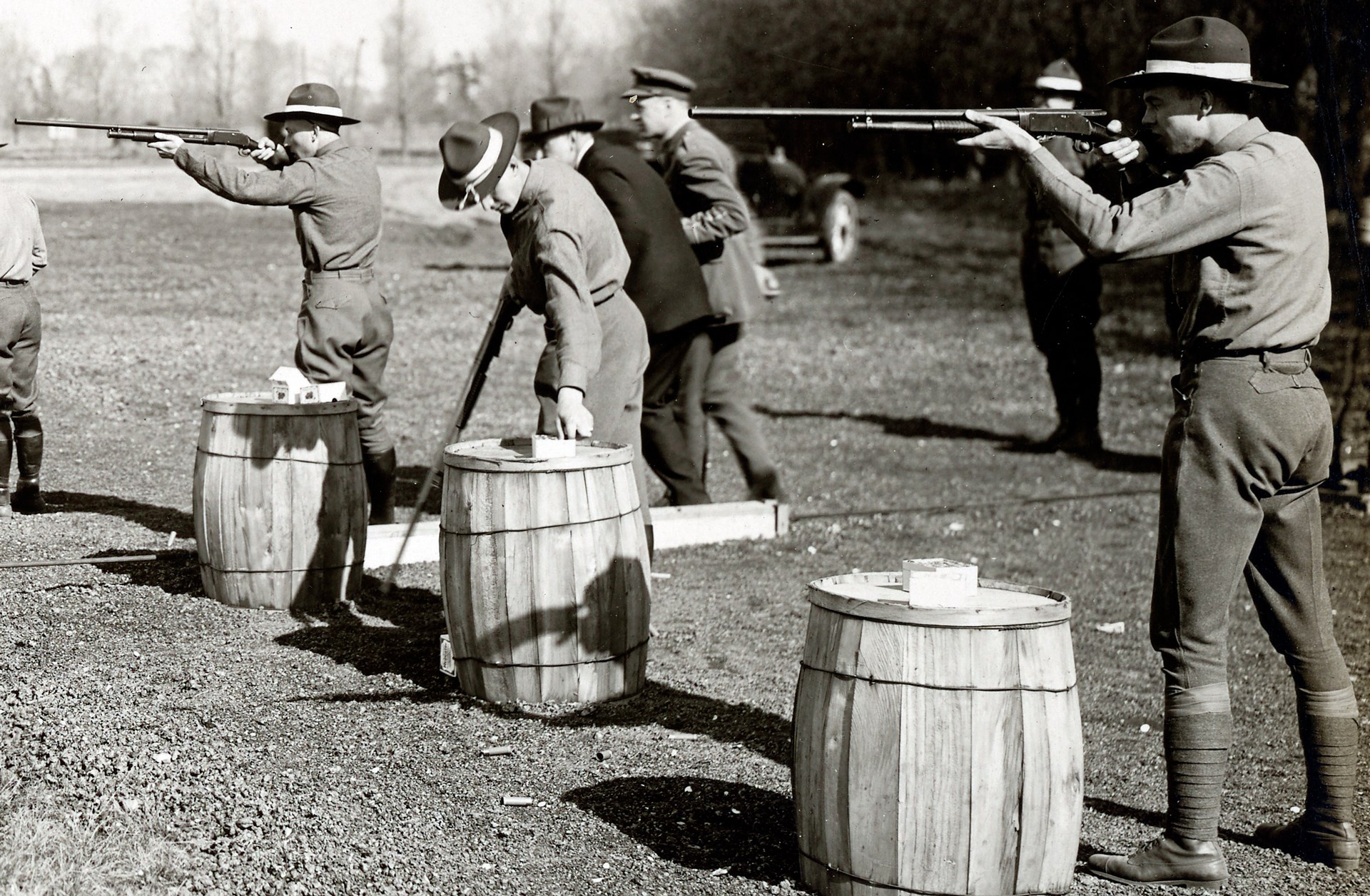 Aerial gunnery training begins: Cadets skeet shooting with Winchester Model 1897 shotguns at the University of Illinois during the spring of 1918. National Archives And Records Administration (N.A.R.A.) photograph.
From First To Worst
In 1917, America was almost completely unprepared for a modern war. Upon joining forces with the Allied nations, the U.S. military found itself without many of the firearms that European combatants already took for granted: heavy artillery, tanks, machine guns and, quite notably, combat aircraft.
Just a decade before World War I, America had pioneered the motor-powered aircraft (December 1903) and, within a few years of the war, became the first nation to fire a machine gun from the air (August 1912). But America’s world-leading military aviation potential was undone with the pen rather than the sword, as the general staff decided that the airplane was only fit for scouting—aerial combat or even bombing wasn’t considered important. Military aviation in the U.S. quickly stagnated, and even though the scouting planes attached to Gen. Pershing’s Mexican Expedition received high praise for their work, when America entered World War I, the U.S. military was without combat aircraft. Even worse, there were no combat-ready airmen or the schools to train them.
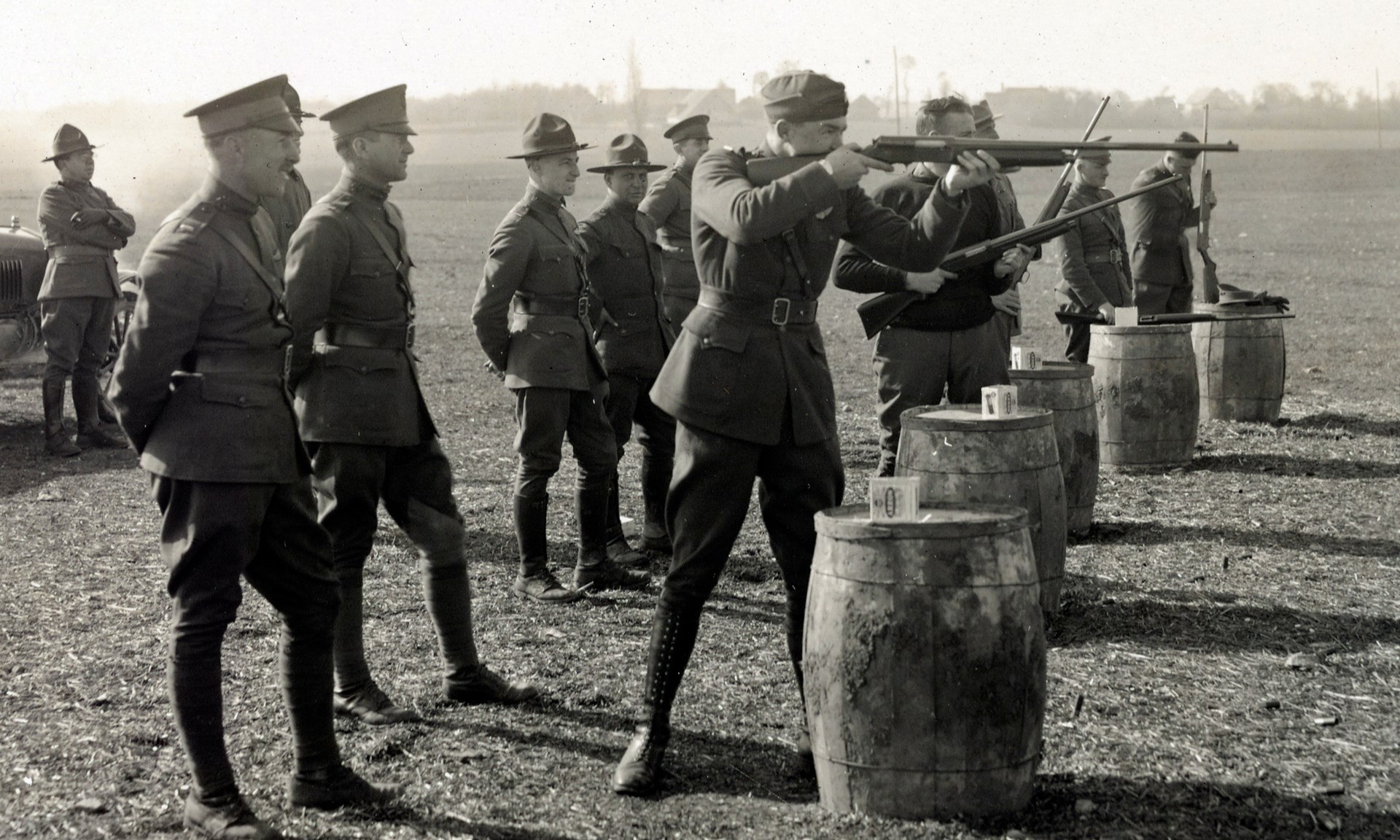 Skeet shooting continues: Shotgun shooting with the Winchester Model 11SL at the U.S. Army Air Service training center at Issodoun, France, during April 1918. N.A.R.A. photograph.
The transcripts for the Army budget hearings in early 1917 show that America’s political and military leaders had little understanding of the airplane and the gun. Chief Signal Officer Gen. Scriven responded to the Chairman of the Committee on Military Affairs in the House of Representatives:
The Chairman: How are the aeroplanes armed?
Gen. Scriven: That is another question that is very difficult of solution. They are carrying now merely the service rifle and pistol. Some men think that a short riot gun, a shot gun, should be used; others think that a gun of the Lewis type or some other such type may be well used.
The Chairman: You have not equipped them with the machine gun at all?
Gen. Scriven: Oh, yes; experimentally, we have tried some. We have used the Lewis gun, but they are not mounted. The Lewis gun weighs only 27 pounds and can be used from the shoulder. It is a very good gun.
Mr. Kahn: Are they all armed with Lewis guns?
Gen. Scriven: There are some down there; 14, I think.
Mr. Kahn: Have you ever used any other machine gun, except the Lewis gun?
Gen. Scriven: The Benet Mercie gun was used. We tried it out. I think there are some down there now. We have tried them all out thoroughly.
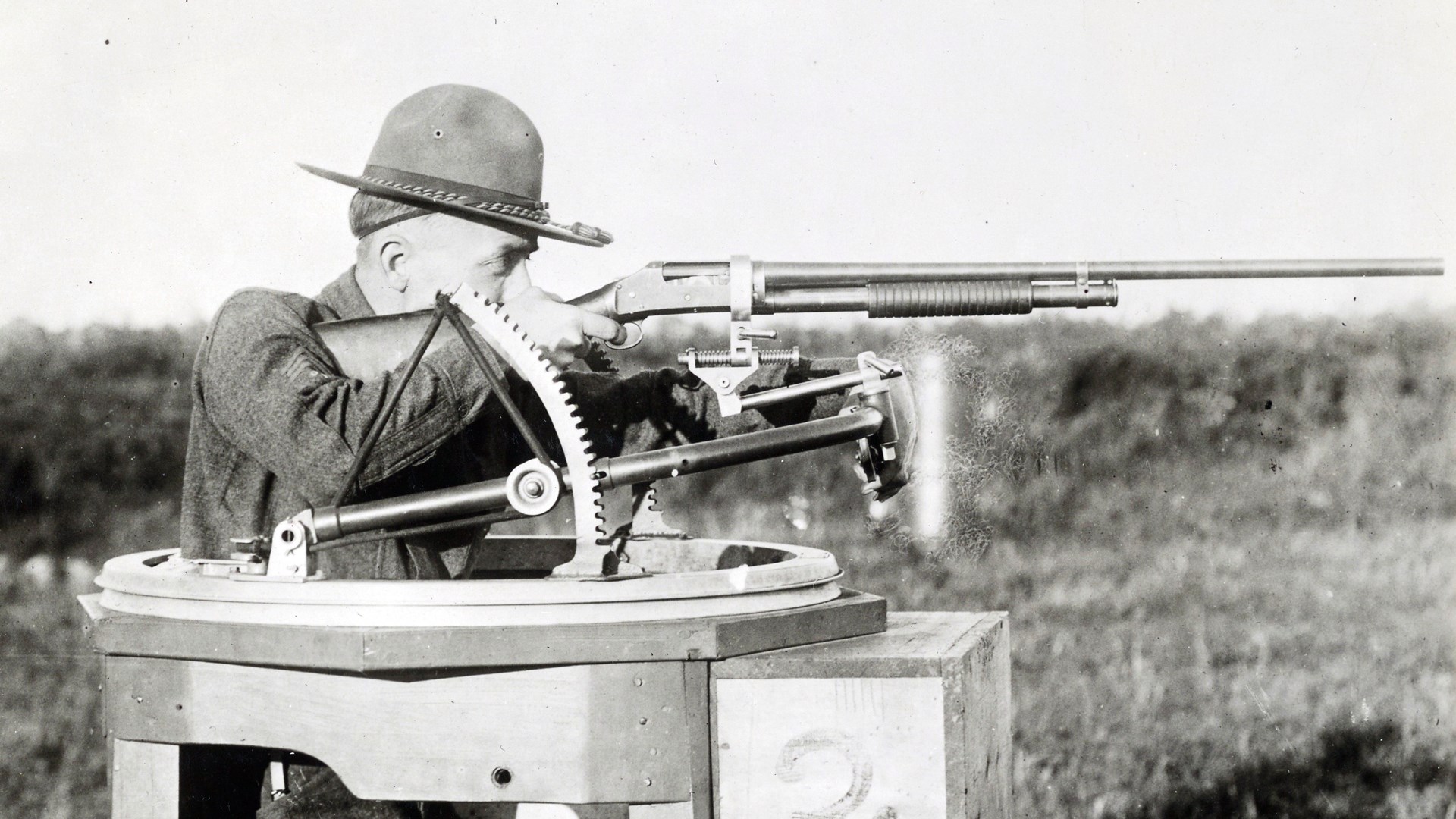 A trainee in a special turret stand equipped with a Scarff mount—featuring a special adapter to attach a Winchester Model 1897 shotgun. Selfridge Field, Mich., 1918. Author supplied photograph.
Most members of the committee were completely unfamiliar with the entire concept of air combat or the use of automatic firearms aboard airplanes. Lieutenant Colonel George Squier was recently back from London, where he had been America’s military attaché. Using his first-hand knowledge of the air war in Europe, Colonel Squier explained:
Mr. Kahn: These aerial battles are all fought with machine guns?
Col. Squier: Absolutely. On that point one might add the angle of view of the machine gun as it appears to our Aviation Section. If you will eliminate the demolitions, for instance, where you drop bombs, or the incendiary bomb, and take the pure case of a fight between aeroplane and aeroplane, it would appear that what we want is not a large gun with a few number of rounds, but a small-caliber gun with a large number of rounds, for the following reason: You get the upper berth and come at the opponent by gravity, shooting through the propeller, and you only have a very short time in which to shoot. You then go by him at the rate of a hundred miles an hour, and you come back again, if you are faster than he is. So that if you had a large gun with only one shot and did not hit him at all, your shot would do no good; but if you had the same weight of lead in a hundred shot you would be more apt to hit him; and the aeroplane is so vulnerable at present, that he would be disabled as much by that small shot as by the large one.
Mr. Greene: Col. Squier, I understand that the theory of this combat in the air is to gain control of that territory, for the other purposes for which the aeroplanes are subsequently to be used in it?
Col. Squier: Yes, sir.
Mr. Greene: The fighting itself has no particular military object?
Col Squier: Well, it is to kill the other man.
Mr. Greene: Well, to kill him, but is it in order to get control of the air zone?
Col. Squier: Yes, sir.
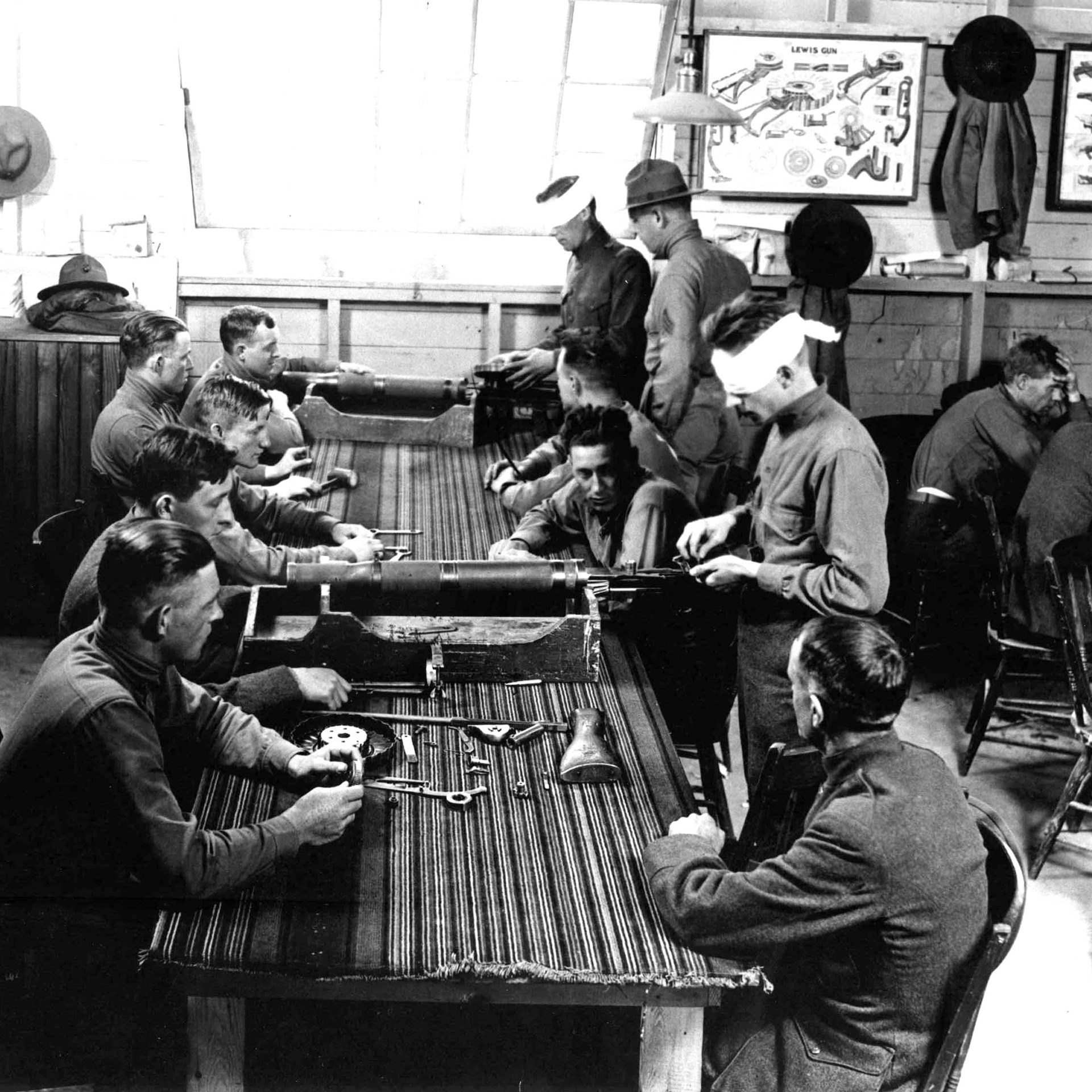 In the classroom: U.S. aviation cadets learn the Lewis gun inside and out while blindfolded. N.A.R.A. photograph.
America’s fledgling aviators may have been woefully behind in combat aviation technology, but they did have the advantage of being able to learn from several highly experienced allies—the British, French and Italian air services all contributed modern aircraft and veteran pilots to serve as instructors. As American industry began to produce aircraft and aerial firearms at a greater pace, airfields and flight schools sprang up around the nation. The U.S. Army Air Service was quickly taking shape.
Machine Guns Of The Aerial Gunners
The combat aircraft of World War I were not particularly sophisticated—at least in the early stages of the war. Consequently, the relationship between the airman and the machine gun he carried aloft was as tight knit and vital as any machine gunner and his firearm on the ground. America was late in developing machine guns, but trainees in the U.S. Army Air Service were still able to handle two of the prime firearms of the Allied air forces along with a new machine gun that would only see combat aboard American planes.
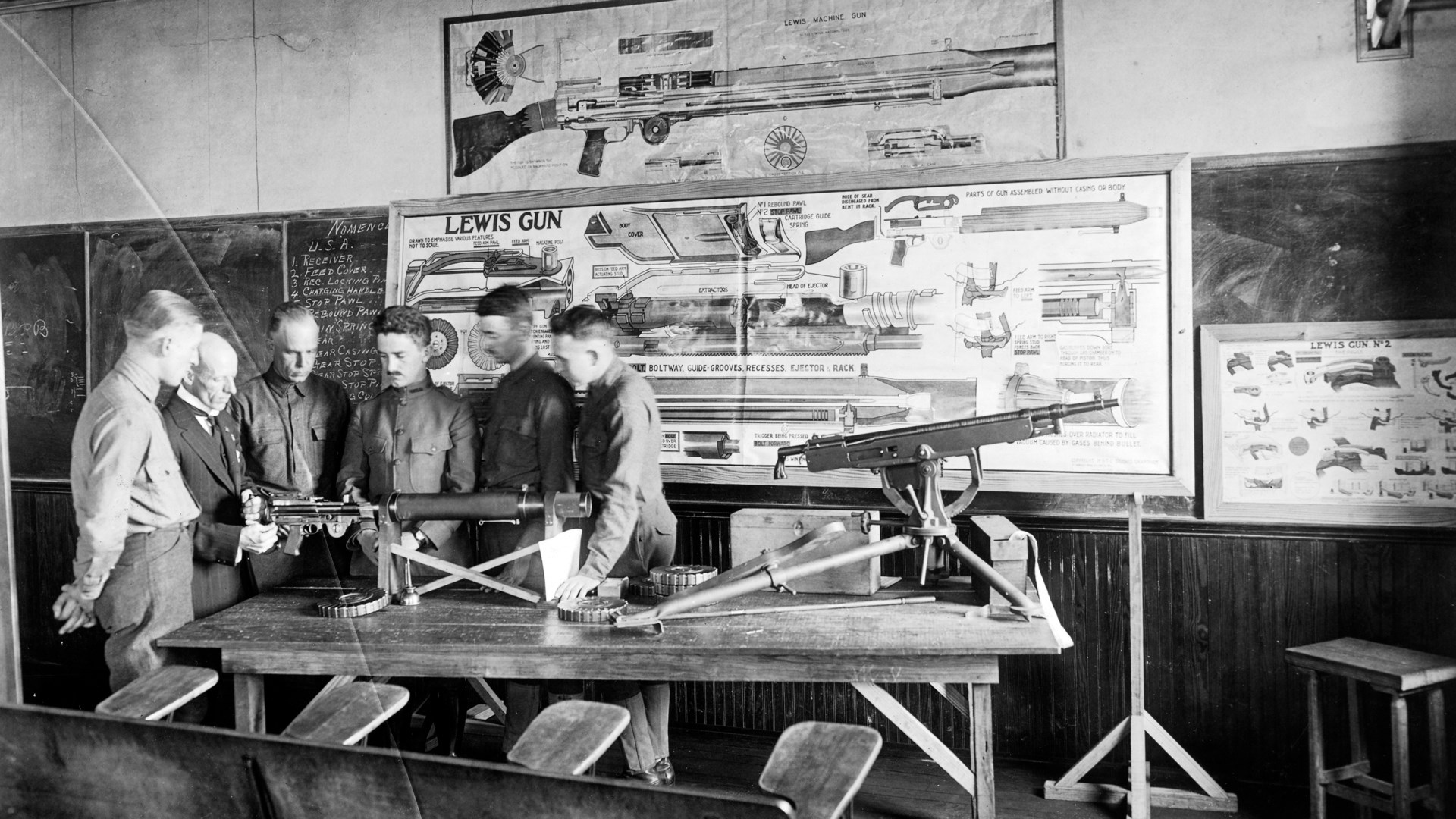 In the School of Military Aeronautics at Georgia Tech: Aero cadets learn the basics of machine guns. A U.S. .30 -cal. (Savage Arms made) Lewis Gun is seen at the left, and a Colt-Browning Model 1895 is at the right. N.A.R.A. photograph.
The Lewis Gun
The Lewis was an American design, but Col. Lewis couldn’t convince the U.S. Army to adopt his light machine gun. By early 1914, the Lewis was working with the Birmingham Small Arms Company, and the gun was made in England (in .303 British). Ultimately, the Lewis would become the preeminent defensive firearm for Allied aircraft in World War I—used as a “flexible” or “free” gun for the observer. In some aircraft, the Lewis gun was mounted on the top wing to fire above the propeller arc. There were never enough Lewis guns to truly meet Allied demands for the firearm on the ground or in the air, and some Lewis gun production came back to America. Savage Arms Company produced Lewis Mark I guns (chambered in .303 British and called the Model 1915) for Canadian forces. As America entered the war, Savage produced the .30-cal. M1917 ground gun—some of which were modified for use as aircraft guns. Finally, Savage created the .30-cal. M1918 Lewis, a purpose-built aircraft MG, stripped to save weight and equipped with a bulb-like muzzle brake. By the middle of 1918, the M1918 was mounted on most U.S. and French bombing/observation aircraft.
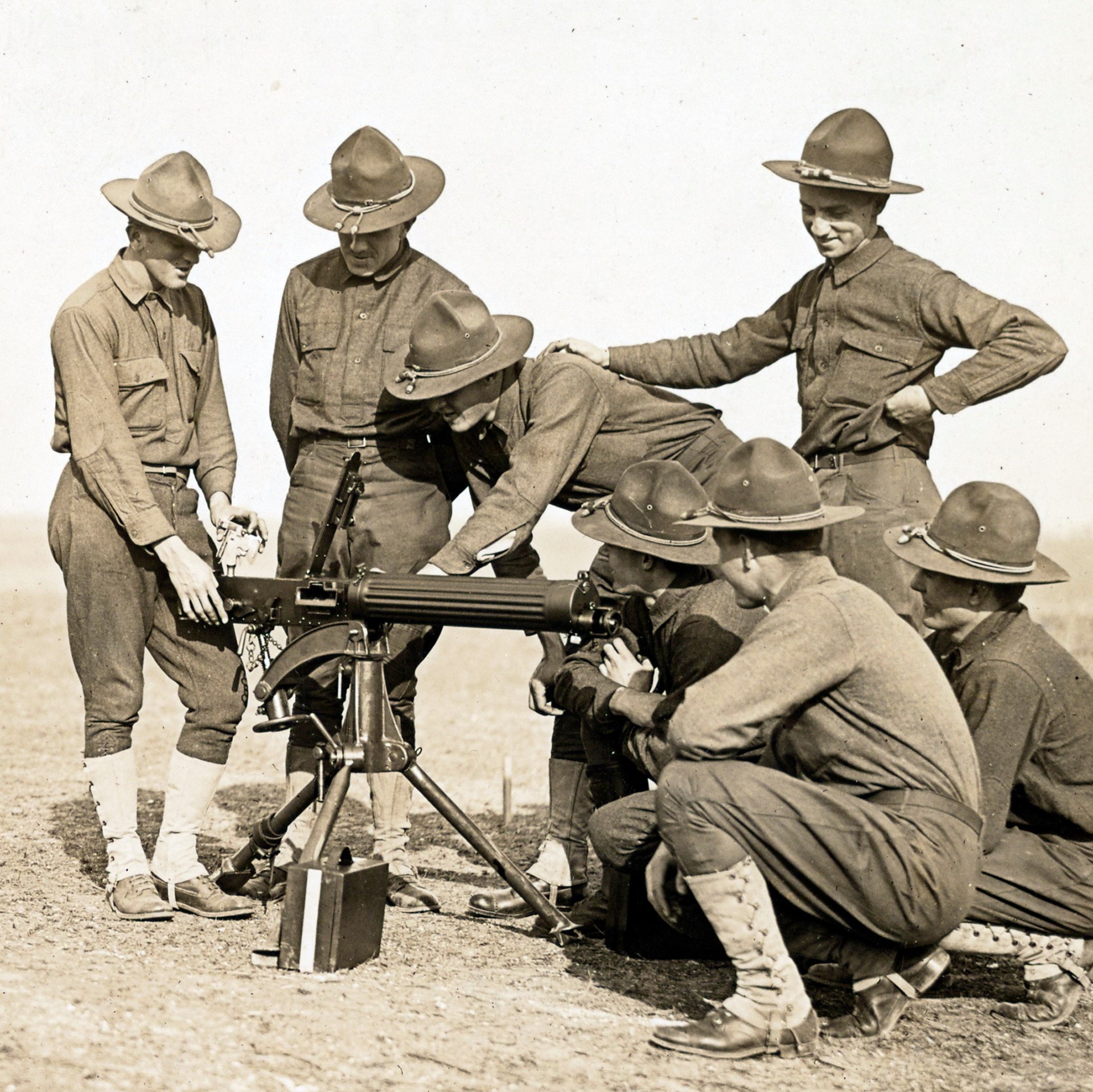 The Vickers Machine Gun was the predominant forward-firing firearm on most Allied combat aircraft. The Colt-made U.S. M1915 Vickers .30-cal. was used for training in the U.S., and many of the aircraft guns were used by both French and American squadrons. This is a standard infantry gun, seen at Ellington Field near Houston, Texas, during the summer of 1918. N.A.R.A. photograph.
The M1915 Colt-Vickers
The Vickers machine gun was the dominant Allied forward-firing aircraft gun of World War I, and this, too, was made in the U.S. in some numbers. The Colt-Vickers U.S. Model 1915 (chambered in .30-‘06 Sprg.) was destined to serve in small numbers with U.S. troops in Europe, and some of the M1915 guns were modified for use as synchronized aircraft MGs. To meet the great demand for Vickers guns, Colt then created the “U.S. Vickers Aircraft Machine Gun, Caliber .30, Model 1918,” which equipped many aircraft in the U.S. and French air services in 1918. Colt also rechambered about 1,000 of the Model 1918 guns to 11 mm French for use against observation balloons. The 11 mm round provided a useful incendiary cartridge (at least the French thought so), and these MGs were called the “Gras Vickers” or the “Balloon Gun.” American aviation cadets often became acquainted with the Vickers gun by using tripod mounted M1915 Colt guns on the target range.
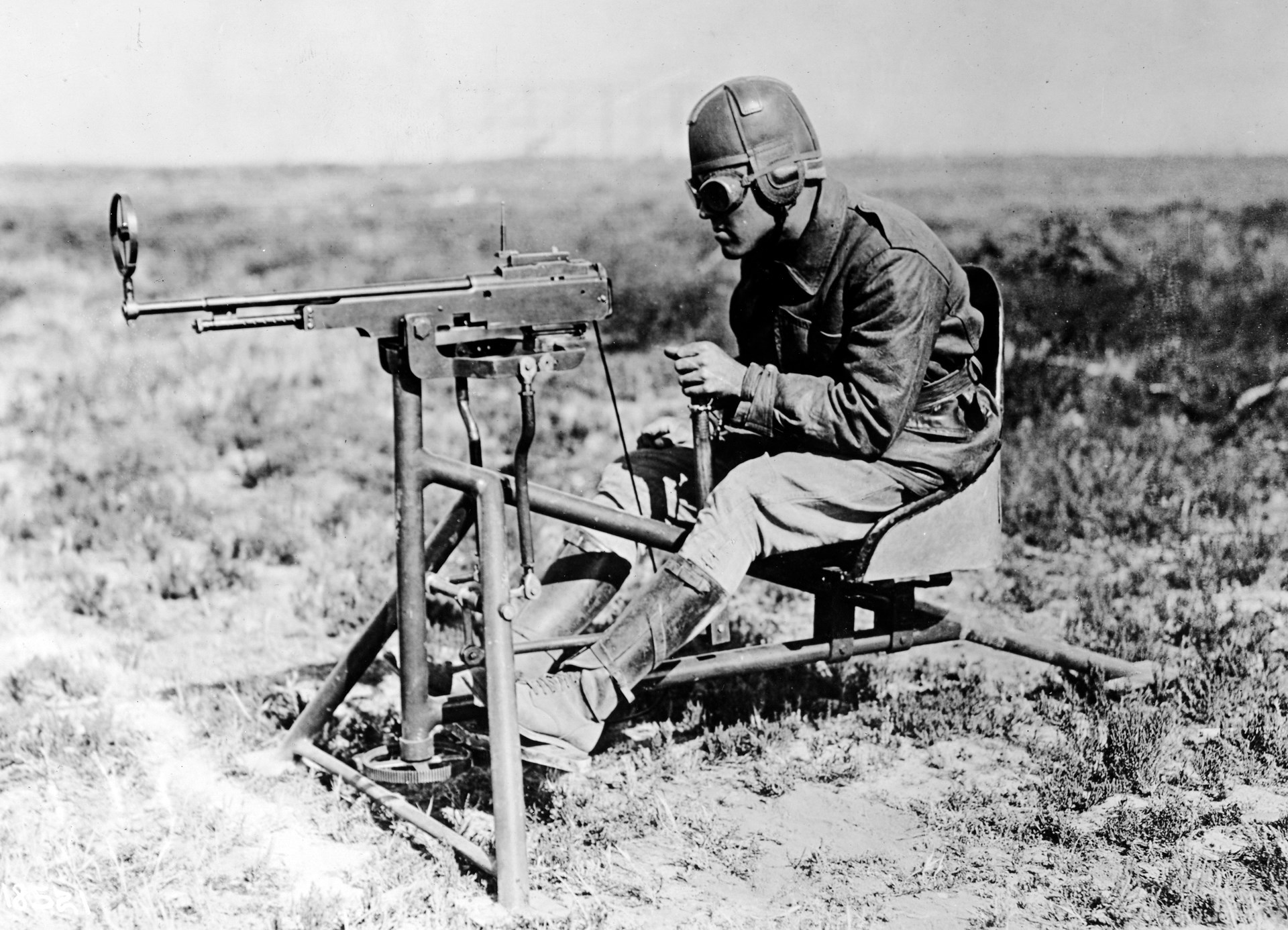 Training equipment was created alongside new firearms. Here, a crude gunnery trainer (equipped with a Marlin aircraft machine gun) is set up at a stateside flight school during 1918. N.A.R.A. photograph.
The M1918 Marlin Aircraft MG
The Marlin-Rockwell Corporation acquired the rights to produce the old Colt-Browning M1895 MG, and designer Carl Swebilius redesigned the gun, replacing the “potato-digger’s” swinging arm lever system with a straight-line, gas-actuated piston. The result was the Marlin M1917 and M1918 aircraft gun, which were faster firing (at 650 rounds-per-minute) and about eight lbs. lighter than the Vickers aircraft guns. Unfortunately, synchronizing gear and ammunition-feed systems were not ready for the new guns, and this delayed the Marlin’s combat debut until the late summer of 1918. Even so, many trainees had the opportunity to work with the Marlin gun in the U.S., and there was some familiarity with the firearm when it began to reach France in quantity. Although its service life was short, the Marlin made a very favorable impression on U.S. pilots and air crews, and it would have replaced the Vickers if the war had continued.
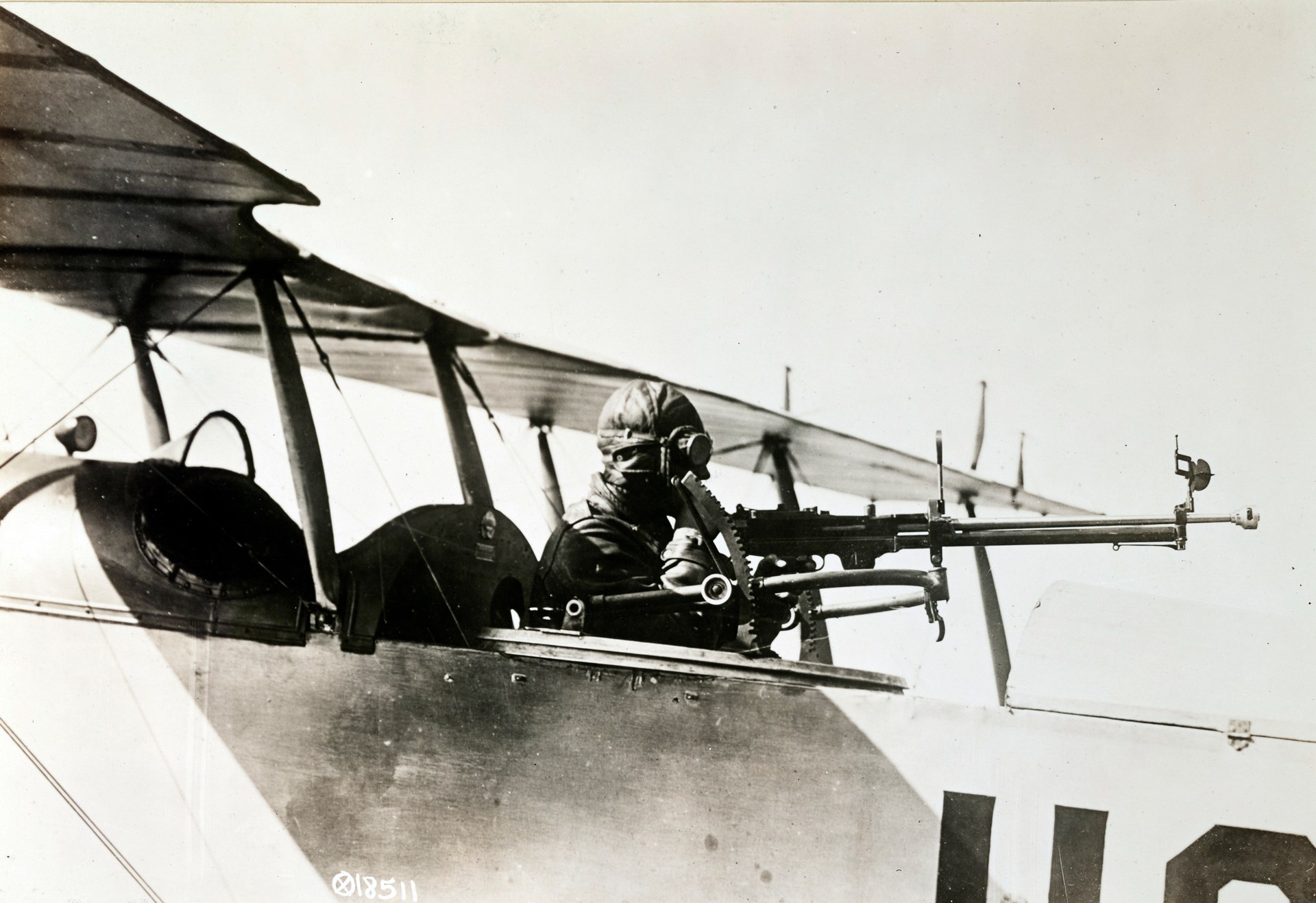 A Curtiss Jenny mounting an M1918 Lewis aircraft MG equipped with a vane sight. Texas, summer 1918. N.A.R.A. photograph.
Aerial Marksmanship
America was born as a nation of riflemen, and that foundation of marksmanship carried over to the fledgling pilots and aerial gunners training in America. One of the biggest problems that the Air Service faced, particularly in 1917, was an embarrassing lack of machine guns. Most of the Lewis guns made in America (by Savage Arms in Utica, N.Y.), were being sent to Canada and France for use with their squadrons. As more U.S.-made Lewis guns became available, many of these were used to train American infantry units.
Photos from the era show that some U.S. airmen began their gunnery training with wooden mock-ups of Lewis guns. Aviation cadets often used the elderly Colt-Browning Model 1895 MGs to get their first live-fire experiences with an automatic firearm. Colt stepped up its production of .30-cal. U.S. M1915 Vickers machine gun, and the tripod-mounted Vickers also helped air cadets get some experience with contemporary machine guns. Knowledge of the Vickers and Lewis guns was particularly important, as once in combat, these were the primary aircraft firearms on U.S. Army Air Service aircraft—the Vickers as the synchronized, fixed, forward-firing armament and the Lewis as the flexible defensive guns for the observers.
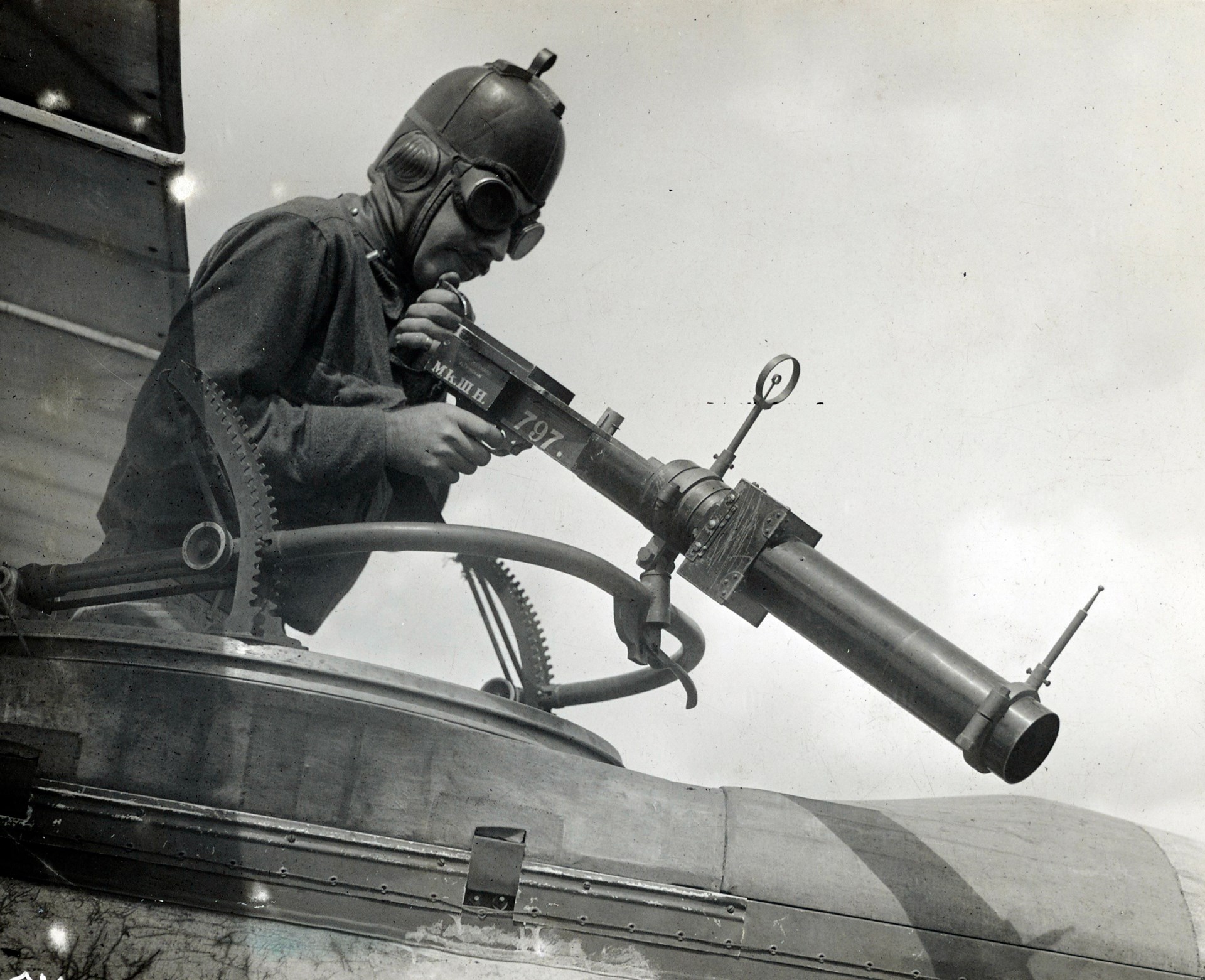 In response to shortages of aircraft machine guns and ammunition, the Hythe Mark III gun camera was introduced in 1918 to simulate the size and weight of the Lewis Gun while providing a series of images that showed the trainee’s aiming points. N.A.R.A. photograph.
Shotguns played an important role in training America’s first air gunners, and skeet-shooting was thought to be a good way to help cadets become adept at hitting fast-moving targets at a variety of angles. Pump-action shotguns, particularly the Winchester Model 1897, were favored for this training, although some early semi-automatic scatterguns, like the Winchester Model 11 SL, were also used.
Photos and films from the era show various “simulators” built to provide fledgling pilots with the rocking, buffeting and bouncing sensations that would affect their aim. In addition, various targets were constructed—ranging from simple silhouettes of German aircraft on paper targets to scale models made of wood, some used in a hand-cranked pulley system. Some pilots did a little training with their M1911 pistols or M1917 revolvers—potting away at clay pigeons or fast-moving paper targets with .45 ACP slugs.
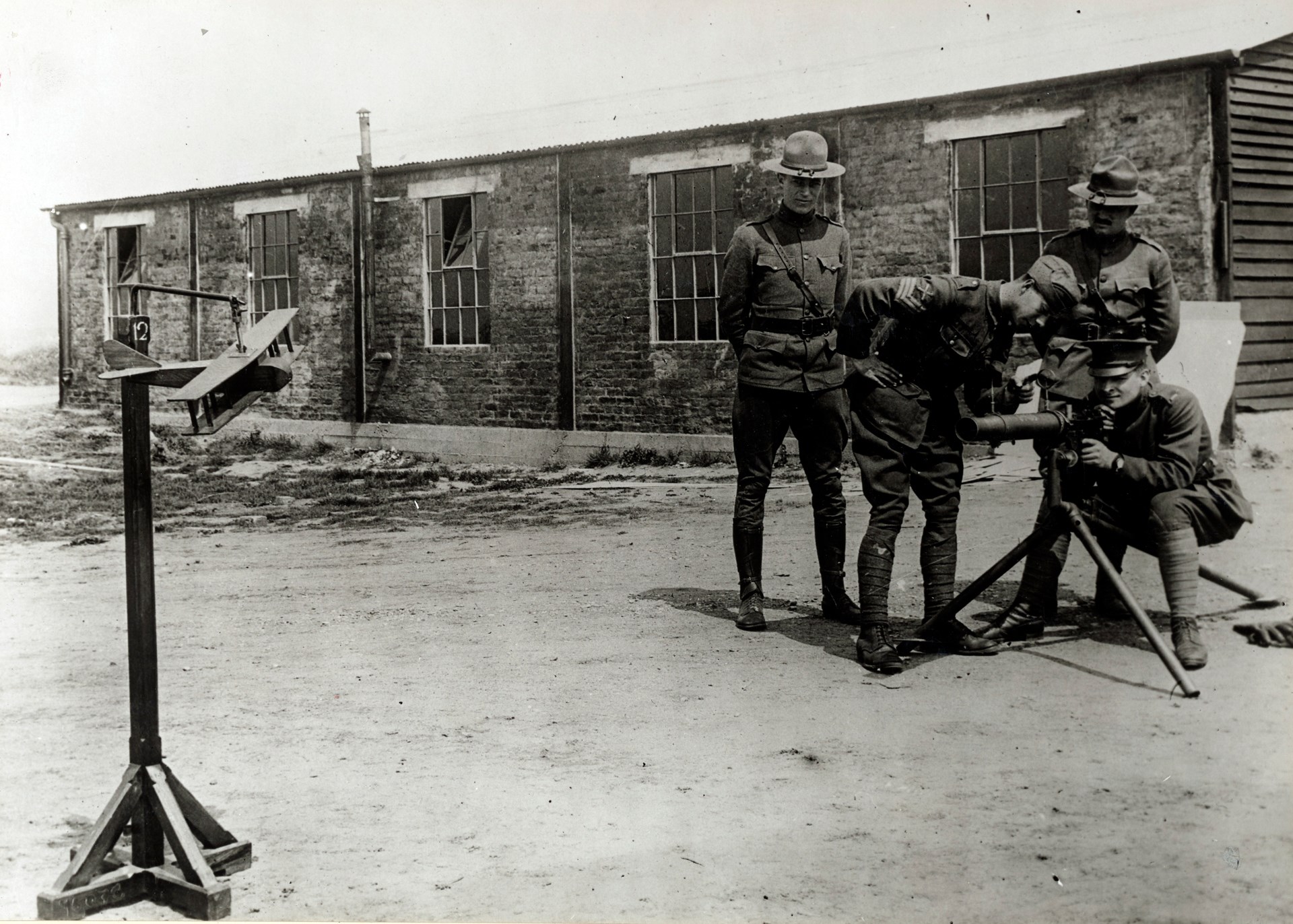 Some U.S. pilots and observers were trained by the British. This British sergeant provides instruction on using the common ring-and-bead sights attached to a Lewis Gun. England, June 1918. N.A.R.A. photograph.
“The Spectacular Elements Of Air Combat”
In the U.S. Army’s detailed 1978 report, “The U.S. Air Service in World War I: The Final Report and a Tactical History” the unsung heroes of the first air war are succinctly described:
1918 has clearly demonstrated the fact that the work of the observer and observation pilot is the most important and far-reaching which an Air Service operating with an Army is called upon to perform.
The report goes on to say that the truth of the preceding statement was not even close to the general or public impression of the air war. In short, everyone seemed to be fascinated with the story of the Great War’s fighter aces, and the indispensable work of the observer/bomber crews was generally overlooked.
The spectacular elements of aerial combat, the featuring of successful pursuit pilots, and the color of romance which was attached to the work of men whose only business was to fight in the air, combined to create a popular idea of the importance of pursuit duty.
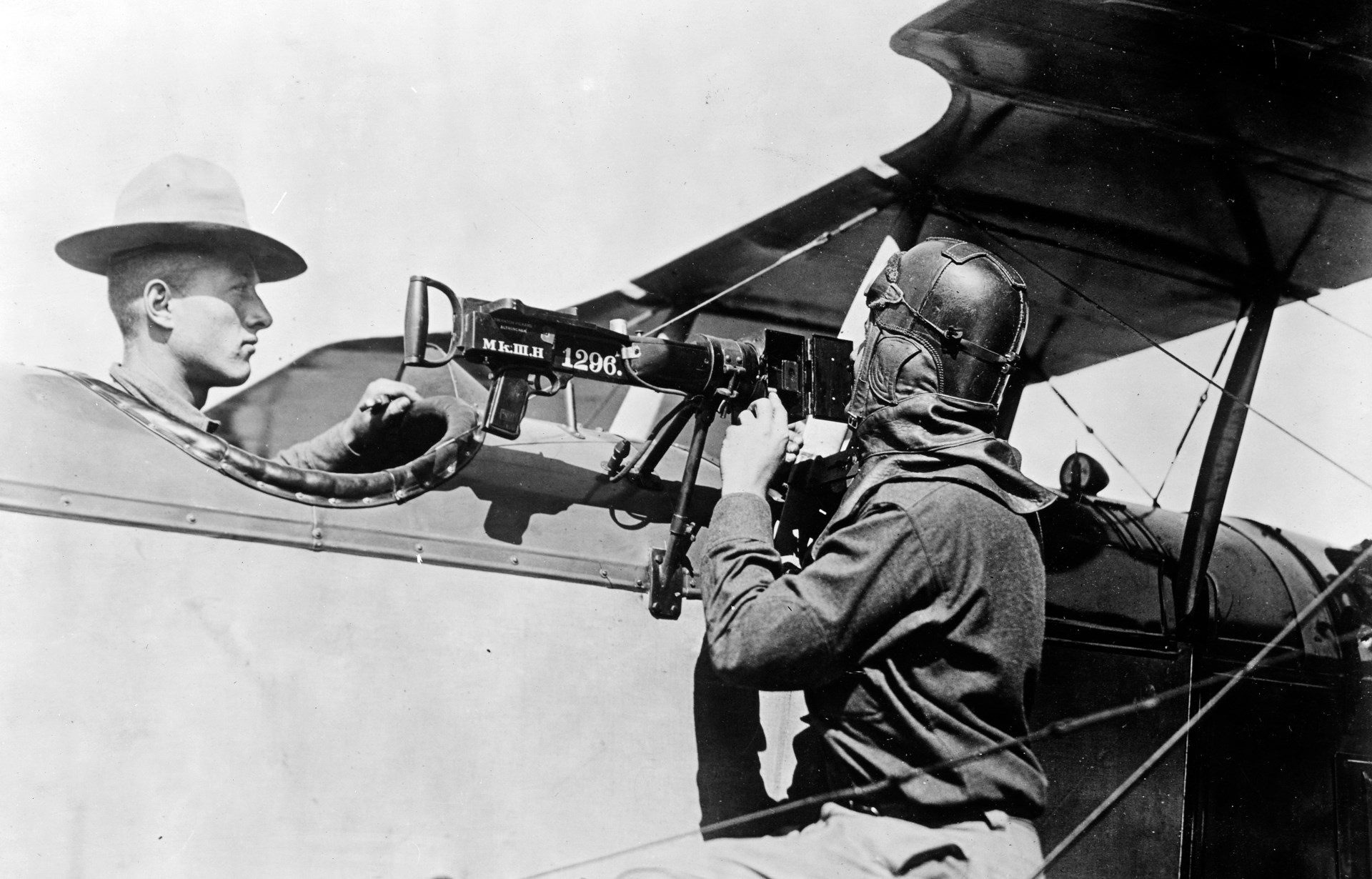 The Hythe Mark III gun camera was used to assess both observer and pilot gunnery skills. N.A.R.A. photograph.
How many of us dreamed of being a successful fighter pilot? How few of us imagined becoming a bomber pilot or an observer sitting in the “back seat?” As it turns out, the observer’s job was complicated, difficult and dangerous—and as completely unglamorous as it was vitally important. Not only did the observer have to be able to read maps and plot artillery fire, he also had to be a capable photographer as well as a marksman who was completely familiar with his Lewis gun—shooting it and maintaining it. The Air Service report notes:
The large percentage of the men who failed to qualify for observer work is the result of two factors: the very high standard required for the modern observer, and the fact that it is impossible to instruct a student in this extremely technical and arduous duty unless he himself desires earnestly to serve in this capacity. In the last phase of the war the work of the observer was constantly becoming more diversified, more important, and more difficult.
Ongoing Training
As important as the stateside introduction to aerial gunnery was, combat experience proved to be the best teacher. Once American airmen reached France, they were in for more intensive training in a completely unforgiving environment—even after the men received their postings to combat squadrons, gunnery training continued during every available moment.
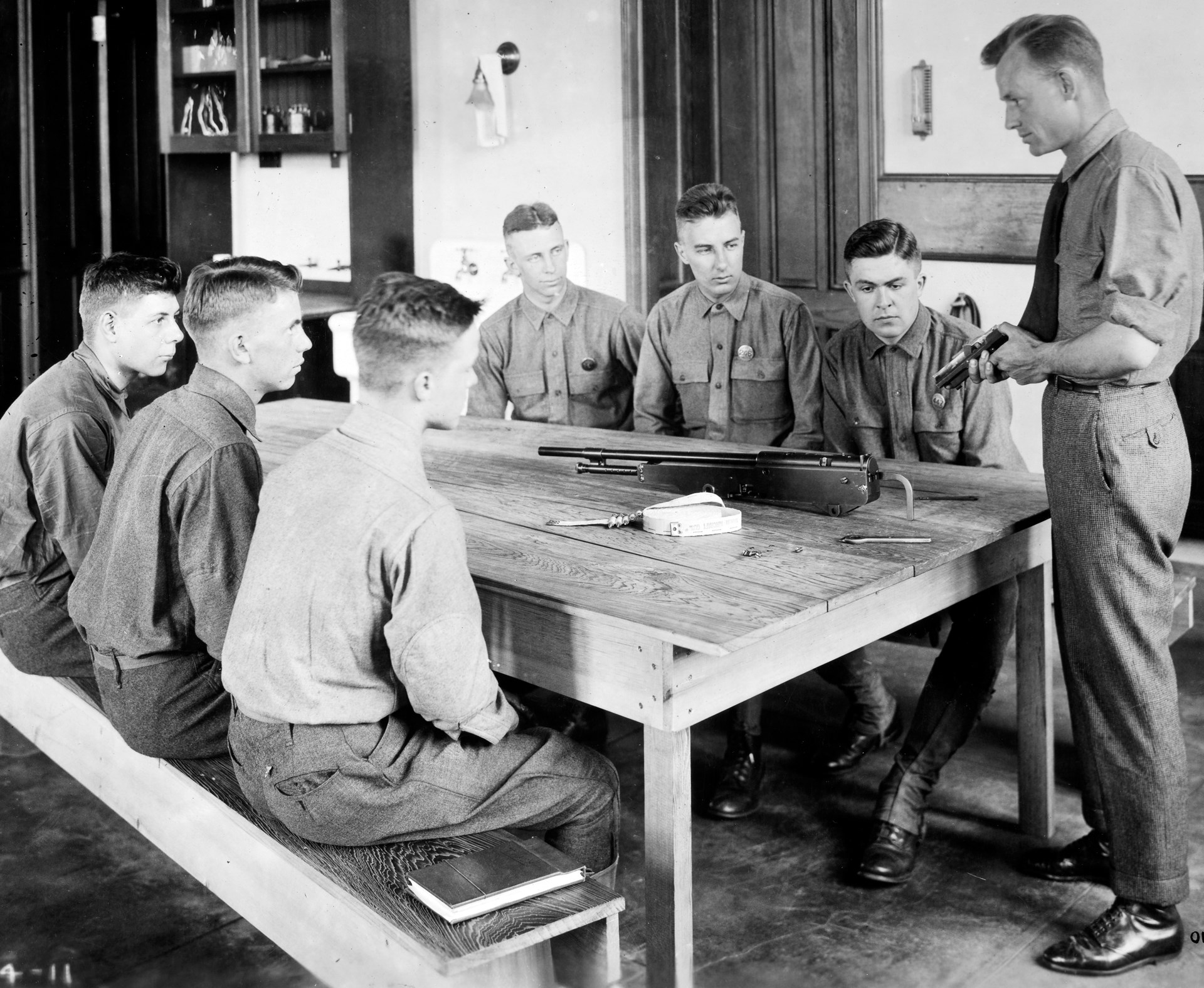 Learning the nuances of an aircraft machine gun: Aviation cadets at Princeton observe the workings of the Marlin aircraft machine gun. N.A.R.A. photograph.
Changes in aircraft and firearms mounts brought on the need for updated training. Pursuit pilots transitioned from the nimble-but-fragile Nieuport 28, with two Vickers MGs mounted on the port side of the engine, to the fast and sturdy SPAD XIII, with its twin Vickers mounted directly in front of the pilot atop the engine.
For the observers, the availability of more Lewis guns meant more twin gun mounts, which provided more defensive firepower but created a much heavier rig for the gunner to maneuver inside his cramped position. Some gunners chose to fly with a single gun, feeling that it sped up their reaction time to fire on an incoming German fighter. The Air Service report comments on the value of accurate shooting, particularly in combat at a great height without a parachute:
The idea that a fighting airplane should be regarded mainly as a moving platform for a machine gun has been fully demonstrated, and it is hardly too much to say that the length of a pilot’s life at the front is directly proportional to his and his observer’s ability to shoot.
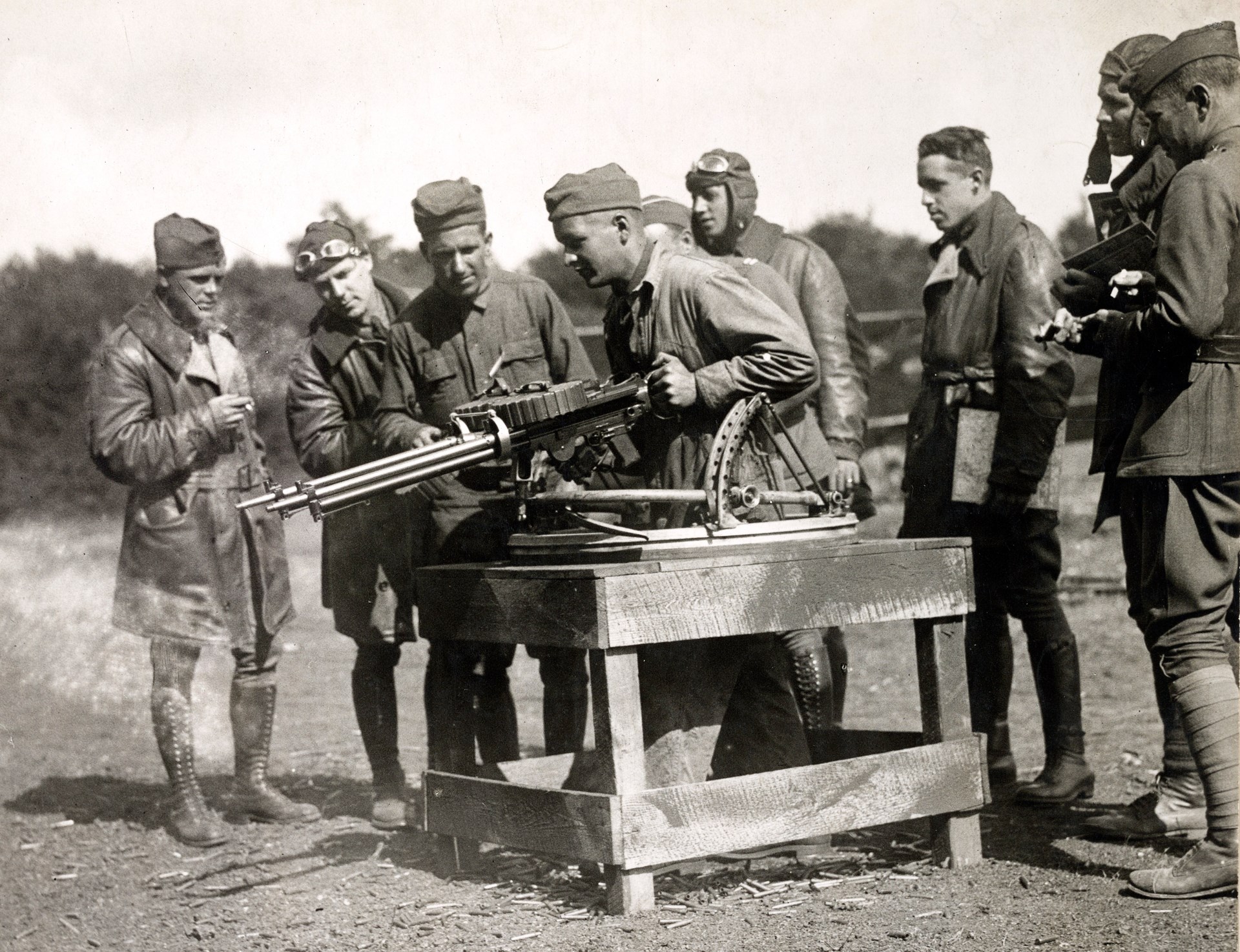 In the combat zone: Continued training kept veterans sharp and helped new men stay alive. Here an observer works out with a twin-Lewis mount, commonly found on the Breguet 14, Salmson 2 A.2, and DH-4 recon/bomber aircraft of the U.S. Army Air Service. Issoudon, France, summer 1918. N.A.R.A. photograph.
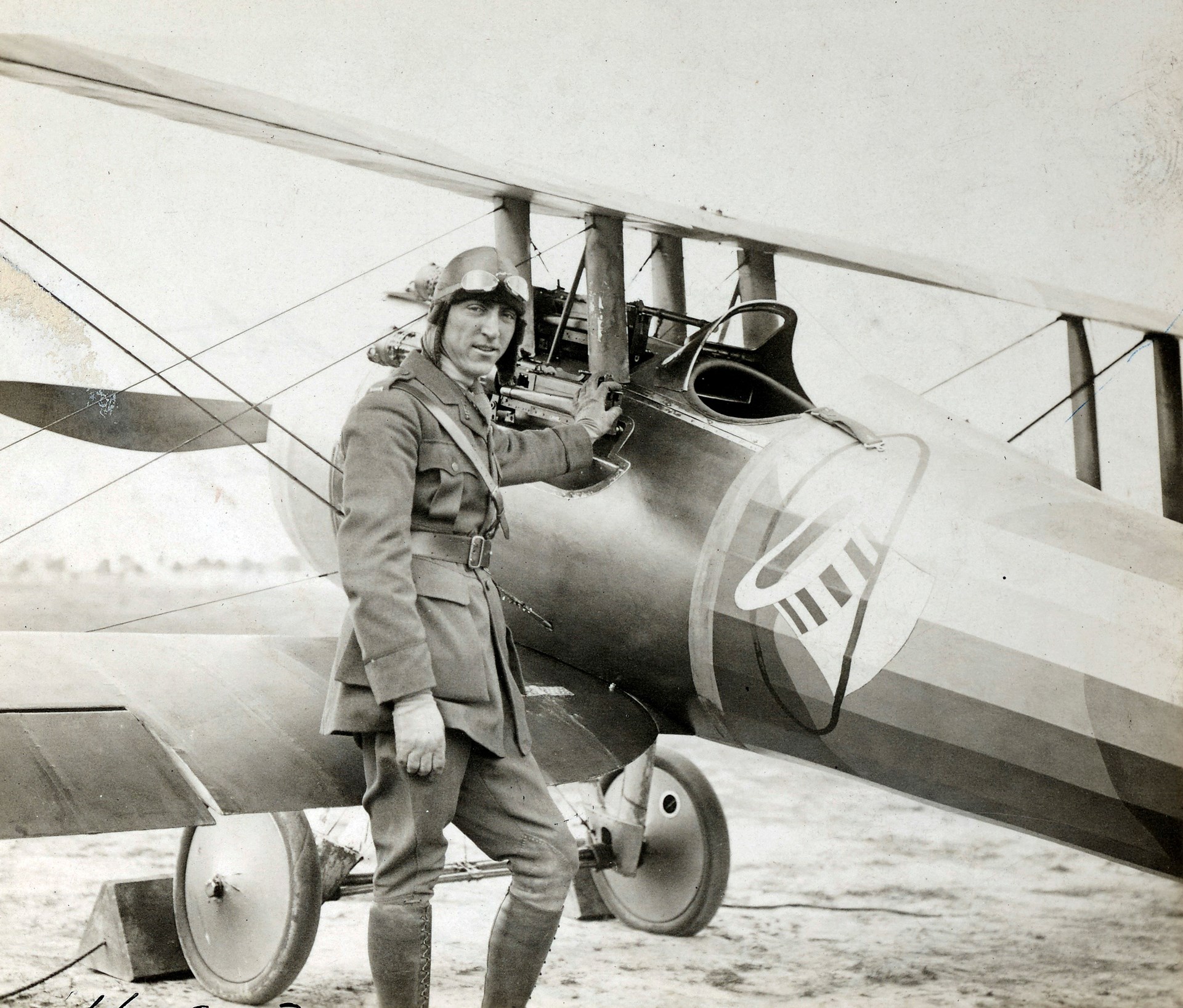 America’s “Ace of Aces” Lt. (later Capt.) Eddie Rickenbacker, of the 94th Aero Squadron. Rickenbacker stands by his first mount, a Nieuport 28—he scored the first six of his 26 victories in this type. Twin Vickers guns are mounted on the port side of the cockpit. N.A.R.A. photograph.
Categories
Vietnam War Equipment
Mike Thornton

Michael Thornton is a hardcore 30 year-veteran of the United States Navy, a founding member of SEAL Team Six, and one of only three SEALs to receive the Medal of Honor in ‘Nam – an honor he earned in blood on Halloween 1972, when he almost single-handedly battled through enemy territory against a swarming horde of enemy soldiers, charged through a naval artillery bombardment to save his commanding officer from certain death, and then swam three hours through North Vietnamese waters with two wounded guys hanging off his back and a half-dozen chunks of grenade shrapnel lodged in various parts of his abdomen.
If that’s not badass enough for you, then clearly you’ve come to the wrong website.

Mike Thornton was born March 23, 1949 in Greenville, South Carolina. He joined the U.S. Navy and served as a Gunner’s Mate on a couple destroyers, but in 1968 he decided to try his hand at making the Navy’s elite Underwater Demolitions Team – the original precursor to the SEALs. Training was brutal, exhausting, and unbelievably intense – of the 129 men who signed up for UDT Class 49, only 16 graduated and were accepted into the program.
One of those 16 was Mike Thornton. Not long after completing one of the most brutal military training courses on the face of the planet, he was assigned to SEAL Team One and deployed to the Republic of Vietnam at the height of the Vietnam War.
Thornton arrived in-country in 1969 and spent the next three years doing a wide variety of super-badass over-the-top Navy SEALs stuff. He gathered intel on enemy positions, scouted deep behind enemy lines on daring covert missions, captured prisoners when he could, battled enemy forces on the reg, and basically did all that cool Black Ops classified SEAL stuff that was presumably so hardcore and top-secret classified that we’ll likely never really know the full details of all of it.
Team One was at the heart of many of America’s Special Operations in ‘Nam, and in the fall of 1972 this was still very much the case. In October, 23 year-old Petty Officer Mike Thornton was sent on a mission to the Qua Viet Naval Base in Quan Tri Province on a dangerous mission to gather intel on some NVA positions, capture a few prisoners, and then somehow extract back to friendly lines. Thornton’s team would consist of himself, three South Vietnamese Special Forces operators, and the unit commander, Lieutenant Thomas Norris, a hardcore Medal of Honor recipient Navy SEAL who was already a legend among the SEALs thanks to a wild mission he’d undertaken a few months earlier when he went undercover deep into enemy territory to rescue a downed American pilot. Facing extreme danger, and surrounded constantly by a massive force of NVA soldiers, Norris succeeded in extracting not only the pilot, but also the crew of a team that had already gone in to get the pilot and ended up getting pinned down. The mission was so hardcore that they made a movie out of it – it’s called Bat*21, and Norris was so tough that they got Gene Hackman to play him in the movie.
Needless to say, this was not a crew of guys you wanted to face in a dark alley late at night.

The SEALs deployed first by sailing an ordinary-looking Vietnamese junk boat up a river late at night, then by boarding a small rubber boat and infiltrating enemy lines under the cover of darkness. Well, unfortunately, the mission started to go sideways right away – the map wasn’t really lining up with what was supposed to be there, and it didn’t take long for Norris and Thornton to realize that they’d landed a little too far into enemy terrirotyr. So now, instead of scouting temporary enemy fortifications that had been thrown up days before, these guys were now straight in the middle of a hardened network of NVA bunkers that had been designed years ago to repel full-scale assaults by massive formations of enemy troops and armor.
It wasn’t really the kind of place you wanted to be walking around with an American flag patch on your shoulder.
So, ok, the SEALs were off-course, and were now wayyyy deeper in enemy territory then they would have hoped, but a mission is a mission, and these guys were pros. They immediately went to work – noting bunker positions, troop concentrations, fortifications, vehicles, and radio towers. They Splinter Celled their way silently and stealthily through the heart of an enemy naval base first by boat, then on foot, collecting tons of valuable intel, all somehow without being detected by the hundreds of hardened veteran NVA troops that now surrounded them from every direction.
Then, over one particular ridgeline, the SEALs saw a couple of NVA guards standing nearby. They were far enough away from the main base that they could potentially have been grabbed and taken prisoner without alerting the base, so the SEAL team moved in to try and take them into custody. The two South Vietnamese SEALs grabbed one of the guys, but they weren’t quick enough to grab the second guy – that dude bolted for it and started screaming his damn head off for the NVA to sound the alarm.
Thornton ran him down and capped him with a well-placed pistol round, but it was already too late – the SEAL stopped dead in his tracks as he heard the sound of alarm sirens blaring from a nearby camp.

Thornton ran for it. By the time he’d reached the spot where his buddies were waiting for him, he was already being run down by a group of roughly fifty NVA soldiers, who immediately started spraying AK-47 gunfire into the jungle all around him.
One of the South Vietnamese SEALs launched a LAW rocket into the middle of the attacking forces, hoping that the resulting explosion would buy the SEAL team a little time to take off and run to the extraction point.
The SEALs were now in a fight for their lives. They had to get back to their extraction point before they were completely surrounded and overrun by a force that massively outnumbered them.
Fighting through the pitch darkness, facing down presumably hundreds of enemy soldiers, the five Navy SEALs fought the way you’d expect the most badass military force in the world to fight. They fired, repositioned, fired again, and launched grenades and LAW rockets, constantly changing position in an attempt to confuse the enemy about how many guys they were facing. The SEALs had the advantage of surprise, and concealment, and the NVA couldn’t just charge in there after them because they couldn’t quite figure out how many guys they were actually facing. So, through the darkness of the Vietnamese jungle, the Navy SEALs spent the next four hours (!!) battling their way back towards the water.

Bullets were zipping through the jungle from every direction as the SEALs made their escape. Five men against hundreds. As his ammunition began to run out, Norris (who took up the rear of the SEAL position) ditched his M-16 and took an AK-47 off a dead enemy soldier, using captured ammo to keep up a steady hail of fire back towards the ever-closing NVA troops. At the head of the column, Mike Thornton raced through pitch-black jungle navigating his team to the extract point. As dawn began to break and the SEALs approached the beach, Norris got on his radio and called in for two Destroyers to come in and lay down some covering fire. Shortly after, though, he received a report that heavy fire from fortified NVA shore guns had damaged both Destroyers and drove them back from the coast. A cruiser was inbound to help, but for now the SEALs were on their own.
Thornton continued to the extraction, firing his M-16 in all directions, until suddenly an enemy grenade landed dangerously close to him. It exploded, ripping shrapnel through the SEAL. White-hot shards of splintered steel embedded in his back in six different places, as the concussive force of the blast sent him flying hard into the ground. With his ears ringing, and his back screaming in pain, Thornton still held on to his weapon, and rolled over onto his back just in time to see four NVA troops running up onto the ridgeline to finish the job – despite every muscle in his body screaming in pain, Thornton still somehow had the calmness and unimaginable skill to take out all four of those guys before they could spray him full of 7.62.
One of the South Vietnamese SEALs rushed over to pick Thornton up, and the SEAL asked what had happened to Tom Norris. The SEAL responded, “He’s gone. Let’s go”. The guy said that Norris’s position had been overrun, he was shot in the head and killed, and the rest of the team had to fall back. He urged Thornton to get to the beach to extract, because the window to get out of this alive was very rapidly closing, and a US Cruiser was already maneuvering into position to lay down some cover fire.
But Navy SEALs don’t leave a man behind. And Thornton wasn’t about to start now.

With AK-47 fire zipping around him from every direction, Michael Thornton ran 400 yards through a hail of bullets to reach the body of his good friend. Four NVA troops were standing over the fallen SEAL, but Thornton killed them with his rifle, screaming with rage, and finally fell to his knees at his friend’s side. Norris was bleeding badly from a gunshot to the head, but Thornton wasn’t about to leave that guy behind. With enemy troops ripping shots past his head, and blood pouring from grenade wounds in his back, Mike Thornton threw Tom Norris on his shoulders and started to make a run back for the beach.
It was at this point that the U.S. Navy cruiser reached firing position. And the coordinates the firing teams had were the ones that Tom Norris had given them – at a time when Norris thought he wasn’t going to get out of this fight alive.
The shell landed pretty much right where Norris’s body had been. The explosion blew Thornton 20 feet through the air, slamming him hard to the beach, ringing his ears, and blurring his vision. As he lie on the ground, he heard something amazing. A familiar voice, quiet and fading, but clearly audible even among the gunfire and artillery.
“Mike, buddy.”
Tom Norris was alive.

Surging with adrenaline, Mike Thornton jumped back to his feet, threw Norris on his back, and started running to the shore. With bullets, mortars, and naval artillery chewing up the beach and the trees around him, Thornton ran though the fire, finally reaching the shore, where one of the Vietnamese SEALs also lay wounded from a gunshot to the back.
Thornton grabbed that guy too. Then he jumped in the water, inflated his life vest, and proceeded to swim through salt water with six grenade wounds in his back for four hours while dragging two seriously wounded men.
The American ship that had been sent to extract the SEALs was preparing to go home, convinced that nobody could have survived that mission, when suddenly they saw a dude in the water shooting his rifle in the air trying to get their attention. It was Mike Thornton.
Every member of the mission survived.
When Thornton received his Medal of Honor in 1973, Tom Norris was still recovering in the hospital, and they weren’t about to let him leave just to attend a medal ceremony. So, the day of the ceremony, Thornton went to the hospital, put Norris in a wheelchair, and snuck him out the back door so he could attend.
After Vietnam, Mike Thornton would go on to be a BUD/S instructor in Coronado, where he would train future Navy SEALs, as well as members of the British Royal Marines’ badass Special Boat Service. He was a founding member of SEAL Team Six in 1980, and retired as a Lieutenant in 1992. Nowadays there’s a really badass statue of his rescue mission standing outside the SEAL museum in Ft. Pierce, Florida.

Links:
Mike-Thornton.com
NavySEALs.com
Achievement.org
Defense Media Network
Wikipedia
Suggested Reading:
Collier, Peter and Nick Del Calzo. Medal of Honor. New York: Artisan, 2006.
Dockery, Kevin. SEALs in Action. New York: Avon Books, 1991.
Norris, Tom and Mike Thornton. By Honor Bound. New York: St. Martin’s Press, 2016.
One reason the M203 was replaced by the M320 was the loading method.
The M320 swings to the side to open, as seen here:-
The M203 slides the launcher forward to load, which limits the length of any grenades you can load into it.
The variation in grenade length can be seen here:-
The shortest “standard” round would be easy to load into a M203, the longer pair would be manageable (about the size of some smoke/flare rounds) and the longest – looks like a fragmentation grenade with longer payload section – wou