Category: The Green Machine
Author’s note—This article is part of an ongoing series on Allied small arms of World War 2. In each installment, we will endeavor to explore the humanity behind the firearms with which Allied combatants defeated the Axis powers.
General George Patton once opined, “Wars may be fought with weapons, but they are won by men.” In this series, we will investigate both the guns and the men behind them in the context of the planet’s bloodiest conflict.

The 1911A1 pistol armed generations of American GIs as they marched off to defend democracy against those who wished to snuff it. We stand on the shoulders of giants and do so frequently take our freedoms for granted.
The man was nineteen years old when he blackened his face with soot from a wood stove and crept to within scant yards of a fortified German position under cover of darkness. During the course of the next several hours, he emplaced a minefield within earshot of dozens of Wehrmacht soldiers.
He could clearly hear them laughing and talking as he methodically armed his devices and then retreated back to his own lines.
His job as a Combat Engineer carried with it all the risks of the Infantry along with the responsibility to emplace and clear minefields. He earned a Silver Star for his actions that night.

 The man and his buddies once cleared a German minefield and ended up with a small mountain of disarmed Teller mines stacked up on a secluded Italian beach.
A sensible man might have blown the mines a few at a time. However, these were not sensible men. These were American teenagers. They rigged a few blocks of TNT with a generous time fuse and placed it in the stack before retreating behind an ample dune.
The resulting explosion left a crater that could be mistaken for a small harbor and blew out every window in the nearby Italian village. The force of the blast lifted him bodily off the ground as he cowered behind his little hill. He and his mates emerged, ears ringing and sinuses cleared, to laugh about the chaos they had just unleashed.
There is an immutable pathos to be found in the fact that most soldiers are really just glorified children. I know I was. What is wrong with us as a species?
The man had never before been outside Mississippi, so he was curious about Italy and the detritus of war. One afternoon after his duties were complete he struck off alone into a nearby bombed-out village simply to explore.
This was a world at war so he carried along his Colt 1911A1 pistol. In a combat zone, a man’s weapon is his constant companion. It is equal part tool and talisman, but one is never without it.
The man wandered into a massive pile of rubble that had once been a large building. In the dim light, he was fascinated with the little-broken things that defined lives once vibrant though now destroyed. Stepping through a wrecked doorway he found himself unexpectedly face to face with his German counterpart.
This other young man was likely on a similar mission, just wandering to satisfy curiosity or assuage boredom. Regardless of the impetus, fate was destined to be exceptionally cruel this day. The young German soldier carried a bolt action Kar98k rifle and was comparably alone.
Both men stared dumbstruck at each other for a pregnant moment, close enough to see the other breathe. Reflexively they scrambled for their weapons, but my buddy was faster. A single .45ACP round to the chest dropped the young German where he stood.
Practical killing is seldom like the movies. The process typically takes a while, and this was no exception. To have been both participant and witness at such close quarters changed this man forever.
This gentleman was not a professional warrior or some highly trained Specops killer. When I knew him he worked in a bank. He was background clutter in the world’s most vibrant democracy.
He and his friends were citizen soldiers who abandoned their lives to ensure the blessings of liberty for their fellow Americans for generations to come. They were heroes in every sense. More than 400,000 of them never came home. How can we ever live up to that?
The Gun

The 1911A1 pistol armed generations of American fighting men. Powerful, reliable, and mean, the 1911 is a fistful of Americana.
In the late 1800’s the US military was burning through prototype firearms at an unprecedented rate. Small arms technology was outpacing both tactics and procurement, so government arms rooms housed a uniquely variegated selection.
In a single decade, the military cycled through the M19892/96/98 Krag rifles as well as the M1895 Navy Lee. Revolvers from Smith and Wesson as well as Colt filled GI holsters. The Colt M1892 fired the .38 Long Colt cartridge.

The 1911 handgun soldiered on until the late 1980’s. Here we see Sergeant Ronald Payne wielding his 1911A1 as he explores a tunnel complex in Vietnam in 1967. I quite literally cannot imagine the kind of courage required to undertake such a thing.
The war went by several names. It was variously called the Filipino-American War, the Philippine War, or the Tagalog Insurgency. Regardless, this short but bloody conflict served as our rude introduction to the fine art of Islamic Jihad.
Muslim Moro tribesmen were known to lash wet leather thongs around their testicles that shrank as they dried, working them into a justifiable frenzy. The .38 revolvers of the day simply weren’t up to the task.


My most prized worldly possession. My wife’s grandfather carried a 1911A1 pistol throughout World War II that bore this handmade sweetheart grip. After his death, last year at age 96 custody of this priceless artifact fell to me.
John Moses Browning was the most gifted firearms designer in human history. He held 128 patents by the time he keeled over of heart failure at his workbench in 1926 at the FN factory in Liege, Belgium. When he built the US government’s new combat handgun and the cartridge it fired he took no chances.
The European standard at the time pushed a 9mm bullet that weighed 115 grains. Old John Moses just doubled that to create the .45ACP that set the standard for man-portable stopping power more than a century later.
The recoil-operated semiautomatic handgun that fired it went on to inspire fully 95% of the modern combat pistol designs available today.
We came surprisingly close to adopting a DWM Luger pistol chambered in .45ACP as an American service handgun. These original .45ACP Lugers submitted for the pistol trials in 1906 are arguably the most collectible military firearms in the world.
They are quite literally priceless today. Should you trip over one in grandpa’s attic please give me a call. Maybe we can work a deal.
DWM ultimately dropped out of the competition leaving only Savage and Colt. Over the course of a two-day period, a single sample of each fired 6,000 rounds.
The guns were simply dunked in water when they grew too hot to handle. At the end of the process, the Savage gun had suffered 37 failures. Browning’s 1911 had none.
The design was tweaked in 1924 into the 1911A1, and this was the gun my friend carried in Italy. I was issued one myself back when I first donned a US Army uniform of my own.
When American GIs of both genders are finally packing phased plasma rifles for their forays downrange, old geezers like me will still be looking with longing admiration at the classic manly lines of John Browning’s martial masterpiece.
Trigger Time

The GI-issue 1911 helped free continents through decades of dependable service

When John Moses Browning needed to build a new cartridge he simply took the 9mm Parabellum (left) and doubled it. The resulting finger-sized round sets the standard for stopping power even today.
In its original GI guise, the 1911A1 is indeed a handful. Recoil is not insubstantial, and there are only seven rounds in the magazine. Additionally, before we started lowering and flaring all of our ejection ports the thing was notorious for dropping empties onto the top of your head.
That first 1911A1 I was issued rattled like a tambourine when you shook it, but it went off every single time you pulled the trigger. I’ve shot lots more accurate handguns, but ours had been through the rebuild process a time or three by the time they fell into our mitts in the late 1980’s. Those tired old pistols had been new when my pal earned his Silver Star in Italy.
The rounds are as big as my finger, and they punch nearly half-inch holes, even with pedestrian ball ammunition. When stoked with modern expanding ammo the downrange results are undeniably devastating.
I once saw a guy who had been shot in the mouth with one of these things. The back of his head sported a hole that would accommodate a mature orange. It didn’t hurt long.
Ruminations

The 1911A1 is a handful in action. Recoil is not insubstantial, but the gun is unnaturally reliable.

 The 1911 pistol is as much a part of the fabric of America as is baseball, fast cars, and pretty girls. Literally, countless young men headed off into harm’s way with one of Mr. Browning’s hand cannons tucked into their belts. When life got extra sucky these guys knew they packed the best combat handgun on the planet.
War defines a man. It also defines a generation. Those old guys came home from the most expansive conflict in all of human history desperate to build and create.
They had seen so much death and pain that all they wanted to do was make a world that was fresh, clean, and new. It was this spirit that built the United States into the most powerful and respected nation in all of human history. It remains to be seen if those of us who came of age later can prove ourselves worthy of this precious legacy.
Special thanks to www.worldwarsupply.com for the gear we used to outfit our period paratrooper.
Technical Specifications
1944-Production Remington Rand 1911A1
Caliber .45ACP
Length (in) 8.5
Barrel Length (in) 5.03
Weight (ounces) 39
Sights Fixed
Action Recoil-Operated
Mag Capacity 7
Performance Specifications
1944-Production Remington Rand 1911A1 .45ACP
Browning 230-gr FMJ/SIG SAUER V-Crown 230-gr JHP
Gun Group Size (Inches) Velocity (Feet per Second)
Browning 230-gr FMJ 1.5 870
SIG SAUER V-Crown 230-gr JHP 1.4 857
Group size is the best four of five shots measured center to center at fourteen meters from a simple rest. Velocity is the average of three shots fired across a Caldwell Ballistic Chronograph oriented ten feet from the muzzle.
Categories
UH NO!
AMERICAN SPECIAL OPS FORCES ARE EVERYWHERE
They’ve become a major military player—and maybe a substitute for strategic thinking.
Illustrations by Mike McQuade
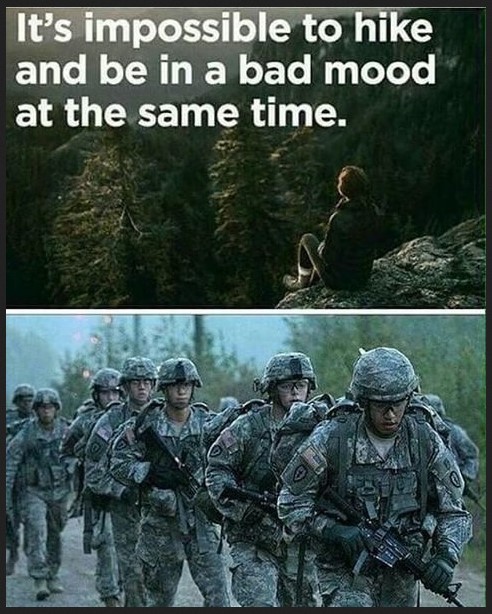
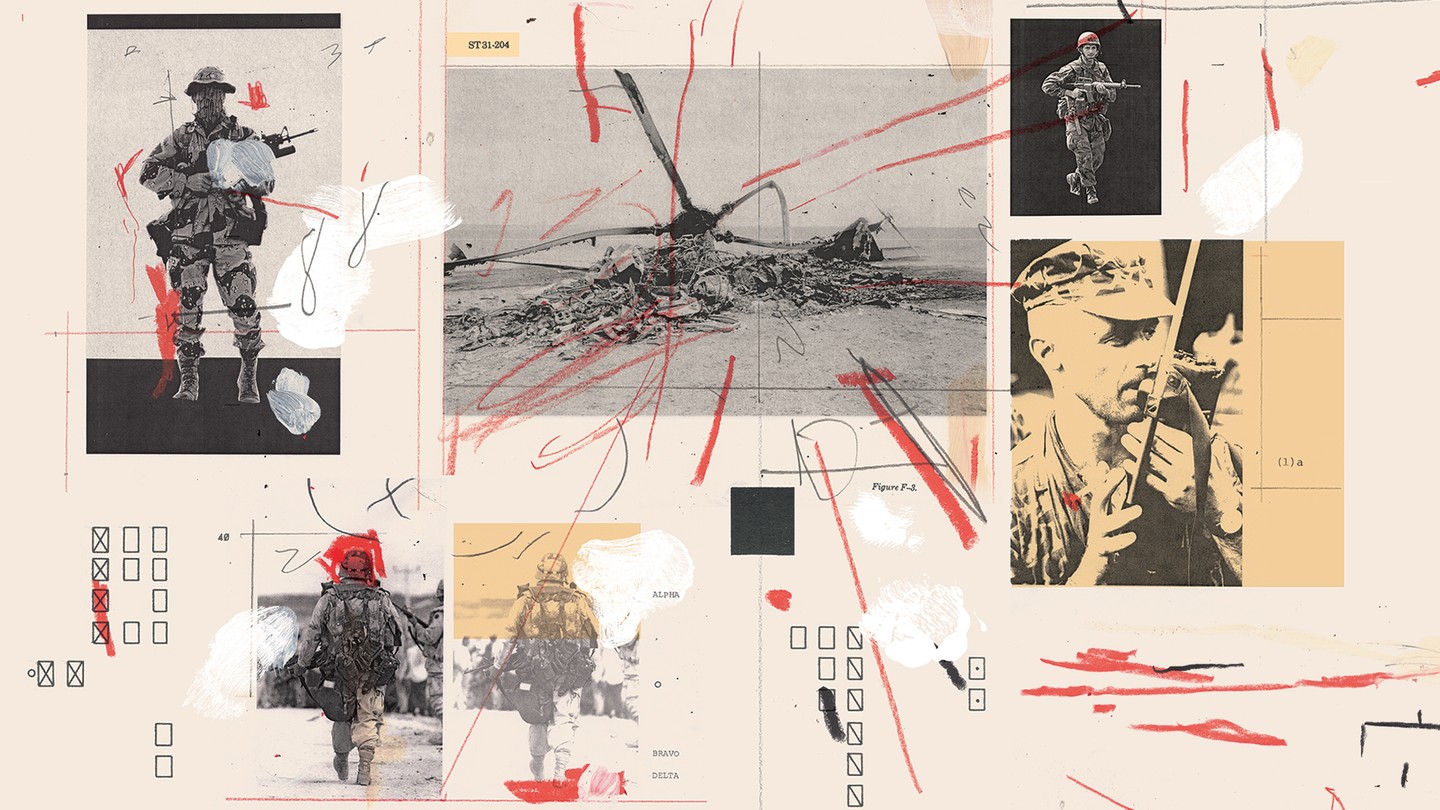
Image above, clockwise from top left: A U.S. Army Special Forces sniper, 1991; the aftermath of Operation Eagle Claw, the failed U.S. rescue operation in Iran, 1980; a marine during the invasion of Grenada, 1983; Captain Vernon Gillespie Jr. in Vietnam, 1964; soldiers on patrol at Camp Victory, in Somalia, 10 days after 18 Americans were killed during the Delta-led Battle of Mogadishu, 1993.*
This article was published online on March 12, 2021.
Updated at 7:17 p.m. ET on March 12, 2021.
Within the span of a few decades, the United States has utterly transformed its military, or at least the military that is actively fighting. This has taken place with little fanfare and little public scrutiny. But without any conscious plan, I have seen some of the evolution firsthand. One of my early books, Black Hawk Down, was about a disastrous U.S. Special Ops mission in Somalia. Another, Guests of the Ayatollah, about the Iran hostage crisis, detailed an abortive but pivotal Special Ops rescue mission. U.S. Special Operators were involved in the successful hunt for the drug lord Pablo Escobar, the subject of Killing Pablo, and they conducted the raid that ended the career of Osama bin Laden, the subject of The Finish. By seeking out dramatic military missions, I have chronicled the movement of Special Ops from the wings to center stage.
Discover “Where Memories Live”
In the second chapter of “Inheritance,” The Atlantic explores how place informs history—and how history shapes who we are.
Big ships, strategic bombers, nuclear submarines, flaring missiles, mass armies—these still represent the conventional imagery of American power, and they absorb about 98 percent of the Pentagon’s budget. Special Ops forces, in contrast, are astonishingly small. And yet they are now responsible for much of the military’s on-the-ground engagement in real or potential trouble spots around the world. Special Ops is lodged today under the Special Operations Command, or SOCOM, a “combatant command” that reports directly to the secretary of defense. It has acquired its central role despite initially stiff resistance from the conventional military branches, and without most of us even noticing.
It happened out of necessity. We now live in an open-ended world of “competition short of conflict,” to use a phrase from military doctrine. “There’s the continuum of absolute peace, which has never existed on the planet, up to toe-to-toe full-scale warfare,” General Raymond A. “Tony” Thomas, a former head of SOCOM, told me last year. “Then there’s that difficult in-between space.”
SOCOM, whose genealogy can be traced to a small hostage-rescue team in 1979, has grown to fully inhabit the in-between space. Made up of elite soldiers pulled from each of the main military branches—Navy SEALs, the Army’s Delta Force and Green Berets, Air Force Combat Controllers, Marine Raiders—it is active in more than 80 countries and has swelled to a force of 75,000, including civilian contractors. It conducts raids like the one in Syria in 2019 that killed the Islamic State leader Abu Bakr al-Baghdadi, and carries out drone strikes like the one in Iraq in 2020 that killed Iranian Major General Qassem Soleimani. It works to locate hidden nuclear-missile sites in North Korea.
Using conventional forces is like wielding a sledgehammer. Special Ops forces are more like a Swiss Army knife. Over the years, the U.S. has found out just how versatile that knife can be; the flexibility and competence of Special Ops have proved invaluable. At the same time, the insularity and elitism of these units have bred a culture with elements that some of their own leaders, to their credit, have described as troubling, and that have, in certain instances, evidenced contempt for the traditional values of America’s armed forces. Much of SOCOM’s action takes place in secret. Most Americans are unaware that it has been active in a country until the announcement that its forces are being withdrawn. Or until something goes wrong—as in Niger in 2017, when four Special Ops soldiers were killed in an ambush.
Notably, its continued growth has been spurred by both success and failure. And perhaps because Special Ops is such a flexible tool, that growth has enabled the U.S. to multiply the way it uses force abroad without much consideration of overarching strategy. The advent of nuclear weapons, in the 1940s, presented leaders with urgent ethical and strategic imperatives. Defining the purpose of such weapons automatically demanded fresh thinking about the bedrock values of a democracy, the nature of multilateral alliances, the morality of warfare, and the scope of U.S. ambitions in the world. Because of its sub-rosa nature, Special Ops has not compelled the same kind of reckoning—and, in fact, may foster the illusion that a strategic framework is not necessary. It’s good to have a Swiss Army knife. And yet even a versatile knife can do only so much.
How did special ops come to occupy such a central role in American military operations—and even foreign policy?
The history of its rise is telling. In a defense establishment where each branch already sells itself as one of a kind—“The few. The proud”—there has been long-standing institutional distaste for a separate elite force, one that siphons off experience and talent and that is first in line for difficult missions. President John F. Kennedy bucked this convention when he stood up the Green Berets. It was a bright idea that burned out in Vietnam, where an initial commitment of Green Beret advisers—who did more than advise—escalated into a full-blown war, with more than 500,000 American troops deployed at its peak. The Green Berets survived as an elite unit, but many ambitious Army officers considered a berth in Special Forces a career-killer.
RECOMMENDED READING


Then came the Iran hostage crisis, in November 1979. Two days after Iranian students stormed the U.S. embassy in Tehran, America’s top brass convened in the “Tank,” a subterranean conference room at the Pentagon, to consider how the military might respond if President Jimmy Carter ordered it to act.
Something called the Delta Force already existed on paper. It was the brainchild of Colonel Charlie Beckwith, a profane, hard-drinking, stubbornly tenacious Army officer who had served briefly with the British Special Air Service in Malaya. He had agitated so long to create a similar multipurpose commando unit within the U.S. military that he had alienated many up the chain, which helped explain why he was still a colonel when he retired. But in the mid-1970s, two spectacular rescue missions captured the headlines. A special Israeli unit stormed an airport in Entebbe, Uganda, in 1976, rescuing more than 100 passengers who had been taken from a hijacked airliner.* A year later, a special German unit did much the same in Mogadishu, Somalia. Beckwith’s stock abruptly rose.
When the Tehran embassy was seized, Delta Force had yet to undertake a mission, and the challenge posed was beyond any imagined for it. Rescuing scores of American hostages from a city of hostile millions who gathered regularly to chant “Death to America,” situated hundreds of miles from any potential staging area, was nothing like storming a parked airliner. But Carter wanted a military option.
“Obviously, we don’t want to do this,” said Major Lewis “Bucky” Burruss, Beckwith’s operations officer, as he briefed the brass in the Tank. The “if we must” plan he outlined was a bold and daring Rube Goldberg scenario. The bottom line was plain: We’re not ready.
Months later, they had to be; Carter was desperate. A new plan had been drawn up, only marginally more plausible. Choppers would deliver the Delta team to Tehran and then would pluck the team and the rescued hostages from a stadium near the embassy. They would all be flown to an airfield secured by a company of Rangers. Eagle Claw, as the mission was called, never cleared the first hurdle—getting to Tehran. The only helicopters large enough for the job couldn’t be refueled in-flight, so the choppers had to perform a complex nighttime rendezvous in the Iranian desert with tanker aircraft. An accident at the landing site ignited a fireball that killed eight servicemen. The mission remains one of the most humiliating failures in American military annals—a failure that became the impetus for expanding Special Ops.
In the aftermath of Eagle Claw, an investigation known as the Holloway Commission found the Pentagon woefully unprepared for daring, joint, pinpoint missions. It revealed a crippling lack of interservice and intergovernmental cooperation. Mission planners had had to plead to obtain blueprints of the embassy compound in Tehran. The Navy pilots flying the helicopters across the desert had not even conducted the practice runs the planners had requested.
As a remedy, the Holloway Commission recommended the creation of a Joint Special Operations Command—JSOC, as it would be known. The service branches hated the idea. Admiral James Stavridis, a former U.S. supreme allied commander in Europe and a man who spent his entire career in the conventional ranks, told me, “The Navy didn’t want to give up the SEALs, and the Army didn’t want to give up the Ranger battalions, and the Marine Corps wouldn’t even talk about it. The services fought it and fought it and fought it, at every level.”
Once created, JSOC was treated like a poor stepchild. In the end, a staff of 70 was dispatched to Fort Bragg to handle administrative chores. The group was given Delta Force, a SEAL team, and a rotating Ranger battalion for specific missions. A Special Ops helicopter unit was created. But JSOC depended on haphazard funding and relied on a grudging chain of command for missions.
That is how things stood in October 1983, when the U.S. invaded Grenada, a tiny island in the Caribbean. Its Cuba-aligned Communist government had collapsed, and its leader, Maurice Bishop, had been murdered. Saying he feared for the safety of 600 American medical students at the island’s St. George’s University, President Ronald Reagan had ordered the military to seize control of Grenada and bring the students home. Rescuing hostages being its prime focus, JSOC was a key player in the invasion, which was over fast. It was celebrated as a rousing success by the Reagan White House. But within the military, it was seen as an embarrassment.
General Thomas, now 62, was then a lieutenant who went in with the first wave. He had been a West Point cadet when the disaster in Iran had unfolded, and had no idea then how important that episode would prove to be for the military or for himself. But in fact he would be present for nearly every major U.S. military action of the next four decades.
The Grenada invasion, he said, was “a clown show.” JSOC had to rely on tourist maps for the most part, because military topographic maps were not available. Four SEALs drowned on a preinvasion reconnaissance mission. Cuban and Grenadian military personnel were known to be on the island, but no one knew exactly where or how many, or what kind of arms they had. Teams meant to be working together were unable to communicate because radio frequencies had not been coordinated. “We were lucky we were not up against the A team,” Thomas acknowledged.
Thomas’s platoon was part of an assault on the Calivigny barracks, where several hundred Cuban and Grenadian forces had reportedly retreated for a last stand. The attackers were crammed into four Black Hawks, as many as 15 Rangers in each helicopter—“I mean, just ridiculous loads,” Thomas recalled.
“We came skimming in over the ocean and had three out of the four helicopters crash,” Thomas said. Three more people died. No Cubans or Grenadians were at the barracks.
Major General Richard Scholtes, who had been the JSOC commander at the time of the operation, testified about these and other failures in a closed session of a Senate Armed Services subcommittee in August 1986. Senator Sam Nunn called the testimony “profoundly disturbing, to say the least.” And then he did something about it.
The disaster in iran had led to JSOC. The mistakes in Grenada led to SOCOM. Thanks to an amendment sponsored by Nunn and Senator William Cohen, Special Ops got its own management and its own budget. Its annual budget today is about $13 billion, which is a sacrosanct 2 percent of all military outlays (and roughly what it costs to build an aircraft carrier). The Nunn-Cohen amendment also gave SOCOM clout. From now on, Special Ops would be headed by a four-star general or admiral, and its mission began to expand.
In 1987, Stavridis was a lieutenant commander on a cruiser stationed in the Persian Gulf as part of Operation Earnest Will, the largest naval-convoy mission since World War II. It was guarding Kuwaiti oil tankers, which were a lifeline for Saddam Hussein, who was then locked in a seven-year war with Iran—and being supported by the United States, his future enemy. The tankers were being preyed upon by Iranian forces. Special Ops teams used American ships as platforms to disrupt and counter Iranian attacks. Stavridis was impressed.
“It was the first time that we really started to see them in the field,” he recalled. The Kuwaiti ships had to be boarded and protected, which was not the kind of work the regular Navy did. “We, the Navy—Big Navy—hadn’t boarded a ship in a century,” Stavridis said. “These guys were trained to do that … as opposed to me trying to grab a bunch of boatswain’s mates and hand them a .45 and say, ‘Follow me!’ ”
Special Ops was the star of the 1989 invasion of Panama, an operation that went as smoothly as Grenada had gone badly. A Delta team located the dictator Manuel Noriega, and helped capture and bring him to the United States for prosecution as a drug trafficker and money launderer. Thomas was then a Ranger company commander. He called Panama JSOC’s “graduation event.” Leaders began to find new uses for Special Ops.
When Saddam invaded Kuwait, in 1990, President George H. W. Bush gathered an allied coalition to drive the Iraqis out. That effort, Desert Storm, would be a throwback to conventional warfare—a clash of big armies. But an opportunity for Special Ops quickly arose. In a meeting with the Joint Chiefs of Staff, General Colin Powell, the chairman, handed a report to General Wayne Downing, a former Ranger and then JSOC’s commander. Powell said, “This just in from the Israelis.” Iraq had begun firing Scud missiles at Israel from mobile launchers in the vast western-Iraqi desert. The Israelis were preparing an effort to find and destroy them, something Powell wanted to forestall. If the Israelis entered the war, it would offend Arab states and possibly cripple the coalition.
“Can you do that?” Powell asked Downing. Could he take out the Scuds?
Within days, JSOC teams were camped in remote desert observation posts, launching attacks on Iraqi missile columns from the air or swooping in across the sand in six-wheeled combat vehicles, looking like the pirate gangs of Mad Max. Questions would be raised later about whether these attacks were taking out real missile launchers or decoys fielded by Saddam, but there’s no doubt that the results achieved were fast and dramatic, and kept Israel off the battlefield.
The results were also on film. “We lucked out and came right on a Scud launcher two or three days after we started,” Thomas recalled. The assault was filmed from a helicopter, which flew lower and slower than the jets that provided most of the footage viewed at headquarters. JSOC’s imagery was as intimate and vivid as a video game’s. After the first Scud launcher was destroyed, Downing played the tape at a briefing for General Norman Schwarzkopf, the commander of allied forces, who was struck by the immediacy and detail. “Norm said, ‘Whoa, whoa, is this a training tape from back at Bragg?’ ” Thomas recounted. “And Downing said, ‘No, this was up by al-Qa’im last night in northern Iraq.’ ” Search-and-destroy became another SOCOM specialty.
Experienced socom soldiers were early adopters of new technology, often buying equipment off the shelf that was not available through normal supply lines. As in most other fields, modern telecoms would transform war-fighting.
In December 1998, Thomas had what he called a “sensor-to-shooter epiphany” in the closed back of a truck near Vrsani, a village in northeastern Bosnia. Then a lieutenant colonel, he was in command of a JSOC Delta squadron. The mission was manhunting. Thomas and the squadron had been tracking Radislav Krstić, a one-legged Serbian commander in the Yugoslav wars who had been indicted a month prior by the International Criminal Tribunal for the Former Yugoslavia, in The Hague.
Thomas’s unit had been watching Krstić for days. Surveillance drones were still in the future, but Thomas did have a helicopter with a high-speed camera. It fed a live picture to a Sony television that Thomas held on his lap. His truck was hidden in a thicket about 200 yards from a road he knew Krstić would use. German special forces had provided a snare—a net made of sturdy elastic that could capture even a speeding vehicle.
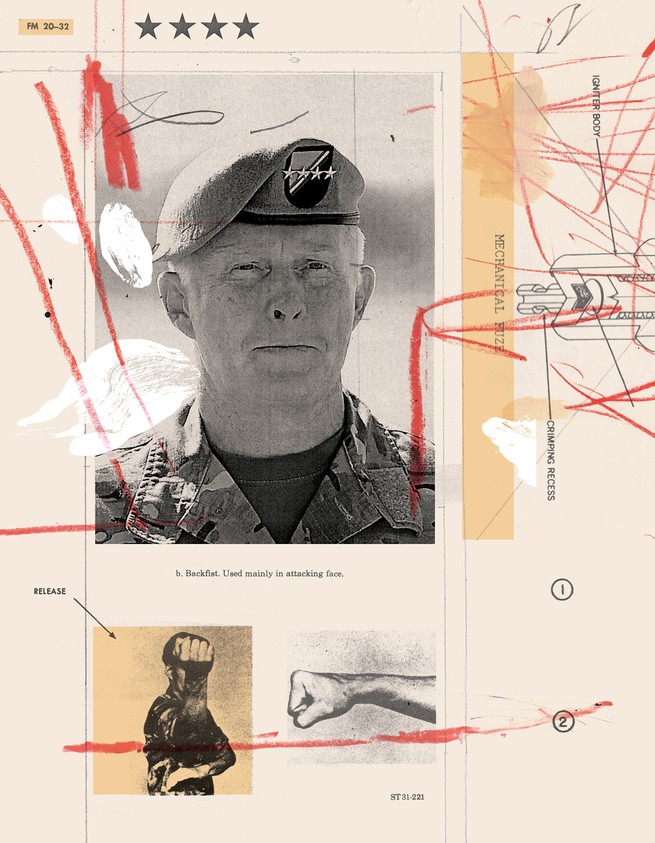
Bottom: Images from “Hand-to-Hand Fighting,” a U.S. Army Special Forces manual. (Mandel Ngan / AFP / Getty; U.S. Army Institute for Military Assistance)
Gunplay was a possibility, so Thomas had a list of strict no-go scenarios, among them the presence of local police, Russian troops, or children. As Krstić’s vehicle neared, first a Russian convoy approached, then a local military-police vehicle. Both passed by. Finally a school bus rolled into the picture. The effort seemed snakebit. At last, on the screen, Thomas watched the school bus clear the zone, with only seconds to spare. “Execute!” he ordered. Krstić’s vehicle was caught in the net, and he was taken without incident.
Thomas would be teased about the episode: an entire Delta squad to capture a one-legged Serbian? What stuck with him was how much more useful the screen had been than his own two eyes. Without the overhead view covering the whole stretch of road, he would have aborted the mission. It occurred to him: This is where we are going in the future.
Live video feeds were just the beginning. When Stanley McChrystal took over JSOC, in 2003, the U.S. invasion of Iraq was eight months old. Special Ops teams were still hunting Saddam and other “high-value targets” when a new enemy arose: Abu Musab al-Zarqawi, a jihadist known as “The Sheikh of the Slaughterers.” His followers were setting off bombs in crowded places, attacking American soldiers, and kidnapping “infidels” and beheading them in horrific videos posted online.
McChrystal was known as a relentless striver. Gaunt, hollow-eyed, and intense, he was famous for his ascetic discipline. He turned his task force into the most efficient hunter-killer force in the world, and a model for the entire command. McChrystal is not Sun Tzu. But in sizing up his adversary and responding creatively, he remade JSOC, and ultimately SOCOM itself. He recognized that the ability to digitize information—audio files, video files, maps, texts, emails, phone calls, documents—could steer him rapidly to targets.
Like most innovations, McChrystal’s was resisted, including by SOCOM itself. He wanted to expand and alter his mission, adding an array of expertise—in some cases, requiring civilian contractors—that had nothing to do with traditional soldiering. He explained the situation to me in a way that both made his position understandable and underlined the institutional imperatives that push in one direction only. “Inside my command, there were a bunch of people saying, ‘We need to pull back to the States and wait until there’s a hostage rescue or something like that, and we’ll do our specialized mission,’ ” McChrystal said. “And I told them, ‘Hey, if we’re not here doing a significant part of this, we’re not going to be able to claim our elite status and be first in line for resources and priority.’ ” There was also resistance from agencies whose support he needed, notably the CIA, which balked at moving interrogators, analysts, software engineers, and imagery experts out from under their direct control. But McChrystal got what he wanted.
His refurbished, tech-assisted team found, fixed, and finished Zarqawi himself with an air strike at one of his hideouts north of Baghdad in June 2006. By that time, his terror network had been decimated. His death was important in the moment, but it also illustrated the limits of even a highly skillful application of force. The insurgency persisted and ultimately morphed into ISIS. McChrystal’s remarkably successful efforts were less of a factor in reversing the war’s direction than General David Petraeus’s “surge,” in 2007. What McChrystal had done was give SOCOM an amazingly potent new tool.
And people noticed. Money, McChrystal recalled, was available for whatever he needed. The very definition of JSOC changed, again. It was no longer just elite “operators” or “shooters” descending from silent choppers; it had become what a business-school case study might call a fully integrated intelligence-and-assault network. But as McChrystal acknowledged, there would always be skeptics, within SOCOM and elsewhere, who believed that “we ought to go back to being a tiny group of people.” And, as he also acknowledged, a revolution in Special Ops tactics isn’t the same thing as strategic wisdom, or success.
Hostage rescue, manhunting, search-and-destroy missions—these had become the U.S. military’s active pursuits worldwide. Other events secured SOCOM’s status. The most dramatic was the killing of Osama bin Laden, in Abbottabad, Pakistan, in 2011. After the CIA traced his location, a SEAL team penetrated Pakistan’s air defenses and hit his compound. Thomas was second in command on that mission, under JSOC’s Admiral William McRaven, who became SOCOM commander later that year. Despite his background leading shooters, McRaven promoted the softer side of the command, long a major part of its portfolio—the Green Beret teams of people who were familiar with local languages and cultures, knew how to build ties with communities, and had the diplomatic skills to serve as advisers rather than call all the shots.
That approach found a receptive audience in President Barack Obama, who was trying to crush emerging terror threats while at the same time lower American troop levels overseas. SOCOM’s small units would steer the battle against Islamist networks in Africa and Asia, working primarily through local armed forces. Its intelligence network and aerial assets would give Kurdish, Iraqi, and Syrian fighters an overwhelming advantage against ISIS. Utilizing SOCOM, the U.S. was still in the fight, just not openly in the lead, and no longer carrying the full load. This opened Obama to political attacks for “leading from behind,” which revealed a fundamental misunderstanding of the change under way. Happy to keep American forces below the radar, Obama was eager to act when the occasion was ripe. Thomas described Obama as “a junkyard dog” when it came to national security.
SOCOM was so active during Obama’s tenure—in addition to the large deployments in the Middle East, there were smaller units in Niger, Chad, Mali, South Korea, the Philippines, Colombia, El Salvador, Peru, and dozens of other countries—that the Pentagon was leery of opening major new fronts. When al-Shabaab, the militant Islamist group in Somalia, showed signs of mounting strength, there was some worry that Obama might want to go in heavy. Thomas was in the room when Pentagon commanders laid out the options, expecting the president to expand the mission. At the conclusion of the briefing, he recalled, Obama made two points: “One, ‘We don’t know enough about the problem.’ And two, ‘Maybe the best thing we can do is mow the grass’ ”—meaning, manage the problem around its edges, quietly. SOCOM gave him the option of mowing the grass, at least for a time.
Special Ops forces are popular for two reasons, McChrystal explained: “One, because they’re sexy, and two, because they are viewed as a way to do things on the cheap, meaning you could send 10 brave people in to do a job instead of 100,000 soldiers, which has political costs and casualties.” The reality, he went on, is that the nonsexy parts of Special Ops are the ones that may have more lasting impact. Killing or capturing a murderous foe appeals to a sense of justice and provides momentary satisfaction, but eliminating a terrorist leader is not victory. It is, in Obama’s words, just mowing the grass.
As Obama explained when I spoke with him after the bin Laden mission: “Ultimately, none of this stuff works if we’re not partnering effectively with other countries, if we’re not engaging in smart diplomacy, if we’re not trying to change our image in the Muslim world to reduce recruits” to extremism. The targeting engine itself, he said, “is not an end-all, be-all. I’m sure glad we have it, though.”
There is a risk in being admired by those in charge. During Thomas’s tenure as SOCOM commander, from 2016 to 2019, the scope of his responsibility grew at a pace he calls “frantic.” New tasks were given to his already swollen organization, grafted on like afterthoughts, even as Obama’s successor as president made several dramatic troop reductions or withdrawals, notably in Syria and Afghanistan. Donald Trump’s words and policies were unpredictable, but SOCOM’s mission continued to enlarge.

Fighting violent extremism remained an active priority—combatting groups such as the Taliban, ISIS, al-Qaeda, and al-Shabaab. SOCOM was also tasked with developing contingencies for conflict with Iran and North Korea. Thomas was already fielding units in virtually every European country bordering Russia and developing plans to deter China. In 2017, responsibility for policing weapons of mass destruction worldwide was handed from U.S. Strategic Command to SOCOM, which was given information operations at about the same time. To compete on the computer-assisted modern battlefield, SOCOM has taken the lead in employing artificial intelligence. And then there are all those “open,” or unclassified, missions around the world—training local militaries, and building relationships and intelligence.
Thomas admits that he fought a losing battle to keep his command from becoming bigger and more bureaucratic. Despite his requests for guidance from Secretary of Defense James Mattis—for more carefully sorted priorities—the new missions just kept coming. He never did get direction from the top. And his own input was not avidly sought. “We weren’t even involved in the National Defense Strategy discussions,” Thomas told me. He recalled asking General Joseph Dunford, the chairman of the Joint Chiefs, “Hey, why am I not in the Tank?” Dunford replied, “Tony, you’re not a real service. You’re a ‘service-like entity.’ ”
Thomas believes that his former command ought to be designated an official branch of the military, and so does James Stavridis. William McRaven disagrees, arguing that SOCOM’s strength is the “joint” flavor of it: “You get diversity of thought, you get diversity of background, and there’s nothing better to creating a good decision than having diversity.” General Joseph Votel, who followed McRaven as SOCOM commander, is ambivalent about formal status, but believes that the SOCOM commander ought to be a member of the Joint Chiefs.
Clearly the key player in U.S. military operations worldwide should have a seat at the planning table. Barring the outbreak of a catastrophic war between major powers, SOCOM will likely remain a primary way America projects force, one that is well suited to the global, varied, and collaborative nature of war in the 21st century. This itself prompts questions about whether America’s vast outlays for the traditional military services are being well spent, and whether they could be reduced. But SOCOM’s own growth should also make us wary. The power to order pinpoint strikes and killings, often cloaked in secrecy, enables a president to act with minimal public scrutiny, and can tempt a president to substitute a few small, dramatic exploits for a more sustained strategy. As SOCOM’s leaders recognize, one cannot defeat a culturally rooted movement, such as al-Shabaab, by occasionally bumping off its leaders. Moreover, once you start mowing the grass, where and when do you stop?
Even beyond all that, bigness may, in the long run, challenge SOCOM’s effectiveness. It has become a central actor in today’s military because of its rapid adaptability and because of the expertise and experience of its forces. As it grows ever larger, it risks losing more than just its elite status. It risks evolving into the very self-justifying, calcified bureaucracy that it was designed to supersede.
This is already happening. The early Delta Force’s administrative staff was skeletal. Today, SOCOM’s central command, at MacDill Air Force Base, in Tampa, Florida, is large and complex. “People often accuse the military of throwing money at problems,” Bucky Burruss, the former Delta Force officer, told me. “We don’t do that. We throw headquarters at problems. And another headquarters eventually becomes just another layer you have to get through.”
McChrystal saw it coming. He remembers attending a military conference in 2007. He ran into another predawn gym rat, a retired Navy SEAL, who lamented, “It’s just not like the old days, is it?”
“No,” McChrystal agreed. Then he asked, “What do you mean?”
“These guys just aren’t—” McChrystal thought he was about to say “heroes” but had stopped himself. “They’re not like we were.”
“What are you talking about?” McChrystal replied. “These guys are doing a hundred times more than we ever dreamed of doing, and doing it better.”
His friend seemed disappointed by the response, so McChrystal explained further: “It’s not just a few, you know, burly men anymore. Shit, this is a machine now. You and I don’t even know how to run it.”
* Lead image credit: Illustration by Mike McQuade; images from Leif Skoogfors; Rolls Press / Popperfoto; Corbis; Larry Burrows / Life Picture Collection; Joel Robine / AFP / Getty
* This article originally stated that a special Israeli unit stormed a hijacked airliner on the tarmac in Entebbe, Uganda, in 1976, to rescue hostages. In fact, the hostages were rescued from an airport in Entebbe.
This article appears in the April 2021 print edition with the headline “How Special Ops Became the Solution to Everything.”
Mark Bowden is a contributing writer at The Atlantic and the author of Black Hawk Down, Huế 1968, and The Finish: The Killing of Osama Bin Laden.
Nearly Half of Female Soldiers Still Failing New Army Fitness Test, While Males Pass Easily
More than seven months after the official launch of the Army Combat Fitness Test, or ACFT, nearly half of female soldiers are still falling short, with enlisted women struggling the most, Military.com has learned. The data again raises questions about whether the Army’s attempt to create a fitter force is creating more barriers to success for women.
Internal Army figures from April show 44% of women failed the ACFT, compared to 7% of men since Oct. 1. “Female soldiers continue to lag male soldier scores in all events,” according to a United States Army Forces Command briefing obtained by Military.com.
The pass rate for women is up 12% from last year, yet enlisted women continue to struggle the most, with a 53% fail rate. Female officers have only a 23% fail rate, but that’s still significantly higher than the fail rate for men, enlisted or officer.
“The ACFT — as part of the Army’s overall physical readiness program — continues to evolve, reduce injuries and empower Soldiers to perform basic Soldier tasks,” a FORSCOM spokesman told Military.com in a statement Monday.

In the aftermath of World War I, the Japanese Empire assumed administrative control of these islands through the League of Nations South Pacific Mandate established by the Versailles Treaty. Through the 1920s and 1930s, they improved infrastructure in Palau, developed commerce and eventually even militarized the islands by building seaplane bases, a submarine base and airfields.


Map of Peleliu by the author.
By 1944, those installations posed a threat to the contemplated U.S. landings on Mindanao in the Philippines scheduled for later that year, so a decision was made to preempt the threat. This would be done through amphibious assaults against two Palauan islands, Anguar and Peleliu.
The larger of the two, Peleliu, was home to an Imperial Army airfield equipped with aircraft revetments, taxiways, a large, concrete headquarters building and a pair of intersecting runways capable of accommodating twin-engine bombers. With Mindanao just 500 miles away to the west and Guam just 800 miles away to the northeast, long range aircraft from Peleliu’s airfield could reach both the Philippines and the Marianas.
The first wave of LVTs moves toward the invasion beaches of Peleliu , on Sept. 15, 1944, passing through the inshore bombardment line of LCI gunboats. Cruisers and battleships are bombarding from the distance. The landing area is almost totally hidden in dust and smoke. Photographed by a floatplane from USS HONOLULU (CL-48). U.S. Navy photograph # 80-G-283533.
In the end, U.S. leadership canceled the invasion of Mindanao but not the Palau operation, which kicked-off on Sept. 15, 1944, when the 1st Marine Division stormed ashore on the western beaches of Peleliu. In the weeks that followed, the fighting reached an appalling intensity that foreshadowed battles yet to come.
It would eventually claim the lives of almost the entire Japanese island garrison of more than 10,000 men in addition to 1,794 Americans. The fighting also left Peleliu strewn with the debris of war. Even today, despite an ongoing de-mining operation, live hand grenades, mortar rounds, artillery shells and small arms ammunition litter the jungle.
U.S. Marines taking cover behind a knocked out LVT (Landing Vehicle, Tracked) nicknamed “The Bloody Trail” during the first day of the Battle of Peleliu. Note the left-handed Marine firing his M1 rifle. (Marine Corps Photo 21-4).
The keen-eyed student of small arms will also find that guns are still there, too. A standard tourist visit to Peleliu today begins where the battle began on the invasion beaches of the island’s southwest coast, which is where the 1st Marine Division began the battle on Sept. 15 by landing three regiments abreast. The 1st Marines came ashore on “White Beach”, a 650-yd. concave strip of sand that represented the division’s far-left flank.
At the far northern end of the sector, a natural rock outcropping known as “The Point” juts out 15 yds. from the shoreline and the Japanese concealed a concrete bunker for a 25 mm Type 96 auto cannon there. The position was oriented to direct flanking fire against anything or anyone approaching the beach, and it was backed-up by machine guns and concealed mortar positions that provided additional supporting defensive firepower.
Marines of the 16th Marine Field Depot on Peleliu’s “White Beach” after just having landed on Sept. 15, 1944. They are armed with M1903A3 rifles. (National Archives and Records Administration – 532535/127-N-95279).
A 26-year-old Captain, George P. Hunt (USMCR), commanding K Company, 1st Battalion, 1st Marine Regiment lead the assault on “The Point” with three platoons adding up to 235 men. He later described the Japanese positions found there:
“Pillboxes, reinforced with steel and concrete, had been dug or blasted in the base of the perpendicular drop to the beach. Others, with coral and concrete piled six feet on top were constructed above, and spider holes were blasted around them for protecting infantry.”
A view of “White Beach 2” showing the spot where F Company, 1st Marines landed on Sept. 15, 1944. The smoke that can be seen at rising at center left is from a white phosphorous smoke grenade that was used against a Japanese bunker located there. Note the 37 mm M3 anti-tank gun at far right.
Capt. Hunt’s plan was to push inland and then take on the little fortress from the rear, but three days of preliminary naval bombardment had done nothing to the position and it unleashed a relentless volume of fire.
Nevertheless, Hunt’s 1st and 3rd platoons conducted an assault during which one of his squad leaders, a 20-year-old Corporal named Henry W. Hahn, tossed a white-phosphorus smoke grenade through the casemate’s firing port. Suffocating from the combination of penetrating heat and toxic fumes, the Japanese soldiers inside attempted to escape but the white phosphorous had set them ablaze.
1st Marine Division PFCs Gerald P. Thursby of Akron, Ohio, and Douglas D. Lightheart of Jackson, Mich., smoking cigarettes shortly after having landed on Peleliu’s “White Beach 2”. (National Archives 127-N-97628).
Hunt later reported that, as they spilled out of the position on fire, the rifle cartridges in their clip pouches were cooking-off in a particularly gruesome scene. Although the way the jungle has reclaimed the Japanese bunker over the decades since 1944 is stunning in its natural beauty, it is impossible to visit the site today without picturing that violent moment.
By 10:00 a.m., all of Hunt’s platoon leaders were casualties and his overall strength was 60 percent of what it had been when the landings began just after 8:30 a.m. Soon thereafter, as his men languished in the 115-degree equatorial heat, the Japanese counterattacked with supporting mortar fire in a move that severed K Company from the rest of the 3rd Battalion. Making matters even worse, Hunt’s men soon ran out of fresh water.
Peleliu under fire, probably during the pre-invasion bombardment, circa Sept. 12-15, 1944. Photographed from a floatplane from USS HONOLULU (CL-48). Photo looks North-East, with the airfield in the foreground and Umurbrogol Ridge in the distance, partly shrouded in smoke. (U.S. Navy photograph #80-G-283520).
Although they spent that first night on the island cut off from the rest of the 1st Marine Regiment, the Brooklyn-class light cruiser USS Honolulu (CL-48) and three destroyers provided star-shell illumination to help them turn back Japanese infiltrators. Twice during the night and then again shortly after dawn on Sept. 16, the Japanese launched bitter counterattacks against the K Company positions, but Capt. Hunt and his Marines held them off.
Marines of the 1st Marine Division firing an M1919A4 .30-caliber machine gun during the battle. From the Frederick R. Findtner Collection (COLL/3890), Marine Corps Archives & Special Collections OFFICIAL USMC PHOTOGRAPH.
Throughout this phase of the action, Cpl. Hahn expertly directed the fire of his squad, and his leadership was instrumental in repulsing the opposing force. Once the sun was up, Capt. Hunt counted the bodies of more than 100 Japanese troops littering the area around “The Point.” In the afternoon Hunt’s Marines received resupply, but then the Japanese attacked again and the fighting reached a climax during which Henry Hahn received a fragmentation wound.
Despite the injury, he chose to lead his squad on a reconnaissance patrol that ultimately encountered a numerically superior Japanese force. Using just M1 rifles and hand grenades, Cpl. Hahn and the patrol drove the enemy back and then returned to friendly lines. Only then did he agree to being evacuated as a combat casualty.
Marines of the 1st Marine Division fighting from the cover of a coral knob. Note that the Marine in front is firing an M1928A1 Thompson submachine gun that is equipped with the simplified L-sight. OFFICIAL USMC PHOTOGRAPH.
More fighting at “The Point” continued during the second night, but by then the 5th Marines had captured the airfield and begun the push toward Peleliu’s eastern shore. For more than 30 hours, K/3/1 had survived four major counterattacks despite being surrounded, low on supplies and out of water. It had suffered 32 killed and 125 wounded, leaving only Captain Hunt and 77 Marines still capable of fighting when it all came to an end.
The author holds up live cartridges and spent shell casings he found at “The Point” during a visit to Peleliu in March, 2014.
The bodies of more than 400 dead Japanese soldiers in the immediate area of the position provided a powerful indication of just how vicious an engagement it had been. Bravery, fighting spirit and the determined leadership of George Hunt as well as Henry W. Hahn had determined the outcome. Both men were ultimately recognized for their contributions when they were awarded the Navy Cross.
The M1917A1 Heavy Machine Gun receiver and top cover that the author found on White Beach about 50 ft. down from “The Point” on March 27, 2017.
You can tell just how fierce the battle at “The Point” was by the way that the debris of battle litters the area to this day, and makes it impossible not to imagine what happened there in Sept., 1944. Shell casings and live rounds of various calibers can be easily found, but so can more substantial artifacts. On March 27, 2017, the author walked about 50 ft. down “White Beach” from “The Point” and noticed what at first appeared to be an oddly shaped rock lying in the sand.
A comparison between the M1917A1 Heavy Machine Gun receiver and top cover that the author found on White Beach on March 27, 2017 and an example in slightly better condition.
On closer inspection, it turned out not to be a rock at all, but rather the receiver and top cover of a Browning M1917A1 .30-cal. heavy machine gun. How it ended-up on “White Beach” would be a matter of pure speculation at this point, but it was there, and the author felt it best to see to its preservation, so he took it to the island’s museum. It remains on display there now with a simple note describing where and when it was discovered.
Two 7.7 mm Type 97 aircraft machine guns in relic condition on display in Peleliu’s museum.
Peleliu’s museum is a collection of artifacts from the battle and it is housed in a concrete Japanese blockhouse located near the airfield. During the naval bombardment that preceded the Sept. 15 amphibious landings, battleship USS Pennsylvania (BB-38) scored a direct hit on this structure. The evidence of which can still be seen today in the form of a gaping hole in the wall where a 14” shell passed through the concrete.
Five M1918A2 Browning Automatic Rifles in relic condition on display in Peleliu’s museum.
The collection inside the blockhouse includes a number of relic-condition firearms recovered on the battlefield during the decades after the battle. There are examples of the BARs, Type 92 heavy machine guns and other weapons used during the 73-day clash of arms that forever changed the complexion of the island. In addition to artifacts on display inside the blockhouse, there are artifacts on display outside as well.
The author poses in front of an LVT(A)-4 AmTrac located near the end of one of the runways of Peleliu’s old airfield while holding the upper receiver of a relic condition M1928A1 Thompson submachine gun.
At several locations on Peleliu, World War II military vehicles can be seen. This includes an M1 Medium Tractor (the military designation for the Allis-Chalmers HD-7W) at the base of Hill 100, a Japanese Type 95 Ha-Gō light tank on the airfield and several examples of one of the most important vehicles of the Pacific war, the Amphibious Tractor or AmTrac. Because it was capable of transporting personnel from ships in deep water all the way to the beach and beyond, the AmTrac, also known as Landing Vehicle Tracked or “LVT”, played an indispensable part in every amphibious landing in the Pacific Theatre.
The upper receiver of a relic condition M1928A1 Thompson submachine gun found near Peleliu’s old airfield in March, 2014.
Examples of the standard configuration LVT can be found at several locations on the island today, but Peleliu also continues to be home to LVTs that were specially modified to provide supporting fire for the infantry during the first wave of an assault landing. One version is the LVT(A)-1, which mounts a turret armed with a 37 mm gun and the other version is the LVT(A)-4, an example of which is located near the end of one of the old runways, which mounts a turret armed with a 75 mm howitzer.
The upper receiver of a relic condition M1928A1 Thompson submachine gun sits on the left side track sponson of an LVT(A)-4 AmTrac located near the end of one of the runways of Peleliu’s old airfield.
During a visit to Peleliu in March 2014, the author stopped at the LVT(A)-4 for a few photographs and noticed an otherwise unremarkable piece of rusted metal on the vehicle’s left side track sponson. Under closer examination, the object turned out to be the receiver of an M1928A1 Thompson submachine gun.
There was no bolt, no actuator, the Cutts compensator was rusted away along with the rear sight, and the fire control group was missing. Otherwise it was unmistakably a Thompson. The Republic of Palau prohibits the removal of any military artifacts, so after a few photographs, the receiver went right back where it was found on the LVT(A)-4.
By the end of the first week of the battle of Peleliu, the 1st Marine Division had captured the entire southern end of the island. The fighting had been tough, and the casualties had been high with 70 percent in the 1st Marine Regiment. However, everything was about to take a turn for the worse because the terrain over which the Americans would now have to maneuver was about to become much more complicated.
A 1st Marine Division radioman with a Motorola SCR-300 “Walkie-Talkie” backpack radio rushes forward during the battle of Peleliu. (National Archives File #80-G-48359/WAR & CONFLICT #1181).
With the loss of the western beaches and the airfield, Japanese forces on Peleliu withdrew into defensive positions within the island’s central hill mass, a complex of jagged limestone ridges, knobs, gulches, sinkholes and caves known as the Umurbrogol. Within the setting of this broken and rubble-strewn terrain, the Americans would have to fight the kind of attritional warfare that the 1st Marines could no longer endure. Having sustained massive combat casualties during the opening phase of the battle, the regiment had ceased to be an effective fighting force.
Picking their way through the rocky terrain of the Umurbrogol, a column of Marines moves up to the front lines. From the Photograph Collection (COLL/3948), Marine Corps Archives & Special Collections OFFICIAL USMC PHOTOGRAPH.
If the fight was to continue, it would be necessary to bring in reinforcements and that was done on Sept. 23 when the 321st Regimental Combat Team of the Army’s 81st Infantry Division landed on the island’s western coast. Fighting alongside the Marines, soldiers from the 321st pushed across a trail at the northern end of the Umurbrogol in a move that, by the afternoon of Sept. 26, had isolated a force of approximately 2,000 Japanese defenders in a pocket that it would take five U.S. regiments almost two months to reduce.
A Marine War Dog handler reads a note just delivered by his canine messenger during the battle. Note the Model 1897 Trench Shotgun at left. Marine Corps Archives & Special Collections OFFICIAL USMC PHOTOGRAPH.
It was roughly 900 yds. long and 400 yds. wide, and consisted of “some of the most unpleasantly exotic terrain on the face of creation,” as one veteran would later describe it. The Umurbrogol pocket’s coral formations were littered with jagged boulders and rubble that made it difficult to move, and its steep slopes meant that there was no place for the attacker to hide. By committing to a defensive fight-to-the-death in fixed positions in the hill mass, the Japanese abandoned all possibility of a maneuver battle on the island and, by extension, they had abandoned all possibility of repelling U.S. forces.
Two photographs showing a Marine of the 1st Marine Division fighting on Peleliu with an M1A1 Thompson submachine gun that is equipped with the simplified L-sight. OFFICIAL USMC PHOTOGRAPH.
After the fall of Saipan nearly three months earlier, the Imperial armed forces realized that pointless “banzai” charges were unproductive and wasteful, and so they would not be used on Peleliu. Instead, the fighting there would take the character of an attritional slogging match intended to stretch the battle out as long as possible and tie-up U.S. troops for the greatest length of time possible.
Although other protracted defensive battles would follow on Iwo Jima and Okinawa, Peleliu would be the proving ground where the strategy would be tested for the first time, and this is why September eventually gave way to October with no end in sight. For the troops engaged in ground combat operations, the adversities continued unabated because in southern Palau, even during autumn months, the daily high temperature rises to a sweltering 105 degrees.
Marines of the 1st Marine Division engaged in the type of fighting that typified the struggle for the Umurbrogol Pocket. Mk. 2 Fragmentation Hand Grenades are seen here alongside the M1 Rifle, one example of which is equipped with the M7 Rifle Grenade Launcher
By this point, it was two weeks since the initial landings, and despite the immense firepower brought to bear against the island, the struggle on it had produced 5,000 dead and wounded. When the 7th Marines took over the mission to reduce the pocket on Sept. 29, it began a two-week rotation during which the regiment would sustain 46-percent casualties. That high rate was produced mainly by a technique known as “corkscrew and blow torch” that employed the satchel charge and the flamethrower as the only means of making progress.
Sherman medium tanks from the 1st and 3rd platoons of A Company, 710th Tank Battalion moving into Peleliu’s Mortimer Valley past Grinlinton Pond on Oct. 7, 1944. (U.S. Marine Corps photograph #97433).
Even with artillery support, close air support and the extensive use of flamethrower tanks, the slogging match continued to wound and kill at an astonishing rate. Because of this, Marines and soldiers began referring to the Umurbrogol as “Bloody Nose Ridge” in acknowledgement of the brutal and unrelenting fight that was unfolding within the cracks and fissures of the pocket’s coral badlands. This phase of the battle produced one of Peleliu’s most striking landmarks: a knocked-out M4 Sherman tank nicknamed “Flyin’ Home.”
The wreck of “Flyin’ Home”, a Chrysler M4 “Large-Hatch” composite hull Sherman medium tank from A Company, 710th Tank Battalion that was knocked out on Oct. 18, 1944.
In Sept., 1944, it belonged to A Company of the U.S. Army’s 710th Tank Battalion and it participated in the Battle of Anguar for a week before being transported to Peleliu to support the 1st Marine Division. On Oct. 18, “Flyin’ Home” was directing fire at Japanese forces in cave positions in the vicinity of Hill 210 when it drove over an aerial bomb that had been buried to function as an improvised anti-tank mine. The explosion breached the bottom of the Sherman and started a fire in the hull that killed S4 Otto Hasselbarth, Cpl. Michael Valentino, PFC Georges Lopes, and PFC Howard Dahms.
An M1919A4 .30-caliber machine gun can still be found in the bow mount of “Flyin’ Home”.
Today they are remembered by a memorial plaque sitting just a few feet from the wreckage, and an M1919A4 .30-caliber machine gun is still in the bow mount for the tank’s assistant driver. Two days after “Flyin’ Home” met its fate, the 81st Infantry Division relieved the 1st Marine Division completely and began mopping-up operations despite the fact that organized groups of Japanese soldiers would continue to resist for another five weeks.
One of the highlights of a visit to the island is the Battle of Peleliu Jungle Trail. This prepared footpath leads visitors into the heart of the sharp precipices of the uplifted coral plateau where the Umurbrogol pocket took its final form. The trail is strewn with U.S. and Japanese field gear: entrenching tools, mess kits, canteens and gas masks are almost everywhere you look.
The author noticed this live Type 97 fragmentation hand grenade in a cave near Hill 300 during a visit to Peleliu in March, 2014.
Ominously, it is also strewn with unexploded mortar rounds, artillery shells and even the occasional hand grenade, which is unsurprising considering the unrelenting character of the fighting that took place there. It has been estimated that U.S. forces used over 118,000 hand grenades and over 150,000 mortar rounds during the battle. Even though de-mining and clearing has been going on for quite some time on the island, the Jungle Trail is a place where you can still see “Explosive Remnants of War” as they are now called.
An M1 Garand rifle that the author found on the Battle of Peleliu Jungle Trail during a visit there on March 28, 2017.
During a hike there on March 28, 2017, the author had not even gone 500 ft. down the length of a feature known as “China Wall” before he spotted the unmistakable profile of an M1 Garand rifle.
Although the wood was long gone and the receiver heel was missing, the barrel, operating rod and gas cylinder confirmed that this relic was indeed a Garand that had been carried onto Peleliu by some forgotten soldier or Marine in 1944. Nearby, a loaded 15-round magazine for the M1 Carbine blended in with the natural jungle foliage to such a degree that it almost went unnoticed. Another 1,000 ft. down the trail, an M1918A2 Browning Automatic Rifle was found leaning against a rock.
The front of the M1 Garand rifle that the author found on the Battle of Peleliu Jungle Trail during a visit there on March 28, 2017. Note that the gas cylinder is less corroded due to being made of stainless steel.
To be a student of firearms history on Peleliu’s Jungle Trail is to experience a hallowed ground like no other, because there just isn’t a battlefield anywhere else on earth quite like it. Guam, Saipan, Tinian and Iwo Jima are close, but they are places where the march of time has moved on. They are places where the modern era feels more present than it does on Peleliu.
A loaded M1 Carbine magazine that the author found on the Battle of Peleliu Jungle Trail during a visit there on March 28, 2017.
Even though it is now overgrown in a way that it was not during the battle, at every turn Peleliu reminds you how one of the most intense battles of the 20th Century was fought on it, especially on the Jungle Trail in the Umurbrogol pocket. By Nov. 8, there were only 300 Japanese Imperial Army soldiers left in the pocket, but still they fought on.
By Nov. 24, the Americans had captured every enemy position but one, the island’s “Last Command Post.” Col. Kunio Nakagawa, the 46-year-old commanding officer of the Imperial Army’s 2nd Infantry Regiment, had led Japanese forces throughout the vicious engagement.
A Marine on Peleliu after several days of fighting – Oct., 1944. (National Archives 80-G-48358 WAR & CONFLICT #1182).
After 70 days of combat, all that he had left was 120 men, more than half of which were so badly wounded that they could not fight. Col. Nakagawa understood that defeat was inevitable. Rather than surrendering or allowing himself to be captured, he burned his regimental colors and then committed ritual suicide. The Peleliu Jungle Trail will ultimately lead you to the site of his “Last Command Post,” but you have to do a little climbing to reach it.
While that place may feel more than a little haunted, for anyone interested in this chapter of World War II history there is no better place to contemplate the Battle of Peleliu, a battle that was supposed to last only three days. When the Army finally declared the island secure on Nov. 27 though, two months, one week and five days had passed.
That two months, one week and five days had been characterized by battle fatigue, heat exhaustion and disease in addition to staggering combat casualties. Peleliu was a place of blood and suffering that stood in sharp contrast to every battle that came before it and, in many ways, introduced the U.S. to the confronting reality that achieving victory in the Pacific through ground combat operations was going to be costly and time consuming.
I met a guy in my Guard Unit that had served with the 2nd ID. He said it was a very hairy time for him. Especially since he had thought he had dodged going to Nam. Grumpy