Extra duty means some punishment work like cleaning toilets, moving heavy stuff, volunteering for extra Guard Duty etc. Hopefully you get the idea. Grumpy
Category: The Green Machine
By the way my Old Principal Bill Chun stars in this film. He is one of the nicest guys, That and he was one Hell of a Good Boss too! (He is the little Korean Kid in this fine film by the way)
Grumpy


Nineteenth Century African American soldiers who served in the Western United States have generally been known a “Buffalo Soldiers.” In this article, however, military historian Frank N. Schubert, challenges modern popular perceptions of the soldiers, among them the significance of their name and the nature of their views of the native people against whom they fought. His argument appears below.
On and off for about forty years, I have been writing about the men and families of the black regiments that served in the U.S. Army between the Civil War and World War I. I found their history intriguing and important because they were pioneers in post-slavery America, the first black soldiers allowed to serve in the regular Army, staking their claims on citizenship by serving their country and doing so within a pervasively racist context that limited their occupational mobility, caused humiliation, and sometimes put them at personal risk.
While historians explored their contributions and lives, myths and misconceptions emerged and gained acceptance, covering a range of topics from the origin and significance of their widely recognized nickname—-“Buffalo Soldiers”–to the supposed empathy they shared with their Indian foes. Myths and misconceptions also include the widely held belief that their combat record far surpassed that of white units (it did not), and the view that their equipment, uniforms, and mounts were worse than those issued to other units (they were not). And, most extraordinarily, in light of the ongoing flood of literature and memorabilia concerning their lives and service, the notion persists that theirs is an untold story or hidden history, slighted and kept from public knowledge.
Elements of the buffalo-soldier myth started to appear coincident with wider knowledge of the black regiments. William Leckie’s 1967 book, The Buffalo Soldiers, essentially a campaign history of the 9th and 10th Cavalry regiments, brought the service of these units to popular attention and popularized the term “buffalo soldiers.” Leckie suggested that the Indians gave the name to the black soldiers of the 10th Cavalry because they saw some resemblance between the buffalo and these brown-skinned men, some of whom had woolly looking hair and who sometimes wore buffalo hide coats in the winter. He went from there to assert that the name might have reflected the Indians’ respect for the soldiers because the buffalo was so important to their culture and they would not have made the comparison if it had not been respectful. In a footnote, Leckie hedged his suppositions: “The origin of the term ‘buffalo soldier’ is uncertain, although the common explanation is that the Indian saw a similarity between the hair of the Negro soldier and that of the buffalo. The buffalo was a sacred animal to the Indian, and it is unlikely that he would so name an enemy if respect were lacking. It is a fair guess that the Negro trooper understood this and thus his willingness to accept the title.”
Over the years since Leckie offered this cautious explanation, we have moved to the point where many people regard the nickname “buffalo soldiers” as honorific, showing that the Indians considered the black troopers to be exceptional, perhaps the best soldiers that the army had. In the course of forty years, Leckie’s cautious guesses evolved into the hyperbolic text on the Wal-Mart website. The giant retailer offered a Black History Month study guide in 2005, which declared that “Their name–Buffalo Soldiers–was bestowed on them by the Cheyenne people. It refers to their fierce fighting abilities along with the woolly texture of their hair.” Yet the fact remains that we lack proof that the name meant anything more than identification between brown skin and nappy hair on one side and brown fur on the other and no evidence has turned up that the soldiers themselves used the name to refer to themselves, not in black newspapers, not in pension files, not in letters, not anywhere. The 10th Cavalry’s crest prominently displayed a bison, but it was designed and adopted in 1911, so while it may reflect some memory of the name dating from the regiment’s early days, it does not necessarily indicate acceptance of the name by black soldiers of the Indian-war period.
The alleged bestowal of this name “Buffalo Soldiers” as a sign of respect by Indian warriors has not gone unchallenged. The most serious objection has come from contemporary Native American leaders, who were angered over the publicity attending the issue of a buffalo-soldier postage stamp in 1994 and resented the suggestion that there was some special bond between the soldiers and their warrior ancestors. The first salvo of dissent came from Vernon Bellecourt of the American Indian Movement. Writing in the weekly Indian Country Today, a reliable forum for objections to glorification of Buffalo Soldiers, Bellecourt denied that the name reflected any “endearment or respect.” As far as he was concerned, Plains Indians only applied the term Buffalo Soldier to “these marauding murderous cavalry units” because of “their dark skin and texture of their hair.”
On the other side, it is worth noting, black soldiers writing in pension requests and veterans’ newspapers showed no signs of a special regard for the Indians. They used the same dismissive epithets–”hostile tribes,” “naked savages,” and “redskins”—and the same racist caricatures employed by whites. Reminiscent of the use among whites of “blackface” to denigrate and stereotype African-Americans, a black private named Robinson went to a masquerade ball at Fort Bayard, New Mexico, in 1894, dressed as “an idiotic Indian squaw,” according to a published report by a fellow soldier.
By the same token, it should not be too surprising to read of a black soldier calling a Plains Indian in 1890 “a voodoo nigger,” repeating the voice of a white soldier who called the Plains Indians in 1873 “red niggers.” This buffalo soldier only reflected the overall values of the culture in which he struggled for a place, hoping to ally himself with the dominant group. As historian William Gwaltney, a descendent of buffalo soldiers, said, “Buffalo Soldiers fought for recognition as citizens in a racist country and…American Indian people fought to hold on to their traditions, their land, and their lives.” These were not compatible, harmonious goals that could provide the basis for interracial harmony.
The idea that the buffalo-soldier combat record surpassed that of other units helps support the notion that the Indians might have been especially respectful of the black soldiers. However, it fails to withstand analysis. These soldiers did participate in significant battles. They fought in major wars against Indians, including conflicts against the Cheyenne in Kansas after the Civil War, the decade-long and brutal Apache war of the late 1870s and early 1880s, and the last major campaign on the Pine Ridge in South Dakota during 1890-1891. Depending on which of three overlapping listings of combat engagements you choose, in the years between 1866 and 1897 they fought in between 135 and 163 of 939 to 1,282 battles and skirmishes. A consolidated count, incorporating all the engagements mentioned at least once in the three lists yields 168 encounters in which black soldiers participated, out of a total of 1,296, or 13 percent of all engagements, just about proportional to their numerical presence in the Army. This was enough to show their active participation in more than thirty years of bloody and occasionally severe combat but does not support claims that they bore the brunt of frontier warfare.
The claim that the Army treated these regiments as a scrap heap for discarded and useless materiel and horses was shown to be false by William Dobak and Thomas Phillips in their book The Black Regulars. All Army units, white as well as black, received left-over Civil War equipment and mounts, from a Department of War that focused on cutting costs and reducing manpower.
That leaves the myth of the untold story. On the scholarly side this myth found expression as recently as 1999 in historian Charles Kenner’s assertion that the Buffalo Soldiers’ “lives and deeds have largely been overlooked.” Only the year before, Bruce Glasrud’s bibliography on African Americans in the West contained over twenty-four pages and more than 300 entries devoted to the black regiments. On the popular level, General Colin Powell’s highly publicized dedication of the buffalo soldier statue at Fort Leavenworth, Kansas, in the summer of 1992, made the buffalo soldier into a well-known, widely familiar cultural icon, adorning tee shirts, refrigerator magnets, phone cards, jigsaw puzzles, and coffee mugs. Buffalo soldiers also became the subjects of western novels, bodice rippers, children’s books, plays, movies, and popular songs. By the turn of the 21st century, there were also statues of black frontier-era soldiers at five western posts, most recently one dedicated at Francis E. Warren Air Force Base, in 2007, with two more soon to come. These are not manifestations of an untold story, but of one that is embedded in the popular culture.
The explanation for the myth must be sought in the period of its emergence, rather than in the history. Why, in the absence of data, or even despite the contrary evidence, has the myth taken hold? What needs does it meet? How much of the myth is a multi-cultural fantasy, an attempt to see the past through a present-day prism? Is it patronizing to give these soldiers more credit than they deserve? Why is a story that has been told repeatedly from multiple perspectives over the last two generations widely labeled “untold”? The myth raises many questions that still await answers.
Lucian K. Truscott: The Soldier’s General
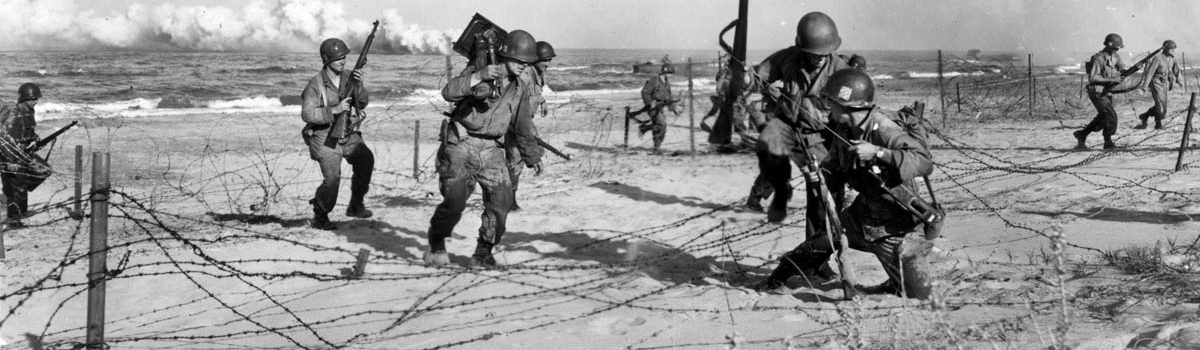
By Nathan N. Prefer
In his Maxims of War, Napoleon Bonaparte wrote, “It is exceptional and difficult to find in one man all the qualities necessary for a great general. What is most desirable, and which instantly sets a man apart, is that his intelligence or talent are balanced by his character or courage.” In North Africa, Sicily, Italy, and France, Lucian King Truscott, Jr., proved himself just such a man.
The future general began simply enough when he arrived on January 9, 1895, in Chatfield, Texas. Although the family soon moved to Oklahoma, he would always claim to be a Texan at heart. The grandson of an immigrant from Cornwall, England, he nearly died at a young age when he was playing in his father’s office.
His father, Lucian King Truscott, Sr., was a physician in Chatfield and was busy in another room when his son decided to taste something that looked good in his father’s office. His choice was a poor one, however, and he swallowed some carbolic acid. His father heard his screams and saved his life, but that day he earned one of his trademarks, a raspy, gruff voice that one observer called “a rock-crusher.”
The Truscott family moved to Oklahoma when the land boom began in 1901. Here, young Truscott came into contact with the U.S. Cavalry, an attachment that would last a lifetime.
To help his parents support him and his three sisters, he decided that he and his mother would both attend the Summer Normal School at Norman, Oklahoma. The goal was to acquire a teaching certificate. By age 16, having lied about his age, he was teaching school at Stella, Oklahoma. Later, after another family move, he taught in Onapa, Oklahoma.
Despite his success in achieving a trade, he was restless. This was no doubt what caused him to enlist in the Army Reserves program in which, after two years as a lieutenant, he would become a Regular Army officer.
Lieutenant Truscott’s first assignment was to the 17th Cavalry on the U.S.-Mexican border near Douglas, Arizona. Here he gained on-the-job experience with the vagaries of morning reports, sick reports, duty rosters, and troop administrative requirements.
By the time World War I ended, Lieutenant Truscott was an experienced, if combat-deficient, Army officer. Concerned that he would soon have to return to civilian life, he was relieved to learn that his regiment was being shipped to Hawaii for garrison duties. But before he shipped overseas, Lieutenant Truscott acquired something far more important to his life and career.
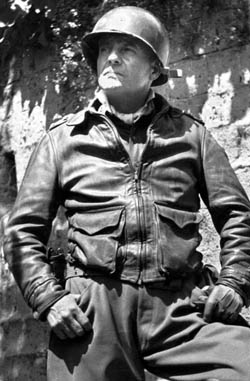
Sarah Nicholas Randolph was the fourth-generation granddaughter of President Thomas Jefferson and, as such, she had a comfortable life and lofty social standing. Lieutenant Truscott was soon in love, and under the pressure of a move to Hawaii, the two were married on April 5, 1919, in Cochise County, Arizona. With the wedding came a promotion to first lieutenant. In Hawaii he took up polo and became a highly regarded horseman, something he would later have in common with another rising star, George S. Patton.
In a shrinking postwar army, Lieutenant Truscott nevertheless earned a promotion to captain. The interwar years were typical for the Truscotts. After Hawaii came California, then back to Douglas, Arizona. Texas was next, the fourth move in three years. In 1925, Captain Truscott was ordered to attend the Troop Officers’ Course at the Cavalry School in Fort Riley, Kansas where he later served as an instructor.
In 1934, after serving as a troop commander of the 3rd Cavalry Regiment at Fort Myer, Virginia, where he met Majors Dwight D. Eisenhower and George S. Patton and participated in dispersing the “Bonus March” on Washington, he was selected to attend the Command and General Staff School at Fort Leavenworth, Kansas, another prestigious stepping stone to high command. His performance earned him promotion to major, along with an instructorship that lasted until 1940.
In September 1940, the newly promoted Lt. Col. Truscott transferred to the developing armored force. Soon after, Colonel Truscott was off to Fort Lewis, Washington, where he renewed his friendship with Colonel Eisenhower. Together, the two men participated in maneuvers in California. Both would also later participate in the 1941 Louisiana Maneuvers.
After these large-scale maneuvers, Truscott found himself back in Texas, assigned to the 1st Cavalry Division. When word came of the attack on Pearl Harbor, Truscott was promoted to full colonel. While training with his troops Colonel Truscott received an urgent call from General Mark Clark of the War Department who ordered him to report to Washington immediately.
Upon arrival in Washington, Truscott was surprised when General Clark asked if he wanted to become a British commando. These light raiding forces had been developed by the British while they bided their time to rebuild their military strength. General Clark went on to explain that President Franklin D. Roosevelt and British Prime Minister Winston Churchill had agreed to invade Europe in 1943 and, in the meantime, U.S. forces would establish within their organization a group of U.S. commandos.
Truscott was sent to General Eisenhower for details. Eisenhower explained that Army Chief of Staff General George C. Marshall believed that the U.S. Army lacked combat experience throughout its ranks. To achieve this goal, a group of American officers were being sent to England to observe and learn from the experienced British. Colonel Truscott would lead the group that would observe the British Combined Operations Headquarters, the top headquarters for the commandos.
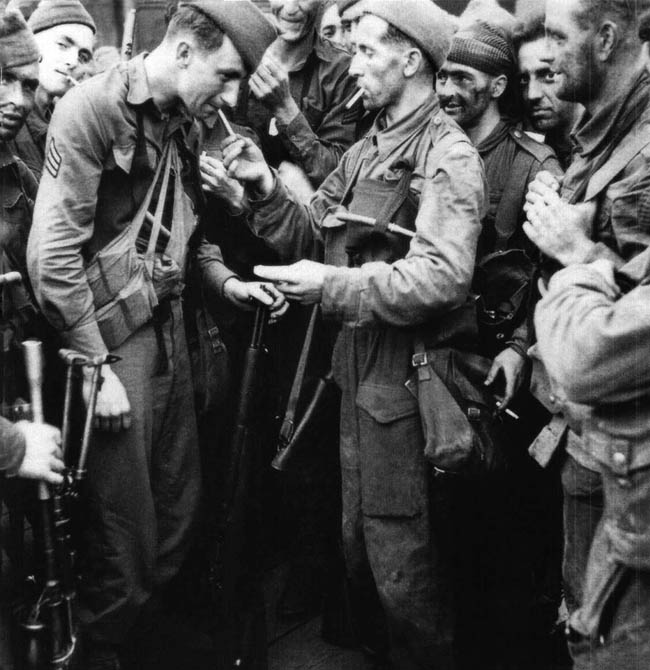
After studying every document he could lay his hands on regarding the British situation and listening in on War Department meetings about American plans for the European invasion, Truscott set off for London. As he flew via Canada to England, he received promotion to brigadier general in May 1942. His group began to absorb the organization of the British commando structure from Admiral Lord Louis Mountbatten, and he was invited to sit in on planning conferences for the cross-Channel invasion. He observed commando training and exercises.
The lack of American infantrymen in England at the time and the continuing movement of American units to training bases caused General Truscott to create a unit that could then instruct others rather than pulling men out of existing units. As a result, the 1st Ranger Battalion was created.
In June, General Truscott was advised of a plan to land a large raiding force at the English Channel port of Dieppe in German-occupied France. Since several commando units would be involved in this operation, Truscott had 50 of his newly trained rangers added to the invasion forces. It would result in the first American combat losses in the European Theater. He observed the bitterly opposed landing from offshore.
General Marshall arrived in London in July, and Truscott was summoned to give a detailed report on every aspect of his stay in London to date. Later, he would attend a meeting with Generals Marshall, Eisenhower, and Clark to go over the same information. Using this data, General Marshall had a tentative plan drawn up for the Allied invasion of Europe. Disagreements between the Allies were resolved, albeit temporarily, by a decision to invade French North Africa in 1942. Truscott and his staff became involved in the planning of the new operation and worked with Eisenhower and Patton on the details.
General Patton was pleased to see his old friend. After asking Truscott what he had been doing in London, Patton said, “Dammit, Lucian, you don’t want to stay on any staff job in London with a war going on. Why don’t you come with me? I will give you a command.” Truscott replied that he was eager to get in on the fighting, but he would need Eisenhower to release him. Patton quickly obtained Truscott’s release and placed him on his staff where he became deeply involved in the planning of Operation Torch, the North African invasion.
With the planning completed, Truscott returned to the United States for his new duties. These involved his command of Sub-Task Force Goalpost, a heavily reinforced regiment from the 9th Infantry Division scheduled to land at Port Lyautey in French Morocco. Organizing an efficient task force took all of Truscott’s time, although he did manage to see Sarah and Lucian III, who was now a West Point cadet.
With a force of 9,079 officers and men, Truscott’s Sub-Task Force Goalpost landed against minimal opposition on November 8, 1942, and seized Port Lyautey and its vital airfields. There were problems, of course. During the approach, the task force lost its direction. H-hour had to be delayed while the assault waves reorganized. Heavy seas slowed matters as well. Some boats missed their assigned beaches. At daybreak, French planes strafed the beaches. Overall, though, the invasion succeeded, and the objectives were soon secured. The French surrendered on November 10. This success earned Truscott promotion to major general.
With the invasion complete, Sub-Task Force Goalpost was disbanded. This left Truscott without a command, so he went to Eisenhower in search of a new one. He was told to “wait around for a few days.” Concerned with the slow progress of American forces toward Tunis, Eisenhower made Truscott his deputy chief of staff to control operations with the British First Army. This was a difficult job, requiring the cooperation of the American, British, and French forces involved. This posting would prove an essential part of the eventual Allied victory in North Africa.
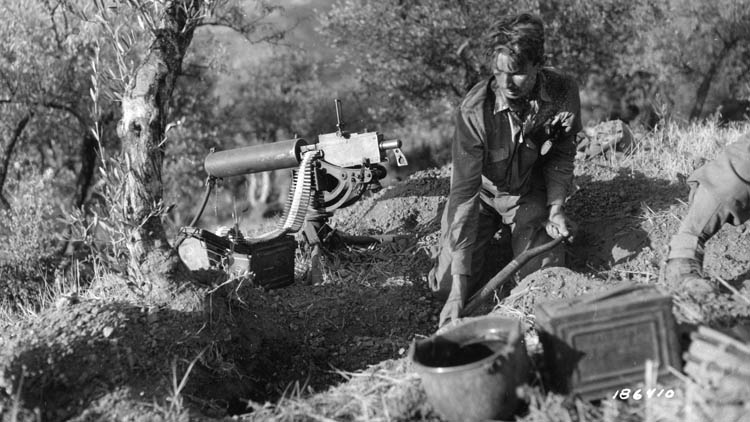
Once again, Truscott’s outstanding performance earned him a new job, this time commanding the 3rd Infantry Division. The division had an outstanding World War I record and had been stationed at Fort Lewis, Washington, in the interwar years, where both Eisenhower and Truscott had served with it. The division had participated in the North African invasion under Maj. Gen. Jonathan W. Anderson. When the latter was promoted to command of X Corps, Eisenhower gave the division to Truscott in April 1943.
Truscott’s first steps were to improve the training and physical endurance of his new command. As he remembered, “I had long felt that our standards for marching and fighting in the infantry were too low, not up to those of the Roman legions nor countless examples from our own frontier history, not even to those of Stonewall Jackson’s ‘Foot Cavalry’ of Civil War fame,” he wrote. Adopting a tactic of the rangers and commandos, he ordered his men to march at the rate of four miles per hour. Despite initial skepticism, the new rate, soon dubbed “The Truscott Trot,” was achieved by all units of the 3rd Infantry Division and helped make it one of the best combat units of the war.
Alerted for Operation Husky, the coming invasion of Sicily, the division began a new training cycle. The 3rd Infantry Division assaulted Sicily as part of the newly created Seventh Army under Patton. The landings were lightly opposed, and the division quickly moved inland. On the third day of Operation Husky, Truscott was already up front with his leading units, pressing them forward. As he observed one battalion attack an enemy position, his driver advised him that standing in the middle of the road with binoculars was inviting incoming fire. The group retired to a nearby ditch.
Soon Patton came calling. He was frustrated that his army was under orders to pace the advance of the adjoining British Eighth Army under General Bernard L. Montgomery. The two men talked the situation over and felt that the Seventh Army could easily conquer the western half of Sicily with the prize of its largest city, Palermo, if given permission. Together, the two men decided upon a “reconnaissance-in-force” to the west to, as General Truscott wrote, “clear up the situation.” Thus began the “Race for Palermo.”
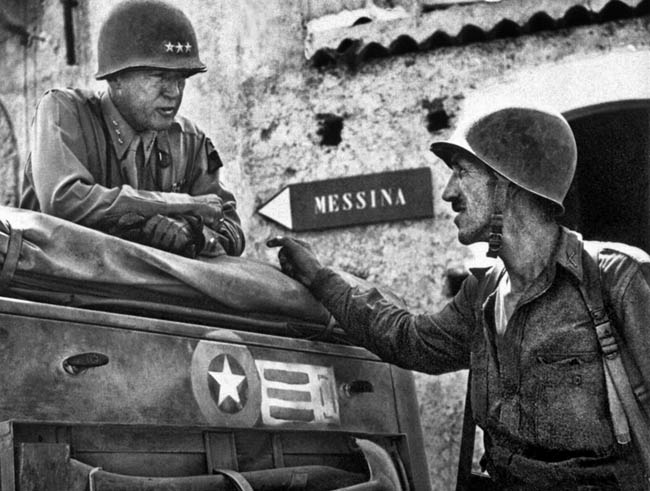
A few days after the capture of Palermo, the 3rd Infantry Division was back fighting the Germans in mountainous eastern Sicily. Progress was slow and costly. This time Patton sent his deputy, Maj. Gen. Geoffrey Keyes, to order Truscott to have one of his battalions conduct an amphibious landing behind the German lines. Truscott agreed with the idea, but insisted that it be within supporting distance of the main division force. This soon became a point of disagreement and resulted in a rather famous episode in Truscott’s career.
The first date for the landing was postponed when German aircraft destroyed one of the landing craft. When the next scheduled date was postponed by Truscott because he felt that the bulk of the division was still too far away to support the isolated battalion, Keyes appeared and demanded the landing proceed. He reported to Patton that Truscott did not want to carry out the landing. An hour later, Patton came screaming into the 3rd Infantry Division command post.
Truscott recalled the scene. “He was screamingly angry as only he could be. ‘Goddammit, Lucian, what’s the matter with you? Are you afraid to fight?’ I bristled right back: ‘General, you know that’s ridiculous and insulting. You have ordered the operation, and it is now loading. If you don’t think I can carry out orders, you can give the division to anyone else you please. But I will tell you one thing, you will not find anyone who can carry out orders which they do not approve as well as I can.’” Truscott’s reply calmed Patton immediately, and the two men settled down to discuss how best to relieve the amphibious force.
Lieutenant Colonel Lyle W. Bernard’s 2nd Battalion, 30th Infantry Regiment, itself at two-thirds strength, was reinforced with three batteries from the 58th Field Artillery Battalion, a platoon of the 10th Combat Engineer Battalion, and a platoon of Company C, 753rd Tank Battalion. As Truscott feared, the battalion took severe punishment in its isolated beachhead, and the division, despite its best efforts, took longer than expected. Seven of the eight artillery pieces were lost as were several tanks and other vehicles. But the battalion survived. By August 16, the division was on the hills overlooking Messina. The battle for Sicily was over.
Initially relieved that his division would not be in the assault phase of the invasion of southern Italy, Truscott was soon ordered by his new commander, Maj. Gen. Mark Clark of the Fifth U.S. Army, to be prepared to land farther north once the Allied advance made progress in that direction. But the strong German defense of the Salerno beachhead soon changed such plans. In less than a week, Truscott was ordered to prepare his division to land at Salerno and join the battle there. While his men sailed to Italy, Truscott went to the beachhead to see things for himself and confer with General Clark. Traveling by PT-boat, he visited the beachhead, saw the strong defenses, and received orders to assign his division to the Fifth Army’s VI Corps once ashore.
During the battles along the German Winter Line at Cassino, Truscott learned of an old plan, Operation Shingle, that had been discarded and now suddenly revived. The VI Corps, along with the 3rd Infantry Division and the British 1st Infantry Division, was to land at the town of Anzio, on the coast behind the Winter Line.
The initial landings in January 1944 went surprisingly well and caught the Germans by surprise. But as always, they recovered quickly and soon had the beachhead surrounded. During the early days of the battle, Truscott was wounded in the leg when an enemy shell exploded nearby. Saved from serious injury by his favorite cavalry breeches and boots, he remained on duty after medical treatment.
The attack to break out of the beachhead failed when unexpected German reinforcements stopped the advance. During this attack, General Truscott suffered a personal blow when three ranger battalions assigned to his division for the attack were overwhelmed by the enemy. The Allies went on the defensive. For several weeks, the VI Corps would struggle to save its beachhead from increasingly heavy enemy assaults.
Truscott was asleep in his headquarters on the evening of February 16, 1944, when he was awakened by Colonel Carleton. He had a message from General Clark that relieved Truscott of command of the 3rd Infantry Division and appointed him deputy commander of the VI Corps.
Truscott arrived at the VI Corps headquarters to find Lucas and his staff concerned over the latest German counterattack, which threatened to push the Allies into the sea. He observed that there seemed to be “a feeling of desperation, of hopelessness” prevalent in the headquarters. “My optimistic assurance that nothing ever looked as bad on the ground as it did on a map at headquarters did little to dispel the pall-like gloom.” Truscott contacted the division commanders, learned the situation, and was satisfied that each had done all he could, and that in fact, the situation was not as bad as first feared.
A few days later, Clark visited the beachhead and invited Truscott to accompany him on a tour of the frontline units. During the ride, Clark intimated to Truscott that in a few days Lucas would be relieved of command of VI Corps, and that Truscott would replace him. Truscott recalled, “I replied that I had no desire whatever to relieve Lucas, who was a personal friend, and I had not wanted to leave the 3rd Infantry Division for this assignment. I had done so without protest because I realized that some of the command, especially on the British side, had lost confidence in Lucas.”
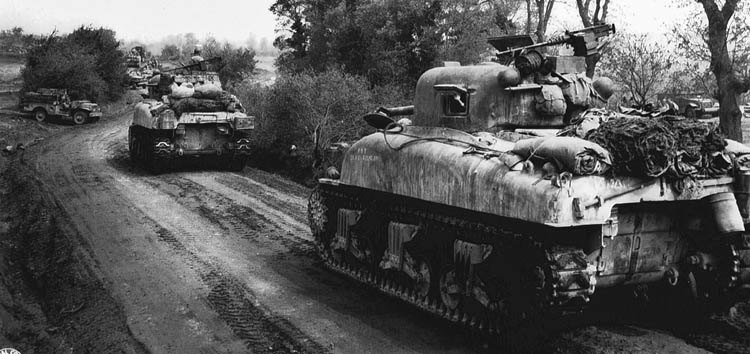
Continuing as deputy corps commander, Truscott had some ideas to improve the Allied position. He called in the corps artillery officer, Brig. Gen. Carl A. Baehr, and asked how the artillery was employing its guns. Disturbed by what he heard, he called for the 3rd Infantry Division’s artillery operations officer, Major Walter T. (“Dutch”) Kerwin. After Kerwin explained how the division massed its guns against enemy attacks, Truscott ordered him, accompanied by Baehr for authority, to make similar arrangements for all corps and other divisional artillery units.
On February 22, 1944, Clark returned to the beachhead and met with Truscott, ordering him to assume command of VI Corps the next day. Truscott repeated his earlier arguments against relieving Lucas, but was informed that the decision had been made. Later, after Lucas had been informed of his relief by General Clark, Truscott expressed his regrets as to how things turned out. Lucas expressed no hard feeling against Truscott, and the two men remained friends until Lucas’s death.
As corps commander, Truscott had to deal with problems relating to both the American and the British troops under his command. Further, Clark had established an advanced Fifth Army headquarters at the beachhead, and this brought its own problems in assigning space, priorities, and rights of way.
By May, the VI Corps was heavily reinforced and ready to break out of the Anzio beachhead. The original plan had VI Corps striking east to cut the line of retreat of the German Tenth Army. The opening attacks went well, and General Truscott was ecstatic. After viewing the progress of the attacks, he returned to his command post where Clark’s chief of staff, Brig. Gen. Donald W. Brann, was waiting. The new orders required Truscott to turn the bulk of VI Corps north to capture Rome. Only a token force was to be left to try to cut the German escape route.
Truscott “was dumbfounded. I protested that the conditions were not right. This was no time to drive to the northwest where the enemy was still strong; we should pour our maximum power into the Valmontone Gap to ensure the destruction of the retreating German army.” But the orders remained, and Truscott obeyed, participating in one of the war’s most controversial episodes.
With the capture of Rome, the VI Corps stood down for a brief rest. The months of July and August were spent training and planning a new operation, the invasion of southern France. This time Truscott and his VI Corps were under a revived Seventh Army commanded by Lt. Gen. Alexander (“Sandy”) Patch, a veteran of the Pacific War. Allowed to pick his own combat units for the operation, Truscott chose his favorite 3rd Infantry Division and the equally battleworthy 45th Infantry Division, which had fought under his command at Anzio. The third division was the 36th (“Texas”) Infantry Division, which had led the breakout at Anzio.
Truscott planned and executed Operation Anvil-Dragoon, the invasion of southern France, with little difficulty. The landings were lightly opposed, and the drive inland began quickly. The push toward the Belfort Gap went as planned, and the Germans were too busy withdrawing to make much of a defensive stand. Things continued to go well as the VI Corps entered the Vosges Mountains near the German border. As winter slowed operations, Truscott was visited by Eisenhower, who told him, “Lucian, I am going to assign you to organize the Fifteenth Army. You won’t like it, because this Army is not going to be operational. It will be an administrative and training command, and you won’t get into the fighting.”
General Edward H. (“Ted”) Brooks would take over VI Corps while Truscott returned to the United States for a well-earned rest before returning to command the new army. After two years of fighting in North Africa, Sicily, Italy, and southern France, General Truscott was finally going home.
He thoroughly enjoyed his visit. Besides spending time with his wife, he visited West Point to see his son, Lucian III. As he was preparing to return to Europe, he was suddenly called to Washington. While at the War Department, he learned that the unexpected death of a British senior commander had resulted in a series of promotions and moves that would now affect him. One of the unexpected moves was the promotion of General Clark to command the Fifteenth Army Group in Italy. That left a vacancy in command at Fifth Army. General Marshall asked Truscott, “How do you feel about going back to Italy?” Surprised, Truscott replied, “Sir, I will do the best I can wherever you wish to send me.”
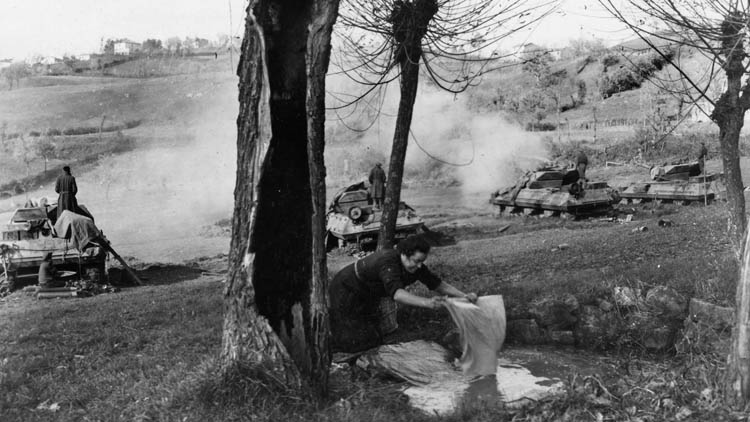
Taking his faithful staff, Truscott assumed command of the Fifth Army in Italy. With 300,000 soldiers under its command, including at various times Britons, South Africans, Polish, New Zealanders, Brazilians, and soldiers of other nationalities, Truscott’s Fifth Army pushed against the new German Winter Line, captured Bologna, broke the back of German resistance at the Gothic Line, and pushed into the Po River Valley, dispersing the German Tenth and Fourteenth Armies. It was a part of the force that accepted the first surrender of a German army group in World War II when Army Group C surrendered to Allied forces in Italy.
With the defeat of Germany, Truscott returned to Texas and then volunteered for the war in the Pacific. He was assigned to a group of high-ranking officers who were directed to visit China and prepare to serve there until the defeat of Japan. But even as the group was conducting inspections, Japan surrendered. The war was over. His assignment to command a group of Chinese armies against Japan was moot.
Returning to Italy, Truscott learned that Fifth Army headquarters was to become inoperative. He said goodbye to his faithful staff and decided to visit his friend Patton, then on occupation duty in Germany. Expecting to be sent home to an unknown assignment, Truscott was suddenly caught up in another of Patton’s indiscretions. As he was making the rounds of farewells, Eisenhower’s chief of staff, Maj. Gen. Walter Bedell Smith, caught up with him. Eisenhower wanted to see him immediately. Truscott reported to Eisenhower and learned that he was to replace Patton as commander of the Third Army. For the final time, Truscott protested, but agreed that for the good of the service Patton had to go.
The exchange between two longtime friends went without rancor. When introducing Truscott to the Third Army, Patton said, “A man of General Truscott’s achievements needs no introduction. His deeds speak for themselves.” And so they did.
As the commander of the Third Army on occupation duty, Truscott was faced with new challenges. Tens of thousands of displaced persons needed caring for. He became involved in Cold War politics when, for reasons of their own, some Americans claimed that the Army was abusing or neglecting these unfortunate people. Alerted to the coming storm, Truscott invited newspaper reporters to visit the camps and report accurately on the conditions. Additionally, he was responsible for the trials of Nazi war criminals. He also was responsible for opening a university program for refugees under the auspices of the United Nations. Many who knew him were surprised at his rapid adjustment from combat leader to government administrator.
In early 1946, General Truscott received word that Sarah was seriously ill at Walter Reed Army Hospital. He remained home for 10 days, until he was convinced Sarah was getting well. On the return flight to Germany, he became ill. An electrocardiogram indicated a heart attack, and the doctor ordered several weeks of bed rest. Told that his condition was not improving, Truscott retired on September 30, 1947, after 30 years in the United States Army. He later briefly served as a deputy director of the Central Intelligence Agency. Promoted to the rank of four-star general on the retired list, Lucian King Truscott, Jr., died at the age of 70 on September 12, 1965.
Nathan N. Prefer is the author of several books and articles on World War II. His latest book is titled Leyte 1944, The Soldier’s Battle. He received his Ph.D. in Military History from the City University of New York and is a former Marine Corps Reservist. Dr. Prefer is now retired and resides in Fort Myers, Florida.