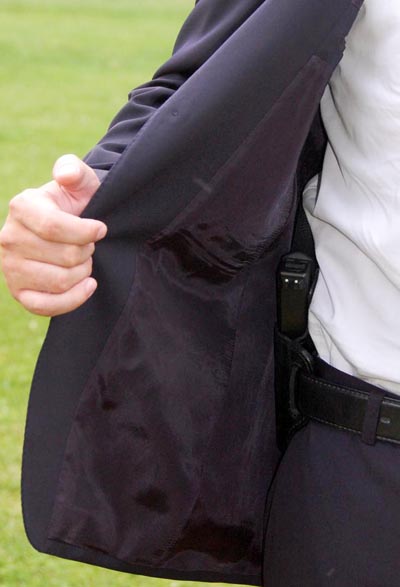
How to arrange good-looking clothing around the decidedly non-standard bulge of a handgun is a topic worth looking at. It’s something that a whole range of men need to think about: police detectives, security guards, entrepreneurs in dangerous countries, and even your average American civilian who prefers to be armed.
“Concealed carry” exists for a number of reasons. When you’re doing it, you want to be living up to both parts of the phrase: you want to be carrying, and have access to, a firearm, and you want it to be discreetly hidden until such time as you need it.
For some men, any jacket long enough to hide a holster is sufficient. But for most men, concealed carry needs to fit other societal expectations:
- Most plainclothes peace officers will have specific dress needs — either a respectable suit or blazer to give them out-of-uniform authority, or in some cases a disguise to help them blend into their environment.
- Security guards are almost always expected to dress professionally, as much for the comfort of their employer’s clients as anything else. Banks and government buildings need high security, but prefer a discreet man in a blazer as opposed to a uniformed, paramilitary-looking trooper looming over their customers.
- An armed civilian gets less hassle if he doesn’t fit the stereotype of an armed threat. A trenchcoat and combat boots conceal a weapon, but it doesn’t really conceal the likelihood that you’ve got a gun under there. Bringing a little men’s style into the equation makes the “concealed” part of “concealed carry” a lot more effective. Plus, it’s the law in most states that if you’re carrying heat, you conceal it. Editor’s Note: If you’re a civilian, be sure to check with your local and state laws before you begin carrying a firearm. Most states require citizens who wish to carry a firearm to obtain a concealed carry license; there also may be restrictions on where you can carry your firearm.
There are many reasons to think about both concealed carry and style in the same picture. This article lays out the quickest and best steps to making your concealed carry experience both practical and stylish:
- Step 1: Choose Your Weapon
- Step 2: Choose Your Method of Carry
- Step 3: Choose Your Outfit
- Step 4: Talk to Your Tailor
So let’s take it step by step:
Step 1: Choose Your Weapon
Concealed carry means striking a balance between firepower, ammunition, and size. You inevitably end up making a sacrifice in one area or the other — it’s more a question of personal needs and tastes than it is a matter of which is the “best” weapon.
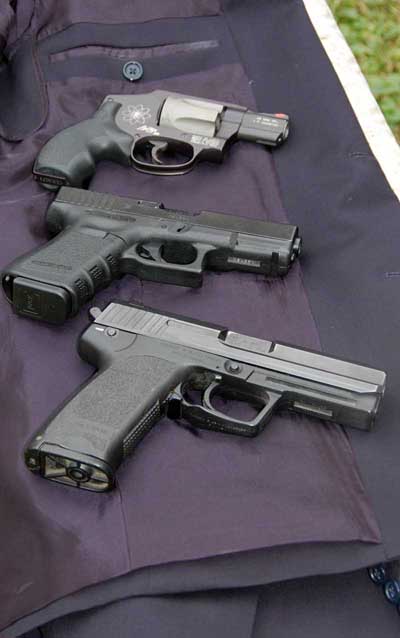
But for choosing a handgun, which is what most men will be carrying when they carry a firearm in public, here are a few factors worth thinking about:
Magazine Size and Shape
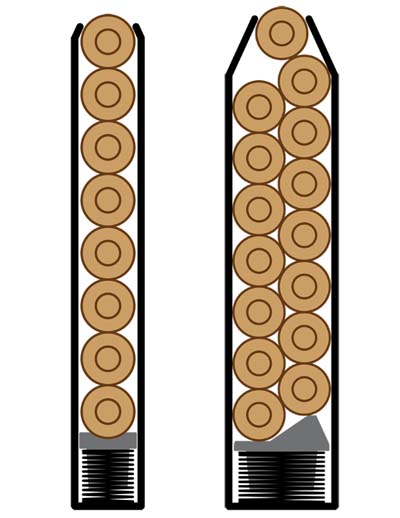
A single-stack magazine is always easier to conceal than a double-stack.
The most important dimension of a pistol for concealment purposes is the width — how fat the barrel and the grip are. That’s what’s going to make a bulge under your clothing, more than the length or even the weight of the gun.
As a result, it’s better to have a single-stack magazine of relatively low caliber, at least in terms of concealment purposes. If that’s just not going to meet your needs in terms of firepower or ammunition, you get a slightly thicker magazine and cope as best you can.
The disadvantage of a smaller grip/magazine (aside from limiting your shots) is that a powerful handgun with a small grip has a ton of kick. The shorter the grip, the less leverage you have, making aiming trickier (especially follow-up shots after the first). A heavier frame can help compensate for a smaller magazine, and won’t alter the concealment in most holster types (though it will create more of a sag if you’re carrying it in your pocket or by another non-holstered method).
Look for a balance that suits your needs, but from a concealment standpoint do be aware that a longer grip/magazine is harder to hide, and may end up poking you depending on your carry method.
Caliber
This is one that some people have very strong feelings on. Some people will swear that you always want the maximum firepower you can carry; other people are comfortable with the idea that no bullet is a bullet anyone wants to take, and therefore even a tiny holdout pistol is plenty for self-defense.
You’ve got to make that call yourself. But the reality is, smaller caliber handguns are easier to conceal both because of the magazine size and the barrel width and length.
It’s not a universal scale — a .45 could be more concealable than a .38 depending on the shape and size of the grip and magazine — it’s just something you need to be thinking of as a firepower/concealability trade-off.
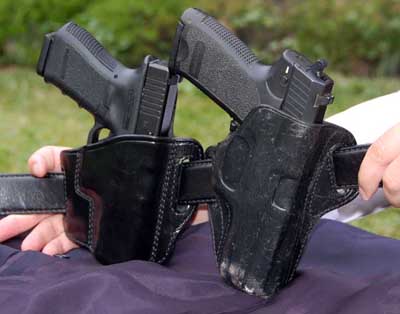
Exterior Construction
To use a very untechnical term, some guns are made with lots of “fiddly bits.”
You know what I’m talking about — everything from sighting notches to bulky safety catches to raised lettering on the barrel. Any of those is going to make the gun harder to conceal.
Weapons that are purpose-designed for concealed carry (and a number of manufacturers do have models specifically for the CC market) tend to be smooth-sided and streamlined. Look for designs with minimum “fiddly bits.” It’ll help both your concealment and your draw.
Barrel and Magazine Length
It’s a secondary consideration next to width, but the length of the pistol (in both directions) does matter. Extended magazines are hard to hide, and tend to poke you while you carry them.
Longer barrels give you range and accuracy, and longer magazines give you more shots without reloading, but the reality for most of us is that neither of those is a huge consideration. Unless you’re in an active military or paramilitary kind of situation, you — hopefully — won’t ever need more than a shot or two, even in the very worst-case scenario. Most of the time you won’t even need that.
So when possible, err on the side of a smaller weapon and magazine for the sake of concealability and comfort. It’s one of those trade-offs where you have to know your own needs, but don’t just default to the biggest magazine and longest barrel available for your handgun of choice.
Although easy to conceal, the mosquito gun is ineffective against anything larger than a squirrel.
So Which Gun is the Right One?
There’s no single right answer to that question. But, most men with concealed carry experience will recommend something along the same basic lines:
- low to mid-caliber ammunition
- single-stack magazine (or very slim-profiled revolver)
- slim grip
- short barrel
- smooth exterior
- light weight
Here are a few of the more popular models that get tossed around in discussions of concealed carry — this is by no means an exhaustive list, nor should any of these be taken as strong recommendations, but they’re good examples of the relatively broad range of options you have:
- Glock Model 19
- NAA .22 Magnum Mini-Revolver
- Kahr PM9
- Smith & Wesson M&P series
- Walther PPS
- Springfield XD
There are many more beyond these. But the important step here — and this is key — is to know which one you carry (or will be carrying) before you start planning your wardrobe around it, and especially before you have any tailor-made adjustments. You get the maximum benefit when you can have clothes tailored specifically for your gun and holster of choice.
Which brings us to our next step:
Step 2: Choose Your Method of Carry
Just like handguns, holsters come in every style imaginable. You might own one, or you might own a dozen. Depends on your needs. But for purposes of deciding what to wear and how to conceal your gun, you’ll want to know where you’re going to wear it, and in what kind of holster.
Regardless of your method of carry, one key piece of equipment is a very sturdy belt. This not only helps keep the gun in place and prevents your trousers from sagging, it’s also an important safety feature. You don’t want the holster shifting and you certainly don’t want the belt buckle popping open because of the extra weight or the jerk of your draw. Invest in something broad and made of sturdy leather or ballistic nylon. Most stores that sell holsters will also sell belts designed for them.
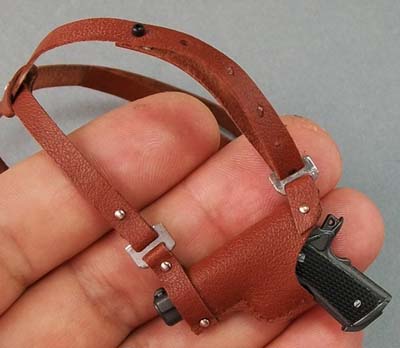
Paddle Holster, Hip Carry – OWB (Outside the Waistband)
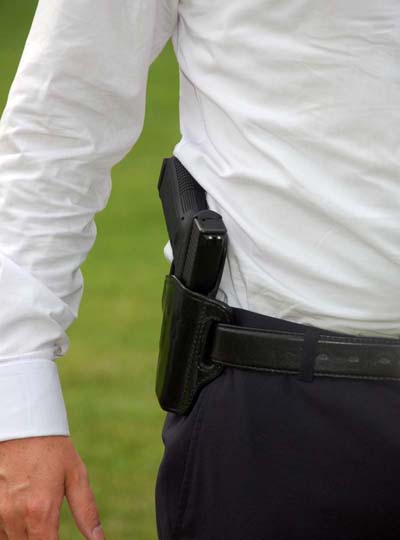
- Advantages: Simple, cheap, and quick to draw
- Disadvantages: Bulky and hard to conceal
This is the most typical way for peace officers and soldiers to carry their primary handgun: a “paddle” style holster (basically the outline of the gun, with a flat “paddle” backing that rests against your body) worn at the belt line, with the pistol pointed down the thigh. The magazine points toward the rear of your body, and the grip is typically angled a bit forward.
The disadvantage for concealed carry should be obvious: it’s going to be very easy to accidentally reveal a gun that’s worn up by your front pockets. A long, loose jacket will do the trick, but as soon as you unbutton/unzip the front it only takes a stiff breeze to expose your holster.
It’s also hard to conceal the bulge if you wear a buttoned suit or sports jacket, even one tailored for the holster. You can pull it off with a small holster and a small gun, but expect to look pretty heavy around the hips when you do it.
Paddle Holster, Behind the Back – OWB (Outside the Waistband)
- Advantages: Simple, cheap, and still fairly quick to draw
- Disadvantages: Still bulky; still requires at least a jacket to conceal
An obvious solution to the hip-carry problem is to keep the same simple holster but move it to the small of your back.
This removes the problem of an unbuttoned jacket brushing back to expose the pistol. The whole back of your coat/jacket would have to flip up to reveal your firearm. It makes a suit or sports jacket much more effective concealment, especially if it’s cut a bit long in the rear. A little looseness also looks more natural on the back of your jacket than it does at the sides.
Drawing a pistol from behind your back is a bit slower than off the hip, but still not too cripplingly inconvenient. There is growing concern, however, that a gun in the small of your back can cause back injuries if you fall or are struck hard where the gun rests — many police departments mandate that nothing except soft items (gloves, CPR kits, etc.) be carried directly in the center of the back for this reason.
So while the simple paddle holster worn behind the back is an effective method of concealment, and still a favorite for a lot of concealed carriers, it comes with some safety cautions. And, of course, it requires you to sit down pretty gingerly, if at all.
Shoulder Holster
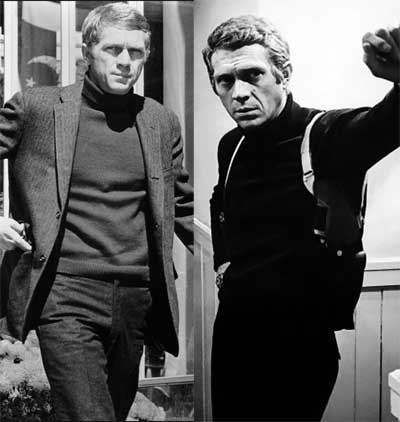
- Advantages: Decent concealment, faster draw than behind the back
- Disadvantages: Uncomfortable, easy to accidentally expose
The shoulder holster, which keeps the handgun tucked under your armpit and against your upper ribs, is a popular one with law enforcement (and one made famous by Hollywood and television cops). It’s a good choice for easy access, and only slightly slower to draw from than a holster on your hip.
Unfortunately, it’s also not that great for concealment. A suit jacket or blazer angles back toward the shoulder — you’ve usually only got a few inches between the butt of your pistol and the opening of your jacket. Unbuttoned, it’s very easy for the jacket to slide back far enough to reveal your weapon.
Typically, your draw with a shoulder holster also has to cross your body, with the barrel sweeping in almost a full semi-circle. They’re not allowed on many firing ranges for this reason — instructors and managers don’t want to risk other people being placed within the line of fire as you draw. It’s important to have very good trigger control and be careful with your safety when you’re drawing from a shoulder holster.
Due to the concealment drawbacks and need for trained habits, shoulder holsters tend to be best for people like plainclothes detectives and security guards who are being discreet, but don’t need to effectively disguise the fact that they’re carrying a weapon, and tend to have more firearms training than your average civilian.
Sheath Holster IWB (Inside-the-Waistband)
- Advantages: Good concealment, doesn’t require a jacket
- Disadvantages: Requires tailored trousers
IWB holsters (the most common name) carry the gun tucked into the trousers rather than worn outside them. They make special holsters for this, which are worth investing in. Whatever you may see on TV, don’t go tucking guns into your pants without a holster unless you absolutely have to. Most IWB holsters can be positioned anywhere on your back, allowing for basic behind-the-back carry or for something shifted to one hip or the other.
The advantage here is that you only have to hide the handle of the gun, rather than the whole thing. A smooth holster inside custom-widened trousers conceals most of the bulk for you. Just a loose T-shirt will do to hide an inside-the-waistband carry in a pinch.
The downside is that it’s an expensive and a fairly uncomfortable option. You need the tailored trousers, the specific holster, and the willingness to stand and sit with a gun barrel pointed down your rear end.
Pocket Carry
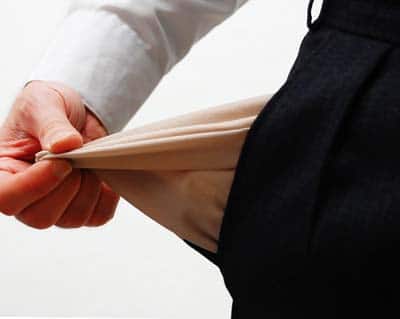
- Advantages: Good concealment, flexible positioning
- Disadvantage: Requires a small gun, concealment can vary; gun may shift
Pocket carry is what it sounds like — sticking a gun in your pocket. How effective the method is at concealment depends on how large your pockets are, how thick their lining is, and what style they are — big patch pockets with thick lining and a closing flap will hide a gun fairly effectively, while the back or hip pockets of your jeans will not.
The biggest disadvantage of carrying your gun in your pocket is that, unless you have an internal holder sewn into the pocket (which we recommend if you plan on pocket carrying regularly), the gun will shift around as you move. This can slow your draw, make the gun more likely to “print” (show its outline through the fabric), and even be a safety hazard.
If you wear a garment with large, easily-accessed pockets low on your midsection, you can position a gun for off-hand draw as well. A side-slit pocket near where your off-hand naturally falls is about as easy access as you’re going to get for emergency off-hand draw if your primary arm is incapacitated.
Many people prefer to use pocket carry for a back-up or holdout weapon, paired with another method of concealed carry for a primary weapon. If you do pocket carry, be sure that the gun is snug in the pocket, and have a tailor sew a holder into the interior if necessary. You don’t want your gun falling out, or to go to draw it and find it upside down and backwards in your pocket.
Ankle Holster
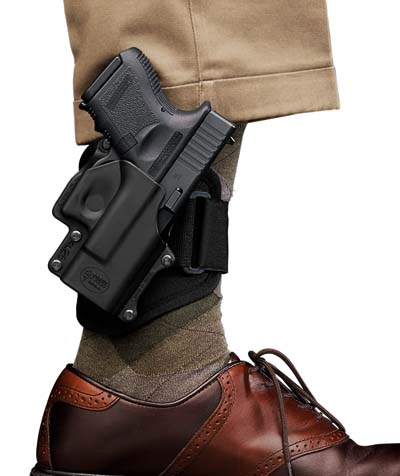
- Advantages: Excellent concealment
- Disadvantages: Very slow draw, limited to the smallest handguns
An ankle holster is a traditional holdout option for very small handguns. It requires nothing fancier than boot-cut jeans to conceal, and may even be missed by careless pat-downs. But it limits you to little more than a derringer (though some police carry sub-compacts, usually in specially-tailored trousers), and takes several seconds to draw from, making it a backup option rather than a primary method of carry for most men.
Holdout holsters can also be strapped to a forearm, inner thigh, or other unusual point for maximum concealment. Again, however, these are difficult to draw from and can only conceal the very smallest handguns out there.
Step 3: Choose Your Outfit
Once you know what gun you’re going to carry and where you’re going to carry it, you’re ready to plan an outfit that both conceals the weapon and looks sharp on you.
Different men have different sartorial needs, just as they have different firearm needs. The good news is, there’s a concealing outfit for every standard of dress from James Bond’s tuxedo all the way down to cargo pants and a T-shirt.
Business Concealed Carry
Suit-and-tie concealed carry is more common than you might think. Businessmen who travel frequently like to take personal protection along with them, and some politicians actively advertise their habit of carrying a weapon as a matter of principle as well as protection.

Can you spot the handgun’s print?
Happily for all of them, a business suit is a fairly effective method of concealment. It’s actually one of the better options out there, short of a full length coat. You can use pretty much every type of holster:
- Paddle on the hip (with the jacket buttoned; jacket should be tailored for the bulge)
- Paddle behind the back (a long jacket easily conceals the whole thing)
- Inside the waistband (practically invisible under a jacket)
- Shoulder/armband holster (concealed as long as the jacket’s buttoned)
- Ankle holster
The biggest consideration for a man in a suit is usually whether he needs to be able to take the jacket off or wear it unbuttoned. An unbuttoned suit jacket can still conceal either kind of behind-the-back carry, and of course a holdout, but will probably reveal a holster on the hip or under the arm if the wearer moves much.
Men who need to be able to take their jacket off and still keep a weapon hidden should wear trousers tailored for inside-the-waistband carry and a shirt with a long, loose back that can be untucked or draped over the butt of the gun.
Three-piece suits are also popular with concealed carriers — the waistcoat can be cut deliberately long to hide an inside-the-waistband carry.
If you’re actually likely to be in any sort of combat situation, be sure to swap a clip-on tie with a breakaway clip for the hand-tied version. They’re not quite as nice-looking, but someone who’s working as a bodyguard or security officer doesn’t need to be offering a free chokehold to potential assailants.
Business-Casual Concealed Carry
A step down from the suit and tie look, business casual is the style preferred by most men who carry a handgun as part of their job — plainclothes cops, body guards, security guards, and so forth. A business casual outfit looks respectable and often includes a conveniently concealing jacket, making it all around useful for people in that sort of line.

Civilians should also take advantage of the blazer-and-slacks combination. It gives you plenty of places to conceal a weapon, and it has the added advantage of making you look well-dressed relative to the average guy on the street. People looking at you are going to be thinking, “Hey, he looks sharp,” not, “Hmm, I wonder if he’s carrying a gun.”
A sport coat or blazer jacket and long trousers of any kind offer basically the same concealment as a suit jacket. You also have the option of wearing either an unmatched “odd vest” or a longer sweater vest, either of which will hide the handle of a gun worn inside the waistband without the need for a jacket.
Dress-casual concealed carry can be made to look quite casual — think Dirty Harry, Miami Vice, or Steve McQueen in Bullitt, all of which feature shoulder-holstered policemen in jackets and sharp shirts.
Of course, if you’re planning on serious physical activity or movement, don’t expect a suit jacket or blazer to provide much concealment. But presumably at the point where you have to sprint, concealment is no longer the chief priority.
Casual Concealed Carry
If there’s no dress code to observe, you can wear almost anything that conceals a weapon. That said, don’t default straight to baggy jeans and an untucked T-shirt — it works, but it doesn’t do much to disguise the fact that you could be armed, and it’s neither as practical nor as attractive as some of your other options:
- Concealment jackets – These are coats made by arms manufacturers (or affiliates) specifically for concealed carry. SIG makes one designed to look like your basic work jacket, similar to a Carhartt or Dickies, making it very unobtrusive almost anywhere in America. Concealment jackets have large internal pockets, usually Velcro-sealed, with loops or hooks for a handgun. They’re great for outdoors concealed carry, but get both uncomfortable and obviously out of place if you’re indoors for any length of time.

- Leather jackets – A classic style and excellent concealment, opt for one that’s on the longer and looser side. Bomber-style jackets are perfect for concealed carry, since they have a padded lining that conceals bulges and a longer waist than moto-style jackets.
- Denim or wool coats – Lightweight coats are comfortable most of the year and can conceal any style of holster except the paddle (longer coats will even cover that). Just be cautious of tight-fitted waists, typical on jean jackets, unless you know you’re going to be using a shoulder holster exclusively.

- Safari/photographer’s vests – The thigh-length, multi-pocketed vest typical among journalists and photographers is an ideal concealed carry garment. It’s long enough to hide holsters at the waistband, thick enough to disguise bulges, and features plenty of pockets for ammunition or even a smaller holdout weapon. There’s a reason they’re popular with people traveling in rough countries — that said, they’re also the most recognizable “concealed carry” garments, and may draw attention from people looking for concealed weapons.
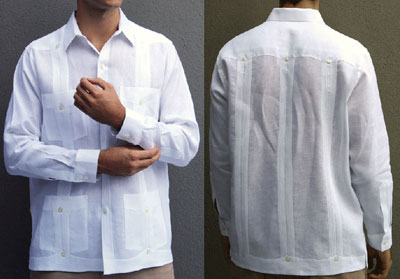
- Casual shirts worn untucked – Just a plain white dress shirt is plenty of concealment if you’ve got an inside-the-waistband holster. Wear any sort of collared or uncollared shirt loose and untucked and you’ve got enough concealment to hide the grip of a handgun from casual observation. It’s a good option when you’re carrying in places where a jacket or blazer would be conspicuously overdressed. Remember the guayabera shirts we just wrote about?
- Sweatshirts/hoodies – These are pretty much everywhere, and they add plenty of bulk around the waist that can hide even a large handgun. Just be aware that men over 30 wearing a hoodie look like they’re trying a little too hard. It’s good gun concealment, but it’s not magical urban camouflage that will make people think you’re from the streets if you’re not. To learn more about your options check out this classic AOM article on sweater styles for men.
Step 4: Talk to Your Tailor
Bizarrely, this is the step most men skip — even though the cost of alterations is usually less than the cost of a holster, and certainly less than a decent handgun.
Don’t skip it.
A single purpose-made garment is better concealment than any half-dozen layers of unaltered clothing. Tailors have their jobs for a reason.
The key here is to find a tailor who’s willing to work specifically on concealed carry issues. Always ask ahead of time — it’s very bad form to walk into a stranger’s shop and pull out a gun unannounced, even for demonstration purposes. Set up an appointment ahead of time and make it clear that you’ll be bringing a gun.

Some basic changes a tailor can make that go a long way in concealed carry include:
- An extra layer of canvas and lining in the jacket increases stiffness, which reduces the “print” the gun makes through the outer fabric.
- Extra length in the back (you can usually get away with up to an extra inch before it starts to look odd) helps keep a paddle holster concealed when you move or raise your arms.
- Small armholes make the jacket rise less when you move your arms, making them good for paddle holsters. Large armholes, on the other hand, help hide a shoulder holster, and the hem of the jacket lifting doesn’t affect shoulder carry. Pick whichever you need for your holster.
- Small pockets can be added inside the lining at the bottom front corners. You can slip a fishing weight or large coin into the pocket to help keep the jacket in place as you move, preventing any inadvertent holster-flashing.
- If you’re planning on pocket-carrying, a small cloth sling or loop can be added inside the pocket to hold your pistol at the proper angle and keep it from sliding around.
- Select a textured fabric to help break up lines, especially if you carry a bulkier gun. Herringbone, birdseye, and rough tweed all help reduce the visibility of the outline. Stay away from stripes, which emphasize any bulges.
- A stiffened rod or strap can be sewn into the front edge of the jacket, making it easier to flip out of the way when you do draw but keeping it lightly weighted down at all other times.
- Extra pockets can be added to any garment for spare ammunition. If you plan on carrying one specific type of magazine, bring an empty along and have the pocket made to fit it.
- Get a tight-fitted shirt if you use a shoulder holster, to prevent the holster from tugging loose fabric into conspicuous wrinkles across the front of your body.
A good tailor will always take the measurement of the gun itself and of you wearing the gun. Be sure to have all components in place, especially if it makes a difference in size.
Once you have a jacket and trousers (or other garment) tailored for concealed carry, the rest is in your personal style and mannerisms. Carry yourself calmly and with confidence, and dress tastefully but blandly, and you should be able to slip past everyone’s notice without the possibility that you’re armed ever crossing their mind.
The worst thing a concealed carrier can do is fiddle with his clothing, especially where the gun is hidden, so keep your hands at your side and try to look bored. In the ideal concealed carry situation, no one knows you have a gun until you’re using it — and if you’re lucky, that means no one ever knows you have a gun.
Thank You
I would like to extend a big thank to the many law enforcement professionals, military men, and citizens whom I consulted with on this article.
______________
Written by Antonio Centeno, Founder Real Men Real Style
Want to learn more about style? Watch my men’s style videos here.
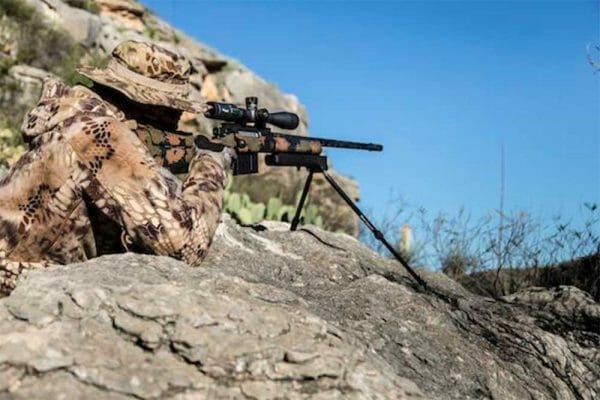



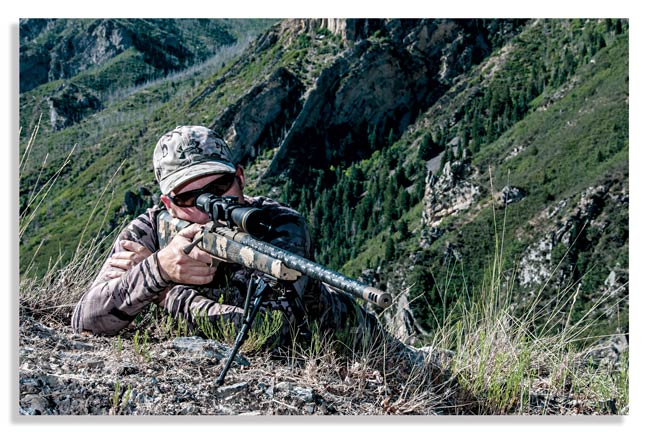



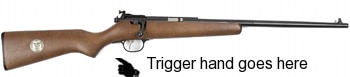
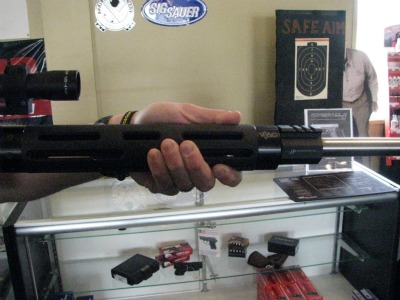
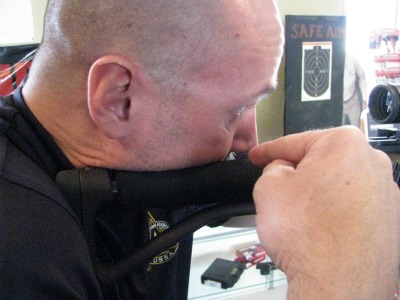
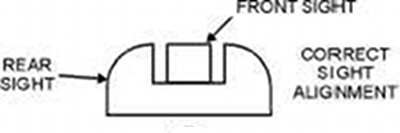
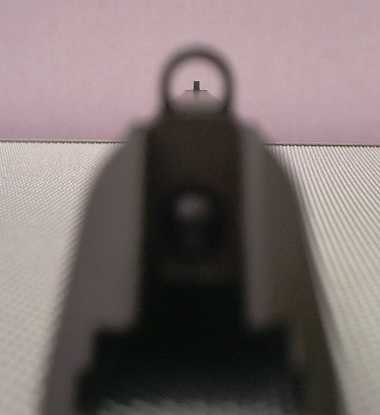
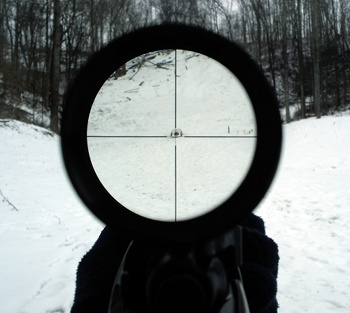 Scopes provide the most accurate and easy sighting on a rifle. They allow the shooter to magnify their target for better target definition at long ranges. A scope’s most useful attribute is that everything in the shooter’s field of view is in the same optical plane. Translation: there’s no need for your eye to balance focusing on multiple objects like you do with open sights and aperture sights. You can keep both the crosshairs and the target in focus. Just aim your cross hairs at your target and shoot.