Categories
All About Guns Anti Civil Rights ideas & "Friends"

How a medieval English law affects the US gun control debate By Bernd Debusmann Jr BBC News, Washington

The Battle of Crecy, which took took place on 26 August 1346IMAGE SOURCE,GETTY IMAGES
Image caption,

Guns did not exist in Europe when the statute was passed

A medieval English law dating back nearly seven centuries is now at the heart of the most important US Supreme Court gun case in a decade.

The case – which stems from a New York legal battle – challenges a state law that requires that gun users who want a concealed carry permit first prove they have a valid reason.

To help them determine how broad the rights of America’s many gun owners go, the country’s nine supreme court judges are also looking back to the 1328 Statute of Northampton, which dates back to the reign of Edward III.

Here’s what we know.

What’s the case?

On Wednesday, the Supreme Court heard oral arguments in the case of the New York Rifle and Pistol Association v Bruen, which revolves around New York’s laws governing concealed carry licenses.

The laws require that residents who want a license to carry a concealed pistol must prove they have “proper cause” for it and that they face “a special or unique” level of danger.

The plaintiffs in the case, Robert Nash and Brandon Koch, applied for a concealed carry permit but were denied, although they were given licenses that allow them to carry guns for recreational purposes such as hunting and target shooting.

With the support of the New York Rifle and Pistol Association – which is affiliated with the National Rifle Association (NRA) – in 2018 Mr Nash and Mr Koch filed a lawsuit challenging the constitutionality of New York’s “proper cause” requirement and handgun regulations.

Their case was dismissed by a federal court in New York, a decision that was affirmed by an appeals court. This, in turn, led the Supreme Court to hear the case.

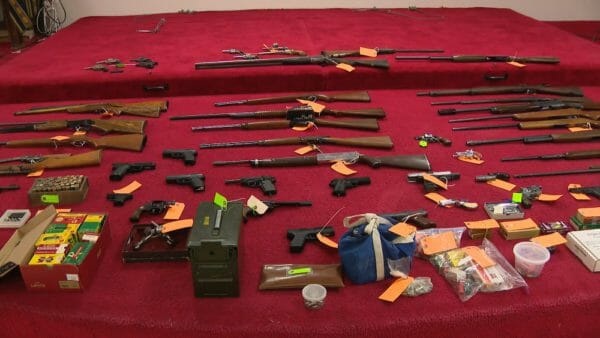
Officers display guns recovered from New York City streetsIMAGE SOURCE,GETTY IMAGES
Image caption,

Officers display guns recovered from New York City streets

Why is the Statute of Northampton involved?

In a separate 2008 Supreme Court case that struck down strict Washington DC handgun laws, the late Justice Antonin Scalia argued that the Second Amendment to the US constitution codified “a pre-existing right” from England.

He added that by the time the United States was founded in 1776, the “right to have arms had become fundamental for English subjects.”

Some historians, however, have disagreed with that assessment, noting that by the late 1200s, English authorities had passed laws restricting the right to carry weapons while traveling in public or in London.

The later 1328 Statute of Northampton – which predates the first recorded use of a firearm in Europe by several decades – declared that nobody “except the King’s servants in his presence” will “go nor ride armed by night nor by day” in fairs, markets “nor in no part elsewhere”.

Lawyers for New York, for their part, have written to the Supreme Court that from the Middle Ages onward, laws “broadly restricted the public carrying of firearms and other deadly weapons.”

Saul Cornell, an American history professor at Fordham University, said he believes it is “beyond ironic” that US gun advocates would look to England as the foundation of their view on gun rights.

“England was a super hierarchical society, and one in which the King has a monopoly of force and violence,” Mr Cornell told the BBC. “I’m not sure how anyone could conclude that this was a society that nourishes this robust, libertarian view of arms.”

“It just doesn’t make any sense whatsoever to any who really understands the complexity of English history,” he added. “Obviously, that doesn’t include many people in the gun rights community or many people sitting on some courts in America.”

Gun rights advocates argue that the Statute of Northampton is being misinterpreted.

In a brief for the Supreme Court, attorney Paul Clement – who represents Mr Nash, Mr Koch and the New York Rifle and Pistol Association – wrote that the statute was only meant to control “unusual weapons” that would frighten the public.

Stephen Halbrook, a firearms law litigator and author, told the BBC that he believes New York “is really reaching and trying to find a precedent to restrict the right [to bear arms] based on Northampton”.

“It was held to apply to carrying arms in a way that terrified other people, not just carrying peacefully,” Mr Halbrook added. “It just didn’t say what New York urges the court it means.”

What could be the impact of the case?

A Supreme Court ruling against New York in the case would have far-reaching implications for states that have similar restrictions on concealed carry licenses. Six other states have requirements that gun owners show “proper cause” for such permits.

During oral arguments on Wednesday, several justices signalled a willingness to reverse or limit New York’s “proper cause” requirements.

Justice Brett Kavanaugh, for example, asked New York’s solicitor general, Barbara Underwood: “Why isn’t it good enough to say I live in a violent area, and I want to defend myself?”.

Mr Halbrook said that he believes that it is likely that if the court rules against New York “these other states are going to have to revise their statutes to be in accord with this new case.”

“It’s looking that way, but you never know,” he said. “I think the court would simply cross out the requirement that an official has to determine a proper purpose or special need.

“All the other requirements would still be there, such as law-abiding training and things like that.”

Media caption,

Bullets and bills: The cost of getting shot in America
Categories
All About Guns Allies Anti Civil Rights ideas & "Friends"

Supreme Court looks to medieval England in gun rights case David G. Savage LA Times

The Supreme Court is preparing to decide whether the 2nd Amendment gives Americans a right to carry a loaded gun when they leave home — and some justices are looking back to the England of 1328 for an answer.

a large building: At issue: Do Americans have a right to be armed when they travel in a car, walk down the street or march in protest rally? (Associated Press)© Provided by The LA Times At issue: Do Americans have a right to be armed when they travel in a car, walk down the street or march in protest rally? (Associated Press)At issue is the meaning of the “right to keep and bear arms” that was added to the Constitution in 1791 and expanded by the high court in 2008.

In a dispute to be argued Wednesday, a newly strengthened conservative Supreme Court majority will have an opportunity to go even further in broadening the rights of gun owners.

The late Justice Antonin Scalia sent the court on a search through history when he wrote the first opinion upholding an individual’s right to be armed.

Until then, the 2nd Amendment had been interpreted by the court as applying to the states’ right to establish a “well-regulated militia,” rather than to an individual’s right to own guns.

But Scalia, who died in 2016, successfully argued for interpreting the Constitution based on what he viewed as the original understanding of its terms. He said the 2nd Amendment “codifies a preexisting right” that was brought from England to the American colonies.

“By the time of the founding” of this country, he wrote in District of Columbia vs. Heller, “the right to have arms had become fundamental for English subjects.”

That 5-4 decision struck down an unusually strict gun-control ordinance in Washington D.C., and held that law-abiding residents had a right to keep a handgun at home for self defense.

Now the court faces a far more consequential decision in a New York case to be heard this week: Do Americans have a right to be armed when they travel in a car, walk down the street or march in protest rally?

It is a test of gun rights as well as originalism.

One group of prominent historians recently told the court that even by using Scalia’s rationale of relying on the understood gun rights of old England, the court should conclude there is no right to carry weapons in public.

They said England had no “right to carry firearms or other dangerous weapons in public based on a generic interest in self-defense. For centuries, both English and American law have restricted individuals’ right to publicly carry arms — especially in populated places and especially in the absence of a special need for self defense — in order to preserve the public order and public peace.”

Beginning in the late 1200s, kings had issued proclamations prohibiting being armed when traveling in public or entering the city of London, the group noted.

And in 1328, the parliament adopted the statute of Northampton which said “no man great nor small … except the King’s servants in his presence” shall “go nor ride armed by night nor by day, in fairs, markets … nor in no part elsewhere” or “forfeit their armour … and their bodies to prison at the King’s pleasure.”

This statute, which stayed on the books until the mid-20th Century and was adopted by several colonies in the late 1700s, has emerged at the center of the debate over the “preexisting right” that became the 2nd Amendment.

Gun-rights advocates dismiss the medieval law and say it was intended only to restrict “dangerous and unusual weapons” that would “terrify” the public. But others, including most historians, say it reflects a 700-year old tradition of restricting dangerous weapons in public places.

Saul Cornell, a historian at Fordham University, is among the leading skeptics of a broad right to arms coming from England to this country.

“They are inventing a historical tradition, not discovering one,” he said of the gun-rights advocates. “There are very few English historians who believe there is or ever was a broad fundamental right to travel armed wherever you want.”

Brown University historian Tim Harris grew up in south London and earned his degrees at Cambridge. He, too, finds it “bizarre” that Americans would look to England as a source of gun rights.

He noted the Game Acts of 1671 and 1693 restricted firearms to the landed elite who owned a substantial amount of property and were subject to poaching.

“In my view, the English legal precedents have been misunderstood and misapplied in order to try to support a more expansive interpretation of the 2nd Amendment,” he said.

New York, like California and five other states, sharply restricts who may obtain a permit to carry a concealed gun with them. Typically, gun owners are required to show they have “proper cause” or “special need” to be armed.

Those laws had been upheld for the past decade, despite the Heller decision and over dissents from Justices Clarence Thomas, Samuel A. Alito Jr. and Neil M. Gorsuch.

However, earlier this year, after Justice Amy Coney Barrett arrived, the court agreed to hear a constitutional challenge to New York’s law. It arose when two men from the Albany area sued after a county judge turned down their request for a general license to carry a handgun because they did not face “any special or unique danger.” They were given licenses to carry firearms for hunting and target shooting.

Washington attorney Paul D. Clement, a former U.S. solicitor general and Scalia clerk, represents them and the New York State Rifle & Pistol Assn.. He is urging the court to rule that the right to “bear arms” protects the right to carry a gun in public.

“The text and the well-documented history of the right to bear arms in England and America” as well as the Heller decision “make clear that the 2nd Amendment protects not only the individual right to keep arms for protection inside the home, but also the individual right to bear arms for protection outside the home,” he wrote in New York State Rifle & Pistol Assn. vs. Bruen.

He cited the statute of Northampton, but says it was meant to limit only “unusual weapons,” not “ordinary arms for self-defense.”

Like Scalia, he relies heavily on the English Bill of Rights of 1689. After James II, a Catholic, had been deposed for, among other offenses, disarming Protestants in Ireland, Parliament adopted a declaration of new rights.

One said “the subjects, which are Protestants, may have arms for their defence suitable to their conditions, and as allowed by law.” Clement argues the 2nd Amendment had its “roots” here when the English established the right to have “arms for self-preservation and defense.”

Lawyers for New York portray a different history. “From the Middle Ages onward, laws on both sides of the Atlantic broadly restricted the public carrying of firearms and other deadly weapons, particularly in populous places,” they told the court.

The most thorough court opinion on the history of gun rights and the 2nd Amendment was written by Judge Jay Bybee, an appointee of President George W. Bush. In March, he spoke for a 7-4 majority of the 9th Circuit Court of Appeals and rejected the idea of a right to be armed in public.

“Our review of more than 700 years of English and American legal history reveals a strong theme: government has the power to regulate arms in the public square,” he wrote in Young vs. Hawaii.

“Indeed, we can find no general right to carry arms into the public square for self defense,” he wrote. “The contours of the government’s power to regulate arms in the public square is at least this: the government may regulate, and even prohibit, in public places—including government buildings, churches, schools, and markets — the open carrying of small arms capable of being concealed, whether they are carried concealed or openly.”

Not all the history in this case is of medieval vintage. A brief filed by retired Judge J. Michael Luttig and several top Washington lawyers urged the court to focus on the Jan. 6 insurrection by supporters of President Trump, and to imagine thousands of armed protesters descending on the Capitol.

Two days before Trump’s planned “stop the steal” rally, the police chief in Washington warned that carrying guns is illegal in the District of Columbia and would “not be tolerated.”

That warning “indisputably prevented even more bloodshed and doubtless saved many lives during the insurrection” and “may well have prevented a massacre,” they wrote.

If the court were to rule in favor of a broad right to be armed, “imagine the difficulties law enforcement would face if future protesters — whether motivated by conspiracy theories, police shootings, or anything else — arrived on the streets legally armed with loaded guns…. Adopting a right to carry,” they say, “would be to throw gasoline on the fires of our nation’s future political conflicts.”

This story originally appeared in Los Angeles Times.

__________________________________________________

GOD BLESS SCALIA!!!!! Grumpy

Categories
All About Guns Anti Civil Rights ideas & "Friends"

Gun Owners of CA’s Founder STILL Raising the Left’s Blood Pressure – Yippee! BY L.A. PAREDES

It’s no surprise to us but Gun Owners of California’s late founder is still making the Left’s blood pressure rise. And boy, does this make us smile.

Long after he retired from the California State Senate, H.L. “Bill” Richardson continued to be a media favorite as the guy who would pull-no-punches and colorfully tell it like it is, whether it was about the 2nd Amendment, freedom or his love of America. And were he still with us today, we know damn well he’d stand proudly with the “domestic terrorists” – also known as concerned parents – who have had the courage to recently stand up to the jack-booted thuggery of our government and educational bureaucracy.

To see his name elevated by an East Coast Leftist as one of the chief architects of this current political movement thrills us at GOC to our core:

“One blueprint that conservative activists have adopted comes from the book “Confrontational Politics” by the late H.L Richardson, a former California state senator and gun-rights activist.” – Joseph D. Bastrimovich

True. The popular “Confrontational Politics” does provide a blueprint on how to engage effectively with the Left, and yes, it has been adopted by smart activists over the past 30 years.

But then the fiction is rolled out:

“They’ve [activists] brought scrutiny upon themselves for aggressive tactics, which include being deliberately disruptive, shouting down school board members and even threatening violence toward those they see as enemies. These have become commonly used tactics for other conservative groups.”

Aggressive tactics? Deliberately disruptive? Threatening violence? At this point, I’d ask if the guy had even read the book, but realistically it doesn’t matter because he proves the book’s point that “Dogs bark, jackasses bray, snakes wiggle and liberals lie, it’s their nature to do so.”  Let’s leave it at that.

Throughout Richardson’s career and beyond, he called the Left out at every opportunity. Why? Because letting them march ahead without a challenge is a sign of weakness – and the Left knows most resistance on the right is exactly that…weak. That’s why learning how to effectively confront is key. To the average citizen, confrontation is not perceived as a tactic, a method of achieving a given end. However, to the Leftist, it is. To quote from the book, “they view confrontation as a verbal game, a form of semantic warfare to achieve a specific end, a strategy of bluff and bluster, a tactic used to accomplish a political goal, a technique to put an opponent on the defensive.”

The bottom line is that confrontation makes many people uncomfortable because it invokes negative emotions and is perceived as “unsociable behavior.” This actually makes the average American vulnerable, and often the victim of their own decency.

Liberals attribute our civility as weakness and deem our opposition to their agenda as desperate.  They think we are buffoons, simpletons, adhering to ideas that are no longer relevant. Thus, understanding their verbal strategies is the first step in being able to combat them – and make no mistake about it – combat them we must. To do otherwise is to abdicate not only the field of American politics, but our homes, families and businesses as well.

For every individual who challenges their local school board or battles unconstitutional gun laws in front of an over-reaching city council – becoming proficient in confrontation is a wise tool to have in your belt. Nothing annoys a Leftist more than an effective conservative.

There’s simply no need to avoid conflict – especially if done well and with control. There’s no need to be nasty. Use perseverance and professionalism. To be effective, positive confrontation requires a positive attitude.

There are teachable moments every step of the way as we battle the evils of the world. We must learn to build alliances and collect residuals in any and all confrontations with the Left – even when facing temporary setbacks or losses. From each conflict something can and must be gained – experience, friendships, political skills, fundraising files, and an evaluation of talent. Understanding how this works will prevent any wilting from the hot pressure of politics. Besides, the Left getting their panties in a bunch because parents are justifiably getting loud these days just demonstrates what a bunch of whiny, insecure adolescents they are.

In closing, GOC sends a big THANK YOU to Joseph D. Bastrimovich of National Park New Jersey, not for his defamatory remarks (read them HERE) about concerned parents, but for providing a brand new forum for GOC to highlight the value of Confrontational Politics (to his credit, Bastrimovich did link to a superb article on Richardson’s passing.)  But to see what all the fuss is about, you can secure your own copy of Confrontational Politics at the GOC store HERE.

GOC is encouraged by a newly energized electorate and is pleased to announce that we will be re-launching our Confrontational Politics workshops. For more information, contact us at (916) 984-1400 or email at laurie@gunownersca.com


Categories
Anti Civil Rights ideas & "Friends"

Anti-hunting Activists Still Blame Hunters for Condor Deaths By Larry Keane

California Condor iStock-495123612
Anti-hunters continue blaming lead ammo for the deaths of California Condors IMG iStock-495123612

U.S.A. -(AmmoLand.com)- California banned the use of traditional ammunition statewide in 2019, but anti-hunting activists continue to blame traditional ammunition made with lead components for the deaths of the scavengers.

Mike Stake, a wildlife biologist with the Ventana Wildlife Society in California, told KCBX that of the 13 deaths of California condors in 2020, nine were attributed to lead poisoning. Anti-hunting activists have long blamed traditional ammunition for the condor deaths. They theorize that these scavengers would feed on animal carcasses or even gut piles left behind by hunters ingesting lead fragments from hunters’ ammunition as the source of lead poisoning.

That caused California lawmakers to pass a law in 2013 that began a phased traditional ammunition ban for all hunting in California. The ban was fully implemented statewide by July 1, 2019.

For two years, no hunters have been allowed to use anything but more expensive alternative ammunition. California’s Department of Fish and Wildlife reported 98.89% hunter compliance with the regulation. If hunters aren’t using traditional ammunition, how do anti-hunting activists still blame traditional ammunition for lead poisoning in California condors?

Are Hunters to Blame?

Ventana Wildlife Society didn’t study why condors are still getting sick from lead, despite it being banned for hunting. Instead, they speculate. Without proof, Stake told KCBX that hunters must be skirting the rules since ammunition is in high demand these days.

“But the law does permit the sale and purchase of lead ammunition because it’s still legal to use in target ranges where wildlife is not the target,” KCBX reported. That’s right. They are now saying condors must be consuming lead from hunters who break the law, even though California authorities say this isn’t the case, or condors are eating lead out of the berms and fields of gun ranges.

That’s a stretch unsupported by any science, but not one that anti-hunting and anti-gun activists haven’t already made. The original data upon which California based the law to ban traditional ammunition for hunting is suspect. Hunt for Truth Association pored over the reports submitted to California lawmakers and found those reports were deeply biased. The condor population did crash, but it wasn’t due to hunters using traditional ammunition.

A combination of habitat destruction and “use of DDT, other organochlorine pesticides, and certain rodenticides throughout the remaining condor habitat in Central and Southern California had serious and significant impacts on condor populations.”

The group’s research looked directly at data regarding condor consumption of lead. It found that it wasn’t as easy as singling out lead fragments from animal carcasses leftover by hunters.

Questioning Data

“While some researchers maintain that lead ammunition from gut piles or game carrion left in the field by hunters is the primary source of lead exposure to condors, there is compelling evidence of alternative sources of lead in the environment,” Hunt for Truth reported. “Such alternative sources of lead include paint chips from old buildings, legacy leaded gasoline in soils, mining wastes, old insecticides, and micro trash.”

Two condors that were studied were actually observed eating paint chips from a fire lookout tower. Those condors were later observed regurgitating those paint fragments to feed their chicks.

“Rarely, if ever, has an actual projectile fragment been found in the digestive tract of a California condor,” the report continued“However, objects that were thought to be projectile fragments were subsequently found to be pieces of gravel or a ‘woody’ substance, not from ammunition.”

Hunt for Truth didn’t pull punches on questioning the studies.

“Hunt for Truth has discovered that many of these researchers ‘cherry-picked’ this information, deleting it and often refusing to present the underlying information to scientific peer review, policymakers, and the public at large. This activity by the researchers calls their very claims and conclusions into serious question,” the group stated in the report. Information about condor deaths was intentionally suppressed by the Obama-era U.S. Fish & Wildlife Service (USFWS) and not provided to California legislators when they were considering expanding the ban statewide because it did not support the narrative that hunters were to blame.

Still, falsely blaming hunters for using traditional ammunition two years after the ban was in effect even after California authorities conclude hunters are complying isn’t just bad form. It’s bad science. Making unsubstantiated claims based on hearsay is antithetical to setting science-based policies.

California hunters stopped using traditional ammunition two years ago. If condors are still getting sick from poisoning, it’s not because carcasses have been lying in the wild for over two years. Something else is going on and it’s time anti-hunting activists come clean on their agenda.


About The National Shooting Sports Foundation

NSSF is the trade association for the firearm industry. Its mission is to promote, protect and preserve hunting and shooting sports. Formed in 1961, NSSF has a membership of thousands of manufacturers, distributors, firearm retailers, shooting ranges, sportsmen’s organizations, and publishers nationwide. For more information, visit nssf.org

Categories
Anti Civil Rights ideas & "Friends" Born again Cynic! California

Anti-Gun Researchers Want More Money For California Red Flag Law By Cam Edwards (& I am supposed to be surprised by this call for more $$$!?!)

AP Photo/Julio Cortez
California’s had a “red flag” gun seizure law on the books since 2016, but apparently it’s not being used often enough for gun control activists. The UC-Davis Violence Prevention Research Program, a state-funded anti-gun “research” center headed up by longtime gun control activist Dr. Garen Wintemute, is out with a new report calling on the state to increase funding for the implementation of Extreme Risk Protection Orders that allow the state to confiscate the firearms of anyone a judge deems to be a danger to themselves or others.

I wrote about the due process dangers and the lack of a mental health focus inherent in these red flag laws yesterday, so I won’t re-litigate those arguments here. I do find it interesting, however, that even in California these laws apparently aren’t that popular, and haven’t even been used in many counties. Wintemute and his colleagues chalk that up to a lack of information about red flag laws among law enforcement agencies and the general public, but I think they’re unfairly discounting the idea that in many counties, there’s not a lot of support for red flag gun confiscations.

In order to conduct their “research,” Wintemute and his colleagues conducted “semi-structured interviews” with ” 27 key informants, including judges, law enforcement officers, city and district attorneys, policy experts, and firearm violence researchers” to talk about how well (or not) red flag petitions are being implemented. No number crunching involved here, just subjective interviews with folks, the vast majority of whom have undoubtably already come to the conclusion that red flag laws are valuable and needed “gun safety” tools. In fact, the study authors admit as much:

Potential key informants were selected due to their experience with or demonstrated knowledge of GVROs (e.g., through published reports). They were identified through professional relationships with the authors, activity in the gun violence prevention community, public records indicating involvement in the service or disposition of GVROs, and by recommendation from other informants.

Was there a single stakeholder interviewed who has a knowledge of “Gun Violence Restraining Orders” but who thinks they’re a bad idea? Given the fact that (according to Wintemute) only 14 of California’s 58 counties had enforced a red flag gun seizure order between 2016 and 2020, it shouldn’t have been difficult to find a sheriff or D.A. with an opinion contrary to those writing the report. It sounds to me like these “researchers” simply weren’t interested in hearing another point of view. And why would they, if they already knew that the gist of the report was going to be “red flag laws are good, but here’s how they could be better”?

So the state-funded “research” center came to the completely unsurprising conclusion that more state funds are needed to improve how Gun Violence Restraining Orders are implemented. Any problems with the law (including the fact that in 50% of cases handled by one police officer, individuals refused to give up their guns) can be addressed by throwing money at it. Or rather, any problems that the gun control lobby and their political allies are willing to acknowledge can have more tax dollars thrown at it. Inherent defects like a lack of counsel for those who can’t afford to hire an attorney or a low legal standard for a finding of dangerousness, on the other hand, can be brushed aside and ignored completely.

If this sounds more like propaganda than research, I’m with you. Unfortunately, we can expect this same gun control advocacy disguised as objective science to soon be coming from our federal government, not just anti-gun academics in California, thanks to the CDC’s newfound interest in researching “gun violence.” Millions of dollars have already been appropriated to various academics around the country who’ll soon be issuing reports of their own that either lavish praise on gun control laws already in place in some states or warn of the dire consequences of not imposing those restrictions on the right to keep and bear arms. It’s far more junk than science, and unfortunately its our tax dollars (well, more like our grandchildren’s tax dollars at this point, given how much we’re borrowing) that’s paying for it.

Categories
Anti Civil Rights ideas & "Friends"

Some Folks who are NOT your Friends about The 2nd Amendment

Current List of Anti-Gun Businesses You Should Avoid Giving Your Money

gun coins nra-ila
Current List of Anti-Gun Businesses You Should Avoid Giving Your Money IMG NRA-ILA

USA – -(AmmoLand.com)- Do you watch movies at AMC Theaters? Was the film produced by Bad Robot?

Do you eat at Chipotle, Shake Shack, Panera, Burger King, or Subway, or have a meal delivered by Door Dash?

Do you wear clothes from Levi Strauss, the Gap, or Gucci?

Do you watch CNN, MTV, NBC, HBO, MSNBC, or Showtime?

Do you browse Tinder, Yelp, eBay, or Pinterest on a Microsoft computer with Comcast internet?

Do you shop at Costco?

If you answered yes to any of these questions, you have financially supported companies that want to strip us of our God-given constitutional rights.

Citizens Committee for the Right to Keep and Bear Arms

The Citizens Committee for the Right to Keep and Bear Arms maintains a list of anti-gun businesses, which is also known as the “Don’t feed them” list. To be added to the list, a company and/or their decision-makers have either instituted an anti-gun corporate policy or lobbied lawmakers to draft or support anti-gun legislation. In other words, they had to take action – anti-gun action – against the Second Amendment. None of the firms made the list by accident.

“We’re not calling for a boycott of these companies,” CCRKBA Chairman Alan Gottlieb said last year when four more firms were added to the list. “But we are providing this information to American gun owners so they can make informed decisions about where to spend their hard-earned money without unknowingly supporting efforts to erode an important constitutional right.”

One of the beauties of the American Free-Market system is that it allows business leaders to run their company in any manner they choose, and the marketplace will then decide whether their decisions were prudent or ill-conceived.

Like Mr. Gottlieb, I don’t support boycotts as they’re a favored tactic of the gun prohibitionists. Nowadays, they seem ready to scream “BOYCOTT!” for even the most minor of reasons or for no reason at all. Still, I work hard for my money, so I would rather patronize a business that supports my constitutional rights – all of my constitutional rights. Therefore, I use the list to screen out those firms that don’t support me. That’s not a boycott. It’s being an informed consumer.

CCRKBA list of anti-gun businesses.

Some of the businesses won’t be missed. I’ve never needed a $1,350 Gucci man-purse, especially after they donated $500,000 to March for Our Lives. I don’t watch CNN or MSLSD, browse Tinder, eat at Burger King or subscribe to HBO, especially since the Sopranos ended.

Costco, on the other hand, will be difficult. I hope someone talks some sense into their CEO, Craig Jelinek. This gun owner already misses his great deals.

This story is presented by the Second Amendment Foundation’s Investigative Journalism Project and wouldn’t be possible without you. Please click here to make a tax-deductible donation to support more pro-gun stories like this.


About Lee Williams

Lee Williams, who is also known as “The Gun Writer,” is the chief editor of the Second Amendment Foundation’s Investigative Journalism Project. Until recently, he was also an editor for a daily newspaper in Florida. Before becoming an editor, Lee was an investigative reporter at newspapers in three states and a U.S. Territory. Before becoming a journalist, he worked as a police officer. Before becoming a cop, Lee served in the Army. He’s earned more than a dozen national journalism awards as a reporter, and three medals of valor as a cop. Lee is an avid tactical shooter.

Lee Williams

Categories
All About Guns Anti Civil Rights ideas & "Friends" Fieldcraft Gun Info for Rookies

As old Alec has found out these Rules are ALWAYS the smart thing to follow!

Categories
Anti Civil Rights ideas & "Friends"

I just feel sorry for the Victims Family myself

Categories
All About Guns Anti Civil Rights ideas & "Friends"

How to Create a Gun-Free America in 5 Easy Steps

Categories
All About Guns Anti Civil Rights ideas & "Friends" California

Don’t let California persecute gun owners by Washington Examiner

The Democrats’ assault on the First Amendment has been so brazen lately that it’s often easy to forget that they have been waging an even longer and more concerted battle against the Second Amendment.

In states where Democrats hold complete control, such as California, they can be counted on to do whatever they can to prevent law-abiding citizens from owning guns — or at least to harass them to the point that it is as difficult as possible.

When they aren’t trying to ban the most popular rifles (even though they are almost never used in crimes), they are filing dubious lawsuits against gun manufacturers for consumers’ misuse of their products. When they aren’t devising cutesy ideas such as ammunition taxes, they are trying to pass rules under strange pretexts, such as environmental rules supposedly designed to protect animals from eating the lead in bullets, but are really just trying to make it impossible to use bullets.

Another such cute proposal has just been signed into law by Gov. Gavin Newsom. The measure, AB 173, will soon give researchers at the California Firearm Violence Research Center at the University of California-Davis access to all the information that the state collects about gun and ammunition purchasers , including personally identifying information, although this is supposedly not to be “transferred, revealed, and used for purposes other than research.”

Although the media try to tell a different story, Democrats’ obsession with identifying and tracking gun owners has been the single biggest obstacle to reforms that would help keep guns out of the wrong hands at the federal level. The best such proposal , which would have dramatically reduced the number of transactions lacking background checks, was rejected by the Obama administration after the Sandy Hook massacre because it deliberately avoided creating databases that could be used to track gun owners.

More to the point, California’s state government already has the bad habit of using the information it keeps on gun owners to hound them in a way other states do not. In 2013, the state began a very expensive program of doubtful effectiveness to seize guns from purchasers who subsequently were rendered ineligible — for example, due to a criminal conviction or even just a nasty divorce.

Earlier this month, California Rifle and Pistol Association Legislative Director Roy Griffith wrote to Newsom , asking him to veto the bill. He correctly argued that gun owners deserve privacy just as much as all other consumers, who are protected in California from the dissemination of their personal information by Proposition 24, passed in 2020.

“The identities and confidential personal information of individuals should only be provided by … state entities to law enforcement agencies when conducting an investigation that has a specific need for it,” writes Griffith. “No other entity, not even research institutions, has sufficient justification to have access to an individual’s private information.

If government workers leak private IRS data despite felony penalties, California gun owners’ private data will be leaked too. It is not a question of if, but of when. This will not only violate gun owners’ privacy, but it will also give criminals a nice list from which to work when looking for guns to steal.

Even before that inevitably happens, there is simply no reason to send the personal information of gun owners to anti-gun academics. The federal courts must step in to preserve Second Amendment rights in the states.