Category: Ammo
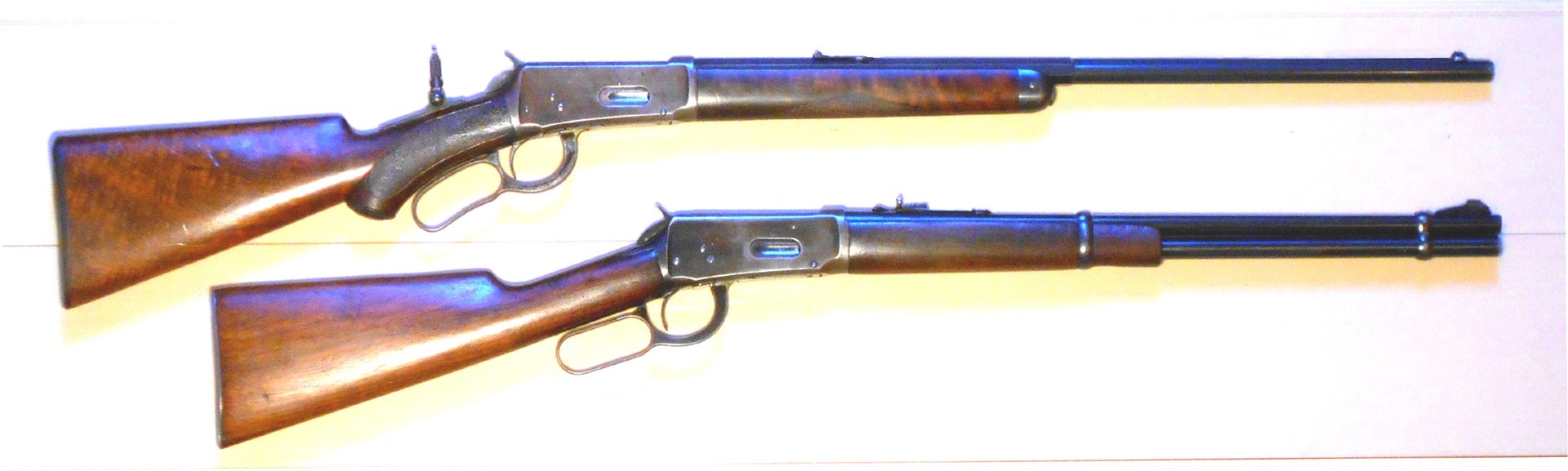
Any debate about the quintessential American hunting rifle would be incomplete without a mention of a lever-action rifle chambered in .30-30 Winchester.
The .30-30 was originally known as the .30-30 WCF (Winchester Centerfire Cartridge), which indicated that the round had a .30 caliber bullet sitting in front of 30 grains of then-new smokeless powder.
Debuting in Winchester’s 1895 catalogue paired with the iconic Model 1894 lever-action rifle, the round became wildly popular with hunters across North America, remaining a widely used hunting cartridge to this day.
In light of the cartridge’s age and the advent of newer, more advanced cartridges, one might wonder, “Is the .30-30 still any good?”

The answer is a resounding “yes!” While true that newer cartridges like the 6.5 Creedmoor and 300 PRC have undeniable advantages over the .30-30 in some areas, the old classic still has its place.
In many parts of the country, such as the Southeast, medium game such as Whitetail are encountered inside 200 yards and often in thick brush. A .30-30 lever-action rifle excels in these conditions, being easily maneuverable and able to deliver quick follow-up shots when needed.
The .30-30 delivers projectiles weighing between 110 and 170 grains at velocities ranging from 2200 fps to 2700 fps, providing more than enough energy to take medium game at 200 yards and closer.
The restricted range is partially due to the fact that .30-30 is most commonly a lever-action rifle cartridge, and therefore most ammunition uses a flat nose bullet that doesn’t run the risk of setting off the round in front of it in the rifle’s tubular magazine. An exception to this is Hornady’s Leverevolution line of ammunition, which makes use of a modern, more aerodynamic Spitzer-style bullet that is safe to use in lever action rifles. These rounds greatly reduce drag and deliver greater energy at longer ranges relative to the more traditional, flat nose variety of bullet.
Lever-action rifles chambered in .30-30 continue to be very popular. Both Henry and Marlin have introduced updated versions of their classic rifles that feature threaded barrels, picatinny rails for optics, and other accessory mounting options.
While it might not be taking elk at 600 yards, I suspect that, thanks to modern ammunition and continued manufacturer support, the .30-30 will be filling American freezers for many years to come, just as it has done since 1895.
What do you think about the old .30-30? Share this out to your social media of choice and let us know!
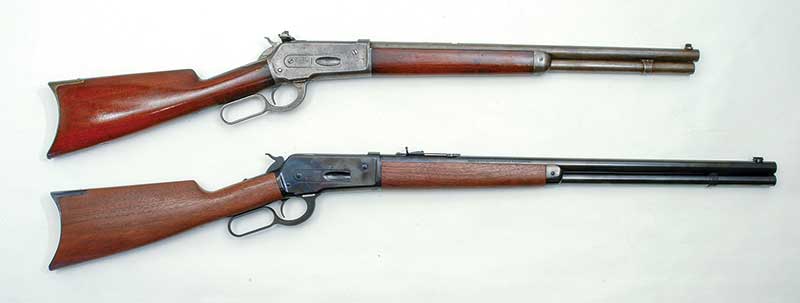
Duke’s altered Model 1886 .40-82 (top) with a 20″ barrel shown for comparison
with a new Japanese Winchester Model 1886 .45-70 with its standard 26″ barrel.
Naturally we clearly remember the “firsts” in our lives — first gun, first car, first date, etc. I remember fondly my first experience with an antique lever gun because it started my career on a path still followed today: learning the ins and outs of safely shooting old and obsolete guns and their cartridges.
Back in the late 1970s a friend, knowing of my handloading and bullet casting experience, asked if I would load some .40-82 cartridges if he supplied brass, dies and bullet mold. His lever gun was a nice Winchester Model 1886 .40-82 manufactured in the late 1880s. It was a family heirloom but had not been fired in decades due to the lack of factory ammunition. His request sounded like an easy way to introduce myself to Winchester lever guns. The experience turned out to be more complicated, but more educational, than expected.
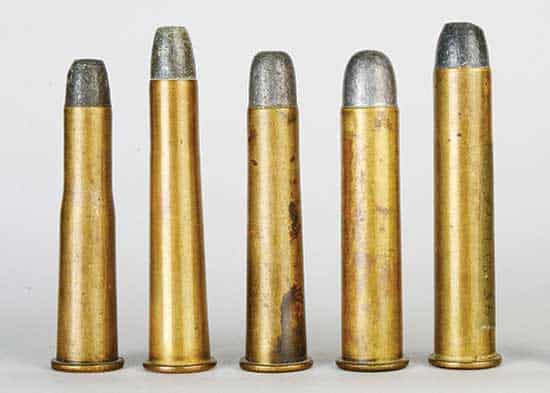
This photo shows a .40-82 in comparison to several other popular Winchester Model
1886 factory chamberings (left to right): .38-56, .40-82, .40-65, .45-70 and .45-90.
The Loads
The mold supplied was an Idea/Lyman #406169 which dropped a 0.408″ bullet weighing 260 grains of the wheel weight alloy I had on hand. I lucked out because the groove diameter of old .40-82 measured 0.408″ instead of the nominal 0.406″. Cases supplied were RCBS .45 Basic with a length of 3.25″. Those were hacksawed to just over the .40-82’s length of 2.40″ then trimmed to the final spec. Next, a now-forgotten charge of a likewise forgotten smokeless powder was dumped in 20 cases. Bullets were seated and crimped and I was ready to shoot.
Only I wasn’t! The rounds were too fat to chamber. It had not occurred to me the .45 basic case walls increased in thickness from case mouth to case rim. Thinning the case walls was the cure so RCBS tooling for the chore was acquired. Again I thought everything was a go. It wasn’t. Every shot fired gave a click-bang. The click was the hammer falling. The bang was the powder charge firing a second or so later, meaning it wasn’t igniting properly. At least the bullets passed through paper targets point on. Some research revealed an old remedy for poor powder ignition was to fill the case atop the powder charge with corn meal. The fix worked and the old rifle began to shoot beautifully. In fact we took it hunting and I shot an elk with it.
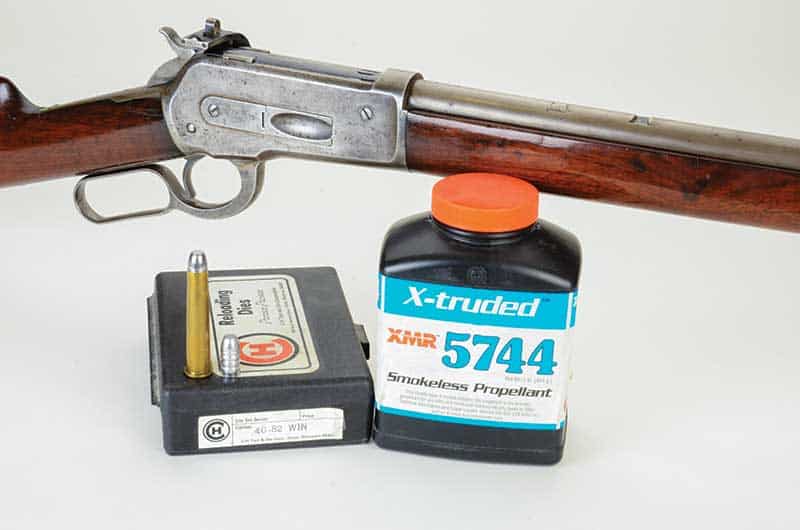
Duke’s Winchester Model 1886 .40-82. Note the filled sight dovetail and
new cut one a few inches ahead of it.
Collecting
As I began to assemble an array of vintage Winchesters, for my own Model 1886 slot I wanted a .40-82. What I finally landed was one made in 1887 as indicated by its serial number. However, it was not a prime specimen. Its buttstock and receiver actually were very nice and it even had a Lyman No. 21 side-mounted peep sight. The problem was the barrel. While bore condition was very good, it had been shortened from 26″ to 20″ with the magazine tube cut correspondingly. Also, someone had roughly filled the original barrel sight’s dovetail and cut another one a few inches ahead of it but left it empty. Because of those problems the price was right.
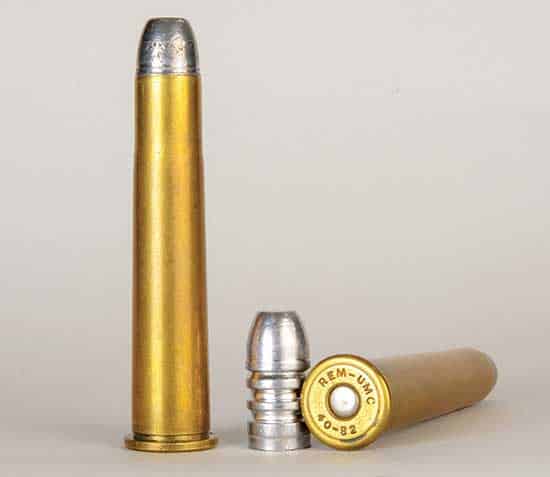
Duke had custom bullet mold maker Steve Brooks cut a set of blocks for a slightly
oversize .40-82 bullet because his Winchester’s bore was likewise oversize.
Cleaning Up
In my mind the idea was to restore it someday with an intact .40-82 barrel and magazine tube. In the meantime I wanted to enjoy shooting it. Times had changed a bit. I knew to slug the barrel first — it was a whopping 0.409″, so I had custom mold maker Steve Brooks (brooksmoulds.com) cut a set of blocks for a 0.410″ bullet with a gas check shank. From my favorite 1–20 tin to the lead alloy I favor, the mold dropped them a mite heavy at 280 grains. A batch of .45 Basic cases were cut and inside reamed as before.
Between my first .40-82 and the one I purchased there was a new smokeless powder introduced. The powder was Accurate 5744 and it revolutionized all my thinking about smokeless powders in voluminous cases. Because it easily ignites in large cases there is no filler necessary. To my great pleasure, 100 yard groups from my .40-82 were outstanding from the very beginning. When I pull the trigger properly, most are in the 2″ to 3″ range at 100 yards. My favored 5744 charge of 25 grains pushes those 280-gr. bullets out at about 1,390 fp. All ideas about getting a replacement barrel for my cut down ’86 were forgotten.
Other shooters might prefer more glamorous ’86 chamberings like .45-90 or .50-110. I’ve even had such but it’s the .40-82 I’ve kept.
Categories
Martini Henry Cartridges
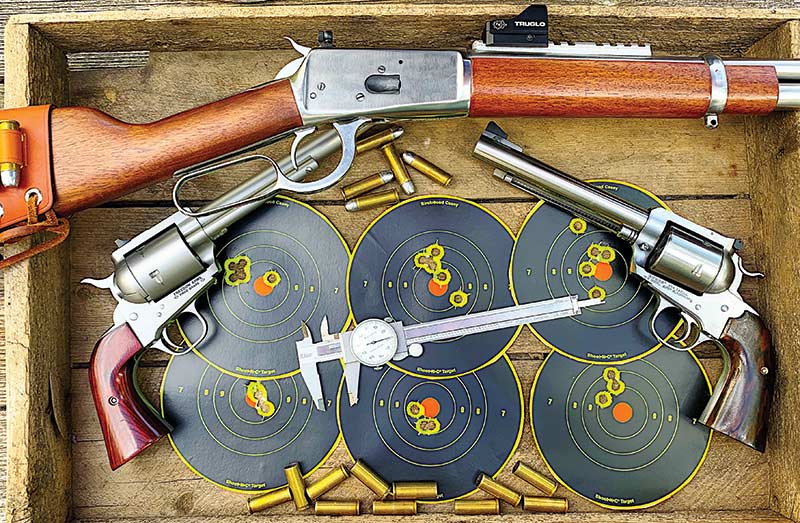
Typical 50-yard groups from the Rossi R92, bottom row targets,
and handgun targets, top row, shot at 25 yards.
Deep within the belly of social media, amongst tiered special-interest groups, you’ll find “bullet casters” at the bottom of the heap. A small lot, these lead-heads and worshippers of the silver stream manage to miraculously meet up.
Roaming the earth like dinosaurs before them, lead bullet casters are almost as rare. It’s also how jacketed bullet shooters think of them, snidely asking, “You’re still shooting lead?” But it’s more accusation than question. The dinosaurs grin, shrugging prehistoric shoulders, knowing the reasons why.
Perhaps this is the reason lead-heads seek their own, talking cast bullets/loads, fully aware of the fun the average shooter is missing? Dinosaurs are more than happy to share this information to those appreciating it.
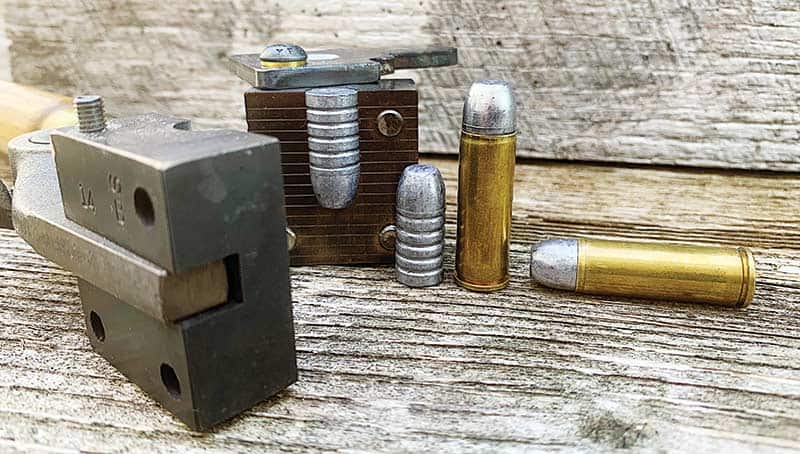
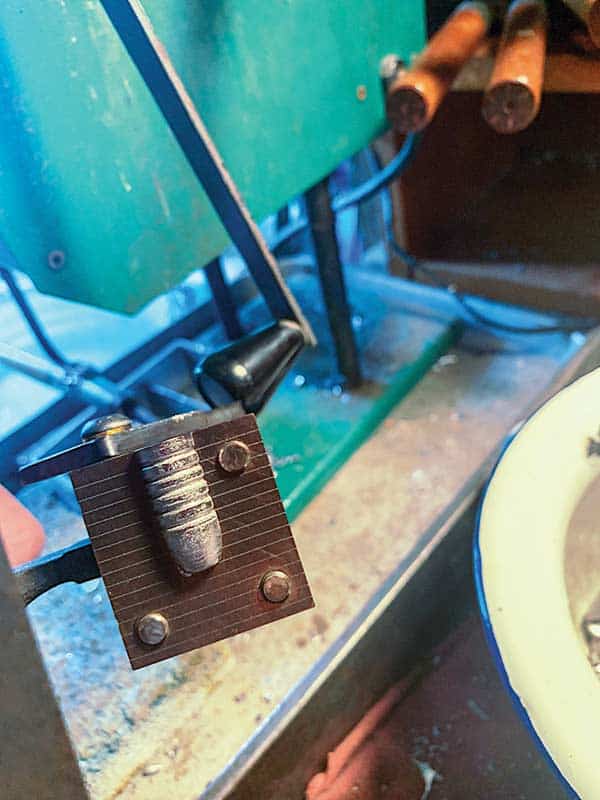
Steve Brooks made the quality single-cavity mold designed by Mic McPherson.
The mold makes it very easy to cast wonderful bullets.
A Friend Indeed
This was the case when friend Jim Williamson called. You remember Jim, he owns a very cool 71/84 11mm Mauser I wrote about here. Seeing my article on the Rossi .454 Casull R92, a lightbulb went off in his head. Seems he and Mick McPherson were experimenting with the Freedom Arms 454 Casull. Mick designed a special mold casting a heavyweight bullet for long-range shooting at easy cruising speeds. Jim offered some of the bullets for me to try. A few days later, over two hundred of the prettiest cast slugs arrived in the mail.
Weighing in at a hefty 420-grains, this long bullet is oozing with sectional density and bearing surface, making it fly true and penetrate deep at great distances. Jim told me they’ve discovered using 11.0 grains of Hodgdon Longshot generates 1,000 fps from Freedom Arms model 83s with wonderful accuracy.
Jim also stated they’ve shot it out to 600 yards, busting rocks, and it appears to be stable at this distance. This isn’t surprising, as Mic McPherson knows how to design a bullet. He’s a walking encyclopedia on handloading, gunsmithing and any other shooting-related information.
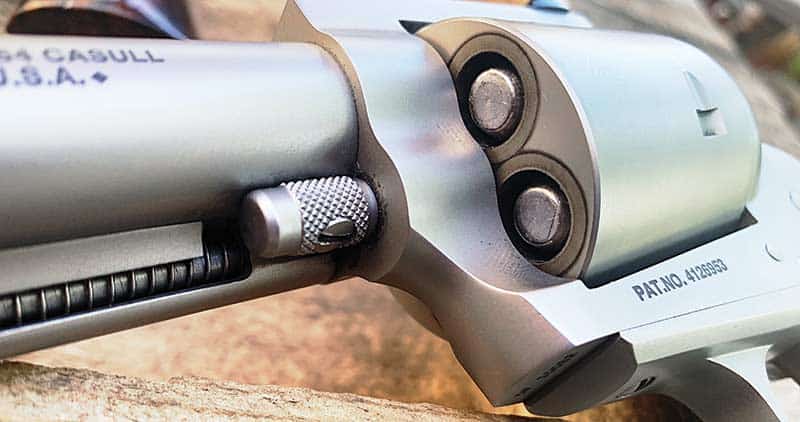
The bullet is designed to maximize powder capacity, so the crimp-groove
keeps the bullet seated as far out as possible on Freedom Arms model 83s.
Load & Shoot
Loading Jim’s slugs over the suggested 11.0 grains of Longshot, sparked by a CCI 400 small rifle primer in Starline brass and using my Dillon 550C progressive press, I’m ready for the range. I bring the Rossi R92 in .454 Casull, along with a Freedom Arms model 83 and Ruger Bisley 5-shot.
Touching off a typical 454 Casull load — a 300-grain bullet going in excess of 1,600 fps —is pretty violent, like holding onto a stick of dynamite. This load is much more manageable.
Shooting day was hot, 95º with 88% of T-shirt-wringing humidity. I had a TRUGLO Micro red dot sight mounted on the Rossi. At 50 yards, 3-shot groups cloverleafed into sub-inch groups. The Freedom Arms stayed true to its reputation with 1″ groups or better at 25 yards.
The Ruger 5-shot Bisley held its own with groups in the 1″ to 1.5″ range. The load, while stout, isn’t unpleasant at all to shoot. Without sweat stinging my eyes, I believe accuracy could have been a smidge better.
Jim’s right — velocity hovers around the 1,000 fps mark for the revolvers. The Rossi and its 20″ barrel increase velocity to 1,350 fps, which incidentally matches velocity of a Sharps rifle with black powder loads. A 420-grain slug, ambling along at 1,000 or 1,350 fps has a lot of momentum. Worshippers of the silver stream know this, as did the buffalo hunters so many years ago.
Nice Dinosaurs Rule!
Bullet Casters/Shooters are a complex breed, indeed. Far from being Luddites, they like doing things the old way while applying the newest techniques, designs, and thoughts to their shooting. One thing for certain — while some may call them dinosaurs, the Cast Bullet brotherhood is far from being extinct.
I have a feeling there’s going to be an avalanche of busted rocks next year at the Whittington Center from all the 420-grain bullets pulverizing boulders, one shot at a time. Jim let me borrow his mold, so I’ll cast plenty of bullets. Dinosaurs are known to do such things, just to have some good prehistoric fun.