Categories
All About Guns Ammo

PERSONIFICATION OF THE PERFECT PACKIN’ PISTOL THE .38 SPECIAL WRITTEN BY JOHN TAFFIN

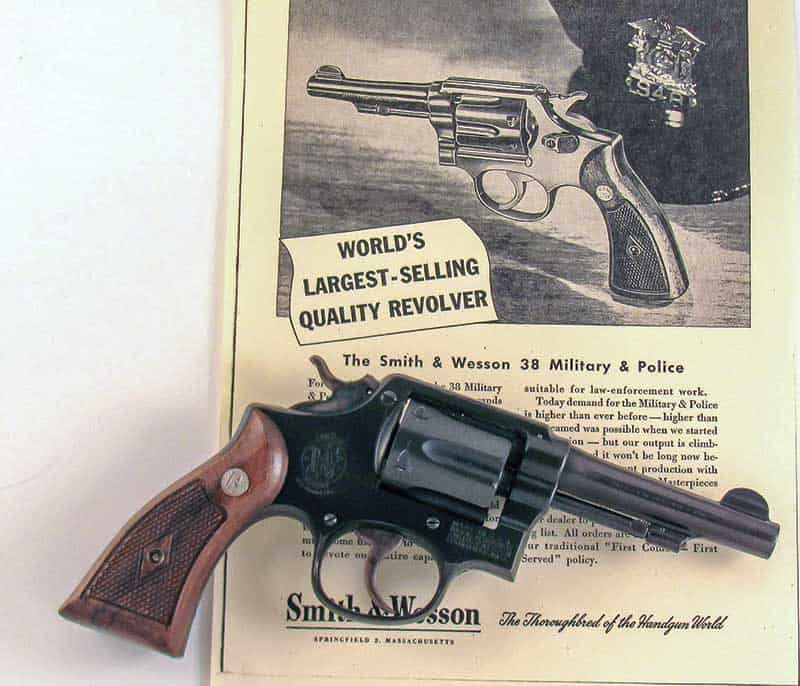
The S&W Military & Police .38 Special rests on a copy of early advertising.


From the Taffin Dictionary of Sixgunning — “Perfect Packin’ Pistol is a title given to a sixgun or semi-automatic with a barrel not less than 4″, nor more than 5-1/2″, which can be carried easily all day in a well-designed holster, placed under a bed roll comfortably at night and can be expected to handle any situation which should arise.”

This definition takes in a lot of territory and obviously it depends where the bearer of such a PPP normally finds himself/herself. Whether daily travels take one on concrete, sagebrush, foothills, forests, or mountains, the encounters likely to occur have a great bearing on the caliber chosen have the duty. We will be taking a look at the epitome of Perfect Packin’ Pistols, namely the 4″ Double Action Smith & Wesson.
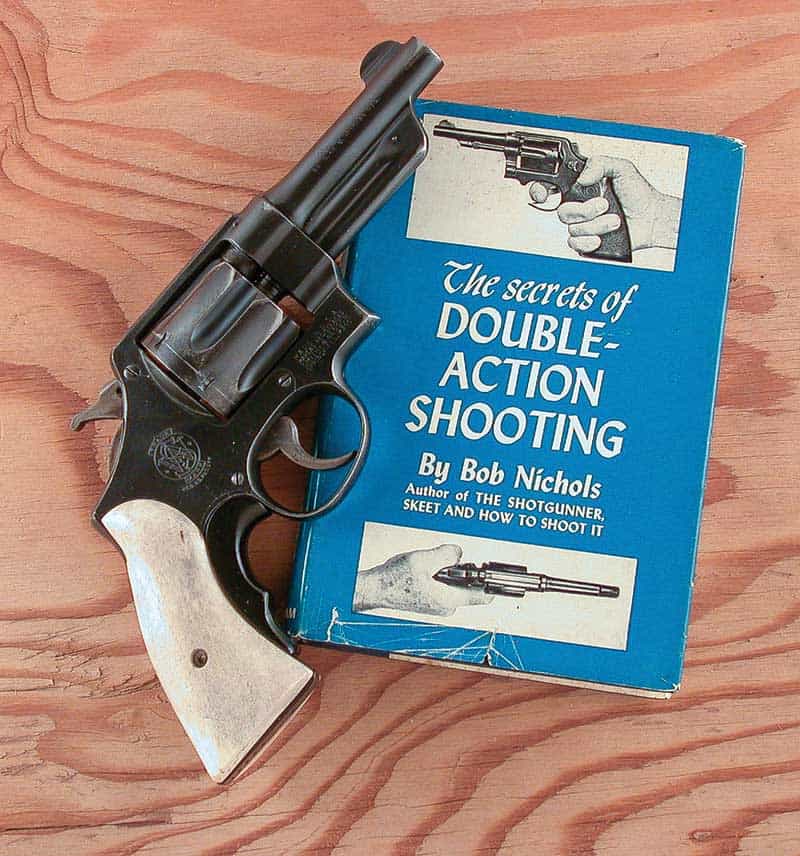
 

This pre-war long action .38/44 Heavy Duty is probably the finest
double-action shooting sixgun ever offered.

In The Beginning

To come up with the .38 Special, D.B. Wesson, along with his son, took a good look at the .38 Long Colt, the official U.S. Military Chambering at the time. The brass case was lengthened to accommodate 21-1/2 grains of black powder instead of the standard 18 and the bullet weight was increased from 150 grains to a round-nosed 158-grain bullet.

The new revolver was the first K-Frame and was given the name of Military & Police. For the next half-century plus, it would be found in the holsters of thousands upon thousands of police officers. Over the decades it would be made in the standard barrel configuration as well as a heavy barrel model in both blued and stainless finish. Bill Jordan especially liked the 4″ Heavy Barrel Military & Police in his exhibitions of fast double-action shooting.

With the coming of smokeless powder, the .38 Special was found to be especially accurate and from the very beginning the M&P was offered with target sights. Production of all civilian revolvers was shut down during WWII, however with the end of the war S&W began the development of what would become one of the finest target revolvers ever offered — the K-22.

The Personification of the PPP is the epic S&W Combat Masterpiece.

A Masterpiece


The K-22 was introduced in December 1946 and six months later the first K-38, followed almost immediately by the K-32, arrived. These were all given the title of Masterpiece, which was definitely fitting. I have examples of all three revolvers chambered in .22 Long Rifle, .32 Smith & Wesson Long and .38 Special. They were and are excellent target pistols but too long to be classified as a PPP. This matter was handled in 1950 with the arrival of the 4″ Combat Masterpiece. This magnificent revolver was available in both .22 and .38 with a few examples and .32 Long.

In 1957 the .38 Special Combat Masterpiece became the Model 15 with the .22 Long Rifle version known as the Model 18. For situations where either one of these chamberings will suffice, it would be pretty difficult to find a better choice than the Combat Masterpiece.

The .38 Special, although a great choice for target shooting or plinking, left a lot to be desired in its original round-nosed 158-grain version. After WWI ended, our society was rapidly changing from an agrarian one and many of those who had been content to stay on the farm were now gravitating to the large cities; couple this with Prohibition and the easy money to be made outside the law — as well as the arrival of a new breed of criminal robbing banks escaping in a super-fast V8 powered sedan — and peace officers certainly found themselves behind the times.

The standard .38 Special that had served law officers for nearly 30 years suddenly had to compete with criminals firing .45s and automatic weapons from an automobile. Those little slow moving .38s either bounced off car bodies and windshields or at the very best, offered shallow penetration. Something had to be done to help officers. Smith & Wesson decided a newer and, more powerful, .38 Special was needed and the result was the .38/44 Heavy Duty.

Smith & Wesson, in conjunction with Winchester, in 1930 changed the standard .38 Special using a round-nosed bullet at around 850 fps to a flat-nosed semi-wadcutter design traveling 300 fps faster, and also added a metal-penetrating version. To house this new round, S&W simply used their 1926 Model, or 3rd Model Hand Ejector .44 Special with a .38 Special barrel and cylinder. The result was a much heavier sixgun than the S&W Military & Police and it did an excellent job of dampening recoil even with the new load.

The Military & Police has always been a relatively easy gun to shoot, however this new .38/44 had such a slick action and heavy cylinder it almost seemed to shoot by itself once the trigger action is started. From my perspective it is the finest .38 ever produced; and I am certainly not alone in this assessment. The following came from Elmer Keith.

“About a year ago Smith & Wesson heeded the demand for a heavier .38 with their new .38/44. This weapon was designed primarily as a police weapon and brought out on their .44 Military frame, to my notion the best sized and shaped frame of any double action for my individual hand.”
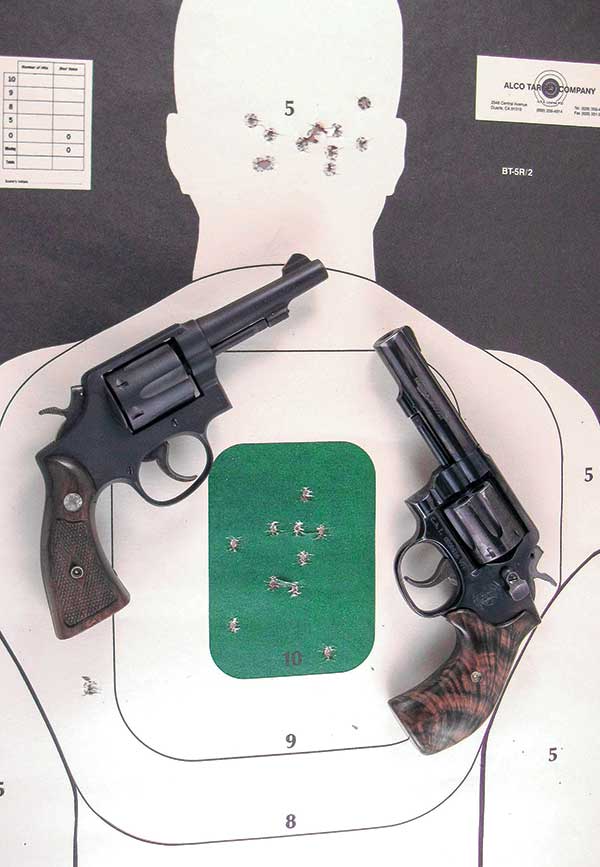


Whether in the standard barrel configuration or the Heavy Barrel
version at right, the .38 Special M&P delivers.

A New Start


The introduction of the .38/44 sixgun and cartridge did get the .38 Special up off its knees. However, this was only the beginning. The fixed-sighted .38/44 Heavy Duty was offered in barrel lengths of 4″, 5″ and 6-1/2″. In 1931 this latter model was upgraded with the addition of adjustable sights and introduced as the .38/44 Outdoorsman. Just as its name suggests, it became very popular as a field and hunting sixgun. A few were made with the 5″ length and I am certain there were those who shortened the barrel to an easy packing 4″. I had planned to do this someday, however someday has not yet arrived. My itch has been scratched with the use of .38 Special loads in the 4″ S&W Highway Patrolman.

In the early 1930s Col. Doug Wesson and writer/ballistician Phil Sharpe began working together on a new project using the .38/44. Sharpe had the .38 Special lengthened and their work together resulted in one of the finest sixgun/cartridge combinations, the .357 Registered Magnum and the .357 Magnum itself. Smith & Wesson Historian Roy Jinks called it the greatest sixgunning development of the 20th century. I will not argue with the assessment!

Categories
All About Guns Ammo Fieldcraft

Elephant Guns Point of View: .470 Nitro, .505 Gibbs, .450 Rigby, .375 H&H

Categories
Ammo

Top 5 Overrated Rifle Cartridges by PHILIP MASSARO

overrated_cartridges_f.jpg

The myriad selection of rifle cartridges today has a metric ton of overlap, duplication, and some downright silly designs. Some of these designs boast wonderful claims, but not all of them measure up. In order to be overrated, you have to be rated at all, so that leaves some of the more obscure designs off the menu.

I’m well aware that I’m going to be taking a lot of flak for this article, no matter which cartridges I were to pick, so let me give you some details to start with. When you sit down to make your voodoo doll of me, you need to be as realistic as possible, I’m six feet tall, bald, blue eyes, and the goatee is graying. Accuracy counts in the voodoo-curse world as well.

That said, I have to pick five, and I know someone will come away with hurt feelings, but I’m going to throw caution to wind and do this anyway. “Overrated” is a tough term. It doesn’t mean that the cartridges I’m going to pick are bad, or even that they don’t work, it means that I feel that the glorification of them may not live up to the actual performance. Let’s roll.

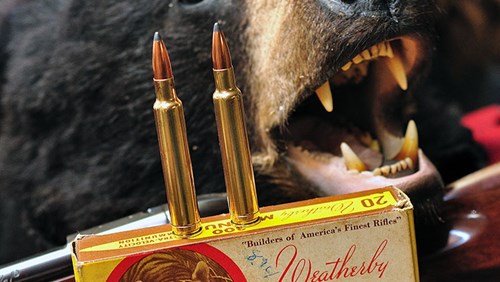
1. .300 Weatherby Magnum
I can feel the hot needles already. Roy Weatherby had a passion for the pursuit of velocity, and in some instances it made for a fantastic cartridge. However, the .300 Weatherby, based on a blown-out .300 H&H case, and featuring Roy’s signature double-radius shoulder, may have been the hottest on the market in the 1950’s, but it has been pushed off the stage. In my opinion, you can get field performance out of a .300 Winchester Magnum that is so close the game animals will never know the difference. Add in the costly ammunition and component brass, as well as the ramped-up recoil, and the scales lean even harder toward the Winchester case. If you want to really move .30 caliber bullets in a magnum length action, look to the .300 RUM or .30-378 Weatherby, just don’t shoot anything you intend to eat at close range.

undefined

2. .270 Winchester Short Magnum
Why do my feet feel like they’re on fire? When you have a cartridge that is as flat shooting and hard hitting as the venerable .270 Winchester, improving upon it isn’t easy. The Winchester Short Magnum series of cartridges have their own unique set of issues (they’re very finicky to reload for, not to mention the feeding issues), but to try and push the bullets even faster, out of a shorter and lighter rifle with more recoil, doesn’t make a ton of sense to me. The .270 Winchester is a fantastic long-range cartridge. The longer bullets start to eat up case capacity, and the caliber is generally limited to bullets that top out at 150 grains. The .270 WSM is too much of a good thing, in my opinion.

undefined

3. .220 Swift
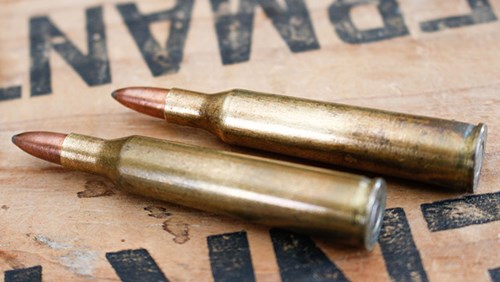
Yes sir, that was a needle in my eyeball. Good thing I have a spare. How dare I insult the .22 centerfire velocity king? Well, here’s my thinking. The .22-250 Remington, which performs around 150 to 200 fps slower than the Swift, will hit distant targets very well, with less powder, a shorter action, and is every bit as accurate as the Swift cartridge is. Not to mention, the .22-250 doesn’t have that rim, which can make for feeding problems in a magazine rifle. I know, the Swift hits that illustrious 4,000 fps with 55 grain bullets, but the 3,800 fps generated by the .22-250 is more than enough for me.

undefined

4. .458 Winchester Magnum
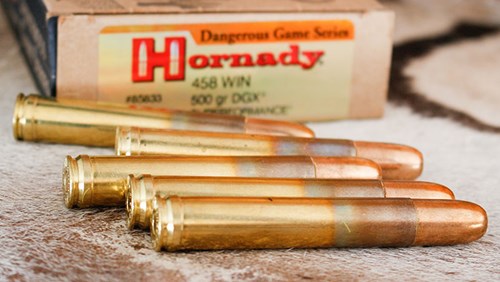
The idea of replicating the ballistics of the .450 Nitro Express, in an easy-to-produce bolt action rifle, was a very sound one. However, Winchester’s claim has historically fallen short of the mark. The engineers shortened the blown out .375 H&H case to fit in a long-action receiver, and in the same stroke reduced case capacity to the point that it became a problem. If you’ve ever tried to handload for the .458, I’m sure the thought of compressing powder with a pogo stick (please DO NOT try this, it’s humor) has crossed your mind. Look to Jack Lott’s full-length design, as it’s much easier to achieve the velocities that Winchester intended when handloading, and there are more than enough factory loads available. Almost all of the African Professional Hunters I’ve met re-chamber their .458 Winchester into a a .458 Lott, or are saving up to do so.

undefined

5. .223 Remington
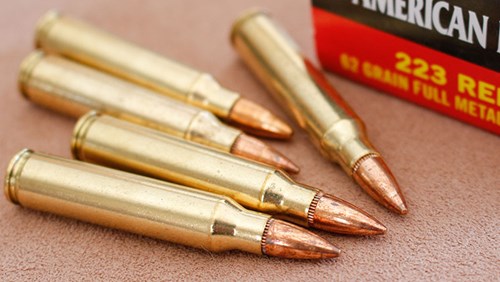
Yes, I said it. Look, the .223 works, and works well for most of its intended purposes. But, I truly believe if the U.S. Government hadn’t smiled upon it, the cartridge would have a small fraction of the followers it does today. I hear shooters tell me all the time about how it is a miracle-wrought-in-brass-and-lead, and proceed to boast of its heretofore unheard-of capabilities. I feel, for the hunters, that a .222 Remington is more accurate for close ranges, and the .22-250 Remington has a huge advantage in the velocity and accuracy department at all ranges. The .223, with the right twist rate, can use the heavier 69 and 77 grain bullets, where the slow twist of the .22-250 limits it to 55 or maybe 60 grains tops, but for me, the .223 isn’t the Holy Grail of cartridges that so many profess it to be.

undefined

There you have it, take it for what it’s worth, and let voodoo curses and author-bashing commence.

Categories
All About Guns Ammo

ODE TO A BOONDOCKING GUN IN A HARD PLACE WITH A HANDFUL OF STEEL WRITTEN BY JEREMY CLOUGH

109

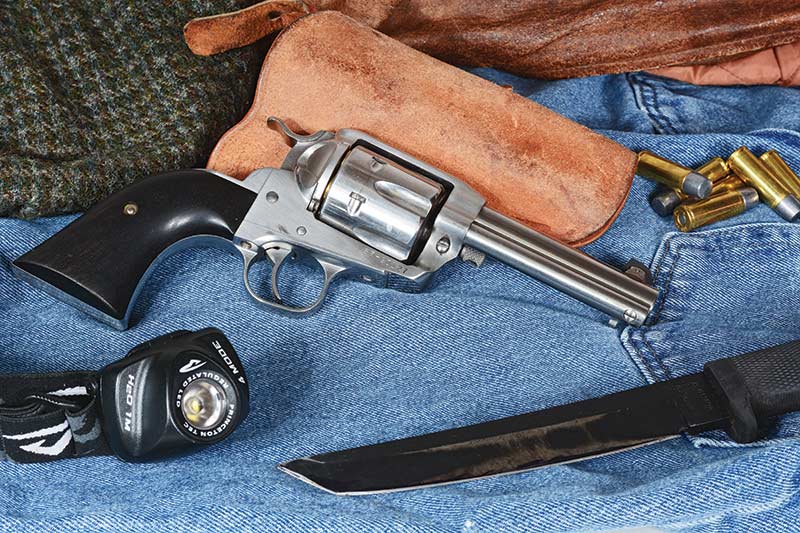
Jeremy’s Vaquero, customized by Hamilton Bowen and the star of many adventures.


I saw the two green points shining back at me in the beam of the headlamp I’d just turned on — but it wasn’t until I made out the dark bulk behind them I realized what was on the side of the trail ahead. Living and hiking in the mountains, I’d seen this shape before. “Bear,” I thought to myself. Not good, but not the end of the world.

Then, in the bluish light of the LED, I saw a black catlike form scramble up the tree behind her. I can see it now, still hear the scratching sound her cub’s claws made on the bark as it clambered up — whether it actually made such a sound in the moment or not. What I don’t remember is pulling out the big stainless sixgun or laying the wide Bisley hammer back over a cylinder-full of 335-grain hardcast solids.


A Rock And A Hard Place


It was my first time out bowhunting and when darkness caught me miles away from my car, I’d disassembled the takedown recurve and stowed it in my pack. I then walked down the closed gravel road in the dark, the gray of the road and the dark blue of the sky standing out enough from the black woods to keep me headed the right direction without a light. I’d hiked quite a bit in the dark and except for my family giving me a hard time, I’d never really given it much thought. At least until a little voice in the back of my head — you know, the one telling you you’re wrong — told me to turn on the light.

I backed off to give Mama Bear room and considered my options. There was a trail behind me splitting off to head north, the wrong direction, and dead-ended several miles away at a state road on the far side of a mountain. I looked at my phone: no service, no way to call for a ride even if I hiked the several miles uphill to get there.

Ahead of me, the ground fell off downhill to the left side of the road — where she was — and rose steeply, impassable, on the right. There was one way out and it went right past where Mama Bear had staked her claim.

The Gun


I bought the Old Model Vaquero almost 20 years ago when it was just a Vaquero, alongside my old college shooting buddy who bought its twin from a gunshop whose doors are now closed. Polished stainless steel, with 4¾” barrels, faux ivory grips and chambered in .45 Colt, the two sixguns were one digit off from being sequential serial numbers. Close to broke, we bought a single box of 20 cartridges and split them. I promptly took my new thumb buster — loaded with the last six rounds from the box — with me to Mississippi when I went to see my grandfather.


Grandad


Born in California to a veteran of the Spanish American War, my mother’s father was raised in a rambling way, growing up in Kentucky and Florida before settling in Mississippi, but he never lost his love of the West. His house — more specifically, his studio, where he painted and where my cot was usually stationed when we visited — was fascinating from the powder horn and barbed-wire collection on the wall, to his oil lamps and the Winchester I always begged him to show me. I don’t remember what he said about my Vaquero but I know he approved.

If I have any doubt about it, I can look around my own office at his Stetson up on the top of a bookshelf or the couple pairs of rattlesnake rattles and a foil-wrapped packet of .30/30 cartridges I inherited from him.
Nonetheless, the Vaquero remained a bit of a novelty for a few years while I mostly shot M1911s until I snagged a writing assignment on Bowen Classic Arms and dropped the Vaquero off with Hamilton. Returned with a fine, brushed finish, the newly lightweighted gun now had a 4″ barrel, useable front sight and a low, fast-cocking Bisley hammer. The grips were replaced with Persinger ebony grips made in El Paso and fitted to the newly decked frame. It was almost too pretty to shoot.

Almost. I put several hundred rounds of Black Hills and Hornady through it but never quite mastered the gun. What I didn’t understand at the time was how much grip consistency affects accuracy with a single-action, where the gun is recoiling through your hand as the bullet exits the barrel.

Grip it hard, the bullet goes low; loosely, it goes high. I finally learned this about 10 years ago, when I made the decision to put a thousand rounds each through three guns I didn’t shoot all that well. After enough weekly or twice-weekly trips to the range, depleting the large stock of ammo a friend had loaded for me on his Rock Chucker, I could finally hit consistently with the big Ruger, gleefully slamming 255-grain SWCs into my steel spinner until it cracked. At the insistence of another shooting friend, this one from law school days, I shot my first cowboy action match with it. I placed an enjoyable second to last, just ahead of him.


Loading Up

By then I wasn’t afraid to scuff the Vaq up anymore and after a couple less serious encounters of the ursine kind, I decided the extra power of +P .45 Colt rounds was preferable to the .45 ACP I usually carried in the woods. At Bowen’s advice, I stoked it with Grizzly Cartridge Company’s 335, which I chronographed at a freight-train like 1,089 fps.

And there it was, in my hand, cocked. I was the most scared I’ve been in my adult life, more scared than riding shotgun at Road Atlanta in a Porsche racecar dropping down Turn 12 at a buck-twenty, more scared than when I was serving legal papers on people, alone, in downtown Atlanta as a law student, more scared than walking down the stairs in the dark for the first time holding my newborn son.

Shaken But Not Stirred


Scared, but not shaking. With no other option, I breathed a prayer, short and packed with condensed intensity, and began my one-step-at-a-time trip past Mama Bear, now out of sight on the other side of the brush lining the road. Desperately not wanting to shoot this bear, I had decided if she charged I would fire a warning shot first to try to turn her. Considering the extremely short distances involved — 20 feet or less — the decision likely would have cost me a mauling, if not my life.

She let me pass, but followed me through the dark for a hundred yards. At some point I’m sure I gently lowered the hammer and re-holstered but it was no time soon. In the car on the way home, I called my mother who’d long been worried about my hiking habits. “I think it’s time to re-evaluate my decision-making paradigm,” I said drily.

Still Here


The old Vaq is still loaded with 335s, their big, broad meplats almost flush with the end of the cylinder — fresh ones, of course. There’s a little play in the cylinder now, which is striped with irregular lengthwise scratches from many trips in and out of its holster. There are some fine cracks in the grain of the ebony, too, and if you look closely I’m sure you can find a dull red speck or two in the crevices of the dovetailed front sight where it’s hard to wipe the moisture out. This after all the times it’s been rained on, alongside with me.

Sometimes when I pick it up, I think of my grandfather long since passed on to his reward, or my other friends — the one with its partner who moved to Texas and largely out of my life, the other who had lost his vision and with it his dreams of cowboy shooting.

And those two bright green eyes — I think about those a lot.

Categories
All About Guns Ammo

FEEDING YOUR .45 SIXGUNS WRITTEN BY JEFF “TANK” HOOVER


Hands down, the .45 Colt is my favorite handgun cartridge. You know this! Sure, I love other cartridges too, fickle as I am, but .45 caliber cartridges just grab my attention, mainly because of the way they grab the attention of anything shot with them. The “grand” father of .45 caliber metallic cartridges, the .45 Colt, started many love affairs with sixgunners, including me. We’re going to discuss how to make your .45 shooters more versatile, by shooting .45 ACP and/or .45 Auto Rim. Pretty nifty in a .45 caliber kind of way, eh?


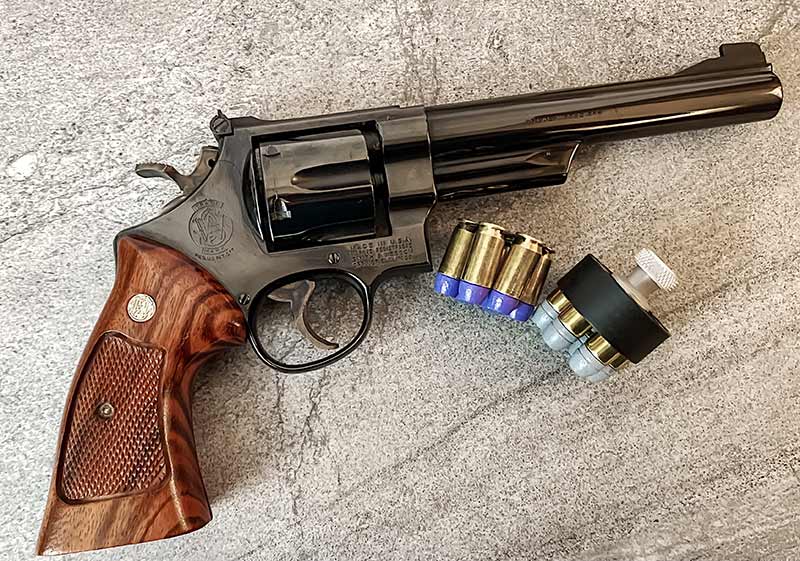
Here’s Tank’s Ruger Redhawk. You can see the slight machining on his cylinder,
allowing the use of moon clipped .45 ACPs from TC Custom. Other feeding utensils
include a speed strip and speed loader with .45 Colt ammo.

Ruger’s Redhawk


I love my Ruger Redhawks almost as much as my Ruger single actions (SA) but love them I do. Double-Action (DA) advantages? They allow the use of speed loaders during hot tactical reloads, and of course double-action shooting, which is simply pressing the trigger as smooth and fast as possible. For precision work, you can cock your hammer and shoot SA, if it works for you. Pretty handy, I’d say.

I have a 4″ Redhawk originally chambered in .45 Colt. Wanting to make it more versatile, I had TC Customs alter the cylinder so I can shoot moon clipped .45 ACPs in my gun. I love the added ability of shooting more efficient .45 ACPs, while still being able to shoot heavy .45 Colt handloads. TC Custom simply mills the breech side of your cylinder a few thousandths to allow your moon clipped .45 ACPs to chamber in your cylinder.

Better yet, you only need to send your cylinder for the alteration, not your whole gun. TC even has videos on their website showing how easy removing your cylinder is. You can alter your S&W .45 Colt too, making it more versatile with moon clip .45 ACPs.


The S&W Model 25 shoots both moon clipped .45 ACPs and .45 AR splendidly!

S&W Model 25


You have two options for feeding your .45ACP wheelgun. Obviously, .45 ACP is the first, utilizing moon clips, or you can skip the “moonies” and use .45 Auto Rim (AR) brass, which is simply .45 ACP brass with a rim, so cases will extract when you pound your ejector rod. Moon clipped .45 ACPs will drop right in your cylinder, and you can use either a speed strip, or speed loader, with the .45 AR.


Comparison of moon clip and speed loader for size. Both work wonderfully.

Ruger Blackhawk .45 Colt/ACP Dual


Single actions chambered in .45 Colt sometimes come with auxiliary cylinders in .45 ACP, allowing you to swap cylinders, depending on what caliber you feel like shooting that particular day. But you need to swap cylinders to do it. You’d think our friend, the .45 AR, would be perfect for the .45 Colt cylinder, but you’d be WRONG. The .45AR will not fit in a .45 Colt single action cylinder! The rim is too thick! It’s too thick for the .45 ACP cylinder also.

If you wanted, you could have your .45 ACP cylinder milled, allowing the .45 AR, and it would also be able to shoot .45 ACP, since it headspaces on the rim. I just might do this alteration to allow full versatility with my .45 Colt/ACP dual’s one day.

When using your .45 ACP cylinder, a convenient way of carrying and loading your SA is to borrow your 1911’s magazine and feed your gun straight from the magazine. You and your gun will love it!


Hard to beat a dual cylindered sixgun for versatility. Chambered for both .45 Colt
and .45 ACP, you can handle many of your shooting needs confidently.

Loadin’ Moon Clips


TC Custom makes the slickest nutcracker type tool for loading your moon clips. You can load while watching TV or enjoying a beautiful day on your deck. Some hate those clips, but being a tinkering kind of guy, I like ’em! I even like removing spent brass from those thumb-cuttin’ SOBs, as long as I have the right tool. Yup, TC Custom makes those too and they’re a joy to use. I give them two “cut-free” thumbs up!


Keeping The .45 Alive


To keep anything alive, it needs to be fed. I hope I showed you a few different ways of feeding your .45 wheelguns, whichever one you have. After all, everyone enjoys a varied diet, and guns are no different.

Categories
Ammo

Custom Aluminum TURBINE Shotgun Slugs -Testing

Categories
Ammo Born again Cynic!

6 8x19mm Because what we totally need right now is another brand new cartridge

Categories
Ammo

Reloading Obsolete Cartridges. Modern vs. Vintage Equipment

Categories
All About Guns Ammo

Ruger Vaquero 357 / 9mm Convertible – YouTube

Categories
All About Guns Ammo

6 Classic Rifle Cartridges that Should Be More Popular