
Category: A Victory!

“TATE001”
That’s the official serial number of what appears to be the first legally registered 9mm potato silencer, according to a Bureau of Alcohol, Tobacco, Firearms, and Explosives (ATF) registration form obtained by The Reload. It’s registered to a man named Zach Clark, who said he pulled off the feat as an act of defiance against the National Firearms Act (NFA).

“It’s a good way to highlight to normal people that like, ‘Yeah, this is dumb,’” Clark told The Reload. “This whole law is kind of dumb.”
The spud suppressor may be the most remarkable result of the NFA tax cut enacted at the beginning of the year as part of President Donald Trump’s One Big Beautiful Bill, which made the cost of registering suppressors $0 and opened up the floodgates.
The ATF saw more NFA electronic registration requests on New Year’s Day than at any time in its history. The lower cost of compliance, combined with a recently-digitized process, has made new kinds of suppressors–including disposable or even meme designs–more viable than before.
“The Bureau of Alcohol, Tobacco, Firearms and Explosives (ATF) informed NSSF that on Thursday, January 1, 2026, alone, an unprecedented surge in e-Forms submissions were being processed,” the National Shooting Sports Foundation, the gun industry’s trade group, said last week. “That total was approximately 150,000 e-Forms.
For an eye-popping comparison, last year, ahead of the $200-to-$0 tax change, typical daily volume on e-Forms for suppressors, SBRs and SBSs would hover closer to around 2,500.”
While the NFA requires registration of all sound-suppressing devices that attach to a gun barrel to be registered with the ATF, it provides a process for people to register their own homemade designs.
In the same way that somebody buying a suppressor from a store would have to fill out an NFA registration form and get the ATF to approve it before taking possession of the device, a home builder has to submit their intent to build one and get approval before actually constructing the device.
Clark went through that process with his potato suppressor design. He said he made sure to keep potatoes out of his house while he waited to hear back from the ATF.
“As of this moment, I have the serialized washer, and I have the potato, but I haven’t put it together,” he told The Reload. “There’s a manufacturing buffer on that from approval; you have to wait. Plus, that’s a whole thing of like, what is your manufacturing intent? Does it count when you’ll buy the potato? Is it having any potato in your house? Any potato products?”

While Clark’s registration effort is something of a troll, gun-rights lawyer Matt Larosiere noted it isn’t entirely a laughing matter.
“The terms ‘firearm silencer’ and ‘firearm muffler’ mean any device for silencing, muffling, or diminishing the report of a portable firearm.
So, the definition is pretty broad with respect to a silencer itself, as opposed to the definitions covering silencer parts,” Larosiere, who has dealt with many NFA registrations over the years, told The Reload. “We can see this going way back to ATF’s precursors deeming the XM177 moderator a ‘silencer,’ even though it barely reduced muzzle report.
On the other hand, we’ve seen ATF consistently take the position in determination letters and when giving expert testimony, that a pillow or potato, when used ‘for’ diminishing the report of a firearm, are in fact ‘silencers.’”
Larosiere said it doesn’t really matter how significant the noise reduction is, either. What matters is whether the “device” is for reducing the noise or not.
Which is relevant because Clark isn’t the first person to have the idea of strapping a potato to the end of a gun in order to suppress the sound of gunfire. At least a few YouTube accounts have tested whether spuds can effectively silence gunshots, with unimpressive results, including a test by licensed manufacturer SilencerCo.
(It’s not clear whether those potatoes were officially registered with the ATF or not.)
Additionally, there is some history of people misusing potatoes as suppressors in the real world. There have been several cases where people have attempted to use improvised potato silencers in crimes, with one case wrapping up as recently as last year.
One incident was reportedly inspired by a Hollywood depiction of a potato suppressor in season four of The Wire.
Some lawmakers have also warned that the ATF’s interpretation of what constitutes a silencer is overly broad and could include potatoes. In 2022, Republican Congressman Daniel Webster warned, “anyone with a potato in their home could be committing a felony” in a newspaper piece.
Clark said that history was on his mind when he decided to submit his potato silencer registration just after the ball dropped on New Year’s Day.
“This seems to be what the ATF has run with historically,” he said. “Anything you could put on the end of the device that could, even if it’s only a single time, suppress the noise of a gunshot, they consider that an NFA item. It’s very similar to how you get the goofy historical samples of a rubber band or a shoelace being considered a machine gun, right?”
He reasoned that if he could be arrested for having an unregistered potato silencer, then it must be possible to register one as well.
“There was definitely some precedent to it. And, you know, and the argument is, if you can arrest me for possessing a potato suppressor, and I’m constitutionally allowed to have a potato suppressor if I go through the process, then I should constitutionally be allowed to register a potato.”
Use anything you can to aid in searching for parts.
Gunplay is never advised! Worst case scenario, it can easily end with fatal results. In best-case instances, it leads to the embarrassment and/or annoyance of the owner. Either way, gunplay isn’t good! But what if it’s the gun initiating the amusing antics?
No matter how seriously I take gun handling, my guns sometimes get that mischievous glint in their eye and start playing one of their favorite games. It usually happens while cleaning my dirty shooters.
Like pups at bath time, they start their frolicsome antics. All I can think is, “oh no, not again …” And it can be very frustrating when they start their shenanigans.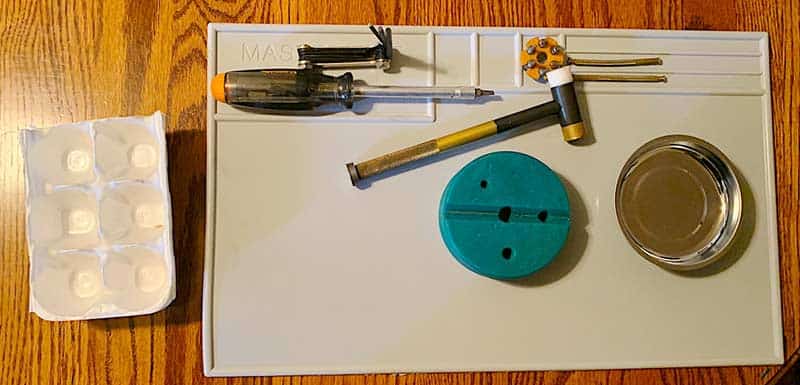
Working in a clean, uncluttered area helps keep small parts
from escaping. Old egg cartons for smaller parts help in
reassembly while magnetic dishes and rubber mats with
anti-roll spaces help keep things corralled.
Hide & Seek
The most popular game my guns enjoy playing is hide-and-seek. Hide-and-seek players are hard to find, but my guns are professionals. And to make matters worse, my guns are arrogant. They like teasing me by exposing most of themselves, then taking sadistic pleasure in hiding their smaller disassembled parts. This delays complete assembly of the freshly scrubbed, oiled and wiped down nomenclature. It’s maddening at times!
The funny thing is, no matter how much I disapprove of gunplay, it happens more frequently. If you think you have your guns under control … good for you! But don’t be surprised if, one day, your guns decide to get frisky. I’ve found cleaning them in well-lit rooms discourages play, as does having a large, clean work area.
Don’t Be Screwed
Containers corralling smaller parts like screws and springs discourage playfulness. Here are a few examples of marathon mayhem I’ve partaken in during “gunplay” games … unintentionally, of course! My guns ambushed me as I took the bait. And I wasn’t even in a playful mood.
Don’t overlook the obvious when searching for escaped parts.
Oh, Christmas Tree
It was my first Christmas with my lovely bride — 35 short years ago. Like most of us, I started the habit of buying my gift for her, in the name of saving her the trouble. It’s continued to this day and I’m good at it, sometimes buying my gifts months before Christmas. Anyway, it was Christmas morning and I unwrapped my gift. It was a Springfield Armory Mil-Spec 1911! How’d she ever know (wink)?
Like most kids on Christmas day, the first thing I did was disassemble the gun, wiping off the heavy factory grease and using a lighter gun oil. As I started reassembling the gun, it decided to get frisky and wanted to play. As I compressed the recoil spring, pushing on the spring plug so I could lock it in place with the barrel bushing, it slipped past my bratwurst fingers and let loose. BOINGGGG!
I heard it laughing in free flight as it launched across the living room. Let the games begin!
I figured it would be a short game. Wrong!
I searched and searched for that recoil spring plug for two days! Tired, frustrated and embarrassed, I admitted defeat, but the part kept playing. Recalculating trajectory, direction and any unsearched area, I went over to the Christmas tree. I heard the giggling before seeing it. There it was, insolently sitting on a tree bough. Game over!
Hidden in Plain Sight
I’d just gotten back from the range and was ready to clean my guns. It was a single-action kind of day, so any unintended gunplay would be unlikely … or so I thought. Besides playing hide and seek, my guns like making me feel stupid at times — adding insult to injury.
So, I started cleaning my single actions, pulling base pins, cleaning barrels and cylinders, lightly oiling them and started reassembling. Uh oh! I cleaned four guns, but there were only three base pins on my shop rag. Game on!
I looked on the ground in my immediate area. No luck!
I spread my search pattern with negative results. I started looking under my benches, checking every nook and cranny. Nothing! For three hours, I played this frustrating game! My wife was yelling that dinner was ready. I’m soaking wet, mad and frustrated. I picked up the disassembled gun, trying to get a clue, when it smacked right between the eyes!
For a small 4 ¾” Ruger Blackhawk, it packed a wallop! Base pins on 4 ¾” can’t be removed without taking off the ejector rod housing. Duh! Double Duh!! Now I was really pissed for being so stupid! Guns enjoy every moment of these playful times.
Misery Loves Company
This last story involves a good friend. His story may be the best of all. He enjoys Weatherby Outfitter rifles and must have 8 or 9 of them in different calibers. Each of them came with threaded barrels, muzzle brakes and thread protectors. One day, he pulled the box out for his latest Outfitter. For some reason, he looked for the muzzle brake. It wasn’t in the box! He had been reorganizing the past year and figured it would eventually turn up.
My buddy plays at a much more relaxed pace than I do, but he ended up playing a marathon game of hide-and-seek.
He checked with the gun shop owner to see if he had pulled the bag out of the box containing the brake while scoping the gun for him. Nope! He searched his storage facilities, safes, garage, and every square inch of the house—nothing! A year went by, and it was still missing. He figured he’d have to buy a new brake and thread protector from Weatherby.
I guess his rifle started feeling guilty and finally decided to stop playing. When looking the rifle over he was knocked out cold by the discovery — his barrel is NOT threaded! He’d been searching for a nonexistent part. That’s some serious gunplay! My buddy told me he was so happy and pissed off at the same time, he didn’t know how to react.
The Searchers
For all my fellow searchers, don’t feel bad. Things happen. Take your time. And if you do get the urge to play with your gun, do it this way! Because real gunplay is dangerous and stupid!

New York City has always been pretty congested.
This picture dates back to the 1930s.
The news this morning sported yet another headline trumpeting the sordid state of my countrymen living in New York City. It seems every day brings some fresh new tragedy from some Leftist enclave overrun with homelessness, drug abuse, crime, violence and despair. In this case, some well-to-do woman was walking back to her building when she was accosted by a pair of muggers.
The criminals threw the poor woman against the building and snatched away her purse and phone. The many bystanders present just looked on with disinterest. What made the event newsworthy was that the doorman at her building actually chose to intervene. He shooed away the two miscreants and escorted the shaken woman inside. The two scumbags strolled away laughing as they cataloged their new swag. Oddly, that sort of thing really doesn’t happen down here in the Deep South where I live.

I don’t much want to live in New York City myself. However, the
Statue of Liberty is pretty darn awesome, so there’s that.
Photo by MCJ1800 / Wikipedia
Daylight and Dark
Far be it from me to insinuate that one part of our great republic is superior to any other. I freely admit that, in addition to more than 90,000 homeless people and roughly half a million illegal immigrants, the Big Apple also plays host to the Statue of Liberty. That is indeed pretty darn cool.
My own home state of Mississippi admittedly rates 47th in literacy. Only New Mexico, Texas and California beat us in our race to the bottom. Incidentally, New York is 43rd.
Mine is still a pretty Godly state. We are number one in the country for adults who pray daily and believe in God. We are fourth in church attendance. Additionally, Everytown for Gun Safety, a rabid mob of freedom-averse gun-hating hoplophobes, rates us 49th for gun law strength. I’m pretty proud of that myself.
Every single day at work, I see some redneck guy in my medical clinic and ask him to shed his jacket or vest so I can listen to his chest. That’s when I see it. The next question is invariably, “What you packing?”
I already know the answer to that question, of course, but it is a great way to start a conversation. And that is why we don’t have thugs throwing women up against buildings on the square in Oxford, Mississippi. It is not hyperbole to say that the first time you do that around here, half a dozen armed rednecks are just going to blow you away.
Mine is a constitutional carry state. Down here, your birth certificate is your concealed carry license. We also really love our cops, and they love us. The local fuzz is forever offering free classes on self-defense for women and similar civic-minded stuff. My wife took it. That was great until she got home and wanted to practice what she learned on me.
We had to call the cops a few years ago for a disturbance in the waiting room. Some crazy person was getting out of hand. It happens. One of the responding officers actually arrived on horseback. He had been across the street showing off his police horse at the nearby nursing home when he got the call.
Rednecks are a timeless part of the Deep South. These were photographed back in the early 20th century. However, guys like this are tough, they love America, and they will not stand idly by while women get beat up.
Find a Need and Fill It
If random armed rednecks are a deterrent to crime, that seems like an opportunity to me. We have plenty of armed rednecks down here in Mississippi, while our friends in New York appear to have a relative dearth. As such, I would like to announce my newest business venture. I call it Will’s Redneck Rentals. We gladly export.
Here is one of our hypothetical armed rednecks available for rent — Colt Thompson (I actually know a guy down here named Colt Thompson) has worked for the past 15 years as an electrician. He is 40 pounds overweight, married and has three children. He was a Bud Light man until last year when he inexplicably switched to Coors. His preferred carry piece is a 9mm Springfield Armory Hellcat in a well-used CrossBreed IWB rig. He’s looking for a side gig to help keep things spicy.
Nowadays, Colt is an overweight middle-aged redneck. However, right out of high school, he spent four years in a Ranger battalion. He still shoots regularly and recreationally. That fat, unassuming HVAC repairman can run that Hellcat like a Delta Force commando. He also loves America, goes to church regularly and absolutely hates people who pick on women, like viscerally. Give the guy a cot and keep him in food and beer, and he’s yours for as long as you need him.
So, surf on over to www.mississippiactuallysoundsprettyfreakingawesome.com to sign up for your own rental redneck. We deliver. Additionally, if you are the sort who shakes down women in public spaces, be forewarned. Try that in front of Colt Thompson or one of his peers, and that guy is going to kill you deader than rocks. We guarantee it.

This isn’t your average fishing report, as square grouper isn’t really a fish. It’s a slang term for drugs, in this case – cocaine. The term ‘square grouper’ came about in the 1970’s as a term for a bale of marijuana that washed up on the Florida shore. As drug runners encountered authorities out in the open waters, they would dump their cargo overboard. Bales of tightly wrapped weed.
These bales would sometimes (and still do) wash up on shore leaving the person finding them to make a decision – call the cops, or take them with you. Obviously calling the police was the safest (albeit less profitable) option.

A Florida Keys charter boat captain was arrested this past weekend in a multi-agency drug bust after trying to sell kilos of cocaine he reportedly stumbled upon at sea.
Brad Picariello, 65, was arrested on Monday after selling a kilo of cocaine for $10,000 to an undercover Monroe County Sheriff’s Office detective.
OR as grumpy , old & very cynical me is thinking. The Gun Makers want to sell some more guns. So they invent this new round that will do everything but go around corners, never miss, clean it and then cook it.
Sorry folks but as the late Master Gunner Ian Hogg said a very long time ago. We have taken small arms ammo as far as it can go . So stick with the classics and you really cannot go too far! Grumpy

Categories