

The Battle of Château-Thierry was fought on July 18, 1918 and was one of the first actions of the American Expeditionary Forces (AEF) under General John J. “Black Jack” Pershing.

It was a battle in World War I as part of the Second Battle of the Marne, initially prompted by a German offensive launched on 15 July against the AEF, an expeditionary force consisting of troops from both the Army and Marine Corps, and the newest troops on the front.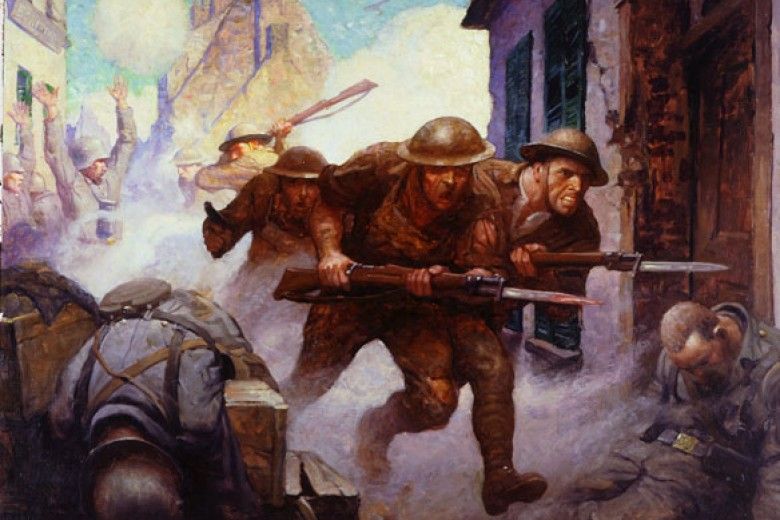
On the morning of 18 July 1918, the French (some of them colonial) and American forces between Fontenoy and Château-Thierry launched a counter-assault under the overall direction of Allied généralissime Ferdinand Foch against the German positions.
This assault on a 40 km (25 mi) wide front was the first in over a year. The American army played a role fighting for the regions around Soissons and Château-Thierry, in collaboration with predominantly French forces.
The allied forces had managed to keep their plans a secret, and their attack at 04:45 took the Germans by surprise when the troops went “Over the Top” without a preparatory artillery bombardment, but instead followed closely behind a rolling barrage which began with great synchronized precision.
Eventually, the two opposing assaults (lines) inter-penetrated and individual American units exercised initiative and continued fighting despite being nominally behind enemy lines.[2]
Contents
[hide]
Background
Despite the revolution in Russia, fortune seemed to favor the Allies with the arrival of the Americans to France. However, these troops needed time to train before they could be combat effective.
Recognizing the window of opportunity, Ludendorff consolidated the manpower freed up from the Eastern Front to conduct Operation Michael in order to split the Allies’ lines. The successes of the German Stormtroopers infiltration tactics earned Germany approximately 40 miles of territory. But the offensive lost momentum when it surpassed its supply lines.
Up to this point, American General Pershing refused to hand over American divisions to either the British or French armies, insisting on keeping them together as one army. But in the face of the German onslaught, Pershing relented and sent a portion of his army to assist the French in blocking the German advance.[3]:7–10
Prelude[edit]
Looking to defeat the British occupied in Flanders, Ludendorff sought to divert the Allies’ French reserves away from the region. In his Operation Blucher, Ludendorff aimed some of his forces at the Chemin des Dames and took the French Sixth Army by surprise.
Driving on, the Germans were soon at the Marne River, situated under 50 miles from Paris. With Marshal Ferdinand Foch unable to acquire British assistance, General Pershing’s chief of operation, Colonel Fox Conner, recognized the gravity of the situation and ordered the 3rd Division to block them.[3]:39–41[4]
Battle
The 3rd Division occupied the main bridge on the south bank of the Marne that led in Chateau Thierry on May 31 as the French 10th Colonial Division rendezvoused with them from the north bank. The Americans positioned their machine guns to cover the French retreat, and had a unit led by Lt John Bissell situated north of the second bridge. The French spent the night adding explosives to the bridges to destroy them. Early the following morning, on June 1, the Germans advanced into Chateau Thierry from the north, forcing the French to the main bridge, which they defended with the support of American machine-gun fire. The French succeeded in destroying the bridge as the Americans kept up their fire on the Germans. Lt. Bissell’s group was still on the north side of the Marne. They worked their way back to the secondary bridge in-between American machine-gun fire and made it across, along with a group of Germans that were captured shortly afterwards. From the north of the Marne on June 2, the Germans engaged in heavy artillery and sniper fire against the Allies. They made an attempt to take the remaining bridge but were forced to end the assault as the casualties rose.[3]:41–42
Memorials[edit]
After World War I, a memorial was built on Hill 204, 2 miles (3 km.) west of the town for which it is named. The Château-Thierry Monument, designed by Paul P. Cret of Philadelphia, was constructed by the American Battle Monuments Commission “to commemorate the sacrifices and achievements of American and French fighting men in the region, and the friendship and cooperation of French and American forces during World War I.”[5]
There is also a monument in front of the Bronx County Courthouse in New York City that was presented by the American Legion on November 11, 1940. The monument consists of the “Keystone from an arch of the old bridge at Chateau Thierry,” which the monument notes was “Gloriously and successfully defended by American troops.”[6]
The first Filipino to die in World War I was Private Tomas Mateo Claudio who served with the U.S. Army as part of the American Expeditionary Forces to Europe. He died in the Battle of Chateau Thierry in France on June 29, 1918.[7][8] The Tomas Claudio Memorial College in Morong Rizal, Philippines, which was founded in 1950, was named in his honor.[9]
References[edit]
- Jump up^ http://www.kumc.edu/wwi/index-of-essays/american-military-operations-and-casualties.html
- Jump up^ Edwin L. James (1918). “A Description of the Battle of Chateau-Thierry”. New York Times Current History. New York Times. Archived from the original on 6 June 2009. Retrieved 2009-06-22.
- ^ Jump up to:a b c David Bonk (2007). Chateau Thierry and Belleau Wood 1918: America’s baptism of fire on the Marne. Great Britain: Osprey Publishing. ISBN 978-1-84603-034-5. Retrieved 31 October 2016.
- Jump up^ Eisenhower, John S.D. (2001). Yanks: The Epic Story of the American Army in World War I. New York: The Free Press. pp. 136–137. ISBN 0-684-86304-9.
- Jump up^ “Aisne-Marne American Cemetery and Memorial” (PDF). American Battle Monuments Commission, U.S. Government. Archived from the original (PDF) on 2009-07-04. Retrieved 2009-06-22.
- Jump up^ “An overlooked memorial”. Matt at I’m Just Walkin’. Retrieved 2014-11-15.
- Jump up^ Zena Sultana-Babao, America’s Thanksgiving and the Philippines’ National Heroes Day: Two Holidays Rooted in History and Tradition, Asian Journal, retrieved 2008-01-12
- Jump up^ Source: Philippine Military Academy
- Jump up^ “Schools, colleges and Universities: Tomas Claudio Memorial College”. Manila Bulletin Online. Archived from the original on 2007-07-07. Retrieved 2007-07-04.
– “Tomas Claudio Memorial College”. www.tcmc.edu.ph. Retrieved 2007-07-04.
The Story of the American Expeditionary Forces |
CHATEAU – THIERRY
| U.S. Marine Corps |
THE BATTLEFOR |
At Belleau Wood
| | Quick Facts | Background | Chronology | | A First Hand Account | Quick FactsWhere: The Aisne-Marne Sector, 5 miles immediately northwest of the town of Chateau-Thierry on the River Marne. BackgroundThe Hunting Lodge within Belleau Wood
|
| Sources and thanks: A half dozen works were consulted for this page including E.M. Coffman’s War to End All Wars, Stalling’s The Doughboys, Friedel’s Over There, SLA Marshall text in the American Heritage History of World War I and American Armies and Battlefields in Europe. The most valuable resource for the chronology was the Official 2nd Division History which is now available on CD from our friends at the Digital Bookshelf. A forgotten Marine contributor sent the Frederick Wise comments which are from the memoir, A MARINE TELLS IT TO YOU. The top illustration is a detail from a Leatherneck Magazine cover. Regular contributors Herb Stickel and Ray Mentzer helped with the other photos.All of the above are recommended for deeper study of the battle as well as two interesting websites: Bradley Omanson’s Scuttlebutt & Small Chow: A Salty Old Harbor of Marine Corps History Great War Society Member Edward Swaim’s Belleau Wood Today Photo Essay Last, a special thanks for Col. Bill Anderson, USMC, a Great War Society Member and student of the battle who caught some serious errors of omission in my original draft. MH |
| To find other Doughboy Features visit ourDirectory Page | For Great War Society Membership InformationClick on Icon |
| For further information on the events of 1914-1918 visit the homepage of The Great War Society |
Additions and comments on these pages may be directed to:
Michael E. Hanlon (medwardh@hotmail.com)
Categories
Memorial Day


We all grew up watching cowboys played by the likes of John Wayne, Clint Eastwood, Matt Damon, and Emilio Estevez carrying 1873 lever actions. Its big brother, the Winchester Model 1876, however, despite being the first large caliber repeating rifle, never quite got the same acclaim.
When the 1873 came out it was a paradigm shift. A repeating rifle that was as reliable and capable as it was practical. However, it was still a pistol caliber carbine. For real rifle work, you had to go to something like an 1869 Sharps, a Ballard Perfection rifle, or a Remington Rolling Block. That’s what buffalo hunters used. What these long range, big game guns had in common was that they were all single shot firearms. The Winchester Model 1876 changed that forever.

Photo courtesy of Cimarron Firearms.
Whether shooting grizzlies, buffalo, or marauding Indians, having the ability to fire multiple shots in quick succession often meant the difference between life and death for the western frontiersman. It was embraced by those who needed the power and range the bigger cartridges provided including settlers, professional hunters, and soldiers. Probably also why it became a favorite of Teddy Roosevelt in his treks out west (and even Africa).

Roosevelt with his Winchester 1876 rifle. Phot courtesy Library of Congress.
Cimarron contracted with Uberti to produce the replica Winchester Model 1876 and they couldn’t have picked a better company. Uberti makes beautiful and detailed replica guns. Their Model 1876 is a gorgeous rifle. The wood, bluing, fit of the wood to steel, and the action are all excellent. And it shoots as good as it looks.

Tom Horn Signature

It also wears the Tom Thorn Aperture Sight from the Steve McQueen Movie.
In order to handle more powerful cartridges, Winchester took their successful Model 1873 and made it bigger. In fact, the 1876 utilizes the same toggle action as the 1873. However, in the Cimarron/Uberti guns, it’s much stronger than the original. Modern metallurgy definitely makes a difference.

A Brass elevator positions the round for chambering
The gun pictured and evaluated is Cimarron’s special Tom Thorn edition. So who was Tom Thorn, you might ask? Horn was a legend in his own time. At 6’ 2” and 200 lbs. he was an imposing figure. A cowboy, US Army scout in on the capture of Geronimo, a Pinkerton agent in the time of Butch Cassidy and the Hole-in-the-Wall gang, and a range detective (some might say hired gun) working for cattleman’s associations. In other words, he was a bigger than life, fiercely independent, and rugged individual fighting for what he thought was right.

Storage in the stock for emergency supplies, extra ammo, or Slim Jims. Horn carried a cleaning rod in his.
Although there have been at least ten movies and TV programs over the years featuring the legendary Thomas Thorn, Jr., the best known is probably the 1980 movie starring Steve McQueen. In this movie, Horn’s near constant companion is a Winchester Model 1876 in 45-60. (Back in the black powder days, cartridges were typically denoted by the caliber followed by the number of grains of black powder they contained. So 45-60 was a 45 caliber bullet, generally cast lead, over a charge of 60 grains of powder.)

Photo downloaded from http://www.imfdb.org/wiki/Tom_Horn shows how big the 1876 is.
The gun McQueen carried in the movie was an original Winchester Model 1876. It was, in reality, a 45-75 but was depicted in the movie as a 45-60 since that’s the caliber Horn used. In fact when Horn was arrested for the murder of Willie Nickell, a murder which he probably didn’t commit, he had 45-60 cartridges in his pocket. Unfortunately, Horn still swung from a rope for it in Cheyenne, Wyoming.

The gun was modified for the movie with a rear aperture sight as is the Cimarron version. Photo downloaded from http://www.imfdb.org/wiki/Tom_Horn
The Winchester Model 1876 was introduced at the Philadelphia Centennial Exposition celebrating the founding of the USA and was well received. It achieved a unique position in the market until being dethroned by the Winchester Model 1886. Still, it was produced until 1897 with a total production of 64,000 guns. The Cimarron Model 1876 is the very first version to be produced since then.


A dustcover protects the elevator area from dirt and debris and retracts when the action is opened.
1876 Centennial “Tom Horn” Signature Rifle Specs
| Price | $1,818.70 |
| Caliber | 45-60 |
| Style | Centennial Rifle |
| Trigger | 7 lb. 8 oz. |
| Frame | Standard Blue |
| Finish | Standard Blue |
| Stock/Forearm | Walnut |
| Barrel | 28 in. |
| Weight | 10.05 Lbs. |
Shooting the 1876
My first outing with the 1876 was a little disappointing. The action was stiff, the sight was off quite a bit to the left, and I got some light primer strikes. Keep in mind that the test and evaluation (T&E) guns we writers get to review make the rounds. I didn’t clean or lubricate it when I got it. I just went straight to the range. When I got home I cleaned it, sprayed some Rem Oil down the firing pin hole, and properly lubricated the other moving parts. Should’a done that to begin with.

Fired Ventura Heritage 305 grain RNFP ammo. It was a joy to shoot.
My next trip to the range the action was slick as warm butter, the front sight was easily adjusted, and no more light primer strikes. It functioned flawlessly. Lesson learned. Clean it before you shoot.

Front sight adjustment is as easy as loosening a screw and moving the blade in the dovetail.
I have to say that this is a fun gun to shoot. The weight of the gun mitigates the recoil from the 45-60 round firing a 305 grain lead round nose flat point (RNFP) bullet. With a muzzle velocity of 1137 fps you get muzzle energy of 876 foot pounds. That’s more than enough for deer, hogs, or black bear.

The only safety is a lever safety button that must be depressed.
Firing offhand at 50 yards, like you would if you were hunting, my best group was 2.238”. Four of the five shots were at just over an inch and a half. You should know that I’m not the best with iron sights. The targets I brought with me that day were also black and it was even more difficult to see the blued, almost black sights on a black target. So you might say this was a worst case test. I truly believe that the gun is more accurate than this for someone with younger eyes. Still, that accuracy is good enough for shots out to 100 yards, even for me. You could likely use it successfully to 200. That’s probably the limit of its accuracy for humane kills due to the trajectory of the most un-aerodynamic blunt 305 grain bullet.

Four rounds into 1 ½” at 50 yards plus a flier.
The trigger was a little heavier than what I prefer in a rifle, but I can’t blame the trigger for my shooting. Even though it broke at 7 pounds 8 ounces on my Lyman trigger gauge, there was no takeup, it broke crisply, and with almost no over travel. It is one sweet trigger.
Ammo
Ammo is an issue since you’re not likely to find it at your local gun shop. The only ammo I was able to get for the evaluation was from Ventura Munitions. From what I’ve read in the forums, ammo is a little scarce although Cimarron is investigating ways to make it more available. If you roll your own, you shouldn’t have any problems. Otherwise, check with these three sources:
Buffalo Arms
Goex Black Dawge – Midway
Ventura Munitions
Wrap up
The Cimarron Centennial Tom Thorn Signature Edition rifle doesn’t have a cross block safety or half cock safety, just like the original. The only compromise made for our litigious society is a lever safety. The lever has to be held against the stock to depress a button. Easy enough to do, especially once you’ve familiarized yourself with the gun.
Although not the best-known rifle from our frontier days, the 1876 is still a storied gun. Get into the history of the era and the rifle and you’ll learn a lot about the old west and some legendary characters who carried it. If you like to hunt with a firearm that was used extensively in the wild west, you owe it to yourself to consider the beautiful guns from Cimarron like the Tom Horn Signature Edition Model 1876.
Shoppers Step Over Bodies at Hogg-Led Publix Protests

After having begun the week receiving national attention for being run by people too stupid to know the difference between academic achievement and pornography, Publix Supermarkets Inc. finished it letting everyone know that the company’s corporate stupidity is here to stay:
 The Hill
✔@thehill
Publix suspends political contributions after being pressured by Parkland shooting survivors http://hill.cm/JWdLGHf
The Newly Press has more:
Liberal Democrats who believe in bullying people and/or corporations into submission ought to feel proud today, ladies and gentlemen, because thanks to the bullying of David Hogg and his peers, one major Florida company has just abdicated its free speech rights.
The bullying started this week after Hogg, a survivor of the Marjory Stoneman Douglas High School mass shooting in Florida three months earlier, began targeting a popular employee-owned supermarket chain that employees over 190,000 Americans.
Publix supermarket chain attracted the 18-year-old gun control zealot’s ire after he learned that it had contributed over half a million dollars to the Florida gubernatorial campaign of Adam Putnam, a Second Amendment advocate and proud NRA member.
For those who have been busy enjoying life and not reading news about David Hogg, the kid’s modus operandi (not dirty, Publix, I swear!) is to use his Prized Progressive Puppet status to bully anyone who disagrees with him into silence.
As the progs and Democrats really have nothing else going for them at the moment, he’s getting an extension on his fifteen minutes of fame.
While Hogg’s spiteful focus is currently on NRA supporters, the odds are probably pretty good that the kid will be branching out to a variety of other leftist issues before long.
These thoughts and actions aren’t his own, remember. His handlers are grooming him for bigger things. Look for him to be targeting anyone who opposes taxpayer funding of Planned Parenthood any day now.
There is also a fairly decent chance Hogg will eventually be a violent alcoholic because, instead of getting the trauma counseling he so desperately needed, heartless progressive activists kept shoving him in front of television cameras while he was still in shock.
The real laugher in all of this is that every time Hogg gets a victory with public threats and bullying, he starts blathering about “love”:
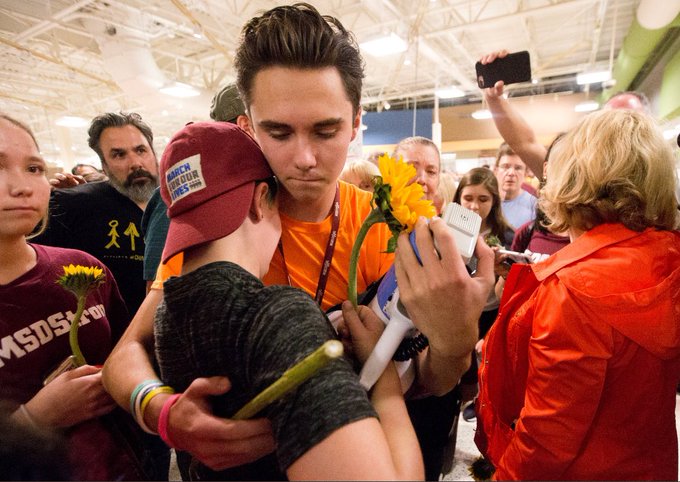

 David Hogg
✔@davidhogg111
Together we can do anything. Together the young people will win by choosing love.
“Yay! I just threatened to destroy people and it worked again! Also: love or something.”
You know what I love? This picture from Hogg’s “die-in”:

 Emilee McGovern@EmileeRose
This is America. #PublixDieIn #neveragainmsd
“Oh, you’re having a die-in? Well, I’m having a walk-over. It’s a holiday weekend and I’m making fruit salad for the barbecue.”
Not every hero wears a cape.
Publix managed a couple of perverse publicity bookends for the week. They dishonored a kid who quietly achieved highest academic honors, then honored a kid who publicly complained about not being accepted at any of the universities he wanted to go to.
“Florida Man” has now become “Florida Company.”



From left to right is a Gorilla Ammo .45ACP, a Browning .40S&W, and a Winchester 9mm Parabellum round.
Our patient was a heavily muscled young gladiator of the sort who frequents an urban emergency department. Stabbings and gunshot wounds are lamentable side effects of his day job. When he hobbled into the ER he had a bandana pressed against the lower right side of his abdomen yet seemed pleasant enough.
I forget the sordid details. Turf, drugs, or women accounted for the lion’s share of the chaos, so the impetus this evening was likely some toxic combination. Once we got him into the CT scanner we could see the 9mm round flattened against the back of his pelvis. The bullet had undoubtedly played holy havoc with the intervening entrails so the surgical residents got a laparotomy out of it, but I will never forget how calm he seemed. The round could have ricocheted or passed through some intervening barrier material to bleed a little horsepower, but its terminal effectiveness in this particular instance was decidedly underwhelming.
I have seen men killed with the 9mm round, but that experience with that thug in the ER made an impression. I like to shoot the 9mm because it is lightweight and fun. The round is cheap, produces modest recoil, and remains easy to carry. None of these attributes speaks to the crux of the issue, however, which is speedy incapacitation and expedient behavior modification.
Background
The 9mm Parabellum is the most popular centerfire pistol cartridge in the world. Parabellum means, “If you seek peace, prepare for war.” Georg Luger contrived the round in 1902 to feed his eponymous toggle-locked handgun. 60% of the cops in America carry 9mm handguns, and the FBI relatively recently retired their .40-caliber weapons in favor of guns firing the smaller round. The 9mm is credited with the demise of the combat revolver in America in favor of high-capacity autoloading handguns.
In its military guise, the 9mm cartridge pushes a 124-grain metal-jacketed lead-cored projectile to about 1,150 feet per second. I have an acquaintance who shot a man in Iraq three times in the chest with his M9 Beretta handgun after an unfortunate surprise encounter in an alleyway. He then went on to develop a friendship with the hapless Iraqi after he recovered. When shooting ball ammo the 9mm never seemed to command respect in the ER.
The .45 ACP—Practical Tactical
This poor guy caught a .45ACP round to the head and was rapidly approaching room temperature when we met. The bullet separated from the jacket and went its own way, while the jacket lodged outbound between his skull and his scalp. The jagged scrap of copper measured 11mm on a piece of EKG paper. The job that thing did on that guy’s melon was the stuff of nightmares.
Special Forces Operational Detachment-Delta employs some of the finest shooters on the planet. They called it the Combat Applications Group for a time. I think the Army’s pet name is Army Compartmented Element these days. JSOC calls it Task Force Green. The guys who actually serve there just call it “The Unit.” Delta is the best we can produce, and they are some rarefied warriors indeed. Their very existence is supposed to be a secret, but they have a Wikipedia page.
The Delta guys I bumped into back when I wore the uniform typically carried high-capacity 1911 handguns. Their pistols were built around Para-Ordnance frames and had all the bells and whistles. With 14+1 of .45ACP chaos onboard these were some of the most effective combat handguns in the world. They also must have been boat anchors to hump. I’m told there are more Glocks in those holsters nowadays, but these guys know guns and the .45ACP was their round.
The .45ACP was a John Moses Browning creation in 1905, and it pushed a bullet roughly twice as big as that of the original 9mm Parabellum. However, all that horsepower comes at a cost. The .45ACP is big and chunky to tote and a handful to run for those with modest mitts.
The .40S&W—The Grand Compromise
If there is a message to be found in the ignoble tale that follows it is that the sensible citizen should never try to run over a police officer with an automobile. The cop sidestepped the speeding car and fired a single .40-caliber round through the driver’s side window. The bullet struck the hapless felon in the chest and peeled open the left ventricle of his heart like a can opener. Had it happened in the operating room the guy still wouldn’t have survived. That high-performance police-issue expanding bullet performed exactly as it was intended. It passed through the glass, the dude’s shirt, his skin, and the intervening muscle without checking up before deploying like a miniature buzzsaw to thoroughly rearrange the guy’s chest cavity. It didn’t hurt long.
The .40S&W arose as the indirect result of the FBI’s 1986 Miami shootout. If you aren’t familiar with the details surf on over when you’re done here. Any student of small arms is well served to read up on it. Google is your buddy.
During the Miami shootout, two FBI special agents were killed and five wounded by a pair of bank robbers wielding a variety of weapons. One of the Bad Guys, in particular, took a 9mm round to the chest and went on to foment a great deal of mischief before he succumbed. With this as an impetus, S&W partnered with Winchester to produce the ideal Law Enforcement pistol round.
The resulting .40S&W was, in essence, a shortened 10mm auto cartridge. This rimless straight-walled round was short enough to fit into existing 9mm pistol frames yet pushed a 165-grain bullet to more than 1,100 feet per second. In many cases converting between 9mm and .40S&W was as simple as exchanging the barrel and magazine. The resulting magazine capacity was typically reduced from 2 to 4 rounds, but this interchangeability meant easier maintenance and a convenient transition for officers already familiar with the platform.
.40S&W does inevitably offer greater recoil than the 9mm but remains more pleasant than the .45ACP. There were some teething problems but in general, the .40S&W has lived up to its press releases. Why then might the FBI and 60% of American Law Enforcement agencies be switching back to the 116-year-old 9mm Parabellum when the .40S&W was specifically designed to replace it?

Despite its blocky utilitarian appearance, the Glock 22 is an exceptionally efficient combat implement.
Technology Marches On
The three anecdotes related above represent a comically small sample size. I have seen a guy survive being shot with a .45ACP to the torso and another paralyzed for life with a .25ACP to the neck. Shot placement is everything, and bullet design is indeed a combat multiplier. However, there’s way more to it than that. No handgun round will reliably guarantee one-shot stops.
Most of the thugs I have encountered feed their cheap crappy guns the cheapest ball ammo they can steal. As a result, the downrange effects can indeed be underwhelming. By contrast, trained Law Enforcement Officers running the finest antipersonnel rounds money can buy generally find their tools to be markedly more effective.
In 2014 the FBI produced a report that detailed how improvements in powder efficiency and bullet design had generated 9mm performance that was in some cases superior to comparable .40S&W and .45ACP Law Enforcement loads. Given that 9mm ammo is cheaper and produces less recoil, this equates out to less expensive training and better accuracy, particularly with small-statured officers. As a direct result, Law Enforcement agencies across our great republic seem to be tripping over themselves to trade out their .40S&W handguns for the 9mm sort.
Statistically, trained Law Enforcement Officers shooting under the stress of a life or death situation connect with their targets with one round in five. As a result, a softer-shooting handgun that yields better follow up accuracy can itself render a combat advantage so long as penetration is adequate. However, that takes us full circle to Miami, wherein a determined assailant hit in the chest with a bullet that rendered adequate penetration went on to kill two federal agents before he expired. What conclusions should we mere civilians draw from all this?
The Real Skinny
Whenever I am not asleep or in the shower I am invariably armed, but I’m not a cop. I carry my handguns concealed or in a vehicle and don’t expect to engage an armed assailant as part of my day job. However, I have a difficult time getting past the image of that guy standing in the exam room with the bandana on his groin.
The 2014 FBI report is itself fascinating reading, and it makes some great points. However, I’m personally not quite ready to cash in my .40’s for something smaller. I have carried most everything at one point or another, and I do prefer toting a compact 9mm as I wander through my daily sojourn. However, when I travel or am someplace static the game changes. If I have two otherwise identical handguns sitting on the table, one in 9mm and the other in .40S&W, it’s most typically the .40 that ends up in the center console of the truck.
A Few Options
Most popular modern combat handguns sport polymer frames and striker-fired triggers. The Glock 22 is the industry standard. The Glock 22 packs 15 rounds in its magazine and sports the raked grip-to-frame angle and low bore axis for which Glock has become justifiably famous. The sole external safety is a blade in the trigger, and the gun is arguably the most reliable autoloading handgun ever made.

The Glock 22 is the most popular .40-caliber pistol in Law Enforcement. Sporting legendary reliability and simple operation, the Glock and its Safe Action trigger precipitated the polymer pistol revolution.
The Smith and Wesson M&P offers an oblique grip-to-frame angle more akin to that of the 1911 and a pivoting safety as part of the trigger body. The M&P has interchangeable palm swells and a 15-round magazine. The M&P comes standard with steel sights and is a dream on the range.

The Smith and Wesson M&P .40 is a rugged and effective design. Sporting interchangeable palm swells and a bilateral slide release, the M&P .40 is an Amer-ican-made warhorse.
The Steyr L40A1 is the “Other Austrian Combat Pistol.” Featuring the same raked grip-to-frame angle and low bore axis as the Glock, the L40A1 has an extended slide and barrel for enhanced accuracy. Magazine capacity is limited to 12 rounds, but the gun looks like it fell off the set of a science fiction movie.

The Steyr L40A1 is the longest of their three .40-caliber combat handguns. The rakish design offers an exceptionally low bore axis and a fresh slick geometry.
The HK VP40 offers the most customizable grip of any combat pistol in the world with three interchangeable backstraps and six side panels of various thicknesses. The slide also includes polymer ears the company calls “charging supports” to enhance your grip when sweaty or rushed. There is the obligatory trigger safety, and the gun is available in black or FDE. The VP40 carries 13 rounds in its magazine. The VP40 is the most expensive gun of the four profiled, but it also sports a legendarily smooth crisp trigger.

The HK VP40 features the most customizable grip in the industry. Grip panels are interchangeable between 9mm and .40-caliber versions, so I just mixed and matched.
Ruminations
All things being equal I shoot a bit better with a .40S&W than I do a .45ACP. I also shoot a little bit better with a 9mm than a .40S&W. However, taken to an illogical extreme, I shoot even better than that with a decent .22LR. Life is all about compromises, and the .40S&W was designed from the outset to balance power and portability. As a result, I think until I can lay my hands on a phased plasma rifle in the 40-watt range I’ll hang onto my full-sized .40-caliber handguns. They all punch deep, but the .40 seems intuitively destined to make bigger holes.

The polymer-framed .40-caliber pistol still offers more power than the 9mm and less recoil than a .45ACP all in an envelope comparable to the weaker gun.
Technical Specifications
Glock 22 S&W M&P Steyr L40A1 HK VP40
Caliber .40S&W .40S&W .40S&W .40S&W
Barrel Length 4.49in 4.25in 4.5in 4.09in
Overall Length 8.03in 7.6in 7.4in 7.34in
Weight 25.59oz 27.9oz 28.8oz 28.93oz
Mag Capacity 15 15 12 13
MSRP NP $569 $575 $719

All of these guns are fast. Magazines drop away freely, and these tapered magazines find the magwell easily.
About the Author – Will was born and raised in the Mississippi Delta, having been immersed in hunting and the outdoors since his earliest recollections. He holds a degree in Mechanical Engineering from the University of Mississippi and is the product of a traditional American nuclear family. Where most normal American kids get drunk to celebrate their 21st birthday, Will bought his first two machineguns.
Will served eight years as an Army Aviator and accumulated more than 1,100 flight hours piloting CH47D, UH1H, OH58A/C, and AH1S helicopters. He is scuba qualified, has parachuted out of perfectly good airplanes at 3 o’clock in the morning, and has summited Mt. McKinley, Alaska–the highest point in North America–six times (at the controls of a helicopter, which is the only way sensible folk climb mountains). For reasons that seemed sagacious at the time he ultimately left the Army as a Major to pursue medical school.
Dr. Dabbs has for the last dozen years owned the Urgent Care Clinic of Ox-ford, Mississippi. He also serves as the plant physician for the sprawling Winchester ammunition plant in that same delightful little Southern town. Will is a founding partner of Advanced Tactical Ordnance LLC, a licensed 07/02 firearms manufacturer and has written for the gun press for a quarter century. He writes solely to support a shooting habit that is as insensate as it is insatiable. Will has been married to his high school sweetheart for more than thirty years. He and his wife currently have three adult children and a most thoroughly worthless farm dog named Dog.