


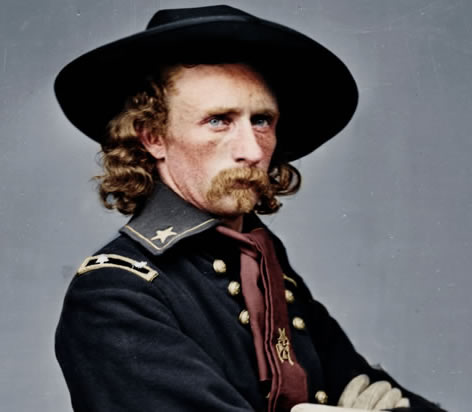
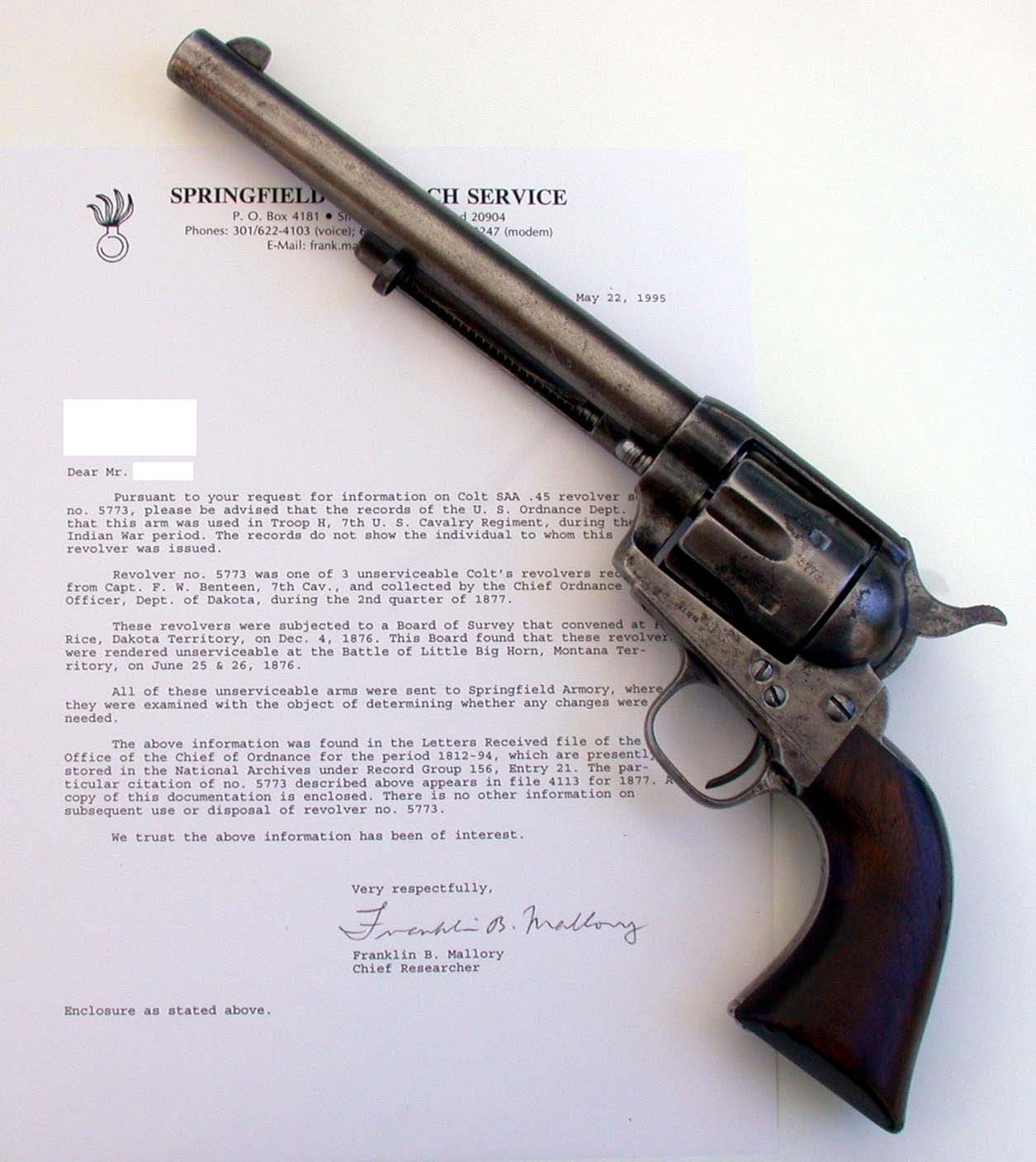
To say that this Officer is controversial would be a huge understatement. In that folks even now over a hundred years after his death at Little Big Horn. They are still talking about him.
His grave at West Point
But enough of that! Since this is a blog about Guns. Here is some stuff I found about his guns. Enjoy! Grumpy


TREASURES FROM OUR WEST: GEORGE ARMSTRONG CUSTER TARGET RIFLE

George Armstrong Custer’s target rifle. 1988.8.735
Originally published in Points West in Fall 2010
Target rifle that belonged to George Armstrong Custer
Although he did not take it with him on the ill-fated sojourn that ended in his death at the Battle of the Little Bighorn on June 25, 1876, this splendid .44 caliber Remington-Rider Long Range Creedmore Target Rifle was owned by Lieutenant Colonel George Armstrong Custer. His wife Elizabeth, known affectionately by Custer as “Miss Libbie,” reputedly gave it to him as a gift.
Mrs. Custer presented the rifle to the Winchester Repeating Arms Company in 1883 in memory of her husband, and the Olin Corporation donated it to the Cody Firearms Museum as part of the Winchester Arms Collection.
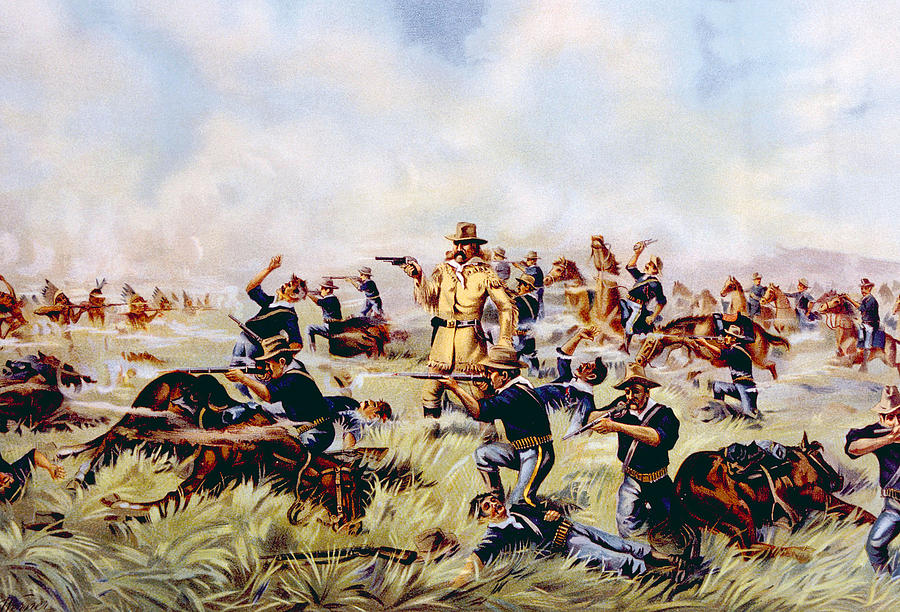
Remington-Rider Long Range Creedmore target rifle. Gift of Olin Corporation, Winchester Arms Collection. 1988

About Nancy McClure
Military Mystery: What was George Custer’s Last Gun?
by | October 3rd, 201143 Comments
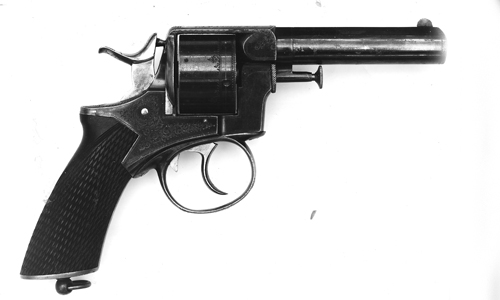
For a good number of years there has been much speculation about what was Lt. Col George Armstrong Custer‘s last gun.
As he and most of his command were killed during the Battle of Little Big Horn, everything has to be put together from spotty evidence, innuendo and guesswork. Here’s my take on the matter.
There is extant, a revealing 1870s-vintage photograph (below) of Custer and his wife, Libby, sitting in their library at Ft. Abraham Lincoln on the Missouri River, Dakota Territory.
In the far right corner is the Lt. Colonel’s gun rack. Four handguns can be seen—two Smith & Wesson No. 2s that had been presented to him by Major General J.B. Sutherland.
A percussion revolver which is most likely either a Colt 1861 Navy or Remington New Model Army that was given to him by Remington, and what strongly appears to be a Webley Royal Irish Constabulary revolver (pictured above).
One tradition persists that British sportsman Lord Berkeley Paget presented George Custer with a solid-frame Webley First Model Royal Irish Constabulary (RIC) revolver on a buffalo hunt in 1869.
The British revolver in Custer’s gun rack follows the lines of the RIC much more closely than those of the Galand, which has a rather involved under-barrel extraction mechanism and slightly different grip than the Webley.
Over the years, for reasons we will mention later, it has been supposed Custer had a pair of nickel-plated RICs with ivory grips–but there is no question the gun in the Ft. Lincoln photograph has walnut grips and a darker, blued finish. Also, there is only one such gun showing, leading me to surmise that Custer, in fact, only had one RIC.
As both Smith & Wessons are displayed and there appear to be empty slots in the rack this supposition would appear to be confirmed. It was very unusual to see double-cased British cartridge revolvers at this period.
Of course there is always another explanation; that being the whole Berkeley Paget thing was something of a red herring and Custer either purchased the Webley himself, or it was given to him by someone else.
Just because a gun was made in England, doesn’t necessarily mean it had to come from an Englishman. British firearms of all types had been actively marketed in the States for decades prior to the 1870s.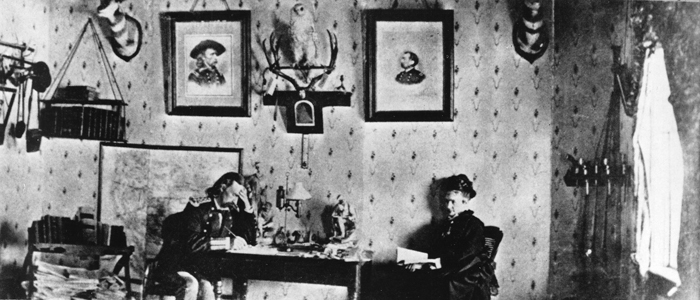
As both Smith & Wessons are displayed and there appear to be empty slots in the rack this supposition would appear to be confirmed. It was very unusual to see double-cased British cartridge revolvers at this period.
Of course there is always another explanation; that being the whole Berkeley Paget thing was something of a red herring and Custer either purchased the Webley himself, or it was given to him by someone else.
Just because a gun was made in England, doesn’t necessarily mean it had to come from an Englishman. British firearms of all types had been actively marketed in the States for decades prior to the 1870s.
Custer and Libby at Ft. Lincoln. Gun rack mentioned at the far right of the picture.
The Royal Irish Constabulary revolver, built by Birmingham, England gunmaker Philip Webley, took its name from the force that adopted it in 1868.
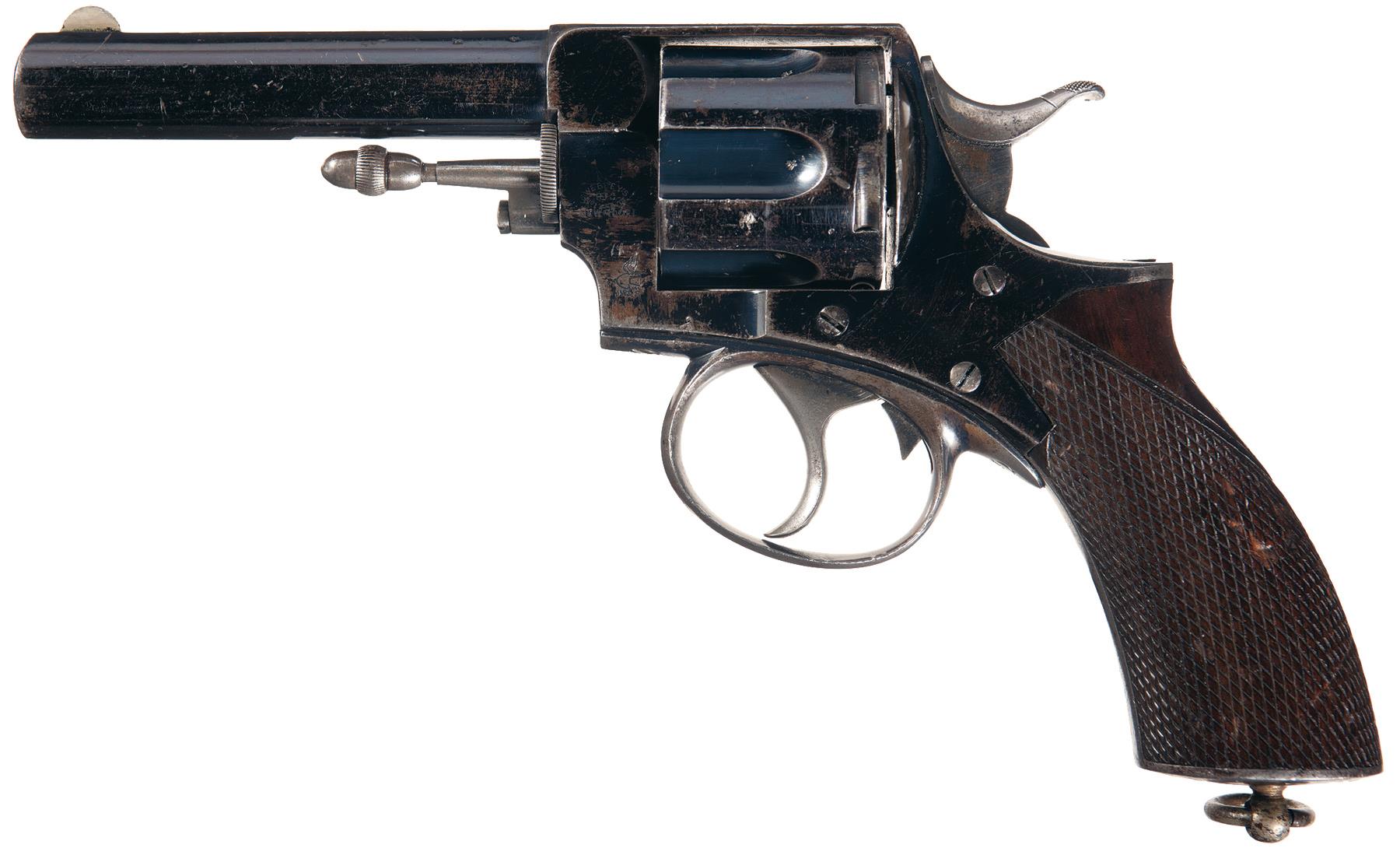
This solid-frame double-action at one time or another was chambered in such calibers as .430, .442, .450, .476 and .44-40, among others.
While the military version of the gun had a four-inch barrel, over its long career the gun was also made in short barreled “Bulldog” versions.
“Bulldog” by the way is a British term going back at least to the latter part of the 18th century and along with “barker” and “snapper” was slang for a short-barreled, large caliber pistol.
Due to the date of presentation and/or the Ft. Lincoln photograph, there can be little doubt that Custer’s RIC would have been a First Model, recognizable by forward locking notches on the cylinder.
The caliber would unquestionably have been .442, for even though the British military had adopted the .450 round in 1868, this chambering was not offered in the RIC at the time of the surmised Berkeley Paget gifting.
After the battle Lt. Edward Godfrey, of K Company, 7th Cavalry, noted that during the expedition Custer was carrying “two Bulldog self-cocking, English white handled pistols with a ring in the butt for a lanyard.”
As we have determined, Custer’s RIC was blued with walnut grips and no lanyard ring, so it’s possible that Godfrey might have confused the Webley with the Smith & Wessons which were plated and had pearl grips, though they didn’t have lanyard rings either, and to be fair he did describe Custer’s other gear pretty accurately.
Too, the fact all of the guns seen in the gun rack are currently accounted, for with the exception of the Webley, adds more strong evidence to the assumption the RIC was the gun Custer probably had with him at Greasy Grass.
To date, no .442 cartridge cases have been found on the battlefield, but as things were getting pretty hot and heavy as the Indians approached the troopers at handgun range there’s a good chance that Custer might not have had time to fire off more than a cylinder-full of bullets.
This means that the empty cases could have still been in the gun when it was taken from the commander’s dead body by one of Sitting Bull’s best. Of course, there is also the very real possibility that he never even drew his revolver and used only his .50-70 Remington rifle. There is also the excellent chance he simply had a Colt SAA.
In any event, it is a mystery that will never be completely solved. The chances of the gun turning up with decent provenance after all these years are virtually nil.
Unearthing of spent .442 cases on the battlefield would certainly lend more veracity to Godfrey’s claims but as the round, while uncommon, was not unknown in the West at the time there is no way of conclusively proving they came from a revolver actually fired by Custer.
Read more: http://www.gunsandammo.com/blogs/history-books/what-was-custers-last-gun/#ixzz4xfJRaeCC

Here is some more information about this character:
George Armstrong Custer
| George Armstrong Custer | |
|---|---|
 |
|
| Born | December 5, 1839 New Rumley, Ohio |
| Died | June 25, 1876 (aged 36) Little Bighorn, Montana |
| Buried | Initially on the battlefield; Later reinterred in West Point Cemetery |
| Allegiance | United States of America Union |
| Service/branch | United States Army Union Army |
| Years of service | 1861–1876 |
| Rank | Lieutenant Colonel Brevet Major General |
| Commands held | Michigan Brigade 3rd Cavalry Division 2nd Cavalry Division 7th Cavalry Regiment |
| Battles/wars | American Civil War |
| Awards | see below |
| Spouse(s) | Elizabeth Bacon Custer |
| Relations | Thomas Custer, brother Boston Custer, brother James Calhoun, brother-in-law |
| Signature |  |
George Armstrong Custer (December 5, 1839 – June 25, 1876) was a United States Army officer and cavalry commander in the American Civil War and the American Indian Wars. Raised in Michigan and Ohio, Custer was admitted to West Point in 1857, where he graduated last in his class in 1861. With the outbreak of the Civil War, Custer was called to serve with the Union Army.
Custer developed a strong reputation during the Civil War. He participated in the first major engagement, the First Battle of Bull Runon July 21, 1861, near Washington, D.C. His association with several important officers helped his career as did his success as a highly effective cavalry commander. Custer was brevetted to brigadier general at age 23, less than a week before the Battle of Gettysburg, where he personally led cavalry charges that prevented Confederate cavalry from attacking the Union rear in support of Pickett’s Charge. He was wounded in the Battle of Culpeper Court House in Virginia on September 13, 1863. In 1864, Custer was awarded another star and brevetted to major general rank. At the conclusion of the Appomattox Campaign, in which he and his troops played a decisive role, Custer was present at General Robert E. Lee‘s surrender to General Ulysses S. Grant, on April 9, 1865.
After the Civil War, Custer remained a major general in the United States Volunteers until they were mustered out in February 1866. He reverted to his permanent rank of captain and was appointed a lieutenant colonel in the 7th Cavalry Regiment in July 1866. He was dispatched to the west in 1867 to fight in the American Indian Wars. On June 25, 1876, while leading the 7th Cavalry Regiment at the Battle of the Little Bighorn in Montana Territory against a coalition of Native American tribes, he and all of his detachment—which included two of his brothers—were killed. The battle is popularly known in American history as “Custer’s Last Stand.” Custer and his regiment were defeated so decisively at the Little Bighorn that it has overshadowed all of his prior achievements.
Contents
[hide]
- 1Family and ancestry
- 2Birth, siblings and childhood
- 3Early life
- 4Civil War
- 5Reconstruction duties in Texas
- 6American Indian Wars
- 7Grant, Belknap and politics
- 8Battle of the Little Bighorn
- 9Death
- 10Controversial legacy
- 11Monuments and memorials
- 12Miscellany
- 13Dates of rank
- 14See also
- 15References
- 16Bibliography
- 17External links
- 18Further reading
Family and ancestry[edit]
Custer’s ancestors, Paulus and Gertrude Küster, emigrated to North America around 1693 from the Rhineland in Germany, probably among thousands of Palatine refugees whose passage was arranged by the English government to gain settlers.[1][2]
According to family letters, Custer was named after George Armstrong, a minister, in his devout mother’s hope that her son might join the clergy.[3]
Birth, siblings and childhood[edit]
Custer was born in New Rumley, Ohio, to Emanuel Henry Custer (1806–1892), a farmer and blacksmith, and his second wife, Marie Ward Kirkpatrick (1807–1882).[4] He had two younger brothers, Thomas Custer and Boston Custer, both of whom died with him on the battlefield at Little Bighorn. His other full siblings were the family’s youngest child, Margaret Custer, and Nevin Custer, who suffered from asthma and rheumatism. Custer also had three older half-siblings.[5] It was in this large, close knit family that Custer and his brothers acquired their life-long love of practical jokes.
Emanuel Custer was an outspoken Democrat who taught his children politics and toughness at an early age. In a February 3, 1887 letter to his son’s widow, Libby, he related an incident “when Autie [from his first attempts to pronounce his middle name] was about four years old. He had to have a tooth drawn, and he was very much afraid of blood. When I took him to the doctor to have the tooth pulled, it was in the night and I told him if it bled well it would get well right away, and he must be a good soldier. When he got to the doctor he took his seat, and the pulling began. The forceps slipped off and he had to make a second trial. He pulled it out, and Autie never even scrunched. Going home, I led him by the arm. He jumped and skipped, and said ‘Father you and me can whip all the Whigs in Michigan.’ I thought that was saying a good deal but I did not contradict him.” [6]
Early life[edit]

USMA Cadet George Armstrong “Autie” Custer, ca. 1859
Custer spent much of his boyhood living with his half-sister and brother-in-law in Monroe, Michigan, where he attended school. Before entering the United States Military Academy, Custer attended the McNeely Normal School, later known as Hopedale Normal College, in Hopedale, Ohio. While attending Hopedale, Custer and classmate William Enos Emery were known to have carried coal to help pay for their room and board. After graduating from McNeely Normal School in 1856, Custer taught school in Cadiz, Ohio.[7]
Custer entered West Point as a cadet on July 1, 1857, to become a member of the class of 1862. His class numbered seventy-nine cadets embarking on a five year course of study. With the outbreak of the American Civil War, the course was shortened to four years so that Custer and his class graduated on June 24, 1861. He was 34th in a class of 34 graduates: 23 classmates had dropped out for academic reasons while 22 classmates had resigned to join the Confederacy.[8]
Throughout his life, Custer tested boundaries and rules. In his four years at West Point, he amassed a record-total of 726 demerits, one of the worst conduct records in the history of the academy. A fellow cadet recalled Custer as declaring there were only two places in a class, the head and the foot, and since he had no desire to be the head, he aspired to be the foot. A roommate noted, “It was all right with George Custer, whether he knew his lesson or not: he simply did not allow it to trouble him.”[9] Under ordinary national conditions, Custer’s low class rank would represent a ticket to an obscure posting, but Custer had the fortune to graduate as the Civil War broke out. During his rocky tenure at the Academy, Custer came close to expulsion in each of his three years, due to excessive demerits. Many of these were awarded for pulling pranks on fellow cadets.[citation needed]
Civil War[edit]
McClellan and Pleasonton[edit]

Custer with ex-classmate, friend, and captured Confederate prisoner, Lieutenant James Barroll Washington, an aide to General Johnston, at Fair Oaks, Virginia, 1862
Custer was commissioned a second lieutenant in the 2nd U.S. Cavalry Regiment and was assigned to drilling volunteers in Washington, D.C. On July 21, 1861, he was with his regiment at the First Battle of Bull Run during the Manassas Campaign, where Army commander Winfield Scott detailed him to carry messages to Major General Irvin McDowell. After the battle, he continued participating in the defenses of Washington D.C. until October when he was sick and absent from his unit until February 1862. In March, he participated with the 2nd Cavalry in the Peninsula Campaign (March to August) in Virginia until April 4.
On April 5, he served in the 5th Cavalry Regiment and participated in the Siege of Yorktown, from April 5 to and May 4 and was aide to Major General George B. McClellan; McClellan was in command of the Army of the Potomac during the Peninsula Campaign. On May 24, 1862, during the pursuit of ConfederateGeneral Joseph E. Johnston up the Peninsula, when General Barnard and his staff were reconnoitering a potential crossing point on the Chickahominy River, they stopped, and Custer overheard his commander mutter to himself, “I wish I knew how deep it is.” Custer dashed forward on his horse out to the middle of the river and turned to the astonished officers of the staff and shouted triumphantly, “That’s how deep it is, Mr. General!” Custer then was allowed to lead an attack with four companies of the 4th Michigan Infantry across the Chickahominy River above New Bridge. The attack was successful, resulting in the capture of 50 Confederate soldiers and the seizing of the first Confederate battle flag of the war. McClellan termed it a “very gallant affair” and congratulated Custer personally. In his role as aide-de-camp to McClellan, Custer began his life-long pursuit of publicity.[10] Custer was promoted to the rank of captain on June 5, 1862. On July 17, he was reverted to the rank of first lieutenant. He participated in the Maryland Campaign in September to October, the Battle of South Mountain on September 14, the Battle of Antietam on September 17, and the March to Warrenton, Virginia in October.

Custer (extreme right) with President Lincoln, General McClellanand other officers at the Battle of Antietam, 1862
On June 9, 1863, Custer became aide to Brevet Lieutenant Colonel Alfred Pleasonton, who was now commanding the Cavalry Corps, Army of the Potomac. Recalling his service under Pleasonton, Custer was quoted as saying that “no father could love his son more than General Pleasonton loves me.”[citation needed]Pleasonton’s first assignment was to locate the army of Robert E. Lee, moving north through the Shenandoah Valley in the beginning of what was to become the Gettysburg Campaign.
Brigade command[edit]

Custer (left) with General Pleasonton on horseback in Falmouth, Virginia

Custer (left) with Alfred Pleasonton in Autumn 1863
Pleasonton was promoted on June 22, 1863 to Major General of U.S. Volunteers. On June 29, after consulting with his new commander, George Meade, Pleasanton began replacing political generals with “commanders who were prepared to fight, to personally lead mounted attacks”.[11] He found just the kind of aggressive fighters he wanted in three of his aides: Wesley Merritt, Elon J. Farnsworth (both of whom had command experience) and George A. Custer. All received immediate promotions; Custer to brigadier general of volunteers, commanding the Michigan Cavalry Brigade (“Wolverines”).[12]
Now a general officer, Custer had great latitude in choosing his uniform. Though often criticized as gaudy, it was more than personal vanity. “A showy uniform for Custer was one of command presence on the battlefield: he wanted to be readily distinguishable at first glance from all other soldiers. He intended to lead from the front, and to him it was a crucial issue of unit morale that his men be able to look up in the middle of a charge, or at any other time on the battlefield, and instantly see him leading the way into danger.” [13]
Some have claimed Custer’s leadership in battle as reckless or foolhardy. However, he “meticulously scouted every battlefield, gauged the enemies [sic] weak points and strengths, ascertained the best line of attack and only after he was satisfied was the ‘Custer Dash’ with a Michigan yell focused with complete surprise on the enemy in routing them every time.”[14]
Hanover and Abbottstown[edit]
On June 30, 1863, Custer and the First and Seventh Michigan Cavalry had just passed through Hanover, Pennsylvania, while the Fifth and Sixth Michigan Cavalry followed about seven miles behind. Hearing gunfire, he turned and started to the sound of the guns. A courier reported that Farnsworth’s Brigade had been attacked by rebel cavalry from side streets in the town. Reassembling his command, he received orders from Kilpatrick to engage the enemy northeast of town near the railway station. Custer deployed his troops and began to advance. After a brief firefight, the rebels withdrew to the northeast. This seemed odd, since it was supposed that Lee and his army were somewhere to the west. Though seemingly of little consequence, this skirmish further delayed Stuart from joining Lee. Further, as Captain James H. Kidd, commander of F troop, Sixth Michigan Cavalry, later wrote: “Under [Custer’s] skillful hand the four regiments were soon welded into a cohesive unit….” [15]
Next morning, July 1, 1863, they passed through Abbottstown, Pennsylvania, still searching for Stuart’s cavalry. Late in the morning they heard sounds of gunfire from the direction of Gettysburg. At Heidlersburg, Pennsylvania, that night they learned that General John Buford‘s cavalry had found Lee’s army at Gettysburg. The next morning, July 2, 1863, orders came to hurry north to disrupt General Richard S. Ewell‘s communications and relieve the pressure on the union forces. By mid afternoon, as they approached Hunterstown, Pennsylvania, they encountered Stuart’s cavalry.[16] Custer rode alone ahead to investigate and found that the rebels were unaware of the arrival of his troops. Returning to his men, he carefully positioned them along both sides of the road where they would be hidden from the rebels. Further along the road, behind a low rise, he positioned the First and Fifth Michigan Cavalry and his artillery, under the command of Lieutenant Alexander Cummings McWhorter Pennington, Jr. To bait his trap, he gathered A Troop, Sixth Michigan Cavalry, called out, “Come on boys, I’ll lead you this time!” and galloped directly at the unsuspecting rebels. As he had expected, the rebels, “more than two hundred horsemen, came racing down the country road” after Custer and his men. He lost half of his men in the deadly rebel fire and his horse went down, leaving him on foot.[17] He was rescued by Private Norvell Francis Churchill of the 1st Michigan Cavalry, who galloped up, shot Custer’s nearest assailant, and pulled Custer up behind him.[18] Custer and his remaining men reached safety, while the pursuing rebels were cut down by slashing rifle fire, then canister from six canons. The rebels broke off their attack, and both sides withdrew.
After spending most of the night in the saddle, Custer’s brigade arrived at Two Taverns, Pennsylvania roughly five miles southeast of Gettysburg around 3 A. M. July 3, 1863. There he was joined by Farnsworth’s brigade. By daybreak they received orders to protect Meade’s flanks. He was about to experience perhaps his finest hours during the war.
Gettysburg[edit]
Lee’s battle plan, shared with less than a handful of subordinates, was to defeat Meade through a combined assault by all of his resources. Longstreet would attack Cemetery Hill from the west, Stuart would attack Culp’s Hill from the southeast and Ewell would attack Culps’ Hill from the north. Once the Union forces holding Culp’s Hill had collapsed, the rebels would “roll up” the remaining Union defenses on Cemetery Ridge. To accomplish this, he sent Stuart with six thousand cavalrymen and mounted infantry on a long, flanking maneuver.[19]
By mid-morning, Custer had arrived at the intersection of Old Dutch road and Hanover Road. He was later joined by Brigadier General David McMurtrie Gregg, who had him deploy his men at the northeast corner. Custer then sent out scouts to investigate nearby wooded areas. Gregg, meanwhile, placed Colonel John Baillie McIntosh‘s brigade near the intersection and sent the rest of his command to picket duty along two miles to the southwest. After making additional deployments, that left 2,400 cavalry under McIntosh and 1,200 under Custer, together with Colonel Alexander Cummings McWhorter Pennington, Jr.‘s and Captain Alanson Merwin Randol‘s artillery, a total of ten three-inch guns.
About noon Custer’s men heard cannon fire, Stuart’s signal to Lee that he was in position and had not been detected. About the same time Gregg received a message warning that a large body of rebel cavalry had moved out the York Pike and might be trying to get around the Union right. A second message, from Pleasonton, ordered Gregg to send Custer to cover the Union far left. Since Gregg had already sent most of his force off to other duties, it was clear to both Gregg and Custer that Custer must remain. They had about 2700 men facing 6000 Confederates.
Soon afterward fighting broke out between the skirmish lines. Stuart ordered an attack by his mounted infantry under General Albert G. Jenkins, but the Union line- men from the First Michigan cavalry, the First New Jersey Cavalry and the Third Pennsylvania Cavalry– held. Stuart ordered Jackson’s four gun battery into action. Custer ordered Pennington to answer. After a brief exchange in which two of Jackson’s guns were destroyed, there was a lull.
About one o’clock, the massive Confederate artillery barrage in support of the upcoming assault on Cemetery Ridge began. Jenkins’ men renewed the attack, but soon ran out of ammunition and fell back. Resupplied, they again pressed the attack. Outnumbered, the Union cavalry fell back, firing as they went. Custer sent most of his Fifth Michigan cavalry ahead on foot, forcing Jenkins’ men to fall back. Jenkins’ men were reinforced by about 150 sharpshooters from General Fitzhugh Lee‘s brigade and, shortly after, Stuart ordered a mounted charge by the Ninth Virginia Cavalry and the Thirteenth Virginia Cavalry. Now it was Custer’s men who were running out of ammunition. The Fifth Michigan was forced back and the battle was reduced to vicious, hand-to-hand combat.
Seeing this, Custer mounted a counter- attack, riding ahead of the fewer than 400 new troopers of the Seventh Michigan Cavalry, shouting, “Come on, you Wolverines!” As he swept forward, he formed a line of squadrons five ranks deep- five rows of eighty horsemen side by side- chasing the retreating rebels until their charge was stopped by a wood rail fence. The horses and men became jammed into a solid mass and were soon attacked on their left flank by the dismounted Ninth and Thirteenth Virginia Cavalry and on the right flank by the mounted First Virginia cavalry. Custer extricated his men and raced south to the protection of Pennington’s artillery near Hanover Road. The pursuing Confederates were cut down by canister, then driven back by the remounted Fifth Michigan Cavalry. Both forces withdrew to a safe distance to regroup.
It was then about three o’clock. The artillery barrage to the west had suddenly stopped. Union soldiers were surprised to see Stuart’s entire force about a half mile away, coming toward them, not in line of battle, but “formed in close column of squadrons… A grander spectacle than their advance has rarely been beheld”.[20] Stuart recognized he now had little time to reach and attack the Union rear along Cemetery Ridge. He must make one, last effort to break through the Union cavalry.
Stuart passed by McIntosh’s cavalry- the First New Jersey, Third Pennsylvania and Company A of Purnell’s Legion- posted about half way down the field, with relative ease. As he approached, they were ordered back into the woods, without slowing down Stuart’s column, “advancing as if in review, with sabers drawn and glistening like silver in the bright sunlight….” [21]
Stuart’s last obstacle was Custer, with four hundred veteran troopers of the First Michigan Cavalry, directly in his path. Outnumbered but undaunted, Custer rode to the head of the regiment, “drew his saber, threw off his hat so they could see his long yellow hair” and shouted… “Come on, you Wolverines!”[22] Custer formed his men in line of battle and charged. “So sudden was the collision that many of the horses were turned end over end and crushed their riders beneath them….”[23] As the Confederate advance stopped, their right flank was struck by troopers of the Fifth, Sixth and Seventh Michigan. McIntosh was able to gather some of his men from the First New Jersey and Third Pennsylvania and charged the rebel left flank. “Seeing that the situation was becoming critical, I [Captain Miller] turned to [Lieutenant Brooke-Rawle] and said: “I have been ordered to hold this position, but, if you will back me up in case I am court-martialed for disobedience, I will order a charge.”[24] The rebel column disintegrated into individual saber and pistol fights.
Within twenty minutes the combatants heard the sound of the Union artillery opening up on Pickett’s men. Stuart knew that whatever chance he had of joining the Confederate assault was gone. He withdrew his men to Cress Ridge.[25]
Custer’s brigade lost 257 men at Gettysburg, the highest loss of any Union cavalry brigade.[26] “I challenge the annals of warfare to produce a more brilliant or successful charge of cavalry”, Custer wrote in his report.[27] “For Gallant And Meritorious Services”, he was awarded a regular army brevet promotion to Major.
Marriage[edit]

George and Libbie Custer, 1864
On February 9, 1864, Custer married Elizabeth Clift Bacon (1842–1933), whom he had first seen when he was ten years old.[28] He had been socially introduced to her in November 1862, when home in Monroe on leave. She was not initially impressed with him,[29] and her father, Judge Daniel Bacon, disapproved of Custer as a match because he was the son of a blacksmith. It was not until well after Custer had been promoted to the rank of brevet brigadier general that he gained the approval of Judge Bacon. He married Elizabeth Bacon fourteen months after they formally met.[30]
In November 1868, following the Battle of Washita River, Custer was alleged (by Captain Frederick Benteen, chief of scouts Ben Clark, and Cheyenne oral tradition) to have unofficially married Mo-nah-se-tah, daughter of the Cheyenne chief Little Rock in the winter or early spring of 1868–1869 (Little Rock was killed in the one-day action at Washita on November 27).[31] Mo-nah-se-tah gave birth to a child in January 1869, two months after the Washita battle. Cheyenne oral history tells that she also bore a second child, fathered by Custer in late 1869. Some historians, however, believe that Custer had become sterile after contracting gonorrhea while at West Point and that the father was, in actuality, his brother Thomas.[32] A descendant of the second child, who goes by the name Gail Custer, wrote a book about the affair.[33] Clarke’s description in his memoirs included the statement, “Custer picked out a fine looking one and had her in his tent every night.”[34]
The Valley and Appomattox[edit]
In 1864, with the Cavalry Corps of the Army of the Potomac reorganized under the command of Major General Philip Sheridan, Custer (now commanding the 3rd Division) led his “Wolverines” to the Shenandoah Valley where by the year’s end they defeated the army of Confederate Lieutenant General Jubal Early in the Valley Campaigns of 1864. During May and June, Sheridan and Custer (Captain, 5th Cavalry, May 8 and Brevet Lieutenant Colonel, May 11) took part in cavalry actions supporting the Overland Campaign, including the Battle of the Wilderness (after which Custer ascended to divisioncommand), and the Battle of Yellow Tavern (where J.E.B. Stuart was mortally wounded). In the largest all-cavalry engagement of the war, the Battle of Trevilian Station, in which Sheridan sought to destroy the Virginia Central Railroadand the Confederates’ western resupply route, Custer captured Hampton’s divisional train, but was then cut off and suffered heavy losses (including having his division’s trains overrun and his personal baggage captured by the enemy) before being relieved. When Lieutenant General Early was then ordered to move down the Shenandoah Valley and threaten Washington, D.C., Custer’s division was again dispatched under Sheridan. In the Valley Campaigns of 1864, they pursued the Confederates at the Third Battle of Winchester and effectively destroyed Early’s army during Sheridan’s counterattack at Cedar Creek.
Sheridan and Custer, having defeated Early, returned to the main Union Army lines at the Siege of Petersburg, where they spent the winter. In April 1865 the Confederate lines finally broke, and Robert E. Lee began his retreat to Appomattox Court House, pursued by the Union cavalry. Custer distinguished himself by his actions at Waynesboro, Dinwiddie Court House, and Five Forks. His division blocked Lee’s retreat on its final day and received the first flag of truce from the Confederate force. Custer was present at the surrender at Appomattox Court House and the table upon which the surrender was signed was presented to him as a gift for his wife by General Philip Sheridan, who included a note to her praising Custer’s gallantry. She treasured the gift of the historical table, which is now in the Smithsonian Institution.[35]
On April 25, after the war officially ended, Custer had his men search for, then illegally seize a large, prize racehorse “Don Juan” near Clarksville, Virginia, worth then an estimated $10,000 (several hundred thousand today), along with his written pedigree. Custer rode Don Juan in the grand review victory parade in Washington, D.C. on May 23, creating a sensation when the scared thoroughbred bolted. The owner, Richard Gaines, wrote to General Grant, who then ordered Custer to return the horse to Gaines, but he did not, instead hiding the horse and winning a race with it the next year, before the horse died suddenly.[36]
Promotions and ranks[edit]
Custer’s promotions and ranks including his six brevet [temporary] promotions which were all for gallant and meritorious services at five different battles and one campaign:[37]
Second Lieutenant, 2nd Cavalry: June 24, 1861
First Lieutenant, 5th Cavalry: July 17, 1862
Captain Staff, Additional Aide-De-Camp: June 5, 1862
Brigadier General, U.S. Volunteers: June 29, 1863
Brevet Major, July 3, 1863 (Battle of Gettysburg, Pennsylvania)
Captain, 5th Cavalry: May 8, 1864
Brevet Lieutenant Colonel: May 11, 1864 (Battle of Yellow Tavern – Combat at Meadow)
Brevet Colonel: September 19, 1864(Battle of Winchester, Virginia)
Brevet Major General, U.S. Volunteers: October 19, 1864 (Battle of Winchester and Fisher’s Hill, Virginia)
Brevet Brigadier General, U.S. Army, March 13, 1865 (Battle of Five Forks, Virginia)
Brevet Major General, U.S. Army: March 13, 1865 (The campaign ending in the surrender of the Army of Northern Virginia)
Major General, U.S. Volunteers: April 15, 1865
Mustered out of Volunteer Service: February 1, 1866
Lieutenant Colonel, 7th Cavalry: July 28, 1866 (killed at the Battle of the Little Bighorn, June 25, 1876)
Reconstruction duties in Texas[edit]
On June 3, 1865, at Sheridan’s behest, Major General Custer accepted command of the 2nd Division of Cavalry, Military Division of the Southwest, to march from Alexandria, Louisiana, to Hempstead, Texas, as part of the Union occupation forces. Custer arrived at Alexandria on June 27 and began assembling his units, which took more than a month to gather and remount. On July 17, he assumed command of the Cavalry Division of the Military Division of the Gulf (on August 5, officially named the 2nd Division of Cavalry of the Military Division of the Gulf), and accompanied by his wife, he led the division (five regiments of veteran Western Theater cavalrymen) to Texas on an arduous 18-day march in August. On October 27, the division departed to Austin. On October 29, Custer moved the division from Hempstead to Austin, arriving on November 4. Major General Custer became Chief of Cavalry of the Department of Texas, from November 13 to February 1, 1866, succeeding Major General Wesley Merritt.
During his entire period of command of the division, Custer encountered considerable friction and near mutiny from the volunteer cavalry regiments who had campaigned along the Gulf coast. They desired to be mustered out of Federal service rather than continue campaigning, resented imposition of discipline (particularly from an Eastern Theater general), and considered Custer nothing more than a vain dandy.[38][39]
Custer’s division was mustered out beginning in November 1865, replaced by the regulars of the U.S. 6th Cavalry Regiment. Although their occupation of Austin had apparently been pleasant, many veterans harbored deep resentments against Custer, particularly in the 2nd Wisconsin Cavalry, because of his attempts to maintain discipline. Upon its mustering out, several members planned to ambush Custer, but he was warned the night before and the attempt thwarted.[40]
American Indian Wars[edit]

Brevet Major General George Armstrong Custer, United States Army, 1865

Custer (left) posing with Grand Duke Alexei Alexandrovich of Russia, 1872

Custer and his wife at Fort Abraham Lincoln, Dakota Territory, 1874
On February 1, 1866, Major General Custer mustered out of the U.S. volunteer service and took an extended leave of absence and awaited orders to September 24.[41] He explored options in New York City,[42] where he considered careers in railroads and mining.[43] Offered a position (and $10,000 in gold) as adjutant general of the army of Benito Juárez of Mexico, who was then in a struggle with the Mexican Emperor Maximilian I (a satellite ruler of French Emperor Napoleon III), Custer applied for a one-year leave of absence from the U.S. Army, which was endorsed by Grant and Secretary of War Stanton. Sheridan and Mrs. Custer disapproved, however, and when his request for leave was opposed by U.S. Secretary of State William H. Seward, who was against having an American officer commanding foreign troops, Custer refused the alternative of resignation from the Army to take the lucrative post.[43][44]
Following the death of his father-in-law in May 1866, Custer returned to Monroe, Michigan, where he considered running for Congress. He took part in public discussion over the treatment of the American South in the aftermath of the Civil War, advocating a policy of moderation.[43] He was named head of the Soldiers and Sailors Union, regarded as a response to the hyper-partisan Grand Army of the Republic (GAR). Also formed in 1866, it was led by Republican activist John Alexander Logan. In September 1866 Custer accompanied President Andrew Johnson on a journey by train known as the “Swing Around the Circle” to build up public support for Johnson’s policies towards the South. Custer denied a charge by the newspapers that Johnson had promised him a colonel’s commission in return for his support, but Custer had written to Johnson some weeks before seeking such a commission. Custer and his wife stayed with the president during most of the trip. At one point Custer confronted a small group of Ohio men who repeatedly jeered Johnson, saying to them: “I was born two miles and a half from here, but I am ashamed of you.”[45]
On July 28, 1866, Custer was appointed lieutenant colonel of the newly created 7th Cavalry Regiment,[46] which was headquartered at Fort Riley, Kansas.[47] He served on frontier duty at Fort Riley from October 18 to March 26, and scouted in Kansas and Colorado to July 28. 1867. He took part in Major General Winfield Scott Hancock‘s expedition against the Cheyenne. On June 26, Lt. Lyman Kidder’s party, made up of ten troopers and one scout, were massacred while en route to Fort Wallace. Lt. Kidder was to deliver dispatches to Custer from General Sherman, but his party was attacked by Lakota Sioux and Cheyenne (see Kidder massacre). Days later, Custer and a search party found the bodies of Kidder’s patrol.
Following the Hancock campaign, Custer was arrested and suspended at Fort Leavenworth, Kansas to August 12, 1868 for being AWOL, after having abandoned his post to see his wife. At the request of Major General Sheridan, who wanted Custer for his planned winter campaign against the Cheyenne, Custer was allowed to return to duty before his one-year term of suspension had expired and joined his regiment to October 7, 1868. He then went on frontier duty, scouting in Kansas and Indian Territoryto October 1869.
Under Sheridan’s orders, Custer took part in establishing Camp Supply in Indian Territory in early November 1868 as a supply base for the winter campaign. On November 27, 1868, Custer led the 7th Cavalry Regiment in an attack on the Cheyenne encampment of Chief Black Kettle — the Battle of Washita River. Custer reported killing 103 warriors and some women and children; 53 women and children were taken as prisoners. Estimates by the Cheyenne of their casualties were substantially lower (11 warriors plus 19 women and children).[48] Custer had his men shoot most of the 875 Indian ponies they had captured.[49] The Battle of Washita River was regarded as the first substantial U.S. victory in the Southern Plains War, and it helped force a significant portion of the Southern Cheyenne onto a U.S.-assigned reservation.
In 1873, Custer was sent to the Dakota Territory to protect a railroad survey party against the Lakota. On August 4, 1873, near the Tongue River, Custer and the 7th Cavalry Regiment clashed for the first time with the Lakota. One man on each side was killed. In 1874 Custer led an expedition into the Black Hills and announced the discovery of gold on French Creek near present-day Custer, South Dakota. Custer’s announcement triggered the Black Hills Gold Rush. Among the towns that immediately grew up was Deadwood, South Dakota, notorious for lawlessness.
Grant, Belknap and politics[edit]
 |
This section needs additional citations for verification. (June 2013) (Learn how and when to remove this template message) |

Lieutenant Colonel George A. Custer, 7th U.S. Cavalry, ca. 1875
In 1875, the Grant administration attempted to buy the Black Hills region from the Sioux. When the Sioux refused to sell, they were ordered to report to reservations by the end of January, 1876. Mid-winter conditions made it impossible for them to comply. The administration labeled them “hostiles” and tasked the Army with bringing them in. Custer was to command an expedition planned for the spring, part of a three-pronged campaign. While Custer’s expedition marched west from Fort Abraham Lincoln, near present-day Mandan, North Dakota, troops under Colonel John Gibbon were to march east from Fort Ellis, near present-day Bozeman, Montana while a force under General George Crook was to march north from Fort Fetterman, near present-day Douglas, Wyoming.
Custer’s 7th Cavalry was originally scheduled to leave Fort Abraham Lincoln on April 6, 1876, but on March 15 he was summoned to Washington to testify at congressional hearings. Rep. Hiester Clymer‘s Committee was investigating alleged corruption involving Secretary of War William W. Belknap (who had resigned March 2), President Grant’s brother Orvil and traders granted monopolies at frontier Army posts.[50] It was alleged that Belknap had been selling these lucrative trading post positions where soldiers were required to make their purchases. Custer himself had experienced first hand the high prices being charged at Fort Lincoln.[51]
Concerned that he might miss the coming campaign, Custer did not want to go to Washington. He asked to answer questions in writing, but Clymer insisted.[52] Recognizing that his testimony would be explosive, Custer tried “to follow a moderate and prudent course, avoiding prominence.” [53] Despite his care, his testimony was a sensation: Custer was sharply criticized by the Republican press and loudly praised by the Democratic press.
After Custer testified on March 29 and April 4, Belknap was impeached and the case sent to the Senate for trial. Custer asked the impeachment managers to release him from further testimony. With the help of a request from his superior, Brigadier General Alfred Terry, Commander of the Department of Dakota, he was excused. Then President Ulysses S. Grant intervened.
The Congressional investigation had created a serious rift with Grant. Custer had written articles published anonomously in The New York Herald that exposed trader post kickback rings and implied that Belknap was behind the rings. Moreover, during the investigation, Custer testified on hearsay evidence that President Grant’s brother Orvil was involved. Grant had also not forgotten that Custer had once arrested his son Fred for drunkenness. Infuriated, Grant decided to retaliate by stripping Custer of his command in the upcoming campaign.
General Terry protested, saying he had no available officers of rank qualified to replace Custer. Both Sheridan and Sherman wanted Custer in command but had to support Grant. General Sherman, hoping to resolve the issue, advised Custer to meet personally with President Grant before leaving Washington. Three times Custer requested meetings with Grant, but each request was refused.[54]
Finally, Custer gave up and took a train to Chicago on May 2, planning to rejoin his regiment. A furious Grant ordered Sheridan to arrest Custer for leaving Washington without permission. On May 3, a member of Sheridan’s staff arrested Custer as he arrived in Chicago.[55] The arrest sparked public outrage. The New York Herald called Grant the “modern Caesar” and asked, “Are officers… to be dragged from railroad trains and ignominiously ordered to stand aside until the whims of the Chief magistrate … are satisfied?”[56]
Grant relented but insisted that Terry- not Custer- personally command the expedition. Terry met Custer in St. Paul, Minnesota on May 6. He later recalled, “(Custer) with tears in his eyes, begged for my aid. How could I resist it?”[57] Terry wrote to Grant attesting to the advantages of Custer’s leading the expedition. Sheridan endorsed his effort, accepting Custer’s “guilt” and suggesting his restraint in future.
Grant was already under pressure for his treatment of Custer. His administration worried that if the “Sioux campaign” failed without Custer, then Grant would be blamed for ignoring the recommendations of senior Army officers. On May 8, Custer was told that he would lead the expedition, but only under Terry’s direct supervision.
Elated, Custer told General Terry’s chief engineer, Captain Ludlow, that he would “cut loose” from Terry and operate independently.[58]
Battle of the Little Bighorn[edit]
By the time of Custer’s Black Hills expedition in 1874, the level of conflict and tension between the U.S. and many of the Plains Indians tribes (including the Lakota Sioux and the Cheyenne) had become exceedingly high. European-Americans continually broke treaty agreements and advanced further westward, resulting in violence and acts of depredation by both sides. To take possession of the Black Hills (and thus the gold deposits), and to stop Indian attacks, the U.S. decided to corral all remaining free Plains Indians. The Grant government set a deadline of January 31, 1876 for all Lakota and Arapaho wintering in the “unceded territory” to report to their designated agencies (reservations) or be considered “hostile”.[59]
The 7th Cavalry, Custer commanding, departed from Fort Abraham Lincoln on May 17, 1876, part of a larger army force planning to round up remaining free Indians. Meanwhile, in the spring and summer of 1876, the Hunkpapa Lakota holy man Sitting Bull had called together the largest ever gathering of Plains Indians at Ash Creek, Montana (later moved to the Little Bighorn River) to discuss what to do about the whites.[60] It was this united encampment of Lakota, Northern Cheyenne, and Arapaho Indians that the 7th met at the Battle of the Little Bighorn in the Crow Indian Reservation[61]created in old Crow Country. (In the Fort Laramie Treaty (1851), the valley of the Little Bighorn is in the heart of the Crow Indian treaty territory and accepted as such by the Lakota, the Cheyenne and the Arapaho).[62] The Lakotas were staying in the valley without consent from the Crow tribe,[63] which sided with the Army to expel the Indian invaders.[64]

Custer and Bloody Knife (kneeling left), Custer’s favorite Indian Scout
About June 15, Reno, while on a scout, discovered the trail of a large village on the Rosebud River.[65] On June 22, Custer’s entire regiment was detached to follow this trail. On June 25, some of Custer’s Crow Indian scouts identified what they claimed was a large Indian encampment in the valley near the Little Bighorn River. Custer had first intended to attack the Indian village the next day, but since his presence was known, he decided to attack immediately and divided his forces into three battalions: one led by Major Marcus Reno, one by Captain Frederick Benteen, and one by himself. Captain Thomas M. McDougall and Company B were with the pack train. Reno was sent north to charge the southern end of the encampment, Custer rode north, hidden to the east of the encampment by bluffs and planning to circle around and attack from the north,[66][67] and Benteen was sent south and west to cut off any attempted escape by the Indians.
Reno began a charge on the southern end of the village but halted some 500–600 yards short of the camp, and had his men dismount and form a skirmish line.[68] They were soon overcome by mounted Lakota and Cheyenne warriors who counterattacked en masse against Reno’s exposed left flank,[69] forcing Reno and his men to take cover in the trees along the river. Eventually, however, this position became untenable, and the troopers were forced into a bloody retreat up onto the bluffs above the river, where they made their own stand.[70][71] This, the opening action of the battle, cost Reno a quarter of his command.
Custer may have seen Reno stop and form a skirmish line as Custer led his command to the northern end of the main encampment, where he apparently planned to sandwich the Indians between his attacking troopers and Reno’s command in a “hammer and anvil” maneuver.[72] According to Grinnell’s account, based on the testimony of the Cheyenne warriors who survived the fight,[73] at least part of Custer’s command attempted to ford the river at the north end of the camp but were driven off by stiff resistance from Indian sharpshooters firing from the brush along the west bank of the river. From that point the soldiers were pursued by hundreds of warriors onto a ridge north of the encampment. Custer and his command were prevented from digging in by Crazy Horse, however, whose warriors had outflanked him and were now to his north, at the crest of the ridge.[74] Traditional white accounts attribute to Gall the attack that drove Custer up onto the ridge, but Indian witnesses have disputed that account.[75]
Hurrah boys, we’ve got them! We’ll finish them up and then go home to our station.
—Famous words reportedly said by General Custer shortly before being killed.[76]
For a time, Custer’s men appear to have been deployed by company, in standard cavalry fighting formation—the skirmish line, with every fourth man holding the horses, though this arrangement would have robbed Custer of a quarter of his firepower. Worse, as the fight intensified, many soldiers could have taken to holding their own horses or hobbling them, further reducing the 7th’s effective fire. When Crazy Horse and White Bull mounted the charge that broke through the center of Custer’s lines, pandemonium may have broken out among the soldiers of Calhoun’s command,[77] though Myles Keogh‘s men seem to have fought and died where they stood. According to some Lakota accounts, many of the panicking soldiers threw down their weapons[78] and either rode or ran towards the knoll where Custer, the other officers, and about 40 men were making a stand. Along the way, the warriors rode them down, counting coup by striking the fleeing troopers with their quirts or lances.[79]
Initially, Custer had 208 officers and men under his command, with an additional 142 under Reno, just over 100 under Benteen, 50 soldiers with Captain McDougall’s rearguard, and 84 soldiers under 1st Lieutenant Edward Gustave Mathey with the pack train. The Lakota-Cheyenne coalition may have fielded over 1800 warriors.[80] Historian Gregory Michno settles on a low number around 1000, based on contemporary Lakota testimony, but other sources place the number at 1800 or 2000, especially in the works by Utley and Fox. The 1800–2000 figure is substantially lower than the higher numbers of 3000 or more postulated by Ambrose, Gray, Scott, and others. Some of the other participants in the battle gave these estimates:
-
- Spotted Horn Bull – 5,000 braves and leaders
- Maj. Reno – 2,500 to 5,000 warriors
- Capt. Moylan – 3,500 to 4,000
- Lt. Hare – not under 4,000
- Lt. Godfrey – minimum between 2,500 and 3,000
- Lt. Edgerly – 4,000
- Lt. Varnum – not less than 4,000
- Sgt. Kanipe – fully 4,000
- George Herendeen – fully 3,000
- Fred Gerard – 2,500 to 3,000
An average of the above is 3,500 Indian warriors and leaders.[81]
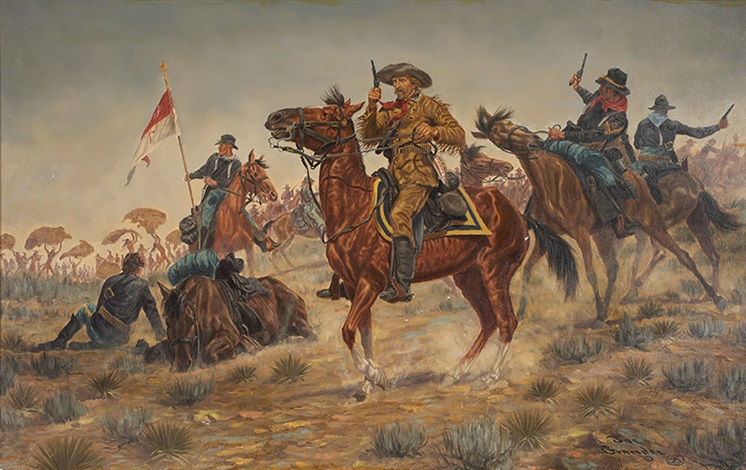
As the troopers were cut down, the native warriors stripped the dead of their firearms and ammunition, with the result that the return fire from the cavalry steadily decreased, while the fire from the Indians constantly increased. The surviving troopers apparently shot their remaining horses to use as breastworks for a final stand on the knoll at the north end of the ridge. The warriors closed in for the final attack and killed every man in Custer’s command. As a result, the Battle of the Little Bighorn has come to be popularly known as “Custer’s Last Stand”.
Death[edit]
It is unlikely any Native American recognized Custer during or after the battle. Michno summarizes: “Shave Elk said ‘We did not suspect that we were fighting Custer and did not recognize him either alive or dead.’ Wooden Leg said no one could recognize any enemy during the fight, for they were too far away. The Cheyennes did not even know a man named Custer was in the fight until weeks later. Antelope said none knew of Custer being at the fight until they later learned of it at the agencies. Thomas Marquis learned from his interviews that no Indian knew Custer was at the Little Bighorn fight until months later. Many Cheyennes were not even aware that other members of the Custer family had been in the fight until 1922, when, Marquis said, he himself first informed them of that fact.”[82]
Nevertheless, several individuals claimed personal responsibility for the killing, including White Bull of the Miniconjous, Rain-in-the-
A contrasting version of Custer’s death is suggested by the testimony of an Oglala named Joseph White Cow Bull, according to novelist and Custer biographer Evan Connell, who relates that Joseph White Bull stated he had shot a rider wearing a buckskin jacket and big hat at the riverside when the soldiers first approached the village from the east. The initial force facing the soldiers, according to this version, was quite small (possibly as few as four warriors) yet challenged Custer’s command. The rider who was hit was mounted next to a rider who bore a flag and had shouted orders that prompted the soldiers to attack, but when the buckskin-clad rider fell off his horse after being shot, many of the attackers reined up. The allegation that the buckskin-clad officer was Custer, if accurate, might explain the supposed rapid disintegration of Custer’s forces.[85] However, several other officers of the Seventh, including William Cooke and Tom Custer, were also dressed in buckskin on the day of the battle, and the fact that each of the non-mutilation wounds to George Custer’s body (a bullet wound below the heart and a shot to the left temple) would have been instantly fatal casts doubt on his being wounded or killed at the ford, more than a mile from where his body was found.[86] The circumstances are, however, consistent with David Humphreys Miller‘s suggestion that Custer’s attendants would not have left his dead body behind to be desecrated.[87]
During the 1920s, two elderly Cheyenne women spoke briefly with oral historians about their having recognized Custer’s body on the battlefield and had stopped a Sioux warrior from desecrating the body. The women were relatives of Mo-nah-se-tah‘s, who was alleged to have been Custer’s one-time lover. In the Cheyenne culture of the time, such a relationship was considered a marriage. The women allegedly told the warrior: “Stop, he is a relative of ours,” and then shooed him away. The two women then shoved their sewing awls into his ears to permit Custer’s corpse to “hear better in the afterlife” because he had broken his promise to Stone Forehead never to fight against Native Americans again.[88]
When the main column under General Terry arrived two days later, the army found most of the soldiers’ corpses stripped, scalped, and mutilated.[89][90] Custer’s body had two bullet holes, one in the left temple and one just below the heart.[91]Capt. Benteen, who inspected the body, stated that in his opinion the fatal injuries had not been the result of .45 caliber ammunition, which implies the bullet holes had been caused by ranged rifle fire.[92] Some time later, Lieutenant Edward S. Godfrey described Custer’s mutilation, telling Charles F. Bates that “an arrow had been forced up his penis.”[93]
The bodies of Custer and his brother Tom were wrapped in canvas and blankets, then buried in a shallow grave, covered by the basket from a travois held in place by rocks. When soldiers returned a year later, the brothers’ grave had been broken into by animals and the bones scattered. “Not more than a double handful of small bones were picked up.”[94]Custer was reinterred with full military honors at West Point Cemetery on October 10, 1877. The battle site was designated a National Cemetery in 1876.
Controversial legacy[edit]

George A. Custer in civilian clothes, ca. 1876
Public relations and media coverage during his lifetime[edit]
Custer has been called a “media personality“,[95][96] and he valued good public relations and used the print media of his era effectively. He frequently invited journalists to accompany his campaigns (one, Associated Press reporter Mark Kellogg, died at the Little Bighorn), and their favorable reporting contributed to his high reputation, which lasted well into the latter 20th century.
Custer enjoyed writing, often writing all night long. He wrote a series of magazine articles of his experiences on the frontier, which were published book form as My Life on the Plains in 1874. The work is still a valued primary source for information on US-Native relations.
Posthumous legacy[edit]
After his death, Custer achieved lasting fame. The public saw him as a tragic military hero and exemplary gentleman who sacrificed his life for his country.
Custer’s wife, Elizabeth, who had accompanied him in many of his frontier expeditions, did much to advance this view with the publication of several books about her late husband: Boots and Saddles, Life with General Custer in Dakota,[97] Tenting on the Plains, or General Custer in Kansas and Texas[98] and Following the Guidon.[99] The deaths of Custer and his troops became the best-known episode in the history of the American Indian Wars, due in part to a painting commissioned by the brewery Anheuser-Busch as part of an advertisingcampaign. The enterprising company ordered reprints of a dramatic work that depicted “Custer’s Last Stand” and had them framed and hung in many United States saloons. This created lasting impressions of the battle and the brewery’s products in the minds of many bar patrons.[100] Henry Wadsworth Longfellow wrote an adoring (and in some places, erroneous) poem.[101] President Theodore Roosevelt‘s lavish praise pleased Custer’s widow.[102]
President Grant, a highly successful general but recent antagonist, criticized Custer’s actions in the battle of the Little Bighorn. Quoted in the New York Herald on September 2, 1876, Grant said, “I regard Custer’s Massacre as a sacrifice of troops, brought on by Custer himself, that was wholly unnecessary – wholly unnecessary.”[103] General Phillip Sheridan likewise took a harsh view of Custer’s final military actions.[citation needed]
General Nelson Miles (who inherited Custer’s mantle of famed Indian fighter) and others praised him as a fallen hero betrayed by the incompetence of subordinate officers. Miles noted the difficulty of winning a fight “with seven-twelfths of the command remaining out of the engagement when within sound of his rifle shots.”[104]
The assessment of Custer’s actions during the American Indian Wars has undergone substantial reconsideration in modern times. Documenting the arc of popular perception in his biography Son of the Morning Star (1984), author Evan Connell notes the reverential tone of Custer’s first biographer Frederick Whittaker (whose book was rushed out the year of Custer’s death.)[105] Connell concludes:
These days it is stylish to denigrate the general, whose stock sells for nothing. Nineteenth-century Americans thought differently. At that time he was a cavalier without fear and beyond reproach.[106]
Criticism and controversy[edit]
When writing about Custer, neutral ground is elusive. What should Custer have done at any of the critical junctures that rapidly presented themselves, each now the subject of endless speculation and rumination? There will always be a variety of opinions based upon what Custer knew, what he did not know, and what he could not have known…
—from Touched by Fire: The Life, Death, and Mythic Afterlife of George Armstrong Custer by Louise Barnett.[103]
The controversy over blame for the disaster at Little Bighorn continues to this day. Major Marcus Reno‘s failure to press his attack on the south end of the Lakota/Cheyenne village and his flight to the timber along the river, after a single casualty, have been cited as a factor in the destruction of Custer’s battalion, as has Captain Frederick Benteen‘s allegedly tardy arrival on the field, and the failure of the two officers’ combined forces to move toward the relief of Custer.[107]Some of Custer’s critics have asserted tactical errors.[citation needed]
- While camped at Powder River, Custer refused the support offered by General Terry on June 21, of an additional four companies of the Second Cavalry. Custer stated that he “could whip any Indian village on the Plains” with his own regiment, and that extra troops would simply be a burden.
- At the same time, he left behind at the steamer Far West, on the Yellowstone, a battery of Gatling guns, knowing he was facing superior numbers. Before leaving the camp all the troops, including the officers, also boxed their sabers and sent them back with the wagons.[108]
- On the day of the battle, Custer divided his 600-man command, despite being faced with vastly superior numbers of Sioux and Cheyenne.
- The refusal of an extra battalion reduced the size of his force by at least a sixth, and rejecting the firepower offered by the Gatling guns played into the events of June 25 to the disadvantage of his regiment.[109]
Custer’s defenders, however, including historian Charles K. Hofling, have asserted that Gatling guns would have been slow and cumbersome as the troops crossed the rough country between the Yellowstone and the Little Bighorn.[110] Custer rated speed in gaining the battlefield as essential and more important. Other Custer supporters[who?] have claimed that splitting the forces was a standard tactic, so as to demoralize the enemy with the appearance of the cavalry in different places all at once, especially when a contingent threatened the line of retreat.
Monuments and memorials[edit]

Custer Memorial at his birthplace in New Rumley, Ohio

Monroe, Michigan, Custer’s childhood home, unveiled the George Armstrong Custer Equestrian Monument in 1910
- Counties are named in Custer’s honor in six states: Colorado, Idaho (which is named for the General Custer Mine, which was named for Custer), Montana, Nebraska, Ok
lahoma, and South Dakota. - Townships in Michigan and Minnesota were named for Custer.
- Other municipalities named after Custer include the villages of Custer, Michigan and Custar, Ohio; the city of Custer, South Dakota; and the unincorporated town of Custer, Wisconsin.
- Custer National Cemetery is within Little Bighorn Battlefield National Monument, the site of Custer’s death.
- The George Armstrong Custer Equestrian Monument of Custer, by Edward Clark Potter, was erected in Monroe, Michigan, Custer’s boyhood home, in 1910.
- Fort Custer National Military Reservation, near Augusta, Michigan, was built in 1917 on 130 parcels of land, as part of the military mobilization for World War I. During the war, some 90,000 troops passed through Camp Custer.
- The establishment of Fort Custer National Cemetery (originally Fort Custer Post Cemetery) took place on September 18, 1943, with the first interment. On Memorial Day 1982, more than 33 years after the first resolution had been introduced in Congress, impressive ceremonies marked the official opening of the cemetery.[111]
- Custer Hill is the main troop billeting area at Fort Riley, Kansas. Custer’s 1866 residence on the post has been preserved and is currently maintained as the Custer House Museum and meeting space (also sometimes referred to as Custer Home).
- The 85th Infantry Division was nicknamed The Custer Division.
- The Black Hills of South Dakota is full of evidence of Custer, with a county, town, and Custer State Park all located in the area.
- A prominent mountain peak in the Black Hills bears his name.[citation needed]
- The Custer house at Fort Abraham Lincoln, near present-day Mandan, North Dakota, has been reconstructed as it was in Custer’s day, along with the soldiers’ barracks, block houses, etc. Annual re-enactments are held of Custer’s 7th Cavalry’s leaving for the Little Bighorn.[112]
- On July 2, 2008, a marble monument to Brigadier General Custer was dedicated at the site of the 1863 Civil War Battle of Hunterstown, in Adams County, Pennsylvania.
- Custer Monument at the United States Military Academy was first unveiled in 1879. It now stands next to his grave in the West Point Cemetery.
Miscellany[edit]
In addition to “Autie” Custer acquired a number of nicknames. During the Civil War, after his promotion to become the youngest Brigadier General in the Army at age 23, the press frequently called him “The Boy General”. During his years on the Great Plains in the American Indian Wars, his troopers often referred to him with grudging admiration as “Iron Butt” and “Hard Ass” for his physical stamina in the saddle and his strict discipline, as well as with the more derisive “Ringlets” for his long, curling blond hair.[113]
Custer was quite fastidious in his grooming. Early in their marriage, Libbie wrote, “He brushes his teeth after every meal. I always laugh at him for it, also for washing his hands so frequently.”[114]
He was 5’11” tall, wore a size 38 jacket and size 9C boots.[115] At various times he weighed between 143 pounds (at the end of the 1869 Kansas campaign)[116] to a muscular 170 pounds. A splendid horseman, “Custer mounted was an inspiration.”.[117] He was quite fit: able to jump to a standing position from lying flat on his back! He was a ‘power sleeper: able to get by on very short naps after falling asleep immediately on lying down.[118] He “had a habit of throwing himself prone on the grass for a few minutes’ rest and resembled a human island, entirely surrounded by crowding, panting dogs.”[119]
Throughout his travels, he gathered geological specimens, sending them to the University of Michigan. On September 10, 1873, he wrote Libbie, “the Indian battles hindered the collecting, while in that immediate region it was unsafe to go far from the command….”[120]
He was well-liked by his native scouts, whose company he enjoyed. He often ate with them. A May 21, 1876 diary entry by Kellogg records, ‘General Custer visits scouts; much at home amongst them.”[121]
Before leaving the steamer Far West for the final leg of the journey, Custer wrote all night. His Orderly, John Burkman stood guard in front of his tent and on the morning of June 22, 1876, found him ‘hunched over on the cot, just his coat and his boots off, and the pen still in his hand.[122]
During his service in Kentucky, Custer bought several thoroughbred horses. He took two on his last campaign, Vic (for Victory) and Dandy. During the march he changed horses every three hours.[123] He rode Vic into his last battle.
Custer took his two staghounds- Tuck and Bleuch- with him during the last expedition. He left them with his orderly, John Burkman, when he rode forward into battle. Burkman joined the packtrain. He regretted not accompanying Custer, but lived until 1925, when he took his own life.[124]
The common media image of Custer’s appearance at the Last Stand- buckskin coat and long, curly blonde hair- is wrong. Although he and several other officers wore buckskin coats on the expedition, they took them off and packed them away because it was so hot. According to Soldier, an Arikara scout, “Custer took off his buckskin coat and tied it behind his saddle.”[125] Further, Custer- whose hair was thinning- joined a similarly balding Lieutenant Varnum and “had the clippers run over their heads” before leaving Fort Lincoln.[126]
Dates of rank[edit]
| Insignia | Rank | Date | Component |
|---|---|---|---|
| None | Cadet | 1 July 1857 | United States Military Academy |
 |
Second Lieutenant | 24 June 1861 | Regular Army |
 |
Captain | 5 June 1862 | Temporary aide de camp |
 |
First Lieutenant | 17 July 1862 | Regular Army |
 |
Brigadier General | 29 June 1863 | Volunteers |
 |
Brevet Major | 3 July 1863 | Regular Army |
|
Captain | 8 May 1864 | Regular Army |
 |
Brevet Lieutenant Colonel | 11 May 1864 | Regular Army |
 |
Brevet Colonel | 19 September 1864 | Regular Army |
|
Brevet Brigadier general | 13 March 1865 | Regular Army |
|
Brevet Major General | 13 March 1865 | Regular Army |
|
Major General | 15 April 1865 | Volunteers (Mustered out on 1 February 1866.) |
|
Lieutenant Colonel | 28 July 1866 | Regular Army |
Categories
Speaker Phone

Why would you spend your hard earned money on a Kahr Arms Desert Eagle in .50 AE or .44 Magnum?
Mostly because they’re fun as hell to shoot. This week in honor of Veterans Day, we had the opportunity to shed light on a worthy cause and spend some time on the range with two Magnum Research Desert Eagles.

The full set of the “13 Hours” Desert Eagles.
You can see my full review of one last year at about this time here. The Desert Eagle we have in house right now provides a much better reason. The proceeds are going to support the Glen Doherty Memorial Foundation, one of the former U.S. Navy SEALs killed in Benghazi.
This is a cause near and dear to my heart, one that I am happy to shed light on. Glen or “Bub” Doherty was one of the four Americans killed in 2012 during the assault on the embassy in Benghazi. John Tig Tiegen, co-author of “13 Hours: The Inside Account of What Really Happened in Benghazi” teamed up with Kahr Arm and Magnum Research to auction 13 custom “13 Hours” Desert Eagles.
This week we got our hands on the fourth one-of-a-kind pistol.

As much as I wish the proceeds were going to fund the prosecution of Hillary, the actual mission of the organization is a winner too.
For more details about the pistol and how to enter the auction to raise money for Doherty’s foundation, click here. Here is a brief overview of their mission statement and focus:

“ OUR MISSION: To ease the transition from military life and work to that of a civilian by helping fund educational costs for Special Operation individuals and their children. We do this knowing Glen’s spirit will continue to touch us all.
OUR FOCUS: Our focus is on providing current and former special operations professionals, from all branches of the government, the means necessary to transition and succeed in civilian life. We are also enabling the children and families of these soldiers the ability to mature and grow through recreation. We employ the following tools to achieve our goals:
-
Scholarships for current or former Special Operation Professionals used for traditional education
-
Scholarships for current or former Special Operations Professionals used for vocational and non-traditional training
-
Subsidies and grants for the children of Special Operations Professionals to attend camps that build leadership
-
Gifts for the families of Special Operations Professionals and Foreign Service Officers, where a loss or life-changing debilitating injury has been suffered, to be used for recreation as a way of supporting the family unit through positive outdoor activities.”

People don’t realize how difficult the transition to normal life can be for Special Operations personnel. Most times, anyone in SOF has been doing that job for a long time. That can make the transition back to normal civilian life difficult. But even more challenging is the gap in care after switching to the VA system. Years ago, I remember helping raise money for a Force Recon Marine that had burns over 90% of his body, and subsequently lost 3 limbs. He needed a specially built house to even be able to live outside of a hospital. The funds had to be raised by private means, it was outside the care prescribed by the government. It’s not always the most helpful system, so it’s important that organizations like Glen’s exist.

Article Continues Below
Range Time with the .44 Magnum & .50 AE
We weren’t allowed to shoot the auction pistol, so I spent time on the range with the Magnum Research Case Hardened Desert Eagle in .44 Magnum and a Magnum Research Desert Eagle Black in .50 AE. Both pistols performed flawlessly and I enjoyed ringing steel out to 40 meters. There’s something about shooting a semiautomatic hand cannon on the range that will leave you laughing and wishing you had brought more ammo.
How was the recoil? It was substantial as you’d expect from a Desert Eagle in .44 Magnum and .50 AE, but Magnum Research has been designing these pistols for a long time and thanks to their dual recoil springs, it helps eat up some of the recoil. There’s also something ingenious about the design — you can swap out the barrel and magazine with Magnum Research’s caliber conversion kits . In a matter of minutes, you can go from a .44 Magnum to a .50 AE.

SPECS
- Type: Gas-operated, rotating lug semiautomatic pistol
- Cartridge: .50 Action Express
- Capacity: 7+1 rds.
- Barrel: 6 in.
- Overall Length: 10.75 inches
- Weight: 4 lbs., 5.8 oz.
- Sights: Fixed, combat style
- Finish: Black
- MSRP: $1,604
- Manufacturer: Magnum Research Inc.
- Type: Gas-operated, rotating lug semiautomatic pistol

- Cartridge: .44 Magnum
- Capacity: 8+1 rds.
- Barrel: 6 in.
- Overall Length: 10.75 in.
- Weight: 4 lbs., 6.6 oz.
- Sights: Fixed combat style
- Finish: Black oxide and various custom finishes
- MSRP: $2,278
- Manufacturer: Magnum Research Inc.
Help Us Raise Support
Here is a chance to do your part and help an incredible cause. The auction is open until November 13th. This custom-finished and engraved Desert Eagle is spectacular. It has a unique Kryptek Typhon Cerakote, and is one of a limited edition of just 13. This pistol is Number Four, and it’s one of many that is raising support for a great cause. The auction on GunsAmerica is part of a larger effort to support veterans spearheaded by Magnum Research, a subsidiary of Kahr Firearms Group and manufacturer of the iconic Desert Eagle, and author John “Tig” Tiegen.

For more information about Magnum Research Desert Eagle pistols, click here.
For more information about Freedom Munitions, click here.
To enter in the auction of the Glen Doherty foundation’s Magnum Research pistol, click here.
Categories
PARKER HALE BOLT ACTION 8X57


This would make a nice gift to any starting out / seasoned Shooter! As the 22 Long Rifle Round has a lot to teach almost any shooter!


Turkey Huh!?!
Grumpy
Like most of us if we’ve done our “homework” and researched our next purchase: be it a Smart TV, a camera, handgun or tires for your truck, we’ll end up eventually selecting an item knowing that it has “almost” all the features and qualities we had on our wish list. It is a pretty good bet that the guys who engineered the new SAR 9 from SAR USA have felt the same way. Being engineers, however, they are in a good position to actually do something about those “wish list” shortcomings. Enter SAR USA and with it the SAR 9.

For those unfamiliar, Sarsilmaz produces thousands of firearms for over 78 nations from its 1-million square foot facility in Turkey. Its the sole provider of the duty pistols to the Turkish army, which is the second largest force in NATO. The SAR 9 has been adopted by Turkish armed forces. With its long-standing tradition of weapon innovation, Sarsilmaz was founded in 1880 in Istanbul, Turkey. SAR USA has begun importing these pistols into the United States and pistol are expected to arrive on dealer shelves this week.
SPECS:
- Type: Striker-fired semiauto pistol
- Cartridge: 9×19 Para
- Capacity: 17+1 rds.
- Trigger: 5 lbs., 8 oz. (tested)
- Weight: 27 oz.
- Barrel Length: 4.4 in.
- Overall Length: 7.5 in.
- Height: 5.5 in.
- Sights: Steel 3-Dot; drift adj. (rear)
- Grips: Configurable with included inserts
- Frame Finish: Polymer
- MSRP: $449
- Manufacturer: Sarsilmaz
Ergonomics
 Now, you or I may not have considered all the following wish list items for a great handgun, but this layout really comes together. It’s a striker-fired pistol with an action described by SAR USA as, “a patented double-action-style trigger that is pounds lighter than traditional double actions.” I am thinking that “traditional double actions” must mean like a CZ75 SA/DA gun, as then the “pounds lighter” would certainly be correct. The SAR9 trigger stroke is about .300 inch long and pulls along at 5 pounds, 8 ounces, all the way to the striker let-off. Yes, I parsed my words there … the trigger pull, if drawn straight through as you would (should) a DA revolver is fully usable. How did I come to this conclusion? I shot a couple of “steel challenge” competitions with it right out of the box and neither the trigger nor the gun held me back from a win at both local clubs. That said, the trigger is, shall we say, gritty.
Next, we have the grip frame. SAR engineers must have had an HK VP9 (or something like it) nearby as the SAR9’s grip is VERY similar in shape and modularity. And that is a good thing. It feels really good in the hands. The magazine well definitely has a leg up on my favorite plastic fantastic Glocks as it is more generous in accepting magazines at speed. In other words, I love this grip frame.

Article Continues Below
As you look through the photos you’ll notice some striking similarities to a very popular polymer gun’s fire controls. The trigger has a safety dongle: check. Trigger bar has a cruciform: check. The trigger has a trigger spring and a “connector” to roll the cruciform off the striker’s leg. Striker and striker spring: check. All very Glockesque. This is not a bad thing, in my mind. Especially if you know your way around “improving” a Glock trigger! Grit-b-gone!
The slide and barrel could be about any other design and that is just fine. If you are wondering about running lead bullets, you are in luck, the barrel sports conventional rifling. If you have concerns about supported chambers, no worries in that regard either. The front sight accepts those that would fit a Glock and the rear looks for all the world to be a Novak (at least in the dovetail size) and both are made of steel. Extraction is handled by a beefy unit that is reminiscent of one on my SIG Sauer 1911 and that works for me. If you need to know if you have one in the chamber, the extractor has a “bump” on it if you are so inclined to use that method of checking readiness. Return to battery is handled by a dual recoil spring assembly that runs on a steel guide rod.
Ok, now we come to the 300-pound Gorilla in the room — what are those funny wing things on each side of the frame? They’re ambidextrous thumb safeties. You may not want or need them, but I can tell you first hand they are not a hindrance in bringing this gun to bear on those pesky steel targets. Other than the off-side lever rubbing against my right hand, I actually like this setup. These safeties truly fall right where they should under the thumb and are neither prone to being bumped on under recoil, nor off when holstered. They are active safeties and it is up to you if you want to activate them and run it like a Glock. However, if you are opposed to them, word on the street is a model of this gun is available sans these units.
Digging a little further into this neat little 9mm you will see a “cassette” or “fire control module” but I wouldn’t call either description 100% correct. The folded steel “carrier” for the locking block, trigger, connector and ejector housing is open on one end so that the preceding parts can be removed for service. Removing this “carrier” is not difficult at all provided you have a 1/16-inch roll pin punch to drive the pin from the “off-side” safety level. After that you have two more push pins at the takedown lever, and a second crosspin lower and in front of that.
As you can see the “carrier” has 4 burly tabs, one at each corner, so the slide will travel “to and fro” with boring repeatability. A solid set-up for sure.
While blasting better than 400 rounds at two steel shooting matches this gun did not miss a beat. When I broke a shot with the sights in close proximity to the intended target, I was consistently rewarded with a satisfying ting. I will add that the point of aim versus point of impact was quite a bit right as the rear sight favors that side of the slide. While the SAR9 did point a little high for me at first, after a couple of presentations it “aimed” where I was aiming.
During my bench testing accuracy phase, I did have two malfunctions. They were not quite a classic stove pipe but I did have two fired cases get trapped between the breech face and the barrel hood. Not sure what the cause was, but it never happened again. Speaking of accuracy, I am hard to please when it comes to accuracy. I want every $400 dollar gun to shoot under 2 inches at 25 yards. Well, the truth is most don’t. That kind of accuracy is generally within the purview of handguns that cost considerably more than the full retail price of this econo-blaster. That said, the SAR9 averaged under 2.25 inches at 25 yards. And it did that using five different kinds of ammo.


Lasting Impressions
Let’s wrap this thing up: yes, it has safeties, and yes, it takes some design cues from several good if not great guns on the market. Neither of those is a bad thing. What isn’t so good is the gritty trigger. Living with that is not a problem for me; I have shot it and shot it pretty well. The trigger may be a short-lived issue for you, if, as I said you have some “glocksmith” skills. It is reliable within the 400-plus rounds I fired sans the two malfunctions. Ergonomics fit me just fine and are adjustable to fit you. It feels great in the hand and is very “smooth shooting.” It is quick to reload “on the clock” so it can play well as a weekend competition gun, or after a few hundred more trouble-free rounds can be counted on to protect. Consider that it is within a quarter of an inch of passing my accuracy snob test and you get all that for an MSRP of $449. Yea, I am going to keep it. And you just might see a long-term test report before too long.
For more information about SAR USA, click here.
For more information about Federal & American Eagle ammunition, click here.
For more information about CCI ammunition, click here.
To purchase a SAR pistol on GunsAmerica, click here.


My kind of a guy!
For those too young to know this:
Augusto Pinochet
| Augusto Pinochet | |
|---|---|
 |
|
| President of Chile | |
| In office 17 December 1974 – 11 March 1990 |
|
| Preceded by | Salvador Allende |
| Succeeded by | Patricio Aylwin |
|
President of the Government Junta of Chile
|
|
| In office 11 September 1973 – 11 March 1982 |
|
| Preceded by | Position established |
| Succeeded by | José Toribio Merino |
| In office 23 August 1973 – 11 March 1998 |
|
| Preceded by | Carlos Prats |
| Succeeded by | Ricardo Izurieta |
| Senator for life of Chile | |
| In office 11 March 1998 – 4 July 2002 |
|
| Constituency | Former president |
| Personal details | |
| Born | Augusto José Ramón Pinochet Ugarte 25 November 1915 Valparaíso, Chile |
| Died | 10 December 2006 (aged 91) Santiago, Chile |
| Cause of death | Heart attack |
| Nationality | Chilean |
| Spouse(s) |
Lucía Hiriart (1943–2006; his death)
|
| Children |
|
| Alma mater | Chilean War Academy |
| Occupation |
|
| Profession | Soldier |
| Signature |  |
| Military service | |
| Allegiance |  Chile |
| Service/branch |  Chilean Army |
| Years of service | 1931–1998 |
| Rank |  Captain General |
| Unit |
|
| Commands |
|
| Battles/wars | 1973 Chilean coup d’état |
Augusto José Ramón Pinochet Ugarte (/ˈpiːnəˌʃeɪ/;[1] Spanish: [auˈɣusto pinoˈ(t)ʃe, -ˈ(t)ʃet];[2][A] 25 November 1915 – 10 December 2006) was a Chilean general, politician and the dictator of Chile between 1973 and 1990; he remained the Commander-in-Chief of the Chilean Army until 1998. He was also president of the Government Junta of Chile between 1973 and 1981.[3][4][5]
Pinochet assumed power in Chile following a United States-backed coup d’état on 11 September 1973 that overthrew the democratically elected socialist Unidad Popular government of President Salvador Allende and ended civilian rule. Several academics – including Peter Winn, Peter Kornbluh, Tim Weiner, and Christopher Hitchens – have stated that the support of the United States was crucial to the coup and the consolidation of power afterward.[6][7][8] Pinochet had been promoted to Commander-in-Chief of the Army by Allende on 23 August 1973, having been its General Chief of Staff since early 1972.[9] In December 1974, the ruling military juntaappointed Pinochet Supreme Head of the nation by joint decree, although without the support of one of the coup’s instigators, Air Force General Gustavo Leigh.[10]
Following his rise to power, Pinochet persecuted leftists and political critics, resulting in the executions of from 1,200 to 3,200 people,[11] the internment of as many as 80,000 people and the torture of tens of thousands.[12][13][14]According to the Chilean government, the amount of executions and forced disappearances was 3,095.[15]
Under the influence of the free market-oriented neoliberal “Chicago Boys“, the military government implemented economic liberalization, including currency stabilization, removed tariff protections for local industry, banned trade unions and privatized social security and hundreds of state-owned enterprises. These policies produced what has been referred to as the “Miracle of Chile” by right-wing libertarian Milton Friedman [16][17] but critics state that economic inequality dramatically increased and attribute the devastating effects of the 1982 monetary crisis on the Chilean economy to these policies.[18][19] Chile was, for most of the 1990s, the best-performing economy in Latin America, though the legacy of Pinochet’s reforms continues to be in dispute.[20]
His fortune grew considerably during his years in power through dozens of bank accounts secretly held abroad and a fortune in real estate. He was later prosecuted for embezzlement, tax fraud and for possible commissions levied on arms deals.[21]
Pinochet’s 17-year rule was given a legal framework through a controversial 1980 plebiscite, which approved a new Constitution drafted by a government-appointed commission. In a 1988 plebiscite 56% voted against Pinochet’s continuing as president, which led to democratic elections for the Presidency and Congress. After stepping down in 1990, Pinochet continued to serve as Commander-in-Chief of the Chilean Army until 10 March 1998, when he retired and became a senator-for-life in accordance with his 1980 Constitution. However, Pinochet was arrested under an international arrest warrant on a visit to London on 10 October 1998 in connection with numerous human rights violations. Following a legal battle he was released on grounds of ill-health, and returned to Chile on 3 March 2000. In 2004, Chilean Judge Juan Guzmán Tapia ruled that Pinochet was medically fit to stand trial and placed him under house arrest.[9] By the time of his death on 10 December 2006, about 300 criminal charges were still pending against him in Chile for numerous human rights violations during his 17-year rule, and tax evasion and embezzlement during and after his rule;[22] he was accused of having corruptly amassed at least 28 million USD.[23] Despite the indictment and 300 charges, he only served time in house arrest.
Contents
[hide]
Early life and military career[edit]
Pinochet was born in Valparaíso, the son of Augusto Pinochet Vera, a descendant of a French Breton immigrant from Lamballe, and Avelina Ugarte Martínez, a woman of Basque descent.[24] Pinochet went to primary and secondary school at the San Rafael Seminary of Valparaíso, the Rafael Ariztía Institute (Marist Brothers) in Quillota, the French Fathers’ School of Valparaíso, and then to the Military School in Santiago, which he entered in 1931. In 1935, after four years studying military geography, he graduated with the rank of alférez (Second Lieutenant) in the infantry. In September 1937, Pinochet was assigned to the “Chacabuco” Regiment, in Concepción. Two years later, in 1939, then with the rank of Sub-lieutenant, he moved to the “Maipo” Regiment, garrisoned in Valparaíso. He returned to Infantry School in 1940. On 30 January 1943, Pinochet married Lucía Hiriart Rodríguez, with whom he had five children: Inés Lucía, María Verónica, Jacqueline Marie, Augusto Osvaldo, and Marco Antonio.
By late 1945 Pinochet had been assigned to the “Carampangue” Regiment in the northern city of Iquique. Three years later, he entered the War Academy but had to postpone his studies because, being the youngest officer, he had to carry out a service mission in the coal zone of Lota. The following year he returned to his studies in the Academy, and after obtaining the title of Officer Chief of Staff, in 1951, he returned to teach at the Military School. At the same time, he worked as a teachers’ aide at the War Academy, giving military geography and geopolitics classes. He was also the editor of the institutional magazine Cien Águilas (“One Hundred Eagles”). At the beginning of 1953, with the rank of major, he was sent for two years to the “Rancagua” Regiment in Arica. While there, he was appointed professor of the Chilean War Academy, and returned to Santiago to take up his new position.[9]
In 1956 Pinochet and a group of young officers were chosen to form a military mission to collaborate in the organization of the War Academy of Ecuador in Quito. He remained with the Quito mission for four-and-a-half years, during which time he studied geopolitics, military geography and military intelligence. At the end of 1959 he returned to Chile and was sent to General Headquarters of the 1st Army Division, based in Antofagasta. The following year, he was appointed commander of the “Esmeralda” Regiment. Due to his success in this position, he was appointed Sub-director of the War Academy in 1963. In 1968, he was named Chief of Staff of the 2nd Army Division, based in Santiago, and at the end of that year, he was promoted to brigadier general and Commander in Chief of the 6th Division, garrisoned in Iquique. In his new function, he was also appointed Intendent of the Tarapacá Province.
In January 1971, Pinochet was promoted to division general and was named General Commander of the Santiago Army Garrison. At the beginning of 1972 he was appointed General Chief of Staff of the Army. With rising domestic strife in Chile, after General Prats resigned his position, Pinochet was appointed commander-in-chief of the Army on 23 August 1973 by President Salvador Allende just the day after the Chamber of Deputies of Chile approved a resolution asserting that the government was not respecting the Constitution. Less than a month later, the Chilean military deposed Allende.
Military coup of 1973[edit]
On 11 September 1973 the combined Chilean Armed Forces (the Army, Navy, Air Force, and Carabineros) overthrew Allende’s government in a coup, during which the presidential palace, La Moneda, was shelled and Allende committed suicide.[25] While the military claimed that he had committed suicide, controversy surrounded Allende’s death, with many claiming that he had been assassinated (theory discarded by the Chilean Supreme Court in 2014).[26]
In his memoirs Pinochet said that he was the leading plotter of the coup and had used his position as commander-in-chief of the Army to coordinate a far-reaching scheme with the other two branches of the military and the national police.[citation needed] In later years, however, high military officials from the time have said that Pinochet reluctantly became involved only a few days before the coup was scheduled to occur, and followed the lead of the other branches (especially the Navy, under Merino) as they executed the coup.[citation needed]
The new government rounded up thousands of people and held them in the national stadium where many were killed. This was followed by brutal repression during Pinochet’s rule, during which about 3,000 people were killed, and more than 1,000 are still missing.[27]
In the months that followed the coup, the junta, with authoring work by historian Gonzalo Vial and admiral Patricio Carvajal, published a book titled El Libro Blanco del cambio de gobierno en Chile (commonly known as El Libro Blanco, “The White Book on the Change of Government in Chile“), where they said that they were in fact anticipating a self-coup (the alleged Plan Zeta, or Plan Z) that Allende’s government or its associates were purportedly preparing. United States intelligence agencies believed the plan to be untrue propaganda.[28] Although later discredited and officially recognized as the product of political propaganda,[29] Gonzalo Vial insists in the similarities between the alleged Plan Z and other existing paramilitary plans of the Popular Unity parties in support of its legitimacy.[30]
Canadian Jean Charpentier of Télévision de Radio-Canada was the first foreign journalist to interview General Pinochet following the coup.[31]
U.S. backing of the coup[edit]

U.S. Secretary of State Henry Kissinger with Pinochet in 1976
The Church Report investigating the fallout of the Watergate scandal stated that while the U.S. tacitly supported the Pinochet government after the 1973 coup, there was “no evidence” that the US was directly involved in the coup.[32] This view has been contradicted by several academics, such as Peter Winn, who writes that the role of the CIA was crucial to the consolidation of power after the coup; the CIA helped fabricate a conspiracy against the Allende government, which Pinochet was then portrayed as preventing. He stated that the coup itself was possible only through a three-year covert operation mounted by the United States. He also points out that the US imposed an “invisible blockade” that was designed to disrupt the economy under Allende, and contributed to the destabilization of the regime.[6] Author Peter Kornbluh argues in his book The Pinochet File[33] that the US was extensively involved and actively “fomented”[33] the 1973 coup. Authors Tim Weiner, in his book, Legacy of Ashes,[34] and Christopher Hitchens, in his book, The Trial of Henry Kissinger [35] similarly argue the case that US covert actions actively destabilized Allende’s government and set the stage for the 1973 coup.
The U.S. provided material support to the military government after the coup, although criticizing it in public. A document released by the U.S. Central Intelligence Agency (CIA) in 2000, titled “CIA Activities in Chile”, revealed that the CIA actively supported the military junta after the overthrow of Allende, and that it made many of Pinochet’s officers into paid contacts of the CIA or U.S. military, even though some were known to be involved in human rights abuses.[36] The CIA also maintained contacts in the Chilean DINA intelligence service. DINA led the multinational campaign known as Operation Condor, which amongst other activities carried out assassinations of prominent politicians in various Latin American countries, in Washington, D.C., and in Europe, and kidnapped, tortured and executed activists holding left-wing views, which culminated in the deaths of roughly 60,000 people.[37][38] The United States provided key organizational, financial and technical assistance to the operation.[39][40][41] CIA contact with DINA head Manuel Contreras was established in 1974 soon after the coup, during the Junta period prior to official transfer of Presidential powers to Pinochet; in 1975, the CIA reviewed a warning that keeping Contreras as an asset might threaten human rights in the region. The CIA chose to keep him as an asset, and at one point even paid him. In addition to the CIA’s maintaining of assets in DINA beginning soon after the coup, several CIA assets, such as CORU Cuban exile militants Orlando Bosch and Guillermo Novo, collaborated in DINA operations under the Condor Plan in the early years of Pinochet’s presidency.
Military junta[edit]
A military junta was established immediately following the coup, made up of General Pinochet representing the Army, Admiral José Toribio Merino representing the Navy, General Gustavo Leigh representing the Air Force, and General César Mendoza representing the Carabineros (national police). As established, the junta exercised both executive and legislative functions of the government, suspended the Constitution and the Congress, imposed strict censorship and curfew, banned all parties and halted all political activities. This military junta held the executive role until 17 December 1974, after which it remained strictly as a legislative body, the executive powers being transferred to Pinochet with the title of President.
Presidency[edit]

Junta session one week after the 1973 coup

Pinochet in 1982
The junta members originally planned that the presidency would be held for a year by the commanders-in-chief of each of the four military branches in turn. However, Pinochet soon consolidated his control, first retaining sole chairmanship of the military junta, and then proclaiming himself “Supreme Chief of the Nation” (de facto provisional president) on 27 June 1974.[42] He officially changed his title to “President” on 17 December 1974. General Leigh, head of the Air Force, became increasingly opposed to Pinochet’s policies and was forced into retirement on 24 July 1978, after contradicting Pinochet on that year’s plebiscite (officially called Consulta Nacional, or National Consultation, in response to a UN resolution condemning Pinochet’s government). He was replaced by General Fernando Matthei.
Pinochet organized a plebiscite on 11 September 1980 to ratify a new constitution, replacing the 1925 Constitution drafted during Arturo Alessandri‘s presidency. The new Constitution, partly drafted by Jaime Guzmán, a close adviser to Pinochet who later founded the right-wing party Independent Democratic Union (UDI), gave a lot of power to the President of the Republic—Pinochet. It created some new institutions, such as the Constitutional Tribunal and the controversial National Security Council (COSENA). It also prescribed an 8-year presidential period, and a single-candidate presidential referendum in 1988, where a candidate nominated by the Junta would be approved or rejected for another 8-year period. The new constitution was approved by a margin of 67.04% to 30.19% according to official figures;[43] the opposition, headed by ex-president Eduardo Frei Montalva (who had supported Pinochet’s coup), denounced extensive irregularities such as the lack of an electoral register, which facilitated multiple voting, and said that the total number of votes reported to have been cast was very much larger than would be expected from the size of the electorate and turnout in previous elections. Interviews after Pinochet’s departure with people involved with the referendum confirmed that fraud had, indeed, been widespread.[44] The Constitution was promulgated on 21 October 1980, taking effect on 11 March 1981. Pinochet was replaced as President of the Junta that day by Admiral Merino.
In a massive operation spearheaded by Chilean Army para-commandos, some 2,000 security forces troops[45] were deployed in the mountains of Neltume from June to November 1981,[46] where they destroyed two MIR bases, seizing large caches of munitions and killing a number of guerrillas.
In a 1985 report, the Inter-American Commission on Human Rights stated that it hoped that “the case now under way will lead to the identification and punishment of the persons responsible for the execution of so culpable an act.”[47] Eventually, six members of the police secret service were given life sentences.
According to a book by Ozren Agnic Krstulovic, weapons including C-4 plastic explosives, RPG-7 and M72 LAW rocket launchers, as well as more than 3,000 M-16 rifles, were smuggled into the country by opponents of the government.[48]
In September weapons from the same source were used in an unsuccessful assassination attempt against Pinochet by the FPMR. His military bodyguard was taken by surprise, and five members were killed. Pinochet’s bulletproof Mercedes Benz vehicle was struck by a rocket, but it failed to explode and Pinochet suffered only minor injuries.[49]
Suppression of opposition[edit]
| “ | He shut down parliament, suffocated political life, banned trade unions, and made Chile his sultanate. His government disappeared 3,000 opponents, arrested 30,000 (torturing thousands of them) … Pinochet’s name will forever be linked to the Desaparecidos, the Caravan of Death, and the institutionalized torture that took place in the Villa Grimaldi complex. | ” |
| — Thor Halvorssen, president of the Human Rights Foundation, National Review[50] | ||
Almost immediately after the military’s seizure of power, the junta banned all the leftist parties that had constituted Allende’s UP coalition.[51] All other parties were placed in “indefinite recess” and were later banned outright. The government’s violence was directed not only against dissidents but also against their families and other civilians.[51]
The Rettig Report concluded 2,279 persons who disappeared during the military government were killed for political reasons or as a result of political violence. According to the later Valech Report approximately 31,947 were tortured and 1,312 exiled. The exiles were chased all over the world by the intelligence agencies. In Latin America, this was made in the frame of Operation Condor, a cooperation plan between the various intelligence agencies of South American countries, assisted by a United States CIA communication base in Panama. Pinochet believed these operations were necessary in order to “save the country from communism”.[52] In 2011 the commission identified an additional 9,800 victims of political repression during Pinochet’s rule, increasing the total number of victims to approximately 40,018, including 3,065 killed.[53]
Some political scientists have ascribed the relative bloodiness of the coup to the stability of the existing democratic system, which required extreme action to overturn. Some of the most infamous cases of human rights violation occurred during the early period: in October 1973, at least 70 people were killed throughout the country by the Caravan of Death. Charles Horman and Frank Teruggi, both US journalists, “disappeared“,[54] as did Víctor Olea Alegría, a member of the Socialist Party, and many others, in 1973. British priest Michael Woodward, who vanished within 10 days of the coup, was tortured and beaten to death aboard the Chilean naval ship, Esmeralda (BE-43).[55][56]

Memorial to victims of Pinochet’s regime
Many other important officials of Allende’s government were tracked down by the DINA in the frame of Operation Condor. General Carlos Prats, Pinochet’s predecessor and army commander under Allende, who had resigned rather than support the moves against Allende’s government, was assassinated in Buenos Aires, Argentina, in 1974. A year later, the murder of 119 opponents abroad was disguised as an internal conflict, the DINA setting up a propaganda campaign to support this idea (Operation Colombo), a campaign publicised by the leading newspaper in Chile, El Mercurio.
Other victims of Condor included, among hundreds of less famous persons, Juan José Torres, the former President of Bolivia, assassinated in Buenos Aires on 2 June 1976; Carmelo Soria, a UN diplomat working for the CEPAL, assassinated in July 1976; Orlando Letelier, a former Chilean ambassador to the United States and minister in Allende’s cabinet, assassinated after his release from internment and exile in Washington, D.C. by a car bomb on 21 September 1976. Documents confirm that Pinochet directly ordered the assassination of Letelier.[57] This led to strained relations with the US and to the extradition of Michael Townley, a US citizen who worked for the DINA and had organized Letelier’s assassination. Other targeted victims, who escaped assassination, included Christian-Democrat Bernardo Leighton, who escaped an assassination attempt in Rome in 1975 by the Italian terrorist Stefano delle Chiaie; Carlos Altamirano, the leader of the Chilean Socialist Party, targeted for murder in 1975 by Pinochet, along with Volodia Teitelboim, member of the Communist Party; Pascal Allende, the nephew of Salvador Allende and president of the MIR, who escaped an assassination attempt in Costa Rica in March 1976; US Congressman Edward Koch, who became aware in 2001 of relations between death threats and his denunciation of Operation Condor, etc. Furthermore, according to current investigations, Eduardo Frei Montalva, the Christian Democrat President of Chile from 1964 to 1970, may have been poisoned in 1982 by toxin produced by DINA biochemist Eugenio Berrios.[58]
Protests continued, however, during the 1980s, leading to several scandals. In March 1985, the murder of three Communist Party members led to the resignation of César Mendoza, head of the Carabineros and member of the juntasince its formation. During a 1986 protest against Pinochet, 21-year-old American photographer Rodrigo Rojas DeNegriand 18-year-old student Carmen Gloria Quintana were burnt alive, with only Carmen surviving.
In August 1989, Marcelo Barrios Andres, a 21-year-old member of the FPMR (the armed wing of the PCC, created in 1983, which had attempted to assassinate Pinochet on 7 September 1986), was assassinated by a group of military personnel who were supposed to arrest him on orders of Valparaíso’s public prosecutor. However, they simply executed him; this case was included in the Rettig Report.[59] Among the killed and disappeared during the military junta were 440 MIR guerrillas.[60] In December 2015, three former DINA agents were sentenced to ten years in prison for the murder of a 29 year old theology student and activist, German Rodriguez Cortes, in 1978.[61] That same month 62 year old Guillermo Reyes Rammsy, a former Chilean soldier during the Pinochet years, was arrested and charged with murder for boasting of participating in 18 executions during a live phone-in to the Chilean radio show “Chacotero Sentimental.”[62]
On June 2, 2017, Chilean judge Hernan Cristoso sentenced 106 former Chilean intelligence officials to between 541 days and 20 years in prison for their role in the kidnapping and murder of 16 left-wing activists in 1974 and 1975.[63]
Economic policy[edit]
| “ | The first country in the world to make that momentous break with the past—away from socialism and extreme state capitalism toward more market-oriented structures and policies—was not Deng Xiaoping’s China or Margaret Thatcher’s Britain in the late 1970s, Ronald Reagan’s United States in 1981, or any other country in Latin America or elsewhere. It was Pinochet’s Chile in 1975. | ” |
| — Robert Packenham & William Ratliff Hoover Institution[64] | ||
In 1973, the Chilean economy was deeply hurt for several reasons, including the expropriation of 600 businesses by the Allende government, a tiered exchange rate that distorted markets, protectionism, and the economic sanctions imposed by the Nixon administration,[65] inflation was 1000%, the country had no foreign reserves, and GDP was falling rapidly.[66] By mid-1975, the government set forth an economic policy of free-market reforms that attempted to stop inflation and collapse. Pinochet declared that he wanted “to make Chile not a nation of proletarians, but a nation of proprietors.”[67] To formulate the economic rescue, the government relied on the so-called Chicago Boys and a text called El ladrillo.
Chile’s nationalized main copper mines remained in government hands, with the 1980 Constitution later declaring them “inalienable”.[68] In 1976, Codelcowas established to exploit them but new mineral deposits were opened to private investment. Capitalist involvement was increased, the Chilean pension system and healthcare and education were privatized.
Wages decreased by 8%.[69] Family allowances in 1989 were 28% of what they had been in 1970 and the budgets for education, health and housing had dropped by over 20% on average[69] The junta relied on the middle class, the oligarchy, foreign corporations, and foreign loans to maintain itself.[70] Businesses recovered most of their lost industrial and agricultural holdings, for the junta returned properties to original owners who had lost them during expropriations, and sold other industries expropriated by Allende’s Popular Unity government to private buyers. This period saw the expansion of business and widespread speculation.
| Economic history of Chile |
|---|
 |
Financial conglomerates became major beneficiaries of the liberalized economy and the flood of foreign bank loans. Large foreign banks reinstated the credit cycle, as the Junta saw that the basic state obligations, such as resuming payment of principal and interest installments, were honored. International lending organizations such as the World Bank, the International Monetary Fund, and the Inter-American Development Bank lent vast sums anew.[69] Many foreign multinational corporations such as International Telephone and Telegraph (ITT), Dow Chemical, and Firestone, all expropriated by Allende, returned to Chile.[69]Pinochet’s policies eventually led to substantial GDP growth, in contrast to the negative growth seen in the early years of his administration. Foreign debt also grew substantially under Pinochet, rising 300% between 1974 and 1988.
His government implemented an economic model that had three main objectives: economic liberalization, privatization of state owned companies, and stabilization of inflation. In 1985, the government started with a second round of privatization, it revised previously introduced tariff increases and gave a greater supervisory role for the Central Bank. Pinochet’s market liberalizations have continued after his death, led by Patricio Aylwin.[20]
Critics argue the neoliberal economic policies of the Pinochet regime resulted in widening inequality and deepening poverty as they negatively impacted the wages, benefits and working conditions of Chile’s working class.[71][72] According to Chilean economist Alejandro Foxley, by the end of Pinochet’s reign around 44% of Chilean families were living below the poverty line.[73] According to The Shock Doctrine by Naomi Klein, by the late 1980s the economy had stabilized and was growing, but around 45% of the population had fallen into poverty while the wealthiest 10% saw their incomes rise by 83%.[74]
1988 referendum and transition to democracy[edit]
According to the transitional provisions of the 1980 Constitution, a referendum was scheduled for 5 October 1988, to vote on a new eight-year presidential term for Pinochet. Confronted with increasing opposition, notably at the international level, Pinochet legalized political parties in 1987 and called for a vote to determine whether or not he would remain in power until 1997. If the “YES” won, Pinochet would have to implement the dispositions of the 1980 Constitution, mainly the call for general elections, while he would himself remain in power as President. If the “NO” won, Pinochet would remain President for another year, and a joint Presidential and Parliamentary election would be scheduled.
Another reason of Pinochet’s decision to call for elections was the April 1987 visit of Pope John Paul II to Chile. According to the US Catholic author George Weigel, he held a meeting with Pinochet during which they discussed a return to democracy. John Paul II allegedly pushed Pinochet to accept a democratic opening of his government, and even called for his resignation.[75]
Political advertising was legalized on 5 September 1987, as a necessary element for the campaign for the “NO” to the referendum, which countered the official campaign, which presaged a return to a Popular Unity government in case of a defeat of Pinochet. The Opposition, gathered into the Concertación de Partidos por el NO (“Coalition of Parties for NO”), organized a colorful and cheerful campaign under the slogan La alegría ya viene (“Joy is coming”). It was formed by the Christian Democracy, the Socialist Party and the Radical Party, gathered in the Alianza Democrática (Democratic Alliance). In 1988, several more parties, including the Humanist Party, the Ecologist Party, the Social Democrats, and several Socialist Party splinter groups added their support.
On 5 October 1988, the “NO” option won with 55.99%[76] of the votes, against 44.01% of “YES” votes. Pinochet accepted the result and the ensuing Constitutional process led to presidential and legislative elections the following year.
The Coalition changed its name to Concertación de Partidos por la Democracia (Coalition of Parties for Democracy) and put forward Patricio Aylwin, a Christian Democrat who had opposed Allende, as presidential candidate, and also proposed a list of candidates for the parliamentary elections. The opposition and the Pinochet government made several negotiations to amend the Constitution and agreed to 54 modifications. These amendments changed the way the Constitution would be modified in the future, added restrictions to state of emergency dispositions, the affirmation of political pluralism, and enhanced constitutional rights as well as the democratic principle and participation to political life. In July 1989, a referendum on the proposed changes took place, supported by all the parties except the right-wing Southern Party and the instrumental Chilean Socialist Party (created by the dictatorship to confuse voters).[77] The Constitutional changes were approved by 91.25% of the voters.
Thereafter, Aylwin won the December 1989 presidential election with 55% of the votes,[76] against less than 30% for the right-wing candidate, Hernán Büchi, who had been Pinochet’s Minister of Finances since 1985 (there was also a third-party candidate, Francisco Javier Errázuriz, a wealthy aristocrat representing the extreme economic right, who garnered the remaining 15%[76]). Pinochet thus left the presidency on 11 March 1990 and transferred power to the new democratically elected president.
The Concertación also won the majority of votes for the Parliament. However, due to the “binomial” representation system included in the constitution, the elected senators did not achieve a complete majority in Parliament, a situation that would last for over 15 years. This forced them to negotiate all law projects with the Alliance for Chile (originally called “Democracy and Progress” and then “Union for Chile”), a center-right coalition involving the Unión Demócrata Independiente (UDI) and Renovación Nacional (RN), parties composed mainly of Pinochet’s supporters.
Due to the transitional provisions of the constitution, Pinochet remained as Commander-in-Chief of the Army until March 1998. He was then sworn in as a senator-for-life, a privilege granted by the 1980 constitution to former presidents with at least six years in office. His senatorship and consequent immunity from prosecution protected him from legal action. These were possible in Chile only after Pinochet was arrested in 1998 in the United Kingdom, on an extradition request issued by Spanish judge Baltasar Garzón, allegations of abuses had been made numerous times before his arrest, but never acted upon.[78] The extradition attempt was dramatised in the 2006 BBC television docudrama Pinochet in Suburbia, with Pinochet played by Derek Jacobi. Shortly before giving the power, Pinochet prohibited all forms of abortion, previously authorized in case of rape or risk to the life of the mother.[79]
Relationship with the United Kingdom[edit]
Chile was officially neutral during the Falklands War, but Chile’s Westinghouse long range radar that was deployed in the south of the country gave the British task force early warning of Argentinian air attacks. This allowed British ships and troops in the war zone to take defensive action.[80] Margaret Thatcher, the British prime minister at the time of the war, said that the day the radar was taken out of service for overdue maintenance was the day Argentinian fighter-bombers bombed the troopships Sir Galahad and Sir Tristram, leaving 53 dead and many injured. According to Chilean Junta member and former Air Force commander, General Fernando Matthei, Chilean support included military intelligence gathering, radar surveillance, allowing British aircraft to operate with Chilean colours, and facilitating the safe return of British special forces, among other forms of assistance.[81]
In April and May 1982, a squadron of mothballed British Hawker Hunter fighter-bombers departed for Chile, arriving on 22 May and allowing the Chilean Air Force to reform the No. 9 “Las Panteras Negras” Squadron. A further consignment of three frontier surveillance and shipping reconnaissance Canberras left for Chile in October. Some authors have speculated that Argentina might have won the war had the military felt able to employ the elite VIth and VIIIth Mountain Brigades, which remained sitting in the Andes guarding against possible Chilean incursions.[82] Pinochet subsequently visited the UK on more than one occasion.[83] Pinochet’s controversial relationship with Thatcher led Labour Prime Minister Tony Blair to mock Thatcher’s Conservatives as “the party of Pinochet” in 1999.[84]
Ideology and public image[edit]
Pinochet himself expressed his project in government as a national rebirth inspired in Diego Portales, a figure of the early republic:[85]
| “ | …[democracy] will be born again purified from the vices and bad habits that ended up destroying our institutions… …we are inspired in the Portalian spirit which has fused together the nation… | ” |
| — Augusto Pinochet, 11 October 1973. | ||
The lawyer Jaime Guzmán participated in the design of important speeches of Pinochet, and provided frequent political and doctrinal advice and consultancy.[86]
Jacobo Timerman has called the Chilean army under Pinochet “the last Prussian army in the world”,[87] suggesting a pre-Fascist origin to the model of Pinochet’s military government.
Historian Alfredo Jocelyn-Holt has referred to Pinochet’s figure as “totemic” and added that it is a scapegoat that attracts “all hate”.[88] Gabriel Salazar, also a historian, has lamented the lack of an international condemnation of Pinochet in court, since, according to Salazar, that would have damaged his image “irreparably” and that of the judicial system of Chile[for the good] too.[88]
According to Pinochet, who was aware of his ancestry, he was taught the French language by an uncle. He would then have forgotten most of it. Pinochet admired Napoleon as the greatest among French and had a framed picture of him. Another French ruler he admired was Louis XIV.[89][B]
Accusations of fascism[edit]

Image showing Pinochet in an event with background imagery comparing the year of Chilean independence, 1810, with 1973, the year of the coup d’état that brought Pinochet to power.
Pinochet and his government have been characterised as fascist.[91] For example, journalist and author Samuel Chavkin,[92] in his book Storm Over Chile: The Junta Under Siege, repeatedly characterizes both Pinochet himself and the military dictatorship as fascist.[93]
However, he and his government are generally excluded from academic typologies of fascism.[94][95][96][97] Roger Griffin included Pinochet in a group of pseudo-populist despots distinct from fascism and including the likes of Saddam Hussein, Suharto, and Ferdinand Marcos. He argues that such regimes may be considered populist ultra-nationalism but lack the rhetoric of national rebirth, or palingenesis, necessary to make them conform to the model of palingenetic ultranationalism.[94] Robert Paxton meanwhile compared Pinochet’s regime to that of Mobutu Sese Seko in the former Zaire (now Democratic Republic of the Congo), arguing that both were merely client states that lacked popular acclaim and the ability to expand. He further argued that had Pinochet attempted to build true fascism, the regime would likely have been toppled or at least been forced to alter its relationship to the United States.[95] Anna Cento Bull also excluded Pinochet from fascism, although she has argued that his regime belongs to a strand of Cold War anti-communism that was happy to accommodate neo-fascist elements within its activity.[96]
World Fascism: a Historical Encyclopedia notes that “Although he was authoritarian and ruled dictatorially, Pinochet’s support of neoliberal economic policies and his unwillingness to support national businesses distinguished him from classical fascists.”[98]
Historian Gabriel Salazar stated that Pinochet’s establishment cult of personality around him was a fascist tactic:
| “ | It is notable that in all the declarations of Pinochet’s men, nobody has mentioned the creators of the new Chilean society and state, I haven’t heard anybody mention Jaime Guzmán, Carlos Cáceres, Hernán Büchi, Sergio de Castro. There is no mention of the true brains, or that the whole of the armed forces were involved in this, in dirty and symbolic tasks. Everything is embodied in Pinochet, it’s very curious that figures of the stature of Büchi are immolated before the figure of Pinochet, in what is to me a fascist rite, give everything to the Führer, “I did it, but ultimately it was him”.[88] | ” |
Intellectual life and academic work[edit]
Pinochet was publicly known as a man with a lack of culture. This image was reinforced by the fact that he also portrayed himself as a common man with simple ideas. He was also known for being reserved, sharing little about his opinions or feelings.[99] Before wresting power from Allende, Pinochet had written two books, Geopolítica (1968) and Campaña de Tarapacá (1972), which established him as a major figure in Chile’s military literature.[99] In Geopolítica Pinochet plagiarized his mentor general Gregorio Rodríguez Tascón by using paragraphs from a 1949 conference presentation of Rodríguez without attributing them to him.[100][101] Rodríguez had previously lectured Pinochet and René Schneider and Carlos Prats in geography and geopolitics. In contrast to the two latter Pinochet was not an outstanding student but his persistence and interest in geopolitics made Rodríguez assume the role as his academic mentor.[101] Rodríguez granted Pinochet a slot as assistant lecturer in geopolitics and in geography. According to Rodríguez Pinochet would have been particularly impressed by his lectures on The Art of War.[101] Pinochet would later succeed Rodríguez in the geopolitics and geography chair.[101]
Investigative journalist Juan Cristóbal Peña has put forward the thesis that Pinochet felt intellectual envy of Carlos Pratsand that the latter’s assassination in 1974 was a relief for Pinochet.[100]
During his lifetime, Pinochet amassed more than 55,000 books in his private library, worth an estimated 2,840,000 US dollars (2006–07). The extent of his library was only known to the public after a police inspection in January 2006.[99]Pinochet bought books at several small bookshops in the old centre of Santiago and was later supplied with books from abroad by military attachés who bought texts Pinochet was searching after.[102][103] As ruler of Chile he used discretionary funds for these purchases.[103] The library included many rare books including a first edition (1646) Historica relacion del Reyno de Chile and an original letter of Bernardo O’Higgins. A significant part of the books and documents of the library of José Manuel Balmaceda was found in Pinochet’s library in 2006.[99] Pinochet’s library contained almost no poetry or fiction works.[103]
Nicknames[edit]
Supporters sometimes refer to Pinochet as mi general (the military salutation for a general) while opponents call him pinocho (Spanish for “Pinocchio“, from the children’s story).[104] A common nickname used by both younger generations is el tata (Chilean Spanish equivalent of “the grandpa”). Since the Riggs Bank scandal he has been referred to sarcastically as Daniel Lopez, one of the fake identities he used to deposit money in the bank.[105]
Post-dictatorship life[edit]

Pinochet in 1995.
Arrest and court cases in Britain[edit]
The case was a watershed event in judicial history, as it was the first time that a former government head was arrested on the principle of universal jurisdiction.[106]
After having been placed under house arrest in Britain in October 1998 and initiating a judicial and public relations battle, the latter run by Thatcherite political operative Patrick Robertson,[107] he was eventually released in March 2000 on medical grounds by the Home Secretary Jack Straw without facing trial. Straw had overruled a House of Lords decision to extradite Pinochet to face trial in Spain.[108]
Return to Chile[edit]
Pinochet returned to Chile on 3 March 2000. His first act when landing in Santiago’s airport was to triumphantly get up from his wheelchair to the acclaim of his supporters.[109][110][111] He was first greeted by his successor as head of the Chilean armed forces, General Ricardo Izurieta.[109] President-elect Ricardo Lagos said the retired general’s televised arrival had damaged the image of Chile, while thousands demonstrated against him.[112]
In March 2000 Congress approved a constitutional amendment creating the status of “ex-president,” which granted its holder immunity from prosecution and a financial allowance; this replaced Pinochet’s senatorship-for-life. 111 legislators voted for, and 29 against.[113]
The Supreme Court ruled in favor of judge Juan Guzmán’s request on August 2000, and Pinochet was indicted on 1 December 2000 for the kidnapping of 75 opponents in the Caravan of Death case.[114] Guzmán advanced the charge of kidnapping as the 75 were officially “disappeared“: even though they were all most likely dead, the absence of their corpses made any charge of “homicide” difficult.
However, in July 2002, the Supreme Court dismissed Pinochet’s indictment in the various human rights abuse cases, for medical reasons (vascular dementia). The debate concerned Pinochet’s mental faculties, his legal team claiming that he was senile and could not remember, while others (including several physicians) claimed that he was only affected physically but retained all control of his faculties. The same year, the prosecuting attorney Hugo Guttierez, in charge of the Caravan of Death case, declared, “Our country has the degree of justice that the political transition permits us to have.”[115]
Pinochet resigned from his senatorial seat shortly after the Supreme Court’s July 2002 ruling. In May 2004, the Supreme Court overturned its precedent decision, and ruled that he was capable of standing trial. In arguing their case, the prosecution presented a recent TV interview Pinochet had given for a Miami-based television network, which raised doubts about his alleged mental incapacity. In December 2004 he was charged with several crimes, including the 1974 assassination of General Prats and the Operation Colombo case in which 119 died, and was again placed under house arrest. He suffered a stroke on 18 December 2004.[116] Questioned by his judges in order to know if, as President, he was the direct head of DINA, he answered: “I don’t remember, but it’s not true. And if it were true, I don’t remember.”[117]
In January 2005 the Chilean Army accepted institutional responsibility for past human rights abuses.[118] In 2006 Pinochet was indicted for kidnappings and torture at the Villa Grimaldi detention center by judge Alejandro Madrid (Guzmán’s successor),[119] as well as for the 1995 assassination of the DINA biochemist Eugenio Berrios, himself involved in the Letelier case.[120] Berrios, who had worked with Michael Townley, had produced sarin gas, anthrax and botulism in the Bacteriological War Army Laboratory for Pinochet; these materials were used against political opponents. The DINA biochemist was also alleged to have created black cocaine, which Pinochet then sold in Europe and the United States.[121]The money for the drug trade was allegedly deposited into Pinochet’s bank accounts.[122] Pinochet’s son Marco Antonio, who had been accused of participating in the drug trade, in 2006 denied claims of drug trafficking in his father’s administration and said that he would sue Manuel Contreras, who had said that Pinochet sold cocaine.[123]
On 25 November 2006 Pinochet marked his 91st birthday by having his wife read a statement he had written to admirers present for his birthday: “I assume the political responsibility for all that has been done.”[124] Two days later, he was again sentenced to house arrest for the kidnapping and murder of two bodyguards of Salvador Allende who were arrested the day of the 1973 coup and executed by firing squad during the Caravan of Death.[125][126]
However, Pinochet died a few days later, on 10 December 2006, without having been convicted of any of the crimes of which he was accused.
Scandals: secret bank accounts, tax evasion, and arms deal[edit]

Documentation of some of Pinochet’s many United States bank accounts.
In 2004, a United States Senate money laundering investigation led by Senators Carl Levin (D-MI) and Norm Coleman (R-MN)—ordered in the wake of the 11 September 2001 attacks—uncovered a network of over 125 securities and bank accounts at Riggs Bank and other U.S. financial institutions used by Pinochet and his associates for twenty-five years to secretly move millions of dollars.[127] Though the subcommittee was charged only with investigating compliance of financial institutions under the USA PATRIOT Act, and not the Pinochet regime, Senator Coleman noted:
This is a sad, sordid tale of money laundering involving Pinochet accounts at multiple financial institutions using alias names, offshore accounts, and close associates. As a former General and President of Chile, Pinochet was a well-known human rights violator and violent dictator.[127]
Over several months in 2005, Chilean judge Sergio Muñoz indicted Augusto Pinochet’s wife, Lucia Hiriart; four of his children – Marco Antonio, Jacqueline, Veronica and Lucia Pinochet; his personal secretary, Monica Ananias; and his former aide Oscar Aitken on tax evasion and falsification charges stemming from the Riggs Bank investigation. In January 2006, daughter Lucia Pinochet was detained at Washington DC-Dulles airport and subsequently deported while attempting to evade the tax charges in Chile.[128] In January 2007, the Santiago Court of Appeals revoked most of the indictment from Judge Carlos Cerda against the Pinochet family.[129] But Pinochet’s five children, his wife and 17 other persons (including two generals, one of his former lawyer and former secretary) were arrested in October 2007 on charges of embezzlementand use of false passports. They are accused of having illegally transferred $27m (£13.2m) to foreign bank accounts during Pinochet’s rule.[130][131]
In September 2005, a joint investigation by The Guardian and La Tercera revealed that the British arms firm BAE Systemshad been identified as paying more than £1m to Pinochet, through a front company in the British Virgin Islands, which BAE has used to channel commission on arms deals.[132] The payments began in 1997 and lasted until 2004.[132][133]
Furthermore, in 2007, fifteen years of investigation led to the conclusion that the 1992 assassination of DINA Colonel Gerardo Huber was most probably related to various illegal arms traffic carried out, after Pinochet’s resignation from power, by military circles very close to himself.[134] Huber had been assassinated a short time before he was due to testifyin the case concerning the 1991 illegal export of weapons to Croatian army. The deal involved 370 tons of weapons, sold to Croatia by Chile on 7 December 1991, when the former country was under a United Nations‘ embargo because of the support for Croatia war in Yugoslavia.[135] In January 1992, the judge Hernán Correa de la Cerda wanted to hear Gerardo Huber in this case, but the latter may have been silenced to avoid implicating Pinochet in this new case[134][136][137]—although the latter was not anymore President, he remained at the time Commander-in-Chief of the Army. Pinochet was at the center of this illegal arms trade, receiving money through various offshores and front companies, including the Banco Coutts International in Miami.[138]
Pinochet was stripped of his parliamentary immunity in August 2000 by the Supreme Court, and indicted by judge Juan Guzmán Tapia. Guzmán had ordered in 1999 the arrest of five militarists, including General Pedro Espinoza Bravo of the DINA, for their role in the Caravan of Death following the coup on 11 September. Arguing that the bodies of the “disappeared” were still missing, he made jurisprudence, which had as effect to lift any prescription on the crimes committed by the military. Pinochet’s trial continued until his death on 10 December 2006, with an alternation of indictments for specific cases, lifting of immunities by the Supreme Court or to the contrary immunity from prosecution, with his health a main argument for, or against, his prosecution.
The Supreme Court affirmed, in March 2005, Pinochet’s immunity concerning the 1974 assassination of General Carlos Prats in Buenos Aires, which had taken place in the frame of Operation Condor. However, he was deemed fit to stand trial for Operation Colombo, during which 119 political opponents were “disappeared” in Argentina. The Chilean justice also lifted his immunity on the Villa Grimaldi case, a detention and torture center in the outskirts of Santiago. Pinochet, who still benefited from a reputation of righteousness from his supporters, lost legitimacy when he was put under house arrest on tax fraud and passport forgery, following the publication by the US Senate Permanent Subcommittee on Investigations of a report concerning the Riggs Bank in July 2004. The report was a consequence of investigations on financial funding of the 11 September 2001 attacks in the US. The bank controlled between US$4 million and $8 million of Pinochet’s assets, who lived in Santiago in a modest house, dissimulating his wealth. According to the report, Riggs participated in money laundering for Pinochet, setting up offshore shell corporations (referring to Pinochet as only “a former public official”), and hiding his accounts from regulatory agencies. Related to Pinochet’s and his family secret bank accounts in United States and in Caribbean islands, this tax fraud filing for an amount of 27 million dollars shocked the conservative sectors who still supported him. Ninety percent of these funds would have been raised between 1990 and 1998, when Pinochet was chief of the Chilean armies, and would essentially have come from weapons traffic (when purchasing French ‘Mirage’ air-fighters in 1994, Dutch ‘Léopard’ tanks, Swiss ‘Mowag’ tanks or by illegal sales of weapons to Croatia, during the Balkans war.) His wife, Lucía Hiriart, and his son, Marco Antonio Pinochet, were also sued for complicity. For the fourth time in seven years, Pinochet was indicted by the Chilean justice.[139]
Death[edit]

Augusto Pinochet on the bier on 11 December 2006

Pinochet’s funeral
Pinochet suffered a heart attack on the morning of 3 December 2006, and subsequently the same day he was given the last rites. On 4 December 2006, the Chilean Court of Appeals ordered the suspension of his house arrest. On 10 December 2006 at 13:30 local time (16:30 UTC) he was taken to the intensive care unit.[140] He died of congestive heart failure and pulmonary edema,[141] surrounded by family members, at the Military Hospital at 14:15 local time (17:15 UTC).[142]
Massive spontaneous street demonstrations broke out throughout the country upon the news of his death. In Santiago, opponents celebrated his death in Alameda Avenue, while supporters grieved outside the Military Hospital. Pinochet’s remains lay in repose on 11 December 2006 at the Military Academy in Las Condes. During this ceremony, Francisco Cuadrado Prats—the grandson of Carlos Prats (a former Commander-in-Chief of the Army in the Allende government who was murdered by Pinochet’s secret police)—spat on the coffin, and was quickly surrounded by supporters of Pinochet, who kicked and insulted him. Pinochet’s funeral took place the following day at the same venue before a gathering of 60,000 supporters.[143]
In a government decision, he was not granted a state funeral (an honor normally bestowed upon past presidents of Chile) but a military funeral as former commander-in-chief of the Army appointed by Allende. The government also refused to declare an official national day of mourning, but it did authorize flags at military barracks to be flown at half staff, and for the Chilean flag to be draped on Pinochet’s coffin. Socialist President Michelle Bachelet, whose father Alberto was temporarily imprisoned and tortured after the 1973 coup and died shortly afterwards from heart complications, said that it would be “a violation of [her] conscience” to attend a state funeral for Pinochet.[144] The only government authority present at the public funeral was the Defense Minister, Vivianne Blanlot.
In Spain, supporters of late dictator Francisco Franco paid homage to Pinochet. Antonio Tejero, who led the failed coup of 1981, attended a memorial service in Madrid.[145] Pinochet’s body was cremated in Parque del Mar Cemetery, Concón on 12 December 2006, on his request to “avoid vandalism of his tomb,” according to his son Marco Antonio.[146][C] His ashes were delivered to his family later that day, and are deposited in Los Boldos, Santo Domingo, Valparaiso, Chile; one of his personal residences. The armed forces refused to allow his ashes to be deposited on military property.[147]
Human rights violations[edit]
Pinochet’s regime was responsible for various human rights abuses during its reign, including murder and torture of political opponents. According to a government commission report that included testimony from more than 30,000 people, Pinochet’s government killed at least 3,197 people and tortured about 29,000. Two-thirds of the cases listed in the report happened in 1973.[148]
Professor Clive Foss, in The Tyrants: 2500 Years of Absolute Power and Corruption (Quercus Publishing 2006), estimates that 1,500–2,000 Chileans were killed or “disappeared” during the Pinochet regime. In October 1979, the New York Timesreported that Amnesty International had documented the disappearance of approximately 1,500 Chileans since 1973.[149]Among the killed and disappeared during the military regime were at least 663 Marxist MIR guerrillas.[150] The Manuel Rodríguez Patriotic Front, however, has stated that only 49 FPMR guerrillas were killed but hundreds detained and tortured.[151] According to a study in Latin American Perspectives,[152] at least 200,000 Chileans (about 2% of Chile’s 1973 population) were forced to go into exile. Additionally, hundreds of thousands left the country in the wake of the economic crises that followed the military coup during the 1970s and 1980s.[152] Some of the key individuals who fled because of political persecution were followed in their exile by the DINA secret police, in the framework of Operation Condor, which linked South American military dictatorships together against political opponents.
According to Peter Kornbluh in The Pinochet File, “routine sadism was taken to extremes” in the prison camps. The rape of women was common, including sexual torture such as the insertion of rats into genitals and “unnatural acts involving dogs.” Detainees were forcibly immersed in vats of urine and excrement. Beatings with gun butts, fists and chains were routine; one technique known as “the telephone” involved the torturer slamming “his open hands hard and rhythmically against the ears of the victim,” leaving the person deaf. At Villa Grimaldi, prisoners were dragged into the parking lot and had the bones in their legs crushed as they were run over with trucks. Some died from torture; prisoners were beaten with chains and left to die from internal injuries.[153] Following abuse and execution, corpses were interred in secret graves, dropped into rivers or the ocean, or just dumped on urban streets in the night. The body of the renowned Chilean singer, theatre director and academic Víctor Jara was found in a dirty canal “with his hands and face extremely disfigured” and with “forty-four bullet holes.”[154]
The practice of murdering political opponents via “death flights“, employed by the juntas of Argentina and Chile, has been the subject of numerous alt-right internet memes, with the suggestion that progressive political enemies be given “free helicopter rides.”[155]
Notes[edit]
- Jump up^ Evidence suggests Chileans, possibly including Pinochet, pronounced his name both ways. Recordings with the first and most common pronunciation can be found here: “Augusto Pinochet”. Forvo. 27 August 2014. Retrieved 27 August 2014..
- Jump up^ When the admiration of Louis XIV surfaced in a 1986 interview it sparkled APSI to publish a graphic satire made by Guillowhich showed Pinochet dressed as Louis XIV on its front page. The magazine was subsequently censored out of the newsagent’s shop and its staff imprisoned.[90]
- Jump up^ See also: corpse of Pedro Eugenio Aramburu, corpse of Evita and Hands of Perón.