Categories
How NOT To Point a Gun!


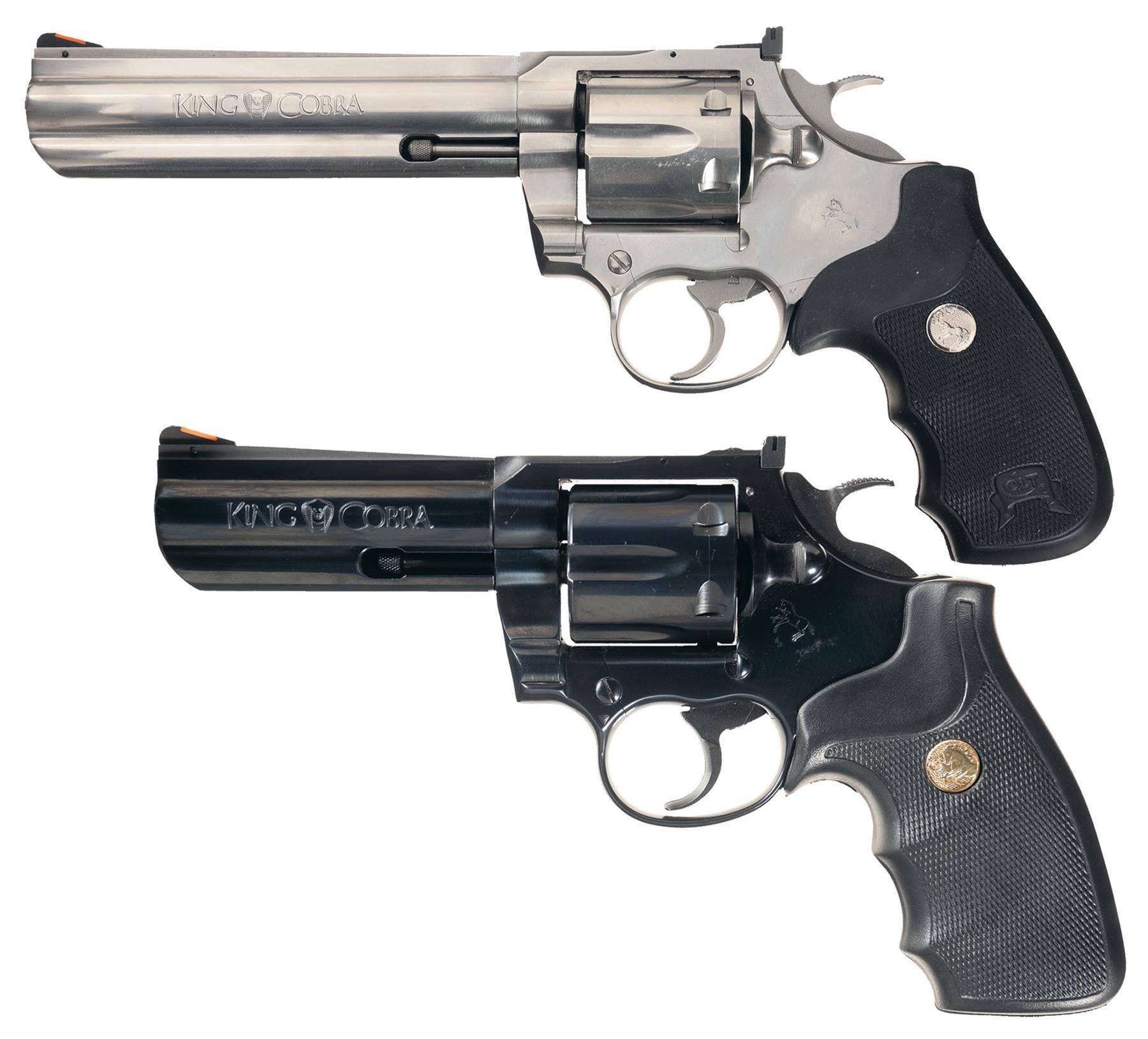


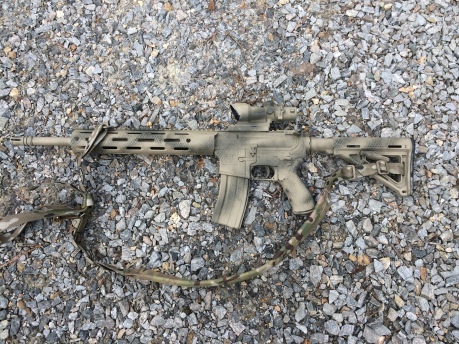
The Practical Combat Carbine- Simple, Light, Effective.
There’s a lot of confusion even among longtime shooters between what a rifle is capable of doing off the bench on a nice controlled square range and what’s actually practical for a serviceable combat weapon. The two really aren’t the same. While tight groups are definitely a plus and a goal to be attained, having a precision weapon in the general purpose role is not always completely necessary to make one combat effective. There’s a happy medium to be found, and getting there is not always hard or expensive. Above all else, it’s the fundamentals of the shooter that make a weapon deadly, no matter what.
One of the really neat things about the past couple decades, firearms-wise, is the real renaissance we’ve seen in weapons development and maximization of potential. Most visibly is this phenomena with the proliferation of the AR-15 platform, but really among all classes of weapons. One can pick up even a lower-tier carbine and have a decent action capable of making solid hits at further distances than many shoot on average. That is, if the shooter is capable. Some of this has to do with the plethora of modern ammo choices out there, some with the advent and precision of CNC machines, and some with the proliferation of free-floated handguards. While the Colt M4A1 series has a mil-spec tolerance of 4 MOA, or a ~4 inch group at 100 meters, and usually easily exceeding this your common off the shelf AR-15 can expect much better than that on average. It begins, however, with the skill of the man behind the trigger.
The same can be said for the huge boom in the Long Range hobby. Lots of people are getting into it and it can be a ton of fun putting steel on target from 500m or more. The ability to squeeze every last fraction of capability is definitely nice. And usually the underlying goal, whether plinking, running 3 gun or Long Range type stuff, is ultimately protection of hearth and home. But the question that comes to my mind is do you really need all of that to make an effective rifleman? The answer is largely determined by the rifleman’s purpose. For a combat weapon, even a designated marksman’s role, it doesn’t necessarily have to be a .5 MOA rifle or even one that really impresses at the range. Gasping for air, I know. Practical accuracy is a different animal from mechanical accuracy. But let’s look at some reasons why.
1. What is the median distance you plan to engage?
For my operating environment, I live in mostly dense forest with rolling hills. The long distance stretches are either pastures, power lines, or highways. From a light fighter’s standpoint, these three amount to the cardinal rule of never walking in the open or crossing a linear danger area with no overwatch. Overwatch, by the way, is not some fancy buzzword to sell you junk but actually is someone on your team hidden watching for muzzle flashes in case you get shot…while you’re crossing in the open or across linear danger areas. They watch over you. That said, my average engagement distance here is under 100m. Are you accurate enough to be lethal within 100m? How about 200m? How about 300m? Do you really need to shoot further than that? Maybe, maybe not. What are the intermediate barriers, i.e. potential cover (rocks, deadfall, etc) between you and where an adversary may fire from? Are you capable of shooting over those same open areas that they may cross?
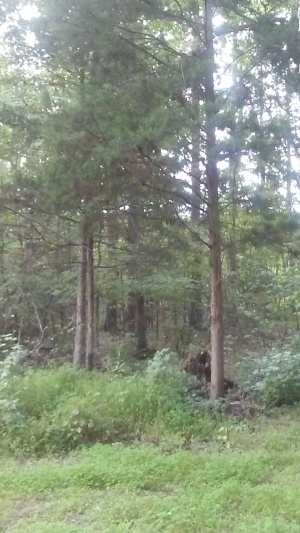
Average backwoods of NC.
A good way to put this into context is to think of the average shot a deer hunter will make in a given area. Around here, between thick Carolina conifer and hardwood stands, shotguns do just fine for 99% of putting meat in the freezer. Rifles are nice for shooting across cutovers or fire breaks- those open areas requiring a little more range I just warned you about. And how accurate is that Remington 770 or 742 with meat ammo versus a heavyweight barreled Remington 700 5R and precision handloads? Mechanically it wouldn’t make much difference in the woods over relatively short distances. But the weight sure as heck will, regardless of whether you’re a twenty something stud out shootin’ n’ lootin’ or a mid 50s patriarch looking to protect his home. Doesn’t mean that any of these are my personal choice for anything other than hunting game, but the concept is basically the same. Which bring my next point.
2. What is your Weight Threshold?
I knew a guy a while back who had a uber-high end semi-auto AR-10, decked out to the nines, with every cool guy gimmick you can imagine and a giant NightForce 56mm celestial telescope on top. Beautiful rifle, crisp glass. Weighed 18lbs empty and carried like a 4×4 post in the hands. And there’s nothing wrong with that, if you want a high end benchrest-type gun. But that’s a ridiculous and unnecessary amount of weight for a general purpose weapon. For him, making tiny groups at a given distance was a lot of fun. But when it came time to carry it, you’d see him ditch that for his handy WASR-10 that weighs half as much loaded and accomplishes the same task within 100m.
The point is that what feels heavy but tolerable in your hands at the gunstore becomes a boat anchor after carrying it over distances with supporting equipment. Common knowledge usually dictates weight equates superior accuracy, but too much becomes self-defeating. That lightweight AR-15 with a pencil barrel can get heavy too. After a four day cave clearing mission in Afghanistan my M4 felt like a cinderblock. And aside from a PEQ-15, it wasn’t too far removed from the AR-type carbine pictured above. Granted, I was carrying a lot of other equipment including a SMAW-D and several days worth of 5590 batteries (which is like toting around bricks), but the point is that a carbine I intend to fight with needs to remain lightweight to keep me unencumbered. Because you have to keep in mind its purpose- it’s a carbine, after all. On that note, there’s a reason the broad shouldered bubbas get picked to hump the M-240B; it’s big and heavy, and the small guys can’t handle and effectively employ it over long distances. Even the meat eaters get tired though, and shaving a few ounces here and there makes a world of difference when you’re gassed.
3. Remaining Combat Effective- Remember BRAS
The reality of fighting in armed groups is that it is nothing like sitting at a range plinking targets. That’s nice for basic rifle marksmanship, and it’s really important to work on fundamentals. It’s purpose is to confirm zero & dope (Data Of Previous Engagement- a record of ballistic data for that weapon and specific ammo load) and make sure you can hit a target at a given specific distance, hence why most square ranges are referred to as Known-Distance or KD ranges. Square range time is critical, and should be at least a monthly training event for you and your group. But understand it is not the end-all-be-all; its just a foundation for Basic Rifle Marksmanship consisting of BRAS- Breathe, Relax, Aim, Squeeze. For creating and maintaining proficiency this is the proper cadence for trigger control. It’s easy to get right when relaxed and very easy to get wrong any other time. Only training on a 100m square range is a dangerously false sense of security. Only shooting from a bench and calling it good is preparing you for nothing except shooting off a bench. Getting out and humping that safe queen through the woods for a bit is critically more important than making tiny groups from the bench or even shooting fast at stationary targets in the 3-gun stall. You learn the ins and outs of that weapon on a patrol and get to make it better.
You may very well learn that what you can do with a 12lb rifle you can also do with an 8lb rifle, and that 4lb weight saving could make a big difference. If I’m running a .5MOA rifle but it’s a beast to carry with that 20in bull barrel, I may end up being so exhausted after a movement or a quick react to contact that I can’t hit anything with it because I can’t settle down behind the gun. Under duress this will happen to you. If you’re out of shape this will be you. And at that point the rifle’s accuracy is irrelevant. Shooting a half inch at 100m now becomes not even being able to acquire a target in that 14x zoom lens, because you’re spent and can’t think through your situation. Believe me, it will happen to you.
4. “If you can’t do it with irons, don’t bother with optics”
I was talking recently with an old-hand Sniper Instructor who made this comment. It may come as a shock to some of you but I agree wholeheartedly for making new riflemen. The optics themselves make life easy, especially today in the world of precision machining and glass manufacturing that makes even lesser-expensive options fairly high quality. And it can produce decent marksmen in a shorter amount of time because the process of sight-aquire-fire now becomes streamlined. But- and this is a big objection- without the fundamentals of proper marksmanship, an optic of any type does you little good and in some cases might make you worse. If I’m running way more glass than necessary, such as putting a 16×50 on an M4 because it helps me shoot tiny groups off a bench or in the prone, I’m not effective anywhere but in that one scenario. I may very well lose my target on the glass if something throws me off kilter as usually happens in a dynamic environment and I may also have trouble returning to target with any amount of speed. If I back the zoom off but have a second focal plane scope, now my reticle is worthless for any sort of bullet drop or ranging measurements.
His logic is that if I can do it with iron sights, then I have zero problem with optics. The fundamentals are there, along with my confidence. The foundation is laid. Optics of any type are a tool to enhance one’s capability, not a shortcut in training. If Joe knows he can ring steel with irons on his weapon at an average engagement distance, then an optic of any type enhances his capability. He now has confidence in himself and his weapon. And confidence is the difference maker above any piece of kit. So with that said, anyone getting started in rifle marksmanship should begin with iron sights and graduate to implementing optics down the road. Simplicity equals success. Keep in mind this is for basic training purposes; a standard for those new or inexperienced. Additionally, for those simply thinking optics always equate accuracy, buying airsoft-grade trash or even decent glass but a skimpy or improper mounting solution is a recipe for problems in the long run. If it’s worth doing, it’s worth doing right. If you genuinely don’t know, swallow that pride and get some instruction- I promise, it will be worth it.
Mechanical vs. Practical
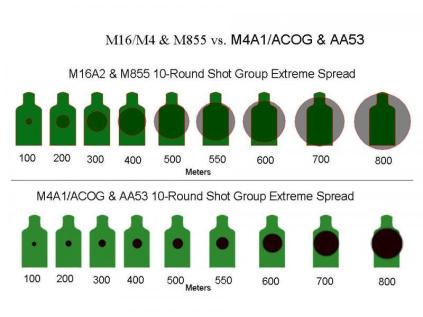 Mechanical accuracy definitely plays a large role in practical accuracy, but if your fundamentals are trash nothing is going to make you a good shooter. While you’ve read up until now that pinpoint accuracy is not a central requirement in a primary fighting carbine or rifle, good mechanical accuracy is definitely a desirable asset. If my weapon shoots 2 MOA, or a 2 inch group at 100 yards, that means on an average man-sized target at any given distance I have some margin of error to still make solid hits, all things being equal. Anything up to 4 MOA for a general purpose carbine then becomes perfectly acceptable. Even out to 600m this gives us, in theory at least, 24 inches of spread but still perfectly capable of a solid hit if you do your part. But you have to know how to do your part, and that only comes from solid training. But will you need to shoot that far? Probably not in most cases- and only your own situation can determine this. Most often our expectations should be half that distance at the most, but if everyone in your group can make those kinds of shots, then they’ll have no problems engaging closer than that.
Practical accuracy comes from the individual rifleman; riflemen are only produced and maintained through quality training. The tactics of the Team of Riflemen are the real difference maker. You should be seeking out training outside the square range on a regular basis. My friend JC Dodge has an upcoming class which will go beyond the typical comfort zone of most, pushing both the student and his equipment. In addition, I’m available for those seeking private instruction on both making the shot and proper field techniques, along with other small units skills such as Off-Grid Communications, Recon & Surveillance, Basic Survival and Combat Casualty Care. We’re not the only ones who can teach this stuff; there’s many others. But I highly implore the reader to get that training along with all the other skills to give you the tactical edge in setting up a secure retreat, even if you think you’re the ‘expert’. And with that, I’ll leave you with a quote from the late, great Peter Kokalis:
To train others in the art of war, you must both know war from the trenches and undergo constant training from others, both to keep the sharp edge and be exposed to the ever-evolving tactical concepts of combat at the down and dirty level. Several have asked why an “expert” (God how I loathe that word) like me would need to participate in training at a firearms school. The answer is simple: for the same reason tennis and golf pros constantly train under other tennis and golf pros. You cannot observe yourself while shooting, but the professional firearms instructors under whom I train can constantly detect slight nuances of incorrect movement that need to be reprogrammed.

Categories
Some more high end mauser rifles


In the spring of 1942 following the release of Polish prisoners and deportees in the labour camps in Siberia, the main route out of the Soviet Union was across the Caspian Sea to Persia or Iran as it is known today. A new Polish Army was being formed in the Middle East under the command of the British and on their way to the organization area, a group of Polish soldiers came across a little bear in the mountainous region of Persia. The cub was an orphan following the death of his mother at the hands of hunters and he was traded to the soldiers by a shepherd boy who kept the bear in a sack.
 The animal was very small and the problem of feeding him was soon overcome by the improvised techniques employed by his new family including feeding him from on a bottle filled with condensed milk. Eventually, they all arrived in Palestine and the bear was taken to the 22nd Transport Company, Artillery Division, Polish 2nd Corp where the men would become his companions for the next few years. He was given the name Wojtek, pronounced Voytek.
From the beginning he became a popular member of the Company spending most of his time with the soldiers of the 4th Platoon. Two of his closest friends were two young soldiers, Dymitr Szawlugo and Henryk Zacharewicz who would both be featured in many of the photos and film footage taken of Wojtek. He would often be found in the kitchen area and he ate everything he was fed and even developed a taste for beer and wine together with cigarettes which he would only accept when lit. He had a habit of drinking from a beer or wine bottle and when empty, he would peer into the bottle waiting patiently for more. He would usually take one puff of a lit cigarette and then swallow it.
Wojtek grew to become a very strong bear and was happy bathing and wrestling with his comrades. Only a few soldiers dared to take him on in a wrestling match as some times the men would get roughed up a bit by getting scratched or have their uniforms torn. The rest of the men were happy to watch. In Palestine, Wojtek became a hero one night by capturing a thief who had broken into an ammunition compound where the bear was sleeping. The Arab was shocked to find himself confronted by the animal and the commotion that ensued resulted in his arrest. Wojtek was quite satisfied with the reward of a bottle of beer.
 When he was small, it was easy for Wojtek to ride in the cab of the transport vehicles but as he grew he would sit in the back with the supplies though he would often ride on one of the recovery trucks where there was more room to lie down during the long journeys and he could play by climbing up the crane. Wherever he went, Wojtek would attract attention and his antics would cause a sensation as he loved to entertain people. He made friends with a few of the other mascots including Kasha the monkey and Kirkuk the dog. Kasha died of a broken heart after her chronically sick baby lived for less than a year and Kirkuk did not survive a sting by a scorpion. Such an insect did sting Wojtek on the nose on one occasion and the men of the Company thought that he would not make it through. His close companion Henryk nursed him back to health and he did not leave his side for a couple of days. After he had recovered, he was back to his usual self.
As the Polish Army prepared to enter the war zone in Italy during 1943, the problem confronting the Polish soldiers was the question of Wojtek’s status. Animals were not permitted to accompany the army during the fighting. By giving the bear his own paybook, rank and serial number there would be no question that he was on the list of soldiers. There was a minor problem during the embarkation prior to crossing the Mediteranean Sea but with his papers in order Wojtek would be on his way. In the Italian theatre, the Polish 2nd Corp soon prepared to break through the German defenses at Monte Cassino where it successfully captured the stronghold after much bitter fighting.
During the conflict, Wojtek found himself at the artillery firing line where he was seen to move crates of ammunition close to a truck where he was chained. Henryk had been assigned to take care of the bear that day but when he was ordered forward as an artillery spotter, he had to leave Wojtek alone. Always inquisitive and willing to copy what the soldiers were doing, he began picking up the crates and moving towards the cannons. The sounds of gunfire did not concern him and he displayed courage in his willingness to participate in the action. After the battle, the official badge of the 22nd Transport Company became a likeness of Wojtek holding a shell. This symbol appeared on vehicles, pennants and on the uniforms of the soldiers.
The war ended in May 1945 and the Polish soldiers were eventually sent across Europe to Berwick Upon Tweed in England where they stayed at Winfield Camp. As the soldiers went through a process of demobilization, they would say goodbye to Wojtek, many knowing that they would never see him again since their journeys would take them to distant parts of the globe. Wojtek found a home at Edinburgh Zoo where he became a popular attraction with many visitors including ex-Polish servicemen who would talk to him in their language. His death in 1963 was met with sadness from those who knew him and it was reported in newspapers and radio stations. His exploits and adventures have not been forgotten with numerous written accounts, memorials and statues. In a time when Polish soldiers had lost their country to the Nazis and later to the Communists, Wojtek became a symbol which the soldiers were proud of, themselves knowing that they would not soon return to a free homeland. He became part of the history of the Polish Armed forces in the Second World War and his legacy will endure.
The animal was very small and the problem of feeding him was soon overcome by the improvised techniques employed by his new family including feeding him from on a bottle filled with condensed milk. Eventually, they all arrived in Palestine and the bear was taken to the 22nd Transport Company, Artillery Division, Polish 2nd Corp where the men would become his companions for the next few years. He was given the name Wojtek, pronounced Voytek.From the beginning he became a popular member of the Company spending most of his time with the soldiers of the 4th Platoon. Two of his closest friends were two young soldiers, Dymitr Szawlugo and Henryk Zacharewicz who would both be featured in many of the photos and film footage taken of Wojtek. He would often be found in the kitchen area and he ate everything he was fed and even developed a taste for beer and wine together with cigarettes which he would only accept when lit. He had a habit of drinking from a beer or wine bottle and when empty, he would peer into the bottle waiting patiently for more. He would usually take one puff of a lit cigarette and then swallow it.
Wojtek grew to become a very strong bear and was happy bathing and wrestling with his comrades. Only a few soldiers dared to take him on in a wrestling match as some times the men would get roughed up a bit by getting scratched or have their uniforms torn. The rest of the men were happy to watch. In Palestine, Wojtek became a hero one night by capturing a thief who had broken into an ammunition compound where the bear was sleeping. The Arab was shocked to find himself confronted by the animal and the commotion that ensued resulted in his arrest. Wojtek was quite satisfied with the reward of a bottle of beer.
When he was small, it was easy for Wojtek to ride in the cab of the transport vehicles but as he grew he would sit in the back with the supplies though he would often ride on one of the recovery trucks where there was more room to lie down during the long journeys and he could play by climbing up the crane. Wherever he went, Wojtek would attract attention and his antics would cause a sensation as he loved to entertain people. He made friends with a few of the other mascots including Kasha the monkey and Kirkuk the dog. Kasha died of a broken heart after her chronically sick baby lived for less than a year and Kirkuk did not survive a sting by a scorpion. Such an insect did sting Wojtek on the nose on one occasion and the men of the Company thought that he would not make it through. His close companion Henryk nursed him back to health and he did not leave his side for a couple of days. After he had recovered, he was back to his usual self.As the Polish Army prepared to enter the war zone in Italy during 1943, the problem confronting the Polish soldiers was the question of Wojtek’s status. Animals were not permitted to accompany the army during the fighting. By giving the bear his own paybook, rank and serial number there would be no question that he was on the list of soldiers. There was a minor problem during the embarkation prior to crossing the Mediteranean Sea but with his papers in order Wojtek would be on his way. In the Italian theatre, the Polish 2nd Corp soon prepared to break through the German defenses at Monte Cassino where it successfully captured the stronghold after much bitter fighting.
During the conflict, Wojtek found himself at the artillery firing line where he was seen to move crates of ammunition close to a truck where he was chained. Henryk had been assigned to take care of the bear that day but when he was ordered forward as an artillery spotter, he had to leave Wojtek alone. Always inquisitive and willing to copy what the soldiers were doing, he began picking up the crates and moving towards the cannons. The sounds of gunfire did not concern him and he displayed courage in his willingness to participate in the action. After the battle, the official badge of the 22nd Transport Company became a likeness of Wojtek holding a shell. This symbol appeared on vehicles, pennants and on the uniforms of the soldiers.
The war ended in May 1945 and the Polish soldiers were eventually sent across Europe to Berwick Upon Tweed in England where they stayed at Winfield Camp. As the soldiers went through a process of demobilization, they would say goodbye to Wojtek, many knowing that they would never see him again since their journeys would take them to distant parts of the globe. Wojtek found a home at Edinburgh Zoo where he became a popular attraction with many visitors including ex-Polish servicemen who would talk to him in their language. His death in 1963 was met with sadness from those who knew him and it was reported in newspapers and radio stations. His exploits and adventures have not been forgotten with numerous written accounts, memorials and statues. In a time when Polish soldiers had lost their country to the Nazis and later to the Communists, Wojtek became a symbol which the soldiers were proud of, themselves knowing that they would not soon return to a free homeland. He became part of the history of the Polish Armed forces in the Second World War and his legacy will endure.
Categories
Summer is here! NSFW