Categories
Allies

If you want a real & true Friend then get a Dog! Bess Truman

Categories
Uncategorized

How to Ford a River or Stream

Brett and Kate McKay | May 5, 2017

Manly SkillsOutdoorsSurvival

How to Ford a River or Stream

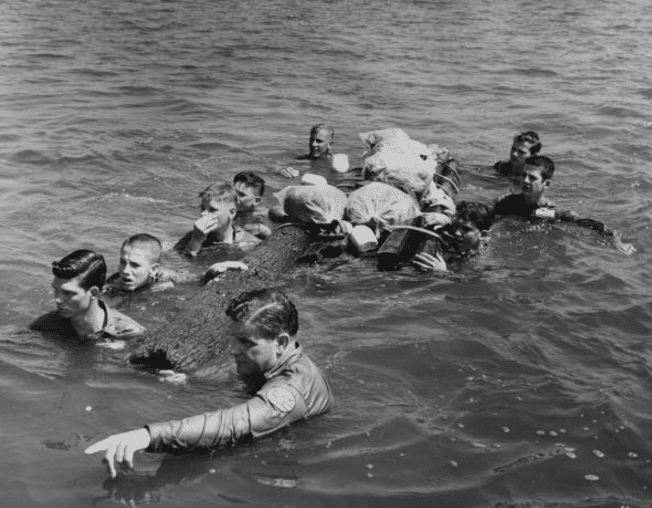
vintage men swimming across river training exercise

Editor’s note: The following excerpt was taken from FM 21-76: Survival Evasion and Escape, an Army field manual published in 1968.

Crossing Water

General

(1) Unless you are traveling in the desert, there is a good possibility that you will have to ford a stream or river. The water obstacle may range from a small, ankle-deep brook that flows down a side valley to a rushing, snow- or ice-fed river. If you know how to cross such an obstacle, you can use the roughest of waters to your advantage. However, before you enter the water check the temperature. If it is extremely cold and if a shallow fording place cannot be found, it is not advisable to try to cross by fording. The cold water may easily cause a severe shock, which can temporarily paralyze you. In this case, try to make an improvised bridge by felling a tree over the stream or build a simple raft.
(2) Before you attempt to ford, move to high ground and examine the river for:
(a) Level stretches where it breaks into a number of channels.
(b) Obstacles on the other side that might hinder your travel. Pick a spot on the opposite bank where travel will be easier and safer.
(c)  A ledge of rocks that crosses the river, indicating the presence of rapids or canyons.
(d) Any heavy timber growths. These indicate where the channel is deepest.
(3) When you select your fording site, keep the following points in mind:
(a) When possible, choose a course leading across the current at about a 45° angle downstream.
(b) Never try to ford a stream directly above or close to a deep or rapid waterfall or deep channel.
(c) Always ford where you would be carried to a shallow bank or sandbar should you lose your footing.
(d) Avoid rocky places, since a fall can cause serious injury; however, an occasional rock that breaks the current may help you.

Methods of Crossing

(1) Wading
Before you enter the water remove your shoes and socks unless you need them to protect your feet from being cut by sharp rocks or sticks.  Use a stout pole for support.  It makes your footing more secure.  Also use the pole to test the stream for potholes.
(2) Swimming
(a) Use the breast, back, or side strokes. They are noiseless, less exhausting than other techniques, and will allow you to carry small bundles of clothing and equipment as you swim. If possible, remove your clothing and equipment and float it across the river. Wade out until the water is chest deep before you begin swimming. If the water is too deep to wade, jump in feet first with your body straight; keep your legs together and your hands at your sides. In deep, swift water, swim diagonally across the stream with the current.
(b) If you are unable to swim, you can ford a river by using certain swimming aids. These include:
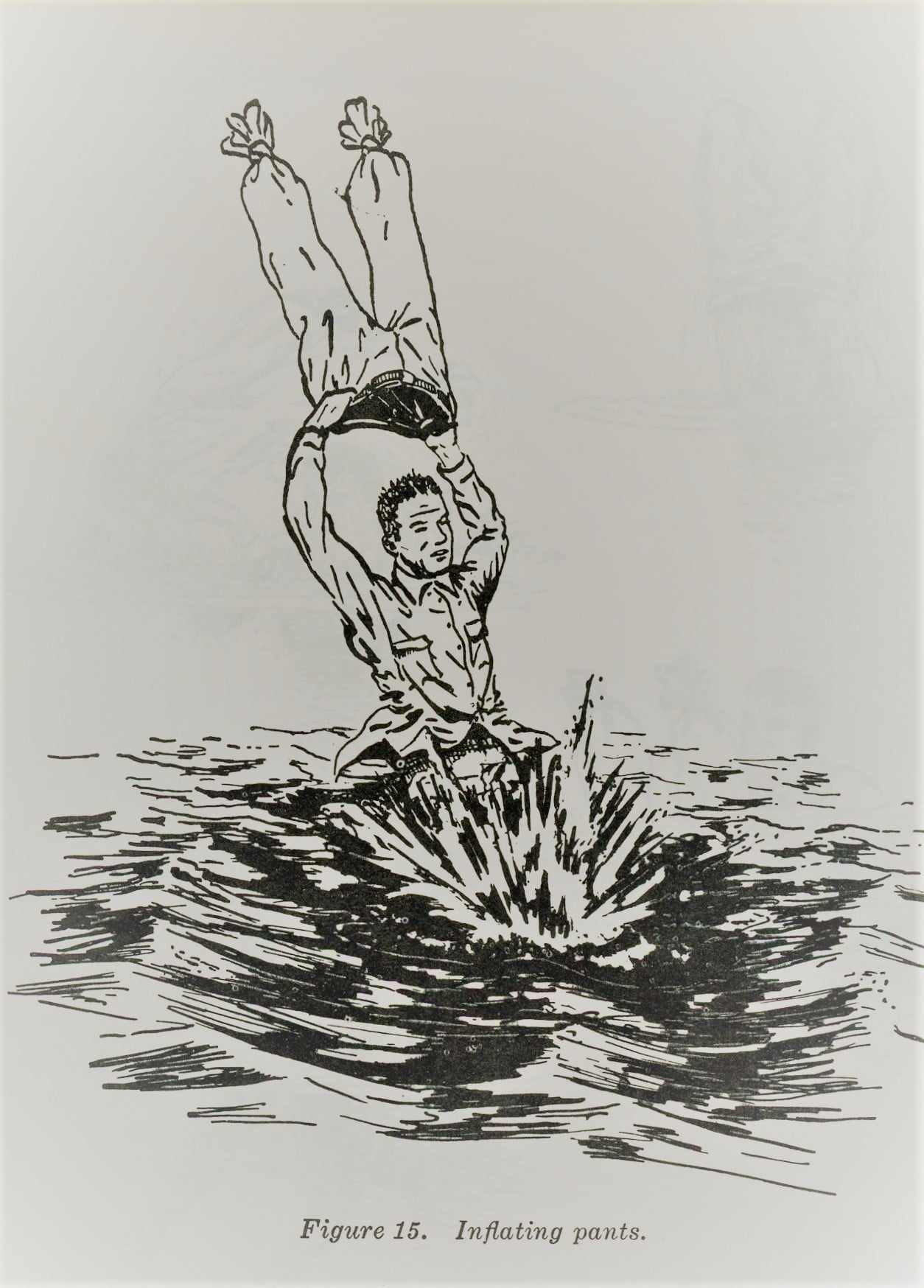
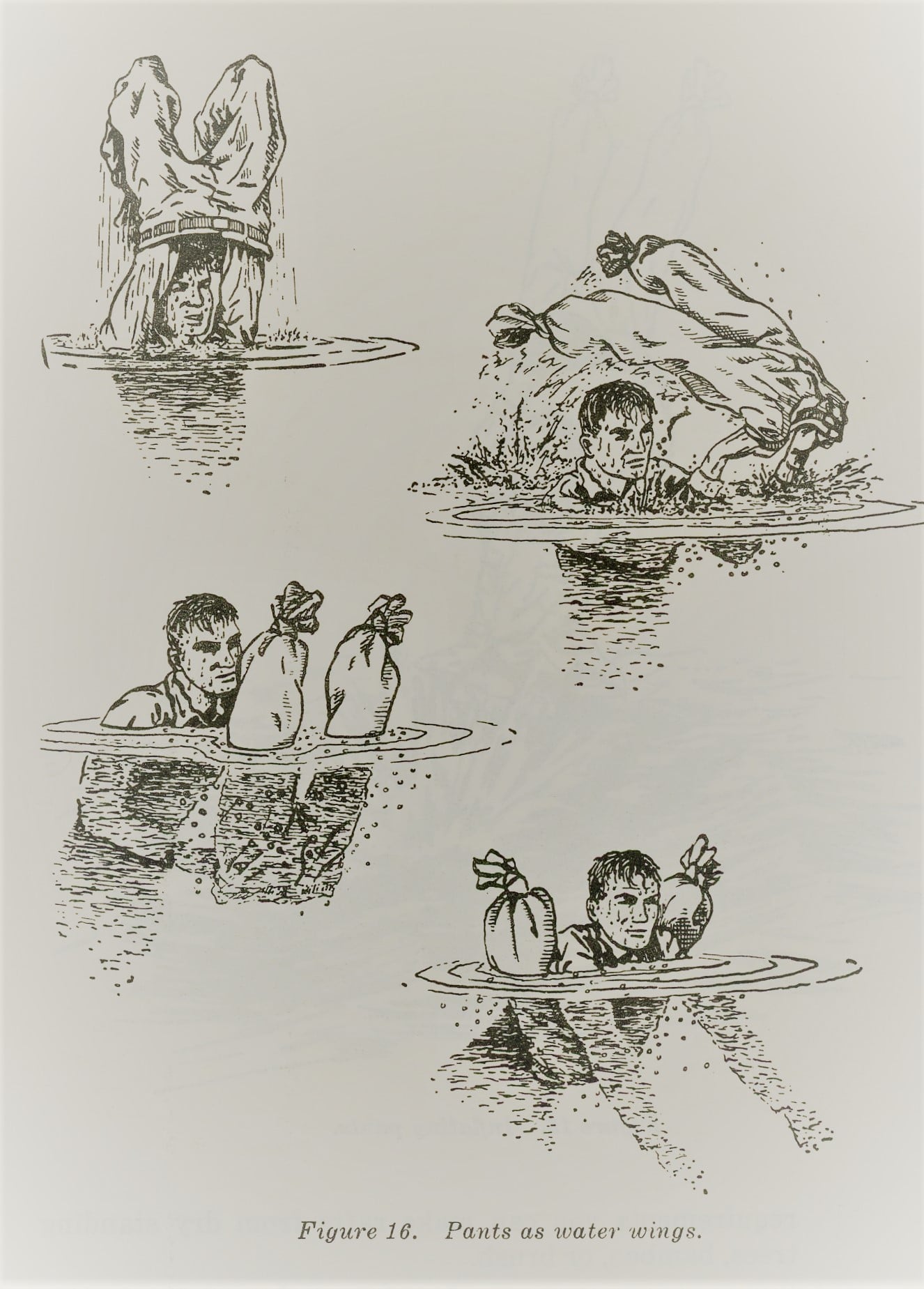
1. Clothing. Take off your trousers in the water; knot each leg and button the fly. Grasp the waist band on one side and swing the trousers over your head from back to front so that the waist opening is brought hard down on the surface of the water. Air is trapped in each leg (fig. 16). If you are not worried about noise, hold your trousers in front of you and jump into the water (fig. 15). Either of these methods provides a serviceable pair of water wings.
vintage illustration using pants as flotation device in water
vintage survival illustration using pants as flotation device
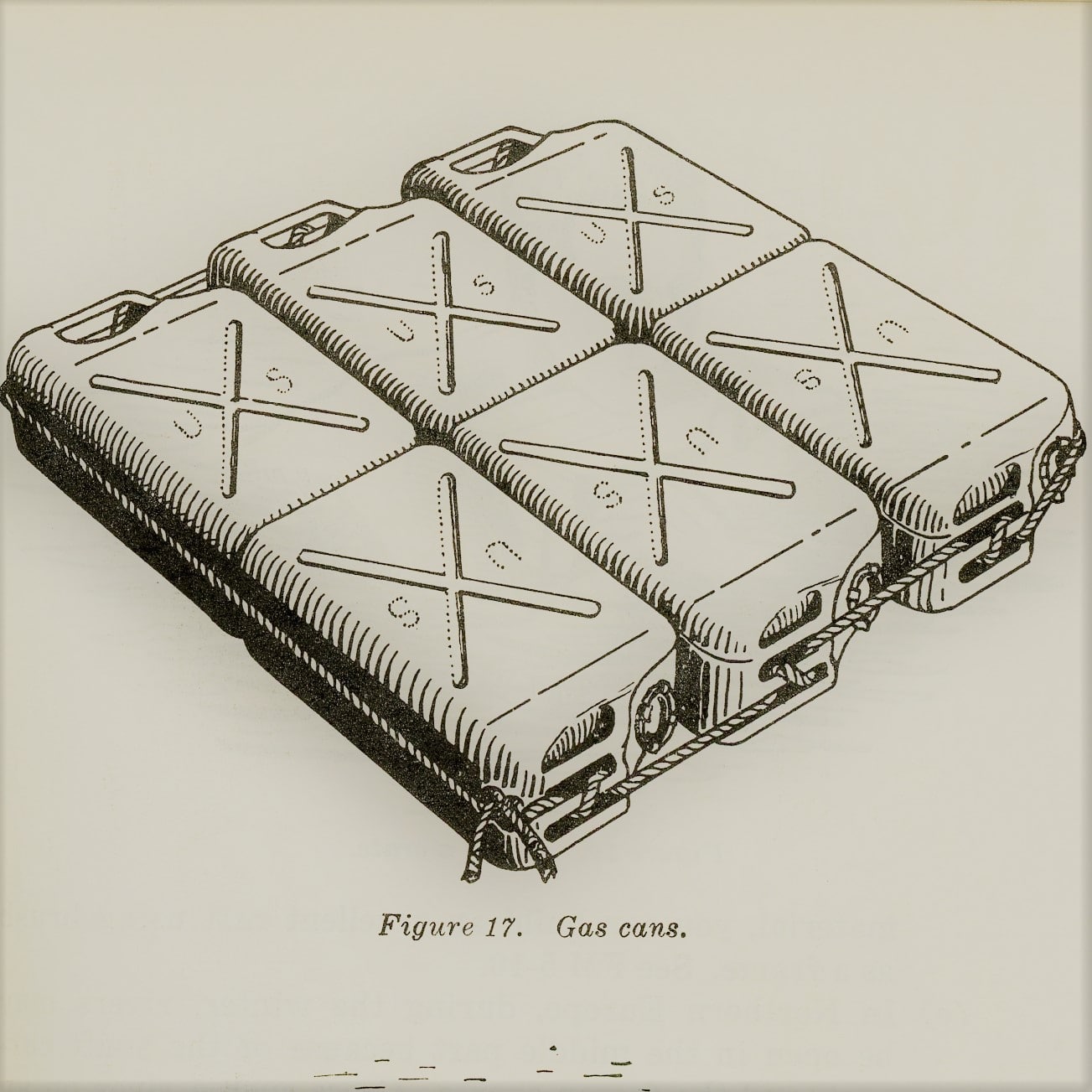
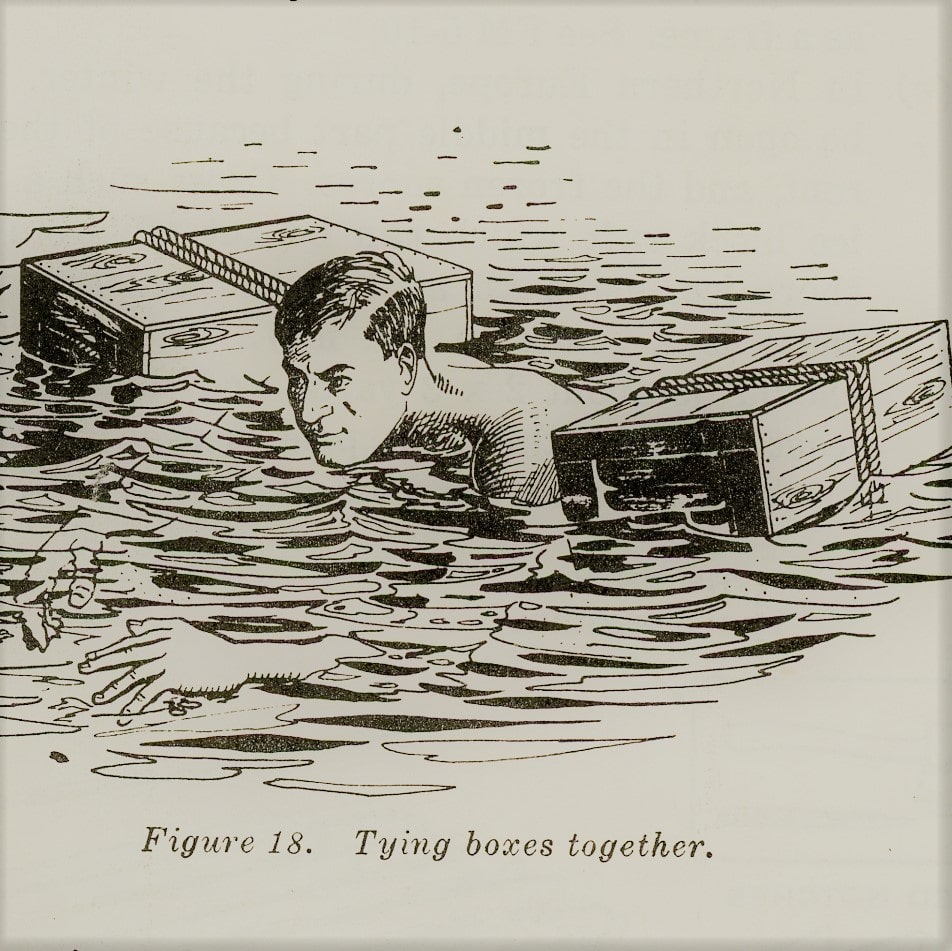
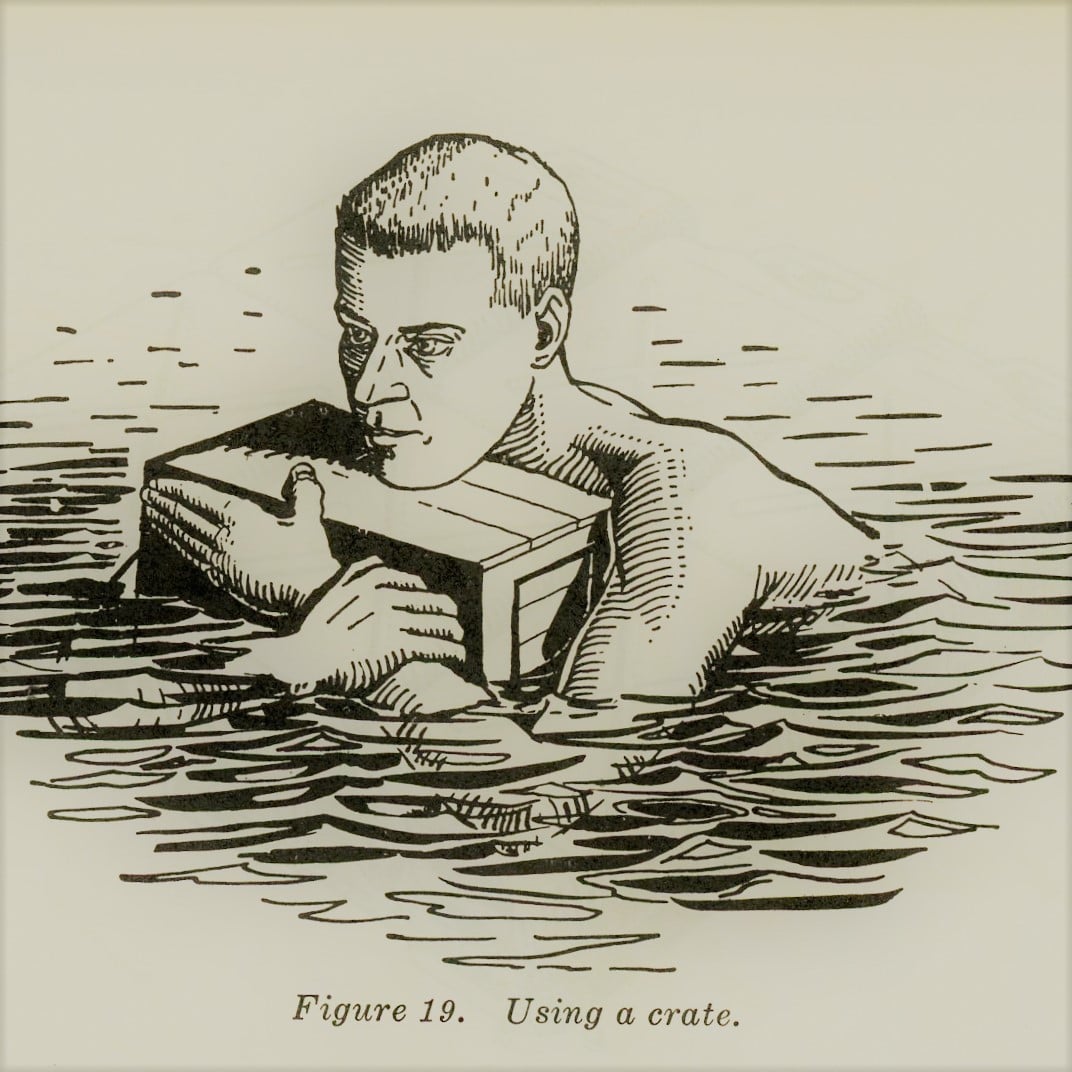
2. Empty tins, gas cans, and boxes. Lash these together as shown in figures 17, 18, and 19. Use them only when crossing slow moving water.
vintage survival illustration using gas cans as flotation device
vintage survival illustration using boxes as flotation device
vintage survival illustration using a crate as a flotation device
3. Logs or planks. Before you decide to use a wooden floating aid, test its ability to float. This is especially important in the tropics because most tropical trees sink, particularly the palm, even when the wood is dead.
(3) Rafts
(a) Rafting rivers is one of the oldest forms of travel and often is the safest and quickest method of crossing a water obstacle; however, building a raft under survival conditions is tiring and time consuming unless you have proper equipment and help. With these two requirements you can make rafts from dry standing trees, bamboo, or brush.
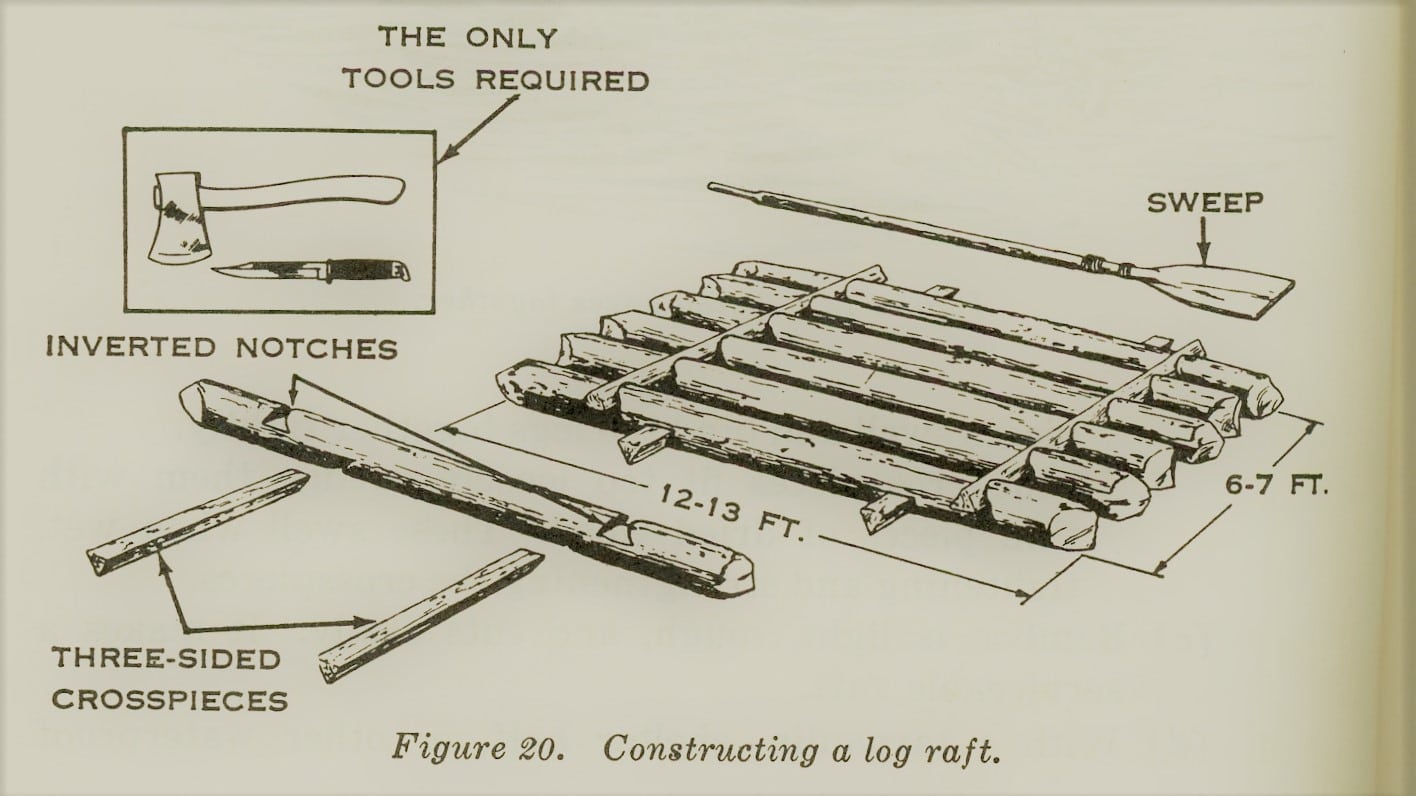
(b) Spruce trees that are found in polar and subpolar regions make the best rafts. You can construct a raft without spikes or rope. All you need is an axe and knife. Considering a suitable raft for three men to be 12 feet long and 6 feet wide:
1. Build the raft on two skid logs placed so they slope downward to the bank. Smooth the logs with an axe so the raft logs lie evenly on them.
2. Cut four offset, inverted notches, one in the top and bottom of both ends of each log (fig 20). Make the notches broader at the base than at the outer edge of the log.
vintage survival illustration constructing log raft
3. To bind the raft together, drive through each notch a three-sided, wooden crosspiece about a foot longer than the width of the raft (fig 20). Connect all the notches on one side of the raft before connecting those on the other.
4. Lash the overhanging ends of the two crosspieces together at each end of the raft to give it additional strength. When the raft enters the water the crosspieces swell and bind the logs together tightly.
5. If the crosspieces fit too loosely, wedge them with thin pieces of dried wood. These swell when wet, tightening and strengthening the crosspieces.
(c) Bamboo is light, tough, and cuts easily. It makes a serviceable craft.
(d) With a tarpaulin, shelter half, or other waterproof material, you can build an excellent raft using brush as a frame.
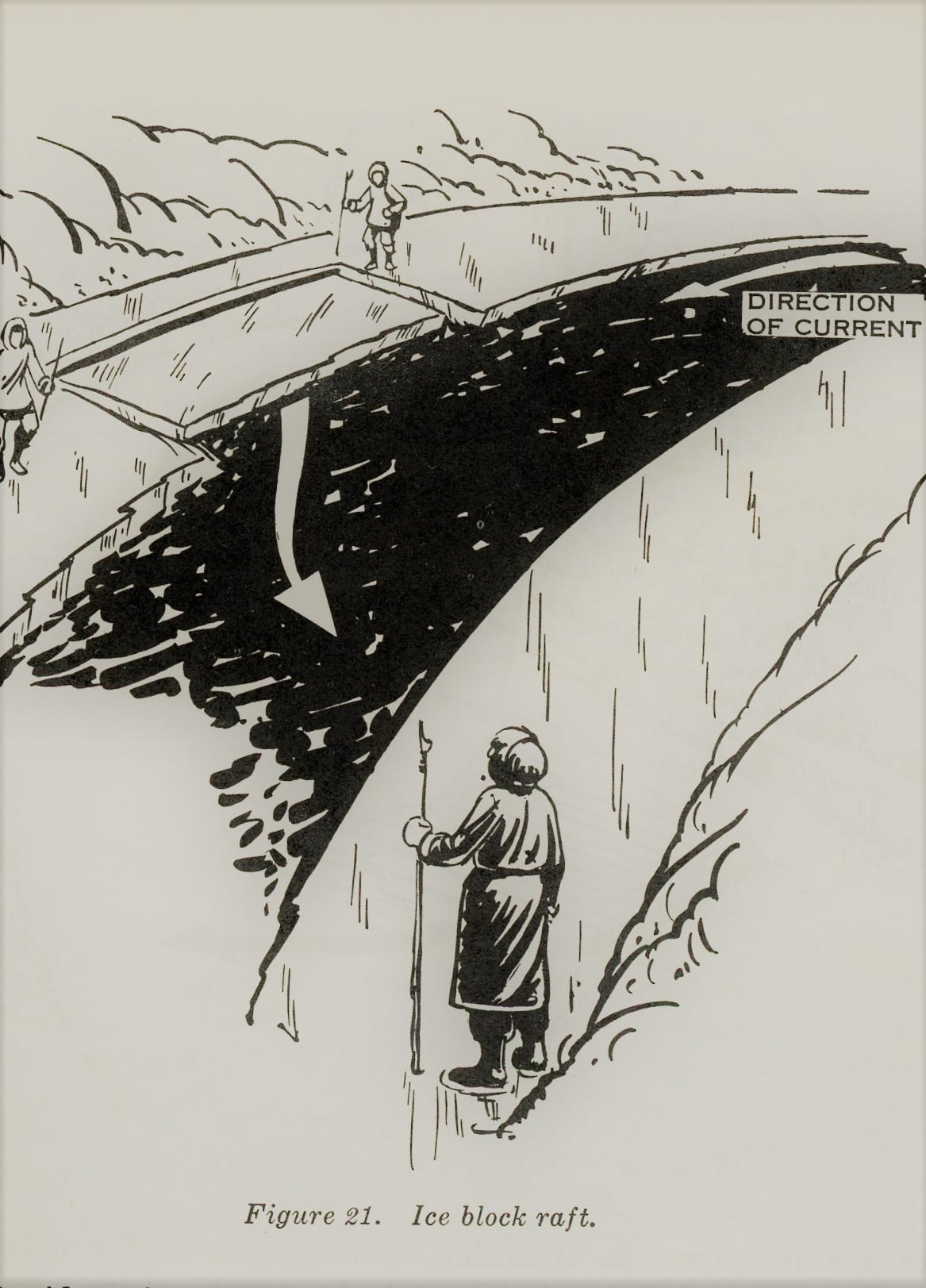
(e) In Northern Europe, during the winter, rivers may be open in the middle part because of the swift current, and the frozen shores. Cross such a river on an ice block raft which can be cut off from the frozen shore ice, using an ax or even sometimes a pole (if there is a crack in the ice). The size of the raft should be about 2 x 3 yards and the ice should be at least one foot thick. A pole is used to move the ice block raft  across the open part of the river (fig. 21).
vintage survival illustration ice block raft

Rapids or Swift Water

(1) Swimming in rapids or swift water is not as great a problem as you think. In shallow rapids, get on your back with your feet pointing downstream; keep your body horizontal and your hands alongside your hips. Flap your hands much like a seal moves his flippers. In deep rapids, swim on your stomach and aim for shore when possible. Watch for currents that converge; you might be sucked under because of the swirls they produce.
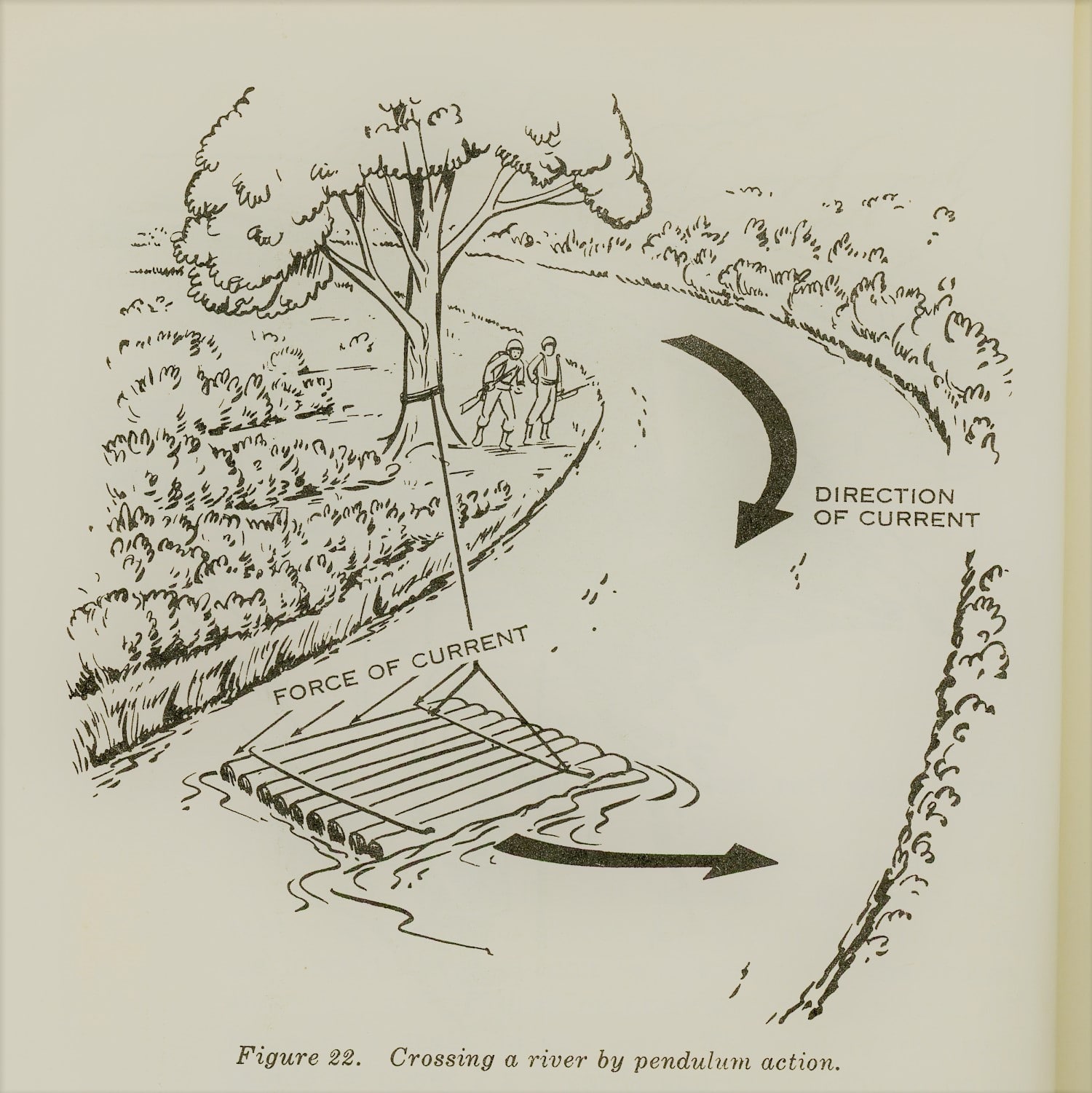
(2) A raft crossing of a deep and swift river may be effected by utilizing a pendulum action at a bend in the river (fig. 22). This method is useful when several men have to cross.
vintage survival illustration crossing a river on a log raft

Quicksand, Bogs, Quagmire

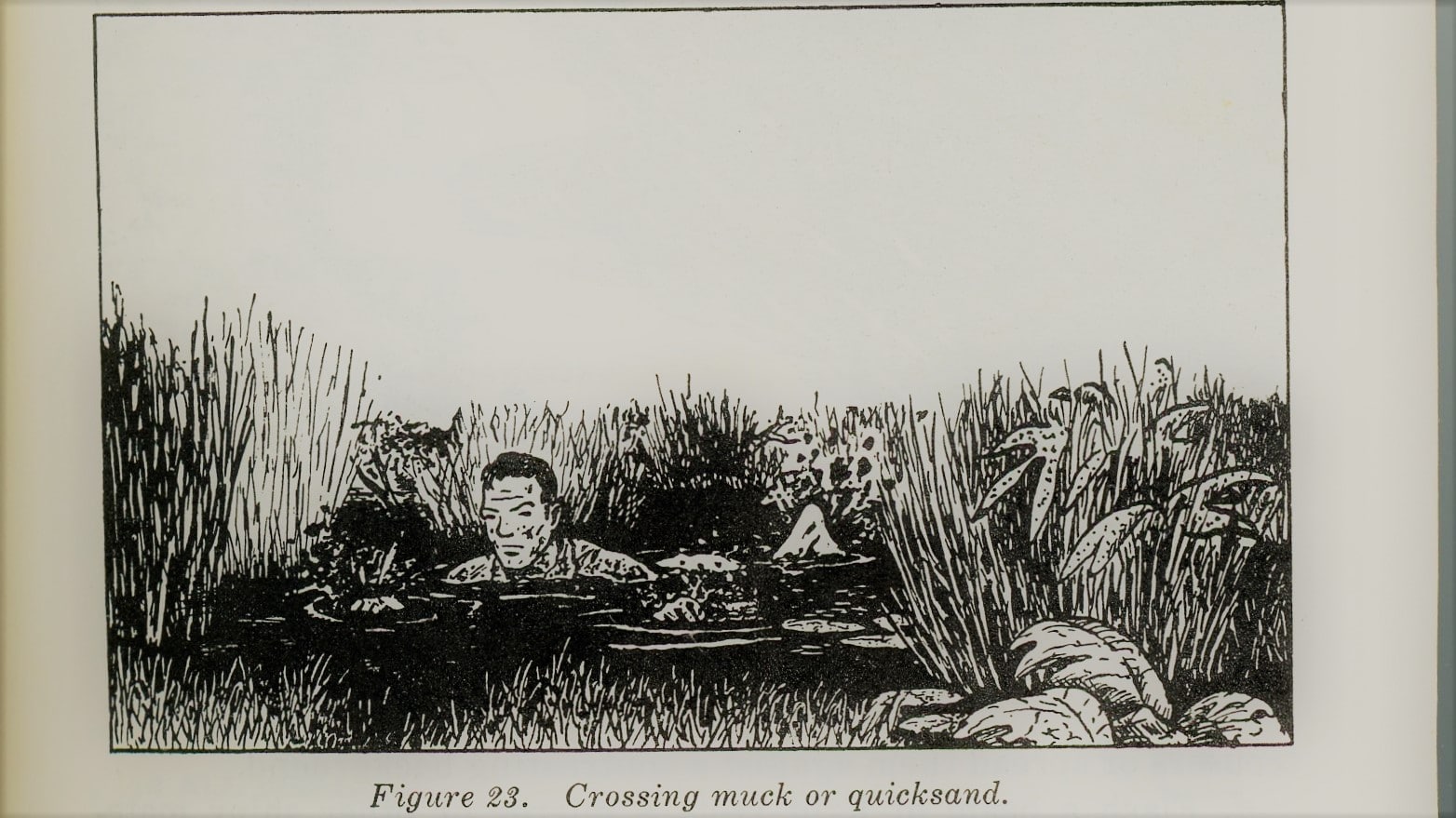
These obstacles are found most frequently in tropical or semitropical swamps. Pools of muck are devoid of any visible vegetation and usually will not support even the weight of a rock. If you cannot detour such an obstacle, attempt to bridge it using logs, branches, or foliage. If none are available, cross it by falling face downward with your arms spread. Start swimming or pulling your way through, keeping your body horizontal. Use the same method for crossing quicksand (fig. 23).
vintage survival illustration crossing wading through quicksand

Last updated: July 5, 2017

Categories
N.S.F.W. Well I thought it was funny!

What a Little Stud! NSFW

Attachments area
Categories
N.S.F.W.

How come I never see these ladies at the Range? NSFW

Image result for michelle manhart playboy spread
Related image
Related image
Related image
Related image
Image result for hot girl with glock
Image result for hot girl with ar15
 
Image result for Gun
Blond Topless Girl
Blond Topless


Categories
All About Guns

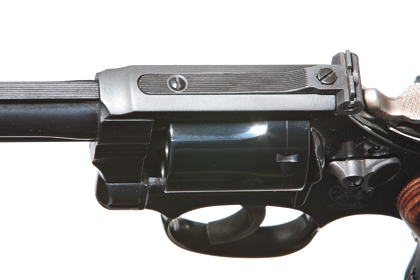
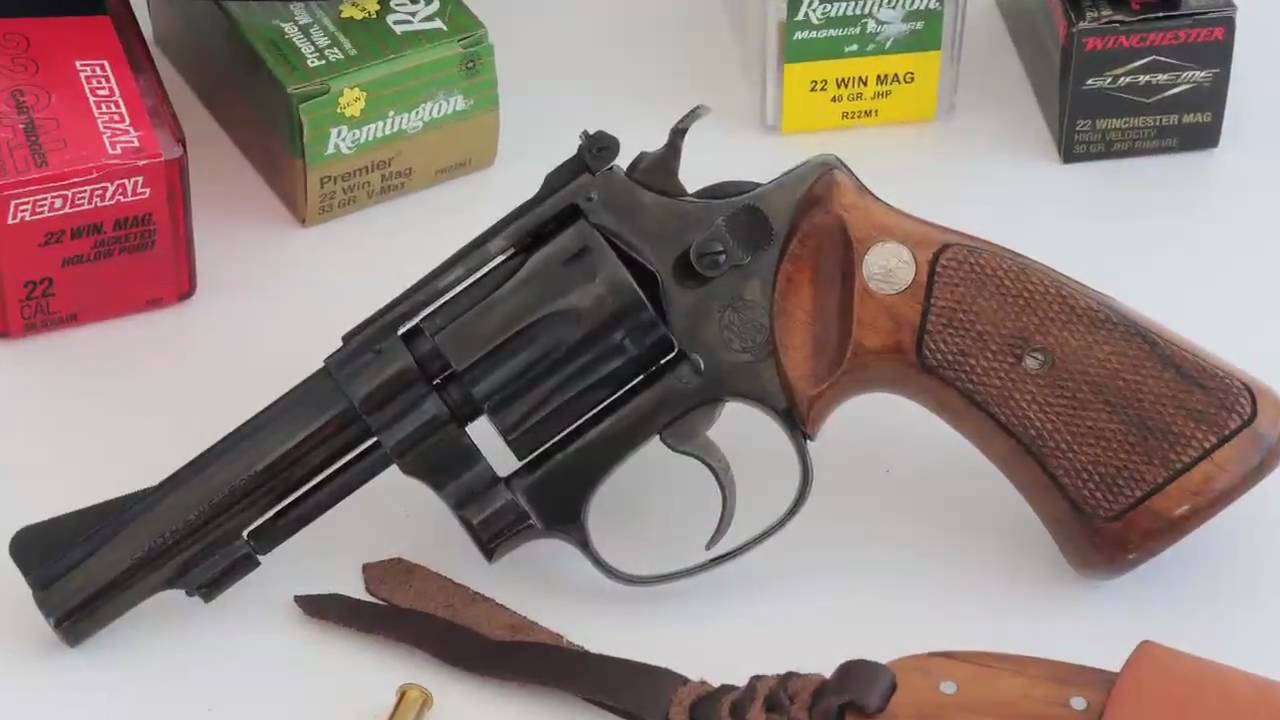
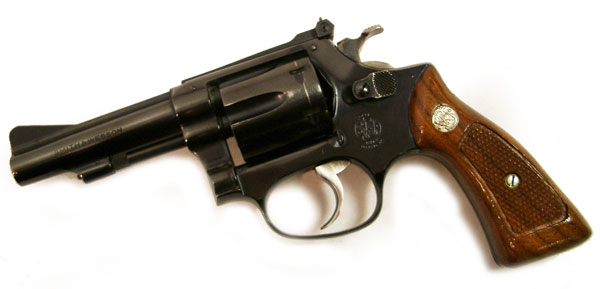
S&W Model 17

Image result for S&W Model 17

Image result for S&W Model 17

Smith & Wesson Model 17

From Wikipedia, the free encyclopedia
Smith & Wesson Model 17
Flickr - ~Steve Z~ - Smith ^ Wesson K22 Pre 17.jpg

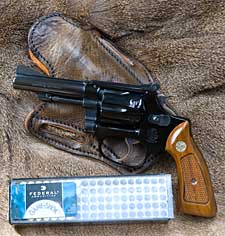
Smith & Wesson Model 17 K-22 revolver
Type Double-action revolver
Place of origin United States
Production history
Designed 1947
Manufacturer Smith & Wesson
Variants Model 617
Specifications
Barrel length 6 in (150 mm)

Cartridge .22 Long Rifle
Action Double-action revolver
Feed system 6 round (Model 17 or earlier 617), or 10 round (Later model 617) cylinder

The Smith & Wesson Model 17 is a six-shot double-actionrevolver chambered for .22 LR. It is built on Smith & Wesson‘s medium-sized K-frame.

History[edit]

Smith & Wesson’s Models 16 and 17 have their origins with the company’s Pre-World War 2 Hand Ejector series in the 1930s. These two revolver models debuted as companion pieces known as the Models K-32 and K-22 after World War 2. The K-32 Masterpiece (Model 16) debuted in 1935 and was chambered in .32 S&W Long caliber. Production ceased during World War 2 and the revolver was reintroduced in 1947 along with the K-22 Masterpiece (Model 17) in .22 Long Rifle caliber.[1]
The Model 16 was dropped from production in 1983 due to the declining popularity of the .32 S&W Long caliber and the Model 17 was discontinued in 1998 as the company focused less on blued steel revolvers at the time.[1]

Design[edit]

The Model 17 has an adjustable rear sight and an un-pinned, fixed ramp or Patridge style front sight. It was designed as a target revolver and could be ordered from S&W with “The Three T’s” : Target Trigger, Target Hammer and Target Grips. Standard barrel lengths were 4″, 6″ and 8 3/8″. The 4″ model 17-6 is infrequently seen, as S&W produced the almost identical, 4″ barrelled, Model 18. The Model 18 was a Model 17 copy- except the 4″ barrel was tapered where the Model 17 4″ barrel was not. Many collectors believe the Model 17-6 with the 4″ non-tapered barrel was a bit of a production oddity, most probably put together from 6″ and 8 3/8″ barrels that were cut down to 4″ at the factory.[2]
In 1990, S&W also shipped the Model 17 featuring a 4″, 6″ or 8 3/8″ full under lug barrel. The “under lug” was a solid, blued steel, circular rod, cast as part of the barrel, and running under the barrel from the front of the cylinder yoke to the muzzle’s end.. The under lug not only enclosed the ejector rod, it also added considerable weight to the gun itself. The under lug model shipped with a special round butt wood grip that featured inletted finger grooves. The 4″ Model 17 Under Lug is infrequently seen and quite possibly manufactured as an afterthought using factory shortened 6″ or 8 3/8″ under lug barrels.

Derivatives[edit]

Model 18 & 617[edit]

The Smith & Wesson Model 18 (or the 22 Combat Masterpiece) was built on S&W’s “K” Frame, (Smith & Wesson’s designation for ‘medium frame’ firearms.) It was a tapered, 4-inch-barreled, double-action revolver, with adjustable open sights, chambered for the .22 long rifle Many believe the Model 18 was designed as a training weapon for law enforcement officials and others who primarily carried Model 10’s, 15’s and 19’s-.38 Special and .357 caliber revolvers. The Model 18 (like the Model 17) operates and handles in a similar fashion to these law enforcement models of the day; and closely shares the size, weight, grips, internal mechanism, and operation of several popular “K” framed revolvers like the Model 10 (.38 Cal.), Model 13 (.38 & .357 Cal.), Model 14 (.38 Cal.), Model 15 (.38 Cal.) and Model 19 (.38 & .357 Cal.) The only significant difference was the Model 18’s .22 caliber.
Model 617 – At the same time S&W introduced the Model 17 full Under Lug, (discontinued in 1998) they also began production of the .22 caliber Model 617. This is the stainless steel version of the blued steel Model 17 .22 LR, however all Model 617’s have full, Under Lug barrels. Offered in the same three barrel lengths as the Model 17, the 617 is still in current production and is shipped with rubber grips. The Model 617 is found with a six-shot or ten-shot, steel .22 LR cylinder. The only exception is the early production Model 617-2 which was made with a ten-shot, aluminium alloy .22 LR cylinder. Later “dash 2” 617’s were shipped with stainless steel cylinders.[3]

Model 53[edit]

Photograph of Model 53 with cylinder inserts.Model 53 in .22 Jet with cylinder inserts to use .22 Rimfire
The Smith & Wesson Model 53 was introduced in 1961 in the .22 Jet caliber. It is a revolver of six round capacity built on the small K frame using a double action trigger. The .22 Jet cartridge had a listed velocity of 2460 fps using a 40 grain bullet, but actually reached 1700-1800 this in the revolver.[4] The Model 53 can also fire the .22 Short, Long, and Long rifle cartridges using chamber inserts. The hammer had a two position firing pin to allow it to be switched from rimfire to centerfire as needed.
The handgun came with target handgrips and sights an in barrel lengths of 4, 6 and 8.3 inches.[5]
In the late 1950s there was considerable interest in the shooting community for revolvers chambered in various .22 caliber wildcat cartridges. Smith & Wesson sought to take advantage of this by unveiling a cartridge known as the .22 Remington CFM (Centerfire Magnum) cartridge or the .22 Remington Jet and chambered a version of the Model 17 in this caliber designating it the Model 53.[6]
The Model 53 was manufactured from 1960 to 1974.[6]

Problems in Use[edit]

Due to the tapered design of the .22 Jet cartridge there were problem with case setback. It was advised that the cylinders and cartridges be kept absolutely dry to prevent this. Note: lubricating cartridges results in a pressure increase. Cartridges should always be dry. https://www.americanrifleman.org/articles/2010/6/28/smith-wesson-model-53/

Present State[edit]

The Model 17 was discontinued in 1998, but in 2009 was reintroduced as the Model 17 “Masterpiece” due to a resurgence in the popularity of vintage Smith & Wesson revolvers. The company chose approx. fifteen previously discontinued models to produce once again. This was done under the “Classics” category of S&W’s current offerings

S&W’s New Model 17 Classic

by Joel J Hutchcroft   |  September 23rd, 20100 Comments

Pinned Front Sight, Target Hammer, Key Lock, Cylinder Latch
Thumbpiece, Laminated Grips, Smooth Trigger, Recessed Muzzle Crown.

 
If you’re like me, you probably have at least one gun that just feels like it’s a part of you. It might be your 1911 that feels like a natural extension of your arm when you raise it and aim at the target.
Or maybe it’s a .22 rimfire rifle that you shot so much while you were growing up that now it just seems to effortlessly point exactly where it needs to and you simply can’t miss each and every time you squeeze off a round.
Or maybe it’s a shotgun that comes to your shoulder and moves to your focus point so easily that you don’t even realize you’re mounting it.
I feel attached to a lot of my guns, but if I had to pick the one that just feels right to me every time I handle and shoot it, I wouldn’t have to think long or hard. I’d pick my old Smith & Wesson Model 17.
Some of you know what I’m talking about, but for those who haven’t experienced this fantastic revolver, after about a 10-year hiatus in production, S&W brought back the traditional six-shot, bright-blue, non-lug-barreled Model 17 last year as part of its Classics line, and now you can experience it firsthand.
Shooting Times has a long and well-established history with the Model 17, also known as the K-22 Masterpiece. ST writers the likes of Skeeter Skelton, Bob Milek, Dick Metcalf, and Mike Venturino have written about the classic K-Frame .22, detailing just about every significant mechanical change and many of the less significant configuration changes that were made to the Model 17 and its stainless-steel brother, the Model 617.
So, since we are celebrating our 50th anniversary, it is fitting to report on this newest version.
The new model is called the Model 17 Masterpiece Classic, and it is stamped “17-9″ inside the cylinder yoke. My old Model 17 is stamped “17-4,” and it was produced in 1980. It was my first brand-new store-bought handgun, and I’ve been shooting it for 30 years.
It’s one gun that has never been sold off or traded, and I can’t see myself ever parting with it. But let’s get back to the new one.
The new Model 17 carries on the tradition of S&W’s medium-frame, square-butt, double-action revolvers, but it has a few differences. For one, the square-butt, service-style stocks are laminated wood instead of walnut.
For another, the new barrel’s muzzle has a recessed crown, whereas my old one doesn’t. And the new barrel itself is slightly larger, measuring .611 inch in diameter at the muzzle, while my 17-4’s barrel is .590 inch at the muzzle.
Also, the leaf of the Micro adjustable rear sight of the new gun is rounded and entirely recessed into the topstrap; my old 17-4’s Micro adjustable rear sight leaf is squared off and the end is not encased by the topstrap. The rear sight blades on both models are plain black.
My old 17-4 has a pinned barrel, whereas the new one’s 6-inch barrel is compression fitted. The top rib on the new barrel measures .240 inch wide, and the one on my old 17-4 is wider, measuring .425 at the frame and slightly tapering down to .333 right in front of the front sight.
 

Specifications:

Model: Model 17 Classic
Manufacturer: Smith & Wesson | 800.331.0852
Type: Double-action revolver
Caliber: .22 Long Rifle
Cylinder capacity: 6 rounds
Barrel: 6 in.; rifling : 6 grooves, 1:15 RH twist
Overall length: 11.25 in.
Width: 1.45 in.
Height: 5.4 in.
Weight, empty: 40 oz.
Grips: Checkered laminated wood, square-butt, service-style
Finish: Bright blue
Sights: Micro adjustable rear; primed Patridge front
Trigger: 4-lb., 6-oz. pull (single action, as tested)
Price: $1,051

My 17-4 came with a target-style hammer,
as does the new model, but my old gun has a serrated, .495-inch-wide target trigger, whereas the new model has a smooth, narrow, .312-inch-wide trigger. Both models have a Patridge-style front sight, but the new gun’s is .240 inch longer and pinned in.
The new revolver has the S&W trademark stamped on the left-hand side of the frame, whereas my old Model 17’s frame is stamped on the right side. The lettering on the new model’s barrel is larger in size but not as deeply set. The new model’s cylinder latch thumbpiece is virtually the same size and shape as the thumbpiece on my old 17-4, but the new one’s checkering is finer.
The new model comes from the factory with its topstrap drilled and tapped for a scope mount. My 17-4 is also drilled and tapped for a scope mount, but I had to do that myself. Back when my gun was made, that feature was not a standard offering from the factory. And lastly, the new model has the S&W key lock located on the left side of the frame; my old 17-4 has no such integral locking device.
As for the new model’s accuracy, well, it is just as accurate as my old 17-4. I installed a Burris 3-9X handgun scope on the new model, set it on 9X, and fired six different .22 LR loadings at 25 yards from a benchrest. The details are listed in the accompanying chart, but suffice it to say, the Model 17 is head-shot accurate on tree squirrels and cottontail rabbits at that distance. In fact, I used the new 17-9 this past fall to do a bit of Fox squirrel hunting at home here in Illinois, and last summer I fired another Model 17-9 while on a prairie dog and ground squirrel shoot in Wyoming. The new model feels almost as good in my hands as my old 17-4.
Quoting from a 1939 Stoeger catalog, former Shooting Times Handgun Editor Skeeter Skelton once referred to S&W’s K-Frame .22 as being as accurate as a watch and as sturdy as a tractor. That rings as true today as it did back then.
 

S&W Model 17 CLassic Accuracy

Ammuntion Velocity (fps) Standard Deviation (fps) Extreme Spread (fps) 25 Yard Accuracy (in.)
.22 Long Rifle
CCI 32-gr. Stinger 1305 29 65 2.65
CCI 36-gr. Mini Mag HP 1134 26 62 2.08
Winchester 36-gr. Xpert HP 1145 25 48 2.75
Federal 38-gr. Game-Shok HP 1171 33 64 2.58
Federal 40-gr. Gold Medal Solid 1009 32 67 2.65
Winchester 40-gr. Power Point 1180 21 44 1.63
Notes: Accuracy is the average of five, five-shot groups fired from sandbag benchrest.Velocity is the average of five rounds measured 15 feet from the gun’s muzzle.

Read more: http://www.shootingtimes.com/handguns/handgun_reviews_st_swnewmodel17_201003/#ixzz4xrbJIY6k

Categories
All About Guns

Smith & Wesson Model 51

Image result for Smith & Wesson Model 51
 Image result for Smith & Wesson Model 51
Image result for Smith & Wesson Model 51
For the last month or so I’ve been running axis deer hunts on our Hill Country lease…

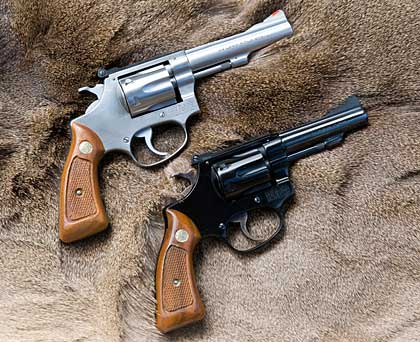
The author’s favorite Kit Guns are the stainless-steel, 4-inch-barreled S&W Model 63 (top) and the blued, alloy-frame, 3.5-inch-barreled S&W Model 43 (bottom). One of these guns rides on his hip every day as he rides the ranch doing chores in the off-season.

For the last month or so I’ve been running axis deer hunts on our Hill Country lease. The days are long, so there are lots of chores to do between the morning and evening hunts. One of my favorites is running my raccoon traps. Few of my clients have ever trapped before, so they often ask to ride along as I check my trapline and dispatch as many of the protein-feeder-raiding thieves as possible. I am astounded at how many of those clients ask about the classic Smith & Wesson Kit Gun that generally resides on my hip.
The Kit Gun made its debut in the mid-1930s as the .22/32 Kit Gun. It was marketed to the outdoorsmen of the day who often carried their necessities in kit bags. The revolvers often rode in the bags for which they were named, but just as many rode on the hips of hikers and ranchers and in the tackle boxes of fishermen.
The Kit Gun was light, compact, accurate, and capable of dealing with the various nuisances outdoorsmen most commonly encountered. Not surprisingly, it was wildly successful.
The first Kit Guns were built on the old S&W I-Frame until about 1960, when S&W began building the guns on the slightly larger J-Frame.
In addition to the standard .22 LR Kit Gun, Airweight and .22 Magnum variants were also available. When Smith & Wesson began numbering all its guns, the blued Kit Gun became the Model 34, the stainless variant was the Model 63, the Airweight became the Model 43, and the Magnum version was called the Model 51.
All came standard with adjustable sights, wood grips, and the old-world craftsmanship for which those old S&W revolvers were known.
I rarely wear a .22 during deer season, but one of my .22 LR Kit Guns gets the nod in the off-season when snakes and coons are the varmints I’m most likely to encounter. My favorite Kit Gun variants are the Models 43 and 63.
The Model 43 has an alloy frame and a round butt. Its barrel is an odd but handy 3.5 inches long with a relatively trim taper. It has the standard S&W adjustable rear sight with a black serrated front. All the examples I’ve seen have a rich, lustrous blue finish that’s darn hard to find these days, and all are beautifully built. As far as carry guns go, the trim, featherweight beauty is tough to beat.
The Model 63 is a stainless-steel gun. Mine has a 4-inch barrel, though 2- and 6-inch barrels were also available. The 63’s barrel is relatively trim, as are its stocks. S&W’s classic adjustable rear sight and a ramp front sight with an orange insert are standard. The combination carries easily and shoots great out to as far as most folks are likely to shoot a rimfire revolver.

The author carries this S&W Airweight Model 43 Kit Gun a great deal, and it’s so lightweight, he often forgets he has it on.

I go back and forth between the two Kit Gun variants. The stainless gun holds up better to the day-in, day-out wear and tear a ranch gun must endure, and I wear it quite often in a pancake-style holster from Tucker Gun Leather (www.tuckergunleather.com). But as much as I like my 63, the 43’s alloy frame and trim tube make it such a joy to carry that I find myself wearing it more often than not.
Worn high on my hip in a belt scabbard from Andy Langlois (www.andysleather.com), the diminutive sixgun is hardly noticeable, but when it’s time to dispatch a trapped raccoon, fox, or bobcat, my Airweight Kit Gun is instantly at hand.
The Kit Gun is not just a short-range plinker, though. I use mine to dispatch wounded big game without excessive damage to the meat, hide, or head. [Editor’s note: In some states it is illegal to even finish wounded big game with a .22. Be aware of local laws.]
In fact, I finished an axis deer and a Corsican sheep with mine just last week. Both were shot well, but I don’t like them to suffer, and the clients don’t seem to mind when I hasten their demise with my little .22. Federal’s 40-grain solid drives deep enough to get the job done without damaging the meat or the hide.
I use them on hogs, too. When a big boar hog runs afoul of a snare, my Kit Guns are accurate enough to put some 40-grain sedatives into their vitals from a distance. I don’t mind getting closer, but a big hog can do a tremendous amount of damage if you get it worked up.
I’ve found that it’s better to shoot them before they see me. Those 40-grain solids drive deep enough to get the job done surprisingly fast when I place my shots accurately.
When I’m not using my Kit Gun to dispatch varmints, it gets a heck of a workout on dirt clumps and cow patties.
Serious plinking is, in my opinion, the very best way to sharpen your shooting and keep it that way, so I do lots of it. I may not hit every egg-sized object I take aim at from long range, but I hit enough, and I don’t miss the lucky ones by much.
When you’re good enough to hit even a cantaloupe-sized object at 100 yards, you’re well on your way to becoming a serious pistolero. The sight alignment and trigger control those long-range sessions build will improve every other aspect of your shooting, too.
Though the classic Kit Guns have come and gone, S&W has introduced several new variants over the years, including .32, .38 Special, and .44 Special guns. Perhaps my favorite recent Kit Gun is the little 2-inch-barreled, flyweight Model 317 that came out in the 1990s.
I sold mine long ago to buy something stupid (like food or gas), but that tiny gun spent a lot of time hanging on a lanyard around my neck as I paddled my canoe up and down water moccasin-infested Oyster Creek near my home.
Today’s Smith & Wesson line is rich with Kit Guns. The same 1.875-inch barreled, 10.8-ounce Model 317 I used to carry is back in the line, as is a 3-inch, fiber-optic-sighted 317. A Model 63 with a 3-inch barrel and fiber-optic sights and a hammerless, DAO Model 43 C round out the .22 LR Kit Gun line. All have eight-shot cylinders.
For anyone who needs a little more horsepower, the Kit Gun line also includes a pair of seven-shot .22 Magnums. The 10.8-ounce Model 351 PD has fiber-optic sights, a 1.875-inch barrel, a blued finish, and Rosewood grips.
The other offering is the hammerless, snub nosed Model 351 C. Both are perhaps better suited to self-defense than trail use, but they would be handy on the trapline.
It’s easy to get wrapped up in selecting the ultimate big-bore hunting revolver or finding the perfect carry gun, but the truth is few folks shoot those big boomers much.
A good rimfire, on the other hand, will get shot a lot. Smith & Wesson’s fine Kit Gun in any of it numerous variations is a great choice. You’ll shoot it lots because .22 ammo is cheap, and you’ll become a better shooter in the process.

Attachments area
Categories
N.S.F.W.

Real Estate, Real Estate. I could sell Real Estate instead of this job! Nah! NSFW

Image result for womens naked butts hd pinterest
Image result for hd nude women pinterest
 
Related image

Categories
All About Guns

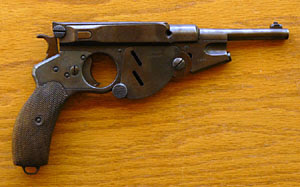
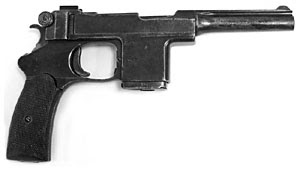
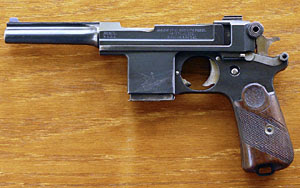
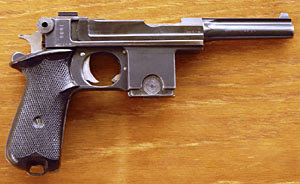
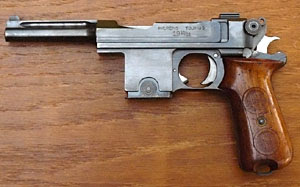
The Bergmann Pistols

Image result for Bergmann Pistols
Related image
Related image

The Bergmann Pistols

by Ed Buffaloe

Historical Perspective
Theodor Bergmann (1850-1931) was from a family of brewmeisters and innkeepers in Spessartdorf, Germany.
Early on he worked for a local stove manufactory, which awakened his interest in the metal working business.  Michael Flürscheim (1844-1912) purchased the Eisenwerke Gaggenau (Gaggenau Ironworks), which was already several centuries old, in 1873; and in 1879 Theodor Bergmann, at the age of 29, became a managing partner in the firm.
In the last quarter of the 19th century Eisenwerke Gaggenau manufactured structural steel, bridges, railings, lamp posts, railroad switches, signalling equipment, gas regulators, crushing mills, paint mills, enamel signs, household hardware, stoves, wrought iron fences, bicycles, rifles, and airguns.
The company still exists today, making kitchen appliances, and calls itself simply Gaggenau.
Flürscheim received a German patent for an air pistol in 1878, two patents for improvements to the design in 1879, and was granted further air gun patents in the 1880’s.
The Flürscheim air pistol was a close copy of the Haviland and Gunn design which had been patented in the U.S. in 1872.  In 1884 Bergmann licensed rights to an airgun patent of Henry Quackenbush.
By 1891 Eisenwerke Gaggenau was manufacturing hunting rifles, military rifles, gun barrels, and reloading tools, as well as air pistols, air rifles, pellets, and darts.  Bergmann later manufactured a small number of airguns under his own name.

Brauswetter Patent Drawing

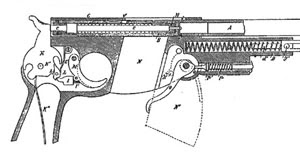
1892 Brauswetter Patent Drawing

On 6 April 1892 a Swiss patent was issued to the Hungarian watchmaker Otto Brauswetter and Aktiengesellschaft Eisenwerke Gaggenau for a self-loading pistol design.  But somehow Bergmann obtained the rights to the patent from Eisenwerke Gaggenau.
Louis Schmeisser was assigned the task of improving Brauswetter’s design.  Beginning in 1893, Bergmann filed a series of patents, one nearly every year through 1901, for mechanisms relating to self-loading firearms, some of which were clearly based on Brauswetter’s earlier patent.  These designs were the work of Louis Schmeisser.
According to Walter, “Bergmann left Eisenwerke Gaggenau in the early 1890’s to exploit Schmeisser’s automatic pistol patents.”  The founding of Bergmann’s new company, Bergmanns Industriewerke, is variously dated between 1893 and 1895.
Apparently, Bergmanns Industriewerke made many of the same items as Eisenwerke Gaggenau, including enamel signs, toilets, stoves, bicycles, guns, ammunition, and later automobiles.  Bergmann received many patents over the years for items other than weapons.
Theodor Bergmann himself is often described in the literature as an inventor, though Ian Hogg in his later writings indicates that he was more a businessman and entrepreneur who exploited the inventions of others, citing in particular Louis Schmeisser, who worked for Bergmann for a number of years.
Ezell also states that Bergmann was “…primarily an industrialist and entrepreneur….”  In searching for patents in Bergmann’s name, I discovered that he continued to take out patents on various machines and weapons right up to the time of his death, long after he had sold his automobile and weapons businesses.
Whether this represents the activity of an inventive genius or simply a very shrewd businessman I cannot say.
Early Bergmann Automatic Pistols
Model of 1892.  According to James B. Stewart, this was Brauswetter’s design, at least one prototype of which was tested by the Swiss against their 1882 revolver.  The gun is described as a long-recoil locked-breech design, the unlocking of which was accomplished by lateral displacement of the bolt.
It was chambered for the 7.5mm M1882 Swiss revolver cartridge.  Interestingly, Hogg and Ezell both state that the locked breech design was never manufactured and the gun tested by the Swiss was a delayed-blowback action which featured an inclined plane in the frame to delay recoil of the bolt .
Whatever the case, the gun had a clip-loaded magazine forward of the trigger with a pivoting side cover and a simple revolver-style single action lockwork mechanism, as shown in Brauswetter’s patent.  Also, according to Hogg, there are no known examples of the M1892 extant.

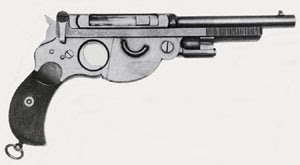
Model 1894 Bergmann-Schmeisser 8mm

M1894 Bergmann-Schmeisser (No.1)

Model of 1894, also known as the Bergmann-Schmeisser, and later as the Bergmann No.1.  This model was covered by patents filed in 1893 and later.  The gun was similar to the Model 1892, except that it was blowback operated, with no locking or delaying action.
The recoil spring was beneath the barrel.  Like the Brauswetter design, the magazine was forward of the trigger guard and had a pivoting cover on the right side of the gun.  The M1894 had no extractor.
Several sources state that it was chambered for a 5mm tapered conical cartridge with no rim or groove (eventually designated the Bergmann No. 1).
However, Stewart says that 8mm is the only caliber this gun was manufactured in, and he displays a photograph of serial number 9 , which he says is in 8mm.   Likewise, Boothroyd lists an 8mm rimless grooveless “Bergmann-Schmeisser” cartridge, in addition to the “5mm Bergmann Model 94” cartridge.
Some sources seem to classify all extractor less Bergmanns as Model 1894 but, as I see it, the distinguishing feature of the M1894 is the recoil spring under the barrel.
Very few of the M1894 guns were made, and I have some suspicion that they may have essentially been prototypes for the later M1896.

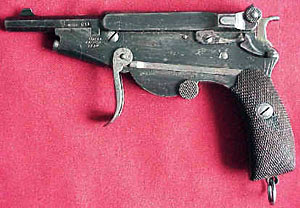
Model 1896 Bergmann No.2 w/ Folding Trigger

M1896 Bergmann No.2 with Folding Trigger

Model of 1896–the Bergmann No.2, No.3, and No.4.  The M1896 was an improved version of the M1894 (covered by patents filed late in 1895).
It was primarily manufactured as a pocket pistol in 5mm (the No.2) and 6.5mm (the No.3), though a limited number of larger guns were manufactured in 8mm (the No.4).  The No.2 was also available in a folding-trigger version.
The early No.2 and No.3 guns had no extractor and fired rimless, grooveless cartridges with tapered conical cases; ejection was accomplished by gas pressure and facilitated by the conical shape of the cartridge.
However, ejection was not reliable because the cases did not always strike the ejector at the proper angle and would hang in the ejection port–eventually an extractor was deemed necessary.
The cartridges were redesigned to have grooves, though the unusual conical design was retained.
Barrels on the M1896 were easily removeable for cleaning.

Model 1896 Bergmann No.3

M1896 Bergmann No.3

The No.2 pistol barrel was held in place by a single locking lug and a retaining screw.
The No.3 and No.4 pistol barrels screwed into the receiver and were likewise held with a retaining screw.  The recoil spring ran inside the bolt, surrounding the striker.  A gas escape port was provided on the right side of the chamber, somewhat reducing the efficiency of the already-weak cartridges.
The magazine was identical to that on the M1894.  A five round clip was placed in the magazine, and a spring arm tensioned the cartridges when the cover was closed.  The clip could be left in place or removed (using the finger loop), as desired.
Hence, cartridges could also be loaded without the clip by simply laying them in the magazine and closing the cover.  R.K. Wilson states that the feed system was unreliable and jams were frequent, whether the clip was left in place or not.  Ejection was to the top, and the ejection port on the Nos. 3 and 4 pistols was covered by a sliding plate.
The M1896 was the first Bergmann pistol to be provided with a means of attaching a shoulder stock.
R.K. Wilson reports that the early Bergmann pistols were available with a lot of special options, including heavy barrels, target sights, hair triggers, and fancy grips.
According to Boothroyd, DWM code No. 416 was the original 5mm rimless grooveless cartridge for the M1894 No.1 pistol, and was also used in the early M1896 No.2 pistol.  When the cartridge was eventually given an extractor groove, it became DWM No. 416A.
The early No.3 pistol fired the 6.5mm rimless grooveless DWM No.413.  The updated cartridge with an extractor groove was DWM No.413A.

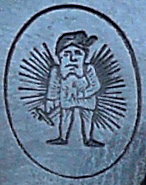
Bergmann Miner Logo

According to Stewart, the No.4 pistol was a variant of the No.3, chambered for a much more powerful straight sided 8mm rimless cartridge with an extractor groove, which of course was called the No.4 cartridge (DWM No.451).
The No.4 pistol was made in limited quantities around 1897, and serial numbers fall in the range between 2300 and 3000.
The later M1896 guns were manufactured by the Valentin Christoph Schilling Company of Suhl (often rendered V. Charles Schilling), because about this time Bergmanns Industriewerke had begun the manufacture of automobiles at their Gaggenau facility and presumably had insufficient space and/or manpower for the gun business.  “Bergmann” means “mountain man” and by extension “miner.”
The logo Bergmann used on his pistols was a miner.  Pistols made by Schilling have “Gaggenau” added at the top of the logo and the letters “V.C.S.” and the word “Suhl” added at the bottom.

Field Stripping the Model 1896 Bergmann

  1. Make sure the chamber is empty.
  2. Remove the screw at the rear of the bolt on the right side.
  3. Cock the hammer and tip the gun backward–the firing pin should fall out.
  4. Remove the rectangular pin through the bolt (to either side) and catch the recoil spring as it exits the rear of the bolt.
  5. Remove the bolt.
  6. Remove the bolt cover by lifting at the rear.
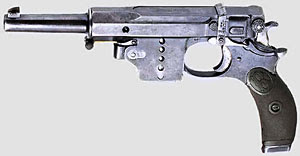
M1897 Bergmann No.5

Bergmann Model 1897

Model of 1897, also known as the No.5, or the M1897 Military.  This gun was covered by German patent number 98318, dated 10 March 1897, and was Bergmann’s first military pistol since the M1892 prototype.
It featured an improved version of Brauswetter’s locked breech design.  The barrel and breech bolt recoiled together for 6-7mm, whereupon the barrel was arrested and a cammed surface caused the bolt to be displaced laterally to the right about 3mm, whence the bolt could continue recoiling, extract and eject the spent case, and feed a new cartridge.
The M1897 retained a gas escape port on the left side of the chamber, similar to the earlier Bergmanns, even though it had a positive locked breech.  The gun had a top-mounted spring steel extractor, and the ejection port was covered by a sliding plate.
The recoil spring surrounds the striker, described by Wilson as a “long, thin floating pin.”  The cartridge was a powerful 7.8mm rimless cartridge with an extractor groove very similar to the 7.63mm Mauser.
It was known as the Bergmann No.5 cartridge (DWM No.461).  A ten round rectangular detachable box magazine was provided, which could be loaded by clip from the top of the gun if desired.
All future Bergmann pistols used similar magazines.  The magazine and frame both had holes to make cartridges visible to the shooter.  The grip had a slot on the bottom to take a shoulder stock.
Approximately 800 M1897 pistols were made.  The U.S. Army Ordnance Department tested one in 1901, but did not purchase any for further testing.
Model of 1899 or No.6 Pistol.  After failing to get a military contract for the M1897, Bergmann went through a period of experimentation, during which a number of pistols were made for testing, but only the M1897 continued to be produced commercially.
The No.6 locked breech pistol may have been a hybrid of the No.4 and No.5 pistols, and was chambered originally for an 8mm rimless cartridge with an extractor groove, first known as the No.4S and later as the No.7 (DWM No.460).  Two No.6 pistols were tested in Switzerland in 1900.
The gun was redesigned in 1901 with some similarities to the M1897, and prototypes were made to shoot the 7.5mm No.7A cartridge (DWM No.460A) and the 7.65mm No.8 cartridge (DWM No.KK475).

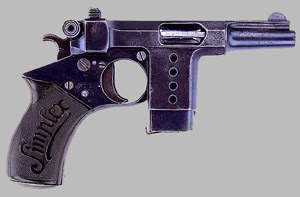
Bergmann Simplex 8mm

Bergmann Simplex

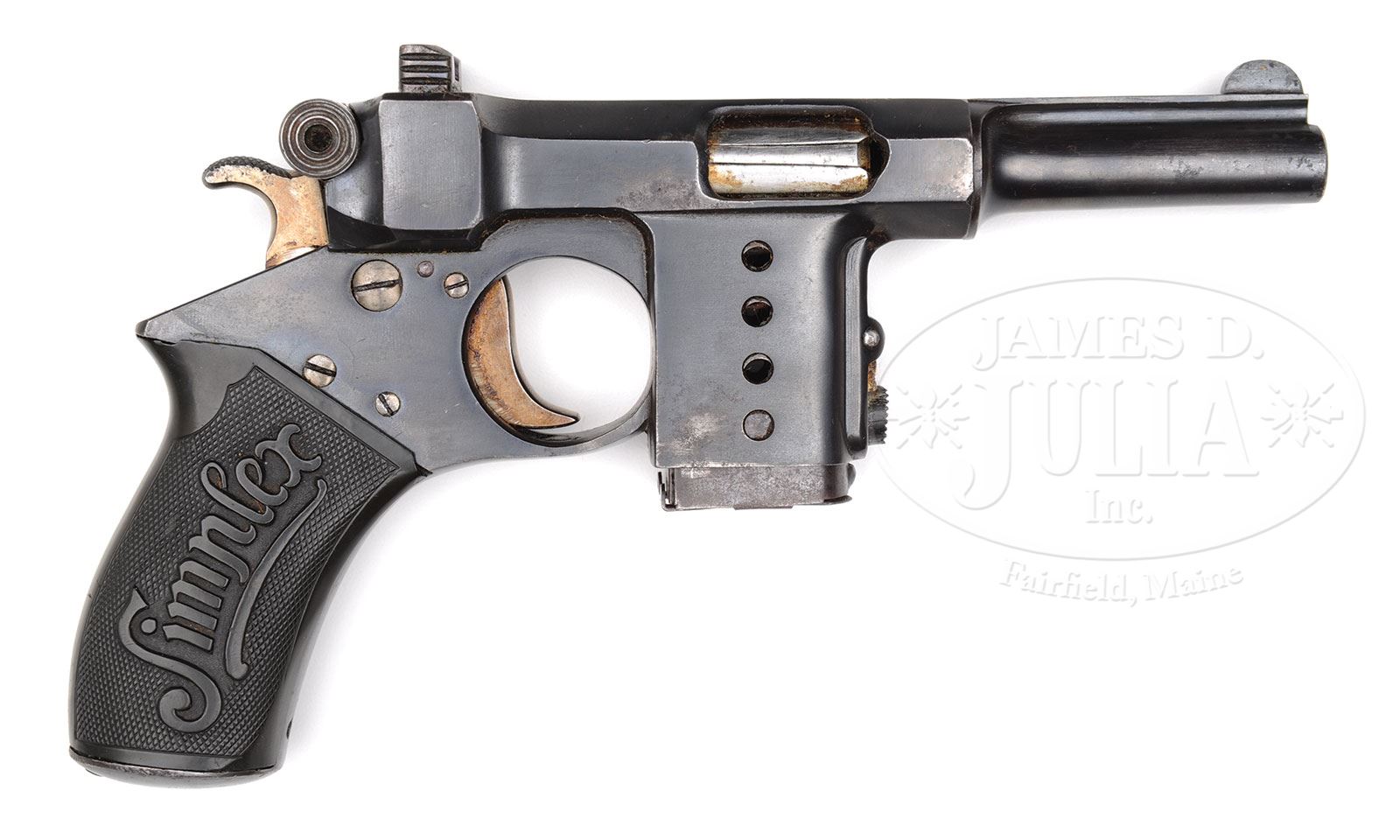
Bergmann Simplex.  Eventually the No.6 pistol was reduced in size and simplified into a blowback operated pistol firing the Bergmann 8mm No.6M/06 cartridge (DWM No.488), said by R.K. Wilson to be similar in characteristics to the 7.65mm Browning (.32 ACP).
This final production version of the No.6 pistol was known as the Bergmann Simplex.  The gun had an ejection port on the right side of the frame, and the extractor mounted on the right side of the bolt.
A manual safety lever on the left side of the frame can be conveniently operated by the thumb.  The magazine was like that of the M1897.
Approximately 4000 Simplex pistols were made through 1903, but Stewart says that the gun was “not up to Bergmann standards” and “suffered from constructional weaknesses.”  Early Simplex pistols were made in Germany by V.C. Schilling, but later guns were made in Belgium..  R.K. Wilson says the Simplex was “.. .made in Belgium of inferior material and finish.”
The Simplex might have had greater success but for the introduction of the Model 1899 FN Browning, which set the bar for manufacturing quality, reliability, and accuracy in pocket auto pistols.
The Bergmann Mars of 1903

Bergmann Mars 9mm

Bergmann Mars

In 1901 Louis Schmeisser designed (and Bergmann patented) a locked action mechanism for a machine gun, which in 1903 they applied to the design for a new pistol, which was called the Mars.
Externally the gun looked and operated very much like other Bergmann pistols, with the rectangular box magazine in front of the trigger guard holding six rounds in two staggered columns, and the usual single action revolver-style lockwork.
The new locking mechanism featured a hollow cubic block, able to move up and down in a square cut in the barrel extension.  The square section bolt fits through this block.
A lug on the bottom of the bolt fits into a recess in the bottom of the cubic block.  The block is made such that it has exactly 1/8 inch of vertical play around the bolt.
The lower forward and upper rear edges of the block are bevelled.  When the weapon is fired the barrel and bolt recoil together, along with the cubic block, for about 1/4 inch, whereupon the bevelled upper surface of the block, moving against the upper surface of the square frame section, is forced down 1/8 inch into a recess in the rear of the barrel extension, unlocking the bolt from the recess in the bottom of the block and allowing it to continue to recoil, extract and eject the spent case, and feed a new cartridge.
This is a positive locking action suitable for high-power military cartridges.  As in earlier Bergmann pistols, the recoil spring runs inside the bolt, around the striker.  The striker itself is a long, thin pin with a return spring at its point.
Prototype Mars pistols were chambered for the 7.8mm No.5 cartridge (DWM No. 461), the 9mm No.6 cartridge (DWM No. 456), a new 10mm cartridge (never produced commercially), and a new 11.35mm cartridge (DWM No. 490 ).
The British Chief Inspector of Small Arms tested the 9mm pistol, two versions of the 10mm pistol, and ultimately the 11 .35mm pistol, but none was accepted for British use.
Finally, however,on 5 September 1905 the Spanish government placed an order for 3000 of the 9mm Mars pistols for evaluation.
According to Antaris, the Bergmann was never formally adopted by the Spanish military.  However, Ezell states that the gun was recommended for adoption by the Spanish ordnance testing commission and that a royal decree of 5 September 1905 declared it to be the Pistola Bergmann 9 m/m Modelo 1903.
Juan Calvo provides nearly identical information.
Bergmann managed to get his 11.35mm Mars to the U.S. Ordnance Department for testing in 1906, but the ammunition for it was impounded by U.S. Customs, so it was not tested.
In 1907 he sent a Mars pistol specially chambered for the .45 ACP.  Almost all the manufacturers involved in the tests had complained about the Frankford Arsenal .45 ammunition issued to them, which had widely varying tolerances.  Bergmann had had some .45 ACP ammunition made in Germany, to the correct specifications, but once again U.S. Customs impounded it.
Frankford Arsenal was instructed to provide some .45 ammunition meeting the tolerances specified by Bergmann for use in his gun, but when tested the force of the hammer blow from the Bergmann pistol was insufficient to ignite the primers, so the Bergmann was eliminated.
Bergmann’s in-house manufacturing facility for guns had always been small, and commercial manufacturing for his pistols had been routinely outsourced to the V.C. Schilling company of Suhl since 1896.
But in 1904 Schilling was bought out by the Heinrich Krieghoff company, which had other plans for the Schilling factory.  After completing work on outstanding contracts in early 1905, Schilling’s cancelled its manufacturing agreement with Bergmanns Industriewerke.
Bergmanns Industriewerke set up a small factory in Gaggenau which manufactured less than 1000 Mars pistols, but only delivered a small number to the Spanish between 1903 and 1908 for testing purposes.
The relatively small 3000 gun contract with the Spanish didn’t justify the tooling up necessary to manufacture them in quantity, and Bergmann failed to find another large customer for the Mars, so he sold his Spanish contract to Anciens Établissements Pieper (AEP) of Herstal, Belgium.
AEP had been desperately seeking new business since they had lost their Belgian army contracts to Fabrique Nationale.  Due to the expense of tooling up, AEP insisted that they should also have the right to manufacture and sell a commercial version of the Mars.
At this point Bergmanns Industriewerke agreed to give up making military pistols altogether and turned its attention to machine guns.
The Bergmann Bayard of 1908

M1908 Bergmann Bayard

M1908 Bergmann Bayard

Meanwhile, the Spanish Comisíon de Experiencias de Artilleriahad been testing the Mars pistols that had been delivered and requested a number of changes to the design.
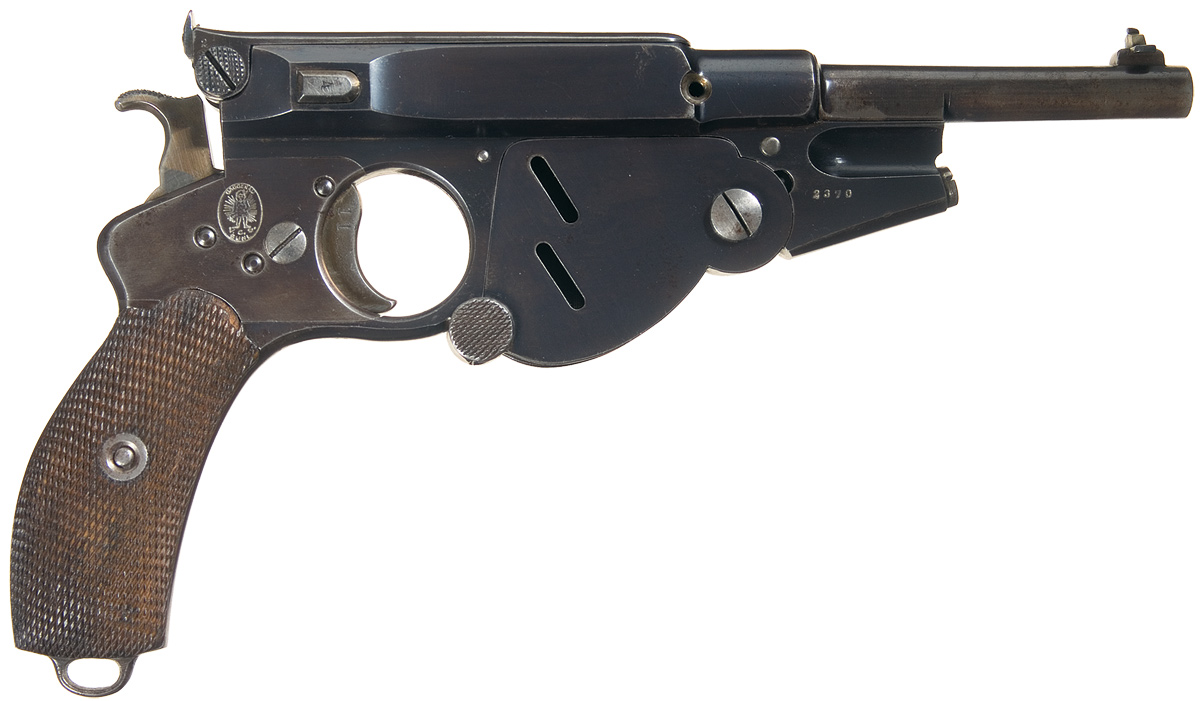
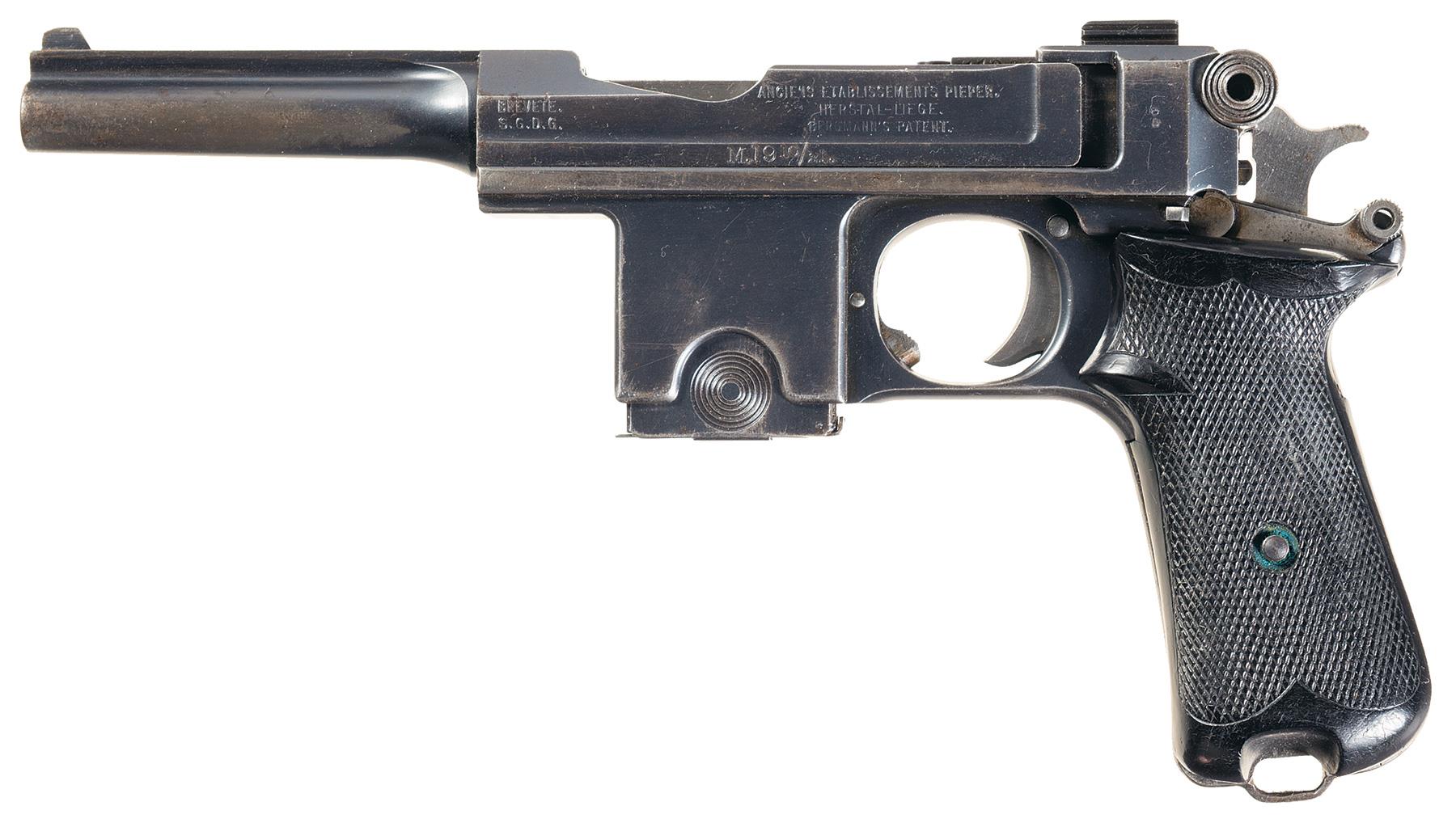
The redesigned pistol became known as the Model 1908 Bergmann Bayard (Bayard being a trademark of Anciens Établissements Pieper).
Perhaps the most significant change was the introduction of a disconnector to assure that the gun didn’t go full automatic.
The barrel was milled out of the solid rather than being screwed in as on the Mars, and was 1/8 inch shorter.  The Bergmann Bayard barrel had six grooves with narrow lands and a left hand twist, whereas the Mars had only four broad grooves with wide lands and a right hand twist.
Other changes to the Belgian gun included adding a hammer stop pin, a larger magazine catch, a shortened throw for the manual safety, a more rounded grip shape, hard rubber grips, and slightly different contours for the frame and barrel extension.  R.K. Wilson described the Bergmann Bayard as “rather more heavily built” than the Mars.
Serial numbers began at 1000.  AEP also redesigned the 9mm Bergmann No.6 cartridge, which subsequently became known as the 9mm Bergmann-Bayard, and in Spain as the 9mm Largo.
AEP fulfilled the Spanish contract before the end of 1909.  The Spanish guns were stamped with the early Spanish acceptance proof mark (a circle divided into thirds) on the left side frame bridge and the top of the breech.
Also on the left side frame bridge was a four-digit Spanish issue number.  The M1908 was used by the Spanish army until it was replaced by the Campo Giro in 1916, and continued in use by the Spanish police through 1939.

Danish M1910 Bergmann  Bayard

Danish M1910 Bergmann Bayard

AEP sent test guns to the British and Danish in 1910.  The British Chief Inspector of Small Arms issued a negative report, but the Danes placed an order for 4840 pistols, with modifications.
The requested modifications included a simplified disconnector, enlarged wooden grips, finger cutouts on the magazine well, grooved gripping surfaces on the magazine, an S-shaped mainspring, and a key on the locking block to prevent it from being inserted incorrectly during assembly.  Pieper made these changes quickly and began delivering the guns in 1911.
This updated gun became known as the Bergmann Bayard Model 1910.  Serial numbers of Danish contract guns range from the low 6000s to approximately 11,000.  The guns feature full Belgian commercial proofs on barrel and bolt, and are engraved with Danish army serial numbers (from 1 to 4840) on the right side of the bridge at the rear of the gun.
AEP also made a small number of commercial pistols based on the Model 1910.  The only one we have documented has a 10,000 series number, and does not feature the Bayard horse and rider logo.
AEP made holster stocks for some of their M1910 commercial production pistols.  The guns had a slot cut in the rear grip strap to accept the stocks, which also attached to the lanyard on the bottom of the grip.
Commercial guns were produced in the 12,000 and 13,000 serial number range which were of the M1908 design and featured the Bayard horse and rider trademark on the left side of the magazine well.  AEP referred to these guns as the Model 1912.
Spanish contract and commercial production pistols were marked

ANCIENS ETABLISSEMENTS PIEPER.
HERSTAL-LIEGE.
BERGMANN’S PATENT

in sans-serif characters on the left side of the barrel extension behind the ejection port.  The serial number is on the bottom of the frame just below the chamber of the barrel.
The German army overran Belgium in August of 1914 and took over all the arms manufacturers in Liege and Herstal.  Under German occupation, AEP was forced to continue manufacturing Bergman Bayard pistols, which by that time were in the 15,000 and 16,000 serial number ranges.
These guns either had no proof marks, or featured a single small proof of a diamond with an apple in the center.  Manufacture ceased after the war, but pistols in the 17,000 serial number range were assembled by AEP from existing parts.

Danish M1910/21 Bergmann

Danish M1910/21 Bergmann

After the war, the Danes needed replacement parts for their M1910 pistols, but could not obtain them from AEP, so they decided to manufacture the guns themselves.
They made a few changes, which included further enlarging the magazine catch, replacing the small wooden grips with oversized grips made from Trolit (a proprietary cellulose-acetate plastic), and replacing the side plate catch on the right side of the gun with a screw (hidden by the oversize grips).
The new gun was designated the M1910/21.  Most existing pistols were eventually modified to these specifications and stamped M.1910/21 on the left side of the barrel extension.  Some later models had broken Trolit grips replaced with wooden grips of the same size.
900 pistols were made between 1922 and 1924 and marked HÆRENS TØJHUS, beneath which was 1910/21.  Another 1904 pistols were manufactured between 1924 and 1925 and marked HÆRENS RUSTKAMMER.
Serial numbers began with 1.  The army issue numbers on the guns follow those of the Belgian guns, beginning with 4841 and ending with 7045.
M1910/21 pistols have a Danish crown acceptance mark and the last two digits of the year of manufacture stamped on the right side.
R.K. Wilson sums up his opinion of the Bergmann Bayard by saying:  “ The Bergmann-Bayard is a clumsy, unhandy weapon.
The grip is too narrow for the average hand and the pistol, when the magazine is loaded, is very muzzle heavy.”  The larger grips installed by the Danes improved the feel of the gun in the hand considerably.
Dennis Adler, in his article in Guns & Ammo, reports that his test gun was reasonably accurate at ten yards.

Field Stripping the Bergmann Bayard

  1. Remove the magazine.
  2. Draw the bolt back to cock the hammer and make sure there is not a round in the chamber.
  3. Using a cleaning rod or drift punch, depress the firing pin and remove the retention pin from the right side of the gnurled retraction knob on the bolt.
  4. Withdraw the firing pin and firing return pin spring.
  5. Holding a finger over the hole in the bolt (to prevent the mainspring from flying out), press the rear sight forward and pull it up.
  6. Withdraw the mainspring from the bolt.
  7. Withdraw the bolt from the back of the barrel extension.
  8. Push the barrel/barrel extension forward and lift up at the front to free it from the frame.
  9. Note the orientation of the cubic locking block in the barrel extension–it must be oriented correctly.  The later Danish-made guns have alignment marks on the block and the barrel extension.

Note:  When reassembling, the broad end of the firing pin can be used (flat side up) to push the recoil spring in far enough to insert the rear sight in front of it.  The locking block will only go in one way, so its orientation should be carefully noted.

Note:  The author welcomes corrections and additional information from informed readers,
as well as additional photographs of any Bergmann pistol.

Copyright 2009-2010 by Ed Buffaloe.  All rights reserved.
Click most photographs to open a larger version in a new window.

References

“Cal. .45 Revolver and Automatic Pistol Ammunition for the 1906-1907 Trials,” by F.W. Hackley and E. L. Scranton.  Woodin Laboratory.  International Ammunition Association Journal, #395, May-June, 1997.
Astra Automatic Pistols, by Leonardo M. Antaris.  FIRAC, Sterling, CO:  1988.
“Bergmann System Military Pistols,” by James B. Stewart.  Gun Digest, 1973.
Blue Book of Airguns, by by Dr. R. Beeman, J. Allen, and S. P. Fjestad.  Blue Book Publications, Minneapolis, MN:  2008.
Dictionary of Guns and Gunmakers, by John Walter.  Greenhill, London:  2001.
German Handguns, by Ian V. Hogg.  Greenhill, London:  2001.
German Pistols and Revolvers, by Ian V. Hogg.  Galahad Books, New York:  1971.
The Handgun, by Geoffrey Boothroyd.  Bonanza, New York:  1970.
Handguns of the World, by Edward C. Ezell.  Barnes & Noble, New York:  1981.
Danish Bergmann Bayard M1910 and M1910/21
Horst Held Bergmann Collection
Pistols and Revolvers in the Spanish Armed Forces, 1855-1955, by Juan L. Calvo.

Categories
War

A neat couple of Bullets from the Crimean War


Bang on target! Crimea War bullets collided in a billion-to-one chance

As an illustration of luck, it doesn’t get much more explosive.
This remarkable picture shows how two bullets from opposing troops fused after striking each other in mid-air.
The odds of the clash are said to be a billion-to-one and it could well have saved the lives of two soldiers.

light brigade bullets

Billion to one chance: Two bullets (one French, one Russian) which fused in mid-air during the Crimea War. It is almost impossible to tell where one ends and the other begins

What makes the discovery more incredible is that the bullets are 150 years old and were found on the battlefields of the Crimean War, now in Ukraine. One has been identified as Russian, the other French.
The discovery is said to have been made close to Balaclava, site of the notorious Charge of the Light Brigade, one of the most notorious events in British military history.
The finder of the bullets – a walker whose name has not been disclosed – is said to be seeking to sell the unique war memorabilia to a military museum.

Crimean War

Conflict: French troops march on Russian lines in the Crimean War

The Ukrainian authorities were unable to throw any light on the exact circumstances of the find or who had validated the discovery as being genuine Russian and French bullets.
A spokesman for the local authority in the Crimea said: ‘We have no official information about this discovery.’
Nor has the exact site of the discovery been disclosed, though there has been a wide discussion of the bullets in blogs.

charge of the light brigade

Warfare at its most courageous and tragic: The Charge of the Light Brigade in 1854 during the Crimean War

The Crimean War, between 1853 and 1856, was fought between tsarist Russia and an alliance of Britain, France and the Ottoman Empire.
More than 374,000 perished in the campaign, including 2,755 British killed in action, 2,019 from wounds and 16,323 from disease.
At issue was European influence over the territories controlled by the declining Ottoman Empire.
light brigade bullets

The bullets would originally have looked like this

The Crimea War also brought to public attention the pioneering nursing of Florence Nightingale – called ‘The lady with the lamp’ – who cared for soldiers killed in battle but also from diseases such as typhoid, cholera and dysentery.
The Charge of the Light Brigade was seen as highlighting the failings of aristocratic, self-centred generals who appeared to have little concern for casualties.
It is recalled in the poem by Allfred, Lord Tennyson, as showing war at its most courageous and horrific.
Read more: http://www.dailymail.co.uk/news/article-1157582/Bang-target-Crimea-War-bullets-collided-billion-chance.html#ixzz4xrGxvEoi

Categories
Born again Cynic! The Green Machine War Well I thought it was funny!

French Passport!

Related image