
But its better than this happening!
But its better than this happening!

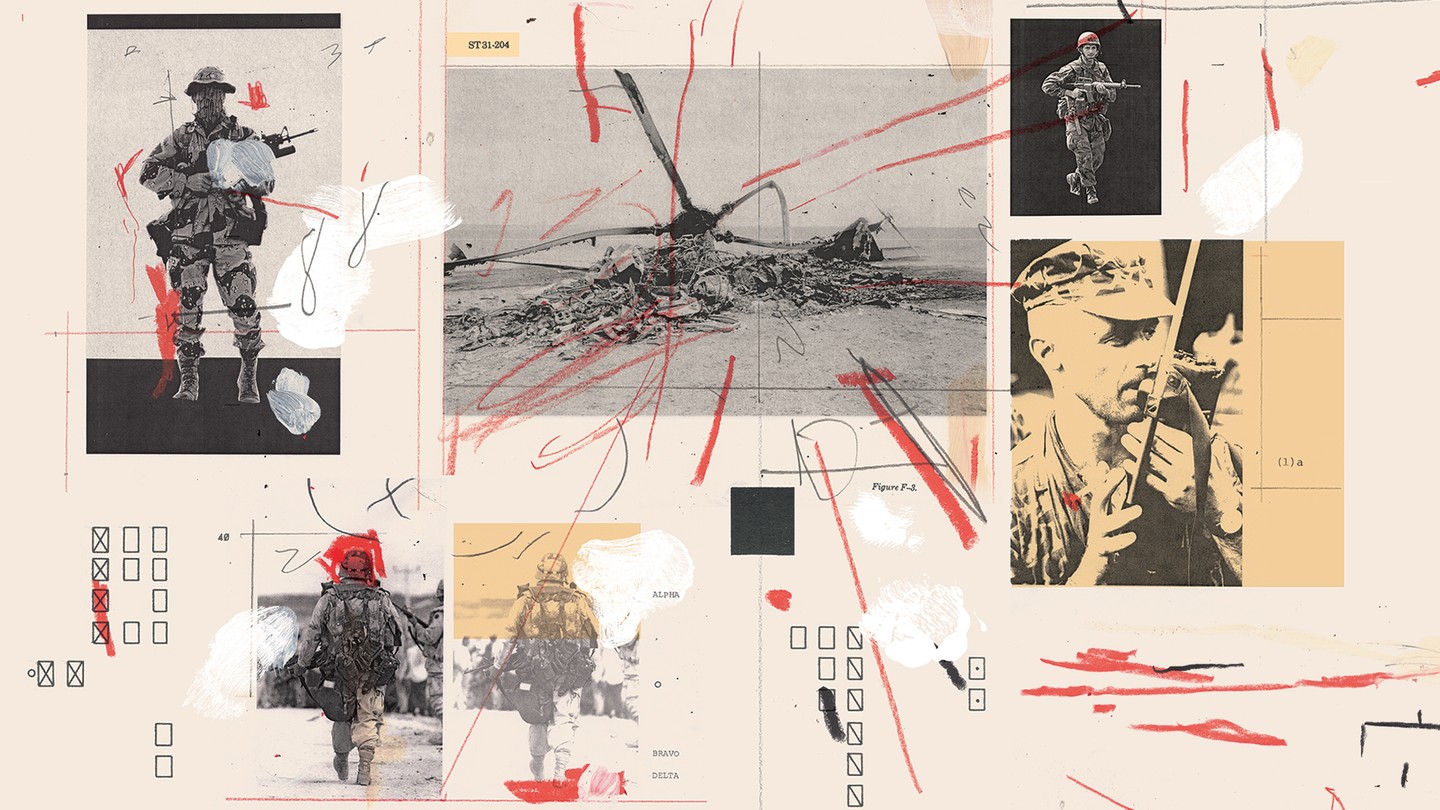
They’ve become a major military player—and maybe a substitute for strategic thinking.
Illustrations by Mike McQuade
Image above, clockwise from top left: A U.S. Army Special Forces sniper, 1991; the aftermath of Operation Eagle Claw, the failed U.S. rescue operation in Iran, 1980; a marine during the invasion of Grenada, 1983; Captain Vernon Gillespie Jr. in Vietnam, 1964; soldiers on patrol at Camp Victory, in Somalia, 10 days after 18 Americans were killed during the Delta-led Battle of Mogadishu, 1993.*
This article was published online on March 12, 2021.
Updated at 7:17 p.m. ET on March 12, 2021.
Within the span of a few decades, the United States has utterly transformed its military, or at least the military that is actively fighting. This has taken place with little fanfare and little public scrutiny. But without any conscious plan, I have seen some of the evolution firsthand. One of my early books, Black Hawk Down, was about a disastrous U.S. Special Ops mission in Somalia. Another, Guests of the Ayatollah, about the Iran hostage crisis, detailed an abortive but pivotal Special Ops rescue mission. U.S. Special Operators were involved in the successful hunt for the drug lord Pablo Escobar, the subject of Killing Pablo, and they conducted the raid that ended the career of Osama bin Laden, the subject of The Finish. By seeking out dramatic military missions, I have chronicled the movement of Special Ops from the wings to center stage.
Discover “Where Memories Live”
In the second chapter of “Inheritance,” The Atlantic explores how place informs history—and how history shapes who we are.
Big ships, strategic bombers, nuclear submarines, flaring missiles, mass armies—these still represent the conventional imagery of American power, and they absorb about 98 percent of the Pentagon’s budget. Special Ops forces, in contrast, are astonishingly small. And yet they are now responsible for much of the military’s on-the-ground engagement in real or potential trouble spots around the world. Special Ops is lodged today under the Special Operations Command, or SOCOM, a “combatant command” that reports directly to the secretary of defense. It has acquired its central role despite initially stiff resistance from the conventional military branches, and without most of us even noticing.
It happened out of necessity. We now live in an open-ended world of “competition short of conflict,” to use a phrase from military doctrine. “There’s the continuum of absolute peace, which has never existed on the planet, up to toe-to-toe full-scale warfare,” General Raymond A. “Tony” Thomas, a former head of SOCOM, told me last year. “Then there’s that difficult in-between space.”
SOCOM, whose genealogy can be traced to a small hostage-rescue team in 1979, has grown to fully inhabit the in-between space. Made up of elite soldiers pulled from each of the main military branches—Navy SEALs, the Army’s Delta Force and Green Berets, Air Force Combat Controllers, Marine Raiders—it is active in more than 80 countries and has swelled to a force of 75,000, including civilian contractors. It conducts raids like the one in Syria in 2019 that killed the Islamic State leader Abu Bakr al-Baghdadi, and carries out drone strikes like the one in Iraq in 2020 that killed Iranian Major General Qassem Soleimani. It works to locate hidden nuclear-missile sites in North Korea.
Using conventional forces is like wielding a sledgehammer. Special Ops forces are more like a Swiss Army knife. Over the years, the U.S. has found out just how versatile that knife can be; the flexibility and competence of Special Ops have proved invaluable. At the same time, the insularity and elitism of these units have bred a culture with elements that some of their own leaders, to their credit, have described as troubling, and that have, in certain instances, evidenced contempt for the traditional values of America’s armed forces. Much of SOCOM’s action takes place in secret. Most Americans are unaware that it has been active in a country until the announcement that its forces are being withdrawn. Or until something goes wrong—as in Niger in 2017, when four Special Ops soldiers were killed in an ambush.
Notably, its continued growth has been spurred by both success and failure. And perhaps because Special Ops is such a flexible tool, that growth has enabled the U.S. to multiply the way it uses force abroad without much consideration of overarching strategy. The advent of nuclear weapons, in the 1940s, presented leaders with urgent ethical and strategic imperatives. Defining the purpose of such weapons automatically demanded fresh thinking about the bedrock values of a democracy, the nature of multilateral alliances, the morality of warfare, and the scope of U.S. ambitions in the world. Because of its sub-rosa nature, Special Ops has not compelled the same kind of reckoning—and, in fact, may foster the illusion that a strategic framework is not necessary. It’s good to have a Swiss Army knife. And yet even a versatile knife can do only so much.
How did special ops come to occupy such a central role in American military operations—and even foreign policy?
The history of its rise is telling. In a defense establishment where each branch already sells itself as one of a kind—“The few. The proud”—there has been long-standing institutional distaste for a separate elite force, one that siphons off experience and talent and that is first in line for difficult missions. President John F. Kennedy bucked this convention when he stood up the Green Berets. It was a bright idea that burned out in Vietnam, where an initial commitment of Green Beret advisers—who did more than advise—escalated into a full-blown war, with more than 500,000 American troops deployed at its peak. The Green Berets survived as an elite unit, but many ambitious Army officers considered a berth in Special Forces a career-killer.


Then came the Iran hostage crisis, in November 1979. Two days after Iranian students stormed the U.S. embassy in Tehran, America’s top brass convened in the “Tank,” a subterranean conference room at the Pentagon, to consider how the military might respond if President Jimmy Carter ordered it to act.
Something called the Delta Force already existed on paper. It was the brainchild of Colonel Charlie Beckwith, a profane, hard-drinking, stubbornly tenacious Army officer who had served briefly with the British Special Air Service in Malaya. He had agitated so long to create a similar multipurpose commando unit within the U.S. military that he had alienated many up the chain, which helped explain why he was still a colonel when he retired. But in the mid-1970s, two spectacular rescue missions captured the headlines. A special Israeli unit stormed an airport in Entebbe, Uganda, in 1976, rescuing more than 100 passengers who had been taken from a hijacked airliner.* A year later, a special German unit did much the same in Mogadishu, Somalia. Beckwith’s stock abruptly rose.
When the Tehran embassy was seized, Delta Force had yet to undertake a mission, and the challenge posed was beyond any imagined for it. Rescuing scores of American hostages from a city of hostile millions who gathered regularly to chant “Death to America,” situated hundreds of miles from any potential staging area, was nothing like storming a parked airliner. But Carter wanted a military option.
“Obviously, we don’t want to do this,” said Major Lewis “Bucky” Burruss, Beckwith’s operations officer, as he briefed the brass in the Tank. The “if we must” plan he outlined was a bold and daring Rube Goldberg scenario. The bottom line was plain: We’re not ready.
Months later, they had to be; Carter was desperate. A new plan had been drawn up, only marginally more plausible. Choppers would deliver the Delta team to Tehran and then would pluck the team and the rescued hostages from a stadium near the embassy. They would all be flown to an airfield secured by a company of Rangers. Eagle Claw, as the mission was called, never cleared the first hurdle—getting to Tehran. The only helicopters large enough for the job couldn’t be refueled in-flight, so the choppers had to perform a complex nighttime rendezvous in the Iranian desert with tanker aircraft. An accident at the landing site ignited a fireball that killed eight servicemen. The mission remains one of the most humiliating failures in American military annals—a failure that became the impetus for expanding Special Ops.
In the aftermath of Eagle Claw, an investigation known as the Holloway Commission found the Pentagon woefully unprepared for daring, joint, pinpoint missions. It revealed a crippling lack of interservice and intergovernmental cooperation. Mission planners had had to plead to obtain blueprints of the embassy compound in Tehran. The Navy pilots flying the helicopters across the desert had not even conducted the practice runs the planners had requested.
As a remedy, the Holloway Commission recommended the creation of a Joint Special Operations Command—JSOC, as it would be known. The service branches hated the idea. Admiral James Stavridis, a former U.S. supreme allied commander in Europe and a man who spent his entire career in the conventional ranks, told me, “The Navy didn’t want to give up the SEALs, and the Army didn’t want to give up the Ranger battalions, and the Marine Corps wouldn’t even talk about it. The services fought it and fought it and fought it, at every level.”
Once created, JSOC was treated like a poor stepchild. In the end, a staff of 70 was dispatched to Fort Bragg to handle administrative chores. The group was given Delta Force, a SEAL team, and a rotating Ranger battalion for specific missions. A Special Ops helicopter unit was created. But JSOC depended on haphazard funding and relied on a grudging chain of command for missions.
That is how things stood in October 1983, when the U.S. invaded Grenada, a tiny island in the Caribbean. Its Cuba-aligned Communist government had collapsed, and its leader, Maurice Bishop, had been murdered. Saying he feared for the safety of 600 American medical students at the island’s St. George’s University, President Ronald Reagan had ordered the military to seize control of Grenada and bring the students home. Rescuing hostages being its prime focus, JSOC was a key player in the invasion, which was over fast. It was celebrated as a rousing success by the Reagan White House. But within the military, it was seen as an embarrassment.
General Thomas, now 62, was then a lieutenant who went in with the first wave. He had been a West Point cadet when the disaster in Iran had unfolded, and had no idea then how important that episode would prove to be for the military or for himself. But in fact he would be present for nearly every major U.S. military action of the next four decades.
The Grenada invasion, he said, was “a clown show.” JSOC had to rely on tourist maps for the most part, because military topographic maps were not available. Four SEALs drowned on a preinvasion reconnaissance mission. Cuban and Grenadian military personnel were known to be on the island, but no one knew exactly where or how many, or what kind of arms they had. Teams meant to be working together were unable to communicate because radio frequencies had not been coordinated. “We were lucky we were not up against the A team,” Thomas acknowledged.
Thomas’s platoon was part of an assault on the Calivigny barracks, where several hundred Cuban and Grenadian forces had reportedly retreated for a last stand. The attackers were crammed into four Black Hawks, as many as 15 Rangers in each helicopter—“I mean, just ridiculous loads,” Thomas recalled.
“We came skimming in over the ocean and had three out of the four helicopters crash,” Thomas said. Three more people died. No Cubans or Grenadians were at the barracks.
Major General Richard Scholtes, who had been the JSOC commander at the time of the operation, testified about these and other failures in a closed session of a Senate Armed Services subcommittee in August 1986. Senator Sam Nunn called the testimony “profoundly disturbing, to say the least.” And then he did something about it.
The disaster in iran had led to JSOC. The mistakes in Grenada led to SOCOM. Thanks to an amendment sponsored by Nunn and Senator William Cohen, Special Ops got its own management and its own budget. Its annual budget today is about $13 billion, which is a sacrosanct 2 percent of all military outlays (and roughly what it costs to build an aircraft carrier). The Nunn-Cohen amendment also gave SOCOM clout. From now on, Special Ops would be headed by a four-star general or admiral, and its mission began to expand.
In 1987, Stavridis was a lieutenant commander on a cruiser stationed in the Persian Gulf as part of Operation Earnest Will, the largest naval-convoy mission since World War II. It was guarding Kuwaiti oil tankers, which were a lifeline for Saddam Hussein, who was then locked in a seven-year war with Iran—and being supported by the United States, his future enemy. The tankers were being preyed upon by Iranian forces. Special Ops teams used American ships as platforms to disrupt and counter Iranian attacks. Stavridis was impressed.
“It was the first time that we really started to see them in the field,” he recalled. The Kuwaiti ships had to be boarded and protected, which was not the kind of work the regular Navy did. “We, the Navy—Big Navy—hadn’t boarded a ship in a century,” Stavridis said. “These guys were trained to do that … as opposed to me trying to grab a bunch of boatswain’s mates and hand them a .45 and say, ‘Follow me!’ ”
Special Ops was the star of the 1989 invasion of Panama, an operation that went as smoothly as Grenada had gone badly. A Delta team located the dictator Manuel Noriega, and helped capture and bring him to the United States for prosecution as a drug trafficker and money launderer. Thomas was then a Ranger company commander. He called Panama JSOC’s “graduation event.” Leaders began to find new uses for Special Ops.
When Saddam invaded Kuwait, in 1990, President George H. W. Bush gathered an allied coalition to drive the Iraqis out. That effort, Desert Storm, would be a throwback to conventional warfare—a clash of big armies. But an opportunity for Special Ops quickly arose. In a meeting with the Joint Chiefs of Staff, General Colin Powell, the chairman, handed a report to General Wayne Downing, a former Ranger and then JSOC’s commander. Powell said, “This just in from the Israelis.” Iraq had begun firing Scud missiles at Israel from mobile launchers in the vast western-Iraqi desert. The Israelis were preparing an effort to find and destroy them, something Powell wanted to forestall. If the Israelis entered the war, it would offend Arab states and possibly cripple the coalition.
“Can you do that?” Powell asked Downing. Could he take out the Scuds?
Within days, JSOC teams were camped in remote desert observation posts, launching attacks on Iraqi missile columns from the air or swooping in across the sand in six-wheeled combat vehicles, looking like the pirate gangs of Mad Max. Questions would be raised later about whether these attacks were taking out real missile launchers or decoys fielded by Saddam, but there’s no doubt that the results achieved were fast and dramatic, and kept Israel off the battlefield.
The results were also on film. “We lucked out and came right on a Scud launcher two or three days after we started,” Thomas recalled. The assault was filmed from a helicopter, which flew lower and slower than the jets that provided most of the footage viewed at headquarters. JSOC’s imagery was as intimate and vivid as a video game’s. After the first Scud launcher was destroyed, Downing played the tape at a briefing for General Norman Schwarzkopf, the commander of allied forces, who was struck by the immediacy and detail. “Norm said, ‘Whoa, whoa, is this a training tape from back at Bragg?’ ” Thomas recounted. “And Downing said, ‘No, this was up by al-Qa’im last night in northern Iraq.’ ” Search-and-destroy became another SOCOM specialty.
Experienced socom soldiers were early adopters of new technology, often buying equipment off the shelf that was not available through normal supply lines. As in most other fields, modern telecoms would transform war-fighting.
In December 1998, Thomas had what he called a “sensor-to-shooter epiphany” in the closed back of a truck near Vrsani, a village in northeastern Bosnia. Then a lieutenant colonel, he was in command of a JSOC Delta squadron. The mission was manhunting. Thomas and the squadron had been tracking Radislav Krstić, a one-legged Serbian commander in the Yugoslav wars who had been indicted a month prior by the International Criminal Tribunal for the Former Yugoslavia, in The Hague.
Thomas’s unit had been watching Krstić for days. Surveillance drones were still in the future, but Thomas did have a helicopter with a high-speed camera. It fed a live picture to a Sony television that Thomas held on his lap. His truck was hidden in a thicket about 200 yards from a road he knew Krstić would use. German special forces had provided a snare—a net made of sturdy elastic that could capture even a speeding vehicle.
Gunplay was a possibility, so Thomas had a list of strict no-go scenarios, among them the presence of local police, Russian troops, or children. As Krstić’s vehicle neared, first a Russian convoy approached, then a local military-police vehicle. Both passed by. Finally a school bus rolled into the picture. The effort seemed snakebit. At last, on the screen, Thomas watched the school bus clear the zone, with only seconds to spare. “Execute!” he ordered. Krstić’s vehicle was caught in the net, and he was taken without incident.
Thomas would be teased about the episode: an entire Delta squad to capture a one-legged Serbian? What stuck with him was how much more useful the screen had been than his own two eyes. Without the overhead view covering the whole stretch of road, he would have aborted the mission. It occurred to him: This is where we are going in the future.
Live video feeds were just the beginning. When Stanley McChrystal took over JSOC, in 2003, the U.S. invasion of Iraq was eight months old. Special Ops teams were still hunting Saddam and other “high-value targets” when a new enemy arose: Abu Musab al-Zarqawi, a jihadist known as “The Sheikh of the Slaughterers.” His followers were setting off bombs in crowded places, attacking American soldiers, and kidnapping “infidels” and beheading them in horrific videos posted online.
McChrystal was known as a relentless striver. Gaunt, hollow-eyed, and intense, he was famous for his ascetic discipline. He turned his task force into the most efficient hunter-killer force in the world, and a model for the entire command. McChrystal is not Sun Tzu. But in sizing up his adversary and responding creatively, he remade JSOC, and ultimately SOCOM itself. He recognized that the ability to digitize information—audio files, video files, maps, texts, emails, phone calls, documents—could steer him rapidly to targets.
Like most innovations, McChrystal’s was resisted, including by SOCOM itself. He wanted to expand and alter his mission, adding an array of expertise—in some cases, requiring civilian contractors—that had nothing to do with traditional soldiering. He explained the situation to me in a way that both made his position understandable and underlined the institutional imperatives that push in one direction only. “Inside my command, there were a bunch of people saying, ‘We need to pull back to the States and wait until there’s a hostage rescue or something like that, and we’ll do our specialized mission,’ ” McChrystal said. “And I told them, ‘Hey, if we’re not here doing a significant part of this, we’re not going to be able to claim our elite status and be first in line for resources and priority.’ ” There was also resistance from agencies whose support he needed, notably the CIA, which balked at moving interrogators, analysts, software engineers, and imagery experts out from under their direct control. But McChrystal got what he wanted.
His refurbished, tech-assisted team found, fixed, and finished Zarqawi himself with an air strike at one of his hideouts north of Baghdad in June 2006. By that time, his terror network had been decimated. His death was important in the moment, but it also illustrated the limits of even a highly skillful application of force. The insurgency persisted and ultimately morphed into ISIS. McChrystal’s remarkably successful efforts were less of a factor in reversing the war’s direction than General David Petraeus’s “surge,” in 2007. What McChrystal had done was give SOCOM an amazingly potent new tool.
And people noticed. Money, McChrystal recalled, was available for whatever he needed. The very definition of JSOC changed, again. It was no longer just elite “operators” or “shooters” descending from silent choppers; it had become what a business-school case study might call a fully integrated intelligence-and-assault network. But as McChrystal acknowledged, there would always be skeptics, within SOCOM and elsewhere, who believed that “we ought to go back to being a tiny group of people.” And, as he also acknowledged, a revolution in Special Ops tactics isn’t the same thing as strategic wisdom, or success.
Hostage rescue, manhunting, search-and-destroy missions—these had become the U.S. military’s active pursuits worldwide. Other events secured SOCOM’s status. The most dramatic was the killing of Osama bin Laden, in Abbottabad, Pakistan, in 2011. After the CIA traced his location, a SEAL team penetrated Pakistan’s air defenses and hit his compound. Thomas was second in command on that mission, under JSOC’s Admiral William McRaven, who became SOCOM commander later that year. Despite his background leading shooters, McRaven promoted the softer side of the command, long a major part of its portfolio—the Green Beret teams of people who were familiar with local languages and cultures, knew how to build ties with communities, and had the diplomatic skills to serve as advisers rather than call all the shots.
That approach found a receptive audience in President Barack Obama, who was trying to crush emerging terror threats while at the same time lower American troop levels overseas. SOCOM’s small units would steer the battle against Islamist networks in Africa and Asia, working primarily through local armed forces. Its intelligence network and aerial assets would give Kurdish, Iraqi, and Syrian fighters an overwhelming advantage against ISIS. Utilizing SOCOM, the U.S. was still in the fight, just not openly in the lead, and no longer carrying the full load. This opened Obama to political attacks for “leading from behind,” which revealed a fundamental misunderstanding of the change under way. Happy to keep American forces below the radar, Obama was eager to act when the occasion was ripe. Thomas described Obama as “a junkyard dog” when it came to national security.
SOCOM was so active during Obama’s tenure—in addition to the large deployments in the Middle East, there were smaller units in Niger, Chad, Mali, South Korea, the Philippines, Colombia, El Salvador, Peru, and dozens of other countries—that the Pentagon was leery of opening major new fronts. When al-Shabaab, the militant Islamist group in Somalia, showed signs of mounting strength, there was some worry that Obama might want to go in heavy. Thomas was in the room when Pentagon commanders laid out the options, expecting the president to expand the mission. At the conclusion of the briefing, he recalled, Obama made two points: “One, ‘We don’t know enough about the problem.’ And two, ‘Maybe the best thing we can do is mow the grass’ ”—meaning, manage the problem around its edges, quietly. SOCOM gave him the option of mowing the grass, at least for a time.
Special Ops forces are popular for two reasons, McChrystal explained: “One, because they’re sexy, and two, because they are viewed as a way to do things on the cheap, meaning you could send 10 brave people in to do a job instead of 100,000 soldiers, which has political costs and casualties.” The reality, he went on, is that the nonsexy parts of Special Ops are the ones that may have more lasting impact. Killing or capturing a murderous foe appeals to a sense of justice and provides momentary satisfaction, but eliminating a terrorist leader is not victory. It is, in Obama’s words, just mowing the grass.
As Obama explained when I spoke with him after the bin Laden mission: “Ultimately, none of this stuff works if we’re not partnering effectively with other countries, if we’re not engaging in smart diplomacy, if we’re not trying to change our image in the Muslim world to reduce recruits” to extremism. The targeting engine itself, he said, “is not an end-all, be-all. I’m sure glad we have it, though.”
There is a risk in being admired by those in charge. During Thomas’s tenure as SOCOM commander, from 2016 to 2019, the scope of his responsibility grew at a pace he calls “frantic.” New tasks were given to his already swollen organization, grafted on like afterthoughts, even as Obama’s successor as president made several dramatic troop reductions or withdrawals, notably in Syria and Afghanistan. Donald Trump’s words and policies were unpredictable, but SOCOM’s mission continued to enlarge.
Fighting violent extremism remained an active priority—combatting groups such as the Taliban, ISIS, al-Qaeda, and al-Shabaab. SOCOM was also tasked with developing contingencies for conflict with Iran and North Korea. Thomas was already fielding units in virtually every European country bordering Russia and developing plans to deter China. In 2017, responsibility for policing weapons of mass destruction worldwide was handed from U.S. Strategic Command to SOCOM, which was given information operations at about the same time. To compete on the computer-assisted modern battlefield, SOCOM has taken the lead in employing artificial intelligence. And then there are all those “open,” or unclassified, missions around the world—training local militaries, and building relationships and intelligence.
Thomas admits that he fought a losing battle to keep his command from becoming bigger and more bureaucratic. Despite his requests for guidance from Secretary of Defense James Mattis—for more carefully sorted priorities—the new missions just kept coming. He never did get direction from the top. And his own input was not avidly sought. “We weren’t even involved in the National Defense Strategy discussions,” Thomas told me. He recalled asking General Joseph Dunford, the chairman of the Joint Chiefs, “Hey, why am I not in the Tank?” Dunford replied, “Tony, you’re not a real service. You’re a ‘service-like entity.’ ”
Thomas believes that his former command ought to be designated an official branch of the military, and so does James Stavridis. William McRaven disagrees, arguing that SOCOM’s strength is the “joint” flavor of it: “You get diversity of thought, you get diversity of background, and there’s nothing better to creating a good decision than having diversity.” General Joseph Votel, who followed McRaven as SOCOM commander, is ambivalent about formal status, but believes that the SOCOM commander ought to be a member of the Joint Chiefs.
Clearly the key player in U.S. military operations worldwide should have a seat at the planning table. Barring the outbreak of a catastrophic war between major powers, SOCOM will likely remain a primary way America projects force, one that is well suited to the global, varied, and collaborative nature of war in the 21st century. This itself prompts questions about whether America’s vast outlays for the traditional military services are being well spent, and whether they could be reduced. But SOCOM’s own growth should also make us wary. The power to order pinpoint strikes and killings, often cloaked in secrecy, enables a president to act with minimal public scrutiny, and can tempt a president to substitute a few small, dramatic exploits for a more sustained strategy. As SOCOM’s leaders recognize, one cannot defeat a culturally rooted movement, such as al-Shabaab, by occasionally bumping off its leaders. Moreover, once you start mowing the grass, where and when do you stop?
Even beyond all that, bigness may, in the long run, challenge SOCOM’s effectiveness. It has become a central actor in today’s military because of its rapid adaptability and because of the expertise and experience of its forces. As it grows ever larger, it risks losing more than just its elite status. It risks evolving into the very self-justifying, calcified bureaucracy that it was designed to supersede.
This is already happening. The early Delta Force’s administrative staff was skeletal. Today, SOCOM’s central command, at MacDill Air Force Base, in Tampa, Florida, is large and complex. “People often accuse the military of throwing money at problems,” Bucky Burruss, the former Delta Force officer, told me. “We don’t do that. We throw headquarters at problems. And another headquarters eventually becomes just another layer you have to get through.”
McChrystal saw it coming. He remembers attending a military conference in 2007. He ran into another predawn gym rat, a retired Navy SEAL, who lamented, “It’s just not like the old days, is it?”
“No,” McChrystal agreed. Then he asked, “What do you mean?”
“These guys just aren’t—” McChrystal thought he was about to say “heroes” but had stopped himself. “They’re not like we were.”
“What are you talking about?” McChrystal replied. “These guys are doing a hundred times more than we ever dreamed of doing, and doing it better.”
His friend seemed disappointed by the response, so McChrystal explained further: “It’s not just a few, you know, burly men anymore. Shit, this is a machine now. You and I don’t even know how to run it.”
* Lead image credit: Illustration by Mike McQuade; images from Leif Skoogfors; Rolls Press / Popperfoto; Corbis; Larry Burrows / Life Picture Collection; Joel Robine / AFP / Getty
* This article originally stated that a special Israeli unit stormed a hijacked airliner on the tarmac in Entebbe, Uganda, in 1976, to rescue hostages. In fact, the hostages were rescued from an airport in Entebbe.
This article appears in the April 2021 print edition with the headline “How Special Ops Became the Solution to Everything.”
1. Have a bug-out kit ready at all times. Many of these folks packed at the last minute, grabbing whatever they thought they’d need. Needless to say, they forgot some important things (prescription medications, important documents, baby formula, diapers, etc.). Some of these things (e.g. prescriptions) obviously can’t be stocked up against possible emergency need, but you can at least have a list in your bug-out kit of what to grab at the last minute before you leave!
2. Renew supplies in your bug-out kit on a regular basis. Batteries lose their charge. Foods have an expiration date. So do common medications. Clothes can get moldy or dirty unless properly stored. All of these problems were found with the folks who kept backup or bug-out supplies on hand, and caused difficulties for them.
3. Plan on needing a LOT more supplies than you think. I found myself with over 30 people on hand, many of whom were not well supplied: and the stores were swamped with literally thousands of refugees, buying up everything in sight. I had enough supplies to keep myself going for 30 days. Guess what? Those supplies ended up keeping 30-odd people going for two days. I now know that I must plan on providing for not just myself, but others in need. I could have been selfish and said “No, these are mine” – but what good would that do in a real disaster? Someone would just try to take them, and then we’d have all the resulting unpleasantness. Far better to have extra supplies to share with others, whilst keeping your own core reserve intact (and, preferably, hidden from prying eyes!).
4. In a real emergency, forget about last-minute purchases. As I said earlier, the stores were swamped by thousands of refugees, as well as locals buying up last-minute supplies. If I hadn’t had my emergency supplies already, I would never have been able to buy them at the last minute. If I’d had to hit the road, the situation would have been even worse, as I’d be part of a stream of thousands of refugees, most of whom would be buying (or stealing) what they needed before I got to the store.
5. Make sure your vehicle will carry your essential supplies. Some of the folks who arrived at my place had tried to load up their cars with a humongous amount of stuff, only to find that they didn’t have space for themselves! Pets are a particular problem here, as they have to have air and light, and can’t be crammed into odd corners. If you have to carry a lot of supplies and a number of people, invest in a small luggage trailer or something similar (or a small travel trailer with space for your goodies) – it’ll pay dividends if the S really does HTF.
6. A big bug-out vehicle can be a handicap. Some of the folks arrived here with big pick-ups or SUV’s, towing equally large travel trailers. Guess what? On some evacuation routes, these huge combinations could not navigate corners very well, and/or were so difficult to turn that they ran into things (including other vehicles, which were NOT about to make way in the stress of an evacuation!). This led to hard feelings, harsh words, and at least one fist-fight. It’s not a bad idea to have smaller, more maneuverable vehicles, and a smaller travel trailer, so that one can “squeeze through” in a tight traffic situation. Another point: a big SUV or pickup burns a lot of fuel. This is bad news when there’s no fuel available! (See point 10 below.)
7. Make sure you have a bug-out place handy. I was fortunate in having enough ground (about 1.8 acres) to provide parking for all these RV’s and trailers, and to accommodate 11 small children in my living-room so that the adults could get some sleep on Sunday night, after many hours on the road in very heavy, slow-moving traffic. However, if I hadn’t had space, I would have unhesitatingly told the extra families to find somewhere else – and there wasn’t anywhere else here, that night. Even shops like Wal-Mart and K-Mart had trailers and RV’s backed up in their parking lots (which annoyed the heck out of shoppers trying to make last-minute purchases). Even on my property, I had no trailer sewage connections, so I had to tell the occupants that if they used their onboard toilets and showers, they had to drive their RV’s and trailers somewhere else to empty their waste tanks. If they hadn’t left this morning, they would have joined long, long lines to do this at local trailer parks (some of which were so overloaded by visiting trailers and RV’s that they refused to allow passers-by to use their dumping facilities).
8. Provide entertainment for younger children. Some of these families had young children (ranging from 3 months to 11 years). They had DVD’s, video games, etc. – but no power available in their trailers to show them! They had no coloring books, toys, etc. to keep the kids occupied. This was a bad mistake.
9. Pack essentials first, then luxuries. Many of these folks had packed mattresses off beds, comforters, cushions, bathrobes, etc. As a result, their vehicles were grossly overloaded, but often lacked real essentials like candles, non-perishable foods, etc. One family (both parents are gourmet cooks) packed eighteen (yes, EIGHTEEN!!!) special pots and pans, which they were going to use on a two-burner camp stove. They were horrified by my suggestion that under the circumstances, a nested stainless-steel camping cookware set would be rather more practical. “What? No omelet pan?” Sheesh…
10. Don’t plan on fuel being available en route. A number of my visitors had real problems finding gas to fill up on the road. With thousands of vehicles jammed nose-to-tail on four lanes of interstate, an awful lot of vehicles needed gas. By the time you got to a gas station, you were highly likely to find it sold out – or charging exorbitant prices, because the owners knew you didn’t have any choice but to pay what they asked. Much better to leave with a full tank of gas, and enough in spare containers to fill up on the road, if you have to, in order to reach your destination.
11. Have enough money with you for at least two weeks. Many of those who arrived here had very little in cash, relying on check-books and credit cards to fund their purchases. Guess what? Their small banks down in South Louisiana were all off-line, and their balances, credit authorizations, etc. could not be checked. As a result, many shops refused to accept their checks, and insisted on electronic verification before accepting their credit cards. Local banks also refused (initially) to cash checks for them, since they couldn’t check the status of their accounts on-line. Eventually (and very grudgingly) local banks began allowing them to cash checks for not more than $50-$100, depending on the bank. Fortunately, I have a reasonable amount of cash available at all times, so I was able to help some of them. I’m now going to increase my cash on hand, I think. Another thing – don’t bring only large bills. Many gas stations, convenience stores, etc. won’t accept anything larger than a $20 bill. Some of my guests had plenty of $100 bills, but couldn’t buy anything.
12. Don’t be sure that a disaster will be short-term. My friends have left now, heading south to Baton Rouge. They want to be closer to home for whenever they’re allowed to return. Unfortunately for them, the Governor has just announced the mandatory, complete evacuation of New Orleans, and there’s no word on when they will be allowed back. It will certainly be several weeks, and it might be several months. During that period, what they have with them – essential documents, clothing, etc. – is all they have. They’ll have to find new doctors to renew prescriptions; find a place to live (a FEMA trailer if they’re lucky – thousands of families will be lining up for these trailers); some way to earn a living (their jobs are gone with New Orleans, and I don’t see their employers paying them for not working when the employers aren’t making money either); and so on.
13. Don’t rely on government-run shelters if at all possible. Your weapons WILL be confiscated (yes, including pocket-knives, kitchen knives, and Leatherman-type tools); you’ll be crowded into close proximity with anyone and everyone (including some nice folks, but also including drug addicts, released convicts, gang members, and so on); you’ll be under the authority of the people running the shelter, who WILL call on law enforcement and military personnel to keep order (including stopping you leaving if you want to); and so on. Much, much better to have a place to go to, a plan to get there, and the supplies you need to do so on your own.
14. Warn your friends not to bring others with them!!! I had told two friends to bring themselves and their families to my home. They, unknown to me, told half-a-dozen other families to come too – “He’s a good guy, I’m sure he won’t mind!” Well, I did mind . . . but since the circumstances weren’t personally dangerous, I allowed them all to hang around. However, if things had been worse, I would have been very nasty indeed to their friends (and even nastier to them, for inviting others without clearing it with me first!). If you offer a place of refuge for your friends, make sure they know that this applies to them ONLY, not their other friends. Similarly, if you have someone willing to offer you refuge, don’t presume on his/her hospitality by arriving with others unforewarned.
15. Have account numbers, contact addresses and telephone numbers for all important persons and institutions. My friends will now have to get new postal addresses, and will have to notify others of this: their doctors, insurance companies (medical, personal, vehicle and property), bank(s), credit card issuer(s), utility supplier(s), telephone supplier(s), etc. – basically, anyone who sends them bills, or to whom they owe money, or who might owe them money. None of my friends brought all this information with them. Now, when they need to change postal addresses for correspondence, insurance claims, etc., how can they do this when they don’t know their account numbers, what number to call, who and where to write, etc.?
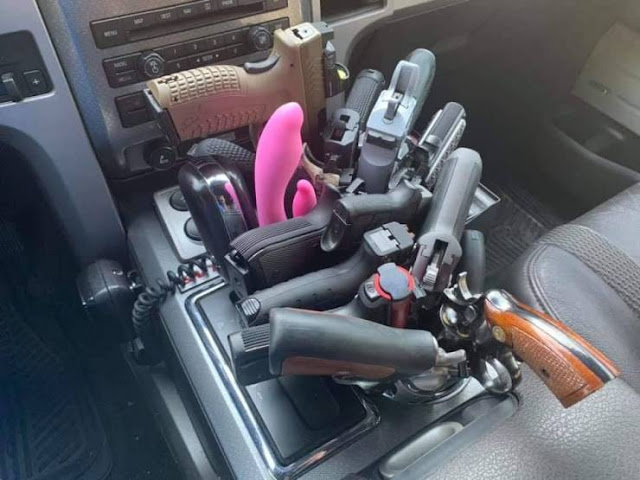
16. Have portable weapons and ammo ready to hand. Only two of my friends were armed, and one of them had only a handgun. The other had a handgun for himself, another for his wife, a shotgun, and an evil black rifle – MUCH better! I was asked by some of the other families, who’d seen TV reports of looting back in New Orleans, to lend them firearms. I refused, as they’d never handled guns before, and thus would have been more of a danger to themselves and other innocent persons than to looters. If they’d stayed a couple of days, so that I could teach them the basics, that would have been different: but they wouldn’t, so I didn’t. Another thing – you don’t have to take your entire arsenal along. Firearms for personal defense come first, then firearms for life support through hunting (and don’t forget the skinning knife!). A fishing outfit might not be a bad idea either (you can shoot something to use as bait, if necessary). Other than that, leave the rest of your guns in the safe (you do have a gun safe, securely bolted to the floor, don’t you?), and the bulk ammo supplies too. Bring enough ammo to keep you secure, but no more. If you really need bulk supplies of guns and ammo, they should be waiting for you at your bug-out location, not occupying space (and taking up a heck of a lot of weight!) in your vehicle. (For those bugging out in my direction, ammo supply will NOT be a problem . . . )
Here are some more ideas.
1. Route selection is very, very important. My friends (and their friends) basically looked at the map, found the shortest route to me, and followed it slavishly. This was a very bad idea, as something over half-a-million other folks had the same route in mind . . . Some of them took over twelve hours for what is usually a four-hour journey. If they’d used their heads, they would have seen (and heard, from radio reports) that going North up I-55 to Mississippi would have been much faster. There was less traffic on this route, and they could have turned left and hit Natchez, MS, and then cut across LA on Route 84. This would have taken them no more than five or six hours, even with the heavier evacuation traffic. Lesson: think outside the box, and don’t assume that the shortest route on the map in terms of distance will also be the shortest route in terms of time.
2. Keep in mind the social implications of a disaster situation. Feedback from my contacts in the Louisiana State Police (LSP) and other agencies is very worrying. They keep harping on the fact that the “underclass” that’s doing all the looting is almost exclusively Black and inner-city in composition. The remarks they’re reporting include such statements as “I’m entitled to this stuff!”, “This is payback time for all Whitey’s done to us”, and “This is reparations for slavery!”. Also, they’re blaming the present confused disaster-relief situation on racism. “Fo sho, if Whitey wuz sittin’ here in tha Dome waitin’ for help, no way would he be waitin’ like we is!” No, I’m not making up these comments… they are as reported by my law enforcement buddies.
This worries me very much. If we have such a divide in consciousness among our city residents, then when we hit a SHTF situation, we’re likely to be accused of racism, paternalism, oppression, and all sorts of other crimes just because we want to preserve law and order. If we, as individuals and families, provide for our own needs in emergency, and won’t share with others (whether they’re of another race or not) because we don’t have enough to go round, we’re likely to be accused of racism rather than pragmatism, and taking things from us can (and probably will) be justified as “Whitey getting his just desserts”. I’m absolutely not a racist, but the racial implications of the present situation are of great concern to me. The likes of Jesse Jackson, Al Sharpton, and the “reparations for slavery” brigade appear to have so polarized inner-city opinion that these folks are (IMHO) no longer capable of rational thought concerning such issues as looting, disaster relief, etc.
3. Implications for security. If one has successfully negotiated the danger zone, one will be in an environment filled, to a greater or lesser extent, with other evacuees. How many of them will have provided for their needs? How many of them will rely on obtaining from others (by hook or by crook) the things they need? In the absence of immediate State or relief-agency assistance, how many of them will feel “entitled” to obtain these necessities any way they have to, up to and including looting, murder and mayhem? Large gathering-places for refugees suddenly look rather less desirable . . . and being on one’s own, or in an isolated spot with one’s family, also looks less secure. One has to sleep sometime, and while one sleeps, one is vulnerable. Even one’s spouse and children might not be enough . . . there are always going to be vulnerabilities. One can hardly remain consciously in Condition Yellow while bathing children or making love! A team approach might be a viable solution here – see point 6 below.
4. There are “too many chiefs, not enough Indians” in New Orleans at the moment. The mayor has already blown his top about the levee breach: he claims that he had a plan in place to fix it by yesterday evening, but was overruled by the State government in Baton Rouge, who sent in others to do something different. This may or may not be true . . . My LSP buddies tell me that they’re getting conflicting assignments and/or requests from different organizations and individuals. One will send out a group to check a particular area for survivors: but when they get there, they find no-one, and later learn that another group has already checked and cleared the area. Unfortunately, in the absence of centralized command and control, the information is not being shared amongst all recovery teams. Also, there’s alleged to be conflict between City officials and State functionaries, with both sides claiming to be “running things”. Some individuals in the Red Cross, FEMA, and other groups appear to be refusing to take instructions from either side, instead (it’s claimed) wanting to run their own shows. This is allegedly producing catastrophic confusion and duplication of effort, and may even be making the loss of life worse, in that some areas in need of rescuers aren’t getting them. (I don’t know if the same problems are occurring in Mississippi and/or Alabama, but I wouldn’t be surprised if they were.) All of this is unofficial and off-the-record, but it doesn’t surprise me to hear it. Moral of the story: if you want to survive, don’t rely on the government or any government agency (or private relief organization, for that matter) to save you. Your survival is in your own hands – don’t drop it!
5. Long-term vision. This appears to be sadly lacking at present. Everyone is focused on the immediate, short-term objective of rescuing survivors. However, there are monumental problems looming, that need immediate attention, but don’t seem to be getting it right now. For example: the Port of Louisiana is the fifth-largest in the world, and vital to the economy, but the Coast Guard is saying (on TV) that they won’t be able to get it up and running for three to six months, because their primary focus is on search and rescue, and thereafter, disaster relief. Why isn’t the Coast Guard pulled off that job now, and put to work right away on something this critical? There are enough Navy, Marine and Air Force units available now to take over rescue missions.
Another example: there are over a million refugees from the Greater New Orleans area. They need accommodation and food, sure: but most of them are now unemployed, and won’t have any income at all for the next six to twelve months. There aren’t nearly enough jobs available in this area to absorb this workforce. What is being done to find work for them, even in states remote from the problem areas? The Government for sure won’t provide enough for them in emergency aid to be able to pay their bills. What about mortgages on properties that are now underwater? The occupants can’t and won’t pay, but the mortgage holders will demand payment. We could end up with massive foreclosures on property that is worthless, leaving a lot of folks neck-deep in debt and without homes (even damaged ones). What is being done to plan for this, and alleviate the problem as much as possible? I would have thought that the State government would have had at least the skeleton of an emergency plan for these sorts of things, and that FEMA would have the same, but this doesn’t seem to be the case. Why weren’t these things considered in the leisurely days pre-disaster, instead of erupting as immediate and unanswered needs post-disaster?
6. Personal emergency planning. This leads me to consider my own emergency planning. I’ve covered my own evacuation needs, and could probably survive with relative ease for between two weeks and one month: but what if I had been caught up in this mess? What would I do about earning a living, paying mortgages, etc.? If I can’t rely on the State, I for darn sure had better be able to rely on myself! I certainly need to re-examine my insurance policies, to ensure that if disaster strikes, my mortgage, major loans, etc. will be paid off (or that I will receive enough money to do this myself). I also need to provide for my physical security, and must ensure that I have supplies, skills and knowledge that will be “marketable” in exchange for hard currency in a post-disaster situation. The idea of a “team” of friends with (or to) whom to bug out, survive, etc. is looking better and better. Some of the team could take on the task of keeping a home maintained (even a camp-type facility), looking after kids, providing base security, etc. Others could be foraging for supplies, trading, etc. Still others could be earning a living for the whole team with their skills. In this way, we’d all contribute to our mutual survival and security in the medium to long term. Life might be a lot less comfortable than prior to the disaster, but at least we’d still have a life! This bears thinking about, and I might just have to start building “team relationships” with nearby people of like mind.
7. The “bank problem.” This bears consideration. I was at my bank this morning, depositing checks I’d been given by my visitors in exchange for cash. The teller warned me bluntly that it might be weeks before these checks could be credited to my account, as there was no way to clear them with their issuing banks, which were now under water and/or without communications facilities. He also told me that there had been an endless stream of folks trying to cash checks on South Louisiana banks, without success. He warned me that some of those banks will almost certainly fail, as they don’t have a single branch above water, and the customers and businesses they served are also gone – so checks drawn on them will eventually prove worthless. Even some major regional banks had run their Louisiana “hub” out of New Orleans, and now couldn’t access their records. I think it might be a good idea to have a “bug-out bank account” with a national bank, so that funds should be available anywhere they have a branch, rather than keeping all one’s money in a single bank (particularly a local one) or credit union. This is, of course, over and above one’s “bug-out stash” of ready cash.
8. Helping one’s friends is likely to prove expensive. I estimate that I’m out over $1,000 at the moment, partly from having all my supplies consumed, and partly from making cash available to friends who couldn’t cash their checks. I may or may not get some of this back in due course. I don’t mind it – if I were in a similar fix, I hope I could turn to my friends for help in the same way, after all – but I hadn’t made allowance for it. I shall have to do so in future, as well as planning to contribute to costs incurred by those who offer me hospitality under similar circumstances.


Despite my affection for light, small-gauge upland doubles, TriStar’s 28-gauge Bristol Silver SxS scared me. Too small. Too trim. Too light. And then I shot it. Just right!

Honestly, this doll-size, 5.25-pound side-by-side carries, rises, points and shoots like an extension of my arm, which is just what an upland bird gun is supposed to do. But what a surprise for an entry-level double with a suggested retail of just $1,040.
Well-built, reasonably priced side-by-sides used to be a staple in the USA, but by mid-20th century they’d faded under the onslaught of even less expensive pumps and autoloaders with their high-capacity magazines. By the 1970s, side-by-sides were Great Grandpa’s antiques.
Well, what goes around comes around, and as upland bird hunting became tougher and tougher, participants became devotees, and devotees are always more deeply involved than fair-weather hunters. They make up for a shortage of birds by investing more time and energy in dogs, vests, boots, hats, shells, history and—most of all—shotguns. Life’s too short to hunt with an ugly gun.
But when pretty guns are also pretty expensive, as they usually are, many of us can’t indulge them. This TriStar Bristol Silver solves that. The laser-engraved, nickel-finished steel receiver contrasts with deeply blued, 28-inch barrels and a Grade 2, satin oil-finished Turkish walnut stock with shockingly rich and extensive figure shot with flame reminiscent of tiger stripes. The quality would be surprising on a gun at twice the price. The checkering pattern is rather mundane, but the points are sharp enough for good function and the borders clean with no overruns. Wood to metal fit is impressively tight and slightly proud. A black plastic spacer protects the end grain and a lightly stippled, three-eighth-inch-thick black rubber pad provides minimal recoil absorption, good “stick” to the shoulder, and ground grip when standing the gun.

Mechanically this is a simplified Anson & Deeley-style boxlock with a Deeley-type latch in the fore-end. The gold-plated, single-selective trigger is mechanical, so the second barrel will fire with or without the recoil of the first. Trigger pull was 3 pounds, 12 ounces for each barrel with a fair bit of overtravel. A barrel selector switch slides left-right in the center of the tang safety. Here is the only flaw I discovered in this otherwise proper functioning gun: a catch in the safety. With the barrel selector set for the right barrel, differing thumb pressure on the safety would variably push it off or make it hang up, perhaps on a burr inside the action. With the selector switch set to the left barrel, this rarely happened. My test gun was one of the first off the line, so perhaps this is an early blip, but something to check for when shopping. TriStar has a full five-year warranty on this double-barrel, so any glitches like this would be remedied at no charge.
The Bristol’s monobloc barrels come flared near the muzzle to accommodate screw chokes, five of which ship with the gun: full, improved modified, modified, improved cylinder and skeet. Considerable if subtle rippling can be seen in reflections off the barrels and the center rib, which is not raised. None of this hindered our shooting.

A friend and I indulged a round of clays with slight trepidation. Tyrell had never shot a 28-gauge before. Nor a side-by-side. Nevertheless, he dropped but one target. The old veteran, alas, dropped two. But he blames one on the safety catch distracting his concentration.
Auto-ejectors seemed perfectly timed. Each selectively spit empty hulls smartly over our shoulders. After losing a couple in the snow, I began holding my hand over the breech to catch them. The action was tight, befitting a new gun. A locking bar in the bottom rear of the action well slides forward upon barrel closing to fit into a tapered underlug notch, suggesting this action should shoot tight with use.
Seriously, Tyrell and I were both impressed with the handling characteristics and natural pointing of this little gun. Both barrels are chambered for 2¾-inch shells. We were shooting Winchester AA ¾-ounce No. 7.5 loads spreading some 262 projectiles from skeet and IC chokes. The gun balances at the hinge, so the 28-inch barrels came up quickly and smoothly, yet their length seems to aid follow-through. Should be the perfect action in the grouse woods and quail thickets. I wouldn’t be at all afraid to hire it in the open, often-windy pheasant fields of South Dakota, either.
All told, the TriStar Bristol Silver 28-gauge is a splendid option for anyone wanting to get into shooting a classic looking, classic handling, traditionally effective upland shotgun. And if 28-gauge isn’t your favorite size, look for one in 20-gauge, 12-gauge or .410.
Technical Specifications
• Type: double-barrel, side-by-side shotgun
• Gauge: .410-bore, 28 (tested), 20, 12
• Barrel: 28″; blued, chrome lined; center rib; auto ejectors; interchangeable chokes
• Trigger: single, mechanical; 3-lb., 12-oz. pull weight
• Sights: front brass bead
• Safety: tang mounted w/barrel selector
• Stock: Grade 2 Turkish walnut; satin oil-finish; length of pull 14.5″; drop at heel 2.5″; drop at comb 2″
• Receiver Finish: nickel w/24 karat gold inlay
• Overall Length: 45″
• Weight: 5.24 lbs. (28-gauge)
• Accessories: 5 choke tubes (Full, Imp. Mod., Mod., IC, Skeet)
• MSRP: $1,040–$1,070; tristararms.com
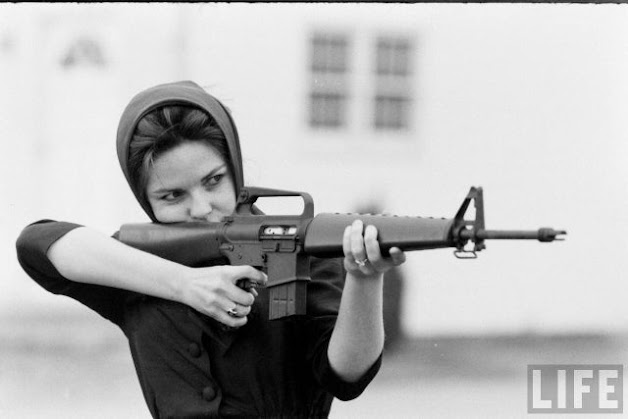
Maria Beale Fletcher (born June 23, 1942) is an American beauty pageant contestant who was Miss America 1962.[1]
Fletcher was born to dancing duo Charles “Beale” and Margaret Gatley Fletcher, who were the founders of the Fletcher School of Dance and the Land of the Sky Civic Ballet. She has one brother, Walter, and two sisters, Margaret and Bonnie.[2]
She is from Asheville, North Carolina, and was a graduate of A.C. Reynolds High School. She worked as a Radio City Music Hall Rockette prior to winning the Miss America crown.[3] After winning Miss America, Fletcher used her earned scholarship towards a degree in French from Vanderbilt University.[4]
She was the Miss America preliminary competition swimsuit winner, and her overseas tour included visits to 31 Army hospitals and Servicemen’s Clubs. For the talent competition, she tap danced to a recording of herself singing “Somebody Loves Me.”[5] She remains to date the only Miss North Carolina to be crowned Miss America.
During the late 1960s, Fletcher served as co-host of The Noon Show on Nashville, Tennessee, television station WSM.