Categories
Old lever guns
Categories
Good to go!

October 04, 2019
Let’s face it. In an age where goods are plentiful and easily available, sometimes having only one of something makes even the hardiest and stout of heart experience a twinge of anxiety. Whether that something is a potato chip, a stick of Secret Powder-Fresh deodorant (don’t judge me…my resolve is strong but my skin is tender… and besides, the logo expressly states it is “strong enough for a man”), or ammunition, a basic rule of human behavior dictates that “more is better.”
But sometimes rules are meant to be broken, and when the rule-breaker in question is a rifle that is capable of firing a bullet whose downrange terminal performance (at least to a white-tail deer) is roughly that of a telephone pole being launched out of a railgun, an exception can be made.
Enter the simple, sturdy, and uber-practical Traditions Firearms single shot “Outfitter G2” in .45-70 Government. The Outfitter G2 is a rebel…defying recent trends of ‘cool but complicated’ rifle systems housing multiple picatinny rails and moving parts galore. Even by conventional bolt-action hunting rifle standards, the Outfitter stands apart as a simple, iconic firearm. With a single barrel and break action, the Outfitter G2’s retro-styling practically begs hunters and shooters from the wide-open, mountainous, ‘big-country’ western states of America…hunters and huntresses who never had to contend with ‘East Coast/Midwest’ firearms restrictions in order to harvest a deer… to ask a single question:
“Why?”
To answer that interrogatory and solve the riddle of the Traditions G2’s “place in the order of things,” it is necessary for us to take you on a short journey back in time. So, sit back, turn down the lights, kick your feet up, and please enjoy this short educational course in what the younger generation of shooters would call ‘ancient history.’
A Land Before Time (and Rifle Hunting for Deer in America’s Midwest and East Coast)!
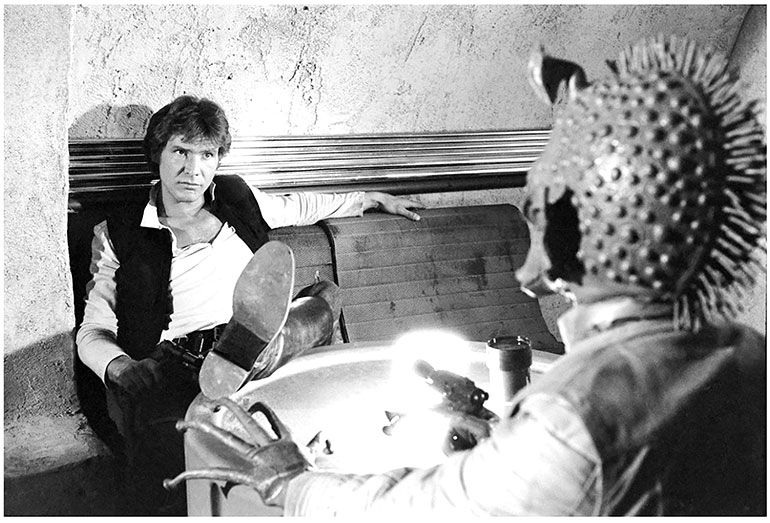
It was a time when Kraft Macaroni & Cheese didn’t taste like something that had oozed out of a Union Carbide chemical company leech-field, Disney stayed in its own lane with cartoon princesses and, much to the chagrin of those from the politically correct crowd, Han shot first (RIP, Greedo, you skeevy little green…ummm…whatever you were).
THIS…WAS 1977!
It was the good ‘ol USA…one year after its bicentennial, and while there WAS a chicken in every pot and an automobile in every garage, there WAS NOT an AR-15 variant in every gun cabinet or a double-stack magazine fed combat handgun in every holster. Suppressors (or ‘silencers,’ depending on what side of that semantic debate you ‘self-identify’!) were only available to James Bond, the newly formed Tier-One special operations unit ‘Delta Force’ (DOB:11-19-1977), the few “class 3” shops who knew that they were legal, and concealed carry, at least in most states, was a figment of the imagination unless you could provide sufficient cause for the issuance of a highly coveted permit. I’m not joking when I tell all of the youngers shooters in our audience that back before Disco was pushing up daisies, the acquisition of one of these unicorn-like concealed-carry licenses required a strong political connection, divine intervention, or a REALLY good justification with supporting documentation…examples of such would be your status as a:
- Restauranteur or businessman doing sizeable after-hours money-drops to the night deposit box of a local bank.
- Night watchman or security guard requiring ‘plain clothes’ status and an express need for carrying a firearm instead of a walkie-talkie, flashlight, and a silly Kubotan pressure point weapon/ninja-thingy you could mail-order from an advertisement in Mad or Cracked magazines.
- One of those poor (but quite well-done in the cardio department) Swiss Guards who had to run for miles alongside the aquarium-reminiscent Pope-mobile during a parade.
In the end analysis, the ‘powers that be’ did not make it easy for the average guy or gal to legitimately ‘go strapped.’ But, in the plus column, it was the 70’s, when kids’ role models were still the good guys: Cops, Firefighters, Paramedics, Secret Agents, iconic athletes (without felony records), comic book super heroes (without ‘social justice warrior’ agendas) and military heroes. Ahh, but those were the idyllic, halcyon years when everything from movies, sports, and all things meant to entertain or bring us joy, up to and including a bowl of ‘Lucky Charms’ cereal, were not politicized.*
*Unless the Irish Republican Army was engaged in some type of ‘Psy-Ops’ (Psychological Operations) program designed to win the hearts and minds of Saturday morning cartoon watching grade-schoolers I wasn’t aware of.
Anyway, the bottom line is…just like today, four decades ago you had to take the good with the bad (bell-bottom jeans, flair-collared leisure suits, and The Captain and Tennille Show excluded).
And bad it was for white-tail deer hunters in the flatter or more populated U.S. states who wanted to utilize a rifle for that purpose, because the Debbie-Downer ‘law of the land’ in those regions was unwaveringly simple and Hellfire-missile precise in its wording. In complicated legalese, the state’s answer to the question of employing rifles that utilize modern metallic cartridges to harvest one of the most beautiful, elusive, predator-savvy, and tasty ungulates in North America was worded as follows:
“No Way, Jose.” Unless you were from Jersey, Philly, or the Big Apple, in which case it was “Fuggedaboutit…!”
These Times They are a Changin’: Viva La Straight Walled Cartridge Revolution!
If there’s one thing to be learned from the above Pre-2000 A.D. history lesson, it is that sometimes things do change for the better. Modern sporting rifles, reliable, combat-grade semi-automatic handguns, and suppressors now enjoy widespread availability and popularity. In an even more surprisingly satisfying turn of events, the potential for success in obtaining a concealed carry permit without rosining up your bow, playing that fiddle hard, and engaging ‘Old Scratch’ in a talent show (or selling a kidney on the black market) is much greater in a vast majority of U.S. States* than it was back when ‘Saturday Night Live’ was still funny and, much to Opec’s dismay, ‘big-gulp’ amounts of liquid gold began blasting down the Alaska Pipeline.
*Condolences to our brethren from the ‘no-Issue/may-issue if you are someone important’ states of Hawaii, Maryland, Massachusetts, New Jersey, New York, and 21% of California. Maybe it’s time for you to band together and stand below your legislator’s bedroom windows in 24-hour shifts with a boom-box blasting ‘The Price is Right’ losing horn (or, if you really want to trigger some anxiety, Hank Williams Jr.’s “A Country Boy Will Survive”) until they understand the error of their ways!
But of more importance to this article, the recent past has also witnessed an era of positive change for white-tail deer hunters who reside in states where modern, metallic cartridge deer-hunting rifles were historically a ‘no-no.’ States who (through no fault of their own) are cursed with high-density populations or terrain features so depressingly flat, their only elevated points or promontories exceeding 20 feet above sea-level are situated on putt-putt golf courses and local waterparks.
The positive change of which we speak was the revision of state game board rules and regulations that opened up the door on a whitetail deer harvesting ‘tool of the trade’ that previously sat gathering dust in the corner for a century.
The age of the straight-walled cartridge hunting rifle had arrived!
So…with the history lesson over, it’s time for us to get this buggy back on the pavement and focus on what we’re all here for which is the low-down on a rifle that has arrived at the right time, right place, and in the right caliber for these wondrous new changes to the hunting regulations.
This…is the story of the Traditions Performance Firearms .45-70 Government Outfitter G2 hunting rifle!
Tradition’s Single Shot Deer Slaying Machine
In the high-stakes profession of gun-writing (cue up dramatic theme music here), planning, research, and forward-thinking are critical, key elements in the acquisition and testing of a quality firearm. I totally wish I could claim all three of those components were in my repertoire for this rifle. Unfortunately, that would be what modern politicians call ‘misremembering’ and decent people would refer to as “something that can set your pants on fire” …more commonly known as a LIE!
In the spirit of transparency, the truth of the matter is…the Traditions Outfitter project just kind of “popped up” (I’m sure with a bachelor’s degree, twenty-seven years of ‘5-0’ (Law Enforcement) report writing experience, and a Mom who is a retired reading teacher, I could do better than that totally weak catch-phrase, but I’m sticking to my guns and staying true to my school with “popped up.”
The bottom line is…when someone from your extended Firearms News’ family asks if you’d like to write an article about a .45-70 government caliber rifle with a masterfully fluted Lothar Walther barrel, you don’t kick said project out of bed for eating crackers…even if you only have a few days to prepare. In fact, I was totally stoked to take part in a gun writer’s equivalent of an impulse buy…except instead of a Pez dispenser, a tube of Chapstick, and a crappy plastic penlight, I was about to shoot a Civil War cannon barrage-worth of .45-70 government lead downrange. VIVA!
The call came in from my good friend ‘Yog’ just down the street at Anchorage’s iconic old-school gun store, Great Northern Guns, that he “had a little something for me” courtesy of the busy folks at UPS or FedEx. However, his voice was a bit more upbeat and animated than usual, and it didn’t take long for me to learn why. In the past, a fair number of newly received, custom order gun shipments arrived at the store with no indication on the packaging as to who the specific customer/purchaser was…just the generic address of the gun store. This little slice of perfidy was the sour milk in Yog’s Cheerios. It was that shiny new toy under his tree on Christmas morning when he was just a pink-cheeked little tyke that would have rocked but instead was a big gyp, as announced in small letters at the bottom of the box: “Batteries Not Included.” Not to beat a dead horse, but to Yog, poor shipping etiquette was on the same plane of misery as an incompetent production engineer at ABC interrupting Lynda Carter’s sparkly, explosive, and pirouetting Diana Prince to Wonder Woman transition with a poorly timed commercial break featuring feminine hygiene products and a commemorative Captain Stubing (from the critically acclaimed television masterpiece The Love Boat) Chia-Pet.
Any-hoo, you get the picture…Yog is a consummate professional and an honest professional who will never send you down the wrong path if you are looking for a quality firearm. He is also kind, good-natured, and slow to anger…as long as you follow the basic tenets of package labeling!
Well, thanks to Jacob, my ‘partner in crime’ on this project and co-conspirator at Traditions Performance Firearms, today’s shipment made Yog’s week. It is also likely that it caused the parcel delivery guy to take pause and think to himself “Rikk Rambo? I’m no ATF Agent, but if that’s not a fake name, I’m Queen Latifah!,” because lo and behold, big and bold, on every side of that box was my name emblazoned in #2,000 sized font. Yes indeed…sometimes it’s the little things in life!
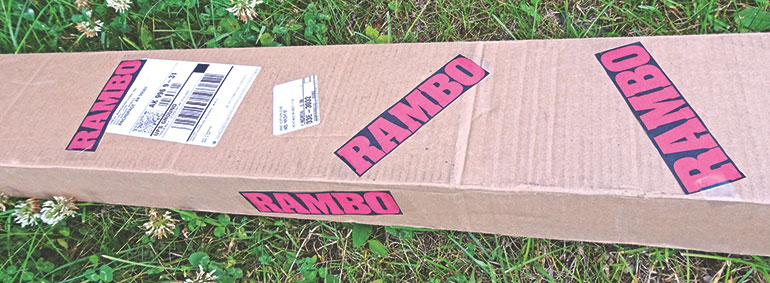
“There Can Be Only One!”-Connor MacLeod, ‘Highlander’
The Outfitter G2 and Connor MacLeod, Juan Sanchez Villa-Lobos Ramirez, and ‘The Kurgan’ (from the movie ‘Highlander’) share the same monolithic DNA…and the same credo: THERE CAN BE ONLY ONE.
In the case of the Outfitter, ‘ONE’ refers to how many shots you have at your disposal while deer hunting in order to dominate your street wise, venison-filled quarry and win those juicy, non-GMO (Genetically Modified Organism), hormone-free quarters, tenderloins, and backstraps you so richly deserve. Don’t let the single-shot nature of this rifle fool you, however. As they say, “It only takes one,” and you’ll understand the significance of this and its relationship to the Outfitter G2 during the range-testing segment of the Outfitter’s story.
I don’t think I’m going out on a limb when I say that just like many other shooters, my first impressions of a firearm don’t always carry the day, good or bad, after the weapon is thoroughly put through its paces and the final vote is in. Without reservation, I can tell you that my first impression of the Outfitter didn’t waiver throughout its testing and evaluation. The .45-70 G2 never failed to impress from the time I removed it from its factory box until the time I mournfully drove it to UPS for shipment back to the good folks at Traditions.
The Outfitter G2 is SOLID. There isn’t hint of give or play related to the rifle’s break action. Open or closed, it gives the impression you are wielding a single, monolithic, solid piece of steal. It feels like the kind of rifle you could drive railroad spikes with.
This break-action deer-harvesting machine is manufactured by Traditions Firearms, a leading name in tough, innovative, and extremely reliable muzzle loading rifles. The G2 is available in the more than capable .450 Bushmaster, .35 Remington, .35 Whelen, .300 Blackout, .243 Winchester, 44 Remington Magnum, and .357 S&W Magnum calibers, but the rifle I was able to get my greedy little mitts on was the .45-70 Government version.
.45-70 Government…a caliber just shy of the Quigley Down Under .45-110, but still adequate for any game animal in North America…even if some attention-starved geneticist gets too big for his or her britches and clones a herd of Mastodons.
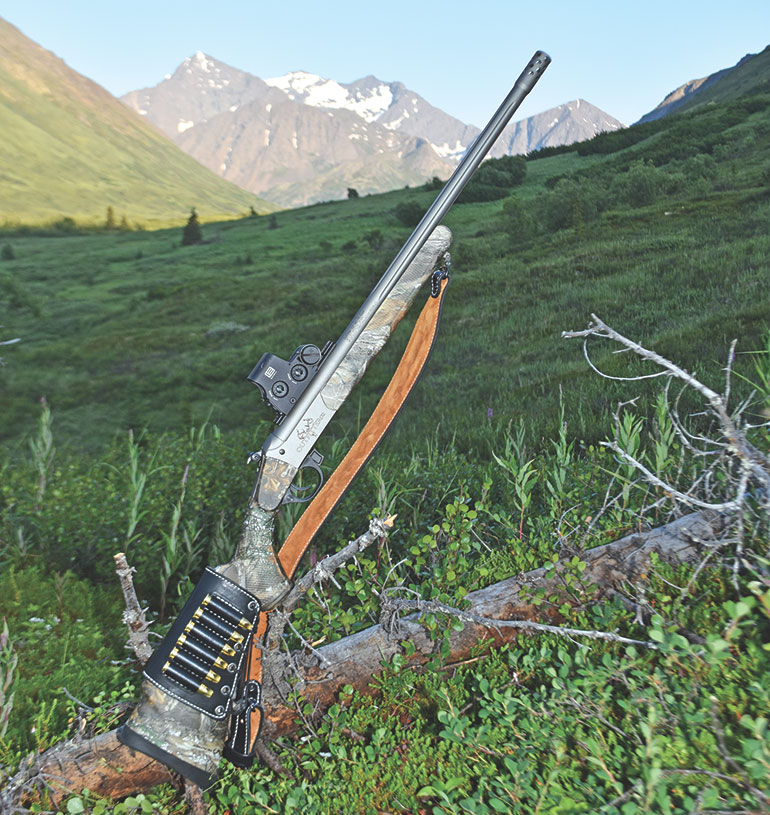
The formal name of the Traditions rifle tested and evaluated for this article was the Outfitter G2 .45-70 Realtree Edge/CeraKote’ variant. This model features several key components that will cause you to question (in a joyous way) the rifle’s modest $557.00 MSRP. First and foremost is the barrel. The Outfitter G2 sports a 22″ Lothar Walther Premium fluted barrel topped off with a highly-effective muzzle break. As a historical side note, Lothar Walther is a company with a storied past dating back to 1925. During the same year that Sears, Roebuck and Company opened its first retail store, and the Mount Rushmore National Monument site was dedicated, Lothar Walther, the youngest son of Carl Walther (are you paying attention, Mr. Connery, Niven, Lazenby, Moore, Dalton, Brosnan, and Craig) started his own firearms barrel production company…a firm that still produces much sought-after firearms barrels and other related products to this day.
The Walther barrel, combined with a handsome matte-silver/gray CeraKote finish, Realtree Edge patterned camouflage stock, and patented quick-detach forend make for an all-business, whitetail deer harvesting machine. The rifle is also drilled, tapped, and ready for a wide variety of optics.
And speaking of optics…
A Little Bit Country and a Little Bit Rock ‘N’ Roll!
It wasn’t until I said my good-byes to Yog, shouted a couple ‘live long and prospers’ to the other fine ‘fellers at Great Northern Guns, and headed back to Castle Rambo in my big ‘ol pickup truck with the newly arrived Outfitter that I came to a stunning realization. I hadn’t formulated a plan for an optic to mount on the rifle. I’d like to say that what happened next was a display of pure genius…or an epiphany…or some other dramatic literary device. But it wasn’t.
I arrived home, what really happened was this: I blankly stared around my workshop for a while, then went into “what do I have that’s just lying around” search mode. I was a little slow on the uptake, but after several long minutes, it struck me. I had recently acquired a weapon sight system at a deep discount from a friend who was big into ‘impulse buys.’ Long work hours and no recent rifle purchases sadly designated the optic as an orphan, with no long gun to call its own. THAT…was about to change.
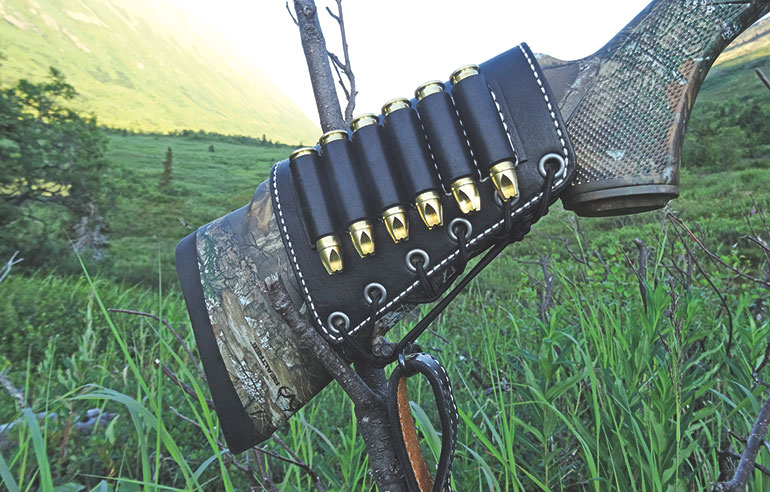
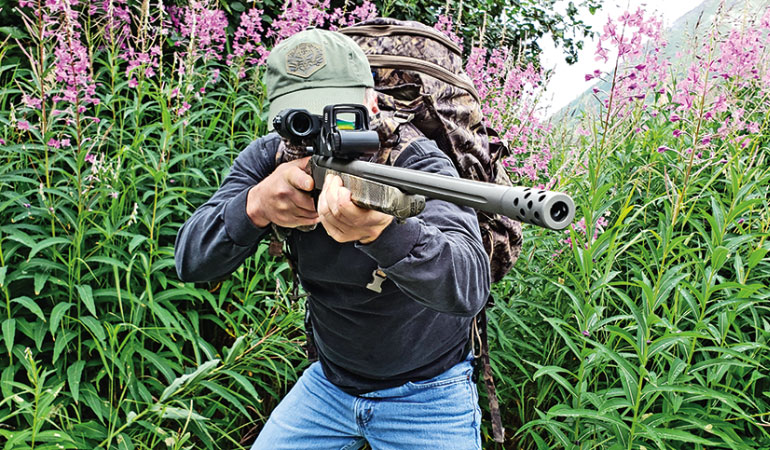
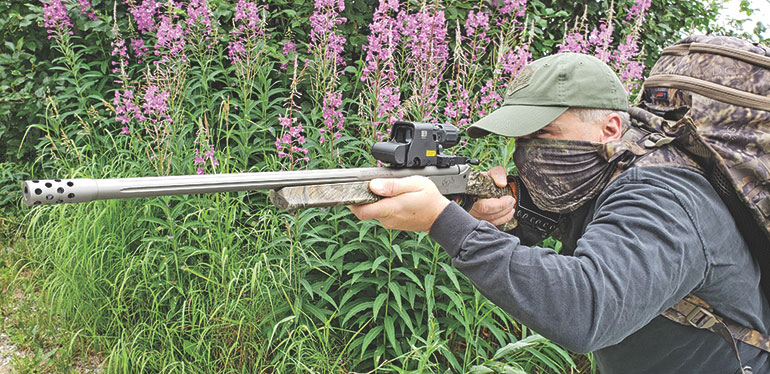
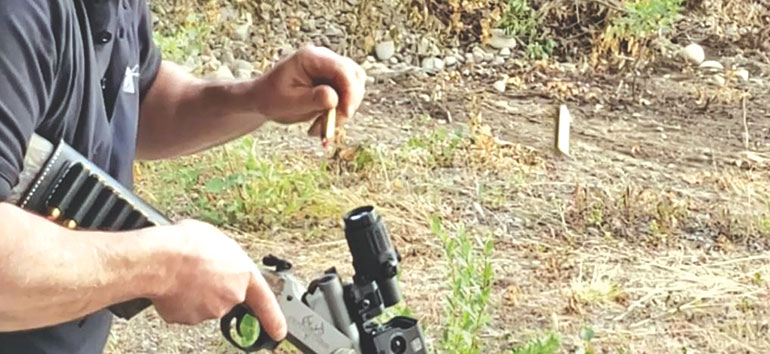
I mounted the optics system on the Outfitter G2 and the results were perfect…as if they were meant to be. The simple, all-business Traditions single-shot deer slayer, now with a skyline silhouetted by the EOTech XPS2 holo-sight and it’s faithful ‘flip to side’ 3x magnifier companion, presented a striking appearance. The simple, tried and true design of the rifle combined with the Buck Rogers EOTech combination struck both a modern AND wild-west appearance…but the night was still young and I found two more accessories that would complete the Outfitter G2’s ensemble. As Chuck Norris would tell you, “Good Guys Wear Black,” and so did my Outfitter G2…in the form of a black leather rifle butt side-saddle cartridge holder and sling expertly crafted by my friends at Diamond D Custom Leather (DiamondDCustomLeather.com). Diamond D is an Alaska-tough holster and firearms accessory manufacturer just up the road from Anchorage that calls Wasilla, Alaska home.
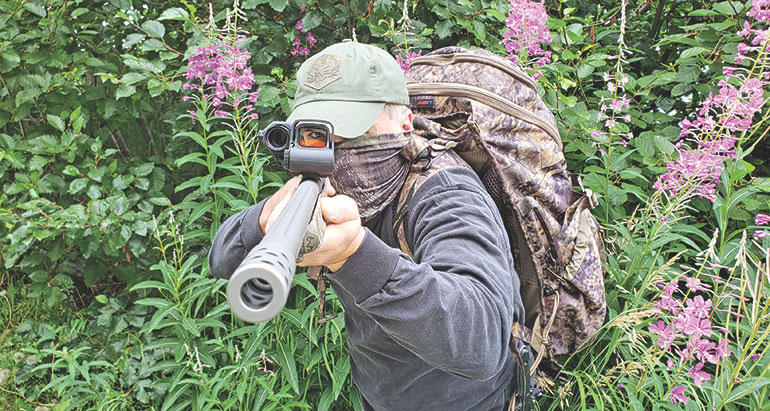
With those finishing strokes, the Outfitter G2/EOTech/Diamond D Custom Leather equipped rifle system was complete. In only 10 short minutes, the solid, capable looking, but embarrassingly naked Traditions .45-70 had gone from its simple roots to a FULLY FUNCTIONAL BATTLE STATION.
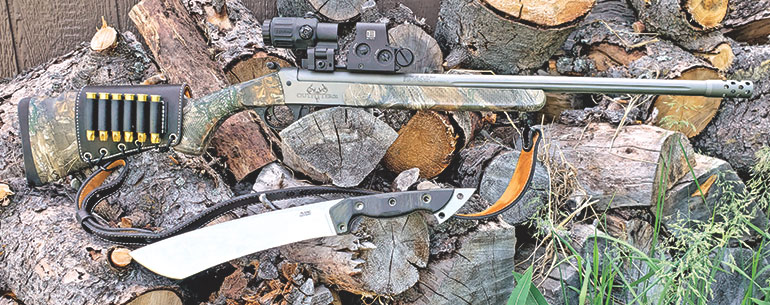
While interior décor and cooking guru Martha Stewart would most certainly turn her nose up at my buffoonery when it comes to food and wine pairing, our well-spoken, favorite daytime television star and much-heralded felon would have no other option than to crow about my “You got your Chocolate in my Peanut Butter” partnering-up of the Outfitter G2 .45-70, EOTech holosight, magnifier, and ‘Diamond D Custom Leather’ side-saddle cartridge holder and sling.
It was the perfect mix…and call me crazy, but I think Donny and Marie put it best when they crooned:
“I don’t know if it’s good or bad,
I know I love it so,
I’m a little bit country,
I’m a little bit rock n roll!”
-Marty Cooper
Accessorizing complete, it was time to take the Outfitter G2 to the range and see what shook loose.
Range Day: “Take a Picture, it’ll Last Longer!”
WARNING: Providing a correct answer to the following trivia question will undoubtedly result in the receipt of an AARP or AMAC card in your mailbox within 1–2 business days.
Do you remember Marine Corps Private Gomer Pyle’s favorite catch phrase? Because that was what went through my head when it came to the interest generated by the Outfitter G2 amongst other shooters at my gun club when I unlimbered that stainless steel beauty from its soft-case and prepared to send some .45-70 everlasting gob-stoppers down range:
“Surprise, Surprise, Surprise !”
It was a puzzlement…I’ve shot many high-speed/low-drag tier-one military weapons at local ranges during peak hours and had fellow shooters approach me to ask questions or to ‘cop a feel’ (of the gun, you nut…I mean, what kind of firing range do you think I go to?). But during the three range sessions I conducted with the Outfitter, this single-barrel, break action, reasonably priced .45-70 practically drew a crowd. I believe the cause for this was the over-all package.
The practical and handsome Outfitter G2, outfitted with the EOTech sight, magnifier, and Diamond D black leather side-saddle cartridge carrier and sling, well… (and this may go down in the annals of gun-writing as the laziest, most sophomoric observation ever) …it just looked COOL.
I answered multiple questions from the newly formed G2 fan-club, acquired a dozen or more new sets of incriminating latent prints from complete strangers on the rifle’s rugged Cerakote exterior and EOTech flip-to-side magnifier, then got down to the serious business of shootin’!
Cutting Paper and Smashing Steel: “The Streets will Run Red with the Eardrum Blood of the Non-Hearing Protection Wearers!”
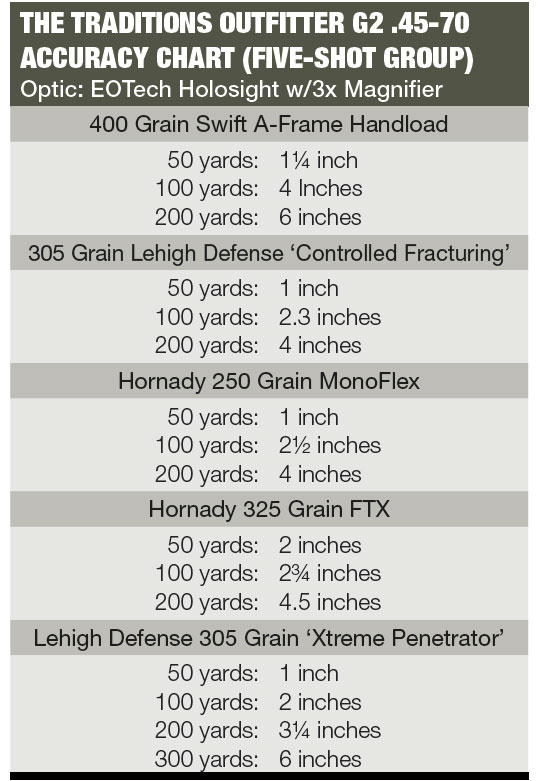
The first two days were dedicated to accuracy testing, on paper, at 50, 100, and 200 yards. The meteorological/climatic conditions during range testing were the exact opposite of what a hunter would normally come to expect from the great Alaskan outdoors: 90 Degrees (above zero!) and blue skies from horizon to horizon! The ambient temperature would be problematic, relative to consistent accuracy, if you were firing a significant number of rounds downrange while sighting in a tapered/thin barreled rifle for distance shooting. Luckily for me, the thicker, fluted barrel of the Outfitter was more than adequate to insure ‘hot-barreled’ accuracy out to two-hundred yards from the leviathan .45-70 Government rounds.
Of the five cartridges tested, only two were capped with bullets of conventional appearance. The others demonstrated some serious mo-jo in their innovative design and space-age profiles. Here’s the rundown!
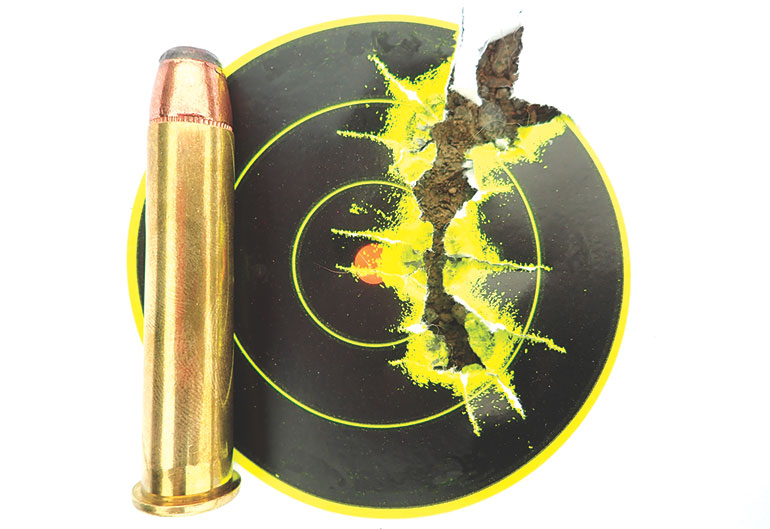
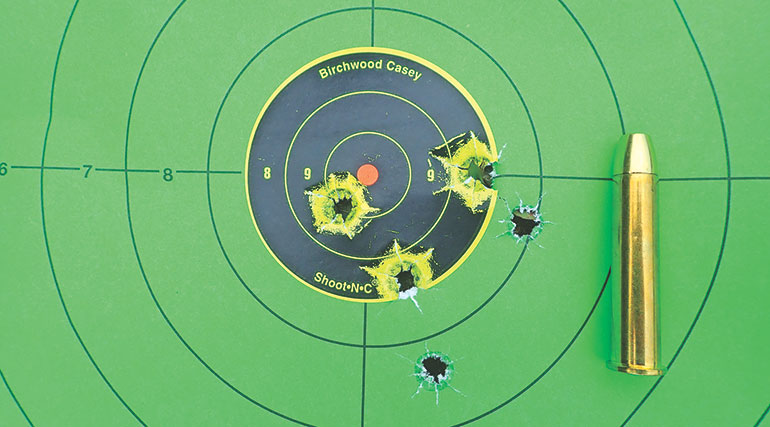
The first round I tested launched a conventional, ‘normal’ looking bullet down-range. This cartridge was a dam-busting handload I formulated several years ago for Brown Bear defense. The cartridges were stuffed to the max with “fill ‘er up, high-test” powder charges and topped off with 400 grain Swift A-Frame Flat Nose tank-killers. At the 50-yard line, this massive bullet (sent downrange in a five-round group) made one ugly, ragged, vertical 1¼ inch hole on paper. At 100 yards, the group opened up to four inches. Finally, at 200 yards, my bear-breaker patterned a six-inch group that I’d like to think reflected the limitations of the holosight and 3x magnifier and definitely not my shooting prowess?!
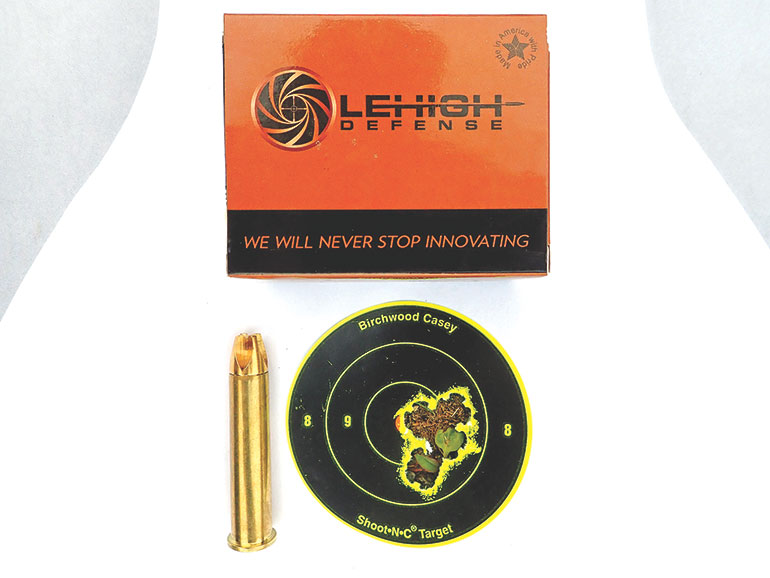
The second round up to bat was a heart-attack serious cartridge from Lehigh Defense featuring a 305 Grain ‘Controlled Fracturing’ all-copper/all-brass bullet. This bullet was designed by the highly innovative professionals at Lehigh Defense to streak downrange at an average speed of 2,000 feet-per-second, then deeply penetrate game before delivering a devastating wound channel with razor-like petals that fracture outwards. The final bit of deadly icing on this terminal ballistics cupcake is a ‘base projectile’ that continues deeper into the target for additional penetrating effect. This high-tech 305 grain bullet performed like a dream at 50 yards, leaving a single hole roughly the size of a quarter in the target. At 100 yards, the performance continued to please, scoring a 2.3-inch group. The reliability continued out to 200 yards with a four-inch group.
Science Fiction Rounds with Non-Fiction Results!
Gun Store Manager: These are brand new, we just got them in…You just touch the trigger, the beam comes on and you put the red dot where you want the bullet to go, you can’t miss. Anything else?
The Terminator: Phase-plasma rifle in the 40-Watt range.
Shopkeeper: Hey, just what you see, pal.
-The Terminator (1984)
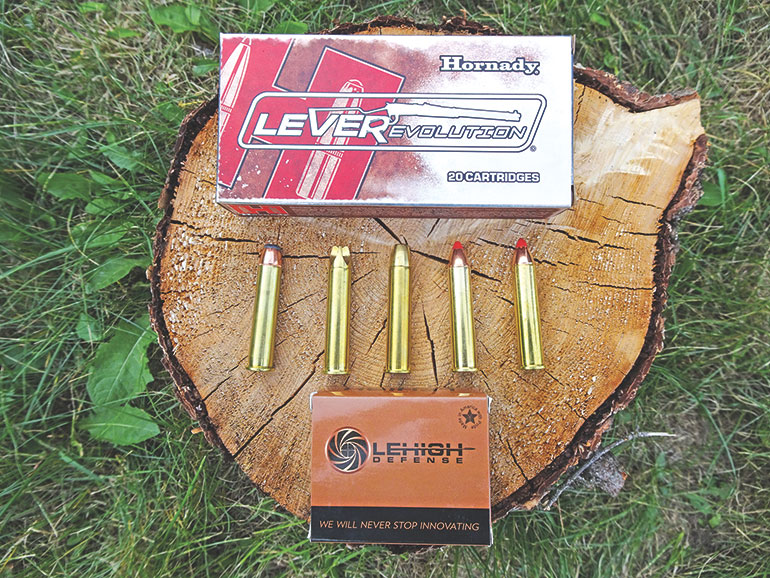
The first barrage of non-traditional .45-70 government cartridges sent down the Outfitter’s barrel for this article are a pair of ‘kissing cousins’ from Hornady that have been putting a smile on deer hunters’ faces since roughly 2005. They are the LeveRevolution Flex Tip and MonoFlex rounds. The fact these cartridges celebrated their 14th birthday this year doesn’t change their status of one of the most ground-breaking straight-walled cartridges ever developed for the big-bore lever-action crowd. The Hornady ‘LEVERevolution’ round was designed for use in intermediate to heavy caliber lever action repeating rifles that utilize a tubular magazine. Before Hornady developed this round, lever action shooters were primarily limited to cartridges firing traditional blunt-nosed bullets from rifles housing tubular magazines. This was due to significant recoil and the potential for a bullet with a pointed tip to impact the primer housed in the cartridge in front of it…an event that could result in a premature detonation and bad times to be had by all. Except for the whitetail buck being stalked…he would be absolutely giddy with laughter! These ground-breaking Hornady rounds neutralized the spire-point/spitzer style ‘pointed bullet’ potential for ‘in-tube’ detonation thanks to their flexible, rubberized tips that act as a shock-absorber during recoil.
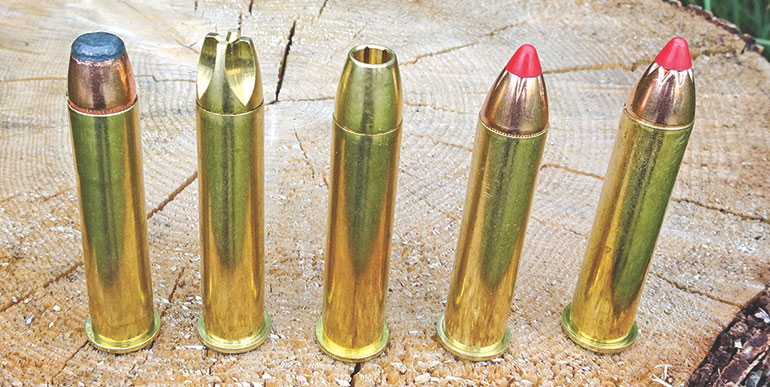
I evaluated two variations of Hornady’s sleek, red-tipped bullets during my range sessions with the Outfitter G2… the 250 grain MonoFlex and the 325 grain FTX/Flex Tip. The MonoFlex bullet is a lead-free, high-weight retention bullet, and the 325 grain FTX is an equally capable, lead-filled powerhouse. I have reloaded the 325 grain FTX/Flex Tip bullet in ‘home-brew’ rounds for years and have never been disappointed. The Hornady factory ammunition tested through the Outfitter G2 mirrored the performance of my handloads: flat trajectories and a LOT OF IMPACT NOISE down range when the round smacked paper or steel…even out to 200 yards.
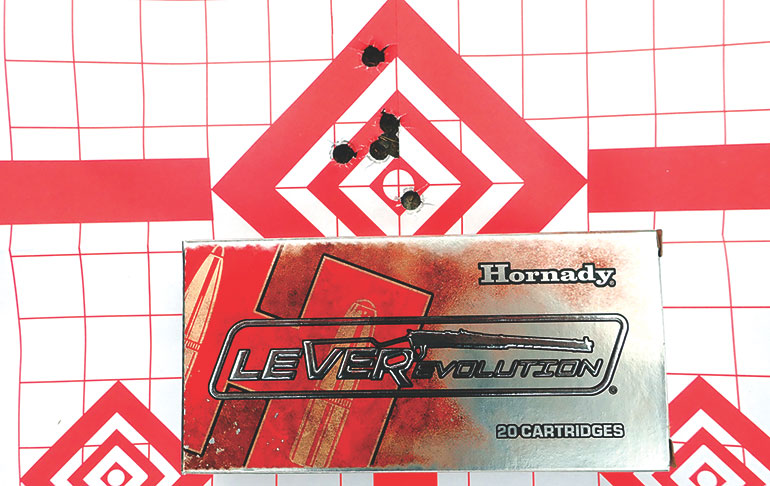
The 250 grain MonoFlex replicated the Swift A-Frame handload and the Lehigh Defense ‘Controlled Fracturing’ rounds at 50 yards. ONE HOLE. Moving out to the 100-yard line, the MonoFlex printed a 2.5-inch group, and at 200 yards, a four-inch group.
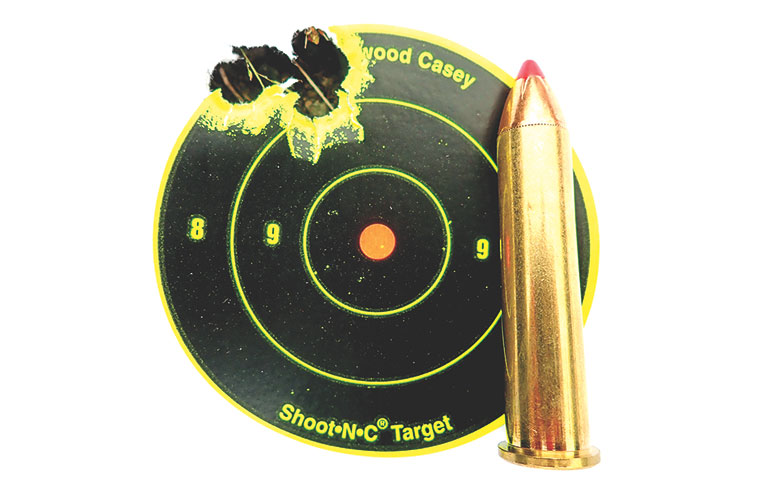
The MonoFlex’s bigger cousin, the 325 grain FTX, also poked (SHOCKER!) a one-hole, five-round group at 50 yards. Not to be outdone by the 250 grain MonoFlex, it did so with a dramatic SLAP! The FTX nearly mirrored the MonoFlex at 200 yards with a 2¾ inch group and a 4.5-inch group at 200 yards. As with the 50-yard impact acoustic signatures, the return ‘whaaack’ that echoed from the targets ‘out yonder’ didn’t fail to entertain!
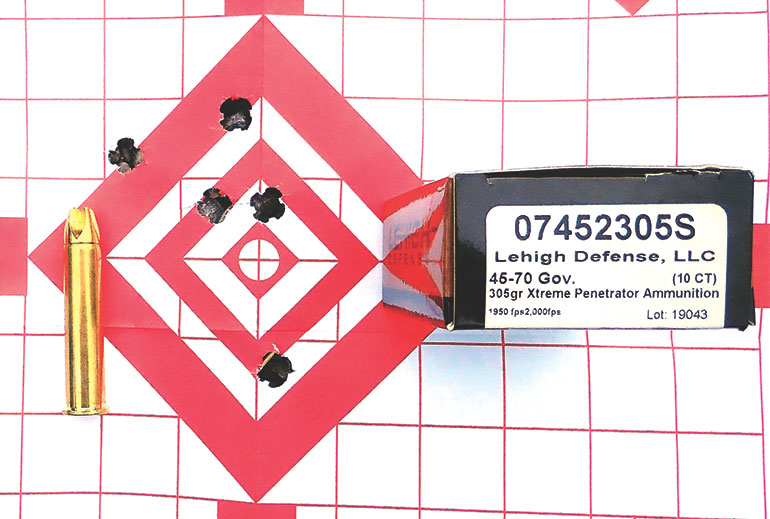
As we draw to a conclusion in the accuracy testing segment of the Outfitter G2’s stay on the ‘Last Frontier,’ I’ve saved what I consider the most interesting and unique round tested until last. Drum roll please, as I introduce…the Lehigh Defense ‘Xtreme Penetrator’ round. This 305-grain monster is deadly in appearance, and, if the targets are any indication, devastating on big game. And by big, I mean anything shy of having the surname ‘SAURUS.’
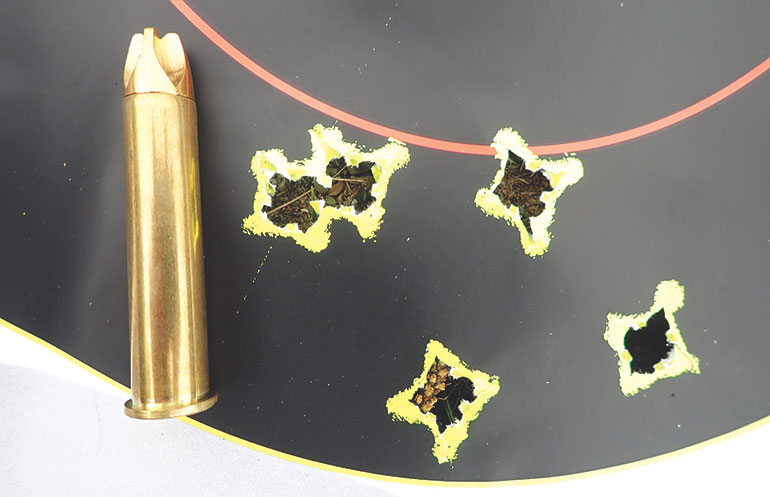
This Lehigh defense round is meant to create massive wound cavities while penetrating game animals deeply. My hunting partners and I work hard to maintain high levels of proficiency with our firearms to ensure humane game-taking, and this round has the energy and design to be a force-multiplier in that regard. This round was the most accurate sent out into the bright Alaska sunlight during my time with the Outfitter G2. It also printed the spookiest looking holes I’ve ever seen on paper. The ‘Xtreme Penetrator’ rounds exhibited a lethal looking profile on paper that were reminiscent of four-blade broadheads on hunting arrows. As for this Leigh Defense round’s accuracy? Well, if you are a fan of the movie ‘Ground Hog’ day or just like repetition, the Xtreme Penetrator’s accuracy was equally as impressive. They scored…you guessed it…. a five-shot/one-hole crater at fifty yards. They five-hole punched a two-inch group at 100 yards and a 3¼ inch group at 200 yards. Since the Xtreme Penetrator fit the definition of a ‘pet load’ and its compatibility with the G2 was so impressive, I decided to stretch the scary looking round’s legs out to the 300-yard line. I was not disappointed. The round printed a six-inch group out yonder…not bad, if I don’t say so myself, for peepers over five decades old and an EOTech holosight with a 3x magnifier! With that kind of accuracy, forget the deer… even if you were a groundhog, you might not be safe from the Outfitter G2’s wrath even if you were wearing ballistic armor and hiding behind a stump and a fire-team of up-armored chipmunks.
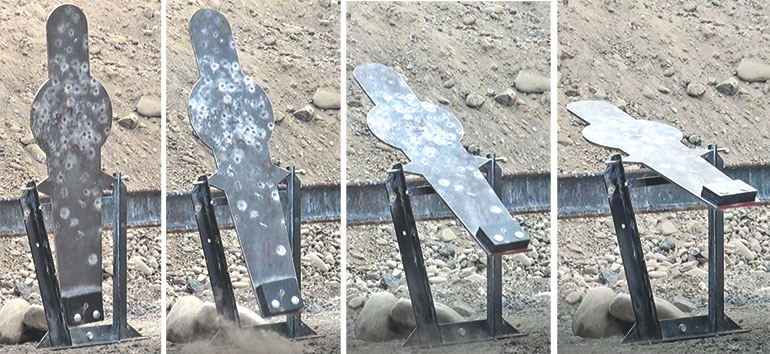
Since I was “in for a dime, in for a dollar” at the 300-yard line, I also placed my pride-and-joy heavy-metal silhouette target out there as well (the local manufacturer promoted it as being fabricated from a section of plate steel removed from the Dreadnought ‘Tirpitz,’ although he may have embellished this a bit as there is a ‘Pittsburgh Steel’ logo at the bottom). A ‘throwdown’ video camera I left adjacent to the target recorded several consecutive ‘head-shot’ strikes. These impacts that were so impressive they looked less like bullet-strikes and more akin to John-Henry induced sledgehammer smashes.
While I love the clanging of steel and the swinging of 50-pound solid steel silhouette targets, at this point, dear readers, we best move on…because with the amount of lead flung hither and yon during the Outfitter G2 range trials, it would be prudent to skedaddle before an Environmental Protection Agency (EPA) task force shows up and makes us complete an environmental impact statement and watch an entire season of Captain Planet reruns!
One is Enough: Final Impressions of the Outfitter G2
For Whitetail Deer Hunters and modern metallic cartridge traditionalists, Traditions Firearms hit a homerun with their Outfitter G2 in .45-70 government. This single shot, solidly constructed deer harvesting machine is up to the task of putting venison on the table, with consistency, to the 200-yard line and beyond. Don’t let the let the single-shot nature of the rifle throw you, because as I would submit to you, fellow shootists, what the hay did Harry Nillsson know about marksmanship or deer hunting? When you are good…ONE IS ALL YOU NEED.
“One…is the loneliest number that you’ll ever do…”
-Harry Nillsson / ‘Three Dog Night’ (1968)
There is only one thing I would change about the Outfitter G2 and that is the extractor. One dose of .45/70 government is enough ‘ouch’ to humanely harvest a vast majority of North American intermediate and big game. However, there may come a time when a hunter has to ‘get on it’ and plunk another kill-dozer cartridge into the Outfitter…something that is slowed by the current extractor configuration on the rifle. The current Outfitter G2 extractor ‘starts the shell’ out of the chamber but doesn’t provide for a positive, affirmative ejection of the spent casing into the air like grand-daddy’s old break-action double-barreled shotgun. After a bit of practice, I was able to reload the rifle fairly quickly by using the old ‘African Hunter’ method of placing the ‘next one down the pipe’ cartridge between the fingers of my non-trigger hand, then, after firing, snapping the action open and using my Chuck Norris-esque ‘pinchers of doom’ forefinger technique to pluck the empty out and fling it flamboyantly into the air while plunking a new round into the chamber. Is the extractor issue a deal-breaker? Not even close. It’s just that when every second counts, a positive, spring-powered ejection hastens a shooter’s reload. And hey…let’s be honest…who doesn’t like to see that brass fly cinematically into the air when the action breaks open!
The positive qualities of the Outfitter far outweighed the negative, effectively leaving my extractor opinion choking in the dust. The G2 is a deer harvesting MACHINE. If you are proficient, ethical, and not one of ‘those guys’ (ie: a ‘slob-hunter’) who takes any shot they can get on an animal, no matter what angle/profile the game provides, the Outfitter G2 will drop the hammer (pun intended) with epic results on your fleet-footed, crafty, cornfield-hugging/hardwood forest whitetail adversaries. The rifle is light, solid, and handles recoil like a boss thanks to the practical, yet cosmetically handsome muzzle brake.
My final word in the “Kudos Department” comes in the form of a ‘thumbs up’ for the Outfitter G2’s accuracy combined with its price tag. Traditions Performance Firearms’ combination of a nicely barreled (shout-out to Mr. Walther for raising his barrel-crafting son right), well-balanced solid rifle and affordable MSRP makes perfect sense (both practically and fiscally) for deer-hunters from states previously handicapped by ‘no rifles allowed’ restrictions.
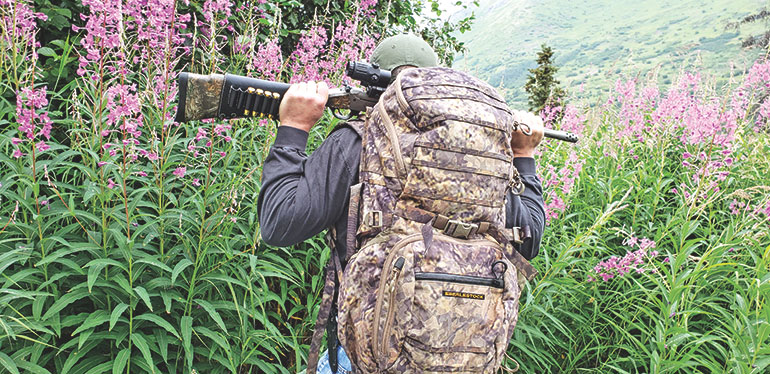
With that, my fellow shootists and hunter-gatherers, the Outfitter G2’s Alaska/Summer vacation comes to an end. In the final analysis, whether you are a rifleman who lives for the finality of a single-shot rifle action slamming shut on an iconic, big bore cartridge, or a Whitetail deer hunting aficionado intent on gaining another tool for your kit, I think it’s safe to say you will find the fine folks at Traditions Firearms smacked one out of the park with the Outfitter G2 .45-70 Government edition.
TRADITIONS OUTFITTER G2 FEATURES:
- Available calibers: .243, 300 Blackout, .35 Remington, .35 Whelen, .357 Magnum, 450 Bushmaster, .45-70
- 22-inch Chromoly Lothar Walther Premium Fluted Barrel with 11 Degree Target Crown
- Premium CeraKote Finish on Barrel
- Patented Quick Detach Forend for easy takedown
- Weighs 5.8 lbs.
- Transfer Bar Safety System
- Manual Trigger Block Safety
- Steel Frame
- Drilled & Tapped
- Lightweight and Maneuverable
- Excellent for smaller framed shooters
- $557.00 MSRP
TRADITIONS FIREARMS
1375 Boston Post Road
P.O. Box 776
Old Saybrook, CT 06475
Tel. 860-388-4656
Fax. 860-388-4657
Email: info@traditionsfirearms.com
TraditionsFirearms.com
State’s pistol purchase permit requirement has been in existence for 110 years.
The North Carolina General Assembly appears poised to repeal the state’s 110-year-old pistol purchase permit, but how exactly it’s accomplished remains unclear.
House Republicans approved House Bill 50 in a party-line vote on Wednesday to repeal the state’s pistol purchase permit. The measure now heads to the Senate, which approved the same in a broader bill package last week.
Senate Bill 41 was also approved in a party-line vote to repeal the permit that requires approval from the respective 100 county sheriffs. SB 41 includes measures to allow concealed carry of firearms at religious services that share locations with private or charter schools, and to launch a two-year firearm safe storage awareness initiative, as well.
Sen. Danny Britt, R-Robeson, sponsor of the Senate bill, contends the vast majority of pistol sales in North Carolina take place through federally licensed dealers, who would still be required to conduct checks through the National Instant Criminal Background Check System run by the FBI.
Supporters of the change have cited complaints about the slow pace of permit approvals and touted support for repeal from the North Carolina Sheriff’s Association.
Democrats have argued the bill would create a “giant loophole” that would allow dangerous individuals to obtain handguns through private sellers who are not required to conduct background checks.
Aspects of SB 41 regarding the safe storage awareness initiative and concealed carry at religious services have already cleared the House in standalone bills with support from Democrats. Democrat Gov. Roy Cooper vetoed similar legislation to repeal the pistol purchase permit in 2021, alleging “gun permit laws reduce gun homicides and suicides and reduce the availability of guns for criminal activity.”
Senate Republicans now hold a supermajority necessary to override a gubernatorial veto, while Republicans in the House came one vote shy of that threshold in the November election.
HB 50’s single Democratic co-sponsor, Rep. Michael Wray of Northampton County, told the media he decided to vote against the bill on Wednesday after consulting with sheriffs in his district.
SB 41 is currently in the Committee on Rules, Calendar, and Operations of the House, while HB 50 has not yet been referred to a Senate committee.
House Speaker Tim Moore, R-Cleveland, recently told reporters that while he believes discussions should continue with Democrats to court support for repeal, the lower chamber could simply adopt SB 41.
Advocates for repeal have highlighted how pistol purchase permits were initially implemented by Jim Crow Democrats to prevent black residents from gaining legal access to guns, dubbing the permit law “the Klan’s favorite law.”
North Carolina is the only southern state that still requires a pistol purchase permit.

The purpose of this short commentary is to record what was perhaps the most memorable chapter of my Air Force career. I was fortunate to have received my advanced prosthodontic training at Wilford Hall USAF Medical Center in San Antonio, Texas, which arguably was and still is the strongest prosthodontic program in the country. That residency was followed by an Air Force-sponsored fellowship in maxillofacial prosthetics at MD Anderson Cancer Center in Houston—the largest cancer treatment center in the world. I was the last Air Force-sponsored person to train there before the Air Force launched its own maxillofacial program.
For the remainder of my Air Force career, fortune favored me with duty assignments where I could use my training to rehabilitate maxillofacial prosthodontic and prosthetic patients. However, beyond my professional career—which has absolutely defined me—the Air Force also afforded me a unique opportunity, unrelated to dentistry, that provided me with some of my best military friends and memories.
That opportunity was my nine-year tenure as a member of the U.S. Air Force National Pistol Team.
BEGINNINGS
In the summer of 1987, after returning from an appointment at David Grant USAF Hospital, my wife presented me with a somewhat worn “waiting room” copy of Airman magazine, which featured an article announcing the resurrection of an Air Force shooting program to replace the former legendary teams terminated more than a decade earlier due to severe defunding.
The new program would be meagerly funded as an MWR (Morale, Welfare and Recreation) activity, comparable to other minimally funded Air Force sports programs. Competitors were expected to provide their own firearms and ammunition and to train during their personal off-duty time. Some limited funds were available for team members to travel to important events as the National, Interservice and Olympic matches. The article also announced a search for interested service members to apply for an invitation to the upcoming selection camp where the coming year’s team would be chosen.
Though I had competed intermittently at local clubs throughout most of my adult life, I never believed that I was up to the task of competing at a national level. However, after reading the article and considerable urging by my wife, I called the MWR office at Randolph Air Force Base the next day. I managed to wrangle an invitation to the upcoming tryouts, but I humbly admit that their gracious invitation was certainly based on my rank of Colonel, rather than any personal shooting accomplishments.
At the time, all team members and tryout competitors were enlisted personnel serving as instructors. That year’s weeklong camp was conducted at Lackland Air Force Base in San Antonio, Texas. The intention of the camp was to identify a 10-person team for the coming year (a five-member primary team and a five-member developmental team). Of the 20-odd contenders who reported to the camp, nearly half had been on the previous year’s team and had recently returned from Camp Perry.
Needless to say, my only goal was to not embarrass myself.
Much to my surprise, after completing the selection process, I qualified. I finished in sixth place—the top scorer on the second-string team.
That 1987 training camp was conducted by the team’s coach, Ralph Talbot, a retired member of the U.S. Army National Shooting Team and holder of several national records. After observing my ability at the National Match Course, firing my personal hardball gun, the coach asked me to complete it again using his ball gun. My groupings immediately improved. Apparently, my gun had “shot loose” over the years.
As a result, he authorized me to be issued an AFPG ball gun for the 1988 season, while the Lackland Air Force Base gunsmith shop rebuilt my personal ball gun to a level of precision suitable for national competition. I had acquired my gun from Paul Mazerov, a lifelong friend who had taught me how to shoot.
A decorated Korean War combat Marine, Paul was a retired Colonel and one of the prime movers in my life. That National Match gun was originally built for him by USMC gunsmiths at Quantico two decades earlier. It was stamped with his service number, and is still one of my most prized possessions.
I competed with Paul’s team in the Pittsburgh Metropolitan Police Revolver League during my final two years of Dental School. In 1987, I located what would become my “Magic Ball Gun” at a pawn shop in Reno, Nev. It was comprised of an excellent Colt M-1911A1 receiver and a mint Union Switch and Signal slide. After removing that rare slide, I gave the pistol to the Gunsmith Shop at Lackland AFB to build me a premium-grade gun.
Master Gunsmith Bill Moore replaced all the partsm except the original receiver with carefully fitted National Match parts. Upon completion, he stamped the gun with “AFPG” and his “XX” mark. The AFPG guns that were issued to the original Air Force team members had to be returned when that member left the team or retired. The latter-day team members already owned their guns and so did not have to return them upon leaving the team, despite any accuracy efforts invested in them by the Air Force Gunsmith Shop.
Consequently, I still have my “Magic Hardball Gun.” I competed with it from the 1989 season until I retired from the Air Force. This pistol was responsible for all my significant accomplishments with the team.
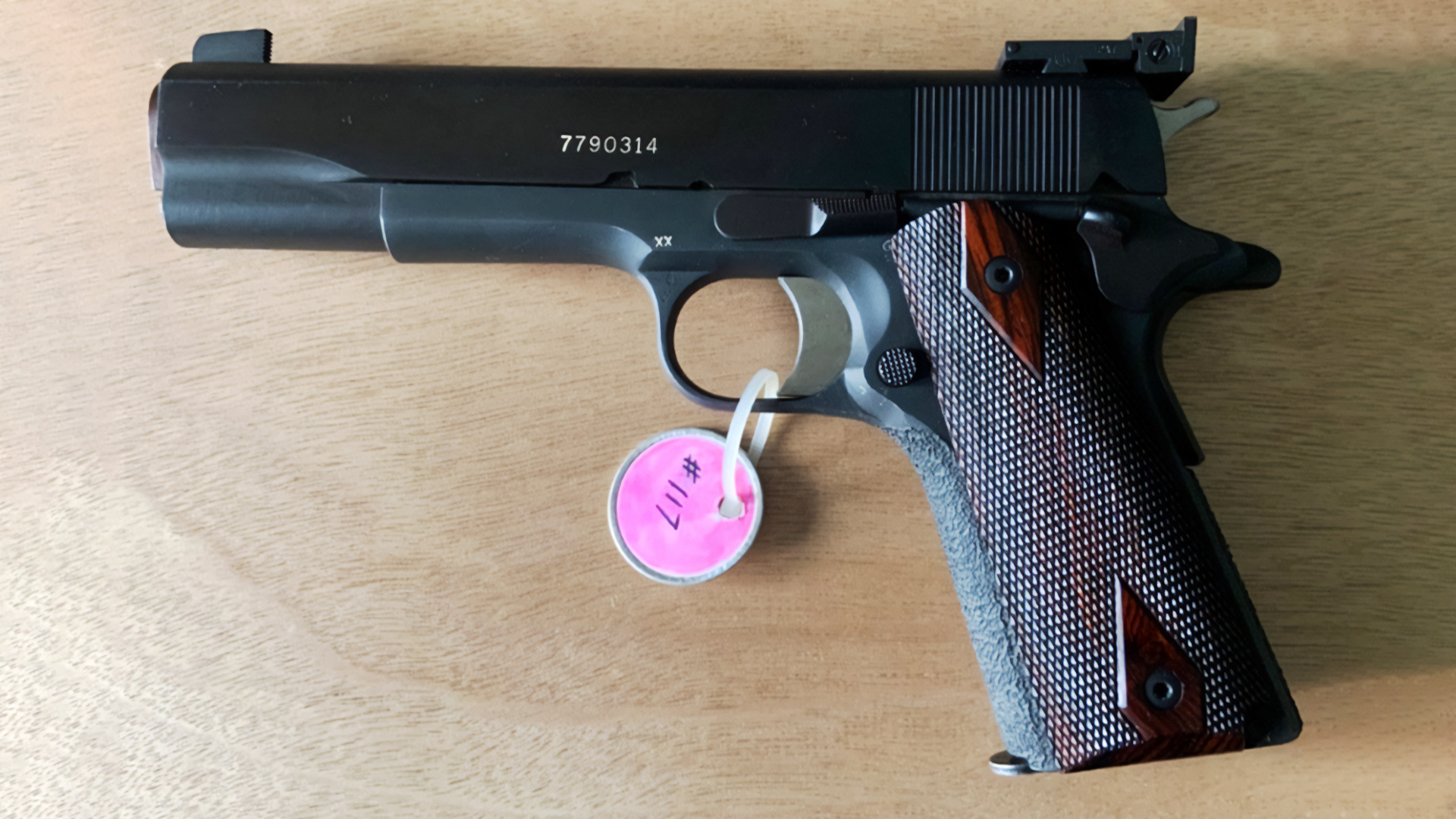
Above: AFPG Hardball gun built in 1988 by USAF Master Gunsmith Bill Moore specifically for the author, Dr. Robert “Doc” Engelmeier, which he used in Air Force Pistol Team competitions through 1995.
U.S. AIR FORCE SHOOTING TEAM HISTORY
Kimpo Air Force Base in South Korea served as a major evacuation site for Seoul stationed diplomats in 1950 when the Korean conflict began. It was overrun by communists on September 15, 1950, but was reoccupied two days later. It fell again on January 4, 1951, but retaken a month later for the final time.
While viewing the devastation of the original September invasion, Gen. Curtis LeMay was appalled as he surveyed all the dead airmen who had perished defending their base. They died hopelessly clutching their .30-cal. M-2 Carbines while futilely trying to reload them with M-1911 .45 Auto magazines.
At that moment, he vowed to train all airmen to a level of proficiency with their issued firearms so that a travesty like that could never happen again.
Once he had been appointed Vice Chief of Staff of the U.S. Air Force, LeMay was finally in a position to fulfill his vow of marksmanship training for all Air Force members. In 1959, he appointed Col. Thomas Kelly to establish a marksmanship school for the purpose of developing master gunsmiths and marksmanship instructors who would focus on training air crews and security forces.
The school was also commissioned to develop and field national and world-class competitive teams in smallbore and high power rifle, trap and skeet shotgun, national and international pistol and running boar tournaments. The school’s training program for small arms instructors was 12 weeks in duration. That marked the origin of the U.S. Air Force “Red Hat” career field.
The gunsmith shop not only built and maintained service firearms, but also evolved to a level of producing precision firearms fit for world-class competition. The custom pistol section of the shop was headed by master gunsmith Bob Day, who built match-grade .45 “Hardball guns” for the team. Only guns that met his high standard of being capable of 50-yard groups less than two inches were acceptable for competition. Those guns were stamped “AFPG,” which stood for Air Force Premium Grade. There was even a section in the shop devoted to testing and developing new systems.
From 1958 through 1969, the program produced legendary teams that far surpassed Gen. LeMay’s expectations. Once selected for team membership, marksmanship became that member’s career field of assignment. All 15 members of that original, legendary team were Distinguished Pistol shots. More than half were 2650 shooters.
Besides winning individual and team championships at the Interservice and National Matches, the team set a few records at those events that have continued to stand decades later. They also brought home international medals from the Olympic and Pan-American Games.
Unfortunately, the team was discontinued after drastic program defunding in 1969 following Gen.LeMay’s retirement. Articles by Charles Petty and T/Sgt. Arnold Vitarbo (USAF, ret.) provide a more comprehensive history of the pistol team from its 1959 origins through its resurrection as a modestly funded MWR activity years later.
After the 1969 budget cuts, a new process was established to extend the existence of an Air Force pistol team a bit longer. Each year, the team consisted of competitors who began their marksmanship journey by achieving membership on their base pistol teams, which usually competed locally. The next step was selection for a position on an Air Command Team following base team competitions at annual Air Command Matches.
Each spring, members of the Air Command Teams reported to the annual All-Air Force Matches at Lackland Air Force Base, where an Air Force National Pistol Team was assembled for the purpose of competing at the upcoming Interservice and National Matches. The primary responsibility of the final team members was not marksmanship, but rather their assigned military career field.
Training was accomplished during off-duty time. They were expected to furnish their own gear. However, the Air Force did provide gunsmith services and travel reimbursement to key national and international events. Unfortunately, all funding was discontinued in 1973. A few unsupported former team members did continue to compete as individuals over the next few years.
One such shooter was Steve Richards, who served as a lieutenant on the original Air Force National Team in the 1960s. He continued to compete on his own for two decades following the severe 1969 defunding of the program. By the 1980s, Col. Richards had become a Pentagon officer. He and a few other marksmanship supporters established that some Olympic events were shooting sports, and thereby qualified for funds allocated to train Olympic athletes under Public Law 84-11.
Consequently, the Air Force Sports and MWR office at Randolph Air Force Base began to set aside sufficient non-appropriated funds to resurrect a team. Shooters had to provide their own guns, ammunition and equipment. They had to train during their off-duty time. However, travel and per diem funds were available for major national and international competitions. A team member could only attend such events with his or her commander’s permission.
Their primary Air Force responsibility was to their assigned career field. This new program was designed to identify airmen who had developed to a competitive level on their own. Team try-outs were set up to occur each year at Lackland AFB. Most candidates at those trials had been well trained instructors or members of the security police.
That trip from the Florida panhandle to Cape Cod ended up taking three days. A Greyhound bus would have been faster. I have no complaints though—we arrived home safely. Further, that adventure was a preview of the great times to come.
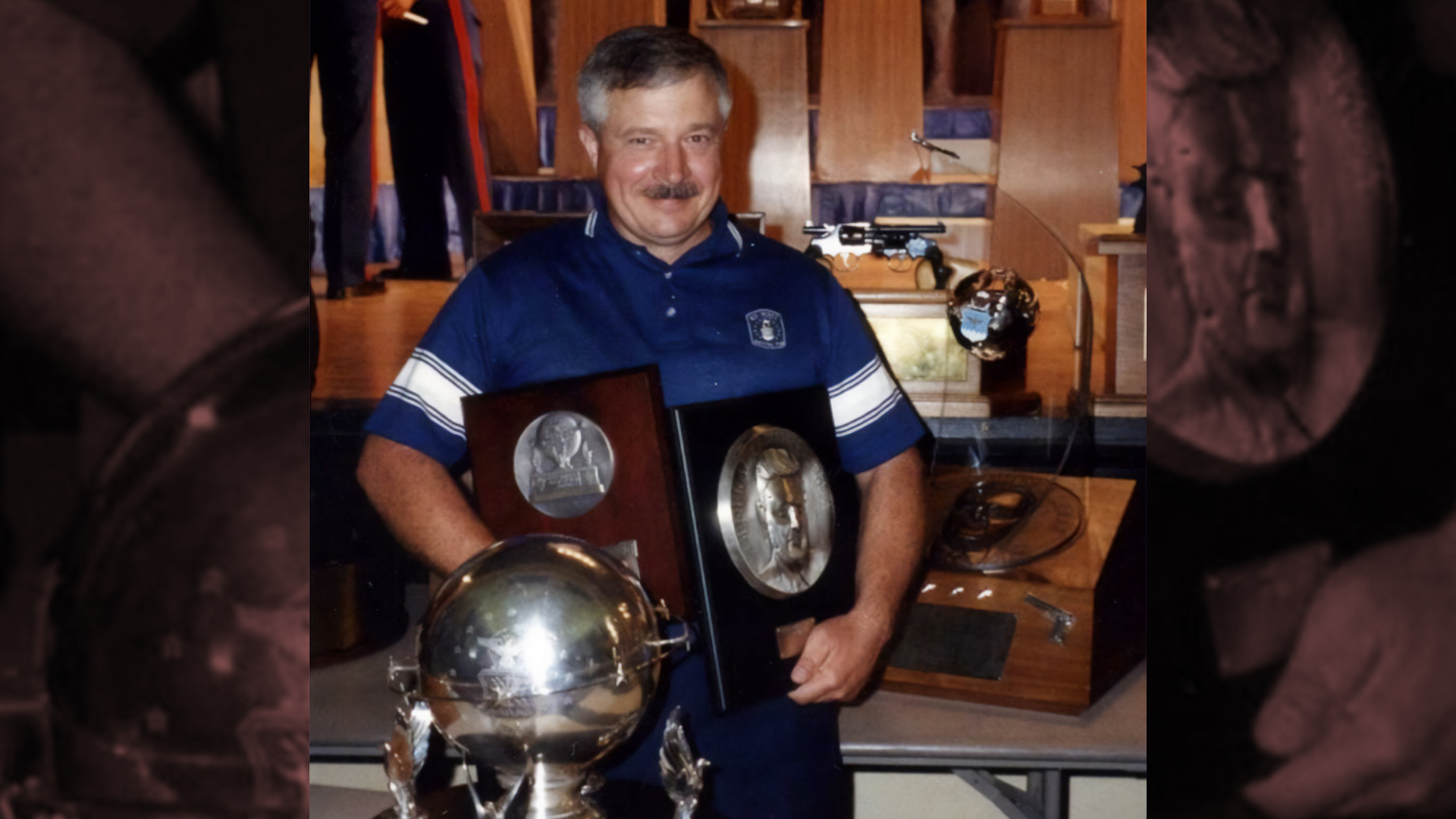
The General Curtis LeMay Trophy won at the Camp Perry NTI Match on July 23, 1992.
Categories