


| AR-7 | |
|---|---|

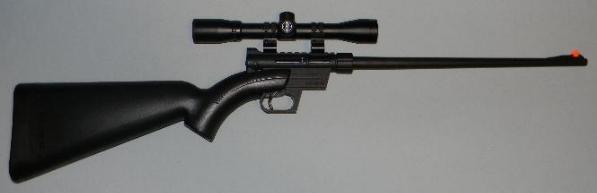
Armalite AR-7 survival rifle with 8-, 10-, and 15-round magazines.
|
|
| Type | Survival rifle |
| Place of origin | United States |
| Service history | |
| In service | 1959–Present |
| Production history | |
| Designer | Eugene Stoner |
| Designed | 1958 |
| Variants | Armalite AR-7 Explorer; Charter Arms AR-7 Explorer; Charter Arms Explorer II Pistol; Israeli Pilot’s Survival Rifle; Henry U.S. Survival .22 |
| Specifications | |
| Weight | 1.13 kg |
| Length | 889 mm |
| Barrel length | 406 mm |
|
|
|
| Cartridge | .22 Long Rifle |
| Action | Straight blowback-operated |
| Rate of fire | Semi-automatic |
| Muzzle velocity | 1,080 ft/s (329 m/s) to 1,280 ft/s (390 m/s) (varies by type of .22 LR cartridge) |
| Effective firing range | 100 m |
| Feed system | Standard 8-round magazine. 10-, 15-, 25-round magazines available. |
| Sights | Aperture rear and drift-adjustable front. |
The ArmaLite AR-7 Explorer is a semi-automatic firearm in .22 Long Rifle caliber developed from the AR-5 that was adopted by the U.S. Air Force as a pilot and aircrew survival weapon.[1]
The AR-7 was adopted and modified by the Israeli Air Force as an aircrew survival weapon.
The AR-7 was designed by American firearms designer Eugene Stoner, who is most associated with the development of the AR-15rifle that was adopted by the US military as the M16.
The civilian AR-7’s intended markets today are backpackers and other recreational users as a takedown utility rifle.
The AR-7 is often recommended for use by outdoor users of recreational vehicles (automobile, airplane or boat) who might have need for a weapon for foraging or defense in a wilderness emergency.
[hide]
The prototype of what would become the AR-7 was designed by Eugene Stoner at ArmaLite Inc., a division of Fairchild Aircraft.
The rifle shares some of the features of the bolt-action AR-5, another rifle designed by Stoner for ArmaLite and adopted by the United States Air Force in 1956 as the MA-1.[2]
The MA-1 was intended to replace the M4 Survival Rifle and the M6 Aircrew Survival Weapon which was a superimposed (“over-under”) twin-barrel rifle/shotgun chambered in .22 Hornet and .410 bore, using a break-open action.
The AR-5 had the advantage of repeat fire over the then-standard M6, using the same .22 Hornet cartridge.
When the AR-5 was adopted as the MA-1 but was not placed in issue due to the numbers of usable M4 and M6 survival weapons in USAF inventory, ArmaLite used the research and tooling for the AR-5 in developing the AR-7 for the civilian market.[3]

Armalite AR-7 Explorer internal parts assembled (left sideplate removed)
The AR-7 uses a blowback semi-automatic action in .22 Long Rifle but retains the AR-5/MA-1 feature of storing the disassembled parts within the hollow stock, which is filled with plastic foam and capable of floating.[4][5]
Like the bolt-action AR-5, the AR-7 was designed as a survival rifle for foraging small game for food. The AR-7 is constructed primarily of aluminum, with plastic for the stock, buttcap, and recoil spring guide.
The bolt is steel. The original barrel was aluminum using a rifled steel liner; barrels of some production models have used all steel barrels, others have used barrels made of composite materials.[6]
The AR-7 measures 35 inches overall when assembled. It disassembles to four sections (barrel, action, stock, and magazine), with three parts storing inside the plastic stock, measuring 16 inches long.
The rifle weighs 2.5 pounds, light enough for convenient backpacking. The rear sight is a peep sight, which comes on a flat metal blade with an aperture (in later production two different size apertures available by removing and flipping the rear sight), and is adjustable for elevation (up-down).
The front sight is adjustable for windage (side-to-side). Accuracy is sufficient for hunting small game at ranges to 50 yards.
Reliability of the AR-7 is highly dependent on the condition of the magazine and on the ammunition used, perhaps more so than with other models of semi-automatic .22 caliber rifles.
The feed ramp is part of the magazine and subject to damage from mishandling. Flat-nosed bullets tend to jam on the edge of the chamber of the barrel.
The transition of cartridge from magazine to barrel can be smoothed by minor beveling of the chamber of the barrel, by using round-nosed as opposed to flat-nosed bullets and by paying attention to condition of the feed lips and feed ramp of the magazine.
Later production magazines include an external wire spring to align the cartridge; earlier magazines used two pinch marks at the top of the magazine body, which in use could become sprung open or worn.[citation needed]
All iterations of the AR-7 from the Armalite to the Henry U.S. Survival rifle use a bolt and dual recoil springs that are heavy compared to most other .22 semiautomatics.
The AR-7 requires high velocity ammunition for reliable functioning. The manufacturers recommend use of 40 grain round nose bullets in high velocity loadings.
It is possible to manually load a single round into the firing chamber, allowing use of flat nosed bullets or low velocity or subsonic ammunition.
The barrel takedown nut tends to loosen during firing and may need hand-tightening to maintain both accuracy and reliability.
Armalite sold the design to Charter Arms in 1973. According to some accounts posted by enthusiasts, this is when quality began to deteriorate.[7]
Barrels were said to have a tendency to warp. Other sources state that the first production at Charter had problems which were corrected in later production runs.[3]
(Summary of information available in The Blue Book of Gun Values)
Armalite barrels had a steel liner in an aluminum shell. The Armalite stock did not accept the receiver with a magazine in place and the gun was normally sold with one magazine.
The receiver did not provide for a scope mount. The rear sight was a peep aperture, adjustable for elevation. The front sight was drift-adjustable for windage.
The AR-7 was also manufactured in Argentina as the Sistema de Armas .22 LR Fire de Brenta.[8] It came with various barrel lengths, shrouds and fixed rifle stocks as well as pistol grips with retractable stocks.
Herter’s, Hy Hunter and American International Distributors marketed .22 replicas of the Broomhandle Mauser (as “Bolomauser”), Thompson submachine gun (as “T-62 Civilian Defense Model”) and M1 Carbine made on AR-7 receivers and barrels.[9]
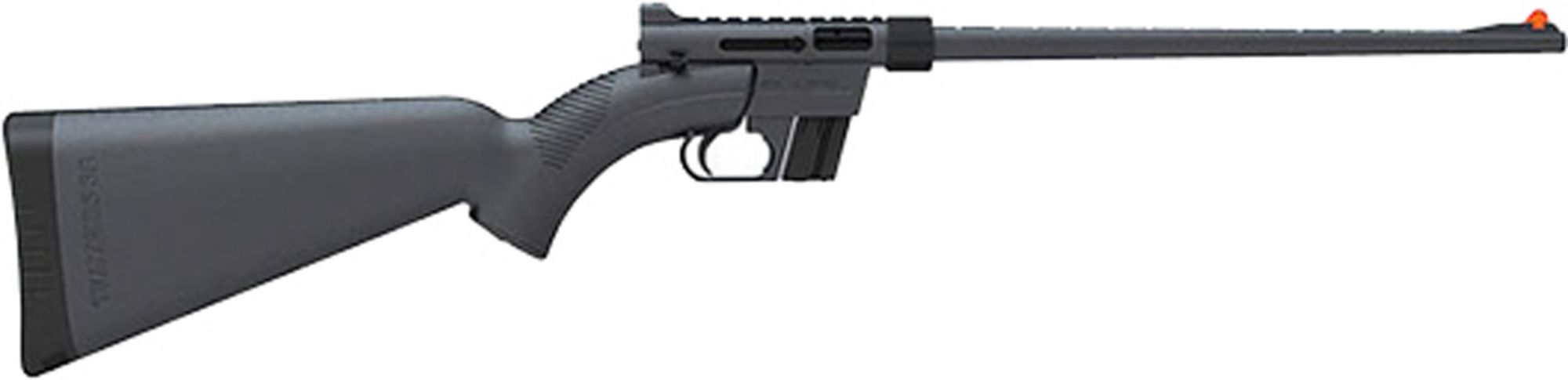
The Charter Arms AR-7 Explorer rifle basically replicated the Armalite AR-7 Explorer with variations in finish.

Explorer II pistol with 8 inch barrel
Explorer II was a pistol version of the AR-7.[10] It resembled a Broomhandle Mauser. The receiver had a built-in pistol grip with no provision for the rifle stock (the internal parts are interchangeable between rifle and pistol).
The rear sight of the pistol was an open notch adjustable for windage and elevation. The Explorer II front sight was integral with the barrel shell and was not adjustable.
The magazine well in front of the trigger guard would accept any magazine designed for the rifle. A spare 8-round magazine could be carried inside the grip.
The most common barrel was six inches. Optional barrel lengths included eight and ten inches.

Alignment lug is on barrel underside
Because the U.S. 1934 NFA regulations set the minimum rifle barrel length at 16 inches, Charter Arms made the barrels of the Explorer I rifle and Explorer II pistol non-interchangeable to prevent installing the pistol barrel on the rifle.
The AR-7 barrel has an alignment lug that mates a notch in the receiver. The rifle receiver notch and barrel lug are on top; the pistol notch and lug are broader and on the bottom.
If a Charter Arms factory-made pistol barrel were installed on a rifle, the extractor on the bolt would be opposite the extractor slot in the barrel, preventing the bolt from closing (plus the front sight would be upside down).
Modifying the pistol barrel to fit the rifle, or modifying the rifle receiver to accept the pistol barrel, would be “making a short barrel rifle” legally requiring federal registration on an ATF Form 1 with payment of a $200.00 tax.
Conversely, after the Supreme Court ruling in United States v. Thompson/Center Arms Co.,[11] modifying the pistol to accept the rifle barrel and/or stock, or modifying the rifle barrel or stock to fit the pistol is legal so long as you do not have the rifle stock attached at the same time as the pistol barrel.
It is legal (as a pistol) to have the rifle barrel attached with the pistol grip; there is no federal maximum pistol barrel length.
AR-7 Industries made solid steel barrels much heavier than the AR-7 barrels by Armalite, Charter or Henry.
In 1980, the design and production rights passed on to Henry Repeating Arms and the compact rifle was slightly revised. The AR-7 is now (2015) known as the Henry U.S. Survival AR-7 rifle. An ABS material replaced the original stock plastic, which was prone to cracking and failure.
The receiver recess in the Henry stock allows storage of receiver with a magazine in place and the rifle is normally sold with two magazines.
The latest versions of the Henry allow for storage of three magazines total, with two in the stock recess, and one in the receiver. The modern Henry U.S. Survival rifle is also water resistant.
They now include a full Teflon coating on the outer surface. A 3/8 in. Weaver Tip-off mount rail milled into the top of the receiver for attaching a wide variety of optics is now a standard feature.
Another variant was made by Armalite and sold to the Israeli Military for use as pilot/aircrew survival weapons.[12]
The Israelis further modified these rifles, adding a telescoping stock, a pistol grip from a FAL-type rifle, shortening the barrel (to 13.5 inches), and adding a front sight based on the K98k Mauser.
After Israeli service, some of these rifles were re-imported into the U.S. by Bricklee Trading Company (the barrels are marked with the BTC identification as required by U.S. laws on imported guns) for sale on the civilian market, and command a premium among collectors.
In order to comply with U.S. Federal law, a 3-inch muzzle brake had to be permanently attached in order to meet the minimum 16-inch-barrel requirement.
The AR-7 functions as a simple or plain blowback semi-automatic. The AR-7 is a light firearm with heavy bolt and twin recoil springs and must be firmly held for reliable blowback operation.
As is common with many blowback .22 rifles, the AR-7 bolt cannot be locked open to demonstrate the weapon is in a safe unloaded state. Firearms without a built-in “bolt hold-open” device may be banned from use at some firing ranges.
Other firing range operators allow use of an open bolt indicator to prop the bolt open so that the chamber is visible. The yellow plastic flag for CMP range use is recommended or a spent cartridge case may be accepted to indicate open bolt.

The fact that both the barrel and stock are detachable has led to a plethora of after-market accessories, similar to those available for the Ruger 10/22. Barrels, stocks, and grips, of varying finishes and utility, can be added to the rifle.
These include collapsible stocks, wire-framed stocks, pistol grips, flash suppressors, shrouded barrels, high-capacity magazines, telescopic sights, reflex ‘red dot’ sights and other occasionally fanciful-looking hardware, some at a cost greater than the rifle itself. Such accessories often make it impossible to use the original floating stock for storage of modified parts.[3]
The current Henry U.S. Survival AR-7 has a 3/8″ scope sight rail integral with the receiver to accept standard Weaver-style “Tip-Off” rings. For earlier makes, B Square supplied the Charter Arms AR-7 Explorer Scope Mount Base, an accessory bracket with a 3/8″ rail.
The base attached by the receiver side plate screw (the Charter Arms side plate screw is longer than that of the Armalite). This base can be used on the Armalite and the Charter Arms Explorer rifles and the Charter Arms Explorer II pistol.
However, with the base in place, the rifle receiver will no longer fit the recess in the stock for storage. (The base is not needed on the Henry version and will not fit the Henry receiver.)
Apart from the highly modified AR-7 Israeli survival rifles, most AR-7 models lack provision for a carry sling. AR-7 owners have adapted slings designed for use on guns without modification, such as universal shotgun slings designed to cup the shotgun buttstock at the rear and clamp to the barrel or magazine tube at the front.
Given the light weight of the AR-7, 2.5 pounds, a proper length of parachute cord with a slip knot at either end can be used as a sling or lanyard.


GAINESVILLE, Ga. (AP) — With Gary Ramey’s fledgling gun-making business taking off in retail stores, he decided to start offering one of his handguns for sale on his website.
That didn’t sit well with the company he used to process payments, and they informed him they were dropping his account. Another credit card processing firm told him the same thing: They wouldn’t do business with him.
The reason? His business of making firearms violates their policies.
In the wake of high-profile mass shootings, corporate America has been taking a stand against the firearms industry amid a lack of action by lawmakers on gun control. Payment processing firms are limiting transactions, Bank of America stopped providing financing to companies that make AR-style guns, and retailers like Walmart and Dick’s Sporting Goods imposed age restrictions on gun purchases.
The moves are lauded by gun-safety advocates but criticized by the gun industry that views them as a backhanded way of undermining the Second Amendment. Gun industry leaders see the backlash as a real threat to their industry and are coming to the conclusion that they need additional protections in Congress to prevent financial retaliation from banks.
“If a few banks say ‘No, we’re not going to give loans to gun dealers or gun manufacturers’, all of a sudden the industry is threatened and the Second Amendment doesn’t mean much if there are no guns around,” said Michael Hammond, legal counsel for Gun Owners of America. “If you can’t make guns, if you can’t sell guns, the Second Amendment doesn’t mean much.”
The issue has already gotten the attention of the Republican who is chairman of the Senate Banking Committee. Sen. Mike Crapo of Idaho sent letters criticizing Bank of America and Citigroup, which decided to restrict sales of firearms by its business customers, over their new gun rules in the wake of the Florida high school shooting in February.
“We should all be concerned if banks like yours seek to replace legislators and policy makers and attempt to manage social policy by limiting access to credit,” Crapo wrote to Citigroup’s chief executive.
Honor Defense is a small operation with a handful of employees that include Ramey’s son and his wife who work out of a non-descript building in a Georgia office park north of Atlanta. In 2016, its first year, it sold 7,500 firearms. Its products — handcrafted 9mm handguns that come in a variety of colors — can now be found in more than 1,000 stores.
When Ramey noticed that neither Stripe nor Intuit would process payments through his site, he submitted a complaint with Georgia’s attorney general’s office, counting on help from a state law that prohibits discrimination by financial service firms against the gun industry. But the state rejected it, saying that credit card processing is not considered a financial service under state law.
He views the credit card issue as companies “infusing politics into business.”
“We’re just a small company trying to survive here,” Ramey said. “It’s hard enough competing with Smith & Wesson, Ruger and Sig Sauer.”
The financial industry actions came amid a broader pushback by corporate America in the aftermath of the Florida shooting. Delta and United Airlines stopped offering discounted fares to NRA members, as did the Hertz, Alamo and National rental car companies. First National Bank of Omaha, one of the nation’s largest privately held banks, decided not to renew a co-branded Visa credit card with the NRA.
Walmart and Dick’s Sporting Goods both decided they would no longer sell “assault weapons” or firearms to people under age 21. REI, an outdoor-gear shop that doesn’t sell firearms, joined in and decided it would stop selling such items as ski goggles, water bottles and bike helmets made by companies whose parent firm, Vista Outdoor, manufactures ammunition and AR-style long guns.
There’s been election-year response from some lawmakers, notably in Georgia where Lt. Gov. Casey Cagle, who is running for governor, led a move in the Legislature to kill a tax break on jet fuel to punish Atlanta-based Delta over its NRA actions. The move cost the airline an estimated $40 million.
Gun-control advocates have applauded the efforts, saying it demonstrates responsible leadership at a time of paralysis in government. Experts say it’s a sign that the business world views wading into the gun debate as not at all risky — and, in fact, potentially beneficial to their brand.
“Companies by and large avoid these issues like the plague and they only get involved — whether they’re credit card companies or airlines — when they feel like doing nothing is as bad as doing something and they feel completely stuck,” said Timothy D. Lytton, professor at Georgia State University’s College of Law and author of “Suing the Gun Industry: A Battle at the Crossroads of Gun Control and Mass Torts.”
The gun industry acknowledges that there’s nothing requiring companies from doing business with gun manufacturers or dealers. Monthly reports from the federal government show background checks to purchase a firearm are up over last year so far, so the early actions apparently have not put a dent in sales.
Still, the industry believes it needs stronger laws against financial retaliation in the future.
“We may have to seek legislation to make sure it can’t be done and that you can’t discriminate against individuals from lawful exercise of a constitutional right,” said Larry Keane, senior vice president and legal counsel for the National Shooting Sports Foundation, which represents gunmakers. “Imagine if banks were to say you can’t purchase books or certain books aren’t acceptable. That would be problematic and I don’t think anyone would stand for that kind of activity by the banking industry.”
Read more: https://www.ammoland.com/2018/05/pistol-shooting-drill-how-to-get-rid-of-your-flinch-video/#ixzz5FxQ5kVIB
Under Creative Commons License: Attribution
Follow us: @Ammoland on Twitter | Ammoland on Facebook
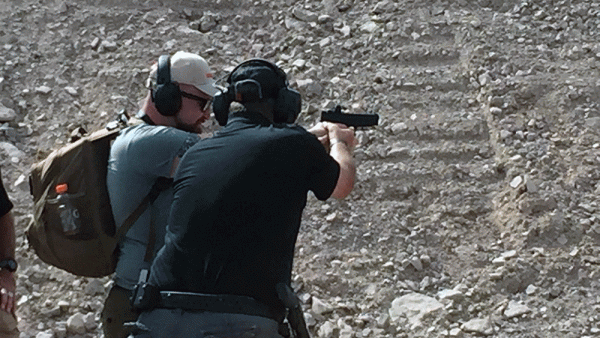
U.S.A. –-(Ammoland.com)- Do you want to get rid of your flinch? You know, that one that makes you shoot low and left (if you are right-handed) consistently? Who wouldn’t?
I reached out to two of my good friends who are excellent pistol shooters and top-rated trainers, Steve “Yeti” Fisher of Sentinal Concepts and Chuck Pressburg of Presscheck Consulting. They both told me that I sucked and then gave me some great advice, shoot ball and dummy. A lot.
Disclaimer: There are a TON of types of flinches, not just one. This drill focuses on you noticing the flinch, not diagnosing what kind of flinch you are displaying.
As much as shooters poke fun at other shooters for having a flinch, many time it isn’t because the gun scared us, but instead has a lot to do with bad habits formed after thousands and thousands of rounds shot over several years without formal instruction. Maybe you are trying to mitigate the recoil of the pistol beforethe shot breaks like I was.
Before we go any further, you will need a couple of things to make this drill a ton easier on you:
Dummy rounds – I prefer the Glock brand ones since they are really cheap and I tend to lose one or two each time I do this drill. You can find them on Brownells for about $37 per 50 with an included box but they can go for about $15 cheaper if you happen to catch them on sale.
3″ Bullseyes or Target Pasters – I normally get mine from Amazon where a 25 sheet package with 9 targets per sheet will set you back $14.99 for the 3″ bulls or you can opt for the 1″ paper dots that run $10.00 for 1,000 little brown dots.
Cardboard Targets – You can also use scrap cardboard if you like but I prefer using IPSC/USPSA targets since I have several hundred of the Action Target brand ones tucked in the garage.
Something that I have struggled with for years as a handgun shooter is flinching just prior to the shot breaking. It wasn’t until Rob Letham showed me exactly what I was doing in a pretty unconventional way. He told me to take aim at the target and then proceeded to pull the trigger for me. The result? A nice tight group that I couldn’t have replicated if my life depended on it at that time in shooting career.
Now there are a ton of really old targets out there that will “diagnose” your flinch, but they are really centered around old style bullseye shooting.
When I asked Steve Fisher about the “diagnosis target” he simply replied with “Junk.” When I pressed him for more info he explained it in more detail saying “It’s a carryover from one-handed pistol shooting taught by the military around the same time that bullseye shooting was popular and has little bearing on the modern defensive and ‘gaming’ techniques taught today”
So I already told you that ball and dummy is the name of the drill. As you might guess it involves some ball ammunition and some dummy rounds. The idea is to have someone load your magazines with dummy rounds loaded randomly so that you have no idea where in the magazine they are.
The goal is to have no idea if the round you are pulling the trigger on is live or a dummy. Now if you are by yourself at the range like I often am, just take a ton of magazines and load them all at once randomly and mix them up so you have no idea what is in each mag.
Once you get all loaded up, head to the 3-yard line and start shooting at the 3″ bull or paster. As you come across a dummy round and you flinch, clear the gun and perform 10 dry fires, then reload the gun and continue. Make sure that every time you flinch on a dummy that you take that 10 dry fire penalty.
That is about all there is to the drill. It isn’t super hard but the benefits that I saw with my shooting was incredible after two full range days and 1,000 rounds of 9mm.
I want to thank Chuck and Steve for letting me bug them for advice. I strongly encourage you to look into both trainers and see if there is a class in your area, you won’t regret it.
About Patrick R.
Patrick is a firearms enthusiast that values the quest for not only the best possible gear setup, but also pragmatic ways to improve his shooting skills across a wide range of disciplines. He values truthful, honest information above all else and had committed to cutting through marketing fluff to deliver the truth. You can find the rest of his work on FirearmRack.com as well as on the YouTube channel Firearm Rack or Instagram at @thepatrickroberts.


Currently soldiers in infantry OSUT go through nine weeks of Basic Combat Training and about 4.5 weeks of infantry advanced individual training. This would add an additional 8 weeks of advanced individual training, tripling the length of the instruction soldiers receive in that phase.
“It’s more reps and sets; we are trying to make sure that infantry soldiers coming out of infantry OSUT are more than just familiar [with ground combat skills],” Col. Townley Hedrick, commandant of the Infantry School at Benning, told Military.com in a June 21 interview. “You are going to shoot more bullets; you are going to come out more proficient and more expert than just familiar.”
The former infantry commandant, Brig. Gen. Christopher Donahue, launched the effort to “improve the lethality of soldiers in the infantry rifle squad,” Hedrick said.
“In 14 weeks, what we really do is produce a baseline infantry soldier,” said Col. Kelly Kendrick, the outgoing commander of 198th Infantry Brigade at Benning, who was heavily involved in developing the pilot.
This works fine when new soldiers arrive at their first unit as it is starting its pre-deployment train-up, Kendrick said.
Unfortunately, many young infantry soldiers arrive at a unit only a few weeks before it deploys, leaving little time for preparation before real-world operations begin, he said.
“I was the G3 of the 101st Airborne and if a [new] soldier came up late in the train-up, we had a three-week train-up program and then after three weeks, we would send that soldier on a deployment,” he said.
With 22 weeks of infantry OSUT, “you can see right off that bat, we are going to have a hell of a lot better soldier,” Kendrick said. “I will tell you, we will produce infantry soldiers with unmatched lethality compared to what we have had in the past.”
The new pilot will start training two companies from July 13 to mid-December, Kendrick said. Once the new program of instruction is finalized, trainers will start implementing the 22-week cycle across infantry OSUT in October 2019.
The effort follows an Army-wide redesign of Basic Combat Training earlier this year, designed to instill more discipline and esprit de corps in young soldiers after leaders from around the Army complained that new soldiers were displaying a lack of obedience, poor work ethic and low discipline.
“If there are two things we do great right now, that’s physical fitness and marksmanship; I really think everything else has suffered a little bit,” said Kendrick. “If you went and looked at special operations forces … the SOF force has realized they have to invest in training and teaching. And they have done that, so we have been the last ones to get it.”
The Army has prioritized leader training for both commissioned officers and sergeants.
“[But] the initial entry, soldier side of the house, has not [changed] whole lot from the infantry perspective for a long, long time,” Kendrick said.
Currently, soldiers in infantry training receive one day of classroom instruction on land navigation and one day of hands-on application.
“We put them in groups of four and they go and find three of about four-five points — that’s their land navigation training,” Kendrick.
The new land-nav program will last a week.
“They are going to do buddy teams to start with, and at the end, they will have to pass day and night land navigation, individually,” he said.
One challenge of the pilot will be, “can I get to individual proficiency in land-nav or do I need more time?” Kendrick said.
“Part of this what we haven’t figured out is hey, how long do those lanes need to be — 300, 600, 800 meters?” said Kendrick, adding that it would be easy to design a course “and have every private here fail.”
“Then I can turn around and have every private pass no matter what with just a highway through the woods,” he continued. “We’ve got to figure out what that level is going to be — where they leave here accomplished in their skills and their ability and are prepared to go do that well wherever they get to. That is really the art of doing this pilot.”
Currently, infantry OSUT soldiers train on iron sights and the M68 close combat optic at ranges out to 300 meters.
The new program will feature training on the Advanced Combat Optical Gunsight, or AGOG, which offers 4X magnification.
“We don’t do much ACOG training; you go out to most rifle units, the ACOG is part of the unit’s issue,” Kendrick said. “It’s a shame that we don’t train them on the optic that half of them when they walk into their unit the first day and [receive it].”
Soldiers will also receive training on the AN/PAS-13 thermal weapon sightand the AN/PSQ-20 Enhanced Night Vision Goggle.
Soldiers will train with these system and their weapons “day and night with qualification associated,” Kendrick said.
The new program will also increase the amount of maneuver live-fire training soldiers receive.
“Everything from a buddy-team to a fire team to a squad, we are going to increase the time and sets and repetitions in getting them into live-firing, day and night,” Kendrick said. “Today when you do a fire-team, react to contact live fire, you do that twice — daytime only. At the end of this thing, when you are done, we will be doing live-fire [repetitions] on the magnitude of 20-plus.”
As with land navigation, Kendrick said, the time allotted for additional marksmanship training is not yet finalized.
“Like anything else, with being an infantryman, it’s sets and reps that make you proficient,” he said. “So now we are talking about the time to do that amount of sets and repetitions that will give them the foundation that can they can work in the rest of their career.”
Infantry OSUT trainees receive about 22 hours of combatives, or hand-to-hand combat training.
“We are going to take that to 40 hours,” Kendrick said. “At the end of 40 hours, we are going to take a level-one combatives test, so every soldier that leaves here will be level-one combatives certified.”
Level-one certification will ensure soldiers are practiced in basic holds instead of just being familiar with them, Kendrick said.
“We are talking about practicing and executing those moves.”
It will be the same with first aid training, he said.
Soldiers will spend eight days learning more combat lifesaver training, trauma first aid and “how to handle hot and cold-weather injuries … which cause more casualties than bullets do right now in some of these formations,” Kendrick said.
“You will have a soldier that understands combat lifesaver, first aid and trauma, all those things because right now you just get a little piece of that,” he said.
Infantry trainees will also receive more urban combat training and do a 16-mile road march instead of the standard 12-miler, Kendrick said.
The plan is to “assess this every week” during the pilot and make changes if needed, Kendrick said.
“Is it going to be enough? Do we need more? Those are all the things we are going to work out in this pilot,” he said. “In December, there will be a couple of 14-week companies that graduate at the same time, so part of this is to send both of those groups of soldiers out to units in the Army and get the units’ feedback on the product.”
The effort is designed to give soldiers more exposure to the infantry tasks that make a “solid infantryman here instead of making that happen at their first unit of assignment,” Kendrick said. “This is really going to produce that lethal soldier that can plug into his unit from day one.”
— Matthew Cox can be reached at matthew.cox@military.com.
Yeah I know that there is a lot of them. So maybe you want to pick & choose. I just feel that on something this important that one can NOT have too much information!
I wish all the best on your choice though and enjoy!
Grumpy