



|
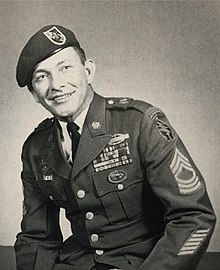
Waugh during his Army service
|
|
| Birth name | William D. Waugh |
|---|---|
| Nickname(s) | “Billy”, “Mustang” |
| Born | December 1, 1929 Bastrop, Texas, United States |
| Allegiance |  United States United States |
| Branch/ agency |  United States Army United States Army Central Intelligence Agency Central Intelligence Agency |
| Years of service | 1948–1972 (Army) 1977–2005 (CIA) |
| Rank |  Sergeant major Paramilitary Operations Officer Sergeant major Paramilitary Operations Officer |
| Unit | 5th Special Forces Group Studies and Observations Group Special Activities Division |
| Battles/wars | Korean War Vietnam War Operation Enduring Freedom – Afghanistan (OEF-A) Operation Iraqi Freedom |
| Awards | Silver Star Legion of Merit Bronze Star Medal (4) Purple Heart (8) |
| Alma mater | |
| Other work | United States Postal Service (1972–1977) |
William D. Waugh (born December 1, 1929) is a former United States Army Special Forces soldier and Central Intelligence Agency paramilitary operations officer who served more than 50 years between the U.S. Army‘s Green Berets and the CIA’s Special Activities Division.
Waugh was born in Bastrop, Texas, on December 1, 1929. In 1945, upon meeting two local Marines who returned from the fighting in World War II, the then 15-year-old Waugh was inspired to enlist in the Marine Corps.
Knowing that it was unlikely that he would be admitted in Texas because of his young age, Waugh devised a plan to hitchhike to Los Angeles, where he believed a person had to only be 16 to enlist. He got as far as Las Cruces, New Mexico, before he was arrested for having no identification and refusing to give his name to a local police officer.
He was later released after securing enough money for a bus ticket back to Bastrop. Now committed to serving in the military once he finished school, Waugh became an excellent student at Bastrop High School, graduating in 1947 with a 4.0 grade point average.[1]
Waugh enlisted in the U.S. Army in 1948, completing basic training at Fort Ord, California, in August of that year. He was accepted into the United States Army Airborne School and became airborne qualified in December 1948. In April 1951, Waugh was assigned to the 187th Airborne Regimental Combat Team (RCT) in Korea.[2]
Shortly after the end of the Korean War, Waugh met two U.S. Army Special Forces members on a train in Germany, they informed him of openings for Platoon sergeants, shortly after he requested a transfer.[3] He began training for the Special Forces, and earned the Green Beret in 1954, joining the 10th Special Forces Group (SFG) in Bad Tölz, West Germany.[2]
As U.S. involvement in the Vietnam War increased, the United States began deploying Special Forces “A-teams” (Operational Detachment Alpha, or ODA, teams) to Southeast Asia in support of counterinsurgency operations against the Viet Cong (VC), North Vietnamese and other Communist forces. Waugh arrived in South Vietnam with his ODA in 1961, and began working alongside Civilian Irregular Defense Groups (CIDGs) there, as well as in Laos.
.png)
Special Forces sleeve insignia, with “Airborne” tab
In July 1965, he was serving with 5th Special Forces Group A-team A-321 at Camp Bồng Sơn, Bình Định Province, commanded by Captain Paris Davis. Following a night raid with a Regional Forces unit on a VC encampment near Bong Son, the unit was engaged by a superior VC force.
Many of the Regional Forces soldiers refused to fight and most of the A team were injured by VC fire, including Waugh who was shot multiple times and left between the VC and U.S./South Vietnamese forces. Waugh was later rescued by Davis under fire.[4] He spent much of 1965 and 1966 recuperating at Walter Reed Hospital in Washington, D.C., eventually returning to duty with 5th Special Forces Group in 1966. He received a Silver Star and a Purple Heart (his 6th) for the battle at Bong Son.

Special Forces Regimental Insignia
At this time Waugh joined the Military Assistance Command-Vietnam Studies and Observations Group (MACV-SOG). While working for SOG, Waugh helped train Vietnamese and Cambodian forces in unconventional warfare tactics primarily directed against the North Vietnamese Army operating along the Ho Chi Minh Trail.
Prior to retirement from U.S. Army Special Forces service, Waugh was senior NCO (non-commissioned officer) of MACV-SOG’s Command & Control North (CCN) based at Marble Mountain on the South China Sea shore a few miles south of Da Nang, Vietnam. Waugh held this Command Sergeant Major role during the covert unit’s transition and name change to Task Force One Advisory Element (TF1AE). SGM Waugh conducted the first combat High Altitude, Low Opening (HALO) jump,[5] a parachuting maneuver designed for rapid, undetected insertion into hostile territory.
In October 1970, his team made a practice Combat Infiltration into the NVA owned War Zone D, in South Vietnam, for reassembly training, etc.[5] Waugh also led the last combat Special reconnaissance parachute insertion by American Army Special Forces HALO parachutists into denied territory which was occupied by communist North Vietnamese Army (NVA) troops on June 22, 1971.[2]
Waugh retired from active military duty at the rank of Sergeant Major (E-9) on February 1, 1972.[2]
After Waugh retired from the military, he worked for the United States Postal Service until he accepted an offer in 1977 from ex-CIA officer Edwin P. Wilson to work in Libya on a contract to train that country’s special forces. This was not an Agency-endorsed assignment and Waugh might have found himself in trouble with U.S. authorities if it weren’t for the fact that he was also approached by the CIA to work for the Agency while in Libya.
The CIA tasked him with surveilling Libyan military installations and capabilities – this was of great interest to U.S. intelligence as Libya was receiving substantial military assistance from the Soviet Union at the time. This additional assignment quite possibly protected Waugh from prosecution after Wilson was later indicted and convicted in 1979 for illegally selling weapons to Libya.[6][7]
In the 1980s he was assigned to the Kwajalein Missile Range in the Marshall Islands to track Soviet small boat teams (Naval Spetsnaz: Dolfin) operating in the area and prevent them from stealing U.S. missile technology. Some of his more critical assignments took place in Khartoum, Sudan during the early 1990s, where he performed surveillance and intelligence gathering on terrorist leaders Carlos the Jackal and Osama bin Laden with Cofer Black.[7][8]
At the age of 71, Waugh participated in Operation Enduring Freedom from October to December 2001 as a member of the CIA’s Northern Alliance Liaison Team led by Gary Schroen which went into Afghanistan to work with the Northern Alliance to topple the Taliban regime and Al Qaeda at the Battle of Tora Bora.[9]
It is unknown how many missions Waugh was involved in during his career.

Waugh in 2011.
In 1985, Waugh was again requested by the CIA for clandestine work. Before he took the offer, he decided to further his education, earning bachelor’s degrees in Business and Police Science from Wayland Baptist University in 1987.
He also earned a master’s degree in Interdisciplinary Studies with a specialization in criminal justice administration (MSCJA) in 1988 from Texas State University (formerly Southwest Texas State), in San Marcos, Texas.[9]
 |
Combat Infantryman Badge (two awards) |
.svg) |
Special Forces Tab |
.svg) |
Master Parachutist Badge |
  |
Military Freefall Jumpmaster Badge with gold combat jump star (5 combat jumps) |
 |
Vietnam Parachutist Badge |
 |
7 Service stripes |
 |
? Overseas Service Bars |
 |
Silver Star[12] |
 |
Legion of Merit |
  |
Bronze Star Medal with three bronze oak leaf clusters |
  |
Purple Heart with seven oak leaf clusters |
   |
Air Medal |
  |
Army Commendation Medal with Valor device and three oak leaf clusters |
|
|
Army Presidential Unit Citation with oak leaf cluster (one award in 2001, SOG) |
  |
Good Conduct Medal (7 awards) |
 |
Army of Occupation Medal |

|
National Defense Service Medal with one bronze service star |
 |
Korean Service Medal with three campaign stars |
 |
Armed Forces Expeditionary Medal |
   |
Vietnam Service Medal with Arrowhead device and six service stars |
 |
Republic of Korea Presidential Unit Citation |
.png) |
Vietnam Presidential Unit Citation |
 |
Republic of Vietnam Gallantry Cross Unit Citation |
 |
Republic of Vietnam Civil Actions Medal Unit Citation |
 |
United Nations Korea Medal |
 |
Vietnam Campaign Medal |
 |
Republic of Korea War Service Medal |


These Exclusive Bundles Feature Five Magazines and Key Performance Upgrades at No Additional Cost
(McLean, VA – February 21, 2023) FN America, LLC is pleased to announce the release of four new promotional pistol bundles for the FN 509® and FNX™-45 Tactical that include upgrades like the FN 509 flat-faced trigger and fiber optic front sight.
Each pistol includes five magazines packaged inside a premium FN zippered range bag at no added cost. These exclusive bundles will be sold through authorized FN distributors and retailers and are available for a limited time only.
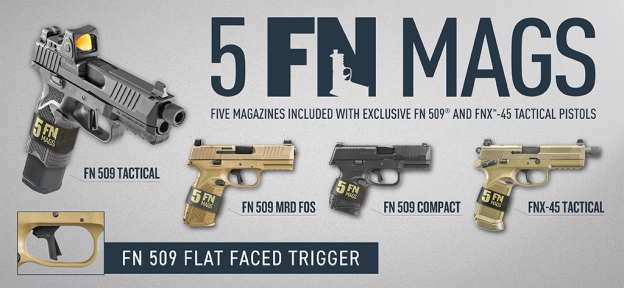
Each pistol will be packaged with three additional extended-capacity magazines, where applicable, for a total of five per pistol. The FN 509 Tactical, FN 509 Compact and FN 509 MRD will feature FN’s custom flat-faced precision trigger that breaks vertically at 90 degrees while the FN 509 MRD FOS will feature the green fiber optic front sight found only on the FN Edge Series models.
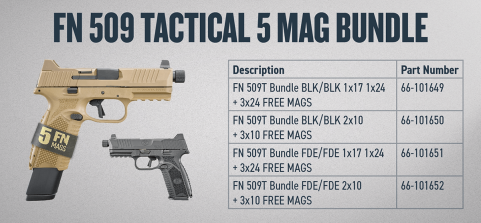
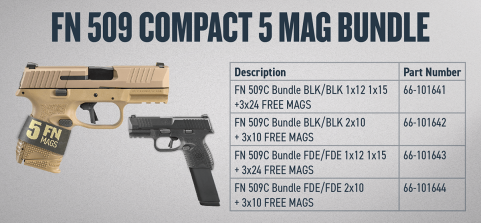
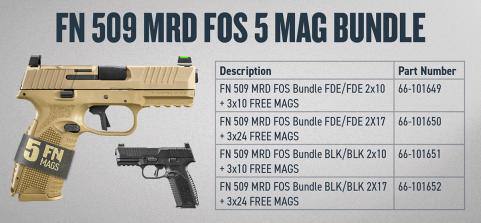
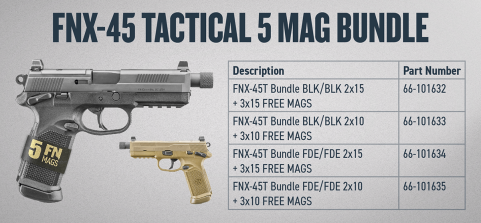
These added accessories and upgrades will be offered at no additional cost to the retail price of the standard models but will be a one-time production run and available only for a short period of time. To purchase, look for the black branded band around the grip at your local retailer. Visit fnamerica.com/promotions/5mags/ to learn more.
# # #
Carry the Future® | FN America, LLC, the U.S. subsidiary of Belgium-based FN Herstal, S.A. provides U.S. military, law enforcement, and commercial customers with a complete range of state-of-the-art, groundbreaking solutions developed around small caliber firearms and associated ammunition under the FN brand name.
FN Herstal is the Defense & Security entity of Herstal Group that also includes a Hunting & Sports Shooting entity (Browning and Winchester Firearms’ brand names) and operates globally.
FN product lines include portable firearms, less lethal systems, integrated weapon systems for air, land, and sea applications, remote weapon stations, small-caliber ammunition, as well as modern and cutting-edge solutions to provide enhanced combat, logistics, maintenance, and communication capabilities.
In addition to FN America – headquartered in McLean, VA, with manufacturing operations in Columbia, SC –, FN Herstal is the parent company of FNH UK in the UK and Noptel (optoelectronics) in Finland.
For more information on FN’s latest products, visit us at www.fnamerica.com or follow us on Facebook, Twitter, and Instagram.

I also bet that she is also sick & tired about talking about her the ump number Great Auntie too! Grumpy

