
Categories
Taurus TCP Break Down Secrets
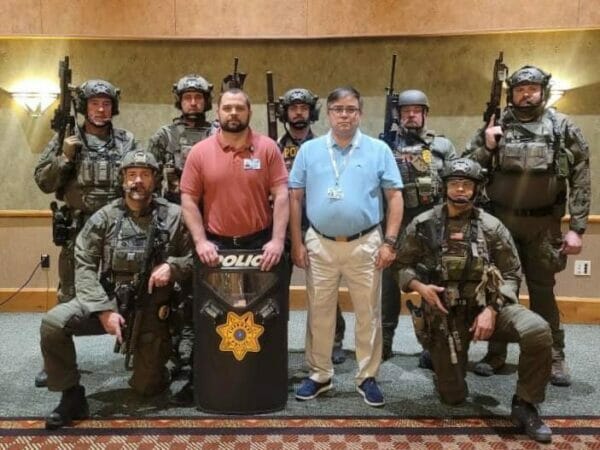
“During its April 6 meeting, the Eastern Band of Cherokee Indians Tribal Council unanimously approved an ordinance change exempting police car and body cam videos from the tribe’s public records law,” Holly Kays of the Smoky Mountain News reports.
“The vote comes on the heels of a Dec. 13, 2022, Cherokee Indian Police Department SWAT response in which officers fired at Murphy resident Jason Harley Kloepfer after he opened the door to his home with his hands held above his head, according to a home security video Kloepfer posted Jan. 18.”
AmmoLand Shooting Sports News reporting included that video in January, followed up by articles questioning the deliberate indifference to this story by major media, a presentation of the Calls for Services recording and transcript with timeline, and documentation of charges dropped against Kloepfer at the request of the individual who set events in motion with a 911 call followed by the District Attorney’s recusal of herself from the case over perceived legal conflicts and questions of other potential conflicts on the part of investigators.
The interests of gun owners in a complete and transparent investigation are clear: Kloepfer was evidently shot as a first reaction by tribal Indian SWAT because of the presumption based on a 911 call from a neighbor that he was armed and dangerous. Any gun owner who might find himself wrongfully accused, whether it be due to a “red flag” complaint or other confiscation order could have his life, and the lives of those he lives with, put in immediate danger. As evidenced by an armed homeowner fatality in a recent wrong house raid, the victim doesn’t even have to be the subject police are looking for.
Without strong checks and balances to ensure police accountability, the danger to all citizens, armed or not, will remain, and it’s not unfair to wonder what part editorial bias might play in the media’s lack of interest in the Kloepfer story. The notable exception is Smoky Mountain News, which has been on top of this story from the start. That’s no small show of commitment when close-knit connections on the part of powerful and seemingly immune local civil authorities are considered.
As things stand, particularly noting “Video of the Dec. 13 shooting had been subpoenaed — but two weeks later, criminal charges against Kloepfer were dismissed and the subpoenas were never executed,” any assumptions outside that civil authority loop about bodycams are speculative. That makes it paramount that investigations receive credible oversight to ensure they are transparent and complete.
This is especially true since, during the Tribal Council meeting, “concern about placing such a strong barrier to public access of law enforcement recordings” was minimal, and “the few representatives who offered comment indicated they saw protection for officers as the priority and cited a desire to give [Cherokee Indian Police Department Chief Carla] Neadeau ‘what she wants’ in this matter.” The ordinance was submitted by Neadeau, and states “It is not feasible nor in the public interest to subject recordings made by body-worn and in-car cameras to the EBCI’s [Eastern Band of Cherokee Indian’s] public records law…”
That’s facilitated by North Carolina state public records law, which “provides that these recordings can be released to the public only by court order.”
Chief Neadeau and the Tribal Council are effectively saying what’s in the police’s interest is in the public’s interest and they’re codifying that into law. And with the lack of concern by major media to inform the public, no one but a handful of citizens will be the wiser.
The unanimously passed ordinance, awaiting action from “Principal Chief Richard Sneed, who has 30 days to either sign it, veto it, or let it pass into law unsigned,” follows:
About David Codrea:
David Codrea is the winner of multiple journalist awards for investigating/defending the RKBA and a long-time gun owner rights advocate who defiantly challenges the folly of citizen disarmament. He blogs at “The War on Guns: Notes from the Resistance,” is a regularly featured contributor to Firearms News, and posts on Twitter: @dcodrea and Facebook.
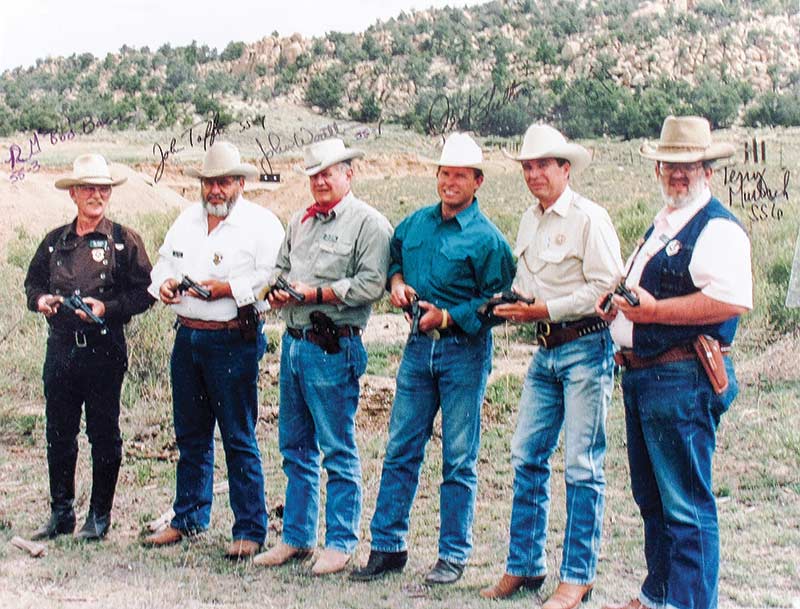
Buena Vista around 1990 (left to right): Bob Baer, John Taffin,
John Wootters, Bart Skelton, Jim Wilson and Terry Murbach.
Regular readers know I never repeat myself, however I sometimes, well, review things. I’ve often said the best part of my job is not all the guns, but rather all the friends I’ve made — friends who not only taught me much but were also great encouragers. I’ve corresponded with many of them regularly, and when the letters and phone calls stop it usually means they’ve been called Home.
Never in my wildest dreams could I have ever envisioned such men as Rex Applegate and Bill Jordan being friends. Both of them called me on a regular basis and I’ve missed those phone talks for a long time now.
Hal Swiggett was a very special friend and fellow Shootist; he helped me in many ways. John Lachuk was a great encourager. I always enjoyed visiting with John Wootters and we were definitely close kin when it came to sixguns. It has been more than 30 years ago since John saw my article on “L’il Guns” and he wrote me a long letter about his friendship with Skeeter Skelton and also how Skeeter’s Custom Ruger .44 Special came to be. The last time I talked to him by phone was just before he passed and we discussed small-bore rifles. Two giants in the industry, JD Jones and Wayne Baker have been close friends for four decades (I’m blessedly joyful they’re both still around). Wayne was just here this past week for a visit and we spent much time discussing important things like Faith, Family, Friends and Firearms.
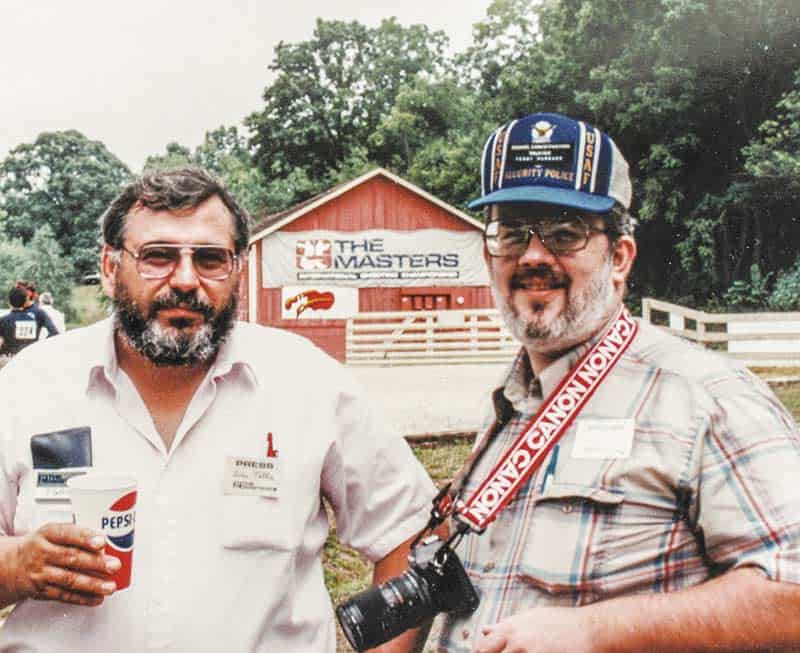
First meeting, Masters Tournament, 1988 — John and Terry.
A Fellow Critic Found
I just finished watching an episode of Gun Stories and as I listened to the expert I immediately thought, “I have to call Terry Murbach.” I first met Terry in 1988 at the first Masters Tournament in Barry, Illinois. I was eating lunch in the hotel dining room when this fellow walked up and introduced himself. We shared lunch together and were friends ever since. Terry was a voracious reader and he and I both shared a real appreciation of history. Today history is being rewritten both deliberately and through a flat-out lack of knowledge. Whenever I caught a mistake by any of the so-called experts on TV, I’d call Terry and we’d both decry the misinformation being disseminated.
In this particular episode on the Winchester Model 1873, I caught several mistakes and I wanted to call Terry immediately but now we’ll have to discuss it when I, too, cross over the river. In this particular segment it was stated as fact Oliver Winchester — after he saw the success of the 1860 Henry — bought the Henry Rifle Company and changed it to Winchester. Not even close to the truth!
In 1855 Oliver Winchester and his partner purchased the remaining assets of the Volcanic Arms Company. They changed it to the New Haven Arms Company and hired B. Tyler Henry as shop foreman. Henry designed the rifle bearing his name. There never was a “Henry Rifle Company” until the arrival of Henry Repeating Arms in the last quarter of the 20th Century. Winchester was not quite ready to put his name on such an endeavor. After the success of the 1860 Henry the company name was changed to Winchester and the 1866 lever gun was the first to bear the Winchester name.
I really regretted not being able to share a laugh with Terry over it!

Ohio get-together (left to right): Blackie Sleeva, JD Jones, Terry and John.
Touching Base Over the Years
How many times have I heard it said Elmer Keith invented the .44 Magnum? Terry and I discussed this several times, along with the fact Elmer said he was as surprised as anyone was when he got the call from Smith & Wesson in December 1955 about his .44-caliber dream becoming reality!
I’ve also seen it in print Elmer Keith invented the .357 Magnum! Again, not true. Keith did do a lot of work with heavy loads in the .38 Special after Smith & Wesson came out with the .38/44 Heavy Duty six-gun. He designed a special bullet — Lyman’s #358429 — with a long nose to fill out the cylinder of the .38-44.
When Smith & Wesson brought out the .357 Magnum with the same length cylinder, it was found Keith’s bullet was too long to be properly crimped in the groove of the longer brass and fit the cylinder of the new magnum sixgun. So Keith continued to use his .38 Heavy loads in the new .357 Magnum. In fact, he reported the hits on long-range targets in Ed McGivern’s book (out to 600 yards) were accomplished with his .38 Heavy in a long-barreled .357 Magnum S&W. Terry, of course, knew this also.
Every two months Terry would call me to tell me he just received the latest issue of Handloader and tell me about all the good things in it (he always received his copy at least two weeks before I did). This past issue came to me very early and I couldn’t even call Terry and tell him I already had mine.
He also called me every time GUNS and American Handgunner showed up to tell me about all the good stuff in them. He read all three magazines cover to cover. Terry was also a great fan of college football and he would also call me and tell me about some of the teams which I had very little knowledge of except for Boise State. When Boise finally hit the big time and defeated some very worthy opponents in bowl games, I think he was even happier than I was (even if he lost a buck on our bet!).
This past bowl season, “his” team Ohio State won big and my first thought was to call Terry, but he’d passed just before Christmas and, unfortunately, long-distance phone calls don’t work when trying to call Heaven. I will continue to think of Terry often especially when I see or hear glaring errors. I always knew he would know exactly what I was talking about. Many of the history books in my library are there because Terry recommended them and now that is done.
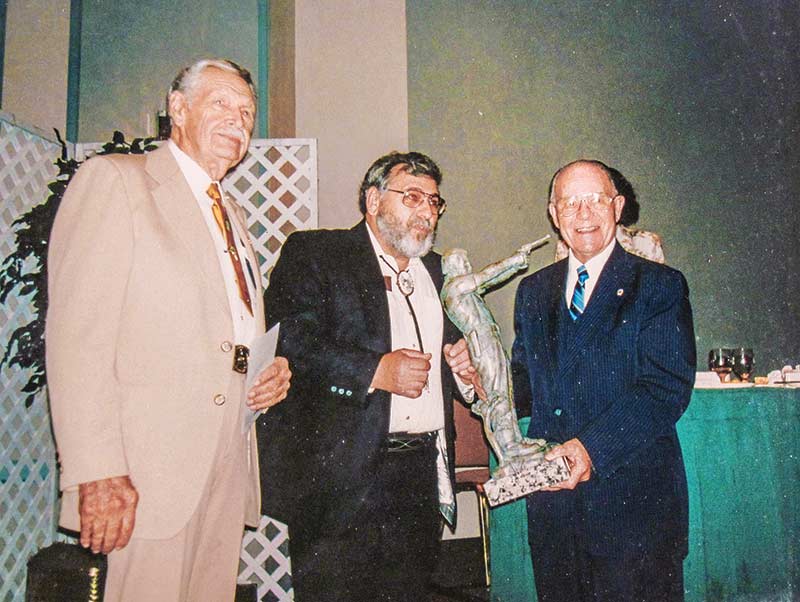
John and good friend Bill Jordan present the Outstanding American Handgunner Award to Harry Reeves.
Special Edition, Special Shootist
When the first Shootist Special Editions were issued Terry couldn’t afford to purchase one, which was unfortunate since he was directly responsible for the project. In the early 1990s Terry had contacted Tom Ruger to see about a special Ruger sixgun for the Shootists. I was sitting in Bill Ruger’s office when he got the phone call telling him about Tom’s fatal leukemia. After Tom died I told Terry to wait a while and then contact Bill directly and see if he wanted to carry on the project as a tribute to Tom. Terry did and Bill agreed and the result was the 4-5/8″ stainless steel .22 Bisley Model, specially marked in honor of Tom Ruger. Several Shootists came together and made sure Terry received one. It was presented to him as a gift from Deacon Deason after Deacon passed on in 1994. They’re probably discussing this right now.
The last time Terry was visiting me he had two very special Ruger .22s. One was a little Bearcat, which not only shot superbly accurately, its muzzle velocity registered much higher than you’d expect from such a short barrel. His other .22 — which he cherished a great deal — was his Bowen-customized Single-Six.
When Terry talked about this project he had planned to stay with the 6-1/2″ barrel and I told him he absolutely had to go with a 7-1/2″ barrel, which he did. He was never sorry and this particular Single-Six with its bright blue and case hardened colors is as beautiful as they come. I hope someone has it now who’ll appreciate it.
Terry old friend, my adopted little brother, I’ll see you down the line. Keep the bacon sizzling and the beans bubbling and don’t let the campfire die out.

Key point: A compact, easy-to-carry firearm.
U.S. Special Operations Command intends to transform some of its standard-issue M4 carbines into Sig Sauer MCX Rattler personal defense weapons, apparently satisfying the command’s year-long hunt for the daintiest little assault rifle on the market.
The contract with Sig Sauer, managed by U.S. Army Contracting Command (ACC) and released on Feb. 1, detailed SOCOM’s plan to purchase 10 MCX Personal Defense Weapons (PDW) conversion kits that, built on the lower receiver of an M4A1, can chamber both .300 Blackout cartridges and standard 5.56 mm rounds.
SOCOM had announced its intent to adopt a new PDW for close-quarters combat in March 2017, but the military took a direct contract with Sig Sauer over a bidding competition because “sample systems are needed quickly to be used in formal combat evaluations,” the ACC said. Both the initial request for information and subsequent award were first reported by The War Zone.
Although the MCX Rattler itself — billed by Sig Sauer as the most “discreet platform” ever built at the request of “elite military units” — doesn’t explicitly appear in the ACC’s Feb. 1 announcement, the weapon’s 5.5-inch barrel and “thin, side-folding ‘skeleton’ buttstock” are a “perfect match” for the compact MCX platform the firearms manufacturer showed off last month at the SHOT Show in Las Vegas, Nevada, according to the War Zone.
“This compact firearm can be had in short-barrel-rifle and pistol configurations and provides a rifle-caliber setup in as compact of a frame as possible,” the company announced during SHOT Show’s final day on Jan 26. “This short, compact size is a boon for members of law enforcement, the military and the shooting public who want a compact, easy-to-carry firearm.”
Fresh off a successful new contract for the Army’s Modular Handgun System, Sig Sauer was eager to showcase the MCX Rattler and sister MCX Virtus assault rifle at SHOT Show, touting the latter as the “ultimate modular platform” in the same vein as the P320 9mm handgun. But as The War Zone originally noted, the real appeal is in those .300 Blackout cartridges, developed by Advanced Armament Company in the early 2000s to minimize sound output without sacrificing accuracy or stopping power.
Time will tell how the MCX Rattler actually holds up during tests. And while the Army Contracting Command may have snapped up the Rattler due to Sig’s willingness to keep that sweet, sweet DoD moolah flowing, the ACC isn’t ruling out other contenders; according to the announcement, “any responsible source who believes to be capable of meeting the requirement may submit a capability statement, proposal, or quotation, which shall be considered by the agency.”
Jared Keller is a senior editor at Task & Purpose and contributing editor at Pacific Standard. Follow Jared Keller on Twitter @JaredBKeller.