.JPG) Especially since I am old, crippled with a bad back & seen way too much real violence in my time. Grumpy
Especially since I am old, crippled with a bad back & seen way too much real violence in my time. Grumpy
Categories
Colt Officer`s Model Match 22LR
A teenager helped save his younger sister from an alleged kidnapper by shooting the suspect with his slingshot, Michigan authorities said.
The 8-year-old girl was mushroom-hunting in her backyard in Alpena Township on Wednesday when “an unknown male appeared from the woods,” the Michigan State Police said in a press release on Friday.
“The suspect had come through the woods onto the property and came from behind her, grabbed her like you’d see in the movies — hand over the mouth, arm around the waist — and was attempting to pull her into the woods,” Lt. John Grimshaw with the Michigan State Police told ABC Traverse City affiliate WGTU.
The girl was able to break free, police said. Her 13-year-old brother also witnessed the attack and shot the assailant in the head and chest with his slingshot, police said.
Grimshaw called the teen’s actions “extraordinary.”
“He really is the one that … I believe saved his sister’s either life or from something seriously bad happening to her,” Grimshaw told WGTU. “He should be commended for it.”
The suspect fled the area but was located by state troopers hiding at a nearby gas station and was able to be identified in part due to injuries from the slingshot, police said.

An Alpena County Sheriff’s Office sign is shown in front of the county jail, in Alpena, Mich.
Google Maps Street View
“The suspect had obvious signs of injury sustained from the slingshot with wounds to his head and chest,” police said.
The suspect — identified as a 17-year-old from Alpena — was taken into custody and allegedly confessed to detectives that he “planned on severely beating the victim,” police said. He was lodged in the Alpena County Jail without incident, police said.
The suspect was arraigned on Thursday on one count of attempted kidnapping/child enticement, one count of attempted assault to do great bodily harm less than murder, and one count of assault and battery, according to police.
His bond was set at $150,000 and his next court appearance was scheduled for May 17, police said.
The suspect is being charged as an adult but his name has not been released by police.
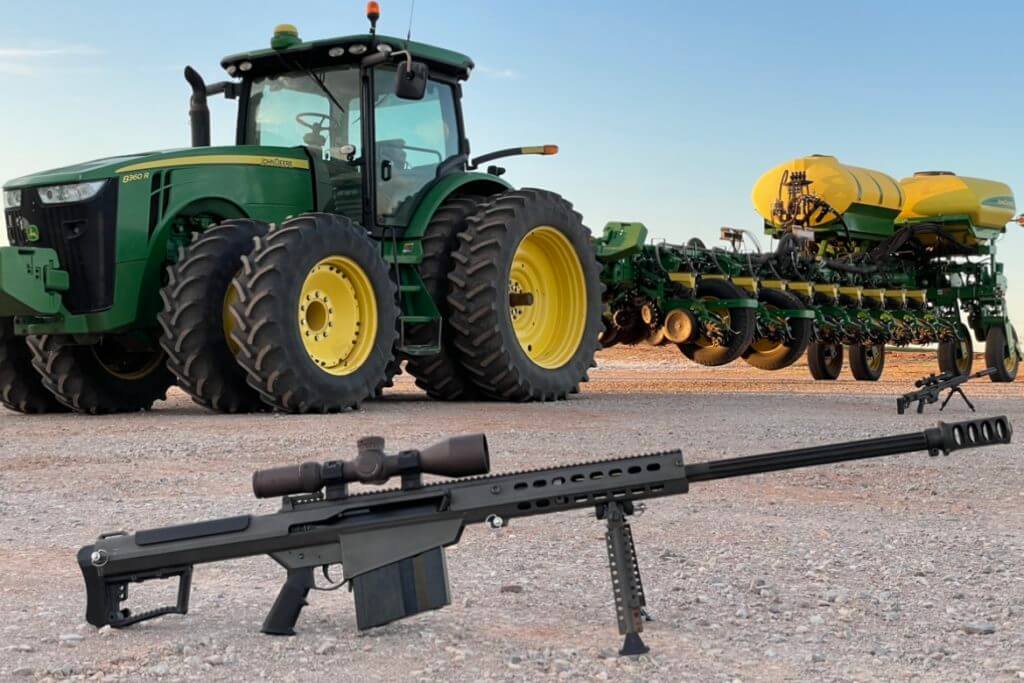
While the Barrett M107A1 has been out and fielded for over a decade now, its legendary status still reigns true. For this reason, I recently had the chance to fulfill a dream by putting it to the test in 2023. Over the course of two days, I shot approximately 90 rounds between target shooting, hunting, and stretching this 50 BMG out to 1265 yards. I also put the rifle through its paces with various drills, hiked five miles in the dark, and experienced an unforgettable weekend. While I normally run rifles longer before writing a review, we had an action-packed weekend and a good variety of situations to test the rifle with. Given its proven history of exceptional performance and devastating power, this rifle is truly a force to be reckoned with.
The M107A1 utilizes state-of-the-art design, manufacturing, and materials, every component of the rifle has been engineered to be lighter and stronger than its predecessors. In addition to a 4-pound weight reduction over the M82A1, the M107A1 is optimized for use with a sound suppressor, providing a much-needed signature reduction capability. Lighter, stronger, more accurate, and more capable; the M107A1 has truly been engineered for action.
Barrett M107A1 Specifications:
- Caliber: 50 BMG
- Operation: Recoil Operated, Semi-Automatic
- Barrel Length: 29″ (737 mm) or 20″ (508 mm)
- Twist Rate: 1 : 15″ (381 mm)
- Overall Length: 57″ (1448 mm) or 48″ (1219 mm)
- Weight: 28.7 lbs (13 kg) or 27.4 lbs (12.4 kg)
- Mag. Capacity: 10 Rounds
- Rail Length/MOA: 23″ (584 mm)/27 MOA
Recoil System
When people think of shooting a 50 cal, they immediately anticipate a ridiculous amount of recoil. Luckily for anyone who has the opportunity to shoot the Barrett M107A1 that is not the case. Utilizing a massive muzzle brake, dual barrel recoil springs, a massive buffer spring, and weighing around 28 lbs, this rifle kicks about like a 12 gauge shooting 3″ shells. It is not quite as sharp as a 12 gauge, but the recoil impulse is much longer due to the distance the bolt carrier assembly has to move to eject and chamber another round. Shooting close to 100 rounds spread between two days, I never even ended up with a bruised shoulder. Kudos to Barrett for designing a rifle to tame the felt recoil of the renowned 50 BMG.


Bolt Carrier Assembly
The M107A1 features a bolt carrier assembly that is suppressor-ready. It comes with a Nickel Teflon® coated bolt which requires less maintenance when shooting with a suppressor. This rifle is designed to shoot both suppressed and unsuppressed without the need to change any components. This carrier is no joke being by far the largest and heaviest I have ever seen. However, it is built to take a beating.

Stock
One of the upgrades for the M107A1 is the “thermal cheek guard” featured on the top of the stock. This functions as a low-profile cheek riser that is comfortable and more temperature stable. The stock also uses a rear hand module which is mounted on an M1913 rail.
This helps shave some weight while providing a good resting point for the shooters off-hand to control shots. It also can be used to mount a lightweight monopod if one so desires, but I did not use it throughout my testing and just used rear bags instead.
An interesting feature is the curved rubber butt pad. While I appreciate the dense rubber, I would have preferred a flat butt since the curved one seemed to draw my shoulder a little too low causing my neck to stretch a little to get a proper cheek weld when shooting laying down.

Sights
While this rifle is worthy of a high-end scope, Barrett includes a set of pop-up irons with this rifle. The rear sight is adjustable for windage and elevation with ticks marked out to 1500 meters. I guess better have and not need than to need and not have.


Throughout this review, I never did end up using the iron sights, but I did use a Vortex Razor 6-36 for target shooting out to 1265 yards, and a Pulsar Thermion 2 LRF XP50 Pro for hunting wild pigs at night. Capable of shooting very heavy projectiles at very long distances, the M107A1 features a 27 MOA Picatinny rail machined into the upper receiver. This is nice as it allows for more elevation adjustment for any scope mounted to it.

Bipod
While shooting this rifle standing up is doable, Barrett includes a bipod for going prone when accurate shots matter. The bipod is lightweight and the whole thing features a quick-detach mount. The legs can be stowed either forward or backward by simply pulling down on the arm and rotating. Each side is independently adjustable to compensate for uneven terrain and accommodate various shooting positions.

Magazine
The M107A1 comes with standard 10-round steel magazines. For a 50BMG, that is a lot of heat. Featuring cutouts on the rear of the mag as witness indicators, it is easy to see how many rounds are currently loaded. Throughout my shooting, I never had a single magazine-related issue. They fed well and rocked in solid.

Muzzle Brake
The M107A1 muzzle brake is a cylindrical muzzle brake that accepts Barrett QDL Suppressor. One of the big perks to this weapon system is the fact that it was designed to run suppressed and the muzzle break works as a great suppressor host. Also, due to the cylindrical muzzle brake, this is easier to shoot un-suppressed than the iconic M82 muzzle brake which was known for a rather brutal muzzle blast. Now don’t get me wrong, even with the newer muzzle brake the M107A1 still packs a punch. The gas-punching me in the face was not a pleasant experience, but the muzzle brake does a good job of reducing recoil and keeping the gun on target for quicker follow-up shots.

Barrel
The M107A1 is available in two barrel lengths: 20 inches and 29 inches. Both barrels have a chrome-lined chamber and bore, while being capable of pushing standard 660gr ammunition at speeds of 2500fps and 2750fps, respectively.
While the 29-inch barrel offers greater velocity and is well-suited for long-distance shooting, it adds an additional 1.3 lbs to the rifle and made maneuvering in and out of vehicles while hunting more difficult. The 20-inch barrel, on the other hand, sacrifices around 250fps in velocity but is much more maneuverable. However, I will say that even the 29″ version is still wieldable. I hiked roughly 5 miles through fields and pastures with night vision chasing wild hogs during this review. While the M107A1 is heavy, it is not unbearable.
Both versions of the rifle feature deep flutes that help to reduce weight and improve barrel cooling during extended shooting sessions. Overall, the choice between the two barrel lengths will depend on the user’s specific needs and preferences.

Trigger
For a rifle as expensive as the M107A1 I would have loved to see a better trigger. While it works, I don’t feel like I was as accurate as I could have been. I forgot to bring a gauge to measure the pull weight, but it was around 5 lbs. There was no real defined wall, and the slack was smooth yet springy as in the 5 lbs of pull was required throughout the whole trigger press. It got the job done but wasn’t the typical precision rifle trigger people may think of.

Accuracy
While I have heard mixed reviews about the accuracy of the Barrett M107A1, I had to test things for myself. During this part of the review, I shot a cardboard target from a distance of 100 yards while battling intense crosswinds of 25-50mph. Due to the wind, the target was shaking, and I had to admit that I was only a 1MOA shooter at best. Oklahoma wind can be relentless, so it was anticipated to cause trouble.

Precision
Considering the circumstances, most of the ammunition I tested performed as expected, producing groups between 2-4MOA. However, I managed to achieve a 1.04 MOA 4-round group using match-grade PPU 725gr ammunition, discounting the fifth shot which I acknowledge I pulled. I have seen other people shoot sub-MOA groups using Hornady 750gr A-Max, which I believe is achievable after my testing. Unfortunately, I had ordered some, but it didn’t arrive in time for this review.

Despite the average groups, I was still able to shoot a TaTargets Goliath AR550 steel silhouette at distances ranging from 100 to 1265 yards. There aren’t many targets that can withstand the power of a 50 BMG, but the Goliath held up remarkably well. Even at a distance of 100 yards, the steel target remained unscathed on the front face, with not even a dimple to show for it. Although it’s a loud ringing target, we couldn’t hear anything due to the 30-50mph winds, but it was satisfying to see the target visibly swing when hit.

Devastation
As expected, 50 BMG is capable of causing significant damage. The typical 660gr M33 Ball ammo, for example, has a muzzle energy of approximately 11,000 ft-lbs, which is roughly 3-4 times more than that of a 308. While there are various rounds designed for specific equipment, the sheer energy of even ball ammunition can have a devastating effect on tissue.
During my review, I took the rifle out for hunting, but I was unsuccessful in catching any wild pigs. However, I did come across an armadillo, which is considered a varmint and tears up our farmland. I deemed it necessary to quickly dispatch it with the M107A1. The image below is a screenshot taken from a Pulsar thermal scope mounted on the rifle. Let’s just say that it got the job done.

Performance
During my testing, the Barrett M107A1 performed admirably. While I didn’t have the chance to test it with Barrett’s QDL suppressor, others I talked to have reported that it works well. The rifle had no trouble firing rounds downrange with enough force to obliterate an engine block.
The only problem I encountered was that by the end of the day, the rifle started to get gummed up with dirt. The combination of 30-50 mph winds and fine dust created a very dirty environment, which led to failures to feed. Fortunately, disassembling the rifle was easy thanks to the takedown pins, as illustrated in the user manual. After wiping down the chamber and applying more oil, the M107A1 was back up and running. In fact, it was able to cycle through 11 rounds in about 3 seconds without any issues – a mag dump to remember!

Summary
The Barrett M107A1 is a powerful and durable semi-automatic rifle chambered in .50 BMG. It has a solid construction and ergonomic design, that made it easy to shoot accurately and bearable to hike miles with. The rifle has impressive long-range capabilities and can take down targets at distances past one mile away. I was even able to get a few hits on a silhouette out to 1265 yards. The M107A1 has a reputation for accuracy and can shoot around 1 MOA groups when paired with premium ammunition. While the barrier to entry for owning the legendary M107A1 is high with an MSRP of $13,275, this rifle provides a lot of capability when used in the right circumstances.

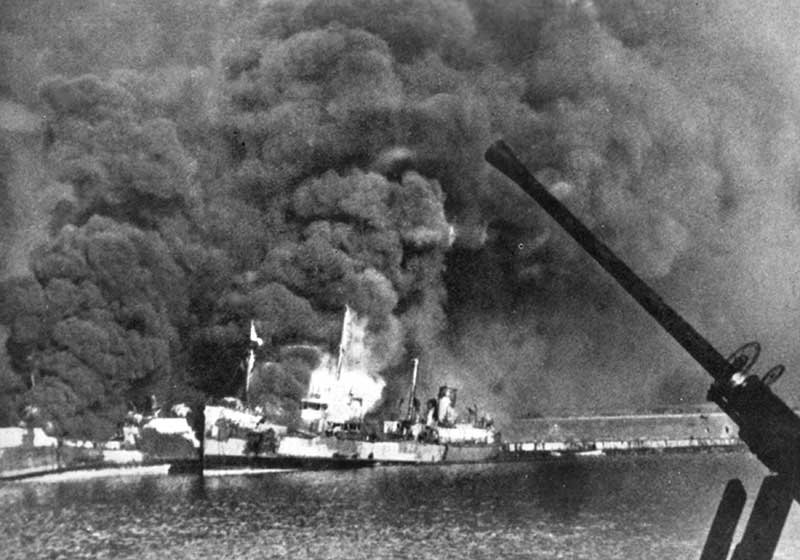
The attack on Bari harbor in Italy in 1943 was a debacle of epic proportions
for the Allies. However, great good was ultimately to come from this dark day.
December 2, 1943, was a Thursday. Allied troops worked feverishly in the freshly-liberated Italian port of Bari on the heel of Italy, offloading the ammunition and supplies required to support the ongoing fight against the Axis. Italy had capitulated three months before, but the Germans still fought like lions.
The port was fat with ships from America, England, Poland, Norway, and the Netherlands. On this very Thursday, British Air Marshal Sir Arthur Coningham, commander of the Allied Northwest African Tactical Air Force, stated, “I would consider it as a personal insult if the enemy should send so much as one plane over the city.” He would live to regret that.
The Germans attacked with 105 Ju-88 A-4 bombers from Luftflotte 2 and achieved complete surprise. The raid spanned about an hour. The attacking Luftwaffe raiders sank 27 cargo ships in the harbor. More than 1,000 allied troops, sailors, and merchant seamen perished alongside roughly the same number of civilians. The Germans lost but a single plane.
That would be bad enough, but survivors pulled from the oily water also began to manifest horrific skin burns. Massive blisters formed on their flesh. Six hundred twenty-eight military patients were hospitalized, suffering from these ghastly injuries. Eighty-three of them eventually died.
At first, there was a suspicion that the Germans had attacked the harbor with chemical weapons. However, the truth was something potentially far worse. The details were immediately suppressed, but we had just inadvertently exposed our own troops to mustard gas.
Among the 27 sunken vessels was a Liberty ship called the SS John Harvey. Its top secret cargo included 2,000 M47A1 mustard bombs to be used in the event Hitler first employed chemical warfare agents on the European battlefields.
During the Luftwaffe attack, these diabolical weapons had broken open, and the mustard agent had mixed with the fuel oil spilled into the harbor’s waters. The results were predictably horrifying.
Adolf Hitler was likely among the top five worst people who ever lived, and the experience he had with chemical agents during World War I kept him from using these dreadful things in World War II.
In the face of such an epic tragedy, Lieutenant Colonel Stewart Francis Alexander, a chemical warfare specialist on Eisenhower’s staff, was sent to Bari to investigate. He immediately identified mustard gas exposure. Alexander’s “Final Report of the Bari Mustard Casualties” was predictably classified.

Sometimes some of the most momentous discoveries come from some of the most unexpected places.
Lt. Col. Alexander’s superior officer at the Chemical Warfare Service (CWS) was Colonel Cornelius P. “Dusty” Rhoads. This was a citizen Army drawn up for the global conflict, and these guys came from all walks. In his previous life, Dr. Rhoads had served as head of the Treatment of Cancer and Allied Diseases Department at New York’s Memorial Hospital.
Col. Rhoads had an unprecedented opportunity to study hundreds of victims of mustard poisoning. He observed that the mustard agent suppressed cell division. Using his experience in oncology as a basis, it occurred to him that mustard agent might be used to inhibit the rapidly reproducing malignant cells that drive cancer.
Every day the human body creates around 330 billion new cells. Almost all of these cells demand that the entire genome be reproduced. Each of these packets of genetic information includes around 3.2 billion base pairs. Given that astronomical volume, mistakes are inevitable.
God designed us with proofreading mechanisms that catch most of these mistakes and destroy the aberrant cells before they can do any damage via a process called apoptosis. However, if one of these cells is almost but not quite normal, it can slip through that net and morph into cancer. These cancer cells typically multiply faster than normal cells and in an uncontrolled fashion.
Col. Rhoads became convinced that the active ingredient in mustard gas could be used, in very small doses, to attack rapidly-metabolizing cancer cells.
After the war, he approached Alfred Sloane and Charles Kettering to fund the Sloan Kettering Institute for Cancer Research (SKI). These two men had made fortunes off of war production through General Motors. The resulting cutting-edge research facility was manned by scientists no longer needed for the advancement of war goals. They proceeded to synthesize mustard derivatives into the first effective medications for cancer. Nowadays, we call this chemotherapy.
In 1949, the U.S. Food and Drug Administration approved Mustargen (mechlorethamine) as the first experimental chemotherapy drug in America. It was used to successfully treat non-Hodgkin’s lymphoma. This effort planted a seed that became the flourishing field of oncology today.
Thanks to this serendipitous discovery and a lot of hard work, cancer is no longer the death sentence it once was. Today, chemotherapy agents specifically target rapidly-metabolizing malignant cells while selectively sparing the healthy stuff, but there is still some overlap. That’s why many patients undergoing chemotherapy lose their hair because hair cells metabolize quickly as well.
The attack on the Bari harbor in 1942 cost some 2,000 lives. However, the American Cancer Society has since described the Bari attack as the beginning of “The Age of Cancer Chemotherapy.” Millions of people have had their lives saved or extended due to research that spawned from that terribly dark day.
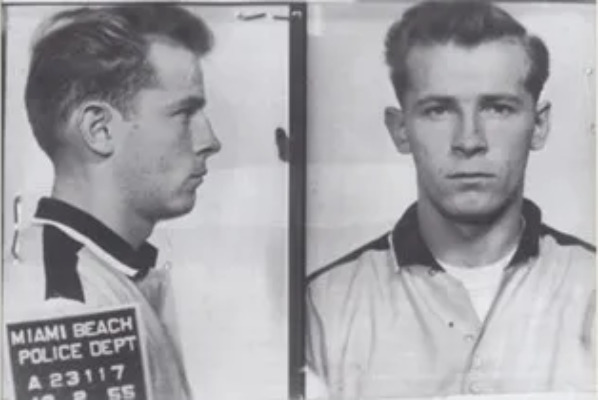
James Joseph Bulger, Jr was born September 3, 1929, to James Joseph and Jane Veronica “Jean” Bulger. He was their first of three children. His father hailed from Newfoundland. The senior Bulger’s parents had both been Irish. Jean was a first-generation Irish immigrant. The younger Bulger’s blood ran green.

James Senior worked as a longshoreman but lost his arm in an industrial accident. There were not quite so many lawyers back then as is the case today. Though the man survived, his family was left destitute. They moved into the Mary Ellen McCormack housing project in South Boston in 1938.

James had two younger brothers, both of whom did well in school. By contrast, James Bulger Jr seemed drawn to the streets at a young age. The kid was a born thug.

To his friends, James went by “Jim”, “Jimmy”, or “Boots.” The latter appellation stemmed from his tendency to wear cowboy boots in which he hid his switchblade knife. When he was young the kid’s hair was blonde to the point of being white. As a result, his chums took to calling him “Whitey.” Though the young man despised the nickname, it nonetheless stuck.

Whitey Bulger’s first arrest was at age 14 for larceny. He ran with a South Boston street gang called the Shamrocks. While with this crew Bulger was eventually arrested for assault, forgery, and armed robbery. He spent time in the juvenile reformatory, but everybody wants kids to succeed. Soon after his release in 1948, Whitey was allowed to join the US Air Force in hopes that a little time in uniform might straighten him out.

Airman Bulger did not thrive in the service. He spent time in a military prison for multiple assaults and also went AWOL. By 1952 Uncle Sam had given up on Whitey and sent him packing, albeit with an honorable discharge. Four years later Bulger was remanded to federal prison for armed robbery and hijacking. Apparently, the kid just couldn’t help it.

As we mentioned earlier, this was a different time with very different rules. While serving time in prison Bulger was used as a test subject for the CIA’s Project MK-ULTRA. This enterprise was pitched as an effort to cure schizophrenia. In reality, the CIA was trying to develop a mind control drug.
While Bulger and the eighteen other participants in the program had indeed volunteered in exchange for reduced sentences, they had no idea of the true nature of the program. They received heavy doses of LSD along with several other hallucinogens. Bulger later admitted that the experience was horrifying. He began hearing voices afterward as a result.

Bulger was later transferred from Atlanta to Alcatraz and then on to Leavenworth. In 1963 he was sent to Lewisburg Federal Penitentiary. On his third try, Whitey Bulger was paroled in 1965. He had served a total of nine years. The career criminal would not see the inside of a prison again for another nearly half-century. However, that wasn’t for lack of trying.

As an ex-con, solid work was tough to find. Bulger toiled as a janitor and construction worker before returning to the only thing he had ever been good at. Under a mob boss named Donald Killeen, Whitey Bulger began working as a loan shark and bookmaker. The Killeen Gang had been a fixture in South Boston for more than two decades.

The Killeen Gang was led by three brothers—Donnie, Eddie, and Kenny. Kenny Killeen purportedly shot and injured Michael “Mickey” Dwyer, a player in the rival Mullen Gang, during a fight at the café the Killeens used as a headquarters.
There resulted a sprawling gang war that swept across Boston stacking up quite the body count. The Killeens soon found themselves outgunned by the younger, more agile Mullens mob. As part of this fight, Whitey was dispatched to liquidate a Mullens Gang member named Paul McGonagle. In a tragic case of mistaken identity, Whitey accidentally killed Paul’s fraternal twin brother Donald. This was Whitey Bulger’s first proper murder. It would not be his last.

One of the players named Kevin Weeks later said, “Although [McGonagle] never did anything, he kept on stirring everything up with his mouth. So (Whitey) decided to kill him…(Whitey) shot him right between the eyes. Only…it wasn’t Paulie. It was Donald…(Whitey) drove straight to his mentor Billy O’Sullivan’s house (who was cooking at the stove top at the time)…and told O’Sullivan…’I shot the wrong one. I shot Donald.’ Billy…said, ‘Don’t worry about it. He wasn’t healthy anyway. He smoked. He would have gotten lung cancer. How do you want your pork chops?”

Sensing that time was running out on the Killeens, Bulger supposedly approached Howie Winter, another mob boss who led the Winter Hill Gang, and offered to end the war. In May of 1972, the eldest Killeen was gunned down outside his home. While there remains some controversy, Bulger was rumored to have been the triggerman. The remnants of both the Killeen and Mullens gangs were subsequently absorbed into the Winter Hill mob.

Bulger was a cold-hearted murderer, but he was also smart. In this chaotic world, his steady leadership and ruthless demeanor brought him great success. Kevin Weeks also had this to say, “As a criminal, he made a point of only preying upon criminals…And when things couldn’t be worked out to his satisfaction with these people, after all the other options had been explored, he wouldn’t hesitate to use violence…Tommy King, in 1975, was one example…Tommy, who was a Mullens, made a fist…(Whitey) saw it…A week later, Tommy was dead. Tommy’s second and last mistake had been getting into the car with (Whitey), Stevie, and Johnny Martorano…Later that same night, (Whitey) killed Buddy Leonard and left him in Tommy’s car on Pilsudski Way in the Old Colony projects to confuse the authorities.”

Whitey’s allegiances shifted with the winds to his maximum advantage. Along the way, he worked as an informant for the FBI while continuing his overt criminal enterprise. In September of 2006, federal judge Reginald Lindsey ruled that the FBI’s botched management of Bulger as an informant had contributed materially to the 1984 death of a government snitch named John McIntyre. The judge awarded McIntyre’s family $3.1 million in damages as a result.

In 1982 Bulger and an associate approached a well-known local cocaine dealer with the street name of “Balloonhead” while he was traveling in a car with a friend. Bulger packed an M1 carbine, while his fellow hitter was armed with a full auto sound-suppressed MAC-10. The two men liberally sprayed the coke dealer’s vehicle at close range. Balloonhead and his buddy died on the spot.

Whitey thrived throughout by threatening and killing competitors and turned enormous profits through his sundry criminal enterprises. It was estimated that he made some $30 million solely by charging local drug dealers fees for operating on his turf. Bulger and his buddies also shipped, “91 rifles, 8 submachine guns, 13 shotguns, 51 handguns, 11 bullet-proof vests, 70,000 rounds of ammunition, plus an array of hand grenades and rocket heads,” along with substantial quantities of C4 plastic explosive to IRA terrorists in Northern Ireland.

With the Law Enforcement heat becoming unbearable, Bulger fled Boston in 1995. He traveled widely in the US and Europe before finally being arrested in Santa Monica, California, in 2011 at age 81. He had been on the run for sixteen years and had been on the FBI’s Ten Most Wanted Fugitives list for twelve of those. The details of those years as a fugitive would require another couple of columns to fully explore. At the time of his arrest, Bulger had 30 firearms, several fake IDs, and $800,000 in cash in his apartment.

What spawned this project was a photograph of Bulger’s arsenal that was released after his capture. Bulger apparently had an affinity for 1911 pistols as there were several in attendance. He also had half a dozen fully automatic weapons. Dissecting his arsenal lends insight into the man and the brutal nature of his crimes.

Bulger’s handguns included a Walther P38, a Ruger .22 pistol, and a variety of revolvers. In addition to his weapons, police seized Law Enforcement badges and assorted carry gear along with fighting knives. However, it was the machine guns that were the most fascinating.


Bulger had a .45ACP MAC M-10 with an original WerBell-designed two-stage sound suppressor. There was also an M1 carbine with a civilian sliding “paratrooper” stock. His SP1-style AR15 included the original 20-inch rifle barrel and triangular handguards but had been fitted with a collapsible CAR-15 buttstock.


Whitey had a fascinating M3 Grease Gun that appeared to include an original GI OSS sound suppressor. These customized Grease Guns were some of the first operational sound-suppressed SMGs to see service alongside the Mk IIS suppressed Sten. We can only imagine where that particular weapon had been. The stash also included three well-worn 9mm German MP40 submachine guns.

Bulger was convicted in short order. He had been charged with a total of nineteen different murders. His first prison stop was the US Penitentiary in Tucson. Soon after his arrival a fellow prisoner nicknamed “Retro” stabbed the elderly criminal in the head and neck with a homemade knife, putting him in the prison infirmary for a month.

Bulger was subsequently moved to the US Penitentiary in Hazelton, West Virginia, on October 29, 2018. By this point, he was wheelchair-bound. The following day Whitey Bulger was beaten to death by multiple inmates armed with a padlock wrapped in a sock and a homemade blade. His eyes were all but gouged out and his tongue was nearly severed. In August of 2022 three inmates named Paul DeCologero, Sean McKinnon, and Fotios Geas were indicted for Bulger’s death. Their cases are winding through the legal system as I type these words.

Young American men will be taught the hard way that selflessness, courage, and their masculine instincts will get them 20 to life in prison.
This week, a brave Marine acted when no one else would to restrain a deranged homeless schizophrenic on a New York City F train who was, by all accounts, terrorizing people and shouting “I’ll hurt anyone on this train.”
“‘I don’t mind going to jail and getting life in prison,’ screamed the 30-year-old Jordan Neely, who had 44 arrests under his belt and an outstanding warrant for felony assault (he punched an old woman in the face), as he flailed around throwing items of his clothing. ‘I’m ready to die!’ In response, a 24-year-old Marine Corps veteran put Neely in a chokehold, incapacitating him and releasing him after he stopped struggling and passed out,” Inez Stepman wrote.
When Neely died at the hospital, all hell broke loose.
This is not the first time a courageous man minding his own business has put himself in danger to protect others. It’s happened many times, in fact. Toxic masculinity has saved more lives than penicillin.
But in this case, the erratic lunatic was black, the courageous restrainer was not just white but blond and handsome, and worst of all: the lunatic shuffled off this mortal coil when he arrived at the hospital.
Inevitably, the left’s muscle memory of how politically lucrative George Floyd’s 2020 death was for them kicked in. The Floyd Playbook could be run!
AOC fired up her Twitter and called his death a “murder.” Al Sharpton is polishing his diamond cufflinks before his press conference. Neely’s cousins are getting fitted for new suits before their Oval Office visit. Nancy Pelosi has already ordered the solid gold casket and white horse-drawn carriage for the funeral, which will be held after Neely lies in state in the Capitol. Kente cloth scarves are being passed out in the Old Executive Office Building. Kamala Harris’s speechwriter is ripping nitrous balloons as he crafts her eulogy. The whole band is getting back together!
Weakness Is Strength. Courage Is Hatred
In the aftermath, I tweeted this: “Strong men brave enough to intervene publicly when a deranged lunatic is terrifying people are going to be rounded up first; this is brilliant strategy for the Regime. Pick off the bravest and most selfless heroes first. Leave the cowards behind, who will fall in line fast.”
The worse the subway Viking’s fate is, the less likely any of us, the sane ones, will be tempted to lift a finger when they come for us, our friends, or our neighbors. If the Viking gets 20 years on Riker’s Island, plus some prison rapes and beatings for good measure as the guards look the other way — that’ll teach you boys a lesson.
Since literally the morning the first European settlers set foot in the new country, the ethos drilled into American men is to be strong, be brave, and be prepared to protect and defend your family, your homestead, and your fellow man. This is what men are for, after all. This is why God made them stronger than women. Those biceps are not just for deadlifting. Their main purpose is twofold: wielding a spear for the hunt, and wielding your fists or a sword for defense.
It feels like Good Samaritan laws have gone in and out of favor over time in America. For many years after 9/11, no able-bodied man boarded an airplane without first preparing himself to tackle a terrorist if he had to. Does that happen anymore? Or would the passengers laugh and whip out their phones as the terrorist slit a flight attendant’s throat? You will not go to jail for watching someone beat another person to death as you stream it live on social media. That’s perfectly acceptable now, even encouraged.
But every normal man I know would be unable to stand and watch a psycho assaulting an innocent stranger. My future husband once threw the first punch in a bloody fistfight against a much larger, much drunker man who was persistently harassing me and getting in my face late at night outside a bar in New York City. (My husband won, so I married him soon after.)
You Won’t Get In Trouble for Being a Coward
As an avid Twitter user, I probably see a dozen graphic videos a week of men doing the opposite: standing idly by, shouting approval and laughing, cameras out, as violent individuals assault, beat, rape, and shoot innocent strangers. This violence is almost exclusively black-on-white, or black-on-Asian.
In April, such a video made national news: a terrified young woman in downtown Chicago is knocked down and stomped on by a large mob during a “teen takeover” of the city. Where are all the videos showing the white-on-black and white-on-Asian stompings? I’m sure if they existed, AOC herself would be tweeting them out 24/7.
In this terrible, ugly, upside-down, zero-trust society I’ve been forced to raise a family in, I have developed new survival rules. I have instructed my husband and son to be cowards. That’s right: to do nothing if they are in a situation where a dangerous psycho is threatening violence to a stranger.
I have begged them to sit on their hands; to be one of the people who just watches, runs away, or calls 911. It goes against every chivalric instinct in their bodies, but I do not want them dead or in jail. Instead of being hailed as heroes for saving some old lady’s life, they would be tried as killers and put away for life.
My teenage son informed me he won’t go along with my surrender monkey ethos and is prepared to defend himself and others if he has to. This is a dangerous virtue for a boy to have in a blue city in 2023! Does he want his mother to get gray hair? Doesn’t he know how much good hair colorists cost these days?
I have failed as a mother because I forgot to teach my sons to be cowards.
This week’s watershed event on the New York City F train illustrates the blackpilling utility of my new rules. “Son, you see that damsel in distress over there getting her teeth kicked out by that filthy homeless man? You just sit tight and get off at the next stop and tell the nearest social worker. It’s not your problem.”
Podcaster Aimee Terese tweeted: “A man threatening the safety of everyone else in a tiny, highly populated, contained space, is a liability to himself and to others. The marine is a hero, and we need more men like him, which is why the left is wetting the bed about it. They don’t want that ethos to catch on.”
Courage and Nobility Will Be Punished
Neely was lynched by a racist and this racist will be made an example of. This is a teaching moment for Democrats — young American men will be taught the hard way that nobility, selflessness, courage, and their masculine instinct to defend the innocent are bad. Don’t be like this former Marine!
Mohammed Atta’s immortal words to the doomed passengers of American Airlines Flight 11 were “Just stay quiet and you’ll be okay.” Of course, it only applies to some of us. The raving maniacs on our subways, in our parks, and on our buses are free to live their best lives.
Democrat politicians have made forced passivity the new rule for normal people out in public. We are all cuckolds now. After all, what other sane choice do we have?
Categories