.jpeg)
Now for the tasteless memes


/cloudfront-us-east-1.images.arcpublishing.com/gray/ELN7I5QUNFGMFFQXDEYTTFZZLQ.png)
A 54-year-old woman living just outside of Tucson, Arizona didn’t really want to have to shoot a neighbor to tried to force entry to her residence, but the man didn’t give her many options. Living by herself, she didn’t have anyone else to help her repel the would-be intruder. She did have a handgun, though, and he availed herself to the great equalizer.
The would-be intruder, a 42-year-old registered sex offender named Jayson Magrum, apparently didn’t care that she’d gotten her gun and told him to stop. Maybe he didn’t think she’d use it. She even fired a warning shot as he tried to crawl in through a window. Even after the shot, Magrum reached in and tried to disarm the woman.
That’s when she shot him. At point-blank range, the pistol proved itself as a great equalizer, ending the attack. The sex offender collapsed after a few more steps and will re-offend no more.
KOLD/Gray News has the story . . .
A convicted sex offender was shot and killed by a woman while trying to break into her Arizona home last week, officials said.
The Pima County Sheriff’s Department said 42-year-old Jayson Magrum died in the Aug. 11 shooting at the home in Three Points, just outside of Tucson.
According to the sheriff’s department, Magrum was trying to break into a woman’s home. She told him to leave, but he did not stop.
Officials said the woman then grabbed a gun and fired a warning shot. Magrum then tried to disarm her, and he was shot and killed.
Fox10 Phoenix had some additional details:
The incident happened just after 2 p.m. on Aug. 11 near Garvey and Pyle Roads. Investigators say 42-year-old Jayson Magrum tried to break into a 54-year-old woman’s home. The woman was home alone and yelled at Magrum to leave, but he allegedly continued to try and break into the home.
“The female armed herself with a handgun and fired a shot out of a window to attempt to scare the male away,” the sheriff’s department said.
Magrum allegedly reached inside the home and tried to take away the gun. The woman then opened fire, shooting Magrum.
Magrum collapsed in the driveway and died at the scene
Once again, a successful defensive gun uses brought to you by the Founders and the right to keep and bear arms. The only thing that stops bad people with evil in their heart is a good guy or good gal with a gun. That is all.






“One year from now – Israel will be the first country to have partial laser protection. In two years there may be complete protection,” said Yuval Steinitz.
By YONAH JEREMY BOB, JERUSALEM POST STAFF
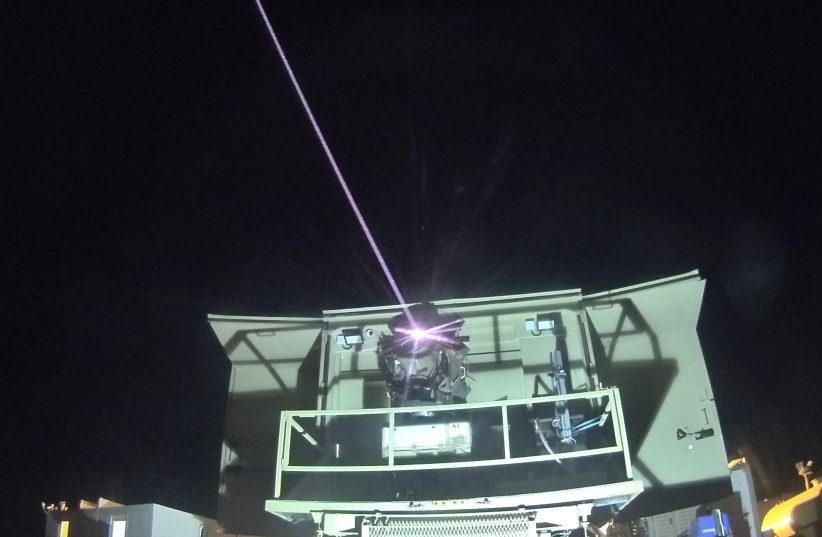
Israel’s ground-breaking laser system experiment carried out in the south of the country by the Defense Ministry’s Directorate of Research and Development (DDR&D, or MAFAT in Hebrew) and Rafael Advanced Defense Systems.
(photo credit: DEFENSE MINISTRY)
Israel will have partial laser defenses by this time next year, Rafael Advanced Defense Systems chairman Yuval Steinitz told Army Radio on Sunday.
“One year from now – Israel will be the first country to have partial laser protection. In two years there may be complete protection – against missiles, shells, rockets, or anything else. This will protect us both in the South and in the North,” said Steinitz.
Israel’s push for laser air defenses
This past February, senior Defense Ministry official Brig.-Gen. (res.) Danny Gold said Israel’s air-defense lasers, when fully deployed, will be able to shoot down the drones Iran has been sending Russia to use against Ukraine.Speaking at the Artificial Intelligence conference at Tel Aviv University at the time, the MAFAT [Directorate of Defense Research & Development] director said his ministry was working on developing “the next generation of using lasers.”
He talked about multiple successful tests destroying rockets “with a very sophisticated laser-weapons system…. We have done the same for mortars, rockets and UAVs [unmanned aerial vehicles], like the Iranian UAVs they are sending to Ukraine. The same concept of UAV, we can shoot them down.”
In February 2022, then-prime minister Naftali Bennett proclaimed that Israel’s ability to use lasers had progressed significantly and could be operational much sooner than people had expected.

 BORDER Police officer checks a unit at a laser system aimed to intercept incendiary balloons, near the Gaza border. (credit: AMIR COHEN/REUTERS)
This past January, outgoing IDF chief of staff Aviv Kohavi told The Jerusalem Post, “The laser-defense system is truly great news. It will be both land- and air-based. I do want to be cautious regarding timeframes. In another two years, we expect to deploy systems along the Gaza Strip border to test this tool’s effectiveness.
“It has worked very well in field tests. If this experiment works – and we continue to integrate and enhance the laser-defense system over two years – we will move as fast as possible to deploy it across the entire North. I cannot commit to a specific number of years. I don’t want to be optimistic and I also don’t want to be pessimistic.”
Kohavi added, “I know that there has been great progress over the last three years, and we invested a lot of money in this. We defined the laser-defense system as having multiple benefits that we would need to invest a lot in. I am happy that it has progressed so much.”
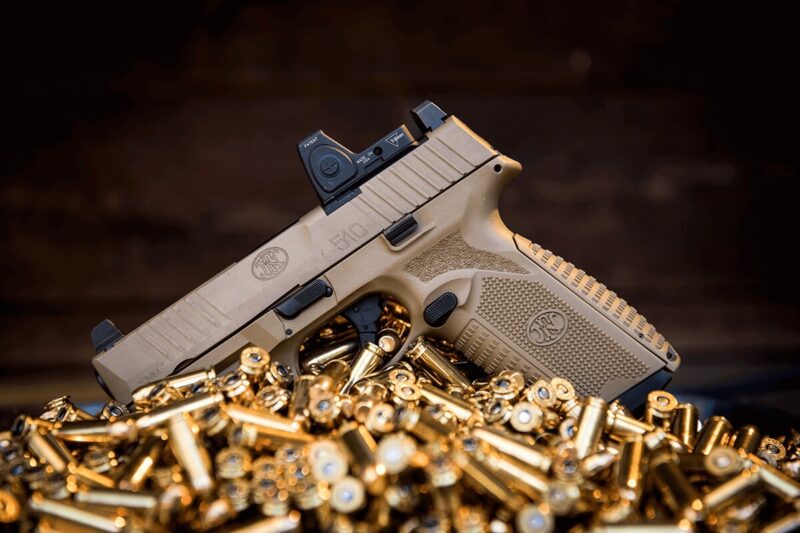
FN America has announced the release of the striker-fired FN 510 MRD and 545 MRD optics-ready big bore pistols.
With dimensions just slightly larger than an FN 509, these two big bore pistols are ideal for users who want to carry with a lot more stopping power.
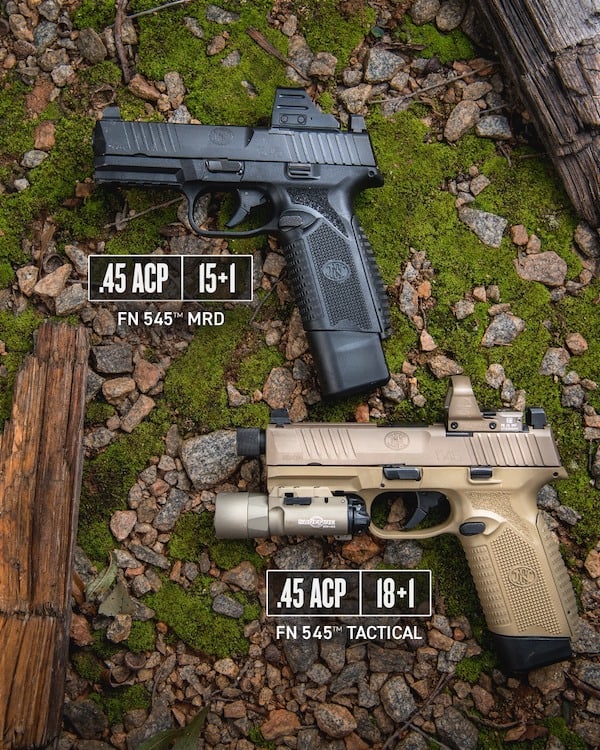
The pistols feature 15+1 rounds of 10mm or .45ACP at the ready, a target-grade 6-pound trigger pull with crisp break, and the company’s patented optics mount that enables enhanced accuracy, making them the perfect tool for personal and home defense.
In response to customer feedback on the FN 510 and 545 Tactical, the FN 510 and 545 MRD feature a flush-fit, 4.1-inch barrel housed within a machined steel slide with front and rear cocking serrations for ease of manipulation. The barrels are cold hammer-forged with a recessed target crown to extend accuracy and a polished feed ramp to ensure reliable feeding of the majority of commercially available loads in both 10mm and .45ACP.
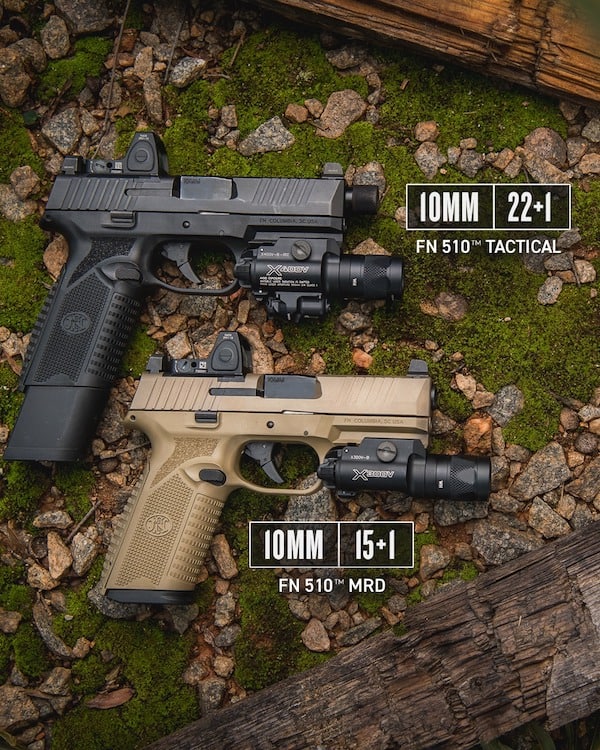
The MRD slide is equipped with FN’s patented Low-Profile Optics-Mounting System that accepts all major optics footprints and enables consumers to direct-mount nearly any optic in minutes with the included hardware while a set of fully adjustable blacked-out iron sights co-witness with most optics and are to provide a clear sight picture, allowing the user the focus on the red dot of the optic.
The ergonomics and contouring of the 15-round grip frame deliver balance to the slide. The included backstraps can be installed to adjust the fit in the user’s hand to deliver a natural point of aim and dampen felt recoil, especially in 10mm. This is coupled with three distinct grip textures that all play a role in anchoring the pistol to the hand.
SPECS
• Chambered in 10mm Auto or .45 ACP
• 4.1-inch flush-fit cold hammer-forged barrel for states that restrict threaded barrels; compatible with FN 510 or 545 Tactical barrels
• 15-round standard capacity with option for 10-round capacity for restricted states; compatible with FN 510 and 545 Tactical extended magazines
• FN Low-Profile Optics-Mounting System with co-witness, blacked-out iron sights
• Target-grade trigger with approximately 6-pound break
• Ambidextrous controls
• MSRP: $919
For full specs on the FN 510 MRD and 545 MRD, visit FNAmerica.com.