Categories
Weapons
The weapons used by the Tomb Guard are more than just for show. These weapons are fully functional and are kept ready for use at all times. The weapon inspection conducted prior to the new Sentinel assuming the post, is a real inspection.
Over the years there have been many different types of weapons used by the Tomb Guards. The changes in weapons reflect the changes in the Army, however each weapon system is picked for good reasons.
The weapons that have been used at the Tomb are broken into three different groups:
| Rifles M1903 M1 Garand M14 |
Bayonets M1905 M1942 M6 |
Pistols 1911 .45 ACP M-9 Beretta SIG Sauer P320 M17 |
M1903 Springfield Rifle
Rifle, Cal. .30-06, M1903 Series (1903). The Springfield M1903, a bolt-action rifle, was the standard issue rifle used by the Army from 1903 thru 1936, when it began to be replaced by the new issue M1 Garand. But it remained in use in many units up until 1943, when the Garand began arriving in large numbers. The M1903 used the .30-06 standard military cartridge in five-round magazines. The M1903 was an accurate weapon and was also used as a Sniper Rifle. It remains in use today as a ceremonial rifle for many different organizations.
M1 Garand
The M1 was designed by John C. Garand, and was the standard issue military rifle used by the U.S. Army from 1936 to 1957. The M1 was one of the first semi-automatic rifles to see action in combat. It offered a great improvement in fire power over the bolt-action M1903 series rifle it replaced. It was rugged, reliable, and tolerant to the abuses of use in the field. The rifle used .30-06 cal. cartridges in eight-round clips. The rifle was used by LTG George S. Patton, Jr., who said:
“In my opinion, the M1 Rifle is the greatest battle implement ever devised.”
M14 Rifle
(Rifle, 7.62mm, M14 series)
Seeking a lightweight replacement for the M1 Garand and the M1918A2 BAR, the Army selected the M14 rifle in 1957. The M14 was basically a product improved M1 Garand. The M14 has an effective range of 500 yards (460m). The M14 uses a standard NATO 7.62mm cartridge in a 20-round magazine. The M14 was the standard Army infantry rifle, until replaced by the mass fielding of the M16 5.56mm rifle in 1966-1967. The M14 was also converted into a Sniper Rifle (M21).
The M14 is the standard ceremonial weapon used by the 3d U.S. Infantry (The Old Guard) today, and is the current weapon carried by Tomb Guards.
Technical Manual description: a lightweight, air-cooled, gas operated, magazine fed, shoulder weapon, used primarily for semi automatic or fully automatic fire. (TM 9-1005-223-10)
M1905 Bayonet
Mission
Defeat the enemy in hand-to-hand combat. Also used as a general field and utility knife.
Entered Army Service
M1905 for WWI
Description and Specifications
The M1942 was designed as the edged weapon for both the Springfield 1903 series and the M1 Garand Rifle.
| M1905 | |
| Blade length (prior to 1942): | 16.00 in |
| Blade length (after 1942): | 10.00 in |
M1942 Bayonet
Mission
Defeat the enemy in hand-to-hand combat. Also used as a general field and utility knife.
Entered Army Service
M1942 for WWII
Description and Specifications
The M1942 was designed as the edged weapon for the M1 Garand Rifle.
| M1942 | |
| Blade length: | 16.00 in |
M6 Bayonet
Mission
Defeat the enemy in hand-to-hand combat. Also used as a general field and utility knife.
Entered Army Service
M6 (1957)
Description and Specifications
The M6 bayonet-knife is used as a bayonet on the M14 series rifle and as a hand weapon.
| M6 | |
| Blade length: | 6.75 in |
| Total length: | 11.5 in |
1911 .45 ACP
(Colt-Browning United States Government Model of 1911 .45 automatic pistol)
The 1911 was designed to comply with the requirements of the US Army, which, during its campaign against the Moros in Philippines, had seen its trusty .38 revolver to be incapable of stopping attackers. An Ordnance Board headed by COL John T. Thomson (inventor of the Thomson submachine gun) and COL Louis A. La Garde, had reached the conclusion that the Army needed a .45 caliber cartridge, to provide adequate stopping power. In the meantime, J. Browning who was working for Colt, had already designed an “autoloader pistol,” around a cartridge similar to contemporary .38 Super (dimension-wise). When the Army announced its interest in a new handgun, Browning re-engineered this handgun to accommodate a .45″ diameter cartridge of his own design (with a 230gr. FMJ (Full Metal Jacket) bullet), and submitted the pistol to the Army for evaluation.
The Colt Model 1911 was slightly improved in early 1920’s when the flat mainspring housing was replaced with an arched one, a shorter hammer spur was used, a short trigger was made standard as well as a longer grip safety. The new model was named Colt M-1911 A1 Government Model. In this form, the gun was produced during the remaining years until
WWII, when military requirements were met by production of M-1911 by several firearms manufacturers such as Ithaca, Remington-Rand, Union Switch etc. Several thousand of this firearm were produced during the war period. ACP stands for “Automatic Colt Pistol.”
M-9 Beretta 9mm
(Beretta 92F)
A variation of the world famous semi-automatic Italian military handgun. This model with modified trigger guard to suit a two-handed grip and extended base to the magazine, was the service weapon of the US Army, Navy, Air Force, and Coast Guard.
SIG SAUER P320 M17 9mm
October 11, 2018, SIG SAUER presented the M17 to the U.S. Army’s 3rd U.S. Infantry Regiment (The Old Guard) for the Tomb Guard Sentinels.
The M17 Tomb of the Unknown Pistols are unique M17 pistols that were created using the same specifications for the U.S. Army’s M17 Modular Handgun System. The ceremonial pistols are 9mm striker-fired pistols with a non-railed aluminum grip module, stainless steel slide, wood grip inserts, a 21-round magazine, and features the same optic cut as specified by the MHS contract, front night sight, removable rear plate, and black controls. The pistols also feature a high polish to withstand the inclement weather while the Tomb Sentinels stand guard.
The unique distinguishing features for the M17 Tomb of the Unknown Pistols include:
- Pistol Names: each of the four pistols bears the name of Silence, Respect, Dignity, or Perseverance and is featured on the dust cover. Dignity and Perseverance represent “The Sentinel’s Creed,” and Silence and Respect represent the request to the public by Arlington National Cemetery when visiting the Tomb of the Unknown, and during the Changing of the Guard;
- Custom Wood Grips: in 1921 the chosen Unknown was transported to the United States of America aboard the USS Olympia. The custom wood grips are made with wood from the USS Olympia and include the crest of the 3rd Guard, Tomb of the Unknown Soldier identification badge inset;
- Cocking Serrations: XXI cocking serrations are engraved on the slide to signify the twenty-one steps it takes for the Tomb Sentinels to walk by the Tomb of the Unknowns and the military honor of a 21 Gun Salute;
- Sight Plate: an engraved impression of the Greek Figures featured on the east panel of the Tomb – Peace, Victory, and Valor – are featured on the sight plate;
- Sights: a glass insert made with marble dust from the Tomb of the Unknown fills the sights of the ceremonial pistols;
- Engraved Magazines: the 21-round magazines feature an aluminum base plate engraved with the names of the Greek figures featured on the Tomb of the Unknown – Peace, Victory, and Valor – and include a name plate on the bottom of the magazine engraved with the Tomb Sentinel badge number.
- Serial Numbers: the pistols are serialized with a unique set of serial numbers that incorporate items of significance to the Old Guard: “LS” represents line six of the Sentinels’ Creed, “My standard will remain perfection; “02JUL37” to signify the first 24-hour guard posted at the Tomb of the Unknown on July 3, 1937; “21” to signify the 21 steps it takes the Tomb Sentinels to walk by the Tomb of the Unknown, and the military honor of a 21 Gun Salute.


During the German “Spring Offensive” of 1918, the British Expeditionary Force took on part of the brunt of the German onslaught in fierce fighting that nearly pushed them back against the English Channel. The British desperately wanted U.S. troops of the American Expeditionary Force incorporated into their lines as reinforcements and met resistance from American General John Pershing.
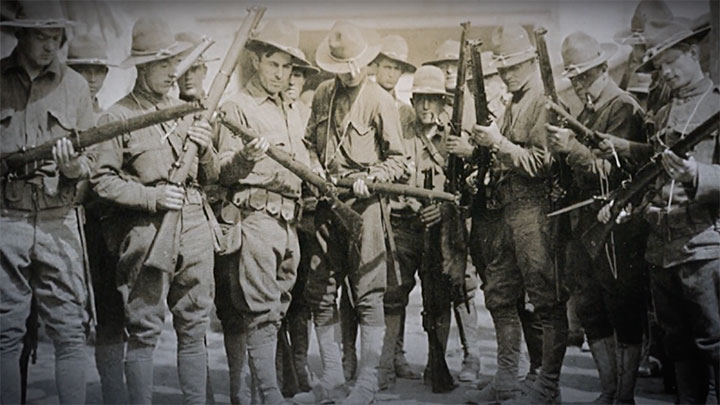
U.S. soldiers inspecting British Short Magazine Lee Enfield rifles.
At the beginning of the Spring Offensive, U.S. soldiers of the AEF were not available to help the allies against the German push, as they were still in training camps. This changed by summer 1918, when the first units of the AEF started trickling into France. General Pershing answered the British request for American reinforcements by sending elements of the 27th and 30th Infantry Regiments to join the British lines under British command.
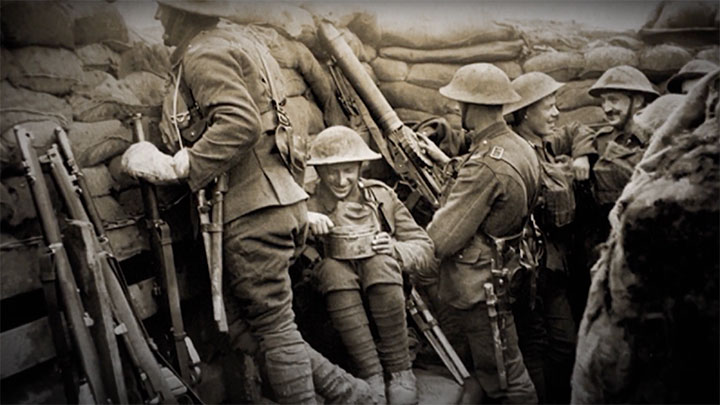
Soldiers packed into a trench on the Western Front surrounded by SMLE rifles and with a Lewis Light Machine Gun.
The U.S. soldiers of the 27th and 30th Infantry Regiments trained with elements of the Australian and New Zealand ANZAC corps to prepare for combat in the trenches. On July 4, 1918, these American troops joined British and Commonwealth forces in the Battle of Hamel, under the command of the Australian General John Monash. During the fighting, the joined AEF and ANZAC forces contributed to a new form of combat in the Western Front, with a combined and coordinated effort of infantry pushes, air cover, artillery and intelligence that would ultimately change the nature of trench warfare.
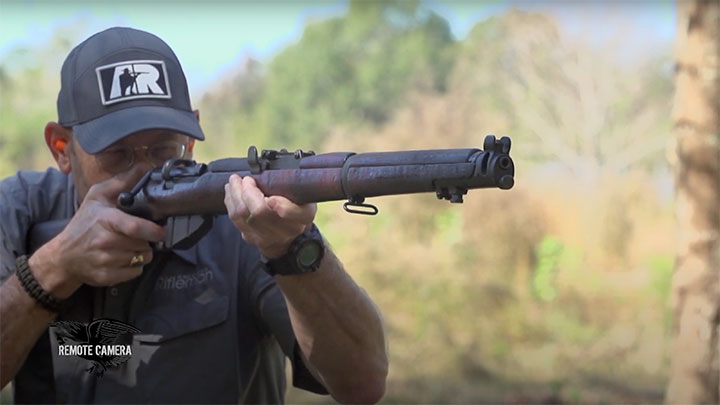
Shooting a British No.1 MKIII* SMLE rifle.
Unlike other AEF troops on the Western Front, the men of the 27th and 30th Infantry Regiments did not use standard American arms like the M1903 Springfield and M1917 Enfield rifles. Instead, they were issued British arms and gear as they fought under British command. These arms included the Short Magazine Lee Enfield, Lewis Light Machine Gun and Vickers Heavy Machine Gun, all chambered for the rimmed .303 British cartridge.
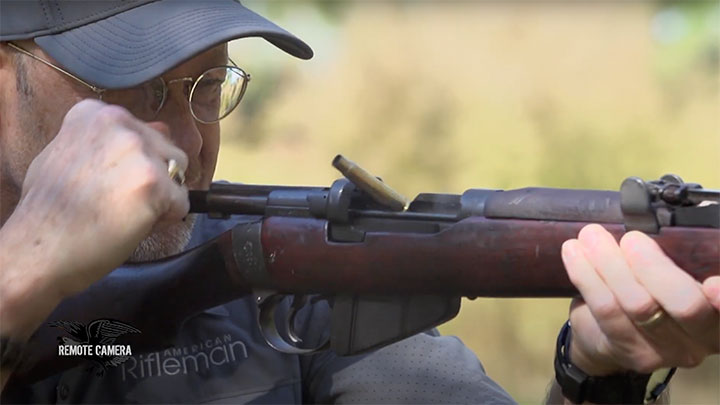
A view of the action of the No.1 MKIII* SMLE ejecting a spent .303 British casing.
The bolt-action Short Magazine Lee Enfield, or SMLE, rifle used by British and Commonwealth forces was one of the best service rifles used during World War I. While the standard-issue SMLE did not have the same long-range accuracy potential compared to the M1903, M1917 and German Gewehr 98, there were several features that made it better suited for the realities of fighting in trenches. The first of these notable features is its magazine capacity of 10 rounds, double the capacity of the other service rifles in use.
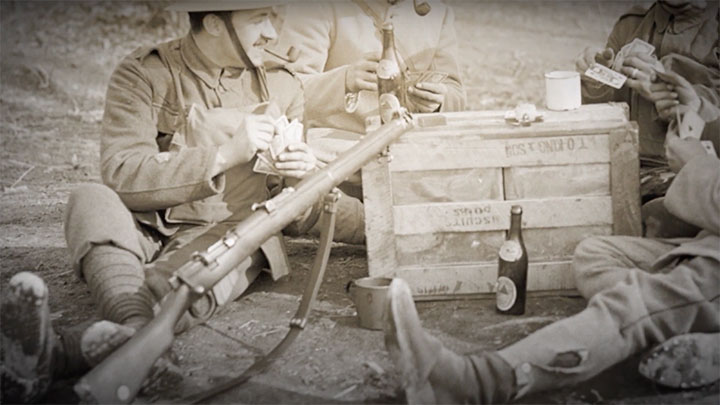
Soldiers sitting around a crate with a No.1 MkIII* SMLE in the foreground.
The SMLE was also slightly shorter than both the M1903 and M1917 rifles in use with other AEF troops, making it easier to maneuver within the tight confines of trench warfare. The cock-on-close action, in addition to the magazine capacity, of the SMLE also meant that trained soldiers could manipulate the action faster and put out a greater rate of fire compared to other bolt-action service rifles in use at the time. The SMLE uses a tangent rear sight and front sight post surrounded by large guard ears, protecting the sights from drops or falls.
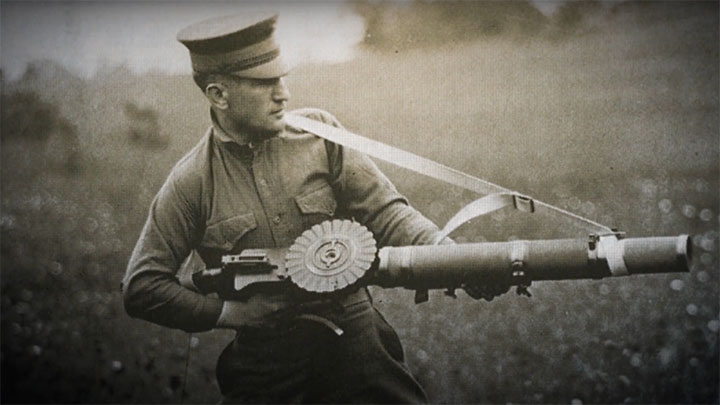
A Marine demonstrating use of the Lewis Light Machine Gun from the hip using a sling.
Another British weapon system used by the soldiers of the 27th and 30th Infantry Regiments under British command was the Lewis Light Machine Gun, designed by a U.S. Ordnance Officer, Isaac Newton Lewis. Lewis based his design off of an earlier machine gun prototype, the McClean, which used a drum feed and gas-operated action. The Lewis Gun fed from a top-mounted rotating drum magazine containing 47 rounds, and was light enough that a single man could carry and operate it versus the more cumbersome and stationary Vickers Heavy Machine Gun.
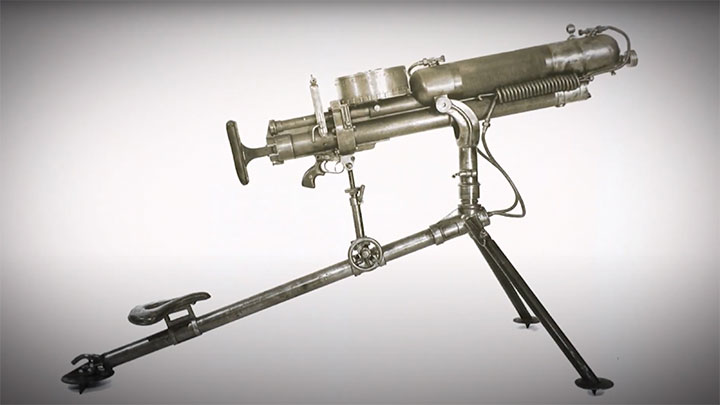
One of the McClean prototype machine guns, off which Issac Newton Lewis borrowed design features for his own machine gun.
One of the most notable features of the Lewis Gun was its finned barrel contained within a hollow shroud. Using a concept called the “Venturi” system, the barrel of the Lewis Gun ended before the opening of the shroud and the muzzle blast pushed air forward through the front while brining in cooler air through opening slits at the back of the shroud near the receiver. It was thought that this method of using flowing air and heat dissipating fins around the barrel would keep it cool during sustained fire while keeping the overall weight down in comparison to a water-cooled jacket.
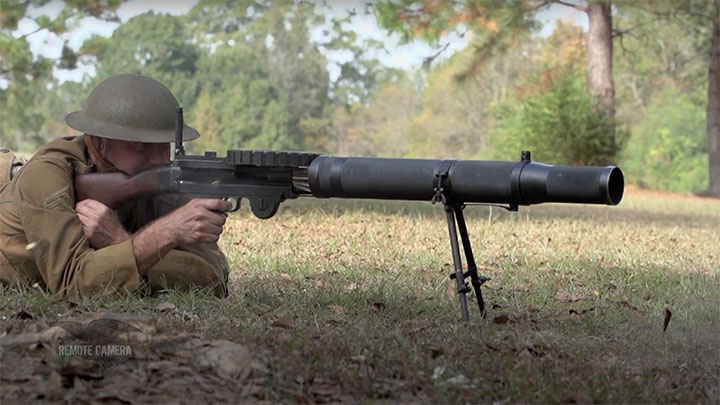
Shooting the Lewis Light Machine Gun.
The Lewis Gun also featured adjustments for the gas regulator and action spring, allowing it to be tuned as fouling built up within the system in order to keep the gun running. The demand for Lewis Guns was high throughout the war as its light weight, magazine capacity and ability to sustain fire made it a valuable asset for British soldiers fighting in the trenches. The number of Lewis Guns in use by British forces constantly grew throughout the war.
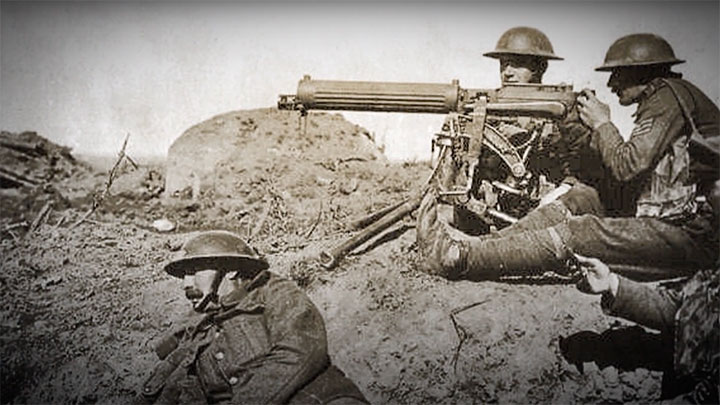
Soldiers crew a Vickers Heavy Machine Gun on the Western Front.
The Heavy Machine Gun Battalions of the 27th and 30th Infantry Regiments were issued the water-cooled, belt-fed British Vickers Heavy Machine Gun. The Vickers was essentially the same design as the American Maxim Gun, albeit a slightly lighter and improved version with the toggle lock turned upside-down. The Vickers uses a recoil-action operating system in which the barrel recoils backwards slightly within the water-jacket to unlock and operate the toggle action. The Vickers proved to be a reliable heavy machine gun on the Western Front, and a trained crew with plenty on ammunition, spare parts and water could fire it continuously.
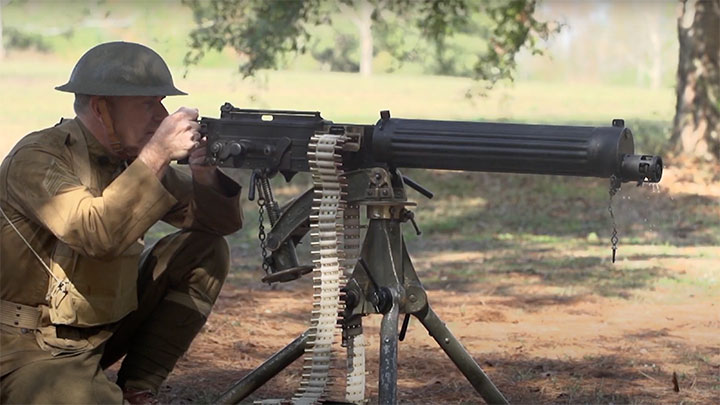
Shooting the British Vickers Heavy Machine Gun.
By mid-1918, the tactics used by the British had improved since the disastrous first Battle of the Somme two years earlier, in which they suffered more than 60,000 casualties on the first day. The British has started off with one Vickers per battalion at the beginning of the war, which increased to several machine guns per company to support the infantry.
The number of Lewis Guns increased to two guns per platoon, or at least one per section. The British also incorporated the use of rifle grenades fired off the front of SMLE rifles as well as “bomber” troops, which were soldiers tasked with hurling multiple grenades at the enemy.
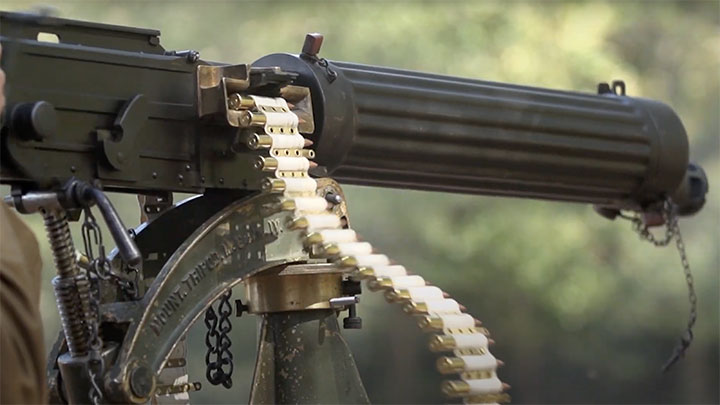
Another view of the Vickers Heavy Machine Gun in action.
The combination of better arms and tactics being used by the British by 1918 allowed for an increased degree of fluidity to be brought back into the fighting which had previously been a near constant stalemate. This was the environment that the U.S. soldiers of the 27th and 30th Infantry Regiments under British command participated in on the old Somme battlefield in 1918. General Monash, who commanded the two American regiments, went on to say that there were “no finer troops” in regards to the U.S. soldiers fighting with the British and ANZAC forces.
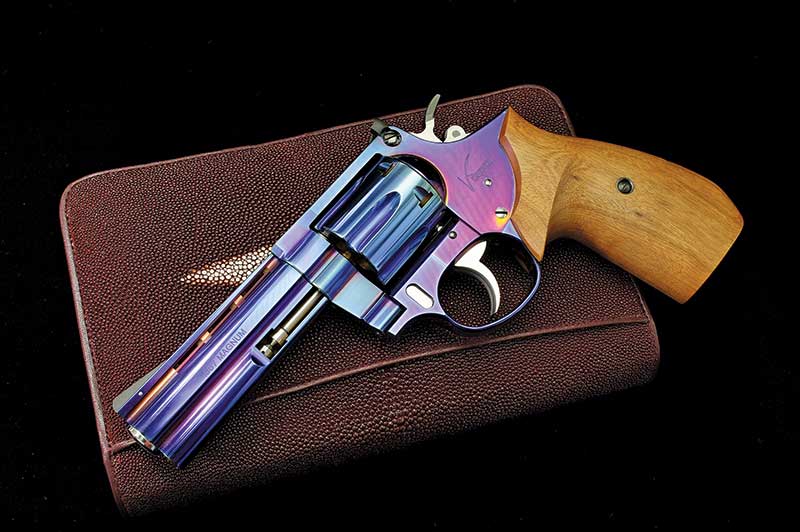
Who says “stock” can’t be stunning? This is a vintage Korth showcased
by a rayskin portfolio. Let your expectations grow beyond the safe full of
high-cap auto pistols you might have now.
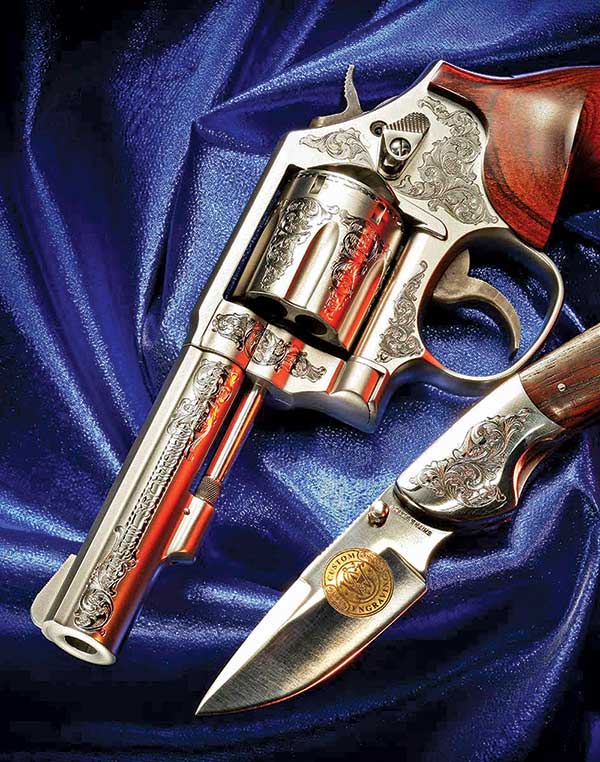
Roy’s wife, Suzi, owns this stunner of a Model 65. She shoots it
and simply enjoys it each and every time she does.
When I learned to SCUBA dive in the middle ’80s, my first “real” dive was in a training pool. Before we went in, the instructor said, “Okay, so once you get over the fact you’re actually breathing underwater, start to think about what’s happening, what you’re doing, how to handle emergencies and actually look around you and appreciate what you see.”
Sure enough, the first five minutes, all I could think about was, “Holy cow, I’m breathing underwater! Hey, look at me, I’m breathing underwater! Look at all those bubbles! Gosh!”
But as time passed, the novelty wore off, and I began to really learn about being a diver. The skills I learned paid off to help me get a slot in our agency’s Harbor Unit, where I became one of our department divers. But the ability to get past that initial astonishment was important.
So why does this matter to us? A shooter’s life journey usually goes along similarly. They shoot a gun for the first time, or buy a first gun, shoot it, then can’t help thinking, “Heck, this is great! What fun! I can’t believe I’m shooting a real gun! This is more fun than I thought. I want to shoot it a whole lot more too!” Remember?
Now comes the important part of the process though. Many people stop there. They have one gun, they shoot it, they repeat, “Gosh, I’m shooting a gun!” but don’t really ever get past that. It’s the same experience simply repeated over and over again. The key is to look down the road and figure out where it might lead. Learn to get better, to reload, learn history, to question ideas and simply to be interested beyond making empty brass.
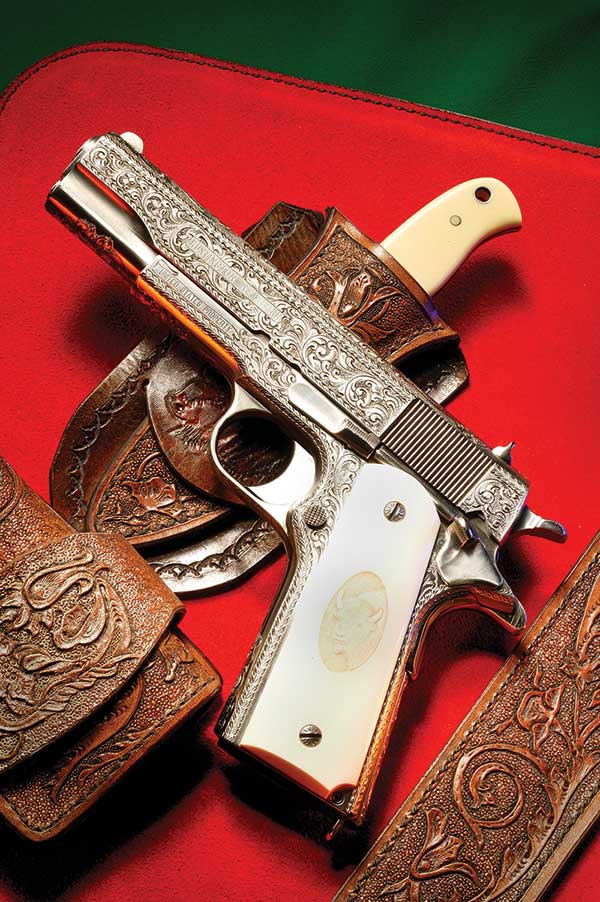
Get past the polymer and go for it, like this engraved 1911. Even a modest —
but still personal gun — helps you to push the envelope on your taste,
skills and the sheer fun of shooting.
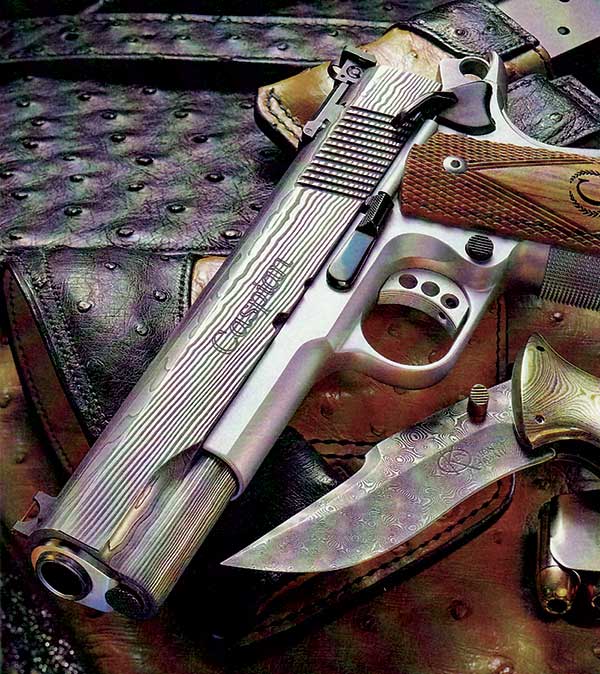
This is the first Damascus slide 1911 ever built, created by Tussey Custom for
Roy in 1998. It was the March cover gun that year for GUNS Magazine. Keep pushing
yourself to grow, learn and participate in outside-of-the-box thinking. It’s often surprisingly
affordable and always satisfying.
Messing With Boats
The term comes from The Wind in the Willows by Kenneth Grahame. They’re a great line of books for adults, sneakily masquerading as children’s books. If you keep your mind open, there are life lessons galore. If you don’t know the books, they are about small animals in the woods, but these animals talk and are as sophisticated as anyone you’ll ever meet. Maybe more.
In one part, Mole and Rat are rowing up a river in Rat’s boat. They are chatting about things in general and nautical things in particular, prompting Rat to say:
“Believe me, my young friend, there is nothing — absolutely nothing — half so much worth doing as simply messing around in boats. Simply messing … about in boats — or with boats. In or out of ’em, it doesn’t matter. Nothing seems really to matter, that’s the charm of it. Whether you get away, or whether you don’t; whether you arrive at your destination or whether you reach somewhere else, or whether you never get anywhere at all, you’re always busy, and you never do anything in particular; and when you’ve done it there’s always something else to do, and you can do it if you like, but you’d much better not.”
To me, Mr. Rat is talking about shooting too. Once you get your feet real and truly wet shooting and decide it’s going to be part of your life, you’ll soon find “messing about” with shooting to be satisfying, enjoyable, sociable and rewarding. The freedom to putter, guess, explore, find limits, discover no limits and learn to hone your tastes can be some of the most gratifying experiences you might have.
The key here, at least to me, is once you’re past the “I’m breathing underwater” stage, is to grow, learn and discover the hidden secrets behind the guns and gear we all love. When you find yourself wishing beyond that first polymer pistol, you’ll know the real journey is beginning. As your tastes broaden, become more sophisticated, and your yearning for knowledge grows, the bars for your expectations will rise accordingly. If you’re always on your tip-toes reaching for the next bar, you’ll find your enthusiasm for all things guns to continue to remain fresh, undeniable and fulfilling.
Just don’t stop at that first single-shot .22 — or plastic pistol. Enjoy them, yes, learn from them, indeed, but never think it stops there — because it doesn’t. When you find yourself eyeing the Bowen Classic Arms website, passing a surprising amount of time clicking on gun photos on the Turnbull Restorations site, or when you find yourself far down the rabbit hole of looking at “Just one more picture of engraved guns” — you’ll know you’re headed in the right direction.
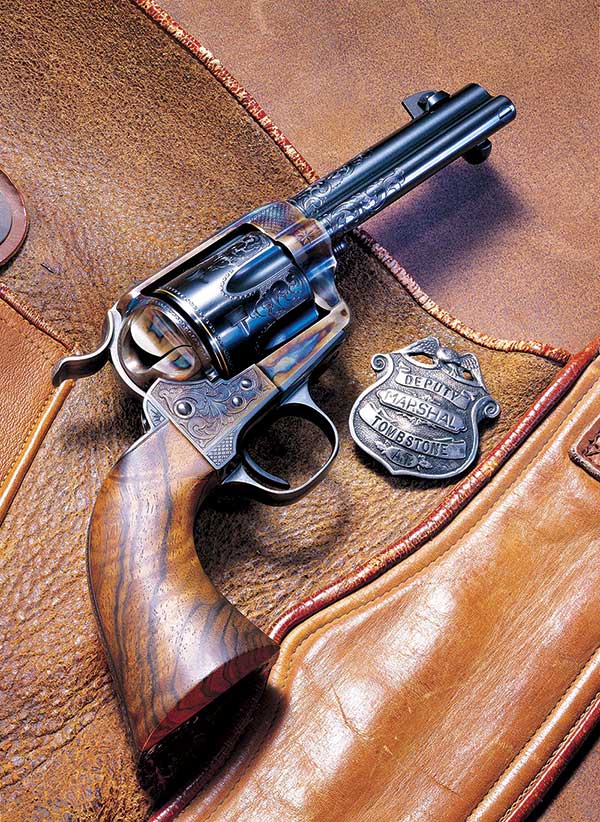
“Working” guns are one thing, but the sublime satisfaction of owning something
like this single action from Bowen Classic Arms ramps the game up!
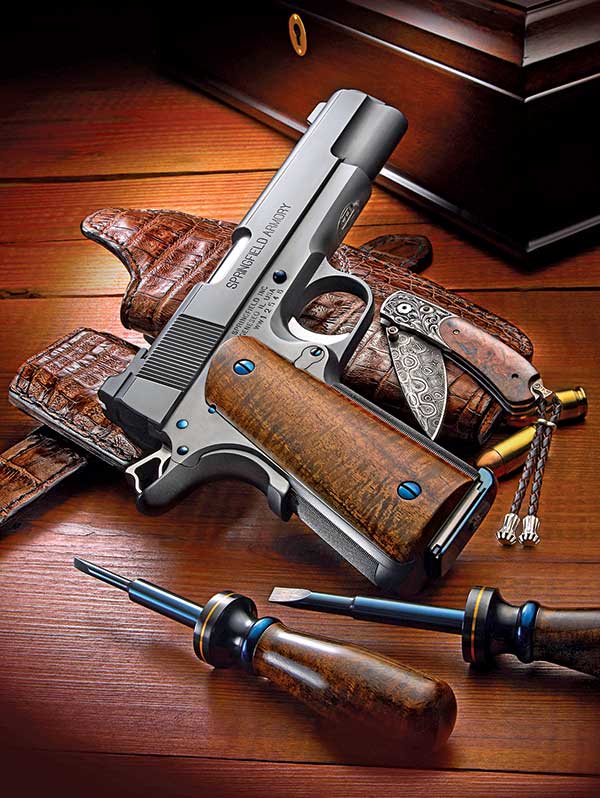
There comes a time for an all-out swing for the fence project and this
Ted Yost boxed set of gun and tools epitomizes it. Don’t lower your
expectations — strive toward them.
What Is Too Much?
I haven’t found it quite yet. It seems with every custom gun project (“No, really, this is the last one, I promise …”) I find new doors opening, new ideas flooding my dreams. When a satisfying group appears as if by magic on my target, it makes me wonder the how’s and why’s behind it — and if it can be better. That leads me to further exploration with reloading ideas, calls to fellows who know more than I do, talks with barrel makers, wondering why one rifle stock shoots better than another.
The key here is to “keep messing about with boats.” And always — always — continue to aim high with your dreams. Never accept adequate as the final word. And by all means, enjoy!