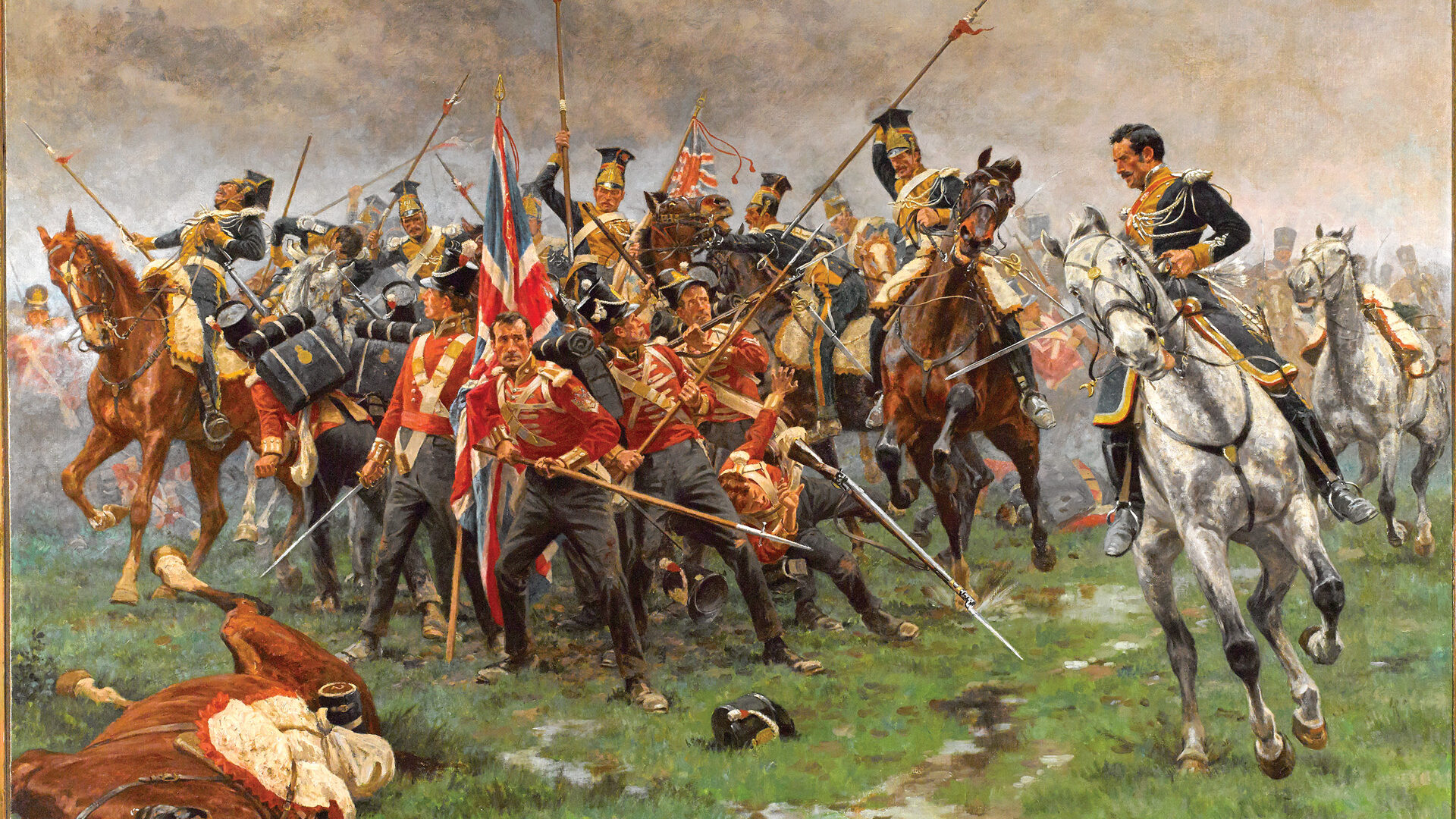
The defense of the Colours of the 3rd Foot – The Buffs at the Battle of Albuera during the Peninsular War in 1811.
The defense of the Colours of the 3rd Foot – The Buffs at the Battle of Albuera during the Peninsular War in 1811.

James Montgomery Doohan was born on March 3, 1920, in Vancouver, British Columbia. His father was a veterinarian, pharmacist, and dentist who developed an early form of high-octane gasoline. Starting in 1946 Doohan took on roles as a voice actor for radio, developing a reputation for his broad range of accents and dialects. Over the next decade, he performed in more than 4,000 radio programs.


In the mid-1950s, James Doohan played forest ranger Timber Tom in the Canadian version of Howdy Doody. Oddly, at the same time, William Shatner was playing Ranger Bill in the American version of the show. Both men later appeared together on the Canadian TV series Space Command.

Over the years Doohan played a wide range of roles on screens both large and small. However, the one part for which he is best remembered is that of Montgomery Scott, the chief engineer on Star Trek‘s starship Enterprise. Though he was neither Scottish nor an engineer, James Doohan’s depiction of the longsuffering Starfleet officer created a cinematic icon.

While auditioning for the part before Gene Roddenberry, the creator and producer of Star Trek, Doohan suggested that all the best engineers were Scottish. He personally chose the first name of Montgomery to honor his grandfather. The resulting beloved character became a fixture across three years’ worth of live-action television, an animated series, and seven major films.

Doohan’s vocal range was indeed remarkable. He voiced a variety of entities on the TV series to include Sargon in “Return of Tomorrow,” the M-5 in “The Ultimate Computer,” the Mission Control Voice in “Assignment: Earth,” and the Oracle in “For the World is Hollow and I have Touched the Sky.” He voiced a total of fifty different characters during the animated series to include as many as seven in a single episode. He also contributed heavily to the development of both the Vulcan and Klingon languages for the films.

The Trekkie truly committed to his craft might appreciate, however, that throughout the run of both the TV shows and movies, Doohan takes care with how he positions his hands. However, in “The Trouble with Tribbles” we do get a quick glance. James Doohan was missing his right middle finger. The tale of how he lost that digit is indeed fascinating.

Doohan’s father was an alcoholic who made life miserable for Jimmy and his three older siblings. At age nineteen, Doohan enlisted in the Royal Canadian Artillery and was assigned to the 14th (Midland) Field Battery of the 2d Canadian Infantry Division. He was later commissioned a Second Lieutenant and assigned to the 14th Field Artillery Regiment of the 3d Canadian Infantry Division. In 1940 he was deployed to England. By 1944 he was ready to go to war.

LT Doohan landed on Juno Beach on June 6, 1944, alongside 14,000 other Canadian troops. Juno was one of five invasion beaches designated as part of Operation Overlord, the Allied invasion of Normandy. Opposing the invading Canadians were two battalions of the German 716th Infantry Division with elements of the 21st Panzer in reserve near Caen. The initial landing was a fairly bitter thing. One in every eighteen Canadian assault troops became casualties that first day.

LT Doohan led his men across the beach strewn with antitank mines and personally killed a pair of German snipers. Doohan was ultimately in combat less than 24 hours. At around 2300 that first evening the young Canadian officer was making his way between a pair of Allied positions when an inexperienced Bren gunner fired at the noise. Doohan caught a total of six not-so-friendly .303 rounds.

Doohan took four rounds to his left knee and leg and one to the chest. The sixth round blew off the middle finger on his right hand. The chest wound would have undoubtedly been fatal had it not struck a glancing blow that deflected off of a cigarette case Doohan kept in his left breast pocket. The case had been a gift from his brother. Doohan joked later in life that he was one of the few people for whom smoking had actually saved his life.

LT James Doohan’s No 4 Lee-Enfield rifle was an evolutionary development of the Short Magazine Lee-Enfield (SMLE) with which Commonwealth forces fought the First World War. These Tommies called their SMLE rifles “Smellies.” The SMLE was itself a development of the previous Lee-Metford.

The No 4 Lee-Enfield was cheaper and faster to produce than the WW1-era weapon. Fed from either a detachable ten-round box magazine or top-fed stripper clips, the No 4 also cocked on closing and had an abbreviated 60-degree bolt throw. These attributes made the Lee-Enfield arguably the fastest bolt-action military rifle ever produced. In 1914 a British musketry instructor named SGT Snoxall put 38 rounds inside a 12-inch target at 300 yards in 60 seconds, a record that purportedly stands even today.

The Bren gun was a license-produced development of the Czech ZGB-33 light machinegun. The name “Bren” is a portmanteau combining Brno, the Czech city where the gun was first designed, and Enfield, the location of the British Royal Small Arms Factory. The ZGB-33 was itself developed from the previous Zb vz.26 designed by Czech designer Vaclev Holek.

Originally adopted in 1935, the Bren fired the rimmed .303 British cartridge and weighed about 23 pounds. The gun’s sedate 500 rpm rate of fire, its superb reliability, and its quick-change barrel made it an efficient and effective support weapon. The Bren fed from the top via a sharply curved 30-round box or a 100-round pan magazine. However, the latter was a bit ungainly in action. All members of the rifle squad would typically pack spare magazines for the Bren.

In the 1950’s the British re-barrelled the Bren gun to fire the NATO-standard 7.62x51mm round and designated it the L4A4 LMG. This variant served through the war in the Falklands. Final production of the Bren by the Indian Ordnance Factories continued until 2012.

Though expensive and fairly heavy, the Bren has been described as the best light machinegun of its era. Filling roughly the same tactical space as did the American BAR, the Bren benefitted from its quick-change barrel and increased magazine capacity. The L4A4 version used a magazine that was interchangeable with those of the L1A1 SLR rifles employed by British forces at the time.

LT Doohan obviously recovered from the wounds he incurred on D-Day. Afterward, he was selected for pilot training and graduated from Air Observation Course 40 alongside eleven other Canadian artillery officers. Doohan trained to fly the Taylorcraft Auster Mark V observation aircraft. He was assigned to the 666 Air Observation Post Squadron RCAF at Andover, England, in support of the 1st Army Group Royal Canadian Artillery.

Captain Doohan soon developed a reputation for his daring at the controls of his nimble little spotter plane. Once in the late spring of 1945 while flying a Mark IV Auster on the Salisbury Plain north of Andover he came across a series of telegraph poles. Doohan then slalomed his little plane back and forth around the poles, in his words later, “to prove it could be done.” He was strongly reprimanded for this stunt. He left the Canadian Army shortly after the end of the war.

Many of the Star Trek cast, particularly Leonard Nimoy, resented being type-cast in those roles. James Doohan did also strive for a time to shake off the inevitable baggage that came with playing such a popular character. However, he eventually came to embrace his Scotty persona and was a popular fixture at conventions for decades. Most of his film and TV roles after Star Trek included some reference or parody to his most famous part.

William Shatner who played Captain Kirk was notoriously difficult. The strained relationship between Shatner and the rest of the cast is beautifully parodied in the simply spectacular spoof Galaxy Quest. If you have any interest in classic science fiction at all and haven’t yet seen Quest then stop what you’re doing immediately and go watch it. You’ll thank me later.

Doohan once said of Shatner, “I like Captain Kirk, but I sure don’t like Bill.” Of the original cast, Doohan was the only one who refused to be interviewed for Shatner’s Star Trek: Memories books about the show and subsequent films. I’m not too proud to admit to having read and enjoyed both tomes. By their final convention appearance together in 2004 Doohan and Shatner seemed to have mended their relationship.

Jimmy Doohan was married three times and had seven children. Like most Hollywood personalities, his personal life was tumultuous. However, it was of his contributions in the Real World that Doohan was most proud. Doohan once corresponded with a young fan who was contemplating suicide. After subsequently meeting at a Star Trek convention Doohan’s encouragement and support not only got the young woman through her emotional slump but inspired her to complete engineering school. At James Doohan’s final stage appearance before his death in 2005 at age 85 Astronaut Neil Armstrong told him, “From one old engineer to another, thanks, mate.”

 A native of the Mississippi Delta, Will is a mechanical engineer who flew UH1H, OH58A/C, CH47D, and AH1S aircraft as an Army Aviator. He has parachuted out of perfectly good airplanes at 3 o’clock in the morning and summited Mount McKinley, Alaska, six times…always at the controls of an Army helicopter, which is the only way sensible folk climb mountains. Major Dabbs eventually resigned his commission in favor of medical school where he delivered 60 babies and occasionally wrung human blood out of his socks. Will works in his own urgent care clinic, shares a business build-ing precision rifles and sound suppressors, and has written for the gun press since 1989. He is married to his high school sweetheart, has three awesome adult children, and teaches Sunday School. Turn-ons include vintage German machineguns, flying his sexy-cool RV6A airplane, Count Chocula cereal, and the movie “Aliens.”

The man lived on his rural farm on the outskirts of his tiny Mississippi town. His yard was meticulously maintained, and Old Glory fluttered quietly in the breeze from an imposing flagpole set in concrete. The flag didn’t stay out overnight…ever. It had been raised and lowered every day on this pole for more than half a century.

He was the very image of a good Christian man of character. He had served as a deacon in his church and teased a modest living out of the farmland that surrounded his modest three-bedroom home. He had raised his kids well and selflessly helped his neighbors. Now well into his eighties, he had agreed to spend an afternoon with me and my young son.

The man was soft-spoken as we nursed our iced tea and soaked up every word. He looked off into nothing as his mind wandered back to very different times. Though we sat in peace, security, and comfort, his memory took him somewhere else.

This unassuming man described being a 19-year-old Infantryman heading ashore in a Higgins boat on June 6, 1944. His destination was Omaha beach. It was about 1400 in the afternoon.

He charged terrified down the open ramp into the very bowels of hell. Wrecked equipment and shredded bodies littered the sand, surf, and shale. The smell of cordite, dirty smoke, ruptured bowels, and death pervaded everything. German mortar and artillery fire still slammed into the beach as well as the advances inland.

The man survived the Longest Day to advance with the Allied vanguard. A product of the Mississippi backwoods and a survivor of the Great Depression, this tough teenager found that he had a knack for soldiering. When his company needed intelligence he and a fellow Southern redneck boy would slip off into the night looking for trouble. Sometimes they came back with a prisoner. Sometimes not. The man told me he got comfortable with a knife in the dark.

By late August the man and his buddies had taken the full measure of the enemy. The hard fighting through the bocage hedgerows had brought him face to face with the Nazi superman. He found the German Wehrmacht to be a hardened professional fighting force.

He called the Waffen SS “those Gestapo men.” Decades later his hatred for these fanatical racist lunatics modulated the timbre of his conversation. He told me unapologetically, “We didn’t take many of those Gestapo men prisoner.”

He explained that the SS frequently left a couple of snipers behind when the Germans finally abandoned a position of strategic importance. The carnage they inflicted made little difference in the grand scheme. They just dealt death whenever they could.

My buddy’s unit was tasked to seize Orly airport outside Paris. The Luftwaffe had used Orly as a fighter and bomber base throughout the occupation of France, and the Allied air forces had pounded it into rubble as a result. In August of 1944, however, the wrecked aerodrome was deceptively quiet.

The company commander called a tactical halt. My friend and his battle buddy crept around the periphery of the wrecked airport before ascending one of the taller structures for a proper vantage. Taking cover such that they could just peer over the edge of the roof they finally saw the two German snipers. Tucked into a pile of debris on the roof of a nearby structure the two SS sharpshooters were well-camouflaged and fixated on the approaches to the aerodrome. The two Germans had no idea that they had only moments to live.

Speaking in hushed whispers my buddy and his comrade estimated the range to their targets and adjusted the rear sights on their heavy M1 rifles to compensate. My friend called the man on the left and his counterpart oriented on the one on the right. On the soft count of three, both men squeezed their triggers.

Both rifles rolled back in recoil as their 152-grain M2 ball rounds covered the distance to the pair of German snipers at 2,800 feet per second. Both of the American grunts had grown up with guns, and they knew how to shoot. Each GI center-punched the coal-scuttle helmet of his respective SS target, killing them both instantly.

In 1936 the United States military was woefully behind those of most other major powers. The Great Depression had ravaged the American economy, and a lack of attention to military readiness had taken a horrible toll on such stuff as tanks and combat aircraft. The gleaming exception was the M1 rifle. American troops entered WW2 with what General George Patton described as, “the finest battle implement ever devised.”

Designed by a Canadian-American inventor named John Cantius Garand (properly pronounced, I’m reliably told, so as to rhyme with “errand.”), the M1 was a .30-caliber, gas-operated, 8-shot, clip-fed, semiautomatic rifle. The weapon weighed 9.5 pounds and was 43.6 inches long. By the time the M1 reached US Army troops in 1937, production at Springfield Armory was ten rifles per day. Two years later output languished at 100 per day. By the end of the weapon’s massive production run, however, some 5.4 million had been made by four major manufacturers.

By modern standards, the M1 was heavy, cumbersome, and grossly overpowered. However, at the outset of the Second World War, the M1 was a wonder weapon. Ammunition was supplied in spring steel 8-round en-bloc clips that were pressed in place from above with the bolt locked to the rear.

En bloc simply means that the ammunition clip became part of the weapon’s action during firing. When loading the rifle, the operator pressed the clip down from above and snatched his thumb clear as the bolt automatically flew home. The clip was ejected out of the top of the action after the last round fired.

An M1 rifle cost Uncle Sam about $85 during the war. That’s about $1260 today. The M1 was rugged, accurate, and powerful. I have never spoken with a combat veteran who carried one who had anything but unvarnished praise for the piece.

There was a still a great deal of fighting left to be done after my friend and his comrades cleared Orly airport. There is no telling how many lives these two young warriors saved just in this one exchange. However, the worst was yet to come.

The Ardennes Offensive has become known as the Battle of the Bulge from the vantage of comfortable hindsight. My buddy said at the time it was pure unfiltered chaos. German Army Group B led by Joachim Peiper and the 1st SS Panzer Division slashed deep into Allied territory, shredding American defenses and scattering combat units randomly among the detritus. The US response devolved into tiny packets of troops fighting for their lives. My pal found himself leading a handful of bedraggled survivors deep behind the German spearheads.

Otto Skorzeny’s Operation Greif involved the insertion of English-speaking Germans in American uniforms to sow confusion in Allied rear areas. The effect that had on the Allied defense was outsized beyond their pure numbers. Suddenly nobody trusted anybody they didn’t already know well, and jumpy sentries shot first and asked questions later.

After a protracted escape and evasion, my buddy’s motley band finally made it back to friendly lines exhausted and spent. The first sentry they encountered covered them with a BAR and demanded to know who won the World Series in a particular year. My buddy not so gently explained that he had no idea. He expounded that while the Yankees were comfortably enjoying their baseball he was out hunting opossums in the Mississippi swamps to keep his family from starving. The sentry let them pass.

My buddy rendered his professional opinion on all of the major US small arms. He explained that there was always only one M1. The M1 Carbine was simply the Carbine, and the M1A1 Thompson was always the Thompson. Nobody used the term Garand. The standard US Infantry rifle was always just called the M1.

He said for an entire year some part of his skin was touching that rifle. Awake, asleep, shaving, eating, or defecating, that weapon was always at arm’s reach. He said that the Carbine was an effective and handy combat tool, but that it did frequently require several shots to take a German soldier out of the fight. By contrast, he said that so long as you caught him center of mass, the M1 would put an enemy soldier down instantly every single time.

We went back to the man’s barn neatly populated with tractor components and the sundry detritus of a working farm. The open building smelled like motor oil, horse manure, and dirt. Hanging obscurely in the corner was a dusty German helmet, the faded SS runes still visible. There was a .30-caliber hole running cleanly in and out both sides. How do we make such men as these?

