Categories
The Green Machine War

SSG Alan Magee: The Luckiest Man in the World by WILL DABBS

In a bygone era, sneezing was understood to be the body’s involuntary effort at expelling evil spirits. Thus the admonition of “Bless you” with each iteration.

Luck. Now that’s a difficult concept to get your head around. Even this deep into the Information Age when most modern folks worship at the exalted altar of science, you can still find people who refuse to walk under a ladder, won’t open an umbrella indoors, or say “Bless you” when someone nearby sneezes. We humans are pretty darn strange.

This was an epic read.

However, what do you expect? Random chance is indeed a fickle mistress. In the superb book Bravo Two Zero by Andy McNab, two SAS operators are sitting side by side in a stolen car stopped at a roadblock on a black rainy night in the Iraqi desert during the First Gulf War. The two men are oriented shoulder-to-shoulder, and the car is stopped in a long line of vehicles rendered immobile by an Iraqi checkpoint.

In combat little things can become big things. Folks often live or die based upon the vagaries of fate.

When discovery was inevitable the two men bailed out of the car, one on the left and the other on the right. One man escaped to freedom, while the other was killed. They began in the same spot, yet each man’s ultimate fate was driven by the side of the car he exited. It’s hard not to get a little weirded out over stuff like that.

I’ve been through too much myself to put a great deal of credence in blind chance. In the dark places Jesus has always worked for me.

Personally, I attribute such stuff to Divine Providence. My faith that an all-powerful God loves and watches over me is a source of great comfort when life is going pear-shaped. God and I have gotten through some remarkable scrapes together. However, in the case of SSG Alan Magee, we find a tale that strains credulity. His story would be impossible to believe had it not been reliably verified.

The Man

The B17 Flying Fortress was one exceptionally pretty warplane. I’d likely feel differently were it dropping bombs on me.
While the B17 got most of the press, there were half again more Liberators in service. The B24 was the most-produced bomber aircraft in history.

Alan Eugene Magee was born on January 13, 1919, the youngest of six children. He grew up in Plainfield, New Jersey. When the war broke out Magee enlisted in the US Army Air Corps and trained to be a gunner on a heavy bomber. The heavies—the B17 Flying Fortress and the B24 Liberator—promised to revolutionize warfare. Through these expensive strategic assets, the Allies hoped to break the will of the German people to fight. Victory, however, would come at a terrible cost.

1LT Jacob Fredericks named this particular B17. 1LT Fredericks had been an engineer at Kellogg’s making Rice Krispies before the war. He originally picked the plane up at Kellogg Field in Battle Creek, MI, where both the cereal and the plane were made. Naming the machine after a breakfast cereal was a no-brainer.

SSG Magee’s mount, a B17F christened “Snap! Crackle Pop!,” carried a crew of ten. WW2-era fliers had a good deal more latitude to personalize their aircraft than we did when I flew for Uncle Sam. Part of that was because so many of these old planes were destroyed so quickly. Tactical aircraft fighting in WW2 frequently did not survive very long in combat. By contrast, our mounts operating without anybody actively shooting at us were expected to last essentially indefinitely.

I got to fly these things, but they were not my airplanes. The flight engineers and crew dogs owned the aircraft. We pilots just drove them from time to time.

For a time I flew an entirely different Boeing product. In my day the flight engineer and crew chief owned the airplane. It was their names that rightfully got stenciled on the sides. The pilots just borrowed them from time to time. We typically drew specific tail numbers for specific missions at the whim of the maintenance officers. When we deployed to some austere spaces we’d typically personalize our aircraft with chalk intending to wash it off when we got home.

You have to be careful what you scribble on the outside of a military aircraft. Sometimes sensitive eyes can see that stuff once you get back to the World.

One of my flight engineers returned from a desert deployment with something quite risqué scrawled on the belly of his aircraft. I never crawled underneath them, so I had no idea it was there. Apparently his pornographic expression was intended to entertain the infantry guys with whom we operated. That was all fine until we got back to home station and did a demo for the local press. The belly of his airplane replete with graphic anatomical references made the front page of the local newspaper. Steve, I bet you thought I had forgotten that. Those were some epically great times.

The Plane

The G-Model B17 Flying Fortress can be differentiated at a glance by the two-gun powered chin turret in the nose.

The B17G was the definitive late-war Fortress. The G-model included such upgrades as a motorized chin turret up front to help dissuade attacking enemy fighters from trying nose-on attacks. SSG Magee’s B17F lacked this particular system in favor of a brace of free fifties in ball mounts in the front Plexiglas.

A modified version of the Wright Cyclone radial engine that powered the B17 actually drove certain models of the M4 Sherman tank as well.

“Snap! Crackle! Pop!” was one of 12,726 of the heavy bombers that rolled out of two plants during World War 2. These planes were powered by four Wright R-1820-97 Cyclone supercharged radial engines each producing 1,200 horsepower. The Wright Cyclone was an iconic design also used in the P36 Hawk, the Douglas DC-3, the SBD Dauntless dive bomber, the Sikorsky H34 helicopter, and, in slightly modified form, certain variants of the M4 Sherman tank.

While obliterating strategic enemy targets was the stated mission of the B17 and B24 heavy bombers, attritting German fighter stocks was also an implicit goal.

The B17’s bomb load ranged from 4,500 to 8,000 pounds depending upon the required range and environmental conditions. The maximum takeoff weight was a whopping 65,500 pounds, and the plane cruised at 158 knots or 182 miles per hour. The B17’s service ceiling was 35,600 feet.

The B17 veritably bristled with AN/M2 .50-caliber machine-guns.

SSG Magee’s B17F packed eleven AN/M2 .50-caliber machineguns in a variety of handheld and powered mountings. These weapons and mounts were meticulously designed to provide optimal coverage all around the plane, particularly when flown as part of an extensive and coordinated formation with multiple aircraft. SSG Magee was a relatively short man, so he got tagged for the ball turret.

The Sperry Ball Turret

Though undeniably weird, the Sperry ball turret was an effective, combat-proven design.

Sperry and Emerson Electric both developed examples of powered ball turrets for use in ventral mounts on combat aircraft during World War 2. The Sperry design was deemed superior and placed into mass production. While the mounts were radically different, both the B17 and the B24 used the same gun turret.

Everything about the ball turret was cramped.

The tricycle landing gear design of the B24 necessitated a retractable mount for the ball turret. Were it not for the retractable mount the turret would strike the ground when the pilot rotated the aircraft for takeoff. By contrast, the conventional landing gear layout of the B17 allowed the ball turret to remain in place through all modes of flight.

You more wore the ball turret than crewed it. It would have been an awfully lonely place in combat.

The ball turret was unimaginably cramped. As a result, this position was typically relegated to the smallest member of the crew. To enter the turret the guns were swiveled straight down, and the gunner entered through a small metal hatch in the back. Once in place, the gunner sat in the fetal position flanked on each side by the ample breaches of his twin Browning fifty-caliber machineguns. There was an electronic reflex sight mounted between the gunner’s feet. Charging these weapons and clearing stoppages were incredible chores within the cramped confines of the ball turret. Ammunition fed from the belly of the plane through a pair of articulated feed chutes.

There wasn’t room in the ball turret for a parachute.

Because of the dearth of usable space, ball turret gunners flew without parachutes. Their chutes were stowed in the crew compartment nearby. However, to bail out, the ball turret gunner had to swivel the guns straight down, unlock and open the access panel, crawl backward out of the turret, attach the parachute, and exit the aircraft. As you might imagine, in a plane that might be gyrating wildly or on fire this could be quite the impressive feat.

The Event

Like many warplanes of its era, “Snap! Crackle! Pop!” didn’t last long in combat.

On January 3, 1943, SSG Magee strapped into “Snap! Crackle! Pop!” for his seventh combat mission while assigned to the 350th Bomb Squadron of the 303d Bomb Group. Their objective this fateful day was a daylight run over Saint-Nazaire, France. The submarines that sortied out of Saint-Nazaire caused no end of frustration to trans-Atlantic convoys. As a result, Allied planners invested tremendous effort in trying to take out the sub pens that housed and serviced them.

Flak is an abbreviation of the German word Flugabwehrkanone which means “Air Defense Cannon.”

Once near the target, SSG Magee’s aircraft encountered murderously thick flak. A nearby shell burst from a high-velocity 88mm flak gun disabled his ball turret and liberally ventilated both the fuselage of the airplane as well as SSG Magee. SSG Magee clambered out of the turret with difficulty only to find that his parachute had been shredded by the flak hit. As he tried to get his head around that revelation a second shell tore off part of the right-wing. Now uncontrollable, “Snap! Crackle! Pop!” entered a vicious spin.

SSG Magee’s B17 disintegrated in mid-air.

SSG Magee’s plane was at cruising altitude, and his quick egress from the ball turret left him without access to the plane’s oxygen supply. He somehow made it to the radio compartment before losing consciousness due to hypoxia. Soon thereafter his B17 disintegrated.

That SSG Alan Magee survived being thrown clear of his disabled B17 at more than 20,000 feet without a parachute was a legitimate miracle.

SSG Magee was miraculously thrown free of the crippled airplane and fell some four miles toward the French ground below. He ultimately ended up crashing through the glass roof of the Saint-Nazaire train station. Passersby found him unconscious but alive on the floor of the terminal.

Both SSG Magee and his aircraft were well and truly mangled.

SSG Magee had 28 different shrapnel wounds from the original flak attack. In addition, he suffered multiple broken bones, severe facial trauma, and damage to both his lungs and kidneys. His right arm was also nearly severed from tearing through the glass of the train station. However, he was inexplicably still alive.

The Rest of the Story

I’ve done this before. Trust me, you come screaming out of the sky at an impressive clip. I can’t imagine surviving such an event without a parachute.

Terminal velocity for a limp human is about 120 miles per hour. Nothing about SSG Magee’s ordeal should have been survivable. However, he was taken prisoner by the Germans and eventually recovered after some decent medical care. He spent more than two years in a German POW camp before being liberated in May of 1945. Once he was repatriated he was awarded the Air Medal along with a well-deserved Purple Heart.

SSG Alan Magee went on to enjoy a long full life. Here he is seen at a memorial for his downed B17 in Europe.

After the war, Alan Magee earned his pilot’s license and worked in the airline industry. He retired in 1979 and moved to New Mexico. SSG Magee died in January of 2003 of a stroke and kidney failure at the ripe age of 84, arguably the luckiest man alive.

Categories
War

Clay’s Op-Ed: Generation GWOT and the Fall of Afghanistan by CLAY MARTIN

(Photo: Off-The-Reservation)

Some of you Afghan Veterans out there are hurting, trying to make sense of what this all means. Including some of my peers, who are not immune to the feel bads coming out of this clusterfuck. So allow me to give you a different perspective, one that will perhaps soothe the pain a bit. I shoot straight, and this isn’t all sunshine and roses. There is going to be some Grim Dark upfront. But it does have a silver lining, hear me out.

Was this a foolish mission to start with? Yes. The only way to decisively win in Afghanistan was full-scale genocide, which we knew from about 2003 forward. We don’t have the stomach for that, and that is probably a good thing.

Did we lose? Yeah, goddamn right we lost. Let’s just get that out of the way now, like ripping off a band-aid. Do not get out the “ We were winning when I left” hats and slap a Ghan flag on them. Face the facts, and then act. If the goal 20 years ago was to remove the Taliban, and now the Taliban is back 100% in control without even requiring a name change, then the objective was not met.

Is it your fault? No. The failure here, while stunning, rests on the political class and the Generals. So like I said, the political class. Who, exactly, do you think lost this war? You, out slogging the mountains, and mowing down Taliban fighters with a machine gun, and surviving on fish sticks and MRE crackers at the firebase, and winning EVERY tactical level engagement for 20 years? Or the spineless General who didn’t hear a gunshot despite 9 tours, who was the architect of the grand strategy, and spent his time quite literally getting his dick sucked by his biographer in his office at Bagram instead of trying to win?

We can safely say at this point that the real goal in Afghanistan was a transfer of wealth from the taxpayers to the MIC ( Military Industrial Complex) and the politicians they bought with the profits. $88 billion dollars ( for the ANA alone) is a staggering figure. For that much money, you could have paid half of Afghanistan to kill the other half. You could have paid China or India or even Pakistan to do it for you. That money was wasted, and we all knew that well over a decade ago.

Afghanistan should never have been anything except a punitive expedition. We should have left in 2004, 2006, 2007, or ten minutes after Osama Bin Laden died. Any one of those would have been a leave with honor type situation. Instead, we opted to snatch defeat from the jaws of victory and look like incompetent boobs to the entire planet. I should say, our Generals and Politicians opted for that. Almost like that was the goal………

The idea of spending 2.2 trillion dollars to “export our way of life” to cavemen is retarded, and anyone with an ounce of sense knows that. I often said that giving the Ghans a Jeffersonian Democracy was a fool’s errand since we could barely keep one functioning ourselves. Post Nov. 4th, 2020, we know that “barely functioning” wasn’t true either. The idea of the U.S. Government fighting corruption is laughable in our own country. So no shit we laundered 2.2 trillion into bribes and fake projects, what did you think was going to happen?

How many Company Grade Officers were relieved of command or run up on charges over 20 years? A lot. Hundreds, if not thousands. How many Generals faced the same fate, or resigned in disgrace over their incompetence? None. Stan McCrystal resigned for saying not nice things about Obumer to a Rolling Stone reporter, but that doesn’t count. In fact, perhaps it is telling that General JSOC himself was played in such a manner. If ole Stanley is too much of a fucking idiot not to effectively give his enemy kryptonite and ask him nice not to use it, what does that say about the rest of the Officer Caste? For that matter, how many children did the CEO of Ratheyon or Boeing or Lockheed Martin lose to the meat grinder?

Yeah, it hurts. I feel you. We all lost friends. Had our brothers return home mangled and broken. Was it worth it? No. But those are sunk costs, so we might as well look at what we gained from the experience. They made a generation of us very, very fucking dangerous. We, especially the Enlisted class, learned how to make war in a manner not seen for decades. Perhaps ever. And while we would all trade that to have our boys back walking this Earth, the bargain can’t be reversed.

Think of the GWOT as history’s biggest training exercise. It was said in antiquity that any training that didn’t kill one out of a thousand was insufficient for training warriors. True. Now it wasn’t a deal that shed our weak. We lost some of our absolute best and brightest, which adds to the pain. But it made even the mediocre of us far better than we would have been. Even if you got fucked up yourself, you learned invaluable lessons firsthand you can teach the youth. You have value in your brain alone that is beyond price. Bill Gates, with all his fortune, couldn’t buy the experience you carry in you every day.

Is it arguable, if a little tinfoil hat, to think that perhaps the globalist factions set up the war in Afghanistan on purpose purely to break a generation of fighting men from the Vanguard of Freedom, ole Team USA herself? It doesn’t seem as fucking crazy to me as it might’ve been 10 months ago. It is at least plausible. But if that was the idea, they failed. Instead, they forged our generation into War Machines the likes of which have never been seen. Did we lose some once again to PTSD and depression? We did. But it doesn’t have to be you. The question is never how hard you can get hit. It’s how hard you can get hit and stand back up. This is a time for standing back up.

Did we learn anything else? Yes. The Taliban, much as we might hate them, just taught us a valuable lesson about will. As did the North Vietnamese and the North Koreans. No odds, no technological advantage, no amount of money, can beat an iron will. As long as you can take enough punishment, there is absolutely nothing that can’t be overcome.

We lost this war the minute Code Pink was taken seriously. The minute Bradly Manning and Bo Berghdale weren’t hung. The first time we charged one of our warfighters with murder or using excessive force. The first time we denied an element in contact air support. Our people, 49% of them at least, are weak and stupid. The great sifting has just begun, and it will get worse. That is the price you pay for allowing weakness to take root in your society.

All of us, I promise, will be needed once again. And soon. And not in some Bureaucrat, Blue Blood, Skull and Bones created debacle on the edge of the Empire. I mean needed as in needed like the Spartans at Thermopylae. The weakness on display right now by the Government of the United States will not go unnoticed by the world at large. We can expect now to be poked in the chest because we have shown that we will take it. You can do one of two things right now. You can drown your sorrows in a bottle of Jameson and think about your dead friends. Or you can honor their memory by getting the fuck up, off your ass, and getting your shit together. The best loyalty I can show my boy Mike Duskin today is to “go pick up something heavy and move it over there.” Go mentor some youth. Get back in the gym. Don’t let the sacrifice have been in vain.

Categories
War

Guide to the French Infantry Squad (NEW Equipment) No not RUN AWAY LIKE HELL!

Categories
Hard Nosed Folks Both Good & Bad Soldiering Useful Shit War

A Short History Of The Garrotte (One hell of a way to die if you ask me!)

Image result for 3 martyr priest
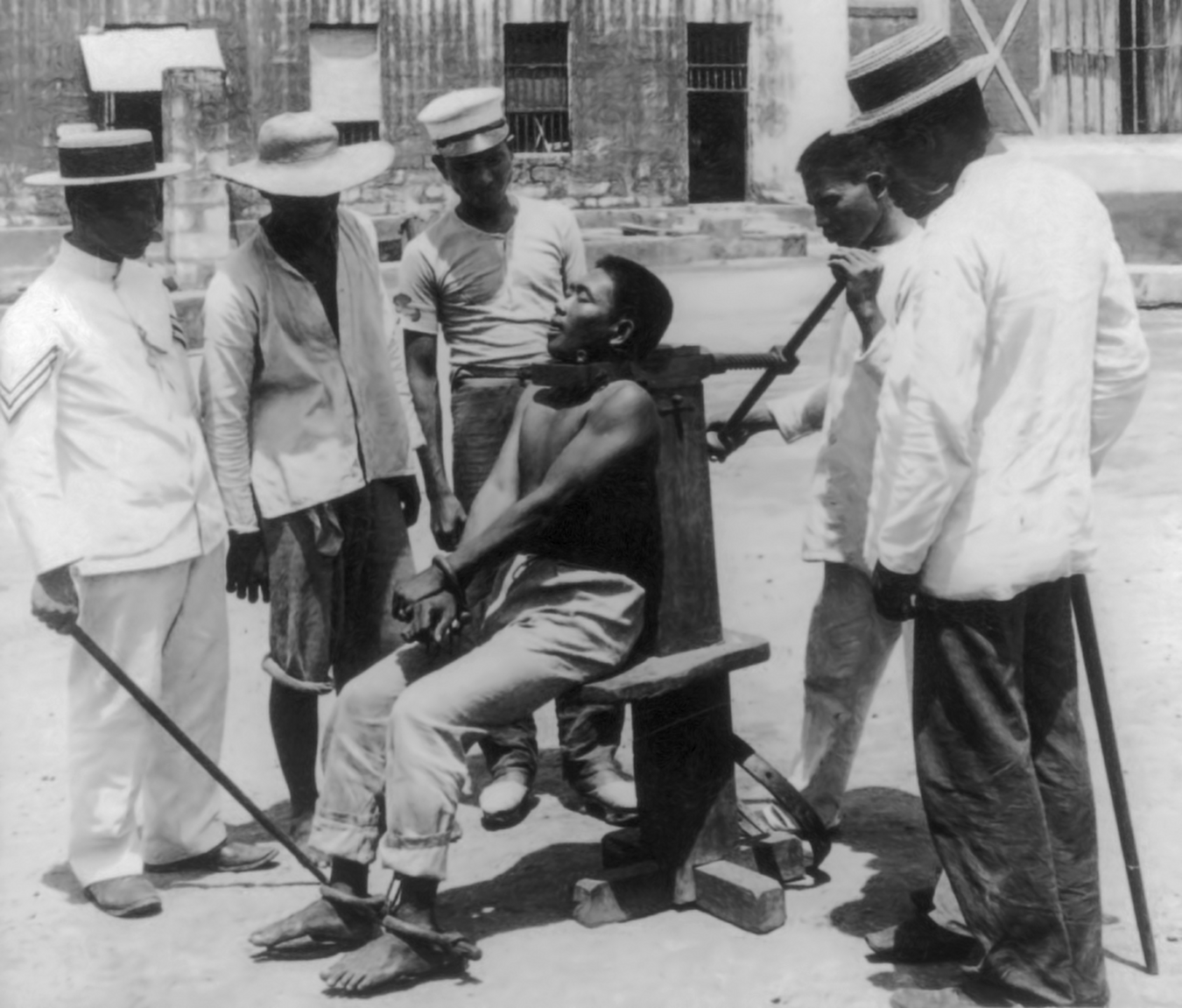
A 1901 execution at the old Bilibid Prison, Manila, Philippines
Opening Disclaimer
I have to put the disclaimer and warning at the beginning of this article. The reason is very simple. Even a Martial Artist operating on an Expert Level of control of hands, elbows, knees and feet can underestimate the destructive power of weapons if they are not intimately used to them.
Weapons multiply force, that is why they are so dangerous to the human body. Even if you are used to choking techniques, a simple leather belt used to hold up your pants, if placed around the neck, can cause severe damage if used with the same force as a choke not using a mechanical device like a belt.
And yes, when you use a belt or a rope, it is a mechanical device used to multiply the force of a choke. It has no moving parts, it is still a mechanical device when attached to your hands.
What I would strongly suggest you do if you wish to train how to defeat these rear attacks is to construct a padded post to practice on.
If you use a live training partner, once the loop goes over the neck, STOP! Any attempt to throw or take down could cause severe injury, the vital structures of the neck are easily damaged, any number of incredibly serious injuries could occur, up to and including paralysis and/or death.
And, keep in mind, with a cutting garrotte, there is absolutely, positively NO WAY WHATSOEVER to practice safely with it so do not even attempt to do so.
I cannot be held responsible for your own negligent attitude, I’m writing this, I’m not doing it with you, you understand… You are strongly advised to seek Professional, safe Instruction in whatever methods you wish to study.
You are on your own, I do not advocate or condone you practicing these things. They are, in a very real way, put up here for historical purposes and for very advanced Martial Arts practitioners, including Marines and Soldiers who might find the history and information useful.
Do NOT practice these things unless you are using an inanimate “Dummy” or a padded post.
Is The Garrotte a Legitimate Self-Defense Tool?
Some people have a heavy opinion on this issue. They have opinions as to the legitimacy of the garrotte as a tool of self-preservation. Others have strong opinions as to the definition of “garrotte.”
[I’m not going to debate the spelling, I’m using Col. Rex Applegate’s spelling of the word and whenever you see me use something different, it’s a typo.]
Some people say, “Well, the garrotte is a…” and then they define it to the exclusion of anything else. The simple fact of the matter is, a “Garrotte” was an execution device that was utilized in Spain up until the mid-1970s. A few other countries used it now and again. And there were many different types of garrottes used as execution devices.
When someone says, “The garrotte is only a killing weapon…” Technically, they are correct, but they are not usually speaking of the execution device that was once used for Capital Punishment, therefore, they are incorrect in reality.
The number one deciding factor is intent. How you use it. You can use some “garrottes” as a Flexible Weapon with no intent whatsoever to kill.
The garrotte had a couple of different forms. One had a metallic collar that was placed around your neck and the collar had a threaded hole that a bolt was inserted through. On the other end of the bolt was a large “T” handle for the executioner.
The condemned was seated in a chair, the collar placed over a wooden post and the head of the prisoner, then, the executioner began to tighten the contraption until your neck was crushed or your vertebrae were dislocated, broken or crushed.
Later versions had a blade that ran through the bolt for what was thought to be a “mercy killing.” The blade was slipped between the vertebrae, severing the spinal cord.
In a pinch, the improvised garrotte could be a seat, wooden post, strong cord and a metal bar. The noose being affixed around the post and neck of the condemned, the bar could be inserted and the cord twisted until death occurred. Much like using a tourniquet and stick.
These are “garrottes.” The important thing to remember is, if someone says, “No, that’s not a garrotte, this is a garrotte…” And they are speaking in absolutes or anything other than an execution device, they’re incorrect. More on that later.
Other “Garrottes”
So, if we exclude the execution devices, what is left? If we do exclude the execution devices, any flexible or semi-flexible weapon that cuts the air off by compressing and/or crushing the trachea, severs (up to and including complete decapitation) the trachea and other vital structures (carotid arteries, jugular veins, vagus nerve, etc.) or breaks the neck, we have a list of items that have been used as a “garrotte.”
One Point of View: The Debate
I was once involved in a debate with a person who insisted that a “True Garrotte” would be a “cutter.” Meaning, a piano wire or guitar string garrotte. The wire being so fine that it would cut into the structures rather than compress/crush them.
If we trace the lineage of these hand held devices back to the origin of the word, as I did above, we see the “Original Garrotte” did nothing of the sort. The “Original” killed by compression and/or crushing and sometimes neck fracture.
Yet, I consider the “cutters” a form of garrotte because there is modern history to back that up. However, the “cutter” type of garrotte is not a “true” garrotte. It’s just another type of garrotte.
The “Cutter”
Back before delicatessens had slicer machines, the cheese was usually cut by a wire. Yes, a “Cheese Cutter” was basically a wire with two handles. As far as I can tell, this is where the “Modern Cutter Garrotte” came from. The source is Melton’s “Clandestine Warfare.”
The British SOE and American OSS used these devices, to what degree I do not know. Some wire garrottes with machined and knurled brass handles (for enhanced grip) were manufactured and issued. They are in the OSS Weapons Catalog, as well as other references…
Gigli bone saws were also used as “Survival Saws” as well as “Cutter” Garrottes during World War Two.
The “Crusher”
“The Garrotte. Thugs in India have long been known for their method of strangling, called garrotting. It can be executed with a rope, strong cord or a piece of twisted cloth about three feet long with a noose in one end. This is a garrotte. Properly applied, it produces a deadly, silent strangle.
Slip the noose over the forefinger of the right hand so that the loop lies down across the palm toward the little finger. Close the right hand and pick up the free end of the cord with the left hand, so that the thumb and fingers are on the inner side of the cord and the end is even with the little finger.
Approach the victim from the rear and, opening the right hand, throw the loop over his head with the left. Use the left hand to draw the noose through the right hand until it is nearly taut about the neck.
Then close the right hand about the noose at the back of the victim’s neck and twist as you would in applying a tourniquet. With your hand against the back of his neck and your right arm stiff, the victim is held at arm’s length and is unable to free himself from the strangling cord or to reach his attacker.
A hard pull to the rear at this point will make the victim fall backward and cause his chin to fold down over the cord, thus adding his own body weight to the pressure of the strangle.” ~Col. Rex Applegate, Kill or Get Killed

In the illustration above you can see the finishing position of what Applegate describes. The right hand is INSIDE the loop, when the loop is pulled tight around the neck and your hand, a fist is made with the open hand then the fist is cranked counterclockwise.
Much like a stick in a tourniquet. The palm is open and oriented UP, then closed into a fist and oriented DOWN.
What Colonel Applegate was describing was the method and weapon of the ancient Thugee Cult of India. This is where we get our slang word of “thug.” The word “Thug” comes from the Hindi verb, “thaglana,” which means, “to deceive.”
I do not know if the garrotte described above contained a rupee or not. There is another line of thought that there was more than one way to strangle with a scarf [rumal]. And that was, a rupee or rupees [coins] were tied into the end of the scarf to give it weight so it could be thrown around the neck and then the strangle was initiated.
In fact, more than a line of thought, there is proof of this from the period of British Occupation of India when the British suppressed the Thugee Cult and executed and imprisoned thousands of Thugs.
Throwing the Japanese Fighting Chain, which is weighted, in such a way that the chain is propelled around the neck is also throughout Japanese Martial Arts that focus on the Manrikigusari/Kusarifundo.
In “Kill or Get Killed,” Applegate then mentions the “Stick Strangle.” This is a triangular method where the stick is held in reverse grip and inserted under the chin from behind (or from the front)…John Steyers covered this Stick Strangle in his book, “Cold Steel.”
Then, he addresses other methods of strangulation:
“The Cord Strangle. Another type of strangulation, as old as history in the Far East, is accomplished with any light cord or wire of good tensile strength, about 18 inches long. The thinner the cord or wire, the quicker will be the effectiveness.
Tie a loop at each end of the cord, or tie small wooden blocks on the ends, so that a secure grip can be taken. Approaching the man from the rear, throw him off balance, as with the stick [strangle], with your right foot against the inside of his right knee.
With a hand on each end of the cord (the cord held taut), bring the cord over the victim’s head and back against the throat. Cross the hands at the rear of the neck and apply pressure both ways. Strangulation is quick and silent…” ~Applegate
You will notice that Col. Applegate describes the cord/wire as being taut when going over the head. During the approach, the arms would not be crossed. After the garrotte is thrown over the head, the arms would then cross at the wrists/forearms.
Imagine holding your hands out in front of you as if you are preparing to clap your hands together. Then, with your right palm, touch your left elbow and simultaneously, with the left palm, touch your right elbow.
The forearms are parallel to one another. That is the motion you make. This also takes a shorter cord/wire to use effectively. The wrists/forearms are crossed after the loop has been thrown over the head, not before.
This is actually a weaker garrotting method than having the arms crossed on the approach as is currently taught in the U.S. Army’s Combatives Manual, 21-150 where the arms are crossed at the wrists/forearms on the approach.
Then when the loop is thrown over the head of the enemy, the arms are jerked apart. This is much stronger.
There is another, older way of achieving the same position without approaching with the arms already crossed. It was depicted in the U.S. Navy’s World War Two Hand to Hand Combat Manual for Naval Aviators, the famous “V-5” manual. This is shown below.
 
Notice that as the years passed, not much changed. This is the U.S. Army’s Field Manual 21-150 marked December 1971. Showing the same, basic method.
 
In this method, your left hand makes a cross-body movement and is positioned at the back of the enemy’s right shoulder.
The right hand holding the other end of the garrotte is then looped over the head of the enemy in a semi-circular, counterclockwise motion and then the arms are pulled apart.
Take downs, Using the Enemy’s Weight
There are four basic ways to take someone to the ground immediately following any of these maneuvers.
#1 Pulling straight downward and back.
#2 Kicking the back of the knee and pulling back and down.
#3 Knee strike to the lower back and a pull backwards and down.
#4 A quick turn of the body where you are back to back with the enemy and the enemy is hoisted off of his feet to complete the crush. This is the movement that can possibly result in decapitation if a “cutter” garrotte is used.
In Closing…
So, is the garrotte a legitimate tool of Self-defense? That was the original question. The answer to the question is, it all depends on what type of garrotte you are going to use really.
I cannot imagine going through the trouble of carrying something with such a single purpose as a “cutting” garrotte. That is a specific type of weapon and the only outcome from the proper use of one is death of the opponent, and that is going to be carried out from behind almost exclusively, as in Sentry Removal.
Any belt, length of rope, cord, a telephone cord, whatever is at hand, can be a garrotte. You can carry a very strong bandana or scarf with that being carried with the intent to be used as a flexible weapon. A jacket or light coat can be used as a garrotte, like the belt, it is a common, every day item. The every day items that are all around us points to flexible weapons being really viable and valuable Self-defense tools.
Anything other than a “cutting” garrotte can be used with lethal or non-lethal intent. So, if you make an improvised garrotte from 550 ParaCord, what you do with it will be the deciding factor.
Now, we can break this down and go to Part Two, “The Flexible Weapon.” Before we do, here is a series of pictures showing just a few methods. Some are not “Classical Garrotte” Techniques. They are still very important. It also shows what can be done totally unrelated to a rear attack, or, a response if the enemy turned to face you. What if someone were trying to Garrotte you from behind? This shows you how the weapon might be used against you if you thwarted the rear attack and you turned to face the attacker.

Always remember, the only way to defend against a weapon and develop real, demonstrable skill, is to know how the weapon is used. It is for that reason I wrote this article.

Rope cannot be banned, and criminals can always find weapons anyway, but could you defend yourself against these methods? That is the question…
In that last series of illustrations, you can substitute a jacket or a belt and you can still see the viability of the techniques. You do not have to tote around a “Garrotte,” and always remember, the criminals don’t have to either.
Stay safe. Train safe.
[Drawings are altered from U.S. Army Combatives Manual, Public Domain]
Don Rearic
ãDonRearic.com

Categories
All About Guns Allies Soldiering War

CSM Stanley Hollis: Humble Hero of D-Day by WILL DABBS

The Normandy invasion was chaos on a simply epic scale.

Operation Overlord. In the overall pantheon of cool military names, Overlord flirts with perfection. The term projects the sort of gravitas demanded of the event.

D-Day represented an unprecedented struggle of good versus evil.

June 6, 1944, was a Tuesday. From the comfortable vantage of my favorite writing chair, it is tough to comprehend the truly timeless significance of D-Day. Comprising the largest amphibious invasion in human history, on that fateful morning, some 156,000 Allied ground troops supported by another 195,700 sailors seized a foothold on mainland Europe. Never before had there been such a single seminal moment that so starkly reflected the struggle between the forces of good and evil.

What a bunch of freaking tools.

Europe was engulfed in darkness. For four long years, mainland Europe had endured under the heel of the Nazi jackboot. In 1940 Hitler’s thugs had waltzed across France and the Low Countries like they owned the place. As D-Day approached Dwight David Eisenhower’s boys now stood poised to give the Germans a healthy dose of perspective.

Nobody knows just how many Germans perished in the D-Day invasion.

It cost the Allies more than 10,000 casualties to acquire title to that precious beachfront property in Normandy, all in that single day. Of those thousands of casualties, some 4,414 were confirmed dead. We lost 185 Sherman tanks. Casualties on the German side ran somewhere between 4,000 and 9,000. So many of them were buried underneath untold tons of rubble that the final tally was known only to God.

In 1944 aerial bombardment was an inexact science.

Around 15,000 Frenchmen died in the pre-invasion bombardment. Roughly the same number perished in the crossfire during the invasion. In aggregate that’s more folks than live in my thriving little Southern town. The French equivalent of every man, woman, and child in Oxford, Mississippi, died to evict the Germans from Western France. Through the lens of history, it is easy to overlook such extraordinary stuff as that.

Drilling Down

The individual soldier in the suck seldom cares much for strategy.

Those numbers are the purview of the Generals, politicians, and historians. The few men I have known well who were there gave a very different perspective. Their world was much, much smaller. One gentleman, a member of the 5th Ranger Battalion who landed in the first wave, described events as utter chaos. They cared little for strategy. Life is distilled down to resisting death whenever possible and killing the enemy. It was here on that blood-soaked beach that General Norman Cota coined the epic phrase, “Rangers, lead the way!”

Combat is the true measure of a man. This most ghastly of human pursuits strips away the fluff from a human soul.

In times of such unimaginable madness, a man’s true nature bubbles forth. Many self-described brave men turn out cowards, while some of the more quiet sort show unimaginable resolve. Such combat is the ultimate crucible. It burns away the dross and leaves a man’s core character exposed for all to see.

This nifty trinket might not look like much at first glance. However, it is actually quite the big deal.

Of the 83,115 British troops who landed as part of Operation Overlord only one man earned the Victoria Cross. Abbreviated VC, the Victoria Cross is England’s highest award for valor in the face of the enemy. It is the British equivalent of our own Medal of Honor, and it is not easily acquired.

British Backbone

Like most true heroes, Stanley Hollis rose from humble beginnings.

Stanley Hollis was born in Middlesbrough, North Riding of Yorkshire, England, in 1912, six years before the end of the First War to End All Wars. As a child, he worked in his parents’ shop selling fish and chips. At age 17 he apprenticed as a ship’s navigator, making regular voyages to the western coast of Africa. He contracted blackwater fever, a particularly vile malarial variant, and was forced to quit the merchant marine.

Amidst a great deal of uncertainty Stanley Hollis and his wife made time to start a family.

Hollis came home, married, and started a family. In 1930 he enlisted in the Territorial Army, the British counterpart to our Army National Guard. With the outbreak of WW2, he deployed to Europe with the British Expeditionary Force. He narrowly escaped during Operation Dynamo, the evacuation of Dunkirk. Dynamo may be the second coolest military operation name ever contrived.

Stanley Hollis, shown here in Tunisia–he’s at the top right with the bandage on his head, seemed indestructible.

Hollis fought at El Alamein with Montgomery’s Eighth Army and was subsequently wounded during the invasion of Sicily in 1943. This was but one of multiple combat wounds Hollis received during the war. He was shot or hit with shrapnel so many times his men came to think him unkillable.

By 1944 Hollis was the senior NCO in his company.

On June 6, 1944, Hollis had recovered sufficiently to join the 6th Green Howards as they stormed Gold Beach. Serving as a Company Sergeant Major Hollis moved forward with his troops. In their rush to get off the beach, the British inadvertently overlooked a pair of German fortifications.

CSM Stanley Hollis ran his Sten gun like he meant it.

Realizing that these active emplacements now threatened the flank of the British invasion force, CSM Hollis charged the first, his Sten gun blazing. Once he reached the pillbox under heavy fire he shoved the muzzle of his Sten through the embrasure and emptied his magazine. Leaping atop the fortification he swapped magazines, threw a Mills bomb through the back door, and emptied his second magazine behind it. In the process, he killed two of the German defenders and captured the rest.

Most PIAT gunners enjoyed a love/hate relationship with their primary weapon.

Hollis immediately indexed to a nearby slit trench and supporting fighting position, singlehandedly taking another 26 prisoners. Later that day Hollis led an assault on a heavily fortified position that included a field piece and several MG42 machineguns. Seizing a PIAT gun, Hollis fired upon the German cannon from a range of 50 meters. This attack was ultimately repulsed, but two of his men were pinned down in the aftermath.

Hollis acquired a Bren gun for its superior suppressive fire capabilities.

Hollis then rushed back into the enemy fire, this time with a Bren gun. He distracted the German defenders long enough for his men to escape. In the process, he threw a Mills bomb but forgot to prime it. The German defenders, however, did not appreciate this. As they scattered in the face of the inert grenade Hollis charged their position and cut them down with his Bren.

The Weapons

The inexpensive Sten gun was the right weapon for the right time. Mind that trigger finger, lassie.

The Sten gun was a desperation weapon developed by Reginald Shepherd and Harold Turpin while working at the Enfield Small Arms Factory. The name Sten is a portmanteau combining elements of all three names. Designed in 1940 specifically to be inexpensive and easy to produce, the Sten was intended to help stave off the expected seaborne invasion by the Germans. More than 4 million copies were produced, making the Sten the second most-produced SMG of the war after the Soviet PPSh.

The Brits turned out Stens by the millions.

The Sten was manufactured in five different marks during the war. The Mk IIS and the Mk VS were the world’s first operational sound suppressed SMGs. The Sten fed on a ghastly side-mounted double-column, single-feed magazine and cycled at a sedate 500 rounds per minute. At a time when an American M1928A1 Thompson cost $200, the Sten ran about $11. That’s roughly $200 today.

The PIAT was a wonderful horrible weapon. The thing was an absolute boat anchor to hump.

The PIAT (Projector, Infantry, Anti-Tank) was technically a spigot mortar. Designed to replace the obsolete Boys antitank rifle, the PIAT was a 32-pound beast of a thing. While the published maximum effective range was 115 yards, in reality, the weapon was only reliable out to about half that. However, it did launch a shaped charge warhead that, when it detonated properly, was quite effective at penetrating German armored vehicles.

The PIAT was quite effective against German armor–when it worked.

The PIAT benefitted from not having any backblast upon firing, but the recoil was said to be murderous. The gun itself contained a massive spring that kicked the 2.5-pound round out. The recoil force from firing would theoretically re-cock the heavy action. 115,000 copies were built.

The Mills bomb was one of the most successful hand grenades ever made.

The Mills bomb was the standard British hand grenade from 1915 into the 1980s. More than 75 million were produced. The Mills bomb was named after William Mills and produced at the Mills Munitions Factory in Birmingham. This patented design was based upon a previous Belgian grenade contrived by a Captain Leon Roland. There actually resulted in a most acrimonious row over patent rights.

The serrations in the body of the Mills bomb didn’t much affect fragmentation.

The Mills bomb evolved over time. It was eventually configured such that it could be fired from a rifle equipped with a grenade discharger cup. The serrations in the grenade body were included to make the bomb easier to grip, not to enhance fragmentation.

The Mills bomb produced a dense cloud of heavy fragments.

The Mills bomb was a defensive grenade. This means that it produced a large volume of lethal fragments. By contrast, the German stick grenade was an offensive grenade that produced a great deal of blast but not so many fragments. A competent British Tommy was expected to throw a Mills bomb between 15 and 27 meters. The effective range of the grenade’s fragments was on the order of 90 meters.

The British Bren gun was arguably the most effective light machine gun of World War 2.

The Bren gun was developed from the Czech ZB vz.26 light machinegun in the mid-1930s. Chambered for the British standard .303 cartridge and cycling at around 500 rpm, the Bren was one of the most reliable and effective light machineguns of the war. After WW2 the British rechambered the Bren for 7.62x51mm and redesignated it the L4A4. In this configuration modernized Bren guns served all the way through the First Gulf War.

The Rest of the Story

Stanley Hollis was the classic everyman hero.

Three months after the D-Day invasion CSM Hollis was wounded once more, this time in the leg. He was subsequently evacuated back to England. He received his Victoria Cross a month later from the hand of King George VI himself. After the war ended, like so many of those great old heroes, Stanley Hollis simply wanted to have a life.

Literally, years of combat made Stanley Hollis a seriously hard man.

Hollis worked as a sandblaster at a local iron works before opening a motor repair business. He spent five years as a ship’s engineer from 1950 until 1955. Apparently earning your nation’s ultimate award for gallantry in combat trumps a little malaria.

Hollis thirsted for a stable family life after so much chaos.

The man needed some stability. Stanley Hollis took over the operation of the “Albion” public house in Market Square, North Ormesby. Under his management, the name of the pub was changed to “The Green Howard” after his wartime combat unit.

Stanley Hollis never fully got past his combat wounds.

Stanley Hollis never fully recovered from his wartime injuries. His children later reported that he carried ample German shrapnel as well as a couple of bullets around in his body for the rest of his life. If he stood too long at the pub his leg and foot wounds would purportedly begin to bleed spontaneously. On February 8, 1972, CSM Stanley Hollis, VC, died. He was fifty-nine years old.

After his death, Stanley Hollis was properly venerated.

A commemorative plaque followed, as did a bronze statue of Hollis with his Sten gun. A Middlesbrough school was renamed Hollis Academy in his honor in 2016. Stanley Hollis’ Victoria Cross is on display in the Green Howards Museum in Richmond, North Yorkshire, today. We just don’t seem to make guys like that anymore.

A modern democracy desperately needs heroes like Stanley Hollis
Categories
Leadership of the highest kind War

Hoover fellow Victor Davis Hanson on the type of men who become savior generals

Categories
A Victory! All About Guns Ammo War

Know Where Your Ammo Comes From! Project Pole Bean: How Sneaky Green Berets Blew Up a Few Guns and Frightened an Entire Army by MARK MILLER

In 1968, American troops in Vietnam reported scattered incidents where dead NVA soldiers were found with parts of their exploded rifles protruding from their skulls. Technical Intelligence attributed this to poor metallurgy and bad ammunition. The situation was a little more complicated than it appeared.

The Type 56 rifle could handle 40,000 p.s.i. of chamber pressure. The kinetic disassembly in the picture was caused by firing a modified cartridge which produced 250,000 p.s.i. This blew up the gun and threw the bolt straight back through the top cover.

My uncle Harvey was a Green Beret who served with MAC-V SOG in Vietnam. When I was a kid, I pestered him to tell me about their missions. They would go deep into the North Vietnamese Army (NVA) base areas and tap communications wire, take prisoners and do bomb damage assessment.

My favorite story was how they used to carry in ammunition and put it in NVA storage bunkers. Well, to be accurate, they put it BACK in the bunkers and some other places too.

Military Assistance Command Vietnam’s Studies and Observations Group (SOG) was America’s top-secret special operations task force in the Vietnam War. SOG’s operators worked directly for the Joint Chiefs, executing highly classified and deniable missions in Laos, Cambodia, and North Vietnam. From 1966 to 1968, SOG was commanded by Colonel John K. Singlaub.

Singlaub was an old school unconventional warfare pro. He parachuted behind German lines with the OSS in August 1944 to fight with the French Resistance fighters supporting the D-Day invasion.

After WW2, Singlaub joined the Central Intelligence Agency (CIA) and worked in Manchuria during the Chinese Civil War. In 1951 he became Deputy Chief of the CIA station in South Korea. Later he ran CIA operations in Manchuria and led troops in the Korean War. He was the perfect guy to run SOG.

SOG teams ran deniable missions into Laos and Cambodia to gather intelligence, wiretap communications, kidnap personnel, ambush convoys, raid supply dumps, plant mines, and generally spread the joys of unconventional warfare across the NVA rear.

SOG recon teams normally consisted of two or three American Green Berets and four to six indigenous soldiers. 

This may not sound as romantic as fighting front line infantry units, but without a secure rear, the bad guys at the front got less food and ammunition. As these operations began to effect NVA operations, several divisions of NVA regulars were put on security missions along the Ho Chi Min trail.

Special NVA units were formed and specific tactics were developed to find and kill SOG teams. Landing zones were watched, trackers and dogs were deployed, and a system of communications established to allow a rapid response to any contact with SOG. While finding the NVA could be a problem for infantry units, they trucked guys in for the SOG teams to mow down.

While skulking around, these teams often encountered ammo caches with millions of rounds.  Being Green Berets, their first inclination was to steal the ammo, but there was just too much of it and it was in very remote areas. Demolition was not feasible as it would only scatter small-arms ammunition, not destroy it.

They could have booby-trapped the caches so that when the NVA picked up a case it would blow up but that would have only impacted a small number of enemy soldiers and the NVA could develop countermeasures. Singlaub came up with a deeper game. He would take some of the ammo, booby trap the individual rounds of ammunition, and give them back.

Like most unconventional tactics, ammunition sabotage was nothing new.  In one well-documented operation, the British slipped exploding rifle cartridges into enemy caches during the Second Matabele War (1896-1897) in what is now Zimbabwe. The British scouts were led by an American, Frederick Russell Burnham, who probably put them up to it.

During World War, the British Special Operations Executive (SOE) and American Office of Strategic Services (OSS) collaborated on Operation Natterjack to plant sabotaged ammunition in the Japanese supply chain. OSS Detachment 101 distributed the ammunition in Burma but little is known about the results.

NVA soldiers with AK-47 rifles.

The SOG ammunition enhancement plan was briefed all the way to the Joint Chiefs of Staff in the Pentagon. On August 30, 1967, they approved the plan and two weeks later, Singlaub watched a CIA technician load a sabotaged 7.62X39 mm cartridge into a bench-mounted AK rifle at Camp Chinen, Okinawa. “It completely blew up the receiver and the bolt was projected backwards,” Singlaub said, “I would imagine into the head of the firer.”

The first cartridges were reloaded with an explosive powder similar to PETN high explosive. The problem was that this white powder looked nothing like Chinese gunpowder, so if the NVA pulled apart an altered round it would be detected. SOG’s technical expert, Ben Baker obtained a substitute explosive that so closely resembled gunpowder that it would pass inspection by anyone but an ordnance expert.

NVA soldiers armed with (from left to right) SKS rifle, RPD light machinegun and AK47. All of these weapons fire the same 7.62X39 ammunition simplifying logistics.

Communist block 7.62X39 weapons such as the SKS, RPD, AK47, and Type 56’s could handle up to 40,000 p.s.i. of chamber pressure. The new powder produced 250,000 p.s.i. enough to blow up the weapon and kill the soldier shooting it.

The secret CIA lab in Okinawa developed more than just rifle ammunition.  Tiger striped fatigues, Time Delayed fuses and Astrolite explosive (developed from NASA rocket fuel) all came from this small group of evil geniuses. Later CIA ordnance experts developed a special fuse for the 82 mm mortar round that would detonate inside the mortar tube. Rounds for 12.7x108mm heavy machine guns soon followed.

After the process was developed in the lab, a specialized ordnance team was formed to modify the ammo. Chinese AK bullets were sealed into steel cases with a thick coat of lacquer where the bullet entered the case. The rounds were pulled apart by hand and the powder was replaced with a high explosive substitute. The bullets were then re-seated and the ammo cans and crates resealed just like the original.

While operating deep in enemy territory on other missions, Green Berets carried booby-trapped rounds and cases of ammunition cases with them and slipped them into the enemy ammunition supply chain whenever possible. If the SOG team encountered an ammo dump, they would plant a case of doctored ammo.

82 mm mortar ammo was not stored as loose rounds, it came in three-round, wooden cases. SOG teams must have been very amused by this concept to volunteer to carry a 28 pound case of mortar rounds in addition to all of their other equipment.

When a SOG team ambushed an enemy patrol, they would load one round into an AK magazine or RPD belt left on enemy bodies with the expectation it would be recovered and re-used. When the gun later exploded, all the evidence of sabotage would be destroyed as the round was fired.

The rigged ammo turned up all over the battlefield, weapons exploded, killing NVA riflemen and sometimes entire mortar crews. Now it was time to initiate SOG’s black psychological operations exploitation plan. The strategic objective was to aggravate the Vietnamese traditional distrust of the Chinese.

At the tactical level, individual soldiers questioned the safety of their Chinese-supplied arms and ammunition. One forged Viet Cong document spread rumors of exploding ammunition while another acknowledged ammo problems resulting from poor Chinese quality control.

The forged document stated, “Only a few thousand such cases have been found thus far,” and concluded, “The People’s Republic of China may have been having some quality control problems but these are being worked out. We think that in the future there will be very little chance of this happening.”

Chinese ammunition was shipped in sealed metal cans with lot numbers stenciled on top. These type cans are still in use. I have seen thousands of these cans all over the Middle East and Afghanistan. American AK shooters who use surplus ammunition are very familiar with “Spam” cans and the big can openers shipped in each wooden case of two cans.

Any NVA soldier, looking at ammunition lot numbers, would see that, due to the length of the supply chain, his ammo had been loaded years earlier. No fresh ammo could possibly reach soldiers fighting in the South for years.  The possibility of compromised ammunition would never disappear.

Military Assistance Command Vietnam (MACV) Technical Intelligence Brief No. 2-68

Military Assistance Command Vietnam (MACV) published a Technical Intelligence Brief titled “Analysis of Damaged Weapons” which was widely circulated to U.S. and South Vietnamese units. The study examined several exploded AKs, concluding they were destroyed by “defective metallurgy resulting in fatigue cracks” or “faulty ammunition, which produced excessive chamber pressure.” Enemy agents passed this information directly back to Hanoi.

American G.I.s were warned against using enemy weapons in public service announcements on Armed Forces Radio and TV which were duly monitored by the Vietnamese. The Army Times warned, “Numerous incidents have caused injury and sometimes death to the operators of enemy weapons.”

NVA 82mm Mortar Team laying in their gun.

Mortars work by using a low pressure charge to throw a bomb with a fragment producing case down range. There is a firing pin in the bottom of the tube which hits a primer in the mortar round when the round is dropped in the tube. A fuse ignites the main charge when it hits the target. The modified fuse blows the main charge inside the mortar tube.

As the rigged ammo spread through the system, Forward Air Controllers observed mortars in Laos, Cambodia, and even in Southern Vietnam blown apart in a star shape pattern. Usually, there were a few 3-4 NVA bodies present.

Planting munitions was risky. On November 30, 1968, a helicopter carrying a SOG team with seven cases of CIA modified 82 mm mortar ammunition was flying 20 miles west of the Khe Sanh Marine base. It was hit by 37 mm anti-aircraft fire and exploded in mid-air with no survivors. The remains of Maj. Samuel Toomey and seven U.S. Army Green Berets were recovered at the crash site 20 years later.

Despite the warnings, American soldiers fired captured arms, and at least one souvenir AK exploded, inflicting serious injuries. To avoid ironic self-injury, SOG stopped using captured ammunition in their own AKs and RPD machine guns and purchased 7.62X39mm ammunition from Finland. This ammo, which SOG’s Green Berets fired at the NVA had been manufactured in a Soviet arsenal in Petrograd. Thank you, Comrades.

To keep it secure, the code name changed through the course of the war. The Project began as Eldest Son, then was changed to Italian Green and ultimately Pole Bean.

In mid-1969, articles in the New York Times and Time magazine compromised the mission. Ordered by the Joint Chiefs to dispose of their remaining stockpiles of ammo, SOG teams rushed to insert multiple missions on the Laotian border to get rid of the stuff before their authority expired.

Even after the enemy was aware of the sabotaged ammunition, the program was psychologically useful. The NVA could never again trust their ammo supply. Radio intercepts confirmed the NVA’s highest levels of command were disturbed by their exploding weapons, Chinese quality control, and sabotage.

Declassified reports reveal that SOG operatives inserted 3,638 rounds of sabotaged 7.62 mm, plus 167 rounds of 12.7 mm and 821 rounds of 82 mm mortar ammunition over the life of the program.

Like all great ideas, this one has been copied. Doctored ammunition of undetermined source is still turning up all over the world. There are reports of a special thermite rifle round that melts in the chamber destroying the gun with no injury to the shooter. This protects innocent users such as American G.I.s while denying weapons to the bad guys.

Who knows if the Americans did this or it was just a happy accident.

Former Green Beret Jack Murphy, author of “Murphy’s Law”, tells the story of attempting to shoot a captured SVD in Iraq. The primer popped and the round got intensely hot melting the chamber and barrel together. No need for fake Technical Intelligence Bulletins to protect friendlies here.

In Iraq and Afghanistan, most of the doctored ammunition is high-explosive 120-millimeter and 82-millimeter mortar rounds. Like SOG rounds, the fuses are altered so they explode inside the mortar tube, destroying the entire mortar system and crew.

The advantage of this particular sort of booby trap is narrow targeting. Unlike rifle ammunition, which might turn up with a homeowner keeping a firearm to protect his family, mortar rounds do not have legitimate home security use.

This 120mm Russian mortar had an unexpected detonation. There are reports the Syrian state military launched an operation secretly passing booby-trapped rounds to insurgent fighters at illegal arms bazaars across the middle east. The New York Times thinks that they got the idea from the US.

While it is gratifying to see the direct results of your efforts, it can be more effective to set the conditions for success and then stand back and watch the enemy do the work for you. The results from Eldest Son, Italian Green and Pole Bean exceeded all expectations.

Green Berets are trained to anticipate the second and third order effects of their actions. These projects killed hundreds, frightened the entire North Vietnamese Army, and sowed distrust between Vietnam and China at the highest levels of government for years to come. In 1979 the two countries went to war.

It pays to know the source of your ammunition and where it has been before it got to you.

Categories
Hard Nosed Folks Both Good & Bad Leadership of the highest kind Soldiering War

T. E. Lawrence – The True Lawrence of Arabia

Categories
War

The Giant Stealth Weapon that Almost Destroyed the Pacific Fleet

Categories
War

Hubris can really bit you in the Ass!!