Category: War
Categories
Germany’s WW2 Japanese Legion

America must keep faith with its military veterans. We owe the greatest debt to those who risked their lives to keep us free.
But the promises America has made to the women and men who have served in uniform are due for a review. The budget for the Department of Veterans Affairs has grown at a dramatic pace since 9/11 — from roughly $45 billion in 2001 to more than $300 billion this year.
None of these steps would be politically easy. Proposing and voting for new benefits for veterans have long been among the few policy areas that both Democrats and Republicans support. We also know that the array of benefits offered by the VA plays an important role in attracting and retaining the all-volunteer force — especially in an era of low unemployment and rising wages in the civilian sector.
But the moral responsibility Americans have to those who fought for the country is of diminished value if it does not align with the fiscal responsibility Americans have to keep their financial house safe and sound.
I haven’t been enraged reading a news article in a long, long time. Why am I enraged? Because of these Ivy League, snot-nosed fucks at the Washington Post.
These ones.
 That’s the publically available editorial staff’s information about the board who wrote one of the most disrespectful articles I have ever seen about veterans. There are so many awful opinions in this opinion piece that it’s difficult to break down each and every one. I’ll lead with some words from the VFW, ya know, the VFW that helps in leading the charge against bullshit like this. The VFW that was a huge driver in getting the PACT act passed.
It is laughable that the employees of one of the richest individuals in the world have the audacity to suggest disabled veterans should be the persons responsible for balancing the federal budget – instead of their wealthy billionaire benefactors who notoriously skirt their tax liabilities.
You would think with all the collective Ivy League degrees held by The Washington Post Editorial Board they would understand basic economics. Instead, they recommend that veterans be subjected to means tests or outright forfeit their earned benefits if they manage to constructively cope with these life-altering disabilities.
If you don’t remember, the PACT Act was established to secure health care and entitlements for thousands of veterans who are being diagnosed with various cancers, lung diseases, and much much more. Health care was also improved for dozens of other causes and ailments.
We have been making great strides in helping or honoring those who served in the longest fucking war in American history. We went to a place where we could have been blown up at any moment. We went to a place where we had to watch someone point a gun at us before we were allowed to return fire. We fought in places where we had to put our battle buddies on choppers in body bags and watch them head back home to their families without breath or a heartbeat.
Vast numbers of us have terrible back problems, difficulty breathing at times, PTSD, Traumatic brain injuries, and on and on and on. These are things that we did for our country and we only ask for what was promised which is payment for the sacrifices to our bodies and minds that no reasonable government or dumb-ass editorial board could ever imagine stripping away with a means test.
Just like the VA’s motto until a few weeks ago, the terminology is what is outdated, not the benefits. Over the years, entitlement has become a bad word that implies laziness or the wanton use of funds by the government. The VA is the opposite of that. The VA provides entitlements based on the injuries you sustained while serving. Those injuries do not go away simply because you got a job. Veterans are entitled to these payments in the purest sense of the word.
Those injuries do not go away simply because the fiscal state of the United States is in dire shape. The injuries remain and will remain for the rest of our natural lives. Injuries like the aforementioned are something those entitled- the bad version now- people who have cushy jobs writing nonsense about some of the hardest working people in this country.
People that while they were typing or doing some kind of financial news stories, we were in sands above 100 degrees for months at time with packs that weighed over 60lbs on the regular. People who while the WP Board was polishing their Pultizers were calling family members on satellite phones from the rooftop where another person was standing watch with a machine gun ready to protect you while you talked to your kids.
People that had no problem walking near and over IEDs so that we could locate, close with, and destroy the enemy by fire and maneuver while you were at the latest James Beard award-winning restaurant. While they were in their posh environments, many of us were marching to the sounds of the guns.
The injuries sustained by veterans and active duty members should be one of the last wells that we fill our buckets with simply because the well is closer and easier to draw water from. Walk to the next village over and look in that well of governmental waste. While I type this blog, my hands shake. My hands aren’t shaking because I am mad, which I am, my hands shake because I sustained an injury to my fucking brain when I was blown up by an IED. Does that change because I have a good job? No.
Does the veteran with PTSD lose it when she works in an accounting job now? No.
Does the Washington Post editorial board deal with any of that? I’d imagine not. While we were going to MOS schools, they were going to Harvard, Yale, Columbia, and Cornell. There is absolutely nothing wrong with going to one of the most prestigious universities in the world.
There is something wrong, however, when you sit there on your ivory fucking tower and scoff your nose at those with injuries, whether you believe they are true or not because you read a congressional budget office proposal and were bored on a Friday afternoon.
While I dont think this type of idea has or ever will get any legs, it’s beyond insulting when a huge newspaper like the Washington Post writes an opinion piece that can mislead and manipulate readers with a lesser understanding of the inner workings of both the VA and the veteran service organizations.
There are plenty of ways to improve the VA, the costs associated with the care of veterans, and the budget without ripping away the entitlements veterans are owed.
It is not only insulting but it also is completely untenable. Homes would go into foreclosure, cars would be repossessed, and families would struggle even more to put food on the table, a concern I’d imagine those Harvard, Yale, and Cornell graduates have never felt in their entire fucking lives.
The Washington Post editorial staff is an abomination to veterans. The Washington Post editorial staff seemingly are terrible people who target those who have served while not being personally impacted in any way. The Washington Post deserves to be shamed on the corner of every street in America. Still though, the military members who have served, are serving, or will serve are going to continue to serve so organizations like the Washington Post can write utter rubbish.
Freedom of the Press is a right guaranteed by the Consitution and those who you are trying to remove benefits from are the guarantors of that right. While invoking your absolute right to free speech, sometimes it’s better to invoke your Fifth Amendment right of shutting the fuck up.
North Korea is preparing to send 500,000 soldiers from its armed forces on combat missions in support of Russia’s special military operation in Ukraine, a Russian state TV war correspondent has claimed.
In his youtube video, Aleksander Sladkov, a seasoned Russian journalist specializing in military affairs, claimed that North Korea is firmly aligned with Russia in the ongoing conflict.
He further added that Pyongyang is willing to contribute to the effort by dispatching its troops to take part in the special military operation – a term commonly used by Moscow instead of referring to the conflict as a war with Ukraine.
However, Sladkov, citing sources in Pyongyang, also mentioned that this military assistance from North Korea would necessitate approval from China.
Sladkov further said that an impressive force of at least 500,000 North Korean troops is prepared to assist the Russian military, and a decision regarding their deployment to fight in Ukraine could be made presently.
Sladkov described how North Korea has reportedly issued a call for volunteers, who are willing to participate in the Russian operations in Ukraine, and on the first day alone, around 800,000 individuals expressed their eagerness to join.
Kim Yo Jong, the sister of Kim Jong Un, reportedly declared that her country is “on the same boat” as Russia, implying that North Korea supports the Russian point of view on the conflict.
Additionally, Kim Yo Jong herself has stated that a war could potentially break out between North Korea and the United States.
“I spoke with a friend of mine, the head of a Korean war veterans’ organization. He was here recently. I said, ‘What do you guys have?’ He said,’ 50,000 special forces are ready for deployment’,” said Sladkov.
Sladkov’s claim comes after a military analyst based in Kyiv commented on the possibility of North Korea providing military aid to Russia.
The notion of North Korean troops potentially participating in the conflict in Ukraine is not a new one and has been previously discussed by various experts and officials.
However, since Sladkov’s comments are coming from a source, it indicates that the speculation is being taken more seriously and has moved up a level.
North Korea Sends Weapons To Russia
In November 2022, the United States claimed that Russia was procuring weapons from North Korea and employing them in the conflict with Ukraine.
However, both Russia and North Korea have denied claims by the United States that Russia is procuring millions of rounds of ammunition and other weapons from North Korea.
Furthermore, it was reported that North Korea supplied rockets and missiles to the Wagner Group, a private military company based in Russia.
The United States has already designated the Wagner Group as a “transnational criminal organization” due to its alleged illicit weapons trade with North Korea, which violates United Nations Security Council resolutions.
As Russia has become increasingly isolated due to its conflict with Ukraine, it has recognized the growing significance of its relationship with North Korea.
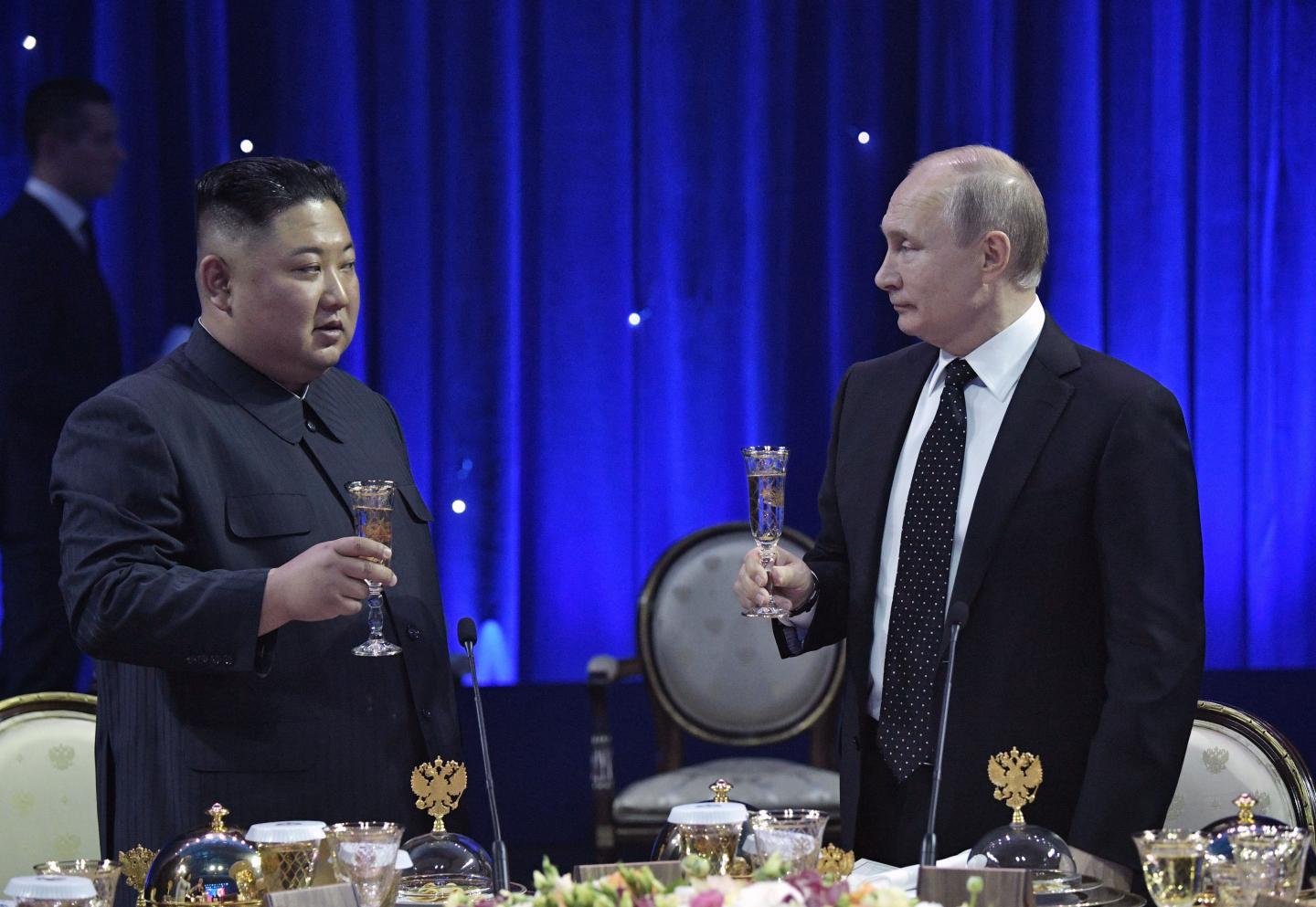
While the relationship between the two countries hasn’t always been as amicable as it was during the Soviet era, North Korea is currently benefiting from Moscow’s desire for allies.
Russia, being one of the five permanent members of the United Nations Security Council, has consistently opposed putting more pressure on North Korea.
Following Russia’s invasion of Ukraine, North Korea publicly expressed its support for Moscow, including recognizing the independence of breakaway regions.
The acquisition of weapons from nations such as Iran and North Korea could serve as a temporary solution for Moscow even as it seeks to boost its domestic defense production to fulfill the military’s requirements.
By doing so, Russia could continue fighting at a similar pace as before. Experts believe that since Russia is currently competing with the industrial output of western countries, it will need to restructure its defense industry accordingly, which will take time.
Furthermore, military observers have pointed out the risks associated with North Korean missiles and ammunition, which are unlikely to have been manufactured to a high standard.
US officials highlighted that the shipments of weapons that Russia has acquired from Iran and North Korea indicate that the ongoing war in Ukraine and western sanctions have weakened Russia’s military capabilities and reduced its ability to manufacture new weapons.
The ones that I met in the Service were some mighty tough troops. That & they would always be welcome in my firing line! Grumpy
Military historian and Hillsdale College professor Mark Moyar has just published Triumph Regained: The Vietnam War, 1965-1968, which is the second in what will become a massive three-volume revision of the entire Vietnam War. It is a book that should be widely read, much discussed, and reviewed in depth regardless of one’s view of that sad chapter in American diplomacy and conflict in Vietnam.
The first book, Triumph Forsaken: The Vietnam War, 1954-1965 appeared in 2006. It gained considerable attention for its heterodox analysis of the postwar origins of communist aggression against the South, beginning with the disastrous French colonial experience and its transference to the Americans. Moyar described the Byzantine intrigue through which the Kennedy Administration inserted American ground troops into Vietnam, and why and how his successor Lyndon B. Johnson rapidly escalated the American presence.
Moyar’s controversial argument in volume one centered on the disastrous decisions of these two administrations that ensured Americans would be sent into an uninviting distant theater of operations in the dangerous neighborhood of both communist China and Russia. Worse, they would be asked to fight under self-imposed limitations of the nuclear age in which their leaders could not achieve victory or perhaps even define it.
Still, Moyar argued that there was nevertheless a chance to achieve a South-Korean-like solution at much less cost, one that was thrown away through a series of American blunders. Most grievous was the American support for the 1963 coup that removed South-Vietnamese strongman president Ngo Dinh Diem and led to his almost immediate assassination‚ even as he was evolving into a viable wartime leader.
Moyar additionally deplored the biased and lockstep reporting of anti-war media, including its icons David “The Best and the Brightest” Halberstam and Neil “A Bright, Shining Lie” Sheehan, who operated on ideological premises far different from reportage in World War II and Korea. Both characteristically exaggerated American shortcomings consistent with their theme that Vietnam was an anti-colonialist war of liberation rather than a Cold War proxy fight over unilateral communist aggression.
Moyar’s Ho Chi Minh was not so much a romanticized “Uncle Ho” national liberationist of the anti-war movement, as a hard-core Stalinist whose agenda at any cost was always the absorption of all of Vietnam into a Soviet-satellite communist dictatorship.
This new second book of the saga follows and expands these themes, with the same scholarly rigor and comprehensive documentation that includes translated North Vietnamese archives as well as a number of memoirs of key American figures that have appeared in the 17 years since the appearance of the first volume. Most importantly, Triumph Regained is the first comprehensive combat history of the war that documents all the major battles of these four years, which saw U.S. troop levels in Vietnam peak in 1968 at well more than a half-million soldiers.
There appears a tragic monotony to these accounts of near weekly battles: initial communist probing attacks are designed to prompt an American response. The subsequent ambush of U.S. troops follows as they are air dropped into these remote jungle and mountainous theaters. Then like clockwork a quick recovery ensues as Americans size up the enemy landscape, call in murderous artillery and napalm attacks, and inflict terrible casualties. Then a few hours or days later, Americans fly out of the now abandoned combat zone. They usually suffered “moderate” numbers of killed in action, characteristically a tenth to even a hundredth of the losses inflicted on the North Vietnamese—but all to be reported from the front as a futile wastage of American lives.
Still, Moyar shows that too often the United States lacked a comprehensive strategy of victory and was shackled by unworkable rules of engagement—a now familiar dilemma in the half-century that followed in Afghanistan and Iraq. Most grievously, the military was too often blocked from fully interdicting supplies and manpower of the communists at their sources in North Vietnam, Laos, and Cambodia. Yet the more enemy men and materiel entered the theater unimpeded, a frustrated administration sought to compensate by single-mindedly increasing the numbers of American soldiers, purportedly in the fashion that had finally brought a stalemated “victory” in Korea.
Moyar’s President Johnson at times seems a tragic Hamlet-like figure. LBJ always claimed that he did not wish initially to send troops to Vietnam. But he was purportedly persuaded to do so by his hawkish Kennedy-leftover advisors—only eventually to be lectured to exit ignominiously by the very former zealots who advised him to escalate in the first place. Moyar’s late-phase Johnson remains a complex character, subject to constant bouts of self-doubt, self-pity, and lethal indecision. Nevertheless he harbored a natural—and correct—suspicion of his condescending and politically fickle old-time liberal Cold Warriors, especially the fixer Clark Clifford, the former whiz kid Robert McNamara, and the Brahmins Averell Harriman and the Bundy brothers. Yet when it most counted, LBJ ultimately yielded to their flawed, politically motivated reversals, and rejected the sounder realist assessments of his inner circle of Ellsworth Bunker, Dean Rusk, Walt Rostow, and Maxwell Taylor.
Moyar offers a number of reassessments that may surprise both diehard critics of the war and those who felt victory was “forsaken” by Congress and our so-called wise men. Gen. William Westmoreland, for example, is usually written off now as the father of futile “search and destroy missions” that defined progress only by inflating enemy “body counts” and sent American soldiers into remote jungles where they were easily ambushed. Not quite true, Moyar shows.
Westmoreland’s forward deployments prevented the North Vietnamese from massing troops for major attacks, and kept them away from South Vietnamese population centers. That buffer was one reason why ARVN (Army of the Republic of Vietnam) forces steadily grew and by 1968 numbered over 1 million troops, and often were achieving parity against the North Vietnamese. Moyar believes that the pacification strategies—championed by the media hero John Paul Vann—were demonstrably flawed in comparison.
There was no real “Viet Cong,” a construct that Moyar shows was not much other than a few thousand communist agents in the South who posed as a large popular resistance movement. In truth, most hostiles in the South of any size were always North Vietnamese infiltrating communist troops and they had almost no popular support among the South Vietnamese.
The media continued to peddle fake news. Despite the claims of journalists and antiwar activists (often the same players), American public opinion supported the war for years. The people did not begin to turn against Vietnam until they tired of futile policies that either could not or would not unleash the military to win the war. Moyar suggests Americans were willing to assume enormous costs in the Cold War, but not in ossified theaters where their sons’ sacrifices were not in the service of victory.
It is also not accurate that Johnson’s “Rolling Thunder” air campaigns were nonsensical indiscriminate area bombings that slaughtered civilians without achieving much utility, in supposed contrast to the deadly Linebacker I and II precision and smart-bombing campaigns that followed in the Nixon Administration. In fact, North Vietnamese archives reveal that even Rolling Thunder terrified the enemy, especially during the abject obliteration of Tet forces surrounding Khe Sanh. Most of the communists’ later diplomacy was designed not to achieve a two-nation settlement but to stop at any cost the devastating bombing. The costly American missions had finally been honed to cripple severely communist supplies that were not declared politically out of reach. They killed thousands of enemy troops in the field, and helped to force the Vietnamese to the Paris Peace conference.
Far from the Tet Offensive being a pivotal communist victory as reported by the media, the 1968 North Vietnamese holiday surprise attacks proved a veritable bloodbath for the North. After their unsustainable losses, the North Vietnamese essentially gave up major conventional offensive operations and in fear of American firepower withdrew a credible presence in the South—even as Walter Cronkite and the network news declared enemy corpses on the Saigon embassy lawn were veritable proof of a fatal U.S. defeat warranting withdrawal.
General Creighton Abrams, the successor to Westmoreland as commander of U.S. forces in Vietnam, was indeed an inspired supreme commander. But he was not necessarily always the corrective to a supposedly incompetent Westmoreland. Moyer controversially argues that Abrams wisely continued Westmoreland’s search and destroy missions for a time. He eventually stopped them not because they had failed, but rather because they had successfully eroded communist concentrations to such a degree that they could be slowly discontinued.
The disconnect between the American media and the realities of the war, evidenced in the North Vietnamese official archives remains striking. Moyar juxtaposes a media assuming the inevitable victory of the North Vietnamese with the communists despairing they were losing the war to the Americans. Each evening at home, as the American public was told we were being systematically killed and crippled by far more adept “jungle fighters,” the communists were mired in depression as they saw their mounting losses as unsustainable and found no other alternative than to go to Paris to negotiate a reprieve. The American military leadership that the media mocked as inept, and the soldiers who were caricatured as drug-ridden, crazed, disobedient, and near insurrectionary were never seen as such by “Charlie” who had to fight them. No wonder then, by late 1968, the Soviets were finally preferring an end to the war, while their Chinese rivals eventually gave up on their North Vietnamese clients. Both feared the growing likelihood of an independent and pro-Western Vietnam in Southeast Asia.
What undermined the Johnson Administration’s war effort ultimately was its rank politicization of the conflict. LBJ became terrified that the left-wing anti-war movement would force him out of office in 1968 in favor of an anti-war candidate unless he capitulated and ordered a bombing cessation, froze troop increases or pulled soldiers out of Vietnam, and perhaps agreed to the unhinged calls for a “coalition” government in the South. Johnson’s despair, of course, was ironic since, for most of his tenure, the old politico enjoyed a Democratic supermajority in the Senate and a huge majority of over 150 seats in the House, ensuring the Democrats could do anything they liked in the war, which of course they had begun and owned.
To the degree Johnson gave in to the pacifists in his circle, the increasingly viable American effort stalled. After his refusal to seek reelection in early 1968, LBJ then found himself in a truly Orwellian situation. Vice President Hubert Humphrey, both to win the nomination and the 1968 general election, felt he would have to insidiously distance himself from his president and boss. By November, the politics became more surreal. LBJ had to endorse Humphrey even as he realized that Nixon would far more likely continue LBJ’s effort that by 1968 was finally winning the war—while his own party would end it and destroy all the hard-won progress of the last two years.
We talk today about “collusion” and “political interference” in our elections, without remembering that Johnson and his subordinates were past masters at it. Most White House discussions about the peace talks and their connection to bombing halts were predicated not just on military efficacy, but on what might play best to the Democratic anti-war base and could win back the American electorate in 1968.
Moyar relates that the communist world and Europe openly rooted for a Humphrey victory over Nixon and was willing to interfere in our elections. Indeed, Soviet ambassador Anatoly Dobrynin secretly offered the likely nominee Humphrey and his campaign a sizable campaign donation among other aid (refused, but not disclosed by Humphrey) to defeat the globally detested Cold Warrior Nixon. In a familiar example of left-wing “projection,” LBJ and his advisors were convinced that some in the 1968 Nixon campaign were colluding with the Saigon leadership to halt any concessions at the Paris talks. No such proof was ever found. No matter: Johnson wiretapped U.S. citizens in a vain effort to prove the empty rumors. That smear was demonstrably false, but in truth Johnson himself halted the bombing, and his team grew lenient in Paris to aid the suddenly surging 1968 Humphrey campaign.
We talk of a “Vietnam War.” In fact, it was a Cold War communist proxy effort that saw over 100,000 Chinese auxiliaries engaged in supply and repairing Vietnamese infrastructure, while thousands of Soviet “advisors” manned tanks, flew planes, and organized and operated anti-aircraft systems. Vladimir Putin’s current objection to U.S. military aid to Ukraine is again ironic, given Russia was historically an active participant on the ground in Vietnam and both directly and indirectly killed Americans in efforts to defeat the United States.
Moyer ends volume two on a mixed note. An exhausted and beaten North was negotiating in fear that its massive losses of 1967-1968, if continued, would have threatened the Hanoi regime itself. An elected Republican hawk Richard Nixon, inheriting a war that already had cost 35,000 dead, was now opposed by the same Democrats who started it. A growing number of frustrated Americans wanted either to win the war or to get out. Nixon would soon take the gloves off, ensuring that a nearly defeated North would be subject to greater bombing pressures—even as the anti-war Left enjoyed complete control of a Congress that was suddenly liable to cut off aid to Saigon, could more easily mobilize against a now oppositional and conservative White House—and the ingredients of the Watergate debacle were on the distant horizon.
Moyar draws on a tradition of Vietnam War revisionism, especially Don Oberdorfer’s corrective on the Tet offensive, Lewis Sorley’s thesis of a radical American improvement under Creighton Abrams, and Michael Lind’s unorthodox but well-argued thesis that the “necessary” Vietnam War sought to ensure American Cold War credibility and diverted communist aggression from other more strategically important U.S. allies and vulnerable neutrals.
The role of Encounter Books should also be noted and congratulated for assuming publication of the series from Cambridge University Press, the original publisher of volume one that somehow did not follow up on its initial much-discussed and reviewed book.
Finally, Moyar does not answer in this second volume the existential question that has haunted America long after the war; namely, was the price tag of 58,000 dead Americans and trillions of dollars in treasure worth the cost and effort of 10 years of war to keep South Vietnam autonomous and to check Soviet expansionism? Or would a far better-managed effort leading to a free Vietnam at even far less cost even have been worth it?
For those answers, we await Moyar’s third and final volume of this landmark work. These first two books have been well argued, meticulously researched, engaging to read—and are anathemas to the all too often orthodox view of an imperialistic American meeting its destined comeuppance through the folly of trying to save Vietnam.
Triumph Regained shows that America’s war in Vietnam could have been won earlier at far less blood and treasure, and in fact, almost was, even belatedly so by 1968.
Volume three no doubt will assess whether the war should have been fought.