Categories
Category: War
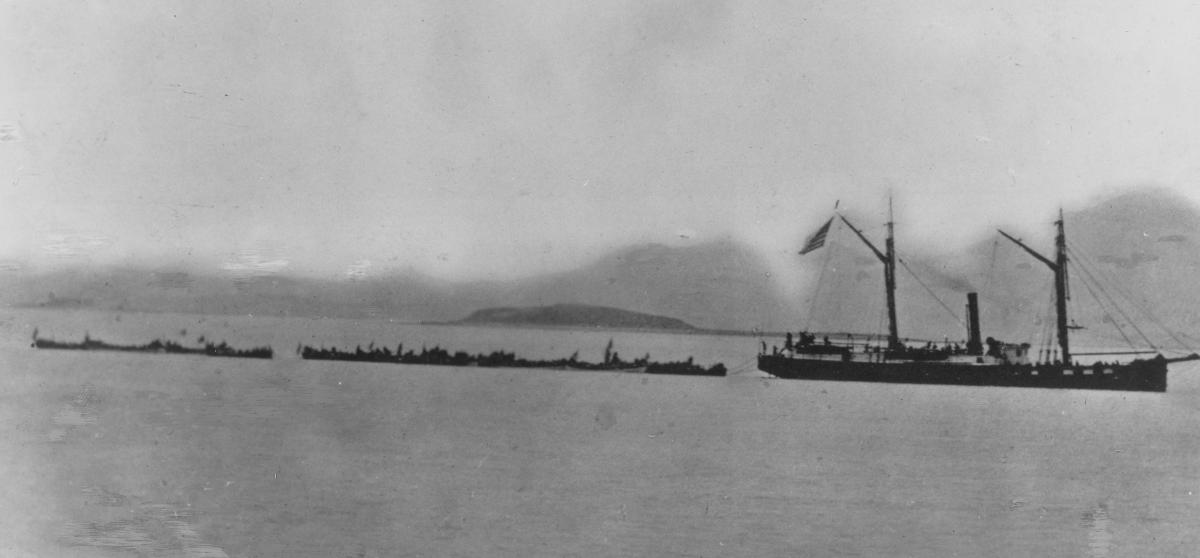
Here, in the first-ever photograph of Marines going into action, the gunboat Palos tows the landing party toward Kanghwa-do on 10 June.
(U.S. NAVAL INSTITUTE PHOTO ARCHIVE)
In an excerpt from the new Naval Institute Press book, The U.S. Marine Corps: An Illustrated History, the authors recount the Korean Expedition of 1871—a military success but a diplomatic failure.
The largest-scale combat in which Leather’ necks participated in the three decades following the Civil War was the Korean Expedition of 1871. On 23 May of that year, five vessels of Rear Admiral John Rodgers’s Asiatic Fleet—the frigate Colorado, sloops Alaska and Benicia, and gunboats Monocacy and Palos—entered Roze Roads on the west coast of Korea not far from Chemulpo (modern-day Inchon).
Aboard Admiral Rodgers’s flagship, the Colorado, was Frederick F. Low, the U.S. minister to China, who had been sent to open diplomatic relations with the hermit kingdom of Korea. Contact was made with the local inhabitants, and on the 31st a small delegation of third- and fifth-rank Korean officials appeared. Low refused to receive them, directing his secretary to explain that the presence of first-rank officials qualified to conduct negotiations was required.
In the meantime, the Koreans were informed, the Americans desired to chart the Salee River, as the channel of the Han River between Kanghwa-do (island) and the Kumpo Peninsula was then called. As the Han leads to the capital city of Seoul, the Koreans might have been expected to consider such an act provocative, American assurances of goodwill notwithstanding, but they raised no objections. Twenty-four hours were allotted for them to notify the appropriate authorities.
Accordingly, at noon on 1 June, four steam launches followed by the Monocacy and Palos set out to begin the survey. As they came abreast of the fortifications on the heights of Kanghwa-do, the Koreans opened fire. The surveying party replied with gusto, shelling the forts into silence, and returned to the fleet’s anchorage. American casualties were two men wounded.
Admiral Rodgers waited nine days for an apology or better tides. The former was not forthcoming, and on 10 June a punitive expedition entered the river with the mission of capturing and destroying the errant forts. The landing force numbered 686 officers and men, including 109 Marines organized into two little companies and a naval battery of seven 12-pounder howitzers.
Fire support would be provided by the gunboats and four steam launches mounting 12-pounders in their bows. Commander L. A. Kimberly was placed in command of the landing force; Captain McLane Tilton led its Leathernecks. Tilton was one of those unconventional characters for whom the Corps has always seemed to exercise an attraction. (Writing his wife from a Mediterranean deployment, he reported that when he first went on deck each day, “If anyone asks me how are you old fellow, I reply, ‘I don’t feel very well; no gentleman is ever well in the morning.’”)
Three forts, each with a walled water-battery, overlooked the shore of Kanghwa-do. In the course of the operation, the Americans christened them the Marine Redoubt, Fort Monocacy, and The Citadel. The Monocacy took the first two under fire shortly after noon. Both had been silenced by the time the Palos appeared with the landing party’s boats in tow about an hour later.
The boats cast off half a mile below the nearest fort, and at 1345 that afternoon the Bluejackets and Marines began struggling ashore across a broad, knee-deep mudflat “crossed by deep sluices,” a disgusted Tilton noted, “filled with softer and still deeper mud.” Some men left their shoes, socks, leggings, and even trouser legs behind, and the howitzers bogged down to their barrels. Fortunately, the Koreans did not attempt to oppose the landing.
The Leathernecks had been selected to serve as the expedition’s advance guard. Tilton deployed them into a skirmish line as soon as they left the boats. Once both companies reached firm ground, Commander Kimberly ordered Tilton to lead his Marines toward the fort, an elliptical stone redoubt with 12-foot walls.
Most of the sailors remained behind to manhandle the guns out of the muck. On the Marines’ approach, the fort’s white-robed defenders fled, firing a few parting shots. The work mounted 54 guns, but all except two were insignificant brass breechloaders. Tilton halted his men until the main body came up, “when we were again ordered to push forward,” he wrote, “which we did, scouring the fields as far as practicable from the left of the line of march, the river being on our right, and took a position on a wooded knoll . . . commanding a fine view of the beautiful hills and inundated rice fields immediately around us.”
At this point he received orders to hold for the night. It was 1630 before the guns had been dragged ashore, and too few hours of daylight remained to demolish the captured fort and tackle the next. The seamen bivouacked half a mile to the rear.
The landing force moved out at 0530 the next morning. Its fire support had been reduced by the withdrawal of the Palos, which had hurt herself on an uncharted rock while the landing was in progress, but that available from the Monocacy and the launches would prove more than sufficient. The second fort, a chipped granite structure about 90 feet square, stood on a bluff a mile upstream. Tilton’s men found it deserted. While a Marine bugler amused himself by rolling 33 little brass cannon over the bluff into the river, other members of the expedition spiked the fort’s four big guns and tore down two of its walls. The march was then resumed.
The track between the first two forts had been relatively easy going, but beyond the second it became extremely difficult, “the topography of the country being indescribable,” Tilton reported, “resembling a sort of ‘chopped sea’ of immense hills and deep ravines lying in every conceivable position.” Presently the column came under long-range musket fire from a Korean force estimated to number from 2,000 to 5,000 among some hills beyond the Americans’ left flank. Five guns supported by three companies of seamen were deployed to hold this body in check, and the remainder of the party continued its advance. On two occasions the Koreans made a rush toward the detachment, but a few artillery shells turned them back each time.
The last and strongest of the Korean fortifications, The Citadel, was a stone redoubt crowning a steep, conical hill on a peninsula some two miles upstream from its neighbor. The Monocacy and the steam launches opened fire on the Citadel at about 1100. At noon, Commander Kimberly halted his command 600 yards from the fort to give the men a breather. By that time, the parties of Koreans seen falling back on The Citadel and the forest of flags in and around it left no doubt that the position would be defended.
After signaling the Monocacy to cease fire, the storming party, 350 seamen and Marines with fixed bayonets, dashed forward to occupy a ridgeline only 120 yards from the fort. Although Tilton’s men were still armed with the model 1861 muzzle-loading Springfield rifle musket (in his words “a blasted old ‘Muzzle-Fuzzel’”), they quickly established fire superiority over the fort’s defenders, who were armed with matchlocks, a firearm that had disappeared from Western arsenals 200 years before. “The firing continued for only a few minutes, say four,” Tilton wrote, “amidst the melancholy songs of the enemy, their bearing being courageous in the extreme.”
At 1230 Lieutenant Commander Silas Casey, commanding the Bluejacket battalion, gave the order to charge. “[A]nd as little parties of our forces advanced closer and closer down the deep ravine between us,” Tilton continued, “some of [the Koreans] mounted the parapet and threw stones etc., at us, uttering the while exclamations seemingly of defiance.” The first American into The Citadel, Navy Lieutenant Hugh W. McKee, fell mortally wounded by a musket ball in the groin and a spear thrust in the side. The spearman also stabbed at Lieutenant Commander Winfield Scott Schley, who had followed close behind McKee. The point passed between Schley’s left arm and his chest, pinning his sleeve to his coat, and he shot the man dead.
Tilton was among half a dozen officers who led their men into the fort moments later. The Koreans stood their ground, and the fighting became hand to hand. Clambering over the parapet, Private Michael McNamara encountered an enemy soldier pointing a matchlock at him. He wrenched the gun from the Korean’s hands and clubbed him to death with it. Private James Dougherty closed with and killed the man the Americans identified as the commander of the Korean forces. Tilton, Private Hugh Purvis, and Corporal Charles Brown converged on The Citadel’s principal standard, a 12-foot-square yellow cotton banner emblazoned with black characters signifying “commanding general.” For five minutes the fort’s interior was a scene of desperate combat. Then the remaining defenders fled downhill toward the river, under fire from the Marines, a company of seamen, and the two howitzers that had accompanied the attackers.
A total of 143 Korean dead and wounded were counted in and around the Citadel, and Lieutenant Commander Schley, the landing force’s adjutant, estimated that another 100 had been killed in flight. Forty-seven flags and 481 pieces of ordnance, most quite small but including 27 sizable pieces—20-pounders and upward—were captured. The storming party lost three men killed and ten wounded, with a Marine private in each category.
Captain Tilton was pleasantly surprised by his survival. In a letter home a few days later, he wrote, “1 never expected to see my wife and baby any more, and if it hadn’t been that the Coreans [sic] can’t shoot true, I never should.” He retired as a lieutenant colonel in 1897. Nine sailors and six Marines were awarded the Medal of Honor. Among the latter were Corporal Brown and Private Purvis, who had rendezvoused with Tilton at the Citadel’s flagstaff.
The landing force reembarked early the next morning, leaving The Citadel in ruins. “Thus,” wrote Admiral Rodgers, “was a treacherous attack upon our people and an insult to our flag redressed.” Successful as it had been from a military standpoint, however, the operation was not a masterstroke of diplomacy. Subsequent communications with Korean authorities, conducted by messages tied to a pole on an island near the anchorage, were entirely unproductive, and on 3 July the fleet withdrew. A treaty with Korea was not negotiated until 1882.
Considering that China has not really fought a major serious war since The Korean War (1950-53) or that skirmish with the USSR in the 1960’s. I am not really surprised by this. But what happens the next time might be a really different story. Grumpy
Categories
Wow!

|
This painting by John Buxton depicts the calm before the storm of an American Indian surprise attack on militiamen. Captain John Lovewell of New England, a ranger and renowned scalp hunter, died on May 8, 1725 as he led a third expedition against the Abenaki Indians in an area now known as Fryeburg, Maine. A number of colonial militiamen and Abenaki Native Americans, including a notorious war chief named Paugus, also died in the engagement which marked the end of hostilities between the Abenaki and the white colonists in this part of the colonies. |
Categories
THE GREAT SIEGE OF MALTA
 LORD BARON

Soldiers of the Ottoman Empire were routed on September 11, 1565 in what came to be known as “The Great Siege of Malta”. They were humiliated and forced to retreat from what was supposed to be an epic campaign of conquest for the greater glory of Allah, the Merciful. Was it a coincidence that Islamic terrorists chose the same date to destroy the twin towers in New York?
Let us start from the beginning. The Knights of Saint John, or Knights Hospitallier, were originally a religious order founded in the 12th Century in the Holy Land. Their mission was to care for the pilgrims who entered the Holy Land, and defend them from any threats on the perilous road to Jerusalem. They were a religious as well as a military order, created under a papal charter, which meant that they answered to no one but the Pope.

Fast forward four centuries. The Knights still lead a never-ending struggle against the forces of Islam. The Crusades were ancient history. The people had all but forgotten them. The Knights of St John were considered obsolete relics of a bygone age. Other orders of Crusaders, such as the Templars, had been extinct for more than two centuries.
The Knights of St. John had been forced from their Fortress in Rhodes in 1522, and for a while were homeless, until they laid claim to the Island of Malta, which was given to them by the Holy Roman Emperor, Charles V, grandson of Fernando de Aragon (Machiavelli’s model of a ruler in “The Prince”). Fernando had expelled the Moors from Spain after eight centuries of invasion, and Charles V himself led a lifelong struggle against the Crescent and Star.
The Grand Master of the Order of St. John, Jean Parisot de la Valette, was 71 years old at the time. He had a personal stake against the Muslims, having been a knight since he was 18, participating in fights against Islam throughout his whole life. His family had served in five different crusades, with distinction, and he was raised with tales of their epic bravery. He had been defeated and expelled from Rhodes years earlier, and had even been a galley slave to the Muslims for a year, rowing up to 20 hours a day, before escaping and swearing revenge.

The Knights survived by raiding Ottoman naval trade routes and basically making life impossible for the Turks. The knights were hardened warriors, great sailors, and pious men. Most of them were the 2nd or 3rd sons of aristocracy, refined noblemen with no inheritance. They were considered the most formidable fighting force in Europe, and were indeed elite in every sense.
Suleiman’s Desire
Since its foundation in the 7th century, Islam had wanted to achieve one feat: invade Europe. These primitive, desert dwelling barbarians had spent most of their history killing one another, until Mohammed united them against one common enemy: Western civilization.
The Ottoman leader, Suleiman “the Magnificent”, was the most powerful man alive. His empire was ridiculously large, stretching from Vienna to Babylon, all the way to Aden, in the southernmost part of the Arabian Peninsula. His titles included Vice-Regent of God on Earth, Lord of the Lords of East and West, and even Possessor of men’s necks, since he beheaded just about anyone who displeased him. But alas, such an empire was not enough. He had set his sights on Europe, and there was not a force on earth powerful enough to stop him. Or so he thought…

The Knights of St John had been a thorn in his side for long enough. They were massively effective at crippling Turkish operations from their new home in Malta, assaulting the Ottoman ships at sea. These western corsairs were led by the intrepid Romegas, a legendary Knight that had joined the order at age 15, and a close friend of La Valette’s. Romegas was considered one of the greatest mariners of his time. He had taken lots of booty and several high-ranking prisoners on his sea raids, and Suleiman had enough. He decided to crush the Order of Knights, once and for all.
Assembling a massive army of 48,000 troops aboard 200 ships, among them elite, scimitar wielding janissaries called “The Invincible Ones” and drug-crazed layalars that wore the skins of wild beasts to battle. Their only concern in life was to slaughter Christians and die a glorious death, to be able to enter paradise and enjoy the 72 virgins promised to them by their prophet.
Who were their opposition? A mere force of 700 knights, keeping watch on a barren little island. Surely, they were no match for the Vice-Reagent of God on Earth. In March 1565, the Muslim fleet set out, determined to obliterate the Western world, and subjugate Europe under Islam’s boot forever.
Alone and Surrounded
Surely enough, La Valette’s intelligence warned him of the impending apocalypse, rapidly sailing directly towards him and his brave knights. He sent messengers to all of the European kings, asking for aid against the coming darkness. None answered, save one: Charles V of the Holy Roman Empire. A legendary bulwark against Islam, Charles promised assistance if they could hold out long enough. For the time being, it seemed, the Knights were on their own.
The Island of Malta had three main fortresses: The Fortress of St Angelo, St Michael and the recently constructed St Elmo, on the peninsula of Mount Sciberras. Both of them were solid structures, and even though they were nothing compared to their original fortifications on the island of Rhodes, they would have to do. La Valette devised a strategy to mount a defense as best as they could, but the situation for the Knights was quite bleak.

The fortifications of Malta
There were 700 knights defending the island, and around 8,000 Maltese soldiers. La Valette swore that there would be no retreat, no surrender. They gathered in a final prayer and braced themselves for the assault. It is said that after the prayer, all weakness disappeared from their hearts, and any petty animosities between them were dissolved. The power of faith made its presence felt.
La Valette, himself a man of deep faith, is said to have stated:
It is the great battle of the Cross and the Quran which is now to be fought. A formidable army of infidels are on the point of invading our Island. We, for our part, are the chosen soldiers of the Cross, and if Heaven requires the sacrifice of our lives, there can be no better occasion than this.
He knew that this was not a fight he would win with brute force, if at all. Cunning, faith, and bravery were to be his tools for survival.

The Onslaught Begins
The first attack launched by the Ottomans was on St Elmo. Relentless artillery fire and waves of assaulting Ottomans rained upon the defenders. A mere 100 knights and 500 soldiers held the fort. They were commanded to fight to the last man. The Turks were confident they could take the fort in three days. Yet after weeks, the defenders were still battling on.
The defenders were quite ingenious, and devised all sorts of incendiary devices. They developed a primitive hand grenade consisting of a clay pot filled with the famous Greek Fire, a napalm-like substance. They hurled these towards their opponents with devastating effects: the shrapnel would explode and damage enemies by the dozens.
The knights invented large fire hoops, wooden rings wrapped in layers of flammable material, such as brandy, turpentine, gunpowder, and cloth, they would get ignited and be rolled downhill towards the Turks by the hundreds.
They also invented the Trump, a long hollow tube filled with flammable sulfur resin and linseed oil that, when lit, would spit fire for several meters for as long as half an hour. The Knights would use these primitive flamethrowers at strategic chokepoints, that would hold back any advance by the attackers. The Turks wore long robes, so being set on fire was quite devastating to them.

After weeks of fighting and being bombed, the defenders were malnourished, sleep deprived, and disfigured to the point of being unrecognizable. Many were gravely injured, limping badly, and bandaged in improvised cloths, but their conviction did not falter. They received reinforcements and supplies from the main fort of St Angelo, with the message from their Grandmaster to fight to the death.
To make matters worse, the arrival of Drajut, known amongst his men as “the drawn sword of Islam” and “the scourge of the Christians,” reinvigorated the Turkish forces. He brought another 1,500 of his elite warriors. The bombardment continued, and the Turks kept trying to charge into the fortress. Soon, a cannon splinter injured Drajut. He was dragged off to his tent. The drawn sword of Islam had met his end. Morale in the Turkish army began to falter.
Enraged, Mustapha Pasha, now commander, ordered the fort surrounded by the entire Turkish fleet. The largest of their cannons were moved to the front, and the defenders were pounded relentlessly. The latter gathered, said their prayers, and defiantly tolled the chapel bell for one last time. Those who couldn’t stand were sat in chairs, fully armed, their souls commended to their Lord Jesus.

The Turks poured in and finally the defenders were defeated. All of them were slaughtered, and Suleiman’s Red Crescent was put in place of the flag of the Knights of St John. But they shuddered, for across the bay was the significantly larger and more impressive St Angelo. It had taken them four weeks to overrun the smaller fortress, and they had lost almost 10,000 men.
Terror Tactics
Mustapha Pasha knew that he had to break the defenders spirit, because he had seen how much their bodies could withstand. So, he ordered the deceased knight commanders to be decapitated. Their heads were put on pikes, and their headless bodies were sailed across the bay to the remaining defenders, fixed atop crude wooden crosses, a mockery of their faith. La Valette responded in kind. He ordered the Turkish prisoners decapitated, and shot their heads across the bay with their largest cannon. The message was clear: no retreat, no surrender.
The bombardment began. There was relentless shelling of the fortress, and an attack from the south side. The Turks were determined to take this little patch of land. Mustapha had a master plan: while the Christians were busy defending the south side, ten large ships with 1000 elite janissaries would storm the north end, but La Valette had prepared for this eventuality. He left Chevalier de Guiral with a 5-gun battery placed at the base of the fort. He could scarcely believe his eyes as the Turks sailed right into his trap.
At the ideal range, he ordered his men to open fire. Nine of the 10 boats were destroyed, 800 janissaries sunk into the water on the spot. Only one ship got away, and the frightened look in their eyes sent fear into the heart of the Muslims. The defenders opened the gate and charged out, and overwhelmed the attackers who ran for their lives. St Angelo survived another day.
Mustapha surrounded the fortress, and continued bombarding the Christians. For over a week, all the Turkish guns thundered upon the defensive positions. The bombardment could be heard from Sicily, over 20 leagues (100 km) away, and the people there were awestruck that any man could survive such a hellfire.

The Turks renewed their attack and poured in from all sides. Victory would be theirs at last, it would seem. They breached the walls, but found themselves upon a second layer of fortifications. Cannon fire rained on them, and they were enclosed in a very effective death trap. After some time, the locals leaped from their defensive positions and forced the Turks to retreat. Again, they were defeated.
Several times the attackers breached the walls, but they were always met with effective funneling towards these kill zones, with an organized wall of pointed pikes and musket fire eager to greet them. La Valette himself grabbed his spear and led the charge several times to push back the attackers. Despite his advanced age, he was a brave and proficient fighter. The sight of their leader leading the attack, inspired the knights to hold back wave after wave of Turkish attackers, in several occasions where all hope seemed lost.
The Will of God
The death toll for the Muslims was catastrophic. Disease was rampant in their ranks, the corpses of friend and foe rotted all around them. Their supplies were running out, including gunpowder. Over 130,000 cannonballs were fired upon the Maltese defenders, in total. The summer heat was scorching them, and the water on the island had been poisoned by the locals before retreating. Their morale was fading. Rumors spread to the commanding officer’s tent, of soldiers whispering “It is certainly not Allah’s will that we take this forsaken island.”
They tried all manners of stratagems to destroy the defenders. They tried digging tunnels, but the Knights collapsed them with mines of their own, and sent soldiers to fend off the tunnel makers.

Then, Mustapha prepared his siege tower, a massive behemoth, taller than even the ramparts of the fortress, to invade. But La Valette ordered his men to remove stone from the base of the walls, and fired upon the tower with huge cannons, containing two cannonballs held together by a chain. The strategy was massively effective and destroyed the tower utterly. The defenders cheered as they saw the Turks jumping from the collapsing contraption, spitting oil and fire upon their own ranks.
Winter was coming, and victory seemed nowhere in sight for the attackers. Mustapha ordered his men to take the nearby walled city of Mdina. His army approached, but was met by heavily armed soldiers manning the walls shooting cannons. “A second St Elmo!!” screamed his soldiers, as they retreated. But it was all a ploy, the governor, foreseeing this turn of events, ordered civilians, women and children, to man the walls, dressed in armor and carrying pikes.
In another attempt to destroy the attackers, the Turkish forces assembled a massive bomb, packed with gunshot and gunpowder, and rolled it into the Christian positions. The latter responded, rolling the fiendish contraption right back at them, resulting in a spectacular explosion. Hundreds died.

The Knights did not display much tolerance with the muslim invaders,
Salvation
Finally, after all hope of salvation had faded from the defender’s hearts, a relief force was in sight. Over 10,000 men in 28 ships had arrived; soldiers from all over Europe, inspired by the courage of these knights had come to join in the fight. Even then, they were outnumbered massively by the Turks. Mustapha ordered his men to charge against the relief force, but they were severely weakened after months of fighting and rampant disease.
In Helm’s Deep style, the Christian relief force charged into the heart of the Turkish army, destroying the Turks utterly. It was a blood bath; the Muslims were slaughtered, chased around the whole island, and picked off. They scrambled to board their ships and leave. It was a crushing victory.
Out of the 48,000 invaders that initially set sail to terrorize Europe, only 10,000 made it back home. The knights suffered heavy losses, too, but by some miracle, victory was theirs. Their sacrifice was immense; the Western world owes these men more than we will ever know. If not for them, Europe would’ve been converted long ago, and we would most likely be speaking Arabic (and sodomized from a young age).

Knights looking from the ramparts as their enemies are crushed
Both Romegas and La Valette survived the fighting. After the siege, the Knights were commended and all of Europe hailed them as heroes. They had heard tales of their legendary exploits, charging in the face of seemingly insurmountable odds, and were inspired. Many donations were made to the Knights, and with them, The Citadel of Valetta was built, in honor of the Grandmaster La Valette. The Pope sent his best engineers and the city was planned and designed as a solid fortress ahead of it’s time, to defend Christendom against any future attacks.
Their victory had a profound impact across all of Europe. The local princes realized that the only way to defeat Islam was to stop warring amongst themselves and unite against the common threat. This resulted in a vast fighting force that seven years later crushed the Turks once again at Lepanto, ending the Ottoman sea superiority forever. Romegas was once again in the front lines of this battle.
Romegas died several years later in Rome, after a long life of fighting Islam at every turn. La Valette was offered the position of Cardinal, but he refused. The sword was the only path he had known for his entire life. He headed the reconstruction of Malta and died a peaceful death only a few years later in 1568. But tales of their heroic deeds would last for centuries to come. This would come to be known as the last epic encounter between Crusader Knights and Islam.

Victory
Conclusion
There are lessons to be learned from these events. It is said that those who do not know their history are doomed to repeat it. La Valette and his knights were considered obsolete, useless fossils by their contemporaries. Many people respected the Knights of St John, but the majority laughed at their traditions and old-fashioned way of life.
But the Knights knew in their hearts the truth. They did not let public opinion sway their convictions. They did not follow the rest of the civilized world in the descent to ignorance, decadence, and madness into forgetting what it is that makes us great. Their faith and their traditions were sacred to them. They held watch, silently, for years, until destiny finally called.
I invite you, fellow reader, to do the same. Forget about political correctness and the opinions of the masses. Search your heart for the truth. Meditate, isolate yourself, get disconnected from the insanity of the modern world. Take some time for yourself, get in touch with nature, and in turn, your own nature. Then, you will begin to see the truth. In the silence of your mind, you will find the answers.
It only took 700 of these Knights to save Europe. Now, Europe is threatened again, this time from the inside as well as foreign invaders. Maybe there will be enough awakened, red pilled souls to stem the barbaric invasion.
Let us prepare and strengthen ourselves. Maybe destiny will call us for a hero’s journey. In the meantime, let us see what we can do to preserve our ancestral homelands and our traditions. Do not allow the sacrifice of the brave men of Malta to be in vain. Strong men are needed now, more than ever.
Categories