Categories
Manly Stuff Real men Stand & Deliver that’s too bad” The Horror! War

I actually feel sorry for this man

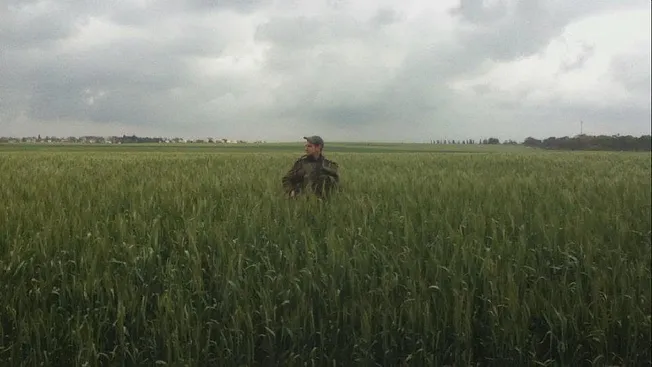
As an IDF soldier stationed near Gaza in 2011, Ilan Benjamin believed he could promote “goodwill with our Palestinian neighbors.” (Photos courtesy of the author)

Once, I Was a Peace Advocate. Now, I Have No Idealism Left.

After terrorists killed my cousin Daniel Pearl, my family called for peace. But after the worldwide celebration of our people’s slaughter, my hope for peace is dead.

By Ilan Benjamin

October 13, 2023

The story I’m about to tell is one that many progressive Jews can relate to. In some ways, it’s a prototypical arc of a diaspora Jew who has always advocated for nuance. This week, something broke in us. We watched history repeat itself. Not just on the global scale, with the wanton massacre of our people, the savage mass murders and dismemberments of entire families and communities. But for many, my family included, history is repeating itself on a personal level as well.

In March 2003, I turned 13 and celebrated my bar mitzvah in Walnut Creek, California. By Jewish tradition, I became a man. But the ceremony felt redundant; I had already grown up. Only one year earlier, my older cousin, Daniel Pearl, an investigative journalist for The Wall Street Journal, was kidnapped and beheaded by Islamist jihadis while on assignment in Pakistan.

His killers, like the Hamas killers of last weekend, proudly released a video documenting Danny’s murder. Among Danny’s last words were, “My father is Jewish. My mother is Jewish. I am Jewish.” At first, I was in shock—how had my own cousin become a player in such a large international nightmare? Why did people get murdered simply for being who they are? In this case, for being Jewish?

Danny’s parents did not call for revenge. Instead they set up The Daniel Pearl Foundation that offers fellowships, sponsors cross-cultural music events (Danny was a gifted musician), and brings people together to improve the world. Even after what my family had been through, their work encouraged me to be idealistic and believe that the Jewish people could make peace with our neighbors. I became a fierce advocate for peace.

When I immigrated to Israel at the age of 18 and enlisted in the Israel Defense Forces, I was still driven by ideals. I thought I could promote more goodwill with our Palestinian neighbors. Serving in a combat unit based on the Gaza border, I witnessed the release of the kidnapped Israeli soldier Gilad Shalit, held for five years by Hamas, when his freedom was exchanged for more than 1,000 Palestinian prisoners. One for 1,000. Despite my many criticisms of the Israeli government, I recognized then how much Israel valued the life of every soldier.

The late journalist Daniel Pearl

On my rare free weekend, I spent my time at Kibbutz Be’eri. Because I was a “lone soldier”—that is, an immigrant without much close family in Israel—I was given a host family. They treated me like a son, including teasing me relentlessly for choosing to come to Israel and serve, whereas most Israelis have no choice. They were politically left, just like me. Despite rockets often raining down on them, they believed in peace, just like me. This week, when the terrorists came, ideals didn’t make a difference.

I watched the news in horror as terrorists massacred over 100 people at Kibbutz Be’eri. Women. Children. I frantically messaged my host family and heard nothing back. Like my cousin Danny years ago, my family was being held hostage. The good news: unlike Danny, my host family at Kibbutz Be’eri was saved. They are physically okay. But how can they really be okay, after watching their friends and neighbors being slaughtered?

There was a time when these types of events couldn’t shake my ideals. I used to argue relentlessly for a two-state solution. I fought bitterly with Israeli friends about the decency of the Palestinian people. Even though radical Islamists had murdered my cousin, even though civilians had been blown up in buses daily during the Second Intifada, I refused to give in to nihilism.

In 2012, I returned to the States to study film at University of Southern California, and published a book about my military service that criticized the Israeli government. This didn’t win me many friends, but I continued to advocate for nuance regardless. I proudly supported Black Lives Matter, LGBTQIA+, and feminist causes. I called myself a progressive Jew.

But over the years, I noticed a disturbing trend: With all the atrocities in the world, why did my social justice warrior friends hate Israel so disproportionately? Why did it feel like intersectionality excluded Jews? Why did the left—who supposedly stood up for human rights—put child-murdering Hamas terrorists on a pedestal?

At first, I thought it must be miseducation.

“Ah, they think Palestinians are the indigenous people. I’ll show that Jewish history, and the archaeology to prove it, dates back millennia.”

“Ah, they think we’re white colonizers. I’ll show how many Jews are people of color, including those who are Mizrahi, Sephardi, and Ethiopian.”

“Ah, they’ll get it once I show them that there are fifty Muslim countries, and only one Jewish state.”

But my friends weren’t interested in correcting their misunderstandings.

Ilan Benjamin at his bar mitzvah.

I agreed that the settlements were unlawful, that Gaza was a humanitarian crisis, that Israeli Prime Minister Benjamin Netanyuahu was a dictator. I assumed—if I cared enough, if I mourned for the Palestinian dead, if I put nuance above all else—our neighbors and their allies would give us the same decency.

How wrong I was. This past week, as over 1,300 Jews were slaughtered, the most murderous attack on Jews since the Holocaust, I saw the true face of Palestinians and their allies. All around the world, they celebrate. They gloat. They mock our tears. They do not protest against Hamas. They embrace pure evil.

And so, to the terrorists I now say:

When you killed my family, I forgave you. When you killed my people, I forgave you. But when you killed my idealism, I had no forgiveness left. 

To non-Jewish friends who have reached out, thank you. It is simply the human thing to do. To friends who dare justify what has happened, you are not friends. You are nothing but Nazi supporters dressed up in leftist intellectual language. To the Palestinians: you have lost all moral authority to claim victimhood. I will never advocate for you again. To my family, friends in Israel, and Jews around the world hurting right now, I love you. Stay safe.

In Berlin, where I live today with my German-Ukrainian Jewish wife, Germans love to say “Never Again.” Right now, Never Again is happening again in real time, livestreamed for the whole world to see. I find myself looking up my military number in case the IDF reserves call for me. Unlike our enemy, I feel no joy at the prospect of going to war. But if our people’s existence is at stake, I will do what I must. I will be the world’s favorite villain: the Jew who has the audacity to defend his people.

Ilan Benjamin is the founder of FourFront, a social media entertainment business; an award-winning filmmaker; and the author of Masa: Stories of a Lone Soldier. Follow him on Twitter (now X): @ilanibenjamin.

Categories
All About Guns War

Ukraine’s WWII Artillery Guns

Categories
War

Major Josef “Sepp” Gangl: The Wehrmacht Hero Who Died Fighting for the Allies

Behold a true World War 2 hero. Major Sepp Gangl gave his life fighting alongside American forces against the Waffen SS in the closing days of the war.

Josef Gangl was born September 12, 1910, in Obertraubling, Bavaria. The son of a Royal Bavarian State Railways official, young Josef aspired to a career as a professional soldier. However, post-WW1 Germany was not the ideal place to pursue such aspirations. The Reichswehr was limited to a roster of 100,000 troops by the Treaty of Versailles. However, Gangl made the cut and was assigned to Artillery Regiment 7 in Nuremberg.

Josef Gangl enjoyed a distinguished career in the Wehrmacht as an artillery officer.

In 1935 Josef Gangl was reassigned to the 25th Artillery Regiment in Ludwigsburg. That same year he also married a local woman named Walburga Renz. Gangl began WW2 as an Oberfeldwebel. The American equivalent would be a Sergeant First Class. He was wounded in the opening salvoes of the war and spent six months recuperating in hospitals. In May of 1940, he returned to service as commander of a reconnaissance unit in the Wehrmacht’s 25th Infantry Division. By 1941 he commanded a battery of 105mm tube artillery assigned to Army Group South on the Eastern Front. By the spring of 1942, Gangl had earned the Iron Cross First and Second class and taken command of a Nebelwerfer unit.

The Nebelwerfer was a simple and relatively low-cost rocket artillery weapon.

The Nebelwerfer was a fearsome bit of rocket artillery that Allied troops called the Screaming Mimi. A relatively low-cost, saturation weapon, the Nebelwerfer could be launched from Sdkfz 251 halftracks or from standalone launchers. The word “Nebelwerfer” means “fog thrower.” This was part of a German disinformation campaign to keep the Allies from categorizing the weapon as an artillery piece.

Gangl’s rocket artillery unit was slaughtered alongside the 12th SS Hilterjugend Division during the bitter fighting in Normandy.

By March of 1944, Gangl was serving with a Werfer-Brigade in France. Assigned to the 12th SS Hitlerjugend Division, Gangl’s Nebelwerfer unit was cut to pieces during its escape from the Falaise Pocket after D-Day. Following a reorganization and resupply with fresh equipment and troops Gangl’s unit participated in the ill-fated Ardennes Offensive in December of 1944. This gory mess earned Josef Gangl the German Cross in Gold.

Don’t let the adorable mini-fraulein prop fool you, Heinrich Himmler was a full-bore psychopath.

By April of 1945, the fate of the Third Reich was irretrievably sealed. Gangl and what remained of his men were posted to Worgl in the Austrian state of Tyrol to defend Heinrich Himmler’s Alpine Redoubt. This far-fetched scheme imagined a protracted guerilla war fought in the mountains after the fall of the Nazi government in Berlin. At this late stage, however, only the most ardent fanatics held out any hope of success. The pragmatists, Sepp Gangl among them, just wanted to get his troops home safely.

Major Gangl’s orders were to defend the town of Worgl to the death.

Gangl’s immediate superior was a Wehrmacht Lieutenant Colonel named Johann Giehl. Giehl’s orders were to defend the town of Worgl against the approaching Americans to the last man. Josef Gangl, however, had other ideas. He contacted Alois Mayer, the leader of the local Austrian resistance, and provided him with weapons and tactical information. Gangl was ready to be done.

When the Americans got tooled up we rolled over Western Europe like a tidal wave.

Meanwhile, the American juggernaut rolled inexorably on, backed up by apparently limitless supplies of tanks, trucks, and men. As the US forces got closer, locals began posting Austrian flags or white bedsheets outside their homes to signify their willingness to capitulate. The SS under orders from Himmler dragged the male residents from these homes and executed them. Violating fresh orders to withdraw, Gangl and ten of his remaining troops stayed behind in Worgl to defend the residents against rampaging SS fanatics.

Itter Castle

Before the Waffen SS blew it to hell, Itter Castle was quite the picturesque place.

Nearby Itter Castle was used by the Germans as a prison for high-ranking French captives. Command of this fortress dungeon fell to the Dachau administration. Incarcerated therein were such dignitaries as former French Prime Ministers Edouard Daladier and Paul Reynaud as well as several French Generals and the acclaimed French tennis star Jean Borotra. Sundry trade union and resistance leaders were also held there along with Marie-Agnes de Gaulle, Charles de Gaulle’s older sister.

The 17th SS Panzer was out for blood.

On May 4, 1945, Sebastien Wimmer, the prison commander, fled the castle along with his contingent of SS Totenkopfverbande guards. The liberated prisoners seized the few abandoned German weapons that remained and prepared for the coming assault by troops of the fanatical 17th SS Panzer Grenadier Division “Gotz von Berlichingen.” A Czech cook named Andreas Krobot bicycled into Worgl with the news that the Waffen SS was staging an attack against the castle. Everyone expected a bloodbath.

American CPT Jack Lee seized the initiative and joined forces with Gangl and his men against the SS.

In desperation, Gangl affixed a white flag to his Kubelwagen and drove 8 km to nearby Kufstein. There he encountered the lead elements of the American 23d Tank Battalion of the US XXI Corps under the command of CPT John C. “Jack” Lee. Gangl explained the situation and requested assistance. In what was one of the most bizarre episodes of the war, CPT Lee joined Major Gangl in his Kubelwagen for a quick recce of the castle and its surrounding area. Lee then fell in alongside Gangl and his 10 remaining Wehrmacht artillerymen to defend the castle against the approaching SS troops. Included among this motley band was also an SS Hauptsturmfuhrer who had grown a conscience named Kurt Siegfried Schrader.

CPT Lee made it to the castle with but a single Sherman tank.

CPT Lee had four Sherman tanks under his command. After the recon, he returned, stationed two Shermans in defensive positions, and requisitioned five more along with support troops from the 142d Infantry Regiment. After fighting through SS roadblocks and attempting to traverse rickety bridges CPT Lee’s relief force had been whittled down to a single Sherman and fourteen US troops. CPT Lee’s tank was christened “Besotten Jenny.”

The Fight

The German high velocity 88mm Flak 36 was one of the most effective weapons of the war. The 17th SS kampfgruppe arrived with three of these monsters.

On the morning of May 5th, CPT Lee positioned his Sherman on the approaches to the castle and organized the defenses. The kampfgruppe from the 17th SS then attacked with a force of between 100 and 150 troops backed up with automatic weapons and three heavy flak guns. Their first move was to take out the Sherman with one of the 88’s.

The German 88 made short work of CPT Lee’s Sherman.

Fortunately, the tank crew was outside the vehicle at the time. The only occupant was a radio repairman attempting to get the tank’s communications systems operational. He escaped the burning tank with minimal injuries.

This frisky rascal actually sprinted out of the castle under fire to try to get help during the assault by SS troops.

The subsequent assault went on for hours. Locals described heavy machine gun fire ongoing throughout much of the day. As German weapons chewed into the 19th-century structure the French tennis star Jean Borotra volunteered to vault the wall and run for help under fire. As the incoming fire became overwhelming, former French Prime Minister Paul Reynaud found himself exposed. Sepp Gangl tackled the French politician, moving him to safety. In the process, Gangl caught a bullet from an SS sniper.

The Weapon

The scoped K43 rifle was the most advanced Designated Marksman Rifle in the German inventory at the end of WW2.

The specific weapon used to kill Sepp Gangl has been lost to history. However, the 17th SS would have been equipped with the most advanced equipment available to the Reich in 1945. The state of the art in optic-equipped battlefield rifles at the time was the scoped K43.

The K43 was the German answer to the American M1 Garand. The krauts never had enough of the guns.

The Gewehr 43 was also known as the G43, the Gewehr 43, the Karabiner 43, the Kar 43, or the K43 rifle. A gas-operated semiautomatic design, the K43 drew inspiration from both the previous German G41(W) as well as the Russian Tokarev SVT-40. The primary strength of the K43 was that it was designed from the outset to take advantage of modern mass production techniques.

4X Zf4 scopes were serialized in the field to their host K43 rifles. One of these retention screws is a replacement.

The 7.92x57mm K43 weighed 9.7 pounds and was fed from a detachable ten-round box magazine. The original intent was to equip each grenadier company with nineteen K43 rifles and ten detachable 4x Zielfernrohr 43 (Zf4) scopes. Unit armorers would then identify the most accurate examples and fit them with optics. Mounts and rifles were therefore locally serialized with an electro pencil to keep track of what accessories went with which rifle. In this configuration, the scoped K43 served in the role occupied by the Designated Marksman Rifle today. Roughly 400,000 copies rolled off the lines during its two-year production run, but supplies of K43 rifles never kept up with the insatiable demand.

The Rest of the Story

Castle Itter took a pounding during the assault.

Reinforcements eventually arrived from the American 142d Infantry Regiment and routed the attacking SS troops. Around 100 SS soldiers were subsequently taken prisoner. Castle Itter was successfully liberated, and the French prisoners returned to their official positions. Sepp Gangl was the only friendly casualty of the operation.

The French dignitaries liberated from Castle Itter went on to play critical roles in the complex recovery operation in France after the armistice.

In retrospect, the troops from the 17th SS were almost assuredly moving on the castle to exterminate the high-value French prisoners housed there. However, these political and cultural leaders ultimately played an outsized role in the post-war recovery in France. Had the SS been successful and killed this nucleus of leadership it could have taken the historical arc of post-war Europe in an entirely different direction.

Sepp Gangl is viewed as a hero today in Austria where he died fighting alongside the Americans.

Josef Gangl was 34 when he died. He left behind a widow and two young children. However, through his bravery and sacrifice, he helped build a foundation of freedom in Europe that is enjoyed to the present day. One of the main streets in Worgl is named in his honor. Tyrolians in Austria revere him as a hero of the Austrian resistance today. The Battle for Itter Castle was the only time during the war that Wehrmacht and US troops fought side by side against a common enemy.

Young ideologically naive men always make the best soldiers. WW2 stole life on an unprecedented scale. Major Gangl’s heroic sacrifice was swallowed up in the carnage.
Categories
Allies Soldiering War

The Retired Israeli General Who Grabbed His Pistol and Took on Hamas

Israel Ziv, a retired Israeli army general, was taking a bike ride Saturday morning when a flood of alarming calls started coming in.

A huge barrage of rockets had been fired from Gaza. Gunmen from Hamas, the armed Palestinian group that controls the territory, were pouring across the border. Soon he would learn a friend’s son was trapped in a kibbutz.

He raced home, put on his uniform and grabbed his weapon, a nine-millimeter pistol.

Within minutes he was flying down a deserted highway in his new white Audi. As he neared the Gaza border, columns of black smoke rose in front of him, and the Israeli Army, at least at first, was nowhere to be seen. Hamas attackers were running across the landscape, hunched under the weight of heavy machine guns and rocket propelled grenade launchers, shooting at him.

“They were all over,” he said. “Hundreds of them.”

Mr. Ziv, stocky, spiky-haired, a bit irascible, and the former head of the operations directorate of the Israeli Defense Forces, is a well-known figure in Israel, especially now. His actions over the weekend — driving headlong into the battle zone armed only with a pistol, organizing a confused group of soldiers into a fighting unit and overseeing evacuations — have been widely publicized on Israeli news channels. In the process he has become an avatar of Israel’s D.I.Y. spirit — and of the failure of its military and intelligence agencies.

The Israeli government said the toll in the devastating incursion by Hamas had reached 1,200 people killed, most of them unarmed civilians.

Already, amid the anguish over the slaughter, public frustrations are beginning to boil, with many Israelis, Mr. Ziv among them, taking issue with the government of Prime Minister Benjamin Netanyahu.

“The government is totally paralyzed,” said Mr. Ziv, who, even before this crisis, was extremely critical of Mr. Netanyahu for what he said were policies that bitterly divided Israelis and put the country’s security at risk.

Nevertheless, Mr. Ziv is still welcome in Israel’s corridors of power. On Wednesday, he held several teleconferences with captains of industry about raising tens of millions of dollars to help victims and their families.

“Just for civilians,” he shouted into his phone. “None of it for the army.”

He spoke to the top brass of the military and the police about shoring up a civilian defense force that had clearly been overwhelmed.

He even walked into Israel’s Defense Ministry, where he met with the defense minister, Yoav Gallant, and held secret meetings with national security officials in which they left their mobile phones on the hallway floor before stepping inside a small office for a chat that, the hope was, could not be tracked.

So weakened is public faith in the country’s military that one of the biggest issues Israelis are talking about is arming themselves. Many already own weapons, but the government announced this week that it was purchasing 10,000 assault rifles for civilians, along with bulletproof vests. Mr. Ziv is spearheading an effort to empower retired generals and former soldiers to rebuild community defense squads in the Gaza border area and around the country.

“We need weapons,” one man pleaded with Mr. Ziv as he visited a massacre site on Wednesday. “And we need a system.”

Mr. Ziv put a hand on the man’s back and said, “We are putting together that system right now.”

As they spoke, huge booms thundered and black smoke billowed up from the horizon, obscuring the banana farms and the wire fence along Gaza’s border with Israel that Hamas had breached to launch the assault. Gaza, only a few miles away, has been under relentless attack by Israeli warplanes since Saturday, killing hundreds of Palestinians.

And in just about every village where Israelis have been slaughtered, when a light breeze stirred the slender eucalyptus trees it also carried the smell of death.

Mr. Ziv spent Wednesday moving through this landscape. Sixty-six years old and a decorated paratrooper, he revisited the same terrain where he had tried to rescue as many people as he could. That included the site of the ill-fated desert rave party where Hamas terrorists massacred hundreds of young people — which Mr. Ziv believes might have been a primary target of the attack. Just about everywhere he went, soldiers and civilians thanked him, then shyly asked for a selfie.

His account of what he did on Saturday has been backed up by other retired generals and active duty officers who fought with him over the weekend.

He left his house, a beautiful home overlooking olive groves near Tel Aviv, and arrived in the battle zone around 10 a.m.. He was traveling with a close friend, Noam Tibon, a retired general whose son was trapped in the Nahal Oz kibbutz.

Mr. Tibon’s son, a prominent journalist, had called his father in deep distress, saying gunmen were closing in on him and his family. In recent media interviews, Mr. Tibon said he told his son, “Trust me, I will come. This is my profession. Nobody can stop me.”

Mr. Ziv said that as they drove closer to Gaza, fires burned everywhere and unchallenged Hamas gunmen fired into buildings and passing cars. At first, he said, he didn’t see any Israeli soldiers. But as they traveled deeper toward the besieged villages, they encountered small bands of Israeli soldiers trying to fight back but clearly outnumbered.

“Things were not organized,” Mr. Ziv said.

He and Mr. Tibon linked up with a platoon of young soldiers, piled several of them into the Audi, and began attacking Hamas gunmen on the road, Mr. Ziv said.

It was difficult taking them on with just a pistol, Mr. Ziv said, but after a soldier in his car was wounded, Mr. Ziv snatched his M16 and started firing out the window.

The worst feeling, though, was knowing that although they were some of the first responders, they were already too late.

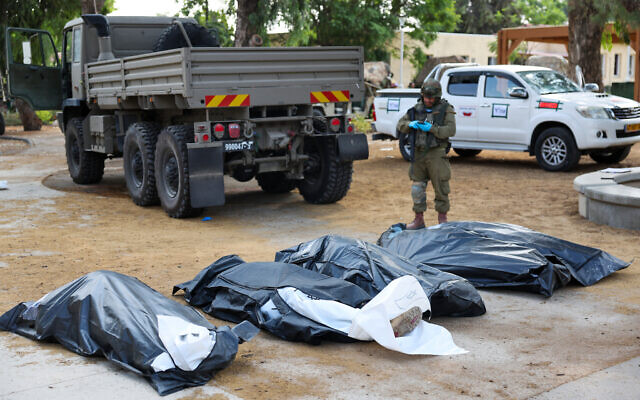
Bodies were strewn on the highway, along the paths in the kibbutzim, in the patches of shaded forest they passed. What Mr. Ziv shared has been corroborated by extensive video and photo evidence, some of it filmed by the Hamas gunmen themselves. They hunted down Israeli civilians sitting in their cars, huddling in their homes, hiding at a bus stop and running for their lives.

“No one could imagine they would do what they did,” Mr. Ziv said. “It is a brutality that we have not witnessed since the establishment of Israel.”

He added: “So now we need to change the whole doctrine about Gaza,” he said. “No more Hamas.”

How do you do that? he was asked.

“Level the ground,” he said.

Mr. Ziv and Mr. Tibon split up near the kibbutz where Mr. Tibon’s son lives. While Mr. Tibon joined a group of Israeli soldiers fighting Hamas members there, and eventually rescued his son, Mr. Ziv raced to other hot spots. He said he spent nearly 24 hours straight rushing around the kibbutzim and villages under attack, firing his own weapon, organizing evacuations of civilians and coordinating with the military to dispatch backup units as fast as possible.

The worst he found was the rave site. On Friday night, several thousand young people, Israelis and many foreigners, had flocked to an open field a few miles from the Gaza border to hold an overnight open-air dance party. By the time Mr. Ziv reached it Saturday night, he said, there was nothing left to be done.

There were bodies everywhere: in the campsite; in the field where everyone had been dancing; in car after car after car lining the road, filled with young people trying to escape.

He ran to one young man slumped out of a car and felt his neck. No pulse.

“I think the trigger for this whole attack was this event,” Mr. Ziv said. “Hamas planned this for a long time. But they knew a critical mass would be here this weekend.”

From evidence the Israeli military found at the rave site, and what witnesses said, the Hamas attackers surrounded the gathering on three sides. One group of gunmen opened fire on the crowd, methodically driving the panicked partygoers toward the road, where more gunmen were waiting to mow them down.

“I can still hear them screaming,” Mr. Ziv said.

He stood on the site looking out at a field littered with water bottles, rolled up sleeping mats, still-full boxes of Oreos, shirts, pants, tents and empty camp chairs. It was like everything was there but the people. One soldier quietly moved past him, carrying a black plastic bag, looking for documents.

“People don’t understand how fragile the situation is,” Mr. Ziv said. “Hamas has to pay for this.” He paused. “With their existence.”

He then walked away.

______________________________________________                If this is true and not BS Propaganda. Then this guy is a real stud in my book. Grumpy

Categories
All About Guns Allies War You have to be kidding, right!?!

Israel – Ben Gvir says 10,000 assault rifles purchased for civilian security teams By JEREMY SHARON

Guns, helmets and body armor to be distributed to hundreds of residents of border regions, mixed Jewish-Arab cities, West Bank settlements

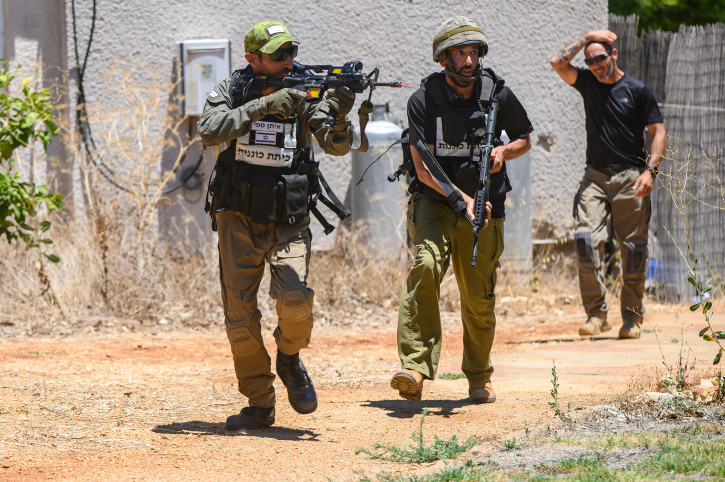
Members of the civilian security team of Kibbutz Malkia in northern Israel close to the Lebanese border are seen during a drill simulating the Infiltration of a terrorist into the kibbutz, July 19, 2023. (Ayal Margolin/Flash90)
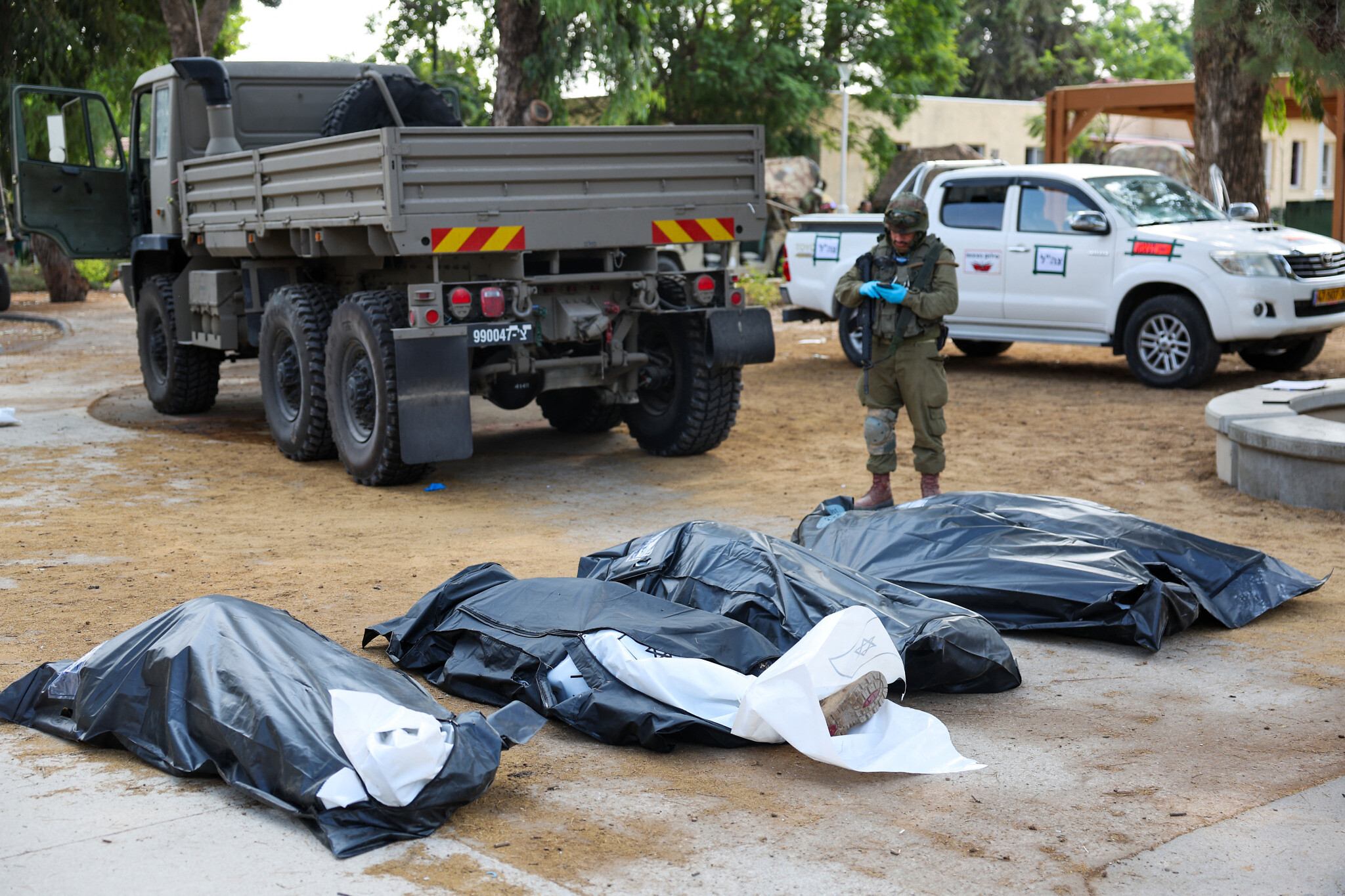
Members of the civilian security team of Kibbutz Malkia in northern Israel close to the Lebanese border are seen during a drill simulating the Infiltration of a terrorist into the kibbutz, July 19, 2023. (Ayal Margolin/Flash90)

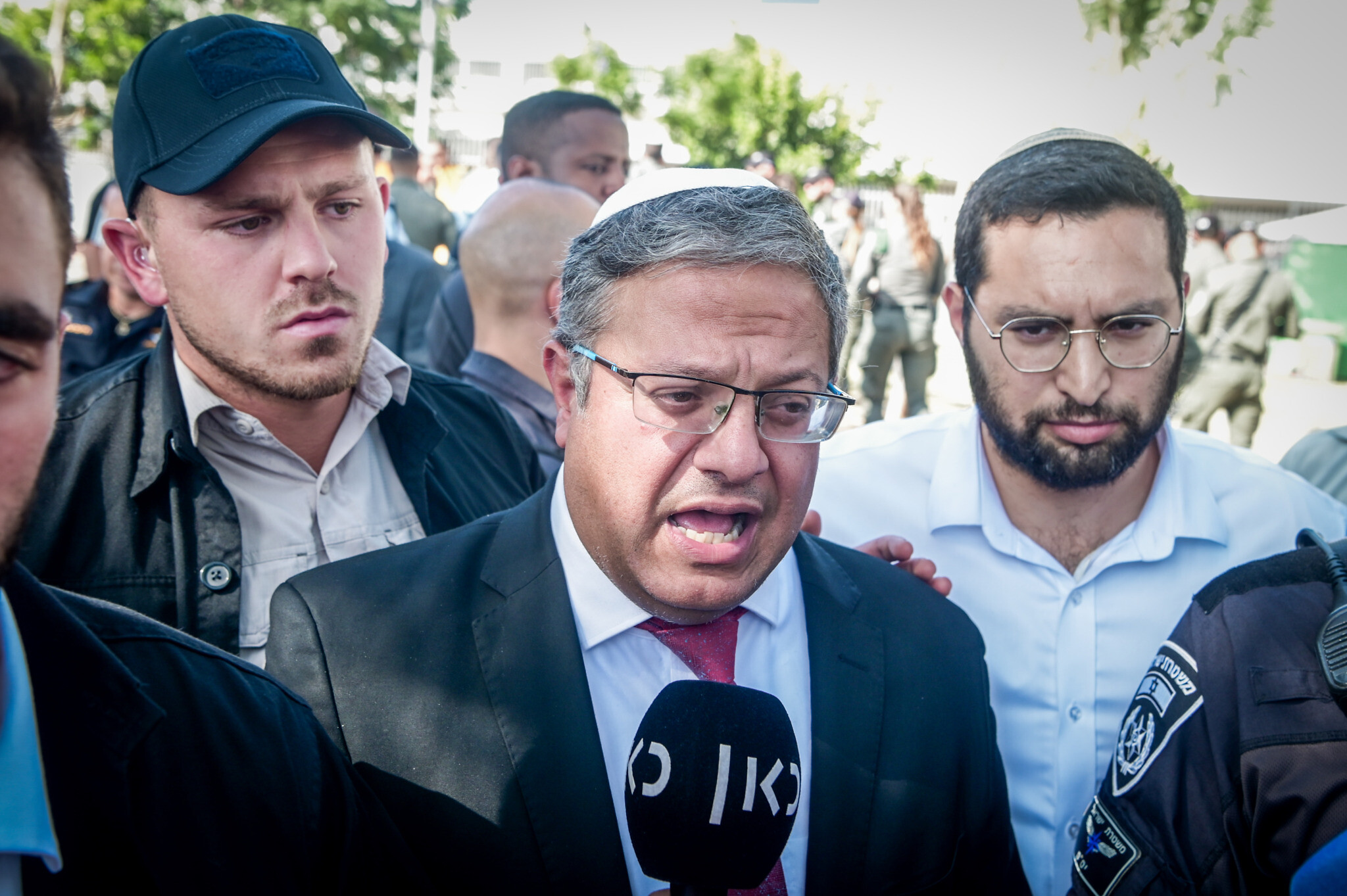
National Security Minister Itamar Ben Gvir announced on Tuesday that his ministry is purchasing 10,000 rifles to arm civilian security teams, specifically those in towns close to Israel’s borders around the country, as well as mixed Jewish-Arab cities and West Bank settlements.

The minister, who heads the far-right Otzma Yehudit party, said 4,000 assault rifles had already been acquired from an Israeli manufacturer and will be distributed immediately.

Helmets and bulletproof vests have also been acquired and will be distributed along with the assault rifles.

The step comes after some civilian security teams reported they had no weapons to fight off Hamas terrorists during Saturday’s devastating assault on southern Israel.

In a statement to the press on Tuesday, Ben Gvir said the new weapons and equipment will be distributed to “hundreds of towns” that have civilian security teams, some of which are manned by civilians who also volunteer in the Border Police, the Israel Police’s gendarmerie unit.

In addition, new civilian security teams will be established in towns that currently lack them, the national security ministry said.

National Security Itamar Ben Gvir during a visit to southern Tel Aviv, September 3, 2023. (Avshalom Sassoni/Flash90)

“We will turn the world upside down so that towns are protected. I have given instructions for massively arming the civilian security teams to provide solutions for towns and cities, and so as not to leave towns unprotected, preparations will be made for a Guardian of the Walls 2,” said Ben Gvir, in reference to the May 2021 conflict with Hamas, which was accompanied by severe inter-communal violence in Israel’s mixed Jewish-Arab cities.

When Israel’s Jewish-Arab cities were the scene of intense riots during the May 2021 conflict with Hamas, Ben Gvir, at the time an MK but not a minister, urged armed Israeli civilians to go to such cities to combat Arab rioters.

Categories
War

Israeli Ground Forces Get Cold Feet? + Ukraine War Updates by SIMPLICIUS THE THINKER

Things continue to both pick up pace and seemingly slow down at the same time.

After making boisterous threats of immediate ground assault into Gaza, the IDF apparently has gotten cold feet and sobered up to the harsh reality that they would face inordinate losses and/or defeat. So now, they’re pretending to gather forces while re-evaluating the situation, and their chances. In the meantime, they’ve resorted to indiscriminately mass bombing civilians from the sky.

But major problems in mobilization have been revealed:

⚠️ The newspaper The Times of Israel announced that reservists who are mobilized into the ranks of the Israeli army face serious problems because they lack adequate uniforms and other equipment (⏺including elements of individual ballistic protection).


▶️It is stated that this problem is being tried to be solved independently in the People’s Republic of China (Aliehpress), but also that the USA has announced military aid that will relieve the logistics of the Israeli army.

.

The Israel Defense Forces were not ready for large-scale mobilization of reservists and combat deployment in war conditions. This was reported by the Israeli portal Ynet.


The reservists gathered from all over the country were not provided with food, they did not have the equipment, basic necessities, and personal hygiene.

Volunteers have already announced a nationwide collection of necessary items for reservists who continue to arrive at collection points throughout the wartime state.

Categories
All About Guns Ammo War

The .22 At War October by JimC (I am willing to bet that the 22LR is very busy right now over there)

I’ve been paying close attention to the war in Israel and Gaza; watching a lot of footage. Came across some video of Palestinians — probably late teens/early 20s — throwing stones at vehicles in a chaotic protest on a road. This was, I believe, on Saturday, and it wasn’t clear to me whether the footage was real time or from recent protests.

Suddenly, one of the most active stone-throwers pulled up his right leg, his face knotted in a grimace of pain, and he began to hop away on his good leg. His comrades abandoned their pile of rocks and helped him down an incline and out of the frame.

I knew immediately what had happened: The stone-thrower had taken a .22lr round to the ankle or shin.

“Medics in the Gaza Strip have reported treating an influx of protesters who appear to have been deliberately targeted in the ankle by Israeli forces in recent unrest at the volatile boundary of the blockaded Palestinian enclave. At least one person has been killed and dozens more wounded since demonstrations by groups of young men, some of them throwing stones and molotov cocktails, began in mid-September.”

The Guardian being The Guardian, this was presented as a new cruelty inflicted by the Occupation on oppressed Palestinians.

Human rights groups say that such targeting procedures are unlawful as they allow the use of potentially lethal force with no immediate threat to soldiers’ lives.

They did get one paragraph of “balance” into the piece:

In a statement, the IDF said: “Over the past few weeks, the Hamas terror organisation has organised violent riots along the border fence, for purposes of harming Israeli security forces … It should be noted that the IDF resorts to live fire only after exhausting all available options, and only as necessary to handle imminent threat.”

For years, the IDF has been deploying integrally suppressed .22 caliber Ruger 10/22 carbines, originally as a “less lethal” option for riot control. They are also used as a “hush puppy” to take out dogs and lights in raid operations. Because Israel actually adheres to rules of engagement and laws of combat, the Israeli Judge Advocate General tested the effect of fire from the .22lr and reclassified it as a lethal weapon, which restricts its use.

But clearly, it was in the field in the weeks preceding the explosion of violence in Hamas’ Operation Al Aqsa Flood.

The use of a .22 in a sniper role at limited range, especially in urban environments makes a lot of sense. It’s comparatively quiet even unsuppressed, making it difficult for an enemy to determine where fire is coming from. Suppressed, it’s pretty close to silent; only the sonic crack of the bullet is heard. If your target is higher than the ankles, a .22 can be plenty lethal. Ask any emergency room doc.

Chechens deployed .22 snipers against Russian troops in urban combat in the 1990s, using makeshift suppressors made from plastic bottles — a technique depicted in the movie Shooter, based off of Stephen Hunter’s classic thriller Point of Impact. They were taking head shots.

The Russians took heed, and developed a purpose-built .22 sniper rifle, the Kalashnikov SV99:

The .22 LR SV-99 sniper rifle was developed as a precision small-caliber weapon for special forces snipers to silently engage enemy personnel and other targets at ranges up to 100 meters, as well as for training purposes.

For their part, the IDF now has an updated and upgraded Ruger to work with (seen in the top photo):

Countless threads on gun forums have flogged the topic to death and beyond, but it bears keeping in mind that the .22 is more than just a plinker.

Categories
Allies Real men Soldiering War Well I thought it was neat!

The 93rd Sutherland Highland Regiment of Foot 1800 – 1881

he 93rd Regiment of Foot, Sutherland Highlanders was raised in April 1799 in the mountains and remote north of Scotland – the lands of Sutherland, Ross, Caithness, the Orkneys and Shetlands. Most of the men were from “Fencible” regiments, home defense forces raised to check the threat of invasion by France and Napoleon. There had been three such Sutherland Regiments and the last, the 3rd – had emerged from the inglorious Irish 1798 rebellion with a uniquely high reputation and along with the Reay Fencibles contributed greatly to the new Regiment’s strength.

Major-General William Wemyss of Wemyss raised the 93rd for his 16 year old cousin Elizabeth, Countess of Sutherland. Extra numbers were drawn in 1803 from the disbanded Reay Fencibles, Rothesay and Caithness Fencibles, and the Scots Militia. Most of the remainder were added from the Sutherland estates in a process harking back to the old feudal system. Assembled young men would be looked over by General Wemyss and likely looking prospects would be invited to drink a dram of whisky and take snuff from a large silver-bound horn mull, no further attesting deemed necessary.

This was the last instance of the old feudal clan form of gathering men to fight. After this ceremony the men would be told when and where to assemble. Amazingly, every man showed up at the designated time. From the start the 93rd became the most solidly and characteristically Highland of all Scottish regiments.

Most of the men were native Gaelic speakers, raised in the traditions of the family, clan and parish. The Regiment now became the “clan” with the commanding officer as “chief”. The Regiment wore what they called “Sutherland Tartan”, a version of the Government Sett (more commonly known as “Black Watch”).

Formally gazetted into the Army in October 1800, the 93rd were dispatched from Fort George, via Aberdeen, to Guernsey. In February 1803, they were sent to quell a brief rebellion in Dublin. During these years they moved about Ireland, becoming quite popular with the Irish people because of their Gaelic language, high discipline and firm and steady conduct. The Regiment in its history would find itself many more times in Ireland. On one occasion a section was sitting in a tavern when a local bully came in challenging them to a fight. The smallest Highlander accepted, rose, lowered his head, ran and butted the bully in the stomach, flattening him. The rest drew their bayonets, cleared the tavern then quietly went back to their conversation and drink.


The 93rd sailed in July 1805 to help recapture Cape Colony from the Dutch. There the 93rd won their first battle honour. While landing 37 men were lost, still cheering madly as their boat capsized. In the ensuing battle the 93rd advanced in line, pipes playing, fired one volley and charged. The enemy broke and ran. After limited skirmishing over the next days Cape Town surrendered and the 93rd moved into Cape Castle, their home for the next eight years.

In an age of great illiteracy, especially in the army, the 93rd was amazing in that nearly every man could read and write. Almost every private had his own Bible – often having been given to him by his family. In Cape Town they built their own church, hired a Chaplain, taught school and gave to charities sending huge amounts home to help those in need.


A remarkable, cheerful and united body of men given to music and Highland dancing. Such was their discipline and good conduct that while in garrison with other regiments the 93rd repeatedly was dismissed from Parade when corporal punishment commenced. Instead of having to see the example given by floggings, they instead became the example of discipline.


In August 1814 the 93rd sailed to Plymouth, England thinking of home. Instead on 17 September they embarked on three ships as part of a three-pronged offensive designed to chastise the United States and end the war dragging on there since 1812 when the U.S. declared war and invaded Canada. Napoleon had been sent into his first exile. Tens of thousands of veteran British soldiers were now free to be used in America. One prong of this strategy would attack through the Great Lakes region, the second front would smash into the eastern seaboard ultimately to burn the capital of Washington in retaliation for U.S. forces burning York (Toronto), Canada. The third – with the 93rd aboard – would attack through the Gulf of Mexico. Their final destination: New Orleans.

For this expedition the 93rd were ordered to wear tartan trousers (trews) and “hummel” bonnets in place of the kilt and feathered bonnet. No other Highland units were in this Division and as only Highland Regiments wore the kilt it is obvious then there were no kilted soldiers involved in the New Orleans campaign, contrary to what Hollywood movies (especially either version of “The Buccaneer”) and some popular thought would like us to believe.


The 93rd landed on 23 December moving up the swamp. American militia attacked at night and a chaotic battle ensued. Elements of the 93rd helped turn the U.S. flank; by dawn superior discipline, training and the bayonet had prevailed over raw troops in the open. The Americans withdrew. Andrew Jackson would not dare to expose his rag tag army in such a way again. On 25 December the British commander arrived. Sir Edward Packenham, the “Hero of Salamanca” and the Duke of Wellington’s brother in law. He was not pleased with the situation nor the terrain he found his army in. Jackson made his stand behind a make shift parapet along a canal 5 miles forward of New Orleans. The main British concern was the limited amount of room to maneuver before sweeping over this small obstacle: after all, in the wars with Napoleon fortifications ten times more massive and defended by professional soldiers had been breached and taken. Rain, sleet and cold assailed the men throughout the campaign. Packenham’s advance on 28 December was halted 700 yards in front of Jackson’s parapet and which withdrew not knowing the American left flank had been turned.


Had the probe been turned into an outright attack, the outcome of the Battle of New Orleans might have been quite different indeed. As many as 30 guns were brought up by the British to try and reduce the American parapet which had been reinforced with mud and earth. (The cotton bales had proved useless and were mostly used as gun platforms.)


The American artillery proved their worth many times over during this campaign, dislodging British artillery and eventually accounting for the horrendous casualty tally. An aborted assault was tried on 1 January, turning into an artillery duel.


Then came the calamatious assault of 8 January. Everything conceivable went wrong. The total result was for the army a disgrace; for the 93rd a tragedy. The Light Company helped to take a forward redoubt but without support were eventually driven out, captured or killed. The main body of the 93rd, some 960 men, moved up in column along the river road on the British left to reinforce where needed, originally to help the Light companies taking the advance US redoubt by the river. Then the British right faltered, US cannon fire from the west bank was continued and so the 93rd with pipes playing “Moneymusk” (the Regimental charge) was ordered to cross the field diagonally to assist the right flank. 100 yards from the parapet Regimental commander Colonel Dale ordered a halt – whether to begin forming an attack column or to ascertain the situation will never be known – he was killed immediately after.


Their brigade commander, Gen. Keane, was also down, as was the commander of the British right flank, Gen. Gibbs. Many more 93rd officers fell. Packenham rode forward to rally his army and died not far from the 93rd, having previously called out, “Have a little patience 93rd and you shall have your revenge!” The Regiment had no further orders and so stood, “firm and immovable as a brick wall” as one American observer was to write.


Other units broke and ran all round them. Most accounts of the battle state the British never even saw the Americans as the defenders would merely throw their firelocks up onto the parapet and fire without exposing even their faces. General Lambert, having taken command and seeing the 93rd standing their ground alone in the murderous artillery fire and haphazard musketry, sent orders for the Regiment to withdraw. Major Creagh, now in command, had first endeavored to advance but was at length compelled to turn back. So the 93rd came back in parade ground precision suffering between 300 to 500 casualties: three quarters of the Regiment’s force and one fourth of total British casualties.


The quiet stoicism of the 93rd was again displayed by the example of a 93rd man who lost an arm to the surgeon’s knife. A friend lying next to him commented, “Jock, you’ll never strike a man again with that arm.” The man asked the surgeon for a last look at the arm and after contemplating the limb, hit his friend with it, saying, “You’ll be the last!”.


The New Orleans debacle must be blamed on a series of mistakes, bad luck, failure to execute certain elements of the battle plan and the generalship displayed at the time by Jackson. It should be noted that on the opposite (West) bank of the Mississippi River the British advance triumphed, driving the Americans from their line (they ran for two miles) and capturing artillery and colours. One of those cannons was engraved as having been captured from the British at Yorktown during the Revolution. This piece now stands in the Royal Military Academy at Sandhurst.


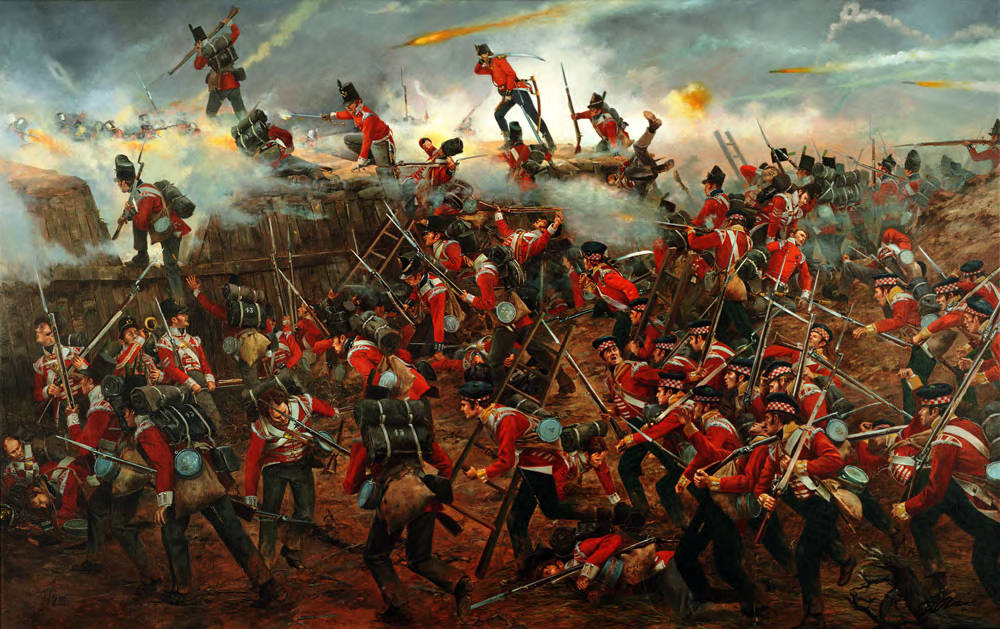
“Battle of New Orleans” by Col. Chs. H. Waterhouse. In many respects a good depiction of the attack on the parapet after the British capture of the advance redoubt next to the river bank. However, errors exist: This scene makes it appear the handful of US Marines actually present single-handedly engaged and stopped the enemy. (As this was painted by a Marine, it’s understandable.)
The US counterattack was also made up primarily of men from the 7th US Infantry and Beal’s Rifles (a local militia). We also do not see any men from the Light Companies of the British 7th and 43rd Regiments who were involved in this attack, nor do we see any of the advance redoubt which had just been overrun and captured.
For once the 93rd Highlanders are shown correctly in trousers. There is speculation some, due to shortage of tartan issue, were in grey trousers. The red stripe of the officer’s pants is debatable. He should also be wearing wing style epaulettes for a flank company and carrying a sabre, not a baskethilt, and sword baldric with slings. As it was the Light Company involved, the men’s shoulder wings are correct, however, the touries (pompoms) on the top of the bonnets should be green for Light Coy.
Also debatable is the presence of US troops on top of the parapet – as all eyewitness accounts state the US troops never showed their faces above the parapet and at this position of the battlefield – inside the redoubt and behind the parapet – an uneasy stalemate occured with both forces keeping their heads down for fear of being shot. Of course, the musket swinging “Davy Crockett” style stance of the Marine at top left is plain silly. 
The British remained in camp for ten days and by the 30th of January were finally embarked and gone. After leaving New Orleans the British captured Fort Bowyer outside Mobile. Two weeks later they learned of the peace treaty of Ghent, signed on 24 December but not ratified by Congress until two months later.


Upon arrival back in Britain the 93rd was helped back to strength with men from a short-lived Second Battalion of the Regiment which had spent its existence as a garrison in Newfoundland. It was not enough nor soon enough to enable the Regiment to take part in Napoleon’s final defeat at Waterloo in June, though some officers of the 93rd were there with other units.


It is interesting to note New Orleans was the only defeat ever suffered by the old 93rd – and it was the only time they wore trousers into battle.

For a more detailed look and some pop myth busting on the Battle of New Orleans,go here.

For a look at some shots from an A&E TV documentary film on the Battle which the 93rd SHRoFLHU worked on click here.


During the “long peace” following the end of Napoleon, the 93rd spent ten years in Britain and Ireland, eleven years in the West Indies from 1823 to 1834 (having the least number of deaths there of any regiment) being stationed variously at Barbados, Antigua, St. Christopher, Montserrat, St. Lucia and Dominica. Then three years at home. They came to Canada in 1838 to aid in quelling an insurrection there. From Nova Scotia the 93rd moved all about Canada. No.4 Company through the entire rebellion was attached to the 71st HLI in the Lower Provinces.


The 93rd was present at the capture of the Windmill after which they were reunited at Toronto. The Regiment spent 10 years in Canada at various garrisons including Drummondsville, Montreal, and Quebec.


One instance of note involved a Volunteer Regiment in garrison with the 93rd. These fellows continued over a long period to hurl abuse and insult at the stoically patient Highlanders until a gang of Volunteers actually beat up a 93rd Sergeant. At word of this the barracks emptied and a fisticuff battle ensued with the 93rd finally mauling and chasing the entire Volunteer battalion out of garrison and through the town.


The commanders of both Regiments watched the proceedings helplessly, the 93rd Colonel at one point trying to intervene only to be lifted by a large 93rd Sergeant by one hand and gently set aside, whereupon the Sergeant saluted smartly and turned back to punching his adversaries. No charges were ever brought against anyone and there was no mention in any official army documents of the incident. It is safe to assume no one ever insulted the 93rd again, either.


In 1854 they were back in England when war broke out with Russia. By September they were in the Crimea. With the 42nd and 79th regiments they formed the Highland Brigade under Sir Colin Campbell, an old Napoleonic veteran and one of the few actually good generals in positions of command.


On 20 September the Brigade in full Highland uniform, with the Guards Brigade, waded the Alma River. Advancing in echelon, the British took the heights above while under constant heavy fire. The 93rd was engaged for the next months alternating in the siege of Sebastopol and serving garrison duty. On 25 October they were positioned to protect the main British supply base. A port called Balaklava.

Several thousand Russian cavalry had swept down and captured artillery batteries overlooking a small valley. They rode on with about five thousand continuing on the road to Balaklava, the others diverting to be cut down by the charge of the Heavy Brigade. The 93rd – about 500 including a few walking-wounded of other units – stood behind a ridge in the road to avoid the artillery now turned against them.


As the Russian cavalry came nearer the 93rd moved forward and stood in line astride the road to the port and the British supplies. On either flank stood a battalion of their Turkish allies who fired an ineffectual volley at 800 yards, then broke and ran. (It may seem from a correspondence from a 93rd officer at the time that 50 casualties suffered by the Turks may have come from a volley purposely fired by a company of the 93rd into their fleeing allies!)


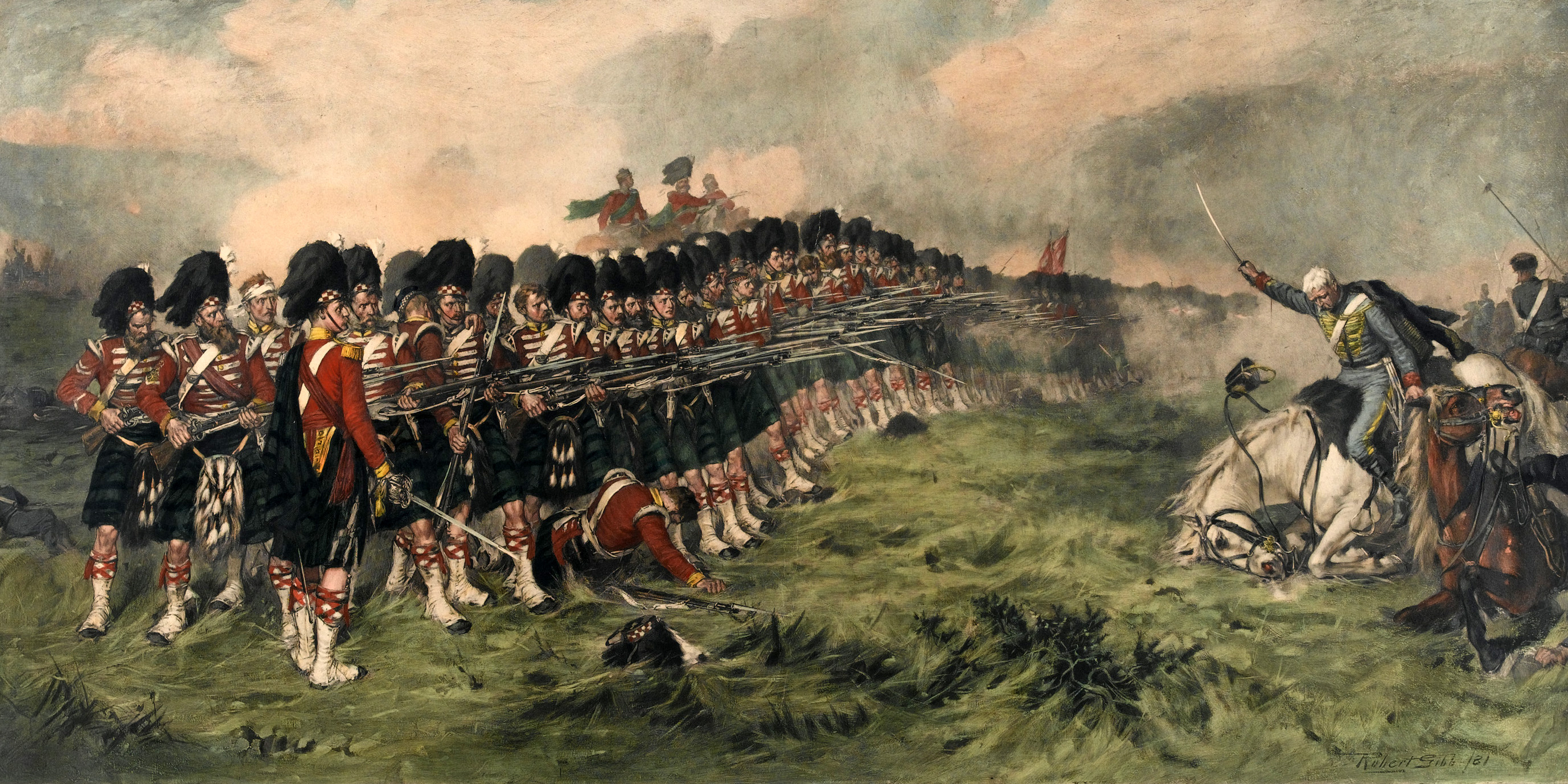
Sir Colin Campbell rode down the line: “There is no retreat from here men, you must die where you stand.” A chorus was taken up by the 93rd in answer, “Aye Sir Colin, and needs be we’ll do that.” Campbell did not form the regiment into the usual square formation to withstand cavalry but rather left them in line, later commenting, “I knew the 93rd, and knew there was no need (to form square).” They fired a volley at 500 yards from their rifled muskets and another at 250 yards. They commenced fire by files.


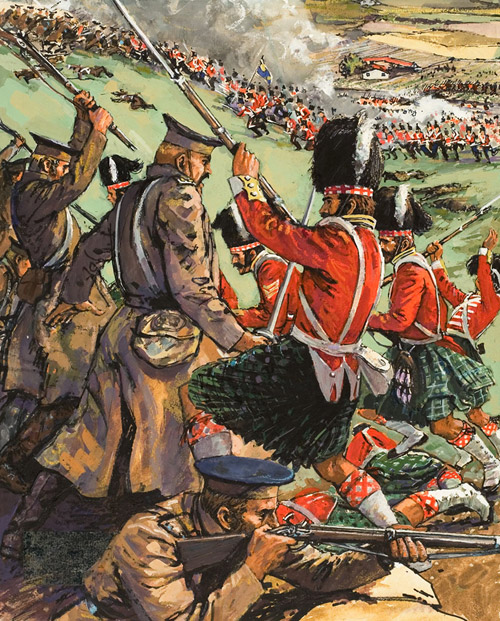
The cavalry split in half and veered to the left and right wheeling back. The Grenadier Company wheeled right to fire once more into the horsemen to refuse the flank and insuring the enemy’s retreat. On a hill above, London Times correspondent W.H. Russell watched and wrote of nothing standing between the cavalry and the supply base but “the thin red streak tipped with steel”. This news report gained the Regiment immortality and gave them their nickname. The phrase was popularly condensed to become “THE THIN RED LINE”.


The 93rd suffered as other regiments from cold and disease through the rest of the war. Finally they returned home in June 1856 to great acclaim. Only a year later they were diverted from their destination of China to land in Calcutta and be reunited with Sir Colin to help quell the Indian Mutiny.

Having seen the grisly, slaughterhouse remains of the men, women and children prisoners murdered out of hand at Cawnpore by rebellious Sepoy regiments’ mutineers, the 93rd, with other British and loyal Indian units fought with a vengeance up to Lucknow where the beleaguered Residency still held out.


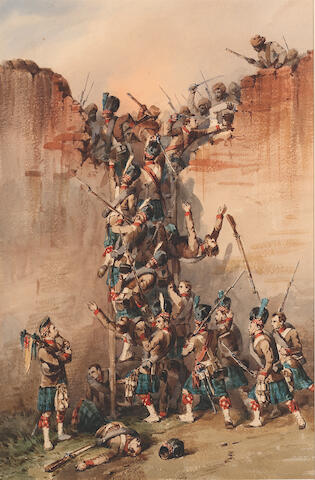
On 11 November 1857 the 93rd faced the two great fortified enclosures of the Sikander Baugh and behind it the Shah Najif. The 93rd swept forward to the pipes playing the “Haughs of Cromdell”. Nine officers and men got through a hole in the wall and, fighting hand to hand held the way open for the rest, eventually forcing the gate open. Fierce fighting continued and as evening fell the enclosure was cleared.


Two thousand mutineers lay dead inside, most of them killed by the bayonet. Sir Colin called on the 93rd once more and sword in hand led them against the Shah Najif. After a terrific cannonade against the walls with little effect and hostile fire beating down, a 93rd Sergeant literally found a back door in.


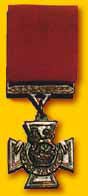
The Regiment rushed round and inside to see the last of the mutineers scurrying out yet another back way. At dawn the Highlanders uncased their Colours on top of a tower inside so those in the Residency knew relief was at hand. Drummer boy Ross who helped in this feat played “Yankee Doodle” on his bugle “so my American cousins (Canadian relatives) would know I was here!”. The harried defenders of the Residency were brought out safely and the 93rd had won six Victoria Crosses.


This was not the end as the relief force now had to escort the relieved to safety and then turn its attention on the rebels occupying Cawnpore once more. From 29 November to 6 December the 93rd was engaged in helping drive out and disperse the rebels. On 1 March 1858 the Regiment with the rest of the army arrived back at Lucknow to finish the job. Lucknow was now the center of rebel power.


Over the next few days the British were involved in enclosing the enemy and retaking that which had been so dearly won previously. On the 11th the 93rd assaulted the strongly garrisoned and fortified Begum Kothi, practically repeating their performances earlier.


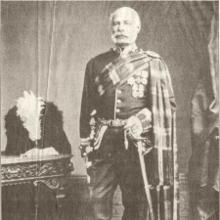
Fierce hand to hand combat was again carried through the fort. Adjutant Wm. McBean was awarded the V.C. for encountering eleven of the enemy in succession and cutting them down with his sword. (McBean was one of those rare fellows: enlisted as a private at age 16, held every rank in the army, never leaving the Regiment, eventually commanded the 93rd and died an honourary Major-General.)

Artillery fire finally formed a small hole in the wall. Pipe Major John McLeod was the first to enter the breach. No sooner was he in than he began and continued through the entire fight to encourage the men with his bagpipe music. By the 21st the fighting in the city was over. There was still long, hard campaigning over the next months against scattered rebels before the 93rd finished with the suppression of the Mutiny. Then it was long years of garrison duty and border fighting in India, including the Umbeyllah Campaign. It would not be until March 1870, twelve and a half years later, that the Regiment would stand once more in Scotland.


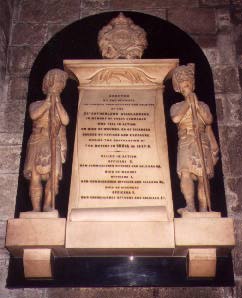
Victoria Cross Winners

Capt. W.G.D. Stewart
C/Sgt. J. Munro
Sgt. J. Paton
L/Cpl. J. Dunley
Private P. Grant
Private D. MacKay
Lt. WM. McBean


Memorial to the Fallen of the 93rd during the Indian Mutiny, in St. Giles Cathedral, Edinburgh.
The 93rd spent 9 happy years at home in Britain. In 1879 they were sent for 2 years to Gibraltar. In 1881 came a reorganization of the British army and the 93rd was amalgamated with the 91st Argyllshire Regiment, becoming the Argyll & Sutherland Highlanders (Second Battalion).


Over the long years since, the Regiment carried on with duty and dignity in peace and war. The worst “battle” was with the War Office in the 1960’s to remain in existence after the famous Aden affair with Lt. Col. “Mad Mitch” Colin Mitchell in command.


Public outcry and a petition with one million signatures helped keep the Regiment alive. Through war, disease, capture and further amalgamation with the First Battalion, the 93rd has lived on. Today “The Thin Red Line” still stands firm in our ever changing world.

A&S Highlanders in Iraq.


“Outnumbered British soldiers killed 35 Iraqi attackers in the Army’s first bayonet charge since the Falklands War 22 years ago. The fearless Argyll and Sutherland Highlanders stormed rebel positions after being ambushed and pinned down.


Despite being outnumbered five to one, they suffered only three minor wounds in the hand-to-hand fighting near the city of Amara. The battle erupted after Land Rovers carrying 20 Argylls came under attack on a highway.After radioing for back-up, they fixed bayonets and charged at 100 rebels using tactics learned in drills.


When the fighting ended bodies lay all over the highway � and more were floating in a nearby river. Nine rebels were captured.
An Army spokesman said: “This was an intense engagement.” The last bayonet charge was by the Scots Guards and the Paras against Argentinian positions. ”


The Regiment Today
The Colonel-in-Chief:

  • Her Majesty the Queen.

The Colonel of the Regiment:

  • Major General D P Thomson CB CBE MC

Regimental Headquarters & Regimental Museum:

  • Stirling Castle

The Regular Army:

  • 1st Battalion the Argyll & Sutherland Highlanders (Princess Louise’s) based at Redford Barracks, Edinburgh.

The Territorial Army:

  • 7th/8th (Volunteer) Battalion the Argyll & Sutherland Highlanders (Princess Louise’s) with Headquarters & one Company in Stirling. Companies in Falkirk, Cumbernauld & Dumbarton & a detachment in Dunoon.

The Army Cadet Force:

  • The Argyll & Sutherland Highlanders Battalion ACF.
  • Detachments of the West Lowland Battalion ACF Combined Cadet Force.
  • Dollar Academy CCF.

Alliances:

  • The Argyll & Sutherland Highlanders of Canada (Princess Louise’s).
  • The Calgary Highlanders.
  • The Royal New South Wales Regiment.
  • 1st Battalion (Scinde) the Frontier Force Regiment.

Affiliations:

  • HMS Argyll

Regimental Association: Headquarters: Stirling Castle
Branches:

  • Stirling, Grangemouth, West of Scotland Branch, London, Manchester, Plymouth & South West.

Freedom Burghs:

  • Stirling 1947
  • Dunoon 1953
  • Oban 1963
  • Dumbarton 1963
  • Inveraray 1963
  • Lochgilphead 1965
  • Campbeltown 1968
  • Tobermory 1970
  • Falkirk 1972
  • Denny and Dunipace 1974
  • Alloa 1974
  • Gourock 1974
  • Kilsyth 1974
  • Tarbert Castle 1974
  • Grangemouth 1974
  • Argyll & Bute 1979

If ever in Scotland, visit the

  • Argyll & Sutherland Highlanders Regimental Museum in Stirling Castle.. Follow the fascinating story of the A & S H in the exhibitions of personal artifacts, uniforms, medals & unique silver collection. Admission to the museum is free but there is an entry charge to the Castle.
    Opening times:
    Easter – September:
    Monday to Saturday 10am to 5.45pm
    Sunday 11am to 4.45pm
    October – Easter:
    10am – 4.15pm
    Telephone: 01786 476165
    One may also view 93rd relics at Dunrobin Castle in Sutherland and at the United Services Museum in Edinburgh Castle.
    To get a History of the 93rd with names and dates in a nutshell go to a Concise History of the 93rd


    Sources used for this article:
    “Historical Records of the 93rd Sutherland Highlanders”, compiled and edited by Roderick Hamilton Burgoyne, late 93rd Highlanders. London, 1883.
    “An Reisimeid Chataich, The 93rd Sutherland Highlanders”, by Brig. Gen. A.E.J. Cavendish, CMG. 1928. Published Privately.
    “History of the 93rd Sutherland Highlanders…1800-1895”, by Lt. Col. Percy Groves, R.G.A. W & AK Johnston, Edinburgh & London, 1895.
    “Records of Service and Campaigning In Many Lands”, by Surgeon-General Munro, MD, CB., late of 93rd Highlanders. London. 1887.
    “Reminiscences of Military Service with the 93rd Sutherland Highlanders”, by Surgeon-General Munro, MD, CB., formerly surgeon of the regiment. London. 1883.
    “Reminiscences of the Great Mutiny 1857-59”, by Wm. Forbes-Mitchell, late sergeant 93rd Highlanders. London. 1895.
    “Recollections of A Highland Subaltern”, by Lt. Col. W. Gordon-Alexander, late 93rd Highlanders. London. 1898.
    “Fighting Highlanders! The History of The Argyll & Sutherland Highlanders”, by Major P.J.R. Mileham. London. 1993.
    “Famous Regiments, The Argyll and Sutherland Highlanders”, by Douglas Sutherland, M.C. London. 1969.
    “The Scottish Regiments 1633-1987”, by Maj. P.J.R. Mileham. 1988.
    “The Scottish Soldier”, by Stephen Wood. Manchester. 1987.
    “Soldiers of Scotland”, by Lt. Col. John Baynes Bt, M.Sc. 1988.
    “The Highland Brigade in the Crimea”, founded on letters written during the years 1854, 1855 & 1856, by Lt. Col. Anthony Sterling, “a staff officer who was there”. “A History of the Regiments & Uniforms of the British Army”, by Major R.M. Barnes. London. 1950.
    “Scottish Military Uniforms”, by Robert Wilkinson-Latham. Hippocrene Books, 1975.
    “Argyll and Sutherland Highlanders”, by Wm. McElwee and Michael Roffe. Osprey. 1972.
    “The Naval War of 1812” by Theodore Roosevelt. NY, 1889.
    “Blaze of Glory – the Fight for New Orleans 1814-1815″ by Samuel Carter III, St. Martin’s Press, NY.
    The Pictorial Field Book of the War of 1812”, by Benson Lossing, NY 1869, reprint 1976.
    “The British at the Gates-The New Orleans Campaign in The War of 1812” by Robin Reilly. Putnam, NY 1974.
    “Amateurs to Arms”, by Col. JR Elting.1991.
    “With Musket, Cannon and Sword – Battle Tactics of Napoleon and His Enemies” by Brent Nosworthy.
    “The Armies of Wellington” by Philip J. Haythornthwaite. 1994.
    “Weapons and Equipments of the Napoleonic Wars”, by Philip J. Haythornthwaite. London, 1996.
    “British Infantry Of The Napoleonic Wars”, by Philip J. Haythornthwaite. London, 1987.
    “Life In Wellington’s Army”, by Antony Brett-James. London, 1994 edition.
    “The Campaigns of the British Army at Washington and New Orleans, 1814-1815” by Rev. G. R. Gleig. London 1827.
    “A Subaltern in America, Comprising His Narrative of the British Army at Baltimore, Washington, etc..”, by Rev. G. R. Gleig. Philadelphia, 1833.
    “British Sieges Of The Peninsular War”, by Frederick Myatt. Spellmount, UK, 1987.
    “The Dawn of Modern Warfare – History of the Art of War, Vol. IV”, by Hans Delbr�ck (1848-1929). Translated by Walter J. Renfroe, Jr. Univ. of Nebraska, 1990.
    “Biographical Sketches of the Veterans of the Battle of New Orleans 1814-1815” by Ronald R. Morazan. Legacy Publishing, 1979.
    “Frederick The Great on the Art of War”, edited & translated by Jay Luvaas. NY, 1966.
    “Military Marching – A Pictorial History”, by James Cramer. Forward by Lt. Gen. Sir Napier Crookenden, KCB, DSO, OBE, DL. Spellmount, 1992.
    “The Face of Battle”, by John Keegan. NY, 1976.
    “The Mask of Command”, by John Keegan. 1987.
    “Firepower – Weapons Effectiveness On The Battlefield, 1630-1850”, by Maj. Gen. B.P. Hughes, CB, CBE. NY, 1997.
    “The FootSoldier”, by Martin Windrow & Richard Hook. Oxford Univ. Press, 1982.
    “Forward into Battle-Fighting Tactics from Waterloo to the Near Future” by Paddy Griffith (16 years senior lecturer in War Studies at Sandhurst). Presidio Press, Novato, CA. 1990.
    “The Elements of the Science of War; Theory and Practice” by William Muller KGL 1811. (classic example of Pakenham’s tactics being “by the book”.)
    “The War of 1812 – A Forgotten Conflict” by Donald R. Hickey. Univ. of Illinois Press. 1989.
    “New Orleans 1815 – Andrew Jackson Crushes the British” by Timothy Pickles. Osprey, 1993.
    “The American War 1812-1814”, by Philip Katcher, Osprey, 1990.
    “Twenty-Five Years in the Rifle Brigade” by W. Surtees, 1833. Reprint by Greenhill Books.
    “A Full and Correct Account of The Military Occurrences of the Late War Between Great Britain and the United States of America”, by Wm. James, 1818.
    “The Battle of New Orleans – A British View”, the Journal of Major C.R. Forrest, Asst. Quarter Master General, New Orleans Campaign. Intro and annotations by Hugh F. Rankin. The Hauser Press, New Orleans, 1961.
    “Rough Notes of Seven Campaigns in Portugal, Spain, France and America, 1809-1815”, by John Spencer Cooper, late Sergeant, 7th Royal Fusiliers. Reprint of 1869 publication by Spellmount, 1996.
    “The Siege of New Orleans”, by Charles B. Brooks, Univ. of Washington Press, 1961.
    “Various Anecdotes and Events of my Life –The Autobiography of Lt. Gen. Sir Harry Smith, covering the period 1787 to 1860”, by Sir Harry Smith. First published in 2 volumes, edited by G.C. Moore, London, 1901.
    “The Historical Memoir of The War in West Florida and Louisiana in 1814-15, with an Atlas”, by Ars�ne LaCarri�re Latour, Major, principal engineer 7th Military District US Army, originally published 1816. The Historic New Orleans Collection and University of Florida Press. reprint 1999 – expanded edition edited by Gene A. Smith.
    “The Amphibious Campaign for West Florida and Louisiana, 1814-1815”, by Wilburt Brown (Maj. Gen. USMC, retired), University of Alabama, 1969.
    “The Dawn’s Early Light”, by Walter Lord, NY 1972.
    “The War of 1812 – Land Operations”, by George F.G. Stanley. MacMillan & national Museum of Canada, 1983.
    “When They Burned The White House”, by Andrew Tully. NY, 1961.
    “The Baratarians and the Battle of New Orleans”, by Jane Lucas de Grummond.
  • __________________________________________________ Sadly the Brits did away with this fine outfit and instead they now have a “Royal Regiment of Scotland” . The world is a lot duller now! Grumpy


Categories
War

The Five Super Machine Guns That Used by Ukraine Armed Forces

Categories
Ammo War

The Economics of Artillery Shells in the Russo-Ukrainian War