Category: This great Nation & Its People

In the early days of the United States’ involvement in World War II, stateside motivational posters proclaimed, “Remember Pearl Harbor”, and “Avenge December 7th”. And while the “date which will live in infamy” focused America’s rage on Imperial Japan, U.S. military planners in the Pacific Theater of Operations (PTO) dreamed of vengeance against the specific planner of the Pearl Harbor attack: Admiral Isoroku Yamamoto.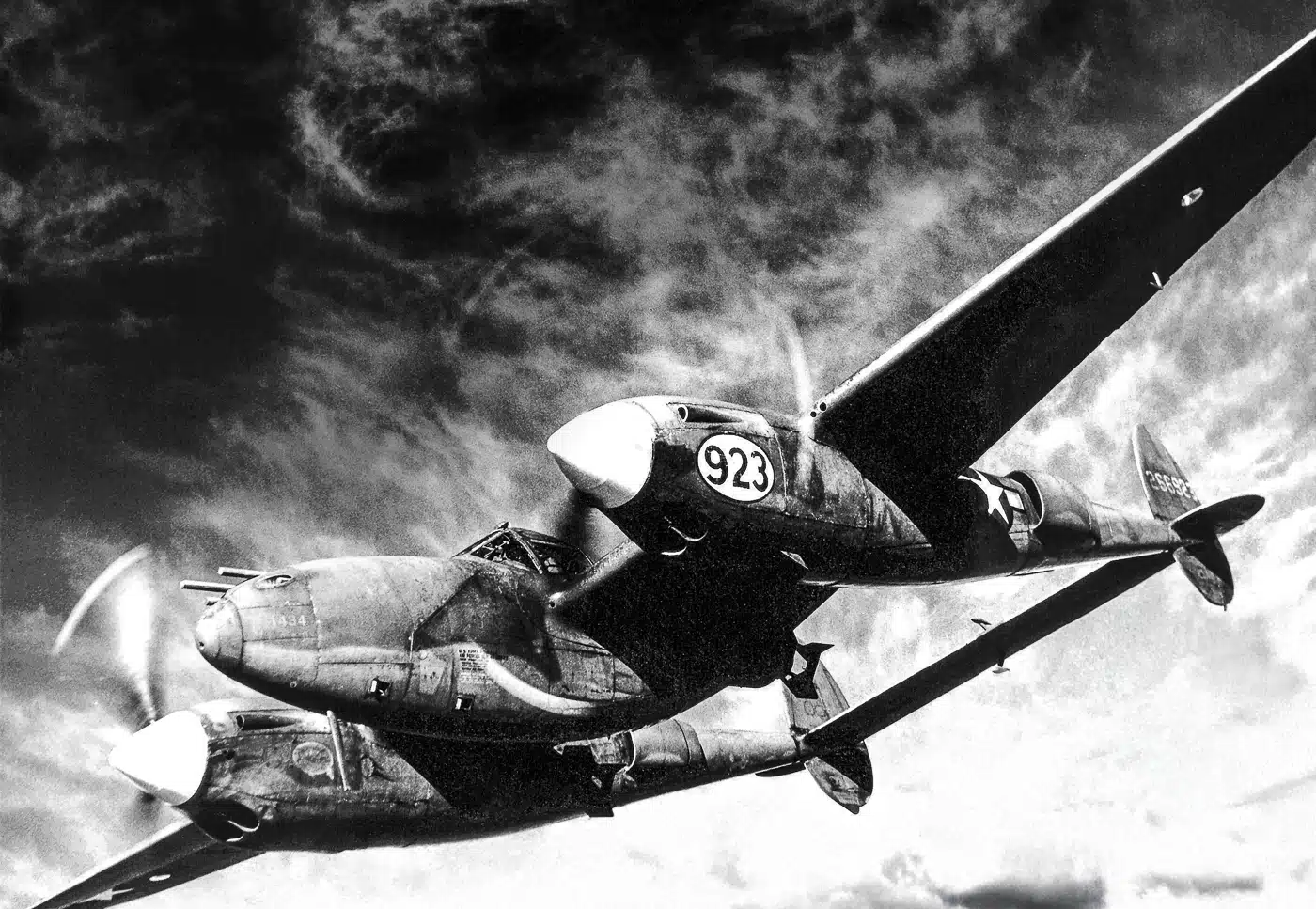
Yamamoto, the commander-in-chief of the Japanese Combined Fleet, had originally been opposed to war with America, and had made his feelings known privately and even publicly. He warned that he believed Japan could not defeat the United States, as Japanese production could never match up against American industrial might. Even so, political pressure and his sense of duty led him to plan the daring first strike against America’s prime naval base in the Pacific.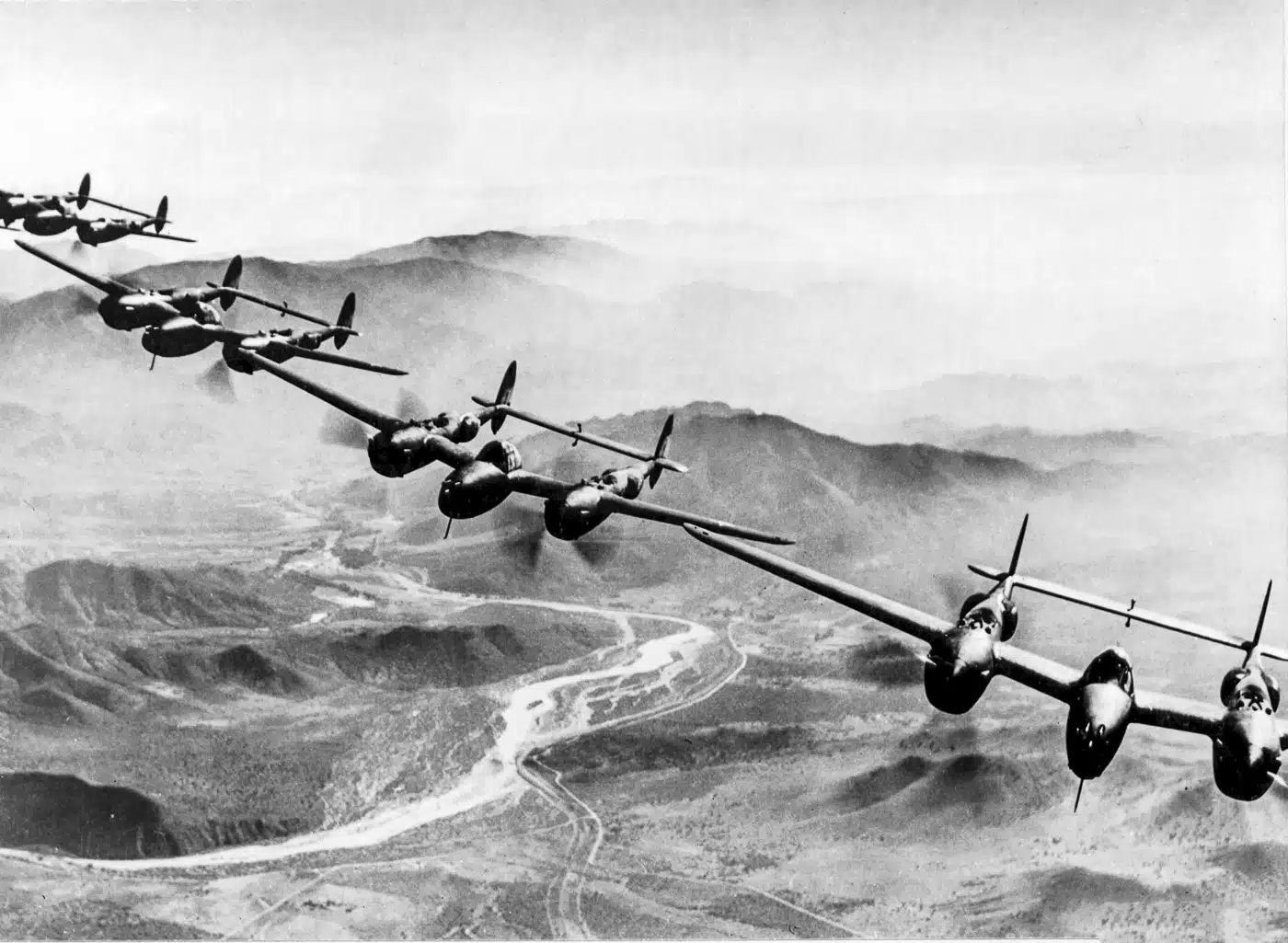
By April 1943, Yamamoto’s prediction was proving correct. Japan was locked in a deepening war of attrition with America, and the situation was turning against the Rising Sun. U.S. forces were advancing in the Solomon Islands, more and more Allied equipment was arriving every day, and the United States Army Air Forces (U.S.A.A.F.) and United States Navy were beginning to achieve air superiority in some areas. The Japanese Mitsubishi A6M “Zero” fighter, while still dangerous, was no longer dominant. The tide was clearly turning.
The Breakthrough
After the efforts of U.S. Navy code-breakers paved the way for the “Miracle at Midway” in early June 1942, the signals monitoring and cryptographic intelligence unit kept at their detective work. On April 14, 1943, the U.S. naval intelligence operation, codenamed “Magic”, picked up an important Japanese naval transmission.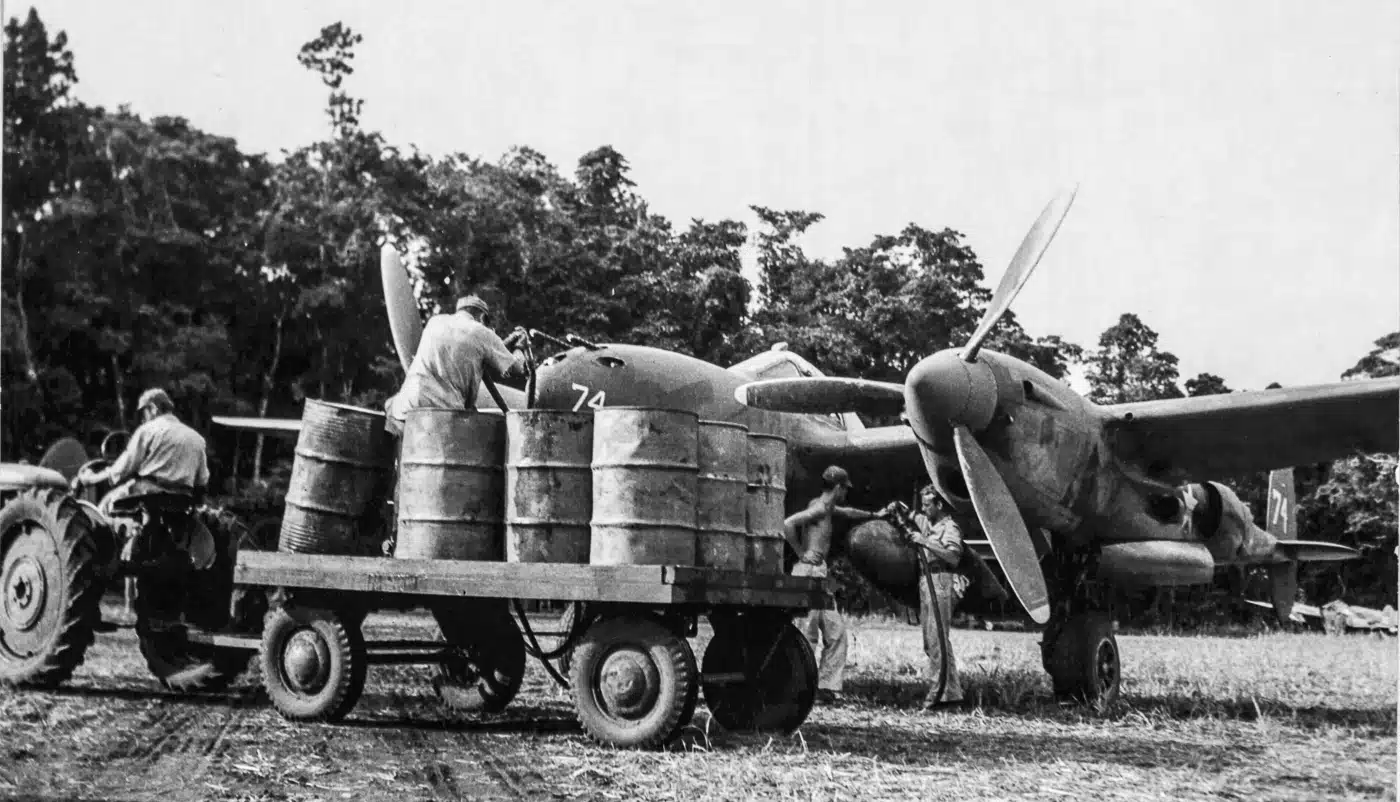
Once deciphered by Tech Sergeant Harold Fudenna, the message yielded the precise itinerary of Admiral Yamamoto’s upcoming inspection tour of bases in the Solomon Islands.
On April 18th, the Admiral and key members of his staff would fly from the massive Japanese naval base at Rabaul (at 06:00 Tokyo time) and arrive at Balalae Airfield near Bougainville (at 08:00 Tokyo time). Yamamoto and his entourage would travel in a pair of Mitsubishi G4M bombers while escorted by six Mitsubishi A6M Zero fighters.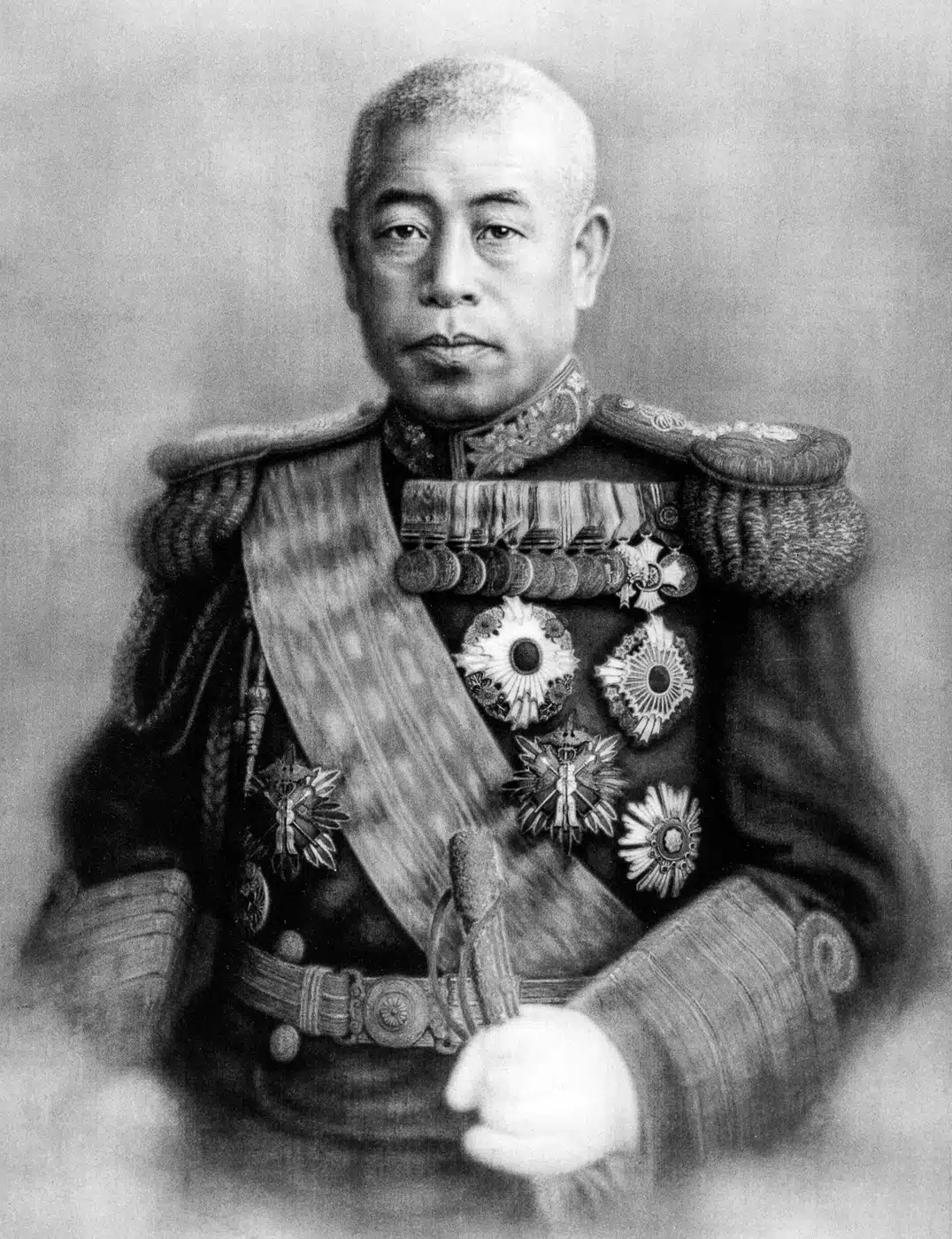
Known to the Allies under the code name “Betty”, the G4M that would be carrying Admiral Yamamoto was not a transport aircraft but rather a land-based medium bomber of the Imperial Japanese Naval Air Service.
The Mitsubishi G4M (Type 1) attack bomber had been in service for two years at the time of the Yamamoto mission and was much prized for its long range — 1,500 miles when carrying a bomb load, and up to 2,700 miles on a ferry mission. But the great range came at a price, and throughout its career the G4M was dogged by its light construction that allowed it to be easily damaged and ignited by gunfire.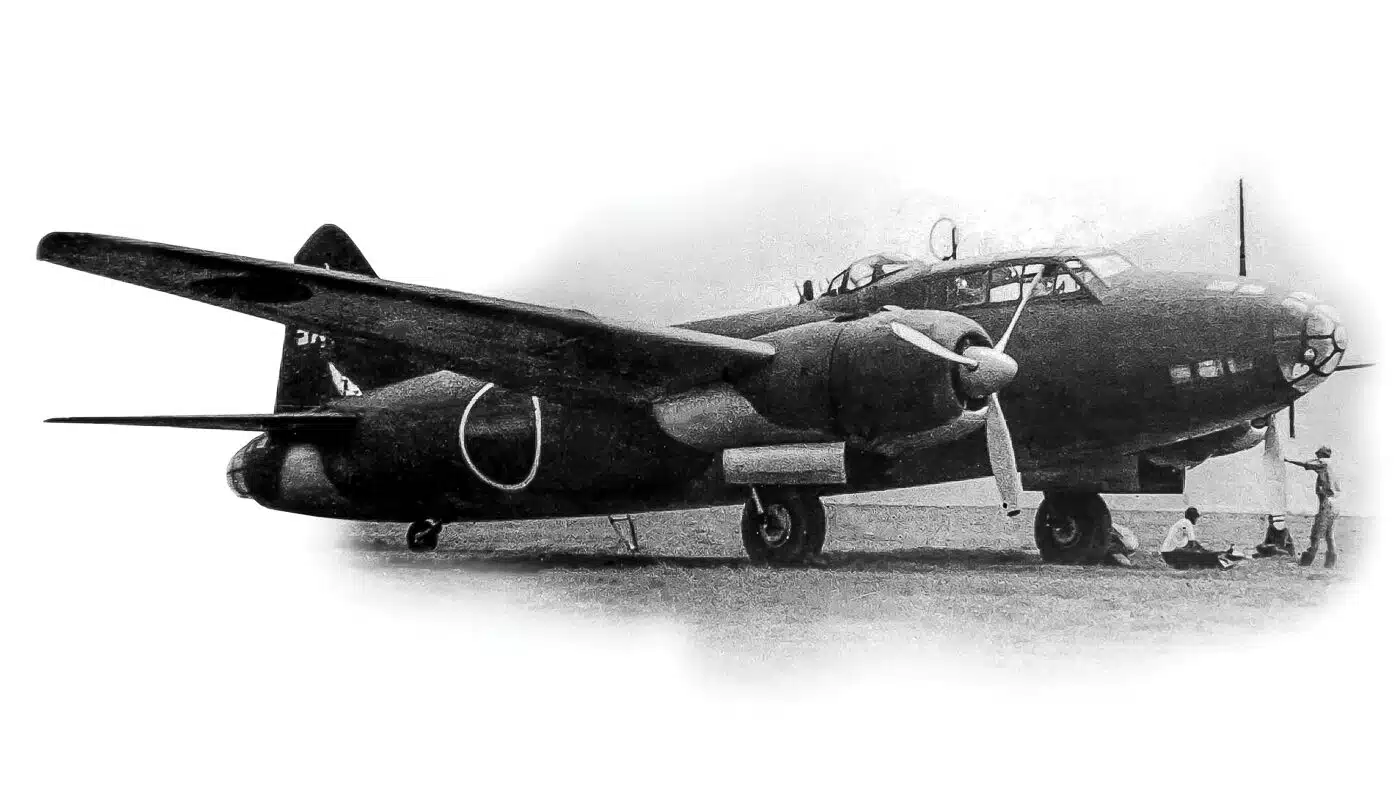
Early models lacked self-sealing fuel tanks, and Allied pilots called the Betty the “Type 1 Lighter” or “The Flying Zippo”. There was little or no armor protection for the crew, the fuel tanks or the engines.
Even so, the G4M squadrons had their share of success in the first year of the war, including the participation in the destruction of the battleship HMS Prince of Wales and the battlecruiser HMS Repulse in December 1941, along with the heavy cruiser USS Chicago in January 1943.
Seizing the Moment
At first, American intelligence officers had a hard time believing that the Japanese would be so cavalier as to transmit such a message, even if it was encoded. But additional code-breakers stationed in Alaska and Hawaii also intercepted that message, deciphering it to reveal the same details.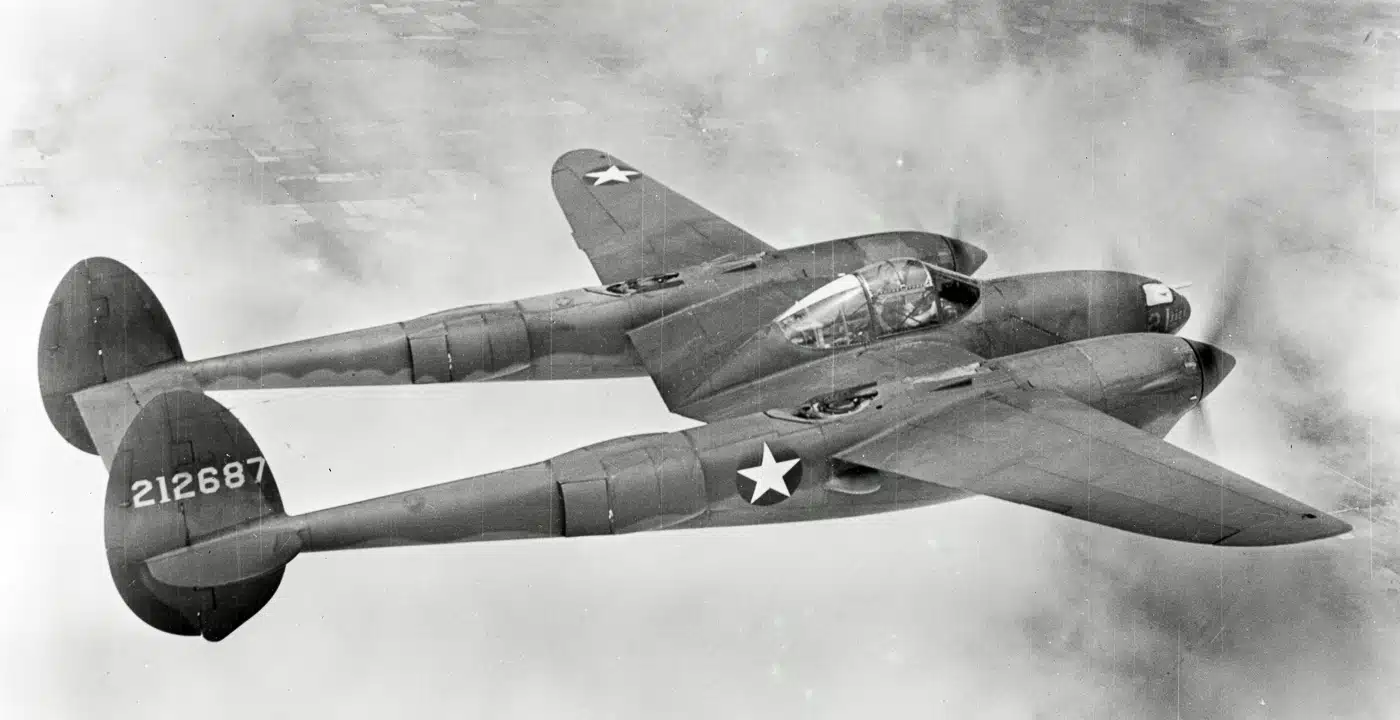
The significance of this intelligence windfall would have been hard to overstate. U.S. armed forces had ample motivation to remove one of Japanese most important chess pieces from the board, and Admiral Nimitz made the call. He judged that the opportunity to terminate Yamamoto and seriously damage the Japanese navy, as well as Japan’s overall morale, was worth the risk of tipping off the enemy that their codes had been broken.
As a code name, “Operation Vengeance” seemed fitting for the mission. Vengeance was clearly on everyone’s mind among America’s military and political leaders. The pain of Pearl Harbor was still fresh, and Admiral Nimitz received permission to proceed from Secretary of the Navy Frank Knox.
Once cleared on the mission, Admiral Nimitz reached out to Vice Admiral William “Bull” Halsey, commander of the South Pacific Area. It was soon determined that there was only one American interceptor that was truly capable of performing this mission, and it was relatively new to the Pacific theater. That plane was the Lockheed P-38 Lightning.
Halsey immediately called upon the U.S.A.A.F. 339th Fighter Squadron based at Henderson Field, Guadalcanal, to handle the interception. Detailed plans for the mission were calculated and mapped out immediately. Vengeance was soon to come, and the Lightning would play an integral part in the mission.
The Right Tool
The P-38 became operational with the 5th Air Force in early March 1943. In that same month, the U.S.A.A.F. prepared a report titled “Tactical Suitability of the P-38F Airplane”, which contained the following information that would be of critical importance during the mission to intercept Yamamoto.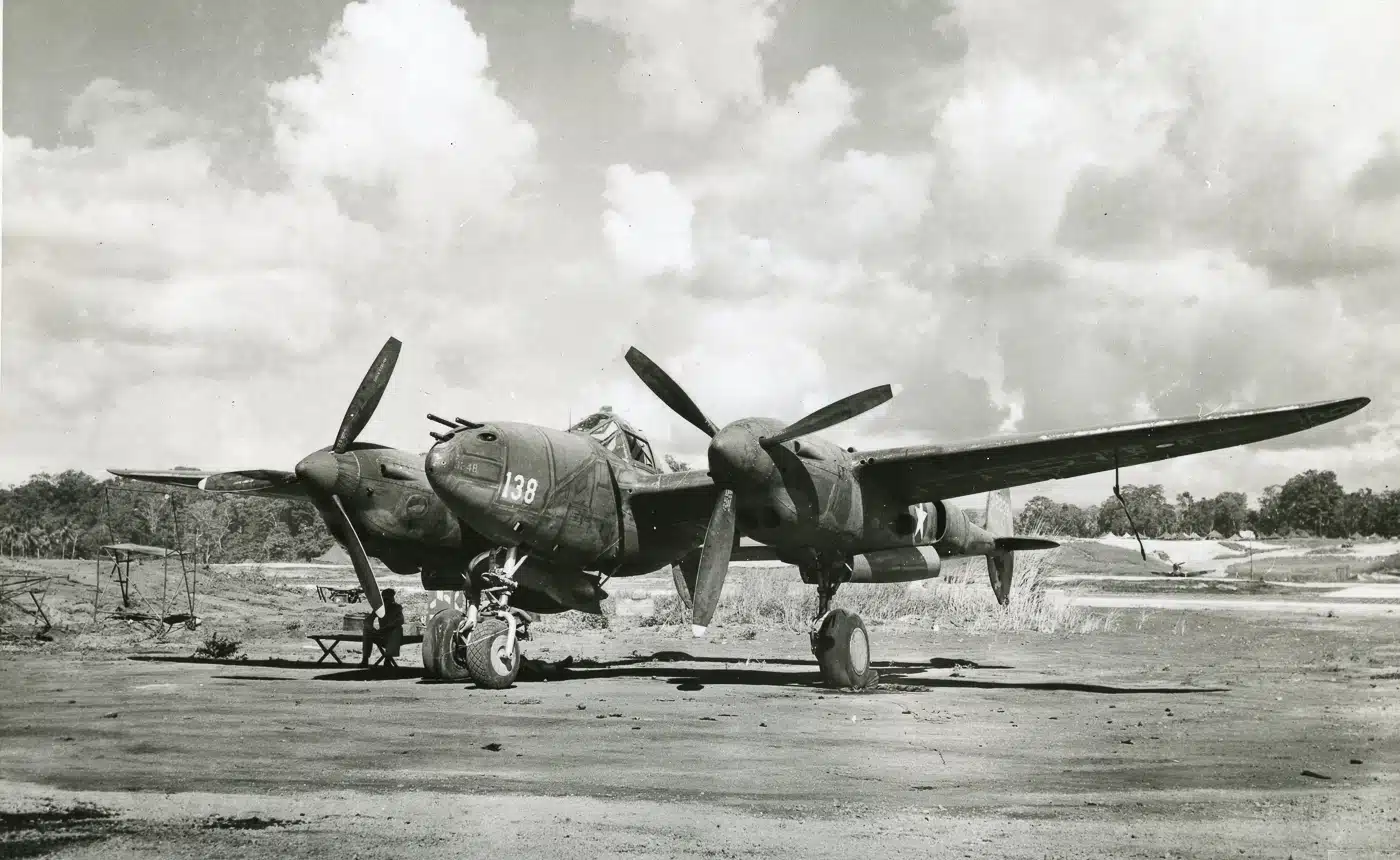
“The visibility over the nose is satisfactory for deflection shooting, but the armor plate window and gunsight obstruct the forward vision for search. To the sides, the view downward is limited by the position of wings and engines, and searching below will have to be accomplished by banking the airplane from side to side. The search view on both sides is greatly obstructed by metal strips where the canopy joins the window. The view to the rear is limited by the boom and rudders, and rear armor plate.”
One of the men who would play a prominent role in the mission, Captain Thomas Lanphier, was interviewed after the mission for a confidential article in a Bureau of Aeronautics publication. The following excerpts provide some insight into how the P-38s were used in their early deployment, and what the combat pilots thought of them:
“P-38s are rugged, they take a lot of punishment. Apparently, they’re vulnerable only in the engine. The pilot is pretty well protected. The Japs thought the P-38s were the best planes they were running into.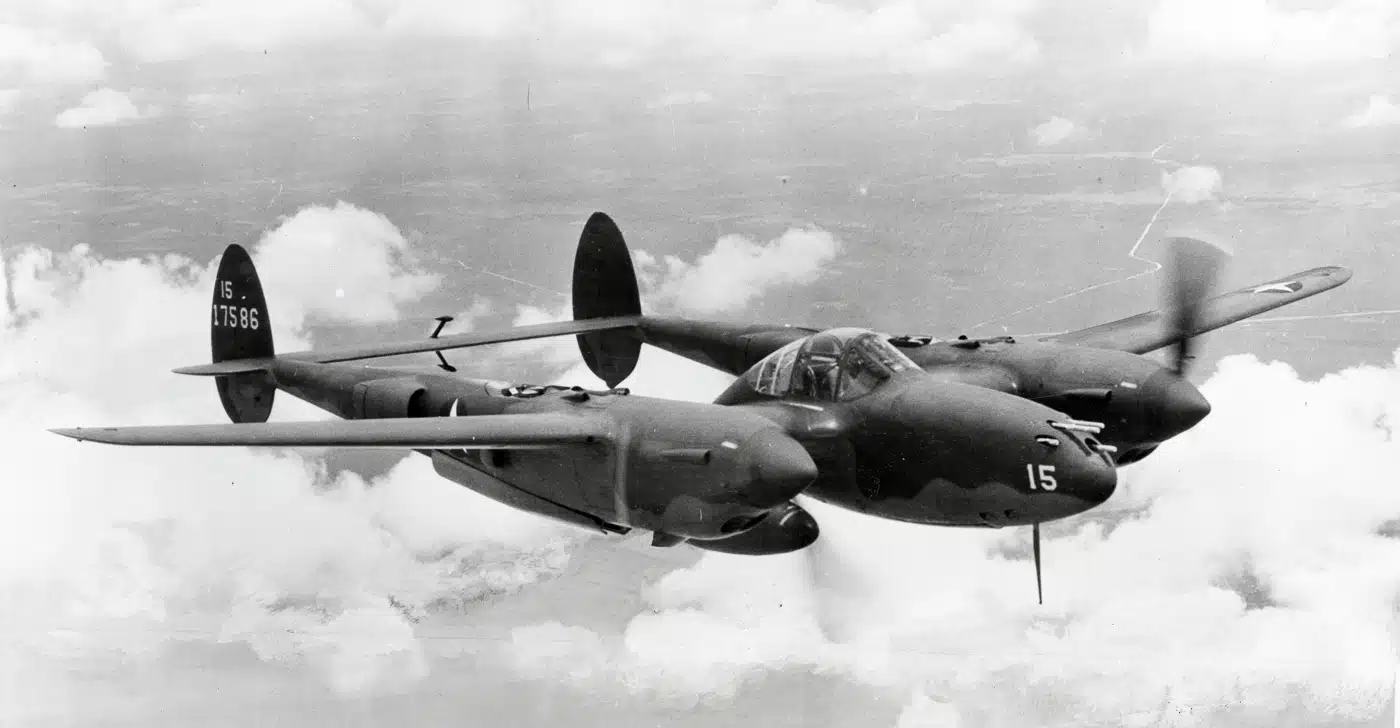
“The firepower, four .50-cal. Machine guns and a 20mm cannon, is quite satisfactory. The cannon uses all explosive ammo. The four .50s flying right straight up made a splendid concentration of firepower.
“When … (new pilots) … have flown the planes and learned how stable they are, how well the pilot is protected, what a lot of damage can be dealt out with them — in other words, once they get on a flight — they’re okay. It doesn’t take very long for the ordinary American kid to catch on.”
Regarding Japanese fighter tactics, he had the following to say:
“The Japanese continue to fly as they always have, react the same way to an attack, and do the same fundamental things. I’ve never run into one who, when attacked from behind, would cut his throttle.
Their planes, I should think, would stop abruptly if they’d cut the throttle and we’d overshoot them. Some of them are smart enough to pull off to the side, but that is usually taken care of by our wingman. Generally speaking, they still pull right up in the air, or roll upside down and go straight down, which puts them out of the fight. The Japanese pilots coming over are not so smart as they used to be; they are probably running into the dregs now.”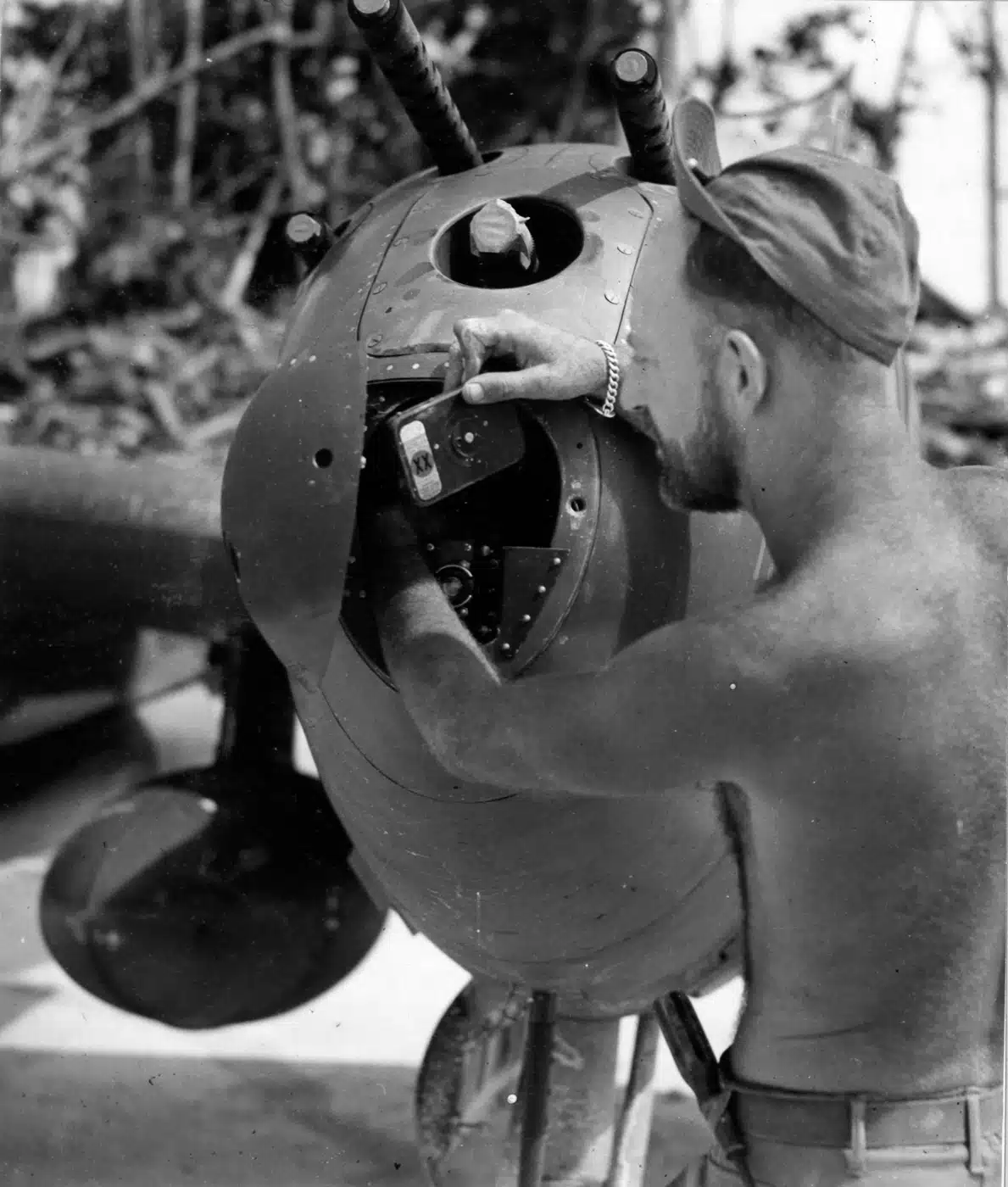
On P-38 tactics against Japanese fighters, he stated the following:
“I had a four-plane section which had flown together for about a year, which is unusual for the Army. Each of us felt very responsible for the others; I was responsible for my wingman, and he was for me. We never had occasion to use any evasive maneuvers; we were never surprised from behind.
We had planned that if we were completely surprised and had to get out in a hurry, we would pull off in a dive and scissor the way naval aviators do in the dive, except we would endeavor to pull off sideways and back. We try to stay in a ball within a mile area, each keeping his wingman in sight.
“The leader, being the ranking man, has the first chance to shoot. The wingman, although he also wants to shoot down enemy planes, suppresses that desire until the leader has taken care of his target. Then it is the wingman’s chance, with the leader protecting him. We operate that way — just two fellows working together. It is the leader’s responsibility, however, to keep the two pairs of planes in proximity to each other.”
When asked if he goes head-on against Zeros:
“I only got two head-on passes. If the Zeros saw there was a chance of us getting around them, they’d turn and go off. We couldn’t seem to get them to tangle with us. The P-38 is a very maneuverable plane despite its size.”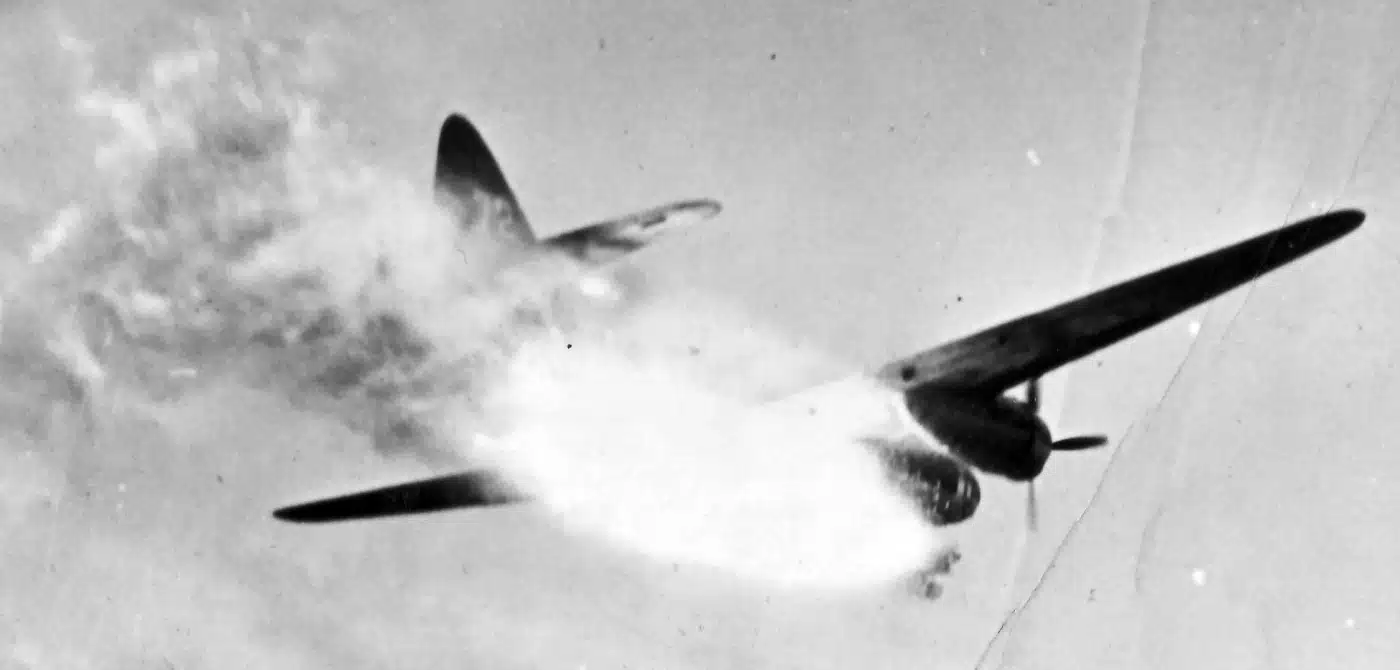
Regarding new pilots, he had this to say:
“New pilots are very cocky and independent when they first arrive. For instance, a big ex-All-American football star looks at the combat pilot to whom he has been assigned for training and asks: ‘That little bird, what does he know? Am I supposed to follow that little weasel?’ Some of the most experienced pilots have ‘baby faces’ and quiet manners, which seem incompatible with their exploits.”
When asked about the P-38’s maneuverability in combat, Lanphier stated:
“We had some trouble fighting Zeros. We can’t turn and approach as fast as they can. Some of us used our flaps and slowed up, staying behind the Zeros when they turned and then turning underneath them. That was frequently effective. If we had planned an attack on bombers, I think I would have my people dive with the flaps (making an overhead approach and using the flaps to keep slow until making a run), then fold the flaps and dive. We can turn inside the Grumman with the flaps.”
Lightning Strikes
So, it was determined what plane would perform this mission, and the men who would fly them. However, distances and hurdles involved in pulling off such a daring mission were extremely daunting.
In a straight line, the range from Guadalcanal to Bougainville was 400 miles. However, there were several Japanese radar stations in the area, plus plenty of coast watchers ready to identify inbound American aircraft and sound the warning. Postwar investigation showed that several Japanese officers at Rabaul strongly advised the admiral to call off his inspection tour — fearing an American attack. Regardless, Yamamoto kept to his schedule.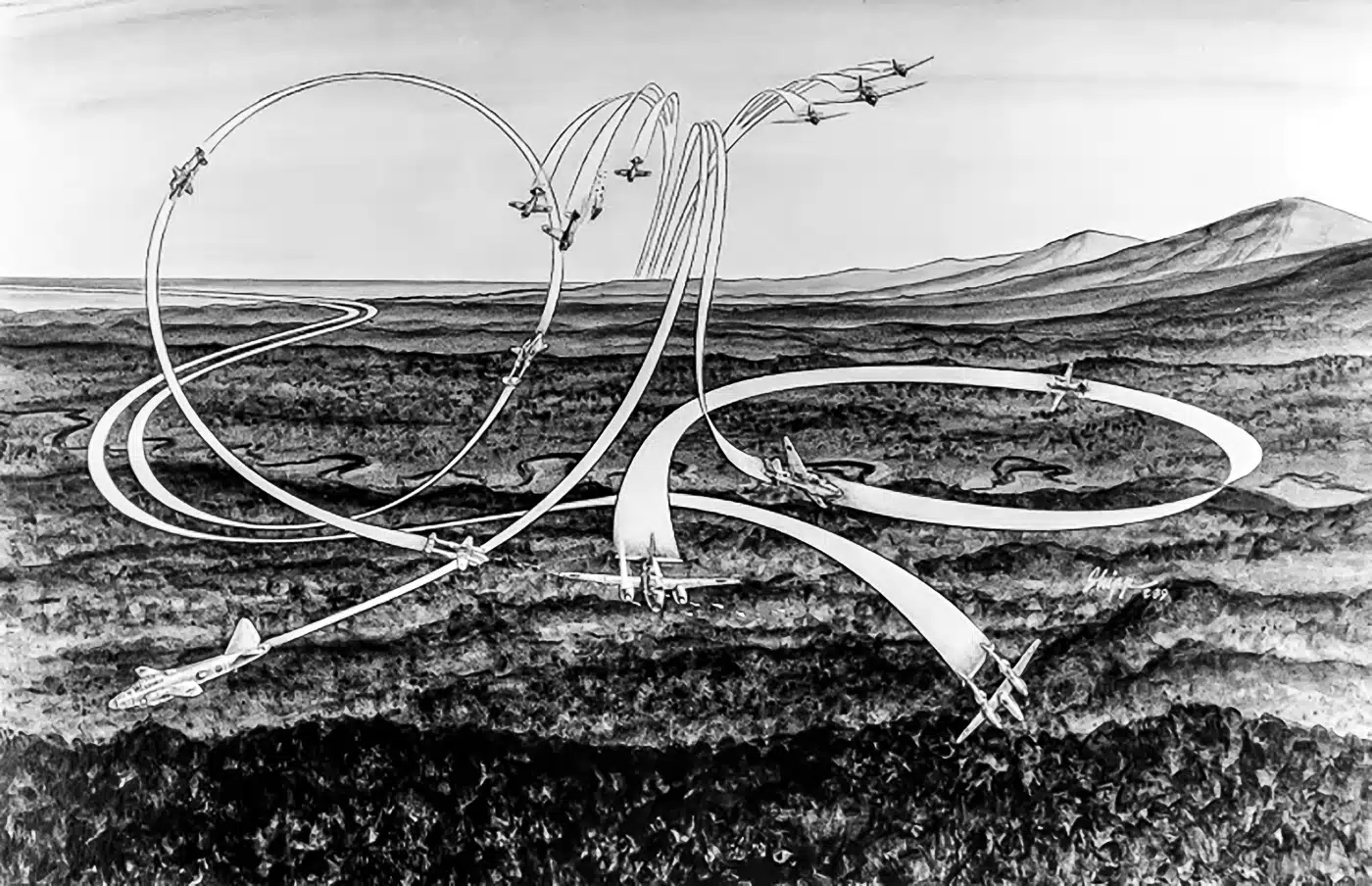
Major John Mitchell, leader of the mission, plotted an interception course that would take the 339th Squadron P-38 fighters out to sea and then back again, to emerge over Bougainville as the admiral arrived at 9:35am. The circuitous route would total 1,000 miles: 600 miles on the outward leg (at about 50 feet over the water), and 400 miles for the return flight. Extra fuel was allocated for the expected dogfights.
To make sure the P-38s had enough avgas, one of the two standard 165-gallon external fuel tanks was replaced with a 330-gallon tank. Despite the unbalanced weight in the P-38’s midsection, the fighters flew without problems.
A total of eighteen P-38s would carry out the mission, with four of them designated as the “Killer Flight”. Major Mitchell and the other 13 Lightnings would fly top cover, prepared to fight off the expected Japanese escort fighters. The plan called for the killer flight to consist of Lieutenants Thomas Lanphier, Rex T. Barber, Jim McLanahan and Joe Moore.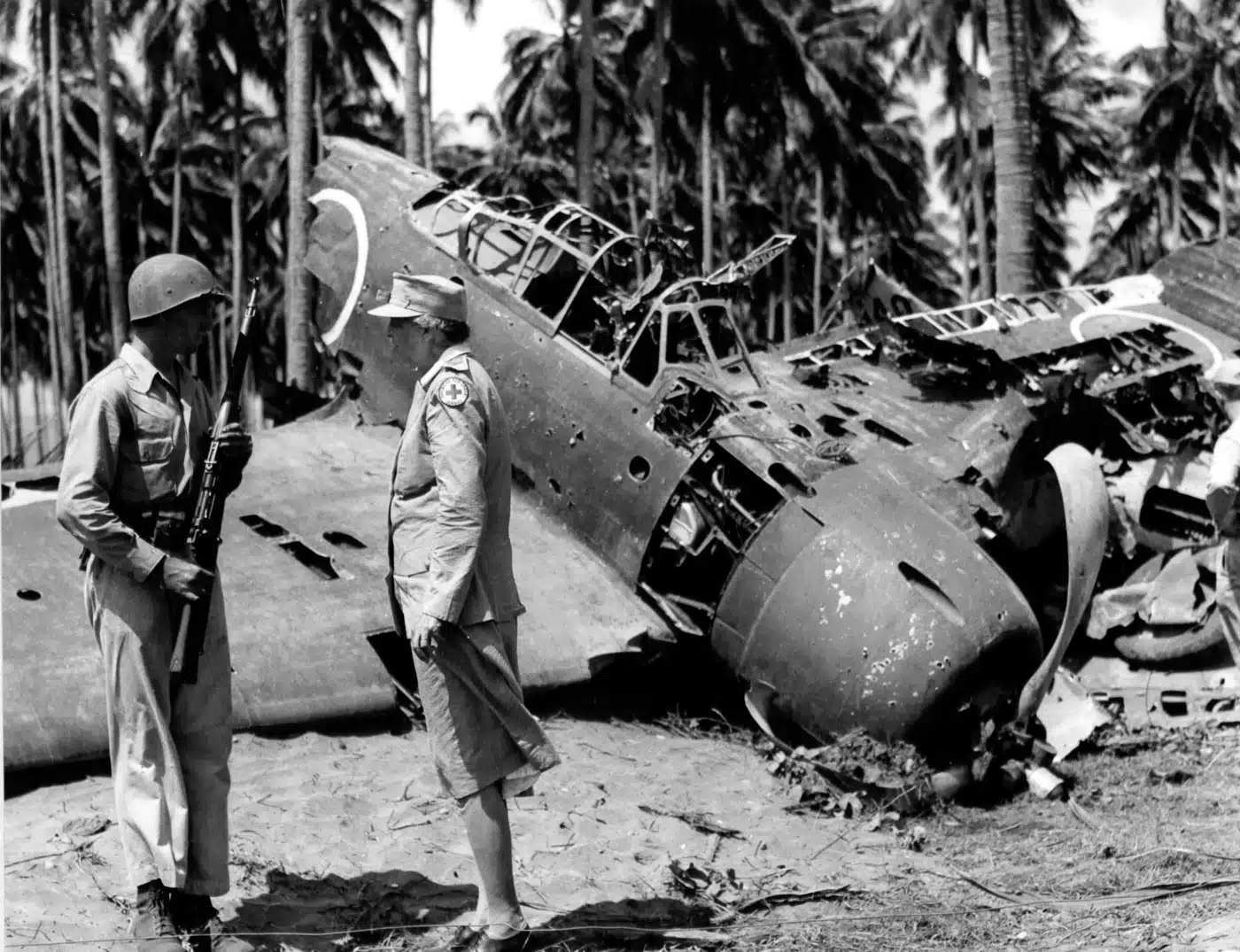
Troubled brewed early, as McLanahan did not make the flight with a flat tire, and Moore dropped out with a fuel line problem. Lieutenants Besby Holmes and Ray Hine moved in to take their places. After this initial complication, everything went completely to plan.
On April 18, the P-38s took off from Kukum Field at 07:25, Guadalcanal time. Major Mitchell’s dead reckoning navigation was outstanding. The Lightnings reached the interception point about a minute early (at 09:34) and immediately saw the two G4M bomber/transports descending through a light haze. The P-38s jettisoned their tanks, turning and climbing into the bombers.
Thomas Lanphier and Rex Barber turned in behind the diving G4M bombers. The four Browning .50-cal. AN/M2 machine guns and 20mm M2 cannons in the Lightnings’ central nacelles tore apart the first Betty’s right engine and sent shells crashing the length of the bomber’s fuselage. The plane suddenly flipped over and, when Barber looked over his shoulder, he saw a smoke trail that terminated in the Bougainville jungle. This Betty turned out to be Yamamoto’s plane.
At that moment, the second bomber was low over the water near Moila Point, under the guns of Besby Holmes and Ray Hine. Both pilots scored some hits on the Betty, but their speed carried them past the target. Rex Barber dove and picked up the chase, and he also scored some hits on the second bomber, which soon bellied into the water at high speed. Remarkably, Yamamoto’s Chief of Staff, Vice Admiral Matome Ugaki and two other passengers survived the violent crash and were rescued.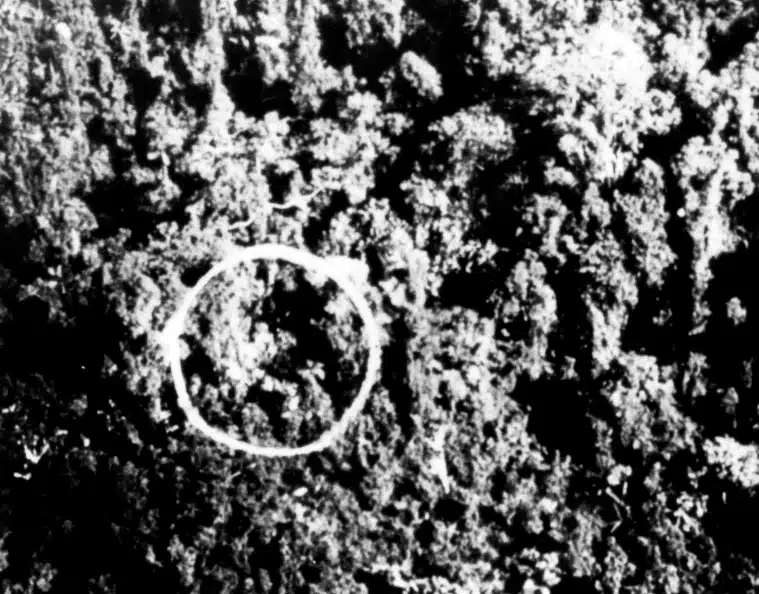
By this point, the Japanese escort fighters were on the scene and Rex Barber’s and Ray Hine’s P-38s received damage — but all the Lightnings exited the interception area.
A Navy PBY Catalina patrol plane encountered Ray Hine on his trip home. The PBY noted his damaged P-38 (one engine feathered) and offered to pick up the pilot if he preferred to ditch. Hine asked for a compass bearing and headed towards Guadalcanal. Unfortunately, he never arrived, and no trace of his aircraft was ever found. He was the only American lost on the mission.
As for Admiral Yamamoto, a Japanese search party found his body near the crash site of the first Betty downed — thrown clear from the wreck but still in his aircraft seat, his hand on the hilt of his katana. He had been hit twice, once in the back of the shoulder and once in the head. The Japanese coroner on the scene concluded that Admiral was probably dead before the Betty hit the ground. Japanese media reported that he “met a gallant death aboard a warplane”.
The Kill Controversy
When Thomas Lanphier returned to Guadalcanal, he announced over a clear-channel radio frequency “I got Yamamoto!” as he entered the landing pattern. This was a major breach of communications security and in violation of standard procedures. Many of the other interception flight pilots reported that they heard him make the claim over an open line.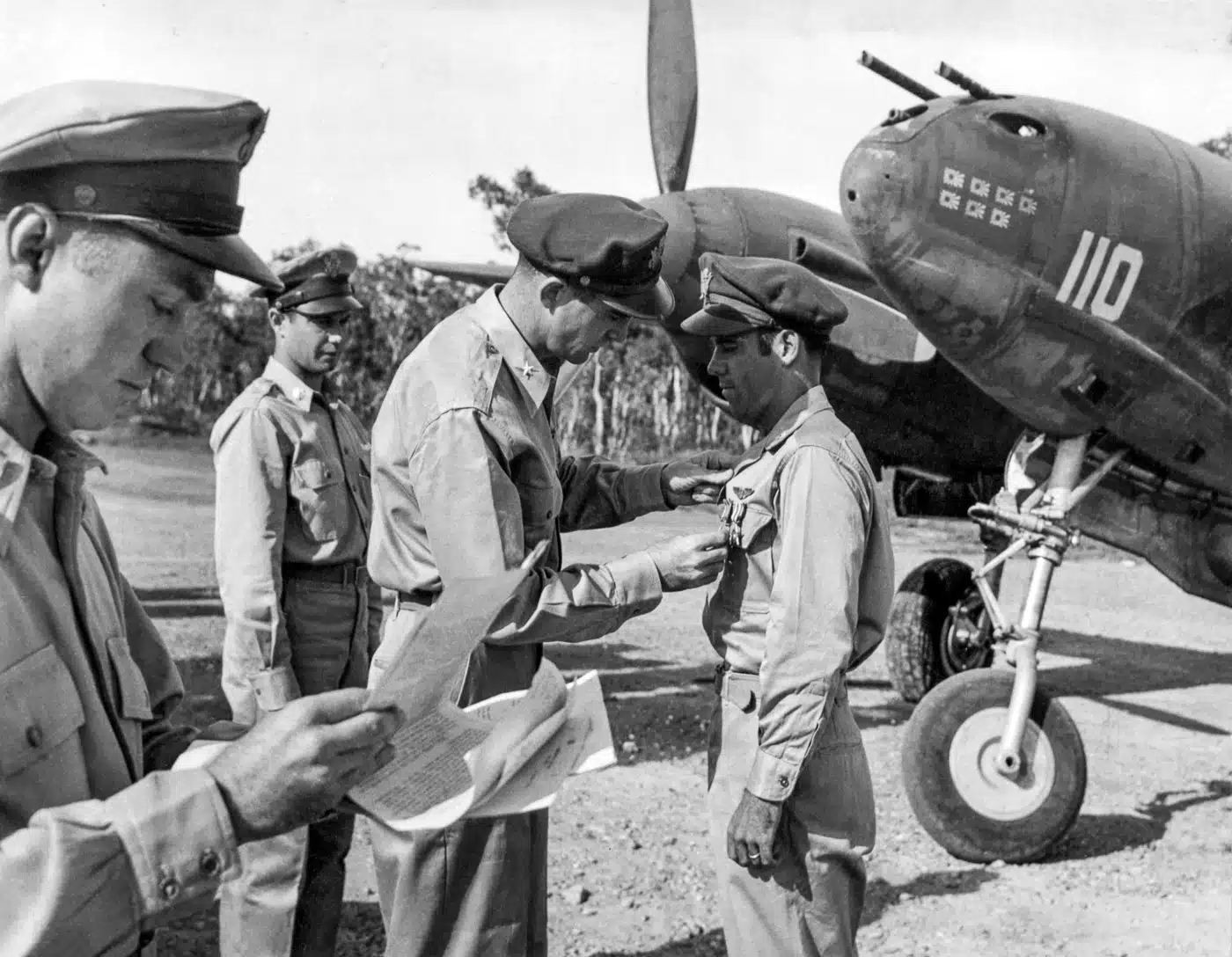
It was Lanphier who wrote the Fighter Interception Report, which described his own actions in glowing terms as being involved in the shootdown. It however did make specific mention that Rex Barber was involved in shooting down a Betty bomber.
While the report mentioned the downing of three of the Zeros (one claimed by Lanphier as well), Japanese records show no losses among their escort fighters — just the two G4M bombers downed.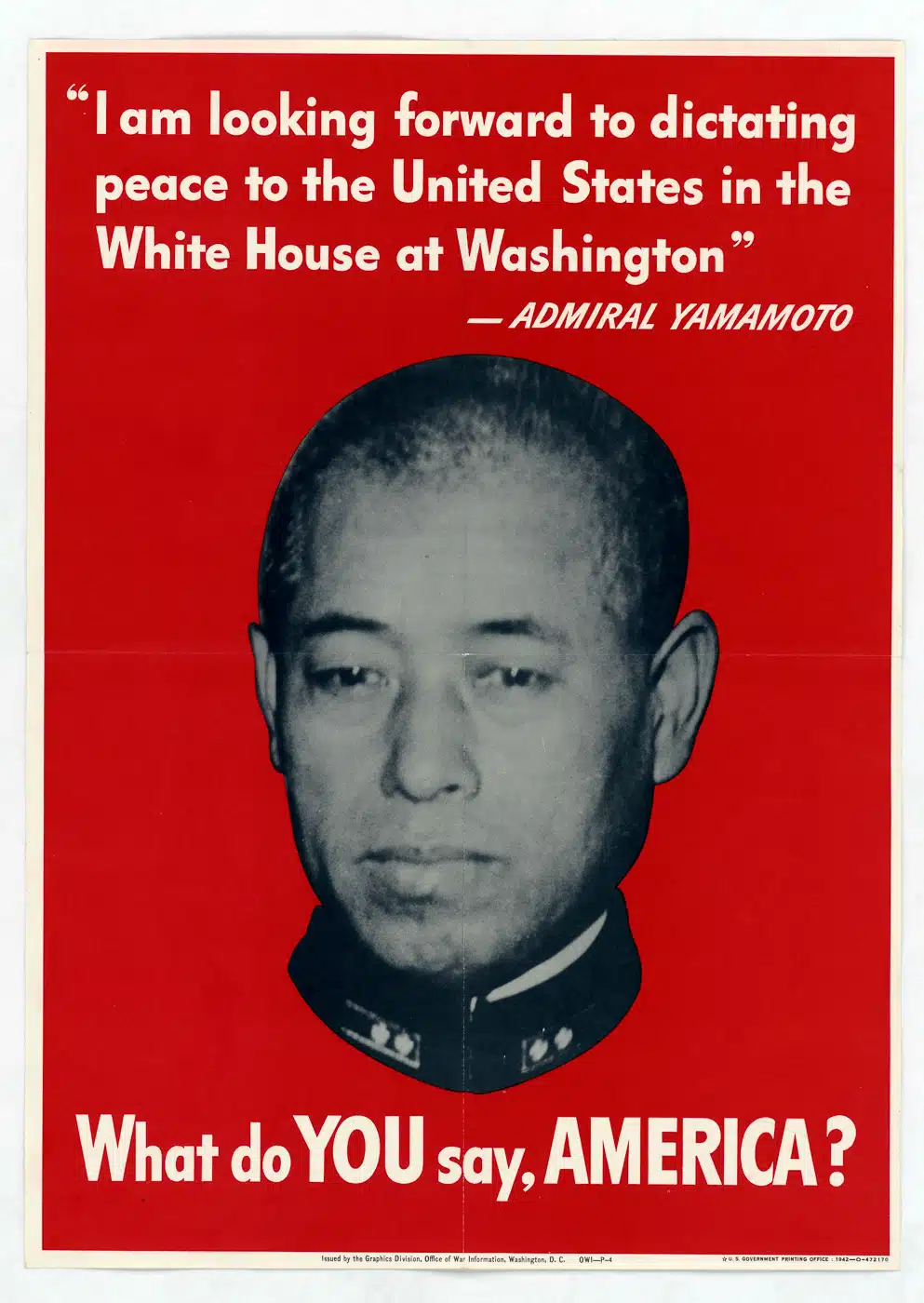
Kill claims have been frequently disputed since the beginning of air-to-air combat. The Yamamoto interception has been reviewed in detail several times since the war, and most of the evidence points to Rex Barber as the pilot who was responsible for taking down Yamamoto. All the pilots in the killer flight received the Navy Cross.
Thomas Lanphier was a skilled and experienced combat pilot, and whether he actually did or simply believed he shot down Yamamoto makes no difference in the final equation. The architect of the Pearl Harbor surprise attack, the day that would live in infamy, was dead. Operation Vengeance was a success.




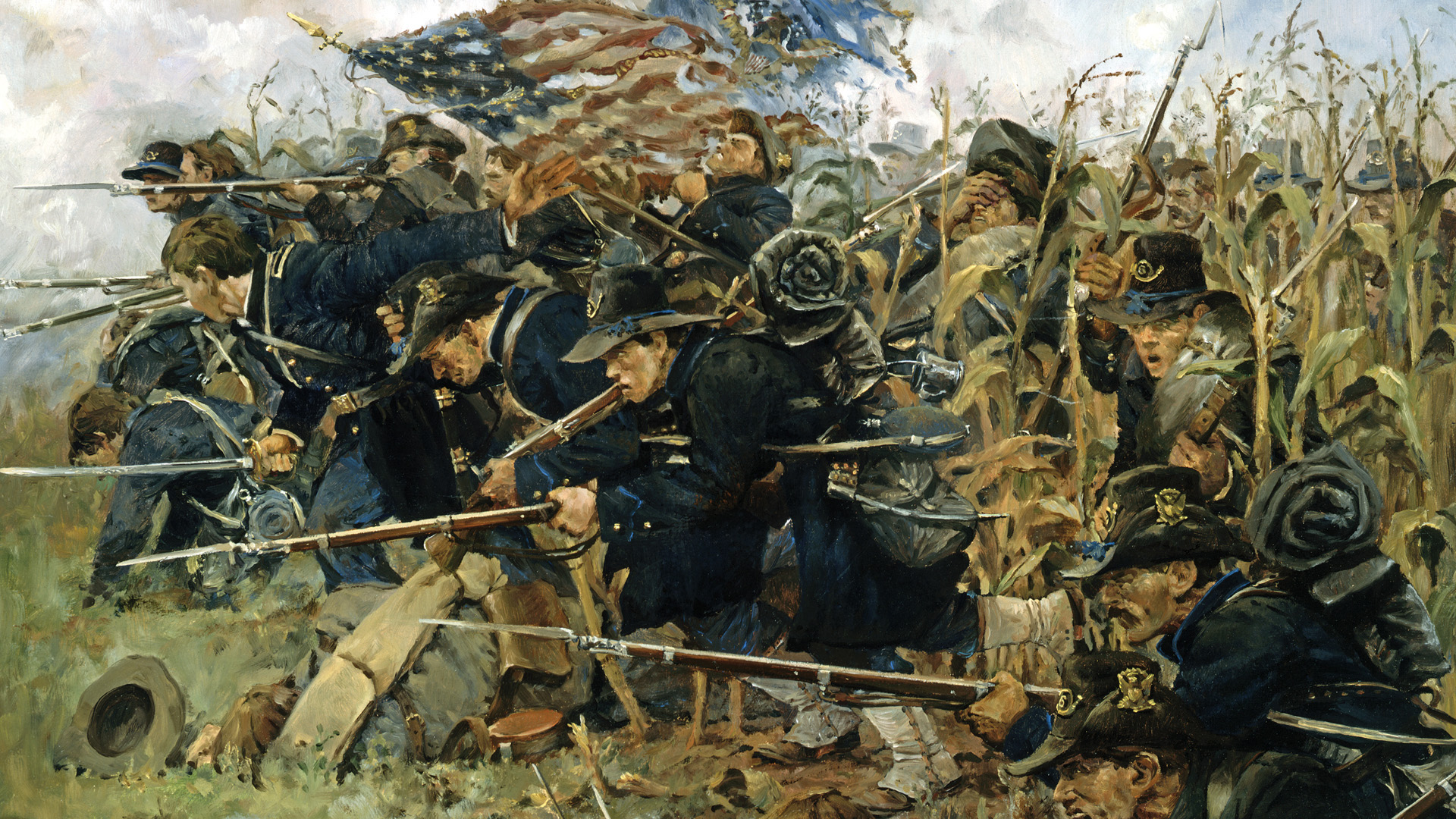
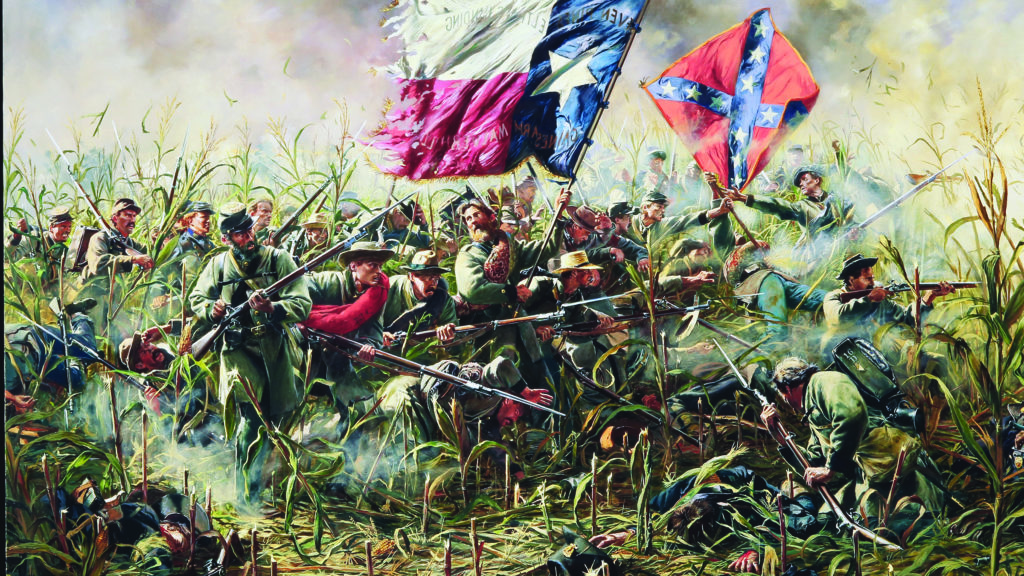

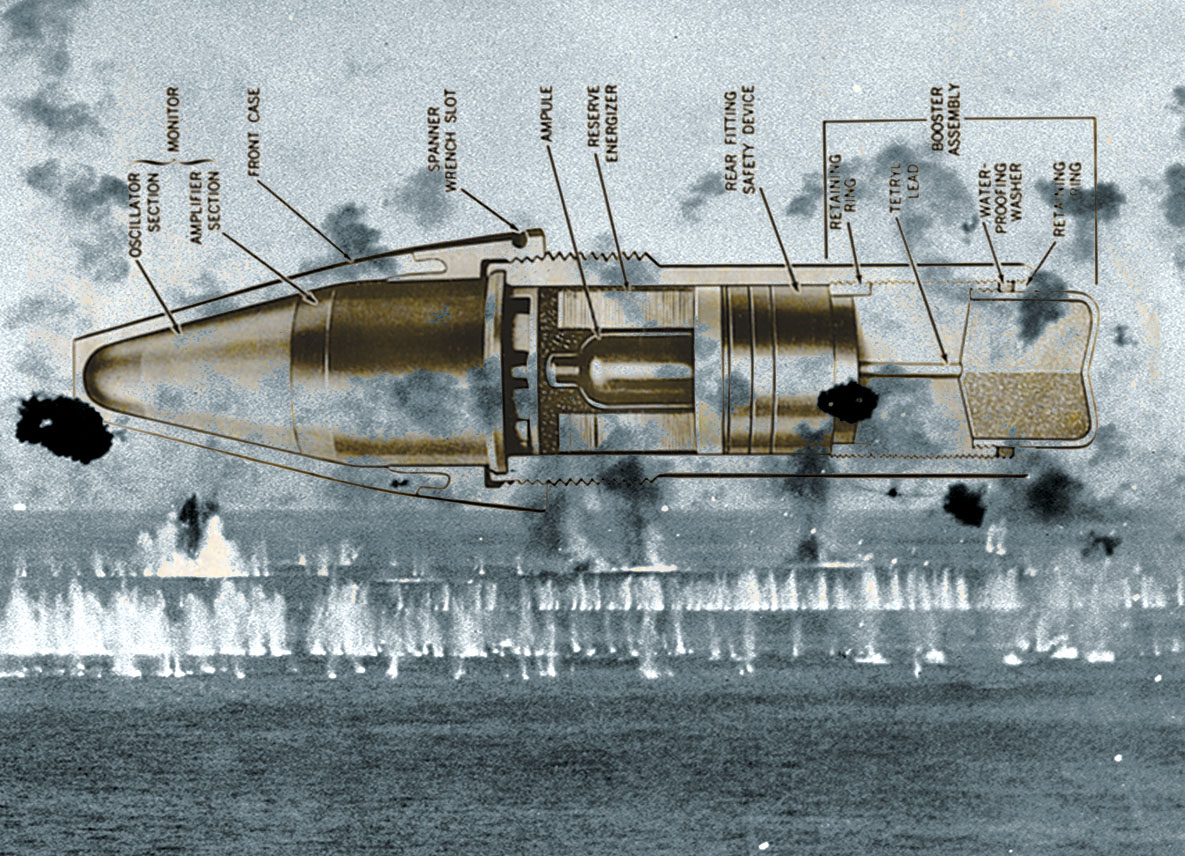
An engineering triumph developed under strict wartime secrecy, the proximity fuze vastly increased the lethality of anti-aircraft guns and field artillery.
On the morning of Jan. 5, 1943, four Japanese Aichi D3A dive bombers surprised a U.S. Navy task force operating off Guadalcanal. Though slow and obsolete, the D3A (Allied reporting name “Val”) remained a threat due to its accuracy and durability. One scored a hit on the attached New Zealand light cruiser Achilles before the group broke off its attack. Almost as an afterthought anti-aircraft (AA) gunners aboard the cruiser USS Helena unleashed a cursory barrage on the departing Vals.
Helena’s AA defenses comprised a dozen 5-inch guns plus short-range 20- and 40 mm guns. Two 5-inch salvos downed one of the Vals––without directly hitting it. Instead, at least one of the cruiser’s shells passed close enough to the dive bomber to detonate and fatally damage the aircraft with a blast of shrapnel.
Though it received no public attention at the time, the engagement marked a transformative moment in the history of artillery and aerial warfare—the first time an enemy aircraft was deliberately brought down by a near-miss.
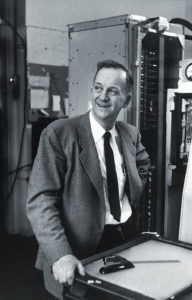 Dr. Merle Tuve / Getty Images
Helena’s 5-inch guns were the first to fire a revolutionary type of projectile in action. The shells incorporated a proximity fuze, or, as it was then deceptively named, a variable time (VT) fuze. The combat success by Helena’s gunners was the desired outcome of a years-long technological, industrial and military endeavor involving scores of researchers and more than 100 factories nationwide. By war’s end an army of workers had assembled and installed more than 22 million innovative fuzes of the type—each containing about 130 miniaturized electronic parts––at a cost of over $1 billion in 1940s dollars (roughly $15 billion today).
The combat effects of the fuzes, whether used in shells fired from AA guns or land-based artillery, were immediate, destructive and demoralizing to enemies. The program remained a closely held secret throughout the war, so Japanese and German recipients of such fire never realized why Allied artillery suddenly became so uncannily accurate and deadly.
World War I had proved an object lesson in the power and effectiveness of aerial warfare. Given such technological leaps, the concept of a proximity fuze was attractive—and deceptively simple. Germany sought to develop such a fuze for artillery and bombs in the early 1930s and persisted in its efforts through World War II, but ultimately concluded it was an impossible idea that would never be practical. Japan also worked to develop a fuze and actually achieved a workable version. But they fielded it too late in the war to be decisive and deployed it exactly once—in a dropped bomb.
British scientists started work on a proximity fuze in the late 1930s and solved enough of the inherent problems to test marginally effective prototypes. Their effort was stymied by cost overruns and the twin challenges of miniaturized components and adaptability for mass production. With the war on their doorstep, they shared their research and began cooperating with the ongoing American fuze project.
Founded in the summer of 1940, the U.S. National Defense Research Committee (NDRC) served as a link between the National Academy of Sciences and the Pentagon. Chairing the committee was eminent MIT-educated electrical engineer and inventor Vannevar Bush, who had proposed formation of the NDRC to Franklin D. Roosevelt. The president reportedly approved the concept within minutes.
To solve the branches’ myriad military problems, the NDRC turned to various specialized sections. Section T was tasked with creating a workable proximity fuze for large-caliber artillery. Fortunately, in August 1940 the section came under the able direction of Merle Tuve, an accomplished and innovative physicist at the Carnegie Institution of Washington. Under Tuve’s astute leadership, a handful of scientists and engineers explored how such a device might be conceived and produced.
The project soon progressed beyond the institution’s capacity. A new research and development facility—dubbed the Applied Physics Laboratory (APL)—was established under the aegis of Johns Hopkins University. The primary military client for its research was the Navy, which was especially concerned about the vulnerability of its ships to aerial attack—a concern vividly borne out by Japan’s devastating 1941 attack at Pearl Harbor, Hawaii.
The urgency to develop a practical artillery fuze that did not depend on time-to-target calculations or even physical contact with a target was obvious to everyone familiar with the limitations of traditional AA artillery. Gunners of the time conceded that bringing down a small, fast-moving and high-flying aircraft was mostly a matter of luck. Period studies showed that statistically a direct hit might occur in one out of some 1,200 AA projectiles fired. Luck indeed!
Adm. Arleigh Burke, who in 1942–43 commanded a fleet of U.S. destroyers in the Solomon Islands campaign, wrote after the war about the difficulties of defending against Japanese air attacks, especially after dark. “Mechanical time fuzes which we had been using only brought down a plane at night by accident,” he recalled. “[They] were good for harassing enemy aircraft at night, but that was about all.”
In their effort to develop a workable VT fuze, Section T’s scientists, engineers and ordnance experts faced a laundry list of challenges:
To create an optical, magnetic or electronic feedback mechanism that signaled “detonate” to an artillery shell moving at an initial speed of 2,600 feet per second at the moment it neared an enemy aircraft traveling at 300 miles per hour.
To fit a radarlike radio (transmitter and receiver) device into a 5-inch projectile only 20¾ inches long and already packed with 7 pounds of high explosive.
To miniaturize such an electronic device to fit the volume of a pint milk bottle in an era when no one had imagined transistors or integrated circuits.
To develop a battery of sufficient power and durability to operate the fuze and function in temperatures ranging from 100 degrees to minus 50 degrees.
To develop a fuze able to withstand the impact of being fired from a 5-inch gun—a shock of acceleration equal to 20,000 times the force of gravity—as well as the spinning projectile’s centrifugal force of 500 revolutions per second.
To incorporate safety features to enable safe handling and prevent accidental detonation.
To craft a fuze adaptable for use in a range of U.S. and British weapons.
To engineer a design for rapid, high-quality mass production—well into millions of units, with components sourced from a multitude of American factories.
Given such requirements, it is small wonder sophisticated nations gave up the proximity fuze as a technological dream beyond their research and production capabilities. Yet it turned out solutions to the challenges were not beyond the reach of American scientists, engineers, inventors, technicians, ordnance experts and mass-production manufacturers. They actually did it.
Tuve’s team, which assembled first at Carnegie and then at the new APL in nearby Silver Spring, Md., assessed the options and settled on devising a radarlike radio device. But how to make one small enough? At the time there was no such thing as solid-state electronic circuitry. Radios utilized bulbous glass vacuum tubes. While miniature vacuum tubes were used in hearing aids, they were in no way suitable for use in artillery shells.
Thus the development of miniature glass vacuum tubes that could withstand being shot from a gun became a top priority of physicist James Van Allen (who later discovered the planetary radiation belts that bear his name).
That took nearly a year of research, experimentation and field testing using a series of powerful guns and explosives.
Meanwhile, APL researchers were refining the transceiver circuitry originally devised by the British scientists, and the National Carbon Co. was developing a workable power supply. (A pioneer manufacturer of dry cell batteries, National Carbon morphed into Union Carbide and Energizer, among other spin-offs.) Refinements of other electronic components and devices continued through the summer and fall of 1941, as such tech companies as Sylvania and the Radio Corp. of America (RCA) got involved.
The wartime urgency felt by those working on the fuze project was starkly expressed in a series of dictates posted on the laboratory walls by Tuve, Section T’s no-nonsense and highly motivated chief:
I don’t want any damn fool in this laboratory to save money. I only want him to save time.
Shoot at an 80 percent job; we can’t afford perfection.
Don’t try for an “A”; in a war “D” is necessary and enough, but an “F” is fatal.
The best job in the world is a total failure if it is too late.
Our moral responsibility goes all the way to the final battle use of this unit; its failure there is our failure, regardless of who is technically responsible for the causes of failure. It is our job to achieve the end result.
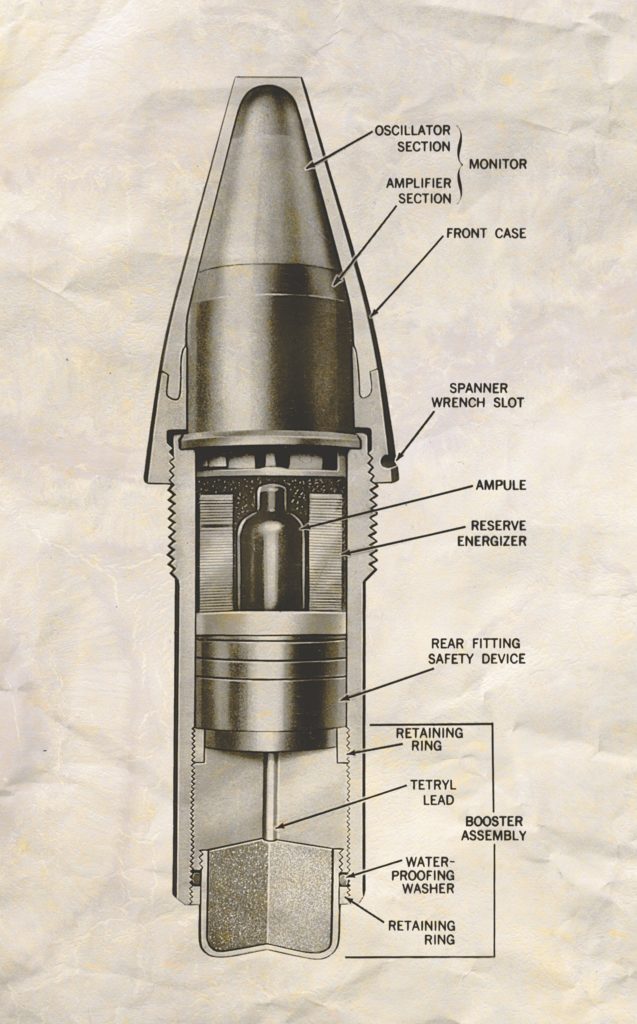
The fuze ultimately developed by Section T and its cooperating organizations employed a miniature radio transmitter and receiver with an amplifier. It included a thyratron trigger, a gas-filled tube that functioned like an electronic switch. It also employed battery-powered safety gear to prevent an accidental detonation.
Once the projectile was underway, the transmitter sent out a continuous radio signal that bounced back from the moving target—similar to the way radar operates. The receiver detected the return signal, which increased in intensity the closer the shell approached its target.
Once the signal level passed a certain threshold, it activated the thyratron trigger, releasing an electrical charge stored in a capacitor. That charge tripped an electrical detonator that in turn set off the main explosive, which in 5-inch AA shells was ammonium picrate, known to ordnance experts as “Explosive D.”
One of the first tests of the configuration of tiny electronic components and dry cell batteries came on Jan. 29, 1942, when researchers had them installed in 5-inch projectiles and fired from a standard AA gun. Fifty-two percent of the launched fuzes activated successfully.
Though falling short of Tuze’s requisite 80 percent, that success rate was good enough that the Navy Bureau of Ordnance instructed the Crosley Corp. of Cincinnati, Ohio, to begin pilot mass production of the fuze. To cloak the significance of the device, the bureau vaguely named it the variable time fuze.
The following month National Carbon developed an improved wet cell battery. The size and shape of a fountain pen, it offered more stability and a longer shelf life by separating out the electrolyte fluid in a glass ampule. The shock of a muzzle blast would break the glass and release the electrolyte, which under the centrifugal force of the rotating projectile would flow out to stacked carbon and zinc plates, thus activating the battery––an ingenious solution. Tuze’s researchers worked tirelessly on ways to refine the fuze. To ensure a kill, it had to detonate the moment the target was within the effective 70-yard blast radius of a standard 5-inch AA projectile.
By the summer of 1942 Tuve and his team were ready to test the VT fuze under simulated combat conditions. On August 12 the newly commissioned light cruiser USS Cleveland, then on its shakedown cruise in the Chesapeake Bay, began a scheduled two-day live-fire evaluation of the new fuze. The targets were three drones—small aircraft under remote radio-control––all of which gunners brought down on the first day with just four bursts of proximity-fuzed AA and despite evasive maneuvering by the controllers.
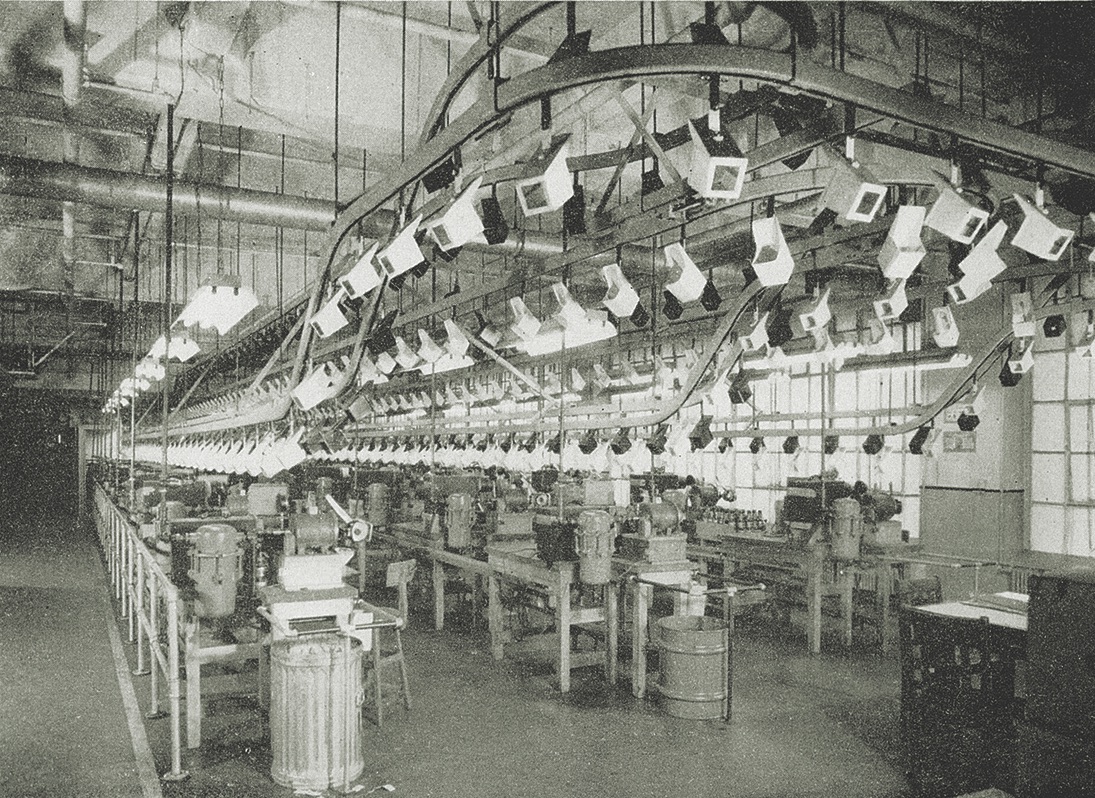
The Navy cancelled the remainder of the test and immediately started Crosley, RCA, Eastman Kodak, General Electric and McQuay-Norris on mass production of the VT fuze using the miniaturized glass vacuum tubes from Sylvania. Production was slow at first—by year’s end the companies were assembling just 500 units per day. By late 1943, however, the rate had risen to about 40,000 units daily, and by war’s end production had reached 70,000 units per day.
Developmental engineers continued to adapt the fuzes for use in varying calibers of American and British AA guns, as well as other naval guns. They also modified fuzes for installation in aerial bombs and field artillery pieces.
In practice that meant producing eight different fuzes for the U.S. Navy, 12 for the U.S. Army, four for the Royal Navy and six for the British army. As the proximity fuze proved itself in combat, demand grew. Eventually, some 70 versions of the device were in production, an undertaking that required continual testing, modification and assembly line changes.
The United States and Britain went to great lengths to ensure no examples fell into enemy hands. To that end the device was initially restricted for deployment to naval forces, largely ensuring enemy forces could not retrieve dud shells to examine and copy for use against the Allies.
IN 1943 VT-FUZED AA FIRE WAS CREDITED WITH MORE THAN HALF OF ALL JAPANESE AIRCRAFT DOWNED
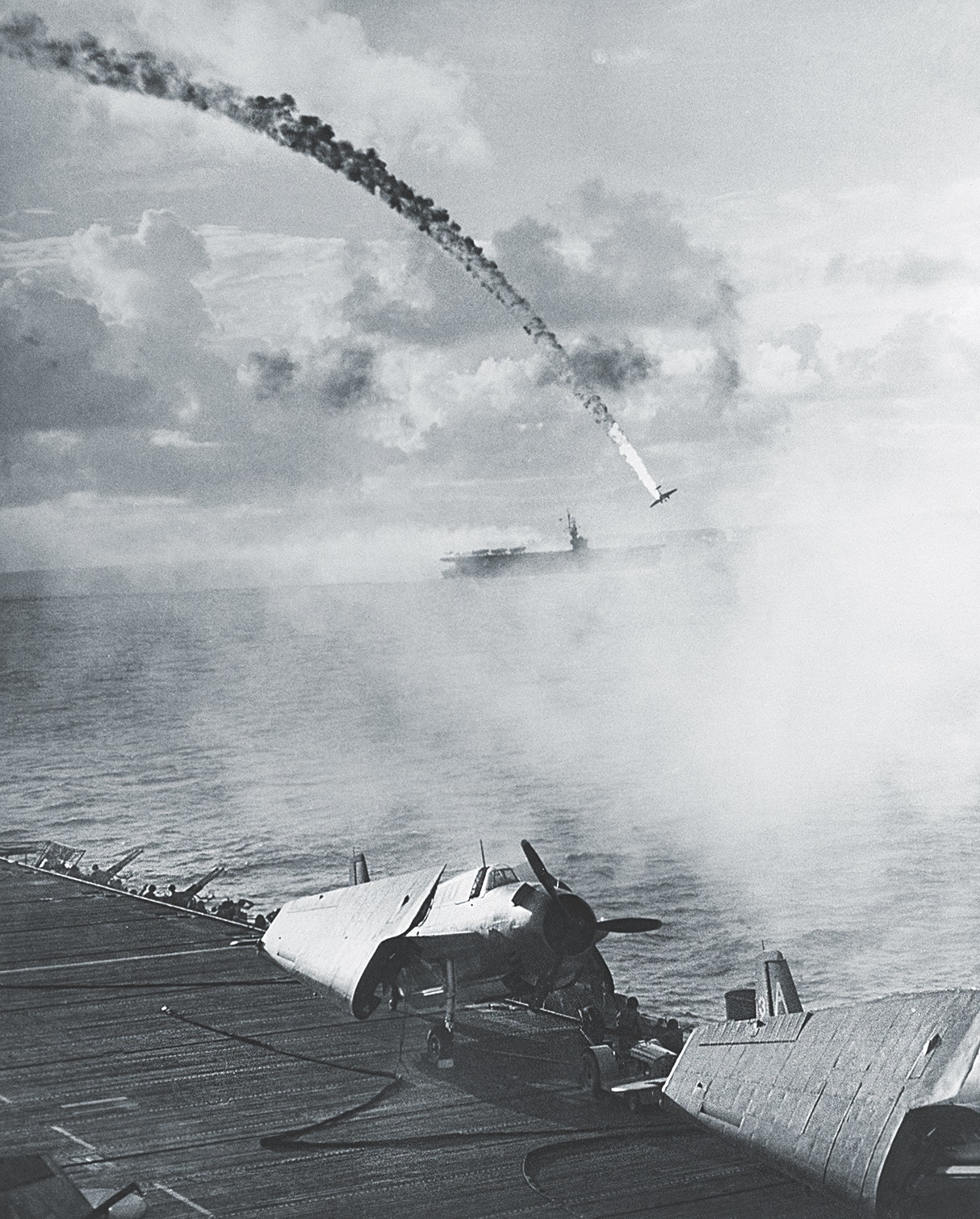
Early in 1943 during the Solomon Islands campaign, the proximity fuze made its presence felt when Adm. William F. “Bull” Halsey’s task forces came under repeated night attack by torpedo-laden Mitsubishi G4M (Allied reporting name “Betty”) twin-engine bombers.
As Samuel Eliot Morison writes in his History of United States Naval Operations in World War II, “The attackers did not escape with whole hides; smoking fuselages and bright surface bonfires attested the accuracy of anti-aircraft batteries and the efficiency of the super-secret Mark-32 shell fuze, which here had one of its first combat tests.” Morison describes the aftermath of a similar Japanese raid that February, a night attack by a dozen Bettys: “The night flickered with muzzle flashes, tracers, flares, float lights and the flaming pyramids of splashing ‘Bettys.’” Five of the attackers were downed and a convoy saved by “excellent anti-aircraft formation, in conjunction with fire-control radar and the deadly proximity fuze.”
That year proximity-fuzed AA fire was credited with more than half of all Japanese aircraft downed by naval gunfire, though only 25 percent of the shells fired had been fitted with VT fuzes.
Use of the new fuze in the Navy’s 5-inch AA guns expanded across the Pacific during the final two years of the war. Some naval historians believe the Japanese resorted to kamikaze attacks by inexperienced airmen in part due to dire losses of seasoned aircrew to American AA fire—not that the kamikazes were immune to VT-fuzed shells.
Consider the following account of a 90-minute suicide attack against the U.S. destroyers Hadley and Evans and four landing craft supply ships on May 11, 1945, during the Battle of Okinawa, as recounted in the wartime Bureau of Naval Personnel bulletin All Hands:
The fighter director tally later revealed that the little group of ships and planes had to oppose a total of 156 enemy planes.…At the end of the first half-hour the Evans had been hit four times by suicide planes, each ablaze from the AA fire. The Hadley had knocked down a dozen enemy planes, and the Evans had accounted for 23 before she had to retire from the fight.…“Indispensable” was the verdict on the role played by VT-fuzed ammunition in this action.
Though proximity fuzes were available for many applications, the embargo on their land use persisted until the summer of 1944 when Germany launched terror bombing attacks against London using V-1 flying bombs.
Not aimed at specific targets, the jet-propelled missiles inflicted tens of thousands of civilian casualties and caused widespread damage. Launched from sites across the English Channel and approaching speeds of 400 mph, the pilotless missiles were hard to spot and even harder to hit.
The British scrambled to thwart the “buzz bombs” with cable-dangling barrage balloons, massed AA fire and even daring interceptions by RAF fighter pilots.
Amid the terror campaign Section T began modifying proximity fuzes to target the small, fast V-1s. The special fuzes were installed in British 3.7-inch AA ammunition and U.S. 90 mm AA shells.
In mid-July the Allies rushed some 500 of the guns to installations along the channel, where their fire would not endanger RAF fighter planes. During the last four weeks of the 80-day campaign the results were dramatic.
The Allied coastal batteries destroyed 24 percent of all V-1s engaged in the first week, 46 percent in the second week, 67 percent in the third week and a whopping 79 percent in the last week, as noted in The Deadly Fuze, by Ralph Belknap Baldwin, a senior APL physicist and one of the fuze developers.
“The last day in which a large quantity of V-1s were launched against England,” Baldwin recalls, “104 were detected by early warning radar, but only four reached London.”
IN GROUND COMBAT PROXIMITY-FUZED SHELLS TOOK A FEARFUL TOLL ON MEN AND MACHINES
The proximity fuze demonstrated its value in two additional deployments during the final stage of the war in Europe.
The late 1944 Allied battle for control of Antwerp highlighted the Belgian port’s key role in supplying the overland advance into Germany. The British 11th Armored Division captured the port on September 4. Over the next five months the Germans countered with round-the-clock launches of some 2,500 V-1 flying bombs and V-2 ballistic missiles aimed at destroying the vital port. When the Germans adjusted the V-1s to fly as low as 1,200 feet (making interception vastly more difficult), APL physicists quickly designed a modified fuze for 3.7 and 90 mm AA shells to counter the threat.
The devices were rushed into production at the Crosley factory, and British Prime Minister Winston Churchill authorized a special flight of Lancaster bombers to transport the fuzes from Cincinnati to Antwerp.
The move paid off when 48 of the first 75 V-1s facing a single AA battalion in Antwerp were destroyed. With the aerial attacks largely thwarted, the great supply port remained open without interruption for the duration of the war.
On Dec. 16, 1944, Germany launched the Battle of the Bulge, its last major offensive on the Western Front. By then proximity fuzes had been developed and tested for all calibers of U.S. artillery, and large supplies had been shipped to the European Theater of Operations (ETO).
The embargo on the use of land-based proximity-fuzed shells, for both AA and field artillery, was lifted within two days of the initial attacks—which included last-ditch concentrated aerial assaults by the Luftwaffe.
The effect on the enemy was immediate and overwhelming. From then until the Allies crossed the Rhine into Germany, proximity-fuzed Allied AA fire brought down more than 1,000 enemy aircraft.
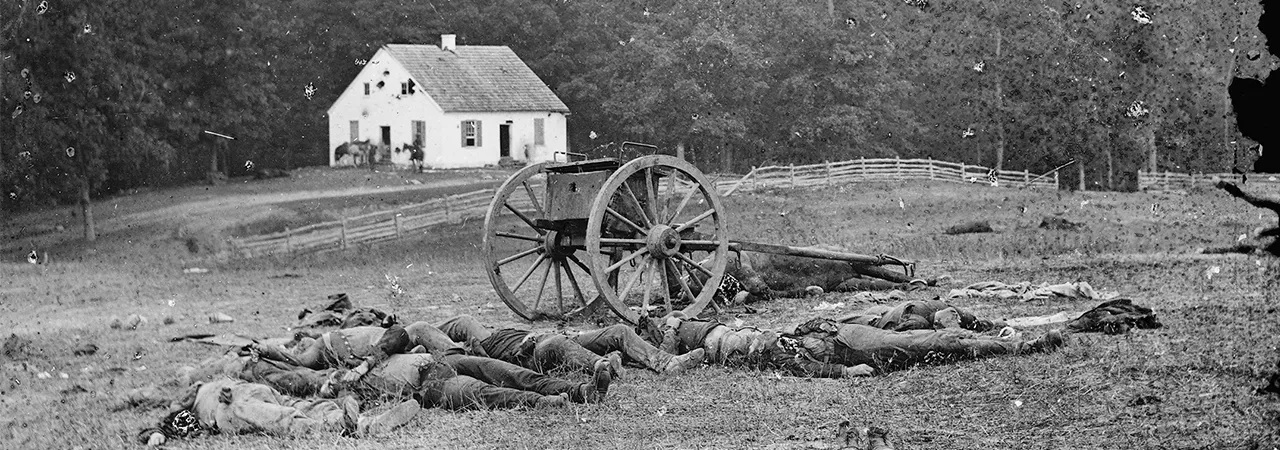
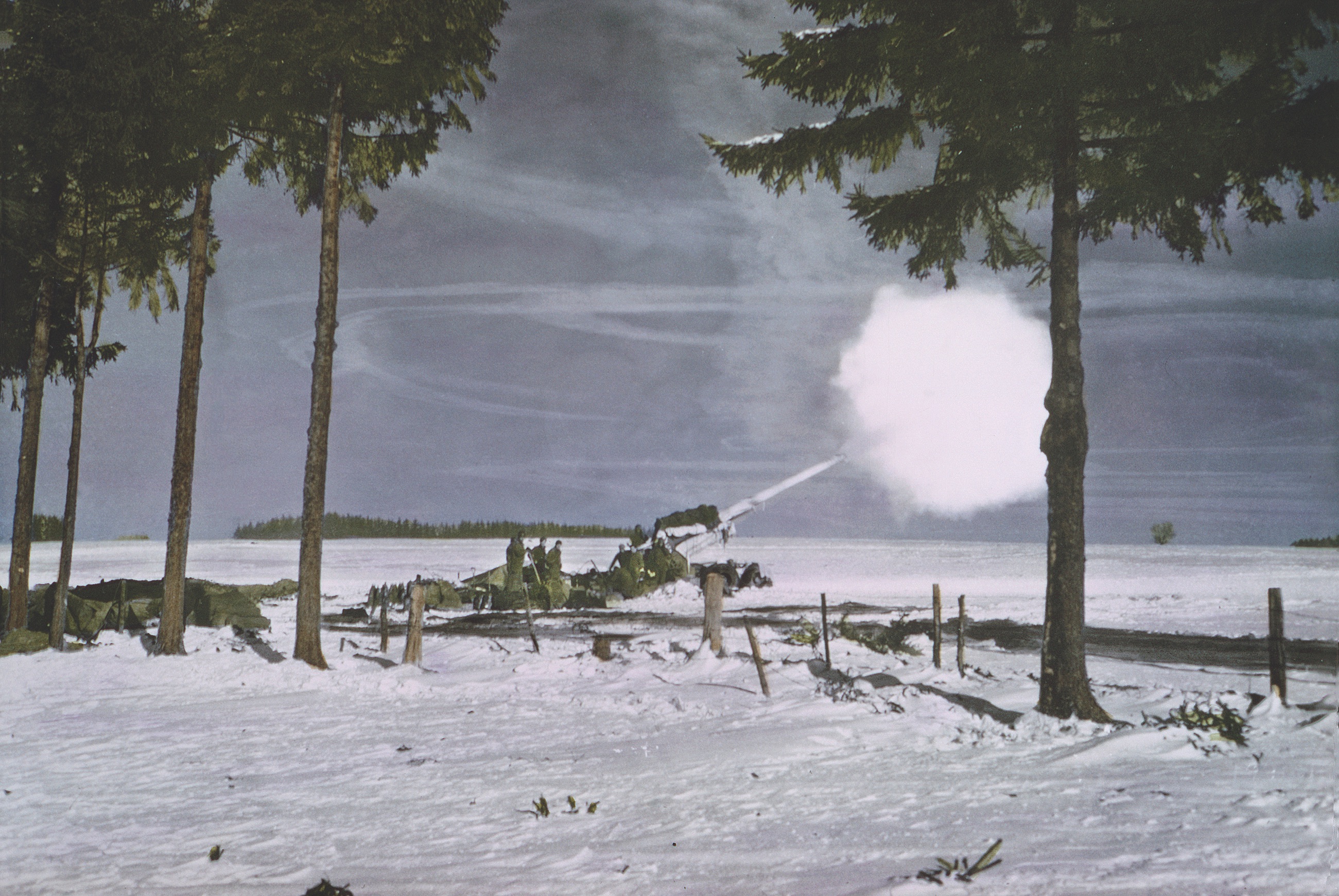
In ground combat proximity-fuzed artillery shells, specially calibrated for airburst detonation 30 to 50 feet above ground, took a fearful toll on men and machines below. Moreover, parallel advances in fire-control radar enabled artillerymen to destroy unseen targets on the reverse slopes of hills and beneath the forest canopy by day or night. A chief ordnance officer in the ETO reported on one German patrol in the Hürtgen Forest hit by a massed artillery barrage; the 96 bodies looked as if they’d “gone through a meat grinder.”
As the artillery was high velocity, the targeted German soldiers could not hear shells until they burst overhead. Foxholes provided no protection, and the shrapnel even penetrated log-reinforced bunkers.
POW interviews often described enemy soldiers emerging from the barrages in a “dazed” state. They realized they were facing a new kind of artillery but could understand neither how it worked nor how to evade it.
In the wake of the campaign Lt. Gen. George S. Patton wrote to Maj. Gen. Levin H. Campbell Jr., the chief of Army Ordnance, about the devastating effects of proximity-fuzed artillery. “The funny fuze won the Battle of the Bulge for us,” Patton remarked. “I am glad that you all thought of it first.” MH
Michael W. Robbins is a former editor of Military History and MHQ. For further reading he recommends The Deadly Fuze, by Ralph B. Baldwin; New Weapons for Air Warfare, edited by Joseph C. Boyce; and The Guns at Last Light, by Rick Atkinson.