Category: This great Nation & Its People
Categories
Our Great Men


William T. “Bloody Bill” Anderson was quite the gifted psychopath. The deadliest Confederate guerilla leader of the American Civil War, Anderson led his ruthless mob of cutthroats on a reign of terror along the rugged Kansas–Missouri border and killed hundreds along the way.
The path Bloody Bill took from a well-behaved, respectful child to an inveterate butcher and rapist is a study in human depravity.
The Tale of “Bloody Bill” Anderson
Anderson was indeed, by all accounts, a decent kid. He had two brothers and three sisters. His father supported slavery but did not own slaves. In 1860 Anderson’s mother was struck by lightning and killed.
In his late teens, Anderson killed his first man, a Native American he claimed was trying to rob him. As he came of age, William and his brother Ellis supported themselves by stealing horses.
His moral compass already a bit askew, all the young William Anderson needed was some kind of catalyst to push him over the edge. In May of 1862, a Union-sympathizing judge named Baker became that catalyst.
William’s father heard of Judge Baker’s allegation that his family harbored Confederate fugitives, armed himself, and traveled to Baker’s courthouse in Council Grove. Baker shot and killed the elder Mr. Anderson in the ensuing confrontation, claiming self-defense. When Judge Baker was not charged for the killing, young William hatched a plan.
Bill and his brother Jim returned to Council Grove three months later and, by means of subterfuge, lured Judge Baker and his brother-in-law into a local store. When the judge realized what was afoot, the two men retreated into the basement of the store. Bill and Jim burned the structure to the ground, killing them both.
The Big Time
Bill Anderson then just went feral. He rode with William Quantrill and attracted a robust following of disaffected Southern sympathizers called Bushwhackers. Together they robbed and killed with wanton abandon, fastidiously protecting women—at least at first—but ruthlessly gunning down Union troops and sympathizers at every opportunity. They were remarkably successful. Along the way, Frank and Jesse James fell in with his crew.
Union Brigadier General Thomas Ewing was directed to bring Anderson to task, something easier said than done. Bill’s sisters Josephine and Mary frequently traveled to Kansas City to purchase ammunition for Bill and his troops.
During one outing, Ewing had the women arrested and placed in a flimsy makeshift stockade. The building collapsed, killing Josephine and four of her companions. This event transformed Bill Anderson from a soldier into a psychopath.
Anderson began carrying a silken cord with him everywhere he went. Each time he personally killed a Union soldier, he tied a fresh knot in the cord. At the time of his death, the cord had 53 knots. Anderson decorated his saddle with the scalps of his Union victims.
Gifted Tactican
In addition to a certain familiarity with killing, Bill Anderson was a legitimately gifted tactician. His forte was luring Union forces into a canalized area using a small contingent of his troops as bait.
He would post his mounted forces in the tree lines or behind terrain features until enemy units entered his kill zone. Anderson then used his superior tactics and high-volume weapons to overwhelm the Union forces. He seldom left more than a token number alive.
Anderson’s “Bloody Bill” moniker was well deserved. In September of 1864, Anderson and his men moved on Centralia, Missouri, looting, robbing and killing as they went. While in the town, they seized a passing passenger train carrying 23 unarmed off-duty Union soldiers.
Anderson ordered one Yankee non-commissioned officer (NCO) held for a potential prisoner swap and had the rest shot on the spot. Anderson’s men killed one German civilian on the train for wearing a blue shirt.
Such stuff happened not infrequently. Bloody Bill once personally killed 14 Union soldiers in a single day. In the face of such brutality, his Union adversaries responded in kind, frequently riding under a black banner that told all comers to expect no mercy. Blood flowed freely on all sides.
Things came to a head in October of 1864. Anderson and his men burned Rocheport, Missouri to the ground and moved on Glasgow. Though nominally under Confederate command, Anderson opted instead to ignore his orders and pursue opportunities to loot.
While in Glasgow, Anderson sought an audience with a well-heeled Unionist. The notorious Bushwhacker raped his 13-year-old servant girl and trampled the man under his horse. The Yankee sympathizer ultimately succumbed to his injuries in 1866.
Loaded for Bear
Anderson’s troops were reported to carry four revolvers, each between their mounts and their persons. When he was killed, Anderson was packing six. Realizing that his foes were armed with accurate but slow-firing muzzleloading muskets, Anderson would typically charge enemy formations and absorb the first ragged volley. He and his men would then tear through the blue ranks, cutting down the Union troops with large volumes of close-range pistol fire.
While there were dozens of different types of handguns in common use during the American Civil War, two were the most common. Colonel Colt’s 1851 and 1860 Model revolvers armed soldiers on both sides. The Remington New Model Army was not quite so popular but also saw widespread use. Each gun has an interesting story.
Colt Revolver
Samuel Colt did not invent the revolver—he optimized it. Under Colonel Sam’s guidance and marketing, his eponymous wheelguns filled holsters across the country and throughout the world.
Colt operated manufacturing facilities that churned out his pistols in both Connecticut and in London, England. While the Model 1851 and Model 1860 differed slightly in some details, the designs were conceptually quite similar. Both guns were evolutionary developments of the previous 1849 pocket pistol.
The 1851 Colt Navy featured a positively retained pivoting ramrod underneath the barrel to assist with reloading chores and a characteristic open architecture around the cylinder.
While this offered relatively easy cleaning and ready access to the nipples, the gun was notorious for dropping its spent percussion caps down into the action. Under the wrong circumstances, this can lock the mechanism up tight. I myself have had this happen several times in the decades I have been shooting these old pistols.
These Colt handguns typically fired either .36– or .44-caliber balls and were constructed of both steel and brass components. Colt produced 215,000 copies domestically and another 42,000 in England. The Griswold Gunnison was a copy of the 1851 Navy built in Georgia for Confederate use.
Remington Revolver
These days the Remington New Model Army revolver is frequently called the Model 1858. This is a reference to the September 14, 1858, patent date engraved on the revolver. I have read, however, that this term is a modern contrivance. The guns did not see wide-scale production until 1861. Some people have claimed that the Model 1858 reference arose in the Navy Arms marketing literature during the 1960s.
Regardless, the Remington New Model Army is an altogether more rugged design than that of the Colt. The steel frame on the Remington gun features a topstrap that wraps up and over the cylinder, offering a great deal more strength.
The design of the Remington pistol also allows the cylinder to be removed more readily than that of the Colt competitor. As loading cap-and-ball revolvers is quite laborious, it was an accepted practice to carry separate loaded cylinders that could be exchanged after partially disassembling the guns. This process is easier on the Remington weapon.
Eliphalet Remington approached the U.S. Army in late 1861 and offered to sell his guns to the government for $15 apiece—this at a time when Colt was getting $25. Regardless, the Union Army was still slow to embrace the weapon. However, by the end of its production run, the New Model Army had seen ten variants and more than 230,000 copies produced.

The End Of The Story
On October 27, 1864, Bloody Bill Anderson fell for his own ruse. Lt. Col. Samuel Cox and a contingent of 150 Union troops located Anderson’s encampment and lured him and his men into a narrow lane bounded by thick woods.
Assuming these Yankees would break as easily as those he had previously dispatched, Anderson charged their formation without hesitation. A heavy volley of accurate Union fire dropped several of the Bushwhackers, taking the spirit out of their charge.
Anderson and two others continued on and tore through the Union lines. As he wheeled his mount around for another pass, a second volley raked the three rampaging Confederates. Bloody Bill Anderson caught two rounds to the head and died where he fell. He was 23 years old.
Force Of Nature
These Colt and Remington pistols served much the same way as the German P08 Parabellum and Walther P38 9mm handguns throughout World War II. There were never enough to go around, and production of both weapons was always inadequate. So it was with these two vintage revolvers.
I recently found myself in the market for an original 1851 Colt. I located a copy for sale online at a decent price. However, on closer inspection, it seemed that the barrel rode at a slightly upward cant relative to the frame. Such was the sensitivity of the design. I passed on the gun as a result.
While the Colt is undeniably the prettier of the two pistols, the Remington is much more rugged. In the hands of men like Bloody Bill Anderson, these six-shot wheelguns were indeed a force of nature.
Dixie Gun Works (DixieGunWorks.com) can get you copies of these two classic Civil War wheelguns in kit form at a good price.

Harrison Ford is one of the most recognizable faces in the world.
He also sounds like a pretty good guy. Public domain.
Harrison Ford was born on July 13, 1942, in Chicago. As a child, he was a Boy Scout and, later, a sportscaster for his high school sports program. He was a shy kid but eventually overcame that through drama classes in college.
Ford moved to Hollywood and secured a variety of trivial roles in a number of movies and TV shows in the 1960s. Along the way, he taught himself carpentry and supported his wife and two sons by building stuff. The characteristic scar tracking across his chin was explained as a wound from a bullwhip in Indiana Jones and the Last Crusade. In reality, he incurred the injury in a car wreck after losing control while putting on his seatbelt.
Harrison Ford went on to become one of the most successful actors in the history of Hollywood. He has been the president, a fugitive from justice and a space pirate. His most iconic roles have included Indiana Jones, Han Solo and Jack Ryan — making him one of the most recognizable faces on the planet.

I maintain a tiny little sport plane myself, but it isn’t terribly expensive.
Golden Handcuffs
I’ve never actually met anybody like that, but I suspect it is honestly a pretty tough life. You might have more money than the government, but you really can’t go anywhere and expect any peace. That’s likely why so many celebrities end up so broken and pitiful. It seems that to survive in that bizarre, rarefied world, you’d have to make time for some proper hobbies. For Harrison Ford, that’s flying.
Flying is kind of a rich man’s game if done on any serious scale. I maintain a sexy, cool little homebuilt fighter plane of sorts. However, my airplane is both simple and relatively inexpensive. Buying and operating my machine is about the same process as a decent car.
By contrast, Harrison Ford has maintained a 1929 Waco Taperwing biplane, a 1942 Ryan Aeronautical PT-22, a 1955 de Havilland DHC-2 Beaver, a 2009 Aviat A-1C-180 Husky, a 2009 Cessna Citation Sovereign 680 jet, and a 2013 Bell 407GX helicopter.
Ford actually started taking flying lessons in the 60s but couldn’t afford to follow through. He finally earned his pilot’s license at age 53. Since then, he’s flown regularly both for recreation as well as work. His DHC-2 Beaver is a former CIA Air America aircraft bearing the stigmata of repaired bullet holes.
A Close Call …
In 2015, Ford took off in his WWII-vintage Ryan PT-22 trainer and had a carburetor failure on climb-out. He deftly put the old plane down on a nearby golf course but was badly injured in the process. The actor suffered a shattered right ankle and pelvis, along with a vertebral fracture and head trauma. He subsequently spent nearly a month in the hospital.
As soon as he recovered, Ford climbed back into an airplane. His wife reportedly refused to fly with him in his old planes after that, but she’d still ride in the jet. Statistically speaking, the most dangerous part of flying is always the drive into the airfield. However, when things go wrong, they typically do seem pretty flashy.

Harrison Ford has flown for fun and work for nearly three decades. Public domain.
Duty Calls
Ford and his family live on a sprawling 800-acre ranch in Wyoming. For a guy like that to find any real peace, he’d need his space. However, that doesn’t mean he’s not a good neighbor.
On July 31, 2000, 20-year-old Sarah George was hiking with friends on the 11,106-foot Table Mountain in rural Wyoming. They expected their outing to take about five hours. However, Sarah soon became dehydrated and fell ill. The toxic combination of heat and altitude got the better of her. Now deep in the wilderness and unable to walk, things seemed grim.
People still die in places like that. The veneer of civilization with which we are all so familiar is actually quite thin. In this case, Sarah needed to get off that mountain. Failure to do so could easily be catastrophic.
After a desperate phone call to the authorities, Sarah’s friends helped carry her to a flat space adequate to admit a helicopter. The aircraft shot a flawless approach and landed long enough to get the young woman aboard. The pilot was wearing a cowboy hat and a t-shirt.
Once aboard, Sarah recognized the pilot as none other than Han Solo himself. She later reported, “I can’t believe I barfed in Harrison Ford’s helicopter.” By all accounts, Ford was a good sport about it all. The following year, he also used his personal helicopter to rescue a 13-year-old Boy Scout who found himself in dire straits near Yellowstone National Park.
Ruminations
I’ll never know what it’s like to be rich and famous, and I’m good with that. The few folks I have met who occupied that rarefied space seemed burdened by it. However, in the case of Harrison Ford, he seems to wear his success well. When folks nearby got in trouble, he just donned his cowboy hat, fired up his helicopter, and flew out to save their lives. Of course, you’d expect nothing else from a proper space pirate with a heart of gold.

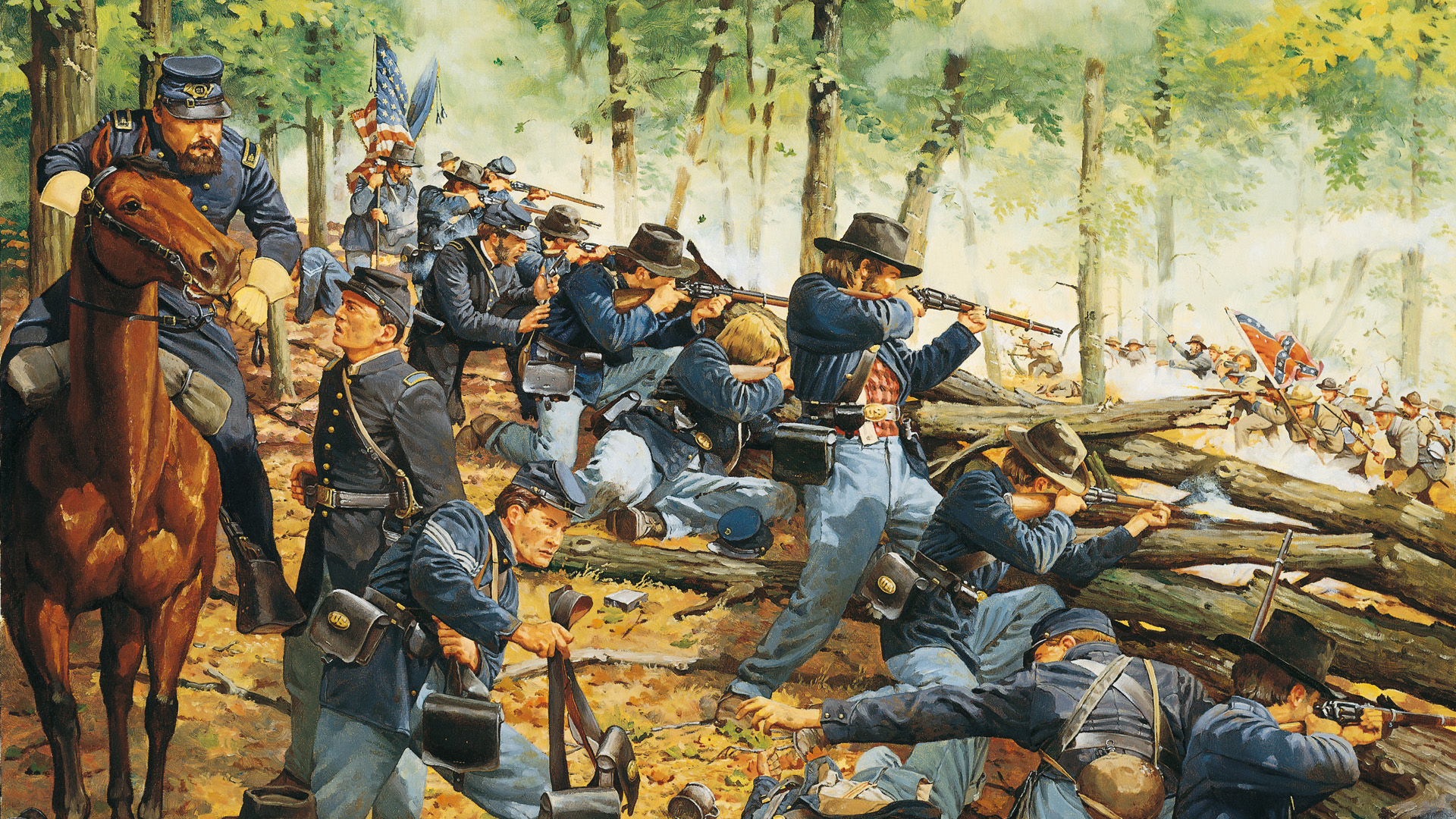
In the deep woods of Chickamauga Creek, wary Union and Confederate soldiers thrashed the the under brush seeking a confrontation to the death.
Catoosa County and Walker County, GA | Sep 18 – 20, 1863
The Confederate army secured a decisive victory at Chickamauga but lost 20 percent of its force in battle. After two days of fierce fighting, the Rebels broke through Union lines and forced the Federals into a siege at Chattanooga.
How it ended
Confederate victory. At the end of a summer that had seen disastrous Confederate losses at Gettysburg and Vicksburg, the triumph of the Army of Tennessee at Chickamauga was a well-timed turn-around for the Confederates, but it came at a great cost. Chickamauga was the second bloodiest battle of the Civil War, ranking only behind Gettysburg, and was by far the deadliest battle in the Western Theater.
In context
The small city of Chattanooga, with 2,500 inhabitants, lay on the banks of the Tennessee River where it cut through the Appalachian Mountains. It was the crossroads for four major railroads. President Abraham Lincoln knew that if his army could capture Chattanooga, vital Confederate supply lines would be severed, and the war would be closer to an end.
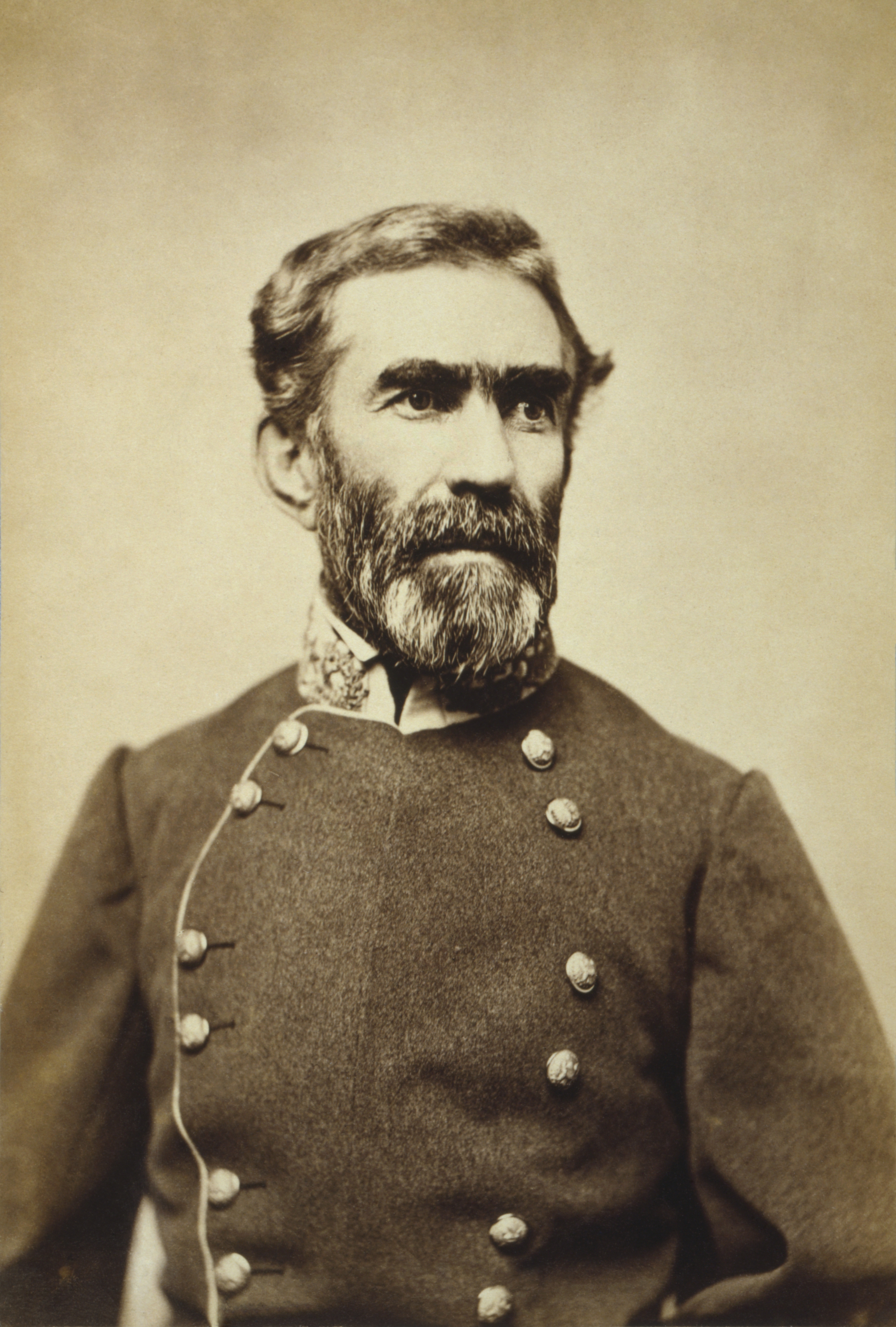
In the summer of 1863, the Confederate army was reeling from a string of losses in the Western Theater, while the success of the Tullahoma Campaign bolstered the confidence of Union Maj. Gen. William Rosecrans. Targeting Chattanooga, Rosecrans outmaneuvered the Rebel army and forced Confederate general Braxton Bragg to relinquish control of the critical transportation hub without a fight.
Rosecrans assumed that Bragg’s demoralized army would retreat further south into Rome, Georgia. He divided his army into three corps and scattered them throughout Tennessee and Georgia. But Rosecrans made a mistake—Bragg had in fact concentrated his men at LaFayette, Georgia, where he was expecting reinforcements and was close to a vulnerable corps of Rosecrans’s army. When Bragg’s troops crossed Chickamauga Creek, the Federals had a fight on their hands.
Although Bragg’s original plan was the destruction of the Army of the Cumberland and the recapture of Chattanooga, the results of two days of bitter fighting at Chickamauga stalled him. He decided to occupy the heights surrounding Chattanooga and lay siege to the city instead. Just two months later, the reinforced Federals drove the Army of Tennessee from their positions around Chattanooga, permanently securing Northern control of the city. With that loss, the Southern victory at Chickamauga was turned into a strategic defeat.
From his position in LaFayette, Georgia, Bragg follows the Union army north, skirmishing with them at Davis’s Cross Roads. By September 17, Bragg’s troops are reinforced with Virginia divisions under Gen. John Bell Hood and a Mississippi division under Brig. Gen. Bushrod Johnson. It is the first transport of Confederate troops from one theater to another to achieve numerical superiority.
On the morning of the September 18, with renewed confidence that Chattanooga could pass once again into Confederate hands, Bragg marches his army to the west bank of Chickamauga Creek, hoping to wedge his troops between Chattanooga and the Federal army.

UNION
CONFEDERATE
FORCES ENGAGED
125,000
UNION
60,000
60,000
CONFED.
65,000
65,000
September 18. Bragg hopes that his advance will be a surprise. Rosecrans, however, observes the Confederates marching in the morning and anticipates Bragg’s plan. By the time Bragg’s army crosses the creek, Union reinforcements are in place. Bragg’s infantry skirmishes with Federal infantry and mounted infantry armed with Spencer repeating rifles.
September 19. The Battle of Chickamauga begins in earnest shortly after dawn. Throughout the day Bragg’s men gain ground but cannot break the extended Union line despite a series of aggressive attacks. Confederate luck changes when, at 11:00 p.m., Gen. James Longstreet’s divisions arrive at Chickamauga. The Confederates now outnumber the Federals. Bragg divides his forces into two wings. Longstreet commands the left; Lt. Gen. Leonidas K. Polk takes charge of Confederate troops on the right.
September 20. The battle resumes at 9:30 a.m., with coordinated Confederate attacks on the Union left flank. About an hour later, Rosecrans, believing a gap exists in his line, orders Brig. Gen. Thomas Wood’s division to fill it. Wood, however, knows that the order is a mistake; no such gap exists in the Federal line, and moving his division would open a large swath in the Union position.
However, Wood who already been berated twice in the campaign for not promptly following orders, immediately moves, creating a division-wide hole in the Union line. This is the chance the Confederates need. Longstreet masses a striking force, led by Gen. Hood, of eight brigades divided into three lines. Longstreet’s men hammer through the gap that Wood had created, and Union resistance at the southern end of the battlefield evaporates as Federal troops, including Rosecrans himself, are pushed off the field.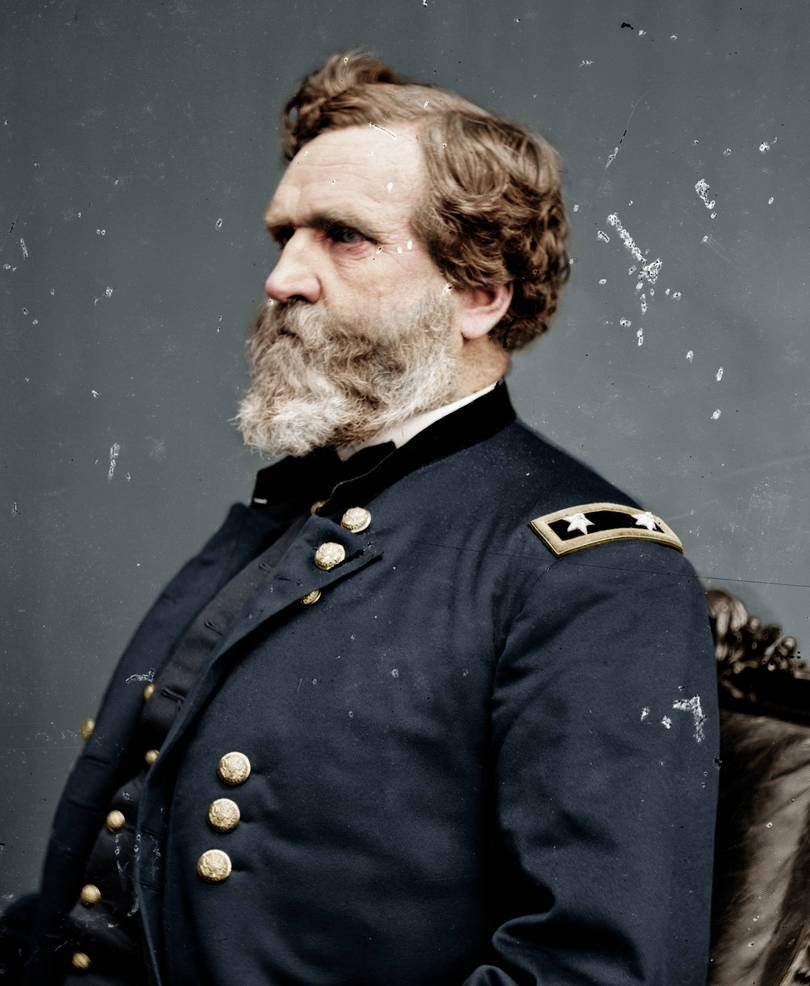
Major General George Thomas, in a move that would earn him the name “The Rock of Chickamauga,” takes command and begins consolidating the scattered Union forces on Horseshoe Ridge and Snodgrass Hill. He and his men form a defensive position, and although Confederates continue to assault and press to within feet of the Union line, the Federals hold firm. Thomas withdraws as darkness falls.
UNION
16,170
1,657 killed
9,756 wounded
4,757 missing & captured
ESTIMATED CASUALTIES
34,624
UNION
16,170
16,170
CONFED.
18,454
18,454
CONFEDERATE
18,454
2,312 killed
14,674 wounded
1,468 missing & captured
Thomas urges Rosecrans to lead the army in an attack the next day, but the general rejects the idea and remains in Chattanooga. Bragg’s victorious army occupies the heights surrounding Chattanooga, blocking Federal supply lines, but does not pursue Rosecrans.
Ten Confederate generals are killed or wounded in the battle, and the fatalities among Bragg’s junior officers are great. With more than 16,000 Union and 18,000 Confederate casualties, Chickamauga reaches the highest losses of any battle in the Western Theater. While the Confederates drive Rosecrans from the field, they do not succeed in executing Bragg’s goals of destroying Rosecrans’s army or reoccupying Chattanooga.
