Category: This great Nation & Its People
On July 7, 1944, Sergeant Thomas Baker was gravely wounded while fighting fanatical Japanese defenders during the Battle for Saipan. His primary weapon had been ruined during vicious hand to hand fighting. Not wanting to endanger his comrades, Sergeant Baker asked for a 1911 pistol containing eight rounds of ammunition. When last seen alive he was resting with his back against a tree in a jungle clearing.
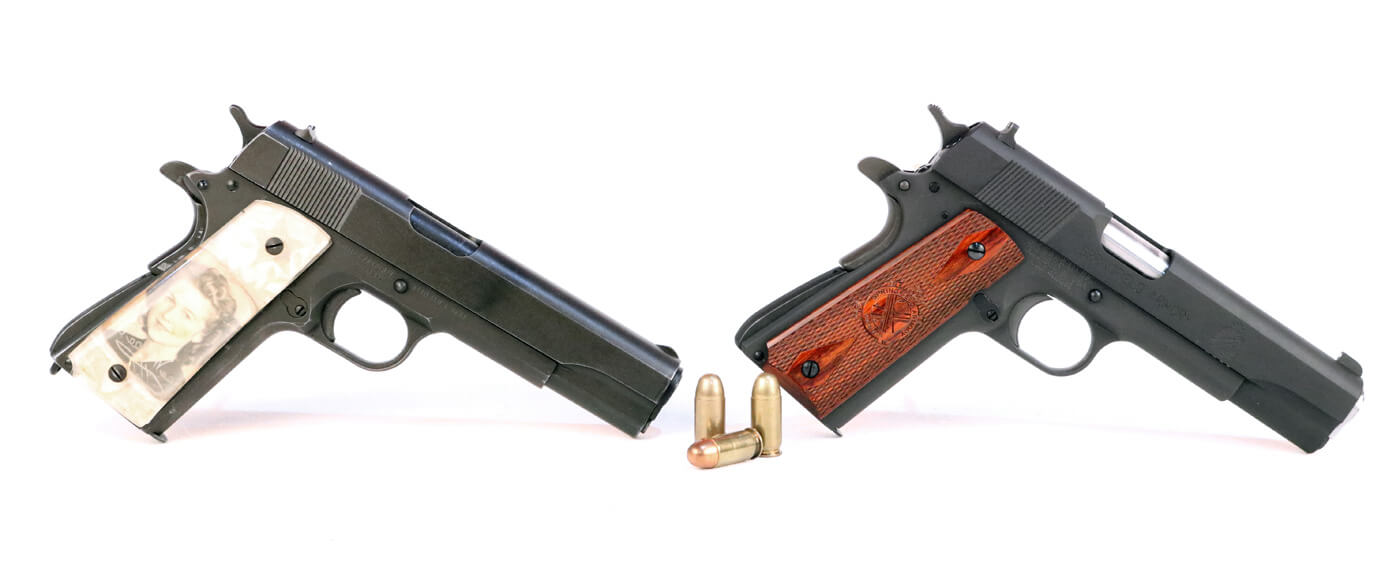
When American forces later assaulted through the area they discovered Thomas Baker’s lifeless corpse. The slide was locked back on his empty pistol, and there were eight dead Japanese soldiers scattered about the clearing. Sergeant Baker’s posthumous Medal of Honor stands in profound testimony to unimaginable personal courage. The G.I. pistol he carried is an American icon.
The M1911 pistol earned its place in Sergeant Baker’s hand that fateful day as a result of a grueling head to head trial between John Moses Browning’s design and one from Savage. The competition came down to a two-day torture test, winner take all. A single example of each gun fired six thousand rounds. When the guns got hot they were simply immersed in water to cool them off. The other had thirty-seven stoppages. John Moses Browning’s 1911 had none.
After more than 2.7 million GI-issue pistols later, the M1911 has formed the foundation of modern pistol craft. Even more than a century after its introduction the 1911 still has more than its share of rabid acolytes. I am one of them.
Modern Treatment
The sundry details of memory bumps, skeletonized triggers, checkering, and customized controls are the places where pistolero dreams go to thrive or die. An entire industry orbits around customizing John Browning’s timeless hogleg. However, like Coke Classic, Lady Liberty, the Beatles, and Marilyn Monroe, sometimes there are salient attributes to be found solely in the original. In addition to the fancier sort, Springfield Armory also fills that need.
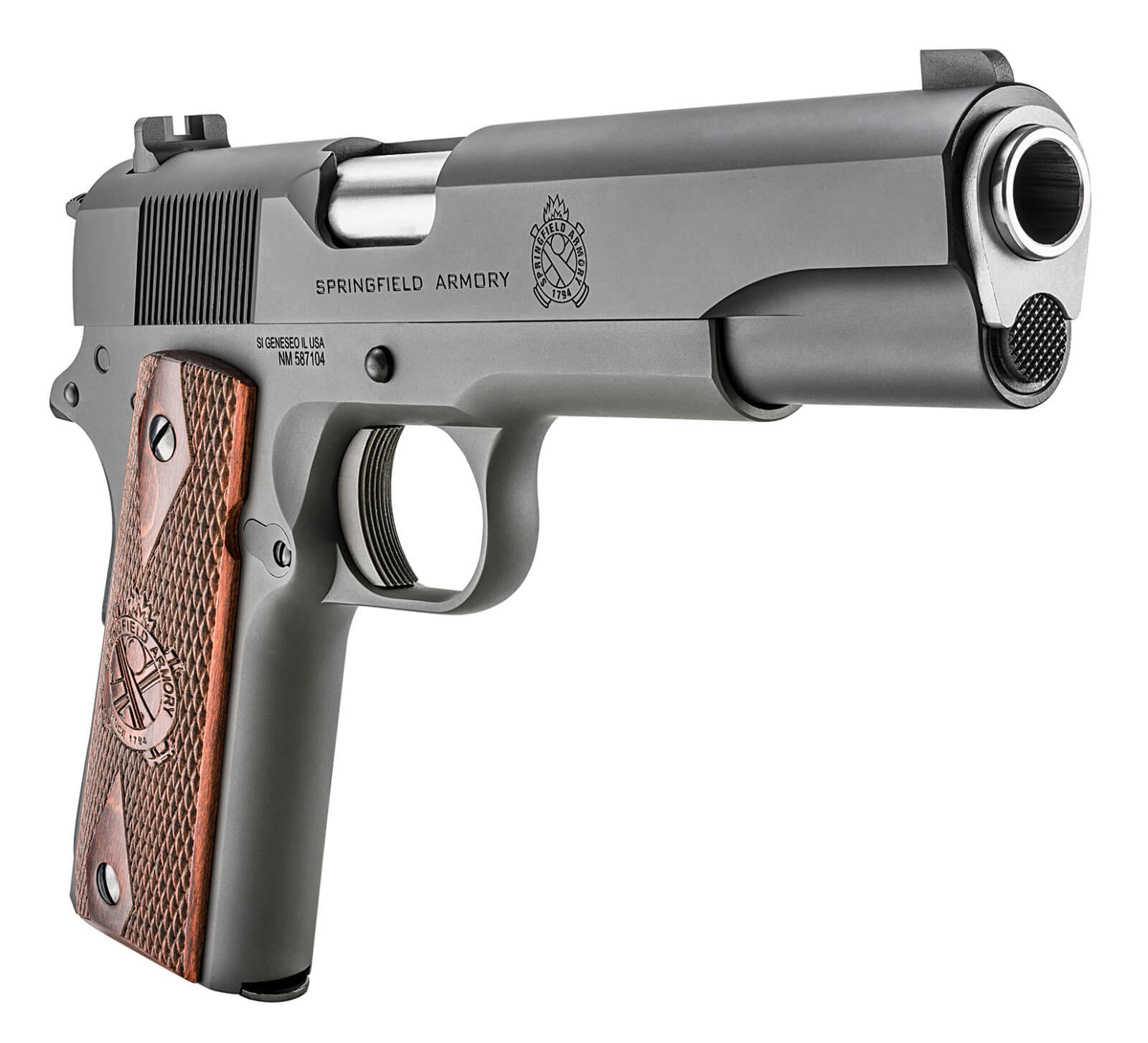
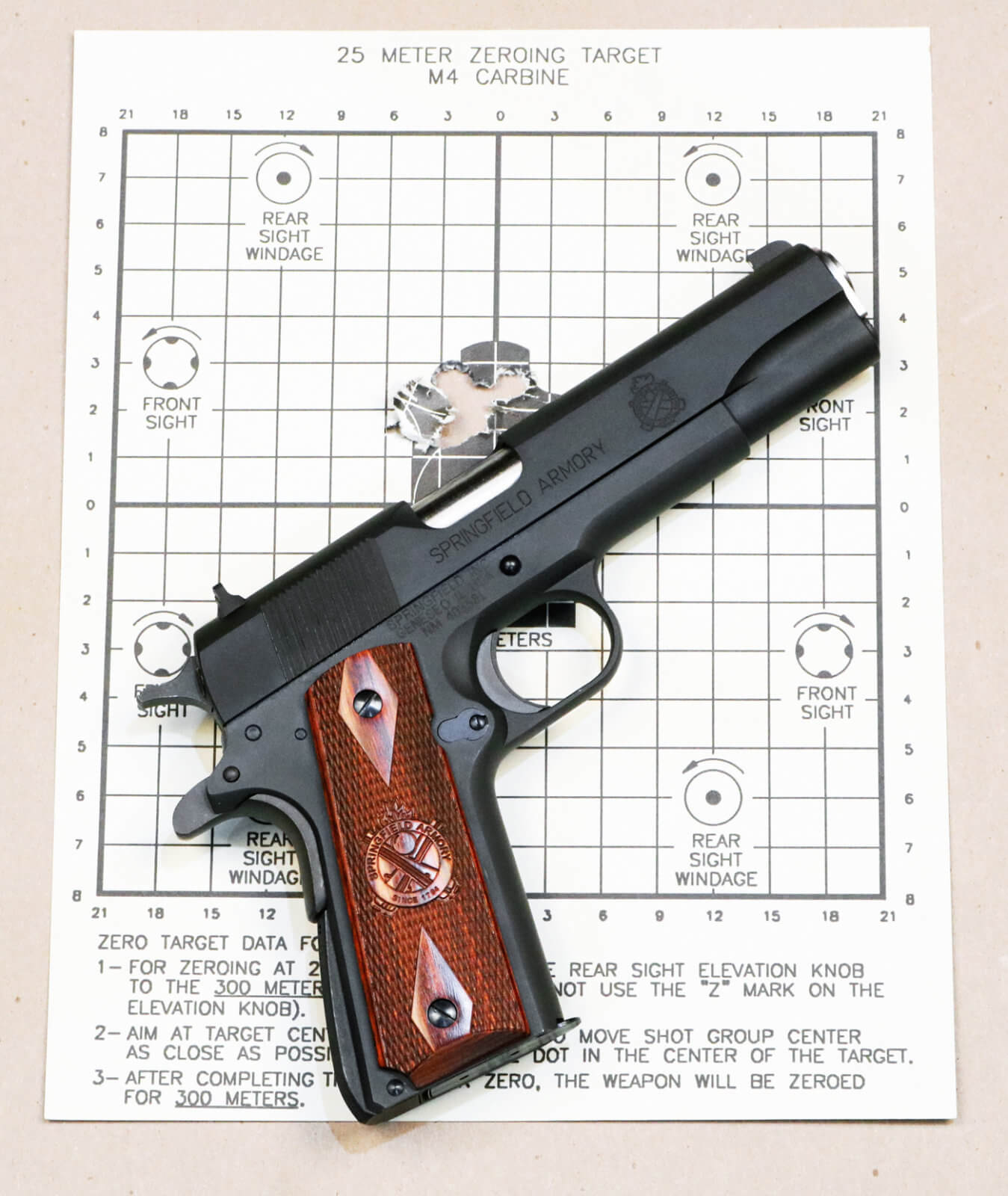
Overall the Springfield Armory 1911 Mil-Spec is typical 1943. The front bit of the frame is smooth, the mainspring housing is arched, and the trigger is small and unremarkable. There are no extraneous grooves on the slide, and the hammer is a classic spur. The gun weighs 39 ounces, just like Browning’s original, and the barrel is a full 5″ long. The gun is finished in a pleasing dull Parkerizing.
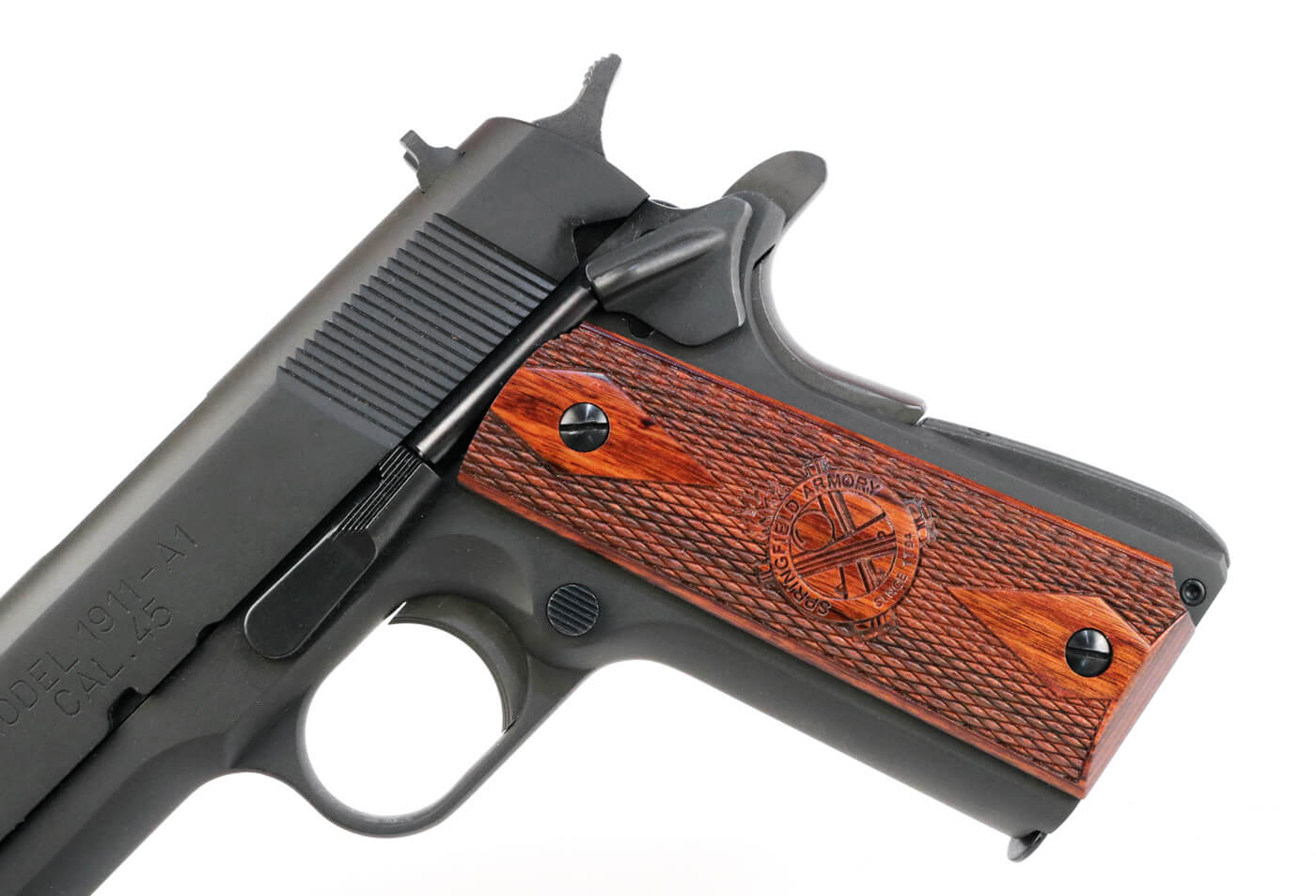
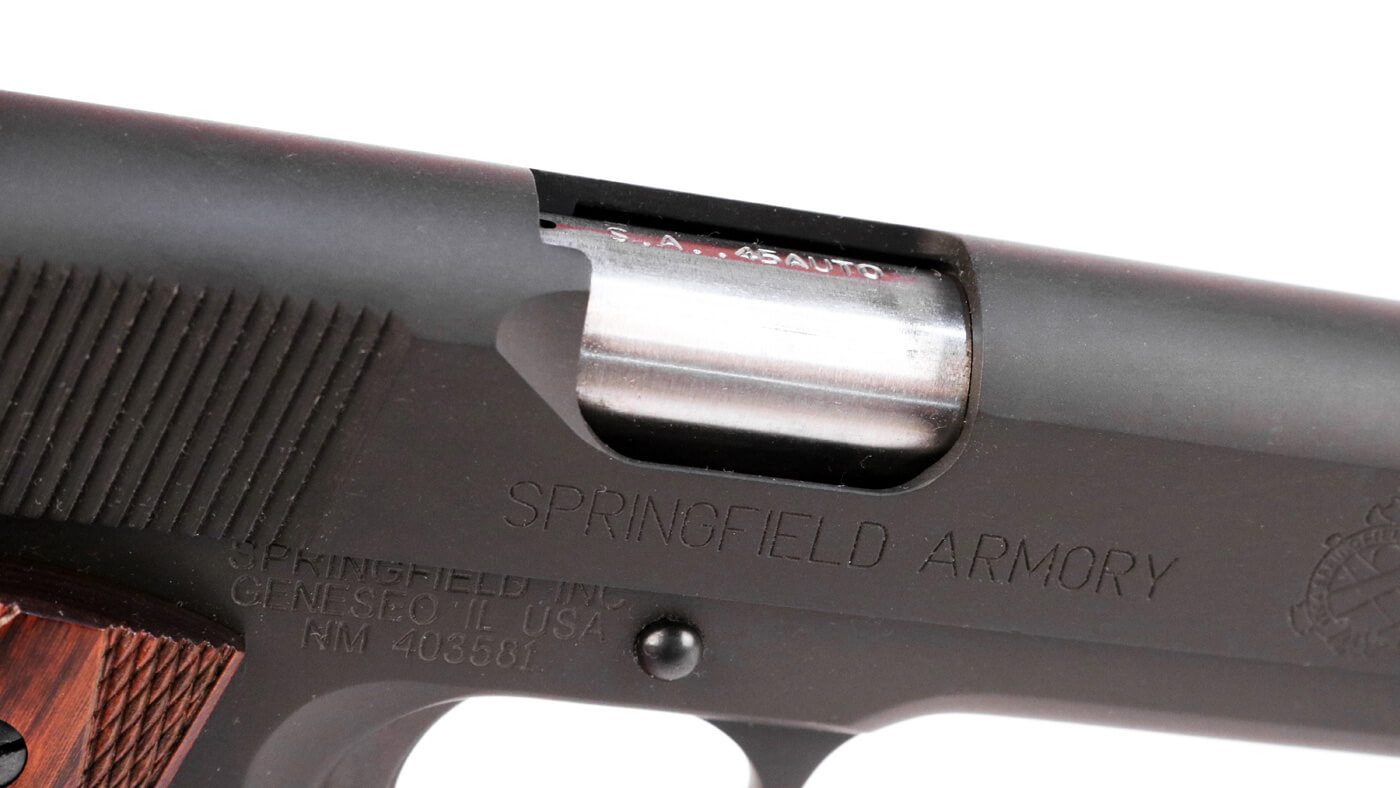
There are indeed a few nods to modern technological evolution. The sights are about the same size as the originals, but they now feature three white dots. The grips are a beautiful walnut with the Springfield Armory crossed cannons logo. The biggest departure, however, is to be found in the ejection port.
I have an original 1944-production M1911A1 that is a jewel in my personal collection. The gun runs like a sewing machine, but it drops its empties on the top of my head with monotonous regularity. The lowered and flared ejection port of the Springfield Armory 1911 Mil-Spec spits the hot brass out to the side without bouncing the cases off your face. The difference is obvious at a glance, but most normal folks won’t care. This does make the gun perform much better on the range while enhancing reliability.
How Does She Run?
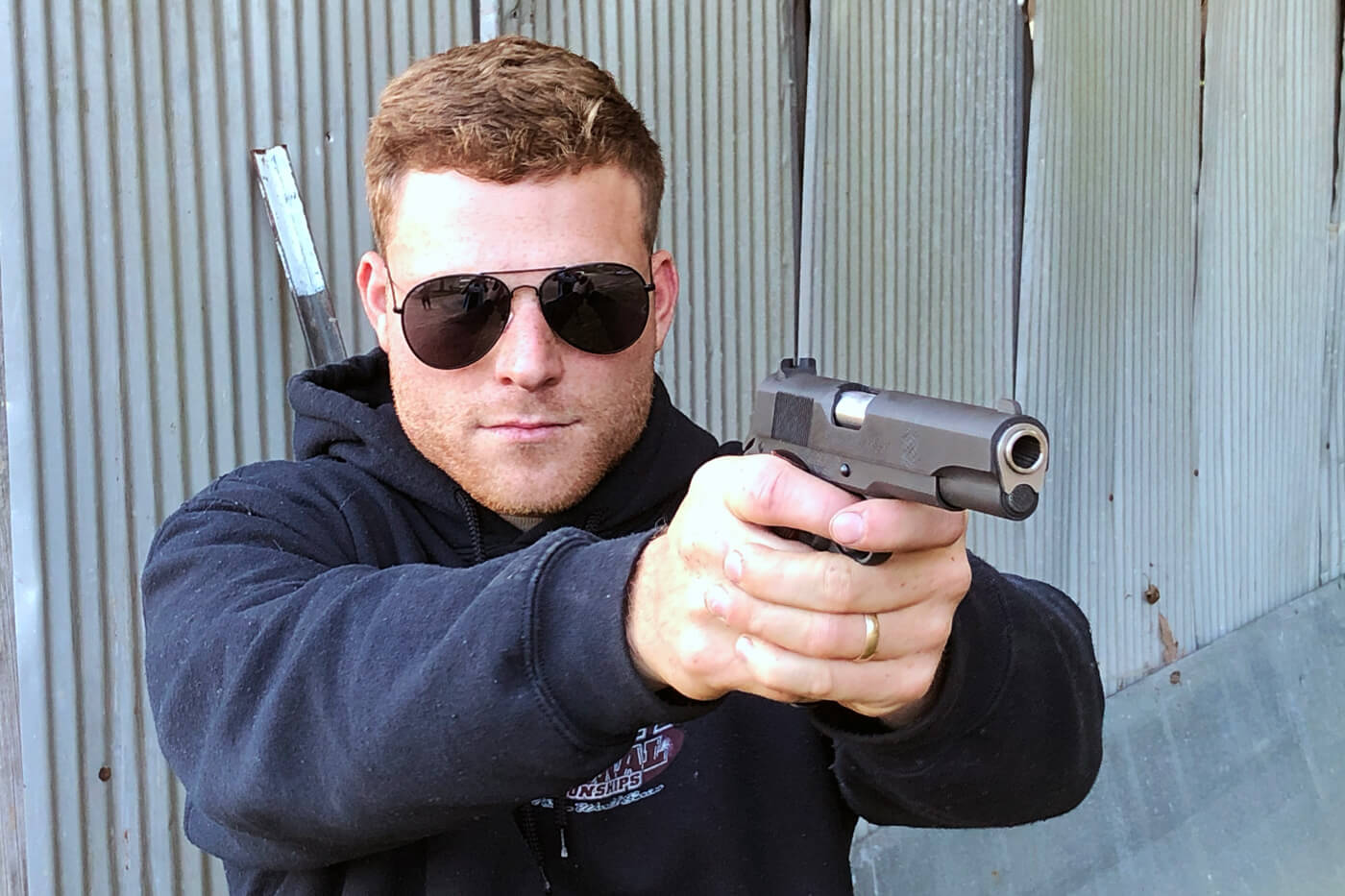
A little trigger time behind the Springfield Armory 1911 Mil-Spec reminds you what all the fuss was about back before the First World War. The single-stack, seven-round magazine keeps the grip comfortable for most American shooters with normal-sized mitts. The slide-to-frame interface slides like greased glass. The trigger is indeed shorter than those on custom guns, yet it nonetheless feels familiar and tight. The three-dot sights are much easier to acquire than the tiny unadorned G.I. versions.
Recoil is manly without being uncomfortable, and the controls fit me like my favorite pair of broken-in boxers. The slide locks back with authority on the last round fired, and empty magazines shoot out of the gun like a liberal fleeing responsibility. Combat reloads will channel your inner Audie Murphy.
Ruminations
John Dillinger carried a gun like this. So did my wife’s grandfather. That young stud fought all the way across North Africa, Sicily, and Italy, slogging through places like Anzio and Monte Cassino to ensure that his children grew up in a world free from the Nazis and their ilk. Countless brave American warriors have wielded John Browning’s martial marvel to crush the forces of oppression and tyranny for three quarters of a century. Armed professionals continue to slay dragons with theirs even today.
Springfield Armory makes reliably awesome guns. Their 1911 Mil-Spec takes an American classic and sprinkles it with just enough modern technology to make a tactical player in the Information Age. The overall effect is retro gold.
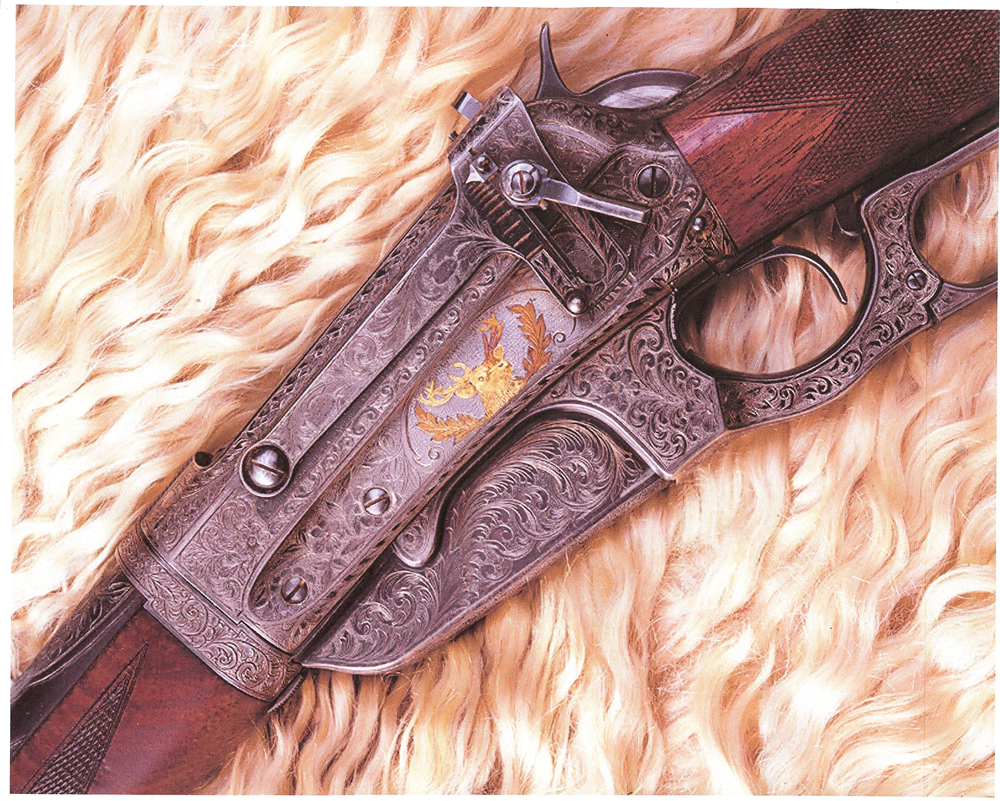
Zane Grey, who became one of America’s most successful authors, hunted the “Tonto Rim” of Arizona for most of a decade with Model 1895 Winchesters in .30 Government (.30-06).
What Zane Grey termed the Tonto Rim in Arizona is officially the Mogollon Rim, named for Juan Ignacio Flores de Mogollon (pronounced ‘muggy-own’) who was Capitan-General of Spanish held New Mexico 1715-1717 and home to a flourishing elk population. It was a favorite bear and turkey hunting ground for Grey, who became one of America’s most successful authors, and who hunted there for most of a decade with Model 1895 Winchesters in .30 Government (.30-06).
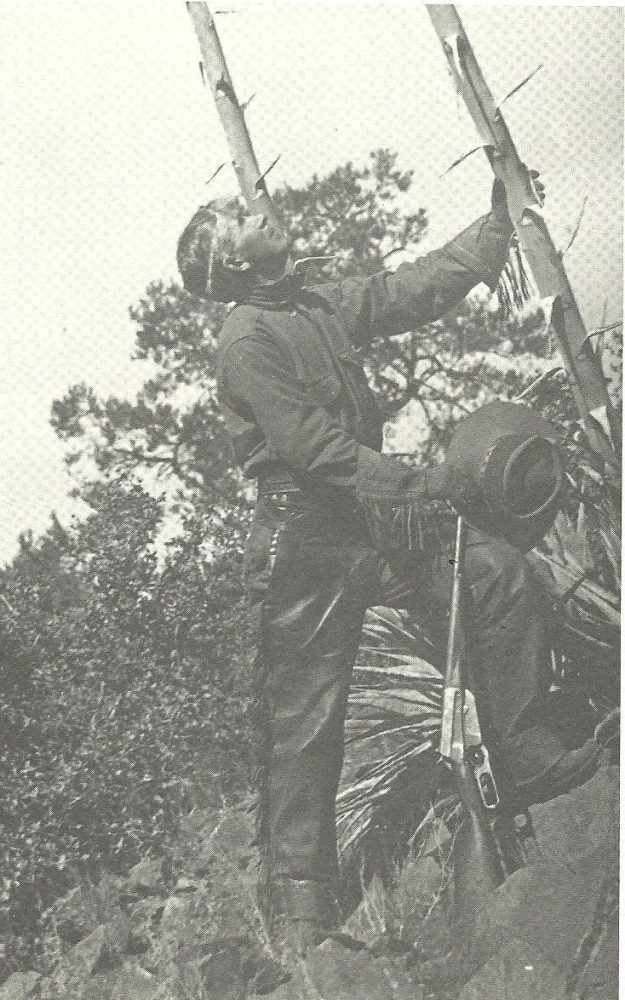 Zane Grey looks up the steep-sided Tonto Rim, one of his many Model 1895s in hand.
To equip for his annual fall hunt in Arizona in 1919, Grey (1986: 246) recalled later that: “I had the fun of ordering tents and woolen blankets, and everything we did not have on our 1918 trip. But owing to the war it was difficult to obtain goods of any description. To make sure of getting a .30 Gov’t Winchester I ordered from four different firms, including the Winchester Co. None of them had such a rifle in stock, but all would try to find one. The upshot of this deal was that, when after months I despaired of getting any, they all sent me a rifle at the same time. So, I found myself with four, all the same caliber of course, but of different style and finish…One was beautifully engraved and inlaid with gold – the most elaborate .30 Gov’t the Winchester people had ever built. Another was a walnut-stocked shotgun butted fancy checkered take-down…The third was a plain ordinary rifle with solid frame. And the last was a carbine model.”
Zane Grey and his party had successful hunts for turkey, deer and bear, leaving alone the recently introduced Rocky Mountain elk which were struggling to fill habitat emptied of Merriam’s elk by over hunting in the previous century.
Grey’s use of the venerable ’95 Winchester in the justly popular .30-06 eventually came to the attention of the Winchester Repeating Arms Company and in 1924 they presented him with yet another one, a fabulously engraved and gold inlaid ’95.
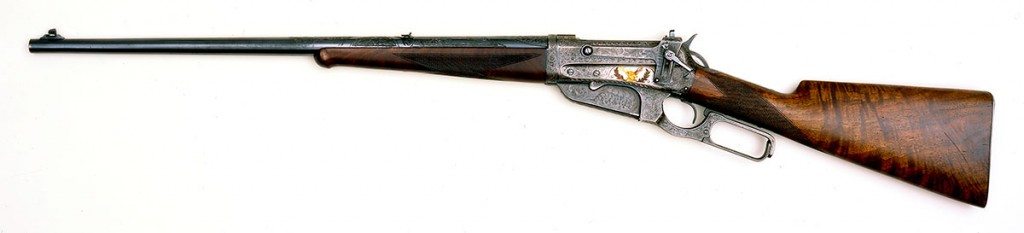 “One was beautifully engraved and inlaid with gold—the most elaborate .30 Gov’t the Winchester people had ever built.” (Photo: Buffalo Bill Historical Center)
Zane Grey (1986:358) summed up his atavistic philosophy about hunting: “Stealing through the forest or along the mountain slope, eyes roving, ears sensitive to all vibrations of the air, nose as keen as that of a hound, hands tight on a deadly rifle, we unconsciously go back. We go back to the primitive, to the savage state of man. Therein lies the joy.
How sweet, vague, unreal those sensations of strange familiarity with wild places we know we never saw before! But a million years before that hour a hairy ancestor of ours felt the same way in the same kind of place, and in us that instinct survives.
That is the secret of the wonderful strange charm of wild places, of the barren rocks of the desert wilderness, of the great-walled lonely canyons. Something now in our blood, in our bones once danced in men who lived then in similar places. And lived by hunting!
Reference cited:
Loren Grey 1986 Tales of Lonely Trails, Northland Press, Flagstaff.
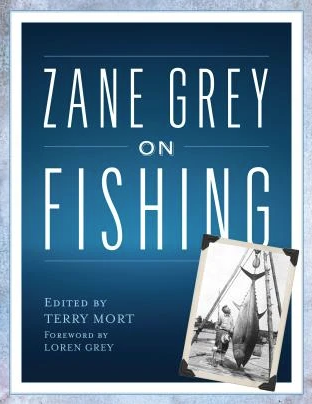 This book is a selection of some of Grey’s best work, and the stories and excerpts reveal a man who understood that angling is more than an activity–it is a way of seeing, a way of being more fully a part of the natural world. No writer exceeds Zane Grey’s ability to integrate the fishing experience with a world he saw so vividly.
Though he made his name and his fortune as an author of Western novels, Zane Grey’s best writing has to do with fishing. There he was free from the conventions of the Western genre and the expectations of the market, and he was able to blend his talent for narrative with his keen eye for detail and humor, much of it self-deprecating, into books and articles that are both informative and exciting.
|
Lt Col John Cary Morgan
United States Army Air Corps United States Air Force |
|
|---|---|

Military photo of John C . Morgan
|
|
| Nickname(s) | “Red” |
| Born | August 24, 1914 Vernon, Texas, US |
| Died | January 17, 1991 (aged 76) Papillion, Nebraska, US |
| Place of burial | |
| Allegiance |  United States of America United States of America |
| Service/ |
Royal Canadian Air Force United States Air Force |
| Years of service | 1941 – 1943 (Canada) 1943 – 1945, 1950 – 1953 (USA) |
| Rank | Sergeant (Canada) Lieutenant Colonel (USA) |
| Unit | 326th BS, 92nd BG |
| Battles/wars | World War II |
| Awards | Medal of Honor Air Medal (3) |
John Cary “Red” Morgan (August 24, 1914 – January 17, 1991) was a United States Army Air Forces pilot in World War II who received the Medal of Honor for his actions during a 1943 bombing run over Germany, which also inspired the character of 2nd Lieutenant Jesse Bishop in the novel and film Twelve O’Clock High.
Background
Born August 24, 1914, in Vernon, Texas, son of attorney Samuel A. Morgan Sr. and Verna Johnson Morgan,[1] Morgan graduated from a military school in 1931 then attended several colleges, including Amarillo College, New Mexico Military Institute, West Texas State Teachers College, and the University of Texas at Austin. While at Texas he learned to fly aircraft, and in 1934 dropped out of college. He worked in the Fiji Islands as a foreman on a pineapple plantation until 1938, when he returned to enlist as an aviation cadet in the U.S. Army Air Corps. However, because of his poor education record, he was refused enlistment. Working at an oil-drilling site for Texaco, Morgan suffered a broken neck in an industrial accident, and as a result was later classified 4-F by the Selective Service System.
Military service
In August, 1941, Morgan joined the Royal Canadian Air Force, and after completion of flight training in Saskatchewan, Ontario, and RAF Church Lawford, England, was posted as a Sergeant Pilot with RAF Bomber Command. On March 23, 1943, he was transferred to the U.S. Army Air Forces as a Flight Officer and assigned to the 92nd Bomb Group‘s 326th Bomb Squadron, RAF Alconbury, England.
Morgan, on his fifth U.S. mission, was co-pilot of a crew flying a B-17F, ser. no. 42-29802, to a target in Hanover, Germany, on July 26, 1943 (not July 28 as reported by his award citation below).[2] It was for his participation in this mission that he received the Medal of Honor (citation shown below in full), which was awarded on December 18, 1943.
Medal of Honor action
Morgan’s experience began as his group formation neared the German coast. The B-17, nicknamed Ruthie II, was attacked by a large number of Focke-Wulf Fw 190 fighters and had part of its oxygen system to the gunners’ positions in the rear of the aircraft knocked out. The first burst of fire also smashed the cockpit’s windshield, damaged the interphone, and split open the skull of pilot Lt. Robert Campbell. The pilot’s upper body slumped over his control wheel, causing it to start out of control. F/O Morgan seized the controls on his side and by sheer strength pulled the plane back into formation.
The disabled pilot continued to try to wrest the controls away from Morgan and smashed at the co-pilot with his fists, knocking some teeth loose and blackening both his eyes. Meanwhile, the top turret gunner was also seriously injured when a 20 mm shell tore off his left arm at the shoulder. He fell out of the turret position, and was found by the navigator bleeding to death. The navigator bailed the gunner out of the aircraft in a successful effort to save his life.
Unknown to Morgan, the waist, tail and radio gunners became unconscious from lack of oxygen and were threatened with death by anoxia. Morgan, unable to call for assistance because of the damaged interphone, had to decide whether to turn back immediately or try to fly all the way to the target and back within the protection of the formation. He also had to decide whether or not to subject Campbell to anoxia by cutting off his oxygen to disable him. In spite of wild efforts by the fatally wounded pilot to seize the controls, Morgan chose to complete the mission and not cut off his pilot’s oxygen supply.

by Lt. Gen. Ira C. Eaker
For two hours he held position in the formation – flying with one hand, fighting off the pilot with the other. At length the navigator entered the flight deck and relieved the situation. The navigator and bombardier secured the dying pilot in the nose compartment of the airplane. F/O Morgan’s B-17 reached the target at Hanover and successfully dropped its bombs. With all his fuel gauges reading empty, Morgan landed the bomber at RAF Foulsham. Lt. Campbell died an hour and half later, and the five surviving gunners recovered from various degrees of frostbite. The B-17 was declared damaged beyond economical repair and never flew again.
Capture
F/O Morgan transferred to the 482nd Bomb Group in October 1943 to fly B-17 H2X radar aircraft and was promoted to second lieutenant in November. He remained on combat duty, flying in 25½ missions.
On March 6, 1944, Morgan, now a first lieutenant, was the co-pilot on a B-17, ser. no. 42-3491, flown by Major Fred Rabo[3] leading the first major USAAF attack against Berlin. The aircraft was shot down and six of the crew were killed.[4][5] In his haste to escape the falling aircraft, Morgan bailed out without pausing to attach his chest-pack-type parachute. Free falling roughly 20,000 feet, he managed to attach the parachute pack and then successfully deploy it only about 500 feet above the ground.[6] Morgan, Rabo and two others were captured.[3][7] Morgan was held in Stalag Luft I, Barth, Germany, for the remainder of the war, the only person to become a POW after being awarded the Medal of Honor.
Post-war career
In 1948 Sy Bartlett and Beirne Lay, Jr. published their novel Twelve O’Clock High and used Morgan as a model for a primary character, Lt. Jesse Bishop. The wording of his actions appearing in his citation was used as dialogue in the script to describe the actions of Bishop under similar circumstances, and like Morgan, Bishop’s character was awarded the Medal of Honor and later became a POW. The circumstances also became a featured part of the 1949 film adaptation.
After the war, Morgan returned to work for Texaco in California selling aviation fuel. Called back to active duty when the Korean War broke out, he took a leave of absence from Texaco (1950–53) and applied for combat duty. The Air Force denied his request but allowed him to fly cargo planes in the United States for two years. He completed his final year on active duty in the office of the Deputy Assistant Secretary of the Air Force. In 1957, he retired from the Air Force Reserves as a lieutenant colonel. Morgan is survived by his only child Sam Morgan, who himself retired from the US Air Force after 20 plus years of service.
Morgan has four grandchildren and three step grandchildren of which two are currently serving in the Army and two others have served. Mark Morgan, the oldest, is a Colonel in the Army and has served several deployments to Afghanistan and Iraq.
Mark began his Military career in the Marine Corps serving in Operations Desert Shield and Desert Storm as well as Operation Restore Hope in Somalia. Wade Ziegler is a Chief Warrant Officer Five, flying helicopters in the Army serving several tours in Afghanistan and Iraq as well as other conflict zones around the world.
Rachel Morgan retired a Captain in the Army serving in Iraq and John Morgan retired a Staff Sergeant in the Marine Corps after having served several tours in Afghanistan and Iraq. Chris Morgan, Kristen and Rachel Ziegler all serve the Country in their own way telling the story of their grandfather to whoever will listen.

Morgan died on January 17, 1991, from complications associated with Alzheimer’s and a stroke. He is buried in section 59 at Arlington National Cemetery.
When questioned of his valor and heroism, Morgan replied, “There’s no such thing as a hero. …I was pushed into circumstances where I was forced to act. You can never say how you’re going to react to something until it happens, but I think most people would have done the same.”
Awards and decorations
[edit]
 |
||
.jpg) |
||
 |
||

|
 |
 |
 |

|
 |
 |
 |
 |


Medal of Honor citation
Citation:
For conspicuous gallantry and intrepidity above and beyond the call of duty, while participating on a bombing mission over enemy-occupied continental Europe, 28 July 1943. Prior to reaching the German coast on the way to the target, the B17 aircraft in which 2d Lt. (sic) Morgan was serving as co-pilot was attacked by a large force of enemy fighters, during which the oxygen system to the tail, waist, and radio gun positions was knocked out.
A frontal attack placed a cannon shell through the windshield, totally shattering it, and the pilot’s skull was split open by a .303 caliber shell, leaving him in a crazed condition. The pilot fell over the steering wheel, tightly clamping his arms around it. 2d Lt. Morgan at once grasped the controls from his side and, by sheer strength, pulled the aircraft back into formation despite the frantic struggles of the semiconscious pilot.
The interphone had been destroyed, rendering it impossible to call for help. At this time the top turret gunner fell to the floor and down through the hatch with his arm shot off at the shoulder and a gaping wound in his side. The waist, tail, and radio gunners had lost consciousness from lack of oxygen and, hearing no fire from their guns, the copilot believed they had bailed out.
The wounded pilot still offered desperate resistance in his crazed attempts to fly the aircraft. There remained the prospect of flying to and over the target and back to a friendly base wholly unassisted. In the face of this desperate situation, 2d Lt. Officer Morgan made his decision to continue the flight and protect any members of the crew who might still be in the ship and for 2 hours he flew in formation with one hand at the controls and the other holding off the struggling pilot before the navigator entered the steering compartment and relieved the situation. The miraculous and heroic performance of 2d Lt. Morgan on this occasion resulted in the successful completion of a vital bombing mission and the safe return of his aircraft and crew.

After World War I proved the utility of scoped rifles on the modern battlefield, the U.S. Army realized that it should build off the lessons learned in the mud and blood of the trenches and begin evaluating scopes and scoped rifles for future conflicts. Fortunately, the National Archives have records of some of these tests, both those conducted during the relative peace of the interwar years and the early years of World War II, when the need for a suitable sniper rifle was more acute.
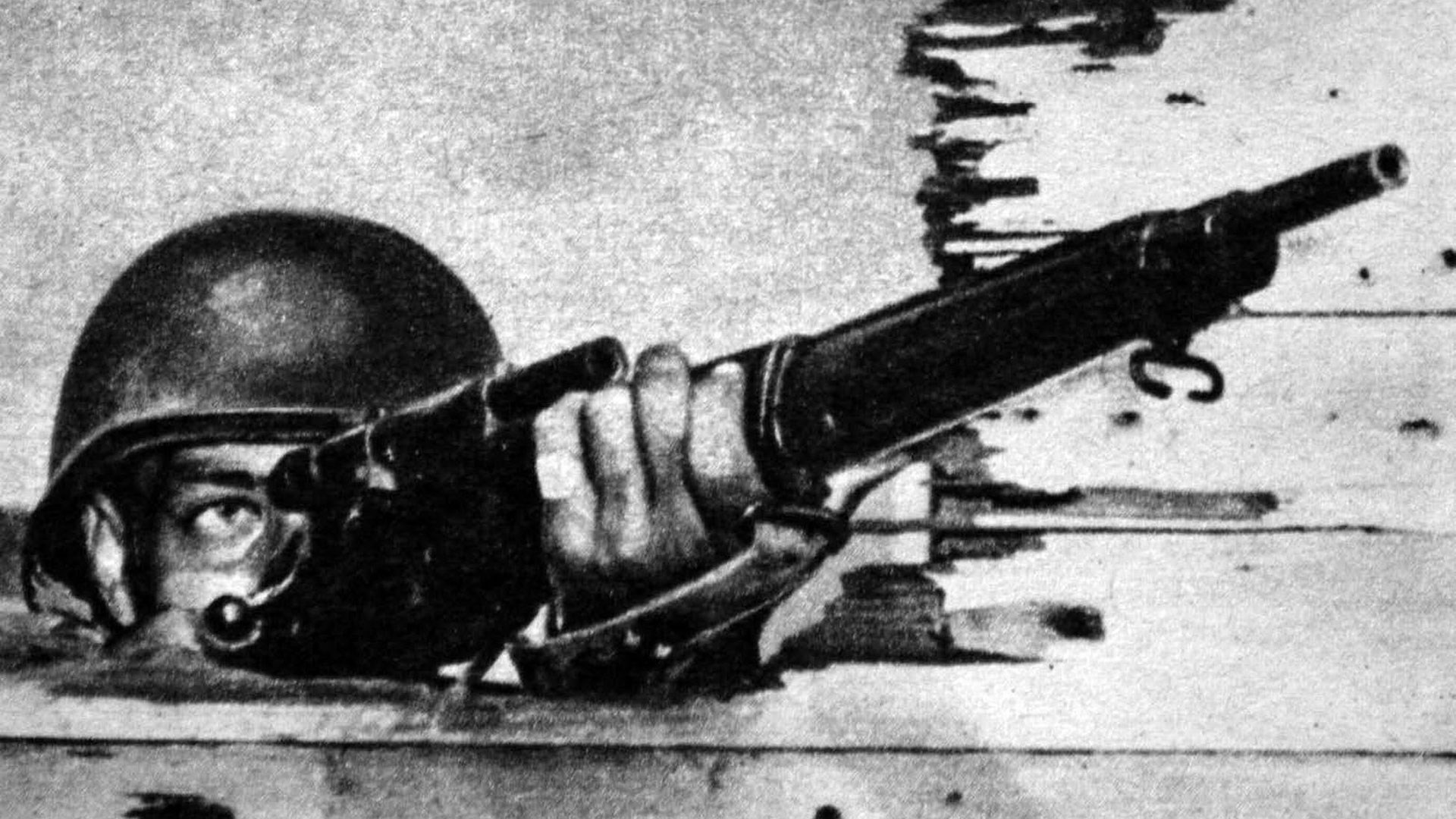 A U.S. soldier takes aim with his M1903A4 sniper rifle.
Even better, the fine folks at Archival Research Group have started the herculean task of digitizing many of these fascinating primary source records for the casual armchair historian to pore over.
The 1925 Test
A test conducted by the Army’s “Department of Experiment” at Fort Benning, Ga., in 1925 determined that a “telescopic sight should be mounted and issued on a specially accurate rifle having a specially constructed stock with high comb and less drop at the heel…” and one also featuring a longer length of pull than the standard service stock. They felt these changes were necessary to get the greatest advantage out of the scoped rifle, and to make it more comfortable for a range of shooting positions.
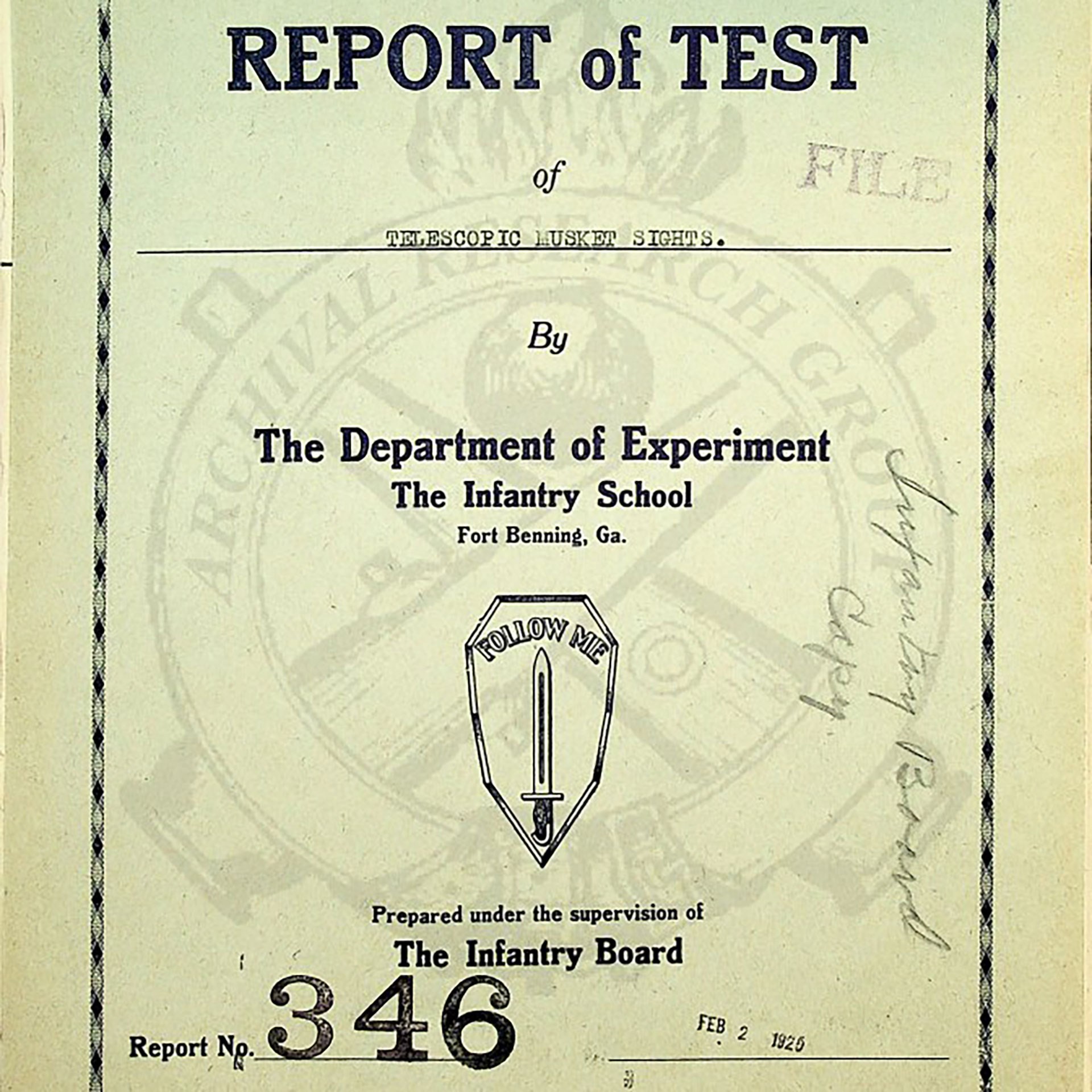 (Photo courtesy of Archival Research Group)
Interestingly, they singled out a weapon already in production at Springfield Armory – the NRA “sporting type” rifle – as the ideal candidate. They noted it as the most accurate of all the Model 1903 rifles (even more so than ones specially selected for the National Matches they claimed), and further stated that “it is provided with the Model 1922 stock, having exactly that high comb, small drop at the heel, and length which experience indicates will be most satisfactory with a telescopic sight.”
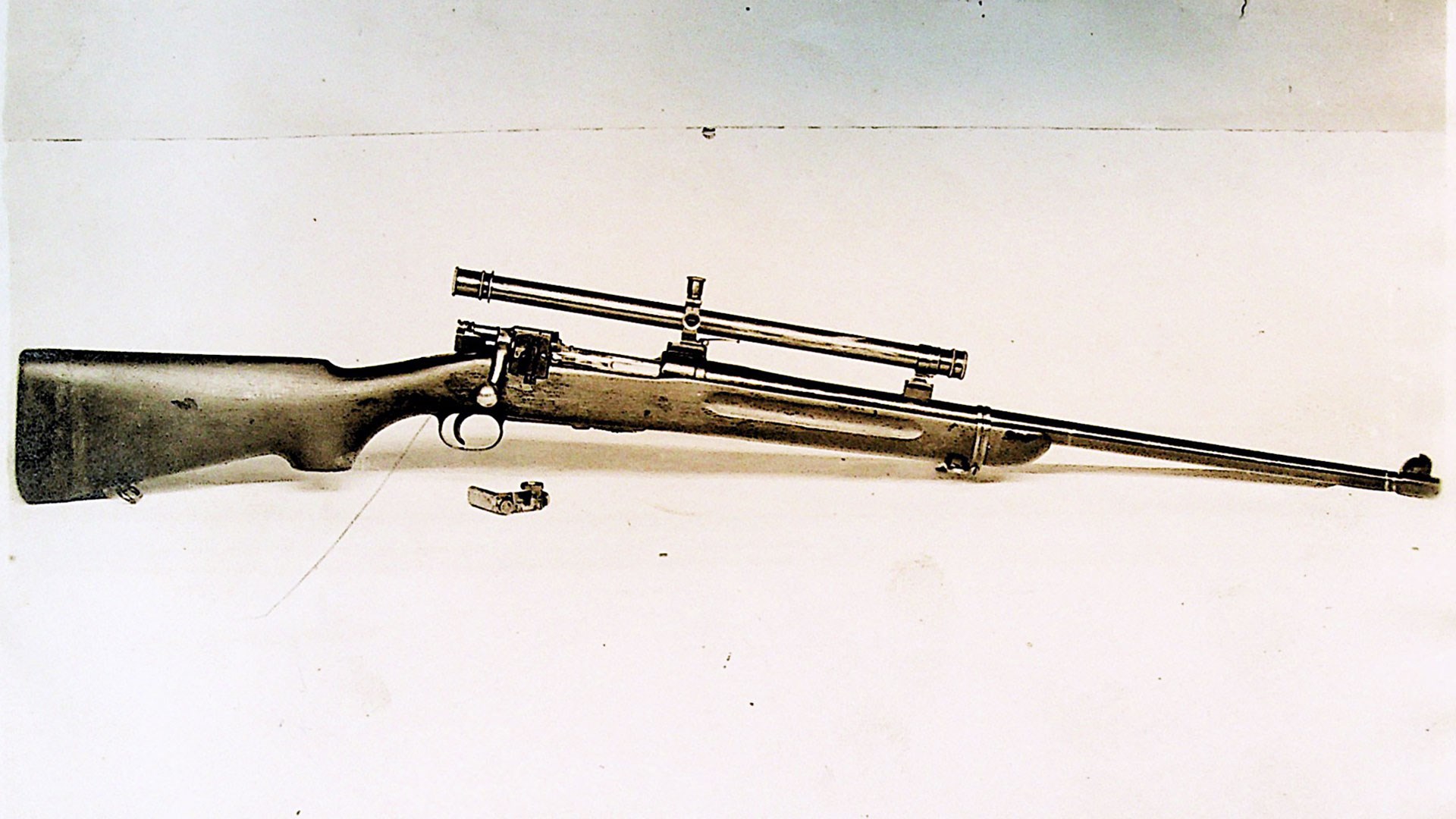 A Springfield Armory Model 1922, .22-Cal., rifle with Winchester A5 Scope mounted. The NRA M1903 “sporting type” rifles looked very similar, and the stock of the Model 1922 was desired. (Photo courtesy of Archival Research Group)
In the end they came down on the side of the sniper rifle, stating that “In any future war it may or may not have a decided usefulness, depending on local conditions. It is therefore felt that this instrument [rifle scope] should be developed to an ultimate successful type”.
Despite this apparent interest in fielding standardized scoped rifles, the U.S. Army allowed its peacetime sniper rifle program to atrophy into functional non-existence. Only the Marine Corps fielded any real number of scoped rifles, and unlike the more compact scopes favored by the Army, they chose to use 16″ long target-style scopes produced first by Winchester and later by Lyman.
The 1942 Test
After the U.S. entry into World War II, the Army once again faced the reality that there was a need for a scoped rifle for use by snipers and other marksman on the battlefield. Unlike 1925, there was a pressing need to get an effective sniper rifle into the hands of soldiers and marines in a timely fashion. To determine what form that rifle should take, they once again embarked upon a series of tests at Fort Benning, now conducted by the Test Section of the Infantry Board. In these tests, dated Nov. 1942, they set out to settle three primary things: the rifle, the optic and the mounting location.
 (Photo courtesy of Archival Research Group)
The Rifle
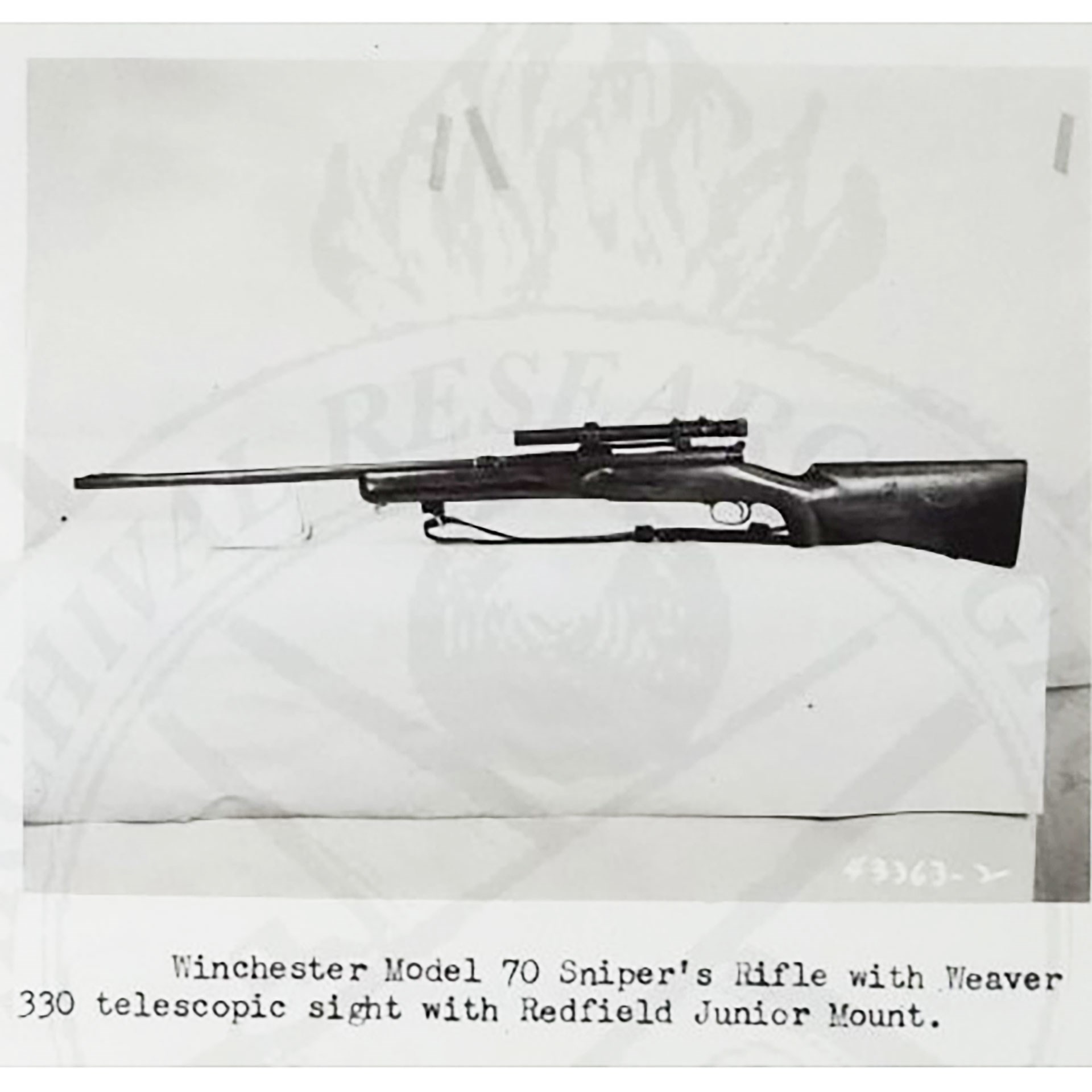
The first task was determining “the type of service rifle most suitable for the use of telescopic sights.” As the NRA Sporters had been discontinued, and the M1 Garand had officially supplanted the M1903 as the Army’s standard rifle, the Army test now considered three contenders: commercial style rifles, the M1903, and the M1. The Test Section received four Winchester Model 70 rifles, which came mounted with Weaver hunting style scopes. While pre-64 Model 70s are beloved and sought-after weapons today, the Army wanted nothing to do with them for simple logistical reasons (although the USMC, and eventually even the Army, would field small numbers of them).
 (Photo courtesy of Archival Research Group)
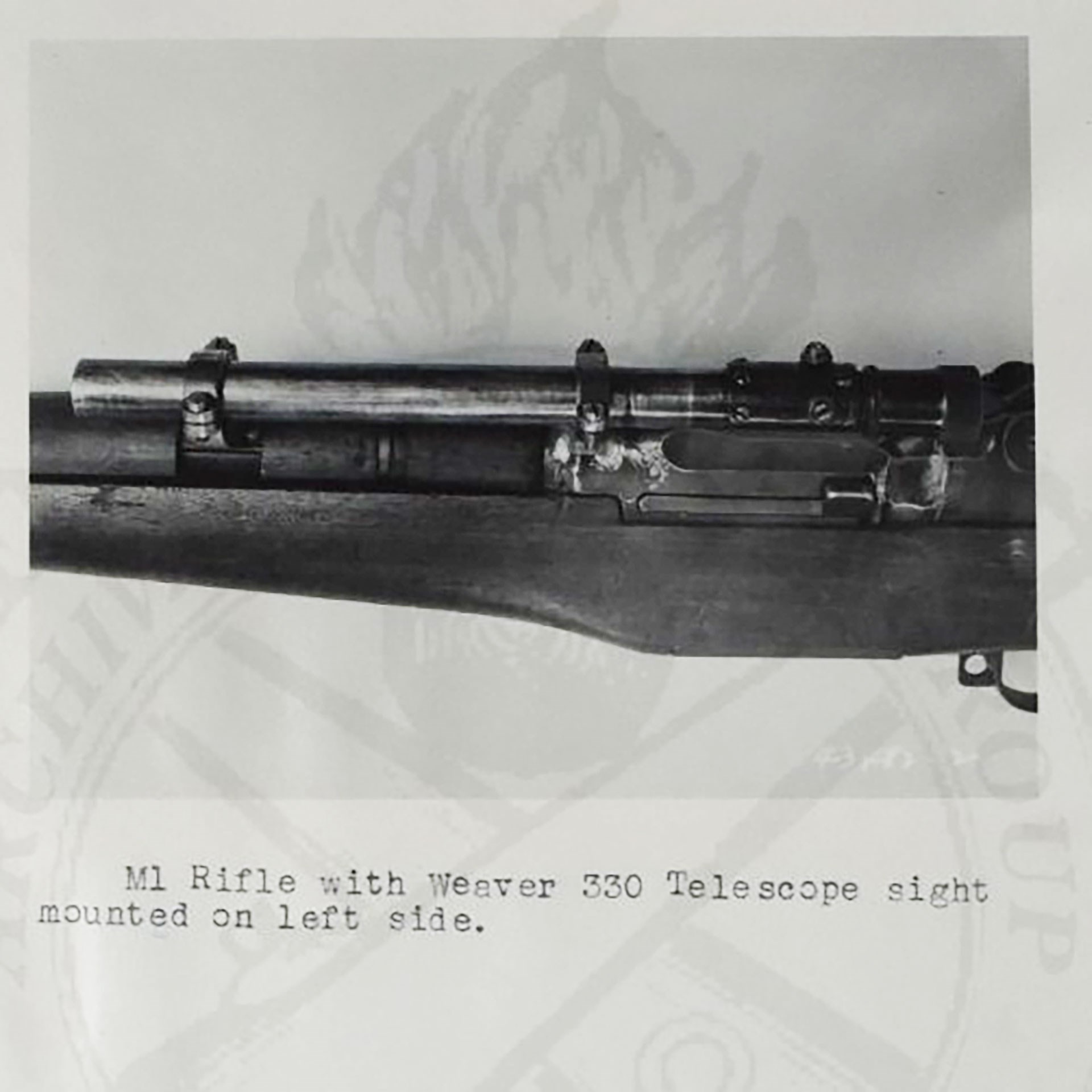
In the 1942 report, they brusquely dispensed with them by stating “Manifestly, this equipment is not what is desired for the reason that the Winchester rifle is not standard and it is not desirable to add another weapon of this type to the rifle company.” Instead, they determined that both the M1903 and M1 were suitable for use by snipers due to them being “extremely accurate” and already part of the standard inventory. They did set forth certain criteria however, and stated that the rifles should be hand selected based on shot group size, and their actions be hand finished.
 (Photo courtesy of Archival Research Group)
While they no longer desired the Model 1922 stocks from the NRA Sporters, they stated that “Stocks should be selected and carefully fitted” and that “In the case of the M1903, the National Match rifles with type ‘C’ stocks would be most desirable.” The “C” stocks featured a full pistol grip, instead of the original service rifle’s straight stock, and had found great favor with competition shooters during the inter-war years. As far as the rifle was concerned, the Test Section’s feelings were summed up when they said “All things should be done to insure smooth operation and greatest accuracy.”
The Optic
Now that they figured out the platform, they would have to “determine the most satisfactory type of telescope for sniping use.” In the end they would compare two scope designs: the higher magnification target style scopes used by the Marines, and the more compact but much lower magnification hunting type scopes. Alongside choosing what scope to use, they had to “determine the type of reticle to be used in the sniper’s telescope.”
 (Photo courtesy of Archival Research Group)
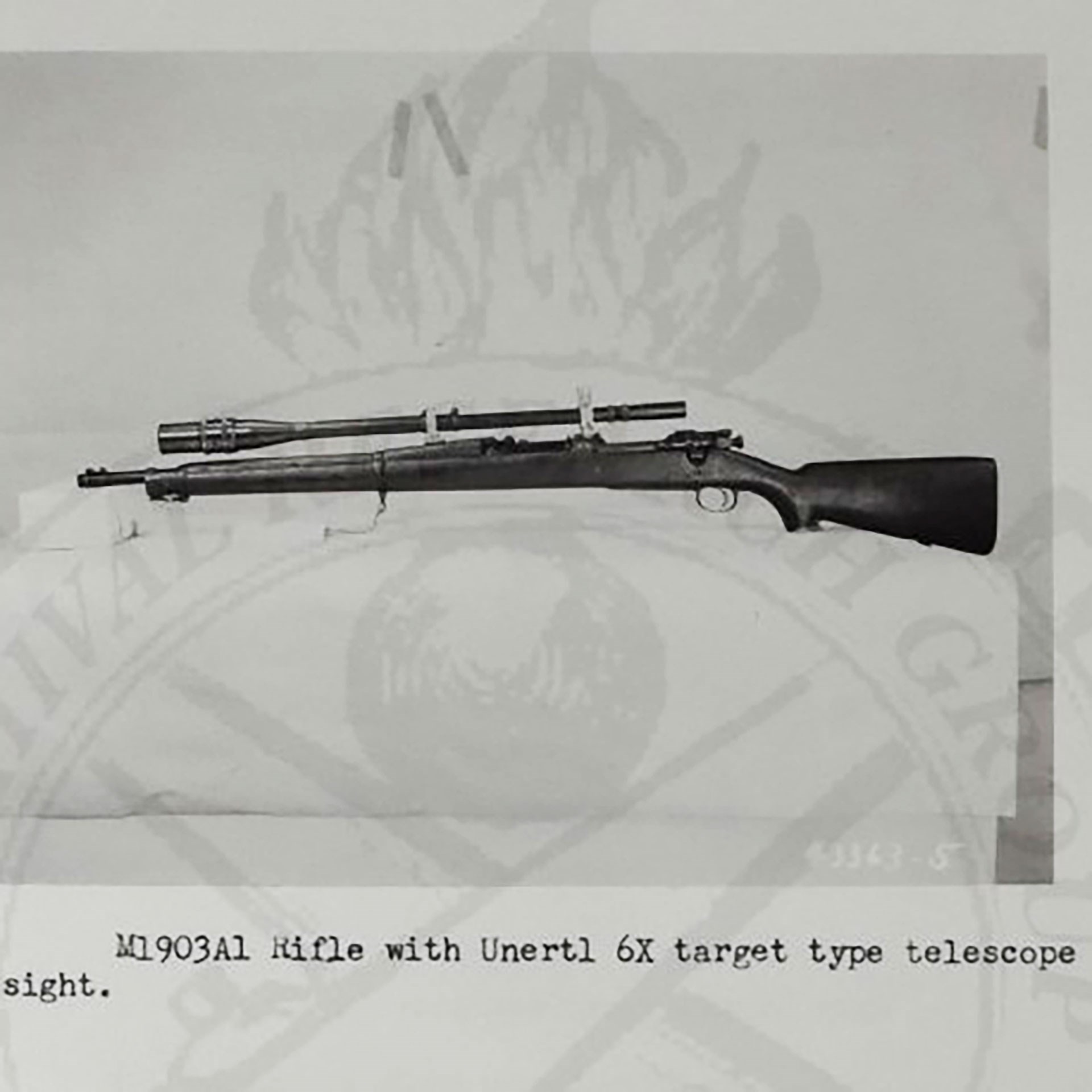
The target type optic that was tested was a Unertl 6X magnification scope mounted on a M1903A1 rifle (the A1 basically being a standard M1903 mounted in a full pistol grip C stock). The Army testers quickly determined that the target style scope would not fit their needs, and noted two main issues that “preclude[d] its use as a ‘field service’ sight.”
First was the overall bulk and fragility of the scope, which while acceptable for the competition firing line, raised concerns about how they would hold up in harsh field conditions. Second was the size of the objective lens, and the type of mount required to attach it to a rifle. In the view of the testers this combined to force the shooter to adopt “awkward firing positions,” which were “uncomfortable, unsteady and slower” than other designs.
 (Photo courtesy of Archival Research Group)
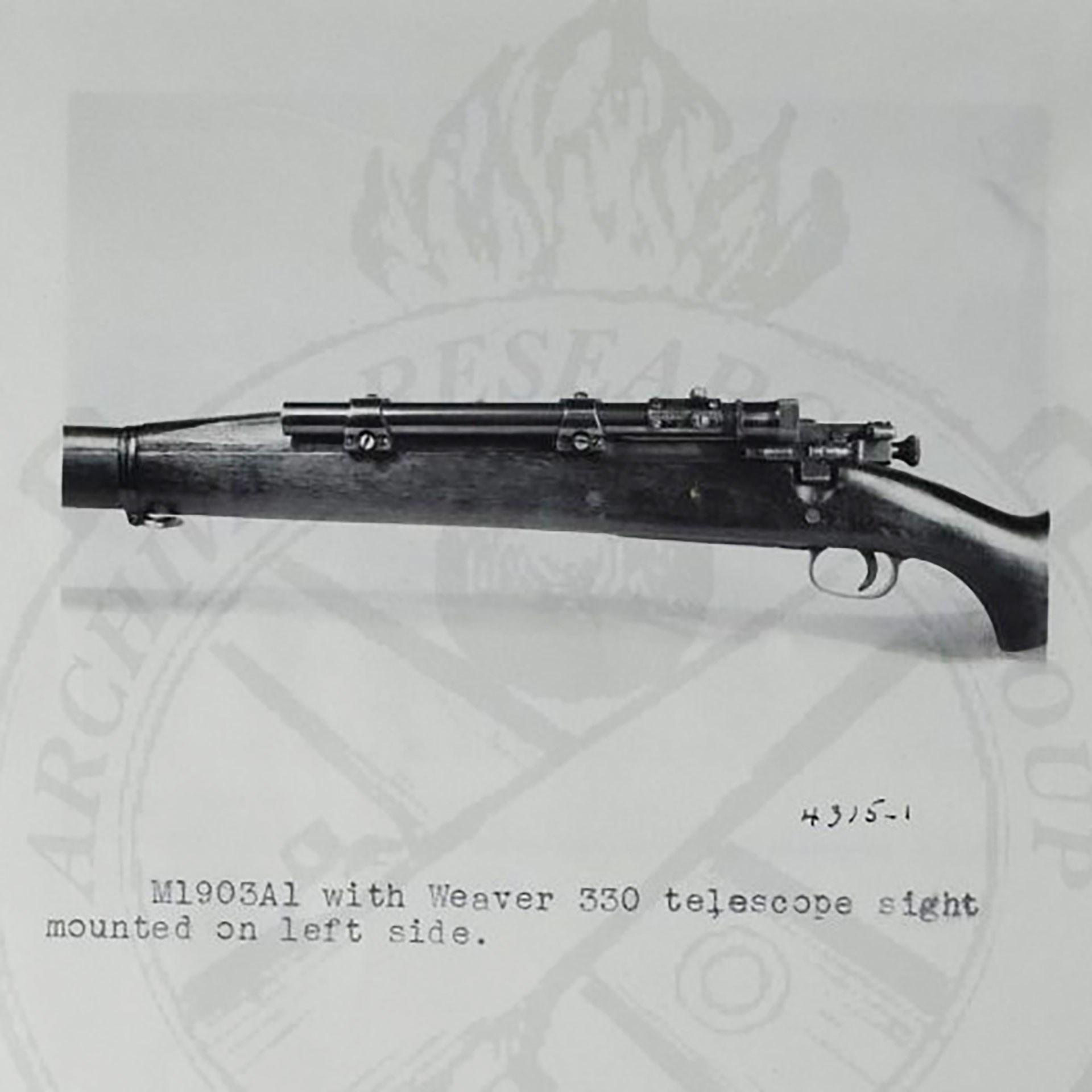
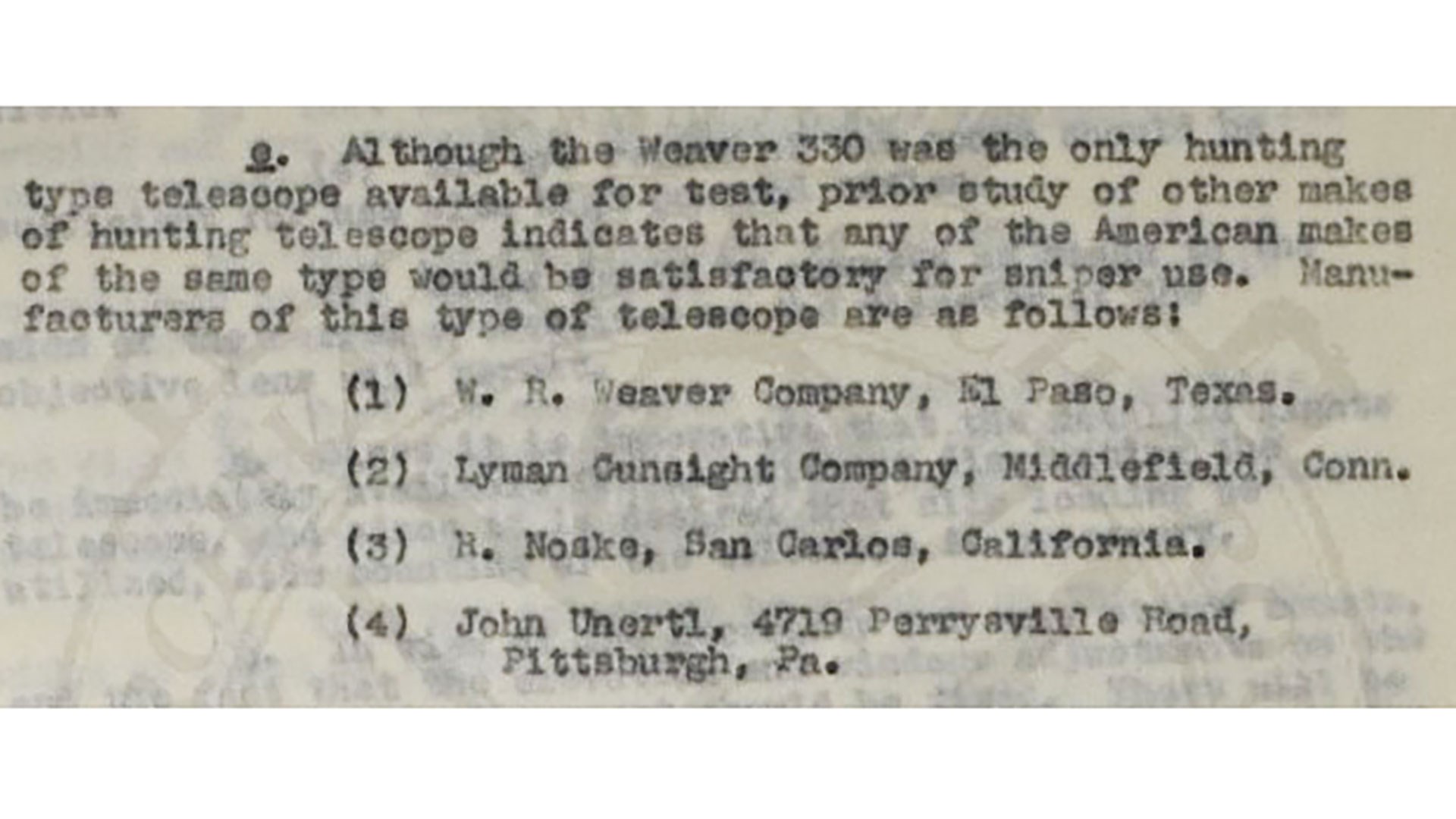
For the “hunting-type scope” however, they had high praise, calling it a “very compact, sturdy sight” which “has been used extensively by sportsmen in all climates and on all sorts of terrain.” The particular scope they used in the testing was a 2.5X magnification Weaver 330, but they noted that “prior study of other makes of hunting telescope indicates that any of the American makes of the same type would be satisfactory for sniper use,” and specifically called out Weaver, Lyman, Noske and Unertl as known suitable manufacturers.
 (Photo courtesy of Archival Research Group)
The testers felt that this simple sight was rugged enough to withstand conditions in the field and, somewhat optimistically perhaps, hoped that “many inducted soldiers will already be trained in its use.” They also specially mentioned that the adopted scope should have “elevation and windage screws [with] knobs and clicks similar to the Weaver 330C,” something that would provide the shooter with tactile feedback when adjusting the scope, and allow them to make adjustments without having to closely eyeball hashmarks as they went.
 (Photo courtesy of Archival Research Group)
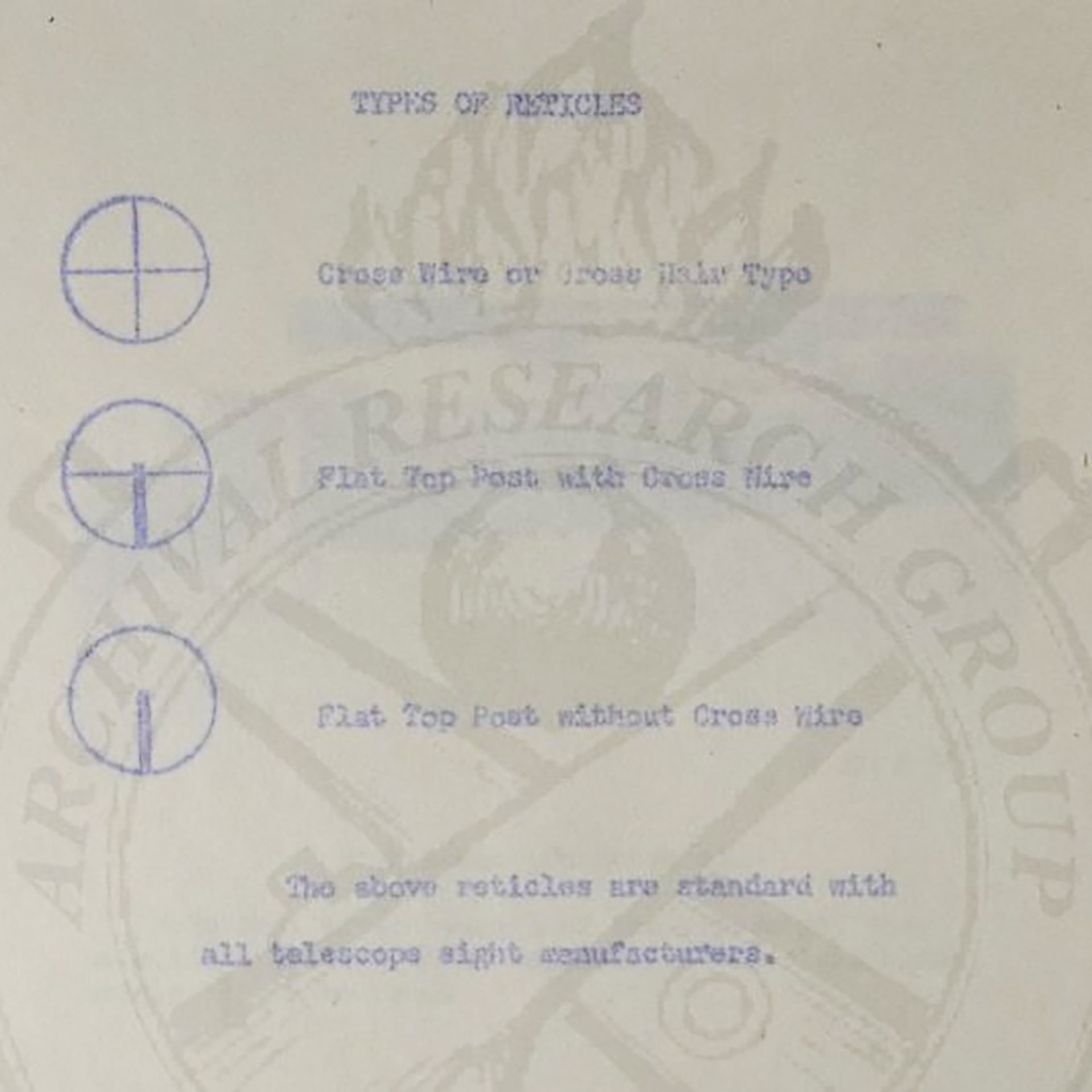
As to the issue of reticle, the Test Section looked at three types: standard crosshair, flat top post and flat top post with a cross wire. While the report notes a preference for the crosshair type with medium thickness wires, it noted that the others would be suitable substitutes.
The Mounting Location
Finally, with the rifle and scope sorted out, the Test Section need to work out the most advantageous way to marry them together. In determined the following factors to be essential:
“(1) That due to the possibility of injury to the scope without disabling the rifle, the metallic sights must be instantly available for use with the scope mounted. (2) Mounts must be sturdy and rigid. (3) Since […] after dismounting and remounting it is necessary to make slight corrections from the former zero, the telescope should not be dismounted in the field. (4) The eye relief of the scope should be sufficient for use with high power rifles. (5) Scope should be mounted as close to the side of the barrel or receiver as the diameter of the objective lens will permit.”
(Photo courtesy of Archival Research Group)
Recognizing that even the hunting-style scopes of the day were still fairly fragile pieces of equipment, and that clip-loading was desirable (and essential on the M1), the Test Section deemed that a side mounted scope was necessary to free up the top of the rifle for aiming with iron sights and loading. They also departed from other nations’ designs by stating that instead of a detachable scope that would be stored in a protective case when not in use, the scope would be permanently fixed in a non-adjustable mount, with all windage and elevation adjustments being internal to the scope itself.
The Birth of the M1903A4 – And Some Significant Deviations from the Recommendations
Like any government acquisitions program, there will typically be some deviation from what the requesting agency asks for and what they ultimately receive. While the reasons for such differences can be legion, so often it boils down to time, simplicity, and money – which appears to be the driving factors behind what became the most common sniper rifle that was fielded to American forces in World War II and Korea.
The Rifle
The first concession to ultimately be made when actually producing the new sniper rifle was the selection of the M1903A3 instead of the M1903 or M1903A1 as the bolt-action sniper platform. While a fundamentally similar rifle, the M1903A3 was created an expedient variation to increase production speed and decrease cost during the war, and generally isn’t quite as finely fitted and finished as peace-time production M1903s. In particular it makes extensive use of stamped parts, to include the integral triggerguard and floorplate, barrel bands and sling swivels.
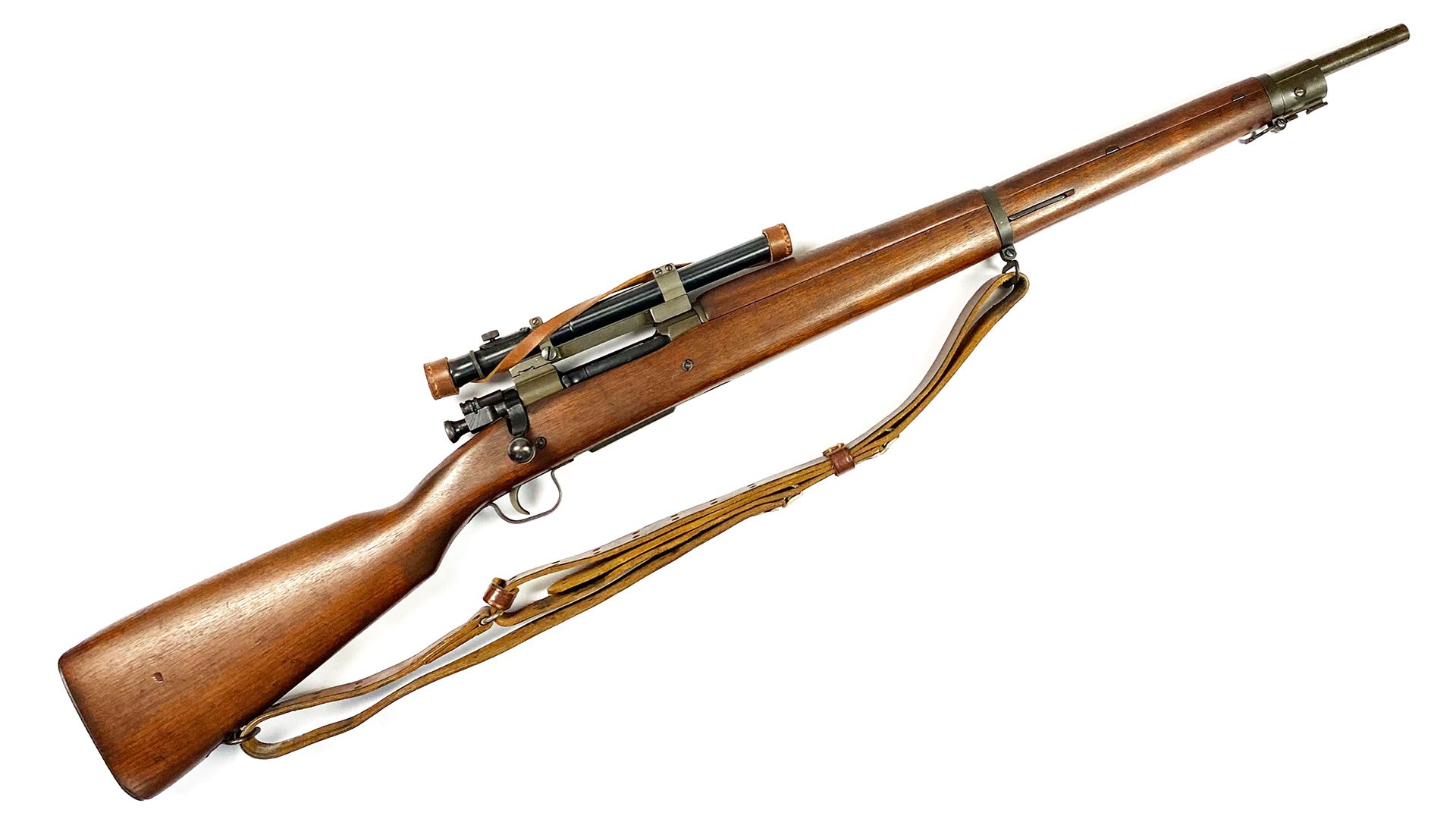 The Author’s Remington M1903A4 sniper rifle.
The feature most notable from a distance is the substitution of a rear receiver mounted aperture sight, something that removed the need for the traditional ladder-type sight, which had its space filled with an extended hand-guard. And since M1903 production had long since ended at Springfield and Rock Island, two commercial firms had been selected to produce the M1903A3 – Remington and Smith-Corona. In the end, only Remington would be contracted to produce sniper variants, while Smith-Corona only produced the regular service rifle.
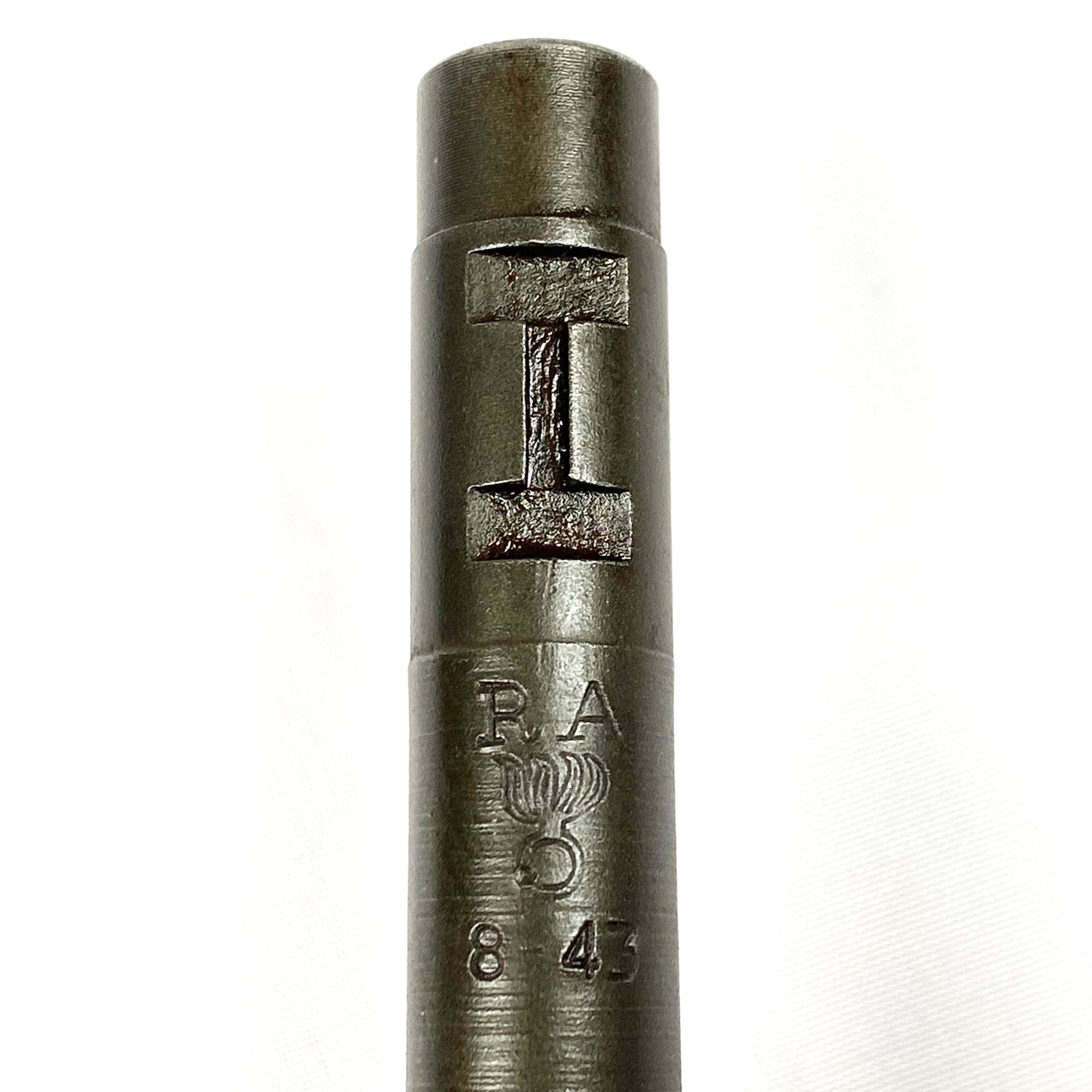 A close-up view of the barrel markings on the author’s M1903A4, with “RA” for Remington Arms, ordnance bomb and Aug. 1943 production date.
Also, despite the recommendations that rifles be hand-selected for accuracy, have their actions hand finished and be carefully fitted with specially selected stocks, there is no indication that any of this was done, with Brophy noting in his seminal work “The Springfield 1903 Rifles,” “[t]he rifle was a Model 1903A3 without any special attention paid to its accuracy, or suitability for such use.”
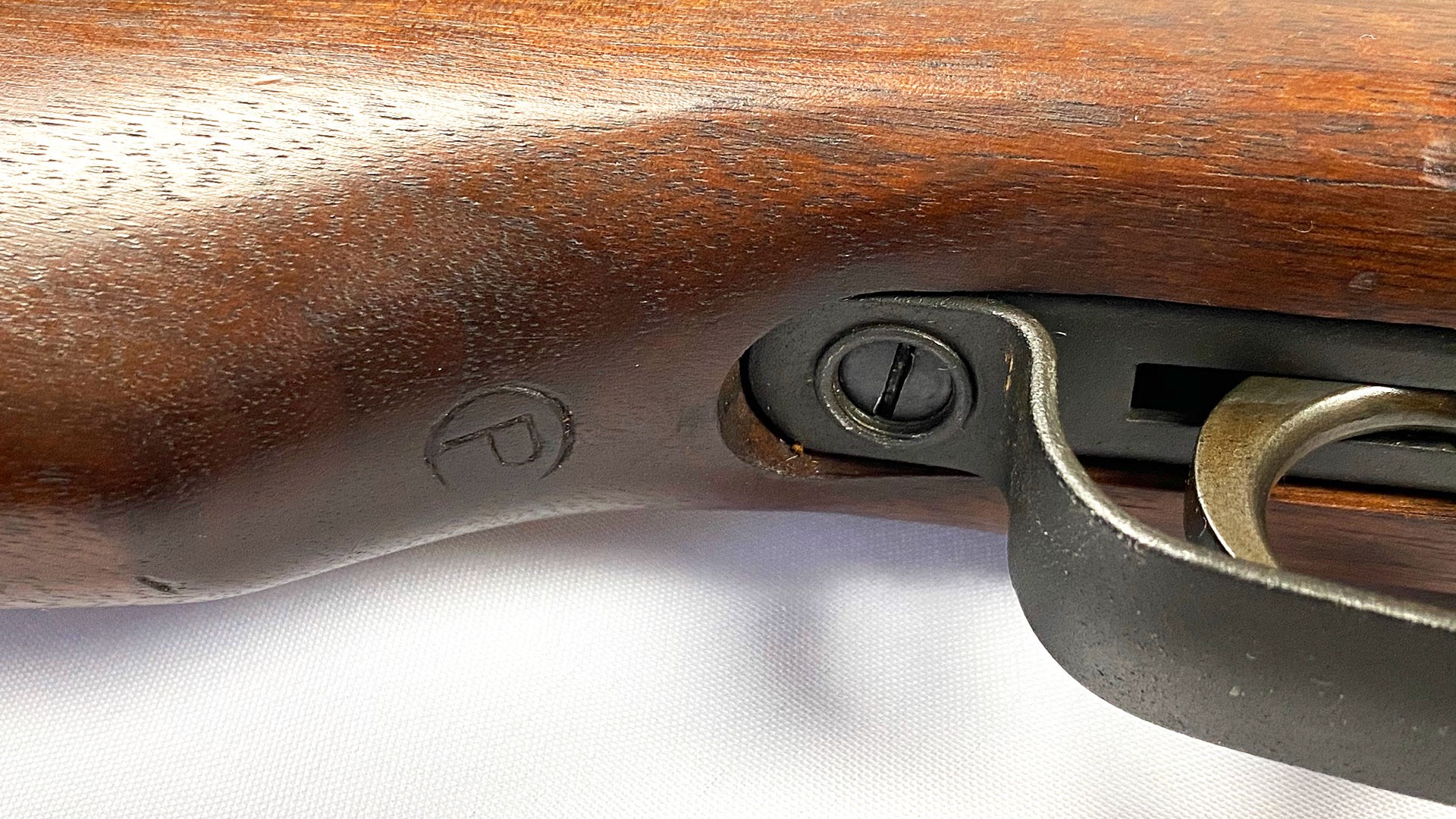 A circled “P” firing proof cartouche at the bottom of the “scant” semi-pistol grip stock.
Additionally, while many M1903A4s were fitted with the full pistol grip “C” stocks as called for, a fair number were (like the main example photographed here from the author’s collection) were placed in the “scant” semi-pistol grip stocks. The stocks had their own interesting story of government frugality and compromise born from stock blanks cut too shallow (in the style of the original straight stocks) to accept a full “C” pistol grip.
The Optic
The scope itself generally followed the specifications dictated, with the final optic being a militarized variant of the Weaver 330C, named the M73B1 (although some standard 330Cs were fitted to the earliest rifles). Having a relatively low fixed 2.5x (some say 2.20x) magnification, and a narrow 0.75″ diameter tube, it is completely archaic by today’s standards both for magnification and light transmission.
Even when compared to the common foreign sniper scopes of the day, it certainly would not come in as best-of-show, but was in the end an available and economic optic. It did however prove to be somewhat fragile in field conditions, prone to moisture seepage and difficult to use in low-light situations.
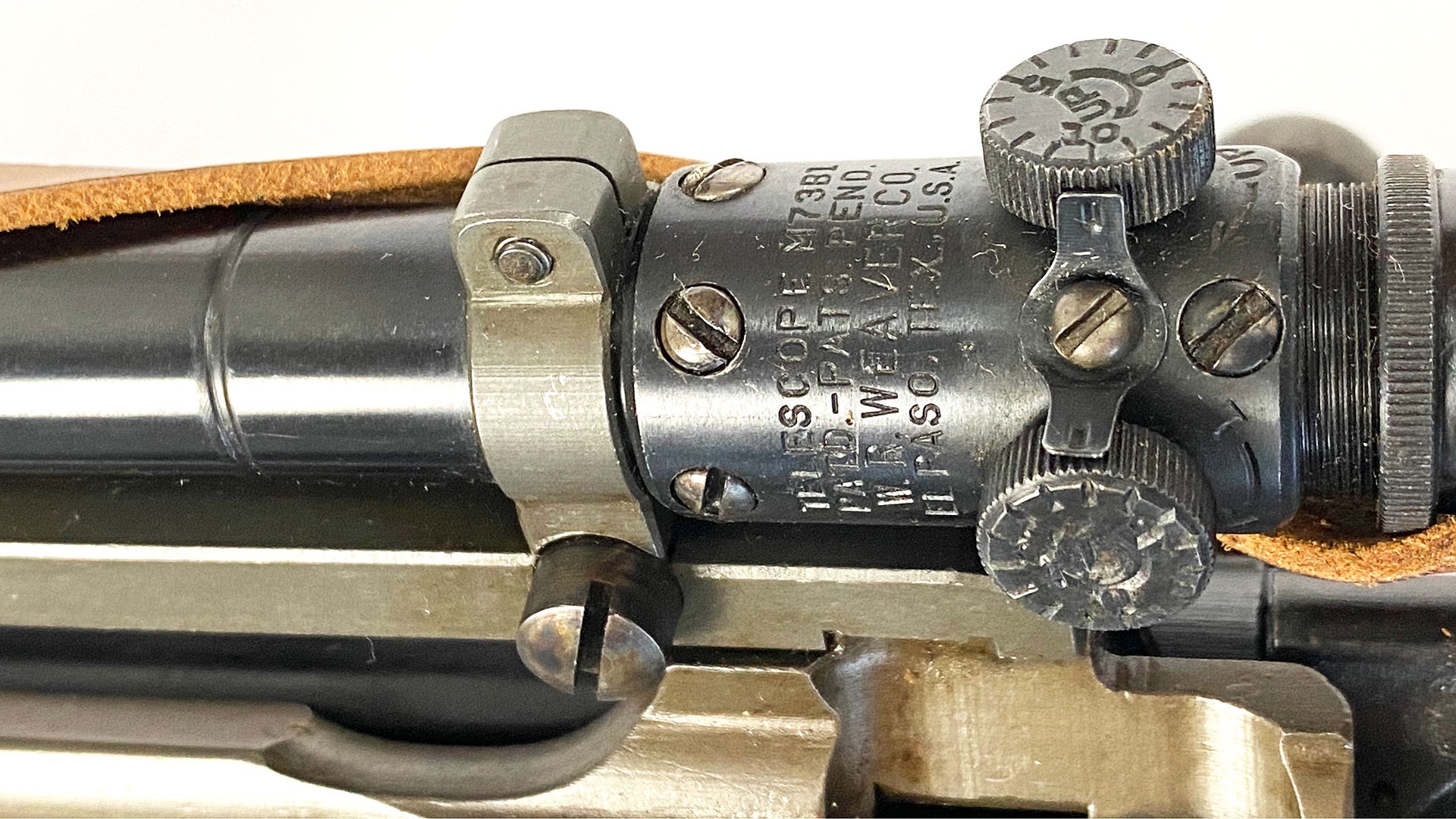 A closer look at the World War II era M73B1, a militarized variant of the Weaver 330C, mounted to the author’s M1903A4.
While the M73B1 would serve as the primary optic for the duration of World War II, as the service life of the M1903A4 continued, it would also occasionally mount the M81, M82 or M84 telescopes. While each was an incremental improvements over the last, they all were narrow-diameter and low-magnification optics that were generally not widely beloved.
The Mounting Location
Probably the most obvious departure from the Test Section’s recommendations was the location of the scope itself. Despite the Test Section stating that a side mounting was “necessary” because “it is imperative that the metallic sights be immediately available for use…,” and that clip loading was desired, the decision was ultimately made to mount the scope in a low “scope over bore” configuration.
The mount chosen was a Redfield Jr. model, which was attached on the front via a hole drilled into the receiver and at the rear via a dovetail type base that is integral to the rifle. The mount and mounting location did present a unique problem to Remington, the solution to which still helps collectors to this day.
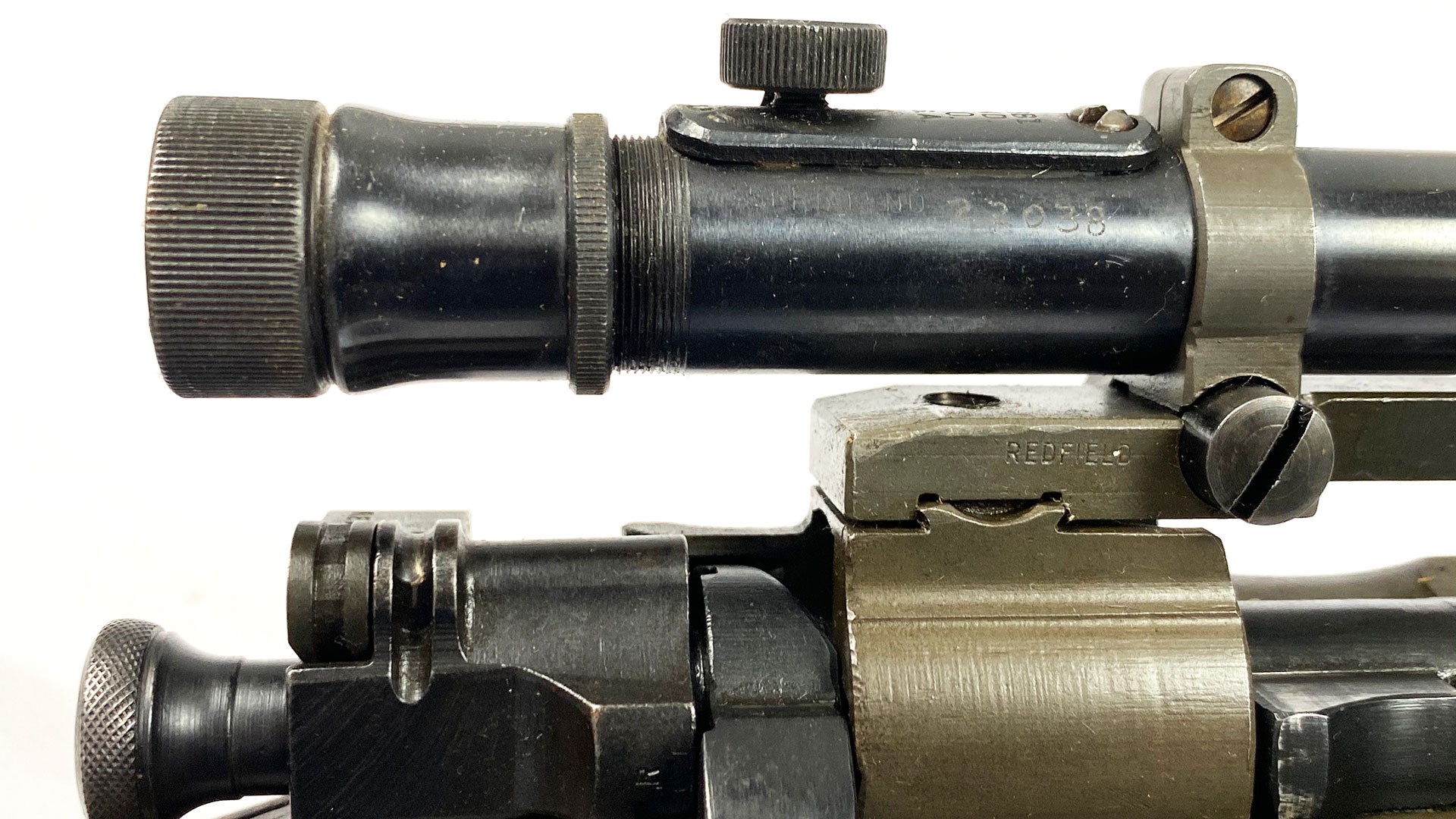 A close-up view of the back-rear portion of the receiver, with the back end of the Redfield Jr. mount dovetailed into what would have been the spot for the adjustable peep sight on a standard M1903A3.
Because the mount would fully obscure the standard service rifle markings, Remington chose to dramatically offset their manufacturers info and rifle model to the left side of the mount, and the serial number to the far right, in order to ensure that all were fully visible. This leaves, when the mount is removed, a large blank space smack-dab in the middle of the receiver (in addition to the mounting hole).
A modern collector can be sure they have a rifle originally configured as a M1903A4, and not a more recent “clone”, if it features this unique stamping pattern. Interestingly, Remington chose not to change the stamped nomenclature on these rifles, and all will bear factory “MODEL 03-A3” markings, although it’s not unheard of for rifles to have a hand-stamped “4”, possibly added later either during the refurbishment process, or by a diligent unit armorer seeking to square his rifles with his supply record.
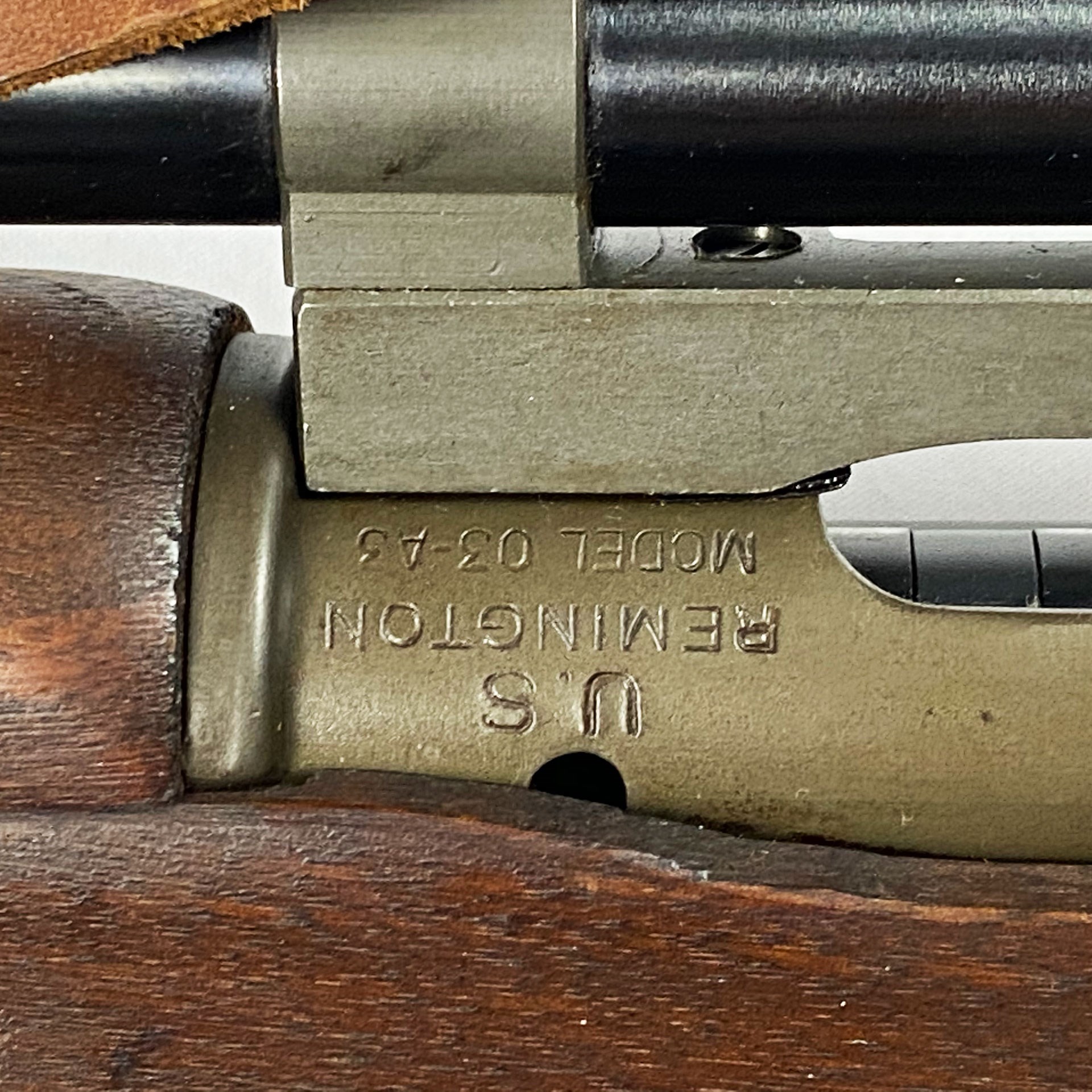 A closer look at the moved receiver roll marks on the left side of the receiver.
While the scope over bore positioning did present less risk of damage when compared to the high mount, it did prevent the use of both the iron sights and clip loading. In fact, on the M1903A4 the Army decided to omit iron sights entirely, leading to the rifle becoming mostly useless if the comparatively fragile scope became damaged by rough handling or environmental conditions. One other interesting side effect of the scope position is that it interferes with the safety operation, while you can wedge the safety into a 3/4 vertical position, it if far from secure or ideal.
This Rifle
The pictured rifle was produced in 1943, with a barrel dated from August of that year. It shows a correct mix of parkerized and blued parts, as well as the “scant stock“ variant that provides a semi-pistol grip. It has a number of clear cartouches, including “RA” – Remington Arms, “FJA” – Frank J. Atwood (the inspector), an ordnance wheel, and “S.A.” in a 3-sided box.
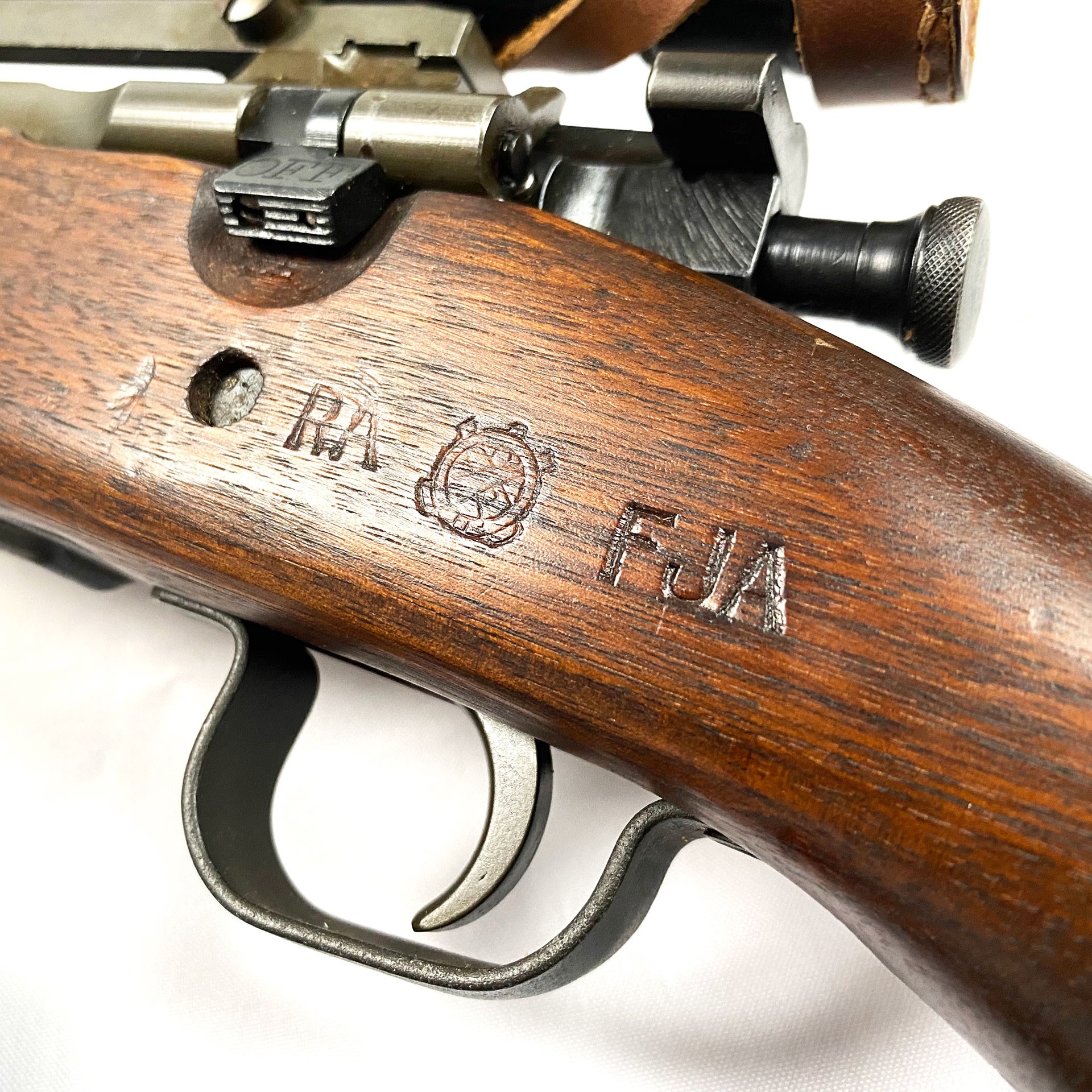 A closer look at the three main cartouches on the left side of the stock ahead of the wrist, with “RA” standing for Remington Arms, an ordnance wheel and “FJA” – Frank J. Atwood – inspector mark.
The final cartouche indicates that it was inspected / overhauled at Springfield Armory post-war, although it doesn’t look like too much refurbishment was done given the condition of the stock and the metal finish being generally consistent with wartime production.
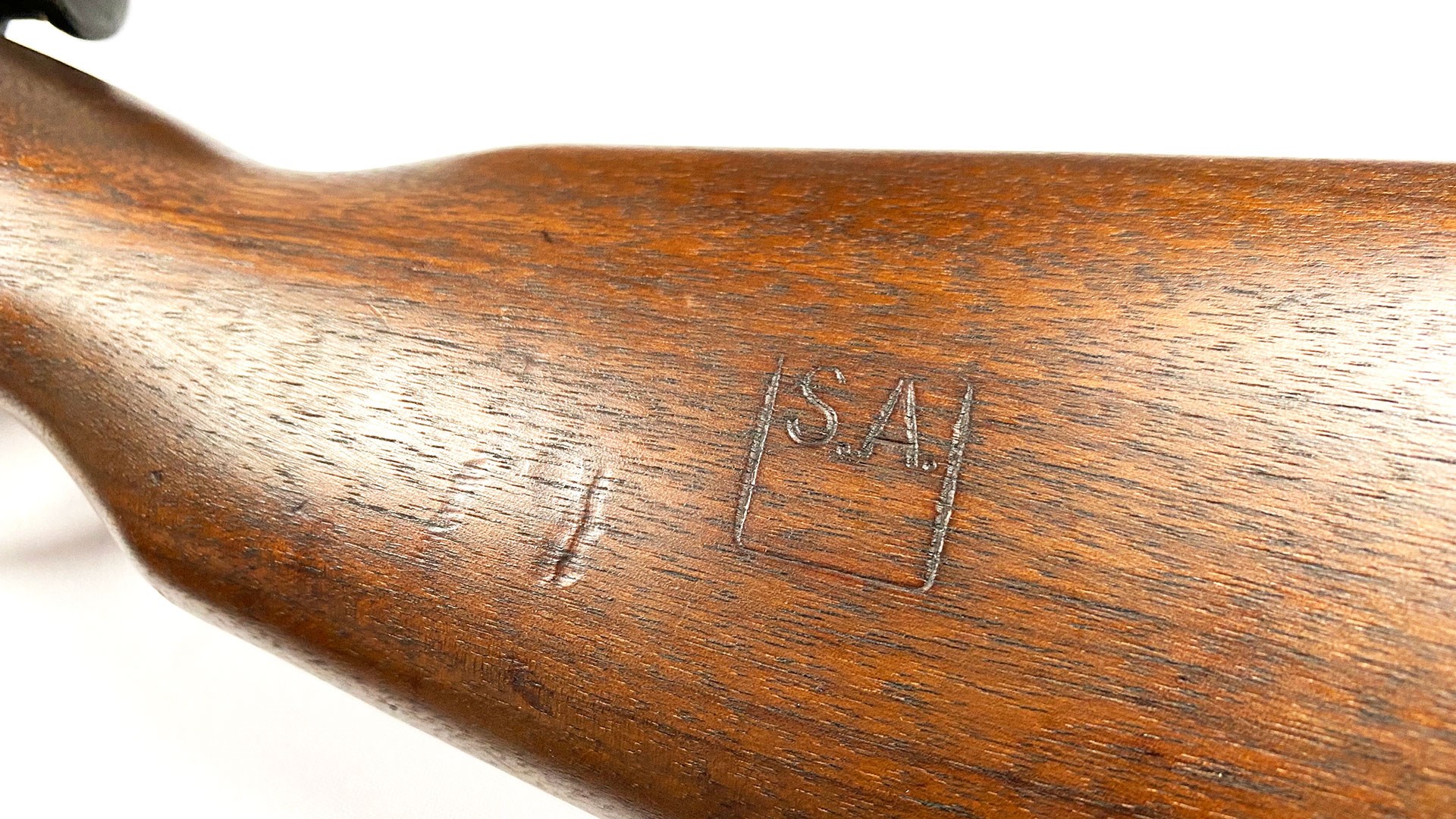 The “S.A.” cartouche inside an open square on the stock, indicating a post-war rebuild at Springfield Armory.
WW2’s Best Sniper Rifle?
Was the m1903A4 the perfect sniper rifle? No, absolutely not. In fact, Colonel Brophy considered it “at best a poor excuse for a sniper rifle”. But I’d suggest that, in light of the failure to adopt a superior sniper rifle and develop a sniper training program during the inter-war years, it was a suitable response by an Army that needed to put functional scoped rifles into the hands of soldiers rapidly and in great numbers.
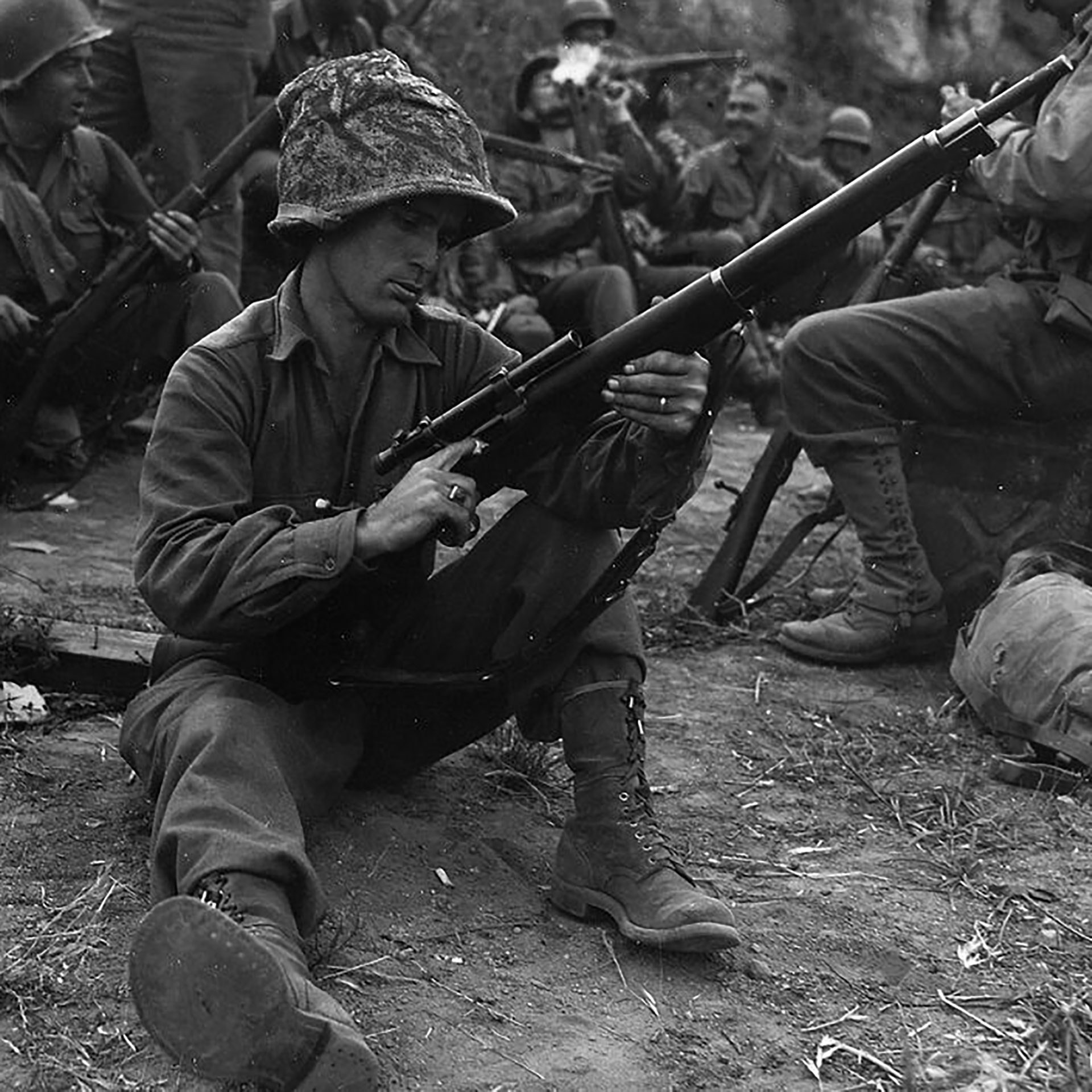 A U.S. soldier cleaning his M1903A4 during World War II. Note the standard M1903 rifles in the hand of the others in the background.
While entering the war with a well-developed and thoroughly tested sniper would have unquestionably been better, having this imperfect but serviceable rifle in the field during the bulk of US combat operations was certainly better than fielding the ultimate sniper system in Aug. 1945.
