Categories
All About Guns This great Nation & Its People War

A Young American Goes to War: The M1 Rifle by WILL DABBS

The Stars and Stripes flew proudly in this man’s front yard every single day.

The man lived on his rural farm on the outskirts of his tiny Mississippi town. His yard was meticulously maintained, and Old Glory fluttered quietly in the breeze from an imposing flagpole set in concrete. The flag didn’t stay out overnight…ever. It had been raised and lowered every day on this pole for more than half a century.

With the exception of nearly a year spent in combat in Europe, this man lived his entire life on his rural Mississippi farm.

He was the very image of a good Christian man of character. He had served as a deacon in his church and teased a modest living out of the farmland that surrounded his modest three-bedroom home. He had raised his kids well and selflessly helped his neighbors. Now well into his eighties, he had agreed to spend an afternoon with me and my young son.

Despite the peaceful safe surroundings, the man’s memory clearly took him to a very different place.

The man was soft-spoken as we nursed our iced tea and soaked up every word. He looked off into nothing as his mind wandered back to very different times. Though we sat in peace, security, and comfort, his memory took him somewhere else.

My buddy rode a Higgins boat ashore on D-Day.

This unassuming man described being a 19-year-old Infantryman heading ashore in a Higgins boat on June 6, 1944. His destination was Omaha beach. It was about 1400 in the afternoon.

Omaha Beach on June 6, 1944, was a butcher’s shop. My son and I had the privilege of hearing a man who was there describe what it smelled like.

He charged terrified down the open ramp into the very bowels of hell. Wrecked equipment and shredded bodies littered the sand, surf, and shale. The smell of cordite, dirty smoke, ruptured bowels, and death pervaded everything. German mortar and artillery fire still slammed into the beach as well as the advances inland.

A Steep Learning Curve

My friend paired up with another backwoods Southerner in his unit to put their homegrown fieldcraft skills to good use.

The man survived the Longest Day to advance with the Allied vanguard. A product of the Mississippi backwoods and a survivor of the Great Depression, this tough teenager found that he had a knack for soldiering. When his company needed intelligence he and a fellow Southern redneck boy would slip off into the night looking for trouble. Sometimes they came back with a prisoner. Sometimes not. The man told me he got comfortable with a knife in the dark.

The German Wehrmacht was a formidable battle-hardened army skilled in the mobile defense.

By late August the man and his buddies had taken the full measure of the enemy. The hard fighting through the bocage hedgerows had brought him face to face with the Nazi superman. He found the German Wehrmacht to be a hardened professional fighting force.

My pal had little use for the Waffen SS.

He called the Waffen SS “those Gestapo men.” Decades later his hatred for these fanatical racist lunatics modulated the timbre of his conversation. He told me unapologetically, “We didn’t take many of those Gestapo men prisoner.”

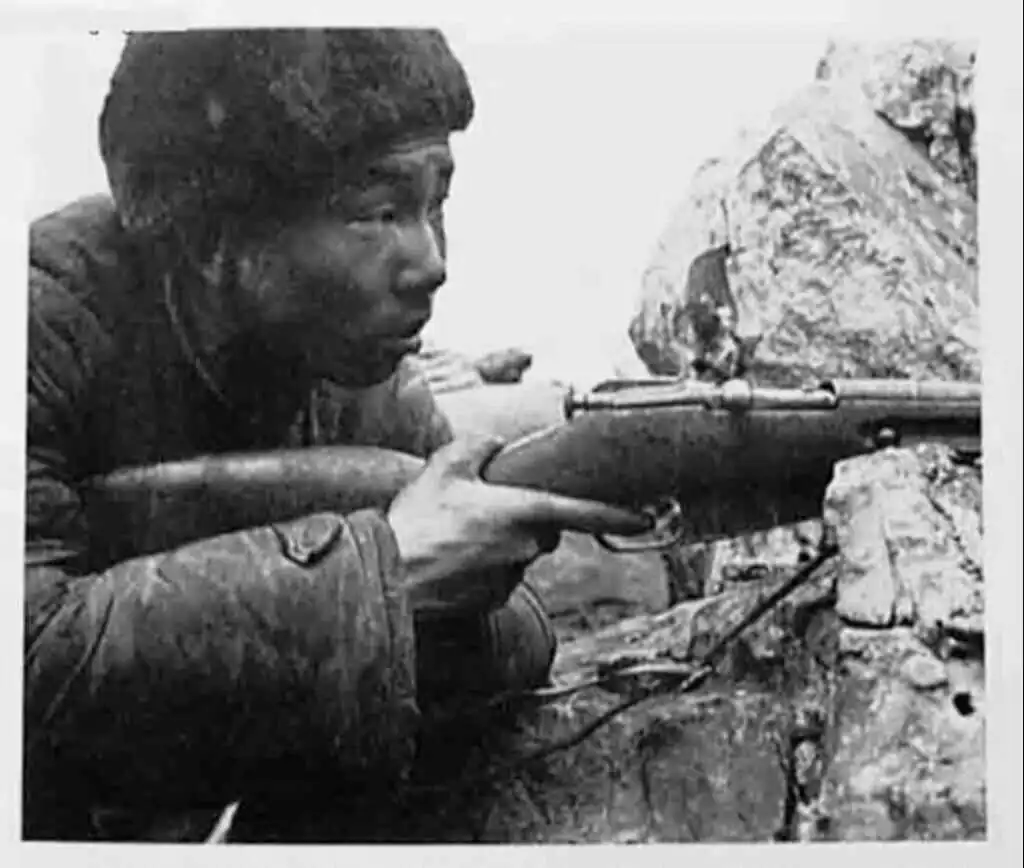
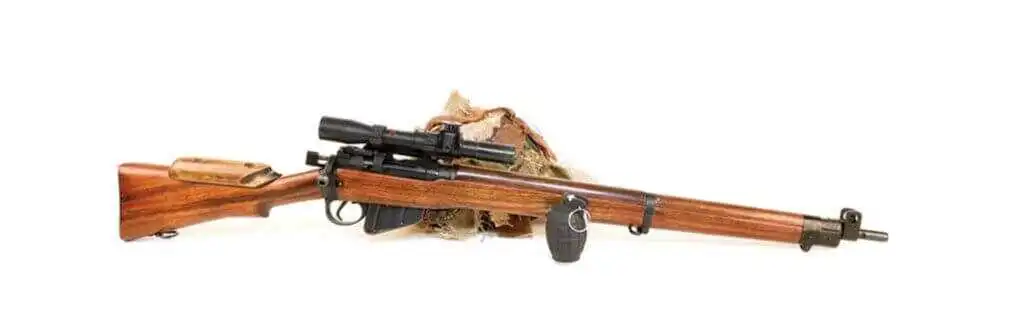
My buddy and his comrades came to expect a stay-behind sniper team when the Germans finally abandoned a significant terrain feature or defensive position.

He explained that the SS frequently left a couple of snipers behind when the Germans finally abandoned a position of strategic importance. The carnage they inflicted made little difference in the grand scheme. They just dealt death whenever they could.

Kill or Be Killed

The Luftwaffe had made good use of Orly Airport as an airbase throughout their time in France.

My buddy’s unit was tasked to seize Orly airport outside Paris. The Luftwaffe had used Orly as a fighter and bomber base throughout the occupation of France, and the Allied air forces had pounded it into rubble as a result. In August of 1944, however, the wrecked aerodrome was deceptively quiet.

The two SS snipers left behind after the Luftwaffe abandoned Orly Airport were fixated on the main body of approaching American troops.

The company commander called a tactical halt. My friend and his battle buddy crept around the periphery of the wrecked airport before ascending one of the taller structures for a proper vantage. Taking cover such that they could just peer over the edge of the roof they finally saw the two German snipers. Tucked into a pile of debris on the roof of a nearby structure the two SS sharpshooters were well-camouflaged and fixated on the approaches to the aerodrome. The two Germans had no idea that they had only moments to live.

My friend and his battle buddy coordinated their fire to neutralize both enemy snipers simultaneously.

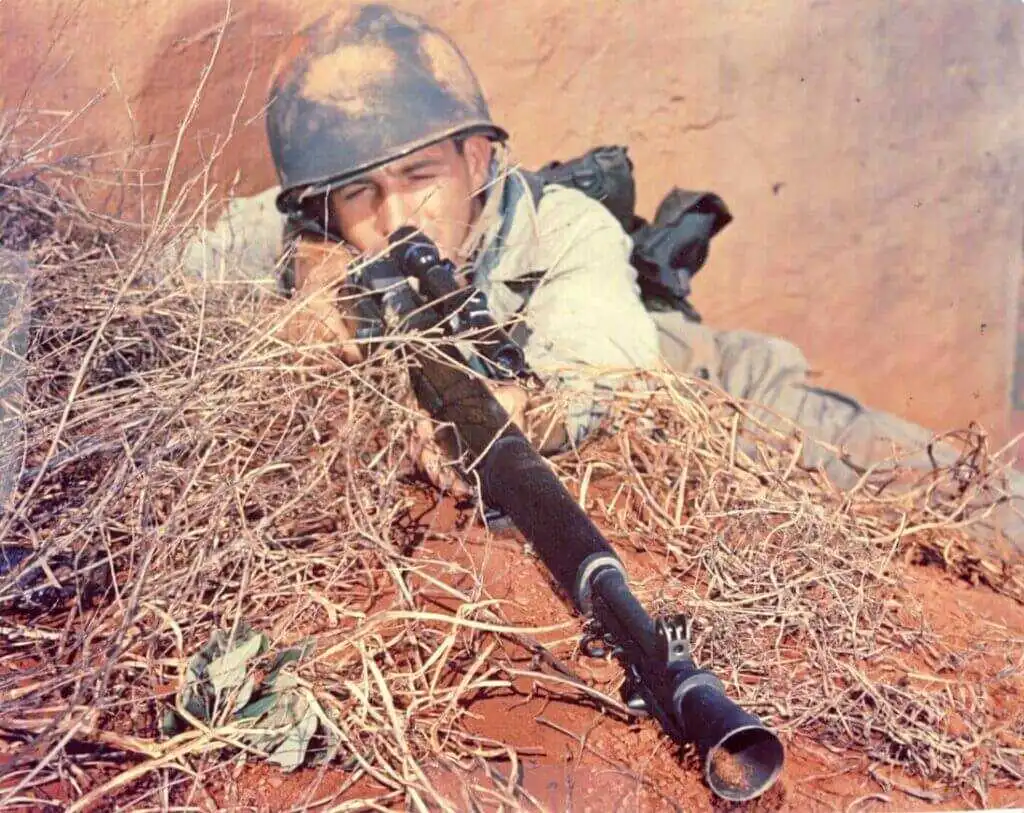
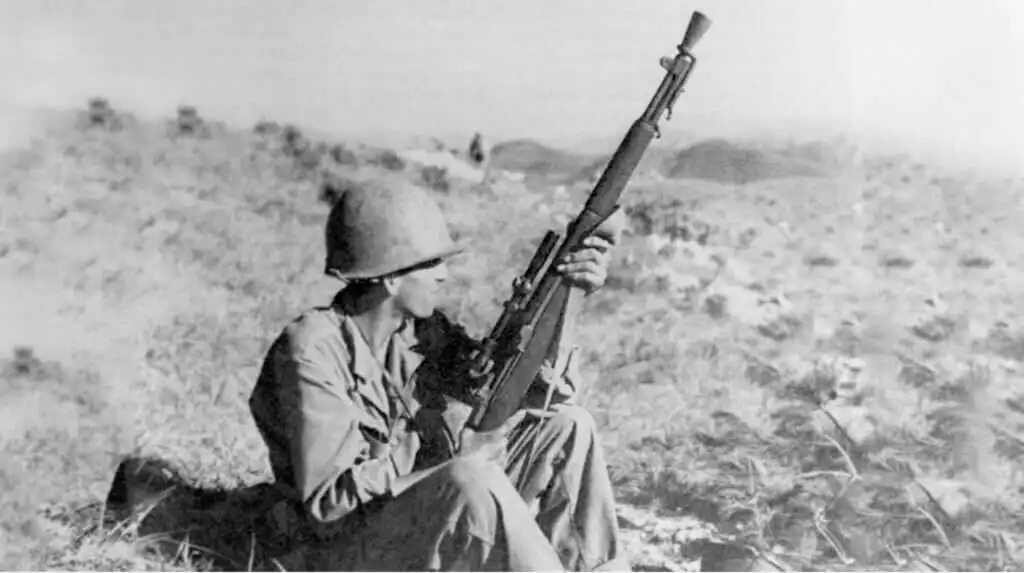
Speaking in hushed whispers my buddy and his comrade estimated the range to their targets and adjusted the rear sights on their heavy M1 rifles to compensate. My friend called the man on the left and his counterpart oriented on the one on the right. On the soft count of three, both men squeezed their triggers.

This shattered SS helmet came from a battlefield in Latvia. The associated cool reproduction gear came from www.worldwarsupply.com.

Both rifles rolled back in recoil as their 152-grain M2 ball rounds covered the distance to the pair of German snipers at 2,800 feet per second. Both of the American grunts had grown up with guns, and they knew how to shoot. Each GI center-punched the coal-scuttle helmet of his respective SS target, killing them both instantly.

The Guns

The M1 rifle was the most capable Infantry weapon on the planet when it was introduced.

In 1936 the United States military was woefully behind those of most other major powers. The Great Depression had ravaged the American economy, and a lack of attention to military readiness had taken a horrible toll on such stuff as tanks and combat aircraft. The gleaming exception was the M1 rifle. American troops entered WW2 with what General George Patton described as, “the finest battle implement ever devised.”

John C. Garand, the inventor of the M1 rifle, was born in Canada but emigrated to the US when he was an infant.

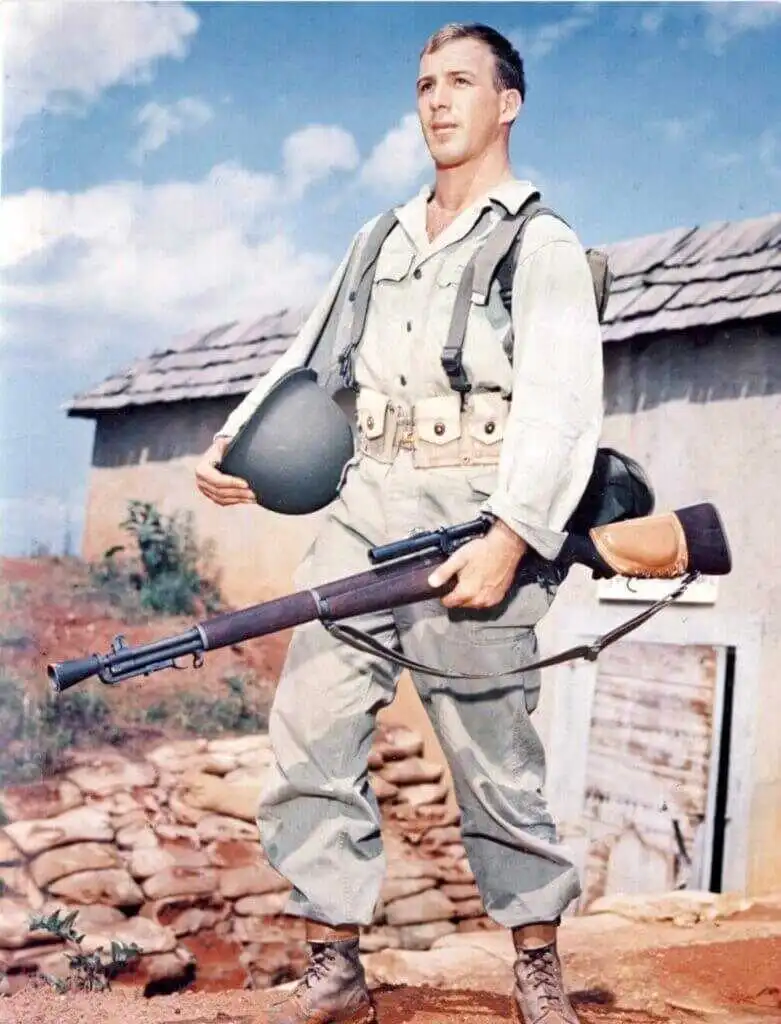
Designed by a Canadian-American inventor named John Cantius Garand (properly pronounced, I’m reliably told, so as to rhyme with “errand.”), the M1 was a .30-caliber, gas-operated, 8-shot, clip-fed, semiautomatic rifle. The weapon weighed 9.5 pounds and was 43.6 inches long. By the time the M1 reached US Army troops in 1937, production at Springfield Armory was ten rifles per day. Two years later output languished at 100 per day. By the end of the weapon’s massive production run, however, some 5.4 million had been made by four major manufacturers.

Ammunition for the M1 rifle was issued in disposable spring steel clips.

By modern standards, the M1 was heavy, cumbersome, and grossly overpowered. However, at the outset of the Second World War, the M1 was a wonder weapon. Ammunition was supplied in spring steel 8-round en-bloc clips that were pressed in place from above with the bolt locked to the rear.

Loading the M1 rifle under pressure was an acquired skill, but the weapon yielded superb service in all theaters of combat.

En bloc simply means that the ammunition clip became part of the weapon’s action during firing. When loading the rifle, the operator pressed the clip down from above and snatched his thumb clear as the bolt automatically flew home. The clip was ejected out of the top of the action after the last round fired.

Despite its prodigious weight and bulk the M1 rifle was beloved by the American grunts who carried it.

An M1 rifle cost Uncle Sam about $85 during the war. That’s about $1260 today. The M1 was rugged, accurate, and powerful. I have never spoken with a combat veteran who carried one who had anything but unvarnished praise for the piece.

The Rest of the Story

It took nearly a year for the Allies to wrest Western Europe out of the clutches of the Nazis.

There was a still a great deal of fighting left to be done after my friend and his comrades cleared Orly airport. There is no telling how many lives these two young warriors saved just in this one exchange. However, the worst was yet to come.

Kampfgruppe Peiper pushed deep into France during the Ardennes Offensive.

The Ardennes Offensive has become known as the Battle of the Bulge from the vantage of comfortable hindsight. My buddy said at the time it was pure unfiltered chaos. German Army Group B led by Joachim Peiper and the 1st SS Panzer Division slashed deep into Allied territory, shredding American defenses and scattering combat units randomly among the detritus. The US response devolved into tiny packets of troops fighting for their lives. My pal found himself leading a handful of bedraggled survivors deep behind the German spearheads.

Tired, cold, jittery GIs fighting in the Battle of the Bulge grew distrustful of strangers after rumors of Skorzeny’s commandos began to circulate.

Otto Skorzeny’s Operation Greif involved the insertion of English-speaking Germans in American uniforms to sow confusion in Allied rear areas. The effect that had on the Allied defense was outsized beyond their pure numbers. Suddenly nobody trusted anybody they didn’t already know well, and jumpy sentries shot first and asked questions later.

My friend had to talk his way back through American lines after several days of evading the Germans.

After a protracted escape and evasion, my buddy’s motley band finally made it back to friendly lines exhausted and spent. The first sentry they encountered covered them with a BAR and demanded to know who won the World Series in a particular year. My buddy not so gently explained that he had no idea. He expounded that while the Yankees were comfortably enjoying their baseball he was out hunting opossums in the Mississippi swamps to keep his family from starving. The sentry let them pass.

There were actually three American small arms used during WW2 that carried the designation M1. This is an M1A1 Thompson submachinegun.

My buddy rendered his professional opinion on all of the major US small arms. He explained that there was always only one M1. The M1 Carbine was simply the Carbine, and the M1A1 Thompson was always the Thompson. Nobody used the term Garand. The standard US Infantry rifle was always just called the M1.

My friend wielded an M1 rifle for nearly a year in combat in Europe during WW2.

He said for an entire year some part of his skin was touching that rifle. Awake, asleep, shaving, eating, or defecating, that weapon was always at arm’s reach. He said that the Carbine was an effective and handy combat tool, but that it did frequently require several shots to take a German soldier out of the fight. By contrast, he said that so long as you caught him center of mass, the M1 would put an enemy soldier down instantly every single time.

This relic Luftwaffe helmet carries four bullet holes from some Russian grunt’s PPSh submachinegun. The grenades came from www.worldwarsupply.com.

We went back to the man’s barn neatly populated with tractor components and the sundry detritus of a working farm. The open building smelled like motor oil, horse manure, and dirt. Hanging obscurely in the corner was a dusty German helmet, the faded SS runes still visible. There was a .30-caliber hole running cleanly in and out both sides. How do we make such men as these?

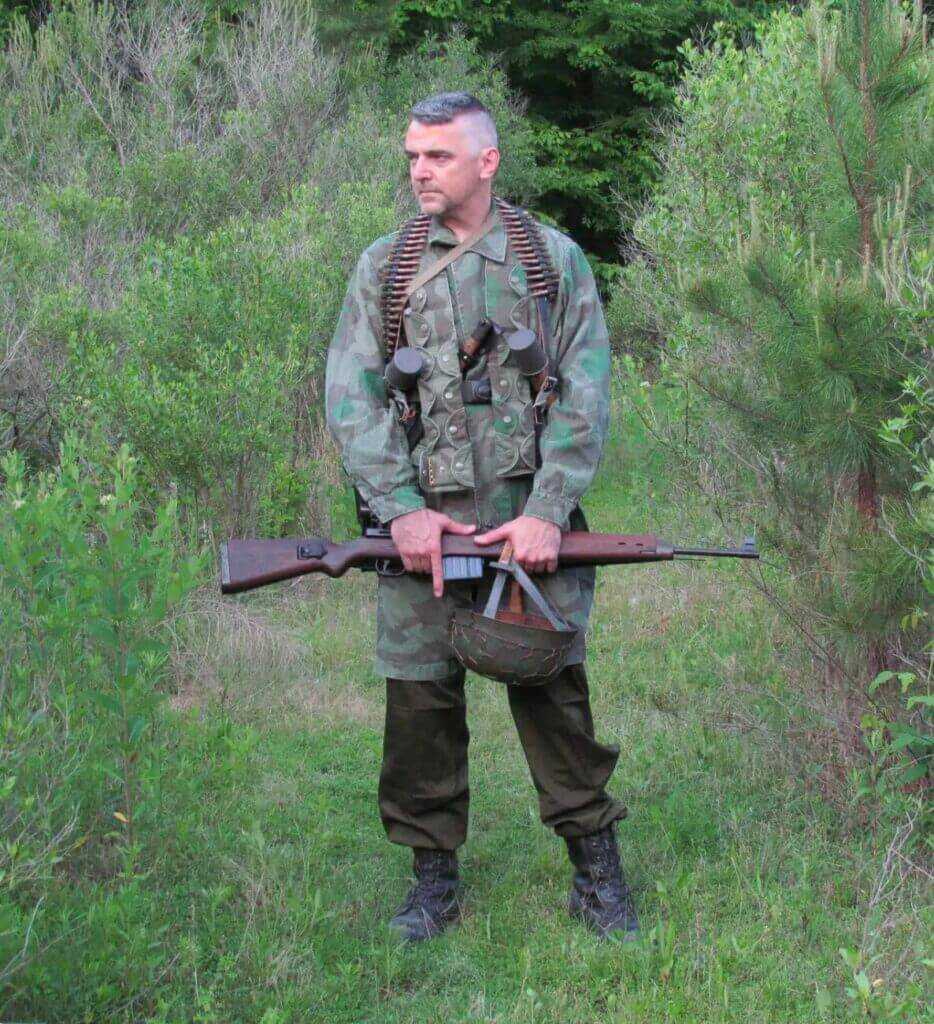
This is a German K43 sniper rifle of the sort frequently used by SS marksmen late in the war. The reproduction grenades come from www.worldwarsupply.com.
The profound violence of modern war is evidenced in this battlefield pickup SS helmet from eastern Europe.
Categories
Good News for a change! Interesting stuff Stand & Deliver This great Nation & Its People

Somebody really has his shit together & Frankly I am impressed!!


I do not care what kind of work it is. I am always appreciative of folks, that come to the job and then do it with style! Grumpy

Categories
Some Red Hot Gospel there! This great Nation & Its People Well I thought it was funny!

Hump day pep talk, by George Carlin

Categories
Dear Grumpy Advice on Teaching in Today's Classroom Hard Nosed Folks Both Good & Bad Leadership of the highest kind This great Nation & Its People

Happy Columbus Day!

Life in 1542 Semi-Quick Facts

By Robert W. Munson

Cabrillo National Monument Historian

Sections:

  1. Regarding the Model of a 16th Century Ship
  2. A Sailor’s Life
  3. Cabrillo’s Crew
  4. The Food
  5. Hidalgo
  6. Horses
  7. Status Symbols
  8. Facts of Life for Women
  9. Clothing of an Average Woman
  10. Llovedo
  11. Santiago
  12. Religious Santiago
  13. Syncretism
  1. Regarding the Model of A Sixteenth Century Ship On Display In the Visitor Center:

Once upon a time there was a man named Juan Rodriguez Cabrillo who had three ships named San Salvador, La Victoriaand San Miguel (note: this is the only time I’m going to screw around with the required italics).

Spanish ships were always given religious names (it’s a rough life out there on the water; you definitely want God on your side). They were also known by the names of their owners and/or captains. (P.S. they almost always had nicknames. That’s how Santa Clara became known as the Nina of Columbus fame).

Think of them as Papa Bear, Momma Bear, and Baby Bear: San Salvador is the macho muscle of the fleet (and the boss’s “Capitana”, i.e. flagship); La Victoria has a nice, full, well-rounded figure and carries lots of goodies (she is the supply ship for the expedition); and little San Miguel is always running off poking its nose into bays, estuaries and rocky places (but that’s expected: San Miguel is, in effect, the reconnaissance/scout).

What makes them what they are, and which one is our model?

Are you all sitting comfortably? Good, we’ll begin: First off, we won’t be dealing with San Miguel, as she is a whole different kettle of fish that we’ll deal with later. Suffice it to say, our model is not of the San Miguel.

Big ships all started back in the Mediterranean with a style of vessel called a carrack. This was a huge, stout, deep-bellied ship with a forecastle (foc’sle) and aftcastle built up by as many as four decks. They were called castles because that’s exactly what they were. There were no design-built warships at this time (even the graceful and beloved Viking long ship was a merchant ship first and pirate second). The carrack was designed to carry lots of cargo, which would attract the attention of the light-fingered brethren (i.e. pirates). The castles provided positions from which the carrack’s defenders could rain down all sorts of grief on anyone coming alongside drooling with greedy lust (or lusty greed if you prefer). And if you really had to go to war with somebody, the castles automatically made them a warship.

Along about the middle of the 15th century two things happened which sealed the carrack’s doom. First, cannons started being used on ships, and ships got out of the Mediterranean into the much rougher waters of the Atlantic. It very quickly became obvious that the high castles made these ships unstable. Second, smaller, lower and faster ships mounting a few cannons could shoot your carrack’s lovely castles to pieces, allowing boarding parties to come aboard unmolested. A true warship was developing, longer, lower and leaner than a merchant ship. However, merchants still wanted to carry lots of cargo so they were unwilling to lose the carrack’s nice big hull. But to keep that hull upright in the open ocean meant cutting down top weight. So you didn’t mount heavy cannon on them and you cut those magnificent castles down to just stumps. Parenthetically (it is interesting to note that, until the 1900s, the foc’sle on a Spanish ship was still called “castillo” and the main superstructure was still called “alcazar”, the Spanish word for “fortified palace”. Has a nice ring to it, huh?)

By early in the 16th century two very distinct styles were developing and being refined: the galleon and the nao. Both words refer to a purpose rather than a specific type. Galleon appears to be derived from the word galley, a long lean ship, fast and maneuverable under either oars or sail. Nao is a Portuguese word that means “ship”.

The men who built the San Salvador and La Victoria had been trained in the carrack tradition, but were savvy enough to adapt to the realities that real blue water sailing made necessary.

So what was built at the miserable mud hole of a mosquito-ridden estuary of the Michatoya River, known as Iztapa in Guatemala? Neither a galleon nor a nao.

San Salvador, although they called her a galleon, was in truth a “proto-galleon”. She had a 3 to 1 hull ratio (length to width ratio), just like a carrack, but her castles had been cut down to only one upper deck in the castillo and only two upper decks in the alcazar, like a galleon. The second deck is usually quite small, often containing just the captain’s cabin and a little super-dry storage space. She is halfway through the metamorphosis of carrack to galleon. Forty-six years from now, when the English confront the Great Armada, they will be using the fully developed “race built” true galleon of Errol Flynn and Johnny Depp fame. These sea-going dragsters will be very low, with an amazing 4 or 5 to 1 hull ratio. Her Datum Water Line (DWL), in other words (fully operational but not loaded), gives a draft of 10 feet. With cargo, supplies and people on board her draft is 12 feet. At DWL she is 74 feet long. By the way, Cabrillo’s cabin was 9 feet wide forward, 3 feet 3 inches wide aft, and 9 feet long. The overhead is 5 feet (not much room for parties).

La Victoria, our display model, is a little shorter than San Salvador (roughly 64 feet at the DWL water line, instead of San Salvador’s 74 feet), but she is 25 feet wide, the same as San Salvador. What this means is her hull ratio is a very matronly 2 ½ to 1. This makes her even more rotund than her carrack ancestors. She also has a much deeper belly. To be ungracious, she is a sea going “tub”. To buy all this cargo space she has a miniscule castillo. In fact many Pacific naos had no foc’sle at all, just a high prow like a caravel type fishing boat to keep blue water waves from coming aboard. Her alcazar is down to just one deck. She is also what is known as “cubierto” which means she has a main deck, but below that there are no lower decks or bulkheads. This enables her to cram more stuff into the hold, all the way down to the keel. What it also means is that there is no below deck space for crew’s quarters. Everyone sleeps on the main deck. Since the whole crew has to sleep in the alcazar, it is extended all the way to, and incorporating, the main mast. Many authors consider this alcazar, so long it includes the main mast, one of the great defining elements of the Pacific nao. Apparently the Spanish thought so too, because in a ship like La Victoria the aft castle is no longer referred to as “alcazar” but is called “La Puente” (i.e. referring to the bridges ashore under which poor people could find shelter to sleep). The overhang at the stern does create a space 14 by 5 feet, which could be partitioned off with sliding panels for the private use of the captain and his personal storage. The overhead is only 5 feet, in order to accommodate the tiller, but this still would be private and similar to what was known as a wall bed. This “cabin” would need some kind of aperture for ventilation and natural light.

The castillo forward has two sheltered decks, each containing 63 square feet of deck space for the crew and other low class types. The puente contains 132 square feet of deck space to accommodate soldiers, ship’s officers, and super numeraries such as priests and gentlemen. This figure does not include the captain’s private space. One of the biggest problems of this ship is that she is very wet as all spaces under cover are still open to weather and the seas. This is probably the reason her gunwhals are so high.

La Victoria is slow, strictly utilitarian, and uncomfortable to live in. She’s never going to win any beauty contests, but she’s still a nao and she does her job very well. She’s the supply tub, er ship. In fact she may have been what was known as a “Nao Grueso” (a “fat ship”).

So, with all the clues noted above, our model in the VC and the one in the Cabrillo exhibit is the La Victoria not the San Salvador.

Now we move on to the San Miguel:

What the heck was she? Well, for starters she was a lot smaller than the other two ships. She could be rowed so she could investigate narrow places like rivers and still be able to back out. She could also run from hostiles even if there was no wind. She had one mast. She has been described as “cubierto” i.e. she is not an open boat like a chalupa; she has a deck. In the Mediterranean it was common for ships to tow their long boat astern. In the Atlantic or Pacific this was a great way to lose your long boat, through swamping and/or a parted line. Some authors have stated that she was a chalupa, which could be stored on the main deck amidships when towing wasn’t feasible. However, there is no indication she was ever taken aboard one of the other ships, and she was big enough to warrant a name and a master. So she wasn’t a glorified long boat. The reason a lot of amateurs assumed she was a chalupa is the mistranslation of the word “cubierto”. Many translate the word as meaning “no deck”. What it really meant to the Spanish of the 16th century was “the lowest actual deck” i.e. there was no deck below the main deck; you could see all the way down to the keel.

She has been called a caravel, fragata or a bergantina. Since Cabrillo helped build 13 bergantinas for Cortez for the assault on Tenochtitlan, he was familiar with the type. The caravel was a coastal trader or fishing boat in Europe, usually with two masts and a high weatherly bow. Nina and Pinta did great work for Columbus in the Atlantic. The thing that rules out San Miguel as a caravel is that they were not set up for rowing. The main difference between the two other types is that a fragata had two masts, a bergantina only one. Bergantinas were of shallower draft and possibly higher in the bow. The draft would make her a good scout where San Salvador could not go, or where they did not want to risk the big ship. Fragatas appear to have been built more for speed than sturdiness like a bergantina, a fact crucial in a long open ocean voyage. The English would probably have called her a pinnace.

Now, let’s get one thing straight right now folks, so you won’t appear uninformed to the public. A bergantina is not a brigantine. A lot of lubberly armchair historians have called them brigantines. A brigantine is a two-masted ship, not rowable, much bigger than a bergantina, and brigantines won’t be invented until the 1700s. So watch your spelling and your pronunciation and you’ll appear brilliant to our visitors.

A bergantina was 35-45 feet long, about half the size of San Salvador or La Victoria. They usually had about six oars on each side in addition to their one mast and one sail on a yard (the spinnaker hadn’t been invented yet). As an open deck, small vessel, with little or no shelter in the hold, she would have been miserable in foul weather, and would have taken a pounding in any kind of sea, which again favors San Miguel as a bergantina. A bergantina was the most robust of the three types. While a chalupa would have been taken aboard the big ships with stormy weather approaching, we know San Miguel had to weather the storms on her own.

Results of a discussion with Doug Sharp, Maritime Architect, San Salvador Project:

Dimensions:

Cabrillo’s cabin: 10 by 9.5 feet (96 square feet), the 4 by 3 foot whipstaff helmsman’s bubble partly intrudes into this space.

The main deck is divided into three sections:

Amidships is the open waist between the castles: 525 square feet

The castillo (forecastle): 205 square feet. Overhead clearance 6′ 3 ¼”

The alcazar (aftcastle, the “main cabin”): 317 square feet. Overhead clearance 6′ 2” forward, and 6’ 7” aft

The tiller flat: 82 square feet. Overhead clearance 2′ 6”, 205 cubic feet

The lower deck: 1030 square feet. Overhead clearance: amidships 6′ 1”. At sides 5′ 8”

Storage space: 6150 cubic feet (200 toneladas, matches San Salvador’s rating). Tonelada (pronounced tun-eh-lada) equals 30 cubic feet

The bilges: Effective length 45′. Overhead clearance: 3′ to keelson. Effective storage space: 1286 cubic feet (31 toneladas)

Water occupies 7 ½ gallons per cubic foot, so the horses are drinking 2 cubic feet of water per day, (240 cu.ft. per horse for 120 days). The Spanish were very horse oriented and no Spanish horseman would allow his horse to be kept in a stall less than 8 by 8 feet as the horses need to be able to lie down to avoid colic, twisted gut, ileus. The stall will take up 384 cubic feet. Grain for 120 days occupies 120 cubic feet. Total: 404 cubic feet. The lowerdeck is the only feasible place to put the horses. It contains 6150 cubic feet. Two horse stalls at 384 cu.ft.each = 768 cubic feet minus 240 days of grain for 2 horses = 1008 cubic feet which is 16% of the lowerdeck storage space.

Dry food ration: 31.75 oz./human/day x 100 humans = 198 pounds/day. Here we are combining beans, salt meat, and hardtack, but the average appears to be about 15 pounds/cubic foot. About 13 cubic feet/day x 120 days =1550 cubic feet. 1008 cubic feet for horses plus 1550 cubic feet for dry food = 2558 cubic feet of storage, 42% of the 6150 cubic feet available lowerdeck space.

The bilge contains 1286 cubic feet. The 100 humans and two horses will drink 10.7 cubic feet of water per day. 1286 divided by 10.7 = enough liquid for 120 days. Put all the ship’s water and wine in the bilges. Humans are rationed one liter of wine & one liter of water/day. One gallon equals roughly 4 liters; 7.5 gallons of liquid (water & wine) = 15 humans divided into 100 souls embarked = 6.7 cubic feet to provide for 100 souls/day.

One hundred embarked humans need 6.7 cubic feet of liquid per day. Each horse needs 2 cubic feet of water each day. The humans and two horses will drink 10.7 cubic feet of water per day; 1286 divided by 10.7 = enough liquid for 120 days (402 cu.ft.of wine, 882 cu.ft. of water), assuming there is no leakage, and no space for access so its like getting olives out of a bottle; as you finish off the contents of one barrel you have to remove the barrel from the bilge, at least until you have enough space to maneuver the barrels.

  1. A Sailor’s Life:

When do you wake up? When the paje (page or ship’s boy) at the sandglass chants the “Buenas Dias” prayer, basically just before sunrise.

What meals do you eat during the day? Breakfast, lunch, dinner

When do you eat these meals? Sunrise, noon, sunset

Where do you obtain water? From barrels in the hold.

Where is food prepared? On the fogon; the brick cookstove located aft, under the sterncastle (alcazar). It was available on a first come first served basis, during daylight hours. The stove would not be lit during rough weather. 

Where is food served? On wood trenchers while seated on a cloth spread on the deck.

Who prepares your food? One of the ship’s pajes. Sometimes there is an actual cook.

Cooks were generally old sailors no longer able to carry out the duties of a sailor. It was considered a demeaning job and a deadly insult was, “Your beard smells of fogon smoke.”

On what is your food served? Wood trenchers

On what do you eat your meals? A tablecloth on the deck

What did you eat for breakfast? 7 ounces of galeta (ships’ biscuit/hardtack), 2 ½ oz. (70 grams) of menestra (horsebeans and garbanzos), 2 ½ oz. (70 grams) of cazon (salt fish, usually dogshark) or 3 ½ oz. (100 grams) of salt pork

What did you eat for lunch? The same as breakfast, with maybe some rice added

What did you eat for dinner? The same as lunch but not as much

What is your favorite alcoholic drink? Wine (Rum won’t be invented for another hundred years)

What is your favorite non-alcoholic drink? Water (preferably fresh)

Where do you usually eat your meals? On deck

What are your usual foods? galeta, menestra, and salt fish 

What are your favorite foods? Fresh water, onions, soft bread

What foods are your special treats? Fresh food of any kind, at-sea fresh fish caught by the crew, two ounces of cheese on Sundays and Tuesdays

  1. Cabrillo’s Crews: 

The following are estimates of the crew make-up of Juan Rodriguez Cabrillo’s three ships in 1542. These are based on the Reglamento of 1522 regarding complement requirements stipulated by the Crown for ships in Nueva España and the Carrera de las Indias. These are also based on data and parameters established by Harry Kelsey in his book Juan Rodriguez Cabrillo.

San Salvador (also known as the Juan Rodriguez or the Capitana)

A proto-galleon, estimate approximately 100 souls embarked.

Crew Supernumeraries
Capitan Procurador (Royal agent/ a lawyer)
Maestre (Sailing Master) Escribero del Procurador
Piloto (Pilot or Navigator) Chronista (Chronicler)
Contramaestre (Boatswain) Sacerdote (Priest)
Guardian (Boatswain’s Mate) Fray (Fraile, a Lay Brother)
Cirujano/barbero (Surgeon/Barber) About 25 Soldados (Soldiers)
Despensero (Supply Officer) About 24 Esclavos (Slaves) (Black & Indian)
Tonelero (Cooper) Escafandrista (diver, usually Indian slave)
Calafate (Caulker) Possibly some gentlemen & merchants
Carpintero (Carpenter) The presence of Llovidos (female stowaways) cannot be verified.
Escribero (Scribe, a secretary)  
Escribiente (Scrivener, record keeper)  
15 Marineros (Seamen) (one would be a qualified Lombardero or gunner)  
8 Grumetes (Apprentice Seamen)  
3 Pajes (Pages, ship’s boys)  
38 crew 55 supernumeraries (not including gentlemen, merchants, servants and Llovidos)
Total of 93  

Authorized                4 bombardetas (large iron cannons) with 36 balls each (144 balls)

Ordnance:                 16 bercos (swivels) with 72 balls each (1142 balls)

8 arquebuz (muskets) with lead and mold

2 hundredweight of gunpowder

10 ballestas (crossbows) with a total of 96 quarrels

48 jabalinas (javelins)

8 quarter pikes

20 rodelos (bucklers)


La Victoria (named after Santa Maria de la Victoria, the seaman’s shrine in the Triana district of Seville). She was also occasionally known as Figuero, Alvar Nunez, Anton Hernandez, and Santa Maria de Buena Esperanza, the patron saint of sailors). She was a nao gruesa, although she’s sometimes referred to as a carrack. Estimate 50 to 60 souls embarked.

Crew Supernumeraries
Capitan About 12 Soldados (soldiers)
Maestre (Sailing Master) About 12 Esclavos (slaves) (Black & Indian)
Piloto (Pilot or Navigator) Escafandrista (diver, usually an Indian slave)
Contramaestre (Boatswain) Sacerdote (Priest) ?
Despensero (Supply Officer)  
Tonelero (Cooper)  
Calafate (Caulker)  
Carpintero (Carpenter)  
12 Marineros (Seamen) (one would be a qualified Lombardero or gunner)  
6 Grumetes (Apprentice Seamen)  
3 Pajes (Pages, ship’s boys)  
Total 55  

Authorized Ordnance:

12 bercos (72 balls each)
5 arquebuz (muskets)
8 ballestas (crossbows)
40 jabalinas (javelins)
5 quarter pikes
16 rodelos (bucklers)

San Miguel

She was probably a bergantina, fragata, or chalupa

Crew Superumeraries
Maestre (Sailing Master) About 10 oarsmen. These would be Esclavos (Slaves, Black or Indian) and/or sailors undergoing punishment
Piloto (Pilot or Navigator)  
5 Marineros (Seamen)  
3 Grumetes (Apprentice Seamen)  
1 Paje (Page, ship’s boy)  
11 crew 10 superumeraries
Total 21                                                 

Authorized  Ordnance:  

In European waters  Bergantinas traditionally carried a Lombard (cannon) in the bow. In the interest of seaworthiness in an expedition going into a rough and unknown sea, San Miguel probably did not carry a Lombard in the bow and also did not cut a gunport for it in the bow.

6 bercos (swivels) 72 balls each. 432 balls.

2 arquebuz (muskets)

4 ballestas (crossbows)

18 jabalinas (javelins)

2 quarter pikes

7 rodelos (bucklers)

  1. The Food Issued To Each Man Each Day Of The Voyage:

Breakfast served at sunrise and consists of:

7 ounces of galeta (ships’ biscuit/hardtack),

2 ½ oz. (70 grams) of menestra (horsebeans and garbanzos),

2 ½ oz. (70 grams) of cazon (salt fish, usually dogshark) or 3 ½ oz.(100 grams) of salt pork.

Lunch is the meal at noon:

7 ounces of galeta (ships’ biscuit/hardtack),

2 ½ oz. (70 grams) of menestra (horsebeans and garbanzos),

2 ½ oz.(70 grams) of cazon (salt fish, usually dogshark) or 3 ½ oz.(100 grams) of salt pork.

Rice may be substituted for menestra.

Dinner is served at sunset:

3.5 ounces of galeta (ships ‘biscuit/hardtack) from brown flour,

1 ¼ oz. (35 grams) of menestra,

1 ¼ oz. (35 grams) of cazon (salt fish) or 1 ¾ oz. (50 grams) of salt meat.

One liter of wine and one liter of water is issued each day.

As a special treat, the captain could authorize two ounces of cheese issued every Sunday and Tuesday.

Water for cooking and washing is available self-serve by the bucket load alongside the ship.

As the Pacific Ocean was thought to be less than a thousand leagues wide (2200 miles), they expected a short, easy trip to China. They did not think scurvy would be a problem as they would be following the coast all the way allowing the crew to forage periodically for lemon grass, wild onions and other fresh vegetables and fruit during shore excursions for fresh water. For those with no stomach for lemon grass and wild onions, bottled sauerkraut was available but had to be purchased by the individual.

Galleta or ships’ biscuit (known in modern times as hardtack) was the staple. The word biscuit comes from the Latin bis (twice), and coctus (cooked). The name refers to the fact that it was unleavened bread subjected to a double process in cooking to render it virtually indestructible. In essence it was made of wallpaper glue: flour, salt and water. The most common way of eating it was to soak it in water or wine to soften it. Frequently it would be cooked as a stew with the salt fish/meat and beans. If you had salt pork to fry, the biscuit could be softened by pouring the liquid fat over it.

The salt meat was usually dogshark, although saltpork was sometimes substituted for it two or three days per week. In the Atlantic cod or sardines added some variety to the salt fish, but these were not available in the Pacific. It all depended on how good at negotiating the ship’s supply purchases the despensero (ship’s supply officer) was (and how much of the ship’s budget he quietly pocketed for himself).

Fresh food, especially chickens, pigs, goats and sometimes even cattle, would be embarked for slaughter during the voyage, but these took up valuable cargo space and needed food themselves. Onions were the most prized vegetables.

Officers and passengers could supplement the onboard fare with purchases of preserved food of their own. This frequently took the form of sauerkraut and dried fruit. Quince, figs and raisins were the most popular fruits. These items not only added variety but also to some degree staved off scurvy. The anti-scorbutic effects of citrus juice had not been discovered, but the Spanish did know that lemon grass, onions, and sauerkraut did slow the advance of scurvy.

The crew frequently supplemented their preserved diet by catching fresh fish.

All in all, the daily ration provided adequate nutrition, bulk and between 3500-4200 calories per person per day. As long as the ration was fully issued it was adequate for the work being done. Proteins made up about 13 percent of the ration, which is within the levels recommended by the World Health Organization for a balanced diet. The main food deficiency was the vitamins provided by fresh fruit and vegetables. In the Atlantic scurvy was not a serious problem. Scurvy takes approximately six weeks to develop and landfalls, even crossing the Atlantic, rarely exceeded 30 days. In the vast distances of the Pacific scurvy became a real killer, which could decimate crews and on occasion wipe out an entire crew. The problem was not solved until the 1700s.

Surprisingly, the real deficiency in the menu above was water. One liter of water was totally inadequate for an adult male, and the wine supplement did not help. An average man eating 3500 calories needs two to three liters of water, especially working hard in tropic climes where a man can sweat a liter in an hour. This was not helped by eating food with a high salt content. The problem with water is that it takes up valuable storage space in a small ship. By cutting back on the water storage, ship masters could increase cargo capacity. Thus, the sailor was not so much continuously hungry as he was continuously thirsty.

Any delays in a voyage, such as calms, storms or contrary winds, could quickly put the crew on half rations of both food and water. Then there was always the problem of barrels leaking and food being rotten when purchased, going rotten or being eaten by vermin. Although a nice tasty vermin could replace salt meat with fresh, it was limited in quantity and full of bones.

So, welcome aboard, enjoy the voyage, and buen provecho!

  1. Hidalgo:

An Hidalgo was a member of the Spanish, non-titled, nobility. They were exempt from paying taxes, but did not necessarily own real property. They were the lower ranking gentry. They were “gentlemen” soldiers.

The hidalguia had its origins in the professional fighting men of the Reconquista, the wars driving the Moslem Moors out of the Iberian Peninsula. These men became known as Hidalgos in the 12th century, and the term referred to any man of sufficient means to provide himself with armor and horse. One of the key points of being an Hidalgo was to consider manual labor as contrary to his honor. Peasants need not apply.

There were three types of Hidalgo: Hidalgo de Sangre, Solariego, or Bragueta.

The Hidalgo de Sangre (by virtue of blood lineage) were men whose family had been Hidalgos for so long they could not say how or when they obtained that status.

The Hidalgo de Solariego (ancestral) merely had to verify that all four of their grandparents were Hidalgos.

The Hidalgo de Bragueta (“fly”) were a sub class of Hidalgo, being men who were entered on the Padrone List because they had produced seven adult sons in legal matrimony all of whom were trained fighting men. Or, in rare cases, the crown could order a man’s name entered on the Padrone of Hidalgos as a recognition of exceptionally meritorious service. The sons of an Hidalgo de Bragueta did not inherit the title.

As surnames evolved in the first centuries of the second millennium, hidalgos adopted the use of the particle de in their surnames in order to distinguish what was still a true patronymic through the addition of their place or city of origin. It is the same as the German von, both of which mean “of”. Thus the legendary El Cid combined his patronymic Diaz “son of Diego” with his family’s hometown: Vivar, to become Rodrigo Diaz de Vivar. Bernal Diaz del Castillo is another example.

By the early 19th century the Hidalgo as a social class had entirely disappeared.

An Hidalgo was not necessarily a landowner. He was considered to be a man who owed loyalty and service to the Crown. As such he had to maintain weapons and armor and to be on call for service as needed. A horseman was expected to also maintain his horse.

An Hidalgo was also expected, by law, to maintain a “Casa Poblada”. This physical structure was supposed to contain his “mucha familia”, the bigger the more prestige a man commanded. The Casa Poblada was to provide food, clothing and shelter for not only the Hidalgo’s extended family, but for servants, distantly related individuals, friends who had fallen on hard times, children born by Indian wives as well as Spanish wives, poor relatives, impoverished gentlemen, military aides, maiden ladies (either orphans, or children of other comrades), protégés, friends, Indian servants, and slaves. When the oldest son married, his wife and children were expected to live at home and he would some day inherit the Casa Poblada with all its prestige and responsibilities.

  1. Were There Horses On Juan Rodriguez Cabrillo’s Expedition In 1542?

In an exhibit at the Park we show a horse embarked in the San Salvador. This element was incorporated based on one document written 18 years after the fact.

We cannot prove their presence on the expedition, even though there is no mention of horses in any of the records of the voyage. This can be excused by the fact we have none of the original logs, journals or other records from the voyage itself. The best we have is a second-hand transcription of notes compiled by Urdanetta from JRC’s Relacion, two reports by unknown authors (possibly Fray Julian de Lescanso, and Lazarro de Cardenas), and the reports prepared by the two pilots of the expedition (Ferrer and Barredo). The “journal” prepared by Juan Leon exists also in only a second-hand transcription. All surviving materials show traces of errors, and multiple and often contradictory sources. But none of them mention horses. The transcription of Juan Leon’s report is in Patronato 20 in the Archive of the Indies. Depositions are in Justicia 290. Bits and pieces show up in various documents as late as 1559 as part of the petition of Juan Rodriquez Cabrillo (JRC’s son) to the crown for recognition and restitution of the services of his father. It is this petition, in 1560, that provides the only reference to horses, it is in Justicia 290 Fol.45. Kelsey quotes it on page 112. It should be remembered that JRC’s son was only six when his father sailed. He probably would not have been put at risk in the brutally unhealthy climate in Iztapa and probably never saw the ship or its lading. He might have seen family records, but in all likelihood he was “padding the bill” in his petition to the Crown. Such padding was a common tactic of petitioners for crown favors, since the Crown would invariably cut the amount requested drastically, if they honored the petition at all.

Kelsey notes that the San Salvador could accommodate 10 horses. This is true if they are the only cargo, such as on the voyage to Peru when San Salvador and La Victoria disappeared. However, on a years long voyage of exploration, seeking trade, they could not lose that much cargo and supply space. The rule of thumb here is: every horse with it’s stall and feed uses up 8% of the lower-deck storage space plus 4% of the water stored in the bilge. The math to arrive at these figures is listed below and is based on figures derived from Doug Scott, the marine architect of the San Salvador Project, and the known needs of a horse in such transport. The normal load for a ship transporting horses across the Atlantic, a voyage of five weeks landfall to landfall and two months total, was two or three horses. The mortality rate on horses in this relatively short, easy voyage was 50%. Columbus’ second expedition in 1493, to establish the settlement of La Isabella with 1200 settlers, had only 20 horses. There were a total of 17 ships, which works out to 1.178 horses per ship.

There could be no guarantee that they could get the horses ashore often enough for proper exercise and fresh air. The Spanish were very horse-oriented and no Spanish horseman would allow his horse to be kept in a stall less than 8 by 8 feet. The bigger problem of the stall was that the overhead on the lower deck was 6′ 1” over the keel and only 5′ 7” at side of the hull. This gave a horse no room to toss its head, as they do reflexively. In such a move the first thing to hit the overhead was the horse’s poll, the soft spot between the ears where the spine meets the skull. A short hard hit to the poll can be fatal. This is why horsemen for centuries have gone to great lengths to protect this spot.

They would have had to carry an incredible amount of grain, preferably oats, to which they would have to be accustomed after grazing in the highlands, and they would have to bulk up before sailing. A horse needs 12-20 pounds of grain, roughly a cubic foot, a day and an all grain diet leads to diarrhea. A horse in a static situation needs to be fed every two hours to keep the bowels moving. They would not take hay as it molds too easily. When the grain ran out, could they acclimate back to whatever graze might have been available? They would need 12-15 gallons of water per day. That equals the daily water ration of 28 men in a 16th century Spanish ship, and fully one quarter of all the humans in San Salvador. How would the crew feel about that?

A sling would have to be loose, to stabilize the horse in rough weather, but the sling must not be weight supporting as the hooves need to be weight bearing to keep blood circulating. A stall-bound horse after two months will need three to four weeks to get back in running condition.

September 6, 2011 telephone call with Harry Kelsey, author of Juan Rodriguez Cabrillo:

He stated he did not believe JRC had any horses on the China expedition. He has read the original Justicia of Salazar’s 1547 deposition in the Archive of the Indies in Seville. It refers to the transport of horses for Alvarado’s 1541 expedition to the Mixton Rebellion in Jalisco, not the expedition to China. This was a much shorter voyage with a definite tactical objective. He noted that the petition of JRC’s son was for recognition and restitution of all of JRC’s service, not just the China expedition. He had, after all, lost a couple of ships in the bargain when Alvarado took the first San Salvador to Peru. Mr. Kelsey expressed his regret that he did not make that clear in his definitive work. He is sending me a copy of the Justicia.

Therefore, it is my firm conviction, and I use this in my interpretative activities, despite what I feel is an inaccurate depiction in the Park display, that there were no horses on the Cabrillo expedition.

The difficulty and risks to horses on such an expedition would not be worth it.

  1. Status Symbols In 1542:

It has been said that history is the study of the psychology of society. This is why Cabrillo National Monument concentrates on concepts and understanding. We have found the best way to approach these is the human touch – people.

One important element of society is status and its expression. One of the most common status symbols is clothing and adornment. The individual with a big SUV isn’t driving it as much as he is wearing it. It is more than just a tool to get from point A to point B, the driver is deeply involved in the vehicle, and he is involved in it on a variety of social levels. Status symbols change. The analogy of comparing a 2007 SUV with a 1540s horse is not accurate; the 1540 status symbol par excellence was social position, of which the ultimate public expressions were pearls and spices. In a frontier environment such as Guatemala in 1542, many of the trappings of status (fancy home, furniture, art, china, glassware, silver etc.) were impossible to come by, but everybody still needed clothes. Clothes became the status symbol.

During our 1542 Living History presentations, we carry involvement right into the audience by asking volunteers to actually try on the clothing worn 450 years ago. While both men and women try the armor, the ultimate expression of status belonged in the realm of the women who held the society together while the men were still out trying to learn about it and control it. So in addition to armor, we have complete female outfits for lady volunteers from the audience so they can experience it for themselves and involve the audience as well. This is something virtual reality can’t achieve.

Just as jeans and t-shirts are the status clothes of today’s youth, the clothes our audience members demonstrate were the status symbols for a woman of New Spain in the 16th century. When a girl reached her eighth birthday in the Spanish culture, she was given a new outfit of clothes similar to her mother’s dresses, and would be expected to dress as a woman for the rest of her life. Since she would probably be married by age 14 or 15, eight was a reasonable age for her to start learning to be a proper Spanish lady.

Both men and women wore identical underclothes in this period. It was a single garment – the camisa. Basically an oversized white nightgown, the woman’s was ankle-length, whereas the man’s was about knee length. The camisa indeed served as a nightgown for both men and women, and provided a sweat and body oil barrier under clothing to protect the more expensive elements of a wardrobe. The large billowing sleeves closed with drawstrings, as well as the neckline, making it adjustable for seasons or occasions. In the home, a woman would seldom wear anything but her camisa, perhaps adding another garment only for warmth or messy work.

In the tightly controlled confines of Inquisition-era Spain, a woman would never think of leaving her house without being fully dressed. The only exception was the washing of clothes in a river, when all males were banished from the area. The first item of formal clothing to be put on was a great source of pride to the Spanish, as it was their invention; an invention that we still see today in bridal dresses – the hoop skirt. Properly called a verdugado, it gave skirts a smooth cone shape, and was wildly adopted all over Europe within years of its appearance in Spain. Reed or cane provided the rings of support. In England it became the farthingale, and in America the crinoline hoop skirt – worn here until 1870. But it survives yet as an elegant addition in bridal dresses.

Usually the next garment was a petticoat or fustan of quilted cotton, again dependent on weather and the exact style of the dress. One of the most favored and cheapest forms of armor for the Spanish was the escuapiel, a vest or jacket of light canvas quilted with raw cotton, which was surprisingly effective as protection. The women in this society routinely made escuapiels, as they were experienced quilters. The quilted petticoat was thus a cheap garment for a woman’s wardrobe.

Historians have yet to agree on how much the next item of dress was used in the 16th century. In Spain it was the caderas postizas, or false hips; in England, it earned the rather common name of bumroll. Any way you look at it, it is rather like a long cloth sausage tied just below the waist. To understand this aspect of 16th century fashion, we really need look no further than today’s extreme emphasis on the bust – even to the point of women altering their body with surgery to match the fashion. In 1542, one of the most desirable and sexy aspects of a woman’s appearance was her hips, the more the better. To the man of Spain, a woman’s ability to produce many children and survive repeated childbirth was arguably the most precious and attractive aspect of her sex, and therefore visibly touted in styles of clothing. So sprang the various methods of emphasizing the size of the pelvis with clothing. The caderas postizas had several other benefits in its wearing: it provided a perfect shelf to carry a baby on the hip, as well as distributing the weight of petticoats and skirts more evenly. After well-developed hips the most crucial element of feminine beauty was healthy white teeth. Healthy teeth proved the probability of the woman’s success as a mother, as it meant she had been well-fed and had strong bones – again a plus for childbearing.

The next layer added to the ensemble would be the underskirt or zagalejo. This might be simply a panel on the front of the petticoat area, a full skirt with better material on the front area, or a full skirt of identical fabric. This was intended to only show in the front between the intentional gap of the overskirt (falda), which was put on next. Rather like a theatre curtain drawn slightly back, the overskirt was often of contrasting material that purposely exposed the underskirt as a front panel.

The body is finished with the addition of the cuerpo, or bodice, above the waist. The 16th century equivalent of the t-shirt or blouse, the cuerpo also incorporated support for the bust, as no such separate undergarment yet existed. To accomplish this, bodices were made with boning or stays – a vertical stiffening of the garment with reed, cane or possibly whale baleen to produce a smooth straight bodice front as well as uplift for the bust. The cuerpo signaled one of the most fundamental status signs for a woman – how it was laced. By wearing a back-lacing bodice, a lady was signaling to one and all that she did not dress herself; in fact it was impossible to do so. It told everyone that she was able to afford a servant to help her dress and undress. A front-lacing bodice told society that a woman was so poor that out of necessity, she must dress herself.

The cuerpo sleeves could be styled and fashioned in a number of ways. They might be fully sewn into the body of the bodice with an open underseam to allow them to be tied back in hot weather. Sleeves were also popularly tied onto the bodice around the armhole, with colorful ties called points. This would allow switching to a different pair of sleeves at will, and complete removal allowed relief in the heat.

In this most Catholic country, no proper Spanish woman would ever be seen in public without her head covered. A wide variety of styles were used, and it appears that many of the headwear fashions were used in many European countries, regardless of their origin. In the early 1500s, the French Hood, worn by Catherine of Aragon when she went to England to marry Prince Arthur and later his brother, Henry VIII, was exceedingly popular, as was the English Gabled Hood. Both hats had many variants and survived for many years in various forms.

Our audience volunteer models help us demonstrate the ensemble described above. Through the process of putting each item on in turn she not only shows how Spanish colonial women dressed but also gives each member of the audience a human touch with the past. She makes the past come alive. Grace and dignity seem to become natural in a style far more elegant than halter and muffin top Levis. The volunteer also helps demonstrate the sumptuary laws that dictated what each class of person in Spanish society was allowed to wear. Metal fibers in cloth, decorations, trim, jewels, and pearls were all carefully restricted to higher classes to protect their status and standing in society. Our girl’s dress is that of a lesser noble child as shown by its gold metallic trim on the bodice, underskirt and gabled hood. It’s rich fabrics of heavy velvet and brocade also signal her standing to the audience. By comparison, the presenters and another volunteer are clothed in middle class attire.

We have had a number of young people participate in these demonstrations of status, and the experience has sparked inspiration in many of them to learn more about Spanish history, clothing, or their own heritage. The feelings, inspiration, and connection experienced may propel them on to a career in clothing history, theatre costuming, teaching, history, sociology, archaeology, drama or an endless list of possibilities. Involvement has demonstrated that doing is often more interesting than watching. It is the spice of life and a pearl beyond value.

  1. Facts Of Life For Women:

Fact #1 There are lots of things here that can kill you, and childbirth is #1 on the list for women. A man plans to sire between 10 and 14 children, but it may take three wives to do it. However, if he lives to age 35 he will probably have seen 75% of his children die. Likewise, if you live to be 40 you too will most likely have seen three fourths of your children die, probably outlived two husbands, and be working on a third.

 Fact #2 This is not a society that can tolerate bachelors, male or female. Fifty years from now the makeup of the society will be such that single women will be commonplace, especially among the lower classes. But for right now you will be married. Young men who are still establishing themselves should not marry, but as a female over 13 you will be married. You need grown children to support you in your old age. Your husband will be at least seven years older than you. 

Fact #3 Santiago, even though it is the provincial capitol of Guatemala, is only 15 years old. It is still the Spanish colonial version of an Old West Boom Town (think Tombstone, Deadwood or Bodie). Although it is arranged around a central plaza, has a stone church, a stone Cabildo (City Hall), and a stone Palacio del Adelantado, the church is the only multi-story building in town. Most buildings are adobe with thatch roofs. Conversion to stone and tile buildings is moving ahead but is not the norm. What this means to you as a woman is there is no social safety net except the Poblado. There is no convent, no beaterios, no orphanage, no casa de recogidor; in other words, there is no place you can turn to for safety and support. There is exactly one convent in all of Central America and it was established only two years ago for 24 women in Mexico City. If you are not part of a Poblado you are a streetwalking prostitute riddled with VD and/or begging on the street corners.

 Fact #4 Like virtually everywhere else on earth in 1542, this is a slave owning society. In a pre-industrial age, the labor of slaves is an operational necessity. The few black slaves are prisoners of war from North Africa; the bulk of slaves here are Mayan prisoners of war. Remember that although the conquest of Guatemala was officially completed five years ago there are still active Mayan cities holding out in the mountains to the east, and raids and counter-raids are never ending. Do not impose 21st century values. You truly believe the Mayans deserve to be slaves because their refusal to accept Jesus Christ as Lord and Saviour means they are obviously minions of the Devil. This does not mean you can’t care about them and treat them kindly (if firmly) as shown by your bringing them salvation through Our Lord. For most Poblados the ratio is one female house slave for every three male field slaves.

Fact #5 This is a Roman Catholic society. There is no other true religion. Any other religion’s adherents are at best decent but woefully misguided people, and at worst full-blown followers of Satan. Heresy is a real threat to humankind. We are doing God’s manifest will. This is demonstrated by the fact that in the very year Their Catholic Majesties King Ferdinand and Queen Isabella completed the Reconquista, 1492, God revealed his next duty for his Catholic people by having Columbus discover the New World. A world languishing in the total darkness of the Devil: paganism, idolatry, human sacrifice, and cannibalism. 

  1. Clothing Of An Average Woman In Spanish Colonial New World 1530-40:


Basics:

Camisa Chemise
Fustan Petticoat – normally two unless worn with bumroll and farthingale.
Falda Skirt
Cuerpo Bodice
Velo Headcloth
Abarca Sandal of leather
Sandalia Sandal of rope
Alpargata Sandal of yucca or hemp

If a lady could afford it she would add:

Vertugado Hoops/farthingale
Caderas Postizas Bumroll
Zagalejo or Faldrilla Underskirt with decorative front panel.
Mangas Sleeves
Calcetas Stockings
Cintura Belt
Faltriquera Pouch
Zapatas Slippers, high-heel shoes, platform shoes,
leather boots, wood shoes
Mantua Cloak
Monjil Cloak with sleeves
Joyas Jewelry
Ropa work dress
Delantal apron

Lace was not really available. Trims were not really very common, but embroidery was. Popular (and available) colors were: Spanish gold, Spanish red, Forest green, Pea green, Dark blue, Mulberry, Brown. Black would not become a popular color until later, in the reign of Felipe II.

Spanish women, even natives and colonials, always dressed properly. They did not “go native”. It was considered better to wear worn clothing of your class than to dress below your class. A woman would go into debt in order to dress her class. Worn clothing would be given as gifts to women of lower classes.

Camisa: gathered at the neck or squared, with embroidery around edge at the neck.

The arm set of the sleeve must be pleated; the wrist cuff would have a ruff trim like a man’s with ties, plus embroidery matching collar. The bottom ten inches of a woman’s chemise would likewise be embroidered in linen white or Spanish period colors. The embroidery could be anything from sturdy to fine, depending on the woman’s status.

Fustan: normally plain, with solid color hem band matching the bodice. Waist with pleated skirt, drawstring or hook and eye is appropriate. Linen, wool or linsey-wool. Quilted version is worn in winter for warmth. If trim is added it should be in wide stripes horizontal to the hem or follow the lines of the bodice. Wide five-inch ribbon on bottom folded over the hem edge to protect the skirt edge from wear and tear and dirt, of value for resale or letting down skirt.

Falda: skirt, gathered at waist with drawstring or tie. Usually open in front to show Petticoat or Underskirt.

Cuerpo: Spanish style i.e.: squared neck with point in front at waist. Fits over the petticoat waistbands. Back lacing only acceptable style for a woman with any pretension to style and class. Back lacing showed you could afford to have help getting dressed. Lower class women (really lower) would have to use front lacing. NO “spring” or gaps. Boning is a MUST. At this time tabs were not widely used. If used they would go under the petticoats to keep the skirts in place. Linen, wool, linsey-wool. Trim could be embroidery, grosgrain ribbon or Gimp. NO gold trims.

Verdugado: hoop skirt. Usually worn only when out and about (church, market, fiesta, visiting) or entertaining.

Caderas Postizas: bum roll. Worn even when working (note the grape pickers in the 16th century Flemish “Book of Hours”)

Zagalejo or Faldrilla: underskirt. Sometimes called an over petticoat. Same as Fustan only with a panel or decorative stripes following the line of the bodice down the front to be seen through the front gap of the skirt.

Mangas: tie on to the “eyes” hidden under the armhole area. Sleeves did not have to match the bodice or outfit, as a common gift among women were pairs of sleeves. Sleeves would be worn even in hot weather as a symbol of status. Linen, wool, or linsey-wool.

Velo: head cloth, white or period Spanish colors. Square 54” in sheer scrim or cotton, tied, use different color braid to trim or accent. Embroidered on corners and edges was popular.

Mantua or Manto: circle cloak of wool or linsey-wool with hood (with pointed tassel).

Monjil: a cloak with sleeves.

Ropa: loose smock skirt, about knee length with large arm and neck openings, belted at the waist. Worn over regular clothes when doing messy work.

Delantal: full length over head, no sides. White or natural color. Heavy-duty knubby linen or canvas. Protects clothes from work soiling and fire damage.

Zapatas: footgear: Slippers, clogs, high heel shoes, platform shoes, leather boots like a Wellington. Wood for rainy, muddy conditions.

Abarca: Sandal of leather

Sandalia: Sandal of rope

Alpargata: Sandal of yucca or hemp

Calcetas: stockings. Knee high, plain although they could be embroidered.

Cintura: belt. Of leather with period buckle. May have various things hung from it such as a pouch, sheath work/eating knife, sewing kit/needle case, scissors, etc.

Faltriquera: pouch

Joyas: most women had earrings, frequently hoops, but a wide variety of period styles. Crucifixes on a ribbon or chain were popular. Rings were very expensive and thus only the well to do or wealthy would have them, and stones would not be faceted. A woman could wear up to eight rings at a time if she could afford them. There were no diamonds, although crystal was popular. The most sought after, and prized, gem was the pearl.

  1. “Llovedo”:

The word is an ancient one, possibly derived from the old word iluveda “raindrop”. Whatever the derivation, among Marinaros, the word meant a female member of the crew of a ship, usually a stowaway. Women such as paying passengers and their female servants were not llovedos.

The woman was either the wife or widow of one of the crew who served to be with her husband or because he was dead and she had to earn her keep by doing his job. This was particularly the case where llovedos (female stowaways) were encountered. Younger men, facing a long voyage, and lacking the wherewithal to provide support for her to stay behind, would sometimes sneak their wives aboard. To be a stowaway, especially as a woman, was most emphatically against the law. When the ship was about a week’s sail into the voyage the man would present his wife to the captain. The captain would hit the overhead, rant and rave and make stern comments about what would happen to them when they returned. Then, having protected himself (CYA) against crown law, the captain, not wishing to lose a week’s sail to leave her behind, would allow her to stay. But her husband was responsible for her behavior and any trouble she might cause. The combination of one or two women, a very crowded ship, a hundred or so men, and a long voyage was a potential disaster waiting to happen. In addition, she would be eating ship’s supplies so she had to work to earn her bread. She might do the traditional chores of cooking and sewing, but in a pinch llovedos hauled sail and helped man the guns. Whether the woman provided other particular services to the crew at large, or just her husband, would have to be worked out by the husband and his shipmates. Any way you slice it, being a llovedo was demanding work and probably not overly glamorous.

The outfit for such a Living History character would consist of:

A cotton, ankle length, long sleeve camisa c. $75

A Skirt shortened to about four inches off the ground so she wouldn’t be tripping all over it. c. $75

A makeshift caderas postizas (bumroll) c. $45

A sleeveless front lacing cuerpo (bodice) with half inch metal boning to strengthen the grommets. These start at $80 and up to easily over $100 depending on sizing and details.

By Regulation, crew personnel were forbidden to wear footgear aboard ship. Rope sandals (Sandalas) or Hemp/yucca sandals (Alpargita), were too slippery to use aboard ship. The frequent splashing by saltwater would destroy leather shoes. However, health and safety issues of modern feet, make footgear an operational necessity. c. $35/pair

Straw, low-crown, broad, flat brim hat or a fitted cap. Possibly a simple veil worn as a scarf.

Crucifix and patron saint medal.

She probably would also have a utility knife, and know how to use it.

The whole “Basic” outfit, for a middle class woman would be: c. $250-$300 and could be used in other interpretive venues such as our LH encampment and outreach programs.

  1. Santiago De Los Caballeros De Guatemala En Almolongo:

Santiago de los Caballeros de Guatemala: Santiago is the second town to be named Santiago de los Caballeros. The first was an army base established by Pedro de Alvarado on the Cakchiquel Indian site of Iximche in 1524. It was described as being a collection of “shacks made of brush and straw”. In 1527 it was moved to a new site in the Almolongo Valley. The Almolongo Santiago is the one in which our interpretive people lived. In our time it has been in existence only 14 years. It is the Spanish colonial version of an Old West boomtown (think Tombstone, Deadwood or Bodie). It is the era of “personalismo”, which makes machismo look like a wimp. It is this cavalier attitude about who is boss that will worry the Crown into establishing the most restrictive bureaucracy in history, starting with the New Laws in 1542 and ending with the Laws of Colonization of 1609.

Guatemala, like other parts of colonial Spanish America, was essentially a kingdom under the personal rule of the monarch of Castile.

For the most part, the first two decades (1524-42) of Spain’s presence in Guatemala was governed in a haphazard, personalist, and tumultuous manner. The government prior to the first arrival of crown officers in 1542 was unstable and dominated by the Adelantado, Pedro de Alvarado, or in his absence, his four brothers. Personal rivalries, the absence of royal institutions, widespread violence and difficulties with the Maya continued until the destruction of our Santiago (today’s Ciudad Vieja) in September 1541. In the 18 years Pedro de Alvarado was officially governor he actually was in Guatemala approximately eight years. He was physically in Santiago 1530-34, 11 months in 1536, and finally for nine months in 1539-40. Although Alvarado tried to be a good governor, by temperament he was not constituted to be an administrator. He went to Peru, made two trips to Spain, and attacked Ecuador and Honduras. At the time of his death in August 1541 in the Mixton War, his brother-in-law Francisco de la Cueva had been the interim governor for nearly a year. With all of Alvarado’s comings and goings, between 1524 and 1541 there were 19 changes of government. His wife Beatriz de la Cueva was appointed governor by the Cabildo on September 9, 1541. She was killed two days later when Santiago was destroyed. Yet despite all the decentralized authority and instability Alvarado did establish one enduring institution, the Cabildo, the formalized town government. Any way you look at it, Santiago was a rapidly growing and dynamic society, a crossroads with streams of people, soldiers, and pack trains passing through.

Although Santiago is arranged around the traditional central plaza, has a stone church, a stone city hall (where the Cabildo meets), and a stone Palacio del Adelantado, the church is the only multi-story building in town. Most buildings are adobe or wattle and daub, whitewashed, with wood or thatch roofs. Conversion to stone and tile buildings is moving forward, but they are not the norm. A standard city lot 150 by 300 feet was called a solar.

This is still a frontier and there are still free Mayan cities (tinamit) to the east in the Peten Mountains resisting Spanish intrusion. The Maya also frequently raid the Spanish hinterland. Encomiendas and Labradores exist in areas as far away as the Panchoy Valley in an effort to block Mayan raiders and prevent them from attacking the immediate areas around Santiago.

The overall objective of Spanish policy was to convert the Indians to Catholicism and incorporate them into the society. In 1512 the Crown issued the Laws of Burgos, which in 32 articles laid the foundation of what was, for the 16th century, a very enlightened colonial policy. In 1542 the New Laws were promulgated which signaled the beginning of the end of the wild frontier form of government. Four days of torrential rains, combined with an earthquake and the collapse of the caldera of the Volcan de Agua on September 11, 1541 destroyed our town. In February 1542 the Cabildo will vote to move the city to a place with no volcanoes nearby. The place they select is in the Panchoy Valley and just happens to border the Encomienda of Don Pedro de Alvarado. It is this third city, established in Feb.1542, destroyed by earthquake in 1773, which is known today as Antigua. The name Santiago died with Antigua, the new capital being named prosaically Guatemala City. No trace of our Santiago survives, even as an archaeological site. Cabrillo’s expedition sailed from Iztapa in June 1542.

The population of Santiago in 1529 was between 100 and 200 vecinos (adult male Spanish citizens) for a total Spanish/Meztiso population of around 600. There were approximately 600 Indian allies (predominately Tlaxcalans, some Mixtec and Zapotec). How many slaves were in the district is open to question, but the most commonly accepted figure is around a thousand. All the slaves were Indians except for about 15 black moors (North African prisoners of war) brought from Spain. All 15 were owned by Don Pedro de Alvarado. In 1533 a slave cost 2 Pesos (900 Maravedis). By1543 inflation had increased the cost to 56-60 Pesos (about 26,000 Maravedis). Much of this was the rampant inflation that was beginning to set in. Also, this was when black slaves started to be imported. Black slaves were a status symbol that would affect the price.

Average life expectancy at birth is around 35 to 40 years. However, this reflects a child mortality rate of 50%. For some reason age 10 seems to be a magic point at which your life expectancy increases by 50%. The fact still remains that only one in four births will live to age 19. For females the most dangerous decade is their thirties. If a woman lives to about 40 her life expectancy jumps to around 60 years. A lot of this is subject to nutrition; the wealthier eat better and survive better. However, sanitation is non-existent in Santiago and disease of epidemic proportions is a very real threat.

1532-34 there was an epidemic of Sarampion (measles) in Santiago.

1536 there was a famine in the Santiago area.

1545 gucumatz (Spanish name) cocoliztli (Nahuat name): an epidemic that wiped out half the population of all races in Central America. This appears to have been pulmonary or bubonic plague.

Literacy is restricted to the Spanish and there will be no formal education in Santiago until 1552. Virtually all mixed bloods and slaves cannot read or write

Baptismal records don’t appear in Guatemala until 1577.

There is no formal representation of the Crown in Guatemala. There is no Audiencia (crown officers appointed to govern). The first crown officer will arrive in 1542. The only semblance of a governing body is the Cabildo.

Describe your climate: Santiago is in the Highlands. In the winter it is cool at night, but frost is rare and snow does not occur here. Even in the summer the temperatures rarely go above 78 degrees. There is almost always a breeze of from 3 to 8 mph. The dry season is December through March. The wet season is from June to October when it rains virtually every day, usually in the afternoons. Mornings and nights are usually clear. We get about 200 inches of rain per year.

Commerce: Small purchases are taken care of by barter or the local medium of exchange–the cacao bean. There is virtually no coinage in Santiago, but when a copper Maravedi does show up it is worth about 2 ½ cacao beans. The shortage of cash means most business is done on credit. The Notarios do a brisk business recording transactions and witnessing transfers of debt. IOUs (Censos in Spanish) are almost a form of local paper money; you can pay off one debt with the IOUs owed you by someone else, or use IOUs as collateral. Virtually everyone in Santiago is in debt to someone. There are no roads in Guatemala, just mule trails. All cargo is carried by mules or tememes (“two legged beast of burden”). Although the only official Atlantic port-of-entry for Mexico and Guatemala is Vera Cruz, a lot of trade is being landed at Puerto Caballo (now Puerto Cortez, Honduras).

The port of Iztapa, where the Pacific ships are built, is due south of our Santiago. It is 51 miles by the Michatoya River, which can be navigated once it drops off the plateau in the vicinity of Esquintla. From there it is 26 miles to Iztapa.

What sort of crops do farmers from your area raise? The soil here is very rich and farmers raise three crops per year. Every vegetable you can think of is grown here (except potatoes), along with the staples of corn, beans, and squash. 

Describe the topography around you: Santiago lies in a valley with volcanoes on three sides. To the west are Acatenago and Volcan de Fuego. Volcan de Fuego has always had fire and smoke at the top, but never erupts. Hanupu to the south “erupted” with a violent earthquake September 11, 1541 during a heavy rainstorm. The earthquake and a massive mud slide destroyed Santiago. Hundreds of Spaniards and 600 Indios (mostly slaves) were lost. The Tlaxcalans suffered surprisingly little loss. It is possible that the Tlaxcalans, being originally from an area with active volcanoes, had a better understanding of what they could do and took effective precautions.

By 1537 the area north of Santiago and the Panchoy Valley, which the Maya called the Tezulutan (The Place of Never Ending War), was named by the Spanish the Tierra de Guerra (the Land of War). The name recognized that the area included the Quiche, Kakchiquel, Tsutujil, and Mam federations and the smaller city-state tribes of the Jacaltec, Chuj, Popoluca, Xinca, Kanjobal, Ixil, Aguatec, Uspantec, Kekchi, Chol, Chorti, Pocomam and Poconchi all constantly fighting each other for dominance and tribute, with a tangled web of shifting alliances. The Tierra de Guerra extended to the Usumacinta River and the Mayan heartland in the El Peten Mountains and lowlands. The El Peten is northern Guatemala today and extending into Belize. Although nominally conquered and at peace, the Tierra in 1541 still hosts unconquered Mayan raiders in tiny hamlets (Amag) of less than a half dozen huts, supported by the fortified Mayan towns in the El Peten. El Peten “mountain” is actually a large, extensively eroded limestone plateau about 700 feet high. Its erosion patterns make access difficult and defense easy. The lowland Peten is characterized by rivers and lakes. All of El Peten abounds in tropical rainforests, as does the Tierra de Guerra.

The fortified Mayan towns in El Peten are actually fortified “civic centers” known as Tinamit. Each Tinamit contains at least one pyramid, nowhere near as grand as the classic Mayan sites but still impressive. They also contained housing for the ruling elite warrior priests, a ball court and the artisans. The peasant farmers are scattered all over the place outside the town defenses. The Tinimit rely extensively on natural defensive positions on mountaintops, steep narrow promontories, lakes or fast moving rivers. There are often significant walls and fortifications especially protecting the entryways and vulnerable areas. Entries are usually not capable of being attacked by horsemen. Utitlan and Iximche in the Tierra de Guerra are good examples which Alvarado himself noted were “very strong and not to be taken by force of arms.” The last of these Tinamit was the island city of Nohoch in the El Peten, which was not captured until 1685. Today it is the community of Flores in Lake Peten.

There were over a dozen different languages spoken in Santiago in the 1530s: Spanish, Latin, Nahuat (Tlaxcalan, Mixtec & Zapotec dialects), Popoluca, Popoti, Zulumeno, Ixil, Quiche, Kekchi, Poconchi, Chorti, Pocomam, Cakchiquel, Zutujil, and the ancient pre-Toltec language Mam.

The conquest of the Cuchumatan Highlands to the north and west of the Tierra de Guerra took place from 1525 to 1530. It involved seven major battles with Mayan armies averaging about 5000 warriors each. In addition there were too many skirmishes and ambushes to count. In every battle but one, horses (cavalry) proved to be the decisive element. The one expedition without any cavalry support was a brutal defeat of the Spanish force, which was virtually annihilated. Even as late as 1540 there were still a couple of independent holdout fortified cities, “tinamit”, to be taken.

The Spanish weren’t impressed by the Cuchumatan as it was too high (up to 12,000 feet), too rugged, and too cold to be of much use. For example, farmers in the Cuchumatan Highlands could only raise one crop per year as opposed to the farmers in the Almolongo Valley who could raise three crops per year. Military operations were primarily interested in stopping the raids by the Maya and capturing slaves. The Holy Order of the Mercedarians were the only ones interested in actually establishing a Christian foothold in the area. They met with only limited success in our time.

Things the Mayans were raiding the Spanish for: to kill male Spaniards; to steal boy children and women, iron goods such as machetes, knives, hatchets, needles, scissors, cloth, blankets, mirrors, bells, and beads (especially glass rosaries). Pack trains were prime targets as you could run off with the pack animals, eat them, and pilfer their goods at your leisure, realizing it would take time for word to get to anyone who could chase you. Presumably the Tememes would be more than willing to end their slavery and join the raiders.

The above is a very brief summation of a very complex time. I have found no one source that adequately answers all the questions. Thus this is an ongoing piece of research. If pressured to provide a single volume history I would probably recommend Guatemala in the Spanish Colonial Period by Oakah L. Jones, Jr., University of Oklahoma Press, 1994.

  1. Religious Santiago De Los Caballeros, Guatemala 1542:

“If we had to choose a single, irreducible idea underlying Spanish colonialism in the New World, it would undoubtedly be the propagation of the Catholic Faith.” Adrian C. Van Oss, Catholic Colonialism: parish history of Guatemala, 1524-182. 1986.

Despite the obvious material desires which drove the Conquistadors, the fact remains that these men believed in their God and his Divine Mandate to a degree difficult for 21st century people to conceive. When the holy men they relied on proved, on occasion, to suffer human frailties, the rank and file of the population were both shocked and angered at what they regarded as betrayal of a holy trust. On the whole, most of the religious men in 16th century New Spain sincerely believed in their ideal and did their best to implement it, often facing incredible danger and odds.

Before her death in 1504 Queen Isabella of Castile, a devout Catholic who took her responsibilities as queen and Catholic very seriously, formally declared that any Indians who accepted the Catholic faith and her dominion over them were free vassals with the same rights as Europeans. Only those Indians that renounced God could be enslaved, as they were obviously minions of Satan. As the Pope had established the Spanish crowns as possessing the right and duty of Royal Patronage, she delegated vicepatronato (the civil authority over the church’s temporal affairs) to royal agencies and officials in the Americas. The secular clergy, from archbishops down to novices of the holy orders were to deal only with spiritual affairs of the church. This organization was carried into Guatemala with the invasion force in 1524.

As a point of definition, in the 16th century the church revolved around two hierarchies: the priesthood and the holy orders, both of which answered to the pope. The priesthood was intended to minister to the religious needs of established Christian communities. Priests served their parish, bishops their diocese and on up the ladder. The holy orders were congregated by men (and women in analogous orders) under a set of rules established by various great spiritual leaders, usually saints. The rules outlined a way of life dedicated to serving God and bringing his light to the benighted. Virtually all orders took vows of poverty, obedience, and chastity so they would not be distracted from their intention to serve God. The holy orders were the evangelical arm of the church. Its friars (fray) were fully ordained as priests, able to consecrate the host and say mass.

In 1535 the only clergy in Santiago were Bishop Francisco Maroquin and Father Juan Godinez.

Although the various religious orders had been working in Guatemala since 1529 they did not really appear in Santiago until the mid-1530s.

The Mercedarian Order (white cassocks) established themselves in Santiago in 1536 with four friars.

The Dominican Order (white cassocks) established themselves in Santiago in 1539 with 11 friars under Fray Luis Cancer.

The Franciscan Order established itself in Santiago in 1540 with six friars. The above constituted the entire religious establishment in Santiago in 1540.

The Augustinians (black cassocks) arrived in Mexico in 1533 and in Peru in 1551, but did not establish themselves in Guatemala until 1610.

In the 1530s there were 40 recorded Encomiendas plus the 19 Encomiendas belonging to Pedro de Alvarado in the Santiago area, with an average non-pureblood Spanish population of 185 each. Twenty nine percent of the Encomienda tribute went to the clergy (the bishop and priests), and none to the religious orders. The true clergy in Santiago during the decade did not exceed Bishop Maroquin and four priests. Don Pedro de Alvarado (the Adelantado of Guatemala) was usually off pursuing his own interests, thus Bishop Maroquin became Alvarado’s right-hand man. As such, the bishop had so much power he was secretly referred to as “el Facineros” (the evil one). Only 27% of the tribute produced by an Encomienda went to the Encomendero himself. Thus it appears the Crown was not getting its 20%, but actually closer to 44%, although it’s possible the officers of the Audiencia (the provincial court) only gave the Crown its 20%. (In fairness to Bishop Maroquin, it should be noted that after Alvarado, who had made him Bishop, was killed in 1541, he reformed himself and became a very devoted and respected religious leader who worked tirelessly for the good of the Indians).

Officially the Crown received taxes and tribute (taxes were paid in money, tribute was paid in goods or services). For some reason taxes and tribute were computed in Tostones; one Toston equaling 4 Reales, a coin never available in Guatemala. The church normally received tithes (10% of all produce or products) but somehow the pureblood Indians of Guatemala were exempt from tithing. So the church took the value of the tithes out in donations of work service. Often times the Encomendero was convinced to build a church for his encomienda by making its floor the family burial plot for the local Encomendero. Building a church was officially the legal responsibility of the Encomendero, usually using the “work service” (free labor) of his Encomienda. He was expected to provide the materials for the church and to provide a “donation” for the support of a priest. The donation was two chickens or a dozen eggs per day per priest, one Fanega (1 ½ bushels) of corn per week and “the service of a woman to grind and bake for him daily and a daily ration of feed for the priest’s burro and a man to care for the burro if he has one.” The priest was supposed to raise his own vegetables. It was not unknown for a son of an Encomendero to enter the priesthood in order for him to be assigned to his father’s encomienda as Cappelan and thus keep his salary in the family.

The religious were not to charge for baptisms, confirmations, marriages or funerals/funeral masses, but a donation was expected. Indians had to pay to be baptized.

Later if they could not remember the name of the priest who performed the rite, they had to pay for another baptism. They made a point of remembering the second priest’s name.

Individuals convicted of a secular misdemeanor were taken to the priest who would lock them in the community picota (pillory and/or stocks). How long the victim would remain immobilized in the wooden frame was entirely at the priest’s discretion, considering the nature of the infraction. The idea was this provided the blessing of sanctity to any punishment. The concept was to punish the body so the soul could be cleansed. The priest could elect to lecture the miscreant, berate him, point out the seriousness of his crime, or just leave him alone to spend the time in contemplation of the evil he had done.

The Maya converts referred to Confradias and Hermanidads as Chac patan (literally “work service”, i.e. free labor). A Cofradia was a lay sisterhood that cleaned the church, sponsored at least one mass/month, and prepared the Guachival or festival of the patron saint of the church. The Crown was committed to providing to each church a “crucifix, paten & chalice, bell, sacramental wine and 50,000 Maravedis for the priest”. The Papal Bull of 1508, the Universalis Ecclesiae, gave the crown of Castile, and thus Imperial Spain, the exclusive right to grant or withhold permission to build a church in the New World, and claim all church income to be Royal Property as Perpetual Patron in the New World.

By 1537 the area north of Santiago and the Panchoy Valley, which the Mayan called the Tezulutan (The Place of Never Ending War), was named by the Spanish the Tierra de Guerra (the Land of War). The name recognized that the area included the Quiche, Kakchiquel, Tsutujil, and Mam federations and the smaller city-state tribes of the Jacaltec, Chuj, Popoluca, Xinca, Kanjobal, Ixil, Aguatec, Uspantec, Kekchi, Chol, Chorti, Pocomam and Poconchi, all constantly fighting each other for dominance and tribute with a tangled web of shifting alliances. The Tierra de Guerra extended to the Usumacinta River and the Mayan heartland in the El Peten Mountains and lowlands. The El Peten is northern Guatemala today. Although nominally conquered and at peace, the Tierra de Guerra still hosted unconquered Mayan raiders in tiny hamlets (Amag) of less than a half dozen huts, supported by the fortified Mayan towns in the El Peten.

The fortified Mayan towns in El Peten are actually fortified “civic centers” known as Tinamit. Each Tinamit contains a small pyramid, housing for the ruling elite priest warriors, and the artisans. The peasant farmers are scattered all over the place outside the town defenses. The Tinamit rely extensively on natural defensive positions on mountaintops, steep narrow promontories, lakes or fast moving rivers. Although there are often significant walls and fortifications, these usually cover entryways and vulnerable areas. Entries are usually not capable of being attacked by horsemen. Utitlan and Iximche in the Tierra de Guerra are good examples which Alvarado himself noted were “very strong, and not to be taken by force of arms”. The last of these Tinamit was the island city of Nohoch in the El Peten, which was not captured until 1685. (Today it is the community of Flores in Lake Peten).

The Franciscans quickly realized that friars going alone or in pairs into the Tierra de Guerra, while putting your life in God’s hands, allowed you to approach the people who would be put on their guard by an invading army. How many anonymous martyrs to the Holy Faith there were is unrecorded. They learned that if they could speak the Indian language and make a sincere convert of the Cacique, his people would readily fall into line peacefully. The operative word here was sincere, as deserters were frequent. The Franciscans made contact in an extensive reconnaissance of the area but it was left to the Dominicans to establish 10 settlements (in religious terms a “doctrina of 30 families”) in this manner. The Mercedarians were not so much an evangelizing order as they were dedicated to alleviating suffering and so occupied only six settlements, these being ones neither the Franciscans nor the Dominicans wanted, because they were in such miserable locations (too cold in the Cuchumatan Highlands which range up to 12,000 feet, or too hot and mosquito ridden in the tropics.). The average life span of a friar in Guatemala was 39. A friar sent to a tropic doctrina invariably measured his remaining life span in months, not years.

The Franciscans quickly realized the way to make the Mass more amenable to the Indian converts was by allowing them to play the music and do the dances originally performed before the pyramid (often times the one on which the church or first chapel was built). Many of the sincere converts did so on the basis that the Christ on the Cross was merely a newly revealed god of the traditional pantheon that was now represented by the appropriate saints. After all, copal incense had been burned to both the old gods and Jesus. The religious expression was often sincere, merely using the Spanish saint names for the old gods whose names would gradually be lost over the decades. Altars in churches frequently took the form of miniature pyramids rather than the traditional table shape, the crucifix usually being alongside rather than behind it. At harvest time a blood sacrifice still has to be made in the Cuchumatan highlands, although now it is an animal. Clay flutes are still played in the fields to keep the corn happy as it grows.

Exactly how much understanding of Christian belief the settlements really had is open to question. For example, the Trinity was perceived, especially in art, as three distinct individuals rather than the manifestation of a single entity. Holy Mary or Santa Maria was spoken more as a magical incantation than with any understanding of her significance. The personage of Mary as the mother of Christ was a totally separate issue. The image of Santiago (Saint James, patron saint of Spain) as a horseman brandishing a bloody sword over dark skinned moors was evidence of a cruel deity, especially for men who had faced such horsemen in battle.

However, Christianity did offer a religion lacking the requirement for blood sacrifices (that had already been done by Jesus in a manner understandable to the Maya), and it was a religion that offered an infinitely more appealing afterlife. And capturing enemy warriors to sell into slavery in Peru was more profitable than cutting their hearts out.

A dozen different languages were spoken in Santiago in the 1530s: Spanish, Nahuat (Tlaxcalan, Mixtec, & Zapotec dialects), at least seven dialects of Mayan (including Quiche, Kakchiquel, Kekchi, Poconchi), and the ancient original language known as Mam.

  1. Syncretism: The Amalgamation Of The Traditional Mayan Religion And Roman Catholicism Santiago De Los Caballeros, Guatemala 1542:

“If we had to choose a single, irreducible idea underlying Spanish colonialism in the New World, it would undoubtedly be the propagation of the Catholic Faith.” Adrian C. Van Oss, Catholic Colonialism: parish history of Guatemala, 1524-1821.

The Guatemala Maya were referred to by their base language stock: Quiche, also called K’iche’.

The Maya are and were an exceedingly religious people. Everything was imbued with a spirit force. The prime essence of their religion was the concept of an all pervasive duality. Nothing positive can exist without an equal negative: man/woman, life/death, dark/light, yin/yang. Even the gods had a duality. Gucumatz, the most beloved and benevolent god, had a corresponding dark side; the epidemic plague brought by the Spanish was called Gucumatz as it was the fulfillment of the prophecy of judgment that would be brought by the servants of Gucumatz upon his return over the oceans to the east. There was even a god of duality. The essential in all this was balance, equilibrium. Without equilibrium even a good can become a negative.

For the Quiche Maya (Guatemala) the supreme god was more of an all-pervasive “Great Spirit” who did not directly involve itself in the affairs of humans. It appears to have been a given force and had no distinct name. If this spirit had to be named it was called Hunab-Ku “Great but remote and impersonal Spirit”. It was the equilibrium of this force that gods and people worked together to maintain.

To the Guatemala Mayans, Gucumatz was the sky god and a primal creator (i.e. the Quiche version of the Aztec Quetzalcoatl). He was the bringer of wind, clouds, thunder and storms. His temples were also observatories for monitoring the stars and celestial events such as solstices, equinoxes, eclipses, phases of the moon, and astrology. He was equated with the Morning Star. He had a brother, Huracan, who was the other primal creator god. The two brothers were also called “The Hero Twins”. They had two younger brothers, the monkey gods, who were the patrons of domestic arts and sedentary professions. This is because they refused to move down out of the Great World Tree when human kind was created. Apparently, once creation was completed, the brothers turned the whole thing over to Tohil, the fire god, to manage. Tohil was both male and female, having breasts, vagina, penis and testicles, otherwise quite human. The primary messengers of Tohil were the moon god Itzama and his consort the moon goddess Ixchel. Itzama was patron of creative art. Ixchel was patron of mothers and children from conception to birth. Tz’ibajal-imul (Writing Rabbit) was either a manifestation of Ixchel or her child who was a lesser god, and patron of scribes. Writing Rabbit is usually shown as a rabbit, sitting on its hind legs and tail, holding a codex in his front paws. He wears a headband to hold his pens as human scribes do, and his ears are erect. The dark patches on the moon are Writing Rabbit’s shadow. The vulture god was the protector of kings, and decided when a king should lose in battle and become a sacrifice.

Chac was the rain god. While Gucumatz was the most revered god, Chac was by far the most important. Gucumatz provided wind, clouds and thunder, but if Chac did not fill them with rain, they were nothing but storms, which sometimes were a bad thing. Rain is the blood of the gods given to enrich the earth.

The earth as we know it is the connecting point between the 13 levels of Heaven and the nine levels of Hell. The Great Cave at Mictlan is the passage way to Xibalba, the Nine Levels of the Underworld. This is no longer considered a mythic place, the cave has been found, with Mayan inscriptions, and matching the Mayan description. Likewise the Great World Tree is the passage way to the Thirteen Levels of the Heavens. The Great World Tree is a species Ceiba Bomax. There are five sacred directions and colors: North (white), South (red), East (yellow), West (black), and Center.

The gods do not cause catastrophes or disasters, or even hold them off. It is the failure of humans to work with the gods to maintain balance in the universe.

The great creation story of the Maya is incredibly long, complex and frequently contradictory.

Shamans came in all sorts of variety, some good, some evil, some with greater powers than others, both male and female. The highest class was the jaguar shaman. Some shamans were attached to a specific temple while others free-lanced. Most shamans tended to specialize in specific brands of spirit forces. A temple shaman carried an honored title, Chilam, and were highly respected.

Hallucinogenic substances were widely used by shamans. They were derived from the toxins found in the head bumps of certain types of toads, morning glory seeds, peyote and various forms of mushrooms. They could be eaten, drunk, burned and the smoke inhaled, or introduced quickly and powerfully into the bloodstream through the use of enemas or deeply seated suppositories. Being directly put in contact with the colon, the drug lost none of its potency through the digestive track. The one drawback was, if the dose was too large it could be fatal.

Examples of Syncretic transition:

Throughout the Mayan world there are stories that parallel similar stories in the Christian Bible. For example they include a great flood like Noah’s, and the story of Xochiquetzal, the flower goddess, is an exact version of Eve being expelled from The Great Tree/Garden of Eden for eating the forbidden fruit. The stories do not appear to be grafted on after Spanish exposure, but appear to pre-date the Conquest. Today’s Day of the Dead celebration is a tradition definitely dating to pre-conquest times.

Other examples:

Medicine (magic) bundles = Catholic Holy Relics (like pieces of the true cross, a bone of a saint, etc.)

“Great Spirit” Hunab Ku if you have to name it = The Holy Spirit

Gucumatz = Quetzalcoatl (Aztec) = Kukulkan (Maya) = Jesus (Spanish) the feathered serpent and the Morning Star were his manifestations.

Hurucan primal creator with his brother Qucumatz = Saint Barbara (the female manifestation of the god)

Chac – the rain god = John the Baptist

Tohil – the fire god = Saint Lorenzo

Ixchebelyax (god of the visual arts) = Saint Luke

Ek Cuah (the god of merchants) = Saint Nicholas

Ek Ahau (god of travelers) = Saint Antonio

Yam Caax – The Maize god = Saint Isidor

Ah-puch (god of archers) = Saint Sebastian

Hobnil (the god of beekeepers) = Saint Ambrose

And, if you can’t find the appropriate saint for your god, or god for your saint, there’s always the Yumbalamob (Yumbalam singular) who are generic spirits of everything that doesn’t have a god or a saint. They’re more than guardian angels as they are job specific.

Then there’s also the bargain basement patrons: The Three Brothers: Yantho, Usukun, & Uyitzin which translates as “The Good, The Bad and The Indifferent”. There’s also Mahucatah (translates as “Not Right Now”) the god of procrastination? (I’m not making this up).

Roys, Ralph L. The Book of Chilam Balam of Chumayel, Carnegie Institution, Washington DC, 1933.

Van Oss, Adrian C. Catholic Colonialism: parish history of Guatemala, 1524-1821. 1986.

Last revised 19-May-19

Categories
A Victory! This great Nation & Its People

The Humble Heroes of Sutherland Springs & the Guns of the Most Deadly Church Massacre by WILL DABBS

Real superheroes don’t wear spandex. On November 5, 2017, the real superhero was taking a nap.

In November of 2017, Stephen Willeford worked as a plumber at the children’s hospital in San Antonio, Texas. He lived in Sutherland Springs, population 600, about an hour away. The commute was onerous, but Stephen was a small-town sort of guy.

Trained as a plumber, Stephen Willeford was just a regular guy.

Stephen was, like many of us, just a responsible American who enjoyed shooting. He was an NRA certified firearms instructor and member of the nearby Church of Christ. On Sunday morning November 5, 2017, however, he was facing a long week on call at the University Hospital. As a result, he played hooky from his own church to take a nap. He lived with his family across the street from the First Baptist Church of Sutherland Springs.

The Monster Among Us

Something about Devin Kelley just wasn’t wired correctly. Trouble followed him everywhere.

Devin Patrick Kelley was the antithesis of Stephen Willeford. Devin Kelley was a card-carrying professional loser. Raised in New Braunfels some 35 miles away, Kelley was suspended seven times during high school for infractions ranging from insubordination and profanity to drug offenses.

Kelley spent time in an inpatient behavioral health facility due to his persistent criminal and antisocial behavior.

Kelley enlisted in the Air Force in 2009 upon graduation from high school. Three years later he was charged with assaulting his wife and fracturing his toddler stepson’s skull. He threatened the charging officer with physical violence and was admitted to an inpatient behavioral health treatment facility.

Tessa Brennaman, Kelley’s first wife, lived in constant fear of him.

His wife later reported that he had held a loaded handgun to her head and waterboarded her over stuff like speeding tickets. They divorced in short order. In 2014 after a fairly long trek through the military justice system, Kelley was separated from the Air Force with a bad conduct discharge.

Danielle was Devin’s second wife. They married after he returned home from the Air Force. Danielle’s family was a regular part of FBC Sutherland Springs. Devin had a fulminant relationship with his mother-in-law.

Leaving the military did little to improve Kelley’s rancid disposition. He was investigated for assault and rape within months of his arrival back in Texas. In 2014 Kelley married a high school friend whose family attended the First Baptist Church of Sutherland Springs.

Arming the Animal

Kelley was not legally authorized to own firearms, yet he easily acquired them due to the systemic failure of a variety of flawed gun control mechanisms.

The nature of Kelley’s discharge from the military and his domestic violence history should have prevented his passing the background check required to buy a gun, but this information was not entered into the NICS system. As a result, Kelley lied on a variety of official forms and bought weapons through legal channels. He even landed a job as a security guard.

Kelley bought an EAA revolver (like this one) legally at Holloman Air Force Base.

Kelley bought a SIG SAUER P250 and European American Armory Windicator .38 revolver at the Base Exchange at Holloman Air Force Base. In April of 2016, he falsified his 4473 at an Academy Sports store in San Antonio and purchased a Ruger AR-556 rifle. Along the way, he also accumulated a Glock 19 9mm, a Ruger SR22 pistol, and a Ruger GP100 .357 Magnum revolver.

The Massacre

At some point, darkness took complete control of this man. Family members said later it was as though he was possessed.

At 11:20 am Kelley exited his Ford Explorer outside FBC Sutherland Springs wearing black fatigues and body armor as well as a facemask adorned with a skull. He shot two parishioners outside the church before pushing his way into the sanctuary. Over the next 11 minutes, Kelley expended about 700 rounds. Police later found fifteen empty rifle magazines.

Stephen Willeford’s daughter, Stephanie, alerted her father to the noise across the street.

Stephen Willeford’s oldest daughter, Stephanie, woke him up to tell him she thought she heard gunshots. Stephen’s first thought was that somebody was tapping on his bedroom window. When he went into the living room he recognized the sound.

Like many of us, Stephen did not keep loaded magazines for his weapons. He had to snap a few rounds into a mag on the fly.

Rushing to his gun safe, Willeford thumbed a few cartridges into a magazine and grabbed his favorite AR15, a homebuilt parts gun he had customized himself. Stephen ran out of the house and headed for the church, the sounds of gunfire growing louder. He directed his daughter to go back and load magazines. He admitted later that this was just to keep her out of danger. Stephen Willeford was barefoot.

Stephen’s wife, Pam, begged him not to go to the church.

As Stephen crossed the 150 yards to the church he called his wife. She was on the other side of town helping another daughter drywall their house. He told them to stay put and avoid the church. As he hung up the phone his wife was shouting, “Don’t go over there!”

The Firefight

Stephen Willeford wasn’t a cop or a soldier. He asserts that God guided his actions that fateful day.

As he approached the church Stephen heard the carnage inside. He involuntarily screamed, “Hey!” as loud as he could, violating every tactical dictum about what to do when approaching a violent crime in progress. He tells people now that, “It was the Holy Spirit calling the demon out of the church.” This was the precise moment the slaughter inside FBC Sutherland Springs stopped.

Willeford responded as he had trained, shooting Kelley twice in the chest with his customized AR15 rifle.

Devin Kelley somehow heard Willeford’s shout and left the church to investigate. Upon seeing Stephen with a gun he fired three rounds, striking a Dodge Challenger, a nearby house, and the Dodge Ram Willeford was using for cover. Stephen steadied his holographic reticle on the man’s chest and stroked the trigger twice. Kelley dropped his rifle but was not otherwise inconvenienced.

Willeford realized that he was going to have to shoot around Kelley’s plates.

On a certain primal level, Stephen now recognized that Kelley was wearing body armor. As the shooter made for his vehicle, Willeford got his angle and shot the monster once underneath his arm and again in the thigh. As Kelley roared away in his Explorer, Willeford estimated where his head should be and blew out the vehicle’s windows.

The Chase

Johnnie Langendorff was at the right place at the right time to help bring Devin Kelley’s rampage to an end.

27-year-old Johnnie Langendorff had driven down from Seguin, 30 minutes away, to visit his girlfriend. Willeford, a stranger to him, ran up to his truck carrying a rifle and said, “That guy just shot up the church. We need to stop him.” Langendorff unlocked his doors.

Willeford and Langendorff had never met before they joined forces to run Devin Kelley down.

The two men chased Kelley for about six miles, passing several cars and topping 90 miles per hour. They kept the 911 dispatcher on the phone updating their location. Willeford had two rounds remaining.

Willeford and Langendorff’s pursuit drove Kelley away from inhabited areas and into a farmer’s field where he ultimately took his own wretched miserable life.

Kelley stopped his truck and Willeford moved to exit the vehicle. Kelley then sped off again, this time swerving erratically from blood loss before tearing through a fence and coming to a stop in a nearby field. The cops arrived soon thereafter. Devin Kelley called his parents expressing extreme remorse and then shot himself in the head.

The Guns

The Ruger AR-556 is a rack grade direct gas AR rifle.

The Ruger AR-556 is an entry-level direct gas impingement version of Gene Stoner’s classic black rifle introduced in 2014. The AR-556 followed on the heels of Ruger’s previous piston-driven SR-556. The SR-556 was an exceptional firearm, but it cost nearly $2000.

Kelley had customized his AR-556 with Magpul furniture and a red dot sight.

The AR-556 is a no-frills AR designed to compete with similar weapons such as the S&W M&P15 Sport.

Devin Kelley bought his Glock 19 through commercial sources after lying on his Form 4473. To presuppose that criminals will obey the administrative rules concerning gun ownership borders upon insanity.

The Glock 19 is a mid-size 9mm combat pistol that has seen widespread distribution. Sporting the familiar Glock Safe Action striker-fired trigger system and a 15-round magazine, the G19 is employed by the military, civilian, and Law Enforcement users pretty much anyplace folks wield guns. The G19 offers a chassis that is small enough to conceal yet large enough to control.

The Ruger GP100 revolver was introduced in 1985.

The Ruger GP100 is a rugged double-action magnum revolver. Available in a variety of chamberings with barrels between three and six inches long, the GP100 employs a transfer bar ignition system.

I presume this is the rifle Willeford used to stop Devin Kelley’s murderous rampage.

I couldn’t ascertain any definitive specifics about Stephen’s gun. The most probable photograph I could find showed a direct gas impingement AR sporting Magpul furniture, an EOTech Holosight, and a tactical light along with a magwell adaptor. As the AR15 is the most modular firearm ever created it lends itself to customization.

Ruminations

To imagine that some law or rule was going to miraculously transform this genuine piece of work into a model citizen represents magical thinking.

Much hay has been made over the fact that Devin Kelley was able to buy his guns through commercial sources. Really? Does any rational person actually believe that his failing a NICS check could have somehow stopped this perennial loser psychopath from shooting up that church?

The Sutherland Springs massacre was the fifth deadliest mass shooting in American history. It all appeared to be Devin Kelley’s failed attempt to get back at his mother-in-law. She was not at the church at the time and was otherwise physically unharmed.

It appeared that Kelley’s sole motivation was to settle a squabble with his wife’s family. Among the 26 dead were 9 children, one of whom was unborn. Another 20 worshippers were wounded. Sutherland Springs was the worst church shooting in American history.

Pastor Frank Pomeroy was not present that Sunday but tragically lost his daughter in the attack. He announced as I was putting this article together that he was running for the Texas State Senate.

The pastor at FBC Sutherland Springs was Frank Pomeroy. Frank typically carried a firearm during services. However, he was away with his wife on November 7th. His 14-year-old daughter was among the victims. Visiting pastor Bryan Holcombe died along with eight of his family members.

True heroism is ordinary people doing extraordinary things. These guys were thrown together by fate to thwart a madman.

Stephen Willeford and Johnnie Langendorff are archetypal American heroes. Quiet, humble, and selfless, these guys did whatever it took to stop a monster rampaging through their little Texas town. Willeford had no military or LEO experience yet said he had trained all his life for that moment.

It’s not hard to perceive spiritual forces behind the horrible events at FBC Sutherland Springs. Willeford sees himself as God’s instrument to stop the carnage.

A committed Christian, Stephen attributes his success to God’s Providence. Given the inevitable state of Devin Kelley’s ears after firing 700 rounds inside an enclosed building, it does make one wonder how he could have otherwise heard Willeford’s shout outside the church.

Out of tragedy pours grace. The man who stopped the massacre and the killer’s widow both worship together among the body of believers so traumatized by Devin Kelley’s actions.

Stephen Willeford moved his church membership to FBC Sutherland Springs. Danielle Kelley, Devin Kelley’s widow, worships with them as well. This ravaged church has welcomed her with open arms.

Stephen Willeford put his years of experience on the range to use when he stopped a psychopath. This sordid tale is fraught with lessons to be learned by responsible American gun owners.

When I finished typing this piece I went downstairs and stuffed two PMAGs with sixty rounds of M855 62-grain ammo. Those two magazines will still work long after I don’t. I also stashed a spare pair of shoes nearby.

Stephen Willeford is an American gun enthusiast who risked everything to save his friends and neighbors.
Law Enforcement investigators seized Willeford’s rifle for a time during the subsequent investigation. A prominent black rifle manufacturer gave him this one as a replacement.
Categories
This great Nation & Its People War

The Death of Stonewall Jackson: Lee Loses His Strong Right Arm by WILL DABBS

Thomas “Stonewall” Jackson has been described by some historians as the finest General the United States ever produced.

Thomas Jackson’s great grandparents were criminals. John Jackson and Elizabeth Cummins were both convicted of larceny in England and were punitively dispatched to the New World in 1749 alongside 150 other convicts. On the voyage across the Atlantic, John and Elizabeth fell in love.

18th-century America was a rugged place.

Once their obligatory bond service was complete in 1755 they were married. Their grandchild Thomas Jonathan Jackson was born in 1824 in Clarksburg, Virginia. He was the third child of Julia and Jonathan Jackson. In his youth, Thomas went by the nickname “The Real Macaroni,” though the origins and significance of that term are not well understood.

Thomas Jackson’s commitment to the Confederacy created a schism with his sister that was never mended.

Typhoid took his six-year-old sister in 1826 and his father some three weeks later. The boy’s remaining sister Laura Ann was born the day after her father died. Thomas and Laura Ann were close as children, but Laura Ann ultimately sided with the Union. Thomas grew to become a Confederate General of some renown. As a result, their relationship remained fractured until his death.

Military Service

LT Thomas Jackson served in Mexico after he was commissioned from West Point.

Thomas Jackson entered the US Military Academy in 1842. Jackson’s lack of formal education hamstrung him upon his arrival at West Point, but his legendary dogged determination compensated. He graduated 18th out of 59 in his class of 1846.

Thomas Jackson was a driven instructor at VMI. His students frequently thought him overly demanding.

Jackson got his formal introduction to war in Mexico. As a young officer, he distinguished himself at Chapultepec. For a decade starting in 1851 he taught at Virginia Military Institute where he was unpopular with his students. Along the way he was twice married. His first wife died in childbirth. His second, Mary Anna Morrison, lived until 1915. When the South seceded in 1861 following the attack on Fort Sumter, Thomas Jackson threw his lot in with the Confederacy.

The affectionate moniker “Stonewall” Jackson stuck with him to his death.

In July of that year, Jackson commanded a brigade at the First Battle of Bull Run. At a critical moment in the fight, Jackson beat back a determined Union assault. Barnard Elliot Bee, himself a distinguished Confederate General who ultimately lost his life in combat, referred to Jackson as a “stone wall” in the face of the enemy. The name stuck.

General Thomas Jackson was veritably deified in the Confederacy.

After an initial setback attributed to flawed intelligence, Stonewall Jackson dominated the Shenandoah Valley campaigns of 1862. Through truly exceptional tactical acumen, Jackson and his troops defeated three separate Union armies in the field. He exercised his martial gifts at places like Harper’s Ferry, Antietam, and Fredericksburg, developing for himself a reputation as a cunning and insightful combat leader. At Chancellorsville Jackson’s 30,000 Confederates launched a devastating surprise attack against the Federal flank that drove the Union troops back fully two miles.

The General’s Theology

General Jackson prayed frequently with his staff and men. A truly pious man, Jackson was also acutely self-conscious and ever attempted to avoid the limelight.

Thomas Jackson has been described as a fanatical Presbyterian. His deep and sincere faith drove everything about his life while making him all but fearless in battle. He once opined, “My religious belief teaches me to feel as safe in battle as in bed. God has fixed the time for my death. I do not concern myself about that, but to be always ready, no matter when it may overtake me…That is the way all men should live, and then all would be equally brave.”

Stonewall Jackson’s arm was ultimately interred 115 miles away from the rest of him. The details are coming directly.

Like most exceptional personalities, Jackson was also a bit strange. He held a lifelong belief that one of his arms was longer than the other. He would frequently hold the perceived longer of the two aloft for long periods in an effort at equalizing his circulation.

Behold Stonewall Jackson’s kryptonite. The esteemed General purportedly loved these things.

General Jackson highly valued sleep and was known to fall asleep at times while eating. His prior service as an artillery officer had severely damaged his hearing. This made communication difficult at times. He also had an abiding passion for fresh fruit like peaches, watermelons, apples, and oranges. His real weakness, however, was lemons. When they could be found Jackson would frequently gnaw whole lemons in an effort at soothing his digestion. General Richard Taylor, son of President Zachary Taylor and a colleague, wrote, “Where Jackson got his lemons ‘no fellow could find out,’ but he was rarely without one.”

Stonewall Jackson and Slavery

One man’s hero is another man’s goat. Jackson’s dashing visage adorns the rock face at Stone Mountain, Georgia. Completed in 1974, this sculpture is so large that a grown man could stand in the mouth of the largest of the three horses. These three figures span three full acres across the mountainside.

No information age treatise of a prominent Confederate can be complete without dragging slavery and race into the narrative. In the late 1850s, Jackson owned six slaves. Three of these–Hetty, Cyrus, and George–were received as part of a dowry from Mary Anna’s father upon their marriage. Two others supposedly requested that Jackson purchase them based upon his purported kindly local reputation. Of the two, Albert was purchased and worked to gain his freedom. Amy served as the Jackson family cook and housekeeper. The sixth was a child with a learning disability who was received as a gift from an aged widow.

This is Major Jackson in 1855 when he taught Sunday School to local slaves.

In what was considered a fairly radical move for the day, in 1855 Jackson organized and taught Sunday School classes for blacks at his Presbyterian Church. Of this ministry, Pastor William Spotswood White said, “In their religious instruction he succeeded wonderfully. His discipline was systematic and firm, but very kind…His servants reverenced and loved him, as they would have done a brother or father…He was emphatically the black man’s friend.” I obviously cannot speak to what any of that was really like, but Reverend White was clearly a fan. Not diminishing the repugnant nature of slavery as an institution, but it was clearly a different time.

The Death of Stonewall Jackson

General Jackson fell victim to the fog of war.

After a wildly successful engagement against Joe Hooker’s forces during the Battle of Chancellorsville, Jackson and his staff were making their way on horseback back through friendly lines. They encountered sentries from the 18th North Carolina Infantry who mistook the party for Union cavalry. The pickets shouted, “Halt, who goes there?” but fired before receiving an adequate response.

General Thomas Jackson was considered invincible in his day.

Frantic remonstrations from the command group were answered by Confederate Major John D. Barry’s command, “It’s a damned Yankee trick! Fire!” During the course of the two volleys, Stonewall Jackson was struck three times.

Several of Jackson’s staff officers were killed in that final fateful exchange.

Two rounds shattered Jackson’s left arm. One ball entered at the left elbow and exited near the wrist, while another struck his left upper arm three inches below the shoulder. A third ball struck his right hand and lodged there. Several members of Jackson’s staff along with their horses were killed. The poor visibility and incoming artillery fire added to the confusion. Jackson was dropped from his stretcher at least once during the subsequent evacuation.

These ghastly things got ample exercise in the horrific field hospitals of the Civil War. Roughly 75% of amputation patients ultimately died.

Battlefield medicine during the Civil War was unimaginably crude in comparison with today’s state of the art. The standard treatment in the face of significant damage to an extremity was amputation. As there were no safe and effective anesthetics available these surgical procedures were typically fast, frenetic, and fairly imprecise.

This is the outbuilding where Stonewall Jackson died.

A Confederate surgeon named Hunter McGuire took the arm, and Jackson was moved to the nearby Fairfield Plantation for recovery. Thomas Chandler, the plantation owner, offered the use of his home. However, Jackson, ever concerned about imposition, insisted he be maintained in a nearby office building instead.

Civil War-era hospitals were truly horrible things.

The germ theory of disease had not yet come to drive battlefield surgery, so secondary infections of combat wounds were ubiquitous. Jackson developed a fever and pneumonia as a result of his injuries and succumbed eight days later. As the end approached he said, “It is the Lord’s Day; my wish is fulfilled. I have always desired to die on Sunday.”

This iconic photograph of Stonewall Jackson was shot seven days before his fatal injury.

General Jackson’s final words, uttered in a delirium immediately preceding his demise, lend further insight into the man’s character. Attended by Dr. McGuire and a trusted slave named Jim Lewis, his final words were, “Order A.P. Hill to prepare for action! Pass the infantry to the front rapidly! Tell Major Hawks…” Then he paused and uttered, “Let us cross over the river, and rest under the shade of the trees.” Stonewall Jackson then breathed his last.

The soft lead projectiles fired by Civil War-era arms inflicted truly devastating injuries.

The fatal bullet was ultimately recovered and identified as a .69-caliber projectile. Union troops in this area typically fielded .58-caliber weapons. The 18th North Carolina Infantry was most commonly armed with older larger-caliber muskets. This discovery sealed the suspicion that Jackson had been felled by friendly fire. This was one of the first incidents wherein forensic ballistics identification was used to establish the circumstances surrounding a violent death.

Most Civil War-era long arms were single-shot rifled muskets.

While the American Civil War ultimately saw the introduction of cartridge-firing repeating rifles like the Henry and Spencer, most combatants on both sides were armed with single-shot, muzzleloading rifled muskets of various flavors. Union troops had the luxury of greater standardization due to their more advanced state of industrialization, while Confederate units frequently had to make do with a hodgepodge of weapons. Regardless, in this particular circumstance, the science of ballistics told an unfortunate tale.

The Rest of the Story

The loss of Stonewall Jackson to friendly fire represented an incalculable blow to the Confederate cause.

Upon learning of his friend’s injury Confederate General Robert E. Lee wrote, “Could I have directed events, I would have chosen for the good of the country to be disabled in your stead.”

He sent this message to Jackson via a courier after his surgery, “Give General Jackson my affectionate regards, and say to him: he has lost his left arm but I my right.”

When told of his death Lee confided to a friend, “I am bleeding at the heart.”

Jackson’s service as Lee’s primary Lieutenant could not readily be replaced.

The Battle of Gettysburg took place a mere two months after the death of General Jackson. As any student of Civil War history will attest, Gettysburg was an iffy thing indeed. The entire outcome of the war potentially turned on a handful of decisions made under the most arduous of circumstances.

Lee was forced to fight at Gettysburg without his most capable subordinate. Stonewall Jackson was only 39 years old when he died.

Had Stonewall Jackson been at Lee’s side during the chaotic maelstrom of Gettysburg the battle might very well have turned out differently. Had Lee’s Army of Northern Virginia been able to take the day and subsequently march on Washington, Lincoln could have been forced to sue for peace on the steps of the White House at the point of a Confederate bayonet. Had that been the case our world would obviously be all but unrecognizable today. Sometimes the most momentous events turn on the smallest things.

Here is one of Stonewall Jackson’s monuments being dismantled, brought down by enraged social justice warriors who likely fancy themselves paragons of tolerance.

Ripping down historical monuments in a fit of emotion strikes me as viscerally unsettling. In 2001 the Taliban blew up the 6th-century Buddhas of Bamiyan and were rightfully reviled as a result. It really should be possible to appreciate historical figures without dogmatically embracing the causes they represented or obliterating the evidence of their existence. For all have sinned, even in modern woke America. If left intact alongside contextual information these monuments could serve as object lessons to enlighten generations yet to come. If freedom from moral stain becomes a prerequisite for veneration then I fear we may be destined to become a nation bereft of monuments.

Categories
All About Guns Soldiering This great Nation & Its People

MG Maurice Rose: The Division Point by WILL DABBS

This chiseled-looking stud was a born soldier.

Maurice Rose was born in 1899 in Middletown, Connecticut, the son of Samuel and Katherin Rose. The son and grandson of rabbis from Poland, MG Rose was ultimately the highest-ranking Jewish officer in the United States Army. From the very beginning, Maurice Rose was a warrior.

As soon as he was able, Maurice Rose tried to enlist in the military.

Rose edited his high school paper and enjoyed a stellar academic career. In the yearbook published the year of his graduation a cartoon of the paper staff depicted him carrying a rifle. Soldiering was in his blood.

Maurice Rose’s first military stint lasted all of a month and a half.

Rose lied about his age and enlisted in the Colorado National Guard hoping to participate in the Punitive Expedition against Pancho Villa. Six weeks later when his commander discovered that he was only sixteen he was discharged. Rose then worked in a meatpacking plant until he turned seventeen and could convince his parents to sign an enlistment waiver.

Maurice Rose earned his commission just before he deployed to Europe during the First World War.

Once on active duty Maurice Rose’s natural leadership qualities became apparent. He was selected for officer training but had to illicitly alter his Army records to reflect a birthdate of 1895 so he would be old enough to be considered. In August of 1917 Rose graduated from the Officer Candidate Course at Fort Riley, Kansas. He was commissioned a Second Lieutenant just in time to deploy for World War 1.

LT Rose Goes to War

2LT Rose’s baptism by fire occurred during the legendary Meuse-Argonne Offensive. This hemoclysm spilled a veritable ocean of blood.

Rose made First Lieutenant in short order. His battalion assumed defensive positions in the vicinity of Toul, France in 1918. Soon thereafter Rose and his comrades found themselves in the thick of the Meuse-Argonne Offensive. This ghastly 6-week operation ultimately claimed a quarter-million casualties on both sides. More than 26,000 Americans were killed.

This was the world Maurice Rose fled the comfort and safety of a military hospital to find.

Rose, for his part, was in the thick of it throughout. He caught a load of shrapnel from a German mortar and suffered a concussion from nearby artillery fire. He refused the medics’ orders to evacuate until he eventually collapsed from exhaustion and blood loss. After a few days in the hospital, Rose slipped away to rejoin his unit.

LT Rose served as part of the military occupation in Europe after the war.

This tidy bit of subterfuge resulted in his parents being informed that he was killed in action, an error that took a few days to rectify. Rose eventually recovered and served with the occupation troops until the summer of 1919 when he was discharged.

His True Calling

Now a Captain, Maurice Rose returned to military life in 1920.

Rose worked as a traveling salesman for a time but returned to the military in 1920, as soon as the Army would allow it. By now he was a Captain and served in a variety of operational and administrative positions. At some point, he altered his military records once again and claimed to be Protestant. Though some biographers attribute this to a religious conversion, more than likely he simply felt that no longer being Jewish would help his career.

Major Rose found himself in the right place at the right time with the right skills to thrive in the wartime military.

By the onset of World War 2 Rose was a Major and a graduate of the Infantry and Cavalry Officer Courses as well as the Command and General Staff College. He was soon promoted to Lieutenant Colonel. A preternaturally handsome man by the standards of the day, a newspaper reporter described him in print as “probably the best looking man in the Army.” That couldn’t do much for a guy’s humility.

Colonel Rose fought the German Afrika Corps in North Africa.

In 1940 the US Army was a growth industry. The American military had to expand in an unprecedented fashion, and it needed experienced commissioned officers and NCOs desperately. By the time he saw combat in North Africa Rose was a full Colonel. He negotiated the surrender of German forces in Tunisia under Generalmajor Fritz Krause.

Operation Husky, the invasion of Sicily, provided the Allies with invaluable experience staging, executing, and supporting an amphibious invasion.

Operation Husky saw Rose promoted to Brigadier General during operations in Sicily. When the commander of the 3d Armored Division, MG Leroy Watson, was relieved in the summer of 1944 General Rose took his place and thrived.

The Character of the Man

Once while serving as Division commander, General Rose dove out of his jeep with a Thompson submachine gun to capture a group of Wehrmacht Landsers.

MG Rose was known as an aggressive and effective combat commander. He once drove his jeep across a mined bridge to ensure it was safe for his men to follow. On another occasion, General Rose spotted a group of Germans running across a field and dove out of his jeep brandishing a Thompson submachine gun.

MG Rose sought out the action and was respected by his men.

Along with his driver, his aide, his DivArty Commander, and a handy PFC this motley band promptly captured a full dozen German soldiers. The Division Commander subsequently marched his POWs back and turned them over to the MPs. Such antics endeared Rose to the troops in his command.

Unlike many famous Allied Generals, MG Rose preferred to keep a low profile and just do his job. Smoking is very bad for you, guys.

MG Rose indeed insisted on leading from the front but also eschewed the publicity, fame, and glory so many of his counterparts feasted upon. Unlike Generals like Patton, MacArthur, and Montgomery, Maurice Rose was satisfied to avoid the limelight and just do his job. This exceptional military ethic ultimately killed him.

Combat is a Chaotic Thing

As usual, MG Rose was at the front of his Division as they punched into Germany.

On March 30, 1945, just over a month from the end of the war in Europe, MG Rose and his staff were traveling in jeeps at the head of a column of his 3d Armored Division near the city of Paderborn, Germany. The Germans were fighting on their home turf, and the situation was desperate. Armored units on both sides fought back and forth, creating a fluid, chaotic battlefield. When word reached Rose that certain of his units had been cut off by the Germans, he pressed forward to investigate.

German tank and small arms fire tore apart the lead elements of MG Rose’s division.

Before they could react, Rose and the men of his armored vanguard began taking fire from German tanks, antitank guns, and small arms. The lead Sherman of his column was hit by an enemy tank round and destroyed. In response, Rose and his command team mounted their jeeps and attempted to flee cross-country.

This is a Panzerkampfwagen Mk VI or Tiger I. It was one of the most feared armored vehicles of the war.

The German tanks soon had the Americans outflanked, and they moved to seal off their escape. The lead jeep accelerated and narrowly avoided a Wehrmacht panzer to reach safety. MG Rose was in the second jeep and found himself cut off. The German Tiger pinned Rose’s jeep against a tree, forcing him to dismount.

The back end of a Tiger I sports these distinctive twin exhaust stacks.

While Allied troops had a tendency to describe all German tanks as Tigers, these were the real deal. Surviving American GIs identified the vehicles based upon their distinctive twin exhausts.

A nameless German tank commander gunned MG Rose down on a chaotic battlefield in Germany.

The German tank commander opened his hatch and emerged with an MP40 submachine gun. As the Wehrmacht soldier covered Rose and his small party, the American General reached for his sidearm. Whether or not MG Rose was attempting to surrender or intended to fight the German officer has been lost to history. The panzer commander leveled his 9mm SMG and shot Rose fourteen times in several bursts. The American General was dead where he fell.

The Gun

The original MP38 was built around a relatively expensive milled tubular receiver.

The German MP40 began life as the MP38 designed by Heinrich Vollmer in, you guessed it, 1938. The MP38 was an evolutionary development of the previous MP36. Not more than a couple of MP36’s survived the war. The MP38 featured a machined steel receiver and bakelite furniture. It can be differentiated from the subsequent MP40 by the longitudinal ridges in the receiver and a small hole pressed into each side of the magazine well.

The MP40 was the world’s first mass-produced submachine gun to eschew wooden furniture.

The MP40 was a very similar design and enjoys essentially complete parts interchangeability with the MP38. Both guns feature a novel but unnecessarily complicated telescoping recoil spring system that makes the guns exceptionally smooth in action. The MP40 was the first general-issue Infantry weapon truly optimized for mass production. Around a million copies rolled off the lines before it was supplanted by the MP44 assault rifle. The MP40 soldiered on until the very end of the war.

The MP40 in Action

Though bulky and front-heavy, the MP40 was exceptionally controllable thanks to the relatively anemic 9mm Parabellum round and the gun’s sedate 500 rpm rate of fire.

I have a friend who was walking point with a buddy on a patrol through a German village in the final days of the war. Coming around a corner he and his pal came face to face with a German soldier armed with an MP40. The kraut soldier loosed a burst into the chest of my friend’s comrade. My buddy killed the German with a burst from his Thompson.

Both Americans retreated into a nearby building. The wounded American then leaned heavily against the wall, slid to the floor, and died. Even well into his nineties that remained a difficult story for my buddy to tell. At close range, the MP40 was a proven man-killer.

The Rest of the Story

In the final analysis, MG Maurice Rose died simply because he was a superb General.

The victorious Allies undertook an investigation to determine if MG Rose’s death might constitute a war crime. He was the highest-ranking American soldier to be killed in action in Europe, and his Jewish heritage made the circumstances of his killing immediately suspect. However, the light was dim at the time, and when his body was recovered the following day his codebook and maps remained unmolested.

This is the helmet MG Rose was wearing when he was killed. Note that the exit holes are in the front.
The impacts from the 9mm rounds fired at close range tore off part of one of his stars.
Forensic analysis later determined that Rose’s helmet was hit after it was knocked off of his head.

MG Rose was ultimately shot with four separate bursts from that German tank commander’s MP40. The first burst knocked Rose’s helmet off. Four rounds from the third burst struck him in the head and killed him. His helmet was recovered from a nearby ditch about ten feet away. The holes in the helmet resulted from its having been hit as it spun in the air behind the dying General.

MG Rose’s elderly parents both survived to see the loss of their son.
MG Maurice Rose was buried alongside his men.

The determination was simply that MG Rose tragically fell victim to the fog of war. German troops were frequently inexperienced and terrified at this late stage. That nameless Wehrmacht tank commander likely just saw Rose move for his pistol and fired reflexively. MG Maurice Rose, known to his men as “The Division Point” because of his penchant for leading from the front, was buried at the US military cemetery at Margraten, the Netherlands. 3d Armored Division commanders rendered honors at his grave until the early nineties when the division was disbanded.

The 3d Armored Division commander and staff rendered honors at the grave of MG Rose until the division was disbanded in 1992.
This Dutch school was named in honor of MG Maurice Rose, a true American hero.
Categories
All About Guns This great Nation & Its People

The Guns of EASY COMPANY!!! (Band of Brothers)

Categories
A Victory! Good News for a change! Hard Nosed Folks Both Good & Bad I am so grateful!! Leadership of the highest kind Manly Stuff One Hell of a Good Fight Our Great Kids The Green Machine This great Nation & Its People War Well I thought it was neat!

CSM Franklin (Doug) Miller

Categories
This great Nation & Its People War

Rest in Peace Folks!