A Red Cross Worker In Afghanistan Looks Up Stats On ESPN.com
CAMP PENDLETON, CA – Members of the American Red Cross held a press conference last week with the 1st Marine Division to proudly announce that Red Cross emergency messages would now carry both ‘Dear John letters’ and sports scores.
“For the longest time people have only associated Red Cross emergency messages with things like the death, severe illness of a family member, or birth of a child,” said William Gossett, regional manager for the Red Cross’ western district.
“But now we can also inform you that your favorite football team just won the big game, or that your wife is leaving you due to your sexual inadequacy.”
According to Gossett, multiple surveys over the past two years showed the majority of deployed servicemen and women were overwhelmingly in favor of adding both.
Message-traffic has increased ten-fold in the days since the policy change, going from 68 messages a day to over 700.
Reactions by deployed personnel have varied.
“Yeah, it’s totally cool,” said Corporal Chris Dirksen. “We were in the middle of a firefight when this Osprey came in low over the battlefield and said: ‘CORPORAL DIRKSEN! THE NATIONALS HAVE BEAT THE CARDINALS 7-4!’ I was so stoked I actually high-fived the Taliban I was slicing open with a bayonet!”
Sergeant Shaniqua Johnson, with Explosive Ordnance Disposal, had a different story.
“I was right in the middle of placing a charge on this 400 pound command-wire IED when my Battalion Sergeant Major comes rolling up in a truck yelling, ‘Sergeant Johnson! Gary says it’s over! Keep the kids! He doesn’t care!'”
“I suppose it wouldn’t have been that bad if my Staff Sergeant hadn’t immediately asked if that meant I was single now.”
Although the Red Cross’ actions have been highly applauded by the service chiefs as “waking up to the reality of deployment,” the move may very well bankrupt the Red Cross organization over time.
Red Cross officials have privately spoke about being overwhelmed by the influx of requests. Three of their dedicated servers have shut down due to the massive increase in traffic and dozens of employees have quit for stress-related reasons.
The Red Cross has already begun revamping the entire program.
One official, speaking off the record, said “the Red Cross messages used to be relatively costless for us, as the only expenses needed were the manpower to make the phone call or send the email. But if this keeps up we may be broke in as little as four months.”
Duffel Blog investigative journalist Fernando also contributed to this report.
“Smack the magazine
Pull the charging handle back
Observe the chamber
Release the charging handle
Tap the Forward assist
Squeeze the trigger
My older AR is the original AR pattern down to the 3 prong flash suppressor and no forward assist and I never had a problem with the rifle functioning except with “Tula” ammo, I blogged about that extensively
I was very comfortable shooting the AR/M16 pattern rifle and I did take it to war and it served me well, And it didn’t lay down on me. I knew people in the service in my unit that complained about the rifle during the range blaming it for their inability to shoot. I would nod in the affirm, ask for their rifle, and shoot a 3 round group at 25 meters that you could put a dime on and hand the rifle back to them and smile. I was called “Davy Crockett” by one of my Drill sergeants during basic because of my groupings. It helped knowing how to shoot before going in the service. I owned 2 3AR pattern rifles,(Until that dastardly kayak accident *sniff*Sniff*) one I have had since 1991 and the other one I built last year(2017 and in 2020). I always liked the modular design of the rifle, you can customize it for whatever you want to do. I have nothing against the AK pattern rifle and know how to use it, but I prefer the AR series.
The M16-series rifles have served the U.S. military, law enforcement and sportsman with distinction for nearly 40 years. They have become the world’s standard for comparison. Here is the latest, the M16A2 assault rifle.
IN MARCH OF 1965, the first U.S. troops landed in Vietnam. They were carrying the M14 rifle, chambered for the 7.62×51mm NATO (M80 Ball) cartridge, which had a detachable 20-round magazine and was capable of semi- and full-automatic fire. The military soon learned the M14 on full auto was extremely difficult to control; most burst fire was ineffective.
As a result, many M14 rifles were issued with the selector levers removed, making the rifle effectively, an M1 Garand with a 20-round magazine. The M14 was accurate but heavy, weighing nearly nine pounds, empty. As U.S. involvement in the Vietnam War escalated, our troops encountered North Vietnamese as well as the Vietcong carrying the Soviet-designed AK47 (Avtomat Kalashnikova model 47), chambered for the 7.62×39mm Soviet cartridge, and had a 30-round magazine. The AK’s light recoil permitted controllable, accurate full-auto bursts and American troops began to feel outgunned. The United States needed it’s own assault rifle — and needed it fast.
During the early 1950s, ArmaLite, a division of Fairchild Engine and Airplane Corporation of Hollywood, California, was working on a new assault rifle. The chief engineer was Eugene M. Stoner (1922–1997), described by many as the most gifted firearms designer since John Browning. His first attempt to create a new assault rifle was designated the AR10 (ArmaLite Rifle model 10).
This article is an excerpt from the Gun Digest Book of Classic Combat Rifles. Click the cover to order this book and read more gun histories.
The AR-10 was the first weapon to incorporate Gene Stoner’s patented (U.S. Patent No. 2,951,424) gas system. This system uses a port in the barrel to bleed gas from the fired cartridge into a tube that runs under the hand-guard, from the front sight assembly to the upper receiver and into the carrier key on the bolt carrier.
The pressure gives a hammer-like blow to the bolt carrier, pushing it rearward while simultaneously unlocking the eight-lug bolt from the barrel extension. The bolt and bolt carrier, continuing to move rearward, extract and eject the spent cartridge case and the buffer and recoil/buffer spring return the bolt assembly forward, stripping a cartridge off the magazine, chambering it and locking the bolt into the barrel extension. Using expertise gained in the aircraft industry, Stoner designed the upper and lower receivers of the AR-10 to be made of lightweight aircraft aluminum.
The first AR-10 prototype, chambered for the 7.62×5 1mm NATO cartridge carried in a 20-round magazine, was completed in 1955. The rifle proved extremely accurate for a gas-operated weapon. In December 1955, the first AR10 was presented to the Infantry Board and School at Fort Benning, Georgia, by Gene Stoner and George Sullivan, an ArmaLite executive. Stoner demonstrated his new weapon concept to General William Wyman at Fort Benning on May 6th, just five days after the announcement of the adoption of the M14.
Subsequently, the Board recommended further investigation into the AR-10. In 1957 General Wyman, impressed by the merits and performance of the AR-10, went to the ArmaLite Company and asked Gene Stoner to join a weapons program, offering ArmaLite financial support for future development of ArmaLite rifles in exchange for proprietary rights to the final product. Subsequently, ArmaLite introduced a totally new concept for the modern battlefield, a 22-caliber battle rifle. As a result, the 30-caliber AR-10 was to have a short history with the U.S. military.
The AR-10, scaled down to fire the popular 222 Remington cartridge, had little recoil in semi-auto mode and was amazingly controllable on full-auto. There was heavy resistance to the radical new design from the Ordnance Corps, especially from Dr. Frederick Carten. Doctor Carten was adamantly opposed to weapons developed by commercial companies outside the Ordnance Corps and Springfield Armory, as well as guns made of aluminum and plastic.
General Wyman ordered 10 of these new rifles, along m with 100,000 rounds of ammunition, for Infantry M Board trials. ArmaLite’s W focus was thus changed to the 22-caliber rifle and the AR-15 M (ArmaLite Rifle model 15) was born. In 1958, General Wyman ordered the Army to conduct the first tests on the new AR-15.
The original AR15; the weapon configuration that Colt bought from ArmaLite. Notice the three-prong suppressor, the fibrite stock/ pistol/grip/firearm grips, the absent forward assist and the smooth bolt carrier without forward-assist grooves. This was the model used in the Department of Defense testing which launched the weapon’s reputation for durability, reliability and accuracy.
Among the changes from the AR-10 to the AR-15 were revised sights to accommodate the flatter-shooting 22-caliber cartridge; elevation to be adjusted via a threaded front post sight rather than within the rear sight, where a less expensive L-shaped peep sight was substituted. The resulting rifle was 37½ inches long and weighed an incredible 6 pounds empty; 6.12 pounds with a loaded 25-round magazine.
The AR-15 made use of high-impact fibrite stocks, pistol grips and handguards. A selector lever on the left side of the rifle could be manipulated with the shooter’s right thumb without removing the hand from the pistol grip. The magazine release, on the right side of the receiver, could be operated with the trigger finger; when pressed, the magazine would drop free.
A fresh magazine, requiring no camming — or ‘rocking’ — could be inserted straight into the magazine well. This attribute contributed significantly to speedy reloading in combat situations compared to its closest rival, the AK47/AKM. These are two of the main reasons why the AR-15/M16-series rifles are considered the finest human-engineered assault rifles in the world.
A bolt catch mechanism is located on the left side of the rifle. When the last round was fired, the magazine follower would elevate the bolt catch and lock the bolt to the rear. After inserting a full magazine, the rifleman would push in on the upper portion of the bolt catch to release the bolt and load the rifle. The receivers, produced from 7075 T6 aircraft aluminum, which helps keep the rifle lightweight and dissipates heat better than conventional metals, are hard-anodized with a non-reflective matte gray weather-resistant finish.
Stoner went to Aberdeen Proving Ground for ammunition assistance. He enlisted the expertise of Robert Hutton, known as the father of the 5.56×45mm round. The pressures involved were more than the 222 Remington case could handle, so the 222 Special was developed.
Sierra Bullet Co. made the 55-grain full metal jacket boat-tail bullet and the first “222 Special” ammunition was loaded by Remington Arms. This cartridge, with a muzzle velocity of 3250 fps and a maximum effective range of 460 meters, became the 5.56×45mm Ball M193/223 Remington.
Tests by the Infantry Board and School at Fort Benning went very well for the AR-15. Stoner personally delivered the weapons and conducted training and familiarization classes for all involved in the testing. In March of 1958, the Board found some “bugs” in the AR-15 system. Some of the resultant changes incorporated in the first rifles were reduction of the trigger pull to seven pounds; replacement of the one-piece handguard with a two-piece triangular handguard; magazine capacity reduced from 25 to 20 rounds and the switching of the selector lever settings.
The Board found the AR-15 to be nearly three times more reliable than the M14 in the development stages. Despite the positive conclusion of the test, Dr. Carten’s report stated the AR-15 had not demonstrated sufficient technical merit and should not be developed by the Army. Accordingly, the Ordnance Corps lost interest in the AR-15.
When Bill Davis, at the time Chief of the Small Arms Branch at Aberdeen Proving Ground, first encountered the AR-15, he was quite impressed and found it had no shortcomings that would not be worked out in the normal course of development. Davis thought Carten’s decision to drop the AR-15 rifle was a bad one and that the weapon held great promise.
The Army/Marine version adopted towards the middle of the Vietnam War to serve the U.S. Marines (until 1983) and the Army (until 1986). Note the forward assist, magazine release fence “Boss” and the “bird cage” flash suppressor. Note the 25-meter zeroing target.
On February 19, 1959, Colt’s Patent Firearms Manufacturing Company of Hartford, Connecticut purchased the rights to the AR-15 and AR-10 from Fairchild Stratos (ArmaLite) for a lump sum of $75,000 plus a royalty of four and a half percent on all further production of the AR-15 and AR-10. Colt also paid Cooper & Macdonald (a sales group who did a lot of work in Southeast Asia) $250,000 and a one percent royalty on all production of AR-15 and AR-10 rifles.
In July of 1960, Air Force General Curtis LeMay attended a Fourth of July celebration where a Colt salesman placed three watermelons on a firing range at distances of 50, 100 and 150 yards — then gave General LeMay an AR-15 and loaded magazines. Following this hands-on range evaluation, General LeMay ordered 80,000 rifles on the spot. However, Congress put the General’s order on hold.
Concurrently, Colt had requested a re-trial from the Ordnance Corps to demonstrate improvements to the rifle. Initially the request was denied, the Ordnance Corps saying the military had no use for such a weapon. However, a request arrived at the Pentagon from Lackland Air Force Base requesting the AR-15 be qualified as a candidate to replace M2 carbines. This turn of events caused Congress to investigate why the Ordnance Corps had boycotted the AR-15. Subsequently, the Ordnance Corps set up the test without delay.
The test was concluded in November 1960. Three rifles were subjected to a light machine-gun test and two to accuracy tests. There were a total of 24,443 rounds fired. One rifle in the accuracy test delivered an amazing 10-round group at 100 yards that measured only 1.5 inches; any group under six inches at 100 yards being acceptable for an assault rifle. The rifle also performed admirably in the unlubricated, dust, extreme cold and rain tests. The final results indicated the AR-15 was superior to all competitors, including the M14. The rifle was then approved for Air Force trial.
It took General LeMay three tries before his request was approved. In the summer of 1961, the Deputy Defense Secretary approved 8,500 AR-15 rifles for the Air Force, pending congressional approval … which Congress withheld. General LeMay then brought the issue to President Kennedy, without success. Finally, in May of 1962, the purchase was approved. With things warming up in Southeast Asia, the AR-15 was about to meet the Army.
Many of the U.S. advisors in Vietnam were equipped with the new AR-15 rifle. Rifles began to surface throughout Vietnam, totally outside the normal small arms procurement process. The first troops using the AR-15 under combat conditions were very enthusiastic, preferring it to all other weapons. The South Vietnamese were impressed with the rifle, as well. In December 1961, Secretary of Defense Robert McNamara authorized a purchase of 1,000 AR-15s.
There was further testing (Project AGILE) to explore the compatibility of the AR-15 rifle to the smaller Vietnamese. The results indicated the AR-15 was more suitable for the South Vietnamese military than the M2 carbine. In actual combat, the new 5.56×45mm cartridge was found to be more lethal than its 30-caliber counterparts. while Project AGILE testing was being conducted, the Army completed the Hitch Report, which was a comparison of the AR-15, AK47, M14 and Ml Garand. The report concluded that the AR-15 was superior to the weapons to which it was compared.
Testing of the AR-15 weapon system had met with contempt from the Ordnance Corps. In one test in the Arctic, weapons were malfunctioning at alarming rates. As soon as Gene Stoner heard, he was on the next plane to Fort Greeley, Alaska. He found parts misaligned, front sights removed (front sights held in with taper pins have no reason to ever be removed) and replaced with pieces of welding rod.
With missing and damaged parts, there was no way the weapons would function properly and, with welding rod replacing the front sight, accuracy suffered. The arctic test was, in fact, rigged to make the AR-15 look inadequate. Gene Stoner repaired all the weapons; the test resumed and the weapons performed admirably.
Fortunately, Defense Secretary McNamara was fond of the AR-15, knew the Ordnance Corps was dragging its feet on the weapon and on January 23, 1963, halted all procurements of the M14. Finally, in 1964, Defense Secretary McNamara ordered the Ordnance Corps to work with all branches of the armed forces to get the AR-15 ready for issue to all military personnel…one rifle for all branches. The Army purchased 100,000 rifles for issue to the Air Assault, Airborne, Ranger and Special Forces units.
The firing sequence of Gene Stoner’s design. After the hammer strikes the primer and fires the round, the bullet travels down the barrel and reaches the gas port where gas is bled into the gas tube and back into the bolt carrier assembly. The diverted gas delivers a hammer-like blow and moves the carrier to the rear, unlocking the bolt, extracting and ejecting the fired cartridge. The buffer spring returns the bolt carrier forward, chambering a fresh round and locking the bolt into the barrel extension — the rifle is now ready to fire again. Printed with permission of Colt Firearms.
After the AR15 — now, the M16 rifle — went into circulation, more was learned about how to improve the rifle. The rifling twist was changed from 1:14 inches to 1:12 inches. The Army wanted a manual bolt closure device added so, if the bolt failed to lock, it could be manually closed — and the forward assist assembly was born. The firing pin was lightened to prevent slam-fires (caused by the inertia of the firing pin when the bolt closed on a round). The buffer was changed from the original hollow version to one with weights in it to prevent the bolt from bouncing back when it slammed into the barrel extension.
On November 4, 1963, Colt was awarded a contract worth $13.5 million dollars for the procurement of 104,000 rifles … the legendary “One Time Buy.” Of those rifles, 19,000 were M16s for the Air Force and 85,000 were the XM16E1 (with the bolt closure device/forward assist assembly) for the Army and Marines. The XM16E1 was adopted as the M16A1 rifle. Steps were taken to procure ammunition.
Procurement of the ammunition is one of the main factors in the rifle’s performance early in the Vietnam War. The initial ammunition used by DOD was made to Armalite/Colt specifications that called for IMR 4475 propellant.
The weapon’s reputation for durability and reliability was based on this ammo/extruded propellant combination. However, the military wanted to standardize propellants and the propellant used in the established 7.62×51mm NATO cartridge was Ball powder manufactured by Olin Corporation. So, when ammunition was ordered, Olin’s Ball powder was used for the new 5.56×45mm M193 Ball cartridge. Both powders created the desired 50,750 psi.
Ball (spherical) powder reaches its peak pressure significantly faster than extruded IMR powder. Ball powder generates larger amounts of carbon residue that clogs the gas tube and barrel port, causing the firearm to malfunction. The most serious malfunctions, during the early use of Ball powder, involved extraction problems and a significant increase in the cyclic rate of fire. Despite having this information, the Department Of Defense still approved use of Ball powder.
Gene Stoner was approached by Frank Vee of the OSD Comptrollers office after the package was approved and asked what he (Gene Stoner) thought of the use of Ball powder. Stoner asked, “Why are you asking me now?” Vee said, “I would have felt better if you would have approved the package.” Stoner replied, “Well, now we both don’t feel so good.”
The “one-time buy” was now a thing of the past. The original $13.5 million contract turned into a $17,994,694.23 contract. There were an additional 33,500 rifles that went to the Air Force, 240 to the Navy and 82 to the Coast Guard. Over $517,000 worth of spare parts was ordered.
The first field performance reports, from the 5th Special Forces in Vietnam, were excellent. The rifle had been well received and was very popular, although instruction manuals were in “short supply.” During the investigation by the Ichord Subcommittee of the M16 Rifle Program, Honorable Richard Ichord said — regarding the rifle’s reputation with the North Vietnamese Army and Vietcong — “I understand that they refer to this rifle as ‘black rifle,’…I have heard their motto is ‘Beware of the units with the black rifles’… they have been possessed with deadly fear.”
Evolution of the M16 to the M16A1 is very evident when the rifles are compared side by side. The M16 (top) and the M16A1 (bottom). Note the addition of the forward bolt assist, magazine fence guard “BOSS” and the “birdcage” flash suppressor on the M16A1.
In September 1965, General Westmoreland ordered an additional 100,000 rifles and requested all U.S. ground forces in Vietnam be equipped with the new M16A1 rifles. Colt now signed an additional contract to deliver 25,000 rifles a month by December 1966. In 1968, GM Hydramatic Division and Harrington & Richardson were awarded second-source contracts from the Department of Defense.
Letters from the field began reporting the rifles were malfunctioning at an alarming rate, with U.S. troops found dead next to jammed M16 rifles. Spent cartridge cases were becoming lodged in the chamber and the only way to remove them was to knock them out with a cleaning rod. Requests were made for Colt to send a representative to the field to solve this problem. This turn of events was highly publicized by the media.
A representative from Colt, Mr. Kanemitsu Ito, went to Vietnam and claimed to be shocked, having never seen equipment in such poor shape. He claimed to have looked down the barrel of one rifle and not seen ‘daylight’ due to severe rusting and pitting. Many of the troops he spoke to said they were never trained to maintain their rifle, that the rifle was “self-cleaning” and that they had not handled an M16/M16A1 rifle until they arrived “in-country.” Subsequently, Mr. Ito gave classes on maintenance all over South Vietnam.
The combat 5.56×45mm. The M193 Ball Cartridge (left), 55-grain full metal jacket boattall bullet. The M855/SS109 Ball Cartridge (right), 62-grain full metal Jacket boattall with a hardened steel penetrator core. Identified by the green tip.
Seeking an independent, unbiased report of the true field performance situation, the Ichord Congressional Subcommittee selected a retired officer, Colonel Crossman, as their representative and sent him to Vietnam. In the course of his investigation, he interviewed 250 soldiers and Marines throughout South Vietnam, fully 50 percent of whom reported malfunctions with their M16/M16A1 rifles.
Of these malfunctions, 90 percent were failures to extract. Colonel Crossman found 22-caliber cleaning kits in short supply and concluded many of the problems were due to lack of maintenance and cleaning. He also felt there was room for improvement in the rifle. He concluded, “It was not possible to correlate ammunition make or type with malfunctions.” His findings report, dated June 16, 1967, included the statement that the rifle needed a complete overhaul in design and manufacture.
According to Gene Stoner, there were hardly any 22-caliber cleaning kits in Vietnam — and no instruction manuals. The “cleanup” began: The military developed bore and chamber cleaning brushes and began to distribute 22-caliber cleaning kits, firearm maintenance cards and instruction manuals, for the M16/M16A1 rifles.
From May 15th through August 22nd, 1967, the much-publicized Ichord Congressional Subcommittee (Honorable Richard Ichord, Chairman) investigated the history, development, testing, procurement and foreign sales of the M16 rifle. During the investigation, the subcommittee visited U.S. military training installations of all branches where the committee members interviewed hundreds of Vietnam returnees on their experiences with the M16/ M16A1 rifle.
They also visited South Vietnam to interview troops in combat zones. Several people were called to testify before the subcommittee. Two topics, not identified until after the subcommittee returned from Vietnam, were the propellant and high cyclic rate issues. The subcommittee would focus most of their attention on these two aspects.
The M16A1 field-stripped. The ease and simplicity of disassembly made cleaning easy. All AR-15/M16-series weapons disassemble in the same manner.
Reports from Vietnam of failures to extract in the field caused the subcommittee great concern. They investigated, finding the major contributor to malfunctions was ammunition assembled using Ball powder. The change from IMR extruded powder to Ball powder in 1964 for the 5.56mm ammunition was neither justified nor supported by test data, they found. The subcommittee also found the Ball propellant sole-source position enjoyed by Olin Mathieson for many years — and their close relationship with the Army — may have influenced Army Materiel Command.
They felt the AR-15/M16 rifle, as initially developed, was an excellent and reliable weapon. Further, certain modifications made to the rifle at the insistence of the Army — also unsupported by test data — were unnecessary. For example, both the Air Force and the Marine Corps found no evidence to support the expense and possible problems of the manual bolt closure (forward assist) device.
Gene Stoner was called to testify at the congressional hearings to explain the extraction problem; he explained the failure to extract was due to the use of Ball powder.
Gene Stoner [To Mr. Bray]: “Well, the cartridge tends to stick under high residual pressure in the barrel, and of course with this too-soon action you also have a higher bolt velocity. In other words, your bolt is trying to open at higher speeds, so you have an aggravated condition where the cartridge is tending to stick in there a little longer or a little harder, and you are also giving it a harder jerk by driving the bolt faster.”
The battle cartridges of the 20th Century ( left to right ): 7.62×63mm (30-06 Springfield); 8mm Mauser; 7.62×54mm Russian; 7.92×33mm Kurtz; 30 US Carbine; 7.62×51 mm NATO (308 Winchester); 7.62×39mm Soviet; 5.56×45mm NATO (223 Remington) and the 5.45×39mm Soviet.
Mr. Bray [To Gene Stoner]: “Then a faster rate of fire could cause that situation (failure to extract)?”
Gene Stoner [To Mr. Bray]: “This is probably one of the worst conditions you can get, by increasing the cyclic rate.”
Basically, Ball propellant causes the bolt to open prematurely, before the spent cartridge case has had sufficient time to contract. The result is the extractor shears off the rim of the spent cartridge case — which sticks in the chamber. Ball and IMR powders create the same peak pressure but the Ball powder reaches its peak much faster than IMR powder, causing a significant increase in the cyclic rate of fire.
Ball powder leaves significantly more fouling in the chamber and bolt assembly. Gene Stoner also pointed out the rifle had gone through more than 22 changes from his original design and neither Colt nor the Department of Defense consulted him on how some changes would impact his design.
The forward assist was one of the changes on which he was not consulted and Mr. Ichord asked Gene Stoner his opinion of the device.
Gene Stoner [To Mr. Ichord]: “I wasn’t in on that, except I was told the Army insisted on it. There were reasons for it.
One reason was that they felt that due to the fact that the M1, and the M14 rifle, and the carbine had always had something for a soldier to push on; that maybe this would be a comforting feeling to him, or something. I could never quite get it through my mind that it was necessary. I did not really advise it. I thought it was a mistake, myself. But I made my thought known to the people.”
Which is the better assault rifle? The M16A1 (top) or the AKM/AK47 (bottom)? Both are the most prolific military rifles of the last half of the 20th century; the most tested and most produced all over the world. Author feels hands-down winner is the M16 series.
He explained the last thing you want to do is force a round into a dirty chamber, which quickly leads to function failures. The chamber fouling tends to embed in the soft brass cartridge case and lock it in, causing a fired cartridge case to be — literally — locked into the chamber at the moment of extraction.
Gene Stoner was able to prove the rifle and ammunition combination he furnished to Armalite/Colt was a totally reliable weapon system and the change the military made, without his consent, caused the malfunctions. He told the committee he expressed these concerns to the OSD Comptrollers office and was ignored. The subcommittee accepted this as the reason for the condition.
M16 rifle project manager, Col. Yout, was of particular interest to the subcommittee. Throughout the hearing he was accused of making irresponsible decisions as to the direction of the program.
Mr. Ichord [to Col. Yout]: “We have evidence and are advised by our experts … that Ball propellant, which you apparently speak so highly of, does have an adverse affect upon the operation of the M16 rifle. It speeded up the cyclic rate. It is dirtier burning … . When we are also advised that the Army was cautioned against making this change from IMR to Ball propellant … Naturally, we would be quite concerned. Apparently you aren’t so concerned. I don’t understand your explanation. I just haven’t been able to understand you — but perhaps you haven’t offered the information in words I can understand. Would you care to say something?” He never replied to the question.
The Army made a statement on July 27, 1967: “From the vantage point of retrospect, it has sometimes been suggested that the particular behavior of Ball propellant should have been predicted … Had the Army anticipated these developments, it is most unlikely that the course chosen in January, 1964, would have been the same. A decision to reduce the velocity requirement, and continue loading IMR4475 propellant would probably have been made instead, and development of alternate propellants could have been pursued more deliberately.”
This is the closest to an admission of negligence by the Army for the decision to use Ball powder. Gene Stoner warned them long before it got to this point; who would know more about the rifle’s performance and design intent than the man who designed it? In the end, the rifle was not the problem; instead, this was an ammunition-driven problem that altered the design intent of the rifle.
In August 1967, the hearings ended, and in October 1967, the subcommittee concluded, “Grave mismanagement, errors of judgment and lack of responsibility had characterized the Army’s handling of the entire M16 program.” They stated the officials in the Department of the Army were aware of the adverse affect of Ball propellant on the cyclic rate of the M16 rifle as early as March 1964, yet continued to accept delivery of additional thousands of rifles that were not subjected to acceptance or endurance tests using Ball propellant.
All Colt endurance testing was done using IMR 4475. The subcommittee also concluded, “The failure on the part of officials with authority in the Army to cause action to be taken to correct the deficiencies of the 5.56mm ammunition borders on criminal negligence.”
The cyclic rate of the rifle was increased 10 to 15 percent (approximately 200 rounds per minute), resulting in higher stress on certain components caused by the higher velocity of the bolt carrier assembly. As a result, there were parts driven beyond their working parameters – as well as the bolt opening prematurely.
Many parts were changed to more stringent specifications to help deal with the higher pressure curve and harder impact. To solve the chamber corrosion and failure-to-extract issues, all future production rifle barrels would be chrome-lined. Even though chrome-lining barrels is a military specification, Ordinance failed to require this basic requirement on the AR-15/M16 rifle system.
The CAR15 (Colt Automatic Rifle 15) gained major popularity with the development of the new M4 and M4A1 carbine. Note the telescoping stock and the shorter barrel. Most CAR15 rifles were issued with a 14.5-inch barrel.
Chrome-lining the barrels gave three major improvements to the standard barrel. First, the chrome-lined barrel was corrosion resistant. Second, chrome is slippery in nature and assists in extraction and ejection. When chromed, the walls of the chamber are harder; sand and mud don’t “iron” into them. Thirdly, chrome is 2 to 3 times harder than standard barrel steel so the barrel lasts significantly longer.
The new, improved M16/M16A1 barrel assemblies would have stamped on the barrel, in front of the front sight assembly: “C” (Chrome Chamber Only), “C MP B” (Chrome Chamber, Barrel & Magnetic Resonance Tested) or “C MP Chrome Bore”(Chrome Chamber, Barrel & Magnetic Resonance Tested). Many experts, including Bill Davis, felt the failure to chrome the chamber was responsible for many of the early malfunctions in Vietnam.
The flash hider was changed from the early three-prong to the new “bird cage” style. The three-prong suppressor was superior to the new design, but was snagprone in the field. With these modifications in place, the M16/M16A1 rifle was “perfected” and performing to the Department of Defense acceptance standards.
The AR15/M16 Carbines
Soon there was a demand for a smaller, more compact, version of the rifle. Early in 1966, the Army expressed interest for a carbine for its special operation units, placing an order totaling some 2,050 carbines. Lieutenant Col. Yout later ordered an additional 765 Colt “Commandos” — and a new name was coined for the carbine project. The first carbines were known as CAR15 (Colt Automatic Rifle). These first designs incorporated a 10-inch barrel and a sliding butt stock. Later the barrel was changed to 11.4 inches to permit the weapon to launch grenades. The Army signed a contract for 2,815 “Commando model” submachine guns on June 28, 1966.
As expected, the CAR15 — now the XM177E2 — successfully passed all testing phases at Aberdeen Proving Ground. However, a new problem appeared: the deafening noise and large fireball from the muzzle, thanks to the CAR15’s higher cyclic rate of 700 to 1,000 rounds per minute. As a remedy, many of these rifles were equipped with 14.5-inch barrels, a practice that carried over to the M4 project of the early 1980s.
Product Improvement (PIP)
On October 28, 1980, there was a new 5.56×45mm cartridge on the block. NATO (Northern Atlantic Treaty Organization) had adopted the Belgian-made SS109. This new bullet had two major differences from the GI 5.56×45mm M193 Ball cartridge. First, the bullet weighed 62 grains instead of 55 grains. Second, this new bullet had a hardened steel penetrator core, giving this new 5.56×45mm round better penetration at all distances than the 7.62×51mm NATO (M80 Ball) round.This new SS109 round penetrated three 3.5mm mild steel plates at 640 meters and a U.S. issue helmet at 1,300 meters.
The new 5.56×45mmNATO round revolutionized military small arms ammunition all over the world. In 1974, the Soviet Union switched from the 7.62×39mm (AK47/AKM) to the 5.45×39mm Soviet round of the new AK74 rifle. This new round was a .221-inch diameter 52-grain full metal jacket boat-tail armor-piercing bullet with a velocity of 3000fps.
The new SS109 round was more lethal than the original M193 Ball round due to the faster “spin” and fragmentation upon impact with soft tissue.
The SR25, perhaps the most accurate autoloader on the face of the earth. Gene Stoner revives his original AR10 design, with some added features of the M16A2, to build this semi-automatic 7.62×51 mm sniper rifle.
Military surgeons all over the world have asked the United Nations to ban small caliber high-velocity rounds in combat — including the 5.56×45mm and the 5.45×39mm cartridges — which they believe cause unnecessary pain and suffering.
Switzerland re-designed the M855/SS109 round with a thicker jacket to stop fragmentation upon impact.
This new cartridge, however, was significantly more accurate at longer ranges than the M193 Ball cartridge, boosting the maximum effective range to 800 meters. To accommodate this new cartridge, a new barrel twist — from 1:12 inches to 1:7 inches — was required to stabilize the heavier 62-grain bullet.
There was a catch: the SS109 ammunition could not be fired accurately in an M16/M16A1 rifle due to its slower rifling twist. The bullet would not stabilize and would “keyhole” in flight. This new cartridge was about to be adopted as the M855 Ball cartridge of the U.S. military and the new PIP project would redesign the M16A1 rifle around this cartridge.
The United States Marine Corps began negotiations with Colt in January of 1980, asking for three modified rifles that would make use of the new FN SS109/XM855 cartridge and would incorporate four Marine-designated changes:
1. The sights must be adjustable to 800 meters.
2. The bullet must be accurate to 800 meters and possess the capability to penetrate all known steel helmets and body armor at 800 meters.
3. The strength of the plastic stock, pistol grip and handguards — as well as the strength of the exposed portion of the barrel — must be improved.
4. The rifle must have the full-auto capability replaced with a 3-shot burst mode.
The Joint Services Small Arms Program (JSSAP) PIP
The first rifles arrived from Colt in November of 1981. The USMC Firepower Division at Quantico, Virginia, would lead the PIP project. On November 11th, 20 Marines and 10 soldiers from the 197th Infantry Brigade at Fort Benning, Georgia, would take 30 M16A1 rifles and 30 M16A1E1 (PIP rifles) and test them for a month.
The test report was issued on December 11th and the conclusions were as follows:
• The sights were easily adjusted in the field by hand rather than with a bullet tip.
• Increased the effectiveness at long range, more so than the M16A1.
• More durable plastic furniture on the M16A1E1, for hand-to-hand combat.
• Sights were better for low-light conditions thanks to a larger-diameter (5mm) close-range aperture in the rear sight.
• Increased ammunition conservation and more effective fire with the 3-round burst than with full-auto fire.
• Utilized the XM855 NATO (SS109) ammunition, which improves the accuracy and penetration at all ranges. The product-improvement (PIP) “M16A1E1” was classified as the M16A2 in September of 1982 and was adopted by the United States Marine Corps in November of 1983. The Marines ordered 76,000 M16A2 rifles from Colt. The Army did not adopt the M16A2 until 1986.
The M16A2 is mechanically identical to the M16 and the M16A1. The only difference is the 3-round burst selector setting in lieu of full-auto. All the changes were improvements to accuracy, more durable stock and grips as well as some structural reinforcements.
The M16A2 Rifle
There were twelve major changes from the M16A1 to the M16A2 and, although the rifles seem similar at first glance, they are two totally different weapons. Many improvements were necessary to accommodate the new M855 Ball and M856 tracer rounds. The twelve major variances between the Al and A2 are as follows:
1. The flash suppresser of the M16A1 is now a muzzle brake/ compensator on the M16A2. Instead of having vents all around the flash suppresser, the bottom has been left solid, which reduces muzzle climb and prevents dust from flying when firing from the prone position.
2. The barrel, from the front sight assembly to the flash suppressor/compensator, is heavier. The M16A1 rifles barrels were known to bend when paratroopers landed and the barrels hit the ground. When the Al barrels would heat up, sling tension could bend them. The new M16A2 barrels had a rifling twist of 1:7 inches to accommodate the SS109/M855 cartridge.
3.The front sight post on the M16A2 is square, contrasted to the round post of the M16A1.
4. The M16A2 handguard was redesigned to have an interchangeable, upper and lower, round ribbed handguard.
5. The slip-ring “delta ring” was redesigned and is now canted for easier removal of the hand-guards.
6. A spent shell deflector was added to the upper receiver behind the ejection port of the M16A2 to accommodate left-hand shooters and, as well, the pivot pin area of the upper receiver has been strengthened. The area around the buffer tube extension (takedown pin area) was strengthened to prevent cracking during hand-to-hand combat or from impact on the butt of the weapon while cushioning one’s fall.
7. The rear sight was redesigned. The 1.75mm and 5mm apertures made adjustable for windage as well as elevation. The maximum elevation setting is 800 meters. There is still an “L-shaped” sight aperture, and there is a 5mm aperture battle sight effective to 200 meters.
8. The forward assist assembly was changed from the “tear drop” style of the M16A1 to the new round “button” style forward assist assembly of the M16A2.
9. The pistol grip is now made of a stronger plastic (™Zytel), and incorporates a “swell” below the middle finger position.
10. The three-shot Burst selector lever setting of the M16A2 replaced the Auto setting of the M16A1.
11. The⅝-inch longer M16A2 stock is made from foam-filled nylon, said to be ten to twelve times stronger than the fibrite stocks of the M16 /M16A1.
12. The buttplate has been made stronger (™Zytel), and the entire buttplate is checkered. The trapdoor can be opened by hand rather requiring the tip of a cartridge.
Critics Attack the M16A2
There were critics who still found problems with the M16A2. One of the greatest criticisms was the substitution of the Burst mode for the Automatic mode selector option. The critics reasoned the M16 rifle was adopted because U.S. troops felt outgunned by the North Vietnamese Army/Viet Cong who were equipped with full-auto AK47s.
While, theoretically, the 3-round burst was more effective than full-auto fire, there was no substitute for a well-trained automatic rifleman. More recently, infantry units have noticed it takes more time to clear rooms and buildings in the MOUT (Military Operations in Urban Terrain) environment with the 3-round burst versus the full-auto mode and feel the full-auto option is desirable in those circumstances.
Not only was the conceptual validity of the three-round Burst under scrutiny, but the mechanical design as well. The burst mechanism does not recycle. If only two rounds were fired — because the trigger was not held long enough or the weapon ran out of ammunition — the next time the trigger was pulled only one round would fire.
Further, some critics found the sighting system too complex. The Canadian military addressed many of the issues brought up by American military critics. When Canada replaced their aging FN FAL 7.62mmNATO rifles, they modeled the new rifle after the M16A2. Their Diemaco-manufactured C7 was, virtually, an M16A2 that retained the rear sight and the full-auto setting of the M16A1.
Some critics did not like the fact that the new M855 cartridge could not be fired in the current issue M16 /M16A1 rifles without raising concerns that the fast l:7-inch rifling twist would more quickly burn out barrels during extended rapid fire.
The forward assist bolt closure mechanism. The M16A1 (shown) had the “tear drop” style while the new M16A2 has a round button style.
The “Shorty” Program Revisited: The M4 Carbine.
In 1994, the Army adopted the second carbine of the 20th century and the first general issue carbine since 1941, the M4, perhaps the finest carbine ever developed. They were, at first, to be used by special operation units, but then were selected for use in many other units. Deliveries began in August of 1994, from Colt’s Manufacturing, for 24,000 M4 carbines contracted at $11 million; another contract followed in 1995 for 16,217 M4A1 carbines.
The M4 is basically an M16A2 with a telescoping butt stock and a 14.5-inch barrel. The barrel has the heavy profile of the M16A2 barrel with a modified groove to accommodate the M203 grenade launcher. With its 14.5-inch barrel, the M4 fires the M855 Ball round at 2900 fps.
The M4 incorporates the M16A2 fully adjustable rear sight. Colt’s Manufacturing claims there is little, if any, difference in accuracy at ranges up to 500-600 meters. M4 carbines can be found with either full-auto or burst settings. The M4 duplicates the reliability and accuracy of the full-size rifle and weighs only 5.65 pounds.
The M4 has two variants, the standard M4 and the M4A1. The M4A1 is identical to the M4 with the exception of its removable carrying handle, which is attached to a Picatinny Weaver rail system. This arrangement enables easy attachment of optical sighting systems or, by reattaching the carrying handle, use of the iron sights.
Rebirth of the AR-10, Further Developments by Gene Stoner
The legacy of the ArmaLite rifles is far from over. The great weapons designer, Eugene Stoner, never stopped working on his AR-10 design. He, along with C. Reed Knight of Knight’s Manufacturing, perfected the AR-10 and added many design features of the M16A2, to build the SR25 (Stoner Rifle Model 25). The model number comes from adding the 10 from the AR-10 and the 15 from the AR-15.
Basically the SR25 looks like an M16 on steroids, beefed up to accommodate the 30-caliber round. The SR25 Match rifle is a 7.62×51mm NATO sniper rifle. Knight’s Manufacturing is one of the only manufacturers that guarantee their rifle will shoot one minute of angle at 100 yards using factory 168-grain Match 7.62×51mm NATO/308 Winchester ammunition. This rifles incorporates the 5R rifling sniper barrel manufactured by Remington Arms for the M24 sniper rifle.
Knight’s Manufacturing is the only company to which Remington has ever sold these precision barrel blanks. The 5R rifling is designed to optimize the use of 168-grain Match 7.62×51mm NATO/308 Winchester ammunition. Many firearms experts claim the SR25 is the most accurate semi-automatic rifle in the world.
In May of 2000, the U.S. Navy SEALS adopted the SR25 — now classified as the Mk 11 Mod 0 — as a full weapons system: rifle, Leupold scope, back-up pop-up iron sights and a sound suppressor. This is a modified SR25 Match rifle, which has a 20-inch barrel instead of 24-inch barrel. Following this sale, the U.S. Army Rangers also purchased SR25 rifles.
Production Sources of Civilian/ Military Versions of the AR-15/M16
The AR-15 rifle has been copied all over the world, in military and sporting configurations. The Canadian military adopted the C7 as its main battle rifle. The C7, literally a modified M16A2 rifle, is manufactured by Diemaco of Ontario, Canada, an unknown company to most of the world but a large player in this weapons system.
The latest in the M16 family, the M16A2. The standard by which all assault rifles are judged. Note major changes: fully adjustable rear sight, round handguards, longer stock, finger swell on pistol grip and cartridge case deflector. Note the 25-meter zeroing target.
Diemaco has supplied their C7 and C8 weapons systems to Denmark, Norway, New Zealand and the Netherlands. They also equip the legendary British SAS and SBS with their SFW (Special Forces Weapon), designated the British L119A1 Assault Rifle. There have also been other military copies of the M16-series rifle made by Elisco Tool Company of the Philippines and Chartered Industries of Singapore.
Currently manufacturing the M16A2 and M4 carbines for the U.S. military are Colt’s Manufacturing Inc, Hartford, Connecticut, and FN Manufacturing of Columbia, South Carolina. Quality Parts/Bushmaster Firearms of Windham, Maine, have manufactured approximately 400 complete M4 carbines for the United States Department of Defense as well as an additional (approximately) 400 complete M4 upper receivers assemblies.
The semi-automatic Colt AR-15/ Sporter-series rifles have become very popular in the world of competitive shooters. Colt’s Manufacturing Company, Inc., manufactures more civilian versions of the rifle than any other manufacturer, even though there are many other semi-auto clones produced. One of the finest is the XM15E2S, made by Quality Parts-Bushmaster Firearms. Some other manufacturers are Olympic Arms of Olympia, Washington, and ArmaLite, Inc., a division of Eagle Arms of Coal Valley, Illinois.
The AR-15/M16 rifle has come a long way, surviving political opposition and its troubles in Vietnam to become one of the finest military rifles ever produced, with more than 9 million M16-series rifles in service throughout the world, equipping the troops of more than 20 nations. The U.S. military has always been a military of marksmen, and the M16A2 complements this philosophy, setting a standard of accuracy very few assault rifles can match while enjoying the reputation of being the finest human-engineered assault rifle in the world.
The M16-series rifle continues to be the rifle of choice of SWAT teams and police departments all over the country, and it will be the main battle rifle of the United States well into the new millennium.
Republicans and Democrats agree, debt crisis is vet’s fault
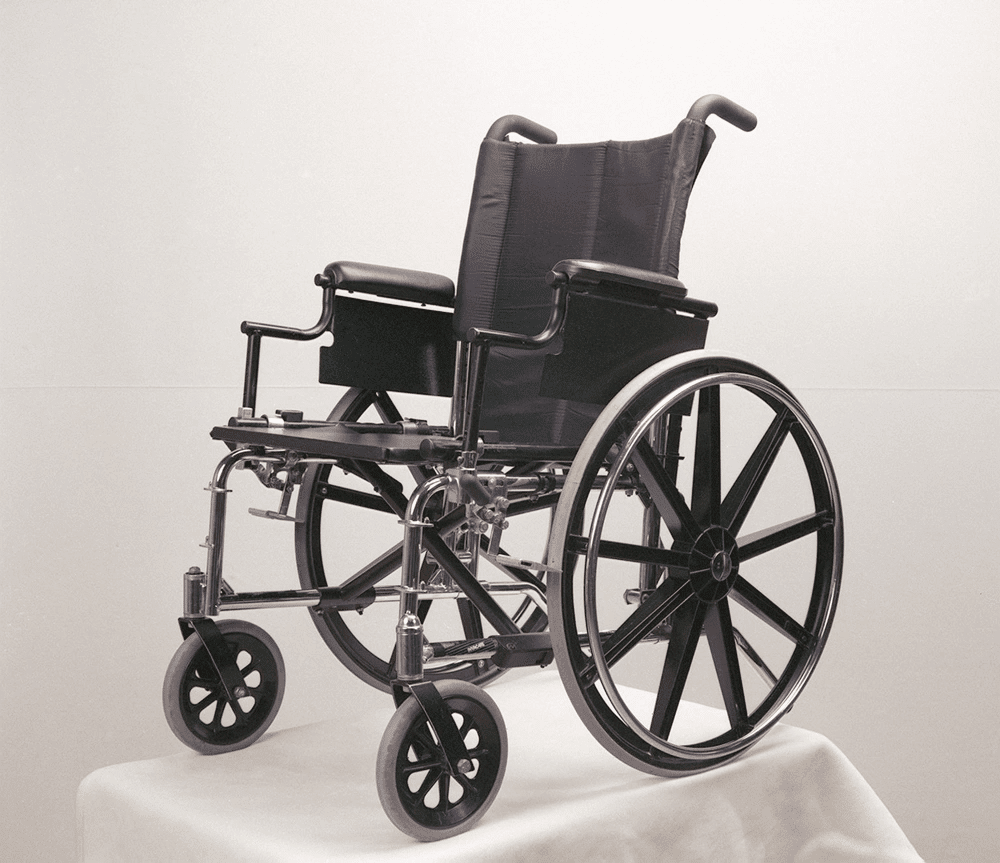
Another lifetime transportation device for some freeloader
WASHINGTON — Military veterans make up only 6.4% of the United States population, according to Census Bureau data, but these freeloaders cost the American taxpayer billions, a fact that brings Republicans and Democrats together.
It is no coincidence that the national debt ceiling has become a contentious issue for usually rational and cooperative legislators. But one silver lining in the fight is the unifying effect that paying for veterans has when they’re no longer actively fighting wars or offering useful photo opportunities. Legislators, budget analysts, and journalists agree, America’s veterans, especially disabled ones, are “a gigantic pain in the ass.”
“When you think about it, the VA budget is about $119 billion but we only have about 19 million veterans,” stated Washington Post journalist Aimes Poorly. “So, that amounts to what? Like, ten billion dollars per veteran?”
“I don’t know about you,” Poorly continued. “But I don’t want my tax dollars to make billionaires out of cripples and shell-shocked kids who can’t contribute to society. They need to pull themselves up by their combat bootstraps. Do you think my parents paid for four years of finding my truth at Wellesley or my Eurosummer with a bunch of government handouts? No! My dad is a simple plastic surgeon. He had to perform a lot of extra elective surgeries to pay for all that. These crybaby vets could have chosen Spain over Nangarhar or Ramadi if they had a little vision. Dude, the raves in Ibiza are nuts.”
No two ways about it: America’s veterans are thieves
Recently, the Washington Post brilliantly used an opinion article to explore this very topic — highlighting the unfortunate fact that advanced medical research and care means more service members survive severe and life-threatening injuries than in previous generations. This huge downside of science has led to a surplus of greedy veterans for the American people to support with benefits like healthcare, free or reduced college costs, life insurance, and career training. It was a thought-provoking exercise in brilliance that really made people think.
Willow Sparks, an unemployed crystals expert, weighed in.
Though she never served in the military, Sparks considers identifying as a wounded veteran as a means of securing the money to pay back student loans. Alternatively, she may move to “this micro-swap commune in the Yucatan and just default.”
ENOUGH ALREADY!!!!
Congressional Representatives share concerns about biased treatment in favor of veterans. In late April, a bill introduced would have cut the VA budget by 22%. Florida representative and off-hours Joker impersonator, Representative Matt Gaetz, believes it was a step in the right direction.
“Plain and simple, the Veterans’ Administration is a drain on the economy. I mean, there’s the medical care for people that had nothing more productive to do than go to Afghanistan and get cancer from standing around burn pits while I was chasing hotties and partying balls during college and law school. But that’s before you even get into non-medical services like the GI Bill, home loans, job and skills training, and legal services for veterans. I sure would like some of that sweet government cash. It’s not like I don’t have my own bills to pay.”
Gaetz then laughed maniacally and disappeared into a puff of smoke.
Reached between a “speaking and sensing session” at a Brooklyn-based indigenous weaving cooperative, traditional Gaetz opponent Representative Anastasia Ocasio-Cortez joined him, “The VA is just an extension of a military that exists solely to turn otherwise future workers in support of state production into killer automatons who generally vote Republican. I can’t support that any more than I support recruiting them in the first place. It’s an issue of consistency.”
These people are smarter than you. Don’t ask questions.
While experts seem unified in support of slashing funds to the VA, no one could say exactly how this would improve the economy in the long or short term. Yet, many remain optimistic that if the VA budget is reduced, those pesky veterans will die off faster.
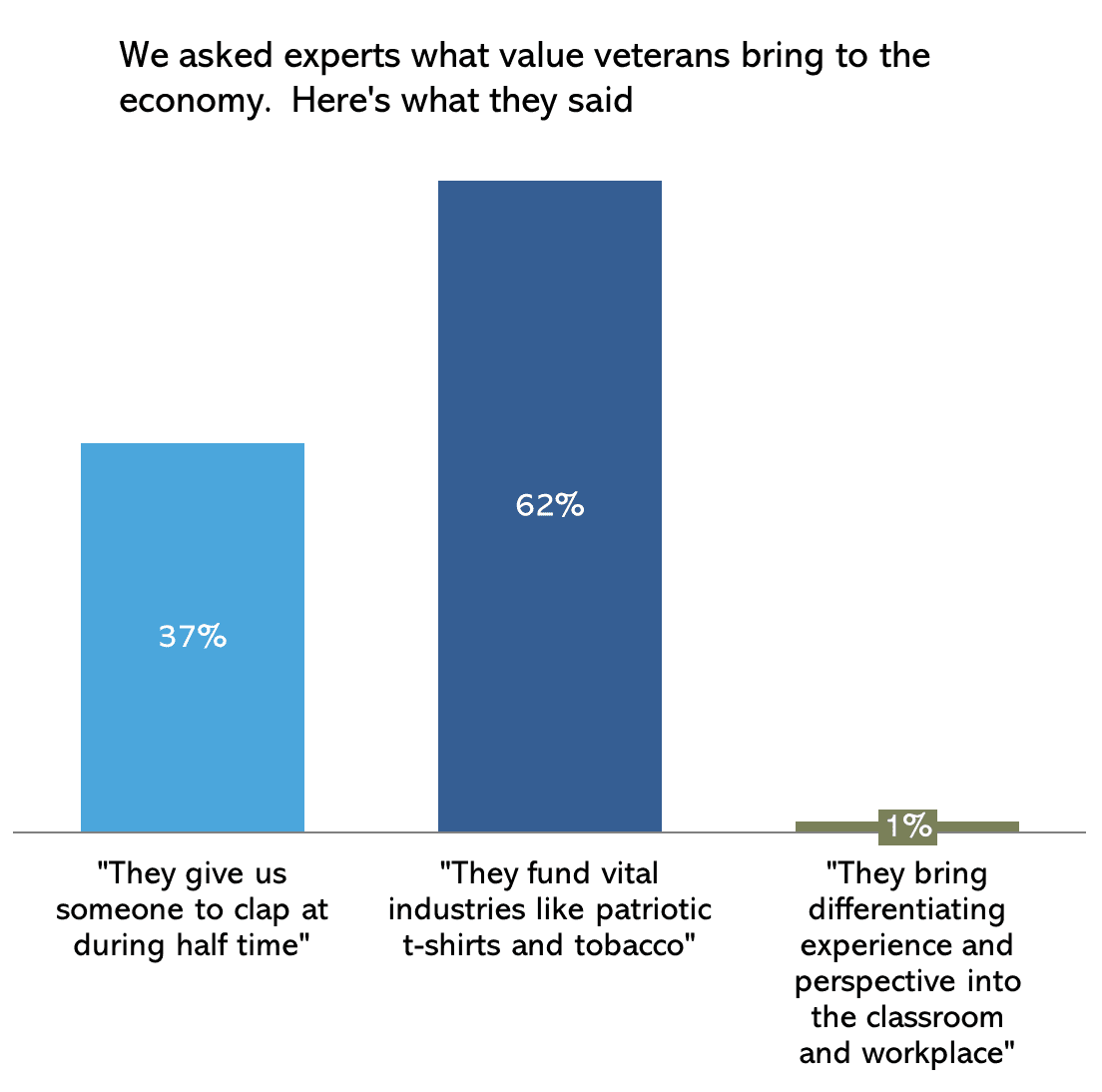
Despite expert opinion to the contrary, one group of Americans seemed opposed to slashing veterans’ funding and, if history is a guide, their opinion will be what wins the day.
Art Popp, a spokesman for The American Military Industrial Complex explained, “Look, the creation of veterans is just good business. Someone has to fire the Tomahawk. Drones don’t exactly fly themselves. Well, they sorta do. Anyway…whatever, ships and planes need someone to move them. Then there’s the infantry. Those guys wandering around finding IEDs are great for the prosthetics guys. And let’s be honest, most of these mouthbreathers can’t do anything else. Crippled vets are just the price of doing business and providing value to the patriotic American shareholder.”
Gray Sea Liu is a former Naval Officer, current smart-ass.
I don’t want to be a battalion commander. I don’t want to be a brigade commander. I don’t want to command anything, ever again.
For an Army officer to say, this is well nigh on heresy. I nearly expected George C. Marshall himself to descend from his lofty throne on Mount This We’ll Defend and smite me down with his Army Strong Scepter as I typed those words. As officers, we are taught from our very beginnings as second lieutenants that battalion command is the end-all goal of our careers. And I believed it, too. I wanted it.
I wanted to wear the silver oak leaves and receive the colors from my brigade commander, seeing all the campaign streamers and unit awards, and knowing that was entrusted to me. That weighty responsibility, all in my hands. And then, I could make positive changes in soldiers’ lives. We could make the Army fun again. My staff and I, we could cut through the BS and show soldiers that their lives in the Army didn’t have to suck. We could make a difference. I truly wanted that.
And then I had company command. Well, command(s). Like battalion command, I had yearned for company command for years. For years, people had told me, “Oh, just wait for company command, you’ll love it.” I was sure I would. Command was a privilege, not a right, I was told. Damn right, and I wanted that privilege. Like all senior lieutenants, I was champing at the bit to take the guidon and run with it. And I did. And it was a blast.
For about a year and a half.
Then the running became a slog. Then the slog became a morass. And then I began to feel like I was drowning. I was exhausted. I was tired of fighting ridiculous battles with higher echelons to do the simplest of things. I was tired of the late-night texts and the phone calls, wondering what one of the soldiers in my unit had done this time. I was tired of the endless meetings, the signatures on an infinity of forms, of constantly feeling like for every step forward, I took two steps back. I was tired of fighting personnel battles, trying to ensure soldiers got to go where it worked best for them and the Army, only to get slapped down. Of building training plans which had to be changed less than a month out because someone above me failed to plan correctly. Of receiving conflicting guidance, where somehow even the most basic things became complicated. Of constantly balancing peoples’ egos and personalities with each other. Of acting as recruiting officer and commander, simultaneously. I was exhausted.
On paper, though, we were winning. Across two line company commands, we averaged the highest retention rates in the battalion and in some years, the whole state. We did this because we treated soldiers like human beings. We treated endemic unit issues and helped soldiers get into marriage, financial, or personal counseling. We destroyed other units’ metrics in training and were rated the best company of our type in our JRTC rotation. We somehow managed to have a robust and fun training schedule during the pandemic, while keeping soldiers safe. All the training paid off when we mobilized the company in 48 hours to get on the ground in DC after January 6. We won best unit in the battalion for years running. Officers, NCOs, and soldiers got to go to their dream schools. We helped so many soldiers get full time jobs in the National Guard so they could spread their skills around and build a solid financial base. We developed good relationships with other units and I got to work with some amazing leaders. And personally, I racked up top blocks on my OER for every year of command. On paper, I was best qualified and on track for battalion command. But I was exhausted.
I knew I needed to come out of command about four months before I actually did. But there’s that thing in your head, where you think, “to be a good leader, I have to give it my everything.” There’s a vivid picture in my memory of my conversation with my battalion executive officer, where I said I needed a break…”But if you really need me to, I can do four full years,” I heard myself say. Totally not like a masochist at all, nope.
I came out of command after 3 1/2 years and as I told someone when they asked me where I wanted to go next, I said, “A dark room where no one talks to me, and I can just read some doctrine or something.” The universe – or some kindly deity – came to my rescue and got me a dream assignment that took me far out of the universe of the operational force. Someplace I could finally take a knee and breathe. It felt weird. And on reflection, I came up with a troubling realization.
I did not love my company command. God knows, I wanted to. I loved the people I worked with, but command? Naw, I’m good. Then I began to think about battalion command and my brain basically shut down. Maybe I just had nothing more to give, or maybe…maybe it held nothing for me anymore. This was an embarrassing thought and I was reluctant to share it with anyone else, because it sounds like admitting failure and weakness.
Then I began to talk to my post-command peers, from across all components of the Army and a whole slew of branches. There were people who had deployed with their companies, some had commanded basic training companies, some who had incredibly specialized commands, and others who had basic branch commands. To a person, when we talked about if we wanted battalion command, the answer was, “Naw, I’m good.” Amazingly, we’d all had very similar experiences. Successful commands, top-blocked on evals, the works; but utterly and entirely drained, disillusioned, jaded, and with no desire to move to that next rung on the ladder. Precisely because they felt like they couldn’t actually make any meaningful changes – all while being ground down and kept away from their families.
So that’s why I write this. Not to complain about the Army. This is for all those other officers out there who might be thinking that you’re the anomaly, the aberration. That something’s wrong with you. Nope, you’re pretty damn normal from what I can see.
However, it should perhaps be sounding some alarm bells for the Army. If it was just me who had been feeling this way, as I thought for a while, then that’s a “me” problem – and I have no problem admitting that. Indeed, it took me so long to write this – I’m almost two years post-command – because I wanted to make sure this *wasn’t* just me being a cantankerous, salty moron. As, you know, I have the propensity to be from time to time. As it turned out, it’s not just a me problem.
Which then leads me to conjecture, that if you have thinking, capable, dynamic, engaged, and caring officers, who are rated among the best, but who are scrambling to find their ways out of their basic branches so as to not have to compete for command…that sounds like an Army problem. And it also means that those who are competing for battalion commands are either the very best of the best (and probably superheroes, to boot), or the egotistical, non self-aware narcissists that absolutely should never lead soldiers but somehow we keep meeting them in places of authority.
If you are looking at the conclusion, here, for a solution to this problem, I regret to inform you that I do not have one. Is there a way to make command less burdensome? Probably, but that would involve reforming the culture of the Army from the top down, which I don’t think I have the brainpower or the rank to call for, let alone the digital space to quantify.
Perhaps this can begin a dialogue, however, as we discuss how we treat command. The times ahead are not getting any simpler, and we will need the most capable minds in the Army to be in the best places for them in the years to come (not mine, it’s barely capable of holding two competing thoughts in it at the same time). As we discuss talent management, this needs to be part of that conversation.
As for me, who knows – maybe I’ll change my mind as I go through my other key duty positions. But I also know that if you do not want to be a commander, you should not be a commander. There’s plenty of fulfilment in the rest of the Army for me.
And hey, if you survived command and loved it, and were good at it, and aren’t some sort of absolute psychopathic micromanager who hates their families – good on you. I’m glad you exist. We need you.