Category: The Green Machine
Categories
I miss things like this!

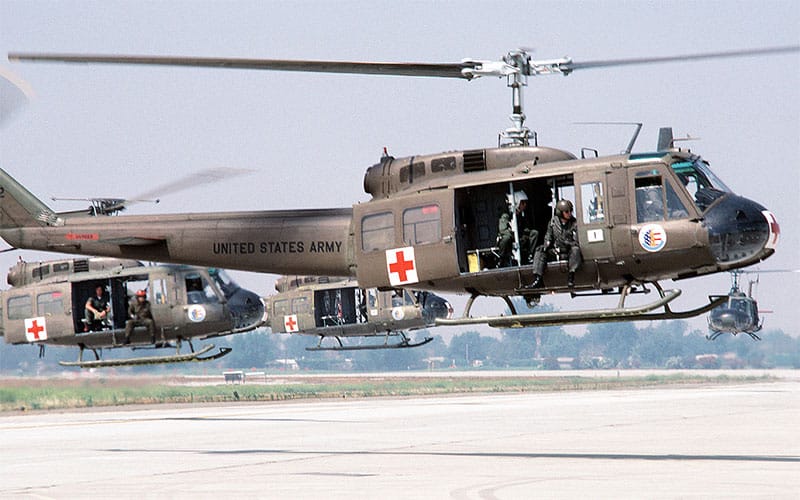
Never underestimate the capacity of the typical Amy Private to think literally.
(Source: Department of Defense)
My buddy was a medevac helicopter pilot flying UH-1H Hueys in the days prior to night vision goggles. Ours was a large training base with a veritable ocean of basic trainees. The training area upon which these young studs learned their trade was both desolate and dark. In the depth of night, it was a massive black hole devoid of artificial light of any sort.
It had been a more torrid summer than most, and a trainee had died of heat stroke a couple weeks before. Basic military training is arduous by design and this young man had succumbed to the toxic combination of dry arid heat and profligate exercise. The military system rightfully does not tolerate such stuff well, so there was a lot of command pressure to treat heat casualties aggressively. In this case, another basic trainee had fallen out during a night tactical movement. The drill instructors determined that he needed medical evacuation by air.
My buddy called through range control and got the range shut down. He chugged into the darkness trying to navigate by the dim light of a weak moon. The terrain was relatively flat and featureless even in daylight. Finding this field site in the dark in the era before GPS was going to take some serious pilotage.
My friend had radio contact with the unit in question via the range control net. This frequency was monitored by all the myriad training units in the field at the time. He called up the unit in question and asked them to point their flashlights skyward. In such a desolate space he figured this would be an easily identifiable way to locate the landing zone.
Alas, Army basic trainees are a terribly literal mob. The entire training area lit up with hundreds of tiny spots of light. My buddy sighed and then got back on the radio. He asked everybody not in the unit with the heat casualty to extinguish their flashlights. The training area went black again save a single glowing spot in the distance.
Time can be of the essence under circumstances such as these, so my friend called the unit again and asked that they get the casualty stripped down to his underwear and prepped for pickup. He also requested they have their trainees stand in a giant circle with their flashlights pointed upward to designate the landing zone. A few moments passed and a glowing circle appeared in the distance as if by magic. My medevac buddy set up an approach to land in the center of the circle and activated his landing light.

An approach into an unimproved landing zone unaided in the dark is indeed a squirrely thing, but it was something we trained to do regularly. You shoot a vector from where you sit to where you want to be and fly the aircraft along that line until touchdown, keeping your head on a swivel throughout for unexpected obstacles or unplanned eventualities. My friend landed the aircraft without incident.
Once the Huey was safely down my buddy glanced between his feet through the chin bubble and his heart stopped. There, stretched out atop an Army-issue litter underneath his roaring helicopter, was one severely dehydrated Army private. The several million-candlepower landing light burned some six-inches from his face. The long sharp WSPS (Wire Strike Protection System) blade had come to rest within a foot of his chest. The young man just lay there still, blinking in bewilderment. I can only imagine the poor kid’s thoughts as this massive flying machine landed directly on top of him.
In the confusion leading up to the landing the unit on the ground had prepared the young man and inexplicably oriented him in the center of the landing area. As luck would have it, they had landed with the skids parallel to the litter. Had the kid been crosswise the 10,500-pound helicopter would have crushed him to death.
Just about the time my buddy started breathing again his crew chief came over the intercom and said flatly, “Sir, take a look outside.”
Arrayed around the idling aircraft in a gigantic circle was an entire company of confused Army basic trainees dressed solely in their t-shirts and boxer shorts. They each obediently held their GI-issue angle head flashlights pointed at the helicopter. Never let it be said that Army privates have any hesitation doing what they’re told, even when it’s a little bit crazy.

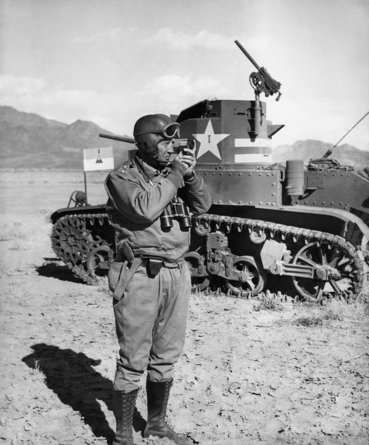 For example here is the Big Guy (General George Patton) who is doing some land navigation with his compass it the right way! Note that he is OUTSIDE & FAR AWAY from his tank. So that is its magnetic signature will not f*ck up his compass sighting.
It was stuff like this & other stuff that made his Armies so much more effective. Like stress on Land Navigation, Marksmanship, Combined Arm Tactics, Communicatiosn, taking care of your gear and your troops. etc etc. No wonder why the German High Command always rated him as their most dangerous opponent!
I just hope that Valhalla is as much fun as the Old timers say for him! Anyways thanks sir for terminating with extreme prejudice so many of our Foes in your time.
Grumpy

The federal bureaucracy is a smoldering smorgasbord of corruption, incompetence, and pride flag-waving wokeness, and the big questions for the next Republican president are where to start fixing it and how.
There are a few things that need to happen day one to begin imposing our iron discipline upon the out-of-control derp state – pardons for every persecuted victim of the two-tiered “justice” system, orders to comply with all GOP investigatory subpoenas immediately, and firing Chris Wray. But defeating the unofficial fourth branch of government requires focus and intensity.
You cannot take it down overnight because it will fight back with support from the regime media. So, you need a quick and critical win.
That’s why the first thing you fix is the military. Getting a big win relatively quickly is substantively vital – we cannot be at the mercy of China, et al. – but beating the Pentagon’s perfumed princes also demonstrates that the bureaucracy can be beaten. Fixing the military checks both boxes.
People wonder how the military went from a glorious force for freedom to a disastrous parody of itself led by a be-medaled faculty lounge on a three-decade-losing streak. They should not wonder – the military is a hierarchical and centralized organization that reflects its commander’s intent. Obama and the people currently holding dust-puppet Biden’s strings treated our military the same way the chardonnay-soaked Munchausen mommies treated their boys and emasculated it.
Trump, though a supporter of a strong military, was bedazzled by the badges, ribbons, and stars of the flag officers and did not disrupt the decline. We need a 180 degree turnaround. Soldiers do what commanders check, and right now, they are checking wokeness. That’s why the military is woke. And therefore broke.
But what if we had a commander-in-chief who checked combat readiness? Its hierarchical nature means that the military is the easiest and fastest federal institution to change back. But it will take the president devoting time and focus to the task; he can win a vast victory fast if he – the commander – demands it.
Doing this will require him to make fixing the military a priority. The president’s most valuable commodities are his time and focus, and everyone will be trying to draw him off-target to aim him at their own priorities. He must demand that his chief of staff rigorously protect his schedule – 0900 to 1030 hours every day for the first six months are devoted to military reform. No exceptions.
Military leaders – well, at least before our military became a punchline – set objectives. The objectives of this campaign should be immediate improvements in combat readiness and immediate improvement in the perception of the military, which goes to morale, public support, and deterrence capability when foreigners see we’re no longer floundering.
The first way to achieve these objectives is to work the personnel angle. Obviously, strong secretaries of Defense and services are essential. No donors. No dilettantes. Only credible true believers who understand that the Pentagon will seek to co-opt them and who will refuse to allow that to happen. They need to be on board with the president’s agenda – no more ridiculous mediocrities like Trump’s Mark Esper managing failure. We need active executives who demand performance – or else.
Next, immediately fire the most grossly incompetent of the joint chiefs. Not all of them – you want to keep some institutional knowledge, but those survivors will know they are following if they fail to perform.
Remember, the key is to relieve them for a cause – “The President has lost confidence in the ability of Admiral Huffnpuff to lead American soldiers. He is relieved of his position, effective immediately, and directed to perform non-command duties at the Pentagon until the Secretary determines the last rank at which he performed adequately. Then he will be retired at that rank.”
Hint: If you are relieved, you did not perform adequately at your current rank. Retire a couple of four-stars as three- or two-stars, and they’ll get the message lima charley. And those losers should consider themselves lucky – the Brits used to shoot half-stepping admirals to encourage the others, and they had the greatest Navy in the world.
Also, during the transition, other key flag officers should be identified for relief based on their ridiculous public antics – like tolerating “pup-play” perverts in their units or persecuting traditional soldiers. There’s some general in the Space Force complaining about states outlawing the gender mutilation of children – fire her. The new president must establish that the military is about fighting again and that it is no longer open season for traditional Americans in the ranks.
Now, identifying those low-performers, as well as those resisting the new CINC’s intent, requires a team of military-savvy operatives working in the transition team and then the administration. They need to monitor the internet and other media,cases of the military not following orders, because the bureaucrats will totally try. What orders?
That’s key. First, eliminate DEI. Completely. Totally. No more of it in the military at all, ever. No “months,” Pride, or anything else. No trans idiocy or drag weirdness – ever. No hassling normals because they won’t play along with the current ruling caste’s cultural commands.
That White House team should be scanning the interwebs and tuning into military/veteran networks to find, for example, some colonel at Fort Doofus who relieved a chaplain for being “too Christian” – which is totally something that would happen.
Then the president orders the unit chain of command – up to the SecDef – to his office in 48 hours to explain why his intent was not followed and to provide a detailed plan about how it will be followed. Reliefs follow, of course. Do that a couple of times, and word gets around – there’s a new sheriff in town, and he’s dead serious.
Other orders need to support the renewed warfighter mindset. Fire most civilian service academy and war college instructors – military or ex-military only (it goes without saying the superintendents all get replaced, and the curricula are immediately revamped to train warriors, not gender studies majors). Freeze Pentagon civilian hiring and shift most jobs out of DC. Cut the Pentagon command staff. In acquisitions, demand speed and refuse to accept nonsense like “Oh, it’ll take five years to replace those Javelins we sent to Ukraine.”
Zero in on unacceptable nonsense. For months, the command at Walter Reed let troops reside in barracks without hot water. Who got fired for that? There were probably excuses – stop accepting them. If General X can’t deliver results, maybe his executive officer can. And for the love of all that is holy, there better not be another United States Navy ship sailing into port with rust streaks running down its hull like it’s some tramp steamer off Zanzibar.
Our troops want to be part of a winning organization. I was in the Gulf War, and I gotta say, it felt pretty awesome even though I basically ran a heavily armed carwash. But we knew we were the best, not because of officers mouthing endless clichés about “lethality” and “readiness” but because we knew what we could do. We need that winning attitude back. We need our military to earn once again the respect of the American people such that young Americans are ready to serve in adequate numbers. And only a commander-in-chief who is willing to focus his time and attention on fixing the armed forces can make that happen.
He’ll get pushback. The Pentagon insiders will drag their feet. He needs to put a box on his desk that says “DEPOSIT STARS HERE” for the generals and admirals who cannot or will not conform to the new (old) standard. The regime media will howl as the drag queens, diversity hacks, and other oxygen thieves get shown the door. But the hardcore troops will applaud.
The military right is the easiest of the bureaucracies to tame, and it is the most important institution to fix. That’s why the next GOP president must fix the military first.
Follow Kurt on Twitter @KurtSchlichter. Get Inferno, the seventh book in the Kelly Turnbull People’s Republic series of conservative action novels set in America after a notional national divorce, as well as his non-fiction book We’ll Be Back: The Fall and Rise of America.
30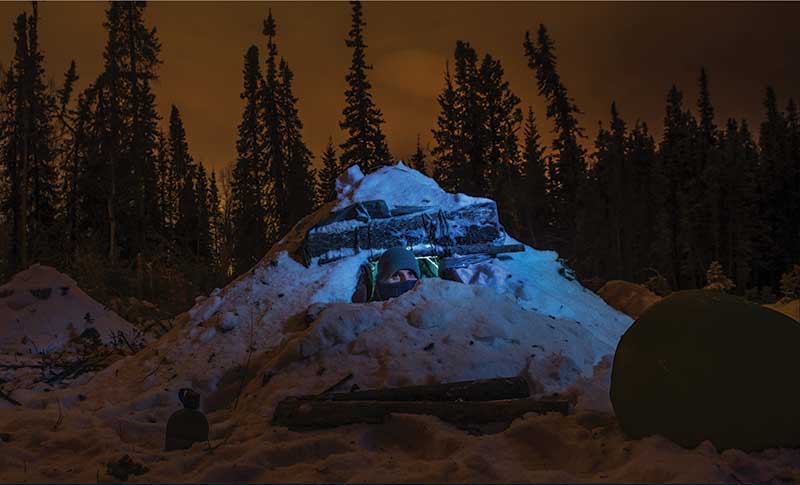
As an Army officer headed to the USAF “Cool School” I naturally presumed any
course presided over by the Wing Nuts would be a walk in the park. I was mistaken
— the arctic cold is no respecter of services. USAF photo: SSG Vernon Young
Soldiers develop an unnatural attachment to the tools of their peculiar profession. Let a stockbroker suffer a catastrophic laptop failure and some critical PowerPoint presentation will likely suffer. The same failure of an Infantryman’s primary tool carries substantially greater gravitas.
Soldiering is a young man’s game. Not only could my knees not bear a proper road march, my general comportment would no longer tolerate the job. If ordered to take some forsaken hill these days, I’d be more inclined to nuke the site from orbit just so I could get home for a good night’s sleep. Old guys make formidable if unpredictable adversaries.
Details
Military service, for all its exoticism, regimentation, and abject lunacy, is quite the rush so long as you’re not getting vaporized. The toys simply have no peer. If you put a 23-year-old male behind the controls of a multimillion dollar gunship helicopter you can’t honestly be surprised when he rolls it inverted just to see what might happen. It drops out of the sky like a greased brick … or so I’m told.
An M1A1 tank weighs 135,000 lbs. yet can get you stopped for speeding in many suburban locales. An Mk19 automatic grenade launcher throws high explosive grenades out to 2,200 meters at a rate of 380 rounds per minute. Watching rocket artillery work over an impact area is like glimpsing the death angel at play. However, all that cool-guy stuff pales in comparison to the one piece of GI kit that rules them all — the humble woobie.
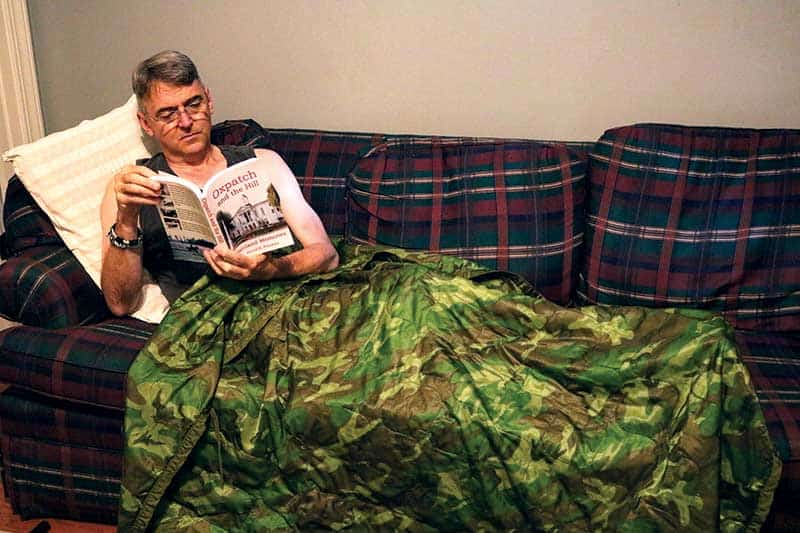
Even today more than two decades after I left the military, I still use my woobie.
Nothing’s better for snuggling up with a warm wife on a cold night.
Weapon: Mass Relaxation
The National Stock Number is 8405-01-547-2559. The technical appellation is the Poncho Liner, USGI Issue, ACU Pattern (UCP). Everybody who has ever worn the uniform calls it the woobie.
The term itself has murky origins. The military version holds “woobie” is mil-slang for “You Would Be cold without it.” I don’t buy that. In the 1983 Michael Keaton film Mr. Mom, the kid calls his security blanket his woobie. I subscribe to the Mr. Mom school myself.
The item in question was first issued in the Vietnam era. The woobie consists of two layers of gossamer nylon material within which is sandwiched a thin stratum of polyester filling. The whole shebang is sewed crossways and edged for exceptional durability. Those earliest woobies were crafted from WWII-surplus parachute material. Hence the camouflage.
The woobie was intended to be secured within a GI-issue poncho by means of tie strings along its edges. My ponchos always smelled like roadkill. By contrast, my woobie was more like a portable all-weather womb.
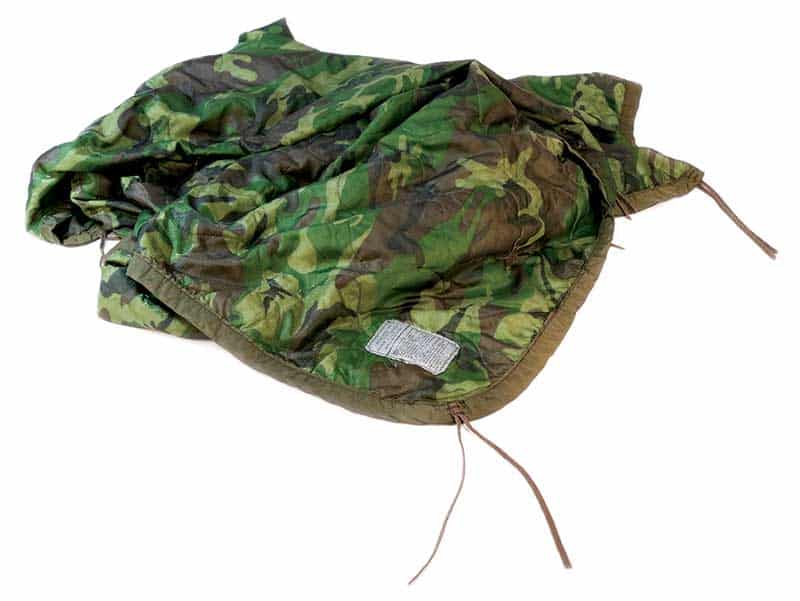
Behold the woobie. The GI Poncho Liner is the most beloved piece of kit in the military inventory.
Military Intimacy
I signed into my battalion in Alaska amidst what would ultimately be one of the coldest winters on record. Once I made my introductions at the S3 shop the ops NCO said, “Hey, sir. You want to go to Cool School?”
I was an Army Aviator. Of course I wanted to go to Cool School. Perhaps I could teach the instructors a few things concerning the refined art of being awesome. Just what was Cool School again?
Cool School is the Air Force Arctic Survival Course. This five-day jaunt into the Alaskan tundra is also colloquially referred to as The Air Force Food Appreciation Course. Two days in the arctic on a single MRE is hardly the Bataan Death March, but I licked every scrap of that thing down and also ate a boiled rabbit. You burn a lot of calories at 40 below zero.
The first night outside was 34 below zero. The second was 43 below. I spent the entirety of that second day building a snow cave. Think of it as a tomb just big enough for your fart sack (sleeping bag) and surrounded by about three feet of packed snow. I wrapped myself in my woobie before inserting my miserable carcass into my cold-soaked sack. Two hours’ worth of shivering later, I was snug and toasty, while my woobie and I were enjoying a relationship that was not altogether professional.
I learned a lot about life when I was a soldier. I enjoyed some extraordinary fellowship and did indeed see the world. I also discovered that I really, really hate eating boiled rabbit.
Forget hypersonic missiles, carrier battle groups, and CAG operators HALO-ing out of the darkness. That’s all just comic book stuff. America’s most effective combat multiplier is undoubtedly the humble woobie.
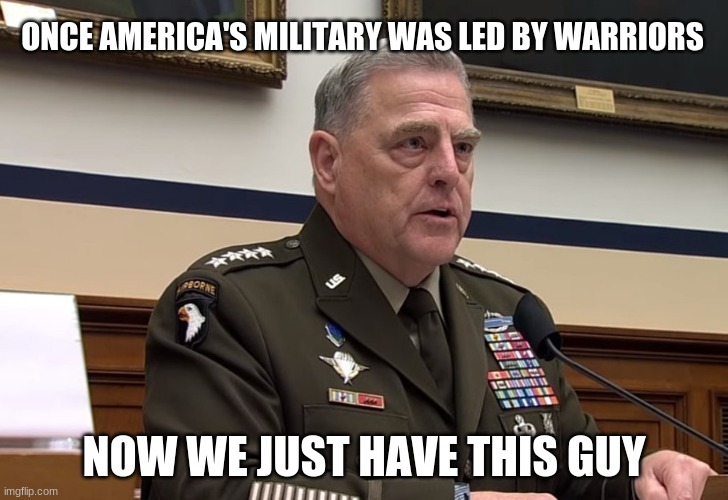
A new system is capable of pinpointing the ‘exact location’ of anyone who could cause reputational damage to its charges

A secretive division of the Pentagon is now tasked with protecting its high-ranking officials not only from assassination and other bodily harm, but also from negative portrayals on social media, according to a procurement document obtained by The Intercept and published on Saturday.
While military records officially state the US Army Protective Services Battalion protects its charges from “assassination, kidnapping, injury or embarrassment,” this now includes monitoring social media for “direct, indirect, and veiled” threats, as well as identifying “negative sentiment” about individuals like Joint Chiefs of Staff General Mark Milley, according to the document, which is dated September.
The document describes the program as “a reliable social media threat mitigation service” with an “Open-Source Web based tool-kit with advanced capabilities to collect publicly available information (PAI).” Beyond the data from Twitter’s “firehose,” 4Chan, Reddit, YouTube, VK, Discord, Telegram, and the like, “PAI” also includes a wealth of commercially acquired information from surveillance firms and private contractors like Dataminr, other data brokers, and unscrupulous smartphone apps and advertisers.

Read more
All this would be apparently combined with geo-fencing capabilities and actual cellular location data, allowing for near-exact pinpointing of the location of the supposedly “signal-rich discussions from elicit threat-actor communities” – keeping in mind that the “threats” discussed in the procurement document potentially include unkind tweets about current and retired generals.
The entirety of this information hoard – including CCTV feeds, radio stations, personal records, even individuals’ webcams – would be accessible through a “universal search selector,” according to the document.
The document specified the need for a two-way stream, requiring the contractor to maintain “the anonymity and security needed to conduct publicly accessible information research through misattribution” by “using various egress points globally to mask their identity.” The contract was given to SEWP Solutions LLC, described as the only company capable of “tunnel[ing] into specific countries/cities like Moscow, Russia or Beijing, China and come out on a host nation internet domain.”
The procurement document specifies that it does not want the Pentagon advertising its interest in violating the online and, potentially, physical privacy of those it deems threats to the reputation of generals retired and current. It is stamped “Controlled Unclassified Information”/FEDCON, meaning it is not meant to be seen by those outside the federal government and contractor system.
The revelation that still more intrusive powers are being sought by the national security state has outraged privacy advocates. “Expressing ‘positive or negative sentiment towards a senior high-risk individual’ cannot be deemed sufficient grounds for government agencies to conduct surveillance operations, even going as far as ‘pinpointing the exact locations’ of individuals,” Ilia Siatitsa of Privacy International told The Intercept.
“The ability to express opinions, criticize, make assumptions, or form value judgments – especially regarding public officials – is a quintessential part of democratic society.”
__________________________________________________________ Could you manage what Ike or Patton , Ridgeway, Abrams et al must be saying Valhalla right about now!?!
 For that special time when you REALLY want the party to either start or end RIGHT NOW!!!