
Category: The Green Machine


Private First Class Ralph Kollberg, a combat veteran of the U.S. Army’s 77th Infantry Division, poses with his M1919A6 machine gun on Okinawa, May 14, 1945. Despite the gun’s 32-lb., 8-oz., weight, it was far more portable than the tripod-mounted M1919A4.
One of the most popular and effective U.S. small arms of World War II was the M1919A4 light machine gun. Despite the almost universal accolades heaped upon the M1919A4, the U.S. Army Ordnance Dept. continued to seek ways to increase the gun’s utility. While attempting to improve upon existing designs is not a bad thing in and of itself, sometimes the “Law of Unintended Consequences” comes into play.
A good example of this in the realm of World War II U.S. military arms was the Model 1918A2 Browning Automatic Rifle (BAR). As a brief review, when the M1918 BAR was fielded late in World War I, it was an immediate sensation and was, hands-down, the best gun of its genre in the world at the time. The Ordnance Dept. couldn’t leave well enough alone, however, and after World War I, the BAR was subsequently fitted with all manner of attachments that were intended to improve it, including bipods, stock rests, folding buttplates, receiver magazine guides and carrying handles. The popular selective-fire feature allowing either full-automatic or semi-automatic operation was discarded on the M1918A2 version and was replaced with a full-automatic-only mechanism consisting of “slow” and “fast” cyclical rates of fire that few of the users liked, or employed, and which was prone to malfunction.
Most of these “improvements” offered few real advantages but seriously mitigated one of the major hallmarks of the original design—its comparatively light weight and handiness. This resulted in many of the users disregarding or stripping off as many of the extraneous features as possible, especially the bipod, in an attempt to put the gun back in the configuration originally designed by John Browning.
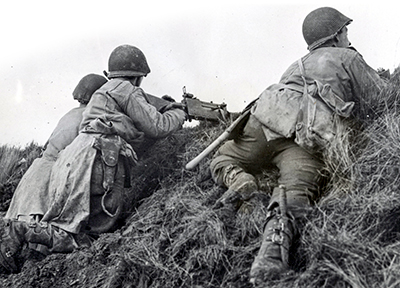
U.S. Army troops are seen here in Germany in early 1945 firing an M1916A6 machine gun. Note also the holstered M1911-pattern pistol on the shooter’s equipment belt and the M3 fighting knife retained by the straps of the M1943 boots worn by the G.I. at right.
A similar scenario occurred during World War II with the M1919A4 machine gun. Since before World War II, the U.S. military had been seeking a gun that could fill the perceived gap between the BAR and the M1919A4. Several designs were evaluated in 1941 and early 1942, but none were deemed to be satisfactory. As the war progressed, there were increased requests for a machine gun of this type. Although the M1919A4 was widely used with notable effectiveness during the war, there were some negative points cited in a 1943 Marine Corps evaluation of the gun:
“Some weapons platoon leaders believe the gun (M1919A4) to be too slow in getting into action and the crew too vulnerable. It is suggested that a new mount for close in jungle fighting be designed, on the order of the bipod and butt-rest similar to the BAR M1918A2 with the addition of a carrying handle on the barrel jacket similar to the British Bren.”
The Ordnance Dept. wanted to develop a new type of gun with the attributes that were being sought and resisted the suggestions to simply field a modified M1919A4 instead. A World War II Ordnance Dept. report stated: “[It] is believed that no advantage would accrue in recommending a modification of the M1919A4 machine gun at this time, as such modifications would meet the approved military characteristics of the light machine gun in part only.”
The Infantry Board did not agree with the Ordnance Dept. assessment and was of the opinion that a modified M1919A4 might not be optimal, but it would fulfill the requirements until a more suitable type of firearm could be developed.
As documented in an Infantry Board report: “The Infantry Board favors a project by the Ordnance Department for the development of a light machine gun. However, based on past experience, the Board believes that the time consumed in the development, technical testing, production of pilot models, service testing, adoption as standard for issue, set up for manufacture and distribution to the services will be so great that under the best of conditions of accelerated procedure, it will be a distant date before the weapon can be placed in the hands of the troops. These modifications for the M1919A4, namely a lighter barrel, no muzzle plug, an 041 spring, a bipod and a shoulder rest … should present no great manufacturing difficulties, and after the items are manufactured, the modifications can be made in the field. If this is accomplished, the services would have a flexible and satisfactory light machine gun at an early date, certainly many months before a new type of light machine gun can be developed and distributed.
“While these modifications [of the M1919A4] do not constitute the ultimate in the development of a light machine gun, they do give a satisfactory gun in a minimum amount of time and manufacturing adjustment.
“The Infantry Board considers the modification of the M1919A4 Machine Gun a matter of major importance to the infantry … and recommends that action be taken to accomplish this modification … .”
This position was very much akin to the hoary old saying, “Perfect is the enemy of the good” or, to paraphrase Gen. George S. Patton, “A good plan now is better than a perfect plan later.” The Infantry Board prevailed, and the modified M1919A4 was recommended for adoption as the “M1919A6.” As stated in the book Machine Guns Of The United States: “The most recent modification of the Model 1919A4, for infantry use, is the Model 1919A6 which incorporates a pressed-metal shoulder stock, a carrying handle, and a bipod similar to that used with the Browning Automatic Rifle. This results in a light machine gun—classed as substitute standard—suitable for air-borne troops as well as for general use. Though the barrel of this gun weighs 2.5 pounds less than that of the 1919A4, the two are interchangeable. This model became substitute standard on April 10, 1943.”
The M1919A6 machine gun was succinctly described by noted author and former Ordnance Dept. officer, the late Konrad F. Schreier, Jr.: “[T]he most unique gun in the M1919 series was the M1919A6. It featured a detachable shoulder stock, a folding bipod on the end of the barrel, a carrying handle, a different barrel bearing than the M1919A4 and a lighter barrel.
Its basic action was identical to the air-cooled M1919A4 machine gun. The gun weighed 32.5 pounds, which made it 12.5 pounds lighter than the M1919A4 mounted on the M2 tripod. A total of 43,479 M1919A6 light machine guns were produced during World War II by Saginaw. However, a number of M1919A4 machine guns were also converted into M1919A6 configuration. The M1919A6 machine guns were manufactured from very late 1943 through 1945. The M1919A6 machine gun could also be used with the M2 tripod if necessary.”
The Ordnance Dept. was not a big fan of the M1919A6, and basically felt that the gun was foisted upon it by the Infantry Board. Paradoxically, while the Infantry Board was successful in lobbying for acceptance of the modified M1919A4, as events transpired, the Board wasn’t overjoyed with the M1919A6 either.
As related by author Dolf Goldsmith: “[T]he Ordnance Department … was most unhappy about their inability to create and supply the infantry with what they had requested … . After the M1919A6 was accepted, testing began anew. Every conceivable facet of the gun was tested … throughout the spring and summer of 1944 … the infantry was … less than happy with the M1919A6, but there was simply nothing else available that could have been used instead. This grudging acceptance is well brought out in one of the test reports, which concluded:
“That the Production Model, Machine Gun, Caliber .30, M1919A6 is substantially equal to the pre-production model as tested and approved, and is satisfactory as an intermediate type.
“That the Machine Gun, Caliber .30, M1919A6, is not a satisfactory light machine gun for infantry use.
“The Infantry Board recommends:
a. “That no action be taken looking at any modification or change in the Machine Gun, Caliber .30, M1919A6.
b. “That development of a more suitable light machine gun for infantry use be pushed.”
It seemed the Infantry Board was talking out of both sides of its mouth. On the one hand, it was stated that the M1919A6 “ … is satisfactory as an intermediate type … .” But in the next sentence stated it “is not a satisfactory light machine gun for infantry use.” Reading between the lines of the Infantry Board report indicates that no more effort should be expended in trying to tweak the M1919A6 any further, and the document closed with the recommendation that the development of a better light machine gun be expedited. As events turned out, this didn’t happen until 1957 with the adoption of the M60 machine gun, which was intended to replace all the Browning .30-cal. machine guns, and the BAR, as standard issue. Throughout its service life, the M1919A6 was designated as “Limited Standard.”
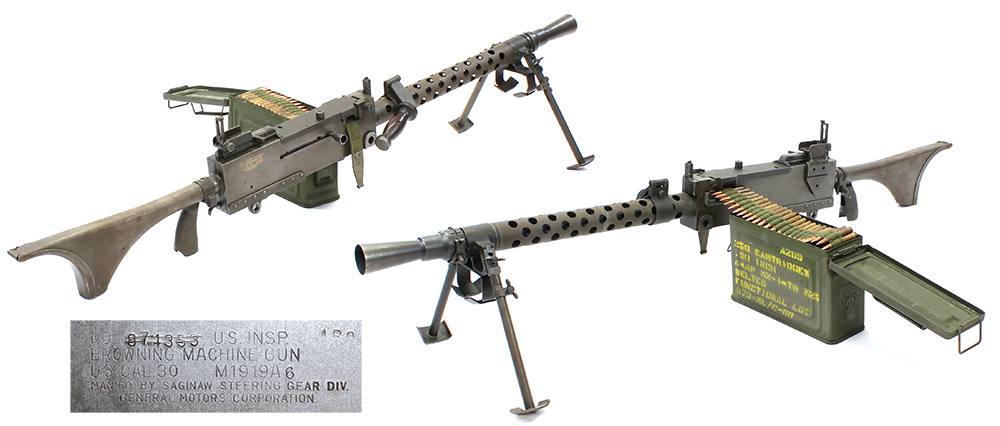
In total, 43,479 of the belt-fed M1919A6 light machine guns were manufactured from late 1943 through 1945. Note how the receiver markings on a Saginaw M1919A6 reveal a slightly misaligned “6” hand-stamped into the model designation (inset).
Contracts were placed with the Saginaw Steering Gear Division of General Motors for the manufacture of the M1919A6. In 1944, 23,329 of the guns were made, with an additional 20,150 produced in 1945, for a total of 43,479. It was a simple matter to convert existing M1919A4s to M1919A6 configuration, and kits to accomplish this conversion in the field were produced.
Examples of M1919A4s modified to M1919A6 configuration have been noted with the last digit “4” being defaced and a “6” overstamped. It is not known how many were modified in this way. Also, later in the war, when many of the light tanks were withdrawn from service, the M1919A5 tank machine guns were removed and converted into M1919A4 or M1919A6 configuration, typically with the “5” similarly being overstamped to “4” or “6”.
The U.S. Army airborne units were issued M1919A6 machine guns, as it was felt that the gun would be better-suited for use by the paratroopers since it was lighter and did not require a tripod. They proved to be unpopular with many of its users. As is the case with most “compromise” arms, it didn’t really excel at any one thing. While it fired at a slightly higher cyclic rate than the M1919A4, it wasn’t any more effective in laying down fields of fire than its predecessor. The M1919A4 and the M2 tripod were carried by the gunner and assistant gunner, respectively, and the M1919A6 (which was heavier than the M1919A4 sans tripod) was carried by a single gunner. The M1919A6 could be mounted on the M2 tripod, but that would defeat the entire purpose of the gun. The gun was too heavy to be a true light machine gun, and it didn’t have the stability of a tripod-mounted gun.
There was a reason why the M1919A6 was always designated as “Limited Standard.” While it wasn’t horrendously bad, the M1919A6 simply wasn’t very good at its intended purpose of being a light and easily portable machine gun. There’s nothing wrong with trying to modify a design for uses other than those for which it was originally designed, but that doesn’t mean such efforts will always produce stellar results. The M1919A6’s major, if not sole, advantage was its ready availability. As stated, it was believed that the time required to design, test and manufacture an entirely new light machine gun would have taken too long.
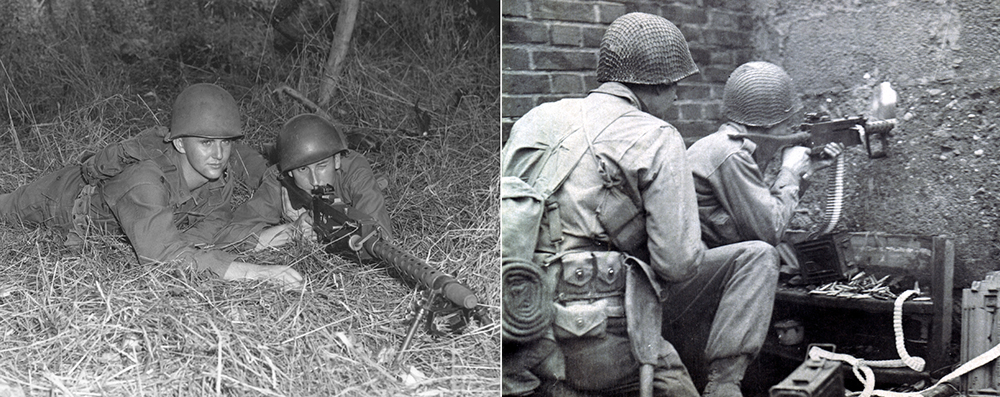
(l.) U.S. Army soldiers, possibly in the post-World War II era, are seen here training with an M1919A6 machine gun fitted with a blank-firing adapter. The gun remained in service well into the Vietnam War. (r.) American troops serving in Germany, in 1945, fire an M1919A6 light machine gun from behind a wall through an embrasure cut into the structure.
It is a little-known fact that the Ordnance Dept. did embark on a program to produce a virtual copy of the excellent German MG42 machine gun chambered for the .30-’06 Sprg. cartridge. Such a gun would likely have filled the role envisioned for the M1919A6 superbly. However, these efforts did not work out very well. The developmental contract to fabricate a copy of the German MG42, to be designated as the “T-24,” was granted to the Saginaw Steering Gear Division of General Motors.
Like the M1919A6, the gun was envisioned as a replacement for the BAR and the M1919A4 machine gun and was designed so it could be used with the M2 tripod as well. The length of the American .30-cal. cartridge as compared the MG42’s 7.92×57 mm cartridge required that the German design essentially be re-engineered. However, the prototype gun functioned quite poorly in initial testing. It was soon discovered that a draftsman had not properly accounted for the differences in the dimensions between the American and German cartridges, and the receiver was about a 1/4″ too short, which resulted in the numerous malfunctions. The amount of additional engineering work to properly re-design the prototype was not considered to be worthwhile, and the project was canceled. This resulted in the gun being discarded and the M1919A6 being adopted instead. It has been suggested that there was an element of the “NIH (not invented here) Syndrome” involved in the decision to abandon the .30-cal. MG42 project and accept, albeit reluctantly, the M1919A6. It may not have been as good as a properly engineered .30-cal. MG42, but it was felt to be better than the alternative, which would have been nothing.
Like the M1919A4 machine gun it was based on, the M1919A6 remained in service well into the Vietnam War era. It is fair to say that the M1919A6 was not one of the best-loved American arms of World War II, even though the gun’s basic mechanism, the .30-cal. Browning, was held in high esteem. It has been said that the M1919A6 machine gun was akin to the old adage that “a camel was a horse designed by a committee.”
The foregoing was excerpted from the author’s comprehensive work U.S. Small Arms Of World War II. The 8 1/2″x11″ book contains 864 pps. and is lavishly illustrated. Contact: Mowbray Publishing, Inc.; (800) 999-4697; (gunandswordcollector.com).
THE UNSINKABLE BATTLESHIP OF MANILA BAY
Warship Wednesday, May 6, 2015: The unsinkable battleship of Manila Bay

Click to big up
Here we see the concrete battleship, Fort Drum, as she appeared before 1941. While yes, this is not a ship but a U.S. Army coastal defense fortification, it has all the aspects of a ship above the waterline!
When Dewey swept into Manila Bay in 1898, the battle that his Asiatic Squadron gave the outgunned Spanish fleet was brief and historic– leaving the U.S. with de facto control of the island chain (or at least the Bay) that was made official after the war ended. After the Japanese defeat of the Russian Pacific Fleets (both of them) in 1905– during which a number of the Tsar’s ships took refuge in Manila Bay under the watchful eye of the USN, it became a priority to beef up the defenses around the harbor to keep the Navy there from turning into another Port Arthur.

The island, before 1909. If you prefer, you can refer to this as the ‘keel’ of Fort Drum
In the mouth of the Bay was El Fraile Island, a small slip of rock that the Army, in charge of Coastal Defense, decided to place a mine-control battery atop. However, this plan soon changed and the Army, with the Navy’s blessing, went about building their own static battleship.
Under the plan of Lt. John Kingman of the Army Corps of Engineers, the military leveled off El Fraile starting in 1909 and encased the entire island in steel-reinforced concrete with an average depth of 36-feet thick along the walls.


Several stories deep, a fort was constructed that included water cisterns, fuel tanks to run electrical generators, barracks for artillerymen, dining facilities, and storage for enough food to last the defenders months if needed.

Topside Plan

Engine tank section. Click to big up
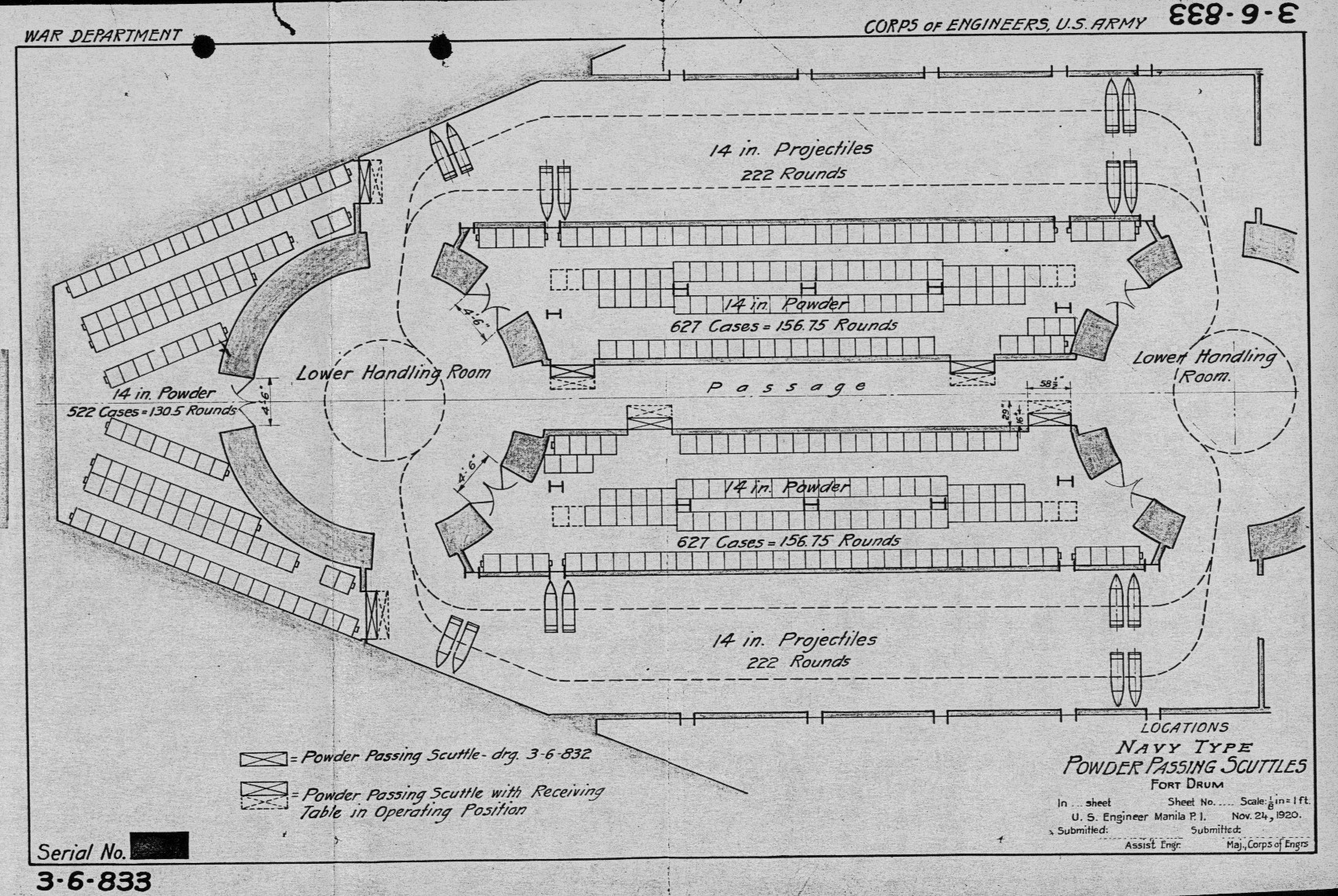
Powder magazines and “navy-type” electrical passing scuttles. Drum could stock 440 shells for its main batteries. Click to big up

Atop the roof of the structure, which itself was 20-feet thick, were mounted a pair of M1909 turrets that each houses a pair of 14-inch (360mm) guns. Although a Navy-style mount, it was all-Army and contained unique wire-wound guns modified from the standard M1907 big guns mounted in coastal defense forts stateside.
 While the standard CONUS 14-inchers were “disappearing” mounts, these larger 40-caliber tubes, with their 46-foot length, allowed the 1,209-pound AP shells to fire out to some 22,705-yards. To protect these turrets (named Batteries Marshall and Wilson), they had 16-inches of steel armor on their face, 14 on the sides and rear, and 6 on the roof. Of course, these giant turrets, with their outsized guns, tipped the scales at 1,160-tons or about the weight of a standard destroyer of the era, but hey, it’s not like they were going to sink the island or anything.
For comparison, the huge 16-inch/50 cal Mk.7 mounts on the Iowa-class battleships– commissioned decades after the Army’s concrete fort was built, weighed 1,701-tons but had three larger guns rather than the two the boys in green staffed.

The M1909 mount was tested at Sandy Hook Proving Ground, New Jersey before shipment to the PI. Only two of these mounts were ever constructed and, to the credit of the Army, are both still in existence despite an epic trial by combat. Click to big up
As befitting a battleship, the fort had a secondary armament of four casemated 6-inch coastal defense guns (dubbed Batteries Roberts and McCrea) as well as an anti-aircraft/small boat defense scheme (Batteries Hoyle and Exeter) of smaller 3-inch guns.
To direct all this a 60-foot high lattice mount (just like those on the latest U.S. battleships) was fitted to the ‘stern’ of the fort that contained fire control spotters (that fed to plotting rooms protected deep inside the facility), as well as 60-inch searchlights, radio and signal facilities to keep in contact with the rest of the harbor defenses.
Finally commissioned in 1913– just in time for World War One, the concrete battleship was named Fort Drum after former Adjutant General of the Army Richard Coulter Drum, who had died in 1909– the year construction began.

The man…
 The fort was a happy post until December 8, 1941, when, just hours after the attack on Pearl Harbor, the Japanese struck at the Philippines. Largely relegated to providing some far-off gunfire support and exchanging pot shots with Japanese planes until Manila fell, this soon changed.
In December two water-cooled .50 caliber machine guns manned by a 13-man platoon of 3/4 Marines (withdrawn only days before from China), was sent to the concrete battleship to beef up her dated AAA defenses.
They joined the 200~ soldiers, officers, Philippine Scouts, and civilian ordnance-men of the 59th and 60th U.S. Army Coastal Artillery Regiments, commanded by Lt. Col. Lewis S. Kirkpatrick. Later, when Bataan fell, about 20 tank-less soldiers from an armored unit– Company D, 192nd Tank Battalion (formerly Harrodsburg’s 38th Tank Company of the Kentucky National Guard)- managed to escape to Drum and lent their shoulders to the wheel for the last month of the campaign.
As the Japanese had done at Port Arthur in 1904 where they brought in 10-ton Krupp L/10 280mm howitzers from the Home Islands to churn the Russian fortifications to gruel, the Imperial Army shipped new 40-ton Type 45 240 mm howitzers just to batter Fort Drum in March.
Although they peppered the fort’s concrete and knocked out some small guns, Drum kept firing and after April, along with Corregidor and the other harbor forts, became the last piece of real estate owned by the U.S. When the Empire tried to take Corregidor in the end, Drum’s 14-inchers made Swiss cheese of a number of their thin-skinned landing barges, sending many of the Emperor’s best troops to the bottom of the Bay.
On May 6, 1942, some 73 years ago today, when General Wainwright surrendered Corregidor, he included the harbor forts in his order. Although still capable of fighting, the defenders of the fort obeyed orders, smashed their generators, burned their codebooks, spiked their weapons, turned the fire-hoses loose in the interior– paying special attention to the powder rooms, and raised a white flag at noon.
Although the 240~ soldiers and Marines of the garrison did not suffer any deaths in direct combat, their time in Japanese prison camps was by no means easy. A number of their unit, including Kirkpatrick, did not live to see the end of the war. Only one officer, battery commander Capt. Ben E. King, survived. Casualties among the enlisted were likewise horrific.
In the end, they were awarded the Presidential Unit Citation and that of the Philippine Presidential Unit Citation, which the 59th carries to this day (as the 59th Air Defense Artillery Regiment)
While the Japanese occupied the concrete battleship and used it as a coastal defense position for the rest of the war, they never did get the M1909s operable again.

US Army landing on Drum
Following bombardment by the USS Phoenix (CL-46), on April 13, 1945, the U.S. Army landed on the roof of the once-great fort. They found the Japanese defenders, shut inside its concrete warren under their feet, unwilling to surrender. Therefore, with McArthur’s blessing, a detachment of B Company/13th Engineers, poured 3,000 gallons of diesel/oil slurry down the ventilation shafts and set it off with timed charges as they withdrew.

US engineers and soldiers guarding them, pumping diesel fuel and oil into the innards of Ft. Drum Philippines. Note the 14-inch turret in the background

The fort burned for two weeks and no living Japanese prisoners were taken, only 68 “body remnants” were recovered. These men were sailors and survivors from the ill-fated super battleship Musashi, sent to the bottom just six months prior. So in the end, her final crew were battleship men.
According to an Augus1945 Yank magazine article:
First there was a cloud of smoke rising and seconds later the main explosion came. Blast after blast ripped the concrete battleship. Debris was showered into the water throwing up hundred of small geysers. A large flat object, later identified as the 6-inch concrete slab protecting the powder magazine was blown several hundred feet into the air to fall back on top of the fort, miraculously still unbroken. Now the GIs and sailors could cheer. And they did. As the LSM moved toward Corregidor there were continued explosions. More smoke and debris.
Two days later, on Sunday, a party went back to try to get into the fort through the lower levels. Wisps of smoke were still curling through the ventilators and it was obvious that oil was still burning inside. The visit was called off for that day. On Monday the troops returned again. this time they were able to make their way down as far as the second level, but again smoke forced them to withdraw. Eight Japs-dead of suffocation- were found on the first two levels.
Another two days later another landing party returned and explored the whole island. The bodies of 60 Japs-burned to death-were found in the boiler room on the third level. The inside of the fort was in shambles. The walls were blackened with smoke and what installations there were had been blown to pieces or burned.
In actual time of pumping oil and setting fuses, it had taken just over 15 minutes to settle the fate of the “impregnable” concrete fortress. It had been a successful operation in every way but one: The souvenir hunting wasn’t very good.

Starboard beam view of the battleship USS NEW JERSEY (BB-62) passing between CORREGIDOR (background) and FORT DRUM as she enters Manila Bay. Date: 3 Jul 1983 Camera Operator: PH2 PAUL SOUTAR ID: DN-SN-83-09891 Click to big up
Now, abandoned, the unsinkable battleship with its charred interior spaces lies moldering away in Manila Bay.

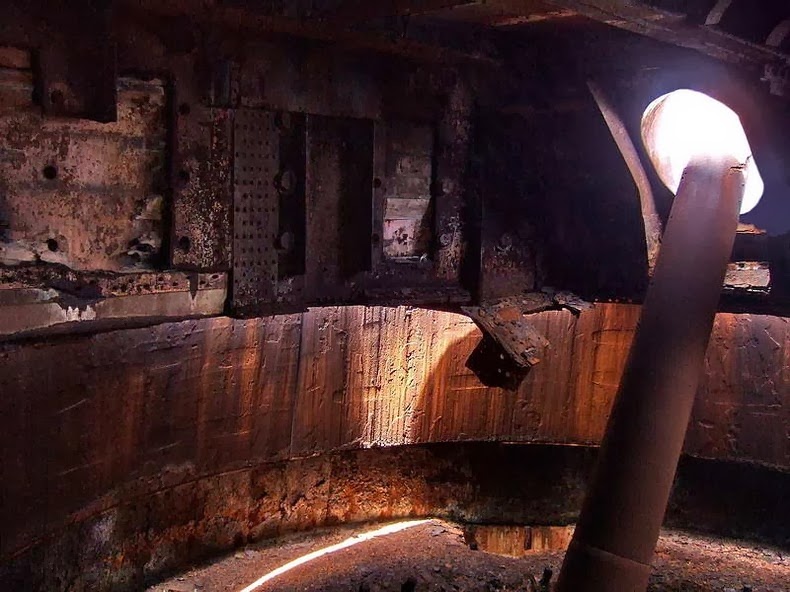
Over the years, it has become a tourist attraction and target for scrap hunters who have carried off every piece of metal smaller than they are.
For more information on Fort Drum, please visit Concrete Battleship.org
As for Gen. Drum himself, he is buried at Arlington Section 3, Site 1776.
Specs:
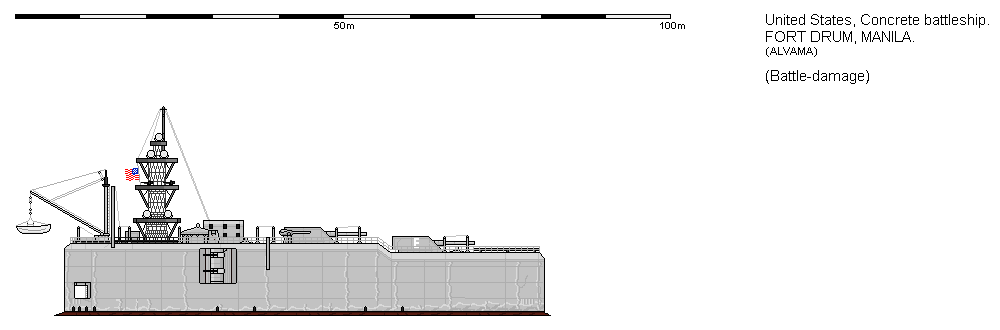

Displacement: It is an island
Length: 350 feet
Beam: 144 feet
Draught: nil, but the fort stood 40-feet high and the lattice tower over 100
Propulsion: None, although the fort had numerous generators
Speed: In time with the rotation of the earth
Complement: 200 men of Company E, 59th Coastal Artillery Regiment, commanded by Lt. Col. Lewis S. Kirkpatrick (1941-42)
Armament: (as completed)
4xM1909 14-inch guns
4xM1908 6-inch guns
Armor: Up to 36 feet of concrete, with up to 16-inches of plate on turrets
If you liked this column, please consider joining the International Naval Research Organization (INRO), Publishers of Warship International.
They are possibly one of the best sources of naval study, images, and fellowship you can find http://www.warship.org/
The International Naval Research Organization is a non-profit corporation dedicated to the encouragement of the study of naval vessels and their histories, principally in the era of iron and steel warships (about 1860 to date). Its purpose is to provide information and a means of contact for those interested in warships.
Nearing their 50th Anniversary, Warship International, the written tome of the INRO has published hundreds of articles, most of which are unique in their sweep and subject.
Categories
Scumbag of the Century
US Army financial counselor admits to defrauding Gold Star families: DOJ
ByLeah Sarnoff
A former financial counselor for the United States Army pleaded guilty to defrauding the families of fallen servicemembers out of life insurance payments, the U.S. attorney’s office announced Tuesday.
Gold Star family members are the immediate beneficiaries of servicemembers who have died in active-duty military service and are entitled to a $100,000 payment and the servicemember’s life insurance of up to $400,000, according to the organization.
Caz Craffy, from Colts Neck, New Jersey, pleaded guilty to obtaining more than $9.9 million from several Gold Star families to invest in accounts managed by Craffy in his private capacity without the families’ authorization, according to prosecutors.
Craffy was a civilian employee of the U.S. Army, working as a financial counselor with the Casualty Assistance Office, but he was also a major in the U.S. Army Reserves, where he has been enlisted since 2003, prosecutors said.
From May 2018 to November 2022, the Gold Star family accounts suffered more than $3.7 million in losses and Craffy made more than $1.4 million in commissions, according to prosecutors.
“Those who target and steal from the families of fallen American servicemembers will be held accountable for their crimes,” Attorney General Merrick Garland said in the press release.
“Nothing can undo the enormous loss that Gold Star families have suffered, but the Justice Department is committed to doing everything in our power to protect them from further harm,” Garland said.
On Tuesday, Craffy pleaded guilty to 10 counts, including six counts of wire fraud and one count each of securities fraud, making false statements in a loan application, committing acts affecting a personal financial interest and making false statements to a federal agency, according to the New Jersey U.S. Attorney’s Office’s press release.
“Caz Craffy admitted today that he brazenly took advantage of his role as an Army financial counselor to prey upon families of our fallen service members, at their most vulnerable moment, using lies and deception,” U.S. Attorney Philip R. Sellinger said in the press release.
“These Gold Star families have laid the dearest sacrifice on the altar of freedom. And they deserve our utmost respect and compassion, as well as some small measure of financial security from a grateful nation,” Sellinger said.
Craffy entered his plea before U.S. District Judge Georgette Castner in Trenton, New Jersey and is scheduled for sentencing on Aug. 21.
Craffy’s plea agreement calls for a prison sentence of 8 to 10 years, according to prosecutors, and the restitution amount will be announced during his sentencing.
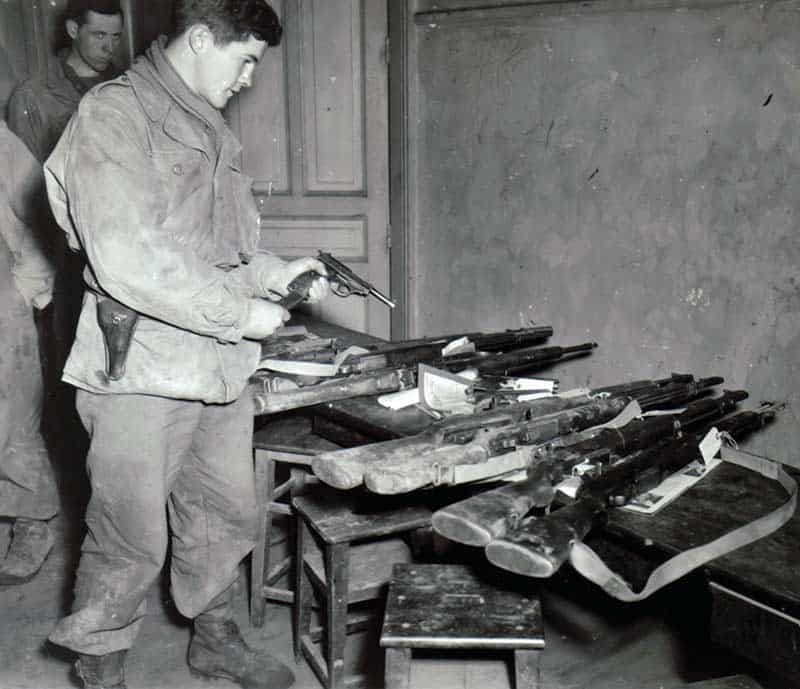
A little R&R: GIs check in their weapons, including a captured P38 pistol,
before a short leave in Nancy, France in December 1944. Photo: NARA

To the victors go the spoils: GIs inspect a war trophy bonanza of P08 Luger pistols at Berchtesgaden at the war’s end. Photo: Patton Museum
When American troops began to deploy to France in late 1917, they would soon realize the horrors of modern warfare. But they would also find one of the few pleasures for the combat soldier, and in WWI, that meant the beginning of a joyful harvest of German war trophy pistols.
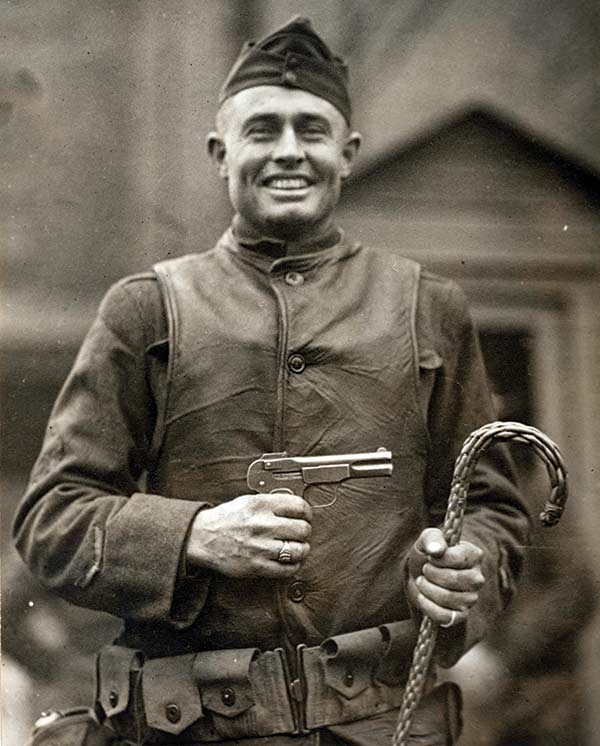
A Doughboy poses with a Langenhan pistol, officially known to German forces as the “F.L. Selbstlader Cal. 7,65.” Introduced in 1915, this is a German copy of the FN M1900. Photo: NARA
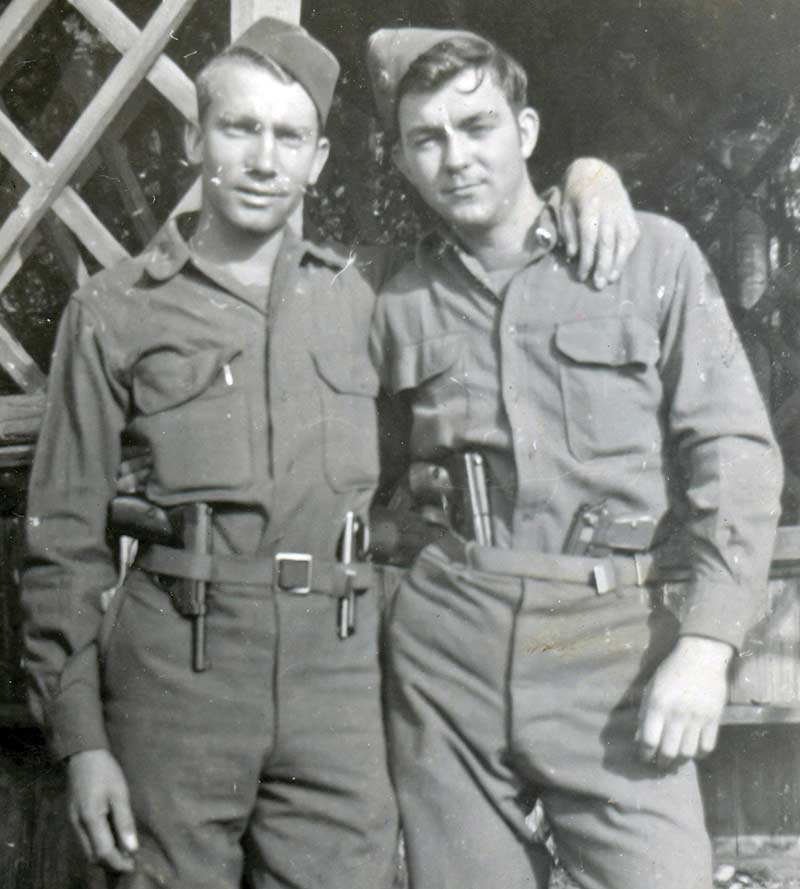
GIs show off their pistol trophies in Germany during the spring of 1945.
On the left: a Walther P38 and Mauser M1914; on the right, a Walther
P38 and Walther PPK. Photo: Author’s collection
WW I Trophy Hunting
By 1918, the German 9mm Pistole Parabellum, commonly known as the Luger pistol, became one of the most sought-after souvenirs of the Great War. The Luger and the Mauser C96 “Broom Handle” (chambered in 7.63x25mm) were not only prized trophies — the Doughboys found them quite useful and turned them against their former owners.
Even while there were plenty of U.S. .45 ACP pistols available (the M1911 auto pistol and the M1917 revolver), any red-blooded American boy will tell you two guns are better than one — particularly when your life depends on them. Even after the war was over, the American army of occupation in Germany continued its interest in war trophies, particularly the pistol variety.
The expression “The English fight for Honor, the French for Glory, but the Americans fight for Souvenirs!” is said to have originated in 1918. It is confirmed in multiple post-war assessments by German troops and civilians concerning American troops.
U.S. Intelligence officers conducted a series of interviews immediately after World War I. One letter from a German in Treves said: “The American discipline is excellent, but their thirst for souvenirs appears to be growing.” A shopkeeper from Bad Neuenahr quipped: “I alone have sold more Iron Crosses to American soldiers than the Kaiser ever awarded to his subjects.”
German pistols became scarce in the 1918–1919 era and unless you picked one up yourself (the hard way), their prices rose steeply. On the plus side, there were no gun laws in the U.S., so if a Doughboy could capture it, trade for it, or buy it, he could bring that pistol, rifle, or even machine gun home with him. After all, World War I was called “the war to end all wars” and nobody believed this world would be stupid enough to go to war again. But sadly, there would be another bigger and better chance for American troops to pick up German pistols on the battlefield just a quarter-century away.

GIs show off their pistol trophies in Germany during the spring of 1945.
On the left: a Walther P38 and Mauser M1914; on the right, a Walther
P38 and Walther PPK. Photo: Author’s collection
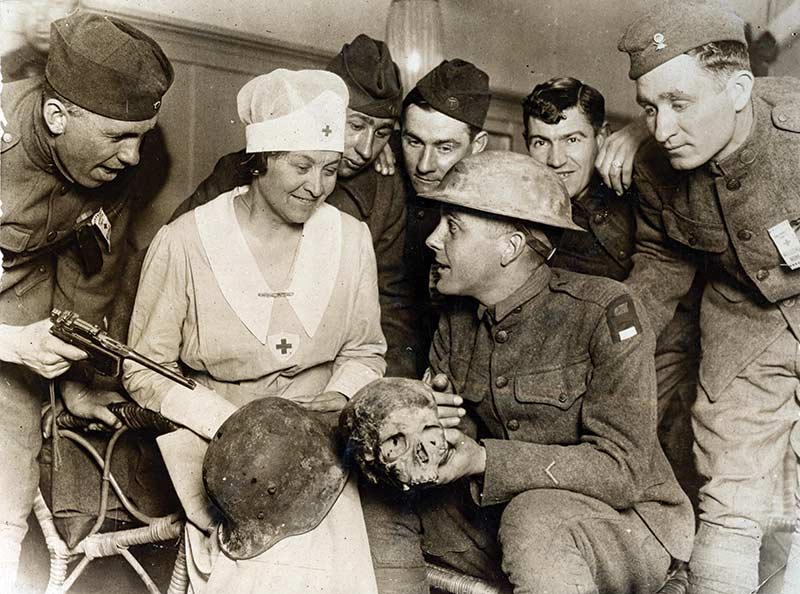
Impressing the girls with war trophies in 1918: These Doughboys show off
a German “coal-scuttle” helmet (M1916 Stahlhelm), a Mauser C96 pistol,
and presumably part of the original owner.
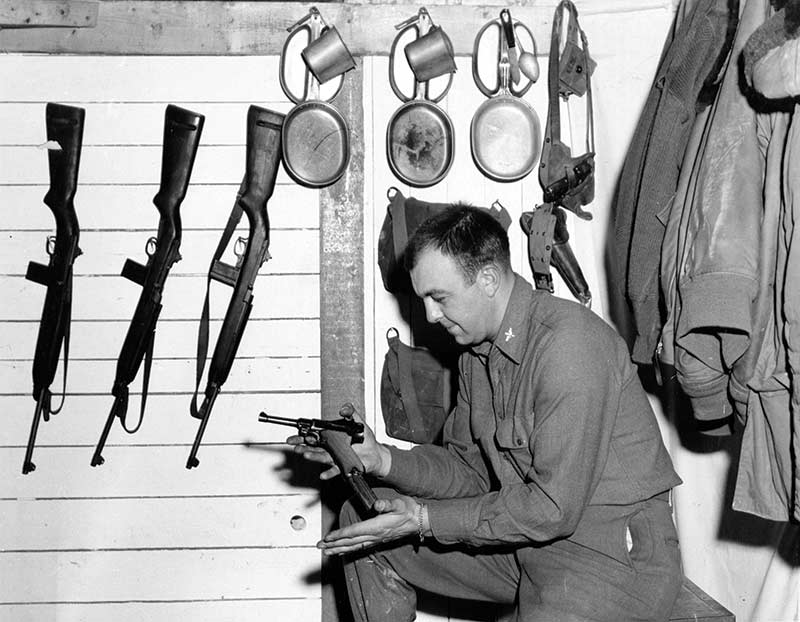
The Luger was a war trophy prized above all others. An airman of the 9th Air Force shows off his Luger at a forward airfield in France in the autumn of 1944. Photo: NARA
Act II: ETO War Trophies
When U.S. forces met German troops in combat in World War II, American interest in German pistols, particularly the Luger, was reinvigorated. The U.S. Military Intelligence publication German Infantry Weapons (May 1943) described the Luger in detail for troops in the field:
“The Luger Pistol: Since 1908, the Luger pistol has been an official German military sidearm. In Germany, Georg Luger of the DWM Arms Company developed this weapon, known officially as Pistole 08, from the American Borchart pistol invented in 1893. The Luger is a well-balanced, accurate pistol. It imparts a high muzzle velocity to a small-caliber bullet but develops only a relatively small amount of stopping power.
Unlike the comparatively slow U.S. 45-caliber bullet, the Luger small-caliber bullet does not often lodge itself in the target and thereby impart its shocking power to that which it hits. With its high speed and small caliber, it tends to pierce, inflicting a small, clean wound. When the Luger is kept clean, it functions well. However, the mechanism is rather exposed to dust and dirt.
“Ammunition: Rimless, straight-case ammunition is used. German ammunition boxes will read ‘Pistolenpatronen 08’ (pistol cartridges 08). These should be distinguished from ‘Exerzierpatronen 08’ (drill cartridges 08). The bullets in these cartridges have coated steel jackets and lead cores. The edge of the primer of the ball cartridge is painted black. British- and U.S.-made 9mm Parabellum ammunition will function well in this pistol; the German ammunition will, of course, give the best results.”
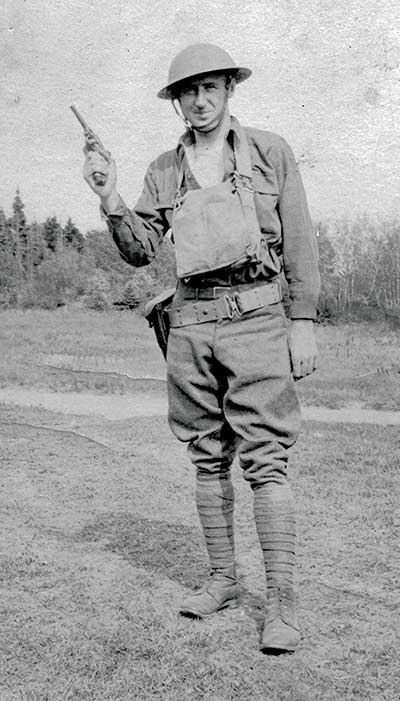
In the beginning: A Doughboy starts the American combat soldiers’ tradition of collecting the German P08 Luger in France, 1918. Photo: Author’s collection
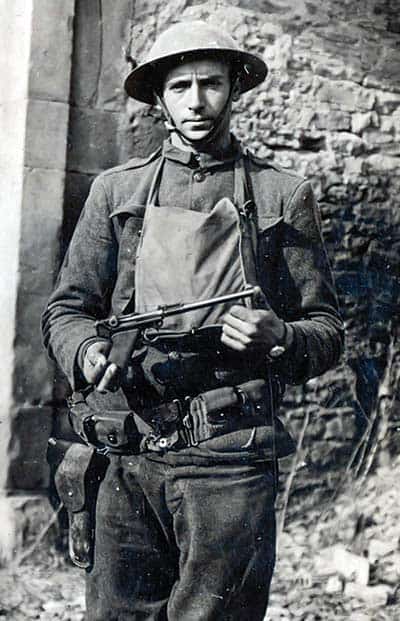
This Doughboy added an Artillery Luger to his holstered
M1911 pistol in France, 1918. Photo: NARA
Don’t Touch That …
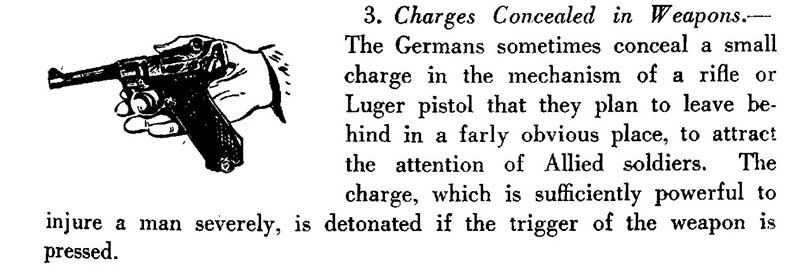
The Luger’s popularity among U.S. troops did not go unnoticed by the Germans. Several wartime cautionary tales emerged as the Luger was sometimes used as “bait” for a booby-trap, ready to catch an over-eager trophy hunter. Other claims were circulated that German troops executed Americans captured carrying German pistols, but this was never substantiated. The February 1945 edition of the U.S. Intelligence Bulletin contained this warning:
“Charges Concealed in Weapons. The Germans sometimes conceal a small charge in the mechanism of a rifle or Luger pistol that they plan to leave behind in a fairly obvious place, to attract the attention of Allied soldiers. The charge, which is sufficiently powerful to injure a man severely, is detonated if the trigger of the weapon is pressed.”
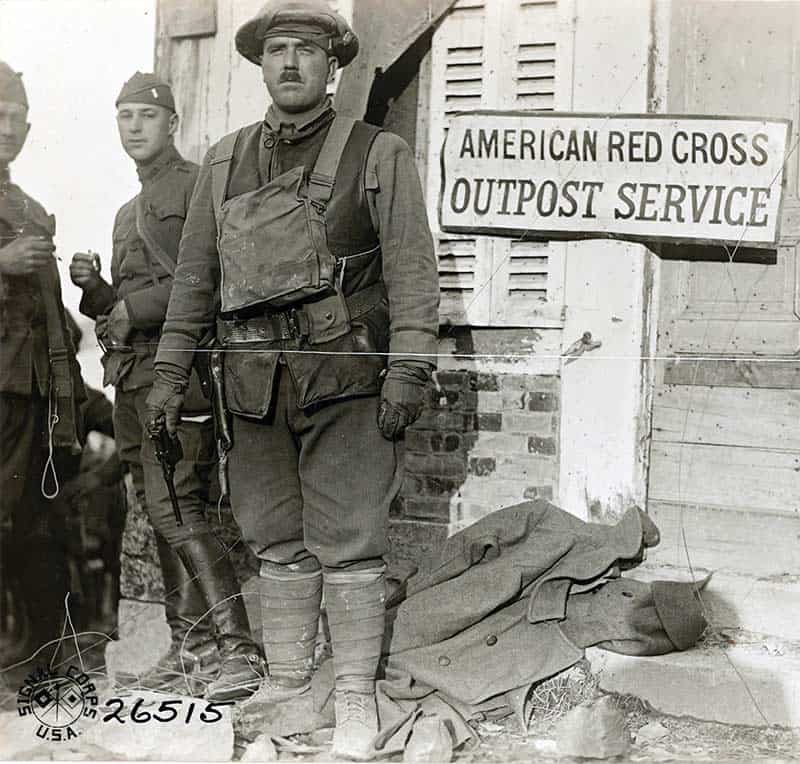
If looks could kill: Stern-faced Doughboy with a captured Mauser
C96 pistol in the Ardennes in October 1918. Photo: NARA
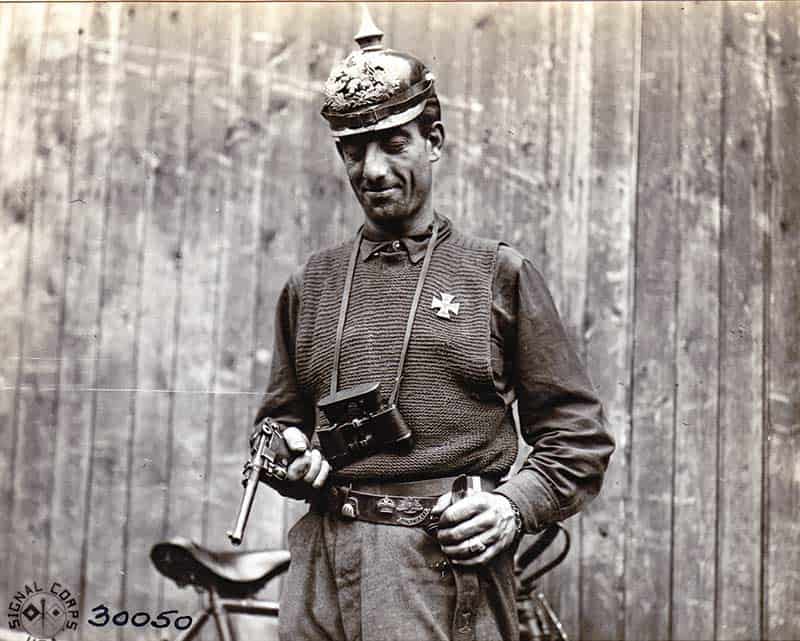
Souvenirs from the Hindenburg Line battle in October 1918: A member of the 27th Division displays his captured Pickelhaube, Iron Cross, binoculars, and Lange Pistole 08 “Artillery” Luger (7.9″ barrel). Photo: NARA
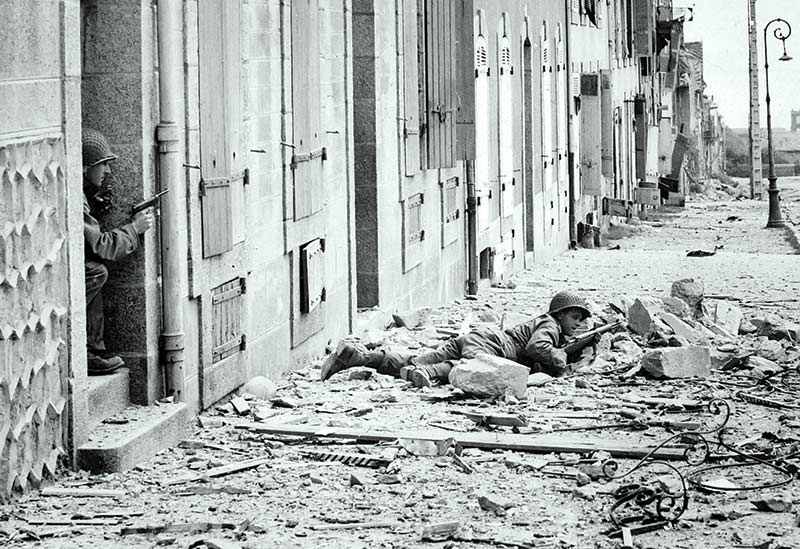
Sometimes, the trophy became a prime weapon. This GI clutches a fragmentation grenade in one hand and a captured Walther P38 pistol in the other during the bitter street fighting in Brest, France in September 1944. Photo: NARA
Bring-Backs & Send-Homes
Such was the mania among GI souvenir hunters to pick up German pistols (and any other German firearm) on the battlefield that the U.S. Army and the U.S. Customs Bureau went to great lengths to approve, then control, and then ultimately restrict American troops’ ability to bring or send the captured weapons home.
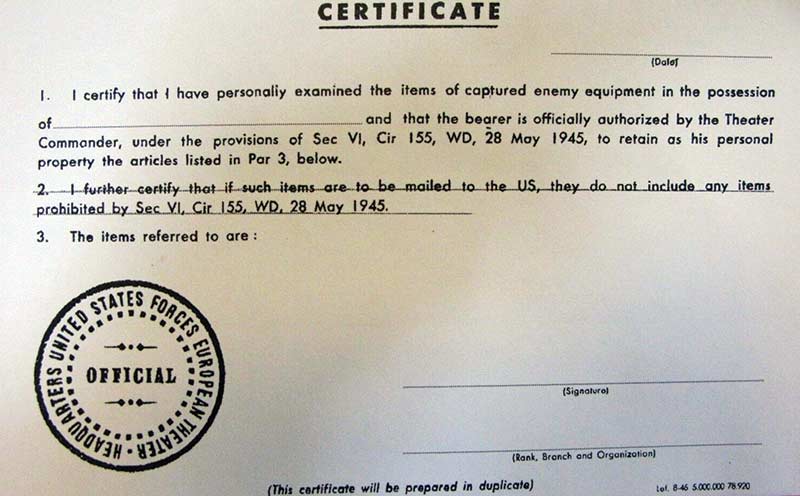
Beginning in 1944, a U.S. government certificate (often called “capture papers”) was provided to GIs that would allow them to send home or carry home a wide range of war trophies. Signed by their commanding officer, these rather vague certificates gave troops a near carte blanche to pass almost any captured firearm through U.S. customs, at least for a time.
Shortly after the war ended, a U.S. Army regulation effective May 28, 1945, limited War Trophy firearms to one per soldier and strictly enforced the prohibition of the importation of machine guns. It all looked good on paper anyway, but most GIs (and apparently their officers) ignored it. Your dad or grandpa put his captured pistol in his duffel bag and carried it home, or he packaged it up and mailed it to the states.
I’ve never seen any credible estimate on the number of German pistols brought home from the world wars. I’m not good at math, so I won’t guess at the total — other than to say, “a lot.” Even so, it is rare to find a WWII trophy pistol complete with its capture papers — the documentation doesn’t change much, but it is an interesting notch on a collector’s belt.
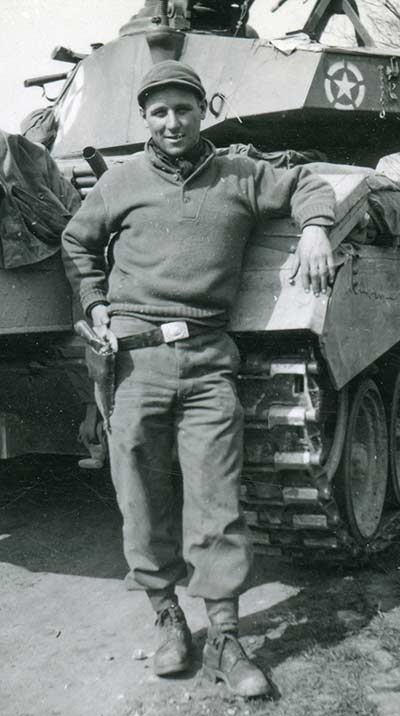
A tank crewman poses by his M24 Chaffee light tank with a captured
Mauser C96 pistol on his hip in Germany in the spring of 1945.
Photo: Author’s collection.

A captured Artillery Luger displayed for the camera, with
42nd Division in France, March 1918. Photo: NARA
Technicalities
I did a little digging and found how Uncle Sam defined “war trophies” and the guidelines of how they could be possessed and brought to the United States as personal property.
“War Trophy: In order to improve the morale of the forces in the theatres of operations, the retention of war trophies by military personnel and merchant seamen and other civilians serving with the United States Army overseas is authorized under the conditions set forth in the following instructions. Retention by individuals of captured equipment as war trophies in accordance with the instructions contained herein is considered to be for the service of the United States and not in violation of the 79th Article of War.
“All effects and objects of personal use — except arms, horses, military equipment, and military papers — shall remain in the possession of prisoners of war, as well as metal helmets and gas masks.
“When military personnel returning to the United States bring in trophies not prohibited, each person must have a certificate in duplicate, signed by his superior officer, stating that the bearer is officially authorized by the theatre commander, under the provisions of this circular, to retain as his personal property the items listed on the certificate. The signed duplicate certificate will be retained by the Customs Bureau; the original will be retained by the bearer.
“Military personnel in theaters of operations may be permitted to mail like articles to the United States, except that mailing of firearms capable of being concealed on the person is prohibited. Parts of firearms mailed in circumvention of this prohibition are subject to confiscation by postal authorities. Parcels mailed overseas which contain captured materiel must also contain a certificate in duplicate, signed by the sender’s superior officer, that the sender is officially authorized by the theater commander to mail the articles listed on the certificate. The Customs Bureau will take up the signed duplicate certificate and leave the original inside the parcel.
“By order of the Secretary of War: G.C. Marshall Chief of Staff August 21, 1944.”