Categories
Our Great Kids The Green Machine

10 Lies Troops Use On Their First Sergeants

Humor photo

The job of first sergeant, or “top sergeant” as it was once called, is perhaps one of the most rewarding positions for enlisted personnel in the Army. The first sergeant is the arbiter for all enlisted-soldier matters within the company. He or she is the senior noncommissioned officer of the company, with considerable influence over the unit’s culture.

While this is very rewarding, it also means that the first sergeant has to deal with all disciplinary issues within the company. As such, first sergeants have to listen to some of the most outrageous lies ever to come out of the mouths of the junior enlisted. From my own experience and in talking with first sergeants, here are some the “greatest hits” of lies told to the first sergeant.

1. “No, I didn’t smoke the weed, I was just in the room when some people happened to be walking by smoking it.” Sure, the poor soldier somehow managed to get those people to walk by 20 times so that he could get that level of THC in his blood.

2. “My mustache is outside the regulations as prescribed by Army Regulation 670-1? I didn’t know there was a regulation for mustaches.” That soldier probably also doesn’t know there’s a regulation that stipulates the amount of Axe body spray he is using now classifies him as a chemical weapon.

3. “Her? In my room during health and welfare? I don’t know where she came from.” Nor does this soldier know why he has a package of condoms in his hand.

4. “The doc says I am pregnant? But that can’t be, I’m a virgin!” Our battalion physician literally witnessed this conversation.

5. “Um, I’m not wearing my eye protection because my dog ate them.” Troops are great at losing things. Not so great at the explanations under pressure.

6. “So you see, first sergeant, I got a DUI because the cop doesn’t like troops.” Bad answer, because Top’s dad was probably a cop.

7. “First sergeant, I was late to formation because of ice in the road. Yes, I know it’s July.” The mouth moves faster than the brain, in some cases.

8. “The commander is gone, so I’m in charge.” The executive officer is so cute to think that.

9. “No first sergeant, I wasn’t sleeping, I was meditating.” See also under, “I wasn’t sleeping, I was pulling security.”

10. “Yes, we are all sober.” Usually stated during morning physical training. The results of a good three-mile run are enough to show the lie.

Categories
Leadership of the highest kind Our Great Kids Soldiering The Green Machine This great Nation & Its People

Just another reason on Why I like Ike!!

“I consider it to be the duty of anyone who sees a flaw in the plan not to hesitate to say so. I have no sympathy with anyone who will not brook criticism. We are here to get the best possible results & you must make a really cooperative effort.” Eisenhower before D-Day.

Categories
Paint me surprised by this The Green Machine You have to be kidding, right!?!

THAT is a US Army Major!?!

https://youtu.be/wKZXi14NycY

You have to be kidding,right !?! (Note to self maybe its time to move to Israel?)

Categories
Born again Cynic! The Green Machine You have to be kidding, right!?!

Recruiters celebrate Supreme Court striking down college loan cancellation by Paul Szoldra

Back gate auto dealers anticipate used Dodge Charger demand increase

Receiving should be fun

STRIP MALLS IN BAD PARTS OF TOWN, U.S.A. — The sounds of champagne bottles popping echoed through recruitment centers over the weekend as recruiters celebrated the news that the Supreme Court blocked President Joe Biden’s attempts to cancel college loans.

“Man, what a huge relief it is for us, the nation’s military recruiters, to know that people who took on crippling predatory loans in search of making better lives through education for themselves and their offspring may still have to turn to us for relief,” said Army Master Sergeant Kim Babcock.

On a 6-3 vote along ideological lines, the Supreme Court ruled that the Executive Branch had no standing to cancel the debt of 40 million borrowers.

“The good news is that we now have a list of 40 million Americans who thought for a few years that they wouldn’t have these massive, interest-bearing debts to pay off. Jackpot!” shouted Air Force Tech Sergeant James Tchaikovsky.

Categories
If I was in Charge The Green Machine You have to be kidding, right!?!

Military suicides rose in 1st quarter of 2023 compared to same time last year, Pentagon report says By DOUG G. WARE

Suicides in the active-duty military increased in the first three months of 2023 compared to the same time last year, according to a newly released Pentagon report. The Defense Suicide Prevention Office revealed in its quarterly report that the overall number of active-duty suicides — 94 — from January through March was up 25% compared to the number of troops — 75 — who took their own lives in the first three months of 2022. 

Suicides in the active-duty military increased in the first three months of 2023 compared to the same time last year, according to a newly released Pentagon report. The Defense Suicide Prevention Office revealed in its quarterly report that the overall number of active-duty suicides — 94 — from January through March was up 25% compared to the number of troops — 75 — who took their own lives in the first three months of 2022.  (Joshua J. Seybert/U.S. Air Force)

WASHINGTON — Suicides in the active-duty military increased in the first three months of 2023 compared to the same time last year, according to a newly released Pentagon report.

The Defense Suicide Prevention Office revealed in its quarterly report that the overall number of active-duty suicides — 94 — from January through March was up 25% compared to the number of troops — 75 — who took their own lives in the first three months of 2022.

“Every death by suicide is a tragedy,” according to the report. “Data includes all known or suspected suicides (both confirmed and pending) as of March 31, 2023.”

The Army had the greatest increase in suicide deaths, from 37 to 49. The Marine Corps increased from eight to 14. The Air Force had one additional suicide compared to 2022 and there was no change for the Navy or Space Force, the Defense Department report states.

The 94 active-duty suicides are the most that the military has seen since 97 were reported in the second quarter of 2021. Among reserve troops and the National Guard, the report said suicide figures did not change between the first quarter of 2022 and the same period this year.

Pentagon data have shown a rise in military suicides in the past decade, including a significant spike in 2020 during the coronavirus pandemic, and the Defense Department has spent millions of dollars on efforts to try to prevent them.

In May, the department enacted the long-awaited Brandon Act to let troops seek mental health services confidentially and any time that they need it. It’s named after Navy Petty Officer 3rd Class Brandon Caserta, who committed suicide in 2018. According to Defense Department data, there were almost 29 suicides per 100,000 troops in 2020 — up from 17.5 per 100,000 in 2010. That figure fell to 24.3 per 100,000 in 2021, but it still represented a serious uptick in suicides compared to most of the 2000s and 2010s.

“There is still a gradual increasing trend for suicide in the military over a 10-year period, and we need to see a sustained long-term reduction in suicide rates to know if we’re really making progress,” Beth Foster, executive director of the Pentagon’s Force Resiliency Office, said when the 2021 Annual Report on Suicide in the Military came out in the fall.

The Defense Suicide Prevention Office was created by a Pentagon task force in 2011 to find more effective suicide prevention methods. Earlier this year, the Pentagon’s Suicide Prevention and Response Independent Review Committee, after studying the problem for a year, made several recommendations, including restricting troops’ access to firearms, imposing waiting periods for gun and ammunition purchases and raising the minimum age for buying both to 25. Firearms are used in about two-thirds of all active-duty military suicides, according to the Defense Department. The Pentagon is reviewing the recommendations.

The second quarter ended June 30 and the Defense Suicide Prevention Office traditionally doesn’t issue an updated suicide report covering that period until October. The Pentagon’s comprehensive yearly study on military suicides also is typically released in October. This year’s will analyze 2022.

“The numbers presented in this report are preliminary and subject to change as previously unknown suicide cases are reported and some known cases are further investigated,” the four-page report states. “Caution should be used when making comparisons across groups and/or interpreting changes in suicide counts across time.”

In addition to Pentagon-wide programs, each of the military services has its own suicide program designed to provide help for troubled troops. Further, the national suicide prevention hotline was streamlined last year and became available by dialing 988. Pressing “1” after calling the number takes callers to the Veterans Crisis Line. Service members and veterans can also text 838255 or visit VeteransCrisisLine.net for help.

author picture

Doug G. Ware covers the Department of Defense at the Pentagon. He has many years of experience in journalism, digital media and broadcasting and holds a degree from the University of Utah. He is based in Washington, D.C.
————————————————————–
I really think that the Joint Chiefs need to SERIOUSLY look into this and fix the causes of this Tragedy!
For example, Operational Tempo, Army Speak for having the Troops doing way too much work & less & less down time.
Also the Big Guys need to start pounding down on a Units leadership for missing the signs of suicide.
I myself would be relieving the Commanding Officer & Senior NCOs of that command for not doing their job of looking out for their people! Plus I would get on the Chaplains and the MDs too as that is one of their jobs too! As they need to get off their butts & get out into the barracks and housing units of the base.
As I am willing to bet that if you do that a few times. Then the word would get out through through the back channels of the Officers Club & NCO Club asap.
Now granted this would not cure the problems of suicide in the service. As there is always going to be someone who is going to check out no matter what. But it would get the numbers down a lot.   Grumpy
Categories
All About Guns The Green Machine You have to be kidding, right!?!

1911s carried by Apaches

Categories
All About Guns Hard Nosed Folks Both Good & Bad Leadership of the highest kind Manly Stuff Our Great Kids Real men The Green Machine This great Nation & Its People War

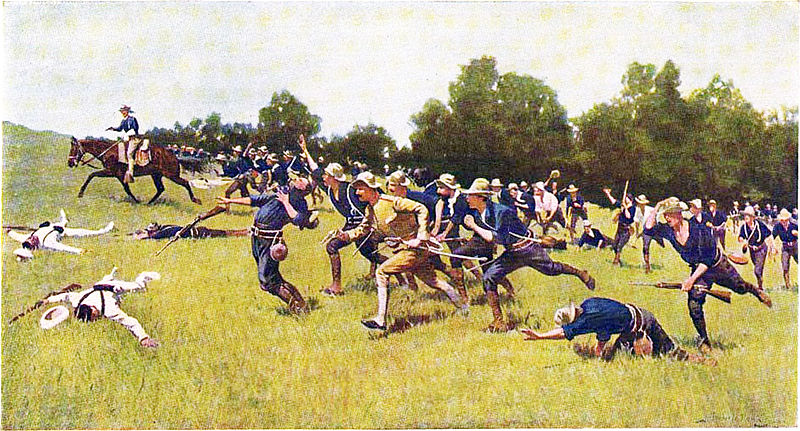
Teddy Roosevelt and the “Rough Riders” in Cuba

Categories
Hard Nosed Folks Both Good & Bad I am so grateful!! Leadership of the highest kind Manly Stuff One Hell of a Good Fight Real men Soldiering The Green Machine This great Nation & Its People War Well I thought it was neat!

Pat Tillman: Portrait of an American Hero by WILL DABBS

Behold the face of the real Captain America. Pat Tillman was a genuine hero.

Politicians refer to themselves as public servants. Swamp creatures like Joe Biden will extol their many decades of employment in Washington DC as though they had been some kind of galley slave toiling away on an Athenian man o’ war. I have actually met a couple of those guys. Their idea of selfless service does not quite match my own.

I wouldn’t pee on these guys if they were on fire.

American legislators spend money like drunken sailors. Actually, that’s not true. Drunken sailors couldn’t even begin to burn cash in as profligate a manner as might your typical freshman congressman. They’ve raised wasting money to an art form.

Hanging with a group of US Congressmen for a week back in the 1990s soured me on the American political system forever.

You think I’m kidding. Back when I was a soldier I spent a week as a local liaison officer for a group of congressmen on a fact-finding mission after the First Gulf War. It was amazing just watching them eat. They’d go to the nicest restaurant in town and order one of anything they might be curious about. Then they swapped plates around so everybody got a taste. One of my several duties was to scurry back and forth to the Officers’ Club cashing $500 government traveler’s checks to pay for it all. It was surreal.

I willingly voted for both of these people. However, I don’t trust anybody in Washington DC. If you weren’t broken before you got there, you were after you’ve been there a while.

Everybody in DC has sold their soul to somebody. I’ll champion the folks on my side of the aisle in the vain hope that they might someday just leave me the heck alone, but they are all irredeemably corrupt. The system perpetuates itself. It will never get better.

This is Pat and Kevin Tillman. They were both real public servants.

On May 31, 2002, Pat Tillman and his brother Kevin walked into a local recruiting office and enlisted in the US Army. Pat walked away from a $3.6 million professional football contract and Lord knows what else so he could serve his country in the immediate aftermath of 911. Pat Tillman’s story is that of a conflicted man and a horribly flawed system. However, his is a tale of epic sacrifice and genuine selfless service.

Origin Story

Pat Tillman excelled at everything he touched.

Pat Tillman was the eldest of three sons born to Patrick and Mary Tillman in Fremont, California. By NFL standards, Tillman was not a terribly big man. He stood 5’11” and weighed 202 pounds when dressed out as a safety for the Arizona Cardinals. Pat personified the axiom, “It’s not the size of the dog in the fight, it’s the size of the fight in the dog.”

That is one seriously intense guidon bearer.

In high school Tillman preferred baseball, but he failed to make the team as a freshman. At that point, he turned his attention to the gridiron. Throughout his childhood and adolescence, Pat was powerfully close to his friends and family. He married his childhood sweetheart just before he enlisted in the Army. He and his brother Kevin enlisted together, trained together, and were eventually both assigned to the 2d Ranger Battalion based at Fort Lewis, Washington.

Pat Tillman really came into his own as a college football player.

Pat Tillman attended Arizona State University on a football scholarship and excelled as a linebacker. An exceptionally deep young man, Tillman was well read and made good grades. He maintained a 3.85 GPA in marketing and graduated in 3.5 years despite the rigors of starting on his college football team.

Pat Tillman had everything the world could offer, yet he gave it all up to serve his country.

Pat thrived in the NFL. Sports Illustrated writer Paul Zimmerman named Tillman to the 2000 NFL All-Pro team based upon his stellar performance as a defensive player. He turned down a $9 million offer to move to the St. Louis Rams out of loyalty to his Arizona team.

Once he completed his 2001 NFL contract Pat Tillman enlisted in the US Army.

Eight months after the 911 attacks and with the remainder of his 15 games completed from his 2001 contract, Pat Tillman left $3.6 million on the table to go to Army basic training alongside his brother. Pat’s brother Kevin gave up a burgeoning career in minor league baseball for the same path. These two men put their love of country ahead of the sorts of things the rest of us would just about kill for.

There’s really no telling how far Pat Tillman might have gone in life.

Appreciate the details here. I’m a happily married hetero man, and even I admit that Pat Tillman was an exceptionally good-looking guy. Intelligent, articulate, and well-educated, Tillman had the world by the tail. Once his time in the NFL was complete Pat Tillman could have easily parlayed his gifts and experiences into a career on television or in Hollywood. Instead, he opted for the Ranger Regiment.

The Rangers have an undeniably sexy cool mission. However, life in a Ranger Battalion is unimaginably grueling. The Ranger Regiment is the only unit in the Army to have been deployed continuously throughout the Global War on Terror.

I was an Army aviator, but I worked with those guys on occasion. Theirs was an absolutely miserable life. Junior enlisted soldiers don’t get paid beans, and the optempo in the Ranger Battalions is utterly grueling. In less than two years on active duty, Pat Tillman completed basic training and AIT as well as the Ranger Assessment and Selection Program. He was deployed to Iraq as part of Operation Iraqi Freedom in September of 2003 after which he attended Ranger School at Fort Benning. Once a fully tabbed Ranger, he returned to Second Bat at Lewis and deployed to Afghanistan where he was based at FOB Salerno.

It’s easy to sit back in the comfort of our living rooms and lose track of exactly what this stuff costs.

Up until this point, Pat Tillman was the US Army’s poster child. An American superhero with a face right out of central casting, Tillman’s story could not have been any more compelling had it been drafted by an action novelist. Then Something Truly Horrible happened.

The Incident

Combat is not the clean sanitary thing Call of Duty might have us believe. The reality is vicious, messy, and sad.

Combat is an ugly, filthy, chaotic thing. It is seldom as tidy or predictable as the movies and sand table exercises depict it to be. On April 22, 2004, the fog of war claimed a genuine American hero.

Even today nobody really knows exactly what happened to Pat Tillman’s mounted patrol.

On a forgotten road leading from the Afghan village of Sperah about 40 klicks outside of Khost, Pat Tillman’s small HUMVEE-mounted patrol ran into trouble. Their mission that day was to retrieve a disabled HUMVEE. This tale is made all the more tragic in that we abandoned tens of thousands of these vehicles when we fled Afghanistan recently. The details are fiercely debated to this day, but here is the official description.

Pat and his fellow Rangers moved on foot to support the element they thought was in contact.

Tillman was in the lead vehicle designated Serial 1. Serial 1 passed through a mountainous pass and was roughly one kilometer ahead of Serial 2, the following HUMVEE. At that point, Serial 2 was purportedly engaged by hostile forces.

It was chaotic, and the situation was confusing. The end result was a tragedy.

Upon hearing of the ambush, the Rangers in Serial 1 dismounted and made their way on foot back toward an overwatch position where they could provide supporting fires for Serial 2. In the resulting chaos, the Rangers of Serial 2 lost touch with the specific location of the lead Rangers. In the violent exchange of fire that followed Tillman’s Platoon Leader and his RTO (Radio Telephone Operator) were wounded. An allied member of the Afghan Militia Force was killed. Pat Tillman caught three 5.56mm rounds from an M249 SAW to the face from a range of 10 meters and died instantly.

The Weapon

The original FN Minimi was a fairly revolutionary weapon.

First introduced in 1984, the Belgian-designed M249 Squad Automatic Weapon was an Americanized version of the FN Minimi. An open-bolt, gas-operated design, the M249 was conceived to provide the Infantry squad with a portable source of high-volume, belt-fed automatic fire. The M249 has seen action in every major military engagement since the US invasion of Panama in 1989.

In its most evolved state, the M249 is a mature and effective combat weapon.

The M249 weighs 17 pounds empty and 22 pounds with a basic load of 200 linked rounds. The weapon fires from an open bolt and features a quick-change barrel system. The gun will feed on either disintegrating linked belts or standard STANAG M4 magazines. In my experience, the magazine feed system was never terribly reliable.

This Ranger is wielding a Mk 46 in an overwatch position.

USSOCOM adopted a lighter, more streamlined version of the M249 titled the Mk46 for use with special operations forces. The M4 magazine well, vehicle mounting lugs, and barrel change handle were all removed on the Mk 46 to save weight. The USMC has aggressively supplemented their rifle squads with the HK M27 Infantry Automatic Rifle in lieu of many of their SAWs. These weapons are currently issued at a ratio of 27 IARs and 6 SAWs per rifle company. The Next Generation Squad Weapon-Automatic Rifle program is tasked with finding a suitable replacement for the aging M249’s in the Army inventory.

The Rest of the Story

The sordid circumstances surrounding his death sullied the story that the Army wanted told.

What happened next was a blight on the US Army. To have Pat Tillman, the real live Captain America killed due to friendly fire in a botched combat operation was not the story the Army wanted pushed. As a result, several senior Army officers moved to massage the narrative and outright suppress the story to both the media and the Tillman family. The end result was an absolutely ghastly mess.

Pat Tillman earned a posthumous Silver Star for his actions in Afghanistan. He has been rightfully revered as an American hero.

There were allegations that Tillman, by now disillusioned with the war in Iraq, was about to offer an interview with controversial activist Noam Chomsky upon his return from his Afghanistan deployment that would be critical of the Bush Administration.

As Tillman’s death occurred in a crucial time leading up to the 2004 Presidential elections conspiracy theorists even proposed that he had been intentionally murdered. However, interviews with his fellow Rangers verified that Tillman was a popular and selfless member of the team. In the final analysis, it all seems to have been a truly horrible mistake. After several investigations undertaken by the military, three mid-level Army leaders purportedly received administrative punishment as a result.

The bond among these guys in combat is as strong as it gets.

A word on the conspiracies. Soldiers don’t fight for mom, apple pie, and America. They fight for each other. There’s just no way you could get a Ranger to intentionally shoot another Ranger to protect the reputation of a sitting President. This was simply a horrible accident.

Pat Tillman gave his life for his country at age 27.

The sordid circumstances surrounding the death of Pat Tillman in no way diminish the truly breathtaking scope of the man’s patriotism and sacrifice. Tillman was an avowed atheist throughout his life. After his funeral, his youngest brother Richard asserted, “Just make no mistake, he’d want me to say this: He’s not with God, he’s f&%ing dead, he’s not religious.” Richard added, “Thanks for your thoughts, but he’s f&%in’ dead.” It was an undeniably strange end for a genuine American hero.

Marie Tillman has gone on to a remarkable life of service after the death of her husband.

Soldiers in combat will often pen a “just in case” letter to be opened in the event of their death. Pat’s note to his wife Marie said, “Through the years I’ve asked a great deal of you, therefore it should surprise you little that I have another favor to ask. I ask that you live.”

Marie Tillman has ably continued her husband’s legacy of selflessness.

And live she did. Marie Tillman today is Chairman and Co-Founder of The Pat Tillman Foundation. This non-profit works to “unite and empower remarkable military service members, veterans, and spouses as the next generation of public and private sector leaders committed to service beyond self.” The Foundation has sponsored 635 Tillman Scholars and invested some $18 million in philanthropy. Marie has since remarried and is the mother of five children.

Categories
All About Guns Soldiering The Green Machine War

Future Combat Systems: The Abandoned US Weapons Platform That Cost $18.1 Billion Dollars

Categories
All About Guns The Green Machine You have to be kidding, right!?!

The Case for the A-10C by Ivan F. Ingraham (I say give them to the Army & Marines but no!! As that would freak out the USAF)

The United States Air Force’s decision to divest the A-10C “Warthog” has larger ramifications for future wars than just an airframe. The service plans to drastically reduce its capability and capacity to provide Close Air Support (CAS) to ground forces, leaving the sons and daughters of America and her allies to fight without a dedicated CAS aircraft for the first time since Vietnam.  

History First

The venerable “Warthog” is viewed by some as a Cold War relic that only exists as a jobs program for congressional representatives. This is myopic.

With nearly four decades in service, the A-10C stems from the lessons (re)learned after Vietnam. From inception, the A-10C was a purpose-built CAS platform with demonstrated battlefield survivability. Because of its rugged design paired with heavy and diverse payloads of modern stand-off decoys and weapons, each A-10C delivers more firepower to support ground forces than its fighter counterparts. Further, its AAR-47 missile warning system is especially effective at defeating nearly all Man-Portable Air Defense Systems (MANPADS).

I spent a 24-year career as a Marine Infantry Officer, later transitioning to Marine Special Operations Command (MARSOC), commanding at the Team, Platoon, and Company levels in both Joint and Combined combat environments.

On September 26, 2007, my platoon was on the receiving end of a complex ambush against an entrenched enemy. We fought our way out, often engaging enemy fighters inside of 100 meters and sometimes at hand-grenade range. In a difficult and violent action, we broke the back of the enemy’s assault.

We used two A-10Cs to destroy the enemy element isolated in a trench line. The A-10C’s impressive firepower and danger-close delivery of bombs facilitated the extrication of my 35-member assault force without a single U.S. casualty. This simply would not have been possible without the A-10C working in close consonance with my Joint Terminal Attack Controller (JTAC); a trained air support employment specialist.

I’m a living testament to the A-10C’s utility.

A U.S. Air Force A-10 Thunderbolt II close air support aircraft simulates its air-to-ground capabilities during the 2011 Aviation Nation Open House on Nellis Air Force Base, Nev., Nov. 12, 2011. (Tech. Sgt. Bob Sommer) Source.

The Issue

In its 2023 budget, the Air Force revealed a 5-year plan to eliminate its A-10C CAS aircraft without an adequate replacement and to cut Terminal Air Control Party Specialist/Joint Terminal Attack Controller (TACP/ JTAC) manning by 50%.

The USAF is a staunchly fighter-oriented culture where platforms like the F-35 and the NGAD fighter are touted as machines that will provide CAS and fight enemy aircraft with equal aplomb, but the Air Force’s plan will divest nearly all close support expertise, crippling America’s ability to employ airpower in close proximity to friendly forces on the ground. Ground troops would be supported by a small, expensive fleet of fragile aircraft that are far less effective at CAS than the A-10C. In low-intensity conflicts, it will cost lives. In Major Combat Operations, it risks losing battles.

Problem Framing

The U.S. is terrible at predicting the next battlespace and future wars. Having a robust quiver of options is better than eliminating a proven platform like the A-10C. Paradoxically, if the USAF follows its own doctrine to justify getting rid of the A-10C this only bolsters the case for keeping it.

No aircraft engages the enemy alone.  Much like ground forces use “combined arms” (tanks, artillery, infantry, and aviation) to prevail on land, the Air Force uses “Force Packaging” to win in the air. The four major threats to aircraft over a modern battlefield are:

  • Air (enemy fighters);
  • Radar-guided Surface-Air Missiles (SAMs)
  • Air Defense Artillery (ADA), and;
  • Man-portable Air Defense Systems (MANPADS)

The Air Force spends a lot of taxpayer dollars to ensure its fighter team (F-16; F-15EX; F-22; and F-35) can kill or negate enemy aircraft and radar SAMs, but the sensitive skins, engines, and reduced capacity for flares make these aircraft extremely vulnerable to ADA and MANPADS. In contrast, the A-10C is by far the most survivable aircraft against ADA and MANPAD threats found directly above the battlefield and is the only CAS platform specifically designed to protect ground forces in battle.

In a firefight, I sought to dominate high ground, known as “key terrain,” to achieve tactical superiority. The airspace directly overhead the battlefield is the ultimate key terrain.  An American ground commander fighting against a capable and determined adversary needs an aircraft with a massive amount of firepower and eyes on both friendly troops and the enemy. Without the A10C’s capability, the USAF cedes the most important position on the battlefield where CAS is a powerful surgical tool. I can’t imagine fighting without A-10Cs which provided me a critical advantage in a dynamic, highly-contested combat environment.

An A-10 Thunderbolt II deploys flairs over Afghanistan on Nov. 12, 2008. A-10s provide close-air support to ground troops in Afghanistan and Iraq. The A-10’s excellent maneuverability at low air speeds and altitude as well as its highly accurate weapons delivery make it an ideal aircraft for supporting coalition operations. (U.S. Air Force/photo by Staff Sgt. Aaron Allmon) Source.

Further, the A-10C was designed to operate from expeditionary airstrips. This works to the A-10C’s advantage in peer conflicts. Advanced fighter aircraft require concrete or asphalt surfaces of at least 8,000 feet in length. Countries like China will use any weapon they can, like ballistic and cruise missiles, to negate aircraft carriers and airfields capable of supporting fighters. Alternatively, the A-10C can island hop around the Pacific with a small support package and operate from 5,000 to 6,000 feet of dirt, grass, or even a short stretch of highway.

The A-10C thrives using a combination of Force Packaging and intelligent tactics, as evidenced in the 2016 deployment of the A-10C to support U.S. forces in Syria. Although Air Force leadership and Beltway pundits would prefer Congress forget about the A-10C operating within multiple surface-to-air missile engagement zones and merging with Russian fighters during Operation Inherent Resolve, the A-10C proved itself on the modern battlefield.

Dollars and Sense

The decision to divest the A-10C is not new; the platform is always considered for retirement when the USAF talks of modernization. The Air Force’s voracious spending habits force an ever-smaller fleet of overpriced aircraft; a single F-35 costs nearly $145 million, which doesn’t account for the billions of dollars spent researching and developing emerging design technologies. Once procured, F-35 operating costs are more than double that of the A-10C, with sustainment costs three times budget expectations.

The A-10C needs a tech refresh, but the aircraft is paid for, and there is little to suggest that the A-10C can’t maintain its relevance with ~$3 million each in modernization and upgrades. That is pennies on the dollar compared to the F-35; the 10-year cost to replace A-10Cs with F-35s is $68 billion. The USAF, just ten years after the initial fielding of the F-35, spent $4 billion dollars on the research and development of an engine it no longer plans to procure. For comparison, it cost less than $1 billion to build and install new wings on the entire A-10C fleet, and another $1 billion could create an all-new, digitally-enhanced A-10EX, capable of employing next-generation weapons, locating threat systems, and acting as an over-the-horizon communications node.

(U.S. Air Force photo by Airman 1st Class Benjamin Wiseman) Source.

Head-To-Head

Money aside, the Key West Agreement of 1948 charged the USAF to provide Close Air Support to the U.S. Army. The A-10Cs real benefit combines specialists (pilots) with a purpose-built airplane, and the funds used to field the A-10C were pulled from the Army’s own Close Air Support programs. Divesting the only CAS-designed aircraft in the USAF without a replacement is akin to dereliction of duty.

As a mission planner requesting CAS assets for ground operations, I was told to ask for aircraft capabilities to support my mission, rather than specific types of aircraft. Since many aircraft share capabilities (ex. ability to employ GPS-guided munitions) and there are always limited assets to meet multiple demands for CAS, focusing on capabilities creates the flexibility to draw from a variety of platforms to fulfill the requirement.

But this created an argument that U.S. ground forces don’t care what platform delivers ordnance so long as those forces receive it. Advocates of this argument fail to realize that the A-10C is the best CAS platform because of its capabilities. In fact, many JTACs cleverly requested Close Air Support assets capable of “employing forward-firing ordnance, below low weather decks, including 30-millimeter rounds.” This ensured A-10Cs; it provided capabilities no other asset could.

To that point, in June 2018 the A-10C conducted a CAS flyoff against the F-35. The results demonstrated the most effective platform to perform CAS against a peer adversary is the A-10C. The test also highlighted the force multiplication achievable by allowing A-10s to focus on supporting ground forces while fighter assets like the F-35, F-16, and F-18 act in their primary roles to counter air threats and suppress enemy air defenses.

F-35A Lightning II (U.S. Air Force photo/Staff Sgt. Madelyn Brown) Source.

After the fly-off, the A-10C bested the F-35 in CAS, Airborne Forward Air Control, and Combat Search and Rescue mission performance–both in low-threat and high-threat environments. An F-35 pilot was quoted as saying “I need F-35s on the leading edge to detect systems and provide a screen against advanced enemy fighters. I need Warthogs in-depth with the magazine firepower to smite our enemies from the face of the earth.” As a former Ground Force Commander (GFC), I agree. There are two salient reasons for this:

The A-10C has integrated modern technology. First, with four radios and four data-link options that talk to ground troops, its communications package is more compatible with ground maneuver elements than any other fighter.  And second, although some A-10Cs are equipped with the newest jam-resistant GPS, its direct-fire weapons and its pilots’ eyes-on tactics negate the effects of GPS jamming. In GPS-denied environments where communications will be severely degraded, other fighters will struggle to accurately deliver GPS-dependent weapons. This is crucial for a GFC in a close fight where seconds feel like hours.

The A-10C also provides an asymmetric advantage by providing CAS from 75 feet above ground level up to 35,000 feet MSL. With moderate speeds and an extremely tight turning radius, which reduces re-attack timelines, the A-10C is responsive, can remain close to friendly forces for long periods of time, and has flexible, forward-firing weapons. These weapons provide more options to quickly engage targets. No other aircraft provides effective CAS in the low-altitude arena, which the war in Ukraine has shown to be one of the few places CAS can be employed in contested airspace.

Unlike the F-35, which requires a prepared airfield to support GFCs from altitudes miles above the battlespace, the A-10C pilot can remain eyes-on friendly forces; enemy forces; utilize targeting pods to generate coordinates for artillery missions; and dominate an adversary in close proximity from tree-top level using 30-mm armor-piercing incendiary rounds, or from 30,000 feet and dozens of miles away using small-diameter bombs.

Air National Guard Photo. Source.

Humans Before Hardware

The A-10C program is important because it trains pilots to become experts in Joint Fires integration.  Their training is directly focused on Close Air Support, Forward Air Control, and Combat Search and Rescue, all of which are complementary missions requiring detailed knowledge of Joint Fires. On June 22, 2016, Joel Bier wrote in The National Interest, “The oncoming challenge is clear: The Air Force must collectively preserve the A-10C pilot manning pool as a force-in-being to save CAS expertise from the dilution of current training and personnel bureaucracy, regardless of its fiscally based hardware decisions.”

Further, Dan Grazier highlighted the inadequacy of CAS training in the F-35 community, showing through official USAF documents that “…no F-35 pilot of any experience level in any component of the Air Force is required to fly a single close air support training mission in 2023 or 2024.” When an aircraft is primarily responsible for destroying enemy aircraft and surface-to-air missile sites, pilots who exclusively train for those missions do not have the time to focus on supporting ground forces.  Advocacy for the A-10C is based upon its capability to provide CAS better than any other Mission Design Series. A-10C pilots and the Tactical Air Control Party community maintain that legacy.

There is also a looming 50% reduction of air-ground combat integration specialists. Tactical Air Control Party (TACP) represents the largest proportion of Joint Terminal Attack Control qualified personnel in the USAF. They are experts in Joint Fires integration and the employment of surface and air-based fires essential to successful large-scale combat operations and work directly with GFCs to employ air power. For the U.S. Army, this reduction will eliminate TACP support below the Brigade level in a large conflict. These mission-focused teams of CAS professionals habitually train with A-10C pilots to ensure the safe, proper, and expeditious employment of CAS.

U.S. Air Force Senior Airman Corban Caliguire and Tech. Sgt. Aaron Switzer, 21st Special Tactics Squadron joint terminal attack controllers, from Pope Field, N.C., look on as an A-10 Thunderbolt II releases its munitions during a close air support training mission Sept. 23, 2011, at the Nevada Test and Training Range. Source.

I worked closely with these impressive Airmen during my time in Special Operations where we have a saying that “humans are more important than hardware.” In this case, it proves particularly true, and hobbling the USAF’s TACP manning defies logic since it directly affects the Army’s ability to fight our enemies, particularly peer adversaries.

Ground combat is difficult and at times confusing. As a GFC and qualified JTAC, I could control my own air support in combat. My background and training provided a distinct advantage. I understood ground force fire and maneuver, and I could utilize air support assets to maximize my Marines’ abilities to succeed. However, as a JTAC-qualified GFC, I was the exception; trying to manage CAS while maintaining control of my unit was not optimal.

Having CAS-trained professionals in the air above me and a TACP next to me on the ground is the ideal partnership. A TACP at my side, focused on using air to achieve my intent for CAS, significantly improved my unit’s effectiveness. This is especially important in dynamic, asymmetric environments where high-altitude aircraft dropping bombs on coordinates without eyes on the battlefield will be worthless at best, and cause fratricide or civilian casualties at worst.

Loss of the A-10C and a preponderance of TACPs will create a huge gap wherein a dedicated CAS team doesn’t exist for use in combat like the ongoing war in Ukraine; tailor-made for the A-10C as I wrote about here.

An A-10 Thunderbolt II flies a combat sortie on Jan. 7, 2014, over northeast Afghanistan. (U.S. Air Force photo by Tech. Sgt. Jason Robertson) Source.

The True Cost

One of the SOF truths is “competent [forces] cannot be created after the emergency occurs.” Getting rid of the A-10C; its qualified CAS-trained pilots; and the air-ground integration expert TACPs is a recipe for disaster.

Vietnam demonstrated that America doesn’t like to wage wars with overwhelming pain to its people. I don’t know what future war holds, but I do know that the largest risk is assumed by ground forces who will go to war without adequate platforms and the flexible engagement options required to fight effectively.  That Congress and the DoD are ignoring this is a mistake of epic proportions.

The American public deserves an explanation of why the Air Force is putting American sons and daughters at risk and should have an opportunity to weigh in on this incredibly important and costly decision. For more information and to contact your congressional representatives, please visit https://www.troops-in-contact.org/

A-10C “Warthog” (U.S. Air National Guard photo by Staff Sgt. William Hopper/Released) Source.

Ivan F. Ingraham is a freelance writer and veteran. He served for 24 years in the U.S. Marine Corps as a Special Operations Officer. This is his first submission to The Havok Journal.

As the Voice of the Veteran Community, The Havok Journal seeks to publish a variety of perspectives on a number of sensitive subjects. Unless specifically noted otherwise, nothing we publish is an official point of view of The Havok Journal or any part of the U.S. government.