American Special Ops Forces Are Everywhere
They’ve become a major military player—and maybe a substitute for strategic thinking.
Posted on: February 2nd, 2014 by Will Rodriguez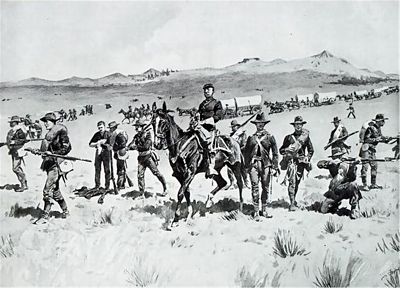
Protecting the wagon train by Frederic Remington
Essay by Yankee Papa (all rights reserved)
In June of 1866 700 men of the 18th Infantry Regiment were marching out of Fort Laramie heading up the new “Bozeman Trail…” This would save hundreds of miles from the old route to the mines in Montana.
The weather was splendid and the troops were marching towards some of the most beautiful country in North America…at least in June. They were also marching into the hunting grounds of the Lakota, the Northern Cheyenne and the Arapaho.
That wasn’t supposed to be a problem. Peace Commissioners were meeting with the chiefs at Fort Laramie as they marched past. Unfortunately some of the chiefs were deeply opposed and nothing had been agreed upon when the troops showed up to build three forts in their territory. A couple of the most fierce, including Red Cloud called foul and rode off pledging war.
As they were too often wont to do, the commissioners decided to ignore the hostile or no show chiefs and just get the signatures of the ones present… even though it might not be their territory at issue. More than one war started this way.
But the word from the brass was that there would not be war… just some hotheaded chiefs… maybe some livestock raids on the posts. The high brass did not understand that as many as 4000 warriors might wish to dispute the matter with them.
The 18th had a proud record in the Civil War, but most of those lads had mustered out. Officers (who often had held higher rank during the war) and NCOs had seen combat… but not most of the common soldiers.
But… the brass indicated that there would be no major fighting. So many raw recruits and almost no training… just what little their NCOs could give them on their way. Drill and musketry not even scheduled until into the next year after the forts built.
The 18th was something new… it was not just made up largely of post-war men… but was among the first of the new blood on the frontier.
The remnants of the old marched past them as they neared Fort Laramie. The last of the “Galvanized Yankees”, former Confederates who volunteered to join the Union infantry to get out of the prison camps. Promised that they would fight Indians on the frontier, not their kin in the South.
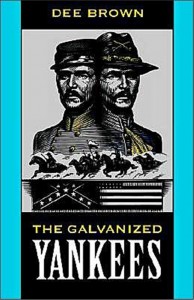 (An interesting book by the way Grumpy)
Many were signed up for three years, and that meant that many were not discharged upon the end of the war. The last of the six regiments marched past the 18th on their way home to be discharged.
The soldiers of the 18th found that interesting, but were more concerned with their boots. Loss of weapons…illness and wounds… and bad feet could cripple an infantry unit.
Unless you paid a private boot maker, you bought “off the shelf…” In 1818 “lasts” were developed to enable production of specific left and right shoes… but this only came into common usage in the late 1850s… and with some minor exceptions, infantry in the Civil War and for some years thereafter (until Civil War stocks used up) had shoes with no left foot-right foot differentiation.
Prior to the march most NCOs would have shown the recruits how to fully soak the “boots” (up to the ankle and 4 sets of eyelets) and then let them dry on their feet before attempting to cover any distance in them. Easier to break in the boots than the feet.
Just as well that no fighting was expected…Colonel Carrington… well, everybody liked him, but he had never been in battle. Commissioned a Colonel from a law practice at the start of the war and handed the 18th Regiment… he was placed on “detached duty” for the entire war… staff duty in Washington.
If some of the officers thought that there might be a fight, they could not be happy at the Regiment’s strength… A new Civil War regiment contained 1000 men… the 18th only had 700… and of those all but 400 would be going to two forts… one at either end of the trail.
Actually they were lucky. A decade later and infantry companies on the frontier would not be at 70 like the 18th instead of the Civil War standard of 100… but down to a normal of 37.
And of course the rifles. The Ordnance Department had plenty of breech loading rifles in storage after the war… but chose to let the 18th head into the Powder River country with muzzle loading rifles (see https://gruntsandco.com/u-s-ordnance-rogue-fiefdom/ ) But then again, there was not supposed to be any fighting.
Only real Indian fighter around here, the Colonel’s guide… Jim Bridger. Even the recruits had heard stories about this old mountain man.
Bridger had his own assessment of what was going on. He thought that Red Cloud and some others would do more than just “steal some livestock…” A lot of horses, mules, and cattle that would have to be grazed outside the fort… Firewood to be cut some miles from the fort…something that required peace…
And then there were the women and children that the brass encouraged the Regiment to take with them. Total including workers of 400 civilians. Most would be at the fort in the middle of the trail… right in the heart of the Powder River hunting grounds. Colonel Carrington listened to Bridger… but the high brass assured Carrington that there would be no major hostilities…
[…The 18th had detachments build forts at both ends of the trail and built Fort Phil Kearny in the middle. Livestock indeed stolen and soldiers and woodcutters killed. On December 21, 1866, a Captain Fetterman… (had commanded the 18th at times during the war in higher brevet rank) put the seal on his disrespect to the Colonel and arrogantly disobeyed his orders.
Sent in relief of a wood chopping party, he instead rode after a party of Lakota to a ridge line. Ordered not to go past it, he did… with a mixed force of Infantry and Cavalry… 80 men. Just the number that he had boasted about… “With 80 men I can run roughshod over the whole Sioux nation.” Instead the Cavalry bolted to the front leaving the infantry panting behind… then more than 1000 Sioux rose up and caught them all in the open. It was over in a couple of minutes…
There would be other fights in the area, but the high brass in Washington decided what they should have in the first place… the soldiers could not guard the trail… only their own forts. Besides, Infantry needed to guard the trans-continental railroad that was being built. A treaty was signed… the troops pulled out by 1868 and the Sioux burned the forts behind them. It was the last war that Indians would win in North America…]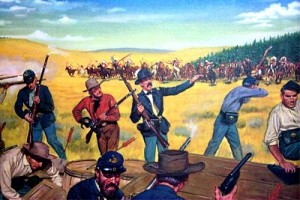
“Good Marksmanship and Guts” DA Poster 21-45
Near Fort Phil Kearney, Wyoming, 2 August 1867. The Wagon Box Fight is one of the great traditions of the Infantry in the West. A small force of 30 men on the 9th Infantry led by Brevet Major James Powell was suddenly attacked in the early morning hours by some 2,000 Sioux Indians. Choosing to stand and fight, these soldiers hastily erected a barricade of wagon boxes, and during the entire morning stood off charge after charge. The Sioux finally withdrew, leaving behind several hundred killed and wounded. The defending force suffered only three casualties. By their coolness, firmness and confidence these infantrymen showed what a few determined men can accomplish with good marksmanship and guts.
These days you mention the Old West and the Indian Fighting Army and people immediately picture Cavalry. Usually John Ford Cavalry. West had wide open spaces and the Indians had horses… so troops had to have horses… right? Oh, maybe some Infantry to guard the forts, but otherwise…
History tells a far different tale. There were never enough Cavalry… there never could be. The gigantic Union Army was mustered out and in the end, only 25,000 soldiers were left in the entire Army… many in the South enforcing Reconstruction.
A Cavalry regiment cost twice as much to raise as an Infantry regiment… and a lot more to keep running each year. And in spite of Hollywood… Infantry had a major role to play.
While mounted forces had played a role in every war from the Revolution on, there were no permanent regiments until the 1850s. Even then the mission a bit “fuzzy…”
Cavalry proper was supposed to fight almost exclusively on horseback. Dragoons were supposed to be able to fight some on horseback and some on foot. We had both, but at the start of the Civil War it was decided to call them all “Cavalry…”
Immediately after the Civil War a lot of regular and volunteer regiments were thrown into Kansas to put down Indian raids. Thousands of soldiers tracked endless miles and only killed two hostiles. Something else would have to be tried… and with a lot less soldiers… most of these were going to be demobilized.
Infantry would be needed for far more than to guard the forts. Wagon trains and supply trains would need escorts. While some Cavalry with the trains were handy… too many and they became a logistic nightmare.
American stock, unlike Indian ponies could not subsist on grass… Cavalry remounts needed oats and the like…a lot of them.
Even “all Cavalry” offensives had a limited range… In 1882 the assistant Quartermaster of the Army reported: “Unless cavalry operate in a country well supplied with forage, a large amount of wagon carriage must be furnished for forage and in such cases, cavalry is of little value except to guard its own train… and to do that in the presence of an enterprising enemy it will need the addition of infantry…”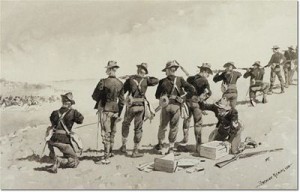
Covering the Cavalry’s Withdrawl by Frederic Remington
Horses are, for all their size, relatively fragile. They can drop from a number of diseases and if worn out require an extended amount of time to recover. At the end of the day men are tougher than horses.
One officer who served in large expeditions in the Sioux and Nez Perce campaigns involving major units of Cavalry and Infantry, Sixth Infantry’s Col. William B. Hazen wrote “After the fourth day’s march of a mixed command, the horse does not march faster than does the foot soldier, and after the seventh day the foot soldier begins to out-march the horse, and from that time on the foot soldier has to end his march earlier and earlier each day to enable the cavalry to reach the camp the same day at all. Even with large grain allowances horses quickly deteriorated under extended exertion…”
In 1876 a 50 man Cavalry troop dismounted had less firepower on the line than an Infantry company of 37 men. Every fourth trooper had to take four horses to the rear and hold them there until the engagement was over. In addition the Cavalry was using shorter range carbines while the Infantry was using longer range (and more reliable) rifles.
The image of the “Cavalry riding to the rescue…” could not have been farther from the truth. In most cases, by the time that the Cavalry found out about a raid, the Indians could be fifty miles away… one hundred if they were Comanches.
Comanches might make a raid… then join up some miles off with couple of boys holding spare ponies… Alternate between them making distance. Cavalry, even an hour away would never catch up with them… just wear out their mounts. Cavalry had to dismount and walk their horses for a while every couple of hours to give them a breather. Meanwhile the Comanches kept swapping ponies.
One thing that cost the Cavalry was riding exhausted mounts into contact with Indians who were up for a fight… Reno almost lost his squadron when he had to retreat with blown horses (and exhausted, sleep-deprived troopers) at the Little Big Horn.
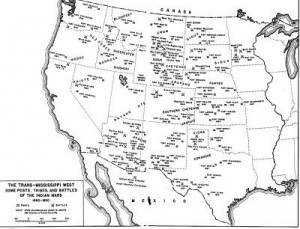
Map from “Winning the West The Army in the Indian Wars, 1865-1890” Army Historical Series
The only feasible military solution was to hit the hostiles in their villages… preferably in the winter when their mounts were scrawny. There were a number of problems with that strategy.
In the first place, during the Civil War a regiment of Colorado volunteers (enlisted for 100 days only) under a fanatic named Chivington had murdered many Southern Cheyennes at Sand Creek. Most of his men were bar sweepings and acted accordingly… rape, beheadings, “trophies” taken… slaves.
These Indians had followed the directive to camp by the nearest fort… but were ordered away by militia officers as a cynical prelude to slaughter. Other Indians were making the trouble… but these were closer… and both Chivington and the Governor of Colorado were looking for a cheap victory.
By the time that the people back East figured out what had happened, the regiment was paid off and the Army could do nothing. One regular officer who was going to testify was murdered in Denver.
So raids even into actual hostile Indian villages… though not as barbaric as Chivington’s would raise holy hell with people back East and their Congressmen.
And just what was a hostile village? Custer’s assault on Black Kettle’s village on the Washita, while not the insanity of Sand Creek was bad enough and raised troubling questions.
Black Kettle himself was an honorable chief who wanted peace. But war parties drifted in and out of his camp…some with hostages. He was not keen to have them rest up in his village… but tribal custom prevented him asking them to leave so long as they did not cause major trouble. He had no actual *authority*… as with most Plains chiefs, he led by his personality.
The Eastern media learned that Black Kettle had attempted to speak with the soldiers before the first shots were fired. He was shot and too many of the soldiers fired at anything that moved. It was a “victory” that would cost the Army in political support and in the unending enmity of both major branches of the Cheyenne people.
The biggest problem was identifying hostiles. Generally back when the Indian wars fought East of the Mississippi, a chief’s word would bind his tribe. On the Plains it was different.
A chief might sign a treaty with every intention of honoring it. But on the Plains both the war chiefs and the peace chiefs led by their personality and influence…not by compulsion.
Some members or clans of his tribe might decide to go their own way and raid. This caused reprisal raids (often by civilians) against the nearest members of that tribe regardless of any possible innocence. This of course led to those victims raiding the nearest whites… regardless of any possible innocence.
The reservation system was supposed to clear all this up. Those on the reservations would be labeled as “peaceful” and those off would be considered hostile.
But not all Plains Indians treaty bound to live on reservations. Some clans might…other might not. And some hostiles came to the reservations (mostly come winter) to rest up for new raids in the Spring. Some reservation occupants had permission to go off reservation on long hunting trips… Some were just that… others…
Shortly before the Little Big Horn campaign the government decided to reshuffle the deck. Indian tribes would no longer be treated as “sovereign nations” but as wards of the government. Certain tribes including the Sioux and Cheyenne were ordered (in winter) to report to a reservation or be considered hostile.
It is doubtful that many got the order…or would have considered moving in that weather… or even in the Spring. They saw no reason to give up their way of life.
The Army moved…and bungled the entire campaign…Custer’s blunders just one part of a bad set of events. But from this point the role of the Infantry would increase.
Like other troops on the frontier, the Infantry had some real problems. Their authorized strength too low… and usually could not meet that. Something like 37% of all troops on their first enlistment deserted each year.
Not just the low pay. Army preferred to pay in paper money at isolated posts. Counterfeiting so rampant for some years that most merchants would only take at a discount.
New troops got very little training. Most years no more than 16 rounds of ammunition per man for target practice. Often used on endless details having little to do with soldiering. If infantry present at a fort, they got most of the endless chores… most troopers work time centered around their mounts.
While officers preferred “Iowa farm boy” type recruits…they usually didn’t hang around. Many of the best soldiers were the Irish and Germans… at least those who made it into the NCO ranks.
Many people have heard of the two regiments of black soldiers in the Cavalry. But there were also two regiments of Buffalo Soldier Infantry on the plains. On average they were a better investment than many of the white recruits.
Lot of drunks and loafers and other types likely to get into trouble and/or desert joined the white regiments… But there was a surplus of good quality men wanting to join the black regiments.
Desertion was a very small problem. Training took longer because of their background (this happened in Rhodesia with the Rhodesian African Rifles as well), but once trained up, these men proved superb soldiers.
Most white officers outside the black units looked down on the regiments…prejudice… nothing more. At the end of the Civil War Custer had refused the rank of full Colonel with a black regiment and chose to be a Lt. Colonel of a white one. (Actual commander, Colonel Sturgis always on temporary duty in Washington until after Custer’s death.)
Whether in garrison, or even in the field, the Buffalo Soldiers often looked smarter than their white counterparts. Some of that was their desire, and that of their officers to look like proper soldiers. Initially, part was because by the time that the black post-war regiments formed, the Army was out of their stocks of poorly made Civil War uniforms (bad contractors) and only had the later quality stuff left.
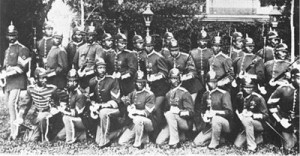
Company B of the 25th Infantry was stationed at Fort Snelling, Minnesota, from 1883-1888.
They pose here in their full dress uniforms. U.S. Army Signal Corps photo
After Custer’s famous luck ran out, the Army got orders to clean up the plains once and for all. The Infantry now would show what they could do.
The Infantry did whatever it took… The Fifth Infantry’s Colonel… Nelson Miles… put some of his troops on confiscated Indian ponies to help run the hostiles ragged and keep them from assembling in mass numbers.
But the real mission for the Infantry was a foot job… Hitting the Indian camps in the winter. The idea was not to win a big battle to the finish… Too often women (who often fought) and children caught up in the gun play and too many warriors would escape.
And a desperate fight for a village would often result in heavy casualties among the troops. At Big Hole later against the Nez Perce, troops from another Department would learn that the hard way.
The object was to cause the hostiles to flee… leaving their winter camps behind them… their shelter… massive food stores… and often most of their spare ponies. The best would be used and later sold… the rest shot.
The Indians would stagger into another village of the same or allied tribe… but they too could be hit by the “walks-a-heaps” tomorrow. One winter of the Infantry doing this broke the backs of the Sioux (many of whom fled to Canada…where only the Royal Navy prevented the U.S. Army from crossing after them…)and the Northern Cheyenne. The foot sloggers could hold up better in appalling weather than Cavalry remounts.
There were other campaigns on the plains… the Nez Perce battles that often involved Infantry… including their final one. Then in Northern California the Modocs in the lava beds where only the Infantry could operate. Others…
Against the Apache the Infantry had its work cut out for it. If Wyoming and Montana cold in the winter… the heat of the Southwest could be hell on earth. And the Apaches liked it just fine…
Other than the expedient of the Indian ponies, there were two primary ways that the Army could mount Infantry. European mounted infantry rode horses but always fought on foot and carried rifles… not carbines.
But it takes time to get Infantry used to the bone breaking gait of a Cavalry remount. Besides, especially in Apache country horses prone to dying even when cared for by specialists.
The answer was to mount the Infantry on mules. Mules can be stubborn…but once one accepts the rider, their easy walking gait far easier for a novice to handle. Add to that that other than camels (used for a time in the 1850s) they were the hardest critters to kill off in the desert. Unfortunately (from a Cavalryman’s standpoint) most mules will not charge into gunfire. Smarter than horses… and maybe their riders.
An elephant’s main strength is in pushing and pulling, but it can still handle a lot on its back. A properly packed Army mule could carry two thirds of the load (weight, not size) on its back that an elephant could.
One of the better Generals was a Colonel named George Crook who had worn stars in the Civil War and after dazzling victories in Idaho and Oregon was promoted to Brigadier General over a great many heads.
“Crook refined the science of organizing, equipping and operating mule trains … selection of mules civilian attendants preferred… proper design mounting and packing of pack saddles…” (Utley)
But the best partnership was Infantry on foot… with pack mules (no wagons that could not go into nasty country)and Apache scouts from the same tribe… day or two out in advance.
This partnership was put to the test in Mexico in the Geronimo campaign. After the Apaches surrendered, they said that this combination gave them the most trouble. They could always mount up and ride away from their hideouts… but American and Mexican Cavalry all over the place… sudden moves dangerous… Meanwhile the Infantry and mules would be maybe a day behind the scouts…as persistent as the scorching sun.
Grant’s troops in Virginia would not have recognized one of these companies. No bugles on the march…bayonets left in barracks. No glorious dark blue tunic over sky blue trousers.
Like Captain Henry Lawton’s company out of Fort Huachuca, they marched in white long underwear and campaign hats.
These companies marched without the drunks and the slackers. They had some of the roughest on the job training on the frontier…that produced hard-bitten professionals. They were a world away from the green 18th Infantry lads marching up the Bozeman Trail in 1866.
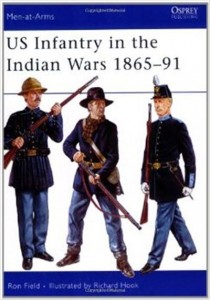
This period of the “Dark Ages” of the United States Army lasted from 1866-98. But these Infantry companies in Mexico would not have been out of place in many Twentieth Century campaigns… from the Philippines to Nicaragua…
US Postage Stamp of Remington’s “Protecting the Wagon Train”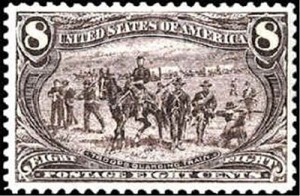
-YP-
Suggested Reading
http://www.amazon.com/Crimsoned-Prairie-S-L-Marshall/dp/0684130890/ref=sr_1_1?s=books&ie=UTF8&qid=1390888130&sr=1-1&keywords=crimsoned+prairie
http://www.amazon.com/Frontiersmen-Blue-United-States-1848-1865/dp/0803295502/ref=sr_1_1?s=books&ie=UTF8&qid=1390887589&sr=1-1&keywords=frontiersmen+in+blue
http://www.amazon.com/Frontier-Regulars-United-States-1866-1891/dp/0803295510/ref=sr_1_1?ie=UTF8&qid=1390887935&sr=8-1&keywords=frontier+regulars+utley
http://www.amazon.com/Dose-Frontier-Soldiering-Corporal-1877-1882/dp/0803242328/ref=sr_1_1?s=books&ie=UTF8&qid=1390887799&sr=1-1&keywords=soldiering+american+southwest
[CORRECTION UPDATE: The above version of YP’s essay is an updated version. The editor (me) originally published an earlier and slightly shorter version. Apologies to all.]
Be Respectful, Candid and Pertinent. No Posers, No Trolls…
|
|
The Great War was notable for the carnage that resulted when 19th-century military tactics were pitted against 20th-century infantry arms—such as machine guns, poison gas and flame throwers—which were used by all belligerent nations. There was, however, one infantry arm employed in the war that was uniquely American: the shotgun.
Although shotguns had been used by individuals in the U.S. military for over 100 years, the guns were generally privately owned arms. After the Civil War, a few shotguns were again employed during the so-called “Indian Wars.” The U.S. Army procured a relatively small number of shotguns for “foraging” use, but some privately owned shotguns also saw action during that period. The use of shotguns for deadly serious purposes was well-ingrained in the American psyche as aptly related in a 1920s article published in Harper’s Pictorial:

“… [The shotgun] is not a new man-killing arrangement. For years, the sawed-off shotgun has been the favorite weapon of the American really out gunning for the other fellow or expecting the other fellow to come a-gunning for him.”
Despite the well-known effectiveness of shotguns for certain situations, the first procurement of shotguns specifically for combat use by the U.S. military did not occur until the dawn of the 20th century. Circa 1900, the U.S. Army purchased an estimated 200 Winchester Model of 1897 slide- action repeating shotguns for use in the on-going “pacification” campaigns in the Philippine Islands following the Spanish-American War of 1898.

There was a clear need for an arm to help battle the fierce Moro tribesmen, who were exacting a deadly toll on American troops in close-quarters combat. It was recognized that a short-barreled, 12-ga. shotgun loaded with 00 buckshot was the most formidable tool available for such applications. These “sawed off” shotguns soon proved their mettle and were used with notable effectiveness in the Philippines.
When the United States entered World War I in the spring of 1917, General John Pershing and the U.S. Army General Staff were determined not to repeat the same mistakes that were made by both sides during the previous three years of the war. As stated in an American Rifleman article published after the war:

“When the A.E.F. began to take over portions of the front lines it brought with it General Pershing’s predetermined decision to break up the enemy’s use of its trenches as take-off points for such assaults, to destroy such attacking ‘shock troops’ as they came on, and so to compel the open-ground warfare for which Europeans had little liking but which was wholly in the character of the American spirit and in which it was foreseen the latter would give an extremely effective account of themselves.”
The new tactics that were to be employed by the American “Doughboys” required new arms. Many of the senior officers of the American Expeditionary Force (AEF), including Gen. Pershing, had previously served in the Philippines and had first-hand knowledge of the effectiveness of the shotgun. It was soon recognized that they possessed much potential for both offensive and defensive trench warfare.
The U.S. Army Ordnance Department was ordered to evaluate which shotgun would best suit the needs of the American troops deploying to France. The consensus was that the Winchester Model 1897 would be the logical choice. The Model 1897, later designated the “M97,” was a reliable gun that had been around for some 20 years and had acquitted itself well in the Philippines.

The variant of the Model 1897 selected by the Ordnance Department had a solid frame (non-takedown) with a riot-length (20”) cylinder bore barrel. The gun had a total capacity of six rounds (five in the magazine and one in the chamber) and lacked a disconnector. This meant that it could be fired by holding down the trigger while rapidly manipulating the slide, which resulted in a high rate of fire when used in that manner.
While a 20”-barreled Model 1897 shotgun could be obtained literally “off the shelf” from Winchester, the Ordnance Department stipulated that the new combat shotgun must be capable of mounting a bayonet. Although that may appear to have been a simple requirement, it posed some vexing problems. While the typical rifle barrel was small enough in diameter to permit it to fit inside a bayonet guard ring, the large diameter of a 12-ga. shotgun’s bore precluded that method of attachment. The problem was solved by the use of an offset bracket attached to the end of the barrel for attachment of the bayonet.

Another problem to overcome was the fact that a shotgun’s barrel would become extremely hot after firing only a few rounds. Since it would be impossible to effectively wield a bayonet without being able to firmly grasp the barrel, some form of protection was required. A ventilated metal handguard was designed that allowed air circulation between the guard and barrel and permitted a bare hand to control a hot barrel. Springfield Armory worked in conjunction with Winchester on the design of a handguard/bayonet adapter assembly. In a relatively short period of time, the proposed new combat shotgun was officially adopted.
The new arm, soon dubbed the “trench gun,” was given the ordnance code designation number “G-9778-S.” The guns were typically hand-stamped with a “US” and “flaming bomb” marking on the right sides of the receivers in front of the ejection ports to signify acceptance by the U.S. Army Ordnance Department.

The new “trench gun” was designed to be used with the M1917 “U.S. Enfield” rifle bayonet, presumably because there were larger numbers on hand as compared to the M1905 bayonet used with the M1903 Springfield rifle. The fact that Winchester was also making the M1917 bayonet at that time may also have played a role in its selection. The new trench gun was fitted with sling swivels that permitted the use of standard service rifle slings, primarily the leather M1907 sling. The guns were initially issued with commercial-production paper-case 00 buckshot ammunition.
As shotguns were not previously in the Army’s Tables of Organization and Equipment (TO&E), limited numbers were issued to selected infantry units in France for preliminary field testing and evaluation. An Ordnance Department memo dated June 8, 1918, stated:
“… 1,000 shotguns, referred to herewith, together with ammunition are now available in Depots in France … . Instructions are requested regarding the issue and distribution of these weapons. It is suggested that they may prove a most valuable arm for the use of raiding parties, and that a practical test be made in the 26th and 42nd Divisions, and that full information be furnished this office within 30 days, showing the difficulties experienced in maintenance, the susceptibility to jam under trench conditions, and the effectiveness of the weapon. Fifty guns should be issued to each Division mentioned above, with 100 rounds of ammunition per gun … .”

Other divisions that were issued trench guns during the war included the 5th, 26th, 32nd, 35th, 42nd, 77th and 82nd. Most of the reports from the units that were issued trench guns for preliminary testing were positive in nature. Typical responses included: “It is the general opinion of those who have used shotguns that they are effective weapons for scouting and patrolling purposes. Col. H.J. Hunt, Sixth Infantry,” and “Shotguns in this regiment have given very satisfactory results. Their effectiveness at short ranges, on raids and patrols makes them a most desirable weapon, and I would recommend that they be adopted. Captain H.P. Blanks, 61st Infantry.”
The most common complaints against shotguns pertained to the propensity of the paper-cased ammunition to become wet in the muddy trench environment, which could cause the shells to swell and become unusable. The lack of belts or pouches to carry the shells was also cited as a problem in several reports. This was discussed in a post-World War I American Rifleman article:
“[I]n the trenches the cartons (of shotgun shells) were set on the long shelf under the parapet … and the doughboys would put a couple of handfuls in their breeches pockets, just as they were accustomed to ‘at home on the farm.’”

Canvas looped shotshell belts were considered for use with the guns but were not the optimum method of carrying shotgun shells in the constantly damp and muddy trenches. A canvas pouch with internal loops (holding 32 rounds) and a shoulder sling was designed and procured to carry trench gun ammunition, but few were likely sent overseas before the Armistice.
Since the major culprit was the paper-cased shells, all-brass 00 buckshot ammunition was ordered. Such ammunition would be less susceptible to moisture and could better withstand the battering from constant loading and unloading of the guns. Some of the all-brass buckshot ammunition of that era was characterized by an unusual “saw tooth” crimp.
U.S. Ordnance Department records indicate that Winchester delivered 19,196 Model 1897 trench guns to the government during the First World War. It is likely that several thousand more guns were procured from wholesalers and jobbers for conversion to trench guns during that period, and, perhaps, as many as 25,000 M1897 trench guns were eventually manufactured during the war. World War I Winchester Model 1897 trench guns were serially numbered in three “blocks”: E433144-E474130; E514382-E566857; and E613303-E697066.

These blocks were obtained from ordnance documents and reports, and some slight variance on either side of the ranges may be expected. Most of World War I M1897 trench guns were in the third block of serial numbers.
In order to augment the supply of combat shotguns, the Ordnance Department contracted with the Remington Arms Co. for a trench gun variant of its Model 10 12-ga. shotgun. The Model 10 was a hammerless slide-action repeater that loaded and ejected from a port in the bottom of the receiver. Rather than utilizing the metal handguard/bayonet adapter assembly of the Winchester Model 1897 trench gun, the Remington Model 10 trench gun was designed with a metal bayonet adapter that clamped on the end of the barrel and a separate wooden handguard. The Model 10 adapter was also designed for use with the M1917 bayonet, which was also manufactured by Remington during that period.
The Model 10 trench gun had a 231⁄2” barrel and was fitted with sling swivels. The guns were stamped with a “US” and “flaming bomb” insignia on the left sides of the receivers. Remington delivered 3,500 Model 10 trench guns to the government during World War I. The serial number range of World War I military Model 10 trench guns was 128000-166000. Again, this is an approximate range and some slight variance on either side is possible.

In addition to the trench guns, the Ordnance Department purchased a quantity of Winchester Model 1897 and Remington Model 10 “riot guns.” These differed from the trench guns in that they were not fitted with bayonet adapter/handguard assemblies and did not have sling swivels. While some combat use cannot be ruled out, the riot guns were primarily intended to be utilized for guarding prisoners and similar duties.
As increasing numbers of the trench guns began to be deployed to the front-line trenches, their effectiveness became apparent. There were numerous references to the efficiency of the shotguns.
A post-war American Rifleman article contained the following statement regarding a U.S. Army officer: “[H]is men had one good chance with them (shotguns) at a German mass assault upon his trench—a charge obviously intended to overwhelm the defenders with its solid rush of men. (They) let them come on; and when those shotguns got going—with nine .34 caliber buckshot per load, 6 loads in the gun, 200-odd men firing, plenty more shells at hand—the front ranks of the assault simply piled up on top of one awful heap of buckshot-drilled men.”

Laurence Stallings related the following in his classic book, The Doughboys: “[A] Chicago sergeant, undergoing much hostile fire to reach a concrete pillbox, made his entrance through the stage door of the pestiferous machine-gun nest bearing a sawed-off shotgun. Two buckshot blasts and the twenty-three performers left on their feet surrendered.”
The shotgun’s effectiveness did not go unnoticed by the German government, which viewed the use of shotguns as a serious breach of international rules of warfare and lodged an official protest on September 14, 1918. The Germans sent a telegram to U.S. Secretary of State Robert Lansing, which stated, in part: “The German Government protests against the use of shotguns by the American Army and calls attention to the fact that, according to the laws of war, every prisoner found to have in his possession such guns or ammunition belonging thereto forfeits his life.”
The Germans were referring to a passage in the Hague Decrees, predecessor of the Geneva Convention, which stated, “It is especially forbidden to employ arms, projections, or material calculated to cause unnecessary suffering.” The Kaiser’s minions also sought to exploit the issue for propaganda purposes, and several German newspapers wrote scathing editorials against this “barbaric” weapon.

For example, the Cologne Gazette opined that “… tommy-hawks and scalping knives would soon make their appearance on the American front … ,” and stated that “… Americans are not honorable warriors.” The Weser Zeitung newspaper was of the opinion that “… the barbarous shotguns have not been served out because they are likely to be effective but because the ill-trained Americans cannot use rifles and are badly supplied with machine guns.” It is reported that some of our Doughboys were rather amused by these editorial rants!
The United States government’s response to the German threat was swift and to the point. Secretary Lansing firmly replied that the use of shotguns was most assuredly not prohibited by the Hague Decrees or any other international treaty. He also made it known that if the Germans carried out their threats in even a “single instance” the American government knew what to do in the way of reprisals and stated that “notice is hereby given of the intention to make such reprisals.”
As correctly summed up in an American Rifleman article after the war: “Uncle Sam did not intend to have his trench-gunners massacred simply because he had given them a weapon which even the pick of the Prussian ‘shock troops’ dreaded more than anything that four years of war had called on them to face.”

Apparently, the American response had the desired effect as there is no indication that the Germans ever executed any Doughboys for possessing a shotgun or shotgun shells. It is perplexing as to why the Germans, who introduced and regularly used poison gas and flamethrowers, were so incensed about our use of shotguns. It is probable that the enemy actually feared the American behind the shotgun as much as the shotgun itself.
The United States considered the matter closed and continued to send trench guns to France as fast as production and shipping permitted. As stated in a publication after the war: “The shotguns went right on at their business—so terrible a success that message after message from G.H.Q. to America begged: ‘Give us more shotguns!’”
In addition to use in trench warfare and for guarding prisoners, some shotguns were reportedly employed in front-line positions in an attempt to deflect incoming German grenades. Some have questioned whether this actually occurred, but a number of World War I and post-World War I accounts confirm this practice.

A post-war American Rifleman article stated: “An interesting if amazing purpose which these guns (trench guns) were supposed to serve was that of shooting from the trenches, a la trapshooting, at hand-grenades, ‘potato mashers,’ and the like thrown over by the enemy, with a view to knocking such missiles back, to fall and explode outside the parapet. The procedure was taught and practiced at training camps during the war, using dummy Mills bombs as the aerial targets.”
Due to extensive use prior to World War II, original World War I Winchester and Remington trench guns are scarce today and are coveted by martial arms collectors. All World War I-era shotguns were originally blued, and any Parkerized examples have been refinished, possibly as part of a later arsenal overhaul.
A number of 1918 vintage M1897 trench guns may be encountered today without martial markings. The most logical explanation for such guns is that they were purchased by the government during World War I but the war ended before the guns could be issued, thus they were not stamped with the “US” and “flaming bomb” markings.
The popularity of shotguns is not restricted to collectors. Modern combat shotguns are in front-line use by American troops today—just as they were in the trenches of France more than 100 years ago. The shotgun is still a uniquely American combat arm. In certain combat applications, it is a fearsome arm with unquestioned effectiveness, just as the Kaiser’s troops first discovered in 1918 “in the trenches.”

This article, “Deep Behind Enemy Lines: Weapons of Vietnam’s Covert Warriors,” appeared originally in the April 2015 issue of American Rifleman. To subscribe to the magazine, visit the NRA membership page here and select American Rifleman as your member magazine.
It’s unlikely that any other U.S. military unit ever fielded such an array of weaponry as did the Military Assistance Command Vietnam, Studies and Observations Group.
Behind that innocuous name, MACV-SOG ran top-secret, covert operations across Southeast Asia during the Vietnam War, especially U.S. Army Special Forces-led reconnaissance missions along the enemy’s Ho Chi Minh Trail road network in Laos, into his sanctuaries in Cambodia, and sometimes into North Vietnam, itself.
These SOG recon teams, usually four to six natives led by two or three American Green Berets, roamed deep behind enemy lines, searching out—sometimes attacking—North Vietnamese truck parks, ammunition dumps, storage sites, truck convoys, command centers and the base camps where enemy units refit between battles in South Vietnam.

Deniability
Since Hanoi insisted it had no troops in “neutral” Laos or Cambodia, the United States, too, denied that SOG operations were underway. To support this deniability, recon teams were required to go “sterile”—meaning no ID or dog tags, unmarked or non-U.S. uniforms, and unattributable arms. Thus, SOG’s armory stocked many foreign firearms with which a team leader armed his men according to how he saw fit to accomplish each mission.
Initially, SOG’s primary weapon was the 9 mm Luger Karl Gustav Model 1945 submachine gun, nicknamed the “Swedish K.” Obtained through the Central Intelligence Agency, these untraceable guns sported a pale green enamel finish, a side-folding stock and a 36-round magazine. The typical combat load was 13 magazines—one in the gun and 12 more in pouches—for some 468 rounds. That may seem like a lot, but SOG teams often fought all-day, running gunfights against untold enemy pursuers.
Eventually the Swedish K’s 9 mm ball cartridge was found inadequate for knocking enemies down and keeping them down. Many teams up-gunned to the more robust 7.62×39 mm, Chinese Type 56 AKM with a fixed or folding stock.
The AKM was not without its own shortcomings: it was slow to reload since the bolt did not lock open with the last round, and its wooden fore-end—oil-saturated by repeated cleanings—could become too hot to grasp. Still, it was an improvement.

Some AKM-armed teams added a degree of deception, disguising themselves in North Vietnamese uniforms. During a chance meeting, the enemy hesitated to engage a masquerading team, giving the SOG men a brief advantage.
Had they been captured in enemy uniforms they could have been executed as spies; however, not one of SOG’s 57 Missing in Action (MIA) Green Berets—nearly all of them undisguised—came back as a live prisoner. The issue was moot.
Some arms were old enough to be deniable, allowing World War II veterans to carry their favorite firearms. For instance, First Sergeant Lionel Pinn, a cigar-chompin’ World War II Ranger, proudly packed an M1A1 Thompson submachine gun. Master Sergeant Charles “Pops” Humble, a veteran of the 1st Special Service Force, wanted a German Schmeisser; SOG got him one.

Foreign arms figured in SOG’s night parachute infiltrations—the world’s first combat skydives. Captain Jim Storter armed his recon skydivers with Fabrique Nationale-made Uzi submachine guns because they, “fit nicely strapped atop the reserve ‘chute,” a consideration where compactness and a streamlined load mattered.
His team also packed slim Walther PPK pistols which, like the Uzis, had detachable suppressors. Some SOG skydive teams also carried golf-ball-size V-40 Mini Grenades, acquired secretly from the Netherlands, which weighed just 3.5 ozs.
Foreign handguns included the .25-cal. “Baby” Browning semi-automatic, complete with a wallet-like concealment holster as a last resort gun. But SOG’s most ubiquitous foreign handgun was the 9 mm Luger Browning High Power, favored for its 13-round magazine capacity. Several dozen SOG High Powers came home as chromed, boxed presentation pistols, awarded by SOG’s commander (“Chief SOG”), to his most accomplished team leaders.
The CAR-15
By 1967, the enemy had captured enough U.S. weapons in South Vietnam that weapon deniability was relaxed for missions into Laos, although the requirement continued another two years for Cambodia. Teams could now carry M16s, but they soon were rearmed with what would become SOG recon’s trademark arm—the CAR-15.

Officially dubbed the XM177, the CAR-15 was a submachine gun version of the M16 and grandfather of today’s M4 carbines. Available in two barrel lengths—a 10″ on the E1 version and an 11.5″ on the XM177E2—it featured a retractable stock, a short, rounded handguard and a distinctive 4.2″ compensator-flash suppressor. SOG’s recon companies were the war’s only units armed entirely with CAR-15s.
As with all U.S. units, during much of the war SOG was stuck with ill-fitting M14 pouches to hold M16 magazines. Many recon men opted for old BAR belts, whose pouches perfectly held four 20-round magazines, or stretched canteen covers to accommodate six magazines.
Frustrated by SOG’s inability to supply 30-round magazines, a number of team leaders purchased them through a Guns & Ammo advertisement, outfitting each man with one 30-rounder. As his first magazine, this typically contained all tracer rounds for psychological effect.
Suppressed Long Guns
SOG stocked many suppressed submachine guns and rifles, useful for chance contacts, ambushing trackers, removing sentries and seizing prisoners. Only SOG’s Uzis had detachable suppressors, the rest having integral ones whose weight and length affected their handling characteristics. The Swedish K’s integral suppressor, for example, added 6″ to its length, which made it barrel-heavy; however, it was especially accurate.
Some recon men preferred the .45-cal. suppressed M3A1 “Grease Gun,” developed by the World War II Office of Strategic Services (OSS), predecessor to today’s CIA. Offering a very controllable 450-r.p.m. rate of fire—making single-shots possible—its suppressor boosted the gun’s weight by 3 lbs., and required cleaning the tube’s metal screen “wafers” to maintain effectiveness.
SOG’s quietest long gun was the Sionics Silent Sniper, an M1 carbine converted to 9 mm Luger and transformed from semi-automatic to a straight-pull. Outfitted with a barrel-length suppressor, telescoping wire stock and 4X scope, its closed bolt firing precluded any mechanical “clacking” while no sound of gas blowback escaped at the breech.

Such “clacking” seemed the only sound you heard when firing the Sten Mk. IIS suppressed submachine gun. Developed in 1940 by the British Special Operations Executive or SOE—whose secret agents operated in Nazi-occupied Europe—the Sten’s loose tolerances kept it firing even when filthy, but limited its accuracy to 8″ groups at 50 yds.
The problem with all suppressed submachine guns was their pistol rounds’ minimal deadliness; not only was that a disadvantage in a firefight, but (as I learned) amid the din of gunfire the enemy heard no muzzle blast to deter his assault or compel him to seek cover.
Instead of carrying a suppressed guns as their primary weapons, many SOG men instead wielded CAR-15s or AKMs, and kept the Stens disassembled into their four major groups—receiver, barrel, magazine and stock—and stowed them in their rucksacks until needed.
As for suppressed M14s and M16s, SOG had them but lacked subsonic ammunition. Medal of Honor recipient Franklin D. Miller and I tested a suppressed M16 and determined that in short-range shootouts its noisy supersonic “crack!” outweighed the benefit of its reduced muzzle blast. Some men thought otherwise, especially when using a suppressed XM21 sniper rifle at greater distances.
Suppressed Handguns
Although of very limited range, suppressed handguns saw considerable action. SOG’s quietest pistol by far was the .32 ACP Welrod, another product of the World War II British SOE. Its minimalist design—a tubular suppressor-barrel-action, a bent metal rod for a trigger and a rubber-covered Colt M1903 pistol magazine for a grip—didn’t even look like a gun.
Like the Sionics carbine, the Welrod was a bolt-action repeater, operated by rotating its knurled end with the palm of the hand. Of limited accuracy and range, the Welrod was more suited to assassinations in wartime Europe than combat in Southeast Asia.
SOG’s most popular suppressed pistol was the .22-cal., High Standard H-D semi-automatic. Another World War II OSS development, its 6½” barrel was fitted with a 73/4″ suppressor that eliminated muzzle flash and achieved 90 percent noise reduction. It was used primarily to capture prisoners, the plan being to disable the target with one, near-silent, well-placed shot. This sometimes worked and sometimes did not, igniting a conventional gunfight.

Other suppressed pistols included Brownings, Walthers and Berettas, but SOG’s most revolutionary pistol—mistakenly acquired as “silent”—was the 13 mm Gyrojet Rocket Pistol. Constructed of plastic and stamped steel with the heft of a cap gun, the six-shot Gyrojet emitted a piercing, “whoosh!” when fired. Its thumb-size, solid-fuel rocket was spin-stabilized by two canted nozzles and generated almost no recoil.
In SOG tests, that rocket punched through 3/4″ plywood and then pierced one side of a water-filled 55-gallon drum to dent the opposite side. Although slow to reload and of limited accuracy, the Gyrojet saw combat service, especially in the hands of 1st Lt. George K. Sisler, SOG’s first Medal of Honor recipient, who had one when he died fighting off an enemy platoon; his Gyrojet was recovered and may have been the same pistol Medal of Honor recipient Franklin Miller used later.
Robert Graham, leader of Recon Team Pick, carried into combat SOG’s most outlandish “silent” weapon. A native Canadian and bow hunter, Graham had a 55-lb. bow mailed from home with broadhead-tipped arrows, which he indeed let loose during a fight in Cambodia. No prisoner resulted, but it did yield one of SOG’s most unbelievable war stories.
Modified Weapons
SOG’s Green Berets constantly tinkered with their firearms, often shortening barrels to improve handiness. Medal of Honor recipient Bob Howard, for example, sometimes toted a compact, selective-fire M14A1 rifle, its barrel and flash suppressor chopped by 8″ and a handgrip installed below the forearm. In it, Howard fired 7.62 mm M198 duplex cartridges, each containing two stacked 84-gr. Spitzer bullets with respective muzzle velocities of 2700 and 2200 f.p.s.. In effect, this doubled his M14’s output to 40 rounds per magazine.
Sawed-off shotguns saw SOG service, too, primarily the Remington Model 870. One SOG recon skydiver, Sammy Hernandez, somehow got his hands on a sawed-off Winchester Model 1897, which he strapped aside his body for a night jump into Laos. Another SOG recon man carried a sawed-off Browning A5 semi-automatic into Laos, which proved his undoing; it was fast to fire but slow to reload, and he was shot dead while reloading.
The belt-fed M60 machine gun, too, was much modified. Poorly balanced, heavy, and somewhat awkward to wield, Special Forces weapons men completely removed the buttstock, capped it, and then shortened the 22″ barrel, eliminated the bipod and installed a pistol grip below the gas tube, which notably shortened it and cut its weight by 5 lbs. (Three decades later, similar features were incorporated into the gun’s M60E4 version.)

However, SOG’s most impressive M60 modification—dubbed the “Death Machine”—was a 500-round drum fitted inside the gunner’s rucksack, connected to his gun with a 5-ft., aircraft-type articulated feed belt. Fabricated at the China Lake, Calif., Naval Weapons Center, its total weight including the gun and ammunition was just short of 90 lbs., requiring a Rambo-sized man to carry it. Best suited to raids, recon teams rarely packed the Death Machine.
But many teams did carry another light machine gun, the Communist Bloc RPD. Modified by Special Forces weapons men, the RPD’s barrel and butt were chopped, reducing its length to 31″, shorter than a Thompson submachine gun. This also reduced the RPD’s weight to 12 lbs. and balanced it so well that you could practically write your name with it. SOG men also modified its 100-round belt to hold 125 rounds, and inserted a slice of linoleum in the drum to eliminate any rattle. Firing the full-power 7.62×39 mm AK round, the RPD was SOG’s deadliest small arm.
Sniper Rifles
Because SOG recon’s primary duty was intelligence gathering, there were few planned sniping missions, which would have compromised a team’s presence with the first shot. However, there was no shortage of sniper rifles when the need arose.
SOG’s most accurate sniper weapon was the heavy-barreled, Remington Model 700 rifle, in 7.62×51 mm NATO (.308 Win.), with a Redfield 3-9X Accu-Range scope, similar to the system issued to Marine Corps snipers. SOG recon was the only Army unit in Vietnam armed with the Model 700.

The M14-based XM21 Sniping System, too, was in SOG’s armory, many of them suppressed. These definitely saw combat service, especially for recon teams in central Laos where the jungle opened up. Special Forces Sgt. Kevin Smith used an XM21 while manning a roadblock overlooking Laotian Highway 922 and made a confirmed 1,000-yd. shot, as well as a number of other kills.
The Korean War-era M1D Sniper Rifle, topped by a 2.5X M84 scope, was considered outmoded by many, but SOG old hands who’d been raised on the M1 rifle thought it an excellent rifle and its .30-’06 Sprg. cartridge more suited to long-range sniping than the 7.62×51 mm.
Quite likely the first-ever flattop AR was an SOG-modified M16. Topped by an M84 scope, SFC J.D. Bath took the experimental sniper rifle to a Laotian mountaintop in early 1967, but no enemy appeared within 5.56×45 mm range. Although promising, that was that rifle’s only known combat service.
Exploding-Projectile Weapons
Some team leaders believed that the slow-firing, single-shot M79 Grenade Launcher reduced their teams’ firepower. Rearming their two grenadiers with CAR-15s, they mounted still-experimental Colt XM148 grenade launchers on their short-barreled CARs, which required a bit of jury-rigging. Later, these were replaced with XM203 grenade launchers.
However, all this bulk degraded the performance of both the CAR-15 and the launcher, which was unacceptable to other team leaders. Instead, they sawed off the M79’s butt and barrel into a “pistol,” which was carried unloaded and snapped into men’s web gear. Thus, 40 mm fire was still available when needed while it freed up everyone to carry CAR-15s.

SOG’s most unusual grenade launcher was an experimental pump-action, four-shot, that functioned like an oversized Winchester Model 12 shotgun. Developed by the Naval Weapons Center at China Lake, Calif., it weighed 10.2 lbs. and measured 34½” overall. It wasn’t too heavy, but notably bulky, poorly balanced and prone to short-stroking.
SOG lost more men to the blast and fragments of enemy RPG rockets than to any other weapon. Attesting to this lethality, several recon teams replaced their M79s with RPG-2 launchers, which fired the Chinese B-40 rocket. In SOG’s hands, it proved just as deadly.
Some considered the RPG too heavy a weapon for a small recon team, yet a few team leaders went a step further and also toted a 60 mm mortar. Normally found with a 120-man infantry company, it was the last thing the North Vietnamese expected in a SOG team.

The 60 mm tube was carried by one man, with about 20 rounds distributed among his teammates. Recon Teams, such as Joe Walker’s RT California and Ed Wolcoff’s RT New York, regularly packed a 60 mm mortar, along with sawed-off RPD machine guns and RPG rocket launchers. Unsurprisingly, these were called “heavy” teams.
Whether heavy or just a half-dozen men, these SOG teams raised such havoc behind enemy lines that the North Vietnamese diverted 50,000 troops from the battlefield to rear area security. However, the cost was significant: SOG lost 243 Green Berets, which included 10 recon teams that went missing while another 14 were overrun.
In 2001—after its covert missions were declassified—SOG received the Presidential Unit Citation for, “Extraordinary Heroism … . while executing unheralded top secret missions deep behind enemy lines across Southeast Asia.”
This article includes images from Jason Hardy’s six-volume series on SOG Teams, which can be found at specialforceshistory.com and from Maj. Plaster’s Book, SOG: A Photo History of the Secret Wars, at ultimatesniper.com
Posted on: February 2nd, 2014 by Will Rodriguez 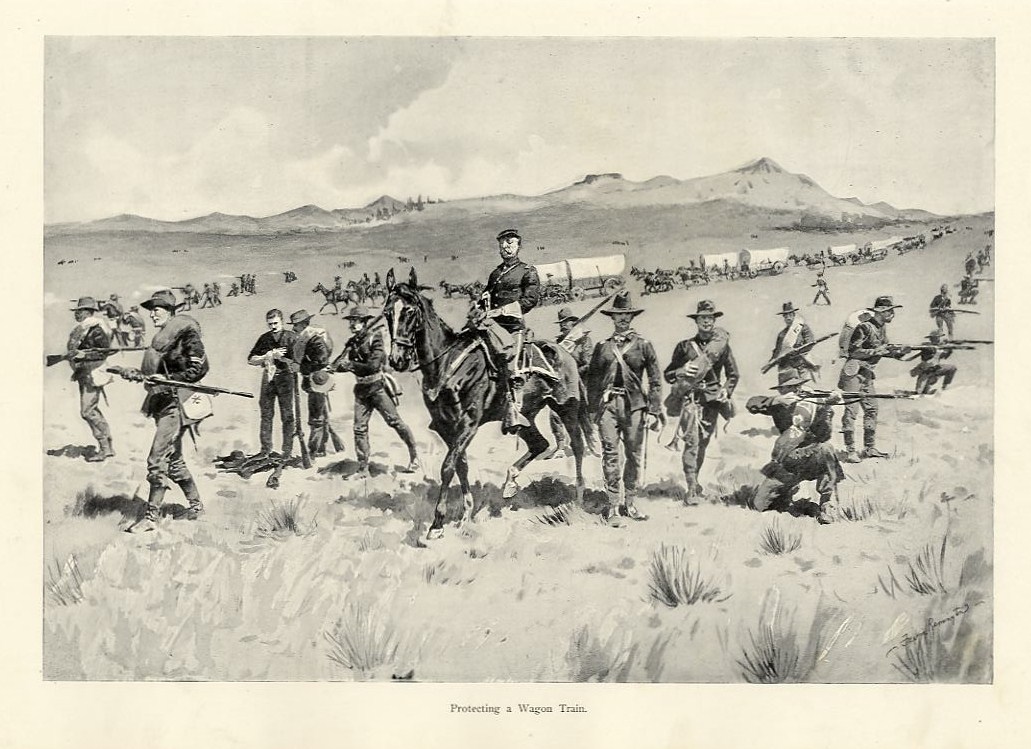
Protecting the wagon train by Frederic Remington
Essay by Yankee Papa (all rights reserved)
In June of 1866 700 men of the 18th Infantry Regiment were marching out of Fort Laramie heading up the new “Bozeman Trail…” This would save hundreds of miles from the old route to the mines in Montana.
The weather was splendid and the troops were marching towards some of the most beautiful country in North America…at least in June. They were also marching into the hunting grounds of the Lakota, the Northern Cheyenne and the Arapaho.
That wasn’t supposed to be a problem. Peace Commissioners were meeting with the chiefs at Fort Laramie as they marched past. Unfortunately some of the chiefs were deeply opposed and nothing had been agreed upon when the troops showed up to build three forts in their territory. A couple of the most fierce, including Red Cloud called foul and rode off pledging war.
As they were too often wont to do, the commissioners decided to ignore the hostile or no show chiefs and just get the signatures of the ones present… even though it might not be their territory at issue. More than one war started this way.
But the word from the brass was that there would not be war… just some hotheaded chiefs… maybe some livestock raids on the posts. The high brass did not understand that as many as 4000 warriors might wish to dispute the matter with them.
The 18th had a proud record in the Civil War, but most of those lads had mustered out. Officers (who often had held higher rank during the war) and NCOs had seen combat… but not most of the common soldiers.
But… the brass indicated that there would be no major fighting. So many raw recruits and almost no training… just what little their NCOs could give them on their way. Drill and musketry not even scheduled until into the next year after the forts built.
The 18th was something new… it was not just made up largely of post-war men… but was among the first of the new blood on the frontier.
The remnants of the old marched past them as they neared Fort Laramie. The last of the “Galvanized Yankees”, former Confederates who volunteered to join the Union infantry to get out of the prison camps. Promised that they would fight Indians on the frontier, not their kin in the South.
Many were signed up for three years, and that meant that many were not discharged upon the end of the war. The last of the six regiments marched past the 18th on their way home to be discharged.
The soldiers of the 18th found that interesting, but were more concerned with their boots. Loss of weapons…illness and wounds… and bad feet could cripple an infantry unit.
Unless you paid a private boot maker, you bought “off the shelf…” In 1818 “lasts” were developed to enable production of specific left and right shoes… but this only came into common usage in the late 1850s… and with some minor exceptions, infantry in the Civil War and for some years thereafter (until Civil War stocks used up) had shoes with no left foot-right foot differentiation.
Prior to the march most NCOs would have shown the recruits how to fully soak the “boots” (up to the ankle and 4 sets of eyelets) and then let them dry on their feet before attempting to cover any distance in them. Easier to break in the boots than the feet.
Just as well that no fighting was expected…Colonel Carrington… well, everybody liked him, but he had never been in battle. Commissioned a Colonel from a law practice at the start of the war and handed the 18th Regiment… he was placed on “detached duty” for the entire war… staff duty in Washington.
If some of the officers thought that there might be a fight, they could not be happy at the Regiment’s strength… A new Civil War regiment contained 1000 men… the 18th only had 700… and of those all but 400 would be going to two forts… one at either end of the trail.
Actually they were lucky. A decade later and infantry companies on the frontier would not be at 70 like the 18th instead of the Civil War standard of 100… but down to a normal of 37.
And of course the rifles. The Ordnance Department had plenty of breech loading rifles in storage after the war… but chose to let the 18th head into the Powder River country with muzzle loading rifles (see https://gruntsandco.com/u-s-ordnance-rogue-fiefdom/ ) But then again, there was not supposed to be any fighting.
Only real Indian fighter around here, the Colonel’s guide… Jim Bridger. Even the recruits had heard stories about this old mountain man.
Bridger had his own assessment of what was going on. He thought that Red Cloud and some others would do more than just “steal some livestock…” A lot of horses, mules, and cattle that would have to be grazed outside the fort… Firewood to be cut some miles from the fort…something that required peace…
And then there were the women and children that the brass encouraged the Regiment to take with them. Total including workers of 400 civilians. Most would be at the fort in the middle of the trail… right in the heart of the Powder River hunting grounds. Colonel Carrington listened to Bridger… but the high brass assured Carrington that there would be no major hostilities…
[…The 18th had detachments build forts at both ends of the trail and built Fort Phil Kearny in the middle. Livestock indeed stolen and soldiers and woodcutters killed. On December 21, 1866, a Captain Fetterman… (had commanded the 18th at times during the war in higher brevet rank) put the seal on his disrespect to the Colonel and arrogantly disobeyed his orders.
Sent in relief of a wood chopping party, he instead rode after a party of Lakota to a ridge line. Ordered not to go past it, he did… with a mixed force of Infantry and Cavalry… 80 men. Just the number that he had boasted about… “With 80 men I can run roughshod over the whole Sioux nation.” Instead the Cavalry bolted to the front leaving the infantry panting behind… then more than 1000 Sioux rose up and caught them all in the open. It was over in a couple of minutes…
There would be other fights in the area, but the high brass in Washington decided what they should have in the first place… the soldiers could not guard the trail… only their own forts. Besides, Infantry needed to guard the trans-continental railroad that was being built. A treaty was signed… the troops pulled out by 1868 and the Sioux burned the forts behind them. It was the last war that Indians would win in North America…]
“Good Marksmanship and Guts” DA Poster 21-45
Near Fort Phil Kearney, Wyoming, 2 August 1867. The Wagon Box Fight is one of the great traditions of the Infantry in the West. A small force of 30 men on the 9th Infantry led by Brevet Major James Powell was suddenly attacked in the early morning hours by some 2,000 Sioux Indians. Choosing to stand and fight, these soldiers hastily erected a barricade of wagon boxes, and during the entire morning stood off charge after charge. The Sioux finally withdrew, leaving behind several hundred killed and wounded. The defending force suffered only three casualties. By their coolness, firmness and confidence these infantrymen showed what a few determined men can accomplish with good marksmanship and guts.
These days you mention the Old West and the Indian Fighting Army and people immediately picture Cavalry. Usually John Ford Cavalry. West had wide open spaces and the Indians had horses… so troops had to have horses… right? Oh, maybe some Infantry to guard the forts, but otherwise…
History tells a far different tale. There were never enough Cavalry… there never could be. The gigantic Union Army was mustered out and in the end, only 25,000 soldiers were left in the entire Army… many in the South enforcing Reconstruction.
A Cavalry regiment cost twice as much to raise as an Infantry regiment… and a lot more to keep running each year. And in spite of Hollywood… Infantry had a major role to play.
While mounted forces had played a role in every war from the Revolution on, there were no permanent regiments until the 1850s. Even then the mission a bit “fuzzy…”
Cavalry proper was supposed to fight almost exclusively on horseback. Dragoons were supposed to be able to fight some on horseback and some on foot. We had both, but at the start of the Civil War it was decided to call them all “Cavalry…”
Immediately after the Civil War a lot of regular and volunteer regiments were thrown into Kansas to put down Indian raids. Thousands of soldiers tracked endless miles and only killed two hostiles. Something else would have to be tried… and with a lot less soldiers… most of these were going to be demobilized.
Infantry would be needed for far more than to guard the forts. Wagon trains and supply trains would need escorts. While some Cavalry with the trains were handy… too many and they became a logistic nightmare.
American stock, unlike Indian ponies could not subsist on grass… Cavalry remounts needed oats and the like…a lot of them.
Even “all Cavalry” offensives had a limited range… In 1882 the assistant Quartermaster of the Army reported: “Unless cavalry operate in a country well supplied with forage, a large amount of wagon carriage must be furnished for forage and in such cases, cavalry is of little value except to guard its own train… and to do that in the presence of an enterprising enemy it will need the addition of infantry…”
Covering the Cavalry’s Withdrawl by Frederic Remington
Horses are, for all their size, relatively fragile. They can drop from a number of diseases and if worn out require an extended amount of time to recover. At the end of the day men are tougher than horses.
One officer who served in large expeditions in the Sioux and Nez Perce campaigns involving major units of Cavalry and Infantry, Sixth Infantry’s Col. William B. Hazen wrote “After the fourth day’s march of a mixed command, the horse does not march faster than does the foot soldier, and after the seventh day the foot soldier begins to out-march the horse, and from that time on the foot soldier has to end his march earlier and earlier each day to enable the cavalry to reach the camp the same day at all. Even with large grain allowances horses quickly deteriorated under extended exertion…”
In 1876 a 50 man Cavalry troop dismounted had less firepower on the line than an Infantry company of 37 men. Every fourth trooper had to take four horses to the rear and hold them there until the engagement was over. In addition the Cavalry was using shorter range carbines while the Infantry was using longer range (and more reliable) rifles.
The image of the “Cavalry riding to the rescue…” could not have been farther from the truth. In most cases, by the time that the Cavalry found out about a raid, the Indians could be fifty miles away… one hundred if they were Comanches.
Comanches might make a raid… then join up some miles off with couple of boys holding spare ponies… Alternate between them making distance. Cavalry, even an hour away would never catch up with them… just wear out their mounts. Cavalry had to dismount and walk their horses for a while every couple of hours to give them a breather. Meanwhile the Comanches kept swapping ponies.
One thing that cost the Cavalry was riding exhausted mounts into contact with Indians who were up for a fight… Reno almost lost his squadron when he had to retreat with blown horses (and exhausted, sleep-deprived troopers) at the Little Big Horn.
Map from “Winning the West The Army in the Indian Wars, 1865-1890” Army Historical Series
The only feasible military solution was to hit the hostiles in their villages… preferably in the winter when their mounts were scrawny. There were a number of problems with that strategy.
In the first place, during the Civil War a regiment of Colorado volunteers (enlisted for 100 days only) under a fanatic named Chivington had murdered many Southern Cheyennes at Sand Creek. Most of his men were bar sweepings and acted accordingly… rape, beheadings, “trophies” taken… slaves.
These Indians had followed the directive to camp by the nearest fort… but were ordered away by militia officers as a cynical prelude to slaughter. Other Indians were making the trouble… but these were closer… and both Chivington and the Governor of Colorado were looking for a cheap victory.
By the time that the people back East figured out what had happened, the regiment was paid off and the Army could do nothing. One regular officer who was going to testify was murdered in Denver.
So raids even into actual hostile Indian villages… though not as barbaric as Chivington’s would raise holy hell with people back East and their Congressmen.
And just what was a hostile village? Custer’s assault on Black Kettle’s village on the Washita, while not the insanity of Sand Creek was bad enough and raised troubling questions.
Black Kettle himself was an honorable chief who wanted peace. But war parties drifted in and out of his camp…some with hostages. He was not keen to have them rest up in his village… but tribal custom prevented him asking them to leave so long as they did not cause major trouble. He had no actual *authority*… as with most Plains chiefs, he led by his personality.
The Eastern media learned that Black Kettle had attempted to speak with the soldiers before the first shots were fired. He was shot and too many of the soldiers fired at anything that moved. It was a “victory” that would cost the Army in political support and in the unending enmity of both major branches of the Cheyenne people.
The biggest problem was identifying hostiles. Generally back when the Indian wars fought East of the Mississippi, a chief’s word would bind his tribe. On the Plains it was different.
A chief might sign a treaty with every intention of honoring it. But on the Plains both the war chiefs and the peace chiefs led by their personality and influence…not by compulsion.
Some members or clans of his tribe might decide to go their own way and raid. This caused reprisal raids (often by civilians) against the nearest members of that tribe regardless of any possible innocence. This of course led to those victims raiding the nearest whites… regardless of any possible innocence.
The reservation system was supposed to clear all this up. Those on the reservations would be labeled as “peaceful” and those off would be considered hostile.
But not all Plains Indians treaty bound to live on reservations. Some clans might…other might not. And some hostiles came to the reservations (mostly come winter) to rest up for new raids in the Spring. Some reservation occupants had permission to go off reservation on long hunting trips… Some were just that… others…
Shortly before the Little Big Horn campaign the government decided to reshuffle the deck. Indian tribes would no longer be treated as “sovereign nations” but as wards of the government. Certain tribes including the Sioux and Cheyenne were ordered (in winter) to report to a reservation or be considered hostile.
It is doubtful that many got the order…or would have considered moving in that weather… or even in the Spring. They saw no reason to give up their way of life.
The Army moved…and bungled the entire campaign…Custer’s blunders just one part of a bad set of events. But from this point the role of the Infantry would increase.
Like other troops on the frontier, the Infantry had some real problems. Their authorized strength too low… and usually could not meet that. Something like 37% of all troops on their first enlistment deserted each year.
Not just the low pay. Army preferred to pay in paper money at isolated posts. Counterfeiting so rampant for some years that most merchants would only take at a discount.
New troops got very little training. Most years no more than 16 rounds of ammunition per man for target practice. Often used on endless details having little to do with soldiering. If infantry present at a fort, they got most of the endless chores… most troopers work time centered around their mounts.
While officers preferred “Iowa farm boy” type recruits…they usually didn’t hang around. Many of the best soldiers were the Irish and Germans… at least those who made it into the NCO ranks.
Many people have heard of the two regiments of black soldiers in the Cavalry. But there were also two regiments of Buffalo Soldier Infantry on the plains. On average they were a better investment than many of the white recruits.
Lot of drunks and loafers and other types likely to get into trouble and/or desert joined the white regiments… But there was a surplus of good quality men wanting to join the black regiments.
Desertion was a very small problem. Training took longer because of their background (this happened in Rhodesia with the Rhodesian African Rifles as well), but once trained up, these men proved superb soldiers.
Most white officers outside the black units looked down on the regiments…prejudice… nothing more. At the end of the Civil War Custer had refused the rank of full Colonel with a black regiment and chose to be a Lt. Colonel of a white one. (Actual commander, Colonel Sturgis always on temporary duty in Washington until after Custer’s death.)
Whether in garrison, or even in the field, the Buffalo Soldiers often looked smarter than their white counterparts. Some of that was their desire, and that of their officers to look like proper soldiers. Initially, part was because by the time that the black post-war regiments formed, the Army was out of their stocks of poorly made Civil War uniforms (bad contractors) and only had the later quality stuff left.
Company B of the 25th Infantry was stationed at Fort Snelling, Minnesota, from 1883-1888.
They pose here in their full dress uniforms. U.S. Army Signal Corps photo
After Custer’s famous luck ran out, the Army got orders to clean up the plains once and for all. The Infantry now would show what they could do.
The Infantry did whatever it took… The Fifth Infantry’s Colonel… Nelson Miles… put some of his troops on confiscated Indian ponies to help run the hostiles ragged and keep them from assembling in mass numbers.
But the real mission for the Infantry was a foot job… Hitting the Indian camps in the winter. The idea was not to win a big battle to the finish… Too often women (who often fought) and children caught up in the gun play and too many warriors would escape.
And a desperate fight for a village would often result in heavy casualties among the troops. At Big Hole later against the Nez Perce, troops from another Department would learn that the hard way.
The object was to cause the hostiles to flee… leaving their winter camps behind them… their shelter… massive food stores… and often most of their spare ponies. The best would be used and later sold… the rest shot.
The Indians would stagger into another village of the same or allied tribe… but they too could be hit by the “walks-a-heaps” tomorrow. One winter of the Infantry doing this broke the backs of the Sioux (many of whom fled to Canada…where only the Royal Navy prevented the U.S. Army from crossing after them…)and the Northern Cheyenne. The foot sloggers could hold up better in appalling weather than Cavalry remounts.
There were other campaigns on the plains… the Nez Perce battles that often involved Infantry… including their final one. Then in Northern California the Modocs in the lava beds where only the Infantry could operate. Others…
Against the Apache the Infantry had its work cut out for it. If Wyoming and Montana cold in the winter… the heat of the Southwest could be hell on earth. And the Apaches liked it just fine…
Other than the expedient of the Indian ponies, there were two primary ways that the Army could mount Infantry. European mounted infantry rode horses but always fought on foot and carried rifles… not carbines.
But it takes time to get Infantry used to the bone breaking gait of a Cavalry remount. Besides, especially in Apache country horses prone to dying even when cared for by specialists.
The answer was to mount the Infantry on mules. Mules can be stubborn…but once one accepts the rider, their easy walking gait far easier for a novice to handle. Add to that that other than camels (used for a time in the 1850s) they were the hardest critters to kill off in the desert. Unfortunately (from a Cavalryman’s standpoint) most mules will not charge into gunfire. Smarter than horses… and maybe their riders.
An elephant’s main strength is in pushing and pulling, but it can still handle a lot on its back. A properly packed Army mule could carry two thirds of the load (weight, not size) on its back that an elephant could.
One of the better Generals was a Colonel named George Crook who had worn stars in the Civil War and after dazzling victories in Idaho and Oregon was promoted to Brigadier General over a great many heads.
“Crook refined the science of organizing, equipping and operating mule trains … selection of mules civilian attendants preferred… proper design mounting and packing of pack saddles…” (Utley)
But the best partnership was Infantry on foot… with pack mules (no wagons that could not go into nasty country)and Apache scouts from the same tribe… day or two out in advance.
This partnership was put to the test in Mexico in the Geronimo campaign. After the Apaches surrendered, they said that this combination gave them the most trouble. They could always mount up and ride away from their hideouts… but American and Mexican Cavalry all over the place… sudden moves dangerous… Meanwhile the Infantry and mules would be maybe a day behind the scouts…as persistent as the scorching sun.
Grant’s troops in Virginia would not have recognized one of these companies. No bugles on the march…bayonets left in barracks. No glorious dark blue tunic over sky blue trousers.
Like Captain Henry Lawton’s company out of Fort Huachuca, they marched in white long underwear and campaign hats.
These companies marched without the drunks and the slackers. They had some of the roughest on the job training on the frontier…that produced hard-bitten professionals. They were a world away from the green 18th Infantry lads marching up the Bozeman Trail in 1866.
This period of the “Dark Ages” of the United States Army lasted from 1866-98. But these Infantry companies in Mexico would not have been out of place in many Twentieth Century campaigns… from the Philippines to Nicaragua…
US Postage Stamp of Remington’s “Protecting the Wagon Train”
Tennessee-based Barrett Firearms on Wednesday pulled down a big U.S. Army contract for new MK22 Advanced Sniper Rifles.
The $49.9 million five-year firm-fixed-price contract announcement covers “procurement of Multi-Role Adaptive Rifle/MK22 Advanced Sniper Rifles, spare parts, accessories, tools, and conversion kits.”
The U.S. Special Operations Command in 2019 tapped Barrett to produce ASRs, as part of an effort to continue “development of enhanced capabilities to improve performance” of “individual sniper weapons to engage out to 1500 meters.”

SOCOM’s MK22 is based on Barrett’s MRAD bolt-action precision rifle in .338 Norma Mag. The MRAD uses a monolithic upper receiver with caliber conversion kits utilizing a separate barrel assembly and bolt that allows it to be swapped to .300 Norma Mag and 7.62 NATO. As such, the overall length of the MK22 can vary from 43.6-inches when fitted with the 20-inch 7.62 barrel, to 50.6-inches with the 27-inch .338NM. In its heaviest configuration, the MK22 tips the scales at just over 15-pounds, sans optics, ammo, and accessories.

When it comes to new guns for SOCOM, the command’s FY21 budget justification book details that 450 new ASRs were acquired in 2020. For those curious, other new small arms deliveries listed by the book over the past two years include 1,562 MK27s (Glock 19 Gen 4s), 250 new Personal Defense Weapons, and 1,930 Upper Receiver Group-Improved (URG-Is).
As for the glass used on the system, Leupold previously announced its Mark 5HD 5-25×56 will be provided for use on the MK22 in a flat dark earth coating and utilize the Army’s Mil-Grid reticle.
Notably, the reticle was developed and patented by the military in 2018.
“Development of the Mil-Grid Reticle was primarily motivated by the lack of standardization of reticles within the sniper community, as well as the cost incurred in using vendor proprietary reticles,” said Tom Pitera, an engineer at the U.S. Army Combat Capabilities Development Command Armaments Center who helped design the reticle.
They’ve become a major military player—and maybe a substitute for strategic thinking.
Illustrations by Mike McQuade
Image above, clockwise from top left: A U.S. Army Special Forces sniper, 1991; the aftermath of Operation Eagle Claw, the failed U.S. rescue operation in Iran, 1980; a marine during the invasion of Grenada, 1983; Captain Vernon Gillespie Jr. in Vietnam, 1964; soldiers on patrol at Camp Victory, in Somalia, 10 days after 18 Americans were killed during the Delta-led Battle of Mogadishu, 1993.*
This article was published online on March 12, 2021.
Updated at 7:17 p.m. ET on March 12, 2021.
Within the span of a few decades, the United States has utterly transformed its military, or at least the military that is actively fighting. This has taken place with little fanfare and little public scrutiny. But without any conscious plan, I have seen some of the evolution firsthand. One of my early books, Black Hawk Down, was about a disastrous U.S. Special Ops mission in Somalia. Another, Guests of the Ayatollah, about the Iran hostage crisis, detailed an abortive but pivotal Special Ops rescue mission. U.S. Special Operators were involved in the successful hunt for the drug lord Pablo Escobar, the subject of Killing Pablo, and they conducted the raid that ended the career of Osama bin Laden, the subject of The Finish. By seeking out dramatic military missions, I have chronicled the movement of Special Ops from the wings to center stage.
Big ships, strategic bombers, nuclear submarines, flaring missiles, mass armies—these still represent the conventional imagery of American power, and they absorb about 98 percent of the Pentagon’s budget. Special Ops forces, in contrast, are astonishingly small. And yet they are now responsible for much of the military’s on-the-ground engagement in real or potential trouble spots around the world. Special Ops is lodged today under the Special Operations Command, or SOCOM, a “combatant command” that reports directly to the secretary of defense. It has acquired its central role despite initially stiff resistance from the conventional military branches, and without most of us even noticing.
It happened out of necessity. We now live in an open-ended world of “competition short of conflict,” to use a phrase from military doctrine. “There’s the continuum of absolute peace, which has never existed on the planet, up to toe-to-toe full-scale warfare,” General Raymond A. “Tony” Thomas, a former head of SOCOM, told me last year. “Then there’s that difficult in-between space.”
SOCOM, whose genealogy can be traced to a small hostage-rescue team in 1979, has grown to fully inhabit the in-between space. Made up of elite soldiers pulled from each of the main military branches—Navy SEALs, the Army’s Delta Force and Green Berets, Air Force Combat Controllers, Marine Raiders—it is active in more than 80 countries and has swelled to a force of 75,000, including civilian contractors. It conducts raids like the one in Syria in 2019 that killed the Islamic State leader Abu Bakr al-Baghdadi, and carries out drone strikes like the one in Iraq in 2020 that killed Iranian Major General Qassem Soleimani. It works to locate hidden nuclear-missile sites in North Korea.
ow did special ops come to occupy such a central role in American military operations—and even foreign policy?
The history of its rise is telling. In a defense establishment where each branch already sells itself as one of a kind—“The few. The proud”—there has been long-standing institutional distaste for a separate elite force, one that siphons off experience and talent and that is first in line for difficult missions. President John F. Kennedy bucked this convention when he stood up the Green Berets. It was a bright idea that burned out in Vietnam, where an initial commitment of Green Beret advisers—who did more than advise—escalated into a full-blown war, with more than 500,000 American troops deployed at its peak. The Green Berets survived as an elite unit, but many ambitious Army officers considered a berth in Special Forces a career-killer.
Then came the Iran hostage crisis, in November 1979. Two days after Iranian students stormed the U.S. embassy in Tehran, America’s top brass convened in the “Tank,” a subterranean conference room at the Pentagon, to consider how the military might respond if President Jimmy Carter ordered it to act.
Something called the Delta Force already existed on paper. It was the brainchild of Colonel Charlie Beckwith, a profane, hard-drinking, stubbornly tenacious Army officer who had served briefly with the British Special Air Service in Malaya. He had agitated so long to create a similar multipurpose commando unit within the U.S. military that he had alienated many up the chain, which helped explain why he was still a colonel when he retired. But in the mid-1970s, two spectacular rescue missions captured the headlines. A special Israeli unit stormed an airport in Entebbe, Uganda, in 1976, rescuing more than 100 passengers who had been taken from a hijacked airliner.* A year later, a special German unit did much the same in Mogadishu, Somalia. Beckwith’s stock abruptly rose.
When the Tehran embassy was seized, Delta Force had yet to undertake a mission, and the challenge posed was beyond any imagined for it. Rescuing scores of American hostages from a city of hostile millions who gathered regularly to chant “Death to America,” situated hundreds of miles from any potential staging area, was nothing like storming a parked airliner. But Carter wanted a military option.
“Obviously, we don’t want to do this,” said Major Lewis “Bucky” Burruss, Beckwith’s operations officer, as he briefed the brass in the Tank. The “if we must” plan he outlined was a bold and daring Rube Goldberg scenario. The bottom line was plain: We’re not ready.
Months later, they had to be; Carter was desperate. A new plan had been drawn up, only marginally more plausible. Choppers would deliver the Delta team to Tehran and then would pluck the team and the rescued hostages from a stadium near the embassy. They would all be flown to an airfield secured by a company of Rangers. Eagle Claw, as the mission was called, never cleared the first hurdle—getting to Tehran. The only helicopters large enough for the job couldn’t be refueled in-flight, so the choppers had to perform a complex nighttime rendezvous in the Iranian desert with tanker aircraft. An accident at the landing site ignited a fireball that killed eight servicemen. The mission remains one of the most humiliating failures in American military annals—a failure that became the impetus for expanding Special Ops.
In the aftermath of Eagle Claw, an investigation known as the Holloway Commission found the Pentagon woefully unprepared for daring, joint, pinpoint missions. It revealed a crippling lack of interservice and intergovernmental cooperation. Mission planners had had to plead to obtain blueprints of the embassy compound in Tehran. The Navy pilots flying the helicopters across the desert had not even conducted the practice runs the planners had requested.
As a remedy, the Holloway Commission recommended the creation of a Joint Special Operations Command—JSOC, as it would be known. The service branches hated the idea. Admiral James Stavridis, a former U.S. supreme allied commander in Europe and a man who spent his entire career in the conventional ranks, told me, “The Navy didn’t want to give up the SEALs, and the Army didn’t want to give up the Ranger battalions, and the Marine Corps wouldn’t even talk about it. The services fought it and fought it and fought it, at every level.”
Once created, JSOC was treated like a poor stepchild. In the end, a staff of 70 was dispatched to Fort Bragg to handle administrative chores. The group was given Delta Force, a SEAL team, and a rotating Ranger battalion for specific missions. A Special Ops helicopter unit was created. But JSOC depended on haphazard funding and relied on a grudging chain of command for missions.
That is how things stood in October 1983, when the U.S. invaded Grenada, a tiny island in the Caribbean. Its Cuba-aligned Communist government had collapsed, and its leader, Maurice Bishop, had been murdered. Saying he feared for the safety of 600 American medical students at the island’s St. George’s University, President Ronald Reagan had ordered the military to seize control of Grenada and bring the students home. Rescuing hostages being its prime focus, JSOC was a key player in the invasion, which was over fast. It was celebrated as a rousing success by the Reagan White House. But within the military, it was seen as an embarrassment.
Thomas’s platoon was part of an assault on the Calivigny barracks, where several hundred Cuban and Grenadian forces had reportedly retreated for a last stand. The attackers were crammed into four Black Hawks, as many as 15 Rangers in each helicopter—“I mean, just ridiculous loads,” Thomas recalled.
“We came skimming in over the ocean and had three out of the four helicopters crash,” Thomas said. Three more people died. No Cubans or Grenadians were at the barracks.
Major General Richard Scholtes, who had been the JSOC commander at the time of the operation, testified about these and other failures in a closed session of a Senate Armed Services subcommittee in August 1986. Senator Sam Nunn called the testimony “profoundly disturbing, to say the least.” And then he did something about it.
The disaster in iran had led to JSOC. The mistakes in Grenada led to SOCOM. Thanks to an amendment sponsored by Nunn and Senator William Cohen, Special Ops got its own management and its own budget. Its annual budget today is about $13 billion, which is a sacrosanct 2 percent of all military outlays (and roughly what it costs to build an aircraft carrier). The Nunn-Cohen amendment also gave SOCOM clout. From now on, Special Ops would be headed by a four-star general or admiral, and its mission began to expand.
In 1987, Stavridis was a lieutenant commander on a cruiser stationed in the Persian Gulf as part of Operation Earnest Will, the largest naval-convoy mission since World War II. It was guarding Kuwaiti oil tankers, which were a lifeline for Saddam Hussein, who was then locked in a seven-year war with Iran—and being supported by the United States, his future enemy. The tankers were being preyed upon by Iranian forces. Special Ops teams used American ships as platforms to disrupt and counter Iranian attacks. Stavridis was impressed.
“It was the first time that we really started to see them in the field,” he recalled. The Kuwaiti ships had to be boarded and protected, which was not the kind of work the regular Navy did. “We, the Navy—Big Navy—hadn’t boarded a ship in a century,” Stavridis said. “These guys were trained to do that … as opposed to me trying to grab a bunch of boatswain’s mates and hand them a .45 and say, ‘Follow me!’ ”
“Can you do that?” Powell asked Downing. Could he take out the Scuds?
Within days, JSOC teams were camped in remote desert observation posts, launching attacks on Iraqi missile columns from the air or swooping in across the sand in six-wheeled combat vehicles, looking like the pirate gangs of Mad Max. Questions would be raised later about whether these attacks were taking out real missile launchers or decoys fielded by Saddam, but there’s no doubt that the results achieved were fast and dramatic, and kept Israel off the battlefield.
Experienced socom soldiers were early adopters of new technology, often buying equipment off the shelf that was not available through normal supply lines. As in most other fields, modern telecoms would transform war-fighting.
In December 1998, Thomas had what he called a “sensor-to-shooter epiphany” in the closed back of a truck near Vrsani, a village in northeastern Bosnia. Then a lieutenant colonel, he was in command of a JSOC Delta squadron. The mission was manhunting. Thomas and the squadron had been tracking Radislav Krstić, a one-legged Serbian commander in the Yugoslav wars who had been indicted a month prior by the International Criminal Tribunal for the Former Yugoslavia, in The Hague.
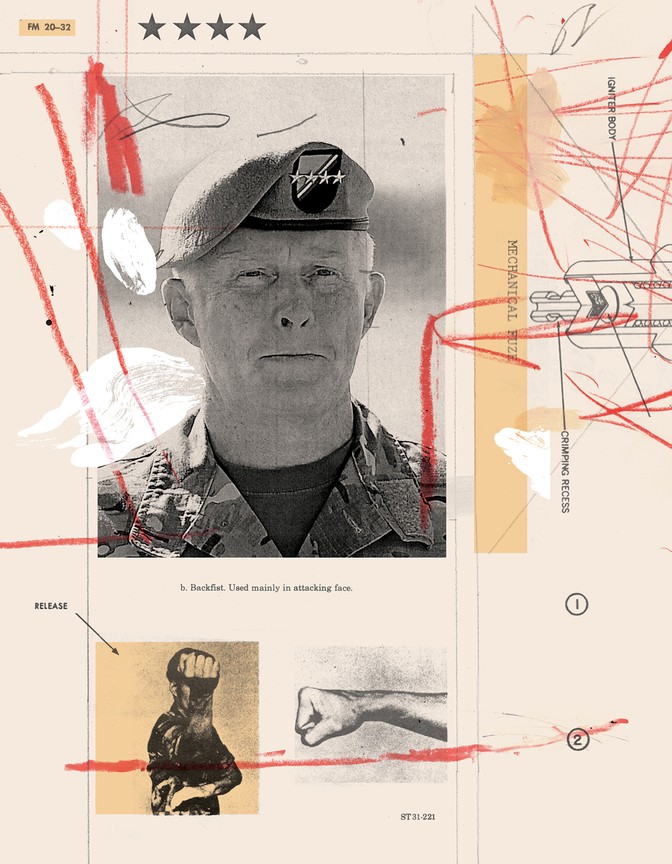
Gunplay was a possibility, so Thomas had a list of strict no-go scenarios, among them the presence of local police, Russian troops, or children. As Krstić’s vehicle neared, first a Russian convoy approached, then a local military-police vehicle. Both passed by. Finally a school bus rolled into the picture. The effort seemed snakebit. At last, on the screen, Thomas watched the school bus clear the zone, with only seconds to spare. “Execute!” he ordered. Krstić’s vehicle was caught in the net, and he was taken without incident.
Thomas would be teased about the episode: an entire Delta squad to capture a one-legged Serbian? What stuck with him was how much more useful the screen had been than his own two eyes. Without the overhead view covering the whole stretch of road, he would have aborted the mission. It occurred to him: This is where we are going in the future.
Live video feeds were just the beginning. When Stanley McChrystal took over JSOC, in 2003, the U.S. invasion of Iraq was eight months old. Special Ops teams were still hunting Saddam and other “high-value targets” when a new enemy arose: Abu Musab al-Zarqawi, a jihadist known as “The Sheikh of the Slaughterers.” His followers were setting off bombs in crowded places, attacking American soldiers, and kidnapping “infidels” and beheading them in horrific videos posted online.
McChrystal was known as a relentless striver. Gaunt, hollow-eyed, and intense, he was famous for his ascetic discipline. He turned his task force into the most efficient hunter-killer force in the world, and a model for the entire command. McChrystal is not Sun Tzu. But in sizing up his adversary and responding creatively, he remade JSOC, and ultimately SOCOM itself. He recognized that the ability to digitize information—audio files, video files, maps, texts, emails, phone calls, documents—could steer him rapidly to targets.
Like most innovations, McChrystal’s was resisted, including by SOCOM itself. He wanted to expand and alter his mission, adding an array of expertise—in some cases, requiring civilian contractors—that had nothing to do with traditional soldiering. He explained the situation to me in a way that both made his position understandable and underlined the institutional imperatives that push in one direction only. “Inside my command, there were a bunch of people saying, ‘We need to pull back to the States and wait until there’s a hostage rescue or something like that, and we’ll do our specialized mission,’ ” McChrystal said. “And I told them, ‘Hey, if we’re not here doing a significant part of this, we’re not going to be able to claim our elite status and be first in line for resources and priority.’ ” There was also resistance from agencies whose support he needed, notably the CIA, which balked at moving interrogators, analysts, software engineers, and imagery experts out from under their direct control. But McChrystal got what he wanted.
Hostage rescue, manhunting, search-and-destroy missions—these had become the U.S. military’s active pursuits worldwide. Other events secured SOCOM’s status. The most dramatic was the killing of Osama bin Laden, in Abbottabad, Pakistan, in 2011. After the CIA traced his location, a SEAL team penetrated Pakistan’s air defenses and hit his compound. Thomas was second in command on that mission, under JSOC’s Admiral William McRaven, who became SOCOM commander later that year. Despite his background leading shooters, McRaven promoted the softer side of the command, long a major part of its portfolio—the Green Beret teams of people who were familiar with local languages and cultures, knew how to build ties with communities, and had the diplomatic skills to serve as advisers rather than call all the shots.
That approach found a receptive audience in President Barack Obama, who was trying to crush emerging terror threats while at the same time lower American troop levels overseas. SOCOM’s small units would steer the battle against Islamist networks in Africa and Asia, working primarily through local armed forces. Its intelligence network and aerial assets would give Kurdish, Iraqi, and Syrian fighters an overwhelming advantage against ISIS. Utilizing SOCOM, the U.S. was still in the fight, just not openly in the lead, and no longer carrying the full load. This opened Obama to political attacks for “leading from behind,” which revealed a fundamental misunderstanding of the change under way. Happy to keep American forces below the radar, Obama was eager to act when the occasion was ripe. Thomas described Obama as “a junkyard dog” when it came to national security.
There is a risk in being admired by those in charge. During Thomas’s tenure as SOCOM commander, from 2016 to 2019, the scope of his responsibility grew at a pace he calls “frantic.” New tasks were given to his already swollen organization, grafted on like afterthoughts, even as Obama’s successor as president made several dramatic troop reductions or withdrawals, notably in Syria and Afghanistan. Donald Trump’s words and policies were unpredictable, but SOCOM’s mission continued to enlarge.
McChrystal saw it coming. He remembers attending a military conference in 2007. He ran into another predawn gym rat, a retired Navy SEAL, who lamented, “It’s just not like the old days, is it?”
“No,” McChrystal agreed. Then he asked, “What do you mean?”
“These guys just aren’t—” McChrystal thought he was about to say “heroes” but had stopped himself. “They’re not like we were.”
“What are you talking about?” McChrystal replied. “These guys are doing a hundred times more than we ever dreamed of doing, and doing it better.”
His friend seemed disappointed by the response, so McChrystal explained further: “It’s not just a few, you know, burly men anymore. Shit, this is a machine now. You and I don’t even know how to run it.”
* Lead image credit: Illustration by Mike McQuade; images from Leif Skoogfors; Rolls Press / Popperfoto; Corbis; Larry Burrows / Life Picture Collection; Joel Robine / AFP / Getty
* This article originally stated that a special Israeli unit stormed a hijacked airliner on the tarmac in Entebbe, Uganda, in 1976, to rescue hostages. In fact, the hostages were rescued from an airport in Entebbe.
This article appears in the April 2021 print edition with the headline “How Special Ops Became the Solution to Everything.”
There’s nothing more entertaining in public life these days, especially with Trump in retirement, than Tucker Carlson’s quarterly incitement of leftoid vitriol online. This week it was middle-aged generals acting like middle-school girls, after Carlson suggested on air that perhaps pregnant women are not the ideal candidate for combat roles in the military. To respond, military leaders, in uniform, published selfies on Twitter citing Carlson’s lack of military experience, the supposed unseriousness of his profession in comparison, his age, and many more peripheral, arbitrary, and mostly untrue aspects of his character and tone: anything but the actual merits of his point.
To borrow a jargony phrase from the academics who brought you the woke revolution, there’s a lot to unpack here.
First, Tucker’s broader point about the institutional feminization and relative unseriousness of the military was proven embarrassingly accurate by their own hysterical, social media-based response. How weak are the wokerati’s sacred cows, which can be slaughtered simply by pointing out their absurdity. And how venomous is the NPC vipers’ spittle-lipped “clapback.” It’s almost as if their career is built around toeing the line.
This brings us to another point: how thoroughly and successfully the lackeys of woke ideology have infiltrated the military: a historic institutional touchstone for conservatives. Any long-harbored illusions about the ideological imperviousness of the military, much like the judiciary, should be dashed by this moment. Frankly, it’s a shame that heartland boys keep joining up, imagining that whatever vestige of masculinity that remains will provide a path to honor and brotherhood, considering that the American military’s reigning ideology makes a mockery and an enemy of them. What better fodder for the endless wars than men you’d like to see dead anyway?
Finally, especially as a recently pregnant woman, the thing that strikes hardest about the entire discourse is the degree to which adult men are willing to completely ignore the fact of women and infant’s prenatal vulnerability. I’m not sure a meaningfully large contingent of our military needs a maternity flight suit, but to the extent that a woman requires such a thing, she is a delusional, malignant careerist and in a sane world would never find herself in such a position. That any one would condone the idea that a mother and child in that precarious period of both of their lives (or any part of their lives postpartum) should be anywhere near guns, helicopters, or big boom boom machines of any sort, let alone areas of the world known for rapist enemy combatants, demonstrates that there is something deeply wrong with their understanding of life itself.
We have forgotten why wars are ever fought in the first place. It’s understandable within the broader context of fighting pointless ones endlessly that America has lost the script. Lest we have forgotten completely: war is often about death for the sake of life. War is politics by other means, propelled by fear, honor, and interest, of course, but undergirding any classical definition is the fact that wars are fought so that a people can continue to exist how they please. Women, as conduits of new life in the world, have no place on the front lines of war because they are the thing—the precious, precarious, transcendentally beautiful and powerful channel for the continued existence of the species—that men will go to any lengths to preserve to ensure the honor of his legacy and his progeny. The happy warrior writes himself into the past so that his children may have a future.
Maternity flight suits are symptoms of the spiritually suicidal state. We are a nation of womanly men, mannish women, and disposable children. Those three have everything to do with one another. The culture of death marches on.