Category: The Green Machine
With a plethora of colorful nicknames, alcohol was widely abused in both Union and Confederate armies during the Civil War.
by David A. Norris
Union General Benjamin Butler was baffled. Every night a picket guard went to an outpost 1½ miles from Fort Monroe, Virginia. The soldiers departed for their shift perfectly sober, yet when they returned to the post the next morning they caused trouble “on account of being drunk.” Investigations failed to reveal the source of their whiskey. Searches of canteens and gear turned up nothing suspicious. But there was one odd thing about the detachment: someone in Butler’s command noticed that the men always held their muskets straight up in a peculiar manner. The mystery unraveled when their muskets were examined. “Every gun barrel,” wrote Butler, “was found to be filled with whiskey.”
Excessive drinking was a constant problem in both armies during the Civil War. “No one evil agent so much obstructs this army as the degrading vice of drunkenness,” wrote Union Maj. Gen. George B. McClellan in February 1862. “It is the cause of by far the greatest part of the disorders which are examined by court-martial.” The complete abolition of alcohol, he believed, “would be worth fifty thousand men to the armies of the United States.” And across the Mason-Dixon Line, the Norfolk Day-Book complained that Confederate enlisted men and officers in the vicinity were drinking whiskey “in quantities which would astonish the nerves of a cast-iron lamp-post, and of a quality which would destroy the digestive organs of an ostrich.”
Whiskey the Drink of Choice for Most Soldiers
Many if not most soldiers were already well acquainted with alcohol from the antebellum era. Whiskey was far and away the most popular drink in 1861. Often made from corn instead of grain, it was distilled at countless locations across the country. Popular nondistilled drinks included cider and beer. Cider, made from apples, was more common, but beer was quickly growing in favor, its rise fueled by the steady German immigration into Northern states.
Low-grade whiskey carried with it the threat of poisoning the drinker, so makers might start with clear alcohol, water it down, and then doctor the mixture to simulate the color and flavor of the real thing. Chewing tobacco, for example, helped approximate the amber tint of whiskey or brandy. Harsher ingredients added the bite that drinkers expected in their whiskey. An 1860 inspection of liquor samples in Cincinnati found whiskey containing sulfuric acid, red pepper, caustic, soda, potassium, and strychnine. It was no wonder that “rotgut” was the most prevalent nickname for cheap liquor during the era.
Countering the growth of alcohol consumption was the temperance movement, which sought to make all forms of alcoholic beverages illegal. Maine enacted a prohibition law in 1851. Several other states or territories passed dry laws in the following years. In most cases, these laws were repealed or overturned within a short time. Per capita consumption peaked in 1830 at an equivalent of 7.1 gallons of alcohol annually. A swift decline followed, with the annual per capita figure dropping to 2.53 gallons by 1860.
“Spirit Rations” Abolished
Alcohol still had an official presence in the U.S. Army in 1861. A daily spirit ration for American soldiers had been abolished in 1832, but officers were permitted to issue special servings of whiskey to relieve fatigue and exposure. Soldiers, naturally, had countless sneaky ways to obtain whiskey. While diligent officers could restrict the flow of whiskey into camp, soldiers could still drink when they received a pass to leave camp. In the Confederate Army, the phrase “running the blockade” meant slipping in and out of camp for illicit purposes, usually involving alcohol.
On February 27, 1862, the Confederate Congress passed a law allowing President Jefferson Davis to suspend habeas corpus and declare martial law in areas threatened by the enemy. Immediately, martial law was declared in Portsmouth and Norfolk, Virginia, followed by Richmond on March 1. Richmond came under control of the provost guards commanded by Brig. Gen. John H. Winder, who prohibited the manufacture of liquor and closed the city’s saloons. By then liquor sales had caused so much trouble and crime among Confederate soldiers and civilian that many in Richmond welcomed martial law. Winder also barred rail shipments of whiskey into the Confederate capital. Apothecaries were allowed to dispense liquor only with a doctor’s prescription.
Martial law did not stop the distribution of whiskey, but merely drove it underground. There were still countless cases of drunk and disorderly behavior, as well as arrests for illegal sales of alcohol. Corruption flourished among the provost guards, some of whom forged prescriptions for alcohol. After obtaining the liquor, they then arrested the apothecaries who had dispensed it, thus adding insult to injury.
A ‘Creature Comfort’ Care Package From Home
A great deal of whiskey was sent to army camps on both sides by well-meaning relatives back home. It was a common practice, especially among the Union soldiers, for families to send their loved ones packages of fresh, canned, or smoked food and other small creature comforts. Commanding officers quickly realized that a great deal of whiskey was also being smuggled into camp inside these care packages. General Butler later testified before Congress that a search of an Adams Express Company depot yielded 150 different packages of liquor in crates and boxes on their way to his command.
Every parcel intended for a soldier had to be opened and inspected by officers of his regiment or brigade. Union Private John D. Billings, in his classic memoir Hardtack and Coffee, recalled, “There was many a growl uttered by men who lost their little pint or quart bottle of some choice stimulating beverage, which had been confiscated from a box as contraband of war.” Billings noted some ingenious ways that innocent-looking gifts concealed whiskey. One favorite ruse was hiding a bottle of whiskey inside a well-roasted turkey. Whiskey bottles also came into Billings’ camp in tin cans of small cakes or in loaves of bread with holes cut in the bottom.
Smuggling whiskey in legitimate-looking containers with false labels was a common practice. A helpful sutler showed Butler several little bottles that supposedly contained hair oil packaged by a New York City firm. Instead, each bottle contained half a pint of whiskey, with a little olive oil on top. The bottles were sold wholesale at eight cents each, but soldiers paid 25 cents for them in camp. The distributor claimed to have sold thousands of such bottles at Fort Monroe.
Alcohol Restrictions Lead to Officer Impersonation
In February 1863, the Union guard boat Jacob Bell searched the supply schooner Mail at Alexandria, Virginia. Aboard the schooner were 428 dozen cans labeled “milk drink” packaged by Numsen, Carroll & Company, a Baltimore firm. Upon closer inspection, Lt. Cmdr. E.P. McCrea learned that the milk drink was actually “villainous eggnog.” Commodore Andrew Harwood noted that the cans were not soldered in the usual way. The top and bottom had been heated with a resinous substance and the edges bent over so that the cover at either end could be removed to convert the can into a drinking cup. Harwood issued orders to the Potomac Flotilla to seize any vessel caught smuggling alcohol.
Sutlers were in a good position to profit from liquor sales. Regulations prohibited them from selling liquor to enlisted personnel, but many of the officially licensed merchants evaded the rules. Sutlers could openly stock whiskey because they were still allowed to sell it to officers. Brassy enlisted men frequently borrowed a pair of officers’ shoulder straps and purchased whiskey in the shops. Others stole bottles from sutler huts, wagons, or tents.
Impersonating an officer was only one of the many ways that Union and Confederate soldiers managed to get around the rules restricting their drinking. Assignment to guard duty also provided opportunities for mischief. In eastern North Carolina in April 1862, several men in the 51st Pennsylvania were ordered to guard the commissary tent in which a newly arrived shipment of whiskey barrels was stored. One night the guards took the barrels off their muskets. After unscrewing the breech plugs, each soldier had a long iron straw, which he inserted into the bung-hole of a whiskey cask and sucked himself into intoxication.
Among the busiest routes for smuggling alcohol to the Union Army was the Long Bridge, which crossed the Potomac River, linking Washington, D.C., to Virginia. On November 23, 1863, all contraband liquor seized on the bridge was turned over to the Army Medical Museum, located not far from the Washington end of the bridge. At the time, tissue specimens saved for the museum were wrapped in cloth and preserved in a keg of alcohol or whiskey. Each specimen was identified by a small wooden block, with a description written on it in pencil so that the alcohol would not dissolve the writing. Confiscated liquor was distilled again by the museum into uniform grade 70 percent alcohol, which was deemed perfect for preserving specimens.
Liquor Smuggling Gets More Sophisticated
Surgeon John H. Brinton recalled that ground around the museum was piled high with “kegs, bottles, demijohns, and cases, to say nothing of an infinite variety of tins, made so as to fit unperceived on the body, and thus permit the wearer to smuggle alcohol into camp.” Another medical officer, Acting Assistant Surgeon Ralph S.L. Walsh, marveled at the ingenuity of liquor smugglers. Goods confiscated for the museum, ranging from blackberry wine to straight alcohol, were packed in many peculiar vessels. Frequently women were arrested with belts under their skirts to which were fastened tin cans holding between a quart and a gallon of whiskey. In a number of cases the women sported false breasts, each holding a quart or more of contraband liquor. Guards seized so much alcohol at Long Bridge during the war that the Army Medical Museum had enough alcohol for its specimens until 1876.
In many camps sutlers were allowed to sell patent medicines. Often these remedies were nothing more than liquor flavored and tinted with herbal concoctions. Countless posters and newspapers touted the healing power of bitters, liquor strongly flavored with herbs. Some medicinal bitters were served as drinks in saloons. The highly advertised Drake’s Plantation Bitters, which blended herbs with St. Croix rum, was enormously popular at sutler tents.
“Snake Smuggling”?
Lieutenant Luther Tracy Townshend, the adjutant of the 16th Vermont, was also the president of the regimental temperance society. Once, in the absence of the regiment’s sutler, it fell to Townshend to order a shipment of necessities and luxuries for the troops. Some of the men persuaded Townshend to order several cases of Hostetter’s Bitters to help soldiers who were suffering from chills. The merchandise soon arrived in their camp in Louisiana. As Townshend reported, “Some of the men, who were more chilly than the others, took overdoses and in consequence became staggeringly drunk.” Only then did the mortified adjutant learn that Hostetter’s Bitters was almost pure whiskey.
An exception to the ban on sutler sales of alcohol to enlisted personnel existed in some German units of the Union Army. Brig. Gen. Louis Blenker, for one, ordered sutlers to sell beer to the soldiers of his brigade, who were predominantly German immigrants, to keep up their morale. His orders caused resentment among non-German units, although this was mollified by sutlers selling beer to soldiers outside the brigade.
Perhaps the most creative dodge was used by a soldier of the 11th Ohio, who killed a snake and, in the words of a marveling comrade, “carefully dissecting the varmint obtained a long, white cartilage, which he carefully cleaned and coiled up. Proceeding to the hospital, he politely requested a small quantity of spirits in which to preserve the curiosity (which he represented as a tape worm). The surgeon not only agreed, but complimented the man highly for the interest he manifested in natural science!”
Whiskey abuse was not confined to land-based armies. Both Union and Confederate navies faced abuses of their own. In the 18th century the British Royal Navy routinely issued a ration of spirits, usually rum, to enlisted personnel. Originally the ration was eight ounces of distilled spirits per day. Naval rum was diluted with water, resulting in the traditional drink called grog. The practice was associated with Admiral Edward Vernon, a famed officer of the mid-1700s whose service nickname was “Old Grog” because he wore a coat made of grogham cloth. (Laurence Washington, George Washington’s older brother, served with Vernon. When Laurence died, George inherited his plantation Mount Vernon, which had been named for the admiral.)
Alcohol Smuggling in the Continental Navy
The Continental Navy, as well as the early U.S. Navy, adopted the British ration of half a pint of grog per day. Before the War of 1812, imported rum from Britain’s Caribbean colonies was dropped in favor of American-made whiskey. Despite the switch, sailors and the general public continued calling the naval ration grog. On land, lower class saloons were called grog-shops or groggeries. Aboard ship, the crew’s barrels of whiskey and the officers’ private stores of liquors and wines were kept locked up in the “spirit room.” At the captain’s discretion, extra rations of spirits were doled out before and after action, or even during a battle. During the long fight with CSS Virginia, the crew of USS Monitor was braced by a special issue of two ounces of whiskey per crewman.
Captains also issued extra liquor as a reward for hard work such as the tedious and backbreaking job of loading coal aboard steam warships. Confederate sailors outfitting Sea King, which was secretly being converted at sea into CSS Shenandoah, received a serving of grog every two hours. Mariners saw the spirit ration as well-deserved compensation for their long months of hard work and isolation at sea. With some reason, temperance advocates saw it instead as a severe problem and focused considerable effort on luring sailors away from the bottle. In 1832 reformers persuaded Congress to cut the naval ration to one gill, or four ounces, daily. Sailors under the age of 21 and anyone who chose not to draw a spirit ration received instead a small cash commutation, which had risen to five cents a day by 1861.
After reducing the naval grog ration, Congress debated but did not act further on the temperance movement’s demands for tighter restrictions. A chance to end the grog ration arose again when Southern members of Congress left the nation’s capital after the beginning of the war. Northern representatives and senators were more sympathetic to the temperance cause, and with Southern seats now vacant, there were enough Northern votes to abolish the naval spirit rations. A July 14, 1862, act of Congress set August 31 of that same year as the last day for the grog ration. A correspondent aboard an unnamed vessel wrote to the Philadelphia Press that Congress had made a great mistake. He warned that ending the spirit ration would drive all the old seamen out of the service. Aboard the receiving ship North Carolina in New York City harbor, the men met the restriction with muttered growls, but no signs of incipient mutiny were readily apparent.
Kegs Auctioned Off & Turned In To Medical Staff
Spirit kegs remained under lock and key until naval vessels returned to port. About 3,000 kegs were auctioned off and others were turned over to the naval medical service for hospital use. Excess whiskey in the North Atlantic Blockading Squadron was stored aboard the aptly named ship Brandywine. As compensation for the loss of the spirit ration, the Navy added five cents per day to sailors’ pay, a raise of between 8 and 10 percent. Despite the banning of grog, there was still some alcohol aboard Union naval vessels. “Distilled spirituous liquors” were allowed on board ship as medical stores. And officers, trusted by Congress more than common sailors, were still allowed to have private stores of liquors and wines.
Grog was served in the Confederate Navy as well. Rebel tars were entitled to one gill of spirits or half a pint of wine per day. As in the Union Navy, a small cash commutation was paid to sailors not taking their spirit ration. Confederate Navy officials had considerable trouble obtaining enough spirituous liquor for rations and hospital use. Naval requirements clashed with state regulations that reserved corn and grain for food rather than distillation of spirits. Eventually a distillery was set up in Augusta, Georgia, to produce whiskey for naval use. Despite the trouble in obtaining liquor, the Confederate Navy never got around to banning its spirit ration, and it remained on the books until the war ended in 1865.
Illicit alcohol resulted in a number of embarrassing incidents at sea. Midshipman James Morris Morgan, in his memoir Recollections of a Rebel Reefer, wrote about an alcohol-fueled riot on the cruiser CSS Georgia in October 1863. Sailors slipped into a coal bunker and bored through a thin bulkhead separating the coal from the spirit room. Then they drilled a hole into the head of a barrel of liquor and inserted a lead pipe. The pilfered grog was distributed among the crew, said Morgan, “and soon there was a battle royal going on the berth deck which the master-at-arms was unable to stop.” Georgia‘s first lieutenant went below and induced most of the men to give themselves up for punishment. One holdout defied the officers, but Morgan tackled him and the master-at-arms handcuffed him. Several crewmen were placed in irons and sentenced to a spell in the brig on bread and water.
Whiskey As Spoils of War
The British blockade-running schooner Sting Ray, under the command of a Captain McCloskey, was captured in the Gulf of Mexico by USS Kineo on May 22, 1864. An acting ensign with a prize crew of seven men took charge of the vessel and followed in Kineo‘s wake. McCloskey produced a stash of whiskey and offered it to the prize crew. By the time Acting Ensign Paul Borner realized what had happened his men were so drunk that they were unable to get back on deck without assistance.
Borner locked the hatch to keep the men from getting any more whiskey, but McCloskey and his crew jumped Borner, took his pistol, and reclaimed the ship. Union sailor William Morgan fell overboard, and McCloskey tossed a spar into the sea as an improvised life preserver. Another man jumped into a ship’s boat, cut the painter, and escaped. The Confederates followed Kineo for a time before changing course and making a dash for shore. Seeing Sting Ray change course, Lt. Cmdr. John Watters of Kineo opened fire with a 20-pounder gun. McCloskey managed to beach the vessel after dodging several Union shells. Borner and five of his sailors were captured by the 13th Texas. Only two of Borner’s crew avoided capture and were picked up later by Kineo. Morgan, according to Watters, was “in a beastly state of intoxication, crazy drunk and howling.”
Doctors at the time incorrectly believed that alcohol was a stimulant, so they prescribed it to treat sick or wounded soldiers. Some drugs were soluble in alcohol, and patients received them in doses with whiskey or brandy. One treatment for diphtheria was a dose of brandy mixed with ammonia. Alcohol itself was seen as having curative powers for some illnesses. Laudanum, a mixture of alcohol and opium, was a widely prescribed painkiller. Ether was made by distilling alcohol and sulfuric acid, called “spirits of nitre.” A purer form of alcohol called alcohol fortius was used to make ether and to dissolve various compounds.
A Prized Commodity in Medical Treatment
Whiskey or brandy, either alone or mixed with other ingredients, were routinely used to treat patients suffering from wounds or illnesses. Usually whiskey was prescribed in frequent but small doses, perhaps one ounce or one tablespoon every few hours. Sometimes it was administered by itself, but it might also be mixed in eggnog or milk punch. One example concerned the case of Private Augustus C. Falls of the 1st New York Heavy Artillery. Falls was admitted to Douglas Hospital in Washington with diarrhea on August 5, 1864. A surgeon prescribed 11/2 ounces of whiskey each day at dinner. Three days later the dosage was raised to two ounces of whiskey three times a day. On September 29, the dosage was again increased to three ounces of whiskey every four hours. Despite the special treatment, Falls died on October 5.
One of the few effective drugs of the era, quinine, could prevent malaria or ease symptoms for patients who already had the disease. Soldiers often balked at taking their malaria medicine, though, because of its markedly bitter taste. To cajole soldiers into taking quinine, some surgeons mixed it with whiskey. This created the opposite problem; some soldiers enjoyed the quinine-whiskey dose so much that they sneaked through the line for a second prescription. While stationed at New Bern, North Carolina, the men of the 44th Massachusetts found that their medical officers took precautions to limit the soldiers to one dose each. Instead of serving quinine in whiskey, the drug came blended with medical alcohol, water, and cayenne pepper. “No soldier,” wrote a veteran of the regiment, “is known to have acquired a dangerous hankering for the mixture.”
Guilty on Charges of Drunkenness
Southern medical officers struggled to obtain sufficient quantities of medicinal alcohol. Surgeon General Samuel P. Moore established distilleries in Montgomery, Columbia, Salisbury, and Macon to produce medicinal alcohol. Volunteer committees gathered food, clothing, medicines, and creature comforts from civilians and shipped them to military hospitals. On November 22, 1861, the Charleston Mercury highlighted the first quarterly report of the city’s Ladies’ Christian Association. Among numerous shipments sent by the association to hospitals in Virginia were 34 boxes or crates of alcoholic beverages, including wine, brandy, blackberry brandy, claret, Madeira, port, whiskey, ale, bay rum, and additional alcohol in the form of medicines and bitters.
Drunkenness could be overlooked if it occurred when a soldier was off duty and did not compound his offense with other crimes. Court-martial of officers charged with drunkenness was handled differently from those of enlisted men. Officers found guilty could be cashiered with forfeiture of pay. In addition to dismissal, a Confederate law of 1862 allowed a public reprimand of officers convicted of drunkenness. An officer dismissed from the Confederate service could also be conscripted back into the ranks as an enlisted man. Enlisted personnel found guilty of drunkenness usually faced some form of confinement, corporal punishment, or public shaming. Penalties varied depending on the degree of the soldier’s offense and the policies of his commanding officer. Common punishments for drunken enlisted men included confinement in a guard tent or guardhouse, wearing a barrel with a placard noting that the culprit was a drunk, extra duty, or a spell carrying a log or marching with a knapsack filled with rocks.
Generals were not immune from abusing alcohol. Indeed, their vast responsibilities encouraged such abuse. Most notoriously, rumors of alcoholism dogged Union General Ulysses S. Grant. After Grant’s capture of Vicksburg, several gentlemen warned President Lincoln that Grant drank to excess. Lincoln was said to have asked what sort of whiskey Grant drank, because “if it makes him win victories like this Vicksburg, I will send a demijohn of the same kind to every general in the army.”
Generals Just As Guilty As Their Soldiers
A serious instance of generals drinking on duty contributed to the Union defeat at the Battle of the Crater on July 30, 1864. After successfully detonating a huge explosion in a tunnel dug under the Confederate lines outside Petersburg, Union forces moved in to exploit the break in the Rebel defenses. Brig. Gens. James H. Ledlie and Edward Ferrero remained behind the lines drinking liquor in a bombproof while their neglected divisions floundered without guidance from their commanders. The attack, which had the potential of taking Petersburg and shortening the war, bogged down, and the Union regiments were devastated by Confederate counterattacks. After investigations into their drinking and dereliction of duty, Ledlie was allowed to resign from the army, but Ferrero escaped serious penalty. He even managed to be brevetted to major general before the end of the war.
Offenses were not limited to line officers. Confederate hospital matron Phoebe Yates Pember wrote of one case in which a drunken surgeon treated a patient whose ankle had been crushed by a train. After the injuries were set and bandaged, the soldier remained in excruciating pain and his condition worsened. Checking the patient, Pember found that the bandaged leg was perfectly healthy, while the other leg was “swollen, inflamed, and purple.” The attending surgeon had been so drunk that he set the wrong leg. Fever set in and the patient died at the hospital.
Plagued with food shortages, inflation, and transportation problems, Southern soldiers and civilians dealt with severe shortages of alcohol caused by state legislatures restricting the use of grain, corn and foodstuffs for distilled liquor. Private distilling took a blow after the Federal capture of Chattanooga in September 1863 and advancing Union forces captured copper mines desperately needed by the South. Not only did their loss crimp production of brass artillery pieces, it also threatened the manufacture of percussion caps and artillery friction primers. The Confederate Ordnance Bureau confiscated scores of copper whiskey stills in western North Carolina. Metal from the stills went into many of the South’s percussion caps made during the remainder of the war.
Persimmon Brandy & Other Homemade Recipes
Southern blockade runners brought wine, whiskey, brandy and other potables from Europe. Less popular than wine and brandy, but still showing up in blockade runner holds, were rum, gin, Scotch whisky, champagne, ale, porter, and schnapps. Occasionally one might even find imported cut glass decanters to serve the imported liquors. Pure alcohol, intended as medical supplies, also passed through the blockade. Blockade-run liquor was beyond the financial means of most Confederates, forcing many people to turn to home-made substitutes. Despite wartime laws, some corn and grain found their way into whiskey. When these standard ingredients were not available, distillers turned to sweet potatoes, rice, sorghum seeds, and persimmons.
On October 21, 1863, the Charleston Courier published a recipe for persimmon brandy. Mashed by a pestle or simply with one’s hands, persimmons were mixed with warm water and left to ferment for five or six days. Then the mash was ready for distillation. In thrifty fashion, the writer suggested saving the persimmon seeds. They could be used for buttons, or parched and mixed with dried sweet potatoes to make a coffee substitute. Beer and wine were simpler to make at home than whiskey, as they needed no distilling apparatus. Newspapers published numerous recipes for persimmon beer. Wine and brandy were made from any kind of available fruit, including peaches, pears, cherries, blackberries, plums, and even watermelons.
F.P. Porcher’s 1863 work Resources of Southern Fields and Forests listed uses for hundreds of plants that grew in the Confederacy. He gave recipes for making beer from corn, persimmons, and boiled sassafras shoots. Blackberries could also be used to make wine, and with the addition of spices and whiskey, a healthy cordial could be concocted. Porcher also mentioned dozens of medicines that could be prepared from native herbs added to whiskey, wine, or brandy. Another way of coping with the lack of alcohol was to make a joke of it. By early 1864, “starvation parties” were becoming a fad in Richmond. Attendees wore the best finery they could manage. Unlike antebellum parties, there were no imported wines or liquors. The fine punchbowls and glassware remaining from the days before the war held only water from the James River.
Robert E. Lee once remarked that it was not possible to have an army without music. He might just as well have said that it was not possible to have an army without whiskey. Whether serving as an innocent aid to relaxation, medication to treat wounds or disease, or a lure to the evils of vice and desertion, whiskey and other types of alcoholic beverages were firmly rooted in the armies of the 1860s. The many creative ways alcohol found its way to soldiers and sailors, and the methods used to control its influence, are intertwined with the story of battles, generals, regiments, and ships of war.
Offenses were not limited to line officers. Confederate hospital matron Phoebe Yates Pember wrote of one case in which a drunken surgeon treated a patient whose ankle had been crushed by a train. After the injuries were set and bandaged, the soldier remained in excruciating pain and his condition worsened. Checking the patient, Pember found that the bandaged leg was perfectly healthy, while the other leg was “swollen, inflamed, and purple.” The attending surgeon had been so drunk that he set the wrong leg. Fever set in and the patient died at the hospital.
For Some, Private Distilling Filled the Gap
Plagued with food shortages, inflation, and transportation problems, Southern soldiers and civilians dealt with severe shortages of alcohol caused by state legislatures restricting the use of grain, corn and foodstuffs for distilled liquor. Private distilling took a blow after the Federal capture of Chattanooga in September 1863 and advancing Union forces captured copper mines desperately needed by the South. Not only did their loss crimp production of brass artillery pieces, it also threatened the manufacture of percussion caps and artillery friction primers. The Confederate Ordnance Bureau confiscated scores of copper whiskey stills in western North Carolina. Metal from the stills went into many of the South’s percussion caps made during the remainder of the war.
++++++++++++++++++++++++++++++++++++++++++++
I of course never, ever drank any kind of booze when I was in! Grumpy
The M1 Abrams was conceived with a singular, unyielding purpose: the total destruction of enemy armored formations. Over the last four decades, it has become the absolute pinnacle of tank warfare made manifest.
Its sheer battlefield dominance has not only won conflicts, but forced militaries across the globe to fundamentally rewrite their combat doctrines when it comes to both employing and defending against armored units.

From spearheading the rapid collapse of the Iraqi regime in the famous “Battle of 73 Easting” to maintaining overmatch and superiority in all manner of theaters worldwide, the Abrams has spent generations striking fear into the enemies of the Free World. As a tank crewman who has served on every position of the M1 Abrams in the U.S. Army, let me be the first to tell you: that fear is well-deserved.

While there have been many changes since the first 105mm M1 rolled off of the assembly line, its core identity remains exactly the same. Its familiar silhouette hasn’t changed much over the decades, but that familiarity should not be mistaken for stagnation. The current iteration, the M1A2 SEPv3, proves the platform’s enduring supremacy.
Make no mistake: underneath that recognizable steel carapace lies a heavily upgraded, cutting-edge war machine that remains the pinnacle of armored technology, lethality, and protection available anywhere in the world.
Genesis & Evolution
Born from the ashes of a failed U.S./West German joint venture in the 1960’s, the United States eventually realized it needed its own independent, uncompromising design to hold the Fulda Gap against any Soviet incursions into the rest of Europe. The result of this realization was the M1 Abrams. Entering service in the 1980s with a 105mm rifled gun, it was a war machine purpose built for what is referred today as Large Scale Combat Operations (LSCO).

As the threat evolved, so did the Abrams. The first step of that evolution was the M1A1. This model introduced the much more powerful 120mm smoothbore cannon that is still used today. This power was demonstrated to the world firsthand during Operation Desert Storm.

Riding high off of the positive waves of absolute victory from Desert Storm, the M1A1 gave birth to the M1A2, which ushered in the digital age of armored warfare. Advanced fire control networks and independent thermal sights for both the tank commander and the gunner are now staples in the armored community, but they were cutting edge and game changing at the time.

During the Global War on Terror, the Abrams was forced to change its identity. Gone were the days of facing down enemy tank battalions.
Now was the time of counterinsurgency (COIN) and urban warfare. Upgrade kits like the Tank Urban Survival Kit (TUSK) and System Enhancement Packages (SEP) facilitated that evolution and allowed the Abrams to adjust as needed to the mission at hand.
However, times and missions have changed once again: COIN is out and LSCO is back in. The M1A2 SEPv3 showcases a definitive return to the Abrams original mission and purpose: complete domination over near-peer adversaries on the battlefield.
Upgraded with enhanced power generation, an Ammo Data Link (ADL) with programmable munitions, and reinforced armor capable of defeating modern anti-tank guided missiles, the SEPv3 ensures the Abrams remains the apex predator in the conventional battle space.
Lethality and Firepower
The first thing any apex predator is judged by is the size of its teeth, and the Abrams possesses some of the sharpest teeth in the game. The combat-proven 120mm M256 smoothbore cannon strikes fear into enemy armor commanders worldwide, and for good reason. The SEPv3 pairs that cannon with an upgraded Fire Control System (FCS) with state-of-the-art, third-generation Forward Looking Infrared (FLIR) day and night optics for both the gunner and tank commander.
This enables true “hunter-killer” capability, allowing the commander to scan for new targets while the gunner engages the current one. The tank can carry up to 43 main gun rounds: 18 in the ready rack behind a mechanized blast door, 18 in the semi ready rack, six in hull storage, and one battle-carried in the tube.

Not every target is going to require a 120mm sized one-way-ticket to hell, so that’s where our secondary armament comes in. A 7.62mm M240 coaxial machine gun sits right next to the main gun, supported by an immense 11,400-round combat load.
The loader’s station features a skate-mounted M240, while the commander operates a .50-cal. machine gun mounted on a Low Profile Common Remotely Operated Weapon Station (CROWS-LP). The CROWS-LP is a massive upgrade for crew survivability, allowing the commander to accurately fire the machine gun using a joystick and screen from the safety of the turret interior.
Armor & Survivability
The SEPv3 features the latest generation of depleted uranium composite armor, offering unparalleled kinetic and chemical energy protection. However, the most significant survivability upgrade against modern threats is the integration of the Trophy Active Protective System, more commonly referred to as the “trophy system”.

The trophy system utilizes radar arrays mounted to the exterior of the tank to detect incoming Anti-Tank Guided Missiles (ATGMs) and rocket-propelled grenades, automatically launching a counter-measure to intercept and destroy the projectile before it impacts the vehicle.
Communications
While the internal networking isn’t the most glamorous aspect of the tank, it is absolutely critical for modern maneuver warfare. The SEPv3 completely overhauls the tank’s digital architecture. It builds upon the situational awareness provided by Joint Battle Command-Platform (JBC-P), allowing the crew to track friendly and enemy forces in real-time on digital maps.

The physical integration of these systems is streamlined through Remote Switching Modules (RSMs), which efficiently distribute power and data across the platform, eliminating the need to completely gut and rewire the tank for future upgrades.
Mobility and Power Generation
The SEPv3 is propelled by the iconic Honeywell AGT1500 gas turbine engine.
Delivering 1,500 horsepower, it can push the tank to a listed top speed of 42mph on paved roads (however I can neither confirm nor deny having gotten one to over 60mph going down a massive hill at Fort Benning as a Private). Keep in mind, this vehicle weighs more than 70 tons.

To support the massive electrical draw of these new systems, optics and networking devices without constantly running the turbine engine, the SEPv3 comes with a factory installed Auxiliary Power Unit (APU). Older model tanks had after-the-fact APUs mounted in the exterior bustle racks of the turret, but this took up valuable storage space and left it vulnerable to enemy fire. This new APU is co-located with the turbine engine in the hull of the tank, giving it valuable armored protection. The APU allows the crew to run all electronic systems in a silent watch mode while preserving main engine fuel and minimizing the tank’s thermal and acoustic signatures.
Peer Comparison
When stack ranking the SEPv3 against the rest of the world, the dividing line ultimately comes down to doctrine. Eastern designs tend to favor a smaller silhouette and lower weight, while Western designs prioritize crew survivability and sustained fighting capability.
The Adversaries
Russia’s T-90 and China’s Type 99A share a fundamental difference in combat philosophy from the Abrams. Both utilize a 125mm main gun fed by an autoloader, reducing the crew to three men. This allows for a lower profile and lighter weight (50 tons to the Abrams’ 70), but it makes these changes in exchange for the acceptance of a few fatal flaws.

The Russian reliance on the carousel autoloader stores ammunition directly in the crew compartment. Once a penetrating hit detonates that ammunition, the crew and tank are instantly destroyed, typically with the turret being cast into the air like a toddler throwing a toy. This is referred to as the “Turret Toss Olympics” in the armor community.

The Abrams’ manual loader, combined with the isolated ammo compartment, mechanized pneumatic blast door and blowout panels, ensures that a similar hit usually leaves the crew alive. Furthermore, the lack of a fourth crew member in the T-90 and Type 99 degrades the crew’s ability to execute tasks like track maintenance, pull security, or manage fatigue during continuous operations.
The Allies
NATO allies’ design philosophy and doctrine tend to align closely with the United States and the Abrams, featuring heavily armored treaded dreadnoughts with four-man crews.

Germany’s Leopard 2A7V is the closest thing the Abrams has to a cousin. The M1’s 120mm cannon is a derivative of the same Rheinmetall gun used in the Leopard 2. The primary divergence between the two vehicles is their means of propulsion. The Leo uses a diesel powerpack rather than a gas turbine. The diesel is more fuel-efficient, but lacks the immediate, drag-strip torque and multi-fuel flexibility of the Abrams AGT1500 turbine.
The UK’s Challenger 2 is renowned for its focus on crew protection and survivability, which is shown in its development and implementation of their highly classified Dorchester armor. The Challenger 2 uses a 120mm rifled gun, but the Challenger 3 will be switching to a 120mm smoothbore cannon, just like the Leopard and the Abrams. This aligns their lethality doctrine directly with that of the USA and Germany, standardizing ammunition logistics across allied armor formations.
The Operator’s Perspective
Allow me to be crystal clear: while being a part of the Abram’s crew is the best job I ever had, it is by no means a walk in the park. It is brutally physically and mentally demanding. You are living, eating, and sleeping out of a mechanized steel coffin, manhandling 120mm tank rounds the size of an adult human leg that weigh 50 pounds each. The sheer kinetic toll of maintaining a 73-ton war wagon and its weapons is intensive to say the least.

The technology inside the SEPv3 is incredible, but it doesn’t make the work effortless. In fact, it just changes the nature of the difficulty. For the Tank Commander, the main challenge is command and control. He must process a massive influx of digital data from his JBC-P and radios while directing his tank and his crew.

The Gunner has to manage the advanced Fire Control Systems, toggle optics, laser targets and conduct fire commands under extreme pressure. The Loader does more than just slam rounds into the breech. They are the ultimate multitaskers who have to balance loading the gun/coax, managing the radios, manning his M240 and assisting the TC/gunner in target acquisition.

The Driver has to execute tactical maneuvers in a massive treaded vehicle from a reclined position with an incredibly limited field of view. This requires constant vigilance to avoid accidents, such as throwing a track or burying the tank in soft terrain.

Furthermore, the Army’s doctrinal shift from counterinsurgency back to Large Scale Combat Operations has been a hard transition for some. Retraining the muscle memory from urban patrols and route clearance to fast-paced, peer-on-peer armored maneuver warfare is a massive undertaking.
Conclusion
But at the end of the day, when the line-of-departure is crossed, the exhaustion fades away. The SEPv3 and its weapons are the absolute best in the world, and they are crewed by the best army in the world.

The Abrams stands as the ultimate refinement of a legendary machine. It is a 73-ton masterclass in firepower, protection, and maneuver warfare. That being said, no platform can defy the limits of physics forever.
Recognizing the unsustainable weight of constant bolt-on upgrades, the Army has pivoted toward the M1E3. Drawing inspiration from the recent AbramsX tech demo, this generation will shed tons in weight, embracing a hybrid-electric drive, unmanned turret, and built-in active protection to counter the drone and missile-saturated battlefields of the future.
Tomorrow will get here eventually, but until it does, we have today thoroughly taken care of. If a nation needs to shatter enemy lines and dominate the ground domain, the M1A2 SEPv3 is the undisputed best tool for the job. It is the sharpest tip of the longest spear, ensuring the nations who use it and the tankers who crew it will continue to dictate the terms of armored warfare for years to come.
Categories
The Army’s Cavalry Hat
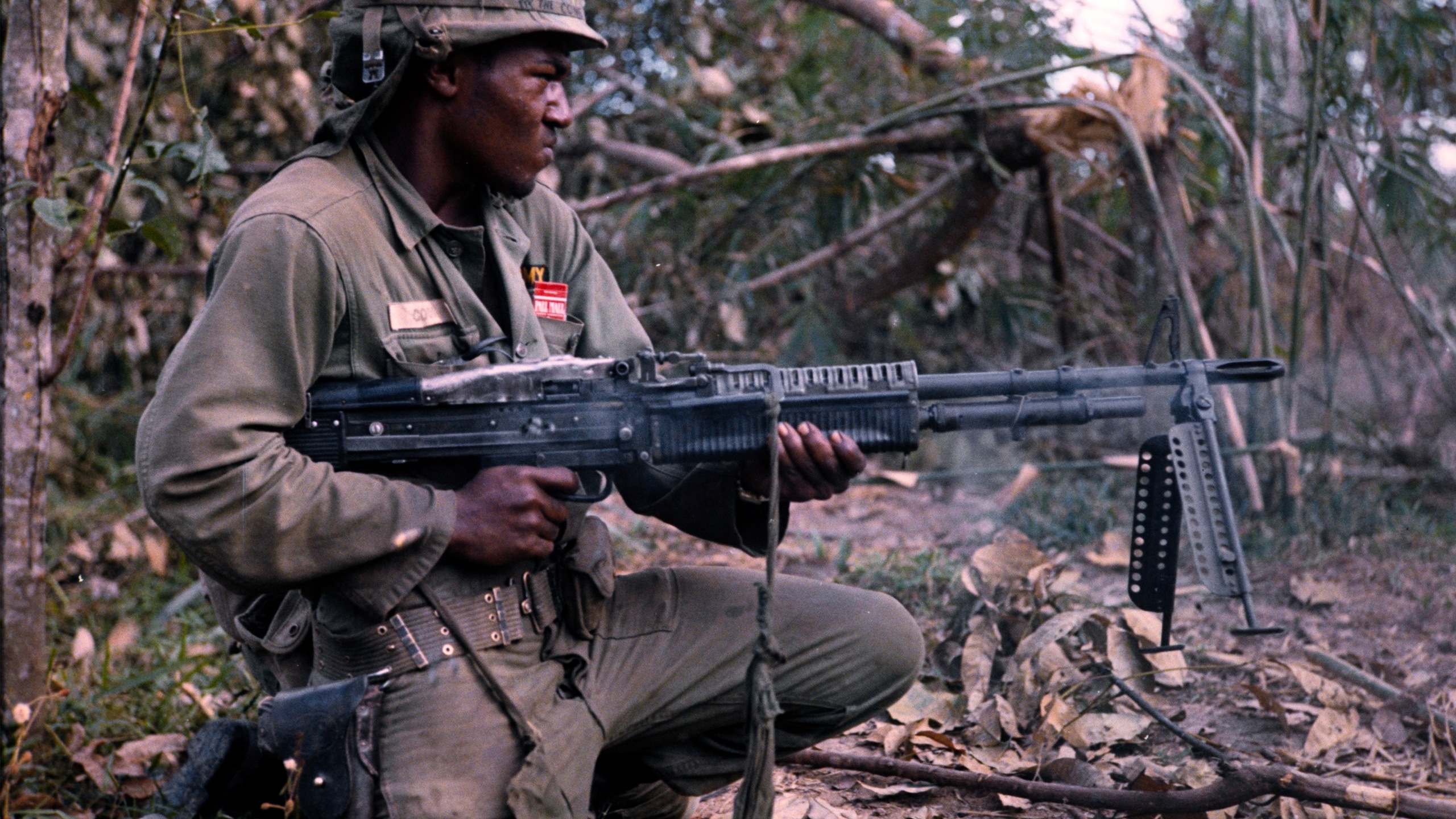 I was six feet tall and 163 lbs. without a gram of extraneous body fat. Though I didn’t enjoy it, I did a weekly 10k run with my mates in boots with a rucksack and M16. I was in the best physical condition of my life and believed myself to be both bulletproof and immortal. Then I met the Pig.
A proper 15-mile forced march was about the hardest thing I have ever done. On this particularly fateful day, I don’t recall whose dog I had inadvertently kicked to deserve what happened to me. This was, however, the day I got tagged to lug the Pig.

The “Pig” was the M60 belt-fed General Purpose Machine Gun (GPMG). Back in my day, we used M60’s as SAWs (Squad Automatic Weapons). Nowadays, our 5.56mm SAWs are relatively lightweight, portable and mean. By contrast, the Pig weighed 23 lbs. empty and fired a 7.62x51mm round the size of my little finger. The Pig would cut through walls, chew through ceilings, ventilate cars and reach out to truly serious ranges. It was, however, indeed still a pig. At the end of that horrible road march, I thought I’d died.
Origin Story
The M60 GPMG wanted so badly to be awesome. Rising from the ashes of World War II, the M60 reflected the U.S. Army’s effort at developing a truly state-of-the-art light machine gun. We fought the Second World War with the Browning M1919A4. This beast ran like the Energizer bunny, but it weighed 31 lbs. and was a veritable mass of sharp corners. The M1919A4 was also designed to be fired off of a separate M2 tripod, an awkward piece of kit that itself weighed another 16 pounds. The subsequent M1919A6 tried to morph the gun into something more portable, but it was yet a pound heavier. We could do better.

The M60 began life as the experimental T44. In what has got to be the coolest job in the history of jobs, American firearms engineers took the belt-fed mechanism from a captured German MG42 and grafted it onto the action of an FG42 paratroop rifle. The resulting frankengun served as the basis for the M60 action.
The M60 orbited around a stamped steel receiver for both economy and weight management. The Germans had shown the world with their MG42 that you could indeed stamp out a GPMG that was rugged enough to thrive on the modern battlefield. Though M60 receivers were ultimately found to stretch a bit, this part of the design performed fairly well.

The M60 featured a gas piston-driven action that fed ammunition in M13 disintegrating links solely from the left. The gun fired from the open bolt and was exceptionally simple to operate. Lock the bolt to the rear, put the gun on safe, open the top cover, and place the ammunition belt in the feedway link side up or “brass to the grass.” Close the top cover, point the gun at something you dislike, flick the safety off, and squeeze. Repeat as necessary. As seems always to be the case, however, the devil was in the details.
The M60 was an air-cooled design intended for sustained fire applications. Running lots of belt-fed rounds through a machinegun creates astronomical amounts of extraneous heat. Getting rid of all that thermal energy is the Achilles heel of any sustained fire weapon system. The generally accepted solution on a gun like the M60 is a quick change barrel system.

You can cut spirals or flutes into a barrel to increase its surface area and subsequently its capacity to dissipate heat. However, if you want this thing to shoot for a while you need mass. Making your barrels heavy is one of the reasons the Pig and I got along so poorly that torrid afternoon at Fort Benning. Certain aspects of the M60’s design were just fatally flawed.

The bipod on the M60 was located at the far end of the gun. This location optimized stability and control. However, in the case of the Pig, this meant that every spare barrel had its own dedicated bipod. For the sorts of guys who might break the handles off of their toothbrushes to help conserve weight on a long patrol, any extraneous mass was the unforgiveable sin.
Additionally, certain components of the M60 gas system had an annoying tendency to come apart at high round counts. As a result, the gas cylinders on our guns were always held together with safety wire. In practice that was not a particularly onerous problem, but it didn’t inspire confidence.
Swapping barrels on the Pig was indeed fast and intuitive. Lock the bolt back, throw the barrel release lever, snatch out the barrel using the handy but heavy carrying handle, and lock a fresh tube in place. Easy peasy.
Variations
The M60 was intended from the outset to be everything for everybody. Uncle Sam wanted one gun that could serve in a variety of roles. In the final analysis, there were only three versions that saw widespread service back in my day.

The standard ground gun featured a rubber-coated steel handguard and buttstock with a folding shoulder rest. This weapon served in most conventional roles to include vehicle mounts. In Vietnam, particularly early in the war, helicopter door gunners frequently hung a standard M60 from a bungee cord and used it for suppressive fire. Innovative gunners sometimes chopped the barrels short or affixed a spare pistol grip to the forearm with pipe clamps. It was a common practice to wire a C-ration can to the left aspect of the feed tray to enhance feeding.

The M60C was used in fixed mounts aboard helicopter gunships, most typically in dual fixtures on each side of the aircraft. The C-model was hydraulically charged and electrically fired via solenoid. The C-model guns used the same basic chassis as the ground guns. However, their barrels lacked bipods, front sights, and carrying handles.
The M60D was the standardized pintle-mounted aerial version of the weapon. The D-model dispensed with the forearm and included a spade grip with twin ring triggers in lieu of the buttstock assembly. The M60D included a folding ring sight as well. The barrels on our D-models still carried their own bipods so you could use the gun on the ground in a crisis.
Reliability
I did not have a homogeneously positive experience with the M60. Most of the guns I was issued seemed fairly finicky. We trained to fire five to eight-round bursts and remain ever mindful of barrel heat. I recall having to fiddle with the guns more than I should have to keep them running, particularly in an austere environment.

I was once signed for twenty-four D-model M60s to be used as door guns on my tactical aircraft. Despite being spotlessly maintained and perfectly lubricated there never seemed to be more than about six that really ran well. Failures in training tended to diminish confidence in the weapons. Given that the mission was to provide suppressive fire going into and out of hostile landing zones that always seemed a wee bit disturbing.
Practical Tactical
When the Pig ran, it ran well. The sedate 550-rpm rate of fire encouraged ammunition efficiency, and the heavy .30-caliber chambering carried plenty of downrange thump. Running the gun was both fun and exhilarating. Humping it, however, particularly for a skinny guy like me, not so much.

Running a belt-fed machinegun out of a moving helicopter is an incomparable rush. It also embodies a fair amount of unexpected physics. When the aircraft is in forward flight and the guns fired out the sides each screaming bullet becomes its own little flying machine.
The 22” barrel on the M60 is rifled one turn in twelve inches. The bullet leaves the gun’s barrel at around 2,800 fps. That means it has a rotational velocity of 2,800 revolutions per second or about 168,000 rpm. The bullet turns clockwise as viewed from the firer. When fired in forward flight out the right side of the aircraft the airflow across the bullet creates a low pressure area on the top that actually draws the projectile upward. Smarter folks than I call this the Magnus Effect. On the left side of the aircraft this low pressure area is formed underneath the bullet and pulls it down.
The end result is that to hit a target on the right the gunner aims intentionally beneath it and lets the bullets fly up to impact. The opposite is true on the left with the bullets plunging precipitously toward the ground. The practical effect when doing this for real firing tracers is frankly surreal.
Denouement
The M60 will forever be associated with Sylvester Stallone and John Rambo. The 1982 action movie First Blood established its own film genre. A fun fact is that Stallone co-wrote the screenplays for First Blood as well as the next four sequels.

In the first film, Stallone’s put-upon Vietnam-era Special Forces veteran character eventually takes up an M60 and uses it to shoot the bejeebers out of the small town of Hope, Washington. Along the way, Rambo even runs his M60 one-handed, albeit on a sling. Just punch “First Blood M60” into YouTube if you haven’t seen the juicy bits. However, should this be the case I sure wouldn’t admit that to any of your guy friends.
For the most part, the M60 has been supplanted in U.S. military service by the M240-series of belt-fed guns. Upgraded versions like the M60E6 still soldier on in certain select units, however. Despite its warts, the Pig yet remains one of the coolest looking automatic weapons ever contrived.
 Our great nation has seen some of the most extraordinary transformations of late. Today’s world bears little similarity to the one in which I came of age. In no place is this on more stark display than in our current obsession with gender nonconformity.
Obligatory disclaimer—legit and no kidding, I don’t care who you sleep with. You be you. I’m just sick of everyone incessantly prattling on about it.
In eons past, people were judged based upon what they accomplished. Produce some lovely art, topple a draconian government, save a bunch of kids from a house fire, or make cool movies, and society rightly venerated you as awesome. Somehow along the way, who or what you were snogging also got a vote.
Wandering about in public without clothes was considered a bad thing for, like, a zillion years right up until it wasn’t. Somewhere along the line, women parading about mostly naked became empowering, whatever that actually means. Nowadays you could likely shag roadkill, and Hollywood would be OK with it.
A Brave New World
All this overt gender-bending is a fairly recent development. Professional social justice warrior Barack Hussein Obama actually spoke out against gay marriage as recently as 2008. Apparently, he then had some sort of grand enlightenment that took him to a better, more tolerant place.
Back in 1994, the mad geniuses at the United States Air Force Research Laboratory were similarly narrow-minded. They spent $7.5 million over the course of six years developing a non-lethal weapon to make men think other men were hot. Respectable historians refer to this thing as the Gay Bomb.
Harnessing the Power of Science
Tragically, there had previously been no reliable scientific studies published on whether or not aerosolized pheromones might expeditiously make straight men gay. Axe body spray claims that a surreptitious squirt will make even skinny, ugly guys irresistible to the Dallas Cowboys Cheerleaders. However, as a card-carrying skinny, ugly guy myself, I’m not completely sure that’s true.
A Swedish study imaged the brains of straight and gay men and then documented the empirical changes that occurred in response to certain distinctive odors.
It was found that homosexual men responded to smells in much the same way as did heterosexual women. Based upon the Swedes’ important groundbreaking work, the Wing Nuts at the USAF Wright Laboratory in Dayton got busy trying to make dudes dig other dudes.
The overarching goal was to produce an aerosol that would serve as a powerful aphrodisiac while simultaneously fomenting homosexual behavior. Perfect world, a quick spritz would cause enemy troops to become physically irresistible to each other.
Keep in mind, this was not Mengele and Co. back in 1943 at Auschwitz-Birkenau. Americans in lab coats were doing this while “Forrest Gump,” “True Lies,” “The Lion King,” and “Pulp Fiction” were still playing in the Cineplex.
Drilling Down
The report titled, “Harassing, Annoying and ‘Bad Guy’ Identifying Chemicals” stated, “Chemicals that effect (sic) human behavior so that discipline and morale in enemy units is adversely effected (sic). One distasteful but completely non-lethal example would be strong aphrodisiacs, especially if the chemical also caused homosexual behavior.”
I suppose spell check wasn’t a thing back in 1994. Anyway, it was hoped that enemy soldiers might become so inflamed with lust for one another that they would lose interest in their military mission. It was an honorable goal, to be sure.
But There’s More …
The Gay Bomb was but a small portion of this most noble enterprise. These rocket surgeons researched spray-on chemicals that might induce fearsome bad breath, imbue folks with intolerable body odor, or precipitate explosive flatulence. They experimented with stuff to attract annoying or dangerous creatures to enemy positions and aerosols that stank so bad that they could be applied to enemy equipment and render it thusly unusable.
One of these wunderwaffe purported to make enemy troops averse to sunlight. Who knew that all you needed to become a vampire was a proper dose of special Air Force spray? They even dabbled in indelible paint that would cover enemy troops in garish colors. When combined with Gay Spray, that would transform any enemy fighting position into an instant Pride Parade.
I can only imagine what the clinical trials must have been like. At the end of the day, I’m just glad they didn’t let it get into the local water supply. Otherwise we might have become a nation of flamboyant, horny, gay, flatulent vampires. On second thought, maybe it did get into the water. That would actually explain quite a lot.