Categories
Hard Nosed Folks Both Good & Bad The Green Machine War

6 years ago We lost a good man! All I can say is that the Army could use a lot more of men like him in the officers Corp!

General H Norman Schwarzkopf passes on…

General Schwarzkopf was the General that was responsible for the success of Desert Storm, We in the storm called him “our General”,  From everything that I read, he and the other officers that were the product of Vietnam war, vowed not to repeat the mistakes that hamstrung the American war effort.  I remember several of them, He would not do the incremental increase that marked the Vietnam effort.  Schwarzkopf wanted to have overpowering force to apply on the Iraqi’s.  He wanted an entire armored corp in theater when the Shield became Storm.  That is why VII corp was brought in from Europe, and that is how my unit found itself still in BDU’s in a desert war.  We in VII corp were very recognizable from the stateside units, they were the desert chocoships and our stuff was Forest green.  Another belief was the what we called ” the duration effect”   We were told that there would be no rotation of units, we would be there for the duration.  There would be no individual soldier rotating out also.  You would go to war with your buddy, no FNG’s like Vietnam.  There were no ROE restrictions, no Navy/Air force segregated kill box.  All the assets were available to the commander for the sole purpose of completing the mission.  General Schwarzkopf was responsible for our pride as a military and finally throwing the “Vietnam effect” on our national policy.     May the vikings raise their meade glasses as another warrior arrives in Vahalla.

WASHINGTON (AP) — Retired Gen. H. Norman Schwarzkopf, who topped an illustrious military career by commanding the U.S.-led international coalition that drove Saddam Hussein‘s forces out of Kuwait in 1991 but kept a low public profile in controversies over the second Gulf War against Iraq, died Thursday. He was 78.

Schwarzkopf died in Tampa, Fla., where he had lived in retirement, according to a U.S. official, who was not authorized to release the information publicly and spoke on condition of anonymity.
A much-decorated combat soldier in Vietnam, Schwarzkopf was known popularly as “Stormin’ Norman” for a notoriously explosive temper.
He served in his last military assignment in Tampa as commander-in-chief of U.S. Central Command, the headquarters responsible for U.S. military and security concerns in nearly 20 countries from the eastern Mediterranean and Africa to Pakistan.
Schwarzkopf became “CINC-Centcom” in 1988 and when Saddam Hussein invaded Kuwait three years later to punish it for allegedly stealing Iraqi oil reserves, he commanded Operation Desert Storm, the coalition of some 30 countries organized by then-President George H.W. Bush that succeeded in driving the Iraqis out.
At the peak of his postwar national celebrity, Schwarzkopf — a self-proclaimed political independent — rejected suggestions that he run for office, and remained far more private than other generals, although he did serve briefly as a military commentator for NBC.
While focused primarily in his later years on charitable enterprises, he campaigned for President George W. Bush in 2000 but was ambivalent about the 2003 invasion of Iraq, saying he doubted victory would be as easy as the White House and Pentagon predicted. In early 2003 he told the Washington Post the outcome was an unknown:
“What is postwar Iraq going to look like, with the Kurds and the Sunnis and the Shiites? That’s a huge question, to my mind. It really should be part of the overall campaign plan,” he said.
Initially Schwarzkopf had endorsed the invasion, saying he was convinced that former Secretary of State Colin Powell had given the United Nations powerful evidence of Iraqi weapons of mass destruction. After that proved false, he said decisions to go to war should depend on what U.N. weapons inspectors found.
He seldom spoke up during the conflict, but in late 2004, he sharply criticized then-Defense Secretary Donald Rumsfeld and the Pentagon for mistakes that included inadequate training for Army reservists sent to Iraq and for erroneous judgments about Iraq.
“In the final analysis I think we are behind schedule. … I don’t think we counted on it turning into jihad (holy war),” he said in an NBC interview.
Schwarzkopf was born Aug. 24, 1934, in Trenton, N.J., where his father, Col. H. Norman Schwarzkopf Jr., founder and commander of the New Jersey State Police, was then leading the investigation of the Lindbergh kidnap case, which ended with the arrest and 1936 execution of German-born carpenter Richard Hauptmann for stealing and murdering the famed aviator’s infant son.
The elder Schwarzkopf was named Herbert, but when the son was asked what his “H” stood for, he would reply, “H.” Although reputed to be short-tempered with aides and subordinates, he was a friendly, talkative and even jovial figure who didn’t like “Stormin’ Norman” and preferred to be known as “the Bear,” a sobriquet given him by troops.
He also was outspoken at times, including when he described Gen. William Westmoreland, the U.S. commander in Vietnam, as “a horse’s ass” in an Associated Press interview.
As a teenager Norman accompanied his father to Iran, where the elder Schwarzkopf trained the country’s national police force and was an adviser to Reza Pahlavi, the young Shah of Iran.
Young Norman studied there and in Switzerland, Germany and Italy, then followed in his father’s footsteps to West Point, graduating in 1956 with an engineering degree. After stints in the U.S. and abroad, he earned a master’s degree in engineering at the University of Southern California and later taught missile engineering at West Point.
In 1966 he volunteered for Vietnam and served two tours, first as a U.S. adviser to South Vietnamese paratroops and later as a battalion commander in the U.S. Army’s Americal Division. He earned three Silver Stars for valor — including one for saving troops from a minefield — plus a Bronze Star, a Purple Heart and three Distinguished Service Medals.

While many career officers left military service embittered by Vietnam, Schwarzkopf was among those who opted to stay and help rebuild the tattered Army into a potent, modernized all-volunteer force.
After Saddam invaded Kuwait in August 1990, Schwarzkopf played a key diplomatic role by helping to persuade Saudi Arabia’s King Fahd to allow U.S. and other foreign troops to deploy on Saudi territory as a staging area for the war to come.
On Jan. 17, 1991, a five-month buildup called Desert Shield became Operation Desert Storm as allied aircraft attacked Iraqi bases and Baghdad government facilities. The six-week aerial campaign climaxed with a massive ground offensive on Feb. 24-28, routing the Iraqis from Kuwait in 100 hours before U.S. officials called a halt.
Schwarzkopf said afterward he agreed with Bush’s decision to stop the war rather than drive to Baghdad to capture Saddam, as his mission had been only to oust the Iraqis from Kuwait.
But in a desert tent meeting with vanquished Iraqi generals, he allowed a key concession on Iraq’s use of helicopters, which later backfired by enabling Saddam to crack down more easily on rebellious Shiites and Kurds.
While he later avoided the public second-guessing by academics and think tank experts over the ambiguous outcome of Gulf War I and its impact on Gulf War II, he told the Washington Post in 2003, “You can’t help but… with 20/20 hindsight, go back and say, ‘Look, had we done something different, we probably wouldn’t be facing what we are facing today.'”
After retiring from the Army in 1992, Schwarzkopf wrote a best-selling autobiography, “It Doesn’t Take A Hero.” Of his Gulf war role, he said, “I like to say I’m not a hero. I was lucky enough to lead a very successful war.” He was knighted by Queen Elizabeth II and honored with decorations from France, Britain, Belgium, Kuwait, Saudi Arabia, United Arab Emirates, Qatar and Bahrain.
Schwarzkopf was a national spokesman for prostate cancer awareness and for Recovery of the Grizzly Bear, served on the Nature Conservancy board of governors and was active in various charities for chronically ill children.
“I may have made my reputation as a general in the Army and I’m very proud of that,” he once told the AP. “But I’ve always felt that I was more than one-dimensional. I’d like to think I’m a caring human being. … It’s nice to feel that you have a purpose.”
Schwarzkopf and his wife, Brenda, had three children: Cynthia, Jessica and Christian.
Categories
Hard Nosed Folks Both Good & Bad Other Stuff The Green Machine

Merry Christmas!

Inline image 1

Categories
Dear Grumpy Advice on Teaching in Today's Classroom Hard Nosed Folks Both Good & Bad I am so grateful!! Interesting stuff Leadership of the highest kind Soldiering Stand & Deliver The Green Machine This great Nation & Its People War Well I thought it was neat!

From the Daily Time waster – He deserved a better War!

There is a long-standing adage in combat arms branches that says “you haven’t had a full career until you’ve gotten an Article 15.”

Well, this Vietnam War veteran had his share non-judicial punishments (authorized by Article 15 of UCMJ), racked up 115 confirmed kills and was awarded the Congressional Medal of Honor. He was also one of the most decorated soldier in American international combat, even eclipsing both Alvin York and Audie Murphy.
Born in the summer of 1938 in South Carolina, Joe Ronnie Hooper was relocated as a child to Moses Lake, Washington.
Originally a Navy man, Hooper first enlisted in December of 1956. He worked in naval aviation, eventually reaching the rank of Petty Officer 3rd class, the equivalent of an Army or Marine corporal (E-4). He was honorably discharged in 1959.
The next year, Hooper enlisted in the US Army as a Private First Class. After graduating Basic Training, he volunteered for Airborne School. From there he did tours of duty in Fort Bragg, Korea and Fort Hood, eventually making his way to Fort Campbell’s 101st Airborne Division.
Now a Staff Sergeant, Hooper requested a tour in Vietnam but was sent to Panama instead as a platoon sergeant. Unable to stay out of trouble while he was there, he was the subject of several Article 15 hearings and was eventually demoted to Corporal.
However, he eventually got his Sergeant back and deployed with the 101st to Vietnam in December of 1967, taking on the role of a squad leader.
On February 21st, 1968, Hooper and his company were beginning an assault on an enemy position when they came under fire by everything from machine guns to rockets.
According to his Medal of Honor citation, Hooper’s unit “was assaulting a heavily defended enemy position along a river bank when it encountered a withering hail of fire from rockets, machine guns and automatic weapons.
Staff Sergeant Hooper rallied several men and stormed across the river, overrunning several bunkers on the opposite shore.
Thus inspired, the rest of the company moved to the attack. With utter disregard for his own safety, he moved out under the intense fire again and pulled back the wounded, moving them to safety.
During this act Hooper was seriously wounded, but he refused medical aid and returned to his men. With the relentless enemy fire disrupting the attack, he single-handedly stormed 3 enemy bunkers, destroying them with hand grenade and rifle fire, and shot 2 enemy soldiers who had attacked and wounded the Chaplain.
Leading his men forward in a sweep of the area, Hooper destroyed three buildings housing enemy riflemen. At this point he was attacked by a North Vietnamese officer whom he fatally wounded with his bayonet.
Finding his men under heavy fire from a house to the front, he proceeded alone to the building, killing its occupants with rifle fire and grenades. By now his initial body wound had been compounded by grenade fragments, yet despite the multiple wounds and loss of blood, he continued to lead his men against the intense enemy fire.
As his squad reached the final line of enemy resistance, it received devastating fire from four bunkers in line on its left flank. Hooper gathered several hand grenades and raced down a small trench which ran the length of the bunker line, tossing grenades into each bunker as he passed by, killing all but two of the occupants.
With these positions destroyed, he concentrated on the last bunkers facing his men, destroying the first with an incendiary grenade and neutralizing two more by rifle fire. He then raced across an open field, still under enemy fire, to rescue a wounded man who was trapped in a trench.
Upon reaching the man, he was faced by an armed enemy soldier whom he killed with a pistol. Moving his comrade to safety and returning to his men, he neutralized the final pocket of enemy resistance by fatally wounding three North Vietnamese officers with rifle fire.
Hooper then established a final line and reorganized his men, not accepting (medical) treatment until this was accomplished and not consenting to evacuation until the following morning.”
While he was discharged from the Infantry upon his return from Vietnam in 1968, he managed to re-enlist and serve as a Public Affairs specialist until President Richard Nixon awarded him the Congressional Medal of Honor in 1969.
Hooper eventually managed to finagle his way back into the Infantry, serving a second tour in Vietnam as a pathfinder with the 101st Airborne.
By 1970, he had been commissioned as a 2nd Lieutenant, though he was discharged from an active commission shortly after due to inadequate educational requirements.
Discharged and a little sour about it, Hooper managed to retain his commission in the Army Reserve’s 12th Special Forces Group before being transferred to a training unit.
Though he was eventually promoted to Captain, he was discharged a final time in 1978 after a spotty drill record.
Much like the war he fought in, Hooper is not as well known as other Medal of Honor recipients of his stature. According to accounts, he was a likeable guy who partied hard, drank a lot and related to veterans.
However, he was allegedly rather troubled by America’s treatment of soldiers and attitudes towards the war in general.
He was found dead in a hotel room in Kentucky on May 5, 1979, having suffered a cerebral hemorrhage in his sleep. He was 40 years old.
In addition to the Medal of Honor, Hooper was also awarded two Silver Stars, 6 Bronze Stars with “V” Devices, an Air Medal, the Republic of Vietnam Gallantry Cross with Palm and 8 Purple Hearts.
Categories
Born again Cynic! The Green Machine

We have the knack of not winning wars but we will have some new uniforms!

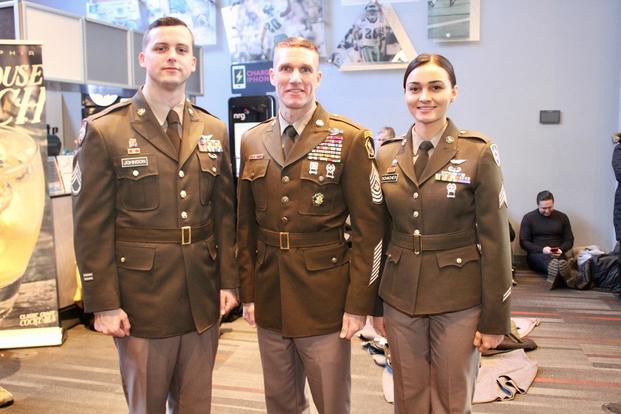
Soldiers to Get New Greens Uniform in 2020 After Army Finalizes Design

Sergeant Major of the Army Dan Dailey stands with Soldier models wearing the proposed Pink & Green daily service uniform at the Army-Navy game in Philadelphia, Pennsylvania December 9, 2017. (US Army photo by Ron Lee)
The Army plans to begin issuing its newly announced Army Greens to new soldiers beginning in summer 2020, the service’s senior enlisted leader said Monday.
Army Secretary Mark Esper approved the Nov. 11 adoption of the much-discussed Army Greens, which all soldiers must wear by 2028. The new uniform, recently renamed by service brass, is a version of the iconic pinks-and-greens uniform Army officers wore during World War II.

“This uniform is still in the minds of many Americans. This nation came together during World War II and fought and won a great war,” Sergeant Major of the Army Daniel Dailey said in a briefing with reporters at the Pentagon. “That’s what the secretary and [Chief of Staff of the Army Gen. Mark Milley] wanted to do, is capitalize on the greatest generation because there is another great generation that is serving today, and that is the soldiers serving in the United States Army.”
Soldiers currently serving in the active duty, National Guard and Reserves will be able to purchase the new uniform in summer 2020, but they do not have to buy it until 2028, Army officials have said. The current blue Army Service Uniform (ASU) will become the service’s optional dress uniform.
“I know it seems like a long time,” Dailey said, explaining that the extended phase-in period is designed to give enlisted soldiers time to save up their annual clothing allowance to pay for the new uniform. “We’ve got to give the soldier ample time to be paid for those uniform items prior to it being required for them to wear it.”
He said it would be “premature” to release the estimated cost of the new uniform.
“We have an estimated cost,” he said. “We are not done with any contracting at this point, so it would be premature to give you any of those costs. What we do know is that, because of the measures we are taking, it is going to be cost neutral to the taxpayer and the soldier in the long run.”
Dailey justified the cost of the new, more-expensive Army Greens uniform by saying it will last longer than the current-issue ASU.
“The estimated cost of the new [Army] Greens uniform is higher than that of the current service blue uniform … because it is a higher-quality uniform,” he said. “We could easily make it the same cost, but that’s not the intent here. The intent here is to increase the quality of the uniform, and that is why we extended the life of the uniform.”
The new Greens jacket will be made of a 55-percent/45-percent “poly-wool elastique.” The pants will feature a gabardine weave made of a 55/45 poly-wool combination as well. The shirt will be made of a 75-percent/25-percent cotton-poly blend, said Army officials, explaining that service life of the Army Greens is six years compared to the ASU’s four years.
“We went for a higher-quality fabric. The uniform costs more as a result … but we intended to do that because one of the chief of staff of the Army’s directives to us was build a higher-quality uniform, which inherently costs more,” Dailey said. “And the way you offset that is you capitalize on the life of that uniform based upon its higher quality.”
Despite the recent adoption announcement, the Army Greens design is not yet finalized.
“There were some design changes all the way up until the week before the secretary made the decision,” Dailey said.
The uniform prototype Dailey wore recently at the Association of the United States Army’s annual meeting in October featured a jacket belt with a gold buckle, he said, adding that the final design will be more subdued.
“The chief of staff has made a slight change on the length of the collar on the male jacket,” Dailey said. “From a design perspective, it’s the right decision the chief made.”
The jacket buttons will also feature an antique finish instead of a brass color, Army officials said.
“The next set of photographs we want to get out to the media, we want them to be accurate” to show the final design, Dailey said.
Before the Army starts issuing the redesigned uniform to the force, the service intends to field 200 sets of Army Greens for a final evaluation.
“We are in the process of being able to produce about 200 uniforms that we want to issue out to designated forward-facing units … and when I say ‘forward-facing units,’ I’m really talking recruiters,” said Col. Stephen Thomas, head of Project Manager Soldier Protection & Individual Equipment. “Then, what we will do is get feedback from those soldiers on how to better refine the uniform so that when we go to final production … we have a comprehensive uniform design that soldiers like.”
Officials from Program Executive Office Soldier said the process should be complete by next summer.
“This is a great day to be a solder,” Dailey said. “As I go around and have talked to soldiers in the last few days … they are very excited about it, and the overwhelming majority are just truly excited about the new uniform.”
— Matthew Cox can be reached at matthew.cox@military.com.

Categories
The Green Machine War

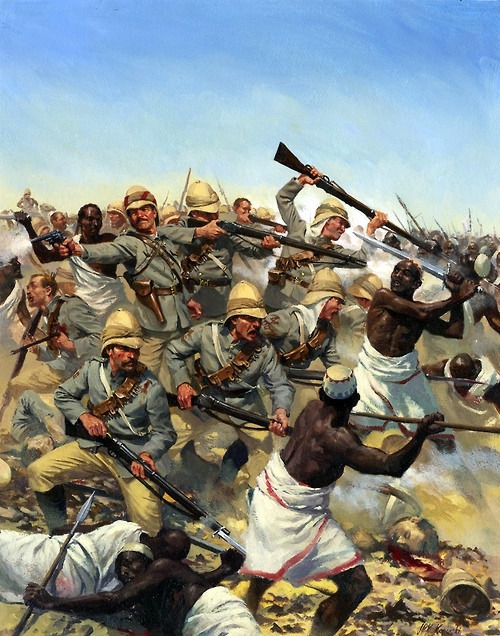
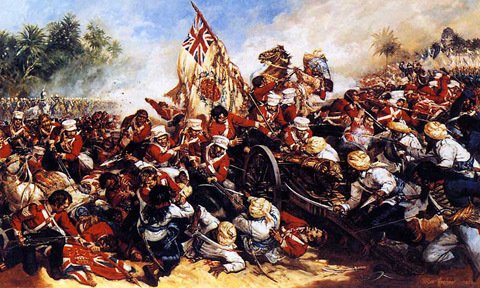
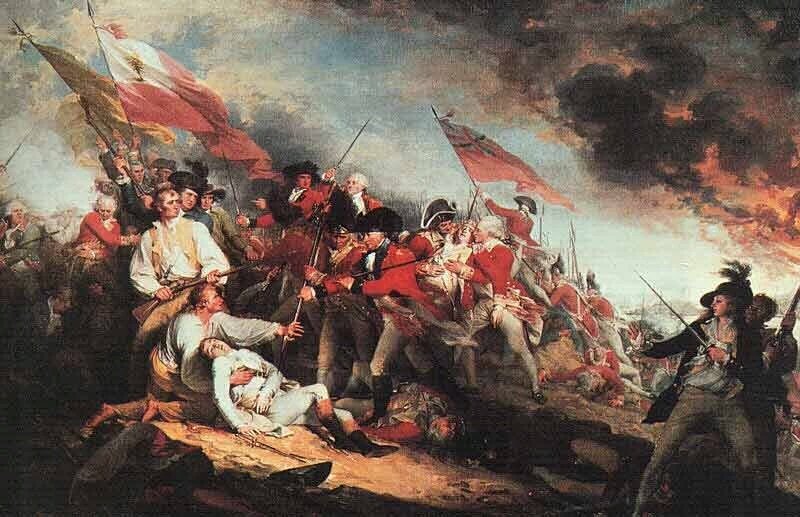
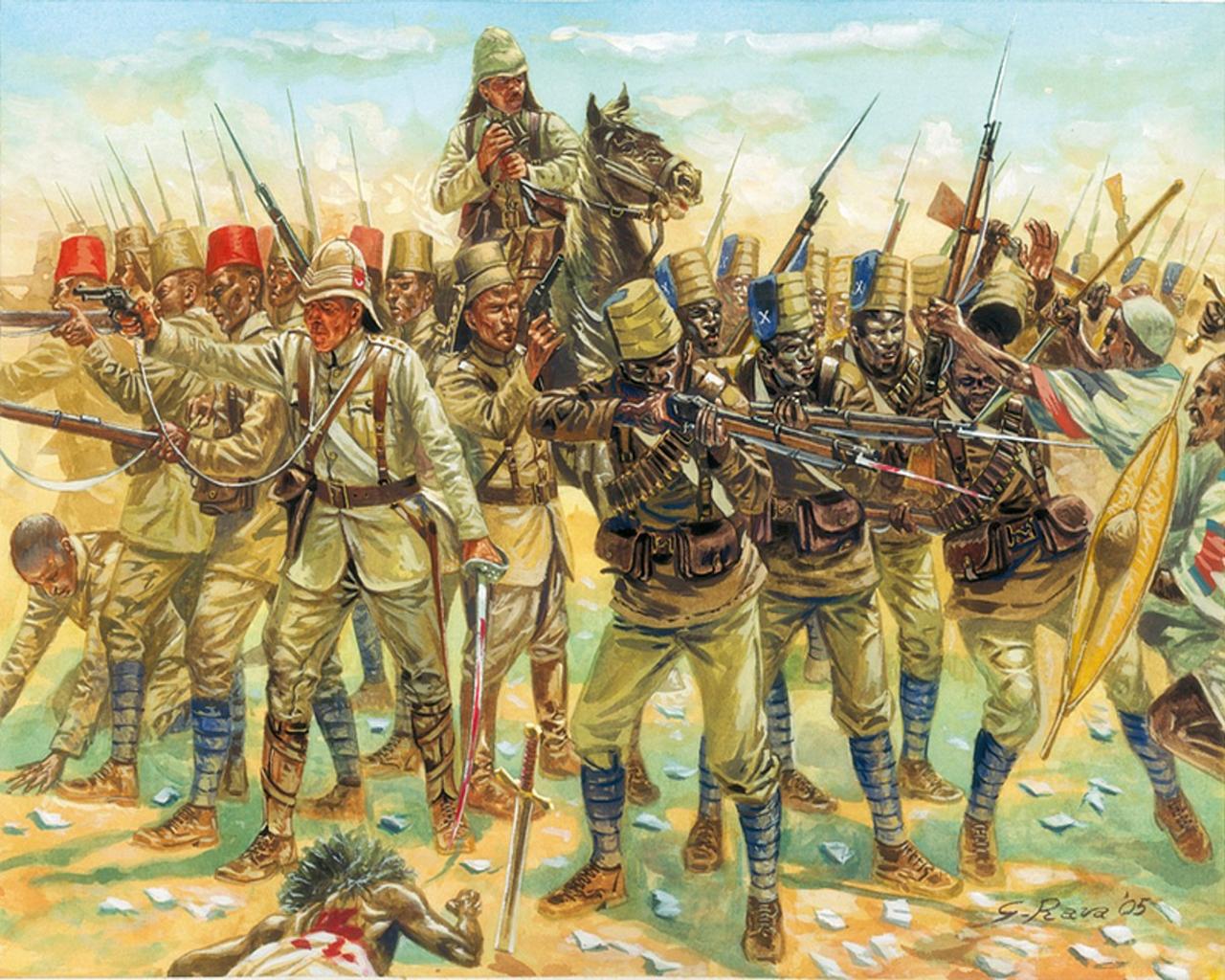
The British Army at War Picture Dump

Image result for osprey books  the british army art
Image result for battle of abu klea
Related image
Related image
Related image
Related image
Related image
Related image
Image result for british colonial wars

Categories
The Green Machine

No matter what, Guard Duty always sucks!

Categories
Dear Grumpy Advice on Teaching in Today's Classroom Hard Nosed Folks Both Good & Bad Soldiering The Green Machine This great Nation & Its People Well I thought it was neat!

Good to go! Grumpy

Related image

Categories
Hard Nosed Folks Both Good & Bad I am so grateful!! Leadership of the highest kind Soldiering The Green Machine This great Nation & Its People War Well I thought it was neat!

Damn Right, Thanks Guys!

Categories
The Green Machine Well I thought it was funny!

I swear every squad has its own Clown!

Image result for Morning

Categories
Dear Grumpy Advice on Teaching in Today's Classroom Good News for a change! Interesting stuff Leadership of the highest kind Stand & Deliver The Green Machine

Operation Magic Carpet – Well I thought it was interesting

From the Feral Irishman: “The Magic Carpet Ride”
Returning the troops home after WWII was a daunting task
The Magic Carpet that flew everyone home.
The U.S. military experienced an unimaginable increase during World War II.
In 1939, there were 334,000 servicemen, not counting the Coast Guard.
In 1945, there were over 12 million, including the Coast Guard.
At the end of the war, over 8 million of these men and women were scattered overseas in Europe, the Pacific and Asia. Shipping them out wasn’t a particular problem but getting them home was a massive logistical headache.
The problem didn’t come as a surprise, as Army Chief of Staff General George C. Marshall had already established committees to address the issue in 1943.
 
Soldiers returning home on the USS General Harry Taylor in August 1945
When Germany fell in May 1945, the U.S. Navy was still busy fighting in the
Pacific and couldn’t assist.
The job of transporting 3 million men home fell to the Army and the Merchant Marine.
300 Victory and Liberty cargo ships were converted to troop transports for the task.
During the war, 148,000 troops crossed the Atlantic west to east each month;
the rush home ramped this up to 435,000 a month over 14 months.
 
Hammocks crammed into available spaces aboard the USS Intrepid
In October 1945, with the war in Asia also over, the Navy started chipping in,
converting all available vessels to transport duty.
On smaller ships like destroyers, capable of carrying perhaps 300 men,
soldiers were told to hang their hammocks in whatever nook and cranny they could find.
Carriers were particularly useful, as their large open hangar decks could house 3,000
or more troops in relative comfort, with bunks, sometimes in stacks of five welded
or bolted in place.
 
Bunks aboard the Army transport SS Pennant
The Navy wasn’t picky, though: cruisers, battleships, hospital ships,
even LSTs (Landing Ship, Tank) were packed full of men yearning for home.
Two British ocean liners under American control, the RMS Queen Mary and Queen Elizabeth,
had already served as troop transports before and continued to do so during the operation,
each capable of carrying up to 15,000 people at a time, though their normal,
peacetime capacity was less than 2,200.
Twenty-nine ships were dedicated to transporting war brides:
women married to American soldiers during the war.
 
Troops performing a lifeboat drill onboard the Queen Mary in December 1944,
before Operation Magic Carpet
The Japanese surrender in August 1945 came none too soon,
but it put an extra burden on Operation Magic Carpet.
The war in Asia had been expected to go well into 1946 and the Navy and
the War Shipping Administration were hard-pressed to bring home all
the soldiers who now had to get home earlier than anticipated.
The transports carrying them also had to collect numerous POWs
from recently liberated Japanese camps, many of whom suffered
from malnutrition and illness
 
U.S. soldiers recently liberated from Japanese POW camps
The time to get home depended a lot on the circumstances. USS Lake Champlain,
a brand new Essex-class carrier that arrived too late for the war,
could cross the Atlantic and take 3,300 troops home a little under 4 days and 8 hours.
Meanwhile, troops going home from Australia or India would sometimes spend
months on slower vessels.
 
                Hangar of the USS Wasp during the operation
There was enormous pressure on the operation to bring home as many men
as possible by Christmas 1945
Therefore, a sub-operation, Operation Santa Claus, was dedicated to the purpose.
Due to storms at sea and an overabundance of soldiers eligible for return home,
however, Santa Claus could only return a fraction in time and still not quite home
but at least to American soil.
The nation’s transportation network was overloaded:
trains heading west from the East Coast were on average 6 hours behind schedule
and trains heading east from the West Coast were twice that late.
 
The crowded flight deck of the USS Saratoga.
The USS Saratoga transported home a total of 29,204 servicemen during Operation Magic Carpet,
more than any other ship.
Many freshly discharged men found themselves stuck in separation centers
but faced an outpouring of love and friendliness from the locals.
Many townsfolk took in freshly arrived troops and invited them to Christmas dinner
in their homes.
Still others gave their train tickets to soldiers and still others organized quick parties
at local train stations for men on layover.
A Los Angeles taxi driver took six soldiers all the way to Chicago;
another took another carload of men to Manhattan, the Bronx, Pittsburgh,
Long Island, Buffalo and New Hampshire.
Neither of the drivers accepted a fare beyond the cost of gas.
 
Overjoyed troops returning home on the battleship USS Texas
All in all, though, the Christmas deadline proved untenable. 
The last 29 troop transports, carrying some 200,000 men from the
China-India-Burma theater, arrived to America in April 1946,
bringing Operation Magic Carpet to an end,
though an additional 127,000 soldiers still took until September
to return home and finally lay down the burden of war.