Private comes out of the box at at NTC with necklace of Donovian ears
FORT IRWIN, Calif. — Pfc. Amanda Richards surprised peers and superiors alike when she emerged from six weeks “in the box” at the National Training Center with an eerie hollowness in her eyes and a necklace of Donovian ears, sources confirmed today.
“Here at the National Training Center, we provide America’s soldiers with the highest quality, most realistic training available,” said Brig. Gen. Geoffrey Broadway, NTC Commander. “As they use the newest technologies to face the intense challenges of the profession of arms, they emerge as better fighters, better teams, and better prepared for complex…what the fuck? She did what? God almighty. How did she even do that? God help us all.”
National Training Center Rotations are designed to place soldiers in austere environment where they can develop new techniques, tactics, and procedures, while honing strengths and identifying weaknesses. Soldiers assigned to play opposing forces, or OPFOR, use tactics of notional countries such as Atropia or Donovia.
In the case of Pfc. Richards, who previously expressed little interest in basic soldier skills, the NTC experiment revealed she had always been three weeks of intensity away from being an elite killing machine, and six weeks of intensity away from being a war criminal, according to defense officials.
“We encourage the most realistic scenarios possible at the National Training Center,” Broadway added. “But not like that. Fuck me. Those men had families. The more you sweat in peace the less you bleed in war, but, for the love of God, we don’t mean real blood.”
Richards, a dental hygienist assigned to Charlie Company, 3834th Combat Hospital, was nervous about “time in the box,” but came to thrive in the intense environment.
“On day one at the RUBA, Amanda couldn’t shut up about not having her cell phone,” said Spc. Kelsey Appleton, Richards’ former roommate. “She’d been texting a guy who had a car and we were all pretty upset about the timing. But by day six, she was really getting into it, yelling at us when we went to the wag bag without our MILES gear on. By week two, she’d pulled all the aces out of a deck of cards ‘for her kills,’ By week four she walked out of the battalion fighting position shirtless with nothing but a DAGR and a dagger, challenging anyone to quench her thirst for blood and vengeance.”
Richards, after a thorough after-action report, will return to her duties as the records clerk at the Raymond Bliss Dental clinic until such time as an investigating board can determine if she is, as she states, the surviving embodiment of Tiger Force.
“I blame myself. When I put that bumper sticker on my Ram that said, ‘kill ‘em all, let God sort ‘em out,’ a couple of the PC types asked me if I was setting a good example for my soldiers,” said Sgt. 1st Class Kenneth Rainier, Richards’ platoon sergeant.
“I said, ‘we’re all POGs, I don’t think anyone is taking this seriously. But then…sweet Jesus. Amanda just had to exact vengeance after the first harassing small arms fire. Men. Women. Some of those men weren’t even Donovian. I think they were OCs. Sometimes, as I drift off to sleep, I still hear them choking on their own blood as they futilely yell ‘ENDEX.’”
On the eve of America’s active involvement in World War II, it was apparent that there would be a serious shortage of service rifles for its rapidly expanding armed forces. Plans were made to increase M1 rifle production at Springfield Armory, and the Winchester Repeating Arms Co. was granted a production contract for the Garand.
Even with this increase in M1 rifle output, the anticipated supply of service rifles would be insufficient to meet the demand. Existing Model 1903 Springfield rifles in the government’s inventory, along with substantial numbers of obsolescent but serviceable Model 1917 rifles, were taken from storage and reconditioned as necessary for issue.
Even so, it was apparent that more rifles would be needed. To this end, in 1941 the U.S. Army Ordnance Dept. contracted with the Remington Arms Co. for new production of the Model 1903 bolt-action rifle using machinery and some raw materials (mainly stock blanks) in storage at Rock Island Arsenal since manufacture of the ’03 rifle ceased at that entity in the early 1920s.
Remington began manufacture of Model 1903 rifles in fall 1941. Initially, the new Remington ’03s were very similar to the rifles made at Rock Island Arsenal in the late World War I period. Shortly after Remington started its new ’03 production line, America was officially at war with the Axis powers, and the expected huge demand for more rifles became a stark reality.
Remington sought to increase production by reducing cosmetic touches such as careful polishing of the metal prior to Parkerizing and eliminating some non-essential features. By early 1942 the company had made some 649 changes in ’03 manufacture to speed production and reduce costs.
While these changes were marginally helpful, further modifications of the basic design were deemed necessary. These changes included less machining to the rear sight fixed base, elimination of the bolt stop, replacement of some milled parts with stamped, sheet metal components and elimination of the grasping grooves on the rifle’s stock.
As demand continued to escalate, Remington received more ’03 production contracts and continued to consider ways to further increase the manufacturing rate.
One component that remained more or less unchanged from the earlier M1903 rifles was the Model 1905 rear sight. This sight, and its barrel-mounted fixed base, required a great deal of machining. A simplified receiver-mounted rear sight would reduce production time and have the added bonus of being a better combat sight.
These changes were significant enough to warrant a new “model” designation and, on May 21, 1942, the “U.S. Rifle, Caliber .30, Model of 1903A3” was standardized. Shortly thereafter Remington began updating its tooling and equipment to accommodate the changes required for production of the new rifle. The first Remington M1903A3 rifles were delivered in December 1942.
While Remington was struggling with increasing its production rate, the Ordnance Dept. sought other manufacturing sources for new ’03 production.
To this end, in January 1942 the Ordnance Dept. began negotiations with High Standard Mfg. Co. of New Haven, Conn., for the production of 100,000 ’03 rifles. High Standard was interested in the contract, but it was already operating at near peak capacity with existing contracts and would be unable to serve as prime contractor on the new project.
The company offered to accept the contract if it would be permitted to manufacture only the barrels and subcontract the rest of the production, including assembly of the rifles, to the L.C. Smith & Corona Typewriter Co. of Syracuse, N.Y. The Ordnance Dept. was reluctant to agree to such a proposal and, logically, took the position that Smith-Corona should be named prime contractor with High Standard serving as the subcontractor for barrel production.
Since the Smith-Corona factory was in relatively close proximity to the Remington plant, it was believed that the latter would be able to assist the new manufacturer with the technical aspects of rifle production. All parties concurred with the proposal and on Feb. 25, 1942, Smith-Corona was granted a contract for M1903 rifle production.
While Smith-Corona was in the process of procuring the necessary manufacturing equipment, the M1903A3 rifle superseded the M1903. Accordingly, in May 1942 Smith-Corona’s contract was modified to substitute the M1903A3 for the M1903 rifle.
Concurrently, the original contract for 100,000 rifles was increased to 380,000. The first “pilot” batch of 20 Smith-Corona M1903A3 rifles was completed in October 1942, and mass production began in November, a month ahead of Remington’s initial delivery of ’03A3 rifles. Production slowly increased, and by December 1942, Smith-Corona had manufactured 5,540 ’03A3s.
As had been the case with Remington, some problems with procurement of rear sights from subcontractors resulted in the delay of initial deliveries. Eventually that problem was resolved and sufficient quantities of the sights were procured, and increasing numbers of ’03A3s began to flow from the Syracuse plant.
Other than the manufacturer’s name on the receiver ring, the Smith-Corona ’03A3 rifles were quite similar to those made by Remington, but differed in some minor aspects. The salient features of the Smith-Corona M1903A3 rifle were: The receiver ring had the same marking format as the Remington rifles except for the name of the manufacturer, “U.S./Smith-Corona”; and Smith-Corona was assigned two distinct “blocks” of serial numbers: 3,608,000 — 3,707,999 and 4,708,000 — 4,992,000.
Interestingly, Remington “over ran” some of Smith-Corona’s first block of serial numbers. Consequently, there were an estimated 3,600 Remington ’03A3 rifles produced with numbers initially assigned to, and used by, Smith-Corona. The receivers with these duplicate numbers were stamped with a “C” next to the serial number for identification and inventory control purposes.
The barrels were marked “SC” and the month/year of barrel production. Reportedly, very early in production, High Standard (the maker of the barrels) acquired some unfinished barrel “blanks” from Savage Arms Co.
These had six grooves and were initially produced for commercial rifles before being diverted to the ’03A3 production program. High Standard completed the machining of the barrels and marked them “SC” along with the month and year of manufacture.
The Ordnance Dept. granted the company a waiver for use of these non-standard barrels as their utilization would permit High Standard to deliver barrels to Smith-Corona sooner than would otherwise have been possible.
The number of six-groove barrels used in Smith-Corona ’03A3 production is estimated to be about 5,000. After using up the six-groove barrel blanks, High Standard began manufacture of four-groove barrels, which were used for the balance of production except for a few two-groove barrels that were used for about a one- or two-month period in late 1943. Regardless, the majority of Smith-Corona rifles had four-groove barrels.
Although nearly identical in configuration, there are several rather subtle differences between the Smith-Corona and Remington stocks. For example, the Remington ’03A3 rifles were stamped with a 7/16-inch “circled P” proof firing mark on the bottom of the grip (behind the trigger guard) while the Smith-Corona rifles had a 1/2-inch proof stamp in this same location.
Another minor difference was the configuration of the recess for the spring on the lower barrel band. The recess on the Smith-Corona stocks had a rounded profile while the Remington stocks had a square profile.
The final inspection marking format stamped on the left side of the stock was similar to the type found on the Remington ’03A3s but lacked the “RA” (Remington Arms) mark.
The only substantive difference between Remington and Smith-Corona bolts was that the Remington bolts were marked “R” at the root of the handle while the Smith-Corona bolts were usually marked with an “X” on top of the bolt handle, although some unmarked examples can be found.
Any bolt found on a Smith-Corona rifle, other than one marked “X” on top of the bolt handle, or unmarked, is a replacement and not a factory original component. Some extractors found on original Smith-Corona bolts were marked “S” on the bottom.
Also, the Smith-Corona bolts had a distinctive “scalloped” profile to the sleeve and safety lug. Some of the bolt sleeves were marked “G.” Like the Remington ’03A3s, original Smith-Corona bolts were blued.
Many rifles can be found today with Parkerized bolts, which indicate that the components were refinished, typically as part of a post-World War II Ordnance Dept. overhaul.
Smith-Corona and Remington rifles used the same type of stamped sheet metal furniture, including barrel bands, band springs, screws, pins, floorplate/magazine assemblies, and buttplates.
Most of these parts were originally blued although a few components made later in production, such as upper bands, may have been Parkerized. Model ’03A3s, either Remington or Smith-Corona, found with all-Parkerized furniture can be safely assumed to have been overhauled.
Unlike some Remington parts, which were stamped “R,” the majority of Smith-Corona parts were unmarked, although a few marked “G” have been observed. Therefore, it should be remembered that factory-original Smith-Corona rifles will not have any “R”-marked parts. Any such parts on a Smith-Corona ’03A3 encountered today were installed at some point after the rifle left the factory, again, normally as part of an arsenal rebuild.
Another difference between Remington and Smith-Corona rifles was the checkering pattern on the buttplates. Remington buttplates had 16 “squares” to the inch while Smith-Corona buttplates had 10 or 11 “squares” per inch.
Also different was the configuration of the stamped and welded trigger guard/magazine assembly behind the front screw hole. The Remington component has a straight profile whereas the Smith-Corona part has a semi-circular indention.
As the war progressed and production caught up with demand, Smith-Corona’s production contract was cancelled on Feb. 19, 1944, by which time the firm had manufactured 234,580 M1903A3s. Remington continued production slightly longer but its ’03A3 rifle contract was cancelled on Feb. 28, 1944, after the company had produced 707,629 ’03A3 rifles.
The Remington and Smith-Corona M1903A3 rifles provided yeoman-like service to U.S. armed forces during World War II. Although not used for overseas combat duty in the same numbers as M1 rifles, or even the earlier M1903 variants, some M1903A3 rifles did, in fact, see action.
Numerous World War II vintage photos depict ’03A3 rifles employed in overseas combat zones. Military Police (MPs) and other ostensibly non-combat military personnel were issued M1903A3 rifles, but they were also employed by front-line combat infantryman.
Model ’03A3 rifles were used in combat in virtually all theaters of the war, including the European, Mediterranean, and China-Burma-India (C-B-I). Large numbers were also utilized for stateside training and for supplementary use by sentries and other personnel.
Despite the shortcuts employed in the manufacture, the M1903A3 rifles were every bit as serviceable as the better-finished earlier production rifles.
The ’03A3s had strong nickel steel receivers, and the rear sights were actually better for combat use than the older M1905-pattern sights. M1903A3 rifles are among the most common variant of the ’03 available to collectors, and examples can usually be found without too much difficulty, although prices for pristine examples are steadily rising.
After the conclusion of World War II, some of the M1903A3 rifles were sent to various and sundry foreign nations. In addition, large numbers were shipped to various ordnance facilities for inspection and overhaul prior to being placed in long-term storage, typically after being coated in cosmoline.
Although most had previously been arsenal-overhauled before being placed into storage, some were never issued and remained in factory-new condition. It is normally easy to differentiate between a rifle remaining in its factory configuration and one that has been overhauled.
The rebuilt examples can be identified by the arsenal rebuild stamps on the stock, the presence of parts with mixed contractor codes and Parkerized furniture (including bolts).
It is sometimes forgotten that America’s true secret weapon of World War II was its awesome industrial might. Civilian firms that had never produced war material or arms were soon turning out vast quantities of desperately needed items with which to fight the war.
There are myriad examples of this industrial versatility, not the least of which was the service rifle made by a typewriter company.
The following was kindly provided by Captain T.W. Forrest of the D.C. Army National Guard.
Suggestions for
Professional Officer Development Readings
Gen. George S. Patton, Jr.
As soldiers it is our duty to continue are professional development by reading. General George S. Patton, Jr. (1885-1945), was known for his study and reading of military history.
In 1952, his widow, Beatrice Patton, provided a list of his favorite books for an issue of Armor magazine (Patton, Beatrice Ayer, “A Soldier’s Reading,” Armor 61 (November-December 1952, pp. 10-11). I provide it to you for your professional development:
Maxims of Frederick the Great
Maxims of Napoleon, and all the authoritative military biographies of Napoleon
Exactly 233 years ago this week, two of America’s founding fathers documented their first exposure to Islamic jihad in a letter to Congress; like many Americans today, they too were shocked at what they learned.
Context: in 1785, Muslim pirates from North Africa, or “Barbary,” had captured two American ships, the Maria and Dauphin, and enslaved their crews. In an effort to ransom the enslaved Americans and establish peaceful relations, Thomas Jefferson and John Adams — then ambassadors to France and England respectively — met with Tripoli’s ambassador to Britain, Abdul Rahman Adja. Following this diplomatic exchange, they laid out the source of the Barbary States’ hitherto inexplicable animosity to American vessels in a letter to Congress dated March 28, 1786:
We took the liberty to make some inquiries concerning the grounds of their [Barbary’s] pretentions to make war upon nations who had done them no injury, and observed that we considered all mankind as our friends who had done us no wrong, nor had given us any provocation. The ambassador answered us that it was founded on the laws of their Prophet, that it was written in their Koran, that all nations who should not have acknowledged their authority were sinners, that it was their right and duty to make war upon them wherever they could be found, and to make slaves of all they could take as prisoners, and that every Musselman who should be slain in battle was sure to go to Paradise
One need not conjecture what the American ambassadors — who years earlier had asserted that all men were “endowed by their Creator with certain inalienable rights” — thought of their Muslim counterpart’s answer. Suffice to say, because the ransom demanded was over fifteen times greater than what Congress had approved, little came of the meeting. It should be noted that centuries before setting their sights on American vessels, the Barbary States of Muslim North Africa — specifically Tripoli, Algiers, Tunis — had been thriving on the slave trade of Christians abducted from virtually every corner of coastal Europe — including Britain, Ireland, Denmark, and Iceland. These raids were so successful that, “between 1530 and 1780 there were almost certainly a million and quite possibly as many as a million and a quarter white, European Christians enslaved by the Muslims of the Barbary Coast,” to quote American historian Robert Davis.
The treatment of these European slaves was exacerbated by the fact that they were Christian “infidels.” As Robert Playfair (b.1828), who served for years as a consul in Barbary, explained, “In almost every case they [European slaves] were hated on account of their religion.” Three centuries earlier, John Foxe had written in his Book of Martyrs that, “In no part of the globe are Christians so hated, or treated with such severity, as at Algiers.”
The punishments these European slaves received for real or imagined offenses beggared description: “If they speak against Mahomet [blasphemy], they must become Mahometans, or be impaled alive. If they profess Christianity again, after having changed to the Mahometan persuasion, they are roasted alive [as apostates], or thrown from the city walls, and caught upon large sharp hooks, on which they hang till they expire.”
As such, when Captain O’Brien of the Dauphin wrote to Jefferson saying that “our sufferings are beyond our expression or your conception,” he was clearly not exaggerating.
After Barbary’s ability to abduct coastal Europeans had waned in the mid-eighteenth century, its energy was spent on raiding infidel merchant vessels. Instead of responding by collectively confronting and neutralizing Barbary, European powers, always busy quarrelling among themselves, opted to buy peace through tribute (or, according to Muslim rationale, jizya).
Fresh meat appeared on the horizon once the newly-born United States broke free of Great Britain (and was therefore no longer protected by the latter’s jizya payments).
Some American congressmen agreed with Jefferson that “it will be more easy to raise ships and men to fight these pirates into reason, than money to bribe them” — including General George Washington: “In such an enlightened, in such a liberal age, how is it possible that the great maritime powers of Europe should submit to pay an annual tribute to the little piratical States of Barbary?” he wrote to a friend. “Would to Heaven we had a navy able to reform those enemies to mankind, or crush them into nonexistence.”
But the majority of Congress agreed with John Adams: “We ought not to fight them at all unless we determine to fight them forever.” Considering the perpetual, existential nature of Islamic hostility, Adams may have been more right than he knew.
Congress settled on emulating the Europeans and paying off the terrorists, though it would take years to raise the demanded ransom.
When Muslim pirates from Algiers captured eleven more American merchant vessels in 1794, the Naval Act was passed and a permanent U.S. naval force established. But because the first war vessels would not be ready until 1800, American jizya payments — which took up 16 percent of the federal budget — began to be made to Algeria in 1795. In return, over 100 American sailors were released — how many died or disappeared is unclear — and the Islamic sea raids formally ceased. American payments and “gifts” over the following years caused the increasingly emboldened Muslim pirates to respond with increasingly capricious demands.
One of the more ignoble instances occurred in 1800, when Captain William Bainbridge of the George Washington sailed to the pirate-leader of Algiers, with what the latter deemed insufficient tribute. Referring to the Americans as “my slaves,” Dey Mustapha ordered them to transport hundreds of black slaves to Istanbul (Constantinople). Adding insult to insult, he commanded the American crew to take down the U.S. flag and hoist the Islamic flag — one not unlike ISIS’ notorious black flag — in its place. And, no matter how rough the seas might be during the long voyage, Bainbridge was required to make sure the George Washington faced Mecca five times a day to accommodate the prayers of Muslims onboard.
That Bainbridge condescended to becoming Barbary’s delivery boy seems only to have further whetted the terrorists’ appetite. In 1801, Tripoli demanded an instant payment of $225,000, followed by annual payments of $25,000 — respectively equivalent to $3.5 million and $425,000 today. Concluding that “nothing will stop the eternal increase of demand from these pirates but the presence of an armed force,” America’s third president, Jefferson, refused the ultimatum. (He may have recalled Captain O’Brien’s observation concerning his Barbary masters: “Money is their God and Mahomet their prophet.”)
Denied jizya from the infidels, Tripoli proclaimed jihad on the United States on May 10, 1801. But by now, America had six war vessels, which Jefferson deployed to the Barbary Coast. For the next five years, the U.S. Navy warred with the Muslim pirates, making little headway and suffering some setbacks — the most humiliating being when the Philadelphia and its crew were captured in 1803.
Desperate measures were needed: enter William Eaton. As U.S. consul to Tunis (1797–1803), he had lived among and understood the region’s Muslims well. He knew that “the more you give the more the Turks will ask for,” and despised that old sense of Islamic superiority: “It grates me mortally,” he wrote, “when I see a lazy Turk [generic for Muslim] reclining at his ease upon an embroidered sofa, with one Christian slave to hold his pipe, another to hold his coffee, and a third to fan away the flies.” Seeing that the newborn American navy was making little headway against the seasoned pirates, he devised a daring plan: to sponsor the claim of Mustafa’s brother, exiled in Alexandria; and then to march the latter’s supporters and mercenaries through five hundred miles of desert, from Alexandria onto Tripoli.
The trek was arduous — not least because of the Muslim mercenaries themselves. Eaton had repeatedly tried to win them over: “I touched upon the affinity of principle between the Islam and Americans [sic] religion.” But despite these all too familiar ecumenical overtures, “We find it almost impossible to inspire these wild bigots with confidence in us,” he lamented in his diary, “or to persuade them that, being Christians, we can be otherwise than enemies to Mussulmen. We have a difficult undertaking!” (For all his experience with Muslims, Eaton was apparently unaware of the finer points of their (Sharia) law, namely, al-wala’ wa’l bara’, or “loyalty and enmity.”)
Eaton eventually managed to reach and conquer Tripoli’s coastal town of Derne on April 27, 1805. Less than two months later, on June 10, a peace treaty was signed between the U.S. and Tripoli, formally ending hostilities.
Thus and despite the (rather ignorant) question that became popular after 9/11, “Why do they hate us?” — a question that was answered to Jefferson and Adams 233 years ago today — the United States’ first war and victory as a nation was against Muslims, and the latter had initiated hostilities on the same rationale Muslims had used to initiate hostilities against non-Muslims for the preceding 1,200 years. Sources for quotes in this article can be found in the author’s recent book, Sword and Scimitar: Fourteen Centuries of War between Islam and the West; 352 pages long and containing over a thousand endnotes, it copiously documents what many in academia have sought to hide: the long and bloody history between Islam and the West, in the context of their eight most landmark battles. American Thinker reviews of the book can be read here and here).
Exactly 233 years ago this week, two of America’s founding fathers documented their first exposure to Islamic jihad in a letter to Congress; like many Americans today, they too were shocked at what they learned.
Context: in 1785, Muslim pirates from North Africa, or “Barbary,” had captured two American ships, the Maria and Dauphin, and enslaved their crews. In an effort to ransom the enslaved Americans and establish peaceful relations, Thomas Jefferson and John Adams — then ambassadors to France and England respectively — met with Tripoli’s ambassador to Britain, Abdul Rahman Adja. Following this diplomatic exchange, they laid out the source of the Barbary States’ hitherto inexplicable animosity to American vessels in a letter to Congress dated March 28, 1786:
We took the liberty to make some inquiries concerning the grounds of their [Barbary’s] pretentions to make war upon nations who had done them no injury, and observed that we considered all mankind as our friends who had done us no wrong, nor had given us any provocation. The ambassador answered us that it was founded on the laws of their Prophet, that it was written in their Koran, that all nations who should not have acknowledged their authority were sinners, that it was their right and duty to make war upon them wherever they could be found, and to make slaves of all they could take as prisoners, and that every Musselman who should be slain in battle was sure to go to Paradise
One need not conjecture what the American ambassadors — who years earlier had asserted that all men were “endowed by their Creator with certain inalienable rights” — thought of their Muslim counterpart’s answer. Suffice to say, because the ransom demanded was over fifteen times greater than what Congress had approved, little came of the meeting. It should be noted that centuries before setting their sights on American vessels, the Barbary States of Muslim North Africa — specifically Tripoli, Algiers, Tunis — had been thriving on the slave trade of Christians abducted from virtually every corner of coastal Europe — including Britain, Ireland, Denmark, and Iceland. These raids were so successful that, “between 1530 and 1780 there were almost certainly a million and quite possibly as many as a million and a quarter white, European Christians enslaved by the Muslims of the Barbary Coast,” to quote American historian Robert Davis.
Read more: https://www.americanthinker.com/articles/2019/03/americas_233yearold_shock_at_jihad.html#ixzz5jlumrdN1
Follow us: @AmericanThinker on Twitter | AmericanThinker on Facebook
The treatment of these European slaves was exacerbated by the fact that they were Christian “infidels.” As Robert Playfair (b.1828), who served for years as a consul in Barbary, explained, “In almost every case they [European slaves] were hated on account of their religion.” Three centuries earlier, John Foxe had written in his Book of Martyrs that, “In no part of the globe are Christians so hated, or treated with such severity, as at Algiers.”
The punishments these European slaves received for real or imagined offenses beggared description: “If they speak against Mahomet [blasphemy], they must become Mahometans, or be impaled alive. If they profess Christianity again, after having changed to the Mahometan persuasion, they are roasted alive [as apostates], or thrown from the city walls, and caught upon large sharp hooks, on which they hang till they expire.”
As such, when Captain O’Brien of the Dauphin wrote to Jefferson saying that “our sufferings are beyond our expression or your conception,” he was clearly not exaggerating.
After Barbary’s ability to abduct coastal Europeans had waned in the mid-eighteenth century, its energy was spent on raiding infidel merchant vessels. Instead of responding by collectively confronting and neutralizing Barbary, European powers, always busy quarrelling among themselves, opted to buy peace through tribute (or, according to Muslim rationale, jizya).
Fresh meat appeared on the horizon once the newly-born United States broke free of Great Britain (and was therefore no longer protected by the latter’s jizya payments).
Some American congressmen agreed with Jefferson that “it will be more easy to raise ships and men to fight these pirates into reason, than money to bribe them” — including General George Washington: “In such an enlightened, in such a liberal age, how is it possible that the great maritime powers of Europe should submit to pay an annual tribute to the little piratical States of Barbary?” he wrote to a friend. “Would to Heaven we had a navy able to reform those enemies to mankind, or crush them into nonexistence.”
But the majority of Congress agreed with John Adams: “We ought not to fight them at all unless we determine to fight them forever.” Considering the perpetual, existential nature of Islamic hostility, Adams may have been more right than he knew.
Congress settled on emulating the Europeans and paying off the terrorists, though it would take years to raise the demanded ransom.
When Muslim pirates from Algiers captured eleven more American merchant vessels in 1794, the Naval Act was passed and a permanent U.S. naval force established. But because the first war vessels would not be ready until 1800, American jizya payments — which took up 16 percent of the federal budget — began to be made to Algeria in 1795. In return, over 100 American sailors were released — how many died or disappeared is unclear — and the Islamic sea raids formally ceased. American payments and “gifts” over the following years caused the increasingly emboldened Muslim pirates to respond with increasingly capricious demands.
One of the more ignoble instances occurred in 1800, when Captain William Bainbridge of the George Washington sailed to the pirate-leader of Algiers, with what the latter deemed insufficient tribute. Referring to the Americans as “my slaves,” Dey Mustapha ordered them to transport hundreds of black slaves to Istanbul (Constantinople). Adding insult to insult, he commanded the American crew to take down the U.S. flag and hoist the Islamic flag — one not unlike ISIS’ notorious black flag — in its place. And, no matter how rough the seas might be during the long voyage, Bainbridge was required to make sure the George Washington faced Mecca five times a day to accommodate the prayers of Muslims onboard.
That Bainbridge condescended to becoming Barbary’s delivery boy seems only to have further whetted the terrorists’ appetite. In 1801, Tripoli demanded an instant payment of $225,000, followed by annual payments of $25,000 — respectively equivalent to $3.5 million and $425,000 today. Concluding that “nothing will stop the eternal increase of demand from these pirates but the presence of an armed force,” America’s third president, Jefferson, refused the ultimatum. (He may have recalled Captain O’Brien’s observation concerning his Barbary masters: “Money is their God and Mahomet their prophet.”)
Denied jizya from the infidels, Tripoli proclaimed jihad on the United States on May 10, 1801. But by now, America had six war vessels, which Jefferson deployed to the Barbary Coast. For the next five years, the U.S. Navy warred with the Muslim pirates, making little headway and suffering some setbacks — the most humiliating being when the Philadelphia and its crew were captured in 1803.
Desperate measures were needed: enter William Eaton. As U.S. consul to Tunis (1797–1803), he had lived among and understood the region’s Muslims well. He knew that “the more you give the more the Turks will ask for,” and despised that old sense of Islamic superiority: “It grates me mortally,” he wrote, “when I see a lazy Turk [generic for Muslim] reclining at his ease upon an embroidered sofa, with one Christian slave to hold his pipe, another to hold his coffee, and a third to fan away the flies.” Seeing that the newborn American navy was making little headway against the seasoned pirates, he devised a daring plan: to sponsor the claim of Mustafa’s brother, exiled in Alexandria; and then to march the latter’s supporters and mercenaries through five hundred miles of desert, from Alexandria onto Tripoli.
The trek was arduous — not least because of the Muslim mercenaries themselves. Eaton had repeatedly tried to win them over: “I touched upon the affinity of principle between the Islam and Americans [sic] religion.” But despite these all too familiar ecumenical overtures, “We find it almost impossible to inspire these wild bigots with confidence in us,” he lamented in his diary, “or to persuade them that, being Christians, we can be otherwise than enemies to Mussulmen. We have a difficult undertaking!” (For all his experience with Muslims, Eaton was apparently unaware of the finer points of their (Sharia) law, namely, al-wala’ wa’l bara’, or “loyalty and enmity.”)
Eaton eventually managed to reach and conquer Tripoli’s coastal town of Derne on April 27, 1805. Less than two months later, on June 10, a peace treaty was signed between the U.S. and Tripoli, formally ending hostilities.
Thus and despite the (rather ignorant) question that became popular after 9/11, “Why do they hate us?” — a question that was answered to Jefferson and Adams 233 years ago today — the United States’ first war and victory as a nation was against Muslims, and the latter had initiated hostilities on the same rationale Muslims had used to initiate hostilities against non-Muslims for the preceding 1,200 years. Sources for quotes in this article can be found in the author’s recent book, Sword and Scimitar: Fourteen Centuries of War between Islam and the West
Read more: https://www.americanthinker.com/articles/2019/03/americas_233yearold_shock_at_jihad.html#ixzz5jluef89M
Follow us: @AmericanThinker on Twitter | AmericanThinker on Facebook
The Siege of Louisbourg by Domenick d’Andrea and Rick Reeves (National Guard Heritage Series)
There’s this thing in the Army where the Active Component is always looking down its nose at the Reserve Component, specifically the National Guard. Why? Because the National Guard is part-time, of course, “weekend warriors” and all that. But also because the Active Component has some real fears that it can never actually live up to the incredible history that the National Guard has and is suffering from a rather embarrassing inferiority complex.
You’re probably at this point saying, “ASO, you’re off your rocker on this one, the National Guard has never saved anything other than discount beer.”
Let’s go back and take a look, shall we?
Louisbourg, 1745
Okay, so it’s 1744, and New England has suffered attacks and raids from the French forces from what now is Canada for over fifty years. The central base of the French is Louisbourg, a massive walled fortification on Cape Breton that provided a good defense to the inner harbors of New France and was strong enough that it could not be attacked from the sea. Now there had already been multiple colonial wars between England in France that had spilled over into their colonies. In these wars, British and French Regulars fought each other, augmented by their provincial forces and Native American allies. It was sort of an article of faith for the English that the colonial militias could not mount a sustained campaign by themselves; they were only considered effective if paired with Regulars.
New England was pretty ticked off about the constant raids from New France and the lack of support from the Crown to do anything about it. So Massachusetts Governor William Shirley decided to take care of things himself. He talks with his neighboring colonies and everyone agrees to pitch in: Massachusetts provides the bulk of the expedition, with about 3,200 militia from Massachusetts and Maine, while Connecticut and New Hampshire pitch in about 500 militia each. The other colonies provide cannons or funds and hey presto! There’s a suddenly a militia expeditionary force of over 4,200, commanded by Sir William Pepperell from Kittery, Maine, heading out on board their very own militia fleet of 90 ships in March of 1745.
They reach New Breton in May of 1745 and conduct a link-up with a Royal Navy force. Then they conduct an amphibious landing on May 11, covered by light infantry from Gorham’s Rangers. After some skirmishing with French defenders, the main force is able to land over 2,000 troops on the landward side behind the fort. The French retreat inside the fortress and the siege begins. Now, sieges are things that are supposed to be done by professional armies, not by untrained provincials. And yet, the tough New Englanders kept building batteries, constructing saps, and generally doing the whole siege thing wicked well. After several attempts by the French to force the militia off the point, they surrender their fortress on June 28 when they realize that there is no longer any hope of reinforcing it.
New England went nuts with celebration while London and Paris couldn’t believe their collective ears that an untrained militia force had conducted an amphibious assault, siege, and reduction of a proper European fortress. However, the rejoicing was short-lived, because in 1748 England traded Louisbourg back to the French in exchange for the Indian city of Madras that the French had captured. Figures.
The Formation of the Continental Army
Alright, we all know that the militia kicked off this whole American Revolution thing in 1775 with the running battles of Lexington and Concord. And then we all know how the militia – those undisciplined yokels – completely wrecked the British at Bunker Hill. But the thing is, they were far from undisciplined yokels. Because of the Colonial Wars, many of the militia regiments across New England had more combat experience than the British Regulars that they were facing.
Not only that, New England had united by April 23, 1775 to field what was called the New England Army. Nearly 20,000 soldiers had assembled around Boston to form this force. The fundamental basis for this force was from the longstanding militia regiments. In the New England tradition, each county was responsible for providing a regiment. During the chaotic early days of the revolution, a portion of each regiment was retained at home for local defense while the rest of it was sent off to the main Army outside Boston. So when George Washington arrived, he found that the basics needed for the creation of a Continental Army were right in front of him.
The American Soldier by Hugh Charles McBarron, Jr. Shows George Washington surveying the troops at the Siege of Boston.
On June 14, 1775, the Continental Congress voted to create a Continental Army, authorizing colonies outside New England to raise ten companies of riflemen – partially a ploy to get the Middle Atlantic colonies to start committing troops. At the same time, it basically made all the colonial organizations then at Boston part of the Continental Army. Essentially federalizing the militia – not for the first or last time, either. Congress appointed generals for the new Continental Army, and the majority were drawn from the militia.
Now, it would take time to grow a professional standing force – not until 1777-1778 could you say that the Continental Army was more than a part-time force, since enlistments kept running out, occasional desertion (run home, plants crops, return to the Army, run home, harvest crops, return to the Army) was rampant, and the Continental Congress was having a hard time actually paying anyone. But the seeds were there, and because of the pre-war militia system, we were able to actually field an army.
Little Round Top
Don Troiani’s “Lions of the Round Top”
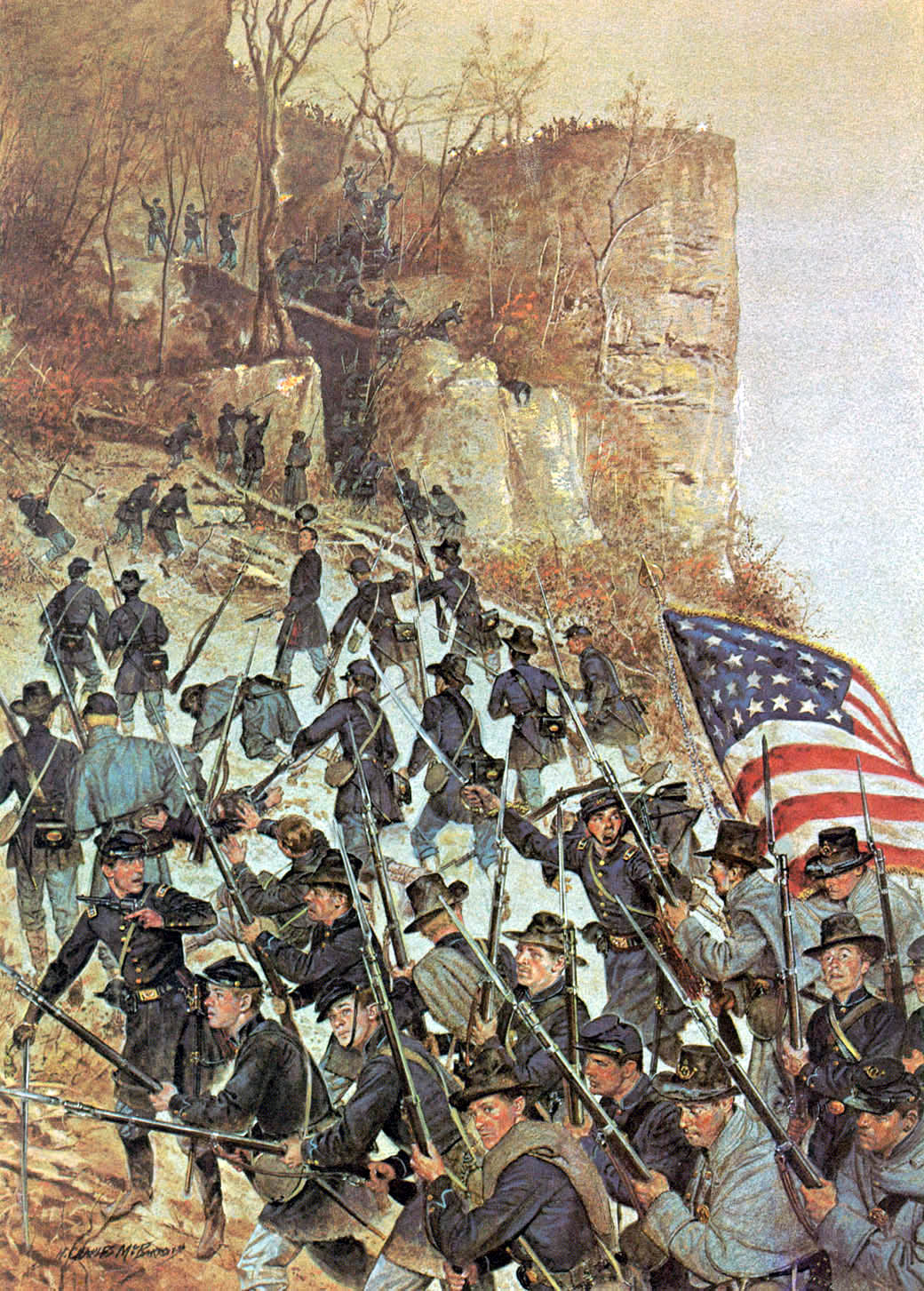
Fast forward to 1863, when this whole American experiment is in trouble. Two armies clash at Gettysburg in July, and on the second day of the month, the battle hangs in the balance as Confederate assaults threaten to overwhelm the blue lines in the Pennsylvania hills and woods. Two Confederate regiments from Alabama are able to push around the left flank of the U.S. Army and strike right at the exposed left flank, where one single regiment stands in their way: the 20th Maine Volunteer Infantry Regiment.
Now, the 20th was not a militia organization. It was composed of volunteers from around Maine. It brought 386 men to the fight that hot afternoon on Little Round Top. But 120 of those men were new to the regiment, but not new to the military. They had come from the 2nd Maine Volunteer Infantry Regiment, which had been inactivated in 1863 because the majority of the men had signed two-year enlistments. Save for these 120 men, who had signed for three years, and now found themselves in this new outfit.
While the 20th was not a militia organization, the 2nd most definitely was. It was formed out of the existing volunteer militia companies from Bangor, Maine and the towns outside of it. It was the first regiment from the state to see combat, taking part in the Battle of Bull Run in 1861 where it was one of the few U.S. units not to hightail it back to D.C.
During the fighting on Little Round Top, the extra 120 rifles in the ranks tipped the scales in favor of the bluecoats, allowing them to keep fighting even after taking 125 casualties. Without the additional firepower, it is unlikely that the 20th could have held on as long as it did. The 2nd also brought an unlikely asset with them: seafarer-turned-soldier, Sergeant Andrew Tozier. As a sign of his trust in these additions to the regiment, the 20th’s commander, Lieutenant Colonel Joshua “Bayonets” Chamberlain made Tozier the regimental color bearer. At one point in the fighting on Little Round Top, Chamberlain recalled looking through the smoke and seeing Tozier standing alone – the color guard shot away – with the colors in the crook of his arm, loading and firing his rifle. The regiment reformed on the colors and – bereft of ammunition – attacked with the bayonet, driving the confused Alabamans down the hill. Tozier would later receive the Medal of Honor for his bravery. The National Guard had come in at just the right time once again.
World War I
Members of Company C, 147th Infantry, 37th Division, who captured the first German prisoners for the 37th Division, back from the trenches for a rest near Brouville, France, Aug. 14, 1918. Pictured are: Cpl. J. V. Ewan (from left) and Pvts. G. L. Fisher, L. S. Thompson, Eddie Downey, W. T. Frank and Phillip Herman. April 6 commemorates the 100th anniversary of the U.S. entry into World War I. (37th Division Veterans Association Collection/Ohio Army National Guard Historical Collections)
When the U.S. entered World War I, the Regular Army numbered around 130,000 men. In military power, the U.S. ranked somewhere around 35th in the world. Suffice it to say, we were not ready to enter the most lethal war in human history to that point. What the U.S. did have, however, was a very strong National Guard, which fielded 17 divisions that would eventually go to France (as opposed to the seven Regular infantry divisions that took part in combat operations). And since many of the Regular units were made up of mostly new recruits, the Guard could actually boast more veteran soldiers in their ranks, who had either come off active duty to join the Guard, had participated in the Mexican Border call-up of 1916, or were veterans of the fighting in the Philippines at the early part of the 20th century.
Out of the first four divisions in France, two were National Guard – with the Guard’s 26th Division from New England being the first full U.S. division in France. While the 1st U.S. Division was the first to see combat in the late fall of 1917, the 26th Division was not far behind in February of 1918. The 42nd Division (from twenty-six states) would quickly follow, as would the 32nd Division, from Wisconsin and Michigan, and then the 37th, from Ohio. Without the Guard, the U.S. would not have been able to get enough troops into France to help the allies stabilize their lines after the German Spring Offensives of 1918, and then to counterattack. It was the Guard that enabled the U.S. to be able to hold the line long enough for the divisions formed of selective service draftees to enter the mix and begin the great push to end the war in the fall of 1918.
Throughout the war, the German general staff would rate eight U.S. divisions as “superior;” six of those were National Guard divisions. ‘Nuff said.
Guard Tanks the First to Fight in WWII
Company A, 192nd Tank Battalion – Survivors, late-1940’s (Rock County Genealogical Society)
Ever hear of the 192nd Tank Battalion? Probably not. Mainly due to its not existing for very long. But what an existence it had. See, in 1941, Army Chief of Staff George Marshall could tell that Bad Things were in the offing, specifically in the Pacific. So he routed as many of the Army’s available M-3 Stuart Light Tanks as he could to the Pacific. But where to find available units? The National Guard, of course. One unit was the 194th Tank Battalion of the California National Guard, and the other was the 192nd Tank Battalion from, well, from National Guards all over the place. Company Acame from Janesville, WI, Company B from Maywood, IL, Company C from Port Clinton, OH, and Company D from Harrodsburg, KY.
The 192nd reached Manila in the Philippines in November of 1941, which just is not a great time to be in the Philippines because Bad Things are about to happen. The Japanese invaded in December, and the 192nd was ordered to counterattack. On December 22, elements from Company B made first contact with the Japanese 4th Tank Regiment, who were equipped with the Type 95 light tank. Both sides were equally matched when it came to armament – having a 37mm main gun – but the M3 was gas powered while the Type 95 was diesel. Predictably, the first U.S. tank that took a direct hit cooked off because of the gas. In the first tank engagement of the U.S. in WWII, the results were inconclusive. The U.S. lost one tank while the remainder took several hits and were able to draw back – until being destroyed by Japanese aircraft later that day, because of course.
The 192nd and 194th would fight on as long as they could, trying to support the beleaguered U.S. infantry units. On April 9, 1942, the U.S. garrison surrendered. The officers and men of the 192nd would spend the rest of the war trying to survive. Most did not. Of the 593 men that arrived in Manila in 1941, 328 would not survive to see the end of the war.
34th Division in North Africa
Stand To! Here, members of the 34th Infantry Division take a break during a training exercise in Northern Ireland. (WW2 Signal Corps Photograph Collection). (Photo Credit: USAMHI)
At the outset of World War II, the 34th “Red Bull” Division (from North Dakota, South Dakota, Iowa and Minnesota) was rated as one of the most combat-ready elements of the U.S. Army – unsurprising because Midwesterners just like to fight. When the U.S. entered WWII, the 34th Division was quickly shipped to Ireland in order to help secure Britain from German attack, as part of a previously established war plan. The first elements reached northern Ireland in January of 1942.
While in northern Ireland, the commander of the 34th, Major General Russell Hartle, was tasked with forming a commander unit. He assigned his aide Captain William Darby to head up this new unit, which would eventually become the 1st Ranger Battalion. 281 men from the Red Bulls transferred into this new unit, forming the core of it. That’s right, Big Army, you don’t even get to claim the Rangers as your own; it was a National Guard thing.
The 34th Division formed part of the Eastern Task Force during Operation Torch, landing in Algiers on November 8, 1942. From then on, the division would be on the attack until the end of the war, amassing 517 days of front line combat – second only to the 654 days of the 32nd Division in the Pacific, also a National Guard outfit. Without the ability to rapidly deploy the Guard as part of the initial war plan, the U.S. could not have projected power so quickly into two theaters of war.
29th Infantry Division on D-Day
Photograph of American troops approaching Omaha Beach, Normandy, on D-Day. (UNIVERSAL HISTORY ARCHIVE/UIG VIA GETTY)
The amphibious invasion to break open Fortress Europe in 1944 was one of the most ambitious military operations in U.S. history. The toughest objective would be the landing at Omaha Beach. This mission was given to the 1st Infantry Division – veterans of fighting in North Africa – and the Virginia and Maryland National Guard’s 29th Infantry Division.
On June 6, 1944, two regimental combat teams (three battalions of infantry, augmented by engineers, field artillery, and armor) hit Omaha Beach. One was the 16th RCT and the other was the 116th RCT of the Virginia National Guard. As the day wore on, both units struggled to gain a beachhead, suffering horrendous casualties. Alpha Company of the 116th was almost completely wiped out, leaving a gaping hole in the community of Bedford, Virginia, where most of the men were from. For this reason, the decision was made to build the National D-Day Memorial here. Combat engineers from the 121st Engineer Battalion – nominally the D.C. National Guard, but in actuality composed mostly of engineers from the Ohio National Guard that day – worked feverishly to create breaches in the enemy defenses.
By mid-morning, troops from Companies B and F, 116th RCT joined with Ranger elements to gain the heights, and soon small parties of GIs worked their way through the maze of enemy bunkers and defensive positions, knocking them out one by one. By nightfall, the Big Red One and the Blue and Gray Division had punched a hole in the Atlantic Wall – Regulars and Guardsmen, fighting side by side.
Iraq and Afghanistan
Taji, Baghdad Province, Iraq – Spc. Adam Feldon, center, talks with an Iraqi boy, May 4, as a patrol of Pennsylvania Army National Guard Soldiers and Iraqi police officers moves through Taji market, north of Baghdad. The Keystone Guardsmen are from Company C, 1st Battalion, 112th Infantry Regiment, 56th Stryker Brigade Combat Team. (Photo By: Sgt. Doug Roles, Pennsylvania National Guard)
So remember that time we did the whole invasion of Afghanistan in 2001 and the whole Iraq thing in 2003? Well, the invasions went pretty damn well, all things considered. Then came that really awkward occupation part that got kinda messy. Well anyways, the National Guard played a role in the invasion, but where they really came to the forefront was in supplying units during the occupation.
See, the way the Army is set up, there’s simply not enough Active soldiers to conduct rotations through Iraq and Afghanistan, support missions around the rest of the world, train, and get a few days to see their families. So that’s why all of a sudden the Guard became one of the keys to fighting the conflicts in Iraq and Afghanistan. Guard units have filled every role, from combat to combat support, in both theaters. Simply put, OIF and OEF would have been impossible without the National Guard.
Which is why in 2014, when General Ray Odierno (now retired, then the Army Chief of Staff) disparaged the service of the Guard in OIF/OEF – and was then followed by more Active officers voicing similar opinions – it felt like a slap in the face. Not just to those of us who supported those operations, but to the hundreds of years where the Guard has more than carried its operational weight.
Enjoy what you just read? Please share on social media or email utilizing the buttons below.About the Author: Angry Staff Officer is an Army engineer officer who is adrift in a sea of doctrine and staff operations and uses writing as a means to retain his sanity. He also collaborates on a podcast with Adin Dobkin entitled War Stories, which examines key moments in the history of warfare. Support this blog’s Patreon here.


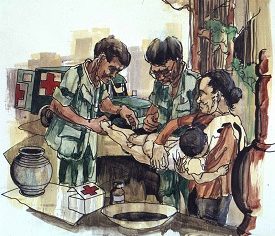 I always liked the Medics when I was in!

 It should be noted that centuries before setting their sights on American vessels, the Barbary States of Muslim North Africa — specifically Tripoli, Algiers, Tunis — had been thriving on the slave trade of Christians abducted from virtually every corner of coastal Europe — including Britain, Ireland, Denmark, and Iceland. These raids were so successful that, “between 1530 and 1780 there were almost certainly a million and quite possibly as many as a million and a quarter white, European Christians enslaved by the Muslims of the Barbary Coast,” to quote American historian Robert Davis.


