Categories
Karma can be a bitch! Some Red Hot Gospel there! Some Scary thoughts

Complex Systems Won’t Survive the Competence Crisis by HAROLD ROBERTSON Key words – “Meritocracy and the new political imperative of protected-group diversity on a collision course”

 Ilya Mirnyy/Firefighter in field, 2020

At a casual glance, the recent cascades of American disasters might seem unrelated. In a span of fewer than six months in 2017, three U.S. Naval warships experienced three separate collisions resulting in 17 deaths. A year later, powerlines owned by PG&E started a wildfire that killed 85 people. The pipeline carrying almost half of the East Coast’s gasoline shut down due to a ransomware attack. Almost half a million intermodal containers sat on cargo ships unable to dock at Los Angeles ports. A train carrying thousands of tons of hazardous and flammable chemicals derailed near East Palestine, Ohio. Air Traffic Control cleared a FedEx plane to land on a runway occupied by a Southwest plane preparing to take off. Eye drops contaminated with antibiotic-resistant bacteria killed four and blinded fourteen.

While disasters like these are often front-page news, the broader connection between the disasters barely elicits any mention. America must be understood as a system of interwoven systems; the healthcare system sends a bill to a patient using the postal system, and that patient uses the mobile phone system to pay the bill with a credit card issued by the banking system. All these systems must be assumed to work for anyone to make even simple decisions. But the failure of one system has cascading consequences for all of the adjacent systems. As a consequence of escalating rates of failure, America’s complex systems are slowly collapsing.

The core issue is that changing political mores have established the systematic promotion of the unqualified and sidelining of the competent. This has continually weakened our society’s ability to manage modern systems. At its inception, it represented a break from the trend of the 1920s to the 1960s, when the direct meritocratic evaluation of competence became the norm across vast swaths of American society.

In the first decades of the twentieth century, the idea that individuals should be systematically evaluated and selected based on their ability rather than wealth, class, or political connections, led to significant changes in selection techniques at all levels of American society. The Scholastic Aptitude Test (SAT) revolutionized college admissions by allowing elite universities to find and recruit talented students from beyond the boarding schools of New England.

Following the adoption of the SAT, aptitude tests such as Wonderlic (1936), Graduate Record Examination (1936), Army General Classification Test (1941), and Law School Admission Test (1948) swept the United States. Spurred on by the demands of two world wars, this system of institutional management electrified the Tennessee Valley, created the first atom bomb, invented the transistor, and put a man on the moon.

By the 1960s, the systematic selection for competence came into direct conflict with the political imperatives of the civil rights movement. During the period from 1961 to 1972, a series of Supreme Court rulings, executive orders, and laws—most critically, the Civil Rights Act of 1964—put meritocracy and the new political imperative of protected-group diversity on a collision course. Administrative law judges have accepted statistically observable disparities in outcomes between groups as prima facie evidence of illegal discrimination. The result has been clear: any time meritocracy and diversity come into direct conflict, diversity must take priority.

The resulting norms have steadily eroded institutional competency, causing America’s complex systems to fail with increasing regularity. In the language of a systems theorist, by decreasing the competency of the actors within the system, formerly stable systems have begun to experience normal accidents at a rate that is faster than the system can adapt. The prognosis is harsh but clear: either selection for competence will return or America will experience devolution to more primitive forms of civilization and loss of geopolitical power.

From Meritocracy to Diversity

The first domino to fall as Civil Rights-era policies took effect was the quantitative evaluation of competency by employers using straightforward cognitive batteries. While some tests are still legally used in hiring today, several high-profile enforcement actions against employers caused a wholesale change in the tools customarily usable by employers to screen for ability.

After the early 1970s, employers responded by shifting from directly testing for ability to using the next best thing: a degree from a highly-selective university. By pushing the selection challenge to the college admissions offices, selective employers did two things: they reduced their risk of lawsuits and they turned the U.S. college application process into a high-stakes war of all against all. Admission to Harvard would be a golden ticket to join the professional managerial class, while mere admission to a state school could mean a struggle to remain in the middle class.

This outsourcing did not stave off the ideological change for long. Within the system of political imperatives now dominant in all major U.S. organizations, diversity must be prioritized even if there is a price in competency. The definition of diversity varies by industry and geography.

In elite universities, diversity means black, indigenous, or Hispanic. In California, Indian women are diverse but Indian men are not. When selecting corporate board members, diversity means “anyone who is not a straight white man.” The legally protected and politically enforced nature of this imperative renders an open dialogue nearly impossible.

However diversity itself is defined, most policy on the matter is based on a simple premise: since all groups are identical in talent, any unbiased process must produce the same group proportions as the general population, and therefore, processes that produce disproportionate outcomes must be biased.

Prestigious journals like Harvard Business Review are the first to summarize and parrot these views, which then flow down to reporting by mass media organizations like Bloomberg Businessweek. Soon, it joins McKinsey’s “best practices” list and becomes instantiated in corporate policies.

Unlike accounting policies, which emanate from the Financial Accounting Standards Board and are then implemented by Chief Financial Officers, the diversity push emanates inside of organizations from multiple power centers, each of which joins in for independent reasons. CEOs push diversity policies primarily to please board members and increase their status. Human Resources (HR) professionals push diversity policies primarily to avoid anti-discrimination lawsuits. Business development teams push diversity to win additional business from diversity-sensitive clients (e.g. government agencies). Employee Resource Groups (ERGs), such as the Black Googler Network, push diversity to help their in-group in hiring and promotion decisions.

Diversity in Theory and Practice

In police academies around the country, new recruits are taught to apply an escalation of force algorithm with non-compliant subjects: “Ask, Tell, Make.” The idea behind “Ask, Tell, Make” is to apply the least amount of force necessary to achieve the desired level of compliance. This is the means by which police power, which is ultimately backed by significant coercive force, can maintain an appearance of voluntary compliance and soft-handedness. Similarly, the power centers inside U.S. institutions apply a variant of “Ask, Tell, Make” to achieve diversity in their respective organizations.

The first tactics for implementing diversity imperatives are the “Ask” tactics. These simply ask all the members of the organization to end bias. At this stage, the policies seem so reasonable and fair that there will rarely be much pushback. Best practices such as slating guidelines are a common tool at this stage.

Slating guidelines require that every hiring process must include a certain number and type of diverse candidates for every job opening. Structured interviews are another best practice that requires interviewers to stick with a script to minimize the chance of uncovering commonalities between the interviewer and interviewee that might introduce bias. Often HR will become involved in the hiring process, specifically asking the hiring manager to defend their choice not to hire a diverse candidate. Because the wrong answer could result in shaming, loss of advancement opportunities, or even termination, the hiring manager can often be persuaded to prioritize diversity over competence.

Within specialized professional services companies, senior-level recruiting will occasionally result in a resume collection where not a single diverse candidate meets the minimum specifications of the job. This is a terrible outcome for the hiring manager as it attracts negative attention from HR. At this point, firms will often retain an executive search agency that focuses on exclusively diverse candidates. When that does not result in sufficient diversity, roles will often have their requirements diluted to increase the pool of diverse candidates.

For example, within hedge funds, the ideal entry-level candidate might be an experienced former investment banker who went to a top MBA program. This preferred pedigree sets a minimum bar for both competence and work ethic. This first-pass filter enormously winnows the field of underrepresented candidates. To relax requirements for diversity’s sake, this will be diluted in various ways. First, the work experience might be stripped. Next, the role gets offered to MBA interns. Finally, fresh undergraduates are hired into the analyst role. Dilution works not just because of the larger field of candidates it allows for but also because the Harvard Admission Office of 2019 is even more focused on certain kinds of diversity than the Harvard Admission Office of 2011 was.

This dilution is not costless; fewer data points result in a wider range of outcomes and increase the risk of a bad hire. All bad hires are costly but bad hires that are diverse are even worse. The risk of a wrongful termination lawsuit either draws out the termination process for diverse hires or results in the firm adjusting by giving them harmless busy work until they leave of their own volition—either way, a terrible outcome for the organizations which hired them.

If these “Ask” tactics do not achieve enough diversity, the next step in the escalation is to attach carrots and sticks to directly tell decision-makers to increase the diversity of the organization. This is the point at which the goals of diversity and competence truly begin displaying significant tension between each other. The first step is the implementation of Key Performance Indicators (KPI) linked to diversity for all managers. Diversity KPIs are a tool to embarrass leaders and teams that are not meeting their diversity targets. Given that most organizations are hierarchical and pyramidal, combined with the fact that America was much whiter 50 years ago than it was today, it is unsurprising that senior leadership teams are less diverse than America as a whole—and, more pertinently, than their own junior teams.

The combination of a pyramid-shaped org chart and a senior leadership team where white men often make up 80 percent or more of the team means that the imposition of an aggressive KPI sends a message to the layer below them: no white man in middle management will likely ever see a promotion as long as they remain in the organization. This is never expressed verbally. Rather, those overlooked figure it out as they are passed over continually for less competent but more diverse colleagues. The result is demoralization, disengagement, and over time, departure.

While all the aforementioned techniques fall into the broad category of affirmative action, they primarily result in slightly tilting the scale toward diverse candidates. The next step is simply holding different groups to different standards. Within academia, the recently filed Students for Fair Admissions v. President and Fellows of Harvard College lawsuit leveraged data to show the extent to which Harvard penalizes Asian and white applicants to help black and Hispanic applicants. The UC System, despite formally being forbidden from practicing affirmative action by Proposition 209, uses a tool called “comprehensive admission” to accomplish the same goal.

The latest technique, which was recently brought to light, shows UC admissions offices using the applicants’ high schools as a proxy for race to achieve their desired goal. Heavily Asian high schools such as Arcadia—which is 68 percent Asian—saw their UC-San Diego acceptance rate cut from 37 percent to 13 percent while the 99-percent-Hispanic Garfield High School saw its UC-San Diego acceptance rate rise from 29 percent to 65 percent.

The preference for diversity at the college faculty level is similarly strong. Jessica Nordell’s End of Bias: A Beginning heralded MIT’s efforts to increase the gender diversity of its engineering department: “When applications came in, the Dean of Engineering personally reviewed every one from a woman. If departments turned down a good candidate, they had to explain why.”

When this was not enough, MIT increased its gender diversity by simply offering jobs to previously rejected female candidates. While no university will admit to letting standards slip for the sake of diversity, no one has offered a serious argument why the new processes produce higher or even equivalent quality faculty as opposed to simply more diverse faculty. The extreme preference for diversity in academia today explains much of the phenomenon of professors identifying with a minor fraction of their ancestry or even making it up entirely.

During COVID-19, the difficulty of in-person testing and online proctoring created a new mechanism to push diversity at the expense of competency: the gradual but systematic elimination of standardized tests as a barrier to admission to universities and graduate schools. Today, the majority of U.S. colleges have either stopped requiring SAT/ACT scores, no longer require them for students in the top 10 percent of their class, or will no longer consider them. Several elite law schools, including Harvard Law School, no longer require the LSAT as of 2023. With thousands of unqualified law students headed to a bar exam that they are unlikely to pass, the National Conference of Bar Examiners is already planning to dilute the bar exam under the “NextGen” plan. Specifically, “eliminat[ing] any aspects of our exams that could contribute to performance disparities” will almost definitionally reduce the degree to which the exam tests for competency.

Similarly, standards used to select doctors have also been weakened to promote diversity. Programs such as the City College of New York’s BS/MD program have eliminated the MCAT requirement. With the SAT now optional, new candidates can go straight from high school to the United States Medical Licensing Examination Step 1 exam in medical school without having gone through any rigorous standardized test whose score can be compared across schools. Step 1 scores were historically the most significant factor in the National Residency Matching Program, which pairs soon-to-be doctors with their future residency training programs. Because Step 1 scores serve as a barrier to increasing diversity, they have been made pass/fail. A handful of doctors are speaking out about the dangers of picking doctors based on factors other than competency but most either explicitly prefer diversity or else stay silent, concerned about the career-ending repercussions of pointing out the obvious.

When even carrot and stick incentives and the removal of standards do not achieve enough diversity, the end game is to simply make decision-makers comply. “Make” has two preferred implementations: one is widely discussed and the other is, for obvious reasons, never disclosed publicly. The first method of implementation is the application of quotas. Quotas or set-asides require the reservation of admissions slots, jobs, contracts, board seats, or other scarce goods for women and members of favored minority groups. Government contracts and supplier agreements are explicitly awarded to firms that have acronyms such as SB, WBE, MBE, DBE, SDB, VOSB, SDVOSB, WOSB, HUB, and 8(a).

Within large employers and government contractors, quotas are used for both hiring and promotions, requiring specific percentages of hiring or promotions to be reserved for favored groups. During the summer of 2020, the CEO of Wells Fargo, was publicly shamed after his memo blaming the underrepresentation of black senior leaders on a “very limited pool” of black talent was leaked to Reuters. Less than a month later, the bank publicly pledged to reserve 12 percent of leadership positions for black candidates and began tying executive compensation to reaching diversity goals. In 2022, Goldman Sachs extended quotas to the capital markets by adopting a policy to avoid underwriting IPOs of firms without at least two board members that are not straight white men.

When diversity still refuses to rise to acceptable levels, the remaining solution is the direct exclusion of non-diverse candidates. While public support for anti-discrimination laws and equal opportunity laws is high, public support for affirmative action and quotas is decidedly mixed. Hardline views such as those expressed in author Ijeoma Oluo’s Mediocre: The Dangerous Legacy of White Male America—namely that any white man in a position of power perpetuates a system of white male domination”—are still considered extreme, even within U.S. progressive circles.

As such, when explicit exclusion is used to eliminate groups like white men from selection processes, it is done subtly. Managers are told to sequester all the resumes from “non-diverse” candidates—that is, white males. These resumes are discarded and the candidates are sent emails politely telling them that “other candidates were a better fit.” While some so-called “reverse discrimination” lawsuits have been filed, most of these policies go unreported. The reasons are straightforward; even in 2023, screening out all white men is not de jure legal. Moreover, any member of the professional managerial class who witnesses and reports discrimination against white men will never work in their field again.

Even anonymous whistleblowing is likely to be rare. To imagine why, suppose incontrovertible evidence was produced that one’s employer was explicitly excluding white male candidates, and a lawsuit was filed. The employer’s reputation and the reputation of all the employees there, including the white men still working there, would be tarnished. That said, we can expect to see more lawsuits from men who feel they have little to lose.

This “Ask, Tell, Make” framework, under various descriptions, is the method by which individuals with a vested interest in more diversity push their organizations toward their preferred outcome. Force begins requesting modest changes to recruiting to make it “more fair.” Force ends with the heavy-handed application of quotas and even exclusion. The American system is not a monolith, however, which means that the strength of the push and its effects on competency is not distributed evenly.

Competency Is Declining From the Core Outwards

Think of the American system as a series of concentric rings with the government at the center. Directly surrounding that are the organizations that receive government funds, then the nonprofits that influence and are subject to policy, and finally business at the periphery. Since the era of the Manhattan Project and the Space Race, the state capacity of the federal government has been declining almost monotonically.

While this has occurred for a multitude of reasons, the steel girders supporting the competency of the federal government were the first to be exposed to the saltwater of the Civil Rights Act and related executive orders. Government agencies, which are in charge of overseeing all the other systems, have seen the quality of their human capital decline tremendously since the 1960s. While the damage to an agency like the Department of Agriculture may have long-term deadly consequences, the most immediate danger is at safety-critical agencies like the Federal Aviation Administration (FAA).

The Air Traffic Control (ATC) system used in the U.S. relies on an intricate dance of visual or radar observation, transponders, and radio communication, all with the incredible challenge of keeping thousands of simultaneously moving planes from ever crashing into each other. Since air controlling is one of the only jobs that pays more than $100,000 per year and does not require a college diploma, it has been a popular career choice for individuals without a degree who nonetheless have an exceptionally good memory, attention span, visuospatial awareness, and logical skills. The Air Traffic Selection and Training (AT-SAT) Exam, a standardized test of those critical skills, was historically the primary barrier to entry for air controllers. As a consequence of the AT-SAT, as well as a preference for veterans with former air controller experience, 83 percent of air controllers in the U.S. were white men as of 2014.

That year, the FAA added a Biographical Questionnaire (BQ) to the screening process to tilt the applicant pool toward diverse candidates. Facing pushback in the courts from well-qualified candidates who were screened out, the FAA quietly backed away from the BQ and adopted a new exam, the Air Traffic Skills Assessment (ATSA). While the ATSA includes some questions similar to those of the BQ, it restored the test’s focus on core air traffic skills. The importance of highly-skilled air controllers was made clear in the most deadly air disaster in history, the 1977 Tenerife incident. Two planes, one taking off and one taxiing, collided on the runway due to confusion between the captain of KLM 4805 and the Tenerife ATC. The crash, which killed 583 people, resulted in sweeping changes in aviation safety culture.

Recently, the tremendous U.S. record for air safety established since the 1970s has been fraying at the edges. The first three months of 2023 saw nine near-miss incidents at U.S. airports, one with two planes coming within 100 feet of colliding. This terrifying uptick from years prior resulted in the FAA and NTSB convening safety summits in March and May, respectively. Whether they dared to discuss root causes seems unlikely.

Given the sheer size of the U.S. military in both manpower and budget dollars, it should not come as a surprise that the diversity push has also affected the readiness of this institution. Following three completely avoidable collisions of U.S. Navy warships in 2017 and a fire in 2020 that resulted in the scuttling of USS Bonhomme Richard, a $750 million amphibious assault craft, two retired marines conducted off-the-record interviews with 77 current and retired Navy officers. One recurring theme was the prioritization of diversity training over ship handling and warfighting preparedness. Many of them openly admit that, given current issues, the U.S. would likely lose an open naval engagement with China. Instead of taking the criticism to heart, the Navy commissioned “Task Force One Navy,” which recommended deemphasizing or eliminating meritocratic tests like the Officer Aptitude Rating to boost diversity. Absent an existential challenge, U.S. military preparedness is likely to continue to degrade.

The decline in the capacity of government contractors is likewise obvious, with the largest contractors being the most directly impacted. The five largest contractors—Lockheed Martin, Boeing, General Dynamics, Raytheon Company, and Northrop Grumman—will all struggle to maintain competency in the coming years.

Boeing, one of only two firms globally capable of mass-producing large airliners, has a particularly striking crisis unfolding in its institutional culture. Shortly after releasing the 737 MAX, 346 people died in two nearly identical 737 MAX crashes in Indonesia and Ethiopia. The cause of the crashes was a complex interaction between design choices, cost-cutting led by MBAs, FAA issues, the MCAS flight-control system, a faulty sensor, and pilot training. Meanwhile, on the defense side of the business, Boeing’s new fuel tanker, the KC-46A Pegasus is years behind on deliveries due to serious technical flaws with the fueling system along with multiple cases of Foreign Object Debris left inside the plane during construction: tools, a red plastic cap, and in one case, even trash. Between the issues at ATC and Boeing, damage to the U.S.’s phenomenal aviation safety record seems almost inevitable.

After government contractors, the next-most-affected class of institutions are nonprofit organizations. They are entrapped by the government whose policies they are subject to and trying to influence, the opinions of their donor base, and lack of any profit motive. The lifeblood of nonprofits is access to capital, either directly in the form of government grants or through donations that are deemed tax-deductible. Accessing federal monies means being subject to the full weight of U.S. diversity rules and regulations. Nonprofits are generally governed by boards whose members tend to overlap with the list of major donors. Because advocacy for diversity and board memberships are both high-status positions, unsurprisingly board members tend to voice favorable opinions of diversity, and those opinions flow downstream to the organizations they oversee.

Nonprofits—including universities, charities, and foundations—exist in an overlapping ecosystem with journalism, with individuals tending to freely circulate between the four. The activities of nonprofits are bound up in the same discourses shaped by current news and academic research, with all four reflecting the same general ideological consensus. Finally, lacking the profit motive, the decision-making processes of nonprofits are influenced by what will affect the status of the individuals within those organizations rather than what will affect profits. Within nonprofits, the cost of incompetent staffers is borne by “stakeholders,” rather than any one individual.

While all businesses subject to federal law must prioritize diversity over competency at some level, the problem is worse at publicly-traded corporations for reasons both obvious and subtle. The obvious reason is that larger companies present larger targets for EEOC actions and discrimination lawsuits with hundreds of millions of dollars at stake. Corporations have logically responded by hiring large teams of HR professionals to preempt such lawsuits. Over the past several decades, HR has evolved from simply overseeing onboarding to involvement in every aspect of hiring, promotions, and firings, seeing them all through a political and regulatory lens.

The more subtle reason for pressure within publicly-traded companies is that they require ongoing relationships with a spiderweb of banks, credit ratings agencies, proxy advisory services, and most importantly, investors. Given that the loss of access to capital is an immediate death sentence for most businesses, the CEOs of publicly-traded companies tend to push diversity over competency even when the decline in firm performance is clear. CEOs would likely rather trade a small drag on profits margins than a potentially career-ending scandal from pushing back.

Whereas publicly-traded corporations nearly uniformly push diversity, privately-held businesses vary tremendously based on the views of their owners. Partnerships such as the Big Four accounting firms and top-tier management consultancies are high-status. High-status firms must regularly proclaim extensive support for diversity. While the firms tend to be highly selective, partnerships whose leadership is overwhelmingly white and male have generally capitulated to the zeitgeist and are cutting standards to hit targets. Firms often manage around this by hiring for diversity and then putting diversity hires into roles where they are the least likely to damage the firm or the brand. Somewhat counterintuitively, firms with diverse founders are often highly meritocratic, as the structure harnesses the founder’s desire to make money and shields them from criticism on diversity issues.

The most notable example of a diverse meritocracy is Vista Equity Partners, the large private equity firm founded by Robert F. Smith, America’s wealthiest black man. Robert F. Smith is one of the most vocal advocates for and philanthropists to historically black U.S. colleges and universities. It would be reasonable to expect Vista to prioritize diversity over competency in its portfolio companies. However, Vista has instead been profiled for giving all portfolio company management teams the Criteria Cognitive Aptitude Test and ruthlessly culling low-performers. Given the amount of value to be created by promoting the best people into leadership roles of their portfolio companies, one might imagine this to be low-hanging fruit for the rest of private equity, yet Vista is an outlier. Why Vista can apply the CCAT without a public outcry is obvious.

The other firms that tend to still focus on competency are those that are small and private. Such firms have two key advantages: they fall below the fifteen-employee threshold for the most onerous EEOC rules and the owner can usually directly observe the performance of everyone inside the organization. Within small firms, underperformance is usually obvious. Tech startups, being both small and private, would seem to have the right structure to prioritize competency.

The American System Is Cracking

Promoting diversity over competency does not simply affect new hires and promotion decisions. It also affects the people already working inside of America’s systems. Morale and competency inside U.S. organizations are declining. Those who understand that the new system makes it hard or impossible for them to advance are demoralized, affecting their performance. Even individuals poised to benefit from diversity preferences notice that better people are being passed over and the average quality of their team is declining. High performers want to be on a high-performing team. When the priorities of their organizations shift away from performance, high performers respond negatively.

This effect was likely seen in a recent paper by McDonald, Keeves, and Westphal. The paper points out that white male senior leaders reduce their engagement following the appointment of a minority CEO. While it is possible that author Ijeoma Oluo is correct, and that white men have so much unconscious bias raging inside of them that the appointment of a diverse CEO sends them into a tailspin of resentment, there is another more plausible explanation. When boards choose diverse CEOs to make a political statement, high performers who see an organization shifting away from valuing honest performance respond by disengaging.

Some demoralized employees—like James Damore in his now-famous essay, “Google’s Ideological Echo Chamber”—will directly push back against pro-diversity arguments. Like James, they will be fired. Older, demoralized workers, especially those who are mere years from retirement, are unlikely to point out the decline in competency and risk it costing them their jobs. Those who have a large enough nest egg may simply retire to avoid having to deal with the indignity of having to attend another Inclusive Leadership seminar.

As older men with tacit knowledge either retire or are pushed out, the burden of maintaining America’s complex systems will fall on the young. Lower-performing young men angry at the toxic mix of affirmative action (hurting their chances of admission to a “good school”) and credentialism (limiting the “good jobs” to graduates of “good schools”) are turning their backs on college and white-collar work altogether.

This is the continuation of a trend that began over a decade ago. High-performing young men will either collaborate, coast, or downshift by leaving high-status employment altogether. Collaborators will embrace “allyship” to attempt to bolster their chances of getting promoted. Coasters realize that they need to work just slightly harder than the worst individual on their team. Their shirking is likely to go unnoticed and they are unlikely to feel enough emotional connection to the organization to raise alarm when critical mistakes are being made. The combination of new employees hired for diversity, not competence, and the declining engagement of the highly competent sets the stage for failures of increasing frequency and magnitude.

The modern U.S. is a system of systems interacting together in intricate ways. All these complex systems are simply assumed to work. In February of 2021, cold weather in Texas caused shutdowns at unwinterized natural gas power plants. The failure rippled through the systems with interlocking dependencies. As a result, 246 people died. In straightforward work, declining competency means that things happen more slowly, and products are lower quality or more expensive. In complex systems, declining competency results in catastrophic failures.

To understand why, one must understand the concept of a “normal accident.” In 1984, Charles Perrow, a Yale sociologist, published the book, Normal Accidents: Living With High-Risk Technologies. In this book, Perrow lays out the theory of normal accidents: when you have systems that are both complex and tightly coupled, catastrophic failures are unavoidable and cannot simply be designed around. In this context, a complex system is one that has many components that all need to interact in a specified way to produce the desired outcome. Complex systems often have relationships that are nonlinear and contain feedback loops. Tightly-coupled systems are those whose components need to move together precisely or in a precise sequence.

The 1979 Three Mile Island Accident was used as a case study: a relatively minor blockage of a water filter led to a cascading series of malfunctions that culminated in a partial meltdown. In A Demon of Our Own Design, author Richard Bookstaber added two key contributions to Perrow’s theory: first, that it applies to financial markets, and second, that regulation intended to fix the problem may make it worse.

The biggest shortcoming of the theory is that it takes competency as a given. The idea that competent organizations can devolve to a level where the risk of normal accidents becomes unacceptably high is barely addressed. In other words, rather than being taken as absolutes, complexity and tightness should be understood to be relative to the functionality of the people and systems that are managing them. The U.S. has embraced a novel question: what happens when the men who built the complex systems our society relies on cease contributing and are replaced by people who were chosen for reasons other than competency?

The answer is clear: catastrophic normal accidents will happen with increasing regularity. While each failure is officially seen as a separate issue to be fixed with small patches, the reality is that the whole system is seeing failures at an accelerating rate, which will lead in turn to the failure of other systems. In the case of the Camp Fire that killed 85 people, PG&E fired its CEO, filed Chapter 11, and restructured. The system’s response has been to turn off the electricity and raise wildfire insurance premiums. This has resulted in very little reflection. The more recent coronavirus pandemic was another teachable moment. What started just three years ago with a novel respiratory virus has caused a financial crisis, a bubble, soaring inflation, and now a banking crisis in rapid succession.

Patching the specific failure mode is simultaneously too slow and induces unexpected consequences. Cascading failures overwhelm the capabilities of the system to react. 20 years ago, a software bug caused a poorly-managed local outage that led to a blackout that knocked out power to 55 million people and caused 100 deaths. Utilities were able to restore power to all 55 million people in only four days. It is unclear if they could do the same today. U.S. cities would look very different if they remained without power for even two weeks, especially if other obstructions unfolded. What if emergency supplies sat on trains immobilized by fuel shortages due to the aforementioned pipeline shutdown? The preference for diversity over competency has made our system of systems dangerously fragile.

Americans living today are the inheritors of systems that created the highest standard of living in human history. Rather than protecting the competency that made those systems possible, the modern preference for diversity has attenuated meritocratic evaluation at all levels of American society. Given the damage already done to competence and morale combined with the natural exodus of baby boomers with decades worth of tacit knowledge, the biggest challenge of the coming decades might simply be maintaining the systems we have today.

The path of least resistance will be the devolution of complex systems and the reduction in the quality of life that entails. For the typical resident in a second-tier city in Mexico, Brazil, or South Africa, power outages are not uncommon, tap water is probably not safe to drink, and hospital-associated infections are common and often fatal. Absent a step change in the quality of American governance and a renewed culture of excellence, they prefigure the country’s future.

Harold Robertson is an asset class head and institutional investor at a multi-billion dollar pool of capital.

Categories
Some Scary thoughts

From HMS Defiant – ON NATIONAL STRENGTH AND WILL

A study of history shows that the United States rose to dominate the world after World War II due to its transcendent wealth and manufacturing and maintained its dominance even as the politics of the nation slipped to encompass outright stupidity at the very top of politics and saw the jobs and manufacturing flow out of the United States and soon followed by the wealth.

Where the international currency had been dominated entirely by the dollar it isn’t anymore thanks in large part to the stupid and insane policies of the Fed and the US Government as it tried to use $hegemony to trim our rivals (not our enemies, just rivals) and so we come to what is left at the end and it isn’t what you think.

There is very little remaining of the military I spent 30 years in and my father spent 26 years in and his father spent 30 years serving.  The debacles go all the way back to our involvement in the dissolution of Yugoslavia and persist right through Desert Storm, Enduring Freedom, Iraqi Freedom and encompass all the myriad little SNAFUs along the way such as Mogadishu and the rest of Somalia and Sudan and Iran.

The officers selected to run our military services were all selected by the handful of officers approved by Bill Clinton who then went on to pick more like themselves for the 3 and 4 star commands which led to an overwhelming number of idiots, morons and incompetent boobs at the help of all 4 military services and things are only getting worse at an accelerating rate because the blinders are off now and the People can see what a travesty military service has become.

General officers like Flynn and Boykin  aren’t just rare these days, the very conditions to bring them out are gone because they’ve been stamped flat. Only officers like former LTGEN Clapper will thrive in this environment. There should not be any room at the top for liars like that.

It says something when the entire United States of America can only build one nuclear submarine at a time because it doesn’t have enough qualified skilled craftsmen to build two nuclear submarines at the same time. Did nobody see that coming?

The surface warships designed and built for the last 20 years have been pure crap Littoral Combat Ships which can literally perform no military duties whatsoever because not one of the mission modules they were designed to operate (supposedly) has ever been embarked and deployed. Not a single module in 20 years. Included in the crummy design category must be the Zumwalt class of extremely large gunboats and the bleeding-edge-tech aircraft carrier, USS Ford.

The Army is short more than an entire infantry division because youngsters failed to materialize out of the old South to fill the ranks of a service that has largely lent its name, image and heritage to vilifying every single aspect of Southern pride and engaged in a never ending witch hunt for some white supremacy in the Army.

It looks like all the pillars of national power and prestige have been deliberately broken and thrown down by the people and the government running this country.

I wonder where they all plan to refugee to when this country “suddenly” goes 3rd world and no longer has electrical power 24/7 and fewer and fewer working roads and nowhere near enough fuel to fire the power stations and the cars and trucks that make this country possible.

It’s probably time for a long hard think about where we’re heading as a country and what we can do to shape a future that is better for all of us. Perhaps there is no future in being the global superpower and we should just stop doing it. We might say the same thing about many of the roles we have found ourselves inserted into over the decades.

Maybe we could end the war on drugs? With the vast amounts of lethal concentrations of fentanyl entering the country now, it’s just a matter of time until the addicts all kill themselves and what the Hell, states are busy legalizing all the fun drugs while still restricting access to things like sudafed….

End the war on poverty. We lost that one so it might be time to initiate a new war that deports the impoverished to someplace else such as California.

End all subsidies for public education at all levels from pre-school to College and let the maket forces sort out what college graduates we really need. It will probably turn out that we need about 1/20th of the ones we currently graduate from 4 year colleges.

We could collapse the entire FBI, CIA, NSA, DIA and the Homeland Security operations/intel centers and go back to the old school way where we only spy on our enemy, not everybody.

It bears some thinking about.

Categories
Some Scary thoughts

What Happens When The Competent Opt Out? BY TYLER DURDEN

By this terminal stage, the competent have been driven out, quit or burned out.

What happens with the competent retire, burn out or opt out? It’s a question few bother to ask because the base assumption is that there is an essentially limitless pool of competent people who can be tapped or trained to replace those who retire, burn out or opt out, i.e. quit in favor of a lifestyle that doesn’t require much in the way of income or stress.

These assumptions are no longer valid. A great many essential services that are tightly bound to other essential services are cracking as the competent decide (or realize) they’re done with the rat-race.

The drivers of the Competent Opting Out are obvious yet difficult to quantify. Those retiring, burning out and opting out will deny they’re leaving for these reasons because it’s not politic to be so honest and direct. They will offer time-honored dodges such as “pursue other opportunities” or “family obligations.”

1. The steady increase in workloads, paperwork, compliance and make-work (i.e. work that has nothing to do with the institution’s actual purpose and mission) that lead to burnout. There is only so much we can accomplish, and if we’re burdened with ever-increasing demands for paperwork, compliance, useless meetings, training sessions, etc., then we no longer have the time or energy to perform our productive work.

I wrote a short book on my experience of Burnout. I believe it is increasingly common in jobs that demand responsibility and accountability yet don’t provide the tools and time to fulfill these demands. Once you’ve burned out, you cannot continue. That option no longer exists.

For others, the meager rewards simply aren’t worth the sacrifices required. The theme song playing in the background is the Johnny Paycheck classic Take this job and shove it.

Healthcare workloads, paperwork and compliance are one example of many. Failure to complete all the make-work can have dire consequences, so it becomes necessary to do less “real work” in order to complete all the work that has little or nothing to do with actual patient care. Alternatively, the workload expands to the point that it breaks the competent and they leave.

2. Loss of autonomy, control, belonging, rewards, accomplishment and fairness. Professor Christina Malasch pioneered research on the causes of burnout, which can be summarized as any work environment that reduces autonomy, control, belonging, rewards, accomplishment and fairness.

Despite a near-infinite avalanche of corporate happy-talk (“we’re all family,”–oh, barf) this describes a great many work environments in the US: in a word, depersonalized. Everyone is a replaceable cog in a great impersonal machine optimized to maximize profits for shareholders.

3. The politicization of the work environment. Let’s begin by distinguishing between policies enforcing equal opportunity, pay, standards and accountability, policies required to fulfill the legal promises embedded in the nation’s social contract, and politicization, which demands allegiance and declarations of loyalty to political ideologies that have nothing to do with the work being done or the standards of accountability necessary to the operation of the complex institution or enterprise.

The problem with politicization is that it is 1) intrinsically inauthentic and 2) it substitutes the ideologically pure for the competent. Rigid, top-down hierarchies (including not just Communist regimes but corporations and institutions) demand expressions of fealty (the equivalent of loyalty oaths) and compliance to ideological demands (check the right boxes of party indoctrination, “self-criticism,” “struggle sessions,” etc.).

The correct verbiage and ideological enthusiasm become the basis of advancement rather than accountability to standards of competence. The competent are thus replaced with the politically savvy. Since competence is no longer being selected for, it’s replaced by what is being selected for, political compliance.

It doesn’t matter what flavor of ideological purity holds sway–conservative, progressive, communist or religious–all fatally erode competence by selecting for ideological compliance. Everyone knows the enthusiasm is inauthentic and only for show, but artifice and inauthenticity are perfectly adequate for the politicization taskmasters.

4. The competent must cover for the incompetent. As the competent tire of the artifice and make-work and quit, the remaining competent must work harder to keep everything glued together. Their commitment to high standards and accountability are their undoing, as the slack-masters and incompetent either don’t care (“I’m just here to qualify for my pension”) or they’ve mastered the processes of masking their incompetence, often by blaming the competent or the innocent for their own failings.

This additional workload crushes the remaining competent who then burn out and quit, go on disability or opt out, changing their lifestyle to get by on far less income, work, responsibility and far less exposure to the toxic work environments created by depersonalization, politicization and the elevation of the incompetent.

5. As the competent leadership leaves, the incompetent takes the reins, blind to their own incompetence. It all looked so easy when the competent were at the helm, but reality is a cruel taskmaster, and all the excuses that worked as an underling wear thin once the incompetent are in leadership roles.

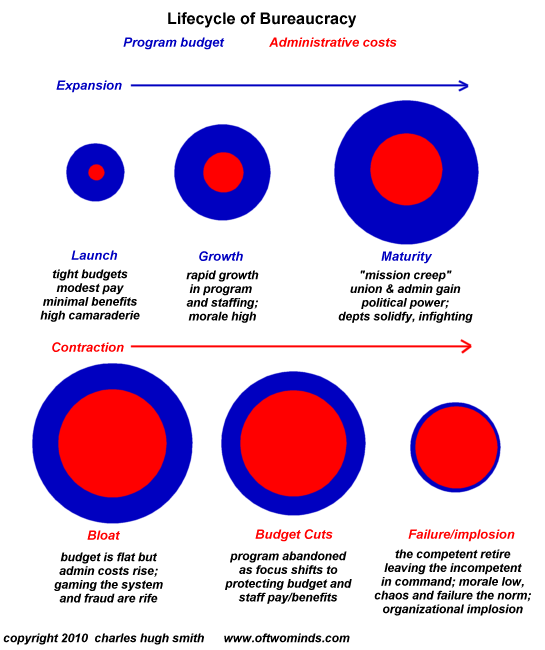
By this terminal stage, the competent have been driven out, quit or burned out. There’s only slack-masters and incompetent left, and the toxic work environment has been institutionalized, so no competent individual will even bother applying, much less take a job doomed to burnout and failure.

This is why systems are breaking down before our eyes and why the breakdowns will spread with alarming rapidity due the tightly bound structure of complex systems.

Categories
Some Scary thoughts You have to be kidding, right!?!

It’s Over! South Africa is F*&$d – Failed State

Categories
Some Scary thoughts

And if they can do this in Jolly Old England……

In Place until 1973

Categories
Some Scary thoughts The Green Machine

On Command: A Confession BY ANGRY STAFF OFFICER

I don’t want to be a battalion commander. I don’t want to be a brigade commander. I don’t want to command anything, ever again.

For an Army officer to say, this is well nigh on heresy. I nearly expected George C. Marshall himself to descend from his lofty throne on Mount This We’ll Defend and smite me down with his Army Strong Scepter as I typed those words. As officers, we are taught from our very beginnings as second lieutenants that battalion command is the end-all goal of our careers. And I believed it, too. I wanted it.

I wanted to wear the silver oak leaves and receive the colors from my brigade commander, seeing all the campaign streamers and unit awards, and knowing that was entrusted to me. That weighty responsibility, all in my hands. And then, I could make positive changes in soldiers’ lives. We could make the Army fun again. My staff and I, we could cut through the BS and show soldiers that their lives in the Army didn’t have to suck. We could make a difference. I truly wanted that.

And then I had company command. Well, command(s). Like battalion command, I had yearned for company command for years. For years, people had told me, “Oh, just wait for company command, you’ll love it.” I was sure I would. Command was a privilege, not a right, I was told. Damn right, and I wanted that privilege. Like all senior lieutenants, I was champing at the bit to take the guidon and run with it. And I did. And it was a blast.

For about a year and a half.

Then the running became a slog. Then the slog became a morass. And then I began to feel like I was drowning. I was exhausted. I was tired of fighting ridiculous battles with higher echelons to do the simplest of things. I was tired of the late-night texts and the phone calls, wondering what one of the soldiers in my unit had done this time. I was tired of the endless meetings, the signatures on an infinity of forms, of constantly feeling like for every step forward, I took two steps back. I was tired of fighting personnel battles, trying to ensure soldiers got to go where it worked best for them and the Army, only to get slapped down. Of building training plans which had to be changed less than a month out because someone above me failed to plan correctly. Of receiving conflicting guidance, where somehow even the most basic things became complicated. Of constantly balancing peoples’ egos and personalities with each other. Of acting as recruiting officer and commander, simultaneously. I was exhausted.

On paper, though, we were winning. Across two line company commands, we averaged the highest retention rates in the battalion and in some years, the whole state. We did this because we treated soldiers like human beings. We treated endemic unit issues and helped soldiers get into marriage, financial, or personal counseling. We destroyed other units’ metrics in training and were rated the best company of our type in our JRTC rotation. We somehow managed to have a robust and fun training schedule during the pandemic, while keeping soldiers safe. All the training paid off when we mobilized the company in 48 hours to get on the ground in DC after January 6. We won best unit in the battalion for years running. Officers, NCOs, and soldiers got to go to their dream schools. We helped so many soldiers get full time jobs in the National Guard so they could spread their skills around and build a solid financial base. We developed good relationships with other units and I got to work with some amazing leaders. And personally, I racked up top blocks on my OER for every year of command. On paper, I was best qualified and on track for battalion command. But I was exhausted.

I knew I needed to come out of command about four months before I actually did. But there’s that thing in your head, where you think, “to be a good leader, I have to give it my everything.” There’s a vivid picture in my memory of my conversation with my battalion executive officer, where I said I needed a break…”But if you really need me to, I can do four full years,” I heard myself say. Totally not like a masochist at all, nope.

I came out of command after 3 1/2 years and as I told someone when they asked me where I wanted to go next, I said, “A dark room where no one talks to me, and I can just read some doctrine or something.” The universe – or some kindly deity – came to my rescue and got me a dream assignment that took me far out of the universe of the operational force. Someplace I could finally take a knee and breathe. It felt weird. And on reflection, I came up with a troubling realization.

I did not love my company command. God knows, I wanted to. I loved the people I worked with, but command? Naw, I’m good. Then I began to think about battalion command and my brain basically shut down. Maybe I just had nothing more to give, or maybe…maybe it held nothing for me anymore. This was an embarrassing thought and I was reluctant to share it with anyone else, because it sounds like admitting failure and weakness.

Then I began to talk to my post-command peers, from across all components of the Army and a whole slew of branches. There were people who had deployed with their companies, some had commanded basic training companies, some who had incredibly specialized commands, and others who had basic branch commands. To a person, when we talked about if we wanted battalion command, the answer was, “Naw, I’m good.” Amazingly, we’d all had very similar experiences. Successful commands, top-blocked on evals, the works; but utterly and entirely drained, disillusioned, jaded, and with no desire to move to that next rung on the ladder. Precisely because they felt like they couldn’t actually make any meaningful changes – all while being ground down and kept away from their families.

So that’s why I write this. Not to complain about the Army. This is for all those other officers out there who might be thinking that you’re the anomaly, the aberration. That something’s wrong with you. Nope, you’re pretty damn normal from what I can see.

However, it should perhaps be sounding some alarm bells for the Army. If it was just me who had been feeling this way, as I thought for a while, then that’s a “me” problem – and I have no problem admitting that. Indeed, it took me so long to write this – I’m almost two years post-command – because I wanted to make sure this *wasn’t* just me being a cantankerous, salty moron. As, you know, I have the propensity to be from time to time. As it turned out, it’s not just a me problem.

Which then leads me to conjecture, that if you have thinking, capable, dynamic, engaged, and caring officers, who are rated among the best, but who are scrambling to find their ways out of their basic branches so as to not have to compete for command…that sounds like an Army problem. And it also means that those who are competing for battalion commands are either the very best of the best (and probably superheroes, to boot), or the egotistical, non self-aware narcissists that absolutely should never lead soldiers but somehow we keep meeting them in places of authority.

If you are looking at the conclusion, here, for a solution to this problem, I regret to inform you that I do not have one. Is there a way to make command less burdensome? Probably, but that would involve reforming the culture of the Army from the top down, which I don’t think I have the brainpower or the rank to call for, let alone the digital space to quantify.

Perhaps this can begin a dialogue, however, as we discuss how we treat command. The times ahead are not getting any simpler, and we will need the most capable minds in the Army to be in the best places for them in the years to come (not mine, it’s barely capable of holding two competing thoughts in it at the same time). As we discuss talent management, this needs to be part of that conversation.

As for me, who knows – maybe I’ll change my mind as I go through my other key duty positions. But I also know that if you do not want to be a commander, you should not be a commander. There’s plenty of fulfilment in the rest of the Army for me.

And hey, if you survived command and loved it, and were good at it, and aren’t some sort of absolute psychopathic micromanager who hates their families – good on you. I’m glad you exist. We need you.

For everyone else, you’re not alone.

Categories
Some Scary thoughts You have to be kidding, right!?!

Senators issued satellite phones, part of new security measures 15 by Scott MacFarlane (Its a big club & we are NOT in it!)

Amid growing concerns of security risks to members of Congress, more than 50 senators have been issued satellite phones for emergency communication, people familiar with the measures told CBS News. The devices are part of a series of new security measures being offered to senators by the Senate Sergeant at Arms, who took over shortly after the assault on the U.S. Capitol on Jan. 6, 2021.

The satellite phone technology has been offered to all 100 senators. CBS News has learned at least 50 have accepted the phones, which Senate administrative staff recommend senators keep in close proximity during their travels.

In testimony before the Senate Appropriations Committee last month, Senate Sergeant at Arms Karen Gibson said satellite communication is being deployed “to ensure a redundant and secure means of communication during a disruptive event.”

Gibson said the phones are a security backstop in the case of an emergency that “takes out communications” in part of America. Federal funding will pay for the satellite airtime needed to utilize the phone devices.

A Department of Homeland Security advisory said satellite phones are a tool for responding to and coordinating government services in the case of a “man-made” or natural disaster that wipes out communication.

Gibson has also opened an office “demonstration space” in the basement of the Russell Senate Office Building to offer senators and staff an exhibition of new home state office security upgrades. The demonstration room offers exhibitions of “duress buttons,” mail screening devices and safety glass to reduce the risk of attacks.

U.S. Senate Sergeant at Arms Karen Gibson testifies before a Senate Appropriations subcommittee on April 25, 2023 in Washington, D.C. / Credit: Kevin Dietsch / Getty Images

In her testimony before the Senate panel in April, Gibson reported, “Our team provided initial physical security enhancements for 31 offices and improved existing security for 52 others in 2022. Maintaining security systems in good working order is a priority, and to support this effort our team conducted over 622 service calls to maintain, repair, and or test and inspect state office physical security systems in 2022.”

Senate administrators have also offered “stop the bleed” training to better equip staffers to respond to medical emergencies and victims of attacks.

In April, the House Sergeant at Arms William McFarland told legislators there is “robust participation” in a program to help House members secure their home residences. McFarland said that House administrators are coordinating with local police departments to help protect members of Congress who hold events in their home states and to help better secure the homes of members.

A spending bill passed in late 2022 provided additional funds for hometown security measures for Congress. The legislation required security administrators to “enhance member protection including providing a security program for Congressional Leadership, expanding Dignitary Protection Division services and expanding USCP field office presence,” which would deploy and broaden Capitol Police protection in cities outside of Washington.

Though the U.S. Capitol complex is shielded by a force of nearly 2,000 Capitol police employees, there have been growing concerns about hometown security for members of Congress. A California man was charged in a 2022 attack at the San Francisco home of then-House Speaker Nancy Pelosi. The assailant was allegedly targeting Nancy Pelosi when he confronted and attacked Pelosi’s husband Paul with a hammer.

In a May 15 attack at the Fairfax, Virginia, office of Rep. Gerry Connolly, one of Connolly’s constituents is accused of attacking two of the congressman’s staffers with a metal baseball bat. Both were briefly hospitalized and are recovering.

Categories
Being a Stranger in a very Strange Land Some Scary thoughts

Stuff like this scares the shit out of me!

                Especially since I am old, crippled with a bad back & seen way too much real violence in my time. Grumpy

Categories
All About Guns Anti Civil Rights ideas & "Friends" Born again Cynic! Interesting stuff Paint me surprised by this Some Scary thoughts You have to be kidding, right!?!

Disarm the IRS, De-Militarize the Bureaucracy, and Dismantle the Standin

John Whitehead

“There are instruments so dangerous to the rights of the nation and which place them so totally at the mercy of their governors that those governors, whether legislative or executive, should be restrained from keeping such instruments on foot but in well-defined cases. Such an instrument is a standing army.”—Thomas Jefferson, 1789

What does it say about the state of our freedoms that there are now more pencil-pushing, bureaucratic (non-military) government agents armed with weapons than U.S. Marines?

Among the agencies being supplied with night-vision equipment, body armor, hollow-point bullets, shotguns, drones, assault rifles and LP gas cannons are the IRS, Smithsonian, U.S. Mint, Health and Human Services, FDA, Small Business Administration, Social Security Administration, National Oceanic and Atmospheric Administration, Education Department, Energy Department, Bureau of Engraving and Printing and an assortment of public universities.

Add in the Biden Administration’s plans to swell the ranks of the IRS by 87,000 new employees (some of whom will be authorized to use deadly force) and grow the nation’s police forces by 100,000 more cops, and you’ve got a nation in the throes of martial law.

We’re being frog-marched into tyranny at the end of a loaded gun.

Make that hundreds of thousands of loaded guns.

According to the Wall Street Journal, the number of federal agents armed with guns, ammunition and military-style equipment, authorized to make arrests, and trained in military tactics has nearly tripled over the past several decades.

As Adam Andrzejewski writes for Forbes, “the federal government has become one never-ending gun show.”

While Americans have to jump through an increasing number of hoops in order to own a gun, federal agencies have been placing orders for hundreds of millions of rounds of hollow point bullets and military gear.

For example, the IRS has stockpiled 4,500 guns and five million rounds of ammunition in recent years, including 621 shotguns, 539 long-barrel rifles and 15 submachine guns.

The Veterans Administration purchased 11 million rounds of ammunition (equivalent to 2,800 rounds for each of their officers), along with camouflage uniforms, riot helmets and shields, specialized image enhancement devices and tactical lighting.

The Department of Health and Human Services acquired 4 million rounds of ammunition, in addition to 1,300 guns, including five submachine guns and 189 automatic firearms for its Office of Inspector General.

According to an in-depth report on “The Militarization of the U.S. Executive Agencies,” the Social Security Administration secured 800,000 rounds of ammunition for their special agents, as well as armor and guns.

The Environmental Protection Agency owns 600 guns. The Smithsonian now employs 620-armed “special agents.”

Even agencies such as Amtrak and NASA have their own SWAT teams.

Ask yourselves: why are government agencies being turned into military outposts?

What’s with the buildup of SWAT teams within non-security-related federal agencies? Even the Department of Agriculture, the Railroad Retirement Board, the Tennessee Valley Authority, the Office of Personnel Management, the Consumer Product Safety Commission, the U.S. Fish and Wildlife Service and the Education Department have their own SWAT teams. Most of those officers are under the command of either the Department of Homeland Security or the Department of Justice.

Why does the Department of Agriculture need .40 caliber semiautomatic submachine guns and hollow point bullets? For that matter, why do its agents need ballistic vests and body armor?

For that matter, why do IRS agents need AR-15 rifles?

Why do local police need armored personnel carriers with gun ports, compact submachine guns with 30-round magazines, precision battlefield sniper rifles, and military-grade assault-style rifles and carbines?

Why is the federal government distributing obscene amounts of military equipment, weapons and ammunition to police departments around the country?

Why is the military partnering with local police to conduct training drills around the country? And what exactly are they training for? The public has been disallowed from obtaining any information about the purpose of these realistic urban training drills, other than that they might be loud and to not be alarmed.

We should be alarmed.

As James Madison warned, “We are right to take alarm at the first experiment upon our liberties.”

Unfortunately, we’re long past the first experiment on our freedoms, and merely taking alarm over this build-up of military might will no longer suffice.

Nothing about this de facto army of bureaucratic, administrative, non-military, paper-pushing, non-traditional law enforcement agencies is necessary for national security.

Moreover, while these weaponized, militarized, civilian forces which are armed with military-style guns, ammunition and equipment; trained in military tactics; and authorized to make arrests and use deadly force—may look and act like the military, they are not the military.

Rather, they are foot soldiers of the police state’s standing army, and they are growing in number at an alarming rate.

This standing army—a.k.a. a national police force—vested with the power to completely disregard the Constitution and rule by force is exactly what America’s founders feared, and its danger cannot be overstated or ignored.

This is exactly what martial law looks like—when a government disregards constitutional freedoms and imposes its will through military force, only this is martial law without any government body having to declare it: Battlefield tactics. Militarized police. Riot and camouflage gear. Armored vehicles. Mass arrests. Pepper spray. Tear gas. Batons. Strip searches. Drones. Less-than-lethal weapons unleashed with deadly force. Rubber bullets. Water cannons. Concussion grenades. Intimidation tactics. Brute force. Laws conveniently discarded when it suits the government’s purpose.

The militarization of America’s police forces in recent decades, which has gone hand in hand with the militarization of America’s bureaucratic agencies, has merely sped up the timeline by which the nation is transformed into an authoritarian regime.

Now we find ourselves struggling to retain some semblance of freedom in the face of administrative, police and law enforcement agencies that look and act like the military with little to no regard for the Fourth Amendment, laws such as the NDAA that allow the military to arrest and indefinitely detain American citizens, and military drills that acclimate the American people to the sight of armored tanks in the streets, military encampments in cities, and combat aircraft patrolling overhead.

This quasi-state of martial law has been helped along by government policies and court rulings that have made it easier for the police to shoot unarmed citizens, for law enforcement agencies to seize cash and other valuable private property under the guise of asset forfeiture, for military weapons and tactics to be deployed on American soil, for government agencies to carry out round-the-clock surveillance, for legislatures to render otherwise lawful activities as extremist if they appear to be anti-government, for profit-driven private prisons to lock up greater numbers of Americans, for homes to be raided and searched under the pretext of national security, for American citizens to be labeled terrorists and stripped of their rights merely on the say-so of a government bureaucrat, and for pre-crime tactics to be adopted nationwide that strip Americans of the right to be assumed innocent until proven guilty and creates a suspect society in which we are all guilty until proven otherwise.

Don’t delude yourself into believing that this thinly-veiled exercise in martial law is anything other than an attempt to bulldoze what remains of the Constitution and reinforce the iron-fisted rule of the police state.

This is no longer about partisan politics or civil unrest or even authoritarian impulses.

This is a turning point.

As I make clear in my book Battlefield America: The War on the American People and in its fictional counterpart The Erik Blair Diaries, we are sliding fast down a slippery slope to a Constitution-free America.

If we are to have any hope of salvaging what’s left of our battered freedoms, we’d do well to start by disarming the IRS and the rest of the federal and state bureaucratic agencies, de-militarizing domestic police forces, and dismantling the police state’s standing army.

ABOUT JOHN W. WHITEHEAD

Constitutional attorney and author John W. Whitehead is founder and president of The Rutherford Institute. His most recent books are the best-selling Battlefield America: The War on the American People, the award-winning A Government of Wolves: The Emerging American Police State, and a debut dystopian fiction novel, The Erik Blair Diaries. Whitehead can be contacted at staff@rutherford.org. Nisha Whitehead is the Executive Director of The Rutherford Institute. Information about The Rutherford Institute is available at www.rutherford.org.

Categories
Paint me surprised by this Some Red Hot Gospel there! Some Scary thoughts

Paint me surprised by this!

When a 28-year-old person identifying as transgender shot up a Tennessee school in March, killing three children and three adults, the usual grim afterlife of tragedy was underlined by an odd note: One by one, media outlets rushed to apologize for “misgendering” the shooter, who, they explained, had been born female but had recently begun identifying as male.

How to make sense of such a statement? And what to do when a newspaper headline tells you about a “trans woman left sobbing in JFK Airport after TSA agent hit her testicles”? Appealing to reason hardly helps, as J.K. Rowling and others learned the hard way when trying to ask simple questions such as how one might define sex if not according to the chromosomes rooted in literally every cell of our bodies. Instead, anyone wishing to find his way through the thicket of American public discourse these days should start by embracing one simple and terrifying idea: The barbarians are at the gates.

I mean this almost literally. Everywhere you turn these days, pagans are afoot, busily hacking away at the Christian and Jewish foundations of American life and replacing them with a cosmology that would have been absolutely coherent to followers of, say, Voltumna, the Etruscan earth god, or to those who worshipped the Celt tribal protector Toutatis.

If you think the above paragraph is a little bit overblown, consider the numbers. In 1990, scholars from Trinity College set out to learn just how many of their fellow Americans practiced some form of pagan religion. The numbers were unsurprisingly small: about 8,000, or enough to pack your average Journey reunion concert. But the researchers asked again in 2008, and this time, 340,000 Americans said yes to paganism. A decade later, the Pew survey posed the same question, and, if it is to believed, there are now about 1.5 million Americans professing an array of pagan persuasions, from Wicca to the Viking lore, making paganism one of the nation’s fastest-growing persuasions. So fast-growing, in fact, that my colleague Maggie Phillips recently reported in Tablet magazine about the thriving, and officially recognized, pagan faith groups within the U.S. Army. “What’s important now,” one of its leaders, Sergeant Drake Sholar, told Phillips, “is showing religious respect and understanding across the board as Norse Pagans, or Heathens, return to a distinguishable religious practice.”

Amen, selah. But as we respect and understand those who profess paganism outright and sincerely, we should worry about those—many more of them—who go by other names and profess different affinities yet whose worldview is consistently, coherently, and crushingly pagan. There are millions more heathens who would shudder to be called such, yet who offer a vision of a perfectly pagan American future. It behooves us, then, to reckon with the paganism in our midst.

And that, it turns out, is not an easy task, mainly because “pagan” is somewhat of a loaded term. If you have an appetite for good origin stories, you might as well place the birth of the notion with St. Augustine in the fifth century C.E. Pressed to explain to his readers why Rome had been sacked by the Visigoths so shortly after embracing Christianity, Augustine wrote his famous treatise, The City of God. Its full title? De civitate Dei contra paganos, or The City of God Against the Pagans. The latter, he opined elsewhere, had delivered unto mankind nothing but a “hissing cauldron of lusts” that have so spoiled our souls and driven us so far from God that the downfall was imminent. The moral stain of Augustine’s description stuck, and it often colors both our historical vision and the observation that “pagan” describes a dizzying array of peoples and beliefs—from the Slavic tribes who believed that the sky god Perun had beget all other deities that control nature to the Germanic peoples and their complex mythology of giants, dwarves, elves, and dragons, familiar to us from Wagner’s operas.

Leaving permutations and particularities to the pedants, though, it’s quite possible to observe paganism as one sweeping vista and find common themes and threads that haunt us still. Let us begin: Just what do pagans believe?

_____________

The answer, while wonderfully complex, may be distilled to the following principle: Nothing is true, everything is permitted. These were the last words, allegedly, of Hasan i-Sabbah—the ninth-century Arab warlord whose group, the Hash’shashin, gave us the English word “assassins.” And his dictum perfectly captures the soul of paganism, illuminated by the idea that no fixed system of belief or set of solid convictions ought to constrain us as we stumble our way through life.

To the pagans, change is the only real constant. Just consider the heathens of old: Believing, as they did, in the radical duality of body and spirit, they enjoyed watching their gods breathe the latter into a wide array of incarnations. To please himself or trick his followers, a god could become a swan or a stone, manifest himself as a river or adopt whatever shape suited his schemes. Ovid, the greatest of Pagan poets, captured this logic perfectly when he began his Metamorphoses with a simple declaration of his intentions: In nova fert animus mutates dicere formas corpora, or, “I am about to speak of forms changing into new entities.” This was not understood as fickle behavior by the gods’ cheerful followers. To the contrary. With no dogma to uphold, the sole job of deities was simply to be themselves. And the more solipsistic a deity chose to be, the better. Nothing, after all, radiates inimitable individuality more than marching to the beat of your own drum and no other.

If that’s your understanding of the gods, or whatever you’d like to call the hidden forces that arrange the known universe, how should you behave? Again, lacking a prescribed credo passed down from generation to generation, pagans began answering this question by casting off the tyranny of fixity. The gods are precarious and ever-changing? Let us follow their example! We should sanctify each sharp transformation in our behaviors and beliefs not as collective madness but as a sign of the wisdom of growth.

Still, change alone does not a belief system make, and pagans, despite differences galore, unite by providing similar answers to three seminal questions: what to do about strangers, how to think about nature, and how to please the gods.

First, the question of difference. What to do with those who are not like us? Easy enough, argued the pagans: Observe any group of humans, no matter how small, and you’ll see it striving to differentiate itself from the group next door. The nomadic Bedouins expressed this idea neatly in an idiom: me and my brothers against our cousins, us and our cousins against our neighbors. Tell children at summer camp that a color war’s afoot, and pretty soon Team Red is likely to develop healthy disdain for Team Blue. Rather than seek to transcend this basic instinct, the pagans sanctified it: It wasn’t for nothing that the Slavs, for example, named their top god Perun, an Indo-European word meaning to strike and splinter, and portrayed him as swinging a mighty axe and engaging in ongoing battles with his fellow divines.

The same spirit, alas, is alive and well among our newest pagans: For them, tribal warfare isn’t just a way of life—it’s a system of divination, with power and privilege waxing and waning to reveal who is pure and worthy and who evil and benighted.

Consider, for example, intersectionality, the academic doctrine that is as close as contemporary paganism gets to a formalized gospel. Its ideas, like most of academia’s excretions these days, aren’t worth studying in any real depth, but the key concept is simple. We each have several components to our identity—sometimes referred to, in the flowery language of assistant professors, as “vectors of oppression and privilege”—and their interplay determines the discrimination we suffer or the violence we may be tempted to wield against others. This means that each introspection is nothing more than an invitation to a fight with those who have more power, real or imagined, than you.

This is what gave Lori Lightfoot, Chicago’s grotesquely inept mayor, the temerity to avoid blaming her recent defeat on, say, the fact that she had called on her city to defund the police, then watched crime soar—with more than 800 murders in 2021 alone, the highest rate in nearly 30 years—and then begged the federal government to help her out of the predictable mess she created. No, she had been defeated for being “a black woman.” For a pagan, tribal identity isn’t the beginning of the conversation; it’s the end, an affiliation beyond which lies nothing but battle for dominance.

Still, merely affirming their own and rejecting others and spending their days trying to decipher who belongs to which group is hardly the sort of theological engine that can power faith for long. Next, then, the pagans turn their lonely eyes toward nature, asking themselves how to understand the creations in their midst. Here, too, a relatively straight forward answer presents itself immediately: If the boundaries between the human world, the natural world, and the divine world aren’t clearly defined—if Zeus, say, can transform himself into a beautiful white bull so that he may rape Princess Europa—then nature should be revered as the repository of divine revelation and rebirth. The Roman historian Tacitus, for example, tells us that the ancient Germanic tribes often worshipped in groves rather than temples. It’s easy to figure out why: Observe the oak in winter, and it stands, barren and leafless, a pillar of death. Visit it some weeks later, when spring is in full bloom, and you see it flourish again. The oak, like the gods, is change embodied, and therefore deserving of worship.

Scan the modern pagan cosmology, and you’ll see much that would have made those ancient Germanic cultists nod in recognition. Consider the eco-protestor who, last year, stormed the court just before Roger Federer’s last career tennis match and set his own arms on fire to protest climate change. Or the Brit who, shortly thereafter, poured human feces on a statue to call attention to environmental causes. Or the lunatics from Just Stop Oil, a radical environmentalist group, who slung soup on Van Gogh’s Sunflowers. Just like the Scandinavian pagans who offered precious gifts to appease the Askafroa, the spirit of the Ash Tree, a vengeful entity that demanded sacrifice lest it wreak havoc, many of today’s green activists seem much more intent on appeasing an angry god than solving a scientific conundrum. And the scientists themselves aren’t helping much either: In 2018, for example, one prominent Columbia University climate scientist took to Scientific American to write that she refuses to debate…climate science. “Once you put established facts about the world up for argument, you’ve already lost,” she wrote, capturing the opposite, more or less, of the scientific method, which is little more than a constant and unfettered argument about established facts, new evidence, and the possible correlations or contradictions therein.

But if pagans have always found the questions of how to treat others and how to live in nature relatively uncomplicated, the third question—that of how to please the gods—is infinitely more shaded. What do the gods want? Study pagan mythologies and you’ll emerge none the wiser, in part because the gods, like their human worshippers, seem to consist of little more than appetites and caprices. But while they may not be understood, they have to be appeased—and this left classical pagans with a question of a more practical order, namely what might they possess that the all-powerful deities could possibly want.

Gold, silver, and other dear things were frequently the answer, but rarely exclusively: Being the creators of the natural world, after all, the gods could hardly care that much about things that they can easily forge themselves, ex nihilo, by virtue of their divine will. And so the pagans scanned the horizon for something truly precious and exquisite, something whose sacrifice would be an unmistakable sign of devotion. And, across time and across cultures, they alighted on exactly the same thing: kids.

At once the embodiment of innocence and the object of our deepest and most sincere emotions, children, the most vulnerable of mortals, were the ultimate offering to the gods—proof that the pagan believer was so certain in his belief that he would offer up his own offspring to show the gods the strength of his faith, appeasing them and avoiding potential punishment. So prevalent among the heathens of antiquity was the practice of child sacrifice that the Torah issued a strongly worded prohibition against it, in Leviticus 18:21: “Do not give any of your children to be sacrificed to Molek.”

Child sacrifice, alas, is alive and well in America these days, too. We may not, like the Vikings, toss our young into wells as offerings to the heavens, but turn over every rock in our craggy contemporary political landscape and you’ll find some pagan policy offering up the well-being of children to the gods of virtue. In March 2020, to choose one stinging example, Sweden bucked the global trend and responded to Covid-19 by keeping schools open. The results of this experiment were available shortly thereafter: Zero dead kids, almost zero kids sick, and very little, if any, risk to teachers. By January 2021, a study published by the Centers for Disease Control and Prevention affirmed that Covid rates in schools that had reopened were 37 percent lower than the rates in the same communities at large. The Biden administration largely ignored this evidence; it took some liberal cities such as New York a full 18 months to reopen their schools.

The results: dramatic upticks in juvenile mental-health crises, sharp declines in basic academic proficiency and just about every other metric of human misery visited on our children. A rational society, to say nothing about one guided by traditional values, would have curbed this suffering long before it blossomed so terribly; the pagans instead composed a fanciful narrative of what constitutes righteous behavior and then forced it on their children, whose pain was then explained away as a necessary evil if one wanted the forces of science to vanquish the darkness and cleanse the soul. When Anthony Fauci said, “I am the science,” he couldn’t have sounded more like the mighty Perun had he worn a cape and a crown.

Maybe you’re a kinder person than I, one more inclined than I am to give fellow human beings the benefit of the doubt. Pandemics are stressful times, and even the most well-meaning public health officials may be forgiven their missteps when the entire world is crackling. No sooner had the wrath of Covid subsided, though, than our pagan witch doctors jumped in with another way to sacrifice the well-being of the young on the altar of ideological convictions. According to a recent Reuters report, for example, 15,172 Americans ages six to 17 were diagnosed with gender dysphoria in 2017; by 2021, that number nearly tripled. How to explain this stratospheric rise? Have doctors gotten better at detecting this particular medical condition? Has the science simply improved?

A 2018 study by Lisa Littman, assistant professor of behavioral sciences at Brown, addressed this very question. Teens, Dr. Littman concluded after studying 256 subjects, were highly susceptible to what she called “rapid-onset gender dysphoria.” When spending time, particularly online, with groups of people who favorably discussed the idea of being transgender, teens were much more likely to become gender dysphoric, a phenomenon Dr. Littman described as “peer contagion.”

The paper was accepted by PLOS One, a peer-reviewed scientific journal, but after transgender activists protested, the article was removed, and a Brown dean explained that censorship had been necessary because Dr. Littman’s findings “invalidate the perspectives” of the transgender community. Meanwhile, the Reuters report also confirmed that the past four years have seen a doubling of the rates of both hormone therapy and puberty blockers prescribed to teens. This uptick, coupled with school policies that now actively seek to exclude parents from conversations about their child’s gender identity, has led lawmakers in 27 states to draft 100 bills to halt so-called gender-reaffirming care.

Meanwhile, the intellectual-industrial complex continues to push its pagan convictions. The University of Pennsylvania recently announced an anonymous $2 million gift that would allow it to hire Alok Vaid-Menon, a self-identified “non-binary transfeminine person,” as a scholar in residence. Vaid-Menon is the author of Beyond the Gender Binary, a children’s book encouraging young readers to understand that “man” and “woman” are but two of an infinity of gender-related options.

But it’s not merely the hotly debated issues in the center of our cultural skirmishes that point to the pagan propensity for child sacrifice; it’s the pagan style of politics itself. A study published in 2022 and led by Columbia epidemiologist Dr. Catherine Gimbrone examined the longitudinal data collected by the Monitoring the Future project, which asks high-school students a wide array of questions about attitudes, beliefs, and behaviors. Dr. Gimbrone’s findings were alarming: Before 2012, there had been no differences between boys and girls, and none between self-identified conservatives and liberals, when it came to mental health. Then, depression scores began to soar for liberal girls and rise considerably for liberal boys. Conservative children registered a far less significant spike. Put crudely, the obsessive and relentless pagan emphasis on gender, ideology, and other divisions was literally driving kids crazy.

Writing about the roles schools played in destabilizing the mental well-being of children, NYU psychologist Jonathan Haidt and journalist Greg Lukianoff argued that our academic institutions were practicing “reverse CBT.” While Cognitive Behavioral Therapy teaches its adherents to catch catastrophic thoughts before they turn into full-fledged panics, schools were now teaching children to see the world in black and white, perceive opposing viewpoints as harmful, and surrender to their worst fears.

_____________

What, then, are we to do when confronted with so much lunacy? Three urgent steps come to mind.

First, let us realize that all of the above-mentioned permutations are far from random. They’re not aberrations to be gawked at separately. They’re part of a cohesive belief system, paganism, that is gripping those who have rejected monotheistic ethics and mores. This recognition is particularly important because the pagans themselves vehemently deny it. They print stickers with slogans like “believe the science,” not realizing that they have just admitted, however tacitly, that theirs isn’t a logical and rational product of the Enlightenment but a religious system like any other, complete with its quirks and its zealotry. Only when it is understood as such can it be confronted; only if we deny the pagans the right to don a white lab coat or a tie and claim impartiality can we provide a sober accounting of their actions.

Second, we must understand that the good, old-fashioned faith traditions that the pagans so often reject as oppressive, patriarchal, racist, misogynistic, or any number of other trendy terms have seen it all before. Judaism has been facing down pagans for millennia now and answering each of their deathly dicta with sound, humanistic alternatives. Here’s a taste: We were all, the Bible tells us, created in God’s image, and even though God elected one people to preserve and protect his Torah, the arc of history bends toward togetherness. God’s house, Isaiah wisely reports, “shall be called a house of prayer for all nations.” In other words, while people are different, and while their differences are meaningful and instrumental in shaping their unique experiences, they also form the bridge that could one day lead to a common house of prayer. The biblical story begins and ends with a universalist message; its meaty middle, the story of the chosen people and their travails, is a crucial reminder that cultivating our own tribal beliefs and rituals is, ultimately, an exercise in self-awareness without which we can never truly empathize with anyone anywhere. Know thyself so you may know others—as credos go, this one is unimprovable and so much more compassionate than the pagan call for perpetual warfare.

Which leads us to step three, the most urgent yet most difficult one: Save your children by shielding them from an ideology that perpetually seeks ways to harm them; root them instead in traditions that nurture them and give them dignity, hope, and a future. At the very least, this means refusing to enlist your children in political crusades, no matter how just they may appear. Resist hagiographical books about activists and rabble-rousers. Realize that taking your kids to a march or a demonstration doesn’t make them better citizens—as if civic duty can be learned by osmosis—but merely ladens them with the anxiety of ideology, a burden no child should ever have to bear. If you can, rescue them from pagan schools as well, or, at least, teach them that there are better options.

When pagans waving the banner of diversity, equity, and inclusion insist that we judge others by the color of their skin, not the content of their character, tell your children that the Hebrew prophets offered a much more transformational vision of racial justice, one that inspired everyone from Frederick Douglass to Martin Luther King Jr. When pagans calling themselves environmentalists tell your children to worship the earth, introduce them to the Talmud for a superior attitude that is as mindful of production as it is of conservation. When pagans quarrel and cancel, teach your children the value of building real communities, and of the tried-and-true blueprints for real human happiness given to us by our faith traditions.

If we do that, we may very well discover that history, God bless, always repeats itself: The heathens ululate and then fold, subdued by the demonstrable advantages of better faith traditions. We’re long overdue for another cycle of pagan defeat; let’s do our best to bring it on soonest.