Category: Gun Info for Rookies


Recently, a buddy called me and asked if I would check out his Ruger 10/22. It was “jamming,” as he described it. That seemed strange because 10/22s are famous for being reliable.
When he brought it over, the problem was obvious: The rifle had not been cleaned in a long time—perhaps ever. My buddy is far from being a gun guy.
A firearm means no more to him than a hammer does to a carpenter. He needs it to dispatch vermin around his place or put meat on the table, but maintaining it is a concept vacant from his wheelhouse.
When he brought it over, the problem was obvious: The rifle had not been cleaned in a long time—perhaps ever. My buddy is far from being a gun guy.
A firearm means no more to him than a hammer does to a carpenter. He needs it to dispatch vermin around his place or put meat on the table, but maintaining it is a concept vacant from his wheelhouse.

Today’s shooters—as have most for more than a century—are in love with rimfire firearms, except for this buddy. They are relatively quiet, have little to no recoil, are quite accurate and relatively cheap to shoot.
Each year, well more than a million rimfire cartridges are expended. With the many rounds sent downrange, problems are bound to occur.
Whether you are a plinker, a small-game hunter or sophisticated target shooter, keeping your firearm running is a top priority—or it should be. Here are a few tips on keeping your rimfire gun running.
Cleanliness is next to Godliness
That may seem to be an antiquated idea, but it is a fact that clean gunsfunction more reliably than dirty guns. However, as blasphemous as it may seem, too much cleanliness can shorten the life of your firearm. Let me explain.
There is a notion held over from the past that guns and gun barrels must be scrupulously cleaned after every shooting session. In the days of blackpowder and corrosive primers, that was a truism.
Even today, black powder shooters are wise to clean their firearms after a shooting session. The residue from combusted blackpowder is hydrophilic, meaning that it attracts water and in the case of the black powder residue, it can literally suck it out of the air.
The same is true for shooting cartridges loaded with corrosive primers. The residue left behind from those primers are salts—mostly potassium chloride—and they attract moisture, thus setting up an environment for corrosion in the barrel.
This is why so many barrels from older guns are pitted to some extent. Today, however, modern primers and powders are generally non-corrosive, unless you are in a very humid climate.
A lot of shooters have discovered that their favorite gun does not require a thorough cleaning each time it is used. Modern barrels—most are made from 4140 chrome-moly for blued barrels; stainless steel for others—can maintain their accuracy for several hundred rounds without cleaning.
Cleaning, if not done properly, can actually accelerate the wear on a barrel, thus stealing some life from it. The smaller the bore, the more likely it is to do damage to the barrel. Since most rimfires are smaller bores—.22 and .17 cal.—over-cleaning the bore can be a real issue.
The risk comes from cleaning rods that can flex and thereby scrape the internal surface of the barrel. Using eyes instead of a properly fitted jag and worn brushes that use twisted steel to retain the bronze bristles combined with a zealous arm behind it has worn out many a barrel.
Consequently, many shooters do not clean their barrels until they see a decay in accuracy.
Those who live or shoot in humid environments will probably need to clean their barrels more often than those in dryer climes. The residue from shooting can have microscopic fissures in it so that the effects of humidity are enhanced.
Their barrel-cleaning schedule will be determined by trial and error. If you shoot and then wait a week to clean, and see evidence of rust on the cleaning patches, then a more rigorous schedule must be worked out.
But there’s more
Of course, there is more to gun cleaning than just the barrel. The breech section of the gun is subject to fouling as well, and this can be critical to keeping the gun functioning.
Rimfire ammunition is notoriously filthy. It leaves behind a lot of crud. Don’t believe me? Take a piece of cardstock and place it within 6″ of the muzzle. Fire the gun and notice all the crud around the bullet hole.
Some of that crud doesn’t get blown out of the barrel, so guess where it collects—in the receiver, along with the operational components. That area needs more regular attention, whether it is a break-open single shot or a fast-firing semi-automatic.
Shooters all have their preferred method of dealing with this fouling, and the details may vary a bit. My preferred method is to spray the hell out of the fouled area with brake cleaner, a product available at most automobile service stores.
Brake cleaner is a solvent under a bit more pressure than most aerosol cans that easily loosens the fouling and blows most of it out of the gun. This means that cleaning the gun on your kitchen table—at least this part of the cleaning—won’t be welcome by anyone else sharing that table for dining.
Take it outside, and be sure to use goggles or a face shield to protect your eyes. Don’t ask me how I know this, but I can assure you that you do not want to find out why first hand.
*One more caveat: Be careful about using brake cleaner with plastic—the current buzzword is “composite”—parts.
The solvent may attack some composites and either pit them or dissolve them. If your gun has plastic in or around the breech, you will have to use traditional solvents and rags unless you have a source of compressed air.
Slip sliding away
Another old-school saw says that lubricating a firearm is not necessary unless you live in a humid environment. This is a holdover from the days of petroleum-based lubricants that were viscous and low in volatility. The worry was that the lubricant would attract dust and grime from the outside and foul-up the gun.
Again modern technology has come to the rescue. Too, an increase in knowledge, hence maintenance practices, has pretty well negated this argument.
Fact is, components that slide together to make something—in the case guns—operate correctly requires some lubrication. There are generally two schools of thought regarding lubrication.
The lazy, “I got no time for fancy stuff,” group takes a spray can of whatever is claimed as gun oil and sprays everything until it is dripping, then puts the gun away. There is, however, a better way.

Many gun oils are available in a squeeze bottle with a rotating delivery tip. It doesn’t take that much more time to carefully apply a drop or two—sometimes more, depending on the individual firearm—and gently wipe off the excess with a rag.
Not only do you not have to deal with the gun leaking the stuff everywhere, but you don’t leave excess lubricant in some place on the gun that would attract dust and grime, negating its reliability.
It does not necessarily mean dismantling the firearm; most of the time it can be done with the gun assembled. In rare cases where lubricant must be sort of surgically inserted, an old hypodermic syringe is handy. A Q-tip, a.k.a. cotton swab, for cleaning, as well as lubrication, is also a handy item in your gun maintenance kit.
The spray can is not a complete no-no. I usually have a can with me at my range or a competition for emergency cleaning and lubrication when there is not an opportunity to tear into a gun.
Sometimes just spraying the gun’s action, shaking out and wiping off the excess can mean the ability to stay out at the range or complete the match.
Now here’s a tip not often publicized: Lubricating your ammo can go a long way toward keeping your rimfire running. But before you go and dip your ammo in a can of oil, let me explain.
You must be very careful about lubricants that touch your ammunition. Many fine gun lubricants have the ability to creep into every nook and cranny.
This can be a good thing when working on your gun, but if it creeps into a cartridge, it can cause the cartridge not to fire.
There are, however, dry lubricants that when carefully applied can enhance the reliability of your rimfire. This mostly applies to semi-automatics, but I now try to lube all my rimfire ammo. Here’s the safe way to do it: 
You’ll need a cloth—I use an old silicone gun cloth that I keep in a zip-lock bag just for this purpose—a can of dry silicone lubricant and ammo that is already clean.
By clean, I mean that old, cruddy ammo kept in a box or jar won’t work. Fresh ammo in its original packaging is what you should be using. Lay the cloth out on a suitable surface and spray it with the dry lube.
This is important: Wait until it dries. Place a given amount—I usually grab a good handful of ammo, say, 50 rounds—onto the cloth.
Carefully bring up the edges until it resembles a loose pouch. Shake and roll the ammo around the cloth to ensure each cartridge gets lubed. You can either put these rounds back in the box for use or load up a magazine(s) directly from the cloth. It is surprising how effective this is in slicking up the feeding and extraction of your gun.
A dry silicone lube is the best. The reason you wait until it dries on the cloth is to ensure the lube cannot creep into the cartridge.
Another good use for dry lube is your magazines. Especially with blowback semi-automatics, the area around the top of the magazine can get caked in crud. And again a caveat: Be careful when using aggressive solvents like brake cleaner with plastic magazines.
You might spray a bit of it on a rag, and test it on a non-critical and unobtrusive part of the magazine. The same is true with dry lube. Make sure the solvent isn’t going to screw up your plastic magazine.
I asked my buddy if his rifle was still accurate. “How the hell would I know?” he replied, “It still hits rabbits.” So I left the barrel alone. I removed the action from the stock and sprayed the receiver liberally with brake cleaner.
While it was dripping, I hit it with a few blasts from my air hose. Then I hit the areas where the bolt rides in the receiver with a few drops of Ballistol. I also cleaned up the magazine and hit it with some dry lube.
Bingo! The rifle was running as good as new again. Total time: about 10 minutes.

What I think would make for a great rifle to have in the field. As one could break it down and then put in your rucksack. To then act as a have around as a “keep out of sight camp rifle”.
Which could be used as a way to fill the pot with fresh meat. Or if need be, to be a really nasty surprise. To those who mean you harm in the field.
Grumpy










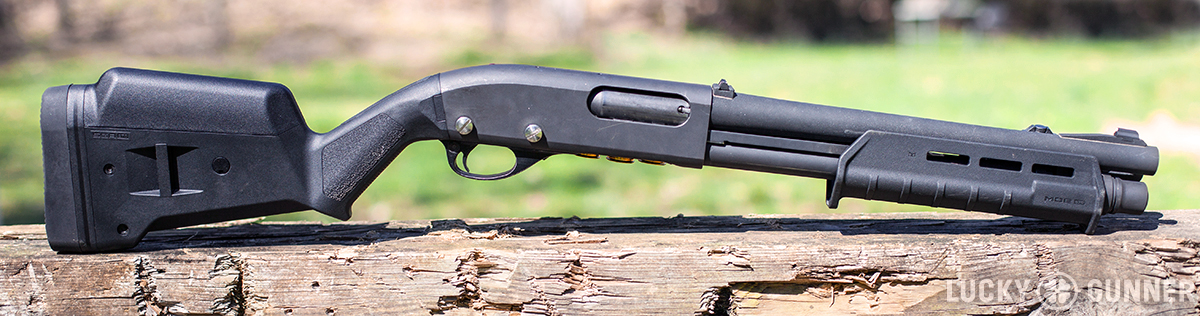
Some of you have noticed the Remington 870 SBS (short-barreled shotgun) that’s made some appearances in our defensive shotgun series over the last few weeks. Honestly, the shotgun isn’t all that remarkable aside from the NFA-length barrel.
Internally, it’s just like the millions of other 870s out there, and I’ve equipped it with some pretty mundane, albeit useful parts to make it more suitable for home defense.
But a lot of our readers and viewers have been asking questions about the 14-inch barrel and whether it’s something I would recommend, so that’s the topic of today’s video:
Video Review: Remington 870 SBS
I wasn’t planning to review this gun, but since I’ve been using it in the last few videos, you guys have been asking a lot of questions about it, so today I’m going to deliver some answers.
This is my Remington 870 12 gauge short barreled shotgun. It started out as a cheap surplus police shotgun that I bought with no barrel. If you look closely, you can tell that it’s pretty well used, but it’s in great mechanical condition.
I replaced the stock with a Magpul SGA stock. I’ve removed all of the spacers in order to get the length of pull as short as possible and I’ve added one of the Magpul cheek risers to raise the comb height.
The forend is also from Magpul. It’s actually not my favorite design — I’m not crazy about this lip here in the back, but I like that it’s really easy to attach a light.
You can put a piece of rail on any of these slots on the forend and attach whatever light you want. I’ve got this Inforce WMLX attached here, which works pretty well with the way I normally grip the forend.
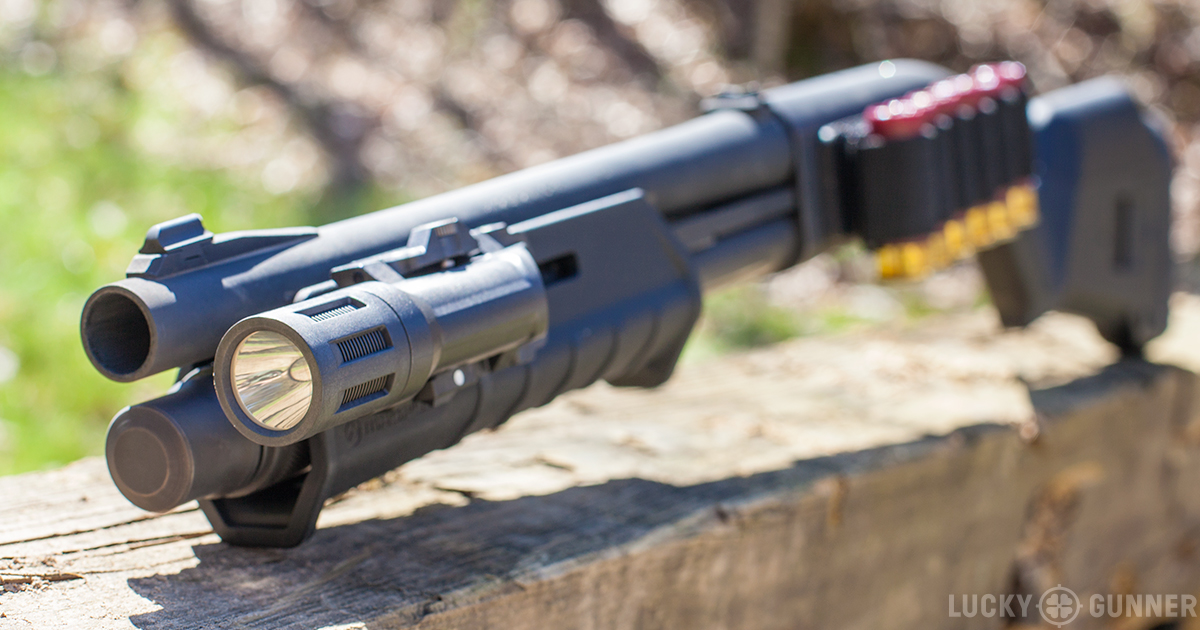
The mag tube extension is the only accessory I kept that was on the shotgun when I bought it. It’s a Vang Comp Systems +1 extension, so I can get a total of five rounds in the tube.
The side saddle is also from Vang Comp. It’s a plate with Velcro on it that attaches with screws through the receiver. These Velcro-backed cards with the elastic loops just stick right to the plate.
The barrel is actually a Remington factory 14-inch barrel with a fixed modified choke. Remington doesn’t typically sell these to the general market, but you can sometimes find them on the auction sites.
I got this one for a little under $200. It came with XS express sights pre-installed — they’ve got a v-notch rear and a big white dot on the front. I’m not a big fan of the XS sights on handguns, but I really like them for this shotgun. I’ve found them to be a lot quicker to use than a ghost ring and more accurate than a bead sight.
The Remington 870 is probably the easiest platform to start with for a short barreled shotgun, because it doesn’t require any custom work and the factory barrels aren’t too hard to come by.
Because this shotgun has a barrel under 18-inches, it does fall under the National Firearms Act regulations. That basically means I had to pay a $200 tax and do a bunch of paperwork and wait a few months for Uncle Sam to process all that before I could legally install this barrel.
If you want to know more about how the whole NFA thing works, I’ll put a link to more information in the video description.
But I think the more pressing question a lot of you have is whether I think the short barrel is worth the extra $200. That’s going to depend a lot on your individual situation, but I do think it’s got some pretty compelling advantages.
I like the way the gun balances better versus a typical 18 inch barrel. It’s not a drastic difference, but it’s noticeable. It also doesn’t sacrifice much in terms of shot spread. I can easily keep all the pellets inside the vital zone of a target at 15 yards with Federal Flite Control 00 buckshot.
Most importantly though, the short barrel on the Remington 870 SBS is a lot more maneuverable inside a house.
I’ve done some dry practice at home and at the range with some obstacles set up and I was surprised at just how much easier it is to get around furniture and doors and that kind of thing.
I’m not suggesting anyone try to go hunt bad guys and clear their own house alone. But even just staying put in one room, the shorter barrel is easier to work with and for me, it also makes the gun a little quicker retrieve from where I have it stored.
There are some disadvantages to the short barreled shotgun. It’s got a shorter magazine tube than you can get with a longer barrel, and that means you have one or two fewer rounds of ammo capacity.
More ammo is certainly a good thing, but I’ve explained before why capacity is not nearly as critical with a shotgun as with a handgun or a carbine.
The purpose of using a shotgun to solve a problem is precisely because historically, they haven’t required multiple hits to stop a threat.
To paraphrase Tom Givens, if you’ve got five rounds in a shotgun, then you’ve got a “five bad guy gun.” And personally, I’m pretty happy with that.
Capacity is not the only perceived disadvantage. The short barrel may not be as PR friendly as a more typical shotgun and that might be a big deal for some people. You also have to fill out paperwork and get permission from the ATF any time you want to take a short barreled shotgun across state lines, which is kind of a pain if you travel a lot.
Overall, for me personally, I think the benefits of the 14-inch barrel outweigh the potential disadvantages but it’s not what I’d call an essential modification.
If you’ve already got a decent shotgun with an 18 or 20-inch barrel, your money is probably better spent on a few cases of ammo and a good training class.
But if you’ve still got some room in the budget after that, I do think the short barrel makes the shotgun more convenient to use and might be worth considering.
—

Ten years ago this rifle would’ve been the pinnacle of a precision competition build. It’s still a very nice rifle, but modern options give you a lot more flexibility for your money.
Get A Grip: Stocks In The Modern Era of PRS
Evolution is a constant state—especially in precision rifle competition where manufacturers look to improve and upgrade products to give an advantage wherever possible. While the rifle stock may seem like a pretty simple thing, it has evolved with the sport as much as optics and ammunition have.
The rifle stock is a vital part of the overall precision rifle system because it is the one part you interact with the most on the rifle. I like to say that a good precision rifle stock should fit you like an old pair of dusty boots so that when you get behind the gun you’re comfortable and relaxed. But picking the right stock for your precision rig can be a challenge because of the sheer number of options and accessories available.
What Is A Good Rifle Stock?
Before I get too deep into the weeds, I think I need to come right out and say that most of the stocks that come on factory varmint or long range rifles are pretty terrible. All too often they’re made from cheap plastic that’s too flexible for serious use and generally have poor ergonomics that don’t fit the shooter at all. This is why stocks are one of the first things to get replaced when a person gets a new long range rifle.
A stock that’s going to be good for long range competition use has to be made from a durable, rigid material that free floats the barrel and is adjustable to fit the shooter perfectly. A lot of different stocks are going to fit this bill and they generally fall into two categories: traditional composite stocks or chassis systems.

A chassis system like this Accuracy International AX AICS provides on-the-fly adjustability, a folding stock, a built-in detachable magazine system, and modularity that is hard for a composite stock to match.
Chassis Systems
Believe it or not, chassis systems were once looked down on by the long-range community. But that tide has turned as chassis systems have become more accepted for precision rifle builds. It should be noted that nearly every major rifle manufacturer makes a chassis rifle now and the US military’s M2010, M40A6, and Mk 13 sniper rifles use chassis systems. It’s not all that surprising that chassis systems have gained the popularity that they have given the enormous bang for the buck that they can provide.
One might be inclined to start off by extolling the virtues of the chassis bedding interface and how it doesn’t require the shooter to bed the action. To an extent this is true, but I’d like to start by talking about the adjustability of the chassis’ stock because this is where they begin to come into their own. Some stocks will start out as a non-adjustable base model but almost every chassis system that I’ve come across has had an adjustable length of pull (LOP) and adjustable cheek piece right off the bat. This is important on a competition rifle so that the gun can perfectly fit the shooter. Some chassis go beyond simple LOP and cheek adjustments though and allow the butt pad height and angle to be set, as well as allowing lateral adjustment to the cheek rest for the ultimate in shooter comfort. It’s not uncommon to also see some chassis systems like those from XLR Industries or MDT be compatible with AR-15 stocks and pistol grips for end-user customization.

Many chassis systems on the market offer a fully adjustable buttstock that provides cheek height adjustment and length of pull adjustment, in addition to sling attachment points. Some models, like this Accuracy International chassis, offer additional adjustments of the butt plate to set it up perfectly for your shoulder.
Since the action area on a chassis systems is made from aluminum it’s easy for them to set up for a detachable box magazine (DBM) system from the get-go, which is a necessary feature on a modern competition rifle. I remember a time when a having a DBM wasn’t really that big of an advantage but now many courses of fire are designed around having at least 10 rounds in the rifle at the start. Given that the magazine well is machined into the chassis, it’s another part you that don’t have to buy and have installed. This keeps costs down for the shooter who may be on a budget and also increases the overall reliability of the DBM system.

The great thing about some aluminum chassis systems like those from XLR Industries or Modular Driven Technologies is that they are compatible with AR-15 stocks and grips. Using the same tools you wrench on your AR with you can install a new pistol grip or stock to suit your fancy.

Folding stocks on a precision competition rifle are a beautiful thing for many reasons, and not just for making the overall length of the rifle shorter. A folding stock makes it easier to bore sight the rifle or clean the bore without having to make any changes to the cheek piece.
Where a chassis really makes its money on a competition rifle, setting itself apart from more traditional composite stocks, is in its modularity and ability to the adapt to the situation. Most chassis forends will have built-in modularity to some degree, even if it is just being able to place rail sections in different places. This opens up the ability to mount bipods where you want them, barricade stops, and sling mounting positions where they are comfortable for you. Furthermore, some chassis (like the ones from MasterPiece Arms) have features like moveable barricade stops that can almost lock a gun into a barricade for better stability, integrated ARCA compatible cuts for tripod mounting, and the ability to easily add a night vision rail. Now, not everyone is going to need all of that modularity all the time so you can run the forend slick if you want, but the capability is there for when you need it.

Detachable magazine systems are a must-have feature for a chassis or stock that’s going to be used for precision rifle competition. This author recommends sticking with AICS pattern magazines since it is the most common and proven type of magazine in the circuit. All four rifles in this picture are using AICS pattern magazines so if you forget one or have one go bad, someone will be able to spot you in the short term.

Modularity is where chassis systems separate themselves from traditional composite stocks because with the aid of a wrench the location of rails, flush cups, and bipod mounts can be moved around at will. Some chassis are even M-Lok and Keymod compatible so some of the same accessories that you use on your AR-15 can be used on your precision rifle.

MasterPiece Arms takes chassis modularity to the next level with machine work that borders on the artistic. The grooves machined into the sides of the chassis are Arca Swiss compatible for direct tripod mounting and the holes along the bottom are for setting up their barricade stop system, which is great for PRS skills stages.
As good as chassis systems are they do have a couple of drawbacks, chief among them being their weight. Most systems weigh on average about five to six pounds. Add in a barreled action, scope, and bipod and the total weight can easily balloon north of 16 pounds. However, sometimes that weight can be an advantage, and many competitions don’t really require a lot of long-distance movement so the benefits could be worth the extra heft.

A pretty trick feature of the MasterPiece Arms chassis is a built-in leveling system to make sure that you’re reticle won’t be canted for those long-range shots on small targets.

The bedding interface is where chassis systems are either loved or hated. Their loved because they often negate the need for an expensive epoxy bedding jobs and hated because sometimes they have to be skim bedded anyway. Traditional V-block bedding blocks like the one on the left is a common configuration in many chassis systems but some manufacturers are improving them, like the Accuracy International chassis on the right. The ridges on either side of the action screws provide increased support at the tang and front of the action to reduce the possibility of the action being stressed once torque is applied.

Left folding buttstocks are a dime a dozen on many chassis but a right hand folding stock on a chassis keeps the overall width to a minimum since it will nest with the bolt handle. A relatively small detail but a nice one nonetheless when you’re looking to make the package as small as possible for storage or transport.
The other drawback to a chassis is that sometimes the bedding interface doesn’t play well with some actions and induces stress, which can hurt consistent accuracy. An easy test to see if your chassis might be causing stress in the action is to torque both action screws down and then loosen the front action screw while holding the barrel at the end of the barrel channel. If the bedding interface is stress-free, you won’t be able to notice any movement of the barrel in the channel once the screw is loosened. If there is stress in the action you will feel the barrel move upwards, but it’s not the end of the world. You can sometimes play with the torque settings and still get good accuracy. However, if nothing seems to work, it could be that the chassis needs to be skim bedded to the action at the recoil lug pocket and rear tang.

This Manners Composite Stocks T6 is the latest evolution of a traditional composite stock for PRS-type competition. It’s lighter, with better adjustments, some level of modularity, and, yes, it’s magazine fed. According to the owner, this stock costs about $1,100+ with a six month lead time, but he said the cost was well worth it considering the quality and comfort. So in a way, it’s the Cadillac of composite stocks, I suppose.
Traditional-Style Composite Stocks
Although chassis systems have become hugely popular, traditional-style stocks like the ones from McMillan and Manners Composite still have a place on the firing line. The materials and methods used to construct these stocks have been around for decades, which is really what I mean when I say traditional. So, what’s going to push someone towards a traditional-style stock versus a modern chassis system? One reason has got to be the custom nature of these stocks since they are made by hand-laying fiberglass, kevlar, carbon fiber, or a combination of materials into specific molds. This allows nearly every facet of the stock to be determined by the customer, from the material to the color, to finally what features and adjustments it will have. This method of construction also means when finished that these stocks are often one-piece, very solid, and impervious to the elements, all of which are important in a precision rifle stock.

While the Manners T6 pictured earlier featured their mini-chassis, most traditional composite stocks need to be epoxy bedded in something like Marine Tex or Devcon Steel Puddy. When done properly it will look like the above bedding job that matches the action perfectly to give it a nice, stress-free resting place for consistent accuracy.
Traditional-style stocks will also have a different feel compared to chassis systems with softer lines and a more comfortable grip that’s an easy transition for some shooters. Traditional-style stocks are also lighter in comparison to many chassis systems, which can be an important factor for a shooter if they plan to carry the rifle long distances. The use of carbon fiber in making traditional-style stocks is becoming more commonplace, allowing manufacturers to put out a stock that weighs less than two pounds depending on options.
Although traditional-style stocks are made by hand compared to the CNC machined chassis systems, they are available with some of the same features. The only difference is that on a traditional-style stock you start out with a base model and then everything else is an add-on option. In a lot of ways, it’s not so different from ordering a car. Sling swivels, for example, can include quick detach sling mounts on a traditional stock, just as you can on a chassis, but you have to tell the manufacturer how many and where you want them. Also, unlike many chassis systems, once these mounts are installed, they can’t be moved, so if you want another one at another location you have you’ll have to drill some more holes.

The KMW Loggerhead cheek piece is an option on Manners stocks and is widely considered a standard by which other adjustable cheek pieces are judged by. It’s very secure and will not loosen up under recoil like older designs such as the saddle cheek piece that was held in place by two small set screws.
Cheekpiece and length of pull adjustments are also present on a traditional stock but executed a little differently compared to a chassis. The length of pull adjustments on a traditional-style stock is usually done via a spacer system, which is effective and robust but a little slow and clumsy. For the purposes of precision rifle matches, you definitely want an adjustable cheek piece and they come in many forms.

Unlike chassis, in order to run a detachable magazine system in a traditional composite stock, it requires a separate trigger guard to be installed. Often the stock needs to be inlet for the specific trigger guard and the bedding pillars set to the correct depth so that it will work reliably. The Badger Ordnance M5 pattern is the most common inlet for these types of systems but a few manufacturers have their own proprietary profile that can complicate things.

Traditional composite stocks can sometimes be accused of being less modular than their chassis brethren but a few companies are looking to change that outlook. Area419, for example, makes an Arca Swiss compatible accessory rail with a built-in barricade stop that bolts to the bottom of the stock without modification.
Truth be told, the older systems from McMillan—like the saddle cheek rest and thumb screw cheek rests— were pretty horrible, they came loose all the time and could strip set screws. In fact, when I had a saddle cheek piece on my McMillan A-5 I had to put spacers underneath it to keep it from collapsing all the way while I was shooting. The newer clamp bar and KMW Loggerhead cheek pieces are far superior for a traditional-style stock since they lock down tight and don’t move under recoil. Unlike chassis systems, traditional style stocks do not come with a DBM system out of the box. It’s usually a separate item that needs to be purchased and installed with specific bedding pillars to ensure it will function reliably. This is just another cost that needs to be added to the budget when buying a competition-ready stock.
So, what are some of the downsides to a traditional-style stock? Well, first, the cost is pretty steep since you start out with a baseline stock and all of those options needed to make it competition-ready really eat into your wallet. $15 per sling mount here, $200 for a detachable magazine system there, and it adds up quick. Before long. you have a stock that exceeds the cost of a high-end chassis, but hey, at least it’s lighter. The lead times can also be pretty extraordinary, too, since each stock is made-to-order and done by hand. Where you can sometimes get a chassis in a couple days, a traditional-style stock can take up to half a year to arrive, and even then it could require additional work to get it ready for prime time.

It’s not a new concept for a manufacturer to drop one of their barreled actions into a composite stock and send it out the door as a factory precision rifle. However, as manufacturing has improved and new materials get used, rifle makers can provide a composite stock like the one on this Bergara HMR that has all the features a precision rifle competitor needs at a fraction of the cost.
Conclusion
If you’re in the market for a new stock, my recommendation is to try to get behind some different types and see how they feel and what features they have. We’ll call it a test drive. Usually, if you ask nicely, some guys will let you send a few rounds downrange as well. There’s nothing worse then ordering a new stock, waiting months for it to arrive, and then come to the realization that you hate how it feels. I know, I’ve done it. There’s a wide world of options out there, but my advice is to stick with well-established brands with a history on the competition circuit.
If you value lighter weight with a few extra features, then perhaps the traditional-style stock is for you. Weight not being a concern, but you need adjustability, modularity, and you need it fast, then a chassis is probably right up your alley. Just remember that a good stock should fit you like an old pair of dusty boots. Your shooting will thank you later.
