Category: Gun Info for Rookies


Very Clever!

Now I found these Videos and they were frankly very eye opening! But you decide on what your thoughts are on this.
Grumpy
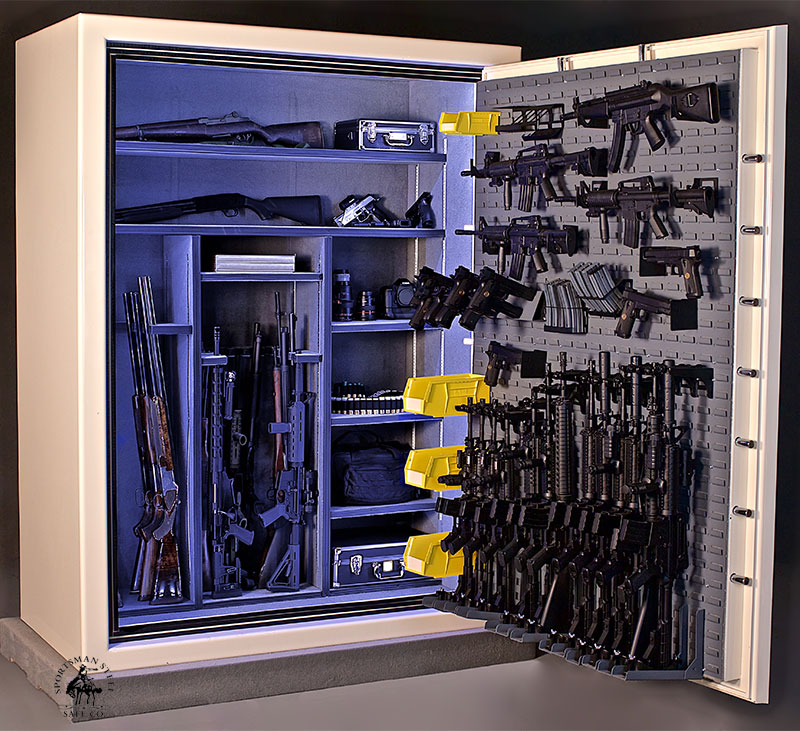
Preview YouTube video How Safe Is You Safe? Watch Theives Break Into A Cheap Safe!
Preview YouTube video Traditional Gun Safe | Fail
Preview YouTube video GUN SAFES “THE TRUTH” weaponseducation
Preview YouTube video GUN SAFES – Must Watch Before Buying – The Safe Keeper
| August 31, 2010
I grew up around guns my entire childhood. My dad was a federal game warden, so seeing him holster up or clean his gun are some of my boyhood memories. Despite being around guns, I never really took an interest in them. I’m not sure why. I guess I just saw them as my dad’s work stuff. Nothing to get really excited about.
A few months ago, I had a sudden urge to shoot a gun. I called my dad on the phone. “Hey Dad. I want to learn to shoot a handgun. Can you teach me how?”
He was sort of surprised.
“Why do you want to learn to shoot a gun all of a sudden?” he asked.
“Oh, I don’t know. It’s just something I think I should know how to do.”
So my dad took me, my brother, and my wife, to the gun range and showed us how to fire a gun.
It got me thinking. I know I’m not the only man out there who has gone their entire life without shooting a gun. For some of these men it’s a deliberate choice. They don’t want anything to do with guns and that’s cool.
But I’m sure there are a lot of men out there who have never fired a gun, but like me have the desire to do so. Or maybe you never shot a gun, but got invited to the gun range by some buddies. You want to go, but you don’t want to look like an idiot when you handle the gun. You’d like to have an idea of how to fire a gun safely and correctly before you go.
To get the lowdown on how to shoot a handgun safely and correctly, I headed over to the United States Shooting Academy in Tulsa, OK and talked to Mike Seeklander, the Direct of Training at the Academy. He explained the basics of firing a handgun so a first-time shooter could do so safely and semi-accurately (the accuracy part will take some practice!).
The Four Cardinal Safety Rules of Firing a Handgun
The very first thing Mike brought up were four rules, that if followed strictly, will keep you and others safe so you can have a good time unloading a few rounds.
1. Always treat every firearm as if it were loaded. No ifs, ands, or buts. Even if you know the gun is unloaded, still handle it as if it were loaded.
2. Always keep the firearm pointed in a safe direction, a direction where a negligent discharge would cause minimum property damage and zero physical injury. According to Mike, even the most experienced gun handlers break this rule all the time. They’ll take a gun and start pointing it all over the place while exclaiming, “Ah, sweet bro, this gun is kickass.”
“They don’t even know they’re doing it,” says Mike, “which makes it even more dangerous.”
The safest direction to point a gun is always downrange (as long as there aren’t any people downrange!).
3. Always keep your trigger finger off the trigger and outside the trigger guard until you have made a conscious decision to shoot.
4. Always be sure of your target, backstop, and beyond. You want to be aware of what’s in your line of fire. This isn’t usually a concern if you go to a professional gun range. They make sure that people and property stay out of the path of the guns firing downrange. Where this becomes a concern is when you go shoot with your buddy out on his property.
“Ask your friend what exactly is beyond the target and backstop you’re shooting at, especially when you’re shooting into a wooded area. Don’t just settle for, ‘Oh, don’t worry. There’s nothing back there.’ Ask specifically if there are any houses, property, etc beyond your backstop. Err on the side of being overly cautious,” says Mike.
How to Grip a Handgun
Alright, let’s get down to business. How do you hold a handgun?
For beginners, Mike says a two-handed grip is a must.
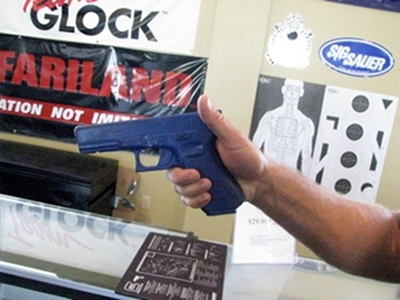
1. The gun hand (your dominant hand) should grip the gun high on the back strap (the back strap is the back of the grip on the gun). This gives you more leverage against the weapon which will help you control recoil when you fire the gun.

Mike showing how to hold the gun high on the gun’s grip with your gun hand.
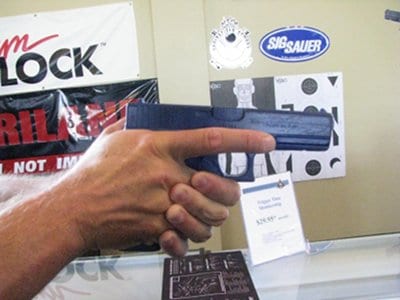
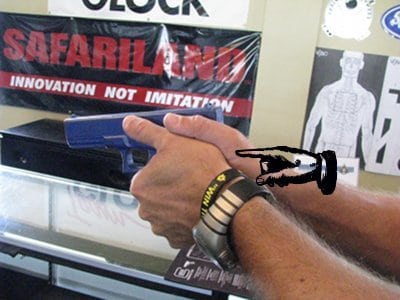
2. Place your support hand (your non-dominant hand) so that it is pressed firmly against the exposed portion of the grip not covered by the gun hand. All four fingers of your support hand should be under the trigger guard with the index finger pressed hard underneath it. Here’s Mike demonstrating for us:

Fingers of support hand directly under the trigger guard. Notice Mike’s trigger finger is on the outside of the trigger guard. Safety first!
Like you did with your gun hand, you should place your support hand as high as possible on the grip with the thumb pointing forward, roughly below where the slide meets the frame. Look at the back of your hands. There should be a distinct fit, like the fit of a puzzle, with your gun and support hand, like so:
Notice how your hands fit together. Just like a puzzle.
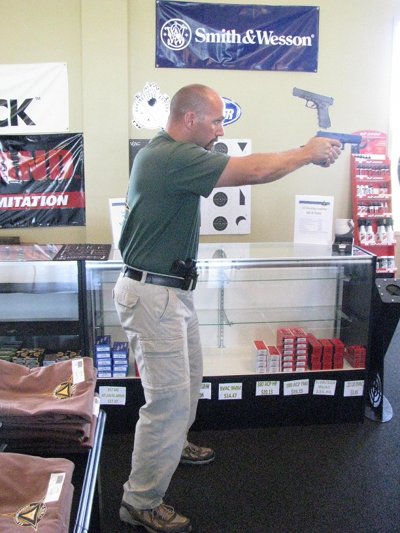

Assume the Extended Shooting Position
Stand with your feet and hips shoulder width apart. Bend your knees slightly. Mike calls it an “athletic stance.” It allows you to fire the weapon with stability and mobility. Raise the weapon toward your target. Here’s Mike showing us how it’s done:

How to Aim a Handgun
Use your dominant eye. You want to aim with your dominant eye. To figure out which of your eyes is the dominant one, perform a quick eye test by forming a one inch circle with your thumb and index finger. Hold the circle at arm’s length. Look at a distant object and look through your circle so that the object appears in the center of it. Keeping both eyes open, bring your circle toward your face slowly. Your hand will naturally gravitate toward one eye. That’s your dominant eye.
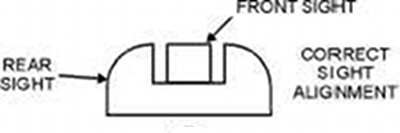
Align your sights. Your handgun has a front sight and a rear sight notch. Aim at your target and align the top of the front sight so that it lines up with the top of the rear sight. There should also be equal amounts of empty space on both sides of the front sight.
Proper sight alignment
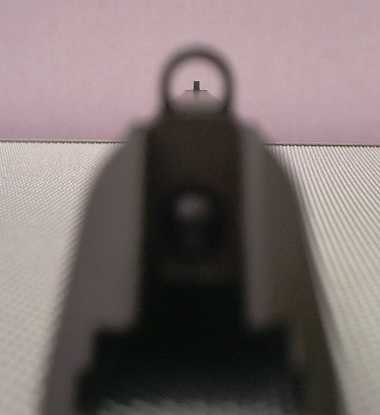
Set your sight picture. The sight picture is the pattern of your gun’s sights in relation to your target. When you’re aiming a gun, you’re looking at three objects: the front sight, the rear sight, and your target. However, it’s not possible to focus simultaneously on all three objects. One of the objects will inevitably be blurry when you’re aiming. When you have a correct sight picture, your front and rear sight appears sharp and clear and your target appears to be a bit blurry. Like so:

Correct sight picture. The sights are in focus and the target is blurry.
According to Mike, the further away your target is, the greater the need for a clear focus on the front sight.
Trigger Management (aka Pulling the Trigger)
To fire a gun, we often use the popular phrase “pull the trigger.” However, to fire a gun properly, you don’t actually want to pull the trigger, but rather press it in a controlled fashion so you don’t disrupt your sights. Here’s a brief and very basic rundown on proper trigger control when firing a gun.
1. Press, don’t pull. Instead of pulling the trigger, press (or like my dad likes to say “squeeze”) the trigger straight to the rear. Apply constant, increasing reward pressure on the trigger until the weapon fires. Ensure that you’re only applying pressure to the front of the trigger and not the sides.
2. Take the slack out of the trigger. Squeeze the trigger to the point you start feeling resistance.
3. Surprise yourself. Keep pressing the trigger straight to the rear until the gun fires. Don’t anticipate when the gun will fire. You sort of want to surprise yourself as to when the gun actually discharges.
And there you go. Now you can go fire a gun at the gun range and look like you know what you’re doing. However, none of the information in this article can replace the instruction and supervision of a professional instructor. If you’ve never fired a gun before, we strongly suggest you visit a firing range and talk to an instructor who will walk you through the process.
Have any other tips for the first time shooter? Share them with us in the comments!
Editor’s note: This article is about how to fire a gun safely and correctly. It is not a debate about gun rights or whether guns are stupid or awesome. If you try bringing up that dead horse around here, your comment will be deleted. I will show no mercy. Keep it on topic, please.
_____________________________________________________________________________
Special thanks goes out to Mike and the crew at U.S. Shooting Academy for their help on this article. Mike along with the U.S. Shooting Academy Handgun Manual were the source of this article. If you’re ever in the Tulsa area, stop by their facility. It’s top notch and the staff and trainers are friendly, knowledgeable, and super badass.
My “in” box filled up on Thursday with questions, after the shooting that took place at a Country music bar out in California Wednesday night. Well, let me clarify that. 99% of them were questions/comments and about 1% were rants about how we need more gun controls.
Most of the questions came from people asking if there’s anything you can do in a situation like that. The answer is yes, to some extent.
The answer SHOULD be that no mentally ill person even attempts such a thing, because everyone behind the bar, and every “bouncer” has a concealed weapon on them, and have been trained how to use them. A sign on the door should read that all employees are armed and trained. Unfortunately, that’s just a dream.
Mass shooters do NOT frequent places where they know the people are armed. There’s no active shooters at gun shows. None at gun ranges. None in police stations. You know the reason why. They can’t get their ten minutes of fame when 20 people blast them to pieces after they fire their first shot. No, they go exactly where our stupid laws TELL them to go.
Gun free zones are hunting preserves for the Mentally ill. Period. This isn’t rocket science folks. Think about it logically for just 2 silly minutes and you’ll know I’m right.
If I somehow snapped my lid and decided I want to go out blazing and taking 20 people with me, where would I go to achieve the best success? Would I go to the hunting and fishing expo, where upwards of 100 people might be carrying a concealed weapon? Probably not. You know that.
Of course he’s going to go to the school. The college. The nightclub. All places where normal law abiding folks are barred from carrying their weapons.
And, it works. It works because he knows he’s got between 5 and 9 minutes to shoot the hell out of people before the police get there. So, he marches in, sees 200+ people enjoying themselves and for what ever evil went berserk in his mind, he starts mowing them down. They are absolutely defenseless. Fish in a barrel.
Now, the lowest hanging fruit for those that don’t want to spend the time to realize the reality of things, is to push for either more gun laws, or outright gun bans. It’s so perfect in their minds. Make everyone turn in their guns,and outlaw them. See, problem solved! Except the problem isn’t solved. For one, you still have a mentally deranged evil person that wants to kill people.
Remember a while ago the spat of “truck killings?” where they were simply using trucks to run over people on sidewalks? Just last year, some lunatic used a moving truck on a bike path in NY and killed 8, wounding 30. The year before in Ohio another evil scum ran over 4, and then got out and started slashing people with knives. Evil people will find a way to do their deeds.
In London, it is virtually impossible to get or own a gun. In fact, not only have they banned guns in England for years, two years ago they banned “knives”. So how is this happening:
LONDON is experiencing a horrifying rise in violent crime, with 100 suspected murders in the capital since the start of the year.The total number of offences involving a knife or bladed instrument that have been recorded by cops in the year to March 2018 rose to 40,147, a seven-year-high.There was also a two per cent spike in the number of gun-related crimes too – that is now at 6,492.
Excuse me? Aren’t knives and guns banned in London? Indeed they are. Did it stop 40 THOUSAND knife assaults and over 6 THOUSAND gun related crimes? No.
And therein lies the problem with the low hanging fruit idea of outlawing, or banning guns. It doesn’t work. But wait, consider this. England has never been a “gun” country. The population was never very free to own guns, and only hunters and collectors would usually go through the hoops to obtain one.
But here in the states? Guns have been a part of rural America for 200 years. Remember the Christmas cards of Grandpa’s fireplace with the rifle hanging on the hooks above it, and a cozy fire burning?
That wasn’t fantasy, that was just a look into “every home” USA 80 years ago. Kids in the 50’s often had marksmanship classes at school. Kids in the 30’s often had to hunt rabbits and squirrel and deer, etc, to help put food on the table.
There’s an estimated 500 million guns in the US. I think that number is ridiculously low, but let’s use it anyway. Until 1968, you could buy a gun by mail order.
Read that again. Mail order. No back ground checks, no registrations, no records, nothing. So where are they coming up with their numbers, when there’s no way to know who bought what back then?
Or consider “bring backs”. In WWII tens of thousands (more) of our soldiers brought back German Lugers and Walters. These didn’t get registered anywhere. Who knows how many of them are still floating around.
So problem 1 is that guns are like drugs. They’re everywhere. They’re in uncle Joe’s attic, and Grandma’s basement. No matter how illegal you make them, I could find you one in ten minutes. Just like crack, coke, heroin, fentanyl, etc is illegal, I could get you any of it within the hour.
Problem 2 of course is that only law abiding citizens abide the law. Duh. So, they pass a gun ban, only the good people turn them in, the bad guys of course don’t, and they get to go play their evil games, knowing no one’s going to be shooting back at them.
We are way way past the idea that banning anything is going to stop evil people. This shooting happened in California. Very tough gun laws. It’s said he had extended magazines. They’re illegal in CA. Did it stop him from getting one? Did it stop him from breaking the law? Please.
So what’s the answer? Is there one? Well to start, I’d like to see all the states go back to spending a lot of their budget on mentally diseased people. Somehow we got civilized and did away with “Mental institutions.”
Now those people walk among us, often jazzed up on a cocktail of antidepressants and God knows what else. One of pharma’s dirty little secrets is that almost 95% of these kind of events finds the person has been using mood altering pharmaceuticals. Let’s start by getting people that need help, the help they need.
Of the 67 ‘shooters” in the last 30 years, 65 had been treated for mental issues. Let that sink in folks
The gun didn’t shoot those people. The person brandishing the gun shot those people. Since guns will always be available, no matter what laws come down the pike, why not work on the person that wants one to commit his evil?
Beyond that, things get messy. Why do I say messy? Because it will take a huge shift in societal thinking to put an end to these sort of events.
Consider this:
Two trends:
1930-1960-most mass shootings were familicides and felony related killings.
1960-present-most mass shootings are in public places against unknown bystanders.
Or this:
Mass shootings in America
By decade:
1900s:0
1910s:2
1920s:2
1930s:9
1940s:8
1950s:1
1960s:6
1970s:13
1980s:32
1990s:42
2000s:28
2010- present 54 so far
For 50 years, we didn’t have issues with mass shooting. Then starting in the 70’s (AFTER Gun registration became law!) they started soaring.
Why? Was it that gun education was removed from schools? Could be.
Was it the gradual breakdown of the nuclear family? Could be.
Was it the loss of mental illness funding? Could be.
Could it be the amount of anti-depressants that started rolling out about then?
Could be. Was it removing “God” from the school? Could be. It could be all that and much much more.
Look at the decade of the 50’s. There was one mass shoot situation.
What was different about life in the 50’s? Everything. Literally everything. June Cleaver hung at home, always nicely dressed while raising the boys. Ward made sure there was discipline in the home. Men went to sporting events wearing jackets and ties. People were civil to each other. One paycheck paid the bills. I could go on for ever.
Well this isn’t the 50’s and I don’t suppose we’re ever going there again. Today’s society is broken in a million different ways. Each year brings more violence, more insanity, more drugs.
With the left taking over the House, they’ve made it clear that they’re going for the low hanging fruit. “Gun control” is big on their list. This is a Headline from the Wall Street Journal on Saturday:
WASHINGTON-Democrats say they will pass the most aggressive gun-control legislation in decades when they become the House majority in January, plans they renewed this week in the aftermath of a mass killing in a California bar.
It’s coming folks. One thing I have to give the left credit for, is that they never stop. Ever. If they have a desire, they work toward it hard and long. They’ve wanted everyone disarmed and continue to work toward that goal.
Okay, so what could you have done in that bar? The answer unfortunately is not much. Even if you’re a legal concealed weapons carrier, most states have laws stating that you can’t carry in a bar. In the case of California, the law states:
While exercising the privileges granted to the licensee under the terms of this license, the licensee shall not, when carrying a concealed weapon:
* Consume any alcoholic beverage.
* Be in a place having a primary purpose of dispensing alcoholic beverages for on-site consumption.
So as you can see, a law abiding person with a valid permit couldn’t legally have his weapon in the Country music bar.
The shooter knew this, that’s why he went there. I so suppose that if a couple patrons of that bar had “broken the law” and carried their weapons in that bar that night, the outcome would have been different. But there’s the rub. Most Concealed weapons folks are incredibly law abiding.
So, since you can’t carry there, your choices are extremely limited when the shooter starts shooting.
First and foremost is situational awareness. I’ve mentioned this in previous letters, try and determine “exits” when you first enter any place. I like to know where the fire exits are, and I often make seating decisions around them.
If you hear a gunshot in a store, restaurant, grocery, bar, etc, GET MOVING.
There is NEVER a time when it’s okay to hear a gun shot in any of those places. If you hear one, you’ll probably hear many more soon. Get out as fast as you can.
Try your best NOT to head toward the main entrance if possible. There’s going to be a stampede trying to get out of there, and you could get trampled, or worse, the shooter might enjoy having 25 or 30 people stacked up in one spot that he can mow down.
Again, try fire escapes, or something else. If there’s a kitchen, you can almost always rely on their being a door to the outside for deliveries, etc. Head there.
If you’re in a big place, and the shooting is going on quite a distance from you, please realize that you are free to do any damned thing you can to get safe.
If that means picking up your chair and hurtling it through the front windows to get out, well so be it. They have insurance for their windows.
Proximity to the shooter will play the biggest role in your decision. If you remember nothing else in this article, remember this fact “Distance is your friend.”
Again, if you’re seated near an exit, and you’ve been smart enough to sit “facing the crowd, or entrance” and you hear shots or see someone walking in with a gun drawn, get moving.
But what if it doesn’t play out that way? What if our shooter kept his weapon in his jacket, until he was snuggled up to the bar, the same bar you’re sitting at just feet away?
At that point your choices get slim and ugly. Your first instinct will be to dive to the floor, or get behind cover. That’s a decent first reaction, but you can’t stay there.
You’re still going to want to use that cover for just long enough that you can make a break for a get away. These people get their jollies shooting people curled up in a ball under a table. Always be thinking about running.
What you need is distance more than anything. At 15 feet, it takes just a 5 degree cant of the weapon to miss you. Yes you read that right.
At 15 feet, if this guy puts his front site on your heart, but just wobbles that gun 5 degrees right or left, he misses you completely.
At 20 feet it’s even harder for him. So while cover is good to initially not get shot, the further away you can get, as quickly as you can, increases your survival by multiples.
Being unarmed in an active shooter situation is about as butt ugly as it gets.
Try and remember these basics, and you’ll have a better chance.
1) at the first hint of a shooting (like you hear one shot go off) DO NOT sit there and look around wondering what’s happening. Don’t pull out your phone and take video’s.
2) you want OUTSIDE and you want it as fast as you can get it. Get there any way you can, fire exit, kitchen door, break a window, etc.
3) distance is your best friend. If you can blend some distance, WITH some cover, you’re gold. ( for instance you make a move across the floor to a ceiling support column. Angle your next run away from the shooter by trying to keep that support column angled between him and you as you’re running)
Finally, there’s the run and hide idea.
That’s the worst one and only useful if there’s absolutely no way to get outside. The problem is that we don’t just want to run and hide in the building, because he might play “hide and seek”.
If ten people pile into the men’s room, this guys got a fish in the barrel game to play. The only way run and hide works is if you can run, hide AND DELAY this nut from coming in.
That’s easy in say a classroom, you can pile up desks, and file cabinets, etc. But in a bar bathroom? Not so easy.
It’s not 1950 any more folks. Learn to be aware of your surroundings. The worlds gone crazy, and it’s getting worse.
Stay safe.
Fred Reed on War
This column is on lactation and isn’t going to write a damned word until half-October. People are talking about some Vietnam series by Ken Burns, I think it is .I saw the original, so I’ll pass. But if we want opinions, I’ll contribute from long ago.
Harper’s, December, 1980
I begin to weary of the stories about veterans that are now in vogue with the newspapers, the stories that dissect the veteran’s psyche as if prying apart a laboratory frog — patronizing stories written by style-section reporters who know all there is to know about chocolate mousse, ladies’ fashions, and the wonderful desserts that can be made with simple jello. I weary of seeing veterans analyzed and diagnosed and explained by people who share nothing with veterans, by people who, one feels intuitively, would regard it as a harrowing experience to be alone in a backyard. Week after week the mousse authorities tell us what is wrong with the veteran. The veteran is badly in need of adjustment, they say — lacks balance, needs fine tuning to whatever it is in society that one should be attuned to. What we have here, all agree, with omniscience and veiled condescension, is a victim: The press loves a victim. The veteran has bad dreams, say the jello writers, is alienated, may be hostile, doesn’t socialize well — isn’t, to be frank, quite right in the head.
But perhaps it is the veteran’s head to be right or wrong in, and maybe it makes a difference what memories are in the head. For the jello writers the war was a moral fable on Channel Four, a struggle hinging on Nixon and Joan Baez and the inequities of this or that. I can’t be sure. The veterans seem to have missed the war by having been away in Vietnam at the time and do not understand the combat as it raged in the internecine cocktail parties of Georgetown.
Still, to me Vietnam was not what it was to the jello writers, not a ventilation of pious simplisms, not the latest literary interpretation of the domino theory. It left me memories the fashion writers can’t imagine. It was the slums of Truong Minh Ky, where dogs’ heads floated in pools of green water and three-inch roaches droned in sweltering back-alley rooms and I was happy. Washington knows nothing of hot, whore-rich, beery Truong Minh Ky. I remember riding the bomb boats up the Mekong to Phnom Penh, with the devilish brown river closing in like a vise and rockets shrieking from the dim jungle to burst against the sandbagged wheelhouse, and crouching below the waterline between the diesel tanks. The mousse authorities do not remember this. I remember the villa on Monivong in Phnom Penh, with Sedlacek, the balding Australian hippie, and Naoki, the crazy freelance combat photographer, and Zoco, the Frenchman, when the night jumped and flickered with the boom of artillery and we listened to Mancini on shortwave and watched Nara dance. Washington’s elite do not know Nara. They know much of politicians and of furniture.
If I try to explain what Vietnam meant to me — I haven’t for years, and never will again — they grow uneasy at my intensity. “My God,” their eyes say, “he sounds as though he liked it over there. Something in the experience clearly snapped an anchoring ligament in his mind and left him with odd cravings, a perverse view of life — nothing dangerous, of course, but… The war did that to them,” they say. “War is hell.”
Well, yes, they may have something there. When you have seen a peasant mother screaming over several pounds of bright red mush that, thanks to God and a Chicom 107, is no longer precisely her child, you see that Sherman may have been on to something. When you have eaten fish with Khmer troops in charred Cambodian battlefields, where the heat beats down like a soft rubber truncheon and a wretched stink comes from shallow graves, no particular leap of imagination is necessary to notice that war is no paradise. I cannot say that the jello writers are wrong in their understanding of war. But somehow I don’t like hearing pieties about the war from these sleek, wise people who never saw it.
There were, of course, veterans and veterans. Some hated the war, some didn’t. Some went around the bend down in IV Corps, where leeches dropped softly down collars like green sausages and death erupted unexpected from the ungodly foliage. To men in the elite groups — the Seals, Special Forces, Recondos, and Lurps who spent years in the Khmer bush, low to the ground where the ants bit hard — the war was a game with stakes high enough to engage their attention. They liked to play.
To many of us there, the war was the best time of our lives, almost the only time. We loved it because in those days we were alive, life was intense, the pungent hours passed fast over the central event of the age and the howling jets appeased the terrible boredom of existence. Psychologists, high priests of the mean, say that boredom is a symptom of maladjustment; maybe, but boredom has been around longer than psychologists have.
The jello writers would say we are mad to remember fondly anything about Nixon’s war that Kennedy started. They do not remember the shuddering flight of a helicopter high over glowing green jungle that spread beneath us like a frozen sea. They never made the low runs a foot above treetops along paths that led like rivers through branches clawing at the skids, never peered down into murky clearings and bubbling swamps of sucking snake-ridden muck. They do not remember monsoon mornings in the highlands where dragons of mist twisted in the valleys, coiling lazily on themselves, puffing up and swallowing whole villages in their dank breath. The mousse men do not remember driving before dawn to Red Beach, when the headlights in the blackness caught ghostly shapes, maybe VC, thin yellow men mushroom-headed in the night, bicycling along the alien roads. As nearly as I can tell, jello writers do not remember anything.
Then it was over. The veterans came home. Suddenly the world seemed to stop dead in the water. Suddenly the slant-eyed hookers were gone, and the gunships and the wild drunken nights in places that the jello writers can’t imagine. Suddenly the veterans were among soft, proper people who knew nothing of what they had done and what they had seen, and who, truth be told, didn’t much like them.
Nor did some of us much like the people at home — though it was not at first a conscious distaste. Men came home with wounds and terrible memories and dead friends to be greeted by that squalling she-ass of Tom Hayden’s, to find a country that, having sent them to Viet Nam, now viewed them as criminals for having been there. Slowly, to more men than will admit to it, the thought came: “These are the people I fought for?” And so we lost a country.
We looked around us with new eyes and saw that, in a sense the mousse people could never understand, we had lost even our dignity. I remember a marine corporal at Bethesda Naval Hospital who, while his wounds healed, had to run errands for the nurses, last year’s co-eds. “A hell of a bust,” he said with the military’s sardonic economy of language. “Machine gunner to messenger boy.”
It wasn’t exactly that we didn’t fit. Rather, we saw what there was to fit with — and recoiled. We sought jobs, but found offices where countless bureaucrats shuffled papers at long rows of desks, like battery hens awaiting the laying urge, their bellies billowing over their belts. Some of us joined them but some, in different ways, fled. A gunship pilot of my acquaintance took to the law, and to drink, and spent five years discovering that he really wanted to be in Rhodesia. Others went back into the death-in-the-bushes outfits, where the hard old rules still held. I drifted across Asia, Mexico, Wyoming, hitchhiking and sleeping in ditches until I learned that aberrant behavior, when written about, is literature.
The jello writers were quickly upon us. We were morose, they said, sullen. We acted strangely at parties, sat silently in corners and watched with noncommittal stares. Mentally, said the fashion experts, we hadn’t made the trip home.
It didn’t occur to them that we just had nothing to say about jello. Desserts mean little to men who have lain in dark rifle pits over Happy Valley in rainy season, watching mortar flares tremble in low-lying clouds that flickered like the face of God, while in the nervous evening safeties clicked off along the wire and amtracs rumbled into alert idles, coughing and waiting.
Once, after the GIs had left Saigon, I came out of a bar on Cach Mang and saw a veteran with a sign on his jacket: VIET NAM: IF YOU HAVEN’T BEEN THERE, SHUT THE FUCK UP. Maybe, just maybe, he had something.
|
The following list was compiled from various online and print sources, including the major ammo manufacturers’ sales lists and the sales of RCBS reloading dies. The various sources tend to parallel each other, with certain exceptions. Bear in mind that a lot (probably the majority) of .223 and 7.62×39 ammo sold is for plinking or “tactical” use, not hunting. The same probably applies to a lower, but still significant, percentage of the .308 ammo sold. The .223, .308, .30-06, .30-30, .270, .243, 7mm Rem. Mag. and .300 Win. Mag. appear on almost all lists. The .22-250, 7.62x39mm, .300 WSM, .338 Win. Mag. and 7mm-08 Rem. have appeared on at least one list, but not others, while the .222 Remington, .30 Carbine and .303 British (once Top 10 stalwarts on most lists) have dropped back in popularity. The .300 Win. Mag. and 7mm Rem. Mag. swap places on some lists. Anyway, here are the averaged results based on the data that I could find. Consider it approximate. USA (Averaged 2015 sales rank)
An interesting survey of the most popular hunting cartridges in use in south/central Alaska was published by the Alaska Department of Fish and Game back in 2000. Very large animals, such as moose and the great bears are hunted here, as well as deer, goats, black bear and caribou, and the Alaskan list reflects this. The number in parenthesis is the percentage of hunters using each caliber. Note the abrupt fall off in popularity after the .30-06, .300 Win. Mag. and .338 Win. Mag. ALASKA TOP TEN CARTRIDGES (Alaska Dept. of Fish and Game survey, 2000)
|
Opinion : John explains why he prefers Collectibles Insurance Services’ gun insurance policy over his regular homeowners insurance.

U.S.A. –-(Ammoland.com)- Imagine if you come home to find your treasured collection of firearms gone. Years of collecting and thousands of dollars down the drain. If only there were a way to protect your investment!
This scenario has been one of my greatest fears. About a year ago I started looking into how to protect myself not only for theft but also from other events like fire or flooding.
There is always homeowner’s insurance, but that can be very risky. Depending on your policy, homeowner’s insurance might not cover your firearms. If your policy does include your guns, the policy will most likely base the value of your collection on the sale price of your guns minus depreciation and your deductible. This formula means that it considers your Colt Python at most is worth $125 since that was the original sale price.
The policy also usually has a limit of the amount that the insurance company will cover for the items in your house. For example, my homeowner’s policy will only cover up to $2500 for my gun collection. I found out that some policies have an even lower cap.
Most insurance companies also want a list of the firearms you have including serial numbers. Giving this information over to an insurance company makes me nervous. Maybe it is just paranoia, but I don’t want information on my collection being turned over to Big Brother.
Most homeowner’s insurance companies do not cover acts of God such as floods and earthquakes unless the homeowner has additional insurance. I found this out the hard way when there was damage to my house after an extremely rare Virginia earthquake.
There is a way to keep your investment your gun collection safe. Collector’s insurance is something every gun owner with more than one or two guns should consider buying. It gives me a little more peace of mind when I compare it to just relying on my homeowner’s policy.
Collectibles Insurance Services

One of the best companies that offer collector’s insurance is Collectibles Insurance Services. Their rates were even cheaper than it was to schedule my firearms onto my homeowner’s policy.
The product that they sell is far superior to my homeowner’s policy. One of the most significant advantages it has over traditional policies and what drew me to it is the fact that the policy covers more than just my firearms.
Optics and other firearms accessories are not cheap. I am into long range shooting. Some of my scopes cost more than my rifles. Collectibles Insurance Services covers all my optics even when I do not have them mounted on my guns.
I also buy ammunition in bulk. It is cheaper in the long run, but the upfront cost is a lot higher. Losing all my ammo means losing a lot of money. Luckily for me, Collectibles Insurance Services (CIS) even covers the cost of ammunition! Not only that, but they also include coverage for the price my gun safes.

I also prefer how Collectibles Insurance Services calculate the value of my guns. Different from the homeowner’s policy that I have, CIS uses the actual market value of the firearms with no deductible. That means that I would get paid out the current price of the Mosin Nagant I paid $75 for at a gun show back in the day. With my homeowner’s insurance policy, it wouldn’t be worth putting in a claim if something happened to my Mosin.
CIS ties their policies to the firearms and not the home. If your gun gets stolen from your car, then you are covered. I also travel with a firearm when I fly. If my gun gets taken from my checked bag when traveling, I know they still have my back. Collectibles Insurance Services even covers your guns if the postal services lose it when mailing my gun out to say a gunsmith.
Another cool thing about the collector’s policy offered by CIS is that it covers bladed weapons. I have a CAS Hanwei Oni Katana. It’s a real cutting sword. Its quality is impeccable, but that quality comes with a steep price. If anything ever happened to it, I would be able to put in a claim for its value.
No Firearms Serial Numbers Required, Your Guns Remain Private
This ‘like’ is a big deal. I like that Collectibles Insurance Services doesn’t ask for the serial numbers of your guns. Call me paranoid, but I don’t like sharing those with anyone. You only need to list firearms valued over $25,000 on the policy individualy. Even then, they only ask for make, model, and an estimated value of the gun.
CIS also covers my antique firearms along with my modern guns. This wide range of coverage saves me the pain of getting multiple policies.
CIS makes the process of getting a quote straightforward. All the collector have to do is answer a few easy questions on their website. They also have a toll free number ( 888-837-9537 ) where one of their team members can answer any question about their products.
From the collector to the dealer (yes they cover FFL dealer’s too!) everyone needs to protect his or her investment, and that is what Collectibles Insurance Services does best. Their service is something I hope I never have to use, but if I do, then I will be glad I have it.
You can get a free quote from Collectibles Insurance Services at https://collectinsure.com/guns
A CIS team member can answer any questions you have for them. They are available Monday to Friday from 8:30 AM to 5 PM ET at 888-837-9537.
About John Crump
John is an NRA instructor and a constitutional activist. He is the former CEO of Veritas Firearms, LLC and is the co-host of The Patriot-News Podcast which can be found at www.blogtalkradio.com/patriotnews. John has written extensively on the patriot movement including 3%’ers, Oath Keepers, and Militias. In addition to the Patriot movement, John has written about firearms, interviewed people of all walks of life, and on the Constitution. John lives in Northern Virginia with his wife and sons and is currently working on a book on leftist deplatforming methods and can be followed on Twitter at @crumpyss, on Facebook at realjohncrump, or at www.crumpy.com.
![]() |
Mosin Nagant Rifle Exploded Views and Disassembly All content copyright © 7.62x54r.net |
The Mosin Nagant is a simple design that is easy to repair and maintain, but proper technique and an understanding of the design is important.
This page will attempt to guide Mosin owners through partial and complete disassembly and provide a pictorial reference of the various parts. For information on which parts will interchange between various models, see the Mosin Nagant Parts Compatibility page.
Tools Quality gunsmithing tools are imperative to prevent damage during firearm disassembly. Anyone who’s handled surplus firearms has seen the stripped screw heads, scratched metal and scarred wood.
While damage in battle is part of the history of a firearm, damage from poor maintenance techniques is a destruction of that history. Past damage can’t be undone, but future damage can be prevented.
A good set of hollow ground screwdrivers in various sizes is the most useful tool on the firearm bench. Following that, brass and steel punches and a light hammer are very handy. Forceps for handling small parts and a magnetic bowl for keeping track of them are useful.
A well lit, clean work area also helps prevent the loss of small parts. A protective mat on the bench will protect the finish of the firearm and a gun vise can make the job much easier when “three hands” are required. Plastic picks, nylon brushes, paper or cloth towels, swabs and pipe cleaners make detail cleaning easier.
A quality cleaning rod and patches will soon be appreciated over the discount variety for periodic maintenance.
Types of solvent and opinions on their use are almost as numerous as gun owners and is beyond the scope of this page. Dummy cartridges for checking function, a firing pin protrusion gauge, and a set of headspace gauges round out the well equipped bench.
Exploded Views Below are exploded views of a Soviet M91/30. Other models have variations in the parts which will be covered later. The primary differences are in the stock hardware and sights, especially among the later Finnish models. For larger views, click on the pictures.
| 1. receiver and barrel 2. stock 3. handguard 4. magazine body/triggerguard 5. nosecap 6. nosecap screw 7. front barrel band spring |
8. rear barrel band spring 9. front barrel band 10. rear barrel band 11. cleaning rod 12. cleaning rod retaining nut 13. stock recoil bolt 14. stock recoil bolt nut |
15. butt plate 16. butt plate screw (2) 17. magazine tang screw 18. receiver tang screw 19. front sight 20. rear sight assembly 21. interrupter/ejector assembly |
22. follower assembly 23. floorplate latch and screw 24. trigger/sear assembly 25. bolt assembly 26. sling and dog collars |
| 1. sear/trigger spring 2. sear screw 3. trigger/bolt stop 4. trigger pin |
5. floorplate latch 6. floorplate latch screw 7. floorplate 8. follower carrier spring |
9. follower carrier spring screw 10. follower carrier pin 11. follower carrier 12. follower spring |
13. follower pin 14. follower |
| 1. ejector 2. interrupter/ejector spring 3. interrupter/ejector spring screw |
4. rear sight base 5. rear sight base pin (2) 6. rear sight leaf spring |
7. rear sight leaf 8. rear sight leaf pin 9. rear sight slide body |
10. rear sight slide buttons (2) 11. rear sight slide button springs (2) |
| 1. bolt body 2. cocking knob/safety 3. guide rod/connector 4. firing pin |
5. firing pin spring 6. bolt head 7. extractor |
Disassembly The following pictures and comments will illustrate the disassembly procedure for the Soviet M91/30.
| Before beginning disassembly, maintenance, or cleaning on any firearm visually inspect the chamber and magazine to be sure that it is unloaded. | |
| Remove the sling by unbuckling the dog collars and removing them from the sling slots.Unscrew the cleaning rod counterclockwise |
| Depress the barrel band retaining springs and slide the barrel bands forward. |
| Decock the bolt by turning the cocking knob 90 degrees counterclockwise and pull the bolt head and connector bar forward. |
| Remove the magazine tang screw. | ||
| Remove the receiver tang screw. |
| Depress the floorplate latch and pull the floorplate away from the magazine body. Compress the follower assembly and pull it straight down from the magazine body. |
This completes partial disassembly for routine cleaning and maintenance.
For detailed disassembly, including the magazine and bolt assemblies, continue below.
| Unscrew the butt plate. |
| Remove the floorplate latch screw and pull the floorplate latch straight down out of the magazine body/trigger guard. |
| Drift out the follower pin and follower carrier pin. The follower carrier spring is screwed to the floorplate. The follower spring can be removed from the follower carrier by lifting up and back. |
| Drift out the trigger pin and remove the sear/trigger spring screw. |
| Drift the front sight off of it’s base. The barrel band can now be removed from the barrel.Note: The front sight base is staked to hold the sight in place. It should only be removed if necessary. |
| Drift the extractor out the back of the bolt head.Note: Removal of the extractor is seldom necessary and there is a risk of damaging it. If it is necessary, a drop of penetrating oil beforehand is recommended. |
Reassembly Reassemble the rifle in the reverse order of disassembly taking note of the following:
Model Specifics The M91/30 was chosen because it is one of the most common models of the Mosin design and is more similar to all other models than any other model. Below are the exceptions to the above instructions for all other commonly encountered models of Mosins.
![]() |
All content copyright © 7.62x54r.net |

RSS