Category: Gun Info for Rookies
Every time the question of a bigger rifle or smaller rifle (for any game) springs up, someone’s bound to say it: Karamojo Bell killed a thousand elephants with an .256. No, wait, with a .275. No, wait, he killed 1011 elephants, but only a few with the .256. No, but he was sniping out undisturbed elephants from long distance.
Exploits of W.D.M. Bell, Esq., nicknamed “Karamojo” because of being the first European to penetrate the territory of the Karamojo people, became legendary and controversial. Any scientific argument must begin with a study of the sources, so let’s turn to the book that made W. D. M. Bell famous: “The Wanderings of an Elephant Hunter”, published in 1923. Our comments will follow.

CHAPTER II. THE BRAIN SHOT AT ELEPHANT (EXTRACT).
In hunting elephant, as in other things, what will suit one man may not suit another. Every hunter has different methods and uses different rifles. Some believe in the big bores, holding that the bigger the bore therefore the greater the shock.
Others hold that the difference between the shock from a bullet of, say, 250 grs. and that from a bullet of, say, 500 grs. is so slight that, when exercised upon an animal of such bulk as an elephant, it amounts to nothing at all. And there is no end to the arguments and contentions brought forward by either side ; therefore it should be borne in mind when reading the following instructions that they are merely the result of one individual’s personal experience and not the hard and fast rules of an exact science.
As regards rifles, I will simply state that I have tried the following: .416, .450/.400, .360, .350, .318, .275 and .256. At the time I possessed the double .400 I also had a .275. Sometimes I used one and sometimes the other, and it began to dawn on me that when an elephant was hit in the right place with the .275 it died just as quickly as when hit with the .400, and, vice versa, when the bullet from either rifle was wrongly placed death did not ensue.
In pursuance of this train of thought I wired both triggers of the double .450/.400 together, so that when I pulled the rear one both barrels went off simultaneously. By doing this I obtained the equivalent of 800 grs. of lead propelled by 120 grs. of cordite.
The net result was still the same. If wrongly placed, the 800 grs. from the .400 had no more effect than the 200 grs. from the 275. For years after that I continued to use the .275 and the .256 in all kinds of country and for all kinds of game. Each hunter should use the weapon he has most confidence in.
Again, the smallest bore rifles with cartridges of a modern military description, such as the .256, .275, .303 or .318, are quite sufficiently powerful for the brain shot. The advantages of these I need hardly enumerate, such as their cheap ness, reliability, handiness, lightness, freedom from recoil, etc.
For the brain shot only bullets with an unbroken metal envelope (i.e., solids) should be employed; and those showing good weight, moderate velocity, with a blunt or round-nosed point, are much better than the more modern high velocity sharp-pointed variety. They keep a truer course, and are not so liable to turn over as the latter.

CHAPTER X. RIFLES
The question of which rifles to use for big-game hunting is for each individual to settle for himself. If the novice starts off with, say, three rifles : one heavy, say a double -577 ; one medium, say a .318 or a .350 ; and one light, say a .256 or a .240 or a .276, then he cannot fail to develop a preference for one or other of them.
\For the style of killing which appeals to me most the light calibres are undoubtedly superior to the heavy. In this style you keep perfectly cool and are never in a hurry. You never fire unless you can clearly see your way to place the bullet in a vital spot.
That done the calibre of the bullet makes no difference. But to some men of different temperament this style is not suited. They cannot or will not control the desire to shoot almost on sight if close to the game. For these the largest bores are none too big. If I belonged to this school I would have had built a much more powerful weapon than the .600 bores.
Speaking personally, my greatest successes have been obtained with the 7 mm. Rigby-Mauser or .276, with the old round-nosed solid, weighing, I believe, 200 grs. It seemed to show a remarkable aptitude for finding the brain of an elephant. This holding of a true course I think is due to the moderate velocity, 2,300 ft., and to the fact that the proportion of diameter to length of bullet seems to be the ideal combination. For when you come below .276 to .256 or 6-5 mm., I found a bending of the bullet took place when fired into heavy bones.
Then, again, the ballistics of the 275 cartridge, as loaded in Germany at any rate, are such as to make for the very greatest reliability. In spite of the pressures being high, the cartridge construction is so excellent that trouble from blowbacks and split cases and loose caps in the mechanism are entirely obviated. Why the caps should be so reliable in this particular cartridge I have never understood. But the fact remains that, although I have used almost every kind of rifle, the only one which never let me down was a .276 with German (D.W.M.) ammunition. I never had one single hangfire even. Nor a stuck case, nor a split one, nor a blowback, nor a miss-fire. All of these I had with other rifles.
I often had the opportunity of testing this extraordinary little weapon on other animals than elephant. Once, to relate one of the less bloody of its killings, I met at close range, in high grass, three bull buffalo. Having at the moment a large native following more or less on the verge of starvation, as the country was rather game less, I had no hesitation about getting all three. One stood with head up about 10 yds. away and facing me, while the others appeared as rustles in the grass behind him.
Instantly ready as I always was, carrying my own rifle, I placed a .276 solid in his chest. He fell away in a forward lurch, disclosing another immediately behind him and in a similar posture. He also received a .276, falling on his nose and knees. The third now became visible through the commotion, affording a chance at his neck as he barged across my front. A bullet between neck and shoulder laid him flat. All three died without further trouble, and the whole affair lasted perhaps four or five seconds.

Another point in favour of the .276 is the shortness of the motions required to reload. This is most important in thick stuff. If one develops the habit by constant practice of pushing the rifle forward with the left hand while the right hand pulls back the bolt and then vice versa draws the rifle towards one while closing it, the rapidity of fire becomes quite extraordinary. With a long cartridge, necessitating long bolt movements, there is a danger that on occasions requiring great speed the bolt may not be drawn back quite sufficiently far to reject the fired case, and it may become re-entered into the chamber.
This once happened to me with a .350 Mauser at very close quarters with a rhino. I did not want any rhino, but the villagers had complained about this particular one upsetting their women while gathering firewood. We tracked him back into high grass. I had foolishly allowed a number of the villagers to come with me.
When it was obvious that we were close to our game these villagers began their African whispering, about as loud, in the still bush, as a full-throated bass voice in a gramophone song. Almost immediately the vicious old beast could be heard tearing through the grass straight towards us. I meant to fire my first shot into the movement as soon as it became visible, and to kill with my second as he swerved.
At a very few paces’ distance the grass showed where he was and I fired into it, reloading almost instantaneously. At the shot he swerved across, almost within kicking range, showing a wonderful chance at his neck. I fired, but there was only a click. I opened the bolt and there was my empty case.
I once lost a magnificent bull elephant through a .256 Mannlicher going wrong. I got up to him and pulled trigger on him, but click ! a miss-fire. He paid no attention and I softly opened the bolt. Out came the case, spilling the flake powder into the mechanism and leaving the bullet securely fast in the barrel lead. I tried to ram another cartridge in, but could not do so. Here was a fix. How to get that bullet out.
Caliber .256 is very small when you come to try poking sticks down it. Finally I got the bullet out, but then the barrel was full of short lengths of sticks which could not be cleared out, as no stick could be found sufficiently long, yet small enough.
So I decided to chance it and fire the whole lot into the old elephant, who, meanwhile, was feeding steadily along. I did so from sufficiently close range, but what happened I cannot say. Certainly that elephant got nothing of the charge except perhaps a few bits of stick. That something had touched him up was evident from his anxiety to get far away, for he never stopped during the hours I followed him.
At one time I used a double .450/.400. It was a beautiful weapon, but heavy. Its drawbacks I found were : it was slow for the third and succeeding shots ; it was noisy ; the cartridges weighed too much ; the strikers broke if a shade too hard or flattened and cut the cap if a shade too soft ; the caps of the cartridges were quite unreliable ; and finally, if any sand, grit or vegetation happened to fall on to the breech faces as you tore along you were done ; you could not close it. Grit especially was liable to do this when following an elephant which had had a mud bath, leaving the vegetation covered with it as he passed along. This would soon dry and tumble off at the least touch.
I have never heard any explanation of the undoubted fact that our British ammunition manufacturers cannot even yet produce a reliable rifle cartridge head, anvil and cap, other than that of the service .303. On my last shoot in Africa two years ago, when W and I went up the Bahr Aouck, the very first time he fired at an elephant he had a miss-fire and I had identically the same thing. We were using .318’s with English made cartridges.
Then on the same shoot I nearly had my head blown off and my thumb severely bruised by an English loaded .256. There was no miss-fire there. The cartridge appeared to me almost to detonate. More vapour came from the breech end than from the other. I have since been told by a great authority that it was probably due to a burst case, due to weak head.
On my return I complained about this and was supplied with a new batch, said to be all right. But whenever I fire four or five rounds I have a jam, and on investigating invariably find a cap blown out and lodging in the slots cut for the lugs of the bolt head. Luckily these cartridges are wanting in force; at one time they used fairly to blast me with gas from the wrong end. The fact that these faults are not conspicuously apparent in this country may be traced to the small number of rounds fired from sporting rifles, or, more probably, to the pressures increasing in a tropical temperature.

I have never been able to appreciate “shock” as applied to killing big game. It seems to me that you cannot hope to kill an elephant weighing six tons by ” shock ” unless you hit him with a field gun. And yet nearly all writers advocate the use of large bores as they “shock” the animal so much more than the small bores.
They undoubtedly “shock” the firer more, but I fail to see the difference they are going to make to the recipient of the bullet. If you expect to produce upon him by the use of big bores the effect a handful of shot had upon the Jumping Frog of Calaveras County, you will be disappointed. Wounded non-vitally he will go just as far and be just as savage with 500 grains of lead as with 200. And 100 grains in the right place are as good as ten million.
The thing that did most for my rifle shooting was, I believe, the fact that I always carried my own rifle. It weighed about 7 lb., and I constantly aligned it at anything and everything. I was always playing with it. Constant handling, constant aiming, constant Swedish drill with it, and then when it was required there it was ready and pointing true.
COMMENTS
A lot of controversy about Karamojo Bell comes from Mr. Bell himself. “The Wonderings of an Elephant Hunter” was written when the trails were still hot, memories fresh, and from the “here’s what worked for me, under my specific circumstances” position. Later in life, however, his views became more radical.
In an article titled “Big Bores vs. Small Bores”, for example, published posthumously by “The American Rifleman” in 1954, he urged everyone to dump the big bores and hunt all animals with rifles of the .308 Win. class (he praised the cartridge, even though he had no personal experience with it).
All dependent on bullet placement, he wrote, “a .600 caliber 900-grain bullet in the right place will kill as dead as a 100-grain bullet”. A few paragraphs later, he called the .318 Westley Richards “the deadliest” of his foursome of favorites, that also included the 6.5 mm. Mannlicher, the 7 mm. Mauser, and the .303 British. So, he could see the difference in killing power between .318 and 7 mm, but not between .22 Swift and .600 NE. Er… seriously?
Was it rhetorical vigor, or was W.D.M. Bell simply pulling the readers’ collective leg? These British “old chaps” loved a good prank – oh, pardon me, practical joke! What most people tend to learn over their lifetimes is that a radical view on anything is usually wrong. That includes Karamojo Bell and his small-bore rifles.
On the one hand, Bell certainly didn’t kill over a thousand elephants with a 6.5 mm rifle. .As we already know, he used rifles for at least eight different rounds. For the trip into the Karamojo country, he had a battery of three rifles, two already mentioned and a.303 British. For three of his trips – to Liberia, up the River Bahr Aouk, and into the Buba Gida Potentiate and the Lakka country, he carried only one big-game rifle: a .318 Westley Richards.
This is a medium bore (.330, or 8.4 mm) round that came loaded with a 250-grain (16 gram) bullet at 2,400 ft/s (730 m/s), or a 180-grain (12 gram) at 2,700 ft/s (820 m/s). He is credited with killing over 1011 elephants in his career, but the .256 accounted for the minority of kills, due to various ammunition problems.

On the other hand, critics tend to downplay Bell’s experience, saying he was mostly shooting undisturbed elephants at long distance in an open country. In fact, Bell killed all kinds of elephants in all kinds of terrain. That included the 12-foot grass in the Lado Enclave, where he had to shoot from an improvised elevation.
If Bell couldn’t see the difference between bigger and smaller cartridges, why would he use the .318 WR on so many trips, and why did he order one .416 Rigby after another (as Rigby’s record books testify)? On the other hand, when African national parks carried out large-scale elephant culls – the nearest thing to Bell’s ivory hunting in modern world – the weapon of choice, to our knowledge, were semi-automatic military rifles and the 7.62 mm NATO (the military version of the .308 Win.). Karamojo would’ve approved. The bottom line is, precisely as Karamojo himself claimed in his earliest prose, the 7 mm Mauser was what worked for a specific person under specific circumstances. It’s not a magic bullet for everyone everywhere.
In any case, Bell’s books make a wonderful read, whether you agree with his views or not. He was one of the people who had a unique experience, intelligent enough to know their experience were unique, and talented enough to preserve it for later generations in high-quality prose and imagery. And, as long as you don’t take Bell’s tips literally, his advice on knowing your weapon, the killing spots of your quarry, and being able to put every bullet where it belongs, still makes a lot of sense.

Although it’s still summer, hunting season is just around the corner for some parts of the United States. In fact, fall bear season has already started here in Washington. It is important that hunters properly prepare their equipment for the upcoming season. Today, I hope to provide some assistance in this matter by explaining how to sight in a rifle.
Since most hunters use telescopic sights on their rifles, this article describes how to sight in a rifle with a scope. After mounting a new scope on a rifle, it is important to ensure that the reticle is completely level. Even a slight cant to the reticle can throw off the impact of the bullet and make the scope much more difficult to sight in. Also, ensure that the scope is secure in the rings and that the rings are tightly mounted to the base. There should be no wiggle whatsoever to the scope.
Before actually shooting the rifle, it is best to bore sight it. First, ensure that the rifle is unloaded and that the barrel is unobstructed. Then, remove the bolt of the rifle and mount the rifle in a secure rest pointing downrange.
Standing behind the rifle, look through the bore and carefully move the rifle until your target is centered in the bore. Then, without moving the rifle, adjust the scope so that the reticle is centered on the same target.
The turret on the top of the scope adjusts the elevation of the reticle, while the turret on the side adjusts the windage. It is not vitally important for the bore sight to be extremely precise. It just needs to be close enough so that the rifle will be on paper at 25 yards in the next step. Your view when looking down the bore of the rifle should look something like this.
 At 25 yards, adjust the scope eight clicks left and eight clicks up.

Since most hunters use telescopic sights on their rifles, this article describes how to sight in a rifle with a scope. After mounting a new scope on a rifle, it is important to ensure that the reticle is completely level. Even a slight cant to the reticle can throw off the impact of the bullet and make the scope much more difficult to sight in. Also, ensure that the scope is secure in the rings and that the rings are tightly mounted to the base. There should be no wiggle whatsoever to the scope.
Before actually shooting the rifle, it is best to bore sight it. First, ensure that the rifle is unloaded and that the barrel is unobstructed. Then, remove the bolt of the rifle and mount the rifle in a secure rest pointing downrange.
Standing behind the rifle, look through the bore and carefully move the rifle until your target is centered in the bore. Then, without moving the rifle, adjust the scope so that the reticle is centered on the same target.
The turret on the top of the scope adjusts the elevation of the reticle, while the turret on the side adjusts the windage. It is not vitally important for the bore sight to be extremely precise. It just needs to be close enough so that the rifle will be on paper at 25 yards in the next step.
Your view when looking down the bore of the rifle should look something like this.
After bore sighting the rifle, you’re ready to start shooting. I like to shoot at 25 yards first, then fine-tune my zero at longer ranges. I’ve learned that this saves time, ammunition and frustration in the long run by avoiding taking shots at 50 or 100 yards and not hitting the paper.
The exact target doesn’t really matter at 25 yards as long as it has a distinct aiming point. Some people use bull’s-eye targets with lots of success. I prefer to use a dedicated zero target that Lucky Gunner provides for free because it has an easy-to-use grid format that helps me determine my adjustments.
When sighting in your rifle, it is extremely important to shoot from a stable position with lots of support. Use sandbags or a specially built rifle rest to do this. Whenever possible, avoid supporting the rifle with your muscles, as this is less precise than using a stable object like a sandbag.
Finally, focus your scope on the target at which you are shooting. This will give you a crystal-clear view of the target and make the shooting easier. Most scopes have a dial to focus the lens, which is normally located at the end closest to the shooter. You can see it on my rifle in the first photo. It’s the dial located on the end of the scope, just to the left of the word “Conquest.”
Once you’re set in a steady position, fire at least three shots at the center of your target at 25 yards. If you’re using a high-magnification scope, you may be able to see the holes your bullets make in the target.
No matter where you see the bullet holes in the paper, do not change your point of aim. Keep aiming at the bull’s-eye, or you’ll end up chasing your shots all over the target. It’s OK if you don’t hit the bull’s-eye at first. In fact, it’s almost guaranteed that you won’t.
After you fire your first group, check the target to see where you’re hitting. Measure from the center of your group to the bull’s-eye and adjust your scope accordingly. Most rifle scopes have 1/4 MOA adjustments. This means that one click will move the bullet impact a quarter of an inch at 100 yards.
However, this means that you need to make four times the number of clicks (16 clicks = 1 inch) to move the bullet impact the same distance at 25 yards. For example, the point of impact on the target below needs to be moved 1/2″ left and 1/2″ up. At 25 yards, that would be eight clicks each way.
At 25 yards, adjust the scope eight clicks left and eight clicks up.
As stated above, the turret on top moves the bullet impact up and down, while the turret on the side moves it left and right. As you can see in the photo below, most scopes have the measurement increments annotated on the turret, along with the proper direction to turn it. In the case of the scope on my rifle, turning the turret clockwise will move the impact of the bullet up or right, depending on which turret you are adjusting.
For example, assume that I shot a group at 25 yards that hit 1″ low and 4″ to the right with my rifle in the photo above. Since I need to move the bullet impact up and to the left, I’d turn the top turret 16 clicks clockwise and turn the side turret 64 clicks counterclockwise. A trick I learned in the Army is to go several clicks past the required number, then go back.
For instance, I’d go 21 clicks clockwise, then 5 clicks counterclockwise on the top turret. After that, gently tap the turret several times to ensure the adjustments are locked in. This is even more important when making large adjustments or when using low-quality scopes.
After making the required number of adjustments, shoot another group at the bull’s-eye. If that group hits where you’re aiming, you’re ready to move the target out to 100 yards. If not, make the necessary adjustments to the scope and shoot until the rifle is dialed in at 25 yards.
Using the same techniques described earlier, shoot a group at 100 yards. Since you zeroed the rifle at 25 yards, it should be at least hitting the paper at 100 yards. Measure the distance from the center of your group to the bull’s-eye and adjust the scope as necessary. Remember: four clicks equals 1″ at 100 yards, not 16 like at 25 yards.
When zeroing at 100 yards, your windage should be dead on. However, there is some debate as to where your shots should be hitting elevation-wise. If you’ll be hunting at a relatively short range, then it might make sense to adjust your scope so that the bullets are hitting the bull’s-eye at 100 yards.
However, sighting in your rifle so it hits slightly high has advantages as well. Each rifle is different, and an ideal 100-yard zero varies. Using my rifle in the photos (a Ruger M77 in 9.3x62mm Mauser) as an example, I sight it in so my shots hit about 2″ high at 100 yards.
With this setup, the bullet will hit about 1″ high at 50 yards, about 1″ high at 150 yards, dead on at 165 yards, and about 3″ low at 200 yards. This means that without having to adjust my scope or my point of aim, I can take a shot on a deer out to 200 yards and still hit the vitals.
After you’ve made your final adjustment, fire one last group to confirm it. If the group hits where you want it to, you’re done. A good scope will hold your adjustments for a long time, certainly through hunting season, as long as you don’t drop the rifle or otherwise damage your scope.
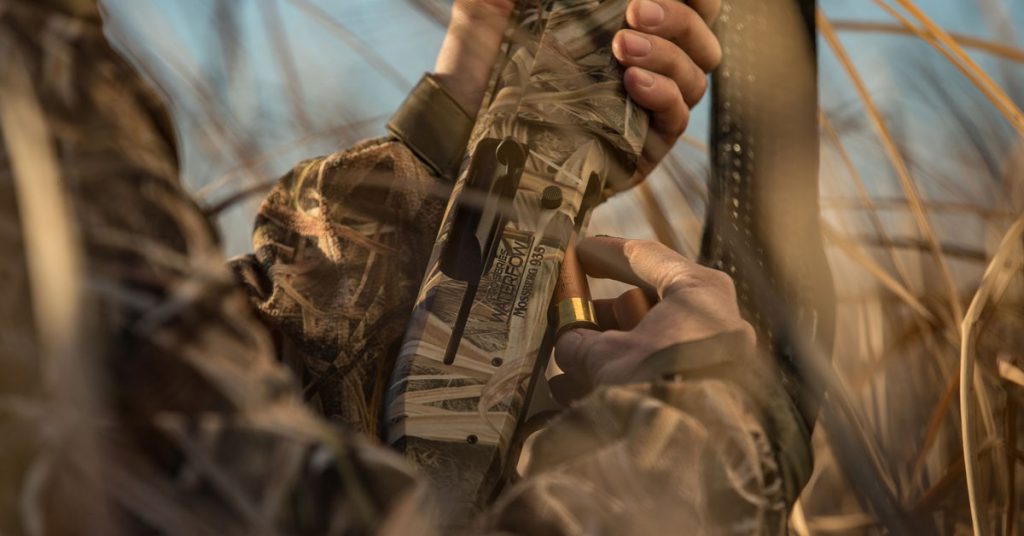
Choosing the right shotgun is not as simple as Hollywood would have you think. The factors that go into your decision are many and it is important to be educated about what is available before you part ways with your hard-earned cash. Let’s take a few minutes and look at some of the points you need to consider.
First up is the gauge of the shotgun.
The term gauge is a very old school English method of determining the diameter of a barrel. “Gauge is determined from the weight of a solid sphere of lead that will fit the bore of the firearm and is expressed as the multiplicative inverse of the sphere’s weight as a fraction of a pound, e.g., a one-twelfth pound lead ball fits a 12-gauge bore.” – Wikipedia. Yeah…makes perfect sense.
Regardless, the smaller the number, the larger the bore of the barrel. While there are several options here, there are three that are most common. The 410 is a small shotgun shell and is used for small game primarily. There is even a popular revolver that is able to shoot this shotgun shell, and they are popular for defense purposes.
Second up is one I see quite a bit and that is the 28-gauge shotgun. This is a capable and effective shotgun that can be used for self-defense as well as hunting. It is generally lighter and produces less recoil. The king of shotguns though is the 12-gauge. The 12-gauge shotgun is the primary gun in the self-defense, law enforcement and hunting market. It enjoys a wide variety of ammunition options and can be easy to run with proper technique.
The next decision you will need to make is what type of shotgun you are going to get.
There are essentially two types of actions available in shotguns with many options inside of those. The first option is the classic pump action shotgun. This is the most common style and has a reputation of being very reliable. These guns tend to be very affordable and are easy to run. The second type of shotgun we should look at are semi-automatic guns. Like semi-auto rifles and handguns, these guns use gas blowback to cycle the action.
That action reduces the tasks a shooter must execute down essentially to just pressing the trigger. These guns can be fired very quickly and are popular in competition circles.
The fact that they are not as reliable as pump guns however makes them a more challenging choice for home defense. One style of gun I did not include as a primary option is the classic double barrel shotgun. These can be a side by side cowboy type gun or an over and under. Regardless their application is limited due to the fact you only have two shots. They are very popular for shooting skeet, but don’t fit many applications beyond that well.
Purpose.
It is at this point where it is a good idea to determine just what you want the shotgun for? Are you hunting, looking for personal protection or both? As a rule of thumb hunting guns tend to have longer barrels and wood stocks. They can be beautiful guns and work well at taking a variety of game. Personal protection shotguns tend to have shorter barrels and are usually set up to accept lights and even optics. You can get a gun that may serve both categories, but I would suggest one for each.
One last general point we need to look at is size and more importantly length of pull.
Length of pull is the distance from the middle of the trigger to the end of the gun’s buttstock. This is a very important item to consider and will determine whether the gun will fit you.
The correct length of pull allows you to square up to the target as opposed to being bladed out. It also allows you to correctly seat the shotgun in the pocket of your shoulder as opposed to the side of the shoulder or in some cases, the arm.
You can adjust the length of pull (LOP) by installing an aftermarket stock like those made by Houge. They can reduce the LOP by as much as four inches in some cases and makes the shotgun much easier and comfortable to shoot. Speaking of stocks, you may decide that a recoil reduction pad may be of use. A good pad like the Falcon Strike recoil reduction system can make shooting a much more comfortable experience.
While you may have thought you would just go to the local gun mart and get a shotgun, you now see there are some things to weigh before you make the purchase. Consider what you want it for first and then go from there. You have a fantastic variety of options and if you choose wisely you can get a gun that you will enjoy shooting for years!
After some thought, you have made the decision to purchase your first handgun. You have visited with friends and read several articles on various guns. While you may believe you are ready to head to the register, I would suggest we make sure you are buying what you really want and need.
There are several things that people rarely consider when they head out to buy their first blaster. So grab a seat and let me share a few things to consider.
1: Small guns are not always the best guns.
The number of micro pistols on the market has grown exponentially and is showing no sign of slowing. These guns can be very well made and easy to carry, but they are also, in most cases difficult with which to train. Their super small size reduces mass which in turn puts more felt recoil into the hands of the shooter.
The word “snappy” is used quite often when discussing these small guns. If you absolutely must have a small gun for concealed carry, then this may still work for you. Just make sure you try before you buy.
2: “I carry a .45 because they don’t make a .46.”
The “which caliber is best” argument is still raging, but modern ballistic testing has proven that the 9mm round performs on par with its chubbier .45ACP counterpart. The upside is higher magazine capacity with the 9mm. The .45ACP is still a formidable round, but I would lean towards having additional ammunition in the magazine.
3: Just because your new handgun has a place for a weapon light, laser, bayonet and blender doesn’t mean you should put it all on there.
While some full -size handguns are designed to accommodate accessories, these items add weight and bulk. If this is going to be an everyday carry gun, I encourage you to dress it up with everything and see if you can carry it concealed. Chances are the gun will be back to bare bones in short order.
4: The price of a handgun generally correlates with the overall reliability and function of said gun.
The purchase of a handgun should be considered an investment. This is especially true if it is a personal defense weapon. If you come across a handgun at bargain basement pricing, you should ask yourself if you are willing to trust it to defend your life. The adage of “buy once, cry once” really applies here.
5: Feel matters.
What this means is that no matter how many people are telling you to buy gun X or gun Y, it needs to be a personal decision. How the gun feels in your hand is very important and honestly one of the biggest things you should weigh. As long as you stay with a respected manufacturer you cannot go wrong by using “feel” as your final decision point. If the gun feels good, you will perform better with it and in turn enjoy your new purchase even more.
After some thought, you have made the decision to purchase your first handgun. You have visited with friends and read several articles on various guns. While you may believe you are ready to head to the register, I would suggest we make sure you are buying what you really want and need. There are several things that people rarely consider when they head out to buy their first blaster. So grab a seat and let me share a few things to consider.
1: Small guns are not always the best guns.
The number of micro pistols on the market has grown exponentially and is showing no sign of slowing. These guns can be very well made and easy to carry, but they are also, in most cases difficult with which to train. Their super small size reduces mass which in turn puts more felt recoil into the hands of the shooter. The word “snappy” is used quite often when discussing these small guns. If you absolutely must have a small gun for concealed carry, then this may still work for you. Just make sure you try before you buy.
2: “I carry a .45 because they don’t make a .46.”
The “which caliber is best” argument is still raging, but modern ballistic testing has proven that the 9mm round performs on par with its chubbier .45ACP counterpart. The upside is higher magazine capacity with the 9mm. The .45ACP is still a formidable round, but I would lean towards having additional ammunition in the magazine.
3: Just because your new handgun has a place for a weapon light, laser, bayonet and blender doesn’t mean you should put it all on there.
While some full -size handguns are designed to accommodate accessories, these items add weight and bulk. If this is going to be an everyday carry gun, I encourage you to dress it up with everything and see if you can carry it concealed. Chances are the gun will be back to bare bones in short order.
4: The price of a handgun generally correlates with the overall reliability and function of said gun.
The purchase of a handgun should be considered an investment. This is especially true if it is a personal defense weapon. If you come across a handgun at bargain basement pricing, you should ask yourself if you are willing to trust it to defend your life. The adage of “buy once, cry once” really applies here.
5: Feel matters.
What this means is that no matter how many people are telling you to buy gun X or gun Y, it needs to be a personal decision. How the gun feels in your hand is very important and honestly one of the biggest things you should weigh. As long as you stay with a respected manufacturer you cannot go wrong by using “feel” as your final decision point. If the gun feels good, you will perform better with it and in turn enjoy your new purchase even more.