Categories
All About Guns Gun Info for Rookies

Stock (firearms) From Wikipedia, the free encyclopedia

Jump to navigationJump to search

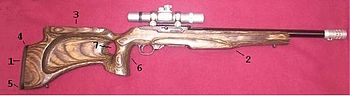
The anatomy of a gunstock on a Ruger 10/22 semi-automatic rifle with Fajen thumbhole silhouette stock. 1) butt, 2) forend, 3) comb, 4) heel, 5) toe, 6) grip, 7) thumbhole

gunstock or often simply stock, the back portion of which is also known as a shoulder stock, a buttstock or simply a butt, is a part of a long gun that provides structural support, to which the barrelaction, and firing mechanism are attached. The stock also provides a means for the shooter to firmly brace the gun and easily aim with stability by being held against the user’s shoulder when shooting the gun, and helps to counter muzzle rise by transmitting recoil straight into the shooter’s body.[1]

The tiller of a crossbow is functionally the equivalent of the stock on a gun.[2]

History and etymology[edit]

An early hand cannon, or gonne, supported by a simple stock

The term stock in reference to firearms dates to 1571 is derived from the Germanic word Stock, meaning tree trunk, referring to the wooden nature of the gunstock.[3]

Early hand cannons used a simple stick fitted into a socket in the breech end to provide a handle. The modern gunstock shape began to evolve with the introduction of the arquebus, a matchlock with a longer barrel and an actual lock mechanism, unlike the hand-applied match of the hand cannon. Firing a hand cannon requires careful application of the match while simultaneously aiming; the use of a matchlock handles the application of the slow match, freeing up a hand for support. With both hands available to aim, the arquebus could be braced with the shoulder, giving rise to the basic gunstock shape that has survived for over 500 years.[4] This greatly improved the accuracy of the arquebus, to a level that would not be surpassed until the advent of rifled barrels.[5]

Ironically, the stocks of muskets introduced during the European colonization of the Americas were repurposed as hand-to-hand war clubs[6][7] by Native Americans and First Nations when fragile accessories were damaged or scarce ammunition exhausted. Techniques for gunstock hand weapons are being revived by martial arts such as Okichitaw.

Anatomy of a gunstock[edit]

A gunstock is broadly divided into two parts (see above), with the boundary roughly at where the trigger is. The rear portion is the butt (1), and front portion is the fore-end (2). The fore-end (or forestockforearm) affixes and supports the receiver, and relays the recoil impulse from the barrel via a recoil lug. The butt (or buttstock) is braced against the shooter’s shoulder for stability and also interacts with the trigger hand, and is further divided into the comb (3), heel (4), toe (5), and grip (6). The stock pictured above has a thumbhole (7) style grip,[8] which allows a more ergonomic vertical hold for the user’s hand.

In some modern firearm designs, the lower receiver and handguard replace the fore-end stock, leaving only the butt portion as the recognizable “stock”, even though they serve the same function as the traditional fore-end.

Styles and features of stocks[edit]

M1 Garand rifle with one-piece wooden stock

SPAS-12 shotgun with a skeletonized folding stock

The most basic categorization of stock types is into one-piece and two-piece stocks. In a one-piece stock, the butt and fore-end are a continuous monolithic piece, such as that commonly found on conventional bolt-action rifles. Two-piece stocks use separate pieces for the butt and fore-end, such as that commonly found on break-action and lever-action firearms. Traditionally, two-piece stocks were easier to make, since finding a quality wood blank suitable for a long one-piece stock is harder than finding short blanks for a two-piece stock.[8]

In one-piece rifle stocks, the butt also varies in styles between the “European” type, which has a drop at the heel to favor quick shooting using iron sights; and “American” type, which the heel remains horizontal from the grip to favor more precision-oriented shooting using telescopic sights. There are also in-between designs (such as the Weatherby Mark V) with a “halfway” heel drop where the front half of the buttstock stays leveled.

Collapsable or folding stocks are often seen on military carbinesSMG/PDWs, their civilian-derived versions and some machine pistols. A collapsible (or telescoping) stock makes the weapon shorter and more compact for storage, carrying and concealment, and can be deployed just before shooting for better control. A butt hook, which is an attachment to the butt of the gun that is put under the shooter’s arm to prevent the rifle from pivoting forward from the weight of the barrel is sometimes used in competitive rifle shooting.[9] These stocks are also used on combat shotguns like the Franchi SPAS-12 to allow the stock to collapse when not in use.[10]

Grip[edit]

Different styles of gunstock grips

The grip is at the front portion of the butt that connects with the fore-end, and is held by the shooter’s trigger hand during firing. The back surface of butt front near the grip is called the tang. Many grips have roughened textures or even finger grooves engraved into the sides to increase the firmness of the shooter’s hold. Some grips have a thumb rest (or groove) carved near the tang to give a more ergonomic hold for the trigger finger.

The grip varies widely in styles. A straight grip stock (A) proceeds smoothly from toe to the trigger, giving a nearly horizontal holding angle for the trigger hand, while a full pistol grip stock (E) contains a separate stand-out grip piece, providing a nearly vertical angle for the trigger hand for maximal ergonomics, and is commonly found on modern military rifles such as the ubiquitous AK-47 and M16/M4 families of assault rifles. In between the two extremes, the semi-grip stock (B) is perhaps the most common sporting rifle stock, with a steeper angle cut into the stock to provide a more diagonal angle for the trigger hand. Modern target-style stocks have generally moved towards a fuller, more vertical grip, though built into the stock rather than made as a separate piece. Anschütz grip stocks (C), for example, use a nearly vertical grip, and many thumbhole grip stocks (D) are similar to pistol grips in shape.

Comb[edit]

Variations in gunstock combs

The comb is another area of wide variation. Since the comb must support the shooter’s cheek at a height that steadily aligns the aiming eye with the weapon’s sights, higher sights such as telescopic sights require higher combs.

The simplest form is a straight comb (A), which is the default form seen in all traditional rifles with iron sights. The Monte Carlo comb (B) is commonly found on stocks designed for use with scopes, and features an elevated comb to lift the cheek higher, while keeping the heel of the stock low. If the elevated comb is of a rounded dome shape, it is often called a hogback comb. A cheekpiece (C) is a raised section protruding from the side of the stock, which provides a more conformed support for the shooter’s cheek. There is some confusion between these terms, as the features are often combined, with the raised rollover cheekpiece (D) extending across the top of the stock to form essentially an exaggeratedly wide and high Monte Carlo comb.[8][11][12]

Some modern buttstocks have a movable comb piece called a cheek rest or cheek rise, which offers adjustable comb height that tailors to the shooter’s ergonomic preference.

Fore-end[edit]

The fore-ends tend to vary both in thickness, from the splinter fore-ends common on British side-by-side shotguns to the wide, flat bottomed beavertail fore-ends found on benchrest shooting guns, and in length, from the short AK-47 style to the long Mannlicher stock that runs all the way to the muzzle. Most common on sporting firearms is the half-stock, which extends roughly half the length of the barrel.[8][13]

Stock measurements[edit]

Stock measurements are important regarding target rifle stocks if competing in IBS or NBRSA registered matches. The target rifle stocks must meet certain dimensional and configuration criteria according to the class of competition engaged in. Stock dimensioning is especially important with shotguns, where the typical front-bead-only sight requires a consistent positioning of the shooter’s eye over the center of the barrel for good accuracy. When having a stock custom built or bent to fit, there are a number of measurements that are important.[8][14]

  • Sight line, a datum line along the line of visual aim, extending axially to all points necessary for shotgun stock reference measurements.
  • Length of pull, the length measured from the back end of the butt to the trigger. Many newer stock designs have an adjustable length of pull. Other relevant length measurements affected by the length of pull include length to sight (LTS) and length to handstop (LTH).[15]
  • Drop at heel, the distance from the sightline to the heel of the butt. Sometimes also called the height of the buttpad or buttplate height.
  • Drop at comb, the distance from the sightline to the comb. Sometimes also called the height of the cheek rest or cheekpiece height.
  • Cast is sometimes also called offset.[15]
    • Cast off, the distance from the center of the butt to the Sight line, to the right side as seen from the rear. Often used by those shooting from the right shoulder.
    • Cast on, the distance from the center of the butt to the Sight line, to the left side as seen from the rear. Often used by those shooting from the left shoulder.
  • Pitch, the vertical angle of the butt of the stock, determined by a straight line from heel to toe, referenced perpendicular to the Sight line.
  • Cant, the angle of the butt of the stock, rotated around an axis parallel to the bore line, referenced to zero degrees if pointing vertical to the ground.[15]
  • Bore line, A datum line concentric with the barrel bore and extending axially to all points necessary for rifle stock reference measurements.
  • Recoil arm, the vertical distance between the bore axis and the contact point of the stock against the shoulder where the recoil acts. If the recoil line corresponds to the bore line, the firearm can recoil straight backwards and minimize muzzle rise.[16]
  • Corporal line, the bottom edge of the butt of the stock, or as determined by a straight line from grip to toe.
  • Corporal angle, the angle of the corporal line referenced to the bore line at the corporal intercept point.
  • Corporal intercept point, the point on the bore line forward of the bolt face where (if) the corporal line intercepts the bore line.
  • Handguard rotation, only found on firearms where the handguard can be rotated.[15]

Accuracy considerations[edit]
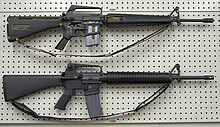
M16A1 cutaway rifle (top) and M16A2 (below) with a “straight-line” stock configuration

In addition to ergonomic issues, the stock can also have a significant impact on the accuracy of the rifle. The key factors are:

  • A secure fit between the stock and action, so that the rifle does not shift under recoil
  • A stable material, that does not suffer from changes in shape with temperature, humidity, or other environmental conditions to a degree that could adversely impact accuracy

A well designed and well built wooden stock can provide the secure, stable base needed for an accurate rifle, but the properties of wood make it more difficult than more stable synthetic materials. Wood is still a top choice for aesthetic reasons, however, and solutions such as bedding provide the stability of a synthetic with the aesthetics of wood.[17][18]

Burst or automatic shoulder fired small arms can incorporate the “straight-line” recoil configuration. This layout places both the center of gravity and the position of the shoulder stock nearly in line with the longitudinal axis of the barrel bore, a feature increasing controllability during burst or automatic fire.[16]

Adjustability[edit]

An M2010 Enhanced Sniper Rifle in a chassis system with adjustable buttplate and cheekriser

Traditional gunstocks have a permanently-shaped buttstock that is fixed in length of pull and comb height, and cannot tailor to the anatomical variation between different users. If the user wants a more comfortable head position to achieve better natural point of aim, then an additional cheek pad (which add to the comb height) or buttplate (which add to the length of pull) need to be installed. These improvisations might not be ideal as they might still not achieve optimal fitting to a person’s ergonomics.

Modern manufacturing and gunsmithing techniques can produce gunstocks with variable comb heights and buttplate positions. This can be achieved either by having interchangeable modules or using spacer blocks, which can increase the vertical and horizontal thickness. Alternatively, the buttstock can be built with a movable comb (known as a cheek riser) and/or buttplate, which use one or more guide rails to control position changes. These moveable parts can be adjusted using a leadscrew (usually turned with a thumb wheel), or have them slide freely along the guide rails and then fastened to desirable positions with set screws or thumbscrews. Some more complex designs also allow horizontal shifting and tilting of the cheek riser, as well as vertical shifting and slanting of the buttplate.

Construction[edit]

Traditionally, stocks are made from wood, generally a durable hardwood such as walnut. A growing option is the laminated wood stock, consisting of many thin layers of wood bonded together at high pressures with epoxy, resulting in a dense, stable composite.[18][17]

Regardless of the material actually employed, the general term “furniture” is often applied to gunstocks by curators, researchers and other firearm experts.

Folding, collapsible, or removable stocks tend to be made from a mix of steel or alloy for strength and locking mechanisms, and wood or plastics for shape. Stocks for bullpup rifles must take into account the dimensions of the rifle’s action, as well as ergonomic issues such as ejection.

Wood stocks[edit]

Gun stock construction on a lathe from the 1850s (photo circa 2015)

While walnut is the favored gunstock wood, many other woods are used, including maplemyrtlebirch, and mesquite. In making stocks from solid wood, one must take into account the natural properties and variability of woods. The grain of the wood determines the strength, and the grain should flow through the wrist of the stock and out the toe; having the grain perpendicular to these areas weakens the stock considerably.[17]

In addition to the type of wood, how it is treated can have a significant impact on its properties. Wood for gunstocks should be slowly dried, to prevent grain collapse and splitting, and also to preserve the natural color of the wood; custom stockmakers will buy blanks that have been dried two to three years and then dry it for several additional years before working it into a stock. Careful selection can yield distinctive and attractive features, such as crotch figure, feathering, fiddleback, and burl, which can significantly add to the desirability of a stock. While a basic, straight grained blank suitable for a utilitarian stock might sell for US$20, an exhibition grade blank with superb figure could price in the range of US$2000. Blanks for one piece stocks are more expensive than blanks for two piece stocks, due to the greater difficulty in finding the longer blanks with desirable figure. Two piece stocks are ideally made from a single blank, so that the wood in both parts shows similar color and figure.[19]

Laminated wood[edit]

Laminated wood consists of two or more layers of wood, impregnated with glue and attached permanently to each other. The combination of the two pieces of wood, if laid out correctly, results in the separate pieces moderating the effects of changes in temperature and humidity. Modern laminates consist of 1/16 inch (1.6 mm) thick sheets of wood, usually birch, which are impregnated with epoxy, laid with alternating grain directions, and cured at high temperatures and pressures. The resulting composite material is far stronger than the original wood, free from internal defects, and nearly immune to warping from heat or moisture. Typically, each layer of the laminate is dyed before laminating, often with alternating colors, which provides a pattern similar to wood grain when cut into shape, and with bright, contrasting colors, the results can be very striking. The disadvantage of laminate stocks is density, with laminates weighing about 4 to 5 ounces (110 to 140 g) more than walnut for a typical stock.[18]

While wood laminates have been available for many years on the custom market (and, in subdued form, in some military rifles), in 1987 Rutland Plywood, a maker of wood laminates, convinced Sturm, RugerSavage Arms, and U.S. Repeating Arms Company (Winchester) to display some laminate stocks on their rifles in a green, brown and black pattern (often called camo). The response was overwhelming, and that marked the beginning of laminated stocks on production rifles.[18]

Injection molded synthetic[edit]

While setup costs are high, once ready to produce, injection molding produces stocks for less than the cost of the cheapest wood stocks. Every stock is virtually identical in dimension, and requires no bedding, inletting, or finishing. The downsides are a lack of rigidity and thermal stability, which are side effects of the thermoplastic materials used for injection molding.[18]

Hand-laid composite stocks[edit]

A hand-laid composite stock is composed out of materials such as fiberglass, Kevlar, graphite cloth, or some combination, saturated in an appropriate binder, placed into a mold to set, or solidify. The resulting stock is stronger and more stable than an injection-molded stock. It can also be as little as half the weight of an injection-molded stock. Inletting and bedding can be accomplished by molding in as part of the manufacturing process, machining in the inletting after the stock is finished, molding directly to the action as a separate process, or molding a machined metal component in place during manufacture. Finish is provided by a layer of gel coat applied to the mold before the cloth is laid up.[18]

Metallic[edit]

Some high production firearms (such as the PPS-43MP-40, and the Zastava M70B) make use of metal frames in order to have a thin but strong stock that can be folded away to make the weapon more compact. However, even a skeletonized steel stock is often heavier than the equivalent solid wooden stock. Consequentially, less cost-sensitive designs like the FN Minimi make use of lighter-than-steel materials such as aluminium alloy or titanium. A few designs, like the Accuracy International Arctic Warfare, use a metallic chassis which securely beds the functional components of the firearm, with non-structural polymer panels attached externally like a shell for ergonomics and aesthetics.

Non-fixed stock[edit]

Telescoping stock[edit]

M4 carbine with a telescoping stock

A telescoping stock, also known as a collapsible or retractable stock, is a buttstock that can shorten by telescoping into itself, usually by sliding along guide rails or an M4-style buffer tube. They are useful in allowing a riflesubmachine gun, shotgun or even light machine gun to be stored or maneuvered in tight spaces where it would otherwise have trouble fitting. The user can either slide in (“collapse”) the buttstock to make the weapon more portable and concealable, or extend (“deploy”) it for bracing. Some telescoping stocks can shorten to more than one length of pull settings, allowing the stock to have some ergonomic customization for different users.

Folding stock[edit]

An AK-103 with its stock folded

An Uzi submachine gun with a double-articulated folding stock

Some buttstocks can have a hinged attachment to the receiver and can be folded forward to shorten the overall length of the gun. The hinge usually has a locking mechanism to prevent accidental or unwanted movements of the buttstock. When stability is not needed, the gun can be folded down to save space, be concealed, or held with one hand or nearer to the core; when stable aim is needed, the buttstock can be quickly extended and held to the shoulder.

Most folding stocks bend left or right depending on factory design or user preferences. Some are however designed to bend up and down, and usually made of a minimalistic “skeletonized” frame to fit over and envelop the receiver. Some compact weapons (e.g. machine pistols) have foldable buttstocks with more than one articulations to allow even more shortening.

Bump stock[edit]
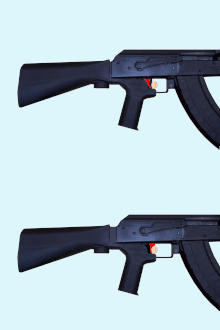
bump stock allows semi-automatic firearms to shoot at a faster rate of fire that somewhat mimics fully automatic fire.

bump fire stock or bump stock utilizes the recoil of a semi-automatic rifle to facilitate a faster rate of fire without requiring any modification of internal mechanisms to convert the firearm to an automatic firearm.

The term “bump fire” was originally an improvised technique to shoot an AR-15 faster by having the shooter applying a non-rigid forward push on the receiver (by gripping the handguard or via a foregrip) and having a loose hold on the pistol grip. When the gun shoots, the recoil shifts the receiver backwards, moving the trigger conversely forward (from the receiver’s frame of reference) and relaxes the pulling force on the trigger, allowing it to reset. When the shooter’s forward push overcomes the recoil momentum and shifts the receiver back towards the front, the trigger is “bumped” against the shooter’s finger and get depressed again, firing off another round, which produces another recoil that repeats the above process. This allows a cycling rate of firing much faster than what the shooter’s own finger can typically achieve, but is usually inaccurate due to the shooter often have to fire from the hip to still hold the gun firmly.

bump stock replaces the manual forward push with a spring mechanism at the interface between the receiver and the pistol grip/buttstock. The user only have to simply hold the trigger back against the grip, and the spring-assisted forward push will itself work against the recoil to cycle the shooting. This allows an increased rate of fire that can reach several hundred rounds per minute, and is far more consistent in performance compared to the manual bump fire.

For handguns[edit]

The Luger Artillery Pistol with its wooden holster attached

The CZ Škorpion with its folding wire stock extended.

Many handguns also support the use of shoulder stocks to handle recoil. An example is the Luger P08 “Artillery Pistol”, which has a wooden factory holster that can be attached to the pistol grip and used as a buttstock. Some aftermarket manufacturers also make accessories for popular semi-automatic pistols such as Glocks, including grip modules that has built-on folding stocks, or even “conversion kit” that allows the pistol to be mounted into a carbine-shaped enclosure with a shoulder stock.

Machine pistols such as the MAC-10Micro-Uzi and Škorpion vz. 61 often use a folding skeleton stock, that can be extended and braced during engagements to provide auto-fire stability.

Pistol brace[edit]

SIG MPX with a retractable Velcro-strap brace with two slide rods

pistol stabilizing brace (PSB) or arm brace is a device similar in shape to a buttstock, but is meant to be in contact with or wrap around the shooter’s forearm like a wrist brace or splint, instead of being pressed against the shoulder. It is mainly designed for pistols with carbine-style receivers (e.g. “AR pistols” and PC Charger), which are stockless out-of-factory to avoid being legally classified as short-barreled rifles, as an alternative measure of countering recoil and muzzle rise with one-handed shooting. The brace can be mounted to the pistol via an M4-style buffer tube, or via a Picatinny rail interface.

Even though the bulkier end of a brace can still be leaned against the shoulder like a shoulder stock, doing so would invite the same legal complications as shoulder stocks do.[20] On December 18, 2020, the Bureau of Alcohol, Tobacco, Firearms and Explosives filed a notice to the Federal Register titled Objective Factors for Classifying Weapons with “Braces”, proposing a series of criteria used to evaluate whether pistols with attached stabilizing braces are firearms that should be regulated by the National Firearms Act,[21] but withdrew the notice five days later.[22]

Legal issues[edit]

In some jurisdictions, the nature of the stock may change the legal status of the firearm. Examples of this are:

  • Adding a shoulder stock on a firearm with a barrel shorter than 16 inches (41 cm) changes it into a short-barreled rifle (SBR) under the United States National Firearms Act.
  • Folding stocks, or stocks with separate pistol grips, are regarded as assault weapon features and banned in some U.S. states and municipalities.
  • In the United States, fitting a bump stock to a semi-automatic firearm causes it to be classified as a machine gun by the Bureau of Alcohol, Tobacco, Firearms and Explosives, meaning they are effectively banned on the federal level. They are also banned in Canada and the United Kingdom.

Gallery[edit]

Categories
All About Guns Grumpy's hall of Shame Gun Info for Rookies

Tip on how to NOT teach somebody to shoot a very fancy Scattergun!

Categories
All About Guns Fieldcraft Gun Info for Rookies

Child Gun Safety

Categories
All About Guns Gun Info for Rookies

10 Gun Show MYTHS Big Pop

There have been myths about what happens at gun shows. These myths stem anywhere from anti-gun activists to people who honestly don’t know the law. In truth, several of the sources for these gun show myths can be traced back to distorted facts.  To help credit the authenticity of this article, all sources will be linked. Please note, it’s been made a point to use sources that are government agencies or that may or may not be biased towards strong gun control. Also J.S.T. Andrews is not an attorney, nor should this be taken as legal advice.

1. Myth: Anyone can Purchase a Firearm at a Gun Show. Fact: False. Licensed dealers are required to run a background check on every gun purchase. This even applies to those who are trading-in a firearm for another.
2. Myth: Most Guns Used in Crimes are Purchased from Gun Shows. Fact: False. According to the Washington Post, a staggering 1.7% of “… offenders [who] were incarcerated from crimes committed with handguns… reported… they obtained the guns…” at a gun show. In addition the National Criminal Justice Reference Service reports: “According to the latest available data, those who use guns in violent crimes rarely purchase them directly from licensed dealers; most guns used in crime have been stolen or transferred between individuals after the original purchase.”
3. Myth: Anyone can Purchase Ammunition at a Gun Show. Fact: True. So long as they are not legally prohibited from purchasing ammo and/or receiving ammo. (Most people would know if they were prohibited.) Long guns and long gun ammunition may be sold only to persons 18 years of age or older. Sales of handguns and ammunition for handguns are limited to persons 21 years of age and older.
4. Myth: Most Gun Show Vendors are Not Licensed FFL Dealers. Fact: True(ish). The majority of dealers sell accessories including ammo, magazines, clips, t-shirts, knives, ice cream, etc. Typically, private sellers at gun shows tend to have a single table. However uncommon, there are some cases where a private seller might have 2+ tables. In addition, most gun shows will dedicate more tables to licensed FFL Dealers. Typically these dealers have anywhere from 5 to 20+ tables. Let’s use New York City’s data from their 2009 “Gun Show Undercover” report. 1% to 8.9% of the tables at gun shows are private sellers. With that being said, if every private seller had two tables, that would mean that anywhere from 2% to 18% of all tables were private sellers.
5. Myth: Gun Show Prices are More Expensive. Fact: This really depends on the gun show and its dealers. Keep in mind that the larger the gun show, the more competition there will be between vendors. Competition between firearm dealers will help lower the prices on guns. This will also depend on the location and the gun you’re looking for.
6. Myth: Gun Shows are not Family Friendly. Fact: Usually this is not the case. Most promoters actually offer a discount for children (usually under the ages of 12) and some promoters will even offer discounts for spouses! It’s even possible to attend a show that has activities for children.
7. Myth: Gun Shows are Dangerous. Fact: The largest factor in gun-related injuries at a gun show is due to accidents. However small this percentage is, it’s still an issue. There’s a reason why promoters require all guns to be zip-tied, no ammo in the firearm(s), and an empty magazine. Never been to a gun show before? Follow these gun show tips. In addition, crime is typically below the local average at and during gun shows. Think about it. There are hundreds to thousands of armed citizens all within a building or two. Not to mention the Law Enforcement Officers, active military, retired military, concealed carry trainers and NRA trainers that all attend the show.
    1. 8. Myth: Gun Shows Cause an Increase in Gun Violence

      The National Criminal Justice Reference Service reports:

      Self-defense is the most commonly cited reason for acquiring a gun, but it is unclear how often these guns are used for self-protection against unprovoked attacks.

      Fact: False. Gun sales are at an all time high and gun crimes are dropping.

      This is actually relatively inconclusive on all accounts. Most reports on this issue gather from relatively small pools of data. Not to mention the majority of these reports do not decipher between gun-related defense and gun-related deaths (Take this report from NEBER.org as an example).

      Source: NCJRS – Firearms and Violence.
      Source: Forbes – Disarming Realities: As Gun Sales Soar, Gun Crimes Plummet

Firearm Private Sales Transaction

  1. 9. Myth: Firearm Gifting is Legal

    Fact: Gifting a firearm is not uncommon within pro-gun families. According to the ATF: “Mr. Smith asks Mr. Jones to purchase a firearm for Mr. Smith. Mr. Smith [then] gives Jones the money for the firearm.” This is not gifting. If “Mr. Brown goes to buy a firearm with his own money to give to Mr. Black as a present…” this is considered gifting. “However, you may not transfer a firearm to any person you know or have reasonable cause to believe is prohibited…”

    Even with the Supreme Court Ruling on June 16th, 2014, gifting is still legal. Using someone else’s money to purchase a firearm and then giving them said firearm is illegal. This is even true if they could legally own a firearm.

    A federal law banning the “straw” purchase of guns on behalf of others applies even to transactions where the person who ends up with the weapon could have legally acquired a firearm…

    Source: LI – Supreme Court Affirms Conviction In Gun “Straw Purchase” Case

    10. Myth: Guns can be Shipped from a Gun Show

    Fact: There are lots of stipulations to this. Basically, a firearm has to be mailed (UPS or FedEx) to a licensed FFL dealer.

    Example: A gun show attendee purchases a firearm from a private seller and wants it shipped out-of-state. The firearm needs to be shipped to a licensed FFL near the purchaser’s desired location.

    Source: ATF – Unlicensed Persons

Categories
All About Guns Gun Info for Rookies

How to CLEAN Black Powder Pistols by PAUL HELINSKI

Believe it or not, soapy water is the best cleaner to use on Black Powder and substitutes. The advanced gun cleaning products are really made for smokeless power that is not corrosive. There is no guarantee that a cleaner or oil will deactivate the acids in black powder fouling, but soap does.

I guess I should have kind of done this first, because if you went out and shot your guns already, you may have some rusty guns by now lol. Well not lol really. Rusty guns are a tragedy.

It is absolutely imperative that you clean your black powder guns the day you shoot them. Plan ahead for the time that it takes, which can be a half our or so for each one. If you don’t clean them, the acids that occur in black powder fouling will begin to eat away at your surfaces, and this oxidizes into rust, even pitting.

Pyrodex, Triple Se7en, and all the other black powder substitutes will rust your guns. Don’t think you get a pass because you are shooting a modern product. This is not smokeless powder.

There is a video here to watch, and it’s kind of like watching paint dry I know. I cut out another half hour of my ramblings, but I’ll try to get some of the points in here. Don’t take my methodology as something that should be cannonized into a religion. If you are a white glove type, you’ll want to remove your nipples, and probably even take apart the gun. I am a utility guy. For me, good enough is good enough. This methodology has always worked for me.

Before we get onto cleaning, we have to start at the range, or the match, or wherever you are shooting these awesome guns.

While you are shooting the gun, make sure to clean the fouling off the cylinder face. Otherwise the gun will get harder to cock, and eventually you will break the internal parts. Crud builds up on the face and catches on the forcing cone, and it has to be cleaned periodically. With heavily lubed paper cartridges I have seen this to not be as much of a problem.

Black powder creates something called fouling. It is a hard and crusty bit of nastiness than can really screw up your gun if you are not careful. The first place it causes a problem is in your cylinder gap. As you are shooting, you may notice that it gets harder and harder to cock it. This is bad. It means that black powder fouling has built up on the face of the cylinder, and it is now dragging on your forcing cone.

If you feel it getting harder to cock, take a wet rag, or patches if that is all you have, and wipe down your cylinder face right away. Don’t fight the difficulty, because you are putting unnecessary wear and tear on your gun. You don’t need to remove the cylinder really (that that it is hard if you are shooting Remmies), but make sure you tilt it sideways so you can see that you got rid of the build up crud.

Please support our sponsor, Star & Bullock Hardware at http://www.cartridgekits.com

Some of the BP substitutes don’t do that at all. You can shoot Triple Se7en all day and you most likely will not have a problem. I did experience this problem a few times with Pyrodex though. I have a pair of open top cartridge conversions, and they can’t get through three rounds of even Pyrodex without them getting more difficult to cock. So I shoot smokeless in them. Haven’t made any rounds for them since Triple Se7en existed. Maybe someday.

Heavy lube with black powder can also make this problem not as much of a problem. Since I found the paper cartridge kits at cartridgekits.com, I have really been shooting almost exclusively those. When you have a heavy lube jacket on the front like that, the fouling stays soft and greasy, so it doesn’t bind your cylinders at all. I had always used Wonder Wads, and always had to deal with hard fouling. The paper cartidges really changed everything.

Taking Apart Colts

To start you have to remove your barrel from the frame. On a Remington that’s easy. You drop your loading lever and pull your cylinder pin out. The cylinder drops out.

On a Colt, it’s not as easy. You have to remove the wedge, and that means backing out the wedge screw.

Before you begin, make sure you have a set of gunsmithing screwdrivers. I got my set on Ebay, and Amazon has them as well. Brownells also sets of them, but you will most likely pay a lot more. A gunsmithing set has a number of sizes and thicknesses, so you can match the slot exactly.

Push down hard while you turn the screw, and 90% of the time you won’t booger it. Maybe 85%. Ok maybe a majority of the time would be a better approach. It’s a common screw to booger, especially if you bought a used gun and that screw hasn’t been out for decades.

You should purchase gunsmithing screwdrivers before removing your wedge screw. Otherwise you will most likely booger the slot.

Removing the wedge can also be testy on some guns. When you understand the engineering of the gun, you will understand that the barrel is essentially jammed to the frame with a peg that gets knocked in and out. There is also a spring catch on the end of that peg, and you have to push down on the spring while knocking it out.

A wedge tool of some kind will help you a lot if you find that your wedge is stuck. Don’t use steel because it will bend the steel on the front of the wedge. The wedge has to be fairly soft steel. I used to have a brass tool my father made for me, but I lost it at some point when I had abandoned these guns for a decade or so. Recently I found an actual product for sale that is essentially the same thing, and they sell it at cartridgekits.com. It also has a nipple pick.

To remove the barrel from the frame, put the gun on half cock so you can spin the cylinder. Then put the cylinder so that it is between chambers, and use your loading lever to separate the two pieces.

I personally do not take the gun down further than that for cleaning. The screws on these guns are very soft, and very easily boogered. I don’t like the look of boogered screws. And in all my years of shooting these guns, including leaving them for decades in a safe, I have never had a gun break due to rusted internal parts. And that was using Rem-Oil. With Corrosion X, I strongly doubt there is a likelihood that any adverse effects will occur at all.

Cleaning Kits and Components

As I said in the video, the gun I cleaned had been cleaned about a week ago, and I blew some caps and a cylinder of BP through it to kind of dirty it a bit.

When I cleaned it, I didn’t clean it where I normally do, and at home I realized that I had no cleaning kit. So that gun, and several others, were cleaned with a steel rod, pieces of t-shirt, and soapy water. Ultimately, in my experience, that is all you need.

It is a good idea to invest in a good steel range rod that has a brass guard to protect the crown of your barrel. But any rod will work with T-shirt patches, which are my preferred material. I used a Hoppes Walmart kit for the video. A smaller diameter brush keeps the patch solid. It is my preferred method for cleaning.

For the video I bought a Hoppes cleaning kit at Walmart, just so it looked more legit to what you might expect, but I didn’t use much of anything in it. Hoppes does make a black powder solvent, but I don’t use it. Dish soap and water works just fine. And even though I am a big fan of Hoppes for cleaning smokeless powder guns, I don’t use it at when cleaning black powder. Soap makes black powder fouling inert, so it’s just carbon. That’s all you need besides a good oil, and maybe a little grease for the cylinder pin. I used Rem-Oil for decades, but since I discovered Corrosion X I don’t use anything else on guns and knives.

Let’s Get Cleaning!

You are going to clean your guns at the sink. Take a jag or ideally a brush that is a couple sizes too small for your bore, and use that to grab your patches. I make my patches out of old t-shirts. The ones in the Hoppes kit are some kind of plastic and work great on tiny AR barrels, but I don’t find them useful for BP.

Center the brush in the patch, dip it in soapy water, and start by sloshing out the chambers of your cylinder. There will be a lot of black stuff, not what you see in the video, or even close. I usually wash the patch after every cylinder, because there is crusty fouling that comes out. Again, it isn’t as much since I started using lubed paper cartridges.

I start by cleaning my chambers with a soapy wet patch double wrapped. Just a long 22 brush works great.

I don’t really use any fresh patch until the gun is almost clean. I just keep washing it out in the soapy water, and that water gets really black.

The back of the cylinder with the nippes is a tough area to get clean, so I use a toothbrush dipped in the soapy water. I personally do not unscrew the nipples, and in all my years of BP shooting, I think I have only had to take a nipple off once, and it came off easy cleaning the guns the way you see me do it now. So I don’t know if there is a benefit or not.

Then I run the cylinder under water, and swab the chambers out with a clean wet patch. Usually there is very little left, and I can tell you that what there is is just inert carbon, and will not harm your guns. I have never seen the need for any kind of brush inside the chambers.

The same goes for the barrel. I have shot Walkers and Dragoons full snot at 1,000 feet per second or more, and I have never had any leading of the barrel. That would be the only reason to use a brush, and even a brush doesn’t work that good on leading.

For the video I did an obligatory brush of the barrel, but I have never seen a need for it with black powder revolvers. Even with heavy bullets in the 1,000 feet per second range, I have experienced no leading.

My method is to run a soapy wet folded patch on the same cleaning brush. For 44s you can use a .38 brush, and on 36s you can use a 22 brush. Just make a tight fit with the patch by folding it as much as you have to so that the rod turns as it travels down the rifling.

When all the crud is out, run it under water, and put a fresh patch down to make sure it’s all out. You can use the same one you used on the chambers.

For the frame, I use my soapy toothbrush on the cylinder face, the bottom where the cylinder stop is, and on Remingtons, the top strap and around the forcing cone. Then I usually wipe it all down with a clean wet patch. I don’t intentionally pour any water through the action, but I’m sure some gets in.

Then I let the gun dry. There was a time when I would put the guns into a warm oven, but I haven’t done that for years. The reason you would do that is so that surface rust does not form inside the barrel, and as you can see in my video, it did in the hour or so that I left it to dry.

I use Corrosion X liberally before putting the guns away.

After the gun is dried, I put it back together and oil it heavily with Corrosion X. I didn’t show it in the video, but I usually make sure it is drooling out through the trigger guard. When I am done, my hands and the gun are usually covered in Corrosion X, and I put it into it’s sock like that. I store these guns in socks to avoid safe booboos.


Categories
All About Guns Gun Info for Rookies

The M1 Garand’s Mysterious 7th Round Stoppage

Categories
Fieldcraft Gun Info for Rookies

Understanding Recoil and How to Manage it for Great Marksmanship

Categories
All About Guns Gun Info for Rookies

AR-15 Maintenance: Field-strip, Clean and Lubricate an AR-15 | Gunsite Academy Firearms

Categories
All About Guns Gun Info for Rookies Interesting stuff

20 of the Best Dangerous Game Rifles From the affordable to the insanely expensive, any of these guns will serve you well should you come face to face with one of the world’s aggressive game species BY RICHARD MANN

young hunter kneeling next to giant black ox
No, a dangerous game rifle does not have to cost as much as a used pickup truck. But, it does have to pack a punch and be every time, all the time, reliable. Richard Mann

Regardless of what you’ve read, and what you might hear experts advise, the number one requirement of a dangerous game rifle is reliability. It can be exquisitely beautiful with engravings of naked concubines and vicious creatures, but if it does not work every time and all the time, it is not a dangerous game rifle.

Many believe a rifle of this sort has to be expensive but that’s not the case. It only must work and deliver a hard enough hit to get the job done. Knowing those facts, if you can afford to hunt dangerous game, you can probably afford a reliable and (very) nice hard-hitting rifle. To help find one that’s right for you, here is a list of 20 of the finest dangerous game guns available, working from a beer to a champagne budget.

Mossberg Patriot Laminate Marinecote

Mossberg Patriot Laminate Marinecote • Price: $629

When most folks think of dangerous game rifles, they think of broken wallets and maxed-out credit cards. It doesn’t have to be that way. Mossberg’s Patriot Laminate is a rugged and reliable bolt-action rifle. It comes with open sights, a fantastically functional detachable magazine, and a great trigger. It’s also chambered for the .375 Ruger, which is all the gun you need for dangerous game, whether it be lions, tigers or bears.

Drilled and tapped for scope mounting, but also fitted with adjustable open sights, and chambered for the most classic of all dangerous-game cartridges—the .375 H&H—this rifle is ready for rough country and perilous encounters. The stainless steel action and barrel are fitted to an ergonomic synthetic stock with checkered grip panels. It has a 3-round magazine capacity and weighs only 6 pounds, 13 ounces, so those long treks on the track of buffalo won’t wear you out.

CZ 550 American Safari Magnum

CZ 550 American Safari Magnum • Price: $1,215

Built on CZ-USA’s famous 550 Magnum action, this rifle is intended for use with magnified optics, but back-up iron sights are there if needed. The stock has a high, flat comb to better aid eye alignment with both optics and irons, and the round forend won’t snag on brush while stalking. Many professional hunters prefer the 550’s Mauser-style extractor and fixed ejector, and the rifle is available for most of the hard-hitting big bore cartridges synonymous with dangerous game hunting.

Ruger Hawkeye African

Ruger Hawkeye African • Price: $1,279

Loaded with features like a non-rotating Mauser-style extractor, fixed ejector, three-position safety, hinged floor plate, integral scope mounts, express style open sights, and the Ruger LC6 trigger, this rifle offers a lot for your money. And, to help control the big bang that comes from cartridges like the .375 and .416 Ruger, the muzzle is capped off with the removable Ruger Muzzle Brake System. This rifle looks as attractive as it’s price tag.

Winchester Model 70 Safari Express rifle

Winchester Model 70 Safari Express

Winchester Model 70 Safari Express • Price: $1,350 Winchester

BUY NOW

Available in .375 H&H, .416 Remington Magnum, and .458 Winchester Magnum, the Model 70 Safari Express is a fine representation of what many expect in a dangerous game rifle. The satin finished stock has cut checkering, the steel bottom metal is one-piece, and the pre-64 Winchester action is one that is revered by African professional hunters. Modernizations include the M.O.A. Trigger System, with zero take-up, zero creep, and zero over travel for outstanding accuracy.

Ruger No. 1 475 Linebaugh/480 Ruger

Ruger No. 1 475 Linebaugh/480 Ruger (Lipsey’s) • Price: $1,919

Though this may not be the traditional action and cartridge associated with dangerous game hunting, the Ruger No. 1 offers a level of reliability and strength that is unmatched. And, the .475 Linebaugh cartridge will push a 370-grain bullet to almost 1,600 fps. The combination isn’t great for long range shots, but will knock down anything inside spitting distance.

Marlin Custom Shop 1895 Modern Lever Hunter

Marlin Custom Shop 1895 Modern Lever Hunter • Price: $1,995

With three times the ammo capacity of a double rifle and faster follow-up shots than a bolt action, it could be argued that this fine quality .45-70 from the Marlin Custom Shop is ideal for dangerous game. Custom crafted to your color preferences, the action of this Marlin Model 1895 is smoothed to perfection, and all metal surfaces are coated with Cerakote. The XS Sights Lever Rail lets you choose between an aperture sight, a red dot, or a conventional or scout style scope.

CZ Safari Classics Magnum Express Rifle

CZ Safari Classics Magnum Express Rifle • Price: $2,271

Available in .375 H&H, .404 Jeffery, .416 Remington, .416 Rigby, .450 Rigby, .458 Winchester Magnum, .458 Lott, and a variety of other dinosaur killing cartridges, this rifle is built to your exact specifications. It features a single set trigger, matte or gloss blue finish, and a #1 Fancy American Walnut stock, with dual cross bolts and a straight comb. A muzzle brake, ebony forend, and a weather resistant coating are options, while the Mauser-style extractor and hammer-forged barrel are standard.

Remington Model 700 Custom C Grade

Remington Model 700 Custom C Grade • Price: $2,995

Don’t let anyone tell you the push-feed Model 700 action is not up to the task when it comes to dangerous game hunting. Not only is it reliable, but you can drop a cartridge in the ejection port and close the bolt for a follow-up shot if you run the rifle dry—something most controlled-round-feed actions cannot do. A gloss finished, C-grade walnut stock, with contrasting grip and forend tips makes this a luxurious safari rifle.

Weatherby Mark V Dangerous Game Rifle

Weatherby Mark V Dangerous Game Rifle • Price: $3,600

Weatherby is a brand synonymous with the African continent and high-dollar hunts. Their Dangerous Game Rifle offers a sub-MOA accuracy guarantee, the Weatherby LXX trigger, a short 54-degree bolt lift, and the famous Weatherby Magnum 9-lug action. The action is bedded in a hand-laminated, composite stock, with a raised Monte Carlo comb, and is finished with spider web accents. It’s available in six Weatherby chamberings and .375 H&H.

Dakota Arms Model 76 Safari

Dakota Arms Model 76 Safari • Price: $8,900

Gorgeous and deadly might be the best way to describe this bolt-action rifle built for African safaris and dangerous game hunting. Constructed on the famous Dakota Model 76 action, it’s available for right or left hand shooters, with a XXX walnut stock, hand-cut checkering, ebony forend tip and barrel band in a variety of chamberings up to .458 Lott.

Dakota Arms Professional Hunter

Dakota Arms Professional Hunter • Price: $8,000

The brand new Professional Hunter from Dakota Arms features their respected Model 76 action and a custom fiberglass stock with pillar bedding. Designed for the dangerous game hunter who values ruggedness over beauty, the rifle’s 23-inch Premium Douglas barrel is Cerakoted and a quarter rib fixed sight and hooded fiber optic front sight are standard features. The cartridge options are vast and include the .450 Dakota and .450 Rigby.

Dakota Arms African Big Five

Dakota Arms African Big Five • Price: $9,700

An exquisite firearm by any measure, the Dakota Arms African Rifle is built on a stock made form XXX grade walnut, with a shadow line cheekpiece, and is detailed with hand-cut checkering. It features a straddle floorplate with an inside release and a drop-belly magazine with a four-round capacity. It’s available in a wide assortment of elephant-capable cartridges including the .450 Dakota.

Heym “Express” Magnum Bolt Action Rifle

Heym “Express” Magnum Bolt Action Rifle • Price: $13,000

Elegance abounds with this bolt-action rifle from Heym. It is reminiscent of the best-grade English sporting rifles that were built between the great wars. The actions used are sized perfectly to the cartridge, with cartridge specific magazine boxes. The barrel, along with everything else, is made in house at Heym in Germany. The action features the famous Mauser claw extractor and true controlled feed design. A single stage trigger and 4+1 capacity Oberndorf-style drop-box magazine is standard. Cartridge options include the .375 H&H, .416 Rigby, .404 Jeffery, .458 Lott, and .450 Rigby.

Krieghoff Classic Big Five Double Rifle

Krieghoff Classic Big Five Double Rifle • Price: $13,995

Combining the heritage of traditional side-by-side design and the sophistication of modern manufacturing technology, the beautiful Krieghoff Classic Double rifle is available in the most common chamberings for an African safari or dangerous game hunting. It features a manual cocking device that allows carrying while fully loaded with the hammers uncocked. With options that include additional barrels you can more than double the price, as well as your cool factor, while sitting on the back of the Land Rover.

Merkel 470 NE 140-2.1 SXS

Merkel 470 NE 140-2.1 SXS • Price: $14,275

Nothing parts the waters of a hunter’s heart like a finely crafted double rifle. The Merkel 470 NE 140-2.1 SXS is elegant, reliable, and responsive. It features a steel action, Greener-style cross bolts, double triggers, manual safety with intercepting sears, automatic ejectors, express sights, and a finely figured wood stock that looks as if it has a life of its own.

Heym Model 88B Double Rifle

Heym Model 88B Double Rifle • Price: $22,000

For more than 35 years, the Heym 88B has been the company’s flagship dangerous game rifle, and it’s likely the most common double rifle in Africa. Handcrafted for a perfect fit and with a host of customizing options available, holding this rifle can make your knees feel weak. Built with Krupp steel hammer forged barrels and a triple lockup boxlock action, automatic ejectors and dual triggers are standard. This rifle will even handle the .577 Nitro Express.

Rigby London Best Rifle

Rigby London Best Rifle • Price: $32,000 to $72,000

When you can afford the very best of everything in life, a starting price of more than $32,000 won’t cause you to blink an eye. What might make you order another drink are the options available on the Rigby London Best rifle. Grade 11 wood, H&H quick detach scope mounts, case hardening, engraving, the take-down option, and a custom case later, and you’re on the other side of $72,000. But, you might have the finest bolt-action rifle in the world. If that doesn’t impress the hippo you’re facing, show him the receipt; maybe it will scare him to death.

Rigby Rising Bite Double Rifle

Rigby Rising Bite Double Rifle • Price: $136,000

You simply cannot afford this rifle. With its custom fitted Grade 7 Turkish walnut stock, best sidelock ejector with dipped edge lock plates, Rigby ¼ rib and front slight block, and color case hardened action, before you start customizing, you’re in for more than a hundred grand. A few customizations later you have created what might be the most fabulous rifle ever. With a rifle like this, it won’t matter if you ever hunt dangerous game or not—you can just sit by the fire ring and brag about it.

Holland Royal Double Rifle

Holland & Holland Royal Double Rifle

Holland & Holland’s Royal Double rifle might be the most iconic dangerous game rifle of all time. Built to deal with any four-legged danger while providing the instinctive handling of a finely fitted shotgun, these rifles exude luxury, craftsmanship, and history. Available in flanged, belted or rimless cartridges, from .284 to .700 caliber, this is the rifle professional hunters lust for and filthy rich safari clients dream of. It will cost more than a trophy wife, kill anything that walks, and leave your heirs in a bitter argument over who gets it after you depart this Earth. Built to your every desire, prices are available by request; which means if you have to ask, you don’t have enough money.

Categories
All About Guns Gun Info for Rookies

Why Buy A 1911? Is it Right For You?