This has always been a problem for me in here the People’s Republic of California. This in spite of the fact that California has a very large Gun Owner population. 


This has always been a problem for me in here the People’s Republic of California. This in spite of the fact that California has a very large Gun Owner population. 


I have been told that the best thing that one can do for themselves is to know one self.


Bipods are probably the most underutilized piece of helpful shooting gear, a tool that should be in your toolbox. But like all tools, you need to pick the appropriate one for the job. Normal size bipods, 6-10 inches, cover a lot of gaps. But sometimes, you are forced into a less than ideal shooting position, and for that, you need something else. Fortunately, that tool now exists.![]()
In the past, your options for a support in kneeling or standing positions were pretty much limited to two options. One was shooting sticks, which have a nasty habit of folding on you when you need them. They are better than nothing, but they also are not the most stable option. The second option was a camera tripod, preferably with a special adaptor on top of it to hold your rifle. This presents the problems of bulkiness to carry, the speed of employment and price.![]()
Last week, I got my hands on an oversized set of bipods, known as Swagger bipods.
These bad boys extend all the way out to 41.25 inches for the blind model, and 29 inches for the field model. The locking mechanism for the legs is a twist lock, offering an endless variety of selectable heights. Each leg is three sections, that lock independently, making employment a cinch.
The bipods attach easily, securely mounting to either an existing sling swivel or a rail. The body of the Swagger matches the contour of your stock, and the legs house inside the plastic body of the unit. Folded away for transport, they don’t extend past the barrel of normal sized guns. To use them, simply pull out on the Bungie loaded legs, and they snap into place in a different position. The top of the legs is a coil spring, which gives the system more flex than a normal bipod, or shooting sticks. It also makes tracking a moving target a breeze.
Article Continues Below:
![]()
The author’s group without the bipod.
For testing, I tried the Swagger in a couple of less than ideal shooting positions. Like most shooters, I am sure I don’t practice standing and kneeling positions enough. That reflected in my test. I shot a five-round group on a bullseye standing and kneeling, first without the bipods. The result was suboptimal. I think I can kiss an invitation to Camp Perry goodbye. Adding the bipods into the equation, my group sizes shrank by half. That is a pretty solid endorsement in my book. The idea of using bipods while standing, secured against your hips, is a bit unorthodox. But it does work, and work well. I did the same thing last week with a 6.5 Creedmoor, and it worked out great.
If your hunting grounds often require you to shoot relatively high positions or down angle shots, this is a tool you need. Perfect for either the blind or the field, Swagger bipods are worth taking a look at.
For more information about Swagger bipods, click here.
The author’s group shrank by half with a bipod.
To read about more tips and tactics about utilizing packs and bipods, click here.
on Jul 3, 2014 11:35:00 AM

1. Buy or borrow a lockable hard case.Per the regulations, it can be a case with integrated combinations locks, but I prefer a case with multiple holes for heavy duty padlocks of my choosing. Do NOT use TSA locks on your gun case. This is a misunderstood area of the law and, technically speaking, it’s illegal for you to do so. Per the letter of the law, as discussed in the footnotes of this article, you alone must maintain possession of the keys or combination to open your gun case. You cannot lock it in such a way that others have access. By using TSA locks on your gun case, lots of people, just about anyone in fact, technically has access to your guns. TSA locks are NOT secure and not even TSA agents are supposed to have access to your case, once cleared, without you being present to unlock the case.
One more thing about cases. If you travel with a pistol, you might want to get a larger than necessary case, like this one. You can legally place other items besides your gun in the case, like cameras or computer equipment.
While most are essentially the same, they don’t have to be. Print out the policy page to bring with you. With all that ticketing agents need to know, not every agent will have a complete understanding of their airline’s gun policy.
It can, and does, change. That’s your tax dollars at work folks. Print this out also, as different TSA agents have different understandings of their own policy. Really.
Complete this step while still at home! Check the chamber to make sure that’s empty. I like to pack my guns in the case with cylinder or action locked open so it’s very apparent the gun is in a safe condition. That’s not required, just good manners.

Most airlines will allow up to 11 pounds of ammunition. And, like any luggage, you will be charged more for any baggage weighing more than 50 pounds. This sounds like a lot, but when traveling to the Crimson Trace Midnight 3 Gun competition last year, my case with shotgun, rifle, pistol and ammunition tipped the scale past the 50 pound mark.
This is another area that’s misunderstood and full of internet myth. Your ammo just needs to be stored in some type of safe container and not loose. Technically, you can keep ammunition in magazines, but I wouldn’t recommend it. It meets the letter of the law storage requirement, but too many airline and TSA agents will give you grief. Use a plastic ammo box or original cardboard packaging and you’ll be fine carrying that in the same lockable case as your gun.
You can’t do curbside check in, so be prepared to go inside to your airline counter. When checking in, calmly tell the ticketing agent that you have a firearm to declare. It helps if you don’t yell something like “I’VE GOT A GUN!!!” Unless you live in one of the Republik states, the agent won’t even bat an eye. They deal with this all the time. The agent will tell you what do to and when. Some airports call TSA straight to the counter. Others have an airline agent escort you to a TSA checkpoint with your luggage. Just do what they say and you’ll be fine. At some point, they will have you fill out an orange declaration card and place it in your gun case.
Don’t rush from the ticket counter to the gate. Once your gun case leaves your possession, there is still a chance TSA will need you to re-open the case. Most airports will tell you to wait for a bit in case they page you. The subtle message here is to always be sure to arrive at the airport plenty early if you plan to check a firearm. Time is your friend and the whole process will be a lot less stressful.
I left mine in the car once and dropped them in my checked baggage another time. Fortunately, I figured out my error in time to correct it, else TSA would have been more than happy to cut my locks off.
Yes, TSA might clear your gun case upon your departure. Yes, some other TSA agent may cut your locks off somewhere between your departure gate and your final destination. They’re not supposed to without a really good reason, but it happens. Again, that’s your tax dollars at work. You can yell, scream and stomp your feet, but you won’t win that battle. Accept the cost of new locks as part of doing business. On the other hand, if your guns are missing, I personally would tell the airline and destination TSA agents that I was calling the FBI immediately to report an interstate theft of firearms. That ought to get you some attention.
I’ve flown many, many times with one or more firearms and have never had a serious issue. Yes, some airports act differently, but I’ve never lost a gun or had a serious run in with the G-men.
The key is preparation and attention to detail. If you do everything right, your trip will be uneventful for both your and your guns.
Here are a few things to be aware of that you may or may not encounter.
First, some airports, like Bend, Oregon, violate federal law. That’s a harsh statement, but it’s true, or was, the last time I traveled through there with guns. The TSA folks asked for my keys so they could inspect my gun cases in a back room, secure, TSA area. I was not allowed to accompany them. According to the Code of Federal Regulations:
Basically, I, the owner, MUST not surrender my keys or combination to anyone. From a practical perspective, good luck with that. When fighting with the federal government over obscure details like this, you will not win in the short term. You may win in the long term, but odds are you won’t make your flight at the scheduled time. So choose your battles carefully. You can be right all day long and still not make it past the TSA checkpoint.
If you’re traveling with optics that you don’t trust to the baggage handlers, you can take those as carry on baggage. Obviously you have to remove it from your gun first! But it’s no problem carryon a scope onto the plane as long as there is no gun attached.
Avoid connecting through New York. Yes, this is another harsh statement, but too many folks have spent too many nights in jail and spent too many tens of thousands of dollars in legal fees not to mention it. If you are legally allowed to have a gun from your departure point, and legally allowed to have it at your destination, under federal law, you are supposed to be able to travel from point A to point B without interference. Unfortunately, some places, like New York, realize that they have more lawyers than you can afford, and choose to harass law abiding travelers anyway, knowing full well there’s not much you can do about it. Most times, if you have a connecting flight through New York, you’ll be fine. Your checked gun case will get moved on to the next flight and all will be well. The gotcha occurs when the travel gremlins arrive. If your flight is canceled or delayed, and you have to spend the night, now you are taking a gun from the airport baggage claim to the hotel then back to the airport again. And given ridiculous laws like the new SAFE Act, your gun is most likely illegal in New York. You may meet Officer Friendly when arriving at the airport the next morning. Welcome to the pokey and I hope you get along with your cell mate. I won’t schedule an itinerary through there for exactly this reason. It sounds far-fetched, yes, but tell that to the folks who have been arrested and harassed. Unfortunately, it happens.

Now moving along smartly as my Old Drill Sgt would say at Ft. Dix.


Preview YouTube video 3 Easy Spring Snare Traps ~ Primitive ~ Survival
Preview YouTube video How to Make a Fish Trap – Very Simple
Preview YouTube video Easy Spring Snare Trap
Preview YouTube video Primitive Survival Traps- Worlds Easiest Deadfall
It was during this time that the Role of Gunpowder really started to take off as the main ingredient of any European Army. There by making the Infantry man the hard core of the Army.
Instead of the Cavalry, which had up to then had been the Arm of Decision.
Now for the majority of Folks. They were issued either a Matchlock. Which was basically a Pipe attached to a wood stock and a lock system with a burning cord that had been soaked in sulphur.
Unless you were a Pikeman. Whose job was to protect the Musketeer from attacking Cavalry. Then you carried a long stick with a steel blade of some sort on the end.
Since the Musketeer did not have a Bayonet to protect himself in a melee.
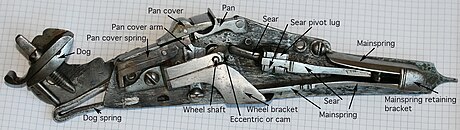
The Other Guns of this Period – The Wheelock
Now this was a very expensive but more reliable firearm. How it worked was a complex system of springs and flint. Which was required the user to tighten down a spring with a key.
Then when the trigger was pulled. The spring was released and causing a ring of spring to rub against a flint. Causing sparks to appear and hopefully ignition.
Needless to say this system was restricted to The Rich and most Cavalry Units.![]()
All I know was that I would not like to be shot at by one of these.
[hide]
Spring-guns were formerly used as booby traps against poachers and tre
In the 18th century, Spring-guns were often used to protect graveyards, offering an alarm system of sorts to protect newly buried bodies, which were often stolen by grave-robbers who supplied anatomists with cadavers.
Spring-guns were often set to protect property. For this purpose, spring-guns are often placed in busy corridors such as near doors. A trespasser opening the door completely would then be shot. Residents who are aware of the trap use a different door or open the door halfway and disconnect the tripwire. To reduce fatalities by using this trap, non-lethal calibers are often used, or the spring gun is fitted to fire less lethal ammunition.
For example, in the United States, most spring-guns are loaded with non-lethal caliber or shot to avoid liability arising from the use of deadly force in protection of a property interest. Posting clear and unmistakable warning signs as well as making entry to spring-gun guarded premises difficult for innocent persons, such as high walls, fences and natural obstacles, are significant ways to reduce potential tort liability arising from the spring-gun’s wounding of a careless or criminal intruder. Important US lawsuits regarding trespassers wounded by spring-guns include Katko v. Briney. Bird v. Holbrook is an 1825 English case also of great relevance, where a spring-gun set to protect a tulip garden injured a trespasser who was recovering a stray bird.[1] The man who set the spring-gun was liable for the damage caused.
A historic use of a spring-gun occurred during the night of June 3 or early morning of June 4, 1775, when a spring-gun set by the British to protect the military stores in the Magazine in Williamsburg, Virginia,[2] wounded two young men who had broken in. The subsequent outrage by the local population proved to be the final act of the Gunpowder Incident, leading Governor Dunmore to flee the city to a British warship and declare the Commonwealth of Virginia in a state of rebellion.
In 1981, Rene Seiptius and two friends attempted to flee from East Germany to West Germany. While they managed to avoid land mines, they did trip a spring gun, killing one of Rene’s friends.[3]
Another case is McComb v. Connaghan in which a 19-year-old burglar was killed by a spring-gun that was set up by the property owner who was a repeated victim of burglary.
Alternative traps are mines such as the crowd control munition, gas mine or the directional mine, such as the SM-70, which was used on the inner German border to prevent refugees from escaping East Germany. Crowd control munition and gas mines can be less lethal, while concussion mines are meant to kill. The latter are thus only used in military perimeter defenses.
A booby trap is a device or setup that is intended to kill, harm, or surprise a person, unknowingly triggered by the presence or actions of the victim. As the word trap implies, they sometimes have some form of bait designed to lure the victim towards it. At other times, the trap is set to act upon trespassers that violate personal or restricted areas. The device can be triggered when the victim performs some type of everyday action, e.g., opening a door, picking something up, or switching something on. They can also be triggered by vehicles driving along a road, as in the case of victim-operated improvised explosive devices (IEDs).
Booby traps should not be confused with mantraps which are designed to catch a person. Lethal booby traps are often used in warfare, particularly guerrilla warfare, and traps designed to cause injury or pain are also sometimes used by criminals wanting to protect drugs or other illicit property, and by some owners of legal property who wish to protect it from theft. Booby traps which merely cause discomfort or embarrassment are a popular form of practical joke.
[hide]
The Spanish word bobo translates to “stupid, daft, naïve, simple, fool, idiot, clown, funny man, one who is easily cheated” and similar pejorative terms. The slang of bobo, bubie, translates to “dunce”. Variations of this word exist in other languages (such as Latin), with their meaning being “to stammer”.[1] Thus, the term “booby trap” gives rise to the idea that an individual with the misfortune to be caught in the trap does so because the individual is a “booby”, or that an individual who is caught in the trap thereby becomes a “booby”.
The word has also been applied to the Sula genus of sea birds, with their common name being boobies. These birds, adapted for sea flight and swimming, have large flat feet and wide wingspans, making it difficult for them to run or take flight quickly. As a result, they are considered clumsy and easy to catch when onshore.[2] They are also known for landing aboard seagoing vessels, whereupon they have been eaten by the crew.[3]
In approximately 1590, the word began appearing in the English language as booby, meaning “stupid person, slow bird”.[4]
The phrase booby trap originally applied to schoolboy pranks, but took on its more sinister connotation during World War I.[4]
A group of 105mm artillery shellswith plastic explosive stuffed into their fuze pockets. Each of the 5 shells has been linked together with red detcordto make them detonate simultaneously. To turn this assembly into a booby trap, the final step would be to connect an M142 firing device to the detcord and hide everything under some form of cover e.g. newspapers or a bed-sheet.
Boobytrap firing devices, c. 1941: Press, pull and release switches; mass-produced components intended for the construction of booby traps.[5]
A military booby trap may be designed to kill or injure a person who activates its trigger, or employed to reveal the location of an enemy by setting off a signalling device. Most, but not all, military booby traps involve explosives.
There is no clear division between a booby trap and buried conventional land mines triggered by a tripwire or directional mine. Other, similar devices include spring-guns and mechanisms such as the SM-70 directional antipersonnel mine.
What distinguishes a booby trap is that its activation is intended to be unexpected to its victim. Thus booby trap design is widely varied, with traps or their trigger mechanisms often hidden. Frequently at least part of the device is improvised from standard ordnance, such as an artillery shell,[6] grenade, or high explosive. However, some mines have features specifically designed for incorporation into booby traps and armies have been equipped with a variety of mass-produced triggering mechanisms intended to be employed in booby traps deployment.
Part of the skill in placing booby traps lies in exploiting natural human behaviors such as habit, self-preservation, curiosity or acquisitiveness. A common trick is to provide victims with a simple solution to a problem, for example, leaving only one door open in an otherwise secure building, thereby luring them straight toward the firing mechanism.[7]
An example that exploits an instinct for self-preservation was used in the Vietnam War. Spikes known as Punji sticks were hidden in grassy areas. When fired upon soldiers instinctively sought to take cover by throwing themselves down on the ground, impaling themselves on the spikes.[8]
Attractive or interesting objects are frequently used as bait. For example, troops could leave behind empty beer bottles and a sealed wooden packing case with “Scotch Whisky” marked on it before leaving an area. The rubble-filled packing case might be resting on top of an M5[9] or M142 firing device,[10][11] connected to some blocks of TNT or to some C4 explosive stuffed into the empty fuze pocket of a mortar shell. Alternatively, the weight of the packing case might simply be holding down the arming lever of an RGD-5 grenade with a zero-delay fuze fitted and the pin removed. Either way, when the case is moved; the booby trap detonates, killing or severely injuring anyone in the immediate area. Many different types of bait object can be used e.g. soldiers will be tempted to kick an empty beer can lying on the ground as they walk past it. However, the can (partially filled with sand to add weight) may be resting on top of an M5 pressure-release firing device screwed into a buried M26 grenade.
Many purpose-built booby-trap firing devices exist such as the highly versatile M142[12][13] universal firing device (identical to the British L5A1[14] or Australian F1A1[15]), or Yugoslavian UMNOP-1[16]
Almost any item can be booby-trapped in some way. For example, booby trapping a flashlight is a classic tactic: a flashlight already contains most of the required components. First of all, the flashlight acts as bait, tempting the victim to pick it up. More importantly, it is easy to conceal a detonator, some explosives, and batteries inside the flashlight casing. A simple electrical circuit is connected to the on/off switch. When the victim attempts to turn the flashlight on to see if it works, the resulting explosion blows their hand or arm off and possibly blinds them.[22][23]
The only limits to the intricacy of booby-traps are the skill and inventiveness of the people placing them. For example, the “bait object” (e.g. a cash box in a corner of the room) which lures victims into the trap may not in fact be booby-trapped at all. However, the furniture which must be pushed away in order to get to the bait has a wire attached, with an M142 firing device connected to a 155mm artillery shell on the other end of it.[24]
A booby trap may be of any size. However, as a general rule the size of most explosive booby traps use between 250 g and 1 kg of explosive. Since most booby traps are rigged to detonate within a metre of the victim’s body, this is adequate to kill or severely wound.[24][25]
As a rule, booby-traps are planted in any situation where there is a strong likelihood of them being encountered and triggered by the targeted victims. Typically, they are planted in places that people are naturally attracted to or are forced to use. The list of likely placement areas includes:[26]
A booby trap does not necessarily incorporate explosives in its construction. Examples include the punji sticks mentioned above and deadfall traps which employ heavy objects set up to fall on and crush whoever disturbs the trigger mechanism. However, setting non-explosive booby traps is labour-intensive and time-consuming, they are harder to conceal and they are less likely to do serious damage. In contrast, booby traps containing explosives are much more destructive: they will either kill their victims or severely wound them.[26][27][28]
In addition to the obvious ability of booby traps to kill or injure, their presence has other effects such as these:
Booby traps are indiscriminate weapons. Like anti-personnel mines, they can harm civilians and other noncombatants (during and after the conflict) who are unaware of their presence. Therefore, it is vitally important for any force which places booby traps to keep an accurate record of their location so they can be cleared when the conflict is over.
A type of booby-trap was referred to in an 1839 news story in The Times.[29]
During the Vietnam War, motorcycles were rigged with explosives by the National Liberation Front and abandoned. U.S. soldiers would be tempted to ride the motorcycle and thus trigger the explosives. In addition, NLF soldiers would rig rubber band grenades and place them in huts that US soldiers would likely burn. Another popular booby trap was the “Grenade in a Can“, a grenade with the safety pin removed in a container and a string attached, sometimes with the grenade’s fuse mechanism modified to give a much shorter delay than the four to seven seconds typical with grenade fuses. The NLF soldiers primarily used these on doors and attached them to tripwires on jungle paths.[30]
The CIA and Green Berets countered by booby-trapping the enemy’s ammunition supplies, in an operation code-named “Project Eldest Son.” The propellant in a rifle or machine-gun cartridge was replaced with high explosive. Upon being fired, the sabotaged round would destroy the gun and kill or injure the shooter. Mortar shells were similarly rigged to explode when dropped down the tube, instead of launching properly. This ammunition was then carefully re-packed to eliminate any evidence of tampering, and planted in enemy munitions dumps by covert insertion teams. A sabotaged round might also be planted in a rifle magazine or machine-gun belt and left on the body of a dead NLF soldier, in anticipation that the deceased’s ammo would be picked up and used by his comrades. No more than one sabotaged round would be planted in any case, magazine, or belt of ammunition, to reduce the chances of the enemy finding it no matter how diligently they inspected their supplies. False rumors and forged documents were circulated to make it appear that the Communist Chinese were supplying the NLF with defective weapons and ammunition.[31]
During the “Troubles” in Northern Ireland, booby trap bombs were often used by the Provisional Irish Republican Army(IRA) to kill British Army soldiers and Royal Ulster Constabulary officers. A common method was attaching the bomb to a vehicle so that starting or driving it would detonate the explosive. According to the Sutton Index of Deaths, 180 deaths during the Troubles were the result of booby trap bombs, the vast majority of them laid by the Provisional IRA.[32]
During the Al-Aqsa Intifada, some Arab-Palestinian groups made wide use of booby traps.
The largest use of booby traps (between 2000–2005, the period of the Intifada) was in the Battle of Jenin during Operation Defensive Shield where a large number (1000-2000 according to Palestinian militant captured in Jenin during the battle[33]) of explosive devices were planted by insurgents. Booby traps had been laid in the streets of both the camp and the town, ready to be triggered if a foot snagged a tripwire or a vehicle rolled over a mine. Some of the bombs were huge, containing as much as 250 lb (110 kg) of explosives.[34] To counter the booby traps, anti-tank and anti-personnel mines the IDF sent armored D9 bulldozers to clear the area out of any explosive device and booby trap planted. The IDF D9 bulldozers were heavily armored and thus did not sustain any damage from the explosions, which were triggered by them as they pushed forwards. Eventually, a dozen D9 bulldozers went into action, razing the center of the refugee camp and forcing the Palestinian militants inside to surrender.
As a rule, most purpose-made military booby-trap firing devices contain some form of spring-loaded firing pin designed to strike a percussion cap connected to a detonator at one end. The detonator is inserted into an explosive charge e.g. C4 or a block of TNT. Triggering the booby-trap (e.g. by pulling on a trip-wire) releases the cocked firing pin which flips forward to strike the percussion cap, firing both it and the attached detonator. The resulting shock-wave from the detonator sets off the main explosive charge.
Booby traps can also be applied as defensive weapons against unwelcome guests or against non-military trespassers, and some people set up traps in their homes to keep people from entering. Laws vary: the creator of the trap may be immune from prosecution since the victim is trespassing, or the home owner may be held liable for injuries caused to the trespasser. Booby traps can also be a manner in which to catch a criminal vandalizing items or areas in which there was no permission given to alter.
Many computer viruses take the form of booby traps in that they are triggered when an unsuspecting user performs an apparently ordinary action such as opening an email attachment.[35]
Instead of being used to kill, maim or injure people, booby traps can also be used for entertainment. Practical joke booby traps are typically disguised as everyday items such as cigars or packets of chewing gum, nuts or other snack items. When the victims attempts to use the item, the trap is triggered. Two of the best known examples of this are the exploding cigar and dribble glass; others include the Snake Nut Can and shocking gum. Booby traps can also be constructed out of household or workplace items and be triggered when the victim performs a common action. Examples of this include loosening the bolts in a chair so that it collapses when sat upon, or placing a bucket of water on top of a partly open door so that when the door is fully opened, the bucket tips onto the victim.[36] A variant is the water bucket which when “thrown” at the target, is full of confetti.
Image source: smithandedwards.com
When it comes to rifles, whether we use them for hunting, taking care of predators, target shooting, or home defense, we want to keep them in top-working condition.
While most hunting style rifles don’t require a significant amount of cleaning, they do get dirty and need an occasional cleaning from time to time. Taking a few moments with the proper cleaning agents and tools can get your rifle ready for storage or for the next time you need to chamber a round.
When you first get your rifle out to clean it, check and recheck that it is unloaded. Work in a safe place and keep the muzzle pointed in a safe direction at all times. Too many supposed “unloaded” guns have killed people.
Lay your rifle down on a bench or table and open the action. Remove the bolt if your rifle is a bolt action and set it aside. Disassemble your rifle as much as you feel comfortable with. Most hunting-style rifles perform admirably with minimal cleaning and do not need to be completely dissembled. Semi-automatic rifles (except for the AR15) can be complicated to disassemble and should be left together unless they are failing to perform or you are advanced enough in your gunsmithing skills to attempt some fine-tuning (beyond the scope of this article).
1. Assemble Cleaning Supplies
Cleaning Rod or Snake
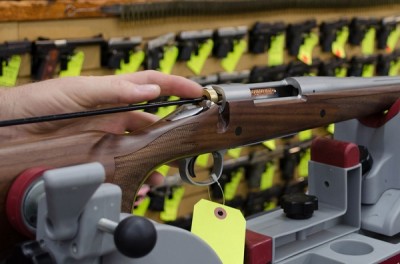
To clean the barrel you’ll want to use a single piece cleaning rod. The screw-together sectional cleaning rods are generally cheaper, but they can damage your bore and should be avoided. Usually the single piece rods are polymer coated, which is softer than the steel of your rifle bore, and won’t scratch it. I recommend purchasing a cleaning rod guide also to ensure you enter your gun’s chamber straight on. If your rod didn’t come with a bore brush, purchase one for your rifle’s caliber out of bronze or nylon.
Keep Your Handgun Locked and Loaded, Ready For Instant Use – Without Fear Of An Accident!
Bore snakes are an excellent option, as well. These soft cords are usually made from washable materials. They can’t damage your bore and for general, quick cleaning, they’re priceless! They also come with a built-in brush, or an additional pull-through brush.
Cleaning Patches
If you’re using a cleaning rod, you’ll also need cleaning patches. These can be made out of any absorbent cloth material (i.e. not paper towels). A cheap option is to cut patches from old T-shirts, but any number of different fabrics will work nicely. You can also purchase patches from sporting goods stores or from online retailers. They may come in larger sizes and need to be trimmed to fit smoothly down the barrel. You also want to grab a clean rag and a few cotton swabs for wiping grime and dust from your rifle’s chamber and action.
Solvent
Lastly you’ll need a solvent, something to cut away at the fouling inside your bore. A favorite solvent is Hoppe’s #9. Another excellent option is Sweet’s 7.62 Bore Cleaning Solvent. Both of these are available at sporting goods stores or online from numerous retailers.
2. Clean the Rifle Bore
First, you’ll clean the barrel. Colin Cash (marksman, military surplus rifle collector, and gun aficionado) shares, “The first and last inch of the barrel are the most important to avoid damaging. If damaged at all, accuracy will suffer.” Keep that in mind as you approach your rifle. While there’s nothing tricky about cleaning a rifle, they do need to be handled with some care.
If at all possible, you want to clean your rifle’s bore in the direction that the bullet travels. Some rifles don’t allow for straight access, but for those that do, this is the best option. If you have a lever action, a pump action or some semi-automatic rifles that don’t allow for straight rear entry, you’ll clean from the direction of the muzzle to the chamber. Or you can choose to use a bore snake. Whichever option you choose, soak a patch or a portion of your bore snake with cleaning solvent and run it down through the bore. If you encounter substantial resistance with your rod and patch, remove the rod and trim the patch before running it again. Allow the rifle to rest for five to 10 minutes to give the solvent time to dissolve the fouling.
Next run a bore brush through the bore to loosen any grime. If you can, once the brush pops out the other end, unscrew it and pull the cleaning rod back out. Be gentle during this step. The solvent should have done most of the work for you. Don’t “scrub” away at the bore as this can damage the lands and grooves of the bore. Run the brush through and then move onto the next step.
Push another patch wet with solvent through the bore and let your rifle rest for a few more minutes. One to three minutes is plenty. Next grab a dry patch and run it through the barrel. This one should pick up plenty of carbon residue (depending on how dirty the rifle is and how long it’s been since it was last cleaned). Continue to run dry patches through until they come out completely clean and dry. If you continue to see dirty patches, you can repeat the above process again with more solvent.
3. Clean the Chamber and Action
While there is not much work to be done on the chamber and action, wiping these areas down with a clean rag is a good idea. You can also use a cotton swab to gently pick up any dust and grime in difficult-to-reach places. Be careful that the cotton swab doesn’t leave any cotton wisps behind though as this can cause malfunctions and attract dirt. There are chamber brushes and mops that you can purchase to clean out your chamber, as well. While not absolutely necessary, they do come in handy. Dental picks can be especially useful as well for more fine-tuned cleaning. Add these to your gun-cleaning kit as you’re able.
4. Clean the Stock and Barrel
When you are finished cleaning your rifle and readying it for storage, take a clean rag and wipe down the rifle barrel with a very light coat of gun oil. This helps remove any water or fingerprint residue that may have gotten on your rifle during the cleaning process. Remington Gun Oil works well, but any kind of gun oil should do the trick. Stocks don’t generally need cleaning if they have a waterproof finish (all synthetics, and sealed wooden stocks). You can wipe them down with a clean rag and brush off any dirt that may have accumulated. Before you store your rifle, wipe off any excess gun oil from the barrel. Close the action and safely drop the firing pin to release any tension in the rifle before storage.
5. Store in a Dry and Safe Place
Perhaps even more important than proper gun gleaning is the safe and dry storage of your rifle. Rust can be an ever-present enemy to rifles, and proper storage is essential to keeping it at bay. Choose a gun safe that fits your rifle collection. It is also a good idea to place some sort of dehydrator within your safe and check it periodically.
You can make your own dehydrator by collecting silica gel packets (like the ones you find in shoes). Cut them open and dump the beads into a tin or aluminum can. To reactivate the beads, simply put them in a 250 degree Fahrenheit oven for three hours. After that, place the open can in your gun safe. Depending on your environment and the size of your safe, you can hope to get anywhere from two weeks to a month or more of protection before needing to remove the moisture from the beads again in the oven.
Keeping a rifle in tip-top working condition is not difficult. A thorough cleaning every once in a while should be more than enough to deal with moisture-attracting carbon buildup and keep rust at bay. Using the proper tools and supplies will ensure that you don’t damage your rifle and should make cleaning a quick and simple process. Storing your rifle in a dry and locked area ensures that your rifle will be ready for use for years to come.
Sign up for Off The Grid News’ weekly email and stay informed about the issues important to you
I found this and I thought you might find it interesting.
Enjoy!
Grumpy